Presentation on
the EmpireHistoryof Bengal, 1757-1947
Presented By :
Syed Saiful Alam - 23016010
Mohammad Khairul Hasan - 23016014
Shakh Samiul Alem Rangon - 23016016
Bangabandhu Sheikh Mujibur Rahman Aviation & Aerospace University, (BSMRAAU)
Contents
 Bengal Under Mughal Empire (1576-1757)
 British Rule in India (British Raj)
 Battle of Plassey (1757)
 British East India Company (1757-1858)
 Bengal Renaissance
 Reasons of the Partition of Bengal (1905)
 Formation of the Muslim League: 1906
 Annulment & Aftermath of the Partition of Bengal, 1911
Bengal Under Mughal Empire (1576-1757)
Although Akbar conquered Bangla in 1576, he
could not control the whole of it. The powerful
Zamindars of Bengal, Baru Bhuiyan (Twelve
Zamindars) did not accept the Mughal rule
Prior to the arrival of European powers, Bengal
was under the dominion of the Mughal Empire.
The Mughals exercised control over Bengal from
the 16th century until the mid-18th century.
Bengal, known for its fertile lands and vibrant
trade, was a significant province within the
Mughal Empire
British Rule in India (BRITISH RAJ)
 British rule in three phases:
- British management by the domestic puppets
- Company Rule
-Administration by British government
 Plundering of treasury and state property.
Mir Quasem was defeated in the Battle of Buxar in 1764. From that time, the British tried to
capture full power
 By 1857, the whole subcontinent went under the occupation of the British
 The colonial period ushered in major political and cultural renewal
Battle of Plassey (1757)
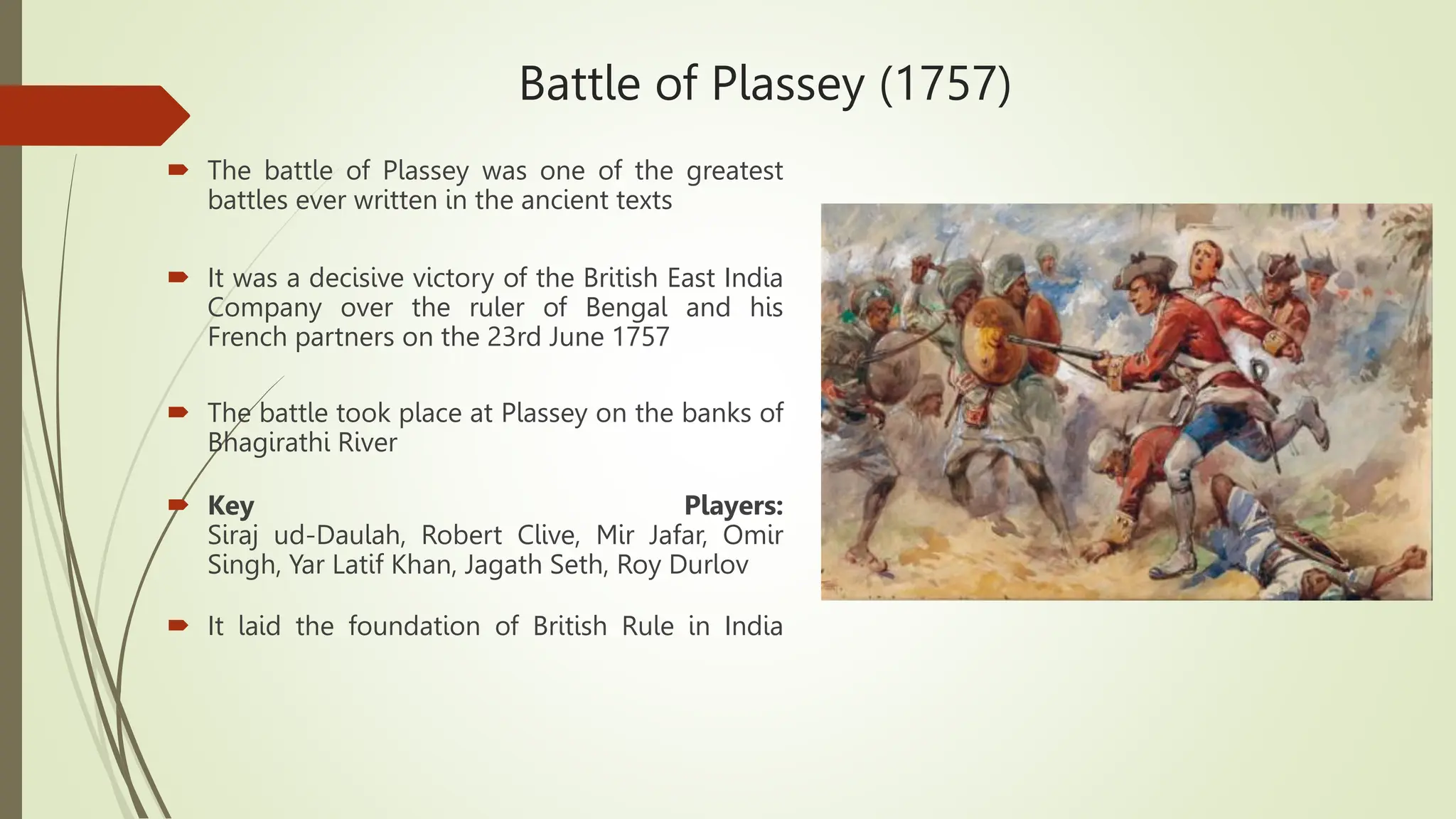
 The battle of Plassey was one of the greatest
battles ever written in the ancient texts
 It was a decisive victory of the British East India
Company over the ruler of Bengal and his
French partners on the 23rd June 1757
 The battle took place at Plassey on the banks of
Bhagirathi River
 Key Players:
Siraj ud-Daulah, Robert Clive, Mir Jafar, Omir
Singh, Yar Latif Khan, Jagath Seth, Roy Durlov
 It laid the foundation of British Rule in India
British East India Company (1757-1858)
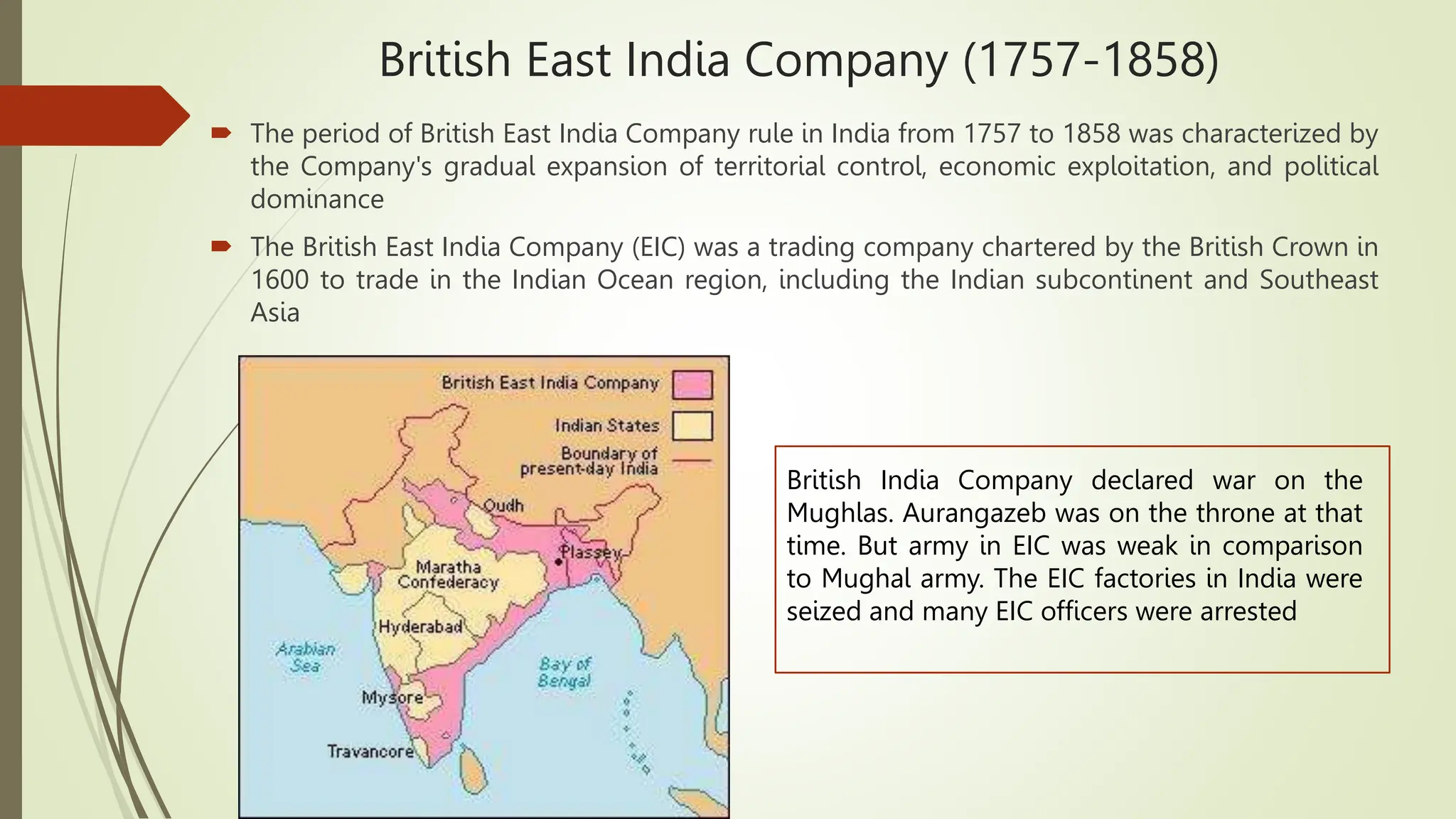
 The period of British East India Company rule in India from 1757 to 1858 was characterized by
the Company's gradual expansion of territorial control, economic exploitation, and political
dominance
 The British East India Company (EIC) was a trading company chartered by the British Crown in
1600 to trade in the Indian Ocean region, including the Indian subcontinent and Southeast
Asia
British India Company declared war on the
Mughlas. Aurangazeb was on the throne at that
time. But army in EIC was weak in comparison
to Mughal army. The EIC factories in India were
seized and many EIC officers were arrested
Bengal Renaissance
 The post of Lt Governor of Bengal was created in 1854.
 Secretary of Britain for India Henry Stafford Northcote, the Lt Governor was sent
to survey the causes and effects of famine of Orissa in 1866.
 He examined that administrative incompetence was the cause of famine.
 He wrote that the unnatural condition of Bengal far surpassed all examples in the
whole of India. Bengal was the most important province and had the largest
administrative structure but far less efficiency than Bombay or Madras
presidencies.
 In 1872, the first census of India showed Bengal with 6.7 crore population, the
largest in India.
 In 1896, the Commissioner of Chittagong Mr Oldham was the first to propose for
the creation of a new province to be called East Bengal with Dhaka, Chittagong and
Assam
 In 1900, the Chief Commissioner of Assam proposed Dhaka, Chittagong,
Mymensingh to be included in Assam
 In 1903, the Chief Commissioner of Central Provinces Andrew Fraser (later Bengal's
Lt Governor) said that it was impossible for one Lt Governor to administer East
Bengal. Assam was too small.
So, East Bengal and Assam be one province
 On 16 Oct 1905, Lord Curzon partitioned Bengal
Reasons of the Partition of Bengal
 Administrative: Burden of largeness: Size and population
 Economic: Development of the backward Assam, and uniting the Uriya-speaking populace
under a single wieldy administration
 Political: Calcutta-based anti-British movement
 Divide-and-rule Policy
 Sociological: Sectarian Hindu-Muslim conflict
Formation of the Muslim League: 1906
 Formation of Muslim League is one of the remarkable
events in the political history of the Sub-continent
 After the establishment of Indian National Congress in
1885, it seemed that some Congress leaders adopted a
revolutionary policy to adopt a Hindu Raj
 Events following the partition of Bengal, and Urdu-Hindi
controversy strengthened the desire of the Muslims to
organize themselves as a politically separate community
Annulment & Aftermath of the Partition of Bengal, 1911
 George V was King of the United Kingdom and the British Dominions, and Emperor of India,
from 6 May 1910 until his death in 1936
 George V announced the revocation of the partition of Bengal in December 1911
 The Government of India should have its capital in New Delhi instead of Calcutta
 The annulment of partition had negative effect both on Bengal and the whole of
Muslim India
 Nawab Salimullah felt much aggrieved
 The British Government decided to placate the angered Muslims:
- In 1917, a circular was issued to give one-third jobs to Muslim in government
- On 31 Jan 1912, the government decided build Dhaka University and High Court - In
1921, the establishment of Dhaka University was a consolation prize
Partition of Bengal (1947)
 In 1947, with the impending independence of India from
British rule, the idea of partition resurfaced. The Muslim
League, led by Muhammad Ali Jinnah, proposed for the
creation of a separate Muslim-majority state, Pakistan
 The proposal for the partition of Bengal aimed to create two
separate entities: West Bengal, which would remain part of
India, and East Bengal, which would become part of the newly
formed Pakistan
 Overall, the partition of Bengal in 1947 was a complex process,
emblematic of the larger partition of British India and the
challenges of nation-building in a diverse and divided region
Conclusion
 In conclusion, we have delved into the history of Bengal from 1757-1947
 Today, exploring its, historical significance, and contemporary relevance. Through
our discussion, we've gained valuable insights into different empires and histories
of Bengal during the presentation
THANK YOU

Indian sub continent Presentation New (history)

  • 1.
    Presentation on the EmpireHistoryofBengal, 1757-1947 Presented By : Syed Saiful Alam - 23016010 Mohammad Khairul Hasan - 23016014 Shakh Samiul Alem Rangon - 23016016 Bangabandhu Sheikh Mujibur Rahman Aviation & Aerospace University, (BSMRAAU)
  • 2.
    Contents  Bengal UnderMughal Empire (1576-1757)  British Rule in India (British Raj)  Battle of Plassey (1757)  British East India Company (1757-1858)  Bengal Renaissance  Reasons of the Partition of Bengal (1905)  Formation of the Muslim League: 1906  Annulment & Aftermath of the Partition of Bengal, 1911
  • 3.
    Bengal Under MughalEmpire (1576-1757) Although Akbar conquered Bangla in 1576, he could not control the whole of it. The powerful Zamindars of Bengal, Baru Bhuiyan (Twelve Zamindars) did not accept the Mughal rule Prior to the arrival of European powers, Bengal was under the dominion of the Mughal Empire. The Mughals exercised control over Bengal from the 16th century until the mid-18th century. Bengal, known for its fertile lands and vibrant trade, was a significant province within the Mughal Empire
  • 4.
    British Rule inIndia (BRITISH RAJ)  British rule in three phases: - British management by the domestic puppets - Company Rule -Administration by British government  Plundering of treasury and state property. Mir Quasem was defeated in the Battle of Buxar in 1764. From that time, the British tried to capture full power  By 1857, the whole subcontinent went under the occupation of the British  The colonial period ushered in major political and cultural renewal
  • 5.
    Battle of Plassey(1757)  The battle of Plassey was one of the greatest battles ever written in the ancient texts  It was a decisive victory of the British East India Company over the ruler of Bengal and his French partners on the 23rd June 1757  The battle took place at Plassey on the banks of Bhagirathi River  Key Players: Siraj ud-Daulah, Robert Clive, Mir Jafar, Omir Singh, Yar Latif Khan, Jagath Seth, Roy Durlov  It laid the foundation of British Rule in India
  • 6.
    British East IndiaCompany (1757-1858)  The period of British East India Company rule in India from 1757 to 1858 was characterized by the Company's gradual expansion of territorial control, economic exploitation, and political dominance  The British East India Company (EIC) was a trading company chartered by the British Crown in 1600 to trade in the Indian Ocean region, including the Indian subcontinent and Southeast Asia British India Company declared war on the Mughlas. Aurangazeb was on the throne at that time. But army in EIC was weak in comparison to Mughal army. The EIC factories in India were seized and many EIC officers were arrested
  • 7.
    Bengal Renaissance  Thepost of Lt Governor of Bengal was created in 1854.  Secretary of Britain for India Henry Stafford Northcote, the Lt Governor was sent to survey the causes and effects of famine of Orissa in 1866.  He examined that administrative incompetence was the cause of famine.  He wrote that the unnatural condition of Bengal far surpassed all examples in the whole of India. Bengal was the most important province and had the largest administrative structure but far less efficiency than Bombay or Madras presidencies.  In 1872, the first census of India showed Bengal with 6.7 crore population, the largest in India.
  • 8.
     In 1896,the Commissioner of Chittagong Mr Oldham was the first to propose for the creation of a new province to be called East Bengal with Dhaka, Chittagong and Assam  In 1900, the Chief Commissioner of Assam proposed Dhaka, Chittagong, Mymensingh to be included in Assam  In 1903, the Chief Commissioner of Central Provinces Andrew Fraser (later Bengal's Lt Governor) said that it was impossible for one Lt Governor to administer East Bengal. Assam was too small. So, East Bengal and Assam be one province  On 16 Oct 1905, Lord Curzon partitioned Bengal
  • 9.
    Reasons of thePartition of Bengal  Administrative: Burden of largeness: Size and population  Economic: Development of the backward Assam, and uniting the Uriya-speaking populace under a single wieldy administration  Political: Calcutta-based anti-British movement  Divide-and-rule Policy  Sociological: Sectarian Hindu-Muslim conflict
  • 10.
    Formation of theMuslim League: 1906  Formation of Muslim League is one of the remarkable events in the political history of the Sub-continent  After the establishment of Indian National Congress in 1885, it seemed that some Congress leaders adopted a revolutionary policy to adopt a Hindu Raj  Events following the partition of Bengal, and Urdu-Hindi controversy strengthened the desire of the Muslims to organize themselves as a politically separate community
  • 11.
    Annulment & Aftermathof the Partition of Bengal, 1911  George V was King of the United Kingdom and the British Dominions, and Emperor of India, from 6 May 1910 until his death in 1936  George V announced the revocation of the partition of Bengal in December 1911  The Government of India should have its capital in New Delhi instead of Calcutta  The annulment of partition had negative effect both on Bengal and the whole of Muslim India  Nawab Salimullah felt much aggrieved  The British Government decided to placate the angered Muslims: - In 1917, a circular was issued to give one-third jobs to Muslim in government - On 31 Jan 1912, the government decided build Dhaka University and High Court - In 1921, the establishment of Dhaka University was a consolation prize
  • 12.
    Partition of Bengal(1947)  In 1947, with the impending independence of India from British rule, the idea of partition resurfaced. The Muslim League, led by Muhammad Ali Jinnah, proposed for the creation of a separate Muslim-majority state, Pakistan  The proposal for the partition of Bengal aimed to create two separate entities: West Bengal, which would remain part of India, and East Bengal, which would become part of the newly formed Pakistan  Overall, the partition of Bengal in 1947 was a complex process, emblematic of the larger partition of British India and the challenges of nation-building in a diverse and divided region
  • 13.
    Conclusion  In conclusion,we have delved into the history of Bengal from 1757-1947  Today, exploring its, historical significance, and contemporary relevance. Through our discussion, we've gained valuable insights into different empires and histories of Bengal during the presentation
  • 14.