PRESENTED BY
ABDUL MAAZ
ALI HASAN
SYED MUHAMMAD HABIB AHMED
ZAIN ALI NAEEM
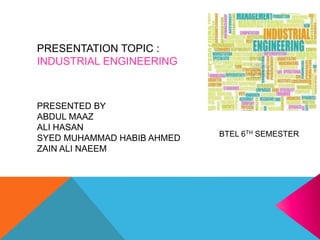
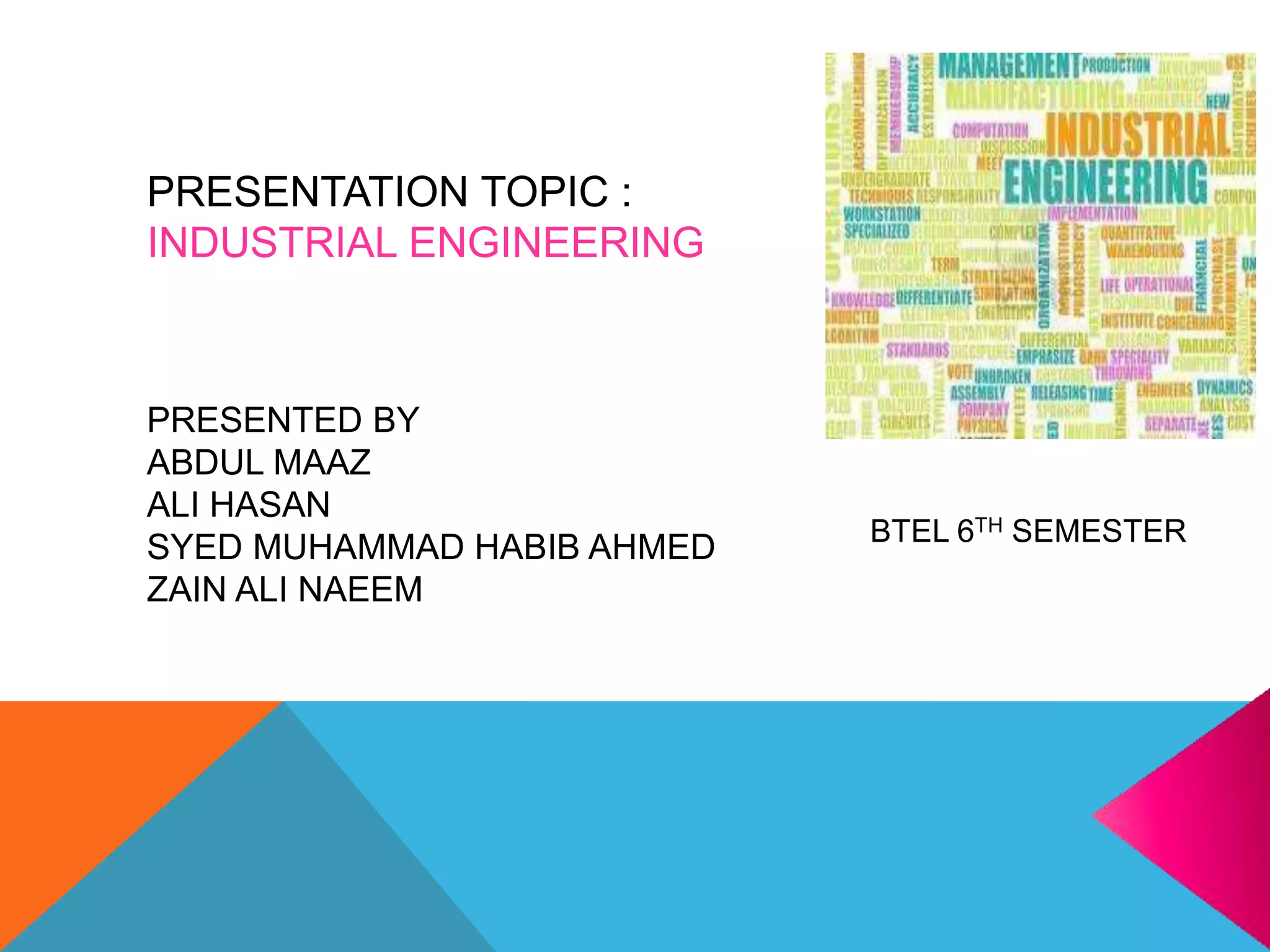
PRESENTATION TOPIC :
INDUSTRIAL ENGINEERING
BTEL 6TH SEMESTER
INDUSTRIAL ENGINEERS DETERMINE
THE MOST EFFECTIVE WAYS TO USE
THE BASIC FACTORS OF
PRODUCTION—PEOPLE, MACHINES,
MATERIALS, INFORMATION, AND
ENERGY -- TO MAKE A PRODUCT OR
PROVIDE A SERVICE.
More efficient and more profitable business practices
Better customer service and product quality
Improved efficiency
Increased ability to do more with less
Making work safer, faster, easier, and more rewarding
Helping companies produce more products quickly
Making the world safer through better designed
products
Reducing costs associated with new technologies
–Project Management
–Manufacturing, Production and Distribution
–Supply Chain Management
–Productivity, Methods andProcess Engineering
–Quality Measurement and Improvement
–Program Management
–Ergonomics/Human Factors
–Technology Development and Transfer
–Strategic Planning
–Management of Change
–Financial Engineering
• Manage Supplier relationships
• Managing and report on company Supplier
Cost /
Performance Indices tomanagement
• Audit Suppliers and ensure supplier processes
and
procedures are beingfollowed
• Travel to suppliers to resolve issues
• Coordinatefirst article Inspections
• Work with Outsource Manufacturers to ensure
product quality, delivery and cost, is
maintained
Develop the detailed work breakdown structure of
complex activities and form them into an integrated plan
Provide time based schedules and resource allocations for
complex plans orimplementations
Use project management techniques to perform
Industrial Engineering analyses and investigations
Conduct facility planning and facility layout development
of new
and revised production plants and office buildings
Form and direct both small and large teams that work
towards a defined objective, scope & deliverables
Perform risk analysis of various project options and
outcomes
Participate in design reviews to ensure
manufacturability of theproduct
Determine methods and procedures for production
distribution activity
Create documentation and work instructions for
production and distribution
Manage resources and maintain schedule
requirements to meet required production and
distribution schedules
Process Optimizationutilizing Simulation tools
Facilitate and Lead process improvement teams
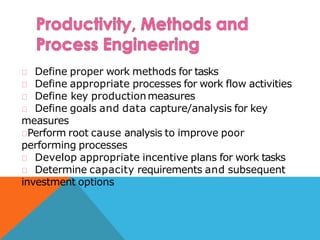
Define proper work methods for tasks
Define appropriate processes for work flow activities
Define key productionmeasures
Define goals and data capture/analysis for key
measures
Perform root cause analysis to improve poor
performing processes
Develop appropriate incentive plans for work tasks
Determine capacity requirements and subsequent
investment options
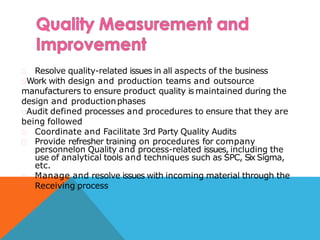
Resolve quality-related issues in all aspects of the business
Work with design and production teams and outsource
manufacturers to ensure product quality is maintained during the
design and productionphases
Audit defined processes and procedures to ensure that they are
being followed
Coordinate and Facilitate 3rd Party Quality Audits
Provide refresher training on procedures for company
personnelon Quality and process-related issues, including the
use of analytical tools and techniques such as SPC, Six Sigma,
etc.
Manage and resolve issues with incoming material through the
Receiving process
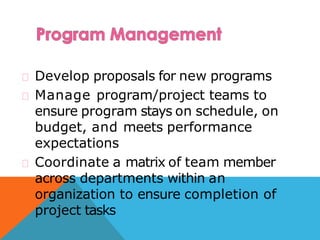
Develop proposals for new programs
Manage program/project teams to
ensure program stays on schedule, on
budget, and meets performance
expectations
Coordinate a matrix of team member
across departments within an
organization to ensure completion of
project tasks
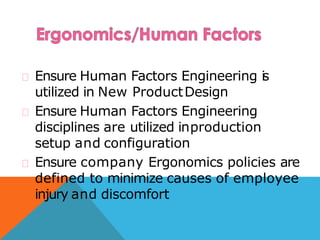
Ensure Human Factors Engineering is
utilized in New ProductDesign
Ensure Human Factors Engineering
disciplines are utilized inproduction
setup and configuration
Ensure company Ergonomics policies are
defined to minimize causes of employee
injury and discomfort
Identify basic business problems requiring analysis
Determine if technology or process based solution
best
Characterize problem, identify prospective
providers/bidders and submit requests for proposals
Evaluate bid responses, select successful bidder(s)
and establish technicalfeasibility
Conduct small scale/medium scale tests to
determine operationalfeasibility, implementation
methods and training requirements
Conductenterprise wide implementation
Transition support activities/responsibilities tolong
term business andtechnology owners
• Develop long range planning models, typically 5-10
years in scope
• Model all areas affected by operation
• Identify anticipated investment in plant, capacity,
network, etc.
• Tie to preliminary production cost, operational cost,
sales forecasts
• Develop preliminary financial impacts, including
profitability and ROI
Ensure that change programs are coordinated,
support one another and move along the critical
path
Create and maintain the imperative for the change,
establish priorities and provide visible sponsorship for
the change
Provide the skills, knowledge, processes,
organization structure and tools required to deliver
the change
Ensure that the individuals involved buy into the
change, actively support it and adopt their behavior
accordingly
Determine production costs using specific cost based
methodology
Develop budgets, forecasts for operating cost
centers
Measure actual performance vs. budget goals and
investigate variance
Develop capital and expense budgets for capacity
Expansion
Perform cost analysis/justification for capital and
expense expenditures
Perform makevs. buy vs. lease analyses
Plan to take courses in engineering and business.
Seek experiences in student organizations to develop
leadership, interpersonal andcommunication skills.
Diplomacy is important in the field, as people are
considered a factor of production.
Pursue practical experience through part-time jobs, co-
ops or internships to develop a professional network and
increase marketability.
Consider membership in student chapters of organizations
such as the Institute of Industrial Engineers to participate in
competitions on topics including operations research,
manufacturing, human factors, ergonomics,management
science, lean practices and simulation.
Earn MS or MBA for advancement in management or
administration; some programs offer dualdegrees.
INDUSTRIESINCLUDING:
› Manufacturing, aerospace,transportation, construction,
communications, electrical and electronics machinery
Retail companies
Consultingcompanies
Banks and financialinstitutions
Hospitals and healthcareorganizations
Education and public service agencies
Utilitycompanies
Not-for-profitorganizations
Smallbusinesses andstart-ups (entrepreneurship)
State and federal government including armed
forces
Institute of IndustrialEngineers
http://www.iienet2.org
www.myplan.com
www.ecampustours.com
http://whatcanidowiththismajor.com
www.topglobaleducation.com
REFERENCE

Industrialengineeringpresentation

  • 1.
    PRESENTED BY ABDUL MAAZ ALIHASAN SYED MUHAMMAD HABIB AHMED ZAIN ALI NAEEM PRESENTATION TOPIC : INDUSTRIAL ENGINEERING BTEL 6TH SEMESTER
  • 2.
    INDUSTRIAL ENGINEERS DETERMINE THEMOST EFFECTIVE WAYS TO USE THE BASIC FACTORS OF PRODUCTION—PEOPLE, MACHINES, MATERIALS, INFORMATION, AND ENERGY -- TO MAKE A PRODUCT OR PROVIDE A SERVICE.
  • 3.
    More efficient andmore profitable business practices Better customer service and product quality Improved efficiency Increased ability to do more with less Making work safer, faster, easier, and more rewarding Helping companies produce more products quickly Making the world safer through better designed products Reducing costs associated with new technologies
  • 4.
    –Project Management –Manufacturing, Productionand Distribution –Supply Chain Management –Productivity, Methods andProcess Engineering –Quality Measurement and Improvement –Program Management –Ergonomics/Human Factors –Technology Development and Transfer –Strategic Planning –Management of Change –Financial Engineering
  • 5.
    • Manage Supplierrelationships • Managing and report on company Supplier Cost / Performance Indices tomanagement • Audit Suppliers and ensure supplier processes and procedures are beingfollowed • Travel to suppliers to resolve issues • Coordinatefirst article Inspections • Work with Outsource Manufacturers to ensure product quality, delivery and cost, is maintained
  • 6.
    Develop the detailedwork breakdown structure of complex activities and form them into an integrated plan Provide time based schedules and resource allocations for complex plans orimplementations Use project management techniques to perform Industrial Engineering analyses and investigations Conduct facility planning and facility layout development of new and revised production plants and office buildings Form and direct both small and large teams that work towards a defined objective, scope & deliverables Perform risk analysis of various project options and outcomes
  • 7.
    Participate in designreviews to ensure manufacturability of theproduct Determine methods and procedures for production distribution activity Create documentation and work instructions for production and distribution Manage resources and maintain schedule requirements to meet required production and distribution schedules Process Optimizationutilizing Simulation tools Facilitate and Lead process improvement teams
  • 8.
    Define proper workmethods for tasks Define appropriate processes for work flow activities Define key productionmeasures Define goals and data capture/analysis for key measures Perform root cause analysis to improve poor performing processes Develop appropriate incentive plans for work tasks Determine capacity requirements and subsequent investment options
  • 9.
    Resolve quality-related issuesin all aspects of the business Work with design and production teams and outsource manufacturers to ensure product quality is maintained during the design and productionphases Audit defined processes and procedures to ensure that they are being followed Coordinate and Facilitate 3rd Party Quality Audits Provide refresher training on procedures for company personnelon Quality and process-related issues, including the use of analytical tools and techniques such as SPC, Six Sigma, etc. Manage and resolve issues with incoming material through the Receiving process
  • 10.
    Develop proposals fornew programs Manage program/project teams to ensure program stays on schedule, on budget, and meets performance expectations Coordinate a matrix of team member across departments within an organization to ensure completion of project tasks
  • 11.
    Ensure Human FactorsEngineering is utilized in New ProductDesign Ensure Human Factors Engineering disciplines are utilized inproduction setup and configuration Ensure company Ergonomics policies are defined to minimize causes of employee injury and discomfort
  • 12.
    Identify basic businessproblems requiring analysis Determine if technology or process based solution best Characterize problem, identify prospective providers/bidders and submit requests for proposals Evaluate bid responses, select successful bidder(s) and establish technicalfeasibility Conduct small scale/medium scale tests to determine operationalfeasibility, implementation methods and training requirements Conductenterprise wide implementation Transition support activities/responsibilities tolong term business andtechnology owners
  • 13.
    • Develop longrange planning models, typically 5-10 years in scope • Model all areas affected by operation • Identify anticipated investment in plant, capacity, network, etc. • Tie to preliminary production cost, operational cost, sales forecasts • Develop preliminary financial impacts, including profitability and ROI
  • 14.
    Ensure that changeprograms are coordinated, support one another and move along the critical path Create and maintain the imperative for the change, establish priorities and provide visible sponsorship for the change Provide the skills, knowledge, processes, organization structure and tools required to deliver the change Ensure that the individuals involved buy into the change, actively support it and adopt their behavior accordingly
  • 15.
    Determine production costsusing specific cost based methodology Develop budgets, forecasts for operating cost centers Measure actual performance vs. budget goals and investigate variance Develop capital and expense budgets for capacity Expansion Perform cost analysis/justification for capital and expense expenditures Perform makevs. buy vs. lease analyses
  • 16.
    Plan to takecourses in engineering and business. Seek experiences in student organizations to develop leadership, interpersonal andcommunication skills. Diplomacy is important in the field, as people are considered a factor of production. Pursue practical experience through part-time jobs, co- ops or internships to develop a professional network and increase marketability. Consider membership in student chapters of organizations such as the Institute of Industrial Engineers to participate in competitions on topics including operations research, manufacturing, human factors, ergonomics,management science, lean practices and simulation. Earn MS or MBA for advancement in management or administration; some programs offer dualdegrees.
  • 17.
    INDUSTRIESINCLUDING: › Manufacturing, aerospace,transportation,construction, communications, electrical and electronics machinery Retail companies Consultingcompanies Banks and financialinstitutions Hospitals and healthcareorganizations Education and public service agencies Utilitycompanies Not-for-profitorganizations Smallbusinesses andstart-ups (entrepreneurship) State and federal government including armed forces
  • 18.