Online Benchmarking:
What Worked in 2012
#OnlineBenchmarking


Chas Offut
Dennis McCarthy
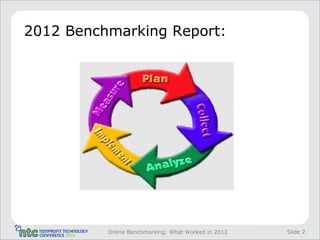
2012 Benchmarking Report:


          Online Benchmarking: What Worked in 2012   Slide 2
2012 Benchmarking Report:
Framework Methodology
Report by started Vinay Bhaghat, founder of Convio – this is the 7th report
and my third.

• The report covers 17 self reported NTEE verticals plus Canada, Teams,
and National Non Profits.

•What’s new this year are email tiers, revenue tiers and the years your
organization has been engaged on line.

•We also require that you be on the Luminate platform for three years to
minimize distortion .

Key Factoids: approximately 500 non profits and their affiliates, 16.8 M
donations, 4.2 billion emails sent and $1.12 billion in revenue


                        Online Benchmarking: What Worked in 2012           Slide 3
2012 Benchmarking Report:
What You’ll Learn in this Session
• What clear trends have emerged in terms of engagement

• How has advocacy, recurring giving been driving engagement

• And what the hell is a median anyway?


                      Online Benchmarking: What Worked in 2012   Slide 4
2012 Key Findings
• Despite double digit decline in website traffic and minimal change in
website conversion rates, email files grew 12.45%.

• Fundraising continues double digit growth as sustainers and repeat donors
grew 27% and 20%, respectively.

• Email opens sees minimal change from previous year, but double digit
decline in CTRs. Response rates for appeals also declined 18.77%.

• The number of advocates grew, but not at rate of total house file growth.
All verticals saw positive growth in number of advocates who give.


                       Online Benchmarking: What Worked in 2012           Slide 5
House file
• As size of file often correlates to revenue, a robust email file is a critical
component of any effective online marketing program.

• Trend: Median growth rate for all      organizations in this year’s cohort is
12.5%.

• Vertical: All verticals experienced positive growth rate in email files. Food
Bank and Hospitals see the highest overall email file size growth rates with
21% and 29%, respectively.

• Email: The largest email tiers saw the greatest growth; 1.5–3x of median
growth rate for all organizations.


                         Online Benchmarking: What Worked in 2012                  Slide 6
Email & Monthly Web Traffic


           Online Benchmarking: What Worked in 2012   Slide 7
Fundraising Growth Rate


          Online Benchmarking: What Worked in 2012   Slide 8
Click Through Rates & Appeals


           Online Benchmarking: What Worked in 2012   Slide 9
Click Through Rates & Appeals


           Online Benchmarking: What Worked in 2012   Slide 10
First Time Gifts
• Gifts with no prior online gift is mapped to that email address. The intent
here is to begin to examine online as a new donor acquisition channel.

• Trend: The funds raised from first time gifts see a modest 3% growth,
but the % of total revenue declined 9%.

• Vertical: Higher Ed (29%), Hospital Foundation (18%), and Hospitals
(22%) see greatest growth.

• Email: Lower and upper email tiers see strongest growth in first time
revenue while middle email tiers struggled the most.

• Revenue: Organizations with revenue <$99k and >$3m see negative
growth in first time revenue, all other positive.


                        Online Benchmarking: What Worked in 2012          Slide 11
Holt International
• 3.5% website conversion rate
• 75% of pledge signees were new registrants
• 120% web traffic increase to campaign landing page (YoY)


                    Online Benchmarking: What Worked in 2012   Slide 12
Repeat Donations
• Repeat donations provide a comparison of the fundraising metrics for
repeat/returning donors and their donations.

• Repeat fundraising revenue sees 20% growth; repeat % of total revenue
also grew 9%.

• Vertical: Visitation (54%), Higher Ed (40%) and Environment & Wildlife
(30%) saw the greatest growth. All verticals see repeat % of total revenue
growth.

• Email: 500,000-749,999 see greatest growth, but overall smaller email
tiers outperformed the larger tiers for repeat fundraising revenue growth.

• Revenue: All organizations see positive growth, but organizations with
revenue >$100K see the greatest growth.


                       Online Benchmarking: What Worked in 2012          Slide 13
National 4-H Council
• A 300% increase in the number of online contributions in one month
compared to the previous 3-months combined.


                     Online Benchmarking: What Worked in 2012          Slide 14
Recurring Donors (i.e. Sustainers)
• Allows organizations to forecast as well as provide designated funding
opportunities for donors.

• Trend: The median online revenue from recurring gifts of $30,052, a
27% increase. Recurring giving represents 8% of online revenue.

• Vertical: Verticals with standout performances: Association &
Membership, Higher Education, Jewish, and Performing Arts.

• Email: Organizations with email files >200k see the greatest increase,
upwards of 48%.

• Revenue: Growth % correlates to larger revenue bands, $2-2.9m see
52% growth.


                       Online Benchmarking: What Worked in 2012            Slide 15
Metropolitan Council on Jewish Poverty
• Grew number of new sustainers by more than 50% in 2012 compared to
2011.


                   Online Benchmarking: What Worked in 2012       Slide 16
Christians United
for Israel
• Return on investment was
achieved in <3 months.


                    Online Benchmarking: What Worked in 2012   Slide 17
Email Performance Metric: Opens
• The open rate is the percentage of constituents who view an email divided
by the number delivered in the given campaign.

• Trends: Appeals (14.72%) & eNews (15.21%) communication see
minimal growth.

• Verticals: The high performing verticals for appeals were Hospital
Foundation and Higher Ed. For eNews, Hospital Foundation and Team Event.

• Email: All but the two largest email tiers see positive email growth.


                       Online Benchmarking: What Worked in 2012           Slide 18
Email Performance Metrics: Clicks
• The click through rates as a percentage of clicks on one or more links
contained in an email divided by the number of email messages delivered.

• Trends: Appeals (.7%) & eNews (1.95%) see decline, 16.01% and
11.91%, respectively.

• Verticals: All verticals except Hospital Foundation and Higher Ed see
negative growth for appeals. All verticals except Team Event see negative
growth for eNews.

• Email: All tiers except 125,000-199,000 see positive email growth for
appeals. All tiers except 750,00-999,999 see negative growth for eNews.


                        Online Benchmarking: What Worked in 2012           Slide 19
Email Performance Metrics: Response
• As with other direct response channels, key drivers are campaign
response rates.

• Trends: The median response rate is .5%, an 18.77% decline.
• Verticals: Only Hospitals had an increase in response rate of 3.96%.
• Email: Across all tiers, there were declines except for the 750,000-
999,000 tier where there was a 21% increase in email response rates.


                       Online Benchmarking: What Worked in 2012          Slide 20
Email Performance Metrics…
• As with other direct response channels, key drivers are campaign
response rates.

• Trends: The median response rate is .5%, an 18.77% decline.
• Verticals: Only Hospitals had an increase in response rate of 3.96%.
• Email: Across all tiers, there were declines except for the 750,000-
999,000 tier where there was a 21% increase in email response rates.


                       Online Benchmarking: What Worked in 2012          Slide 21
A Case Where Engagement Trumps
• The industry report identifies the trends which are used to inform the
health of your online program, not overall constituent engagement.

• The San Diego Zoo’s total monthly messages grew >4x times.
    Does an increase in the number of email messages or the increase in
    the number of people identified in email messages lead to lower email
    message performance?

• Reviewed the performance of the unique cons. on email file over the 12-
mo to identify trends in total # of message opens, clicks, and unsubscribes.


                       Online Benchmarking: What Worked in 2012            Slide 22
• These findings revealed that increased messaging has not compromised
Advocacy
• Online advocacy provide a grassroots voice, recruits new constituents,
and keep constituents engaged.

• Trends: Though number of advocates increase 8.7%, the % of advocates
on file decrease 1%. Advocates who donate see a 11.98% growth.

 Vertical: Jewish organizations see a 29.20% increase of advocates who
donate followed by Environment & Wildlife and Higher Ed (22.21% and
21.21%, respectively).

• Email: Highest email tiers see strongest % of advocates who donate,
upwards of 38%.


                       Online Benchmarking: What Worked in 2012            Slide 23
PETA
• Already high donor &
activist overlap, creation
of I&R designated giving
program converts
activists and one-time
activist+donor to
sustain.


                         Online Benchmarking: What Worked in 2012   Slide 24
Homework, reading material and questions

•   http://blogs.hbr.org/taylor/2007/10/beyond_benchmarking_why_copy_t.html

•   http://blog.learningbyshipping.com/2013/03/16/using-data-to-inform-strategy/

•   Thank you

•   Questions


                           Online Benchmarking: What Worked in 2012                Slide 25
Evaluate This Session!
Each entry is a chance to win an NTEN engraved iPad!

                       INSERT
                      QR CODE
                        HERE


     or Online using <insert session hashtag> at
                www.nten.org/ntc/eval

Benchmark study presentation final

  • 1.
    Online Benchmarking: What Workedin 2012 #OnlineBenchmarking Chas Offut Dennis McCarthy
  • 2.
    2012 Benchmarking Report: Online Benchmarking: What Worked in 2012 Slide 2
  • 3.
    2012 Benchmarking Report: FrameworkMethodology Report by started Vinay Bhaghat, founder of Convio – this is the 7th report and my third. • The report covers 17 self reported NTEE verticals plus Canada, Teams, and National Non Profits. •What’s new this year are email tiers, revenue tiers and the years your organization has been engaged on line. •We also require that you be on the Luminate platform for three years to minimize distortion . Key Factoids: approximately 500 non profits and their affiliates, 16.8 M donations, 4.2 billion emails sent and $1.12 billion in revenue Online Benchmarking: What Worked in 2012 Slide 3
  • 4.
    2012 Benchmarking Report: WhatYou’ll Learn in this Session • What clear trends have emerged in terms of engagement • How has advocacy, recurring giving been driving engagement • And what the hell is a median anyway? Online Benchmarking: What Worked in 2012 Slide 4
  • 5.
    2012 Key Findings •Despite double digit decline in website traffic and minimal change in website conversion rates, email files grew 12.45%. • Fundraising continues double digit growth as sustainers and repeat donors grew 27% and 20%, respectively. • Email opens sees minimal change from previous year, but double digit decline in CTRs. Response rates for appeals also declined 18.77%. • The number of advocates grew, but not at rate of total house file growth. All verticals saw positive growth in number of advocates who give. Online Benchmarking: What Worked in 2012 Slide 5
  • 6.
    House file • Assize of file often correlates to revenue, a robust email file is a critical component of any effective online marketing program. • Trend: Median growth rate for all organizations in this year’s cohort is 12.5%. • Vertical: All verticals experienced positive growth rate in email files. Food Bank and Hospitals see the highest overall email file size growth rates with 21% and 29%, respectively. • Email: The largest email tiers saw the greatest growth; 1.5–3x of median growth rate for all organizations. Online Benchmarking: What Worked in 2012 Slide 6
  • 7.
    Email & MonthlyWeb Traffic Online Benchmarking: What Worked in 2012 Slide 7
  • 8.
    Fundraising Growth Rate Online Benchmarking: What Worked in 2012 Slide 8
  • 9.
    Click Through Rates& Appeals Online Benchmarking: What Worked in 2012 Slide 9
  • 10.
    Click Through Rates& Appeals Online Benchmarking: What Worked in 2012 Slide 10
  • 11.
    First Time Gifts •Gifts with no prior online gift is mapped to that email address. The intent here is to begin to examine online as a new donor acquisition channel. • Trend: The funds raised from first time gifts see a modest 3% growth, but the % of total revenue declined 9%. • Vertical: Higher Ed (29%), Hospital Foundation (18%), and Hospitals (22%) see greatest growth. • Email: Lower and upper email tiers see strongest growth in first time revenue while middle email tiers struggled the most. • Revenue: Organizations with revenue <$99k and >$3m see negative growth in first time revenue, all other positive. Online Benchmarking: What Worked in 2012 Slide 11
  • 12.
    Holt International • 3.5%website conversion rate • 75% of pledge signees were new registrants • 120% web traffic increase to campaign landing page (YoY) Online Benchmarking: What Worked in 2012 Slide 12
  • 13.
    Repeat Donations • Repeatdonations provide a comparison of the fundraising metrics for repeat/returning donors and their donations. • Repeat fundraising revenue sees 20% growth; repeat % of total revenue also grew 9%. • Vertical: Visitation (54%), Higher Ed (40%) and Environment & Wildlife (30%) saw the greatest growth. All verticals see repeat % of total revenue growth. • Email: 500,000-749,999 see greatest growth, but overall smaller email tiers outperformed the larger tiers for repeat fundraising revenue growth. • Revenue: All organizations see positive growth, but organizations with revenue >$100K see the greatest growth. Online Benchmarking: What Worked in 2012 Slide 13
  • 14.
    National 4-H Council •A 300% increase in the number of online contributions in one month compared to the previous 3-months combined. Online Benchmarking: What Worked in 2012 Slide 14
  • 15.
    Recurring Donors (i.e.Sustainers) • Allows organizations to forecast as well as provide designated funding opportunities for donors. • Trend: The median online revenue from recurring gifts of $30,052, a 27% increase. Recurring giving represents 8% of online revenue. • Vertical: Verticals with standout performances: Association & Membership, Higher Education, Jewish, and Performing Arts. • Email: Organizations with email files >200k see the greatest increase, upwards of 48%. • Revenue: Growth % correlates to larger revenue bands, $2-2.9m see 52% growth. Online Benchmarking: What Worked in 2012 Slide 15
  • 16.
    Metropolitan Council onJewish Poverty • Grew number of new sustainers by more than 50% in 2012 compared to 2011. Online Benchmarking: What Worked in 2012 Slide 16
  • 17.
    Christians United for Israel •Return on investment was achieved in <3 months. Online Benchmarking: What Worked in 2012 Slide 17
  • 18.
    Email Performance Metric:Opens • The open rate is the percentage of constituents who view an email divided by the number delivered in the given campaign. • Trends: Appeals (14.72%) & eNews (15.21%) communication see minimal growth. • Verticals: The high performing verticals for appeals were Hospital Foundation and Higher Ed. For eNews, Hospital Foundation and Team Event. • Email: All but the two largest email tiers see positive email growth. Online Benchmarking: What Worked in 2012 Slide 18
  • 19.
    Email Performance Metrics:Clicks • The click through rates as a percentage of clicks on one or more links contained in an email divided by the number of email messages delivered. • Trends: Appeals (.7%) & eNews (1.95%) see decline, 16.01% and 11.91%, respectively. • Verticals: All verticals except Hospital Foundation and Higher Ed see negative growth for appeals. All verticals except Team Event see negative growth for eNews. • Email: All tiers except 125,000-199,000 see positive email growth for appeals. All tiers except 750,00-999,999 see negative growth for eNews. Online Benchmarking: What Worked in 2012 Slide 19
  • 20.
    Email Performance Metrics:Response • As with other direct response channels, key drivers are campaign response rates. • Trends: The median response rate is .5%, an 18.77% decline. • Verticals: Only Hospitals had an increase in response rate of 3.96%. • Email: Across all tiers, there were declines except for the 750,000- 999,000 tier where there was a 21% increase in email response rates. Online Benchmarking: What Worked in 2012 Slide 20
  • 21.
    Email Performance Metrics… •As with other direct response channels, key drivers are campaign response rates. • Trends: The median response rate is .5%, an 18.77% decline. • Verticals: Only Hospitals had an increase in response rate of 3.96%. • Email: Across all tiers, there were declines except for the 750,000- 999,000 tier where there was a 21% increase in email response rates. Online Benchmarking: What Worked in 2012 Slide 21
  • 22.
    A Case WhereEngagement Trumps • The industry report identifies the trends which are used to inform the health of your online program, not overall constituent engagement. • The San Diego Zoo’s total monthly messages grew >4x times. Does an increase in the number of email messages or the increase in the number of people identified in email messages lead to lower email message performance? • Reviewed the performance of the unique cons. on email file over the 12- mo to identify trends in total # of message opens, clicks, and unsubscribes. Online Benchmarking: What Worked in 2012 Slide 22 • These findings revealed that increased messaging has not compromised
  • 23.
    Advocacy • Online advocacyprovide a grassroots voice, recruits new constituents, and keep constituents engaged. • Trends: Though number of advocates increase 8.7%, the % of advocates on file decrease 1%. Advocates who donate see a 11.98% growth. Vertical: Jewish organizations see a 29.20% increase of advocates who donate followed by Environment & Wildlife and Higher Ed (22.21% and 21.21%, respectively). • Email: Highest email tiers see strongest % of advocates who donate, upwards of 38%. Online Benchmarking: What Worked in 2012 Slide 23
  • 24.
    PETA • Already highdonor & activist overlap, creation of I&R designated giving program converts activists and one-time activist+donor to sustain. Online Benchmarking: What Worked in 2012 Slide 24
  • 25.
    Homework, reading materialand questions • http://blogs.hbr.org/taylor/2007/10/beyond_benchmarking_why_copy_t.html • http://blog.learningbyshipping.com/2013/03/16/using-data-to-inform-strategy/ • Thank you • Questions Online Benchmarking: What Worked in 2012 Slide 25
  • 26.
    Evaluate This Session! Eachentry is a chance to win an NTEN engraved iPad! INSERT QR CODE HERE or Online using <insert session hashtag> at www.nten.org/ntc/eval

Editor's Notes

  • #3 Why Benchmarking, why is it important, what does ANY report mean or not mean… Why the Convio/Blackbaud report is different than other reports…
  • #5 #1 Bryan and Chas what might that mean? Adoption of alternative sources list acquisition #2 Sustainer “boom” is occurring with organizations investing in 2 nd gift strategies #3 Potential factors at play: mobile readership continues to grow and organizations are fail to “connect” to audience (ie not enough segmentation. Chas validate this please . #4 Engagement of cons/ donors through advocacy is going strong, suggests orgs are investing in strategies to convert adv to donor.
  • #6 #2 Sustainer “boom” is occurring with organizations investing in 2 nd gift strategies #3 Potential factors at play: mobile readership continues to grow and organizations are fail to “connect” to audience (i.e. not enough segmentation. Chas validate this please . #4 Engagement of cons/ donors through advocacy is going strong, suggests orgs are investing in strategies to convert adv to donor.
  • #7 The intent is to examine online as a new donor acquisition channel.
  • #8 The intent is to examine online as a new donor acquisition channel.
  • #9 The intent is to examine online as a new donor acquisition channel.
  • #10 The intent is to examine online as a new donor acquisition channel.
  • #11 The intent is to examine online as a new donor acquisition channel.
  • #12 The intent is to examine online as a new donor acquisition channel.
  • #13 &lt;1% of new donors acquired (though not focus of campaign).
  • #15 When we think of repeat donations, we need to give our donors a reason to give – again . To garner repeat donations, organizations need to engage donors.
  • #16 Last year we selected this metric, along with one-time gifts, to better understand how the online eco-system was evolving.
  • #18 The take away for readers is that even the smallest changes to the donation form can yield huge results. The optimized CUFI form is an example of best practices, so hope to highlight it.  Increase in # of recurring gifts Increase in average gift amount Increase in recurring revenue
  • #19 The open rate is the percentage of constituents who view an email divided by the number delivered in the given campaign. As was stated last year, very little emphasis should be placed on this metric given preview pane, image rendering, and my favorite Gmail ’s “Everything Else” – the below the fold of the page. According to ReturnPath ‘s Q4 E-mail Intelligence Tool , over 57 percent of all emails in the 4 th quarter were opened on mobile devices. In 2011, about 20 percent of all emails were read on mobile devices. In a single year, email is being turned upside down with mobile being the predominate paradigm. How many of your campaigns are the emails and donation forms leveraging responsive design?   Not sure of the value by naming the source without a footnote, etc.
  • #23 The benchmark study is a tool, and like any tool, it depends on how it ’s used. The benchmark trends are important because they help us ensure our approach is on the path toward success, but a more accurate measurement is the number of constituents engaged. And that ’s what the conversation should be around: constituent engagement, not open and click-through rates. For example, if I send one email to 10,000 people and 2,000 opens the email, I have an open rate of 20 percent. However, if I send three emails to 5,000 people in each group and 1,000 opens each email, I still have an email open rate of 20 percent, but additional 1,000 constituents were engaged . Today ’s email marketing environment is highly competitive and requires the message frequency to correspond to message relevancy. Meaning, I’m less likely to be annoyed with the frequency of communication than I am with the failure of the content connecting to my interests.