Where
are
the
Leaders?

    Jennifer
Moss,
PhD

           Director
                  

     Bellevue
University’s


      Human
Capital
Lab 

Where
are
the
Leaders?

  Becoming
a
strategic
partner
within
your

   organization
takes
more
than
knowledge
of

   the
business,
understanding
education
or
even

   possessing
great
communication
skills.


  Dialogue
with
other
learning
leaders
about

   leadership
qualities
that
move
them
from

   “order
taker”
to
“strategic
partner”.


                                       www.humancapitallab.org

Where
are
the
Leaders?

  What
is
required
of
learning
leaders
today
is

   the
knowledge,
skills,
abilities
that
allow
them

   to
direct
the
activities
of
the
learning

   organization
and
push
those
activities
across

   organizational
boundaries
in
a
purposeful
way.
 

Bellevue
University’s

            Human
Capital
Lab 

  Dedicated
to
creating
the
body
of
knowledge

   around
human
capital
management

  Engaged
with
learning
leaders
on
a
daily
basis

  Dedicated
to
advancing
the
field
of
learning

  Focused
on
helping
organizations
measure
the

   business
impact
of
learning


                                        www.humancapitallab.org

Let’s
talk….


What’s
stopping
leaders
from


   becoming
strategic?  


                           www.humancapitallab.org

What
Stops
Learning
Leaders
from

    Measuring
Business
Impact  

  Grounded
Theory
Study

  Interviewed
25
Learning
Leaders
–
Top
in

    their
field

  Results:
Primary
factors
–
Learning
Leader

  Results:
Secondary
factors
‐
Organization


                                         www.humancapitallab.org

Focus
for
Today

  Leadership


   –  What
is
it?

   –  How
do
you
know
it
when
you
see
it?

   –  Why
is
it
so
difficult?


                                             www.humancapitallab.org

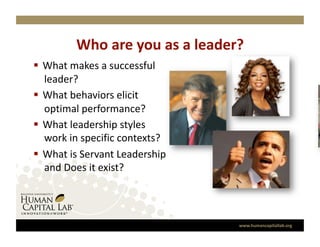
Who
are
you
as
a
leader?

  What
makes
a
successful

   leader?

  What
behaviors
elicit

   optimal
performance?

  What
leadership
styles

   work
in
specific
contexts?

  What
is
Servant
Leadership

   and
Does
it
exist?


                                 www.humancapitallab.org

Questions?

  Leadership
and
Management…are
they
the

   same?

  What
is
your
definition
of
the
“ideal”
leader?


                                          www.humancapitallab.org

Why
did
you
go
into
learning?
–
Your
Job

   Service?

   Science?

   Passion
for
field?

   Are
you
getting
and
giving
what
you
want?


                                        www.humancapitallab.org

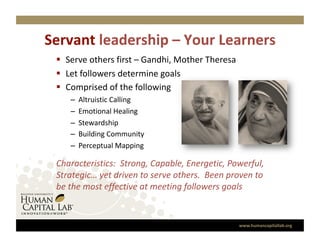
Servant
leadership
–
Your
Learners
                                 

   Serve
others
first
–
Gandhi,
Mother
Theresa

   Let
followers
determine
goals

   Comprised
of
the
following

    –    Altruistic
Calling

    –    Emotional
Healing

    –    Stewardship

    –    Building
Community

    –    Perceptual
Mapping


 Characteristics:

Strong,
Capable,
Energetic,
Powerful,

 Strategic…
yet
driven
to
serve
others.

Been
proven
to

 be
the
most
effective
at
meeting
followers
goals


                                                   www.humancapitallab.org

What
makes
an
effective
leader?

    Service
and
Altruism
–
effectively

     meeting
the
needs
of
others

     through
service

    But….
These
leaders
are
NOT

     necessarily
Successful.

    Why?


                                     www.humancapitallab.org

Hate
Organizational
Politics?

  Why
is
it
important
to
build
your
network?


  What
stops
you?

  Who
do
you
need
to
align
with
to
achieve
your

   goals?

  Who
loses
out
if
you
don’t
build
your
network?     

  Who
loses
out
if
you
don’t
use
political
skills?


                                            www.humancapitallab.org

What
makes
a
Successful
Leader?
–

        Your
Organization 

  Traditional
Definition
of
Success
‐‐
promotability/
   influence/formal
power

  Research
Results
–
Interpersonal
Political
Skills

   (Ferris,
Davidson,
and
Perrewe,
2005)

       Networking
–
who
do
you
know?

       Social
Astuteness
–
do
you
know
how
to
act?

       Apparent
Sincerity
–
do
they
believe
you?

       Interpersonal
Influence
–
do
they
follow
your
lead?


                                                       www.humancapitallab.org

A
Primer
on
Leadership
–
Your
Team

  Transactional
‐
management

  Transformational
Leadership
–
based
in
moral
good

    –  Individualized
consideration
–
do
you
know
your
people?

    –  Idealized
Influence
–
do
they
respect
you?

    –  Inspirational
Motivation
–
do
you
inspire
them?

    –  Intellectual
Stimulation
–
do
you
keep
them
interested?

    Proven
to
be
the
most
effective
in
obtaining
organizational

        goals


                                                     www.humancapitallab.org

Imagine
what
would
happen….
                               

  If
your
initial
Servant
motivations
could
be

    realized
through
the
use
of
incredible

    Leadership
skills?

  What
if
Interpersonal
Political
Skills
enabled

    you
to
SERVE?

  How
would
your
work
change?

  How
would
your
life
change?


                                           www.humancapitallab.org

WHO
ARE
YOU
AS
A
LEADER?

 What
specific
steps
could
you
take
to
build

your
network
and
political
skills?

 What
areas
are
you
most
inclined
to
serve?


 How
can
you
achieve
those
goals?


                                      www.humancapitallab.org

Learning
leader
as
change
agent
–

   necessary
to
become
strategic

  “The
myth
of
leadership
is
the
myth
of
the
lone
warrior:
the

   solitary
individual
whose
heroism
and
brilliance
enable
him
to

   lead
the
way”
(Heifitz,
1994).

  This
notion
reinforces
isolation,
despair,
and
lack
of
movement

   forward

  “How
do
you
stomach
the
repercussions
of
the
distress
caused

   by
change,
while
at
the
same
time
provoking
it?”

  How
do
you
deal
with
the
stress?


                                                      www.humancapitallab.org

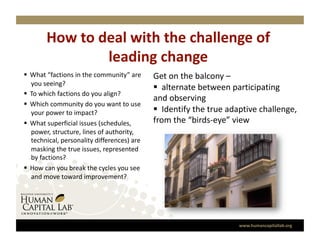
How
to
deal
with
the
challenge
of

                leading
change


  What
“factions
in
the
community”
are
      Get
on
the
balcony
–


   you
seeing?

                                               

alternate
between
participating


  To
which
factions
do
you
align?

                                              and
observing

  Which
community
do
you
want
to
use

   your
power
to
impact?
                      

Identify
the
true
adaptive
challenge,

  What
superficial
issues
(schedules,
       from
the
“birds‐eye”
view

   power,
structure,
lines
of
authority,

   technical,
personality
differences)
are

   masking
the
true
issues,
represented

   by
factions?

  How
can
you
break
the
cycles
you
see

   and
move
toward
improvement?


                                                                        www.humancapitallab.org

From
the
Balcony:
  

       What
is
causing
the
distress?

  What
internal
contradictions
does
the
stress

    represent?

  What
are
the
histories
of
these
contradictions?

  What
perspectives
have
I
and
others
come
to

    represent
to
various
segments
of
the
community
that 

    are
now
in
conflict?

  In
what
ways
are
we
in
the
organization
mirroring
the

    problem
dynamics
in
the
community?


                                              www.humancapitallab.org

Regulating
the
distress
                                 

  What
are
the
characteristic
responses
of
the

   community
to
disequilibrium
(confusion,
sense
of

   threat,
confused
roles
and
relationships,
conflict)?

  Have
you
ever
witnessed
distress
reach
a
breaking

   point
before,
in
any
context?

  What
actions
have
you
seen
restore
equilibrium?

  What
mechanisms
do
you
have
to
regulate
distress?


                                              www.humancapitallab.org

Giving
the
work
back
to
the
people

  Leaders
often
assume
the
problems
are
for
them
to
solve,

   alone

  Giving
work
back
to
people
means
orchestrating
conflict

  We
have
to
know
the
“texture
of
interest”
in
people’s
lives

  Changes
in
whose
values,
beliefs
or
behaviors
would
allow

   progress?

  What
are
the
losses
for
all
interested
parties?

  How
does
my
role
impact
these
parties?


                                                      www.humancapitallab.org

You
as
a
leader
                              

  Do
you
see
the
difference
between
yourself
and
your

   role?


  Can
you
externalize
the
conflict?
“when
conflicting

   criticisms
seem
to
damn
whatever
one
does,
the

   distinction
between
role
and
self
can
be
life

   saving”
(Heifitz,
1994,
p.
265).

  Differentiate
the
“message”
from
yourself


                                            www.humancapitallab.org

Who
are
your
partners?

  Confidant:
the
person
whose
shoulder
you
can
cry
on.


   Holding
environment
for
someone
who
is
holding
everyone

   else

  Ally:
the
person
operating
across
a
formal
line
of
authority
or

   boundary
(fellow
principals,
strong
parent,
other
stakeholder

   groups)

    –  No
direct
authority

    –  Do
not
disclose
everything


                                                       www.humancapitallab.org

Observing
yourself
                             

  Who
do
you
naturally
understand?

  How
do
you
react
to
criticism?

  How
do
you
handle
conflict?

  How
do
you
maintain
energy?

  Who
do
you
emulate?

         Use
your
partners
to
help
you


            answer
these
questions 


                                      www.humancapitallab.org

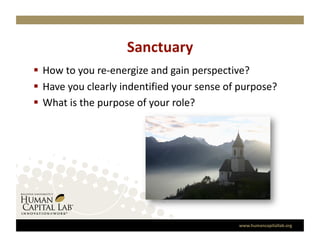
Sanctuary

  How
to
you
re‐energize
and
gain
perspective?

  Have
you
clearly
indentified
your
sense
of
purpose?

  What
is
the
purpose
of
your
role?


                                             www.humancapitallab.org

Lots
covered….
                             

  What’s
next
for
you?

  –  Interpersonal
Political
Skills
–
external

  –  Transformational
Leadership
–
your
team

  –  Servant
Leadership
–
yourself

  –  Getting
to
the
Balcony?


                                             www.humancapitallab.org

Questions?

         Contact
Info:
                     

        Jennifer
Moss 

Jennifer.moss@bellevue.edu 

 www.humancapitallab.org 


Where Are the Leaders? Changing Organizations From the Inside Out

  • 1.
    Where
are
the
Leaders?
 Jennifer
Moss,
PhD
 Director 
 Bellevue
University’s
 
 Human
Capital
Lab 

  • 2.
    Where
are
the
Leaders?
   Becoming
a
strategic
partner
within
your
 organization
takes
more
than
knowledge
of
 the
business,
understanding
education
or
even
 possessing
great
communication
skills.

   Dialogue
with
other
learning
leaders
about
 leadership
qualities
that
move
them
from
 “order
taker”
to
“strategic
partner”.


 www.humancapitallab.org

  • 3.
    Where
are
the
Leaders?
   What
is
required
of
learning
leaders
today
is
 the
knowledge,
skills,
abilities
that
allow
them
 to
direct
the
activities
of
the
learning
 organization
and
push
those
activities
across
 organizational
boundaries
in
a
purposeful
way.
 

  • 4.
    Bellevue
University’s
 Human
Capital
Lab 
   Dedicated
to
creating
the
body
of
knowledge
 around
human
capital
management
   Engaged
with
learning
leaders
on
a
daily
basis
   Dedicated
to
advancing
the
field
of
learning
   Focused
on
helping
organizations
measure
the
 business
impact
of
learning
 www.humancapitallab.org

  • 5.
    Let’s
talk…. 
 What’s
stopping
leaders
from
 
 becoming
strategic? 
 www.humancapitallab.org

  • 6.
    What
Stops
Learning
Leaders
from
 Measuring
Business
Impact 
   Grounded
Theory
Study
   Interviewed
25
Learning
Leaders
–
Top
in
 their
field
   Results:
Primary
factors
–
Learning
Leader
   Results:
Secondary
factors
‐
Organization
 www.humancapitallab.org

  • 7.
    Focus
for
Today
   Leadership

 –  What
is
it?
 –  How
do
you
know
it
when
you
see
it?
 –  Why
is
it
so
difficult?
 www.humancapitallab.org

  • 8.
    Who
are
you
as
a
leader?
   What
makes
a
successful
 leader?
   What
behaviors
elicit
 optimal
performance?
   What
leadership
styles
 work
in
specific
contexts?
   What
is
Servant
Leadership
 and
Does
it
exist?
 www.humancapitallab.org

  • 9.
    Questions?
   Leadership
and
Management…are
they
the
 same?
   What
is
your
definition
of
the
“ideal”
leader?

 www.humancapitallab.org

  • 10.
    Why
did
you
go
into
learning?
–
Your
Job
   Service?
   Science?
   Passion
for
field?
   Are
you
getting
and
giving
what
you
want?
 www.humancapitallab.org

  • 11.
    Servant
leadership
–
Your
Learners 
   Serve
others
first
–
Gandhi,
Mother
Theresa
   Let
followers
determine
goals
   Comprised
of
the
following
 –  Altruistic
Calling
 –  Emotional
Healing
 –  Stewardship
 –  Building
Community
 –  Perceptual
Mapping
 Characteristics:

Strong,
Capable,
Energetic,
Powerful,
 Strategic…
yet
driven
to
serve
others.

Been
proven
to
 be
the
most
effective
at
meeting
followers
goals
 www.humancapitallab.org

  • 12.
    What
makes
an
effective
leader?
  Service
and
Altruism
–
effectively
 meeting
the
needs
of
others
 through
service
   But….
These
leaders
are
NOT
 necessarily
Successful.
   Why?
 www.humancapitallab.org

  • 13.
    Hate
Organizational
Politics?
   Why
is
it
important
to
build
your
network?

   What
stops
you?
  Who
do
you
need
to
align
with
to
achieve
your
 goals?
   Who
loses
out
if
you
don’t
build
your
network? 
   Who
loses
out
if
you
don’t
use
political
skills?

 www.humancapitallab.org

  • 14.
    What
makes
a
Successful
Leader?
–
 Your
Organization 
   Traditional
Definition
of
Success
‐‐
promotability/ influence/formal
power
   Research
Results
–
Interpersonal
Political
Skills
 (Ferris,
Davidson,
and
Perrewe,
2005)
   Networking
–
who
do
you
know?
   Social
Astuteness
–
do
you
know
how
to
act?
   Apparent
Sincerity
–
do
they
believe
you?
   Interpersonal
Influence
–
do
they
follow
your
lead?
 www.humancapitallab.org

  • 15.
    A
Primer
on
Leadership
–
Your
Team
   Transactional
‐
management
   Transformational
Leadership
–
based
in
moral
good
 –  Individualized
consideration
–
do
you
know
your
people?
 –  Idealized
Influence
–
do
they
respect
you?
 –  Inspirational
Motivation
–
do
you
inspire
them?
 –  Intellectual
Stimulation
–
do
you
keep
them
interested?
 Proven
to
be
the
most
effective
in
obtaining
organizational
 goals
 www.humancapitallab.org

  • 16.
    Imagine
what
would
happen…. 
   If
your
initial
Servant
motivations
could
be
 realized
through
the
use
of
incredible
 Leadership
skills?
   What
if
Interpersonal
Political
Skills
enabled
 you
to
SERVE?
   How
would
your
work
change?
   How
would
your
life
change?
 www.humancapitallab.org

  • 17.
  • 18.
    Learning
leader
as
change
agent
–
 necessary
to
become
strategic
   “The
myth
of
leadership
is
the
myth
of
the
lone
warrior:
the
 solitary
individual
whose
heroism
and
brilliance
enable
him
to
 lead
the
way”
(Heifitz,
1994).
   This
notion
reinforces
isolation,
despair,
and
lack
of
movement
 forward
   “How
do
you
stomach
the
repercussions
of
the
distress
caused
 by
change,
while
at
the
same
time
provoking
it?”
   How
do
you
deal
with
the
stress?
 www.humancapitallab.org

  • 19.
    How
to
deal
with
the
challenge
of
 leading
change

   What
“factions
in
the
community”
are
 Get
on
the
balcony
–

 you
seeing?
  

alternate
between
participating


   To
which
factions
do
you
align?
 and
observing
   Which
community
do
you
want
to
use
 your
power
to
impact?
  

Identify
the
true
adaptive
challenge,
   What
superficial
issues
(schedules,
 from
the
“birds‐eye”
view
 power,
structure,
lines
of
authority,
 technical,
personality
differences)
are
 masking
the
true
issues,
represented
 by
factions?
   How
can
you
break
the
cycles
you
see
 and
move
toward
improvement?
 www.humancapitallab.org

  • 20.
    From
the
Balcony:
 
 What
is
causing
the
distress?
   What
internal
contradictions
does
the
stress
 represent?
   What
are
the
histories
of
these
contradictions?
   What
perspectives
have
I
and
others
come
to
 represent
to
various
segments
of
the
community
that 
 are
now
in
conflict?
   In
what
ways
are
we
in
the
organization
mirroring
the
 problem
dynamics
in
the
community?
 www.humancapitallab.org

  • 21.
    Regulating
the
distress 
   What
are
the
characteristic
responses
of
the
 community
to
disequilibrium
(confusion,
sense
of
 threat,
confused
roles
and
relationships,
conflict)?
   Have
you
ever
witnessed
distress
reach
a
breaking
 point
before,
in
any
context?
   What
actions
have
you
seen
restore
equilibrium?
   What
mechanisms
do
you
have
to
regulate
distress?
 www.humancapitallab.org

  • 22.
    Giving
the
work
back
to
the
people
   Leaders
often
assume
the
problems
are
for
them
to
solve,
 alone
   Giving
work
back
to
people
means
orchestrating
conflict
   We
have
to
know
the
“texture
of
interest”
in
people’s
lives
   Changes
in
whose
values,
beliefs
or
behaviors
would
allow
 progress?
   What
are
the
losses
for
all
interested
parties?
   How
does
my
role
impact
these
parties?
 www.humancapitallab.org

  • 23.
    You
as
a
leader 
   Do
you
see
the
difference
between
yourself
and
your
 role?

   Can
you
externalize
the
conflict?
“when
conflicting
 criticisms
seem
to
damn
whatever
one
does,
the
 distinction
between
role
and
self
can
be
life
 saving”
(Heifitz,
1994,
p.
265).
   Differentiate
the
“message”
from
yourself
 www.humancapitallab.org

  • 24.
    Who
are
your
partners?
   Confidant:
the
person
whose
shoulder
you
can
cry
on.

 Holding
environment
for
someone
who
is
holding
everyone
 else
   Ally:
the
person
operating
across
a
formal
line
of
authority
or
 boundary
(fellow
principals,
strong
parent,
other
stakeholder
 groups)
 –  No
direct
authority
 –  Do
not
disclose
everything
 www.humancapitallab.org

  • 25.
    Observing
yourself 
   Who
do
you
naturally
understand?
   How
do
you
react
to
criticism?
   How
do
you
handle
conflict?
   How
do
you
maintain
energy?
   Who
do
you
emulate?
 Use
your
partners
to
help
you
 
 answer
these
questions 
 www.humancapitallab.org

  • 26.
  • 27.
    Lots
covered…. 
   What’s
next
for
you?
 –  Interpersonal
Political
Skills
–
external
 –  Transformational
Leadership
–
your
team
 –  Servant
Leadership
–
yourself
 –  Getting
to
the
Balcony?
 www.humancapitallab.org

  • 28.
    Questions?
 Contact
Info: 
 Jennifer
Moss 
 Jennifer.moss@bellevue.edu 
 www.humancapitallab.org