1
© Ian Phillips 2018
© Ian Phillips 2017
https://ianp24.blogspot.com
Being In-The-Room ...
... A Career’s Perspective on Being an Electronic Design Engineer
Seminar at ...
Centre for Robotics and Neural Systems (CRNS)
University of Plymouth, UK.
09mar18
Prof. Ian Phillips
BSc(hon), CEng, FIET, FIMA, SMIEEE. Retired Dec16.
Formerly: Principal Staff Eng’r. @ ARM Ltd, UK
Visiting Professor with ...
2v0
2
© Ian Phillips 2018
‘Successful Career’ in Electronic & Electronic Systems Design ...
§ Retired Dec 2016
§ Prev: 18yrs, “Principle Staff Engineer”
reporting directly to the CTO of ARM
§ A senior Research role for Technology
Strategy and Methodology
§ Parallel to ARM’s Global Research
Department
§ So how did an ‘Old-Grey-Engineer’
hold such a significant role in this
world-leading Technology business?
... Lets investigate that !
Simon
Segars
Mike
Muller
CEO
CTO
ARM Board of Directors
(Executive of the Company)
ARM Global
Research Dept.
SOLD to SoftBank for £24B in 2016
Me
3
© Ian Phillips 2018
So you want to be an Engineer ?
Some fundamentals that tend to get overlooked ...
§ Engineers Create ... Products or Solutions
§ They Architect & Detail Solutions, using their knowledge of Technologies and Methods, to meet the
Functional and Non-Functional needs of their Customer (May be your Dept. Lead ..to.. the End Customer)
§ They Overcome the Unknowns they encounter, with their Knowledge, Knowhow and Ingenuity
§ They Deliver what they Designed by actually applying those Technologies and Methods
§ Scientists Discover ... And Quantify Fundamentals of Nature:
§ They Explore the Universe to Find Novelty within it
§ They work with the Unknown
§ They Quantify and Numerate it, and Demonstrate its Repeatability
§ They use their Knowledge, Knowhow and Ingenuity (Theoretical bias)
§ Technicians Use ... They are Expert Practitioners in the Application of the Known:
§ Use their technical skills to operate Tools and Equipment (often to a high degree of proficiency)
§ Use their technical skills to Debug and Reinstate Product, and implement Prescribed changes
§ Use tools and equipment to implement Prescribed Methods
4
© Ian Phillips 2018
Copeing with Change !
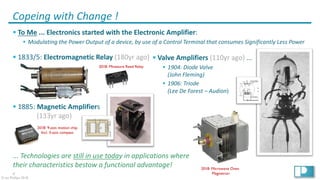
§ To Me ... Electronics started with the Electronic Amplifier:
§ Modulating the Power Output of a device, by use of a Control Terminal that consumes Significantly Less Power
§ 1833/5: Electromagnetic Relay (180yr ago)
§ 1885: Magnetic Amplifiers
(133yr ago)
... Technologies are still in use today in applications where
their characteristics bestow a functional advantage!
§ Valve Amplifiers (110yr ago) ...
§ 1904: Diode Valve
(John Fleming)
§ 1906: Triode
(Lee De Forest – Audion)
2018: Microwave Oven
Magnetron
2018: Miniature Reed Relay
2018: 9-axis motion chip
Incl. 3-axis compass
5
© Ian Phillips 2018
§ General Purpose, Stored Program, Computing Mechanism
§ Based on Alan Turing and John von Neumann’s work (1945)
§ Technology: Electronics (valves/tubes), CRT Memory, Digital (base 2)
... Architecturally very similar to all of todays stored program computers ...
1947: The First Stored Program Computer (71yr ago)
Uo.Manchester, Proof-of-Concept Computer “BABY” (Reconstructed 2000)
6
© Ian Phillips 2018
§ 1947: W.Shockley, J.Bardeen and W.Brattain (71yr ago)
The First Solid-State Amplifier ...
First Proof-of-Concept Transfer-Resistor (Point-Contact)
First Junction Transistor
i
i
C
B
E
7
© Ian Phillips 2018
§ Same Principle but different ‘Implementation’ to Shockley’s original
§ Transistor-at-a-time Process ... £’s per transistor, so use sparingly!
1951: First Commercial Transistors (4yr later)
1954:The OC71Double-Diffused Architecture
8
© Ian Phillips 2018
§ I was Born between the Transistors Invention and its
Commercialisation
§ Electronics had already been ‘going’ for 16 years ...
§ Businesses were supplying Electronic Product to Consumer and
Professional Markets ...
§ Driving improvement in Production Methods and Materials Knowledge
§ Electronics was already shrinking, became cheaper and more reliable
year-on-year-on-year (16yrs before Moore’s Law!)
... And with each step Electronic Technology became applicable to
new Applications, creating new Business Opportunities
1949: Ian Phillips (me) Enters the Scene
1951: Earliest Picture of me
My dad was a Bus Driver
(They wore Uniforms in 1951)
9
© Ian Phillips 2018
1957/8: The Integrated Circuit ...
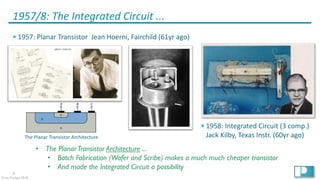
§ 1957: Planar Transistor Jean Hoerni, Fairchild (61yr ago)
§ 1958: Integrated Circuit (3 comp.)
Jack Kilby, Texas Instr. (60yr ago)
• The PlanarTransistor Architecture ...
• Batch Fabrication (Wafer and Scribe) makes a much much cheaper transistor
• And made the Integrated Circuit a possibility
The Planar Transistor Architecture
10
© Ian Phillips 2018
1961: First Commercial Integrated Circuit (3yr later)
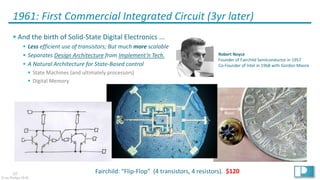
§ And the birth of Solid-State Digital Electronics ...
§ Less efficient use of transistors; But much more scalable
§ Separates Design Architecture from Implement’n Tech.
§ A Natural Architecture for State-Based control
§ State Machines (and ultimately processors)
§ Digital Memory
Fairchild: “Flip-Flop” (4 transistors, 4 resistors). $120
4mm
Robert Noyce
Founder of Fairchild Semiconductor in 1957
Co-Founder of Intel in 1968 with Gordon Moore
11
© Ian Phillips 2018
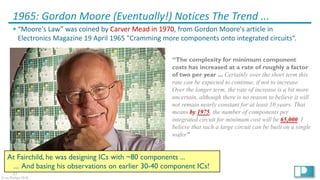
1965: Gordon Moore (Eventually!) Notices The Trend ...
§ “Moore's Law” was coined by Carver Mead in 1970, from Gordon Moore's article in
Electronics Magazine 19 April 1965 "Cramming more components onto integrated circuits“.
“The complexity for minimum component
costs has increased at a rate of roughly a factor
of two per year ... Certainly over the short term this
rate can be expected to continue, if not to increase.
Over the longer term, the rate of increase is a bit more
uncertain, although there is no reason to believe it will
not remain nearly constant for at least 10 years. That
means by 1975, the number of components per
integrated circuit for minimum cost will be 65,000. I
believe that such a large circuit can be built on a single
wafer”
At Fairchild, he was designing ICs with ~80 components ...
... And basing his observations on earlier 30-40 component ICs!
12
© Ian Phillips 2018
1965:Integrated Circuits had 30-40 components ...
§ Transistor Transistor Logic (TTL)...
Quad NAND2
13
© Ian Phillips 2018
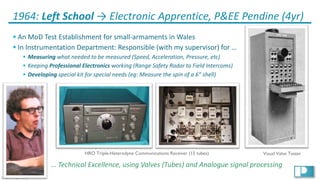
1964: Left School → Electronic Apprentice, P&EE Pendine (4yr)
§ An MoD Test Establishment for small-armaments in Wales
§ In Instrumentation Department: Responsible (with my supervisor) for …
§ Measuring what needed to be measured (Speed, Acceleration, Pressure, etc)
§ Keeping Professional Electronics working (Range Safety Radar to Field Intercoms)
§ Developing special kit for special needs (eg: Measure the spin of a 6” shell)
… Technical Excellence, using Valves (Tubes) and Analogue signal processing
HRO Triple-Heterodyne Communications Receiver (15 tubes) Visual Valve Tester
14
© Ian Phillips 2018
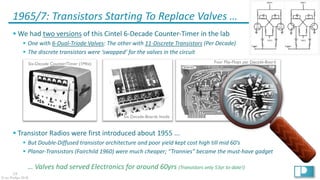
1965/7: Transistors Starting To Replace Valves …
§ We had two versions of this Cintel 6-Decade Counter-Timer in the lab
§ One with 6-Dual-Triode Valves: The other with 11-Discrete Transistors (Per Decade)
§ The discrete transistors were ‘swapped’ for the valves in the circuit
§ Transistor Radios were first introduced about 1955 ...
§ But Double-Diffused transistor architecture and poor yield kept cost high till mid 60’s
§ Planar-Transistors (Fairchild 1960) were much cheaper; “Trannies” became the must-have gadget
… Valves had served Electronics for around 60yrs (Transistors only 53yr to-date!)
Four Flip-Flops per Decade-Board
Six Decade-Boards Inside
Six-Decade Counter/Timer (1Mhz)
15
© Ian Phillips 2018
1970: Large Scale Integration (LSI) ...
§ The SN74181 4-bit ALU bit-slice (300tr, 75gate) ...
§ Provides 16 logic and 16 arithmetic functions
on its operands A and B.
§ Eg: AND, OR, XOR, A OR NOT B, A + B, A - B,
(A OR B) + (A AND NOT B).
§ Could be paralleled to increase arithmetic
‘width’ on a PCB ..or.. in the next generation chip!
... Digital Design (Logic Gates) allows Architecture to be used with different technologies
... Which simplifies moving a design to New Processes and Generations
16
© Ian Phillips 2018
1970: The Solid-State Computer
§ Integrated Circuits (74’ Series)
primarily used in Computers
§ Only affordable by bigger
commercial operations; and
mostly used for Accounts
(Naturally numeric)
§ Universities frequently also
had one for Research support
§ Electronic Designers only
started using them once
Model Based design started to
appear (Mathematics)
...The sort of ‘power’ available was 1MIP. And it was shared amongst many using ‘Batch’ schemes
17
© Ian Phillips 2018
1971: The Intel 4004 4-bit Integrated Processor Chip
§ 1st On-Chip Stored Program Computer
§ 2,300 transistors, 740KHz clock, 16DIL
§ Designed by Intel for the Busicom Calculator
18
© Ian Phillips 2018
§ BSc(Hon) 1st in Electrical and Electronic Eng. (+Beard!)
§ Mathematics, Communications, Physics, Optics, Electrical, Radio,
Discrete Electronics, Digital Logic and Computers, Programming
(Fortran) ... (Familiar Subjects to today’s EE Bachelors!)
§ Offered a Research position but declined
§ A good Degree and ‘lots of confidence’ I was ready to impress my
new employer As An Engineer ...
1974: Graduated → Pye TMC
§ Started in Design Department of Pye TMC, Malmesbury; a company planning to
bringing MicroElectronics into Telecoms (Later acquired by Philips)
§ I had never done actual digital design before, let alone on an Integrated Circuit
§ They used a ‘novel’ 4-phase dynamic logic (Not i2C, RTL, TTL or CMOS)
§ They succeeded in bringing first micro-electronics into UK Telephones and Exchanges
... I quickly learned how little I actually knew relative to the incumbent Engineers
§ I brought some ‘new ideas’; but mostly I was learning from the experienced engineers
19
© Ian Phillips 2018
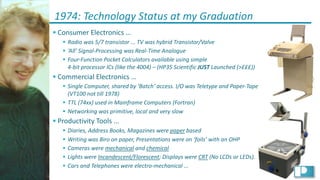
1974: Technology Status at my Graduation
§ Consumer Electronics …
§ Radio was 5/7 transistor ... TV was hybrid Transistor/Valve
§ ‘All’ Signal-Processing was Real-Time Analogue
§ Four-Function Pocket Calculators available using simple
4-bit processor ICs (like the 4004) – (HP35 Scientific JUST Launched (>£££))
§ Commercial Electronics …
§ Single Computer, shared by ‘Batch’ access. I/O was Teletype and Paper-Tape
(VT100 not till 1978)
§ TTL (74xx) used in Mainframe Computers (Fortran)
§ Networking was primitive, local and very slow
§ Productivity Tools ...
§ Diaries, Address Books, Magazines were paper based
§ Writing was Biro on paper, Presentations were on ‘foils’ with an OHP
§ Cameras were mechanical and chemical
§ Lights were Incandescent/Florescent; Displays were CRT (No LCDs or LEDs).
§ Cars and Telephones were electro-mechanical ...
20
© Ian Phillips 2018
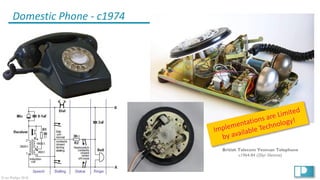
Domestic Phone - c1974
British Telecom Yeoman Telephone
c1964-84 (20yr lifetime)
Implementations are Limited
by available Technology!
21
© Ian Phillips 2018
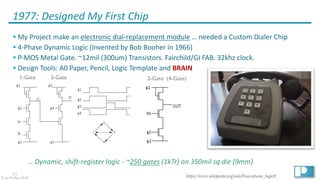
1977: Designed My First Chip
§ My Project make an electronic dial-replacement module … needed a Custom Dialer Chip
§ 4-Phase Dynamic Logic (Invented by Bob Booher in 1966)
§ P-MOS Metal Gate. ~12mil (300um) Transistors. Fairchild/GI FAB. 32khz clock.
§ Design Tools: A0 Paper, Pencil, Logic Template and BRAIN
… Dynamic, shift-register logic - ~250 gates (1kTr) on 350mil sq die (9mm)
1-Gate 3-Gate 2-Gate (4-Gate)
https://en.m.wikipedia.org/wiki/Four-phase_logic#
22
© Ian Phillips 2018
10nm
100nm
1um
10um
100um
ApproximateProcessGeometry
ITRS’99
Transistors/Chip(M)
http://en.wikipedia.org/wiki/Moore’s_law
Moore’s Law: The Personal Computer Years ...
Transistor/PM(K)
1975
~1,000 Tr/Chip
10Ktr
... 10 Ktr/chip brought the Computer to The Person
200Ktr
ARM
Chip
23
© Ian Phillips 2018
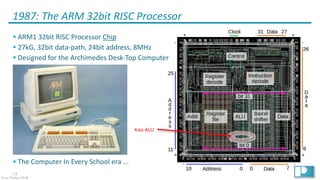
1987: The ARM 32bit RISC Processor
4-bit ALU
§ ARM1 32bit RISC Processor Chip
§ 27kG, 32bit data-path, 24bit address, 8MHz
§ Designed for the Archimedes Desk-Top Computer
§ The Computer In Every School era ...
24
© Ian Phillips 2018
10nm
100nm
1um
10um
100um
ApproximateProcessGeometry
ITRS’99
Transistors/Chip(M)
http://en.wikipedia.org/wiki/Moore’s_law
Moore’s Law: The Emergence of Intellectual Property ...
Transistor/PM(K)
1Mtr
... 1 Mtr/chip enabled whole (computer) Systems on Chip (SoC)
25
© Ian Phillips 2018
1991:The ARM RISC-Processor IP Core Concept
§ System Processor Chip Implementation ...
§ 1um CMOS Process Implementation (~1Mtr)
§ Incorporates the ARM 7 Macro-Cell
§ Customer-Added Circuits to differentiate his
product
ARM7 Core
DMA
Par.
Port
PCMCIA UART (2)
Int’t.
Contr.
Memory
Interface
Timers
W’Dog
Arb’tr.
Misc.ARM 7, 32-bit RISC Processor Macro-Cell (50kgate, 200ktr)
... In the 20yrs since 1970, the 4-bit ALU has become a
tiny part of a 32-bit RISC Processor, which in turn has
become a small part of a typical chip !
26
© Ian Phillips 2018
10nm
100nm
1um
10um
100um
ApproximateProcessGeometry
ITRS’99
Transistors/Chip(M)
http://en.wikipedia.org/wiki/Moore’s_law
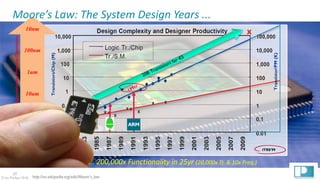
Moore’s Law: The System Design Years ...
Transistor/PM(K)
X
20B Transistors for €5
1Mtr
... 200,000x Functionality in 25yr (20,000x Tr. & 10x Freq.)
27
© Ian Phillips 2018
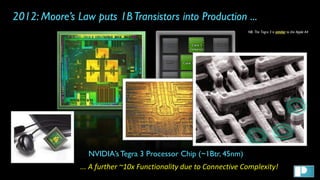
2012: Moore’s Law puts 1BTransistors into Production ...
NB: The Tegra 3 is similar to the Apple A4
NVIDIA’sTegra 3 Processor Chip (~1Btr, 45nm)
... A further ~10x Functionality due to Connective Complexity!
28
© Ian Phillips 2018
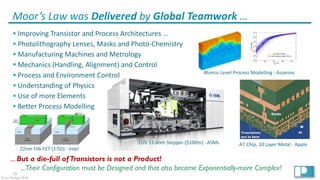
§ Improving Transistor and Process Architectures ...
§ Photolithography Lenses, Masks and Photo-Chemistry
§ Manufacturing Machines and Metrology
§ Mechanics (Handling, Alignment) and Control
§ Process and Environment Control
§ Understanding of Physics
§ Use of more Elements
§ Better Process Modelling
Moor’s Law was Delivered by Global Teamwork …
A7 Chip, 10 Layer Metal - Apple
22nm FIN-FET (2.5D) - Intel
EUV 13.6nm Stepper ($100m) - ASML
Atomic-Level Process Modelling - Assenov
... But a die-full ofTransistors is not a Product!
...Their Configuration must be Designed and that also became Exponentially-more Complex!
29
© Ian Phillips 2018
10nm
100nm
1um
10um
100um
ApproximateProcessGeometry
ITRS’99
Transistors/Chip(M)
Transistor/PM(K)
http://en.wikipedia.org/wiki/Moore’s_law
1Mt
1,800py
8,500py
100py
“Productivity Gap”
... Without >90% Reuse, today’s Electronic Systems would be Un-Producible !
Moore’s Law: The Emergence of Designer Productivity ...
Global TeamsLocal TeamsSmall TeamSingle Designer
Expertise ReuseHW&SW ReuseSome ReuseClean Sheet
“Verification Gap”
30
© Ian Phillips 2018
§ Need: A Mechanism for enhancing human memory (Camera)
§ Technologies: ...
§ Excellent Lens Tech. (3D to 2D transposition!)
§ Fine Mechanical Forming Tech.
§ Electro-Mechanical Exposure Metering Tech.
§ Metal (and some) Plastic Forming Tech.
§ Manual Assembly
§ 2D Photo-Chemical Memory
(35mm Film Technology)
1998: Canon EOS Rebel GII (20yrs ago)
35mm Film & SLR Camera
Camera ArchitecturalView
31
© Ian Phillips 2018
§ Need: A Mechanism for enhancing human memory (Camera)
§ Technologies: ...
§ Digital Logic (CPU+I.O.)
§ Software
§ Memory (NV and RAM)
§ Excellent Lens Tech. (3D>2D) and Displays
§ Analogue Electronics (Network & GPS)
§ Sensors and Transducers (CCD & MEM)
§ Precision Mechanics
§ Micro-Motors
§ Batteries and Energy Storage
§ LEDs and Discharge Tubes
§ Precision forming of Plastics and Metal
§ Electronic Packaging Tech.
§ Integrated Manufacture ... Manufacturing is also Part of the Product!
... The Electronic System is Designed as an Entity
... A Functional-Alloy of Advanced Technologies
2005: Canon EOS 5D
Incorporating DIGIC5+ (ARM)
An ARM-based
Computer !
Camera Architectural View
This is System Design
32
© Ian Phillips 2018
Software Tools
- The character
of the system
Physical IP
– The process-specific
logic-blocks of the chip
Processor and Graphics IP
– The engine of the chip
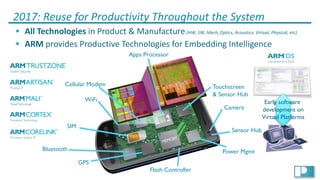
2017: Reuse for Productivity Throughout the System
§ All Technologies in Product & Manufacture (HW, SW, Mech, Optics, Acoustics; Virtual, Physical; etc)
§ ARM provides Productive Technologies for Embedding Intelligence
Early software
development on
Virtual Platforms
Power MgmtBluetooth
Cellular Modem
WiFi
SIM
GPS
Flash Controller
Touchscreen
& Sensor Hub
Sensor Hub
Camera
Apps Processor
33
© Ian Phillips 2018
So What Drives Electronic Technology Today?
§ High Performance Computing (HPC),
Mainframes & Workstations …
§ Highest in-box performance needs
§ Weather, Military and Financial
§ Professional Electronic Applications
§ ‘Stretches the envelope’
§ Surely such challenges must always
be the Technology Driver ?
NO !… HPCs don’t have enough Market Volume/Value to justify Technology Development Costs !
34
© Ian Phillips 2018
Today, the Consumer Drives Electronic Tech.
... Products Purchased and Used by Consumers. Chosen for Function not Technology
35
© Ian Phillips 2018
... ‘Old’ Markets remain today; but they inherit their Technologies from the Lead Markets!
Markets Have Always Driven Technology
1970 1980 1990 2000 2010 2020 2030
Main Frame
Mini Computer
Personal Computer
Desktop Internet
Mobile Internet
Millionsof
Units
ProfessionalçèConsumer
1st Era
Select work-tasks
2nd Era
Broad-based computing
for specific tasks
3rd Era
Computing as part
of our lives
The End-Customer has evolved from Professional to Consumer
36
© Ian Phillips 2018
A Product is a Commercial Opportunity ...
§ A Products exploiting the Opportunities of today’s Si Technologies must be ...
§ Functional - It has Got To Work as it is Expected to by its End-Customer
§ Available - Its got to be-there whilst the Market Window is open
§ Economical – It has got to Cost Less, than it is Valued
§ Manufacturable - It has to Yield, be Distributable and Reliable enough
§ Innovative - It has to be Compelling against Alternatives
§ The Design Engineer is Delivering an Accurate Prediction of the future ...
§ Certainty - Deliver as promised
§ Timescales - Deliver when promised
§ Costs - Development & Manufacturing
§ Quality - Dependability and Reliability
§ Utilising - Appropriate and Available Technology and Methods
... If you succeed then the Customer buys lots and YOU get to keep your job!
37
© Ian Phillips 2018
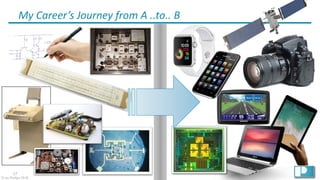
My Career’s Journey from A ..to.. B
38
© Ian Phillips 2018
... Did My Degree Prepare Me for All of This Change!?
My Professors couldn’t possibly teach me all I would need to know over a 45yr Career. But ...
§ They taught me enough of the Language of EE and Science so that I could ...
§ Understand some of what those who would surround me were taking about
§ Ask appropriate questions and understand some of the answers
§ They gave me some hands-on Experience ...
§ Of using the basic tools and methods that I would encounter in my first EE Job
§ To give me experience of applying what I had learned to the ‘muck and muddle’ of a real design
§ They taught me how to Think and Learn for Myself ...
§ Because after the ‘Graduate Engineers’ honeymoon, that’s what an Engineer (Scientist) has to do!
... So the answer is YES; it seems they did an excellent job!
39
© Ian Phillips 2018
So Staying Valuable ..means.. ‘Being in the Room!’
§ Development (or Research) today is a Team Activity; creating Order out of Chaos
§ Your Basic Qualifications (Bs/Ms/Ph) are enough to get you into some rooms ...
§ To understand some of what is being talked about, and to make some basic contributions
§ YOUR Personal Strategy for Success ...
§ To Be In-The-Rooms1: where/when relevant discussions/decisions are being made [1: space, group, networks, etc]
§ To Always Contribute Something: towards the communal objective, from your (albeit limited) knowledge
§ To Always Learn Something: from others in these rooms
§ To Keep Getting Invited to ‘Relevant Rooms’ (for the next 40+yrs!) ...
§ To Keep Contributing you have got to keep Learning about things that will be relevant
§ Become good at things that appeals to you; you’ll never be the best at things you don’t like
§ Make Associations between things you know and things you have heard (people don’t do it often enough)
§ Never be Embarrassed about not knowing, or making an (apparently) irrelevant or stupid contribution
§ Hand-off whatever you can; there will always be more new challenges than you can handle
40
© Ian Phillips 2018
Conclusions
§ Your working life will see as much change as mine did ... Quite probably more!
§ As an Engineer Your job will be to Deliver a timely, serviceable, cost effective Component of a Product
§ As an Engineer (or Scientist) you will need to maintain Good Knowledge of technologies and methods
available and emerging, that might influence your Architectural Decisions!
§ Your Degrees only give you the Language and Basic Skills to get into your first job ...
§ It gets you into your first ‘rooms’ ... Its up to you to be invited to subsequent ones
§ It is the kick-start to a life of Self-Driven, Self-Organised Learning (Your companies will help)
§ You are a Resource to help Create Products ... Your Career is your own responsibility (Your company may help)
§ Being In The Room; means making sure ‘the hosts’ continue to value your participation ...
§ By Reputation of being a Valued Contributor (in that area)
§ ‘Choosing’ the Rooms to align with your (evolving) career plans
... You’ll know you are an Engineer when other Engineers seek your Professional Opinion!
41
© Ian Phillips 2018
© Ian Phillips 2017
https://ianp24.blogspot.com
Thank you for Listening ...
This presentation and others available at
...
http://ianp24.blogspot.com

Being In-The-Room

  • 1.
    1 © Ian Phillips2018 © Ian Phillips 2017 https://ianp24.blogspot.com Being In-The-Room ... ... A Career’s Perspective on Being an Electronic Design Engineer Seminar at ... Centre for Robotics and Neural Systems (CRNS) University of Plymouth, UK. 09mar18 Prof. Ian Phillips BSc(hon), CEng, FIET, FIMA, SMIEEE. Retired Dec16. Formerly: Principal Staff Eng’r. @ ARM Ltd, UK Visiting Professor with ... 2v0
  • 2.
    2 © Ian Phillips2018 ‘Successful Career’ in Electronic & Electronic Systems Design ... § Retired Dec 2016 § Prev: 18yrs, “Principle Staff Engineer” reporting directly to the CTO of ARM § A senior Research role for Technology Strategy and Methodology § Parallel to ARM’s Global Research Department § So how did an ‘Old-Grey-Engineer’ hold such a significant role in this world-leading Technology business? ... Lets investigate that ! Simon Segars Mike Muller CEO CTO ARM Board of Directors (Executive of the Company) ARM Global Research Dept. SOLD to SoftBank for £24B in 2016 Me
  • 3.
    3 © Ian Phillips2018 So you want to be an Engineer ? Some fundamentals that tend to get overlooked ... § Engineers Create ... Products or Solutions § They Architect & Detail Solutions, using their knowledge of Technologies and Methods, to meet the Functional and Non-Functional needs of their Customer (May be your Dept. Lead ..to.. the End Customer) § They Overcome the Unknowns they encounter, with their Knowledge, Knowhow and Ingenuity § They Deliver what they Designed by actually applying those Technologies and Methods § Scientists Discover ... And Quantify Fundamentals of Nature: § They Explore the Universe to Find Novelty within it § They work with the Unknown § They Quantify and Numerate it, and Demonstrate its Repeatability § They use their Knowledge, Knowhow and Ingenuity (Theoretical bias) § Technicians Use ... They are Expert Practitioners in the Application of the Known: § Use their technical skills to operate Tools and Equipment (often to a high degree of proficiency) § Use their technical skills to Debug and Reinstate Product, and implement Prescribed changes § Use tools and equipment to implement Prescribed Methods
  • 4.
    4 © Ian Phillips2018 Copeing with Change ! § To Me ... Electronics started with the Electronic Amplifier: § Modulating the Power Output of a device, by use of a Control Terminal that consumes Significantly Less Power § 1833/5: Electromagnetic Relay (180yr ago) § 1885: Magnetic Amplifiers (133yr ago) ... Technologies are still in use today in applications where their characteristics bestow a functional advantage! § Valve Amplifiers (110yr ago) ... § 1904: Diode Valve (John Fleming) § 1906: Triode (Lee De Forest – Audion) 2018: Microwave Oven Magnetron 2018: Miniature Reed Relay 2018: 9-axis motion chip Incl. 3-axis compass
  • 5.
    5 © Ian Phillips2018 § General Purpose, Stored Program, Computing Mechanism § Based on Alan Turing and John von Neumann’s work (1945) § Technology: Electronics (valves/tubes), CRT Memory, Digital (base 2) ... Architecturally very similar to all of todays stored program computers ... 1947: The First Stored Program Computer (71yr ago) Uo.Manchester, Proof-of-Concept Computer “BABY” (Reconstructed 2000)
  • 6.
    6 © Ian Phillips2018 § 1947: W.Shockley, J.Bardeen and W.Brattain (71yr ago) The First Solid-State Amplifier ... First Proof-of-Concept Transfer-Resistor (Point-Contact) First Junction Transistor i i C B E
  • 7.
    7 © Ian Phillips2018 § Same Principle but different ‘Implementation’ to Shockley’s original § Transistor-at-a-time Process ... £’s per transistor, so use sparingly! 1951: First Commercial Transistors (4yr later) 1954:The OC71Double-Diffused Architecture
  • 8.
    8 © Ian Phillips2018 § I was Born between the Transistors Invention and its Commercialisation § Electronics had already been ‘going’ for 16 years ... § Businesses were supplying Electronic Product to Consumer and Professional Markets ... § Driving improvement in Production Methods and Materials Knowledge § Electronics was already shrinking, became cheaper and more reliable year-on-year-on-year (16yrs before Moore’s Law!) ... And with each step Electronic Technology became applicable to new Applications, creating new Business Opportunities 1949: Ian Phillips (me) Enters the Scene 1951: Earliest Picture of me My dad was a Bus Driver (They wore Uniforms in 1951)
  • 9.
    9 © Ian Phillips2018 1957/8: The Integrated Circuit ... § 1957: Planar Transistor Jean Hoerni, Fairchild (61yr ago) § 1958: Integrated Circuit (3 comp.) Jack Kilby, Texas Instr. (60yr ago) • The PlanarTransistor Architecture ... • Batch Fabrication (Wafer and Scribe) makes a much much cheaper transistor • And made the Integrated Circuit a possibility The Planar Transistor Architecture
  • 10.
    10 © Ian Phillips2018 1961: First Commercial Integrated Circuit (3yr later) § And the birth of Solid-State Digital Electronics ... § Less efficient use of transistors; But much more scalable § Separates Design Architecture from Implement’n Tech. § A Natural Architecture for State-Based control § State Machines (and ultimately processors) § Digital Memory Fairchild: “Flip-Flop” (4 transistors, 4 resistors). $120 4mm Robert Noyce Founder of Fairchild Semiconductor in 1957 Co-Founder of Intel in 1968 with Gordon Moore
  • 11.
    11 © Ian Phillips2018 1965: Gordon Moore (Eventually!) Notices The Trend ... § “Moore's Law” was coined by Carver Mead in 1970, from Gordon Moore's article in Electronics Magazine 19 April 1965 "Cramming more components onto integrated circuits“. “The complexity for minimum component costs has increased at a rate of roughly a factor of two per year ... Certainly over the short term this rate can be expected to continue, if not to increase. Over the longer term, the rate of increase is a bit more uncertain, although there is no reason to believe it will not remain nearly constant for at least 10 years. That means by 1975, the number of components per integrated circuit for minimum cost will be 65,000. I believe that such a large circuit can be built on a single wafer” At Fairchild, he was designing ICs with ~80 components ... ... And basing his observations on earlier 30-40 component ICs!
  • 12.
    12 © Ian Phillips2018 1965:Integrated Circuits had 30-40 components ... § Transistor Transistor Logic (TTL)... Quad NAND2
  • 13.
    13 © Ian Phillips2018 1964: Left School → Electronic Apprentice, P&EE Pendine (4yr) § An MoD Test Establishment for small-armaments in Wales § In Instrumentation Department: Responsible (with my supervisor) for … § Measuring what needed to be measured (Speed, Acceleration, Pressure, etc) § Keeping Professional Electronics working (Range Safety Radar to Field Intercoms) § Developing special kit for special needs (eg: Measure the spin of a 6” shell) … Technical Excellence, using Valves (Tubes) and Analogue signal processing HRO Triple-Heterodyne Communications Receiver (15 tubes) Visual Valve Tester
  • 14.
    14 © Ian Phillips2018 1965/7: Transistors Starting To Replace Valves … § We had two versions of this Cintel 6-Decade Counter-Timer in the lab § One with 6-Dual-Triode Valves: The other with 11-Discrete Transistors (Per Decade) § The discrete transistors were ‘swapped’ for the valves in the circuit § Transistor Radios were first introduced about 1955 ... § But Double-Diffused transistor architecture and poor yield kept cost high till mid 60’s § Planar-Transistors (Fairchild 1960) were much cheaper; “Trannies” became the must-have gadget … Valves had served Electronics for around 60yrs (Transistors only 53yr to-date!) Four Flip-Flops per Decade-Board Six Decade-Boards Inside Six-Decade Counter/Timer (1Mhz)
  • 15.
    15 © Ian Phillips2018 1970: Large Scale Integration (LSI) ... § The SN74181 4-bit ALU bit-slice (300tr, 75gate) ... § Provides 16 logic and 16 arithmetic functions on its operands A and B. § Eg: AND, OR, XOR, A OR NOT B, A + B, A - B, (A OR B) + (A AND NOT B). § Could be paralleled to increase arithmetic ‘width’ on a PCB ..or.. in the next generation chip! ... Digital Design (Logic Gates) allows Architecture to be used with different technologies ... Which simplifies moving a design to New Processes and Generations
  • 16.
    16 © Ian Phillips2018 1970: The Solid-State Computer § Integrated Circuits (74’ Series) primarily used in Computers § Only affordable by bigger commercial operations; and mostly used for Accounts (Naturally numeric) § Universities frequently also had one for Research support § Electronic Designers only started using them once Model Based design started to appear (Mathematics) ...The sort of ‘power’ available was 1MIP. And it was shared amongst many using ‘Batch’ schemes
  • 17.
    17 © Ian Phillips2018 1971: The Intel 4004 4-bit Integrated Processor Chip § 1st On-Chip Stored Program Computer § 2,300 transistors, 740KHz clock, 16DIL § Designed by Intel for the Busicom Calculator
  • 18.
    18 © Ian Phillips2018 § BSc(Hon) 1st in Electrical and Electronic Eng. (+Beard!) § Mathematics, Communications, Physics, Optics, Electrical, Radio, Discrete Electronics, Digital Logic and Computers, Programming (Fortran) ... (Familiar Subjects to today’s EE Bachelors!) § Offered a Research position but declined § A good Degree and ‘lots of confidence’ I was ready to impress my new employer As An Engineer ... 1974: Graduated → Pye TMC § Started in Design Department of Pye TMC, Malmesbury; a company planning to bringing MicroElectronics into Telecoms (Later acquired by Philips) § I had never done actual digital design before, let alone on an Integrated Circuit § They used a ‘novel’ 4-phase dynamic logic (Not i2C, RTL, TTL or CMOS) § They succeeded in bringing first micro-electronics into UK Telephones and Exchanges ... I quickly learned how little I actually knew relative to the incumbent Engineers § I brought some ‘new ideas’; but mostly I was learning from the experienced engineers
  • 19.
    19 © Ian Phillips2018 1974: Technology Status at my Graduation § Consumer Electronics … § Radio was 5/7 transistor ... TV was hybrid Transistor/Valve § ‘All’ Signal-Processing was Real-Time Analogue § Four-Function Pocket Calculators available using simple 4-bit processor ICs (like the 4004) – (HP35 Scientific JUST Launched (>£££)) § Commercial Electronics … § Single Computer, shared by ‘Batch’ access. I/O was Teletype and Paper-Tape (VT100 not till 1978) § TTL (74xx) used in Mainframe Computers (Fortran) § Networking was primitive, local and very slow § Productivity Tools ... § Diaries, Address Books, Magazines were paper based § Writing was Biro on paper, Presentations were on ‘foils’ with an OHP § Cameras were mechanical and chemical § Lights were Incandescent/Florescent; Displays were CRT (No LCDs or LEDs). § Cars and Telephones were electro-mechanical ...
  • 20.
    20 © Ian Phillips2018 Domestic Phone - c1974 British Telecom Yeoman Telephone c1964-84 (20yr lifetime) Implementations are Limited by available Technology!
  • 21.
    21 © Ian Phillips2018 1977: Designed My First Chip § My Project make an electronic dial-replacement module … needed a Custom Dialer Chip § 4-Phase Dynamic Logic (Invented by Bob Booher in 1966) § P-MOS Metal Gate. ~12mil (300um) Transistors. Fairchild/GI FAB. 32khz clock. § Design Tools: A0 Paper, Pencil, Logic Template and BRAIN … Dynamic, shift-register logic - ~250 gates (1kTr) on 350mil sq die (9mm) 1-Gate 3-Gate 2-Gate (4-Gate) https://en.m.wikipedia.org/wiki/Four-phase_logic#
  • 22.
    22 © Ian Phillips2018 10nm 100nm 1um 10um 100um ApproximateProcessGeometry ITRS’99 Transistors/Chip(M) http://en.wikipedia.org/wiki/Moore’s_law Moore’s Law: The Personal Computer Years ... Transistor/PM(K) 1975 ~1,000 Tr/Chip 10Ktr ... 10 Ktr/chip brought the Computer to The Person 200Ktr ARM Chip
  • 23.
    23 © Ian Phillips2018 1987: The ARM 32bit RISC Processor 4-bit ALU § ARM1 32bit RISC Processor Chip § 27kG, 32bit data-path, 24bit address, 8MHz § Designed for the Archimedes Desk-Top Computer § The Computer In Every School era ...
  • 24.
    24 © Ian Phillips2018 10nm 100nm 1um 10um 100um ApproximateProcessGeometry ITRS’99 Transistors/Chip(M) http://en.wikipedia.org/wiki/Moore’s_law Moore’s Law: The Emergence of Intellectual Property ... Transistor/PM(K) 1Mtr ... 1 Mtr/chip enabled whole (computer) Systems on Chip (SoC)
  • 25.
    25 © Ian Phillips2018 1991:The ARM RISC-Processor IP Core Concept § System Processor Chip Implementation ... § 1um CMOS Process Implementation (~1Mtr) § Incorporates the ARM 7 Macro-Cell § Customer-Added Circuits to differentiate his product ARM7 Core DMA Par. Port PCMCIA UART (2) Int’t. Contr. Memory Interface Timers W’Dog Arb’tr. Misc.ARM 7, 32-bit RISC Processor Macro-Cell (50kgate, 200ktr) ... In the 20yrs since 1970, the 4-bit ALU has become a tiny part of a 32-bit RISC Processor, which in turn has become a small part of a typical chip !
  • 26.
    26 © Ian Phillips2018 10nm 100nm 1um 10um 100um ApproximateProcessGeometry ITRS’99 Transistors/Chip(M) http://en.wikipedia.org/wiki/Moore’s_law Moore’s Law: The System Design Years ... Transistor/PM(K) X 20B Transistors for €5 1Mtr ... 200,000x Functionality in 25yr (20,000x Tr. & 10x Freq.)
  • 27.
    27 © Ian Phillips2018 2012: Moore’s Law puts 1BTransistors into Production ... NB: The Tegra 3 is similar to the Apple A4 NVIDIA’sTegra 3 Processor Chip (~1Btr, 45nm) ... A further ~10x Functionality due to Connective Complexity!
  • 28.
    28 © Ian Phillips2018 § Improving Transistor and Process Architectures ... § Photolithography Lenses, Masks and Photo-Chemistry § Manufacturing Machines and Metrology § Mechanics (Handling, Alignment) and Control § Process and Environment Control § Understanding of Physics § Use of more Elements § Better Process Modelling Moor’s Law was Delivered by Global Teamwork … A7 Chip, 10 Layer Metal - Apple 22nm FIN-FET (2.5D) - Intel EUV 13.6nm Stepper ($100m) - ASML Atomic-Level Process Modelling - Assenov ... But a die-full ofTransistors is not a Product! ...Their Configuration must be Designed and that also became Exponentially-more Complex!
  • 29.
    29 © Ian Phillips2018 10nm 100nm 1um 10um 100um ApproximateProcessGeometry ITRS’99 Transistors/Chip(M) Transistor/PM(K) http://en.wikipedia.org/wiki/Moore’s_law 1Mt 1,800py 8,500py 100py “Productivity Gap” ... Without >90% Reuse, today’s Electronic Systems would be Un-Producible ! Moore’s Law: The Emergence of Designer Productivity ... Global TeamsLocal TeamsSmall TeamSingle Designer Expertise ReuseHW&SW ReuseSome ReuseClean Sheet “Verification Gap”
  • 30.
    30 © Ian Phillips2018 § Need: A Mechanism for enhancing human memory (Camera) § Technologies: ... § Excellent Lens Tech. (3D to 2D transposition!) § Fine Mechanical Forming Tech. § Electro-Mechanical Exposure Metering Tech. § Metal (and some) Plastic Forming Tech. § Manual Assembly § 2D Photo-Chemical Memory (35mm Film Technology) 1998: Canon EOS Rebel GII (20yrs ago) 35mm Film & SLR Camera Camera ArchitecturalView
  • 31.
    31 © Ian Phillips2018 § Need: A Mechanism for enhancing human memory (Camera) § Technologies: ... § Digital Logic (CPU+I.O.) § Software § Memory (NV and RAM) § Excellent Lens Tech. (3D>2D) and Displays § Analogue Electronics (Network & GPS) § Sensors and Transducers (CCD & MEM) § Precision Mechanics § Micro-Motors § Batteries and Energy Storage § LEDs and Discharge Tubes § Precision forming of Plastics and Metal § Electronic Packaging Tech. § Integrated Manufacture ... Manufacturing is also Part of the Product! ... The Electronic System is Designed as an Entity ... A Functional-Alloy of Advanced Technologies 2005: Canon EOS 5D Incorporating DIGIC5+ (ARM) An ARM-based Computer ! Camera Architectural View This is System Design
  • 32.
    32 © Ian Phillips2018 Software Tools - The character of the system Physical IP – The process-specific logic-blocks of the chip Processor and Graphics IP – The engine of the chip 2017: Reuse for Productivity Throughout the System § All Technologies in Product & Manufacture (HW, SW, Mech, Optics, Acoustics; Virtual, Physical; etc) § ARM provides Productive Technologies for Embedding Intelligence Early software development on Virtual Platforms Power MgmtBluetooth Cellular Modem WiFi SIM GPS Flash Controller Touchscreen & Sensor Hub Sensor Hub Camera Apps Processor
  • 33.
    33 © Ian Phillips2018 So What Drives Electronic Technology Today? § High Performance Computing (HPC), Mainframes & Workstations … § Highest in-box performance needs § Weather, Military and Financial § Professional Electronic Applications § ‘Stretches the envelope’ § Surely such challenges must always be the Technology Driver ? NO !… HPCs don’t have enough Market Volume/Value to justify Technology Development Costs !
  • 34.
    34 © Ian Phillips2018 Today, the Consumer Drives Electronic Tech. ... Products Purchased and Used by Consumers. Chosen for Function not Technology
  • 35.
    35 © Ian Phillips2018 ... ‘Old’ Markets remain today; but they inherit their Technologies from the Lead Markets! Markets Have Always Driven Technology 1970 1980 1990 2000 2010 2020 2030 Main Frame Mini Computer Personal Computer Desktop Internet Mobile Internet Millionsof Units ProfessionalçèConsumer 1st Era Select work-tasks 2nd Era Broad-based computing for specific tasks 3rd Era Computing as part of our lives The End-Customer has evolved from Professional to Consumer
  • 36.
    36 © Ian Phillips2018 A Product is a Commercial Opportunity ... § A Products exploiting the Opportunities of today’s Si Technologies must be ... § Functional - It has Got To Work as it is Expected to by its End-Customer § Available - Its got to be-there whilst the Market Window is open § Economical – It has got to Cost Less, than it is Valued § Manufacturable - It has to Yield, be Distributable and Reliable enough § Innovative - It has to be Compelling against Alternatives § The Design Engineer is Delivering an Accurate Prediction of the future ... § Certainty - Deliver as promised § Timescales - Deliver when promised § Costs - Development & Manufacturing § Quality - Dependability and Reliability § Utilising - Appropriate and Available Technology and Methods ... If you succeed then the Customer buys lots and YOU get to keep your job!
  • 37.
    37 © Ian Phillips2018 My Career’s Journey from A ..to.. B
  • 38.
    38 © Ian Phillips2018 ... Did My Degree Prepare Me for All of This Change!? My Professors couldn’t possibly teach me all I would need to know over a 45yr Career. But ... § They taught me enough of the Language of EE and Science so that I could ... § Understand some of what those who would surround me were taking about § Ask appropriate questions and understand some of the answers § They gave me some hands-on Experience ... § Of using the basic tools and methods that I would encounter in my first EE Job § To give me experience of applying what I had learned to the ‘muck and muddle’ of a real design § They taught me how to Think and Learn for Myself ... § Because after the ‘Graduate Engineers’ honeymoon, that’s what an Engineer (Scientist) has to do! ... So the answer is YES; it seems they did an excellent job!
  • 39.
    39 © Ian Phillips2018 So Staying Valuable ..means.. ‘Being in the Room!’ § Development (or Research) today is a Team Activity; creating Order out of Chaos § Your Basic Qualifications (Bs/Ms/Ph) are enough to get you into some rooms ... § To understand some of what is being talked about, and to make some basic contributions § YOUR Personal Strategy for Success ... § To Be In-The-Rooms1: where/when relevant discussions/decisions are being made [1: space, group, networks, etc] § To Always Contribute Something: towards the communal objective, from your (albeit limited) knowledge § To Always Learn Something: from others in these rooms § To Keep Getting Invited to ‘Relevant Rooms’ (for the next 40+yrs!) ... § To Keep Contributing you have got to keep Learning about things that will be relevant § Become good at things that appeals to you; you’ll never be the best at things you don’t like § Make Associations between things you know and things you have heard (people don’t do it often enough) § Never be Embarrassed about not knowing, or making an (apparently) irrelevant or stupid contribution § Hand-off whatever you can; there will always be more new challenges than you can handle
  • 40.
    40 © Ian Phillips2018 Conclusions § Your working life will see as much change as mine did ... Quite probably more! § As an Engineer Your job will be to Deliver a timely, serviceable, cost effective Component of a Product § As an Engineer (or Scientist) you will need to maintain Good Knowledge of technologies and methods available and emerging, that might influence your Architectural Decisions! § Your Degrees only give you the Language and Basic Skills to get into your first job ... § It gets you into your first ‘rooms’ ... Its up to you to be invited to subsequent ones § It is the kick-start to a life of Self-Driven, Self-Organised Learning (Your companies will help) § You are a Resource to help Create Products ... Your Career is your own responsibility (Your company may help) § Being In The Room; means making sure ‘the hosts’ continue to value your participation ... § By Reputation of being a Valued Contributor (in that area) § ‘Choosing’ the Rooms to align with your (evolving) career plans ... You’ll know you are an Engineer when other Engineers seek your Professional Opinion!
  • 41.
    41 © Ian Phillips2018 © Ian Phillips 2017 https://ianp24.blogspot.com Thank you for Listening ... This presentation and others available at ... http://ianp24.blogspot.com