1	of	40	
Being	a	Design	Engineer	
...	A	Retrospec0ve	Perspec0ve	
Electrical,	Electronic	&	Computer	Science	Seminar	
11feb16:	Uo.Liverpool,	Uk.	


Pdf	and	Video	at	hCp://ianp24.blogspot.com	
Opinions	expressed	are	my	own	...	
	
	
Prof. Ian Phillips
Principal Staff Engineer
ARM Ltd
ian.phillips@arm.com
Visiting Prof. at ...
Contribution to
Industry Award 2008
1v1
2	of	40	
1974:	At	the	Design	StarNng	Line	...	
§ 1st	in	Electrical	and	Electronic	Eng.	
§  Mathema0cs,	Communica0ons,	Physics,	Op0cs,	Electrical,		
Discrete	Electronics,	Radio,	Digital	Logic	and	Computers,	Fortran	...	
§ Electronics	at	the	Nme	...	
§  Most	Electronics	was	Professional	
§  Solid	State	Electronics	was	just	about	there	(Valves	were	sNll	around)		
§  The	Consumer	had	TV,	radio	and	the	four-funcNon	pocket	calculator	
§  All	real-Nme	Signals	and	their	Processing	was	analogue	
§  Larger	Companies	had	One	Computer,	shared	it	using	Teletype	terminals	
§  74xx	TTL	in	use	in	Mainframe	Computers	(TRS80	first	personal	computer	in	1977).	
§  Paper	tape	was	the	designers	i/o.	Mag	tape	for	any	file	more	than	a	few	Kb.	
§  Ethernet	new	for	business	(Local),	Janet	for	educaNon	(Regional)	(Internet	~1990)	
§  The	Car	and	Telephone	was	s0ll	electro-mechanical	
§  Cameras	were	mechanical	and	chemical;	Diaries,	Organizers,	Magazines	were	physical.	
§  Lights	were	incandescent;	Displays	were	CRT	(No	LCDs	or	LEDs).	
					...	Was	I	prepared	for	the	next	40yrs	as	a	Design	Engineer?
3	of	40	
DomesNc	Radio	-	c1974
4	of	40	
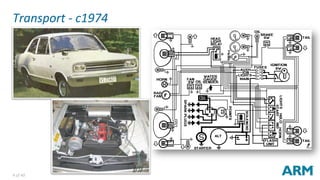
Transport	-	c1974	
Vauxhall Viva HB
SL90
5	of	40	
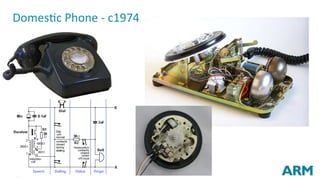
DomesNc	Phone	-	c1974
6	of	40	
Engineering	is	Making	Stuff	Happen...	
§ Stuff	which	is	Valuable	and	Viable	...	
§  Func<onal	-	It	has	GOT	to	work	
§  Economical	-	Its	cost	has	got	to	be	less	than	its	value	
§  Reproducible	-	Yield,	Distributable,	Reliable	(enough)	
§  Innova<ve	-	Compe00ve	against	alterna0ve	implementa0ons	
§ Its	about	Delivering	a	Promise	for	the	future	...	
§  Certainty	
§  Timescales	
§  Development	and	Manufacturing	Costs	
§  Quality	(Dependability	and	Reliability)	
§ Using	Appropriate	Available	Technology	...	
§  The	right	technologies,	not	the	fanciest;	available	technologies,	not	the	op0mis0cally	promised	
§  It	is	about	working	with	others	(Teamwork)	internally	and	externally	to	deliver	
§  It	is	about	thinking	around	and	about	the	problem,	and	being	ingenious	in	the	solu0on	
...	It	is	Not	about	blind	pursuit	of	the	new,	or	s0mula0on	of	your	pleasure-glands.
7	of	40	
CompuNng:	100BC	-	Hipparchos’s	AnNkythera	
Early-Mechanical
Computation
Hipparchos
c.190 BC – c.120 BC.
Ancient Greek
Astronomer,
Philosopher and
Mathematician§  A	Mechanism	for	Compu<ng	Planetary	Posi<ons	
§  Technology:		Hand-Made	Metal,	Hand-Cut	Gears,		Engraving,	Analogue	
§  Found	in	the	Mediterranean	in	1900	(Believe	there	might	have	been	10’s)	
	 	 	See:	hCp://www.bbc.co.uk/programmes/p02hz21v
8	of	40	
CompuNng:	1700	-	Graham’s	Orrery	
§  A	Mechanism	for	Compu<ng	Planetary	Posi<ons	(1,800	yrs	aPer	An<kythera!)	
§  Technology:		Factory-Made	Metal,	Machine-Cut	Gears,	Wood,	Analogue	
§  Inventor:	George	Graham	(1674-1751).	English	Clock-Maker.	
Mechanical
Technology
George	Graham
9	of	40	
§  A	Mechanism	for	Compu<ng	Polynomial	Tables	
§  Technology:	Metal,	Precision	Gears,	Digital	(base	10)	
§  Too	expensive	for	the	technology	of	the	day	
CompuNng:	1837	-	Babbage's	Difference	Engine	
Constructed 2000
Late-Mechanical
Computation
10	of	40	
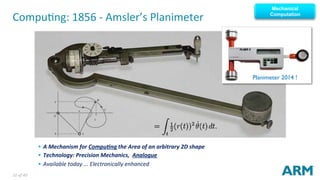
CompuNng:	1856	-	Amsler’s	Planimeter	
Mechanical
Computation
Planimeter 2014 !
§  A	Mechanism	for	Compu<ng	the	Area	of	an	arbitrary	2D	shape	
§  Technology:	Precision	Mechanics,		Analogue	
§  Available	today	...	Electronically	enhanced
11	of	40	
§  General	Purpose,	Stored	Program,	Compu<ng	Mechanism	
§  Technology:	Electronics	(valves),	Digital	(base	2)	
§  Available	today	...	Enhanced	by	Micro-Electronics	(Mainframe	<=>	Laptop)	
CompuNng:	1947	-	Uo.Manchester’s	“Baby”	
Electronic
Computation
ImplementaNons	are	Limited	
by	available	Technology!	
Reconstruction 2000
12	of	40	
§ HPCs	and	Mainframes	…	Certainly stretching the envelope
§ WorkstaBons	(High	Performance	Desk-Top)	…	Maybe
	
The	face	of	CompuNng	Today?	
Is	this	the	fronNer	for	electronic	technology	today?
13	of	40	
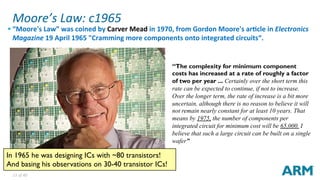
Moore’s	Law:	c1965	
§ “Moore's	Law”	was	coined	by	Carver	Mead	in	1970,	from	Gordon	Moore's	arBcle	in	Electronics	
Magazine	19	April	1965	"Cramming	more	components	onto	integrated	circuits“.	
“The complexity for minimum component
costs has increased at a rate of roughly a factor
of two per year ... Certainly over the short term this
rate can be expected to continue, if not to increase.
Over the longer term, the rate of increase is a bit more
uncertain, although there is no reason to believe it will
not remain nearly constant for at least 10 years. That
means by 1975, the number of components per
integrated circuit for minimum cost will be 65,000. I
believe that such a large circuit can be built on a single
wafer”
In 1965 he was designing ICs with ~80 transistors!
And basing his observations on 30-40 transistor ICs!
14	of	40	
Integra0ng	30-40	components	...	
§ Transistor	Transistor	Logic	(TTL)...
15	of	40	
10nm
100nm
1um
10um
100um
ApproximateProcessGeometry
ITRS’99
Transistors/Chip(M)
http://en.wikipedia.org/wiki/Moore’s_law
Moore’s	Law:	50	yrs	of		Technology	Driven	Opportunity	...	
Transistor/PM(K)
X
16	of	40	
2012: Nvidea’s Tegra 3 Processor Unit (Around	1B	transistors)	
NB:TheTegra 3 is similar to the Apple A4
17	of	40	
§ Good	Businesses	Sell	what	Customers	(You)	want	to	Buy	(Duh!)
§  Successful	businesses	do	it	profitably!	
§ In	a	Global	Market	they	focus	on	their	Core	Competencies	
§  And	op0mise	their	Business-Models	(which	actually	collect	the	Money)	
§ Their	Designers	(of	all	types)	create	Product	DifferenNaNon	…	
§  Making	their	Products	More	Desirable	than	their	Compe0tors	
§  By	Reducing	Costs	and/or	Improving	Func0onality	/	Quality	
§ Product	Development	is	a	Cost	(Risk)	to	be	Minimised	
§  Technology	just	enables	Op0ons!	(HW,	SW,	Mechanics,	Op0cs,	Graphene,	etc)		
§  New-Technology	may	cost	more	(including	risk)	than	it	delivers	in	Product	Value!	
§  Over-Design	costs		...	Cannot	afford	the	Precau0onary	Principle!	
§  Reuse	saves	…	Cannot	afford	to	re-invent	the	wheel,	or	pursue	perfec0on!	
	...	Todays	Businesses	have	to	be	Globally	Compe<<ve,	Money	Making	Machines	
	...	And	Business	is	about	moneNzing	The	Stuff	
Business	funds	the	whole	Ecosystem	(Research,		Science	and	Technology)
18	of	40	
	...	Old	Markets	remain;	but	they	inherit	Technologies	from	the	Lead	Markets!	
So	it’s	Business	OpportuniNes	that	Drive	Technology	
New	21c	Products	will	be	‘Smarter’	and	more	‘Connected’	...	
1970 1980 1990 2000 2010 2020 2030
Main Frame
Mini Computer
Personal Computer
Desktop Internet
Mobile Internet
Millionsof
Units
ProfessionalçèConsumer
1st Era
Select work-tasks
2nd Era
Broad-based computing
for specific tasks
3rd Era
Computing as part
of our lives
19	of	40	
CompuNng:	Today	-	Visible,	but	Not	Vital	
Purchased	by	Consumers	for	FuncNon	not	Technology
20	of	40	
CompuNng:	Today	-	Invisible	and	Vital	
Purchased	by	Professionals	for	FuncNon	not	Technology
21	of	40	
CompuNng	Systems	
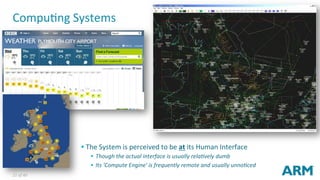
§ The	System	is	perceived	to	be	at	its	Human	Interface	
§  Though	the	actual	interface	is	usually	rela0vely	dumb	
§  Its	'Compute	Engine'	is	frequently	remote	and	usually	unno0ced
22	of	40	
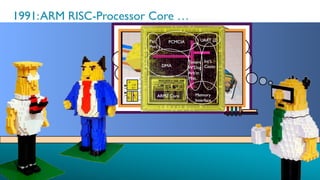
1991:ARM RISC-Processor Core …
23	of	40	
ARM7 Core
DMA
Par.
Port
PCMCIA UART (2)
Int’t.
Contr.
Memory
Interface
Timers
W’Dog
Arb’tr.
Misc.
1991:ARM RISC-Processor Core …
24	of	40	
10nm
100nm
1um
10um
100um
ApproximateProcessGeometry
ITRS’99
Transistors/Chip(M)
Transistor/PM(K)
http://en.wikipedia.org/wiki/Moore’s_law
1,800py
8,500py
100py
Moore’s	Law:	50	yrs	of	Increasing	Design	Challenge	...	
Global TeamsLocal TeamsSmall TeamSingle Designer
Expertise ReuseHW&SW ReuseSome ReuseClean Sheet
“Verification Gap”
25	of	40	
1990's:	Designer	ProducNvity	drove	the	Methodology	
§ The	Product	PossibiliNes	offered	by	uNlising	the	Billions	of	Affordable	and	AestheNcally	
Encapsulate-able	Transistors	is	Commercially	Beguiling!	
§ But	the	only	way	to	realise	these	possibiliNes	in	a	reasonable	Nme,	with	a	reasonable	team	
and	at	a	reasonable	cost;	is	huge	amounts	of	Reuse	of	Design	and	Technology	...	
§  Hardware,	SoPware	and	other	Technologies;	Methods	and	Tools	
§  In-Company:	Sourced	and	Evolved	from	Predecessor	Products	
§  Ex-Company:	Sourced	from	businesses	with	lesser-known(?)	Histories,	
	but	Specialist	Knowledge	
§  Reuse	Improves	Quality;	as	objects	are	designed	more	carefully,	and		
bug-fixes	are	incremental	
§  But	beware;	systems	always	have	residual	errors!		
...	Clean-Sheet	approaches	are	several	orders	of	magnitude	higher	cost!		
		…	>99%	Reuse	will	be	the	rule	for	all	future	Product	Design	and	Development!
26	of	40	
Today:	Bringing	the	Right	Horse	to	the	Right	Course	...	
	 	 	 	...	Delivering	~5x	speed	(Architecture	+	Process	+	Clock)	
About 50MTr
About 50KTr
27	of	40	
...	Which	means:	24	Processors	in	6	Families	...	
Not	just	the	Processors,	but	How	to	Build	them	into	Systems	...
28	of	40	
...	CoreLink	for	Hetrogeneous	MulN-Processing	...	
ACE
ACE
NIC-400 Network Interconnect
Flash GPIO
NIC-400
USBQuad
Cortex-
A15
L2 cache
Interrupt Control
CoreLink™
DMC-520
x72
DDR4-3200
PHY
AHB
Snoop
Filter
Quad
Cortex-
A15
L2 cache
Quad
Cortex-
A15
L2 cache
Quad
Cortex-
A15
L2 cache
CoreLink™
DMC-520
x72
DDR4-3200
8-16MB L3 cache
PCIe
10-40
GbE
DPI Crypto
CoreLink™ CCN-504 Cache Coherent Network
IO Virtualisation with System MMU
DSP
DSP
DSP
SATA
Dual channel
DDR3/4 x72
Up to 4 cores
per cluster
Up to 4
coherent
clusters
Integrated
L3 cache
Up to 18 AMBA
interfaces for
I/O coherent
accelerators
and IO
Peripheral address space
Heterogeneous processors – CPU, GPU, DSP and
accelerators
Virtualized Interrupts
Uniform
System
memory
29	of	40	
…	Tools,	Libraries	and	Partners	to	Realize	the	Opportunity	
§ Technology	to	build	Electronic	System	soluBons:	
§  SoPware,	Drivers,	OS-Ports,	Tools,	U<li<es		to	create	efficient	
system	with	op0mized	sorware	solu0ons	
§  Diverse	Physical	Components,	including	CPU	and	GPU	
processors	designed	for	specific	tasks	
§  Interconnect	System	IP	delivering	coherency	and	the	quality	of	
service	required	for	lowest	memory	bandwidth	
§  Op<mised	Cell-Libraries	for	a	highly	op0mized	SoC	
implementa0ons	
§ Well	Connected	to	Partners	in	the	Life-Cycle:	
§  For	complementary	tools	and	methods	required	by	System	
Developers	
§ Global	Technology	Global	Partners:	
§  ~1000	Partners;	Millions	of	Developers
30	of	40	
§ UK	Established	and	Headquartered		
§ Global	leader	in	the	development	of	
semiconductor	IP	
§  R&D	outsourcing	for	semiconductor	companies	
§ InnovaNve	business	model	yields	high	margins	
§  Upfront	license	fee	–	flexible	licensing	models	
§  Ongoing	royal<es	–	typically	based	on	a		
percentage	of	chip	price	
§  Technology	reused	across	mul0ple	applica0ons	
...	ARM	Technology	Creates	new	and		
Transforms	exis0ng	markets	
...	And	our	Business	Model	
2-3
20+	years	
MulNple	applicaNons	
development	and	sales	
2-3	years	
Partner	chip	
development	
2-3	years	
ARM	research	and	
development	
Cost	incurred	
License	revenue	$	
Royalty	revenue	$	
~1,200	total	licenses	
	…	163	in	2014	
>350	potenNal		
royalty	payers	
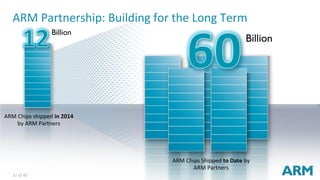
12bn	ARM-based	chips	2014	
20%	CAGR	over	last	5	years	
~£820m	Revenue			(~28%	on	R&D)	
~3300	Employees	ww 			(~1400	in	the	UK)	
… fromY2014 published figures
31	of	40	
ARM	Partnership:	Building	for	the	Long	Term	
ARM	Chips	shipped	in	2014	
by	ARM	Partners	
ARM	Chips	Shipped	to	Date	by		
ARM	Partners
32	of	40	
Software
development
tools
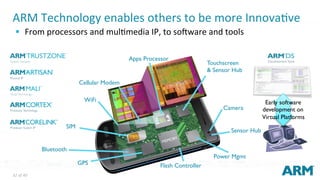
Physical IP – Design of
the building blocks of
the chip
Processor and
Graphics IP – Design
of the brain of the
chip
Power Mgmt
Bluetooth
Cellular Modem
WiFi
SIM
GPS Flash Controller
Touchscreen
& Sensor Hub
Sensor Hub
Camera
Apps Processor
ARM	Technology	enables	others	to	be	more	InnovaNve	
§  From	processors	and	mulNmedia	IP,	to	soxware	and	tools	
Early software
development on
Virtual Platforms
33	of	40	
ARM:	Enabling	InnovaNon	Across	the	EnNre	Industry	
Leader	in	wearables	
and	the	IoT	
>70%	of	smart	TVs	and	>95%	
of	portable	game	consoles	 Enabling	the	transformaNon	of	
the	network	infrastructure	and	
data	center	
ARM-based	servers	
now	shipping	
Driving	smart	energy,	home	
networking,	automoNve		
>95%	of	
smartphones	
and	tablets	
>80%	of	digital	
cameras
34	of	40	
§  Need:	A	Mechanism	for	enhancing	human	memory	(Camera)	
§  Technology:	...	
§  Excellent	Lenses	
§  Fine	Mechanical	Mechanisms	
§  Electro-Mechanical	Exposure	Metering	
§  Metal	(and	some)	Plas0c	Forming	
§  Manual	Assembly	
§  Photo-Chemical	Memory	(35mm	Film)	
	
1998	-	Canon	EOS	Rebel	GII	(17yrs	ago)	
35mm Film Camera
System-Level
Mechanical Computation
35	of	40	
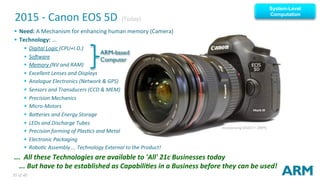
§  Need:	A	Mechanism	for	enhancing	human	memory	(Camera)	
§  Technology:	...	
§  Digital	Logic	(CPU+I.O.)	
§  Sorware	
§  Memory	(NV	and	RAM)	
§  Excellent	Lenses	and	Displays	
§  Analogue	Electronics	(Network	&	GPS)	
§  Sensors	and	Transducers	(CCD	&	MEM)	
§  Precision	Mechanics	
§  Micro-Motors	
§  Baweries	and	Energy	Storage	
§  LEDs	and	Discharge	Tubes	
§  Precision	forming	of	Plas0cs	and	Metal	
§  Electronic	Packaging	
§  Robo0c	Assembly	...	Technology	External	to	the	Product!	
...		All	these	Technologies	are	available	to	'All'	21c	Businesses	today	
...	But	have	to	be	established	as	Capabili<es	in	a	Business	before	they	can	be	used!	
2015	-	Canon	EOS	5D			(Today)	
Incorporating DIGIC5+ (ARM)
System-Level
Computation
ARM-based
Computer
36	of	40	
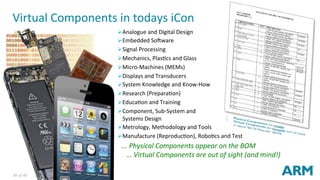
Virtual-Components	in	todays	iCon	
Ø Analogue	and	Digital	Design	
Ø Embedded	Soxware	
Ø Signal	Processing	
Ø Displays	and	Transducers	
Ø System	Knowledge	and	Know-How	
Ø Research	(PreparaNon)	
Ø EducaNon	and	Training	
Ø Component,	Sub-System	and		
Systems	Design	
Ø Micro-Machines	(MEMs)	
Ø Mechanics,	PlasNcs	and	Glass	
Ø Metrology,	Methodology	and	Tools	
Ø Manufacture	(ReproducNon),	RoboNcs	and	Test	
...	Physical	Components	appear	on	the	BOM	
			…	Virtual	Components	are	out	of	sight	(and	mind!)
37	of	40	
Apple's	Global	Products	...	
				...	Global	Teams	contribuNng	their	Specialist	Knowledge	&	Knowhow	
§ 159	Tier-1	Component	Suppliers	...	
§  Thousands	of	Engineers	Globally	
§ ~10x	Tier-2	Virtual-Component	Suppliers	...	
§  Technologies	...	
§  Hardware,	Sorware,	Op0cs,	Mechanics,	
Acous0cs,	RF,	Plas0cs,	etc	
§  Manufacturing,	Test,	Qualifica0on,	etc.	
§  Methods,	Tools,	Training,	etc	
§  Virtual	Components1	and	Knowhow		
									(ARM	is	in	here)	
§  Tens	of	thousands	Engineers	Globally	
...	More	than	90%	of	the	Technology	and	
Methods	are	Reused!	
1:	Virtual	Components	do	not	appear	on	BOM
38	of	40	
§ 40	years	of	conNnuous	Changes	in	Technology	and	their	ApplicaNon	...	
§  Digital	Electronics	(MOS,	CMOS,	BiCMOS,	Bipolar,	GaAs,	I2C,	ECL,	etc)	
§  Integrated	Circuits	Design	and	Manufacture	(HDLs,	Verifica0on	Languages,	etc.)	
§  Systems	Design	
§  Compute	Engines	and	their	Architectures	(CPU,	GPU,	FPGA,	VLIW,	SIMD)	
§  Sorware	(Basic,	Fortran,	C,	C++,	HTML,	Perl,	Pascal,	Java,	...)	
§  Display	Technologies,	Acous0cs,	Transistor	RF,	SAW	
§  Mathema0cal	Methods	and	DSP	
§  Assembly/Manufacturing	technology	
§  Methods	&	Tools	
§  Reuse	(Polygons	to	Stacks	and	OS's)	
§  WorkSta0on	(PC,	Mac,	Linux,	Unix,	MSOffice,	Eudora,	Outlook,	Perl,	html,	Python,	etc)	
...	Con<nuous	Learning	and	Re-Learning	through	my	working	life	
			...	Mostly	hands-on;	mostly	leading-edge	where	'there	are	no	books'	
					...	Odd-Courses;	for	Introduc0ons,	Established	and	Cross-Discipline	stuff	
2016:	At	the	(my)	Finishing-Line	...
39	of	40	
§ TerNary	EducaNon	(Bs,	Ms,	PhD)	gets	you	to	the	start-line	of	an	Engineer/ScienNst	career	
§  It	Enables	you	to	Understand	the	Language	and	the	Context	
§  It	Prepares	you	to	take	the	next	(and	subsequent	steps)	yourself	
§  Knowledge,	Ability,	Adaptability	and	Quality	are	the	key	requirement	of	these	E/S	graduates	
	 	...	Cer0ficates	mawer;	but	not	as	much	as	ability!	
§ A	Design	Engineers	Career	is	a	through-life	experience	...		
§  The	Capabili0es	that	a	business	has,	limits	the	Products	it	can	produce	...		
	...	The	assembled	skills	of	its	Designers	are	that	Capability	
§  A	good	Designer	connects	his/her	Knowledge	and	Experience	with	that	of	others	...	to	Deliver	Innova<on	
§  Because	the	pace	of	change	is	fast,	a	Designers	current	value	is	dominated	by	their	last	3-5yrs	of	‘work'	
	...	Your	Career	as	a	Design	Engineer	is	mostly	in	your	hands	
	
§ EducaNon	System	doesn't	produce	Engineers	/	ScienNsts,	only	people	ready	to	become	them!	
					...	ARM	Starts	with	Good	Graduates	and	expects	to	Develop	them	through	life	
	...	Be	sure	to	work	for	a	Company	that	Recognises	this	need!	
Being	a	Design	Engineer	...	The	Journey	of	a	LifeNme	
Business	Values	Ability	over	the	way	in	which	it	was	achieved	...
40	of	40	
Conclusions	
§ Electronic	Systems	are	the	Most	Technically	Complex	Machines	ever	made	by	man;		
but	the	Commercial	opportuniNes	that	drive	them	do	not	value	(or	recognise)	that	…	
§  Every	year	they	will	con0nue	to	be	More	Complex	...	Ad-Infinitum	
§  And	every	year	the	Customers	Apprecia0on	of	your	role	in	them	will	diminish	...	Do	Something	about	it	
§ Business	Drives	Everything	...	
§  Globalisa0on	means	Global	Compe00on;	for	Business	(but	also	for	the	Individual!)	
§  Product	differen0a0on	is	vital	for	business	
§  Can	be	cost,	quality,	availability	and/or	performance	
§  It	can	come	the	Known-Set	(InnovaNon)	or	by	judicious	use	of	Technology	
§  But	Technology,	offers	no	inherent	value	in	a	product	...	THOUGH	the	'performance'	it	offers	might!	
§  No	prize	for	making	it	work	...	That	is	expected!	(That	is	just	you	doing	what	you	are	paid	for!)	
§ Design	in	an	era	of	rapid	Change	
§  21c	will	be	no	different	to	earlier	eras;	the	Designers	Challenge	is	to	keep	up-to-date	with	Technology	
§  Moore's	Law	for	planar	electronics	has	dominated	the	last	50yrs;	Other	Laws	will	replace	it	(soon)	
§  Expect	to	spend	your	life0me	learning	and	re-learning	(Your	last	3-5yrs	is	the	most	useful)	
	...	You	have	chosen	a	wonderful	career	at	a	very	exci<ng	<me	of	change.	ENJOY!

Being a Design Engineer