The 8th annual Bioinformatics Open Source Conference (BOSC 2007) 18 th  July, Vienna, Austria Biopython Project Update Peter Cock, MOAC Doctoral Training Centre, University of Warwick, UK
Talk Outline What is python? What is Biopython? Short history Project organisation What can you do with it? How can you contribute? Acknowledgements The 8 th  annual Bioinformatics Open Source Conference Biopython Project Update @ BOSC 2007, Vienna, Austria
What is Python? High level programming language Object orientated Open Source, free ($$$)  Cross platform: Linux, Windows, Mac OS X, … Extensible in C, C++, … The 8 th  annual Bioinformatics Open Source Conference Biopython Project Update @ BOSC 2007, Vienna, Austria
What is Biopython? Set of libraries for computational biology Open Source, free ($$$) Cross platform: Linux, Windows, Mac OS X, …  Sibling project to BioPerl, BioRuby, BioJava, … The 8 th  annual Bioinformatics Open Source Conference Biopython Project Update @ BOSC 2007, Vienna, Austria
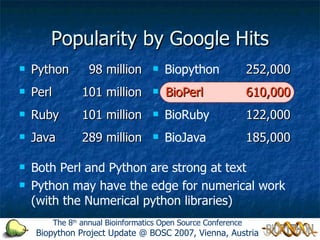
Popularity by Google Hits Python Perl Ruby Java 98 million 101 million 101 million 289 million Biopython BioPerl BioRuby BioJava 252,000 610,000 122,000 185,000 Both Perl and Python are strong at text Python may have the edge for numerical work (with the Numerical python libraries) The 8 th  annual Bioinformatics Open Source Conference Biopython Project Update @ BOSC 2007, Vienna, Austria BioPerl  610,000
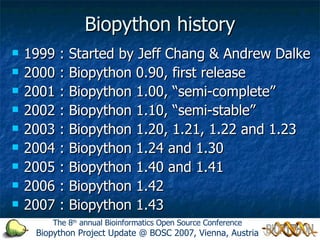
Biopython history 1999 : Started by Jeff Chang & Andrew Dalke 2000 : Biopython 0.90, first release 2001 : Biopython 1.00, “semi-complete” 2002 : Biopython 1.10, “semi-stable” 2003 : Biopython 1.20, 1.21, 1.22 and 1.23 2004 : Biopython 1.24 and 1.30 2005 : Biopython 1.40 and 1.41 2006 : Biopython 1.42 2007 : Biopython 1.43 The 8 th  annual Bioinformatics Open Source Conference Biopython Project Update @ BOSC 2007, Vienna, Austria
Biopython Project Organisation Releases: No fixed schedule Currently once or twice a year Work from a stable CVS base Bugs: Online bugzilla Some small changes handled on mailing list Tests: Many based on unittest python library Also simple scripts where output is verified The 8 th  annual Bioinformatics Open Source Conference Biopython Project Update @ BOSC 2007, Vienna, Austria
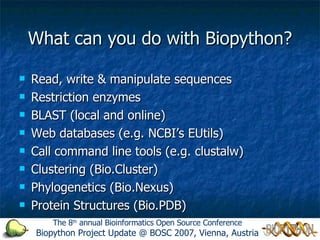
What can you do with Biopython? Read, write & manipulate sequences Restriction enzymes BLAST (local and online) Web databases (e.g. NCBI’s EUtils) Call command line tools (e.g. clustalw) Clustering (Bio.Cluster) Phylogenetics (Bio.Nexus) Protein Structures (Bio.PDB) The 8 th  annual Bioinformatics Open Source Conference Biopython Project Update @ BOSC 2007, Vienna, Austria
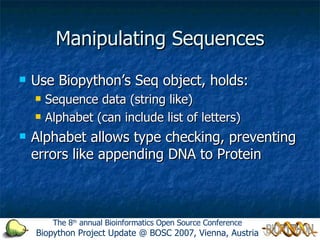
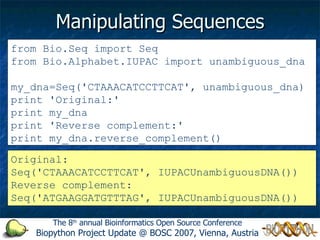
Manipulating Sequences Use Biopython’s Seq object, holds: Sequence data (string like) Alphabet (can include list of letters) Alphabet allows type checking, preventing errors like appending DNA to Protein The 8 th  annual Bioinformatics Open Source Conference Biopython Project Update @ BOSC 2007, Vienna, Austria
Manipulating Sequences from Bio.Seq import Seq from Bio.Alphabet.IUPAC import unambiguous_dna my_dna=Seq('CTAAACATCCTTCAT', unambiguous_dna) print 'Original:' print my_dna print 'Reverse complement:' print my_dna.reverse_complement() Original: Seq('CTAAACATCCTTCAT', IUPACUnambiguousDNA()) Reverse complement: Seq('ATGAAGGATGTTTAG', IUPACUnambiguousDNA()) The 8 th  annual Bioinformatics Open Source Conference Biopython Project Update @ BOSC 2007, Vienna, Austria
Translating Sequences from Bio import Translate bact_trans=Translate.unambiguous_dna_by_id[11] print 'Forward translation' print bact_trans.translate(my_dna) print 'Reverse complement translation' print bact_trans.translate( \ my_dna.reverse_complement()) Forward translation Seq('LNILH', HasStopCodon(IUPACProtein(), '*')) Reverse complement translation Seq('MKDV*', HasStopCodon(IUPACProtein(), '*')) The 8 th  annual Bioinformatics Open Source Conference Biopython Project Update @ BOSC 2007, Vienna, Austria
Sequence Input/Output Bio.SeqIO is new in Biopython 1.43 Inspired by BioPerl’s SeqIO Works with SeqRecord objects (not format specific representations) Builds on existing Biopython parsers The 8 th  annual Bioinformatics Open Source Conference Biopython Project Update @ BOSC 2007, Vienna, Austria
SeqIO – Sequence Input from Bio import SeqIO handle = open('ls_orchid.fasta') format = 'fasta' for rec in SeqIO.parse(handle, format) : print "%s, len %i" % (rec.id, len(rec.seq)) print rec.seq[:40].tostring() + "..." handle.close() gi|2765658|emb|Z78533.1|CIZ78533, len 740 CGTAACAAGGTTTCCGTAGGTGAACCTGCGGAAGGATCAT... gi|2765657|emb|Z78532.1|CCZ78532, len 753 CGTAACAAGGTTTCCGTAGGTGAACCTGCGGAAGGATCAT... ... The 8 th  annual Bioinformatics Open Source Conference Biopython Project Update @ BOSC 2007, Vienna, Austria
SeqIO – Sequence Input from Bio import SeqIO handle = open('ls_orchid.gbk') format = 'genbank' for rec in SeqIO.parse(handle, format) : print "%s, len %i" % (rec.id, len(rec.seq)) print rec.seq[:40].tostring() + "..." handle.close() The 8 th  annual Bioinformatics Open Source Conference Biopython Project Update @ BOSC 2007, Vienna, Austria Z78533.1, len 740 CGTAACAAGGTTTCCGTAGGTGAACCTGCGGAAGGATCAT... Z78532.1, len 753 CGTAACAAGGTTTCCGTAGGTGAACCTGCGGAAGGATCAT... ...
SeqIO – Extracting Data from Bio import SeqIO handle = open('ls_orchid.gbk') format = 'genbank' from sets import Set print Set([rec.annotations['organism'] \ for rec in SeqIO.parse(handle, format)]) handle.close() Set(['Cypripedium acaule', 'Paphiopedilum primulinum', 'Phragmipedium lindenii', 'Paphiopedilum papuanum', 'Paphiopedilum stonei', 'Paphiopedilum urbanianum', 'Paphiopedilum dianthum', ...]) The 8 th  annual Bioinformatics Open Source Conference Biopython Project Update @ BOSC 2007, Vienna, Austria
SeqIO – Filtering Output i_handle = open('ls_orchid.gbk') o_handle = open('small_orchid.faa', 'w') SeqIO.write([rec for rec in \ SeqIO.parse(i_handle, 'genbank') \ if len(rec.seq) < 600], o_handle, 'fasta') i_handle.close() o_handle.close() >Z78481.1 P.insigne 5.8S rRNA gene and ITS1 ... CGTAACAAGGTTTCCGTAGGTGAACCTGCGGAAGGATCATTGTT... >Z78480.1 P.gratrixianum 5.8S rRNA gene and ... CGTAACAAGGTTTCCGTAGGTGAACCTGCGGAAGGATCATTGTT... ... The 8 th  annual Bioinformatics Open Source Conference Biopython Project Update @ BOSC 2007, Vienna, Austria
3D Structures Bio.Nexus was added in Biopython 1.30 by  Frank Kauff and Cymon Cox Reads Nexus alignments and trees Also parses Newick format trees The 8 th  annual Bioinformatics Open Source Conference Biopython Project Update @ BOSC 2007, Vienna, Austria
Newick Tree Parsing (Bovine:0.69395,(Gibbon:0.36079,(Orang:0.33636,(Gorilla:0.17147,(Chimp:0.19268, Human:0.11927):0.08386):0.06124):0.15057):0.54939,Mouse:1.21460):0.10; from Bio.Nexus.Trees import Tree tree_str = open(&quot;simple.tree&quot;).read() tree_obj = Tree(tree_str) print tree_obj tree a_tree = (Bovine,(Gibbon,(Orang,(Gorilla, (Chimp,Human)))),Mouse); The 8 th  annual Bioinformatics Open Source Conference Biopython Project Update @ BOSC 2007, Vienna, Austria
Newick Tree Parsing #  taxon  prev  succ  brlen  blen (sum) support 0  -  None  [1,2,11]  0.0  0.0  - 1  Bovine  0  []  0.69395  0.69395  - 2  -  0  [3,4]  0.54939  0.54939  - 3  Gibbon  2  []  0.36079  0.91018  - 4  -  2  [5,6]  0.15057  0.69996  - 5  Orang  4  []  0.33636  1.03632  - 6  -  4  [7,8]  0.06124  0.7612  - 7  Gorilla  6  []  0.17147  0.93267  - 8  -  6  [9,10]  0.08386  0.84506  - 9  Chimp  8  []  0.19268  1.03774  - 10  Human  8  []  0.11927  0.96433  - 11  Mouse  0  []  1.2146  1.2146  - Root: 0 tree_obj.display() The 8 th  annual Bioinformatics Open Source Conference Biopython Project Update @ BOSC 2007, Vienna, Austria
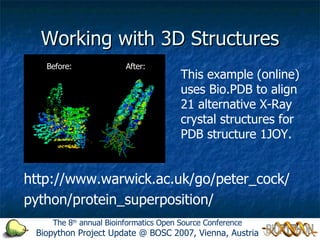
3D Structures Bio.PDB was added in Biopython 1.24 by Thomas Hamelryck Reads PDB and CIF format files The 8 th  annual Bioinformatics Open Source Conference Biopython Project Update @ BOSC 2007, Vienna, Austria
Working with 3D Structures http://www.warwick.ac.uk/go/peter_cock/ python/protein_superposition/ This example (online) uses Bio.PDB to align 21 alternative X-Ray crystal structures for PDB structure 1JOY. Before:  After: The 8 th  annual Bioinformatics Open Source Conference Biopython Project Update @ BOSC 2007, Vienna, Austria
Population Genetics  (planned) Tiago Antão (with Ralph Haygood) plans to start a Population Genetics module See also: PyPop: Python for Population Genetics Alex Lancaster  et al.  (2003) www.pypop.org The 8 th  annual Bioinformatics Open Source Conference Biopython Project Update @ BOSC 2007, Vienna, Austria
Areas for Improvement Documentation! I’m interested in sequences & alignments: Seq objects – more like strings? Alignment objects – more like arrays? SeqIO – support for more formats AlignIO? – alignment equivalent to SeqIO Move from Numeric to NumPy Move from CVS to SVN? The 8 th  annual Bioinformatics Open Source Conference Biopython Project Update @ BOSC 2007, Vienna, Austria
How can you Contribute? Users: Discussions on the mailing list Report bugs Documentation improvement Coders: Suggest bug fixes New/extended test cases Adopt modules with no current ‘owner’ New modules The 8 th  annual Bioinformatics Open Source Conference Biopython Project Update @ BOSC 2007, Vienna, Austria
Biopython Acknowledgements Open Bioinformatics Foundation or O|B|F for web hosting, CVS servers, mailing list Biopython developers, including: Jeff Chang, Andrew Dalke, Brad Chapman, Iddo  Friedberg ,  Michiel de Hoon, Frank Kauff, Cymon Cox, Thomas Hamelryck, me Contributors who report bugs & join in the mailing list discussions The 8 th  annual Bioinformatics Open Source Conference Biopython Project Update @ BOSC 2007, Vienna, Austria
Personal Acknowledgements Everyone for listening Open Bioinformatics Foundation or O|B|F for the BOSC 2007 invitation Iddo  Friedberg &   Michiel de Hoon for their encouragement The EPSRC for my PhD funding via the MOAC Doctoral Training Centre, Warwick http://www.warwick.ac.uk/go/moac The 8 th  annual Bioinformatics Open Source Conference Biopython Project Update @ BOSC 2007, Vienna, Austria
Questions? The 8 th  annual Bioinformatics Open Source Conference Biopython Project Update @ BOSC 2007, Vienna, Austria

Biopython

  • 1.
    The 8th annualBioinformatics Open Source Conference (BOSC 2007) 18 th July, Vienna, Austria Biopython Project Update Peter Cock, MOAC Doctoral Training Centre, University of Warwick, UK
  • 2.
    Talk Outline Whatis python? What is Biopython? Short history Project organisation What can you do with it? How can you contribute? Acknowledgements The 8 th annual Bioinformatics Open Source Conference Biopython Project Update @ BOSC 2007, Vienna, Austria
  • 3.
    What is Python?High level programming language Object orientated Open Source, free ($$$) Cross platform: Linux, Windows, Mac OS X, … Extensible in C, C++, … The 8 th annual Bioinformatics Open Source Conference Biopython Project Update @ BOSC 2007, Vienna, Austria
  • 4.
    What is Biopython?Set of libraries for computational biology Open Source, free ($$$) Cross platform: Linux, Windows, Mac OS X, … Sibling project to BioPerl, BioRuby, BioJava, … The 8 th annual Bioinformatics Open Source Conference Biopython Project Update @ BOSC 2007, Vienna, Austria
  • 5.
    Popularity by GoogleHits Python Perl Ruby Java 98 million 101 million 101 million 289 million Biopython BioPerl BioRuby BioJava 252,000 610,000 122,000 185,000 Both Perl and Python are strong at text Python may have the edge for numerical work (with the Numerical python libraries) The 8 th annual Bioinformatics Open Source Conference Biopython Project Update @ BOSC 2007, Vienna, Austria BioPerl 610,000
  • 6.
    Biopython history 1999: Started by Jeff Chang & Andrew Dalke 2000 : Biopython 0.90, first release 2001 : Biopython 1.00, “semi-complete” 2002 : Biopython 1.10, “semi-stable” 2003 : Biopython 1.20, 1.21, 1.22 and 1.23 2004 : Biopython 1.24 and 1.30 2005 : Biopython 1.40 and 1.41 2006 : Biopython 1.42 2007 : Biopython 1.43 The 8 th annual Bioinformatics Open Source Conference Biopython Project Update @ BOSC 2007, Vienna, Austria
  • 7.
    Biopython Project OrganisationReleases: No fixed schedule Currently once or twice a year Work from a stable CVS base Bugs: Online bugzilla Some small changes handled on mailing list Tests: Many based on unittest python library Also simple scripts where output is verified The 8 th annual Bioinformatics Open Source Conference Biopython Project Update @ BOSC 2007, Vienna, Austria
  • 8.
    What can youdo with Biopython? Read, write & manipulate sequences Restriction enzymes BLAST (local and online) Web databases (e.g. NCBI’s EUtils) Call command line tools (e.g. clustalw) Clustering (Bio.Cluster) Phylogenetics (Bio.Nexus) Protein Structures (Bio.PDB) The 8 th annual Bioinformatics Open Source Conference Biopython Project Update @ BOSC 2007, Vienna, Austria
  • 9.
    Manipulating Sequences UseBiopython’s Seq object, holds: Sequence data (string like) Alphabet (can include list of letters) Alphabet allows type checking, preventing errors like appending DNA to Protein The 8 th annual Bioinformatics Open Source Conference Biopython Project Update @ BOSC 2007, Vienna, Austria
  • 10.
    Manipulating Sequences fromBio.Seq import Seq from Bio.Alphabet.IUPAC import unambiguous_dna my_dna=Seq('CTAAACATCCTTCAT', unambiguous_dna) print 'Original:' print my_dna print 'Reverse complement:' print my_dna.reverse_complement() Original: Seq('CTAAACATCCTTCAT', IUPACUnambiguousDNA()) Reverse complement: Seq('ATGAAGGATGTTTAG', IUPACUnambiguousDNA()) The 8 th annual Bioinformatics Open Source Conference Biopython Project Update @ BOSC 2007, Vienna, Austria
  • 11.
    Translating Sequences fromBio import Translate bact_trans=Translate.unambiguous_dna_by_id[11] print 'Forward translation' print bact_trans.translate(my_dna) print 'Reverse complement translation' print bact_trans.translate( \ my_dna.reverse_complement()) Forward translation Seq('LNILH', HasStopCodon(IUPACProtein(), '*')) Reverse complement translation Seq('MKDV*', HasStopCodon(IUPACProtein(), '*')) The 8 th annual Bioinformatics Open Source Conference Biopython Project Update @ BOSC 2007, Vienna, Austria
  • 12.
    Sequence Input/Output Bio.SeqIOis new in Biopython 1.43 Inspired by BioPerl’s SeqIO Works with SeqRecord objects (not format specific representations) Builds on existing Biopython parsers The 8 th annual Bioinformatics Open Source Conference Biopython Project Update @ BOSC 2007, Vienna, Austria
  • 13.
    SeqIO – SequenceInput from Bio import SeqIO handle = open('ls_orchid.fasta') format = 'fasta' for rec in SeqIO.parse(handle, format) : print &quot;%s, len %i&quot; % (rec.id, len(rec.seq)) print rec.seq[:40].tostring() + &quot;...&quot; handle.close() gi|2765658|emb|Z78533.1|CIZ78533, len 740 CGTAACAAGGTTTCCGTAGGTGAACCTGCGGAAGGATCAT... gi|2765657|emb|Z78532.1|CCZ78532, len 753 CGTAACAAGGTTTCCGTAGGTGAACCTGCGGAAGGATCAT... ... The 8 th annual Bioinformatics Open Source Conference Biopython Project Update @ BOSC 2007, Vienna, Austria
  • 14.
    SeqIO – SequenceInput from Bio import SeqIO handle = open('ls_orchid.gbk') format = 'genbank' for rec in SeqIO.parse(handle, format) : print &quot;%s, len %i&quot; % (rec.id, len(rec.seq)) print rec.seq[:40].tostring() + &quot;...&quot; handle.close() The 8 th annual Bioinformatics Open Source Conference Biopython Project Update @ BOSC 2007, Vienna, Austria Z78533.1, len 740 CGTAACAAGGTTTCCGTAGGTGAACCTGCGGAAGGATCAT... Z78532.1, len 753 CGTAACAAGGTTTCCGTAGGTGAACCTGCGGAAGGATCAT... ...
  • 15.
    SeqIO – ExtractingData from Bio import SeqIO handle = open('ls_orchid.gbk') format = 'genbank' from sets import Set print Set([rec.annotations['organism'] \ for rec in SeqIO.parse(handle, format)]) handle.close() Set(['Cypripedium acaule', 'Paphiopedilum primulinum', 'Phragmipedium lindenii', 'Paphiopedilum papuanum', 'Paphiopedilum stonei', 'Paphiopedilum urbanianum', 'Paphiopedilum dianthum', ...]) The 8 th annual Bioinformatics Open Source Conference Biopython Project Update @ BOSC 2007, Vienna, Austria
  • 16.
    SeqIO – FilteringOutput i_handle = open('ls_orchid.gbk') o_handle = open('small_orchid.faa', 'w') SeqIO.write([rec for rec in \ SeqIO.parse(i_handle, 'genbank') \ if len(rec.seq) < 600], o_handle, 'fasta') i_handle.close() o_handle.close() >Z78481.1 P.insigne 5.8S rRNA gene and ITS1 ... CGTAACAAGGTTTCCGTAGGTGAACCTGCGGAAGGATCATTGTT... >Z78480.1 P.gratrixianum 5.8S rRNA gene and ... CGTAACAAGGTTTCCGTAGGTGAACCTGCGGAAGGATCATTGTT... ... The 8 th annual Bioinformatics Open Source Conference Biopython Project Update @ BOSC 2007, Vienna, Austria
  • 17.
    3D Structures Bio.Nexuswas added in Biopython 1.30 by Frank Kauff and Cymon Cox Reads Nexus alignments and trees Also parses Newick format trees The 8 th annual Bioinformatics Open Source Conference Biopython Project Update @ BOSC 2007, Vienna, Austria
  • 18.
    Newick Tree Parsing(Bovine:0.69395,(Gibbon:0.36079,(Orang:0.33636,(Gorilla:0.17147,(Chimp:0.19268, Human:0.11927):0.08386):0.06124):0.15057):0.54939,Mouse:1.21460):0.10; from Bio.Nexus.Trees import Tree tree_str = open(&quot;simple.tree&quot;).read() tree_obj = Tree(tree_str) print tree_obj tree a_tree = (Bovine,(Gibbon,(Orang,(Gorilla, (Chimp,Human)))),Mouse); The 8 th annual Bioinformatics Open Source Conference Biopython Project Update @ BOSC 2007, Vienna, Austria
  • 19.
    Newick Tree Parsing# taxon prev succ brlen blen (sum) support 0 - None [1,2,11] 0.0 0.0 - 1 Bovine 0 [] 0.69395 0.69395 - 2 - 0 [3,4] 0.54939 0.54939 - 3 Gibbon 2 [] 0.36079 0.91018 - 4 - 2 [5,6] 0.15057 0.69996 - 5 Orang 4 [] 0.33636 1.03632 - 6 - 4 [7,8] 0.06124 0.7612 - 7 Gorilla 6 [] 0.17147 0.93267 - 8 - 6 [9,10] 0.08386 0.84506 - 9 Chimp 8 [] 0.19268 1.03774 - 10 Human 8 [] 0.11927 0.96433 - 11 Mouse 0 [] 1.2146 1.2146 - Root: 0 tree_obj.display() The 8 th annual Bioinformatics Open Source Conference Biopython Project Update @ BOSC 2007, Vienna, Austria
  • 20.
    3D Structures Bio.PDBwas added in Biopython 1.24 by Thomas Hamelryck Reads PDB and CIF format files The 8 th annual Bioinformatics Open Source Conference Biopython Project Update @ BOSC 2007, Vienna, Austria
  • 21.
    Working with 3DStructures http://www.warwick.ac.uk/go/peter_cock/ python/protein_superposition/ This example (online) uses Bio.PDB to align 21 alternative X-Ray crystal structures for PDB structure 1JOY. Before: After: The 8 th annual Bioinformatics Open Source Conference Biopython Project Update @ BOSC 2007, Vienna, Austria
  • 22.
    Population Genetics (planned) Tiago Antão (with Ralph Haygood) plans to start a Population Genetics module See also: PyPop: Python for Population Genetics Alex Lancaster et al. (2003) www.pypop.org The 8 th annual Bioinformatics Open Source Conference Biopython Project Update @ BOSC 2007, Vienna, Austria
  • 23.
    Areas for ImprovementDocumentation! I’m interested in sequences & alignments: Seq objects – more like strings? Alignment objects – more like arrays? SeqIO – support for more formats AlignIO? – alignment equivalent to SeqIO Move from Numeric to NumPy Move from CVS to SVN? The 8 th annual Bioinformatics Open Source Conference Biopython Project Update @ BOSC 2007, Vienna, Austria
  • 24.
    How can youContribute? Users: Discussions on the mailing list Report bugs Documentation improvement Coders: Suggest bug fixes New/extended test cases Adopt modules with no current ‘owner’ New modules The 8 th annual Bioinformatics Open Source Conference Biopython Project Update @ BOSC 2007, Vienna, Austria
  • 25.
    Biopython Acknowledgements OpenBioinformatics Foundation or O|B|F for web hosting, CVS servers, mailing list Biopython developers, including: Jeff Chang, Andrew Dalke, Brad Chapman, Iddo Friedberg , Michiel de Hoon, Frank Kauff, Cymon Cox, Thomas Hamelryck, me Contributors who report bugs & join in the mailing list discussions The 8 th annual Bioinformatics Open Source Conference Biopython Project Update @ BOSC 2007, Vienna, Austria
  • 26.
    Personal Acknowledgements Everyonefor listening Open Bioinformatics Foundation or O|B|F for the BOSC 2007 invitation Iddo Friedberg & Michiel de Hoon for their encouragement The EPSRC for my PhD funding via the MOAC Doctoral Training Centre, Warwick http://www.warwick.ac.uk/go/moac The 8 th annual Bioinformatics Open Source Conference Biopython Project Update @ BOSC 2007, Vienna, Austria
  • 27.
    Questions? The 8th annual Bioinformatics Open Source Conference Biopython Project Update @ BOSC 2007, Vienna, Austria