BEHAVIOURAL SAFETY
QBE ISSUES FORUM MAY 2008
INTRODUCTION
BEHAVIOURAL SAFETY


“Promoting safe behaviour at work is a critical part of the management of health
& safety, because behaviour turns systems and procedures into reality”.1


It is estimated that in up to 80% of work related accidents the employee’s behaviour or their
acts or omissions is a contributing factor.
HSE research1 concluded that proprietary and in-house behavioural safety processes improve
safety when implemented effectively. One study reported an 85% improvement in accident rates.
Successful behavioural safety programmes require senior management commitment, suitable
resources and effective planning to ensure they fit in with your organisation’s culture and
health and safety management system.
QBE supports clients who decide to implement behavioural safety processes and this Issues
Forum discusses the key elements of successful behavioural safety programmes, with practical
advice on how to implement one and the pitfalls to avoid.


2

BEHAVIOURAL SAFETY QBE ISSUES FORUM MAY 2008
WHAT ARE BEHAVIOURAL
SAFETY PROGRAMMES?


Behaviour based safety programmes            Naturally, the support, commitment       HOW DO BEHAVIOURAL
tend to focus on the observable and          and competence of the management
                                                                                      SAFETY PROGRAMMES RELATE
measurable behaviours critical to            team will be critical to success.
safety at a particular facility. They        Introduced well, behavioural safety      TO HUMAN FACTORS AND
promote desired behaviours by                programmes should:                       HUMAN FAILURE?
introducing positive reinforcement
                                             • Engage significant workforce           Behavioural safety programmes are
and feedback for behaving safely.
                                               participation                          a proactive way to encourage desired
They should not be confused with
inspections and audits of the                • Improve management visibility          behaviours and should be considered
workplace for unsafe conditions.                                                      for introduction, once effective health
                                             • Target specific unsafe behaviours      and safety management systems are
Behavioural safety programmes should                                                  in place.
                                             • Collect behavioural safety
not be seen as a “quick fix” and prior
                                               observational data                     Within your health and safety
to any programme, organisations should
satisfy themselves that the key principles   • Use data to measure safety             management system you will have
of managing health and safety such as          performance and drive                  undertaken risk assessments and
policy; organisational arrangements;           improvements                           should have considered “human
planning and implementing; measuring                                                  factors” i.e. how do the demands and
                                             • Consider human factors within          ergonomics of the job; the attitude and
performance; auditing and review are
                                               safety improvements                    skill of the individual and the cultural
in place.
                                                                                      aspects of your organisation impact
                                             • Provide focussed feedback
                                                                                      on how the individual may behave?
                                               to all employees
                                                                                      If not managed effectively, these
                                             • Enable unsafe acts to be promptly
                                                                                      demands and influences may lead
                                               acted upon
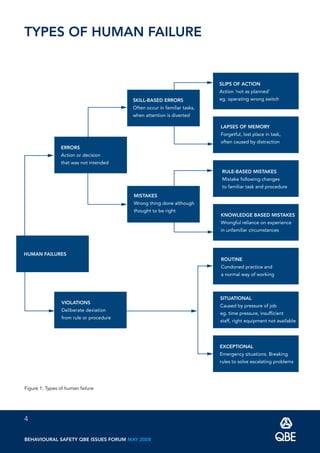
                                                                                      to the types of “human failure” or
                                             With a focus on observable practices     behaviour within figure 1.
                                             and targeting personal behaviour,
                                                                                      Whilst it is possible and desirable
                                             behavioural safety programmes may
                                                                                      to address these behaviours through
                                             be particularly effective at improving
                                                                                      effective assessment of the job, the
                                             use of personal protective equipment,
                                                                                      individual and your organisation, you
                                             use of correct tools, manual handling
                                                                                      should also consider these human
                                             techniques and improving slip/ trip
                                                                                      factors within any behavioural safety
                                             incidence through housekeeping etc.
                                                                                      programme you introduce.


3

BEHAVIOURAL SAFETY QBE ISSUES FORUM MAY 2008
TYPES OF HUMAN FAILURE


                                                                           SLIPS OF ACTION
                                                                           Action ‘not as planned’
                                          SKILL-BASED ERRORS               eg. operating wrong switch
                                          Often occur in familiar tasks,
                                          when attention is diverted

                                                                           LAPSES OF MEMORY
                                                                           Forgetful, lost place in task,
                                                                           often caused by distraction
                ERRORS
                Action or decision
                that was not intended
                                                                            RULE-BASED MISTAKES
                                                                            Mistake following changes
                                                                            to familiar task and procedure
                                          MISTAKES
                                          Wrong thing done although
                                          thought to be right
                                                                           KNOWLEDGE BASED MISTAKES
                                                                           Wrongful reliance on experience
                                                                           in unfamiliar circumstances


HUMAN FAILURES
                                                                           ROUTINE
                                                                           Condoned practice and
                                                                           a normal way of working


                                                                           SITUATIONAL
                 VIOLATIONS
                                                                           Caused by pressure of job
                 Deliberate deviation
                                                                           eg. time pressure, insufficient
                 from rule or procedure
                                                                           staff, right equipment not available


                                                                           EXCEPTIONAL
                                                                           Emergency situations. Breaking
                                                                           rules to solve escalating problems


Figure 1: Types of human failure


4

BEHAVIOURAL SAFETY QBE ISSUES FORUM MAY 2008
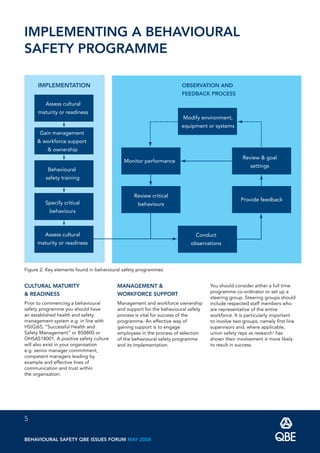
IMPLEMENTING A BEHAVIOURAL
SAFETY PROGRAMME

     IMPLEMENTATION                                                 OBSERVATION AND
                                                                    FEEDBACK PROCESS
         Assess cultural
     maturity or readiness
                                                                     Modify environment,
                                                                    equipment or systems
      Gain management
     & workforce support
          & ownership
                                                                                                Review & goal
                                           Monitor performance
                                                                                                   settings
          Behavioural
         safety training


                                                Review critical
                                                                                               Provide feedback
         Specify critical                         behaviours
           behaviours


         Assess cultural                                                   Conduct
     maturity or readiness                                              observations


Figure 2: Key elements found in behavioural safety programmes


CULTURAL MATURITY                       MANAGEMENT &                             You should consider either a full time
                                                                                 programme co-ordinator or set up a
& READINESS                             WORKFORCE SUPPORT
                                                                                 steering group. Steering groups should
Prior to commencing a behavioural       Management and workforce ownership       include respected staff members who
safety programme you should have        and support for the behavioural safety   are representative of the entire
an established health and safety        process is vital for success of the      workforce. It is particularly important
management system e.g. in line with     programme. An effective way of           to involve two groups, namely first line
HS(G)65, “Successful Health and         gaining support is to engage             supervisors and, where applicable,
Safety Management” or BS8800 or         employees in the process of selection    union safety reps as research1 has
OHSAS18001. A positive safety culture   of the behavioural safety programme      shown their involvement is more likely
will also exist in your organisation    and its implementation.                  to result in success.
e.g. senior manager commitment,
competent managers leading by
example and effective lines of
communication and trust within
the organisation.


5

BEHAVIOURAL SAFETY QBE ISSUES FORUM MAY 2008
BEHAVIOURAL
SAFETY TRAINING
Whatever programme you develop,
training in behavioural safety
techniques will be required. A training
plan for steering group members and
subsequent observers will need to be
developed. The nature of training
should include human factors,
identifying critical safety behaviours
and communication skills to assist with
individual and group feedback.

SPECIFYING CRITICAL
SAFETY BEHAVIOURS
Your behavioural safety programme
will define its objectives and identify
the critical safety behaviours (CSB)
                                          ESTABLISHING A BASELINE                   FEEDBACK
it will address.
                                          A baseline is often established during    Positive feedback is one of the most
Analysis of accident records can
                                          the initial period of observations to     important elements in the process as
identify the CSB that will have the
                                          establish the current level of safe       this is the positive consequence that is
greatest impact on reducing your
                                          behaviours for the critical behaviours    introduced to reinforce safe behaviour.
accident frequency. However, relying
                                          identified. This baseline is useful to    Positive reinforcement should be
solely on accident records has the
                                          measure the programme’s success           provided consistently over an
limitation that infrequent but CSB may
                                          in changing behaviour.                    extended period of time to ensure
be excluded. Your choice of CSB could
                                                                                    that safe behaviours become habit.
also be influenced by reviewing staff
turnover; absenteeism; task based risk
                                          OBSERVATIONS                              Effective feedback requires skill
assessments and safe operating            The frequency of observations and         and to be effective for the receiving
procedures; quality of workmanship;       numbers to be conducted will need         individual should be done soon after
near miss and dangerous occurrence        to be defined. Observations tend to       the observation. Positive feedback
reports; audit reports and discussion     be conducted by peers rather than by      such as “Excellent work John” can
with the workforce or feedback from       superiors. In general, proprietary and    be promoted openly but feedback
employee questionnaires.                  in house systems will create checklists   requesting the individual changes their
                                          for these observations to be recorded     behaviour is best done in private or
Once you have determined the CSB
                                                                                    could be perceived as punishment.
to be observed, checklists should         on. You should ensure that the
be developed, for completion by           behaviours are clearly described          Graphical feedback such as percentage
trained observers.                        to enable the observer to judge           of behaviours observed as safe should
                                          consistently whether someone is           be communicated to the workforce
                                          behaving safely or unsafely.              e.g. via meetings and notice boards.


6

BEHAVIOURAL SAFETY QBE ISSUES FORUM MAY 2008
GOAL SETTING AND REVIEW                  MODIFY ENVIRONMENT
                                HSE research1 indicated that goal        The observation and feedback process
                                setting increases the amount of          may identify unsafe conditions and
                                behavioural change. Goals need to        barriers to why the individual could
                                be realistic and achievable otherwise    not behave safely. Often these fall
                                people may become demotivated.           within the human failures listed above.
                                                                         This information should be collected
                                Some organisations link goal setting
                                                                         and used to review risk assessments,
                                to individual’s appraisals, bonuses
                                                                         followed by actions to create safe
                                and other safety incentive schemes.
                                                                         systems of work.
                                The nature of goal setting may include
                                                                         Prompt feedback to staff on the status/
                                the required level of participation
                                                                         timescale of such improvements is vital
                                and number of observations to be
                                                                         to maintain staff commitment to the
                                conducted and targets for improving
                                                                         programme. To ensure such actions
                                the percentage of observed safe
                                                                         are implemented there will need to
                                behaviours.
                                                                         be suitable senior management
                                                                         commitment and adequate resources
                                                                         allocated to the programme.

                                                                         MONITOR PERFORMANCE
                                                                         Monitoring improvements in the
                                                                         percentage of safe observations
                                                                         can demonstrate the success of the
                                                                         programme. Where improvements
                                                                         are not being made it is important
                                                                         to investigate this behaviour in detail
                                                                         to identify what barriers exist to
                                                                         behaving safely and to identify
                                                                         the improvements required.

                                                                         REVIEW LIST OF
                                                                         CRITICAL BEHAVIOURS
                                                                         The list of critical behaviours should
                                                                         be revised periodically with new
                                                                         behaviours added or existing ones
                                                                         replaced. This can be done by periodic
                                                                         review of your accident records or
                                                                         following a period when a critical
                                                                         behaviour has become habit and
                                                                         is consistently observed as safe.


7

BEHAVIOURAL SAFETY QBE ISSUES FORUM MAY 2008
PITFALLS TO AVOID                         REFERENCES/ FURTHER                     AUTHOR BIOGRAPHY
With effective planning and               READING                                 Jon Lawrence, Risk Manager
implementation your behavioural           1Strategies to promote safe behaviour   Jon Lawrence joined QBE in 2001 and
safety programme should be a success.     as part of a health and safety          has over 20 years experience within
Some common pitfalls that you will        management system (Contract             the insurance industry primarily in the
need to address include:                  research report 430/2002)               field of liability risk management.
• Lack of senior management               Download at:                            Jon specialises in health and safety
  commitment                              www.hse.gov.uk/research/crr_htm/        management systems and assists
                                          2002/crr02430.htm                       clients to reduce their risk exposures
• Adverse behaviour created by
                                          Reducing error and influencing          and to mitigate potential losses. He
  insufficient risk assessment and
                                          behaviour HS(G)48                       is a Chartered Safety and Health
  creation of unrealistic rules and
                                          HSE Books www.hsebooks.co.uk            Practitioner and member of IOSH.
  safety procedures
                                          HSE Website                             QBE
• The programme is not “owned”
  by everyone in the organisation         www.hse.gov.uk/humanfactors             Plantation Place,
                                                                                  30 Fenchurch Street,
• Insufficient trust between              Behavioural Safety – Kicking bad
                                          Habits (IOSH)                           London,
  management and employees
                                          Download at:                            EC3M 3BD
• Some “off the peg” or consultant        www.iosh.co.uk/files/technical/         t: + 44 (0)20 7105 4000
  led programmes may not fit well         Behaviouralsafety%2Epdf                 f: + 44 (0)20 7105 4019
  with your organisation’s culture
                                                                                  enquiries@uk.qbe.com
• Ensure the system is in your own
                                                                                  www.QBEeurope.com
  management style, language and
  presentation
• Observational feedback not seen
  as fair and just
• Workforce concerns over “spying”
  or perception of a blame culture

CONCLUSION
Behavioural safety programmes can be
an effective tool for reducing accident
frequency.
They will require a concerted effort
from both managers and employees
and therefore it is essential that
suitable planning and resource is
allocated prior to the commencement
of any programme.


8

BEHAVIOURAL SAFETY QBE ISSUES FORUM MAY 2008
Dear reader
           Thank you for taking the trouble to read this publication.
           QBE Risk Management believe that best practice organisations are those where senior individuals
           facilitate and engage in the processes of sensible risk management. We make this document available to
           all interest parties in an effort to share knowledge and promote good practise.
           Our services are available only to clients insured by QBE in Europe. Our insurance products are sold
           through insurance brokers. We cannot offer advisory services to anyone else, however we would be
           delighted to hear if you have found this document useful or believe there are risk management issues that
           do not receive appropriate attention in the media.
           Regards
           QBE Risk Management Team
           email: RM@uk.qbe.com
           www.QBEeurope.com/RM


           Disclaimer
           This document has been produced by QBE Insurance (Europe) Limited (“QIEL”). QIEL is a company member of the
           QBE Insurance Group.
           Readership of this Forum does not create an insurer-client, advisor-client, or other business or legal relationship.
           This Forum provides information about the law to help you understand and manage risk within your organisation.
           Legal information is not the same as legal advice.
           This Forum does not purport to provide a definitive statement of the law and is not intended to replace, nor may it be
           relied upon as a substitute for specific legal or other professional advice.
           QIEL has acted in good faith to provide an accurate Forum. However, QIEL and the QBE Group do not make any
           warranties or representations of any kind about the contents of this Forum, the accuracy or timeliness of its contents,
           or the information or explanations (if any) given.
           QIEL and the QBE Group do not have any duty to you, whether in contract, tort, under statute or otherwise with
           respect to or in connection with this Forum or the information contained within it. QIEL and the QBE Group have no
           obligation to update this report or any information contained within it.
           To the fullest extent permitted by law, QIEL and the QBE Group disclaim any responsibility or liability for any loss or
           damage suffered or cost incurred by you or by any other person arising out of or in connection with your or any other
           person’s reliance on this Report or on the information contained within it and for any omissions or inaccuracies.


                                                                                                                                       QBE European Operations
                                                                                                                                                               Plantation Place
                                                                                                                                                           30 Fenchurch Street
                                                                                                                                                                        London
                                                                                                                                                                    EC3M 3BD
                                                                                                                                                      tel +44 (0)20 7105 4000
                                                                                                                                                     fax +44 (0)20 7105 4019


QBE European Operations is a trading name of QBE Insurance (Europe) Limited, no.01761561 ('QIEL'), QBE Underwriting Limited, no. 01035198 ('QUL'), QBE Management Services (UK)
Limited, no. 03153567 ('QMSUK') and QBE Underwriting Services (UK) Limited, no. 02262145 ('QSUK'), whose registered offices are at Plantation Place, 30 Fenchurch Street, London, EC3M
3BD. All four companies are incorporated in England and Wales. QIEL and QUL are authorised and regulated by the Financial Services Authority. QUL is a Lloyd's managing agent. QMSUK
and QSUK are both Appointed Representatives of QIEL and QUL.

Behavioural Safety Issues Forum

  • 1.
  • 2.
    INTRODUCTION BEHAVIOURAL SAFETY “Promoting safebehaviour at work is a critical part of the management of health & safety, because behaviour turns systems and procedures into reality”.1 It is estimated that in up to 80% of work related accidents the employee’s behaviour or their acts or omissions is a contributing factor. HSE research1 concluded that proprietary and in-house behavioural safety processes improve safety when implemented effectively. One study reported an 85% improvement in accident rates. Successful behavioural safety programmes require senior management commitment, suitable resources and effective planning to ensure they fit in with your organisation’s culture and health and safety management system. QBE supports clients who decide to implement behavioural safety processes and this Issues Forum discusses the key elements of successful behavioural safety programmes, with practical advice on how to implement one and the pitfalls to avoid. 2 BEHAVIOURAL SAFETY QBE ISSUES FORUM MAY 2008
  • 3.
    WHAT ARE BEHAVIOURAL SAFETYPROGRAMMES? Behaviour based safety programmes Naturally, the support, commitment HOW DO BEHAVIOURAL tend to focus on the observable and and competence of the management SAFETY PROGRAMMES RELATE measurable behaviours critical to team will be critical to success. safety at a particular facility. They Introduced well, behavioural safety TO HUMAN FACTORS AND promote desired behaviours by programmes should: HUMAN FAILURE? introducing positive reinforcement • Engage significant workforce Behavioural safety programmes are and feedback for behaving safely. participation a proactive way to encourage desired They should not be confused with inspections and audits of the • Improve management visibility behaviours and should be considered workplace for unsafe conditions. for introduction, once effective health • Target specific unsafe behaviours and safety management systems are Behavioural safety programmes should in place. • Collect behavioural safety not be seen as a “quick fix” and prior observational data Within your health and safety to any programme, organisations should satisfy themselves that the key principles • Use data to measure safety management system you will have of managing health and safety such as performance and drive undertaken risk assessments and policy; organisational arrangements; improvements should have considered “human planning and implementing; measuring factors” i.e. how do the demands and • Consider human factors within ergonomics of the job; the attitude and performance; auditing and review are safety improvements skill of the individual and the cultural in place. aspects of your organisation impact • Provide focussed feedback on how the individual may behave? to all employees If not managed effectively, these • Enable unsafe acts to be promptly demands and influences may lead acted upon to the types of “human failure” or With a focus on observable practices behaviour within figure 1. and targeting personal behaviour, Whilst it is possible and desirable behavioural safety programmes may to address these behaviours through be particularly effective at improving effective assessment of the job, the use of personal protective equipment, individual and your organisation, you use of correct tools, manual handling should also consider these human techniques and improving slip/ trip factors within any behavioural safety incidence through housekeeping etc. programme you introduce. 3 BEHAVIOURAL SAFETY QBE ISSUES FORUM MAY 2008
  • 4.
    TYPES OF HUMANFAILURE SLIPS OF ACTION Action ‘not as planned’ SKILL-BASED ERRORS eg. operating wrong switch Often occur in familiar tasks, when attention is diverted LAPSES OF MEMORY Forgetful, lost place in task, often caused by distraction ERRORS Action or decision that was not intended RULE-BASED MISTAKES Mistake following changes to familiar task and procedure MISTAKES Wrong thing done although thought to be right KNOWLEDGE BASED MISTAKES Wrongful reliance on experience in unfamiliar circumstances HUMAN FAILURES ROUTINE Condoned practice and a normal way of working SITUATIONAL VIOLATIONS Caused by pressure of job Deliberate deviation eg. time pressure, insufficient from rule or procedure staff, right equipment not available EXCEPTIONAL Emergency situations. Breaking rules to solve escalating problems Figure 1: Types of human failure 4 BEHAVIOURAL SAFETY QBE ISSUES FORUM MAY 2008
  • 5.
    IMPLEMENTING A BEHAVIOURAL SAFETYPROGRAMME IMPLEMENTATION OBSERVATION AND FEEDBACK PROCESS Assess cultural maturity or readiness Modify environment, equipment or systems Gain management & workforce support & ownership Review & goal Monitor performance settings Behavioural safety training Review critical Provide feedback Specify critical behaviours behaviours Assess cultural Conduct maturity or readiness observations Figure 2: Key elements found in behavioural safety programmes CULTURAL MATURITY MANAGEMENT & You should consider either a full time programme co-ordinator or set up a & READINESS WORKFORCE SUPPORT steering group. Steering groups should Prior to commencing a behavioural Management and workforce ownership include respected staff members who safety programme you should have and support for the behavioural safety are representative of the entire an established health and safety process is vital for success of the workforce. It is particularly important management system e.g. in line with programme. An effective way of to involve two groups, namely first line HS(G)65, “Successful Health and gaining support is to engage supervisors and, where applicable, Safety Management” or BS8800 or employees in the process of selection union safety reps as research1 has OHSAS18001. A positive safety culture of the behavioural safety programme shown their involvement is more likely will also exist in your organisation and its implementation. to result in success. e.g. senior manager commitment, competent managers leading by example and effective lines of communication and trust within the organisation. 5 BEHAVIOURAL SAFETY QBE ISSUES FORUM MAY 2008
  • 6.
    BEHAVIOURAL SAFETY TRAINING Whatever programmeyou develop, training in behavioural safety techniques will be required. A training plan for steering group members and subsequent observers will need to be developed. The nature of training should include human factors, identifying critical safety behaviours and communication skills to assist with individual and group feedback. SPECIFYING CRITICAL SAFETY BEHAVIOURS Your behavioural safety programme will define its objectives and identify the critical safety behaviours (CSB) ESTABLISHING A BASELINE FEEDBACK it will address. A baseline is often established during Positive feedback is one of the most Analysis of accident records can the initial period of observations to important elements in the process as identify the CSB that will have the establish the current level of safe this is the positive consequence that is greatest impact on reducing your behaviours for the critical behaviours introduced to reinforce safe behaviour. accident frequency. However, relying identified. This baseline is useful to Positive reinforcement should be solely on accident records has the measure the programme’s success provided consistently over an limitation that infrequent but CSB may in changing behaviour. extended period of time to ensure be excluded. Your choice of CSB could that safe behaviours become habit. also be influenced by reviewing staff turnover; absenteeism; task based risk OBSERVATIONS Effective feedback requires skill assessments and safe operating The frequency of observations and and to be effective for the receiving procedures; quality of workmanship; numbers to be conducted will need individual should be done soon after near miss and dangerous occurrence to be defined. Observations tend to the observation. Positive feedback reports; audit reports and discussion be conducted by peers rather than by such as “Excellent work John” can with the workforce or feedback from superiors. In general, proprietary and be promoted openly but feedback employee questionnaires. in house systems will create checklists requesting the individual changes their for these observations to be recorded behaviour is best done in private or Once you have determined the CSB could be perceived as punishment. to be observed, checklists should on. You should ensure that the be developed, for completion by behaviours are clearly described Graphical feedback such as percentage trained observers. to enable the observer to judge of behaviours observed as safe should consistently whether someone is be communicated to the workforce behaving safely or unsafely. e.g. via meetings and notice boards. 6 BEHAVIOURAL SAFETY QBE ISSUES FORUM MAY 2008
  • 7.
    GOAL SETTING ANDREVIEW MODIFY ENVIRONMENT HSE research1 indicated that goal The observation and feedback process setting increases the amount of may identify unsafe conditions and behavioural change. Goals need to barriers to why the individual could be realistic and achievable otherwise not behave safely. Often these fall people may become demotivated. within the human failures listed above. This information should be collected Some organisations link goal setting and used to review risk assessments, to individual’s appraisals, bonuses followed by actions to create safe and other safety incentive schemes. systems of work. The nature of goal setting may include Prompt feedback to staff on the status/ the required level of participation timescale of such improvements is vital and number of observations to be to maintain staff commitment to the conducted and targets for improving programme. To ensure such actions the percentage of observed safe are implemented there will need to behaviours. be suitable senior management commitment and adequate resources allocated to the programme. MONITOR PERFORMANCE Monitoring improvements in the percentage of safe observations can demonstrate the success of the programme. Where improvements are not being made it is important to investigate this behaviour in detail to identify what barriers exist to behaving safely and to identify the improvements required. REVIEW LIST OF CRITICAL BEHAVIOURS The list of critical behaviours should be revised periodically with new behaviours added or existing ones replaced. This can be done by periodic review of your accident records or following a period when a critical behaviour has become habit and is consistently observed as safe. 7 BEHAVIOURAL SAFETY QBE ISSUES FORUM MAY 2008
  • 8.
    PITFALLS TO AVOID REFERENCES/ FURTHER AUTHOR BIOGRAPHY With effective planning and READING Jon Lawrence, Risk Manager implementation your behavioural 1Strategies to promote safe behaviour Jon Lawrence joined QBE in 2001 and safety programme should be a success. as part of a health and safety has over 20 years experience within Some common pitfalls that you will management system (Contract the insurance industry primarily in the need to address include: research report 430/2002) field of liability risk management. • Lack of senior management Download at: Jon specialises in health and safety commitment www.hse.gov.uk/research/crr_htm/ management systems and assists 2002/crr02430.htm clients to reduce their risk exposures • Adverse behaviour created by Reducing error and influencing and to mitigate potential losses. He insufficient risk assessment and behaviour HS(G)48 is a Chartered Safety and Health creation of unrealistic rules and HSE Books www.hsebooks.co.uk Practitioner and member of IOSH. safety procedures HSE Website QBE • The programme is not “owned” by everyone in the organisation www.hse.gov.uk/humanfactors Plantation Place, 30 Fenchurch Street, • Insufficient trust between Behavioural Safety – Kicking bad Habits (IOSH) London, management and employees Download at: EC3M 3BD • Some “off the peg” or consultant www.iosh.co.uk/files/technical/ t: + 44 (0)20 7105 4000 led programmes may not fit well Behaviouralsafety%2Epdf f: + 44 (0)20 7105 4019 with your organisation’s culture enquiries@uk.qbe.com • Ensure the system is in your own www.QBEeurope.com management style, language and presentation • Observational feedback not seen as fair and just • Workforce concerns over “spying” or perception of a blame culture CONCLUSION Behavioural safety programmes can be an effective tool for reducing accident frequency. They will require a concerted effort from both managers and employees and therefore it is essential that suitable planning and resource is allocated prior to the commencement of any programme. 8 BEHAVIOURAL SAFETY QBE ISSUES FORUM MAY 2008
  • 9.
    Dear reader Thank you for taking the trouble to read this publication. QBE Risk Management believe that best practice organisations are those where senior individuals facilitate and engage in the processes of sensible risk management. We make this document available to all interest parties in an effort to share knowledge and promote good practise. Our services are available only to clients insured by QBE in Europe. Our insurance products are sold through insurance brokers. We cannot offer advisory services to anyone else, however we would be delighted to hear if you have found this document useful or believe there are risk management issues that do not receive appropriate attention in the media. Regards QBE Risk Management Team email: RM@uk.qbe.com www.QBEeurope.com/RM Disclaimer This document has been produced by QBE Insurance (Europe) Limited (“QIEL”). QIEL is a company member of the QBE Insurance Group. Readership of this Forum does not create an insurer-client, advisor-client, or other business or legal relationship. This Forum provides information about the law to help you understand and manage risk within your organisation. Legal information is not the same as legal advice. This Forum does not purport to provide a definitive statement of the law and is not intended to replace, nor may it be relied upon as a substitute for specific legal or other professional advice. QIEL has acted in good faith to provide an accurate Forum. However, QIEL and the QBE Group do not make any warranties or representations of any kind about the contents of this Forum, the accuracy or timeliness of its contents, or the information or explanations (if any) given. QIEL and the QBE Group do not have any duty to you, whether in contract, tort, under statute or otherwise with respect to or in connection with this Forum or the information contained within it. QIEL and the QBE Group have no obligation to update this report or any information contained within it. To the fullest extent permitted by law, QIEL and the QBE Group disclaim any responsibility or liability for any loss or damage suffered or cost incurred by you or by any other person arising out of or in connection with your or any other person’s reliance on this Report or on the information contained within it and for any omissions or inaccuracies. QBE European Operations Plantation Place 30 Fenchurch Street London EC3M 3BD tel +44 (0)20 7105 4000 fax +44 (0)20 7105 4019 QBE European Operations is a trading name of QBE Insurance (Europe) Limited, no.01761561 ('QIEL'), QBE Underwriting Limited, no. 01035198 ('QUL'), QBE Management Services (UK) Limited, no. 03153567 ('QMSUK') and QBE Underwriting Services (UK) Limited, no. 02262145 ('QSUK'), whose registered offices are at Plantation Place, 30 Fenchurch Street, London, EC3M 3BD. All four companies are incorporated in England and Wales. QIEL and QUL are authorised and regulated by the Financial Services Authority. QUL is a Lloyd's managing agent. QMSUK and QSUK are both Appointed Representatives of QIEL and QUL.