USING BEHAVIORISM TO
ENHANCE TEACHING
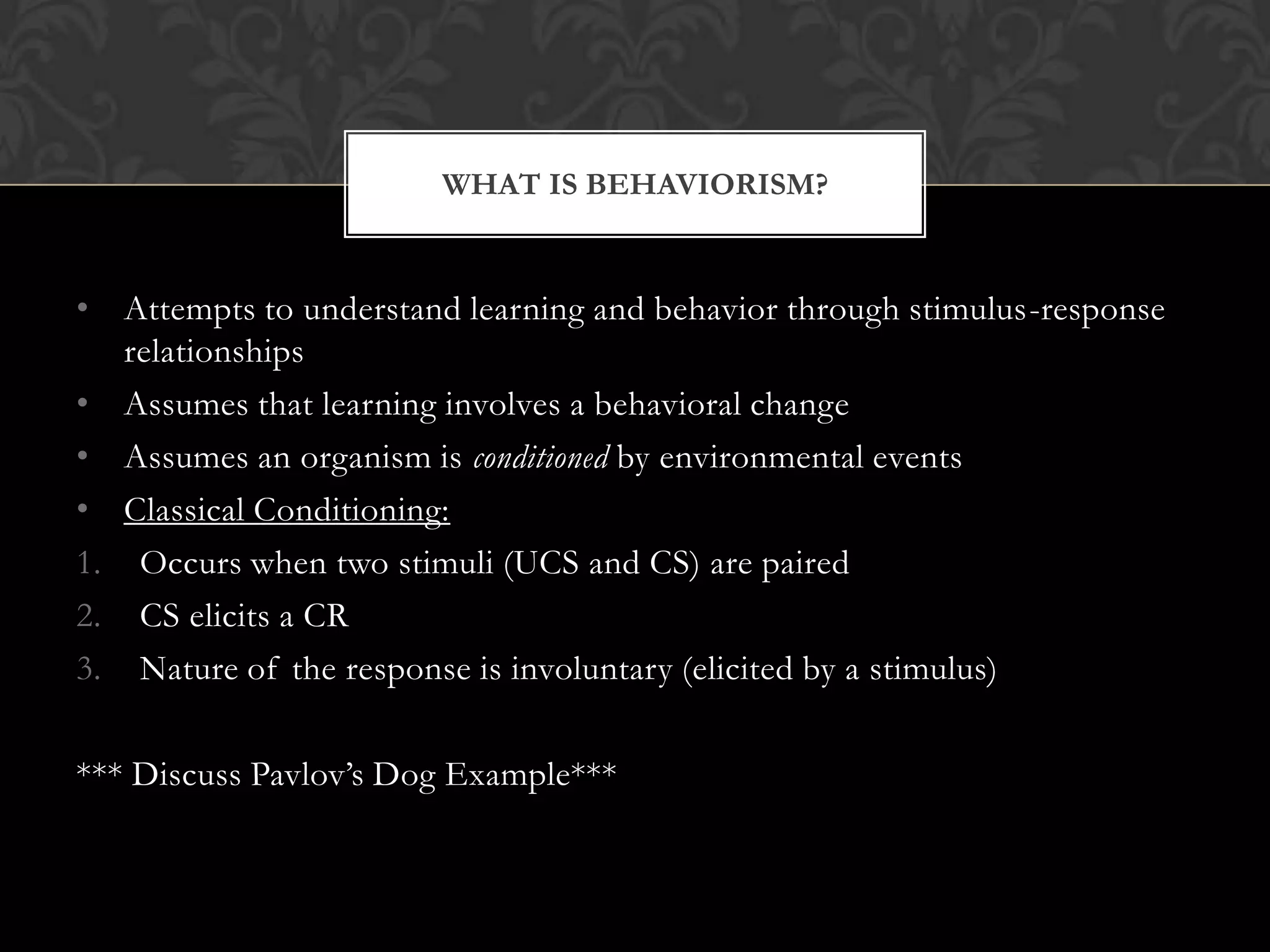
• Attempts to understand learning and behavior through stimulus-response
relationships
• Assumes that learning involves a behavioral change
• Assumes an organism is conditioned by environmental events
• Classical Conditioning:
1. Occurs when two stimuli (UCS and CS) are paired
2. CS elicits a CR
3. Nature of the response is involuntary (elicited by a stimulus)
*** Discuss Pavlov’s Dog Example***
WHAT IS BEHAVIORISM?
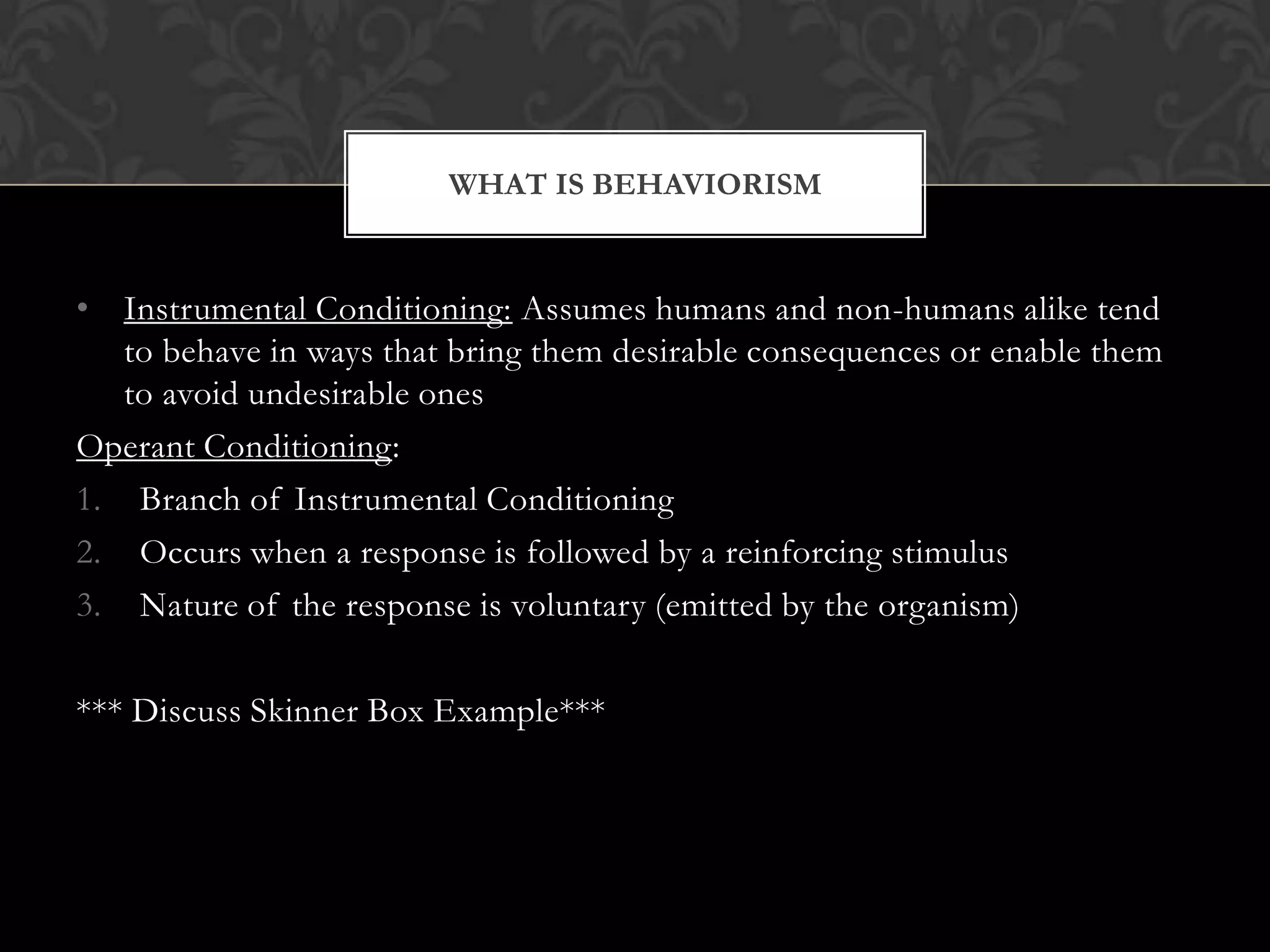
• Instrumental Conditioning: Assumes humans and non-humans alike tend
to behave in ways that bring them desirable consequences or enable them
to avoid undesirable ones
Operant Conditioning:
1. Branch of Instrumental Conditioning
2. Occurs when a response is followed by a reinforcing stimulus
3. Nature of the response is voluntary (emitted by the organism)
*** Discuss Skinner Box Example***
WHAT IS BEHAVIORISM
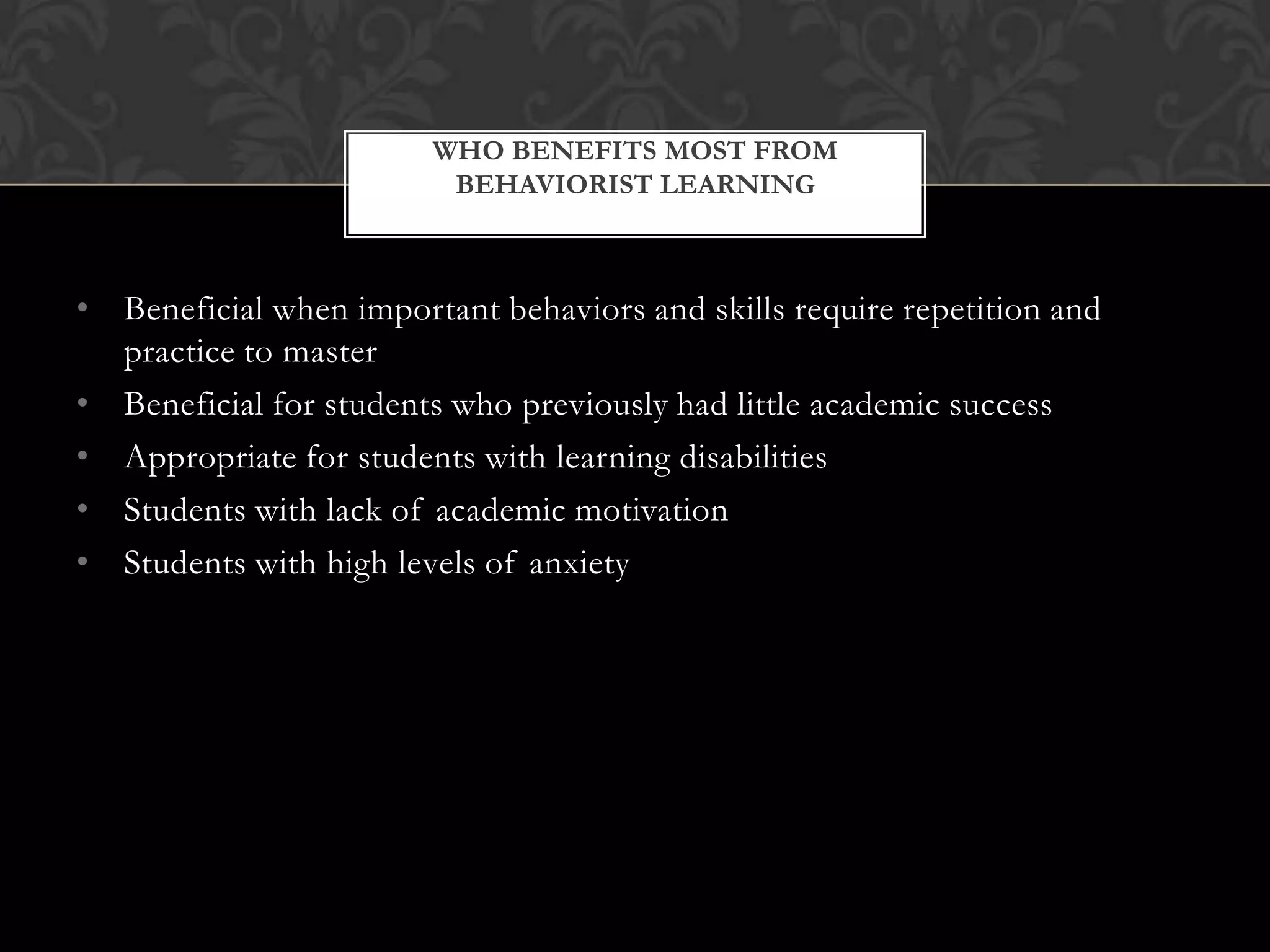
• Beneficial when important behaviors and skills require repetition and
practice to master
• Beneficial for students who previously had little academic success
• Appropriate for students with learning disabilities
• Students with lack of academic motivation
• Students with high levels of anxiety
WHO BENEFITS MOST FROM
BEHAVIORIST LEARNING
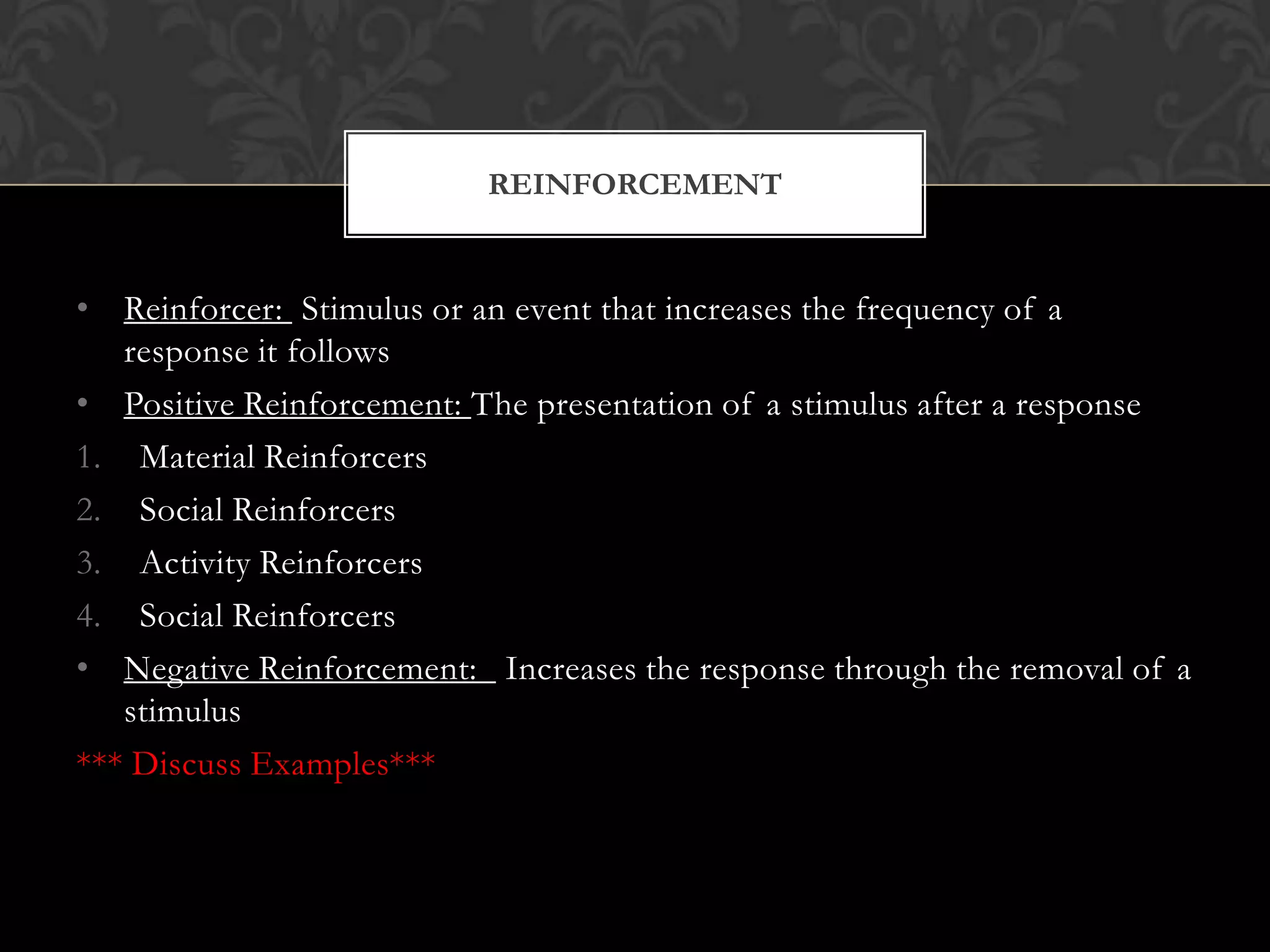
• Reinforcer: Stimulus or an event that increases the frequency of a
response it follows
• Positive Reinforcement: The presentation of a stimulus after a response
1. Material Reinforcers
2. Social Reinforcers
3. Activity Reinforcers
4. Social Reinforcers
• Negative Reinforcement: Increases the response through the removal of a
stimulus
*** Discuss Examples***
REINFORCEMENT
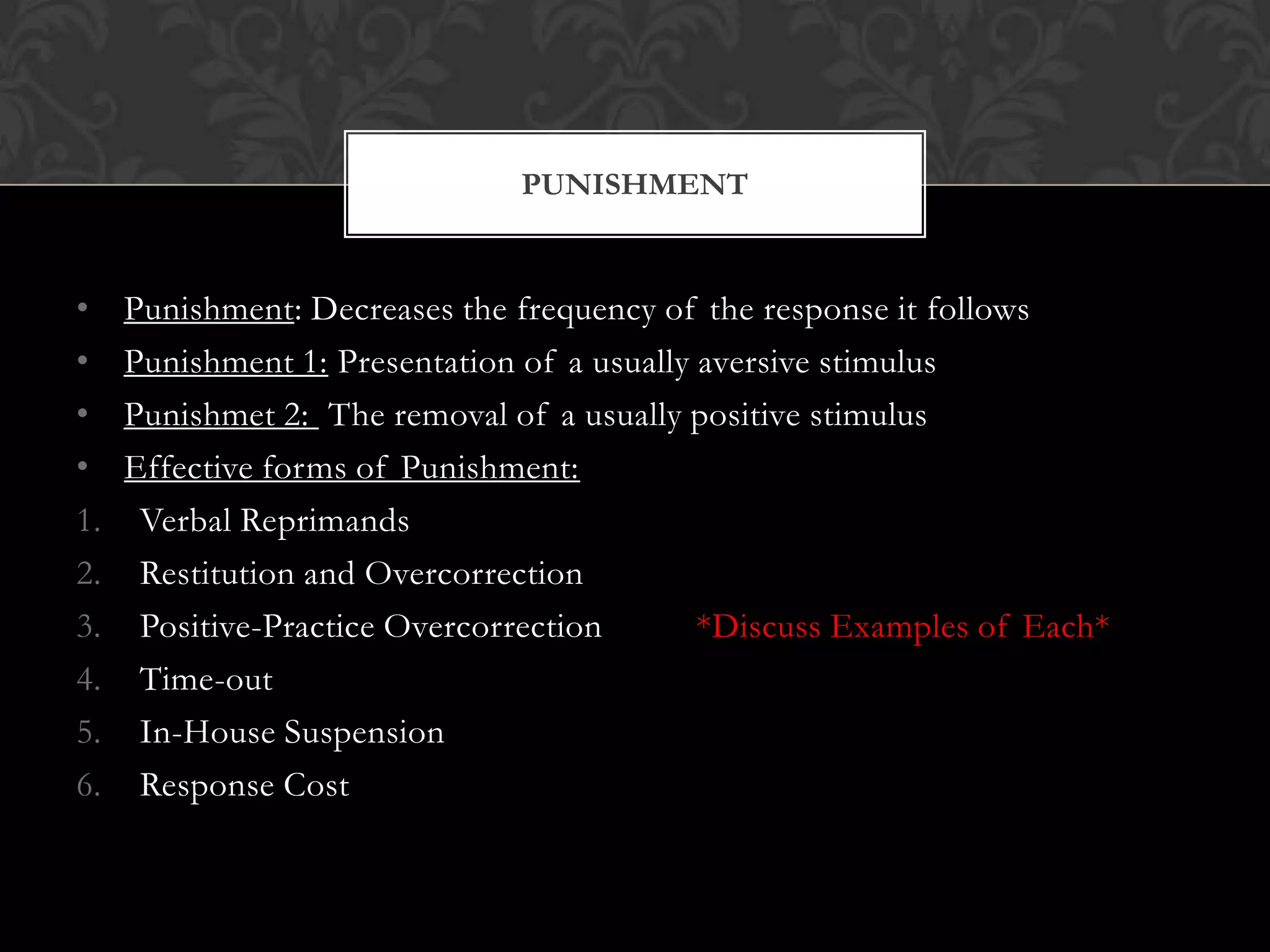
• Punishment: Decreases the frequency of the response it follows
• Punishment 1: Presentation of a usually aversive stimulus
• Punishmet 2: The removal of a usually positive stimulus
• Effective forms of Punishment:
1. Verbal Reprimands
2. Restitution and Overcorrection
3. Positive-Practice Overcorrection *Discuss Examples of Each*
4. Time-out
5. In-House Suspension
6. Response Cost
PUNISHMENT
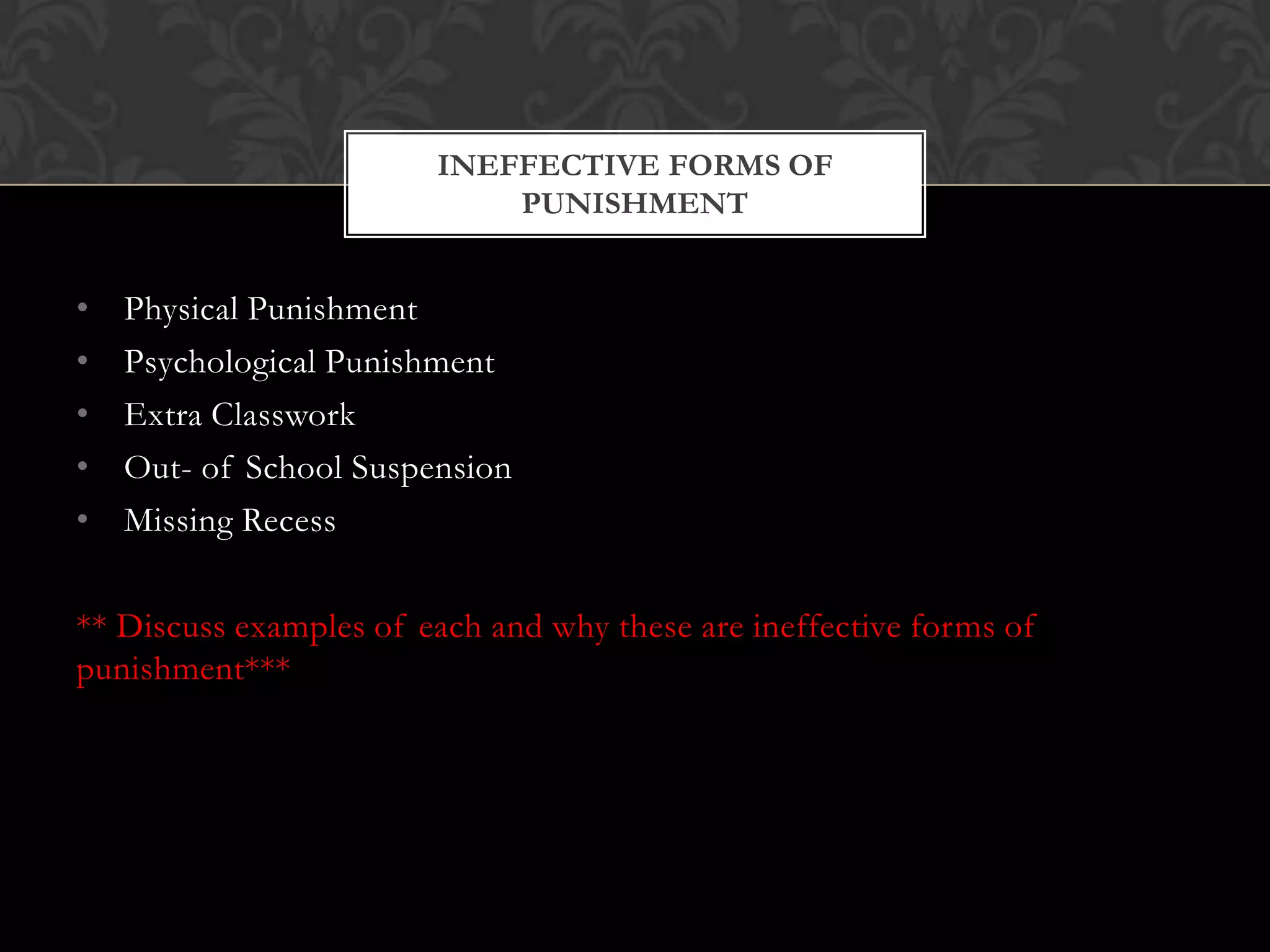
• Physical Punishment
• Psychological Punishment
• Extra Classwork
• Out- of School Suspension
• Missing Recess
** Discuss examples of each and why these are ineffective forms of
punishment***
INEFFECTIVE FORMS OF
PUNISHMENT
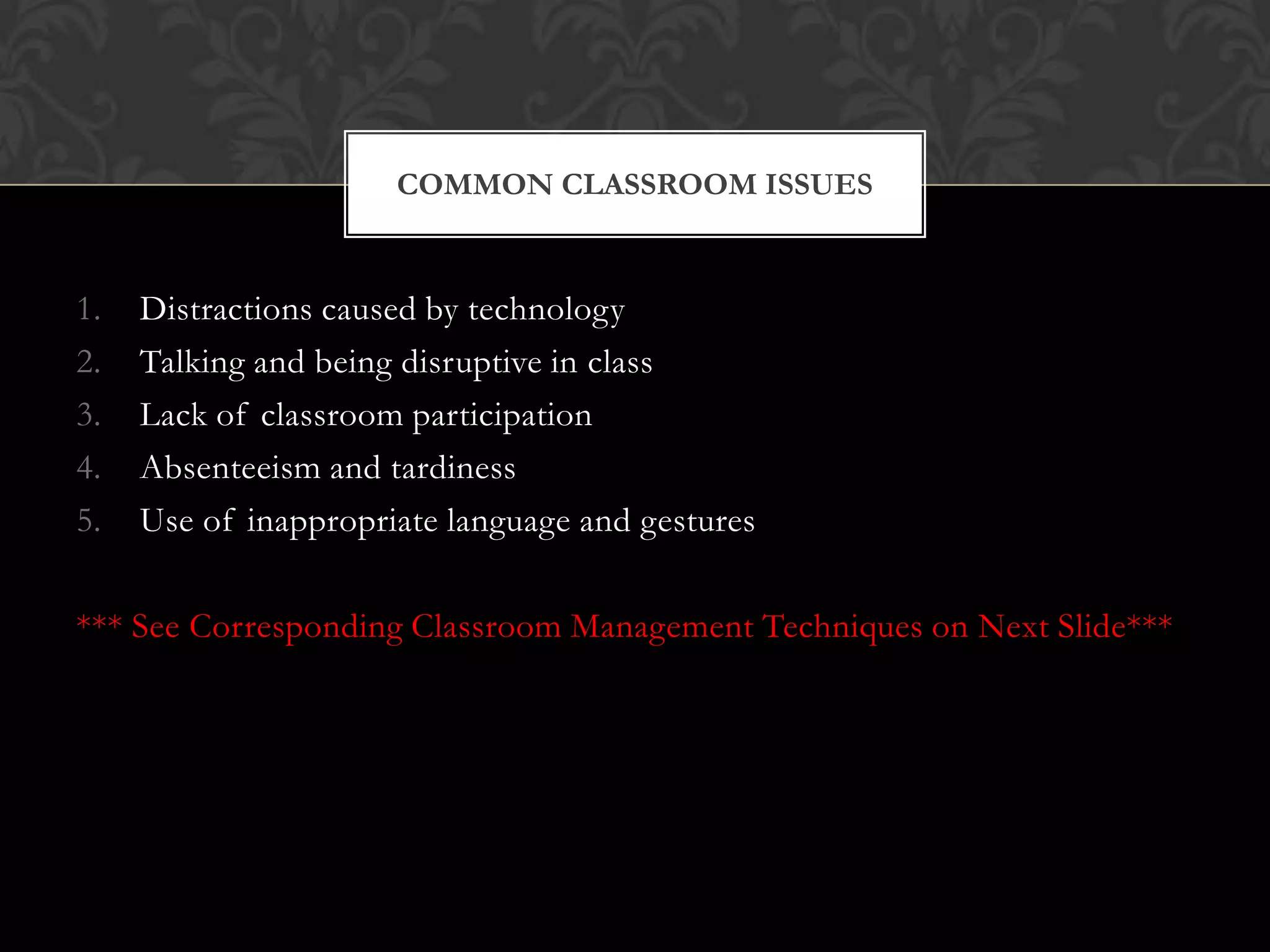
1. Distractions caused by technology
2. Talking and being disruptive in class
3. Lack of classroom participation
4. Absenteeism and tardiness
5. Use of inappropriate language and gestures
*** See Corresponding Classroom Management Techniques on Next Slide***
COMMON CLASSROOM ISSUES
• 1. Group Contingency Strategies- To reduce excessive technology
usage, strategies involving group contingency may be helpful. For
example, reinforcement such as bonus points are awarded only after all
students put away their cell phones until after class.
• 2. Negative Reinforcement and/or punishment for inappropriate
talking, positive reinforcement for appropriate participation
• 3. Positive Reinforcement (non verbal gestures, praise, bonus
points), Shaping, Chaining
• 4. Extinction of possible fear responses, response cost, reinforcement
• 5. Response cost, Reinforcement
• *** Discuss Examples/ Define Terms***
COMMON CLASSROOM ISSUES
What is Mastery Learning?
1. An approach to instruction in which students must learn the material in
one lesson to a high level of proficiency before proceeding to the next
lesson.
2. Using shaping- simple responses reinforced until it is mastered and then
more difficult responses are reinforced until mastered
*** Discuss components of mastery learning p. 106-107***
3. “Research indicates that mastery learning facilitates student learning and
often leads to higher achievement than more traditional instruction” (p. 108)
STRUCTURING THE CLASSROOM
• Behaviorism emphasizes the importance of tracking progress of learning
in a manner that can be measured as objectively as possible
• The importance of setting appropriate goals and objectives is paramount
• Goals: Define the overall purpose of the training in broad, general terms
and do not usually provide guidance on how to achieve them
• Objectives: Statement of what the learner will know, understand, or be
able to do as a result of engaging in learning activity.
TRACKING EDUCATIONAL AND
BEHAVIORAL PROGRESS
SMART stands for:
Specific
Measurable ***Come up with Examples***
Attainable/Achievable
Relevant
Time Bound
Getting Started
To develop SMART objectives, use the template below and fill in the blanks:
By_____/_____/_____, ____________________________________________
_______
[WHEN—Time bound] [WHO/WHAT—Specific]
from _____________________ to
__________________________________________
[MEASURE (
number, rate, percentage of change and baseline)—Measurable
SMART OBJECTIVES
• Appropriate for students with behaviors that are severe enough to interfere
with adaptive learning and require regular intervention. This form of
intervention is typically used for children on the Autistic Spectrum
• Target behaviors are identified which are the focus of the intervention
strategies
• ABCs- Environmental factors that occur before the behaviors are
identified, (antecedents), as are the responses that the individual makes to
these factors (behaviors) as well as the consequences of engaging in those
identified behavior
• Functional Analysis- Data is collected that looks for patterns of the
behavior or specific events that seem to trigger the behaviors
APPLIED BEHAVIOR ANALYSIS
• Center for Disease Control and Prevention. (2011, September 2). Smart Objectives. Retrieved from Division for Heart Disease and
Stroke Prevention: www.cdc.gov
• Chang, H. N., Romero, M., & National Center for Children in, P. (2008). Present, Engaged, and Accounted for: The Critical
Importance of Addressing Chronic Absence in the Early Grades. Executive Summary. Report. National Center For Children In
Poverty,
• Czekanski, K. E., & Wolf, Z. (2013). Encouraging and Evaluating Class Participation. Journal Of University Teaching And Learning
Practice, 10(1),
• Duncan, D. K., Hoekstra, A. R., & Wilcox, B. R. (2012). Digital Devices, Distraction, and Student Performance: Does In-Class Cell
Phone Use Reduce Learning?. Astronomy Education Review, 11(1), 010108-1-010108-4.
• Epstein, J. L., & Center for Research on Elementary and Middle Schools, B. D. (1988). Homework Practices, Achievements, and
Behaviors of Elementary School Students. Report No. 26.
• Froese, A. D., Carpenter, C. N., Inman, D. A., Schooley, J. R., Barnes, R. B., Brecht, P. W., & Chacon, J. D. (2012). Effects of
Classroom Cell Phone Use on Expected and Actual Learning. College Student Journal, 46(2), 323-332.
• Greenberg, P. (2004). Setting Limits: The Child Who Uses Inappropriate Language. Early Childhood Today, 19(2), 18-19.
• Guinee, W. (2012). Encouraging Classroom Participation with Empty Extrinsic Rewards. College Teaching, 60(2), 83.
• International Training and Education Center for Health. (2010, January). I-Tech Technical Implementation Guide #4: Writing Good
Learning Objectives.
• Jay, T. (1997). When Young Children Use Profanity: How to Handle Cursing and Name Calling. Early Childhood News, 9(3), 6-8,11-
13.
• Ormod, J. E. (2012). Human Learning (6th ed.). Pearson Education, Inc.
• Parsonson, B. S. (2012). Evidence-Based Classroom Behaviour Management Strategies. Kairaranga, 13(1), 16-23.
• Reid, K. (2006). Raising School Attendance: A Case Study of Good Practice in Monitoring and Raising Standards. Quality Assurance
In Education: An International Perspective, 14(3), 199-216.
REFERENCES

Pbl behaviorist outline (xl edit)

  • 1.
  • 2.
    • Attempts tounderstand learning and behavior through stimulus-response relationships • Assumes that learning involves a behavioral change • Assumes an organism is conditioned by environmental events • Classical Conditioning: 1. Occurs when two stimuli (UCS and CS) are paired 2. CS elicits a CR 3. Nature of the response is involuntary (elicited by a stimulus) *** Discuss Pavlov’s Dog Example*** WHAT IS BEHAVIORISM?
  • 3.
    • Instrumental Conditioning:Assumes humans and non-humans alike tend to behave in ways that bring them desirable consequences or enable them to avoid undesirable ones Operant Conditioning: 1. Branch of Instrumental Conditioning 2. Occurs when a response is followed by a reinforcing stimulus 3. Nature of the response is voluntary (emitted by the organism) *** Discuss Skinner Box Example*** WHAT IS BEHAVIORISM
  • 4.
    • Beneficial whenimportant behaviors and skills require repetition and practice to master • Beneficial for students who previously had little academic success • Appropriate for students with learning disabilities • Students with lack of academic motivation • Students with high levels of anxiety WHO BENEFITS MOST FROM BEHAVIORIST LEARNING
  • 5.
    • Reinforcer: Stimulusor an event that increases the frequency of a response it follows • Positive Reinforcement: The presentation of a stimulus after a response 1. Material Reinforcers 2. Social Reinforcers 3. Activity Reinforcers 4. Social Reinforcers • Negative Reinforcement: Increases the response through the removal of a stimulus *** Discuss Examples*** REINFORCEMENT
  • 6.
    • Punishment: Decreasesthe frequency of the response it follows • Punishment 1: Presentation of a usually aversive stimulus • Punishmet 2: The removal of a usually positive stimulus • Effective forms of Punishment: 1. Verbal Reprimands 2. Restitution and Overcorrection 3. Positive-Practice Overcorrection *Discuss Examples of Each* 4. Time-out 5. In-House Suspension 6. Response Cost PUNISHMENT
  • 7.
    • Physical Punishment •Psychological Punishment • Extra Classwork • Out- of School Suspension • Missing Recess ** Discuss examples of each and why these are ineffective forms of punishment*** INEFFECTIVE FORMS OF PUNISHMENT
  • 8.
    1. Distractions causedby technology 2. Talking and being disruptive in class 3. Lack of classroom participation 4. Absenteeism and tardiness 5. Use of inappropriate language and gestures *** See Corresponding Classroom Management Techniques on Next Slide*** COMMON CLASSROOM ISSUES
  • 9.
    • 1. GroupContingency Strategies- To reduce excessive technology usage, strategies involving group contingency may be helpful. For example, reinforcement such as bonus points are awarded only after all students put away their cell phones until after class. • 2. Negative Reinforcement and/or punishment for inappropriate talking, positive reinforcement for appropriate participation • 3. Positive Reinforcement (non verbal gestures, praise, bonus points), Shaping, Chaining • 4. Extinction of possible fear responses, response cost, reinforcement • 5. Response cost, Reinforcement • *** Discuss Examples/ Define Terms*** COMMON CLASSROOM ISSUES
  • 10.
    What is MasteryLearning? 1. An approach to instruction in which students must learn the material in one lesson to a high level of proficiency before proceeding to the next lesson. 2. Using shaping- simple responses reinforced until it is mastered and then more difficult responses are reinforced until mastered *** Discuss components of mastery learning p. 106-107*** 3. “Research indicates that mastery learning facilitates student learning and often leads to higher achievement than more traditional instruction” (p. 108) STRUCTURING THE CLASSROOM
  • 11.
    • Behaviorism emphasizesthe importance of tracking progress of learning in a manner that can be measured as objectively as possible • The importance of setting appropriate goals and objectives is paramount • Goals: Define the overall purpose of the training in broad, general terms and do not usually provide guidance on how to achieve them • Objectives: Statement of what the learner will know, understand, or be able to do as a result of engaging in learning activity. TRACKING EDUCATIONAL AND BEHAVIORAL PROGRESS
  • 12.
    SMART stands for: Specific Measurable***Come up with Examples*** Attainable/Achievable Relevant Time Bound Getting Started To develop SMART objectives, use the template below and fill in the blanks: By_____/_____/_____, ____________________________________________ _______ [WHEN—Time bound] [WHO/WHAT—Specific] from _____________________ to __________________________________________ [MEASURE ( number, rate, percentage of change and baseline)—Measurable SMART OBJECTIVES
  • 13.
    • Appropriate forstudents with behaviors that are severe enough to interfere with adaptive learning and require regular intervention. This form of intervention is typically used for children on the Autistic Spectrum • Target behaviors are identified which are the focus of the intervention strategies • ABCs- Environmental factors that occur before the behaviors are identified, (antecedents), as are the responses that the individual makes to these factors (behaviors) as well as the consequences of engaging in those identified behavior • Functional Analysis- Data is collected that looks for patterns of the behavior or specific events that seem to trigger the behaviors APPLIED BEHAVIOR ANALYSIS
  • 14.
    • Center forDisease Control and Prevention. (2011, September 2). Smart Objectives. Retrieved from Division for Heart Disease and Stroke Prevention: www.cdc.gov • Chang, H. N., Romero, M., & National Center for Children in, P. (2008). Present, Engaged, and Accounted for: The Critical Importance of Addressing Chronic Absence in the Early Grades. Executive Summary. Report. National Center For Children In Poverty, • Czekanski, K. E., & Wolf, Z. (2013). Encouraging and Evaluating Class Participation. Journal Of University Teaching And Learning Practice, 10(1), • Duncan, D. K., Hoekstra, A. R., & Wilcox, B. R. (2012). Digital Devices, Distraction, and Student Performance: Does In-Class Cell Phone Use Reduce Learning?. Astronomy Education Review, 11(1), 010108-1-010108-4. • Epstein, J. L., & Center for Research on Elementary and Middle Schools, B. D. (1988). Homework Practices, Achievements, and Behaviors of Elementary School Students. Report No. 26. • Froese, A. D., Carpenter, C. N., Inman, D. A., Schooley, J. R., Barnes, R. B., Brecht, P. W., & Chacon, J. D. (2012). Effects of Classroom Cell Phone Use on Expected and Actual Learning. College Student Journal, 46(2), 323-332. • Greenberg, P. (2004). Setting Limits: The Child Who Uses Inappropriate Language. Early Childhood Today, 19(2), 18-19. • Guinee, W. (2012). Encouraging Classroom Participation with Empty Extrinsic Rewards. College Teaching, 60(2), 83. • International Training and Education Center for Health. (2010, January). I-Tech Technical Implementation Guide #4: Writing Good Learning Objectives. • Jay, T. (1997). When Young Children Use Profanity: How to Handle Cursing and Name Calling. Early Childhood News, 9(3), 6-8,11- 13. • Ormod, J. E. (2012). Human Learning (6th ed.). Pearson Education, Inc. • Parsonson, B. S. (2012). Evidence-Based Classroom Behaviour Management Strategies. Kairaranga, 13(1), 16-23. • Reid, K. (2006). Raising School Attendance: A Case Study of Good Practice in Monitoring and Raising Standards. Quality Assurance In Education: An International Perspective, 14(3), 199-216. REFERENCES