2003 Performance Appraisal – Part II
Behavioral Assessment Form - Individual Contributor
Page 1
Instructions: Rate each competency according to the following definitions.
Manager: Use this assessment in conjunction with business results to determine overall rating.
Colleague: Use this form for your personal assessment.
Peer/Customer/Direct Report: Use this form…
Examples of key behaviors can be found at http://people.attws.com/Career/PPR/Competencies/IndividualContributor.html
Colleague Information
Name: AWID:
Job Title: Date:
Department: Manager:
Definitions
Role Model The competency represents a true strength for this individual; it is an area in which he/she excels. Behaviors
associated with the competency significantly contribute to effective work performance and enhance team
performance. The individual may act as a role model, coaching and guiding others to develop their effectiveness in
performing the behaviors associated with the competency.
Proficient The individual demonstrates sufficient proficiency in the competency to complete expected job responsibilities.
His/her behavior consistently contributes to effective work performance. He/she may have an occasional need for
coaching and guidance.
Developing The behaviors associated with this competency may be new to the individual and his/her skills may need nurturing.
Or, these behaviors may not be expected for a person in his/her current role. In either case, his/her behaviors do not
consistently contribute to team performance or they have a neutral impact. The individual usually requires coaching
and guidance.
Behavioral Assessment
Role Model Proficient Developing
Adaptability
Maintains effectiveness when experiencing major changes in work tasks or the work environment; adjusting effectively to work within new
work structures, processes, requirements, or cultures.
Key Behaviors
 Quickly modifies behavior to deal effectively with changes in the
work environment
 Readily tries new approaches appropriate for new or changed
situations; does not persist with ineffective behaviors.
 Treats change and new situations as opportunities for learning
or growth
 Focuses on the beneficial aspects of change; speaks positively
about the change to others.
 Tries to understand changes in work tasks, situations, and
environment as well as the logic or basis for change
 Actively seeks information about new work situations.
Behaviors to improve/leverage:
Role Model Proficient Developing
Contributing to Team Success
Actively participates as a member of a team to move the team toward the completion of goals.
Key Behaviors
 Adheres to the team’s expectations and guidelines; fulfills team
responsibilities.
 Demonstrates personal commitment to the team.
 Listens to and fully involves others in team decisions and
actions.
 Values and uses individual differences and talents.
 Makes procedural or process suggestions for achieving team
goals or performing team functions.
 Provides necessary resources to help to remove obstacles to
help the team accomplish its goals. Shares important or
relevant information with the team.
Behaviors to improve/leverage:
2003 Performance Appraisal – Part II
Behavioral Assessment Form - Individual Contributor
Page 2
Behavioral Assessment
Role Model Proficient Developing
Decision Making
Identifies and understands issues; problems, and opportunities; compares data from different sources to draw conclusions; uses effective
approaches for choosing a course of action or developing appropriate solutions.
Key Behaviors
 Includes others in the decision-making process as warranted to
obtain good information, make the most appropriate decisions,
and ensure buy-in and understanding of the resulting decisions.
 Formulates clear decision criteria; evaluates options by
considering implications and consequences; chooses an
effective option.
 Identifies the need for and collects information to better
understand issues, problems, and opportunities.
 Creates relevant options for addressing problems/opportunities
and achieving desired outcomes.
 Recognizes issues, problems, or opportunities and determines
whether action is needed.
 Integrates information from a variety of sources; detects trends,
associations, and cause-effect relationships.
 Makes decisions within a reasonable time.
Behaviors to improve/leverage:
Role Model Proficient Developing
Building Partnerships
Identifies opportunities and takes action to build strategic relationships between one’s area and other areas, teams, departments, units, or
organizations to help achieve business goals.
Key Behaviors
 Analyzes the organization and own area to identify key
relationships that should be initiated or improved to further the
attainment of own area’s goals.
 Collaboratively determines courses of action to realize mutual
goals; facilitates agreement on each partner’s responsibilities
and needed support.
 Exchanges information with potential partner areas to clarify
partnership benefits and potential problems.
 Collaboratively determines the scope and expectations of the
partnership so that both areas’ needs can be met.
 Implements effective means for monitoring and evaluating the
partnership process and the attainment of mutual goals.
 Places higher priority on organization’s goals than on own
area’s goals.
 Anticipates effects of own area’s actions and decisions on
partners.
 Influences others to support partnership objectives.
Behaviors to improve/leverage:
Role Model Proficient Developing
Communication
Clearly conveys information and ideas through a variety of media to individuals or groups in a manner that engages the audience and helps
them understand and retain the message.
Key Behaviors
 Attends to messages from others; correctly interprets messages
and responds appropriately.
 Clarifies purpose and importance; stresses major points; follows
a logical sequence.
 Frames messages in line with audience experience,
background, and expectations.
 Uses terms, examples, and analogies that are meaningful to the
audience.
 Keeps the audience engaged through use of techniques such
as analogies, illustrations, body language, and voice inflection.
 Seeks input from audience; checks understanding; presents
message in different ways to enhance understanding.
 Uses syntax, pace, volume, diction, and mechanics appropriate
to the media being used.
Behaviors to improve/leverage:
Role Model Proficient Developing
Customer Focus
Makes customers and their needs a primary focus of one’s actions; develops and sustains productive customer relationships.
Key Behaviors
 Actively seeks information to understand customers’
circumstances, problems, expectations, and needs.
 Shares information with customers to build their understanding
of issues and capabilities.
 Builds rapport and cooperative relationships with customers.  Considers how actions or plans will affect customers.
 Responds quickly to meet customer needs and resolve
problems
 Implements effective ways to monitor and evaluate customer
concerns, issues, and satisfaction.
 Avoids over commitments.
Behaviors to improve/leverage:
2003 Performance Appraisal – Part II
Behavioral Assessment Form - Individual Contributor
Page 3
Behavioral Assessment
Role Model Proficient Developing
Technical/Professional Knowledge
Has achieved a satisfactory level of technical and professional skill or knowledge in position-related areas; keeps up with current
developments and trends in areas of expertise.
Key Behaviors
 Understands technical terminology and developments.  Knows how to apply a technical skill or procedure.
 Knows when to apply a technical skill or procedure.  Performs complex tasks in area of expertise.
Behaviors to improve/leverage:
Overall Rating
Role Model Proficient Developing

Behavioral Assessment Form

  • 1.
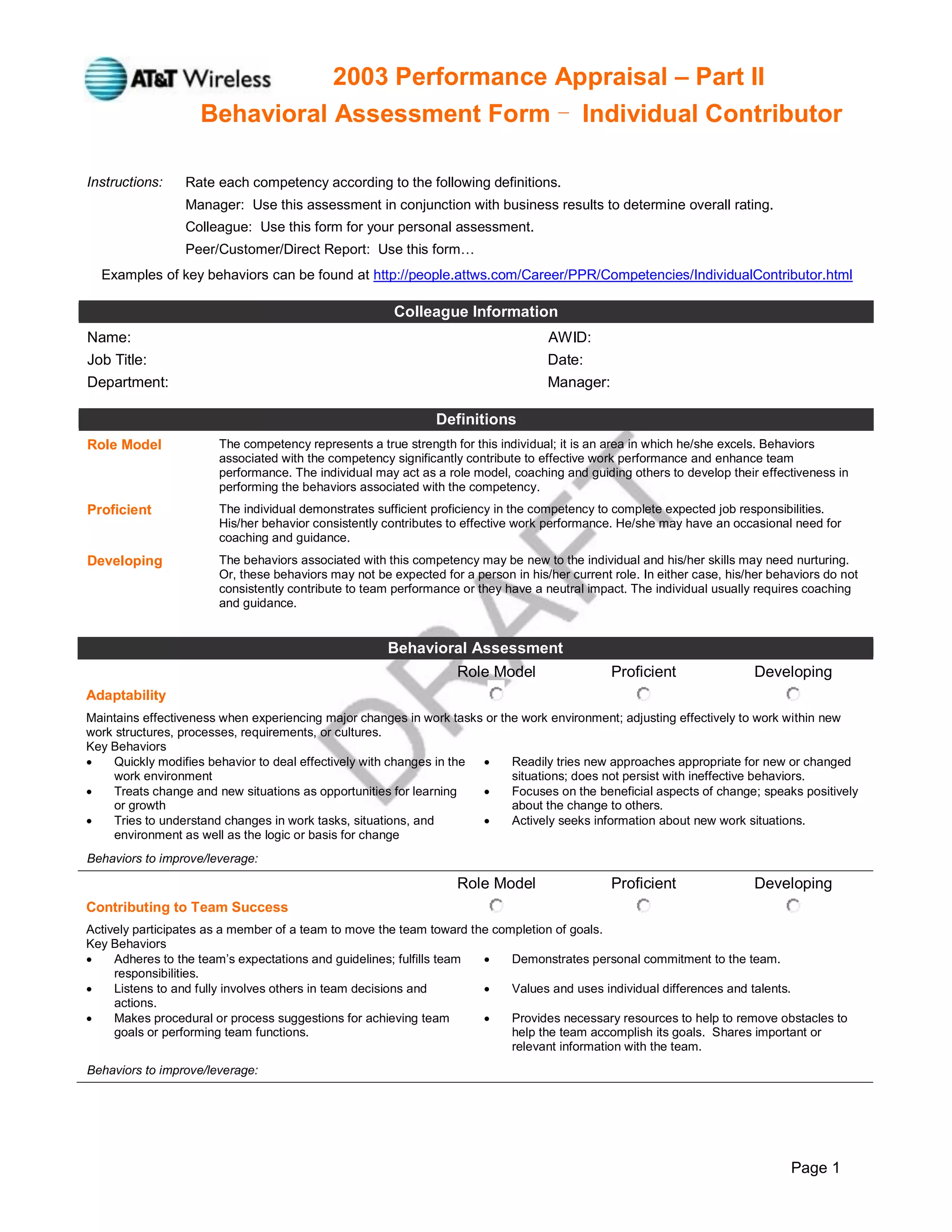
    2003 Performance Appraisal– Part II Behavioral Assessment Form - Individual Contributor Page 1 Instructions: Rate each competency according to the following definitions. Manager: Use this assessment in conjunction with business results to determine overall rating. Colleague: Use this form for your personal assessment. Peer/Customer/Direct Report: Use this form… Examples of key behaviors can be found at http://people.attws.com/Career/PPR/Competencies/IndividualContributor.html Colleague Information Name: AWID: Job Title: Date: Department: Manager: Definitions Role Model The competency represents a true strength for this individual; it is an area in which he/she excels. Behaviors associated with the competency significantly contribute to effective work performance and enhance team performance. The individual may act as a role model, coaching and guiding others to develop their effectiveness in performing the behaviors associated with the competency. Proficient The individual demonstrates sufficient proficiency in the competency to complete expected job responsibilities. His/her behavior consistently contributes to effective work performance. He/she may have an occasional need for coaching and guidance. Developing The behaviors associated with this competency may be new to the individual and his/her skills may need nurturing. Or, these behaviors may not be expected for a person in his/her current role. In either case, his/her behaviors do not consistently contribute to team performance or they have a neutral impact. The individual usually requires coaching and guidance. Behavioral Assessment Role Model Proficient Developing Adaptability Maintains effectiveness when experiencing major changes in work tasks or the work environment; adjusting effectively to work within new work structures, processes, requirements, or cultures. Key Behaviors  Quickly modifies behavior to deal effectively with changes in the work environment  Readily tries new approaches appropriate for new or changed situations; does not persist with ineffective behaviors.  Treats change and new situations as opportunities for learning or growth  Focuses on the beneficial aspects of change; speaks positively about the change to others.  Tries to understand changes in work tasks, situations, and environment as well as the logic or basis for change  Actively seeks information about new work situations. Behaviors to improve/leverage: Role Model Proficient Developing Contributing to Team Success Actively participates as a member of a team to move the team toward the completion of goals. Key Behaviors  Adheres to the team’s expectations and guidelines; fulfills team responsibilities.  Demonstrates personal commitment to the team.  Listens to and fully involves others in team decisions and actions.  Values and uses individual differences and talents.  Makes procedural or process suggestions for achieving team goals or performing team functions.  Provides necessary resources to help to remove obstacles to help the team accomplish its goals. Shares important or relevant information with the team. Behaviors to improve/leverage:
  • 2.
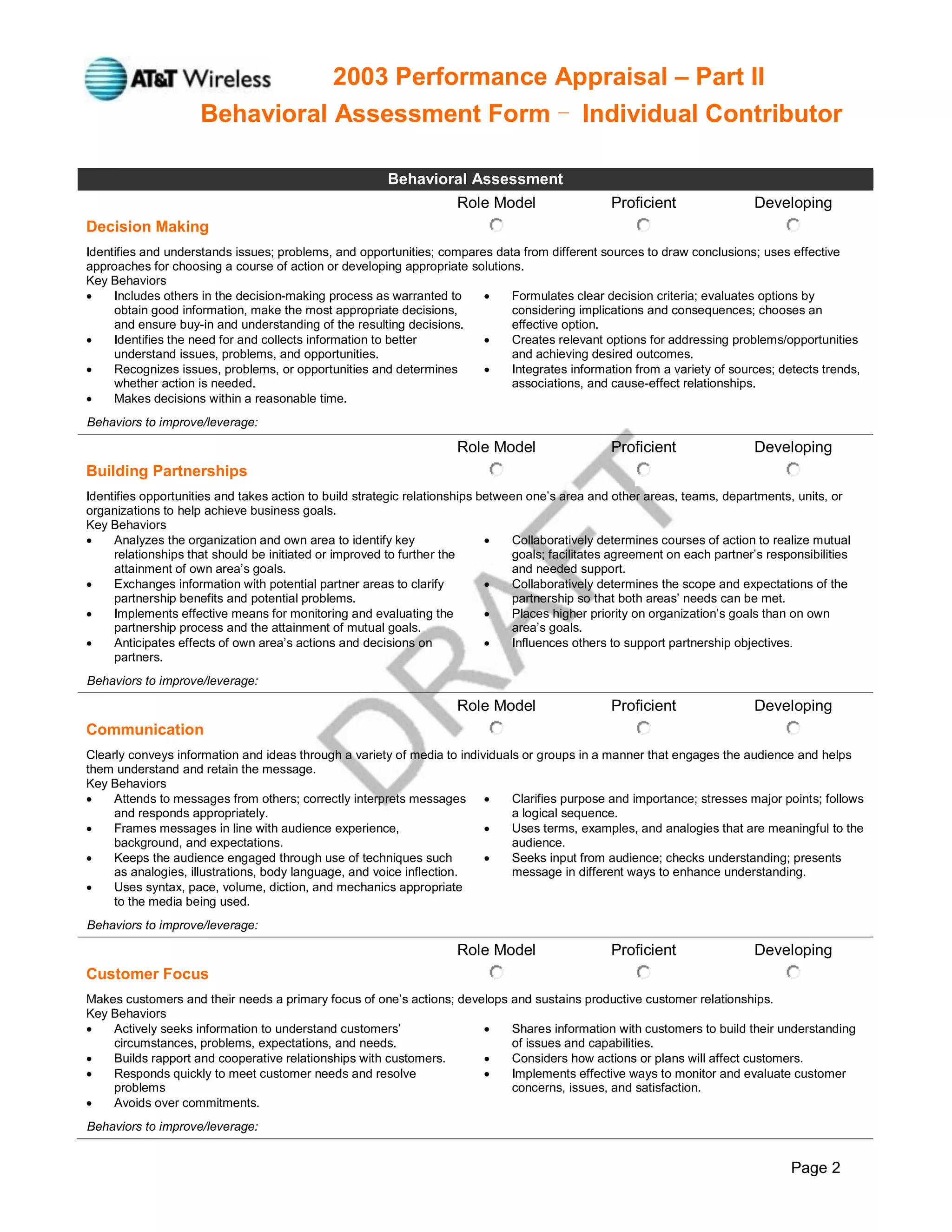
    2003 Performance Appraisal– Part II Behavioral Assessment Form - Individual Contributor Page 2 Behavioral Assessment Role Model Proficient Developing Decision Making Identifies and understands issues; problems, and opportunities; compares data from different sources to draw conclusions; uses effective approaches for choosing a course of action or developing appropriate solutions. Key Behaviors  Includes others in the decision-making process as warranted to obtain good information, make the most appropriate decisions, and ensure buy-in and understanding of the resulting decisions.  Formulates clear decision criteria; evaluates options by considering implications and consequences; chooses an effective option.  Identifies the need for and collects information to better understand issues, problems, and opportunities.  Creates relevant options for addressing problems/opportunities and achieving desired outcomes.  Recognizes issues, problems, or opportunities and determines whether action is needed.  Integrates information from a variety of sources; detects trends, associations, and cause-effect relationships.  Makes decisions within a reasonable time. Behaviors to improve/leverage: Role Model Proficient Developing Building Partnerships Identifies opportunities and takes action to build strategic relationships between one’s area and other areas, teams, departments, units, or organizations to help achieve business goals. Key Behaviors  Analyzes the organization and own area to identify key relationships that should be initiated or improved to further the attainment of own area’s goals.  Collaboratively determines courses of action to realize mutual goals; facilitates agreement on each partner’s responsibilities and needed support.  Exchanges information with potential partner areas to clarify partnership benefits and potential problems.  Collaboratively determines the scope and expectations of the partnership so that both areas’ needs can be met.  Implements effective means for monitoring and evaluating the partnership process and the attainment of mutual goals.  Places higher priority on organization’s goals than on own area’s goals.  Anticipates effects of own area’s actions and decisions on partners.  Influences others to support partnership objectives. Behaviors to improve/leverage: Role Model Proficient Developing Communication Clearly conveys information and ideas through a variety of media to individuals or groups in a manner that engages the audience and helps them understand and retain the message. Key Behaviors  Attends to messages from others; correctly interprets messages and responds appropriately.  Clarifies purpose and importance; stresses major points; follows a logical sequence.  Frames messages in line with audience experience, background, and expectations.  Uses terms, examples, and analogies that are meaningful to the audience.  Keeps the audience engaged through use of techniques such as analogies, illustrations, body language, and voice inflection.  Seeks input from audience; checks understanding; presents message in different ways to enhance understanding.  Uses syntax, pace, volume, diction, and mechanics appropriate to the media being used. Behaviors to improve/leverage: Role Model Proficient Developing Customer Focus Makes customers and their needs a primary focus of one’s actions; develops and sustains productive customer relationships. Key Behaviors  Actively seeks information to understand customers’ circumstances, problems, expectations, and needs.  Shares information with customers to build their understanding of issues and capabilities.  Builds rapport and cooperative relationships with customers.  Considers how actions or plans will affect customers.  Responds quickly to meet customer needs and resolve problems  Implements effective ways to monitor and evaluate customer concerns, issues, and satisfaction.  Avoids over commitments. Behaviors to improve/leverage:
  • 3.
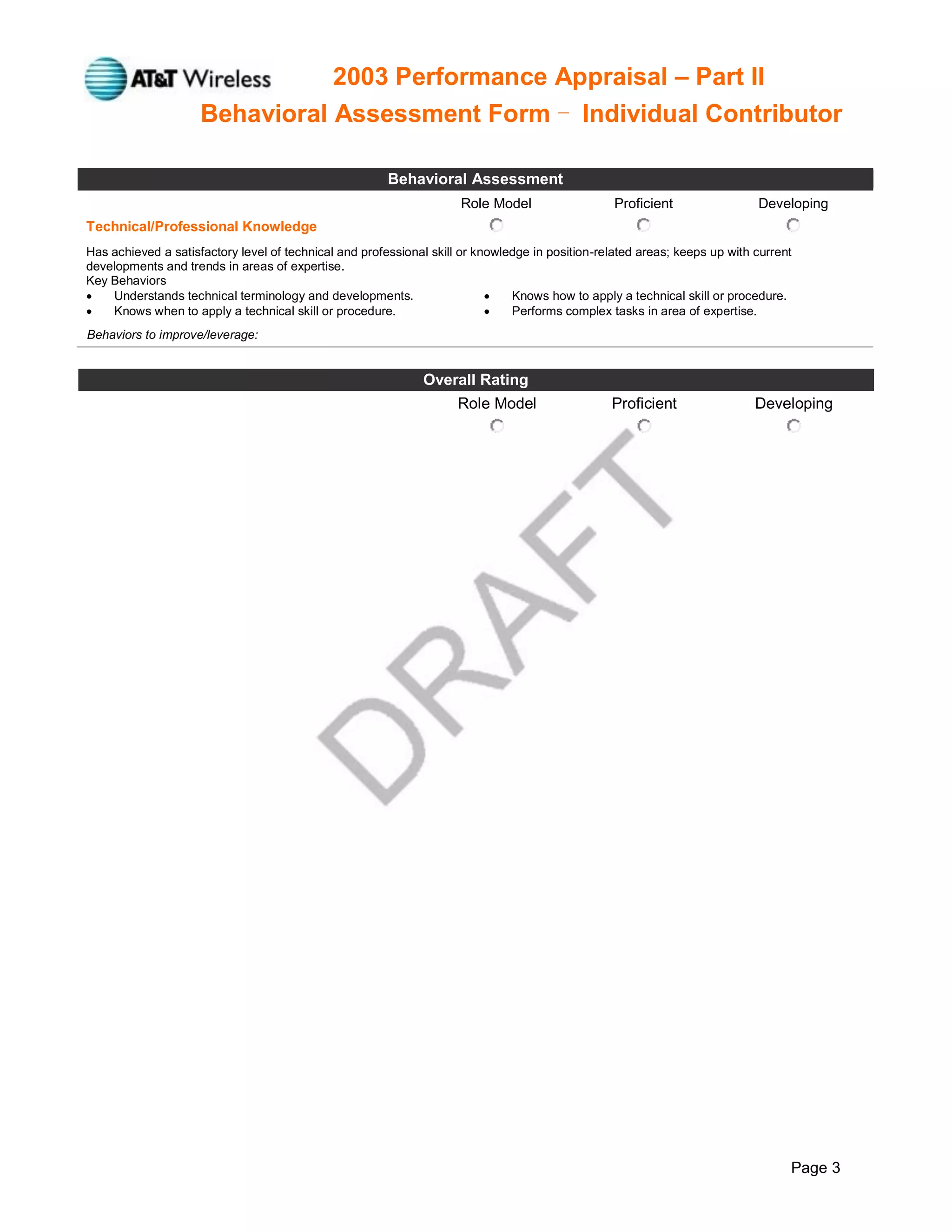
    2003 Performance Appraisal– Part II Behavioral Assessment Form - Individual Contributor Page 3 Behavioral Assessment Role Model Proficient Developing Technical/Professional Knowledge Has achieved a satisfactory level of technical and professional skill or knowledge in position-related areas; keeps up with current developments and trends in areas of expertise. Key Behaviors  Understands technical terminology and developments.  Knows how to apply a technical skill or procedure.  Knows when to apply a technical skill or procedure.  Performs complex tasks in area of expertise. Behaviors to improve/leverage: Overall Rating Role Model Proficient Developing