Beginners Guide to
High Availability for
Postgres
Presented by:
Borys Neselovskyi, Sales Engineer Region
DACH
16 February 2020
Slides and recording will be available in next 48 hours
Please do submit your questions through the chat – answers follow during
Q&A
We will be sharing info about EDB and Postgres later on in the session
Welcome – Housekeeping Items
© Copyright EnterpriseDB Corporation, 2021. All rights reserved.
3
Agenda
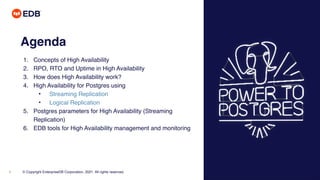
1. Concepts of High Availability
2. RPO, RTO and Uptime in High Availability
3. How does High Availability work?
4. High Availability for Postgres using
• Streaming Replication
• Logical Replication
5. Postgres parameters for High Availability (Streaming
Replication)
6. EDB tools for High Availability management and monitoring
High Availability
Concepts
© Copyright EnterpriseDB Corporation, 2021. All rights reserved.
5
High Availability
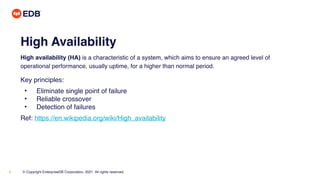
High availability (HA) is a characteristic of a system, which aims to ensure an agreed level of
operational performance, usually uptime, for a higher than normal period.
Key principles:
• Eliminate single point of failure
• Reliable crossover
• Detection of failures
Ref: https://en.wikipedia.org/wiki/High_availability
© Copyright EnterpriseDB Corporation, 2021. All rights reserved.
6
Scheduled/Unscheduled downtime
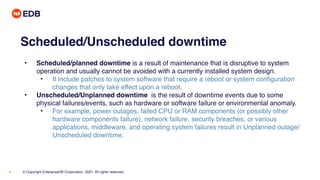
• Scheduled/planned downtime is a result of maintenance that is disruptive to system
operation and usually cannot be avoided with a currently installed system design.
• It include patches to system software that require a reboot or system configuration
changes that only take effect upon a reboot.
• Unscheduled/Unplanned downtime is the result of downtime events due to some
physical failures/events, such as hardware or software failure or environmental anomaly.
• For example, power outages, failed CPU or RAM components (or possibly other
hardware components failure), network failure, security breaches, or various
applications, middleware, and operating system failures result in Unplanned outage/
Unscheduled downtime.
© Copyright EnterpriseDB Corporation, 2021. All rights reserved.
7
Availability calculation
Calculated/expressed as a percentage of uptime in a given year based on the service level agreements. Some companies
exclude the planned outage/scheduled downtime based on their agreements with customers on the availability of their services.
Availability %
Downtime per
year
Downtime per
month
Downtime per
week
Downtime per
day
99.99% ("four nines") 52.60 minutes 4.38 minutes 1.01 minutes 8.64 seconds
99.995% ("four and a half
nines") 26.30 minutes 2.19 minutes 30.24 seconds 4.32 seconds
99.999% ("five nines") 5.26 minutes 26.30 seconds 6.05 seconds
864.00
milliseconds
RPO

RTO

MTTR

GRO
© Copyright EnterpriseDB Corporation, 2021. All rights reserved.
9
Recovery Point Objective (RPO)
RPO is a measurement of time from the failure, disaster or comparable loss-causing event.
RPO can be used to measure:
• How far back must go, stretching back in time from the disaster to the last point where
data is in a usable format
• How frequently you need to back-up your data, although an RPO doesn’t represent
additional needs like restore time and recovery time.
• How much data is lost following a disaster or loss-causing event
• Ex: RPO = 2 hours
* In case of a crash I may forget everything that I did in the last 2 hours!
© Copyright EnterpriseDB Corporation, 2021. All rights reserved.
10
Recovery Time Objective (RTO)
The amount of time an application can be down and not result in significant damage to a business and
the time that it takes for the system to go from loss to recovery
Recovery process includes
• The steps that IT must take to return the application
• And its data to its pre-disaster state.
© Copyright EnterpriseDB Corporation, 2021. All rights reserved.
11
RPO vs. RTO
RPOs and RTOs are key concepts for maintaining business continuity and function as business metrics
for calculating how often your business needs to perform data backups.
• RTOs coincide with recovery point objectives (RPOs), a measurement of time from the
failure, disaster or similar loss-causing event.
• RPOs calculate back in time to when your data was last usable, probably the most recent
backup.
© Copyright EnterpriseDB Corporation, 2021. All rights reserved.
12
Mean Time To Recover (MTTR)
The average time that a device will take to recover from any failure. systems which have to be repaired or
replaced.
• Examples of such devices range from self-resetting fuses (where the MTTR would be
very short, probably seconds), up to whole systems which have to be repaired or
replaced.
• Usually part of a maintenance contract, where the user would pay more for a system
MTTR of which was 24 hours, than for one of, say, 7 days
• Does not mean the supplier is guaranteeing to have the system up and running again
within 24 hours (or 7 days) of being notified of the failure.
© Copyright EnterpriseDB Corporation, 2021. All rights reserved.
13
Geography Recovery Objectives (GRO)
If datacenter becomes unavailable, how long it takes for the service to become available again.
• It covers RPO/RTO for making services available across the geography.
High Availability
For Postgres
Eliminate Single
Point of Failure
© Copyright EnterpriseDB Corporation, 2021. All rights reserved.
16
Eliminate Single Point of failure
• WAL shipping based replication
• Replication based on the archived WAL
• Streaming replication (SR)
• Streaming WAL files to one or more standbys
• Logical replication
• Streaming logical data modifications from the WAL.
© Copyright EnterpriseDB Corporation, 2021. All rights reserved.
17
Eliminate Single Point of failure
• Identical to primary system
• Data is still mirrored in real time
• Allows READ
• On failure, can replace primary
• Approaches
• WAL shipping based
• Streaming WAL (widely used after 9.0)
Hot Standby
© Copyright EnterpriseDB Corporation, 2021. All rights reserved.
18
Eliminate Single Point of failure
Hot Standby: WAL shipping
© Copyright EnterpriseDB Corporation, 2021. All rights reserved.
19
Eliminate Single Point of failure
Monitor: WAL shipping
• Functions on standby
• pg_is_in_recovery()
• pg_last_xlog/wal_replay_location/lsn()
• pg_last_xact_replay_timestamp()
© Copyright EnterpriseDB Corporation, 2021. All rights reserved.
20
Eliminate Single Point of failure
Hot Standby: Streaming Replication
© Copyright EnterpriseDB Corporation, 2021. All rights reserved.
21
Eliminate Single Point of failure
Streaming Replication
• Asynchronous Streaming Replication
• Synchronous Streaming Replication
• synchronous_standby_names
E.g.
• FIRST 1 (standby_east, standby_west)
• ANY 3 (standby_east, standby_west, eu_standby_east, eu_standby_west)
• 'standby_east, standby_west'
• synchronous_commit - off/local/remote_write/on/remote_apply
© Copyright EnterpriseDB Corporation, 2021. All rights reserved.
22
Eliminate Single Point of failure
Monitor: Streaming Replication
• Views
• Master: pg_stat_replication
• Standby: pg_wal_receiver
Reliable
CrossOver &
Detection
© Copyright EnterpriseDB Corporation, 2021. All rights reserved.
24
Reliable Crossover & Detection
• In a redundant system, the crossover point itself becomes a single point of failure.
• Fault-tolerant systems must provide a reliable crossover or automatic switchover
mechanism to avoid failure.
• Detection of failures:
• If the above two principles are proactively monitored, then a user may never see a
system failure.
© Copyright EnterpriseDB Corporation, 2021. All rights reserved.
25
Reliable Crossover & Detection
EDB Postgres Failover Manager:
• Continuously monitors your PostgreSQL service to automatically detect failures.
• After an outage is confirmed, Failover Manager automatically promotes the most up-to-
date standby database as the new master.
© Copyright EnterpriseDB Corporation, 2021. All rights reserved.
26
Reliable Crossover & Detection
EDB Postgres Failover Manager:
RPO

RTO

MTTR

GPO
© Copyright EnterpriseDB Corporation, 2021. All rights reserved.
28
RPO/RTO/MTTR/GPO
Backup And Recovery Tool
© Copyright EnterpriseDB Corporation, 2021. All rights reserved.
29
RPO/RTO/MTTR/GPO
Backup And Recovery Tool
High
Availability
Monitoring
© Copyright EnterpriseDB Corporation, 2021. All rights reserved.
31
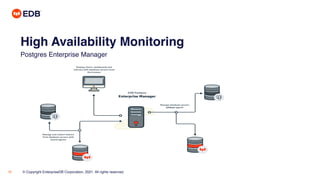
High Availability Monitoring
Postgres Enterprise Manager
© Copyright EnterpriseDB Corporation, 2021. All rights reserved.
32
High Availability Monitoring
Postgres Enterprise Manager
Maintenance
Window/
Planned
Downtime
© Copyright EnterpriseDB Corporation, 2021. All rights reserved.
34
Maintenance Window/Planned Downtime
Software Updates/Patching
• Three reasons for software updates
• Remedy known software issues
• General stability and reliability of the software
• Security problem
© Copyright EnterpriseDB Corporation, 2021. All rights reserved.
35
Maintenance Window/Planned Downtime
Software Updates: Strategies
• Three strategies
• All Nodes Patching
• Rolling Patching
• Minimum Downtime Patching
© Copyright EnterpriseDB Corporation, 2020. All rights reserved.
36
Conclusion
• High Availability components
• Hot Standby (Streaming Replication)
• EDB Postgres Failover Manager
• Postgres Enterprise Manager
• Backup And Recovery Tool
• Design consideration
• Near zero downtime software maintenance
• RPO/RTO/GRO
© Copyright EnterpriseDB Corporation, 2020. All rights reserved.
37
Resources
• Blog series
• What Does High Availability Really Mean
• Patching Minor Version in Postgres High Availability (HA) Database Cluster
• Plans & Strategies for DBAs
• Key Parameters and Configuration for Streaming Replication in Postgres 12
• Quick and Reliable Failure Detection with EDB Postgres Failover Manager
© Copyright EnterpriseDB Corporation, 2021. All rights reserved.
38
• Enterprise PostgreSQL innovations
• 4,000+ global customers
• Recognized by Gartner Magic Quadrant for 7 years in a row
• One of the only sub-$1bn revenue companies
• PostgreSQL community leadership
2019
Challengers Leaders
Niche Players Visionaries
Ability
to
execute
Completeness of
vision
1986
The Design 

of PostgreSQL
1996
Birth of
PostgreSQL
2004
EDB
is founded
2020
Today
Materialized
Views
Parallel
Query
JIT
Compilation
Heap Only
Tuples
(HOT)
Serializable
Parallel Query
We’re database fanatics who care 

deeply about PostgreSQL
Expertise
© Copyright EnterpriseDB Corporation, 2021. All rights reserved.
39
Market Success
© Copyright EnterpriseDB Corporation, 2021. All rights reserved.
40
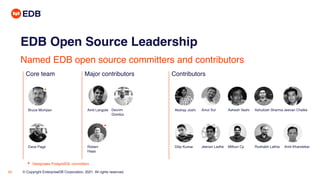
Core team Major contributors Contributors
EDB Open Source Leadership
Named EDB open source committers and contributors
Akshay Joshi Amul Sul Ashesh Vashi Ashutosh Sharma Jeevan Chalke
Dilip Kumar Jeevan Ladhe Mithun Cy Rushabh Lathia Amit Khandekar
Amit Langote Devrim
Gündüz
Robert
Haas
Bruce Momjian
Dave Page
Designates PostgreSQL committers
© Copyright EnterpriseDB Corporation, 2021. All rights reserved.
41
Learn More
Other resources
Thank You
Next Webinar: March 23
Best Practices in Security with PostgreSQL -
German
Postgres Pulse EDB Youtube Channel

Beginner's Guide to High Availability for Postgres

  • 1.
    Beginners Guide to HighAvailability for Postgres Presented by: Borys Neselovskyi, Sales Engineer Region DACH 16 February 2020
  • 2.
    Slides and recordingwill be available in next 48 hours Please do submit your questions through the chat – answers follow during Q&A We will be sharing info about EDB and Postgres later on in the session Welcome – Housekeeping Items
  • 3.
    © Copyright EnterpriseDBCorporation, 2021. All rights reserved. 3 Agenda 1. Concepts of High Availability 2. RPO, RTO and Uptime in High Availability 3. How does High Availability work? 4. High Availability for Postgres using • Streaming Replication • Logical Replication 5. Postgres parameters for High Availability (Streaming Replication) 6. EDB tools for High Availability management and monitoring
  • 4.
  • 5.
    © Copyright EnterpriseDBCorporation, 2021. All rights reserved. 5 High Availability High availability (HA) is a characteristic of a system, which aims to ensure an agreed level of operational performance, usually uptime, for a higher than normal period. Key principles: • Eliminate single point of failure • Reliable crossover • Detection of failures Ref: https://en.wikipedia.org/wiki/High_availability
  • 6.
    © Copyright EnterpriseDBCorporation, 2021. All rights reserved. 6 Scheduled/Unscheduled downtime • Scheduled/planned downtime is a result of maintenance that is disruptive to system operation and usually cannot be avoided with a currently installed system design. • It include patches to system software that require a reboot or system configuration changes that only take effect upon a reboot. • Unscheduled/Unplanned downtime is the result of downtime events due to some physical failures/events, such as hardware or software failure or environmental anomaly. • For example, power outages, failed CPU or RAM components (or possibly other hardware components failure), network failure, security breaches, or various applications, middleware, and operating system failures result in Unplanned outage/ Unscheduled downtime.
  • 7.
    © Copyright EnterpriseDBCorporation, 2021. All rights reserved. 7 Availability calculation Calculated/expressed as a percentage of uptime in a given year based on the service level agreements. Some companies exclude the planned outage/scheduled downtime based on their agreements with customers on the availability of their services. Availability % Downtime per year Downtime per month Downtime per week Downtime per day 99.99% ("four nines") 52.60 minutes 4.38 minutes 1.01 minutes 8.64 seconds 99.995% ("four and a half nines") 26.30 minutes 2.19 minutes 30.24 seconds 4.32 seconds 99.999% ("five nines") 5.26 minutes 26.30 seconds 6.05 seconds 864.00 milliseconds
  • 8.
  • 9.
    © Copyright EnterpriseDBCorporation, 2021. All rights reserved. 9 Recovery Point Objective (RPO) RPO is a measurement of time from the failure, disaster or comparable loss-causing event. RPO can be used to measure: • How far back must go, stretching back in time from the disaster to the last point where data is in a usable format • How frequently you need to back-up your data, although an RPO doesn’t represent additional needs like restore time and recovery time. • How much data is lost following a disaster or loss-causing event • Ex: RPO = 2 hours * In case of a crash I may forget everything that I did in the last 2 hours!
  • 10.
    © Copyright EnterpriseDBCorporation, 2021. All rights reserved. 10 Recovery Time Objective (RTO) The amount of time an application can be down and not result in significant damage to a business and the time that it takes for the system to go from loss to recovery Recovery process includes • The steps that IT must take to return the application • And its data to its pre-disaster state.
  • 11.
    © Copyright EnterpriseDBCorporation, 2021. All rights reserved. 11 RPO vs. RTO RPOs and RTOs are key concepts for maintaining business continuity and function as business metrics for calculating how often your business needs to perform data backups. • RTOs coincide with recovery point objectives (RPOs), a measurement of time from the failure, disaster or similar loss-causing event. • RPOs calculate back in time to when your data was last usable, probably the most recent backup.
  • 12.
    © Copyright EnterpriseDBCorporation, 2021. All rights reserved. 12 Mean Time To Recover (MTTR) The average time that a device will take to recover from any failure. systems which have to be repaired or replaced. • Examples of such devices range from self-resetting fuses (where the MTTR would be very short, probably seconds), up to whole systems which have to be repaired or replaced. • Usually part of a maintenance contract, where the user would pay more for a system MTTR of which was 24 hours, than for one of, say, 7 days • Does not mean the supplier is guaranteeing to have the system up and running again within 24 hours (or 7 days) of being notified of the failure.
  • 13.
    © Copyright EnterpriseDBCorporation, 2021. All rights reserved. 13 Geography Recovery Objectives (GRO) If datacenter becomes unavailable, how long it takes for the service to become available again. • It covers RPO/RTO for making services available across the geography.
  • 14.
  • 15.
  • 16.
    © Copyright EnterpriseDBCorporation, 2021. All rights reserved. 16 Eliminate Single Point of failure • WAL shipping based replication • Replication based on the archived WAL • Streaming replication (SR) • Streaming WAL files to one or more standbys • Logical replication • Streaming logical data modifications from the WAL.
  • 17.
    © Copyright EnterpriseDBCorporation, 2021. All rights reserved. 17 Eliminate Single Point of failure • Identical to primary system • Data is still mirrored in real time • Allows READ • On failure, can replace primary • Approaches • WAL shipping based • Streaming WAL (widely used after 9.0) Hot Standby
  • 18.
    © Copyright EnterpriseDBCorporation, 2021. All rights reserved. 18 Eliminate Single Point of failure Hot Standby: WAL shipping
  • 19.
    © Copyright EnterpriseDBCorporation, 2021. All rights reserved. 19 Eliminate Single Point of failure Monitor: WAL shipping • Functions on standby • pg_is_in_recovery() • pg_last_xlog/wal_replay_location/lsn() • pg_last_xact_replay_timestamp()
  • 20.
    © Copyright EnterpriseDBCorporation, 2021. All rights reserved. 20 Eliminate Single Point of failure Hot Standby: Streaming Replication
  • 21.
    © Copyright EnterpriseDBCorporation, 2021. All rights reserved. 21 Eliminate Single Point of failure Streaming Replication • Asynchronous Streaming Replication • Synchronous Streaming Replication • synchronous_standby_names E.g. • FIRST 1 (standby_east, standby_west) • ANY 3 (standby_east, standby_west, eu_standby_east, eu_standby_west) • 'standby_east, standby_west' • synchronous_commit - off/local/remote_write/on/remote_apply
  • 22.
    © Copyright EnterpriseDBCorporation, 2021. All rights reserved. 22 Eliminate Single Point of failure Monitor: Streaming Replication • Views • Master: pg_stat_replication • Standby: pg_wal_receiver
  • 23.
  • 24.
    © Copyright EnterpriseDBCorporation, 2021. All rights reserved. 24 Reliable Crossover & Detection • In a redundant system, the crossover point itself becomes a single point of failure. • Fault-tolerant systems must provide a reliable crossover or automatic switchover mechanism to avoid failure. • Detection of failures: • If the above two principles are proactively monitored, then a user may never see a system failure.
  • 25.
    © Copyright EnterpriseDBCorporation, 2021. All rights reserved. 25 Reliable Crossover & Detection EDB Postgres Failover Manager: • Continuously monitors your PostgreSQL service to automatically detect failures. • After an outage is confirmed, Failover Manager automatically promotes the most up-to- date standby database as the new master.
  • 26.
    © Copyright EnterpriseDBCorporation, 2021. All rights reserved. 26 Reliable Crossover & Detection EDB Postgres Failover Manager:
  • 27.
  • 28.
    © Copyright EnterpriseDBCorporation, 2021. All rights reserved. 28 RPO/RTO/MTTR/GPO Backup And Recovery Tool
  • 29.
    © Copyright EnterpriseDBCorporation, 2021. All rights reserved. 29 RPO/RTO/MTTR/GPO Backup And Recovery Tool
  • 30.
  • 31.
    © Copyright EnterpriseDBCorporation, 2021. All rights reserved. 31 High Availability Monitoring Postgres Enterprise Manager
  • 32.
    © Copyright EnterpriseDBCorporation, 2021. All rights reserved. 32 High Availability Monitoring Postgres Enterprise Manager
  • 33.
  • 34.
    © Copyright EnterpriseDBCorporation, 2021. All rights reserved. 34 Maintenance Window/Planned Downtime Software Updates/Patching • Three reasons for software updates • Remedy known software issues • General stability and reliability of the software • Security problem
  • 35.
    © Copyright EnterpriseDBCorporation, 2021. All rights reserved. 35 Maintenance Window/Planned Downtime Software Updates: Strategies • Three strategies • All Nodes Patching • Rolling Patching • Minimum Downtime Patching
  • 36.
    © Copyright EnterpriseDBCorporation, 2020. All rights reserved. 36 Conclusion • High Availability components • Hot Standby (Streaming Replication) • EDB Postgres Failover Manager • Postgres Enterprise Manager • Backup And Recovery Tool • Design consideration • Near zero downtime software maintenance • RPO/RTO/GRO
  • 37.
    © Copyright EnterpriseDBCorporation, 2020. All rights reserved. 37 Resources • Blog series • What Does High Availability Really Mean • Patching Minor Version in Postgres High Availability (HA) Database Cluster • Plans & Strategies for DBAs • Key Parameters and Configuration for Streaming Replication in Postgres 12 • Quick and Reliable Failure Detection with EDB Postgres Failover Manager
  • 38.
    © Copyright EnterpriseDBCorporation, 2021. All rights reserved. 38 • Enterprise PostgreSQL innovations • 4,000+ global customers • Recognized by Gartner Magic Quadrant for 7 years in a row • One of the only sub-$1bn revenue companies • PostgreSQL community leadership 2019 Challengers Leaders Niche Players Visionaries Ability to execute Completeness of vision 1986 The Design 
 of PostgreSQL 1996 Birth of PostgreSQL 2004 EDB is founded 2020 Today Materialized Views Parallel Query JIT Compilation Heap Only Tuples (HOT) Serializable Parallel Query We’re database fanatics who care 
 deeply about PostgreSQL Expertise
  • 39.
    © Copyright EnterpriseDBCorporation, 2021. All rights reserved. 39 Market Success
  • 40.
    © Copyright EnterpriseDBCorporation, 2021. All rights reserved. 40 Core team Major contributors Contributors EDB Open Source Leadership Named EDB open source committers and contributors Akshay Joshi Amul Sul Ashesh Vashi Ashutosh Sharma Jeevan Chalke Dilip Kumar Jeevan Ladhe Mithun Cy Rushabh Lathia Amit Khandekar Amit Langote Devrim Gündüz Robert Haas Bruce Momjian Dave Page Designates PostgreSQL committers
  • 41.
    © Copyright EnterpriseDBCorporation, 2021. All rights reserved. 41 Learn More Other resources Thank You Next Webinar: March 23 Best Practices in Security with PostgreSQL - German Postgres Pulse EDB Youtube Channel