THE WORLD OF
“BEER”
HISTORY OF BEER
• Beer originates from the Anglo-Saxon word
“Baere” meaning barley.
• The first detailed mention of beer was made more
than 5000 years ago by the Sumerians, who lived
in the fertile land between Tigris & Euphrates (
now called Iraq).
• Mesopotamian’s had the know-how in 2100 B.C
HISTORY OF BEER
• Alexander the Great took beer to Greece and the
production was placed under the royal rule.
• In the continent, monasteries were the citadels of
brewing with major centers being Cologne &
Hamburg. The monks across Europe helped to
nurture the art of brewing during this period and
their malt was specially valued.
• In England in 1188 first national beer tax was
levied in order to finance the crusades.
HISTORY OF BEER
• The monks of Bavaria were responsible for an
innovation that was to change the face of brewing
- bottom fermentation. This bottom fermented beer
could be stored for much longer periods - a
process known as lagering, from the German word
for storage.
• In 1516, The Bavarian code of purity was
established. This was called “rheinheitsgebot”
• After the religious wars Bavaria emerged as major
brewing centre ( 1618 - 1648 )
HISTORY OF BEER
• In 1800’s in Plzen,( later part of the Czech
republic) 250 families formed a co-operative
called the “Citizen Brewery”, and the new product
was called “Pilsner Urquell”.
• The brew of 1838 was disastrous.
• They then employed a Bavarian brewer , Josef
Groll to brew their beer using the bottom
fermentation method.
HISTORY OF BEER
• On 5 October 1842, Josef Groll mashed his first
batch of beer in Plzen ( known by its German
name of Pilsen), and the world’s first ever golden
coloured lager was born!
• Soon what came to be known as the Pilsner style
was copied all across the world.
• The 19th century was the “Century of
Refrigeration” bringing about the chilling
breakthrough.
The Ingredients
• Barley The grain undergoes a complex series
of changes - germination, roasting, and
mashing before reaching a drinker’s
glass.
• Water The greatest ingredient of all, ideally should
be salty and with less mineral content
INGREDIENTS
The Ingredients
• Hops One of the most aromatic species in the
plant kingdom.Used for fermentation and
preservation.
• Yeast The crucial ingredient for fermentation.
AGENTS
Barley
Hops
Yeast
MANUFACTURE OF BEER
The Basic Recipe
• Barley is turned into Malt.
• Malt is cooked in hot water.
• Hops are added as an agent for flavoring and
preservation.
• Yeast is added to bring about the fermentation.
• Barley provides the best extraction rate of sugars, and
therefore by far the most favoured by brewers the world
over.
• To produce good malt, the barley must have plump sound
grains and must germinate at an even rate. Should be low
in nitrogen, as nitrogen affects fermentation.
• Barley is dried in order to reduce the moisture it has
retained. It is kept dormant for a month. Since it later
improves germination, and ensures a longer shelf life ( a
year ).
MALT
Soaking the Grain
• In traditional floor malting, the grain is soaked in large
water cisterns for 2-3 days.
Germination
• The damp grain is emptied onto huge germinating floors,
and evenly spread, where it is allowed to stay for a period of
5 days to sprout & grow. This is an important process, as it
changes starches in the seeds to sugar. At this stage the malt
is called “Green Malt”
MALT
Baking
• Germination is brought to a sharp halt, where the
“Green Malt” is send to the kiln, where it is baked for 2
days at 80-110 C. Some use wood fired kilns to give the
malt a smoky flavour. The higher the temperature, the
darker the colour and stronger the flavour.
• Brewers skillfully blend different malts to produce
different beers.
MALT
• BASIC PURPOSE:
– To render soluble
starches contained
the barley.
• THE ACTION:
Polysaccharides
• THE STEPS:
– Controlled
germination by
steeping.
– Drying is done,
roasting to produce
dark beer.
– malt is milled into
grist.
Maltose Dextrin
Alcohol Fullness
of flavours
MALTING
The first stage of Brewing Process :
• Malt mixed with hot water to form mash.
• The vessel is called a mash tun.
• Objective is conversion of starches in malt into
fermentable sugars.
STEPS
Mashing takes place by 2 methods :
• Infusion = carried out at a temp of 65-68deg C for 1-2
hrs. Results in warm, thick, sweet liquid called “sweet
wort”, which is drained out.
• Decoction = More widely used, brings about more
exhaustive conversion of starches. Batches of mash are
slowly brought to a boil, and returned back to the mash.
Starts at 35deg C until temps reach 75deg C.
STEPS
• Process could last for 5-6 hours.
• The aim of this method is to extract as much sugar from
the malt at different temperatures.
• The method is usually used in conjunction with another
filter vessel called the lauter tun.
STEPS
• The lauter tun contains rotating blades / knives that keep
the bottom of the mash open, thus allowing the sweet
wort to drain more easily.
• This is the liquid from which beer is brewed.
STEPS
BREWING
• THE PURPOSE:
– To obtain the basic
fermentable liquid for
the production of
beer.
• THE ACTION
– GRIST
Add H2O
( warm)
– MASH
BOIL
– WORT
• THE STEPS:
– Grist is fed into mash
tun.
– water is added to form
a porridge like mash.
– done by:
• infusion
• decoction
– mash is filtered in the
lauter tun. and the
clarified liquid is known
as wort.
– The hops are added
and the the liquid is
boiled.
• Scientific Name: Humulus Lupulus
• Only the female flowers from the plant are used.
• The female cone is made up of a number of
petal like structures called bracts.
• The brachioles of this plant secrete a resinous
substance ( called lupulin ) which is responsible
for the taste and the flavour of the beer. It also
brings about bitterness in the beer.
HOPS
• Best HOPS come from Belgium and
Czechoslovakia.
• In India HOPS comes from Kashmir and
Himachal Pradesh.
HOPS
BREWING
• The wort is fed into a brew kettle ( often referred to
as COPPERS),where it is heated to a boiling point
(between 1/2 hr – 2 &1/2 hrs).
• Heat normally applied through steam.
• The process brings about great changes in the
nature of the wort.
• Hops added at this stage in pellet or whole form,
which releases their oils to provide the final aroma.
HOPS
BREWING
• On completion, hops are removed through a hop
extractor ( like a lemon squeezer ).
• The “hopped wort” is then passed through a
whirlpool / centrifuge to remove unwanted protein.
• It is then passed through a cooler / heat exchanger,
where it is brought down to a temperature suitable
for fermentation. This varies according to the type of
beer being produced.
HOPS
• THE PURPOSE
To convert the simple
sugars in the hopped
wort to alcohol.
• THE ACTION:
C6H12 O6
2C2H5OH + 2CO2
• THE STEPS:
– Temp. is brought down,
suitable for fermentation.
– Takes place in fermentation
vessels.
– Yeast is added.
– Temp. cycle 7-12-7 deg C is
used (bottom fermented)
– Temp cycle 15 - 20 deg C is
used (top fermented)
– Lasts for a week.
– It is called the primary
fermentation.
FERMENTATION
• After the yeast has fed on the sugar rich wort
for a week, the liquid, now known as “green
beer” is run into conditioning tanks, where it is
left to settle & mature.
• Conditioning builds up the beer’s carbon
dioxide, which gives the beer its head when
poured.
• At this stage, Krausening or Priming is carried
out to stimulate a secondary fermentation.
FERMENTATION
• THE PURPOSE
– Further fermentation of
the more stubborn
sugars takes place.
– Some times the process
is stimulated by
addition of partially
fermented wort. This
process is called
KRAUSENING
Process of conditioning is
also known as:
Maturing / Ripening /Aging/
Lagering
CONDITIONING THE BEER
• Most beers are filtered between conditioning &
packaging, wherein they are passed through filters.
• Finings (a glutinous substance from fish bladders-
isinglass) are added to the cask / vessel / tanks to clarify
the beer.
CONDITIONING THE BEER
Pasteurization
• Beer is heated to kill any bacteria that may have entered
during the brewing process.
• Increases shelf life & stability of the product.
• Eradicates unwanted organisms and kills the yeast in the
beer.
Tunnel = 50 deg C , 45 mins
Flash = 72 deg C, 30 secs
CONDITIONING THE BEER
PRODUCTION OF BEER
Steeping of barley
Drying of barley
Milling into grist
Mash is formed Mash Tun
Wort is obtained Lauter Tun
Brewing Brew Kettle
Cooling
Fermentation Fermentation vessel
Conditioning Holding Tanks
Pasteurisation
Bottling
THE CLASSICAL BEER STYLES
• TOP FERMENTED
• WHEAT BEER
• BOTTOM FERMENTED
TOP/BOTTOM FERMENTED BEER
Bottom fermented
• Yeast
– Saccharomyces
carlsbergensis
• Primary fermentation
– Takes place at 7-12-7
deg C
• Holding
– Last for about a
month.
Top fermented
• Yeast
– Saccharomyces
cerevisiae
• Primary fermentation
– Takes place at 15-20
deg C
• Holding
– Last for about a week
TOP/BOTTOM FERMENTED BEER
Bottom fermented
• Krausening
• Service
– 4-6 deg Centigrade
Top fermented
• Priming
• Service
– 18-20 deg Centigrade
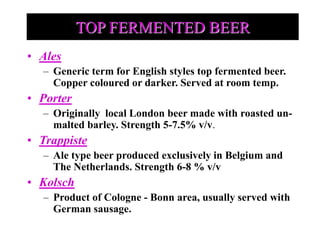
TOP FERMENTED BEER
• Ales
– Generic term for English styles top fermented beer.
Copper coloured or darker. Served at room temp.
• Porter
– Originally local London beer made with roasted un-
malted barley. Strength 5-7.5% v/v.
• Trappiste
– Ale type beer produced exclusively in Belgium and
The Netherlands. Strength 6-8 % v/v
• Kolsch
– Product of Cologne - Bonn area, usually served with
German sausage.
WHEAT BEER
Weizenbier
– Originating from Bavaria
– served with a slice of lemon.
– Alcohol content is 5% v/v.
Weisse (Berliner)
– Originating from Berlin.
– Served with the essence of raspberry juice.
– Alcohol content is 2.5-3% v/v
BOTTOM FERMENTED BEER
• Muchener
– Internationally accepted name for dark brown beer.
– In home city it is called Dunkel.
– Alcohol content is 4-4.75% v/v.
• Vienna
– Amber coloured beer
– In home city it is referred to as Spezial
– Alcohol content is 5.5% v/v.
• Pilsner/Pilsener
– Outside Czechoslovakia usually spelled as Pilsener.
– Golden colour clear bear.
– Alcoholic content 5% v/v
• Bock
– A strong bottom fermented beer
– Often labeled with a goat symbol.
– Alcohol strength not less than 6% v/v.
• Dopple Bock
– Extra strong bottom fermented beer.
– First brewed by the Italian workers in Bavaria.
– Brand names end in the suffix --ator.
– Alcoholic content is 7.5-13% v/v
BOTTOM FERMENTED BEER
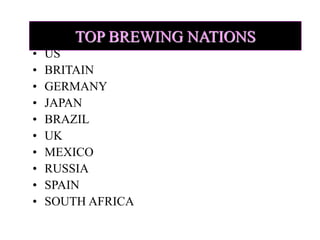
TOP BREWING NATIONS
• US
• BRITAIN
• GERMANY
• JAPAN
• BRAZIL
• UK
• MEXICO
• RUSSIA
• SPAIN
• SOUTH AFRICA
BEERS SERVED AT ITC SONAR
BANGLA
• Heineken
• Budweiser
• Carona
• Kalyani Black Label
• Tiger
• Kingfisher
BEERS SERVED AT OBEROI
HOTELS
• Foster
• Strohs
• Kingfisher
• Kalyani Black label

Beer.ppt

  • 1.
  • 2.
    HISTORY OF BEER •Beer originates from the Anglo-Saxon word “Baere” meaning barley. • The first detailed mention of beer was made more than 5000 years ago by the Sumerians, who lived in the fertile land between Tigris & Euphrates ( now called Iraq). • Mesopotamian’s had the know-how in 2100 B.C
  • 3.
    HISTORY OF BEER •Alexander the Great took beer to Greece and the production was placed under the royal rule. • In the continent, monasteries were the citadels of brewing with major centers being Cologne & Hamburg. The monks across Europe helped to nurture the art of brewing during this period and their malt was specially valued. • In England in 1188 first national beer tax was levied in order to finance the crusades.
  • 4.
    HISTORY OF BEER •The monks of Bavaria were responsible for an innovation that was to change the face of brewing - bottom fermentation. This bottom fermented beer could be stored for much longer periods - a process known as lagering, from the German word for storage. • In 1516, The Bavarian code of purity was established. This was called “rheinheitsgebot” • After the religious wars Bavaria emerged as major brewing centre ( 1618 - 1648 )
  • 5.
    HISTORY OF BEER •In 1800’s in Plzen,( later part of the Czech republic) 250 families formed a co-operative called the “Citizen Brewery”, and the new product was called “Pilsner Urquell”. • The brew of 1838 was disastrous. • They then employed a Bavarian brewer , Josef Groll to brew their beer using the bottom fermentation method.
  • 6.
    HISTORY OF BEER •On 5 October 1842, Josef Groll mashed his first batch of beer in Plzen ( known by its German name of Pilsen), and the world’s first ever golden coloured lager was born! • Soon what came to be known as the Pilsner style was copied all across the world. • The 19th century was the “Century of Refrigeration” bringing about the chilling breakthrough.
  • 7.
    The Ingredients • BarleyThe grain undergoes a complex series of changes - germination, roasting, and mashing before reaching a drinker’s glass. • Water The greatest ingredient of all, ideally should be salty and with less mineral content INGREDIENTS
  • 8.
    The Ingredients • HopsOne of the most aromatic species in the plant kingdom.Used for fermentation and preservation. • Yeast The crucial ingredient for fermentation. AGENTS
  • 9.
  • 11.
    MANUFACTURE OF BEER TheBasic Recipe • Barley is turned into Malt. • Malt is cooked in hot water. • Hops are added as an agent for flavoring and preservation. • Yeast is added to bring about the fermentation.
  • 12.
    • Barley providesthe best extraction rate of sugars, and therefore by far the most favoured by brewers the world over. • To produce good malt, the barley must have plump sound grains and must germinate at an even rate. Should be low in nitrogen, as nitrogen affects fermentation. • Barley is dried in order to reduce the moisture it has retained. It is kept dormant for a month. Since it later improves germination, and ensures a longer shelf life ( a year ). MALT
  • 13.
    Soaking the Grain •In traditional floor malting, the grain is soaked in large water cisterns for 2-3 days. Germination • The damp grain is emptied onto huge germinating floors, and evenly spread, where it is allowed to stay for a period of 5 days to sprout & grow. This is an important process, as it changes starches in the seeds to sugar. At this stage the malt is called “Green Malt” MALT
  • 14.
    Baking • Germination isbrought to a sharp halt, where the “Green Malt” is send to the kiln, where it is baked for 2 days at 80-110 C. Some use wood fired kilns to give the malt a smoky flavour. The higher the temperature, the darker the colour and stronger the flavour. • Brewers skillfully blend different malts to produce different beers. MALT
  • 15.
    • BASIC PURPOSE: –To render soluble starches contained the barley. • THE ACTION: Polysaccharides • THE STEPS: – Controlled germination by steeping. – Drying is done, roasting to produce dark beer. – malt is milled into grist. Maltose Dextrin Alcohol Fullness of flavours MALTING
  • 16.
    The first stageof Brewing Process : • Malt mixed with hot water to form mash. • The vessel is called a mash tun. • Objective is conversion of starches in malt into fermentable sugars. STEPS
  • 17.
    Mashing takes placeby 2 methods : • Infusion = carried out at a temp of 65-68deg C for 1-2 hrs. Results in warm, thick, sweet liquid called “sweet wort”, which is drained out. • Decoction = More widely used, brings about more exhaustive conversion of starches. Batches of mash are slowly brought to a boil, and returned back to the mash. Starts at 35deg C until temps reach 75deg C. STEPS
  • 18.
    • Process couldlast for 5-6 hours. • The aim of this method is to extract as much sugar from the malt at different temperatures. • The method is usually used in conjunction with another filter vessel called the lauter tun. STEPS
  • 19.
    • The lautertun contains rotating blades / knives that keep the bottom of the mash open, thus allowing the sweet wort to drain more easily. • This is the liquid from which beer is brewed. STEPS
  • 20.
    BREWING • THE PURPOSE: –To obtain the basic fermentable liquid for the production of beer. • THE ACTION – GRIST Add H2O ( warm) – MASH BOIL – WORT • THE STEPS: – Grist is fed into mash tun. – water is added to form a porridge like mash. – done by: • infusion • decoction – mash is filtered in the lauter tun. and the clarified liquid is known as wort. – The hops are added and the the liquid is boiled.
  • 21.
    • Scientific Name:Humulus Lupulus • Only the female flowers from the plant are used. • The female cone is made up of a number of petal like structures called bracts. • The brachioles of this plant secrete a resinous substance ( called lupulin ) which is responsible for the taste and the flavour of the beer. It also brings about bitterness in the beer. HOPS
  • 22.
    • Best HOPScome from Belgium and Czechoslovakia. • In India HOPS comes from Kashmir and Himachal Pradesh. HOPS
  • 24.
    BREWING • The wortis fed into a brew kettle ( often referred to as COPPERS),where it is heated to a boiling point (between 1/2 hr – 2 &1/2 hrs). • Heat normally applied through steam. • The process brings about great changes in the nature of the wort. • Hops added at this stage in pellet or whole form, which releases their oils to provide the final aroma. HOPS
  • 25.
    BREWING • On completion,hops are removed through a hop extractor ( like a lemon squeezer ). • The “hopped wort” is then passed through a whirlpool / centrifuge to remove unwanted protein. • It is then passed through a cooler / heat exchanger, where it is brought down to a temperature suitable for fermentation. This varies according to the type of beer being produced. HOPS
  • 26.
    • THE PURPOSE Toconvert the simple sugars in the hopped wort to alcohol. • THE ACTION: C6H12 O6 2C2H5OH + 2CO2 • THE STEPS: – Temp. is brought down, suitable for fermentation. – Takes place in fermentation vessels. – Yeast is added. – Temp. cycle 7-12-7 deg C is used (bottom fermented) – Temp cycle 15 - 20 deg C is used (top fermented) – Lasts for a week. – It is called the primary fermentation. FERMENTATION
  • 27.
    • After theyeast has fed on the sugar rich wort for a week, the liquid, now known as “green beer” is run into conditioning tanks, where it is left to settle & mature. • Conditioning builds up the beer’s carbon dioxide, which gives the beer its head when poured. • At this stage, Krausening or Priming is carried out to stimulate a secondary fermentation. FERMENTATION
  • 28.
    • THE PURPOSE –Further fermentation of the more stubborn sugars takes place. – Some times the process is stimulated by addition of partially fermented wort. This process is called KRAUSENING Process of conditioning is also known as: Maturing / Ripening /Aging/ Lagering CONDITIONING THE BEER
  • 29.
    • Most beersare filtered between conditioning & packaging, wherein they are passed through filters. • Finings (a glutinous substance from fish bladders- isinglass) are added to the cask / vessel / tanks to clarify the beer. CONDITIONING THE BEER
  • 30.
    Pasteurization • Beer isheated to kill any bacteria that may have entered during the brewing process. • Increases shelf life & stability of the product. • Eradicates unwanted organisms and kills the yeast in the beer. Tunnel = 50 deg C , 45 mins Flash = 72 deg C, 30 secs CONDITIONING THE BEER
  • 31.
    PRODUCTION OF BEER Steepingof barley Drying of barley Milling into grist Mash is formed Mash Tun
  • 32.
    Wort is obtainedLauter Tun Brewing Brew Kettle Cooling Fermentation Fermentation vessel Conditioning Holding Tanks
  • 33.
  • 35.
    THE CLASSICAL BEERSTYLES • TOP FERMENTED • WHEAT BEER • BOTTOM FERMENTED
  • 36.
    TOP/BOTTOM FERMENTED BEER Bottomfermented • Yeast – Saccharomyces carlsbergensis • Primary fermentation – Takes place at 7-12-7 deg C • Holding – Last for about a month. Top fermented • Yeast – Saccharomyces cerevisiae • Primary fermentation – Takes place at 15-20 deg C • Holding – Last for about a week
  • 37.
    TOP/BOTTOM FERMENTED BEER Bottomfermented • Krausening • Service – 4-6 deg Centigrade Top fermented • Priming • Service – 18-20 deg Centigrade
  • 38.
    TOP FERMENTED BEER •Ales – Generic term for English styles top fermented beer. Copper coloured or darker. Served at room temp. • Porter – Originally local London beer made with roasted un- malted barley. Strength 5-7.5% v/v. • Trappiste – Ale type beer produced exclusively in Belgium and The Netherlands. Strength 6-8 % v/v • Kolsch – Product of Cologne - Bonn area, usually served with German sausage.
  • 39.
    WHEAT BEER Weizenbier – Originatingfrom Bavaria – served with a slice of lemon. – Alcohol content is 5% v/v. Weisse (Berliner) – Originating from Berlin. – Served with the essence of raspberry juice. – Alcohol content is 2.5-3% v/v
  • 40.
    BOTTOM FERMENTED BEER •Muchener – Internationally accepted name for dark brown beer. – In home city it is called Dunkel. – Alcohol content is 4-4.75% v/v. • Vienna – Amber coloured beer – In home city it is referred to as Spezial – Alcohol content is 5.5% v/v. • Pilsner/Pilsener – Outside Czechoslovakia usually spelled as Pilsener. – Golden colour clear bear. – Alcoholic content 5% v/v
  • 41.
    • Bock – Astrong bottom fermented beer – Often labeled with a goat symbol. – Alcohol strength not less than 6% v/v. • Dopple Bock – Extra strong bottom fermented beer. – First brewed by the Italian workers in Bavaria. – Brand names end in the suffix --ator. – Alcoholic content is 7.5-13% v/v BOTTOM FERMENTED BEER
  • 42.
    TOP BREWING NATIONS •US • BRITAIN • GERMANY • JAPAN • BRAZIL • UK • MEXICO • RUSSIA • SPAIN • SOUTH AFRICA
  • 43.
    BEERS SERVED ATITC SONAR BANGLA • Heineken • Budweiser • Carona • Kalyani Black Label • Tiger • Kingfisher
  • 44.
    BEERS SERVED ATOBEROI HOTELS • Foster • Strohs • Kingfisher • Kalyani Black label