BEER
History of beer
 Many believe that Middle east &
Egypt were the birthplace of beer.
 First detailed mentioned of beer was
made than 5000 years ago by
Sumerians who lived between Tigris
and The Euphrates in the area, now
known as Iraq.
INGREDIENTS
 BARLEY-The grain undergoes a
complex series of changes –
germination, roasting & mashing.
Barley provides body & colour.
 WATER-Beer is mainly made up of
water & its quality & mineral content
directly affect character of the brew.
INGREDIENTS
 HOPS-If malt provides beer with its
body & colour, hops add
immeasurably to its flavour with a
sharp bitter tang. It is the seasoning
& spice in barley meal.
 YEAST-are living organism, members
of the fungus family. Its is crucial
ingredient for fermentation.
THE BASIC PROCESS
 Barley turned into malt.
 Malt is cooked in hot water.
 Hops are added for flavouring &
preservation.
 Yeast is added to bring about the
fermentation.
MALT
 To produce good malt, barley must have
sound grains & must germinate at an even
rate.
 It should also be low in nitrogen as it
affects fermentation.
 Batches of barley when first arrives
screened and sieved to remove straw and
dirt.
 Next, barley is dried in order to reduce the
moisture that it has retained so that it
retained so that the harvested grain can
be stored for use throughout the year.
MALT
 In traditional floor malting the grain is
soaked in large water cisterns containing
upto 6 tons (6.1 tones) of barley & 1500
gallon ( 6,800 liters) of water.
 This steeping process takes 2 to 3 days.
 The barley is not kept under water the
whole time, it is soaked for half a day,
then tank is drained so that grain can
breathe 6 to 12 hrs before it is immersed
in water again.
GERMINATION
 The damp grain is emptied on to huge
germinatory floors & evenly spread to a
depth of 6 to 9 inches ( 15 to 20 cm).
 It stays here for 5 days to allow seeds to
begin to sprout & grow.
 The germinated grain is turned & raked
regularly to ensure adequate aeration &
an even growth & to prevent the seed
roots from becoming tangled together.
BAKING THE GREEN
MALT
 After five days germination is brought
to a sharp halt.
 This green malt is then sent to kiln
where it is baked for 2 days at high
temperature.
BREWING
 THE PURPOSE
 To obtain the
basic fermentable
liquid for the
production of beer.
 THE ACTION
 Grist add warm
water to form
mash . Mash when
boiled gives wort.
 Infusion.
 Decoction
THE STEPS
 Malt is mixed with hot water to form
mash.
 Vessel is called as mash tun.
 Main objective is conversion of starches in
malt into fermentable sugars.
 Mashing is done by two methods infusion
& decoction.
THE STEPS
 Infusion - is carried out at a temperature
of 65-68 degree centigrade for 1 to 2 hrs.
 Decoction – more widely used, brings
about more exhaustive conversion of
starches. Batches of mash are slowly
brought to boil & returned back to the
mash. It starts at 35 degree centigrade
till temperature reaches 75 degree
centigrade.
THE STEPS
 Process last for 5-6 hours.
 The aim is to extract as much sugar from
the malt at different temperature.
 The method is usually used in conjunction
with another filter vessel called ‘lauter tun’.
 The lauter tun contains rotating blades/
knives that keep bottom of mash open,
thus allowing the sweet wort to drain easily.
 The liquid is there to brew.
HOPS
 Scientific name is humulus lupulus. It is
tall, climbing vine that is member of hemp
family.
 Only the female flowers from the vital
cones are required by the brewer.
 The female cone is made up of a number
of petal like structure called brats.
HOPS
 As cones ripens, the bases of these brats
bear glands that are filled with a yellow
resinous substance known as lupulin.
 It is this complex oil, found nowhere else
in the plant kingdom that contains alpha
acid which give the hop its characteristic
bitterness.
 Best hops comes from Belgium &
Czechoslovakia.
FERMENTATION
 THE PURPOSE
 To convert the
simple sugar in the
hopped wort to
alcohol.
 THE STEPS
 Temperature is
brought down for
suitable
fermentation.
 It takes place in
fermentation
vessel.
 Yeast is added.
FERMENTATION
 After sugar has fed on the sugar rich wort.
It is left for a week.
 The liquid now known as ‘green beer’ is
run into conditioning tanks, where it is left
to settle and mature.
 Conditioning builds up carbon dioxide,
giving beer its head when poured.
CONDITIONING OF
BEER
 THE PURPOSE
 Further fermentation of more stubborn
sugars takes place.
 Sometimes the process is stimulated by
addition of partially fermented wort. This
process is called as KRAUSENING.
 Process of conditioning is also known as
Maturing/Ripening/Aging/ Lagering.
CONDITIONING OF
BEER
 Most beer are filtered between
conditioning, they are passed through
filters.
 Finings (Isinglass, a glutinous substance
from fish bladders) are added to cask to
clarify beers.
CONDITIONING OF
BEER
 PASTEURIZATION
 Beer is heated to kill any bacteria that
may have added during beer process.
 It increases shelf life and stability of beer.
 It removes unwanted organism and kills
yeast of beer.
BEER STYLES
Top fermented
Bottom fermented
TOP FERMENTED BEER
 Yeast used is saccharomyces
cerevisiae.
 It takes place at 15 to 20 degree
centigrade.
 Last for about one week.
BOTTOM FERMENTED
BEER
 Yeast used is saccharomyces
carlsbergensis.
 It takes place at 7 to 12 to 7 degree
centigrade.
 It lasts for one month.
TOP FERMENTED BEER
 ALES – term for English styles of top
fermented beer. It is copper coloured or
darker. It is served at room temperature.
 PORTER – originally local London beer,
made with roasted unmalted barley.
 TRAPPISTE –ale type beer, produced
exclusively in Belgium and The
Netherlands.
 KOLSCH-product of Cologne-Bonn area,
usually serves with German sausage.
BOTTOM FERMENTED BEER
 MUNCHENER- internationally accepted
name for dark brown beer. Also called as
Dunkel.
 VIENNA- amber coloured beer. Also
called as SPEZIAE.
 PILSNER/PILSENER- Czechoslovakia
usually spelled as pilsner, golden coloured
beer.
 BOCK- A strong bottom fermented beer
often labeled with a goat symbol.
BOTTOM FERMENTED BEER
 DOPPLE BOCK- extra strong bottom
fermented beer. First brewed by Italian
workers in Bavaria. Brand name ends with
suffix ____ator.
TOP BREWING
NATIONS
 UNITED STATES
 BRITAIN
 GERMANY
 JAPAN
 BRAZIL
 UNITED
KINGDOM
 MEXICO
 RUSSIA
 SPAIN
 SOUTH AFRICA
BEER SERVED AT
HOTELS
LARGER BEER-
 HEINEKEN
 BUDWEISER
 PERONI
 CARONA
 BIRRA MORETTI
 AMSTEL LIGHT
ALE BEER-
 LEFFE BLONDE
 LONDON PRIDE
 ROCHEFORT NO.8
 GULDENBERG
 JENLAIN BLONDE
 CHIMAY
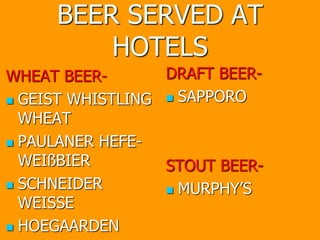
BEER SERVED AT
HOTELS
WHEAT BEER-
 GEIST WHISTLING
WHEAT
 PAULANER HEFE-
WEIßBIER
 SCHNEIDER
WEISSE
 HOEGAARDEN
DRAFT BEER-
 SAPPORO
STOUT BEER-
 MURPHY’S

ALL ABOUT BEER

  • 1.
  • 2.
    History of beer Many believe that Middle east & Egypt were the birthplace of beer.  First detailed mentioned of beer was made than 5000 years ago by Sumerians who lived between Tigris and The Euphrates in the area, now known as Iraq.
  • 3.
    INGREDIENTS  BARLEY-The grainundergoes a complex series of changes – germination, roasting & mashing. Barley provides body & colour.  WATER-Beer is mainly made up of water & its quality & mineral content directly affect character of the brew.
  • 4.
    INGREDIENTS  HOPS-If maltprovides beer with its body & colour, hops add immeasurably to its flavour with a sharp bitter tang. It is the seasoning & spice in barley meal.  YEAST-are living organism, members of the fungus family. Its is crucial ingredient for fermentation.
  • 5.
    THE BASIC PROCESS Barley turned into malt.  Malt is cooked in hot water.  Hops are added for flavouring & preservation.  Yeast is added to bring about the fermentation.
  • 6.
    MALT  To producegood malt, barley must have sound grains & must germinate at an even rate.  It should also be low in nitrogen as it affects fermentation.  Batches of barley when first arrives screened and sieved to remove straw and dirt.  Next, barley is dried in order to reduce the moisture that it has retained so that it retained so that the harvested grain can be stored for use throughout the year.
  • 7.
    MALT  In traditionalfloor malting the grain is soaked in large water cisterns containing upto 6 tons (6.1 tones) of barley & 1500 gallon ( 6,800 liters) of water.  This steeping process takes 2 to 3 days.  The barley is not kept under water the whole time, it is soaked for half a day, then tank is drained so that grain can breathe 6 to 12 hrs before it is immersed in water again.
  • 8.
    GERMINATION  The dampgrain is emptied on to huge germinatory floors & evenly spread to a depth of 6 to 9 inches ( 15 to 20 cm).  It stays here for 5 days to allow seeds to begin to sprout & grow.  The germinated grain is turned & raked regularly to ensure adequate aeration & an even growth & to prevent the seed roots from becoming tangled together.
  • 9.
    BAKING THE GREEN MALT After five days germination is brought to a sharp halt.  This green malt is then sent to kiln where it is baked for 2 days at high temperature.
  • 10.
    BREWING  THE PURPOSE To obtain the basic fermentable liquid for the production of beer.  THE ACTION  Grist add warm water to form mash . Mash when boiled gives wort.  Infusion.  Decoction
  • 11.
    THE STEPS  Maltis mixed with hot water to form mash.  Vessel is called as mash tun.  Main objective is conversion of starches in malt into fermentable sugars.  Mashing is done by two methods infusion & decoction.
  • 12.
    THE STEPS  Infusion- is carried out at a temperature of 65-68 degree centigrade for 1 to 2 hrs.  Decoction – more widely used, brings about more exhaustive conversion of starches. Batches of mash are slowly brought to boil & returned back to the mash. It starts at 35 degree centigrade till temperature reaches 75 degree centigrade.
  • 13.
    THE STEPS  Processlast for 5-6 hours.  The aim is to extract as much sugar from the malt at different temperature.  The method is usually used in conjunction with another filter vessel called ‘lauter tun’.  The lauter tun contains rotating blades/ knives that keep bottom of mash open, thus allowing the sweet wort to drain easily.  The liquid is there to brew.
  • 14.
    HOPS  Scientific nameis humulus lupulus. It is tall, climbing vine that is member of hemp family.  Only the female flowers from the vital cones are required by the brewer.  The female cone is made up of a number of petal like structure called brats.
  • 15.
    HOPS  As conesripens, the bases of these brats bear glands that are filled with a yellow resinous substance known as lupulin.  It is this complex oil, found nowhere else in the plant kingdom that contains alpha acid which give the hop its characteristic bitterness.  Best hops comes from Belgium & Czechoslovakia.
  • 16.
    FERMENTATION  THE PURPOSE To convert the simple sugar in the hopped wort to alcohol.  THE STEPS  Temperature is brought down for suitable fermentation.  It takes place in fermentation vessel.  Yeast is added.
  • 17.
    FERMENTATION  After sugarhas fed on the sugar rich wort. It is left for a week.  The liquid now known as ‘green beer’ is run into conditioning tanks, where it is left to settle and mature.  Conditioning builds up carbon dioxide, giving beer its head when poured.
  • 18.
    CONDITIONING OF BEER  THEPURPOSE  Further fermentation of more stubborn sugars takes place.  Sometimes the process is stimulated by addition of partially fermented wort. This process is called as KRAUSENING.  Process of conditioning is also known as Maturing/Ripening/Aging/ Lagering.
  • 19.
    CONDITIONING OF BEER  Mostbeer are filtered between conditioning, they are passed through filters.  Finings (Isinglass, a glutinous substance from fish bladders) are added to cask to clarify beers.
  • 20.
    CONDITIONING OF BEER  PASTEURIZATION Beer is heated to kill any bacteria that may have added during beer process.  It increases shelf life and stability of beer.  It removes unwanted organism and kills yeast of beer.
  • 21.
  • 22.
    TOP FERMENTED BEER Yeast used is saccharomyces cerevisiae.  It takes place at 15 to 20 degree centigrade.  Last for about one week.
  • 23.
    BOTTOM FERMENTED BEER  Yeastused is saccharomyces carlsbergensis.  It takes place at 7 to 12 to 7 degree centigrade.  It lasts for one month.
  • 24.
    TOP FERMENTED BEER ALES – term for English styles of top fermented beer. It is copper coloured or darker. It is served at room temperature.  PORTER – originally local London beer, made with roasted unmalted barley.  TRAPPISTE –ale type beer, produced exclusively in Belgium and The Netherlands.  KOLSCH-product of Cologne-Bonn area, usually serves with German sausage.
  • 25.
    BOTTOM FERMENTED BEER MUNCHENER- internationally accepted name for dark brown beer. Also called as Dunkel.  VIENNA- amber coloured beer. Also called as SPEZIAE.  PILSNER/PILSENER- Czechoslovakia usually spelled as pilsner, golden coloured beer.  BOCK- A strong bottom fermented beer often labeled with a goat symbol.
  • 26.
    BOTTOM FERMENTED BEER DOPPLE BOCK- extra strong bottom fermented beer. First brewed by Italian workers in Bavaria. Brand name ends with suffix ____ator.
  • 27.
    TOP BREWING NATIONS  UNITEDSTATES  BRITAIN  GERMANY  JAPAN  BRAZIL  UNITED KINGDOM  MEXICO  RUSSIA  SPAIN  SOUTH AFRICA
  • 28.
    BEER SERVED AT HOTELS LARGERBEER-  HEINEKEN  BUDWEISER  PERONI  CARONA  BIRRA MORETTI  AMSTEL LIGHT ALE BEER-  LEFFE BLONDE  LONDON PRIDE  ROCHEFORT NO.8  GULDENBERG  JENLAIN BLONDE  CHIMAY
  • 29.
    BEER SERVED AT HOTELS WHEATBEER-  GEIST WHISTLING WHEAT  PAULANER HEFE- WEIßBIER  SCHNEIDER WEISSE  HOEGAARDEN DRAFT BEER-  SAPPORO STOUT BEER-  MURPHY’S