FULLER THEOLOGICAL SEMINARY
School of Intercultural Studies
THE FOUNDATIONS OF CHRISTIAN COMMUNITY -
GOD’S PEOPLE TRANSFORMED TO CHANGE THE WORLD
A Paper By
Von F. Heckman
G10013996
Presented to Dr. Mark Hopkins
In Partial Fulfillment of the Requirements for
Directed Study ML591: The Purposeful Christian Community
December, 2014
  2	
  
TABLE OF CONTENTS


INTRODUCTION .........................................................................................................................3
I. DEFINING WHAT IS CHRISTIAN COMMUNITY ........................................................4
A Place to Know and be Known..............................................................................................4
Incarnational Love...................................................................................................................6
Presence of the Holy Spirit......................................................................................................7
Spiritual Identity – Gerhard Lohfink.......................................................................................8
Spiritual Activities – Dietrich Bonhoeffer...............................................................................9
Spiritual Rules of Life – Peter Scazzero................................................................................10
A Mission to Gather the Lost.................................................................................................11
	
  
II. INFLUENCE ONE – WHAT IS GOD”S COMMITMENT TO THE CHRISTIAN
COMMUNITY?...........................................................................................................................13
Empowering God’s People....................................................................................................14
Apostolic Purpose..................................................................................................................14
III. INFLUENCE TWO – WHAT IS THE INDIVIDUAL”S RESPONSIBILITY TO THE
CHRISTIAN COMMUNITY? ...................................................................................................15
The Vessel of God .................................................................................................................15
Living Incarnationally ...........................................................................................................16
IV. INFLUENCE THREE – WHAT IS THE CHRISTIAN COMMUNITY’S
RESPONSIBILITY T THE INDIVIDUAL?.............................................................................17
Developing Christian Community.........................................................................................17
Mobilize.................................................................................................................................19
Equip......................................................................................................................................20
Send .......................................................................................................................................21
Sustain....................................................................................................................................21
Evaluate .................................................................................................................................23
	
  
CONCLUSION ............................................................................................................................24
	
  
APPENDICES..............................................................................................................................25
Appendix One – The “Rules of Life”....................................................................................25
Appendix Two – The “Culture Cube”..................................................................................26
Appendix Three - Kotter’s “Eight Accelerators” .................................................................27
	
  
REFERENCES CITED...............................................................................................................28


  3	


INTRODUCTION
For centuries, communities have been a tool used by God for directed growth, protection, and
provision. In the Christian circle, most of us are familiar with the concept of Christian communes
or communities dating back to the early church mentioned in the book Acts, the Jesuit and
Franciscan missions of the Catholic Church, and even the “Jesus Freak” communes of the
“70’s”. In lieu of this however, we can see God’s greatest community development project take
place among the freed Hebrew slaves of Egypt. Throughout the book of Deuteronomy, God
releases a blueprint for His people who were the world’s first refugee population and moves
them into identity and function as “God’s People” with a purpose via community.
It is historically accurate then that community has been utilized to build, develop, focus, and
multiply the influence of God’s people throughout time. Competing against this blueprint is our
current cultural environment. Our Western culture is starkly independent, with an evolving base
in relativism. Yet the desire to belong to “something” has never been stronger in history. People
enjoy being a part of something that engages their heads and hearts. Community can be a catalyst
for this desire to engage in something larger than the individual’s own story. Therefore, the
foundation of Christian community is to provide “belonging” through spiritual transformation by
giving God’s people identity and purpose to transform the world. In the following pages, I will
build on this thesis by unpacking three key influences that contribute to the success of
“belonging” to the Christian community where the head and heart are both mobilized into
  4	
  
transformational growth. We will look briefly at ancient, modern, and contemporary examples of
Christian communities and their patterns of spiritual transformation.
1. DEFINING WHAT IS CHRSTIAN COMMUNITY
A Place to Know Others and Be Known
We might think of Christian communes or communities as austere simple, small, and local
tight knit groups that hang out together around a simple theme of social action, evangelism or a
monastery focused on minimalism. However, Christian communities should begin with a deeper
purpose of being founded first in the Word of God. Since 1960, YWAM has approached
community-based discipleship as a place to know God and be known by God through modular
style training programs: a twelve-week lecture phase with a twelve-week outreach application.
This creates a liminal communitas1
within the participant of this school. They come as one type
of person and are transformed through their experiences with others, with the Word of God, and
by the power of the Holy Spirit. As Charles Mellis described the YWAM community over three
decades ago, in his book, “Committed Communities”, he states, “…YWAM also believes in the
simple life, but projects a less austere image. One might say it reflects more of a joy-image, like
the early Franciscans” (Mellis 1976:96). YWAM, being a missionary sodality, provides a
context for volunteers to come and experience an interdependent life together while being
transformed by biblical teaching, Holy Spirit healing, and empowering with opportunities in
local and cross-cultural mission applications.


1	
  In his book, “The Ritual Process: Structure and Anti-Structure”, Victor Turner describes as a kind of ritual
passage or transition from one state of personhood to another. It is a departure from the old culture and ways to the
beginning of a new. This is often a common theme in African tribes as young boys go out on a hunt to kill an animal
and bring it back to feed their village thus evolving from boyhood into manhood as providers.	
  
  5	
  
Another key component to the Christian community is the presence of the body of Christ as
described in Romans 12 referring to the unity and diversity that make up the body of Christ by
being transformed by the renewing of our minds and leaving the ways of the world behind. There
is a clear invitation to celebrate and use the diversity of spiritual gifts found in Christian
community. Therefore, there is an environment to know others and their gifts and to be known
for what each individual of the community offers to the whole. It is complimentary.
Mellis continues, “The quality of the community is the essential ingredient, not the form”
(Ibid, 109). Living in close proximity to others will create a natural transparent vulnerability. Our
full humanity comes into view within community. This requires a humble attitude and
commitment to be seen for who we are in the community. It is an environment that can foster a
holistic reality of who we were designed by God to be as we see in Gen 1:27. “So God created
man in His own image; in the image of God He created them; male and female he created
them…” (NKJ). We are made up of physical, spiritual, emotional, intellectual, and social
dimensions of God’s original design for humanity. This can come into focus through a liminal
communal setting.
Therefore, our Christian communities should be exhibiting transformative results of God’s
original design as seen in the text of Galatians 5:22-23, fruits of the Spirit: a daily natural
exhibition of love, joy, peace, patience, kindness, goodness, faithfulness, gentleness, and self-
control exercised in daily life of the community. Thus the form of our community should reflect
a holistic design that values diversity in gifting, where humility and transparency are exhibited
and a safe yet challenging environment. In addition, it is based on Godly love exhibited within
Christian community for self and for others. It cannot naturally be generated from a human
source. This unconditional love does not naturally develop within humanity. Dietrich Bonhoeffer
  6	
  
cites, “The basis of all human reality is the dark, turbid urges and desires of the human mind.
The basis of the community of the Spirit is truth; the basis of human community of spirit is
desire” (Bonhoeffer 1954:31). The desire to be known by others (fame and popularity) is
replaced by the desire to be known first by God experiencing his transformational love.
Incarnational Love
John 13:34-35 “A new command I give you: Love one another. As I have loved you, so you
must love one another. By this everyone will know that you are my disciples, if you love one
another” (NIV). This truth of an otherworldly, unconditional love shook the early Christian
church. Christian community should evidence unconditional love being present and
demonstrated to all who are in community and toward those who are lost in the world. This love
was to break down barriers between social structures, ethnicity, and culture. Tim Chester and
Steve Timmis state,
“The Christian community demonstrates the effectiveness of the gospel. We are
living proof that the gospel is not an empty word but a powerful word that takes men and
women who are lovers of self and transforms them by grace through the Spirit into the
people who love God and others…an effective death that achieved the salvation of a
people who now love one another sincerely from a pure heart” (Chester and Timmis
2012:56).
Unconditional love was to be the hallmark of this new community of Christ. They were
taught to be incarnate disciples of Jesus. This love would lead communities to preaching the
words of Christ to the lost, praying for healing, giving to the needy, and even to martyrdom well
beyond their ethnic and geographical roots. It was a selfless love – not of this world. Gerhard
Lohfink comments, “The new family was to encompass all who accepted Jesus’ message of the
reign of God and thus did the will of God…” (Lohfink 1982:106). This love would now be a
model for Incarnational love – modeling Christ’s life and ministry to others.
  7	
  
Presence of the Holy Spirit
In the early church community, the power of the Holy Spirit was clearly evident. Pentecost
was the beginning of a new era. Acts describes the power of the Holy Spirit as faith’s call in both
directions. Andy Crouch states, “…from human beings to God and from God to humanity, will
no longer be from Abraham’s descendants alone” (Crouch 2008:149). The Christian community
began not as an island hidden away until Christ returned but generated movement toward the lost
in the world. Where individuals come together to experience community the power of God will
present itself by accompanying preaching with, signs and wonders accompanied (Luke 9: 1-2).
As Bonhoeffer states, “Once a man has experienced the mercy of God in his life he will
henceforth aspire only to serve” (Bonheoffer 1954:94). Lohfink concurs that a concrete healing
raises the expectation and influences the context in which it happened. Thus, when the Holy
Spirit transforms Christian communities, signs and wonders will emerge anew (Lohfink 1982:
87).
With the community’s focus being on intimacy formed around Jesus and signs and wonders
formed around the presence of the Holy Spirit, the community will not devolve into a mere
commune of collected individuals. As the Father and Son share relationship together, the Holy
Spirit has made a way for us as well to share in this Trinitarian union; a community of believers
on a mission. Stanley Grenz confirms our unity as a body of believers, "We are one people,
therefore, because we are the company of those whom the Spirit has already brought to share in
the love between the Father and the Son” (Grenz 1994:484). In this light, Christian community
should be an environment of activity: a safe place where all can come, grow, and serve Christ.
This is not a static and sedentary Christian community it is a community on the move.
Spiritual Identity – Gerhard Lohfink
  8	
  
The Christian community contains activities that set it apart from all other types of
communes or communities. These practices generate growth and faithful responses to one
another, to God and to the lost. In this sense, the community of God becomes an anti-thesis to the
dysfunctional patterns of this world. “In the Bible the people of God are always understood as a
contrast-society” (Lohfink 1982:122). In his study of the ancient church, “Jesus and Community”
Lohfink describes, in section three of his book, the discipleship community is engaged in being
God’s people of Holy Spirit presence – preaching and healing prayer, ministry to all social
classes, the praxis of togetherness through brotherly love, vulnerable denunciation of domination
– a paradoxical authority, a contrast community, and a sign of invitation for all nations to enter
into God’s community.
Deuteronomy 7:6-8 details God’s intention to build a community of people submitted unto
Himself, set apart from the world’s pagan tribes. In the life of Christ we see Jesus continue in
this path of drawing a people unto God, set apart to do God’s will. Salvation was to lead toward
a new life, a new person (Col. 3:8-14) active in spiritual growth. Lohfink boldly states, “The
decisive task of the church is thus to build itself up as a society in contrast to the world, as the
realm of Christ’s rule in which fraternal love is the law of life. It is precisely through the
church’s doing this that the pagan society will grasp God’s plan for the world” (Ibid, 145). As we
move through the aspects of identity in the Christian community, it is now helpful for us to look
more specifically at the day-to-day activities that create the contrast community.
Spiritual Activities – Dietrich Bonhoeffer
  9	
  
In his original work, “Gemeinsames Leben - Life Together”, Bonhoeffer writes his biblical
observations of the faith community in action. The Christian community is marked by morning
worship, reading the word, devotion, prayer, singing of hymns and communion. The men of the
Bible responded to God with remarkable frequency by rising early in the morning and
participating in quiet time (Bonheoffer 1954:44). Lectio Divina, a type of devotion, was formed
after early Benedictine monastic traditions of devotion, is designed to create quiet time for
believers to meditate, hear, and understand the word in their own way as inspired by the Holy
Spirit. This provides the biblical community the firm ground of the Word of God to stand on in
all activities. Bonhoeffer offers, “Prayer, even though it be free, will be determined by a certain
internal order. It is not a chaotic outburst of a human heart but the prayer of an inwardly ordered
fellowship” (Ibid, 64). While I agree that Bonhoeffer is concerned about moods and feelings
interrupting our spirituality, our spirituality should be connected to the head and heart in addition
to allowing emotions room to feel the greatness of God during worship and prayer. Peter
Scazzero states, “Ignoring any aspect of who we are as men and women made in God’s image
always results in destructive consequences – in our relationship with God, with others, and
ourselves” (Scazzero 2006:18-19). We see this example in the heart of David reflected in Psalms
142 to cry out, to worship, and pray to the Lord with strong, joyful and remorseful emotion.
Bonhoeffer introduces a unique look into the fellowship of the Lord’s Table as a process that
solidifies our devotion towards the Lord, the source of our redemption and spiritual life. Luke
24:30-31 reveals that their eyes were opened and they knew him. It implies obligation from the
community that celebrates the Lord as the giver of all gifts, the creator of the world, the path to
redemption, and that all is for the sake of Christ (Ibid, 66-67). Together we share the bread and
drink the wine of remembrance ending our hunger and shame and the forward direction that
  10	
  
creates mission – salvation of the lost. Grenz comments concerning our view of the Eucharist,
“Through its link to the future fulfillment of Jesus’ promise, the past event of Christ’s death
constitutes our identity…The future that Jesus promises us is a special future. It is characterized
by fellowship (Grenz 1994:538). Through the Eucharist, we can share in God’s relational love,
joy, and celebration; the Creator of the universe does not orphan us. We can spread this message
and hope to a lost world that communicates, “you belong”.
Spiritual Rules of Life – Peter Scazzero
Scazzero breaks up the activities in view of a more contemporary Christian community into
four main groups: Prayer, Rest, Work, and Relationships. Creating a community pattern around
spiritual “Rules of Life” reinforces the counter-cultural standard shown to us in New Testament
scriptures. In her book, “Living Faith Day by Day“, Debra Farrington offers a pattern formed by
old monastic traditions that keep us focused on a holistic life pattern which enables our Christian
growth individually as well as set in community2
(Appendix One). This example can easily be
adapted into Christian communities that want regular activities to reinforce their transformation.
Prayer involves four activities of Scripture reading, silent meditation, the Daily Office of
communion with God, and study of the Scriptures. It is the word of God that is perfect and true
in converting the heart as written in Proverbs 30:5 (Scazzero 2010:224).
We need to stop, rest, and delight in the Lord. We live lives in simplicity to diminish the
stronghold of materialism within our culture and we commit our lives to play and regular
recreation that involves the celebration of the community’s presence and ministry (Ibid, 224).


2	
  See Appendix 1 for a review of the old monastic traditions placed into a “Rules of Life” pattern for Christian
living. This list was adapted from Debra Farringdon’s book to be used for YWAM’s Field Bound training process
for workers moving cross-culturally.	
  	
  
  11	
  
Work is the hallmark to the Christian community. We need a focused outlet of service and
mission to the lost. This can be both locally and globally. It involves the entire body as
exemplified in Ephesians 4:16, the body is held up by the working of each ligament. Care for the
physical body is a stewardship issue. This requires exercise, diet, and rest respecting our God-
given limits (Ibid, 225).
And lastly, relationships are a holistic model that embraces our emotional health. They
should be included in our spiritual formation model. The Incarnational example of being Christ
to others will build our ability to listen to others and to show empathy to the hurting. Family is an
equal value to God, be it as a single or a married. Family relationships reinforce the development
of healthy marriages and rearing of children, with God's authority over the family unit will
affirm honor in the community. The Christian community itself as the conduit in which mission
takes traction grows mature relationships and can nurture and minister to others in need (Ibid,
226).
A Mission to Gather the Lost
Dietrich Bonhoeffer offers that Christian community is not just an ideal but also primarily a
divine reality (Bohoeffer 1954:30). Where human love for one another becomes an end unto
itself spiritual love comes from Christ and serves him alone. Therefore, in Christian community
we have a dynamic process of Jesus becoming the mediator between humans and God (1 Tim.
2:5-6). Secondly, Bonhoeffer states the Christian brotherhood is a spiritual and not a psychic
reality. We participate in this community through the power of the Holy Spirit and relating to the
triune God as He dwells in community; in that spiritual love creates a freedom we can walk in
  12	
  
and be transformed by (Ibid, 36-37). The Christ focused community transforms its participants
through God’s love, which is the catalyst for the liminal process.
God’s design for community, as described by Lohfink, was to gather believers of God into
community and not within isolated individuals. We see this early example by the twelve
disciples. God’s plan was to create something new, a family of disciples around Jesus (Lohfink
1982:72). It was in these early years of the church that the Christian community conducted itself
as the ekklesia, “the assembly of called out ones”. The true people of God were called away and
separated from un-holiness and impurity of their surroundings. Stanley Grenz commented that
the early church was neither an edifice nor an organization. “They were a people – a people
brought together by the Holy Spirit – a people bound to each other through Christ – hence a
people standing in covenant with God” (Grenz 1994:465). Here, again, we see the community
not formed around human interests and fads but formed around the message and purposes of
Christ – kingdom evangelism.
What kind of evangelism do we mean? Most of us think of proclamation of God’s Word to
the lost. Grenz argues that evangelism, being an “announcement”, is an invitation to participate
in the community of God. In this sense the Christian community carries a prophetic role of being
Jesus incarnate to the lost, “…an implicit call to the world to acknowledge the lordship of the
God who has established us as his people” (Ibid, 503).
This invitation to join God’s community continues throughout the world today. The German
word, zeitgeist3
, exhorts one to know the general moral and spiritual climate of the present era
(Mellis 1976:65). We also see this reflected in I Chronicles 12:32 “…from Issachar, men who


3	
  Zeitgeist, http://dictionary.reference.com/browse/zeitgeist an old German word that came to us in the 1830’s, has
been used by theologians to describe the “spirit of the age” and the awareness the church should have in meeting
those felt needs as a missional community.
	
  
  13	
  
understood the times and knew what Israel should do…” (NIV). This tribe was a tribe who could
bring focus from the seeing the felt needs of their environment serving Israel and King David to
better understand their context. The Christian community therefore, must commit itself to
outreach, to the needs of the lost and be the backdrop of a fallen and needy world. Just as the
early church was “called out” to be counter-cultural in their context, the Christian community of
today also needs that focus of mission to avoid the “greenhouse syndrome” of internally focused
relative spirituality. Our outreach then should also have a focus on proclamation and social
action upon the real needs that are robbing life from the lost and hurting. Grenz offers, “We
propose that the involvement of the church in social action is crucial regardless of its relationship
to evangelism” (Grenz 1994:507). In Luke 10:9, as the disciples were sent out to minister, Jesus
instructed them to say, “the kingdom of God has come near to you”. The message of the
kingdom was seen in both word and deed. The empowering of God’s people was released to be
the community of Christ to the world, inviting the lost into fellowship with God (Corbett and
Fikkert 2009:41). This was fulfilling Jesus’ words of the beatitudes in teaching his follows how
to pray for God’s kingdom to come on earth, as it is heaven. Therefore, the Christian community
needs to be a discerning and listening one to the environments in which it is living.
II. WHAT IS GOD’S COMMITMENT TO THE CHRISTIAN COMMUNITY?
God’s commitment to the Christian community is clear, He gives the community a vocation
to be representatives of God’s kingdom to the nations. From the earliest mention of God’s
creation, God saw what he created and called it “good” (Gen. 1:31). From the origin of the
  14	
  
Garden of Eden, God established community between Adam, Eve, and Himself. The interest and
jealousy of God to have a people unto Himself was set in the beginning of time, a people who
had a purpose, a people who were blessed to bless others with the invitation to join God’s
community.
Gen. 12:1-3 The LORD had said to Abram, "Leave your country, your people
and your father's household and go to the land I will show you. 2 "I will make you into a
great nation and I will bless you; I will make your name great, and you will be a blessing.
3 I will bless those who bless you, and whoever curses you I will curse; and all peoples
on earth will be blessed through you." (NIV)
The theme of this blessing flows throughout the Bible. Arthur Glasser states, “God’s
sovereign will ultimately brings to light his lordship over all peoples. It is in the blessings
promised to the nations through Abraham” (Glasser 2003:26). This blessing was intended to
spread through the world wherever God’s people resided. This was a new history and vocation
that was to carry on through history beyond the Old Testament writings and continue on through
God’s son, Jesus, come as a man in the flesh. “The new reality that he introduced into history
was to be continued through history in the form of a community, not in the form of a book”
(Newbigin 1995:52). The community’s vocation was to be incarnate examples of Jesus, the
Savior of the world. We see this modeled clearly in the four gospels.
Empowering God’s People
John 15: 1-16 directs the Christian to remain in the vine of Christ as out empowerment. We
can do nothing outside of this community in Christ. We can do nothing without remaining true to
God’s word. We can do nothing in our own strength to accomplish the kingdom of God without
a bond in Christ. It is generated from the triune God: Father, Son, and Holy Spirit. God’s people
  15	
  
are recipients of the shalom4
blessing and presence of God: God in His entirety, blessing His
people, banded in communities across the globe. Jesus’ authority was released to us as well to be
co-laborers with Christ in bringing in the Kingdom of God. Mark 16: 15-20 speaks of divine
authority given to His people/disciples. This transfer of heavenly authority was used to establish
the disciple’s faith as well as proving the doctrine of the gospel in its formative period (Glasser
2003:231).
Apostolic Purpose
As the disciples reeled after Jesus’ death, this was not the end of God’s kingdom presence, it
was the multiplication of all God intended, to multiply Christian community throughout the
world via the power of the Holy Spirit. Acts 1:8 sets the stage for the continuation of God’s heart
and intention of bringing the kingdom and His shalom presence to his people. Reading through
Acts 2:16-40, Glasser highlights four areas from Peter’s sermon that ushered in the Pentecost and
produced a release of apostolic initiative among the early church community confiming: 1) OT
prophecy was now fulfilled. 2) Jesus was vindicated as Lord and the Christ. 3) Death was
overcome, as evidenced by the presence of the Holy Spirit. And 4) Forgiveness and the gift of
the Spirit are available to all who repent (Ibid, 266). A community who does not see this
apostolic call to create and build Christian communities loses its function and ability to be salt
and light to a lost world. Mission expansion will end, drift will spread throughout the
community’s spiritual foundation, and an island mentality of “come save me!” will ensue.


4	
  Shalom is a positive and proactive concept. “It has to do with community (Ps. 29:11) and means total harmony
within the community” (Glasser 2003:130). It has to do with peace and is representative of the redemptive work of
Christ.	
  
  16	
  
III.WHAT IS THE INDIVIDUAL’S RESPONSIBILITY TO THE CHRISTIAN
COMMUNITY?
The Vessel of God
Now that we understand the vocation for the Christian community, what is our individual
responsibility to this call to be missional and usher in the kingdom of God through the power of
the Holy Spirit? God deserves a vessel that is submitted unto the lordship of Christ. Matthew
22:37-40, exhorts us to love the Lord your God with all your heart, soul, mind and
strength…loving your neighbor as yourself. We find in Psalms 24: 3-4 that those who can ascend
the hill of the Lord must have clean hands and pure heart. There is a condition to the state of our
faith and walk with God that must be genuine in order for God’s full promises and blessing to
accompany His community. The distinctive we possess, as a Christian community, reminds us
that we are chosen from a sinful world by the Father, sanctified for the sake of the world by the
Spirit, and called to missional obedience by Christ’s redeeming blood (Chester and Timmis
2012:47). Lohfink exhorts, “That the church is the chosen people, God’s own property, has the
inevitable consequence that it must be holy among the nations – fundamentally different, in other
words, from the other societies of the world” (Lohfink 1982:151). Therefore, our identity must
be grounded in the fact that we are not our own. We have been bought with the price of the
Christ’s atoning blood.
Living Incarnationally
In the parable of the Good Samaritan (Luke 10:25-37), Jesus challenges the expert of the law
by telling a story of loving your neighbor and showing mercy to those in need. The exhortation
  17	
  
given was to go and do likewise. The Christian life must therefore embody Christ and to live set
apart from the world, yet show unconditional love and compassion on those who are lost; to
show the way of repentance and the forgiveness of sins through Jesus. “The forgiveness of sins is
what makes possible the gift of God’s peace” (Newbigin 1995:48). We therefore, become agents
of God’s peace and grace through Christ to those who are broken. It is so much more than just
living a good Christian life. “Our lives are the evangelistic events. Our life together is the
apologetic” Chester and Timmis boldly add (Chester and Timmis 2012:89).
Darrow Miller asks, “What is the church? At her core, she is an Incarnational community…a
community of believers who are to incarnate the Word in a broken world” (Miller 2009:308).
The church is not a static building hung on its polity; it is the make up of a holy nation, a royal
priesthood as we read in scripture. The individuals of Christian community should reflect all of
who God is through the diversity of the body and its gifts, services and ministries. There is an
expectation and “buy-in” required by each member. We read in John chapter 1:1-4, “In the
beginning was the Word, and the Word was with God, and the Word was God. He was with God
in the beginning. Through him all things were made; without him nothing was made that has
been made. In him was life, and that life was the light of men” (NIV). This same light is what we
live out daily for others to take note of and receive the invitation to join God’s kingdom of life.
Yet, we still find in our Christian communities some who do not share in this conviction of
becoming Christ to others of their own accord and choose a more nominal approach to walking
out their daily faith.
  18	
  
IV. WHAT IS THE CHRISTIAN COMMUNITY’S REPSONSIBILITY TO THE
INDIVIDUAL?
Developing Christian community, as we’ve discovered above, requires a sincere and absolute
conviction to follow Christ and to commit one’s self to God, to the Christian community, and to
developing one’s faith daily. That being said, there is still a danger that drift and/or internalizing
spirituality can limit the impact and function of the Christian community in its context. The
Christian community can be a source of inspiration as it connects the individual to the past
memory of God’s faithfulness and hope for the future of God’s continued promises (Heb 11:1).
This embodies the redemptive story of the Word (Grenz 1994:501). How does the Christian
community create traction in bringing the individual into God’s kingdom plans for earth?
The four detailed areas of Mobilize, Equip, Send, and Sustain below can aid the focus of
urgency for the individuals serving in Christian community. From these four areas, I am
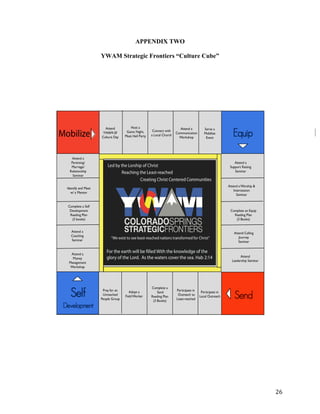
introducing a “Culture Cube”5
tool for Christian community (see Appendix Two).
In his book, “Drive”, Daniel Pink has researched and found that the old ways of workplace,
“rewards and punishments”, do not clearly motivate people as once thought. He offers three
areas that reintroduce the power behind volunteerism these are: 1. People need autonomy over
task, time, team, and technique. 2. Engagement produces mastery as a result from optimal
experiences in flow and 3. Humans naturally seek purpose – a cause greater than their own (Pink
2009:207-208). John Kotter reinforces this dynamic from the Harvard School of Business
revealing that management structures require personal buy-in by their teams. Introducing the
concept of a “dual-operating system”, Kotter observes that it is neither heavy, direct top-down


5	
  The “Culture Cube” has been an ongoing developing strategy through this course in how we create culture in
Christian community at YWAM Strategic Frontiers. It represents the four areas of engagement that our community
is committed to around identity and activity. It is a working document. I have used this once as a “beta test” and will
use it again for new staff intake and staff development for the future. 	
  	
  
  19	
  
management hierarchy nor a completely autonomous creative environment that creates buy-in
growth. Strategic initiatives that are a management hierarchy on one side and a creative network
on the other create a tension of creative balance (Kotter 2014:20).
Business strategy, of course, does not directly crossover to developing the volunteer
Christian community, but there are useful perspectives that can be adapted. Viewing Kotter’s
“dual-operating system”, the Christian community can evaluate the strengths and/or weaknesses
in terms of the apostolic and prophetic roles within our community. Prophetic roles being more
the nuts and bolts management pieces, and the apostolic roles being the more creative and
pioneering aspects of our ministry. What would this look like for Christian communities?
YWAM’s Argentinean national leader, Alejandro Rodriguez, offers a concept of community
built around a strong common identity (YWAM’s foundational values6
) but with diversified and
decentralized vision. “Things move from the inside out, and from top to bottom, like a growing
sapling. Branches reach out and multiply, bearing abundant fruit, all from a common trunk”
(Rodriguez 2009:34). There is no doubt that vision and structure often compete against one
another. The Christian community was originally designed to be an organic environment in
movement holding both apostolic and prophetic roles in unity.
Mobilize
The Christian community needs to be mobilized into a story bigger than them. It is a
compelling opportunity that engages both the head and the heart. It requires a sound strategy
with ambitious goals. It requires tactics that aim at the heart through thoughtfully created human


6	
  YWAM international has established a list of eighteen foundational values that each YWAM operating location or
campus adheres to within their communities and training programs. These can be viewed at:	
  
http://www.ywam.org/about-us/values/
  20	
  
experiences such as: what we see, hear, feel, and touch (Kotter 2008:49). Focusing on “the
why”, “the how”, and “the what” develops belief in a prescribed direction. We must guard the
mission of Christ for the individual and the community and not be seduced by the means of just
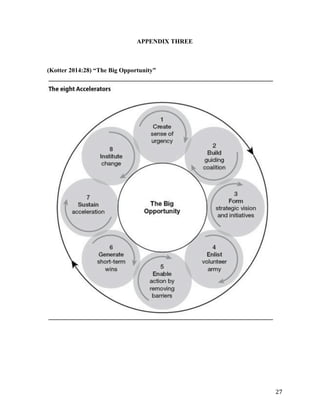
“doing” good things (Greer and Horst 2014:71-72). Kotter offers eight mobilizing accelerators
formed around a big opportunity that propels people into strategic opportunities (see Appendix
Three). As we observed above, the Sons of Issachar could see the signs of the times. What are
the signs of our times? Discontinuous change is a consistent theme in today’s world.
Mobilization efforts should be built around those big opportunities we see where the Community
of Christ can meet the triage of people’s felt needs.
Equip
Once the individual’s heart and mind have been captured and mobilized into a story
larger than themselves, we must evaluate what kind of equipping needs to be done in order to
meet that big opportunity in a strategic and tactical way. The equipping of an individual must
first begin with an examined life. Darrow Miller challenges the individual within Christian
community to be a theologian of Christ’s life, “To follow Jesus, to understand who we are and
what we have been created and called to do, we need both a relationship with the living God and
an increasing understanding of the biblical worldview” (Miller 2009:73).
These are two areas of equipping: first of mission vocation and second of theological
Christian understanding both generated from our personal relationship with Christ. Examining
Bonhoeffer’s challenge, “But one who will not learn to handle the Bible for himself is not an
Evangelical Christian (Bonhoeffer 1954:55). The individual of a Christian community must learn
to handle the word of God and have access to continuous biblical learning. This is challenging
  21	
  
today in that, so many millennials who come to YWAM mission communities are losing their
Bible literacy. Time’s news report of the National Bible Society reveals that almost 20% of
millennials are losing faith in the Bible’s authority and message. The Word of God is truth and it
transforms. Hebrews 4:12 “For the word of God is alive and active. Sharper than any double-
edged sword, it penetrates even to dividing soul and spirit, joints and marrow; it judges the
thoughts and attitudes of the heart” (NIV). Therefore, Bible training, just as important, for
instance, as training in vocational development strategies, is essential in the equipping process
and confronting relativity – the spirit and truth of mission community.
Send
We observed earlier, according to Gerhard Lohfink, that the early church communities
were the “called out” ones. This community of Christ was to be set apart as a counter culture to
the environment in which they lived. Christian community needs a mission sending modus
operandi, a system that sends the community. As we read in Luke 10:1-3, the disciples were
sent out two-by-two. The implication of pairs and/or teams is clear. Being the sent ones
highlights the many of areas of our lives that are potential opportunities to be the light of Christ
through our daily, weekly, and monthly routines where we rub shoulders with the lost. Being
sent is an active ongoing process. We are doing mission along the way of establishing God’s
kingdom. In our habitual routines of life we can be asking ourselves three questions as proposed
by Chester and Timmis these are: 1. Can I involve my community in this opportunity? 2. Is this
a missional opportunity in front of me? And 3. Is this an opportunity to bring Jesus into my
conversation? (Chester and Timmis 2012: 90). In this posture of being sent we are emulating
what I Peter 3:15 exhorts, to always be ready, to give an answer to everyone who asks you to
explain the hope you possess.
  22	
  
Sustain
Reflecting briefly upon the D-day invasion on the coast of Normandy, the Allied Armies
could not have succeeded without a supply pipeline that reinforced breaching the enemy’s
stronghold on the cliffs above7
. I have also experienced, on the other hand, the lack of sustained
focus while living on the field in Pakistan, pioneering a new work. In the recent past, YWAM
did not have a strategy to sustain what was pioneered in the field. This eventually contributed
largely to the failure of my team and its church planting goals.
To sustain any movement there must be clarity of the purpose, values, and vision – a
supply line if you will. YWAM Strategic Frontiers has three core values: 1. We are led by the
lordship of Christ 2. We exist to reach the least-reached peoples of the 10/40 window and 3. We
develop Christ-like communities. As a new member comes to our community, they will quickly
adhere to these core values and understand, in time, the importance of sustaining the individuals
of the YWAM community. In his conclusion of “Life Together”, Bonhoeffer states that the
Christian community has reached its goal of completeness through the joy and celebration of the
Christian community participating in the Lord’s Supper together. “Reconciled in their hearts
with God and the brethren, the congregation receives the gift of the body and blood of Jesus
Christ, and, receiving that, it receives forgiveness, new life, and salvation” (Bonhoeffer
1954:122). A completed community in relationship with Christ is a sustained community.
Therefore, the lordship of Christ in our lives is monumental to sustaining our individual
faith and our community’s faith. It is because of our individual participation with Christ, in
community with others, that we can evaluate spiritual transformation. Being in Christ will lead to


7	
  http://www.almc.army.mil/alog/issues/NovDec03/Logistics_of_Invasion.htm
In his article, “The Logistics of Invasion”, Maj. Frederick V. Godfrey reflects on the behemoth task of moving
supplies form stockpiles to the strategic areas in need for the continual sustaining and forward push of the allies.
Real-time logistics are key to success. 	
  
  23	
  
voluntarily doing for Christ. Daniel Pink offers that autonomy is something people seek out. “It
means acting with choice – which means we can be both autonomous and happily interdependent
with others” (Pink 2009:90). This is a value of honoring those who serve in the Christian
community; we hope to see people enter their calling of the Lord and also to serve the greater
story of God’s expansion around the globe. This is a value of honoring those who serve in the
Christian community. It is by choice we lay down our lives, pick up our cross, and follow Christ.
Evaluate
What do we measure in the Christian community? A popular saying is, “what gets measured
gets done…what’s not measured becomes irrelevant”. What we typically measure in mission
service through growth indicators does not clearly give us the impact or quality of such events.
All measurement is subjective at best especially measuring the spiritual impact or transformation
of an individual or community (Greer and Horst 2014:128).
Wellbeing of the Christian community can be evaluated through these series of
transformational aspects: 1. Spiritual restoration 2. Personal restoration 3. Social restoration. 4.
Material restoration and 5. Physical restoration (Ibid, 134). I added number five as we often
neglect evaluating our health in light of our mission service. What are we seeing transform in our
individual walk with God and the climate of our Christian community? God sees us in our
holistic form and not just in our vocation. These processes encourage mission true focus that
bridges any secular-sacred splits in our lives. Evaluation of the above cannot be performed
without a proper “matrix system” in place that reinforces expected outcomes in each category.
  24	
  
CONCLUSION
There is obviously so much history and reams of paper written about Christian community.
This paper was only a scratch on the surface on this subject. That being said, the critical take
away I had for this subject was the importance to the centrality of Jesus’ life and his original
design around the disciples in purposeful community. Today, we see so many fad groups, even
within the church, that are trying to create that “belonging” for those seeking relationship. While
this may be a good strategy to lure in the curious to Christian community, there must be the real
“nuts and bolts” of transformational spirituality in action. It is my aim to continue developing
Christian community through the tool of the “culture cube” concept as introduced in this paper. I
hope to see this as a tool of spiritual transformation that builds the contrast community and the
individual in missional opportunities.
Christian community is not about us it is about coming into God’s heart as the author of the
grand story of the world. We often have attitudes of “what am I going to get out of this
community?” when, in actuality, it is all about living counter culture to the world around us for
His name’s sake. It is because Jesus is worthy that we chose to be in Christian community with
others. It is not a common ambition from humanity as Bonhoeffer pointed out it is a commitment
of one’s soul and life to the Spirit of God and God’s plan of redemption for the world. All in all
it is a privilege to live and serve in Christian community. It is a model of faith in action that is
still a potent and proven tool in the hands of God to transform the world.
  25	
  
APPENDICES
APPENDIX ONE
The Rules of Life – Debra Farrington
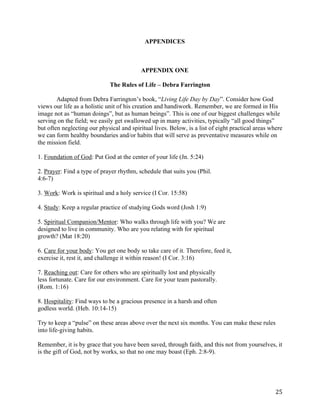
Adapted from Debra Farrington’s book, “Living Life Day by Day”. Consider how God
views our life as a holistic unit of his creation and handiwork. Remember, we are formed in His
image not as “human doings”, but as human beings”. This is one of our biggest challenges while
serving on the field; we easily get swallowed up in many activities, typically “all good things”
but often neglecting our physical and spiritual lives. Below, is a list of eight practical areas where
we can form healthy boundaries and/or habits that will serve as preventative measures while on
the mission field.
1. Foundation of God: Put God at the center of your life (Jn. 5:24)
2. Prayer: Find a type of prayer rhythm, schedule that suits you (Phil.
4:6-7)
3. Work: Work is spiritual and a holy service (I Cor. 15:58)
4. Study: Keep a regular practice of studying Gods word (Josh 1:9)
5. Spiritual Companion/Mentor: Who walks through life with you? We are
designed to live in community. Who are you relating with for spiritual
growth? (Mat 18:20)
6. Care for your body: You get one body so take care of it. Therefore, feed it,
exercise it, rest it, and challenge it within reason! (I Cor. 3:16)
7. Reaching out: Care for others who are spiritually lost and physically
less fortunate. Care for our environment. Care for your team pastorally.
(Rom. 1:16)
8. Hospitality: Find ways to be a gracious presence in a harsh and often
godless world. (Heb. 10:14-15)
Try to keep a “pulse” on these areas above over the next six months. You can make these rules
into life-giving habits.
Remember, it is by grace that you have been saved, through faith, and this not from yourselves, it
is the gift of God, not by works, so that no one may boast (Eph. 2:8-9).
  26	
  
APPENDIX TWO
YWAM Strategic Frontiers “Culture Cube”
  27	
  
APPENDIX THREE
(Kotter 2014:28) “The Big Opportunity”
  28	
  
REFERENCES CITED
Bonhoeffer, Dietrich. 1954. Life Together - The Classic Exploration of Faith in Community.
Translated by John W. Doberstein. San Francisco, CA.: Harper and Row Publishers.
Chester, Tim and Steve Timmis. 2012. Everyday Church - Gospel Communities On Mission.
Wheaton, Ill.: Crossway.
Corbett, Steve, and Brian Fikkert. 2009. When Helping Hurts - How To Alleviate Poverty
Without Hurting The Poor And Yourself. Chicago, Ill.: Moody Publishers.
Crouch, Andy. 2008. Culture Making - Recovering Our Creative Calling. Downers Grove, Ill.:
InterVarsity Press.
Farrington, Debra K. 2000. Living Faith Day by Day. New York: The Berkley Publishing Group.
Glasser, Arthur. 2003 Announcing the Kingdom: The Story of God's Mission in the Bible. Edited
by Dean S. Gilliland Charles Van Engen, and Shawn B. Redford. Grand Rapids: Baker
Academic. Reprint, 2006.
Greer, Peter and Chris Horst. 2014. Mission Drift - The Unspoken Crisis Facing Leaders,
Charities, and Churches. Bloomington, Minn.: Bethany House.
Grenz, Stanley J. 1994. Theology for the Community of God. Grand Rapids, MI.: Eerdmans.
Kotter, John P. 2014. XLR8 - Accelerate. Boston, Mass: Harvard Business Review Press.
________. 2008. A Sense Of Urgency. Boston, Mass.: Harvard Business Review Press.
Lohfink, Gerhard. 1984. Jesus and Community. Translated by John P. Galvin. Philadelphia:
Fortress Press.
Miller, Darrow L. 2009. Life Work - A Biblical Theology For What You Do Everyday. Seattle,
WA.: YWAM Publishing.
Network, Time News Inc. 2014. Millennials Losing Faith in the Bible. In Time Explains, edited
by Cliff Judy: Time.
Newbigin, Lesslie. 1995. The Open Secret - An Introduction to the Theology of Mission. Revised
from 1978 ed. Grand Rapids: William B. Eerdmans Publishing Co.
Pink, Daniel H. 2009. Drive - The Surprising Truth About What Motivates Us. New York, NY.:
Penguin Group - Riverhead Books.
  29	
  
Rodriguez, Alejandro. 2009. Towards An Institutional Or Apostolic Vision. 113,
http://divulgalo.jucum.com.ar/biblioteca/Towards%20an%20Institutional%20%20or%20
Apostolic%20%20Vision.pdf.
Scazzero, Peter. 2010. The Emotionally Healthy Church - A Strategy for Discipleship that
Actually Changes Lives. Grand Rapids, MI.: Zondervan Press.
________. 2006. Emotionally Healthy Spirituality. Nashville, TN.: Thomas Nelson.
Thomas Nelson, Inc. 1985. New King James Bible. Compact Reference Edition ed. Nashville:
Thomas Nelson Publishers.
Turner, Victor. 1969. The Ritual Process: Structure and Anti-Structure. Chicago, Ill.: Aldine
Publishing.
Zondervan. 1997. New International Version Bible. Edited by C. Lynn Green. YWAM year long
Bible ed, Christian Growth Study Bible. Grand Rapids, Michigan: Zondervan Press.

Christian_Community_Heckman_2016

  • 1.
    FULLER THEOLOGICAL SEMINARY Schoolof Intercultural Studies THE FOUNDATIONS OF CHRISTIAN COMMUNITY - GOD’S PEOPLE TRANSFORMED TO CHANGE THE WORLD A Paper By Von F. Heckman G10013996 Presented to Dr. Mark Hopkins In Partial Fulfillment of the Requirements for Directed Study ML591: The Purposeful Christian Community December, 2014
  • 2.
      2   TABLEOF CONTENTS     INTRODUCTION .........................................................................................................................3 I. DEFINING WHAT IS CHRISTIAN COMMUNITY ........................................................4 A Place to Know and be Known..............................................................................................4 Incarnational Love...................................................................................................................6 Presence of the Holy Spirit......................................................................................................7 Spiritual Identity – Gerhard Lohfink.......................................................................................8 Spiritual Activities – Dietrich Bonhoeffer...............................................................................9 Spiritual Rules of Life – Peter Scazzero................................................................................10 A Mission to Gather the Lost.................................................................................................11   II. INFLUENCE ONE – WHAT IS GOD”S COMMITMENT TO THE CHRISTIAN COMMUNITY?...........................................................................................................................13 Empowering God’s People....................................................................................................14 Apostolic Purpose..................................................................................................................14 III. INFLUENCE TWO – WHAT IS THE INDIVIDUAL”S RESPONSIBILITY TO THE CHRISTIAN COMMUNITY? ...................................................................................................15 The Vessel of God .................................................................................................................15 Living Incarnationally ...........................................................................................................16 IV. INFLUENCE THREE – WHAT IS THE CHRISTIAN COMMUNITY’S RESPONSIBILITY T THE INDIVIDUAL?.............................................................................17 Developing Christian Community.........................................................................................17 Mobilize.................................................................................................................................19 Equip......................................................................................................................................20 Send .......................................................................................................................................21 Sustain....................................................................................................................................21 Evaluate .................................................................................................................................23   CONCLUSION ............................................................................................................................24   APPENDICES..............................................................................................................................25 Appendix One – The “Rules of Life”....................................................................................25 Appendix Two – The “Culture Cube”..................................................................................26 Appendix Three - Kotter’s “Eight Accelerators” .................................................................27   REFERENCES CITED...............................................................................................................28    
  • 3.
      3     INTRODUCTION For centuries, communities have been a tool used by God for directed growth, protection, and provision. In the Christian circle, most of us are familiar with the concept of Christian communes or communities dating back to the early church mentioned in the book Acts, the Jesuit and Franciscan missions of the Catholic Church, and even the “Jesus Freak” communes of the “70’s”. In lieu of this however, we can see God’s greatest community development project take place among the freed Hebrew slaves of Egypt. Throughout the book of Deuteronomy, God releases a blueprint for His people who were the world’s first refugee population and moves them into identity and function as “God’s People” with a purpose via community. It is historically accurate then that community has been utilized to build, develop, focus, and multiply the influence of God’s people throughout time. Competing against this blueprint is our current cultural environment. Our Western culture is starkly independent, with an evolving base in relativism. Yet the desire to belong to “something” has never been stronger in history. People enjoy being a part of something that engages their heads and hearts. Community can be a catalyst for this desire to engage in something larger than the individual’s own story. Therefore, the foundation of Christian community is to provide “belonging” through spiritual transformation by giving God’s people identity and purpose to transform the world. In the following pages, I will build on this thesis by unpacking three key influences that contribute to the success of “belonging” to the Christian community where the head and heart are both mobilized into
  • 4.
      4   transformationalgrowth. We will look briefly at ancient, modern, and contemporary examples of Christian communities and their patterns of spiritual transformation. 1. DEFINING WHAT IS CHRSTIAN COMMUNITY A Place to Know Others and Be Known We might think of Christian communes or communities as austere simple, small, and local tight knit groups that hang out together around a simple theme of social action, evangelism or a monastery focused on minimalism. However, Christian communities should begin with a deeper purpose of being founded first in the Word of God. Since 1960, YWAM has approached community-based discipleship as a place to know God and be known by God through modular style training programs: a twelve-week lecture phase with a twelve-week outreach application. This creates a liminal communitas1 within the participant of this school. They come as one type of person and are transformed through their experiences with others, with the Word of God, and by the power of the Holy Spirit. As Charles Mellis described the YWAM community over three decades ago, in his book, “Committed Communities”, he states, “…YWAM also believes in the simple life, but projects a less austere image. One might say it reflects more of a joy-image, like the early Franciscans” (Mellis 1976:96). YWAM, being a missionary sodality, provides a context for volunteers to come and experience an interdependent life together while being transformed by biblical teaching, Holy Spirit healing, and empowering with opportunities in local and cross-cultural mission applications.                                                                                                                 1  In his book, “The Ritual Process: Structure and Anti-Structure”, Victor Turner describes as a kind of ritual passage or transition from one state of personhood to another. It is a departure from the old culture and ways to the beginning of a new. This is often a common theme in African tribes as young boys go out on a hunt to kill an animal and bring it back to feed their village thus evolving from boyhood into manhood as providers.  
  • 5.
      5   Anotherkey component to the Christian community is the presence of the body of Christ as described in Romans 12 referring to the unity and diversity that make up the body of Christ by being transformed by the renewing of our minds and leaving the ways of the world behind. There is a clear invitation to celebrate and use the diversity of spiritual gifts found in Christian community. Therefore, there is an environment to know others and their gifts and to be known for what each individual of the community offers to the whole. It is complimentary. Mellis continues, “The quality of the community is the essential ingredient, not the form” (Ibid, 109). Living in close proximity to others will create a natural transparent vulnerability. Our full humanity comes into view within community. This requires a humble attitude and commitment to be seen for who we are in the community. It is an environment that can foster a holistic reality of who we were designed by God to be as we see in Gen 1:27. “So God created man in His own image; in the image of God He created them; male and female he created them…” (NKJ). We are made up of physical, spiritual, emotional, intellectual, and social dimensions of God’s original design for humanity. This can come into focus through a liminal communal setting. Therefore, our Christian communities should be exhibiting transformative results of God’s original design as seen in the text of Galatians 5:22-23, fruits of the Spirit: a daily natural exhibition of love, joy, peace, patience, kindness, goodness, faithfulness, gentleness, and self- control exercised in daily life of the community. Thus the form of our community should reflect a holistic design that values diversity in gifting, where humility and transparency are exhibited and a safe yet challenging environment. In addition, it is based on Godly love exhibited within Christian community for self and for others. It cannot naturally be generated from a human source. This unconditional love does not naturally develop within humanity. Dietrich Bonhoeffer
  • 6.
      6   cites,“The basis of all human reality is the dark, turbid urges and desires of the human mind. The basis of the community of the Spirit is truth; the basis of human community of spirit is desire” (Bonhoeffer 1954:31). The desire to be known by others (fame and popularity) is replaced by the desire to be known first by God experiencing his transformational love. Incarnational Love John 13:34-35 “A new command I give you: Love one another. As I have loved you, so you must love one another. By this everyone will know that you are my disciples, if you love one another” (NIV). This truth of an otherworldly, unconditional love shook the early Christian church. Christian community should evidence unconditional love being present and demonstrated to all who are in community and toward those who are lost in the world. This love was to break down barriers between social structures, ethnicity, and culture. Tim Chester and Steve Timmis state, “The Christian community demonstrates the effectiveness of the gospel. We are living proof that the gospel is not an empty word but a powerful word that takes men and women who are lovers of self and transforms them by grace through the Spirit into the people who love God and others…an effective death that achieved the salvation of a people who now love one another sincerely from a pure heart” (Chester and Timmis 2012:56). Unconditional love was to be the hallmark of this new community of Christ. They were taught to be incarnate disciples of Jesus. This love would lead communities to preaching the words of Christ to the lost, praying for healing, giving to the needy, and even to martyrdom well beyond their ethnic and geographical roots. It was a selfless love – not of this world. Gerhard Lohfink comments, “The new family was to encompass all who accepted Jesus’ message of the reign of God and thus did the will of God…” (Lohfink 1982:106). This love would now be a model for Incarnational love – modeling Christ’s life and ministry to others.
  • 7.
      7   Presenceof the Holy Spirit In the early church community, the power of the Holy Spirit was clearly evident. Pentecost was the beginning of a new era. Acts describes the power of the Holy Spirit as faith’s call in both directions. Andy Crouch states, “…from human beings to God and from God to humanity, will no longer be from Abraham’s descendants alone” (Crouch 2008:149). The Christian community began not as an island hidden away until Christ returned but generated movement toward the lost in the world. Where individuals come together to experience community the power of God will present itself by accompanying preaching with, signs and wonders accompanied (Luke 9: 1-2). As Bonhoeffer states, “Once a man has experienced the mercy of God in his life he will henceforth aspire only to serve” (Bonheoffer 1954:94). Lohfink concurs that a concrete healing raises the expectation and influences the context in which it happened. Thus, when the Holy Spirit transforms Christian communities, signs and wonders will emerge anew (Lohfink 1982: 87). With the community’s focus being on intimacy formed around Jesus and signs and wonders formed around the presence of the Holy Spirit, the community will not devolve into a mere commune of collected individuals. As the Father and Son share relationship together, the Holy Spirit has made a way for us as well to share in this Trinitarian union; a community of believers on a mission. Stanley Grenz confirms our unity as a body of believers, "We are one people, therefore, because we are the company of those whom the Spirit has already brought to share in the love between the Father and the Son” (Grenz 1994:484). In this light, Christian community should be an environment of activity: a safe place where all can come, grow, and serve Christ. This is not a static and sedentary Christian community it is a community on the move. Spiritual Identity – Gerhard Lohfink
  • 8.
      8   TheChristian community contains activities that set it apart from all other types of communes or communities. These practices generate growth and faithful responses to one another, to God and to the lost. In this sense, the community of God becomes an anti-thesis to the dysfunctional patterns of this world. “In the Bible the people of God are always understood as a contrast-society” (Lohfink 1982:122). In his study of the ancient church, “Jesus and Community” Lohfink describes, in section three of his book, the discipleship community is engaged in being God’s people of Holy Spirit presence – preaching and healing prayer, ministry to all social classes, the praxis of togetherness through brotherly love, vulnerable denunciation of domination – a paradoxical authority, a contrast community, and a sign of invitation for all nations to enter into God’s community. Deuteronomy 7:6-8 details God’s intention to build a community of people submitted unto Himself, set apart from the world’s pagan tribes. In the life of Christ we see Jesus continue in this path of drawing a people unto God, set apart to do God’s will. Salvation was to lead toward a new life, a new person (Col. 3:8-14) active in spiritual growth. Lohfink boldly states, “The decisive task of the church is thus to build itself up as a society in contrast to the world, as the realm of Christ’s rule in which fraternal love is the law of life. It is precisely through the church’s doing this that the pagan society will grasp God’s plan for the world” (Ibid, 145). As we move through the aspects of identity in the Christian community, it is now helpful for us to look more specifically at the day-to-day activities that create the contrast community. Spiritual Activities – Dietrich Bonhoeffer
  • 9.
      9   Inhis original work, “Gemeinsames Leben - Life Together”, Bonhoeffer writes his biblical observations of the faith community in action. The Christian community is marked by morning worship, reading the word, devotion, prayer, singing of hymns and communion. The men of the Bible responded to God with remarkable frequency by rising early in the morning and participating in quiet time (Bonheoffer 1954:44). Lectio Divina, a type of devotion, was formed after early Benedictine monastic traditions of devotion, is designed to create quiet time for believers to meditate, hear, and understand the word in their own way as inspired by the Holy Spirit. This provides the biblical community the firm ground of the Word of God to stand on in all activities. Bonhoeffer offers, “Prayer, even though it be free, will be determined by a certain internal order. It is not a chaotic outburst of a human heart but the prayer of an inwardly ordered fellowship” (Ibid, 64). While I agree that Bonhoeffer is concerned about moods and feelings interrupting our spirituality, our spirituality should be connected to the head and heart in addition to allowing emotions room to feel the greatness of God during worship and prayer. Peter Scazzero states, “Ignoring any aspect of who we are as men and women made in God’s image always results in destructive consequences – in our relationship with God, with others, and ourselves” (Scazzero 2006:18-19). We see this example in the heart of David reflected in Psalms 142 to cry out, to worship, and pray to the Lord with strong, joyful and remorseful emotion. Bonhoeffer introduces a unique look into the fellowship of the Lord’s Table as a process that solidifies our devotion towards the Lord, the source of our redemption and spiritual life. Luke 24:30-31 reveals that their eyes were opened and they knew him. It implies obligation from the community that celebrates the Lord as the giver of all gifts, the creator of the world, the path to redemption, and that all is for the sake of Christ (Ibid, 66-67). Together we share the bread and drink the wine of remembrance ending our hunger and shame and the forward direction that
  • 10.
      10   createsmission – salvation of the lost. Grenz comments concerning our view of the Eucharist, “Through its link to the future fulfillment of Jesus’ promise, the past event of Christ’s death constitutes our identity…The future that Jesus promises us is a special future. It is characterized by fellowship (Grenz 1994:538). Through the Eucharist, we can share in God’s relational love, joy, and celebration; the Creator of the universe does not orphan us. We can spread this message and hope to a lost world that communicates, “you belong”. Spiritual Rules of Life – Peter Scazzero Scazzero breaks up the activities in view of a more contemporary Christian community into four main groups: Prayer, Rest, Work, and Relationships. Creating a community pattern around spiritual “Rules of Life” reinforces the counter-cultural standard shown to us in New Testament scriptures. In her book, “Living Faith Day by Day“, Debra Farrington offers a pattern formed by old monastic traditions that keep us focused on a holistic life pattern which enables our Christian growth individually as well as set in community2 (Appendix One). This example can easily be adapted into Christian communities that want regular activities to reinforce their transformation. Prayer involves four activities of Scripture reading, silent meditation, the Daily Office of communion with God, and study of the Scriptures. It is the word of God that is perfect and true in converting the heart as written in Proverbs 30:5 (Scazzero 2010:224). We need to stop, rest, and delight in the Lord. We live lives in simplicity to diminish the stronghold of materialism within our culture and we commit our lives to play and regular recreation that involves the celebration of the community’s presence and ministry (Ibid, 224).                                                                                                                 2  See Appendix 1 for a review of the old monastic traditions placed into a “Rules of Life” pattern for Christian living. This list was adapted from Debra Farringdon’s book to be used for YWAM’s Field Bound training process for workers moving cross-culturally.    
  • 11.
      11   Workis the hallmark to the Christian community. We need a focused outlet of service and mission to the lost. This can be both locally and globally. It involves the entire body as exemplified in Ephesians 4:16, the body is held up by the working of each ligament. Care for the physical body is a stewardship issue. This requires exercise, diet, and rest respecting our God- given limits (Ibid, 225). And lastly, relationships are a holistic model that embraces our emotional health. They should be included in our spiritual formation model. The Incarnational example of being Christ to others will build our ability to listen to others and to show empathy to the hurting. Family is an equal value to God, be it as a single or a married. Family relationships reinforce the development of healthy marriages and rearing of children, with God's authority over the family unit will affirm honor in the community. The Christian community itself as the conduit in which mission takes traction grows mature relationships and can nurture and minister to others in need (Ibid, 226). A Mission to Gather the Lost Dietrich Bonhoeffer offers that Christian community is not just an ideal but also primarily a divine reality (Bohoeffer 1954:30). Where human love for one another becomes an end unto itself spiritual love comes from Christ and serves him alone. Therefore, in Christian community we have a dynamic process of Jesus becoming the mediator between humans and God (1 Tim. 2:5-6). Secondly, Bonhoeffer states the Christian brotherhood is a spiritual and not a psychic reality. We participate in this community through the power of the Holy Spirit and relating to the triune God as He dwells in community; in that spiritual love creates a freedom we can walk in
  • 12.
      12   andbe transformed by (Ibid, 36-37). The Christ focused community transforms its participants through God’s love, which is the catalyst for the liminal process. God’s design for community, as described by Lohfink, was to gather believers of God into community and not within isolated individuals. We see this early example by the twelve disciples. God’s plan was to create something new, a family of disciples around Jesus (Lohfink 1982:72). It was in these early years of the church that the Christian community conducted itself as the ekklesia, “the assembly of called out ones”. The true people of God were called away and separated from un-holiness and impurity of their surroundings. Stanley Grenz commented that the early church was neither an edifice nor an organization. “They were a people – a people brought together by the Holy Spirit – a people bound to each other through Christ – hence a people standing in covenant with God” (Grenz 1994:465). Here, again, we see the community not formed around human interests and fads but formed around the message and purposes of Christ – kingdom evangelism. What kind of evangelism do we mean? Most of us think of proclamation of God’s Word to the lost. Grenz argues that evangelism, being an “announcement”, is an invitation to participate in the community of God. In this sense the Christian community carries a prophetic role of being Jesus incarnate to the lost, “…an implicit call to the world to acknowledge the lordship of the God who has established us as his people” (Ibid, 503). This invitation to join God’s community continues throughout the world today. The German word, zeitgeist3 , exhorts one to know the general moral and spiritual climate of the present era (Mellis 1976:65). We also see this reflected in I Chronicles 12:32 “…from Issachar, men who                                                                                                                 3  Zeitgeist, http://dictionary.reference.com/browse/zeitgeist an old German word that came to us in the 1830’s, has been used by theologians to describe the “spirit of the age” and the awareness the church should have in meeting those felt needs as a missional community.  
  • 13.
      13   understoodthe times and knew what Israel should do…” (NIV). This tribe was a tribe who could bring focus from the seeing the felt needs of their environment serving Israel and King David to better understand their context. The Christian community therefore, must commit itself to outreach, to the needs of the lost and be the backdrop of a fallen and needy world. Just as the early church was “called out” to be counter-cultural in their context, the Christian community of today also needs that focus of mission to avoid the “greenhouse syndrome” of internally focused relative spirituality. Our outreach then should also have a focus on proclamation and social action upon the real needs that are robbing life from the lost and hurting. Grenz offers, “We propose that the involvement of the church in social action is crucial regardless of its relationship to evangelism” (Grenz 1994:507). In Luke 10:9, as the disciples were sent out to minister, Jesus instructed them to say, “the kingdom of God has come near to you”. The message of the kingdom was seen in both word and deed. The empowering of God’s people was released to be the community of Christ to the world, inviting the lost into fellowship with God (Corbett and Fikkert 2009:41). This was fulfilling Jesus’ words of the beatitudes in teaching his follows how to pray for God’s kingdom to come on earth, as it is heaven. Therefore, the Christian community needs to be a discerning and listening one to the environments in which it is living. II. WHAT IS GOD’S COMMITMENT TO THE CHRISTIAN COMMUNITY? God’s commitment to the Christian community is clear, He gives the community a vocation to be representatives of God’s kingdom to the nations. From the earliest mention of God’s creation, God saw what he created and called it “good” (Gen. 1:31). From the origin of the
  • 14.
      14   Gardenof Eden, God established community between Adam, Eve, and Himself. The interest and jealousy of God to have a people unto Himself was set in the beginning of time, a people who had a purpose, a people who were blessed to bless others with the invitation to join God’s community. Gen. 12:1-3 The LORD had said to Abram, "Leave your country, your people and your father's household and go to the land I will show you. 2 "I will make you into a great nation and I will bless you; I will make your name great, and you will be a blessing. 3 I will bless those who bless you, and whoever curses you I will curse; and all peoples on earth will be blessed through you." (NIV) The theme of this blessing flows throughout the Bible. Arthur Glasser states, “God’s sovereign will ultimately brings to light his lordship over all peoples. It is in the blessings promised to the nations through Abraham” (Glasser 2003:26). This blessing was intended to spread through the world wherever God’s people resided. This was a new history and vocation that was to carry on through history beyond the Old Testament writings and continue on through God’s son, Jesus, come as a man in the flesh. “The new reality that he introduced into history was to be continued through history in the form of a community, not in the form of a book” (Newbigin 1995:52). The community’s vocation was to be incarnate examples of Jesus, the Savior of the world. We see this modeled clearly in the four gospels. Empowering God’s People John 15: 1-16 directs the Christian to remain in the vine of Christ as out empowerment. We can do nothing outside of this community in Christ. We can do nothing without remaining true to God’s word. We can do nothing in our own strength to accomplish the kingdom of God without a bond in Christ. It is generated from the triune God: Father, Son, and Holy Spirit. God’s people
  • 15.
      15   arerecipients of the shalom4 blessing and presence of God: God in His entirety, blessing His people, banded in communities across the globe. Jesus’ authority was released to us as well to be co-laborers with Christ in bringing in the Kingdom of God. Mark 16: 15-20 speaks of divine authority given to His people/disciples. This transfer of heavenly authority was used to establish the disciple’s faith as well as proving the doctrine of the gospel in its formative period (Glasser 2003:231). Apostolic Purpose As the disciples reeled after Jesus’ death, this was not the end of God’s kingdom presence, it was the multiplication of all God intended, to multiply Christian community throughout the world via the power of the Holy Spirit. Acts 1:8 sets the stage for the continuation of God’s heart and intention of bringing the kingdom and His shalom presence to his people. Reading through Acts 2:16-40, Glasser highlights four areas from Peter’s sermon that ushered in the Pentecost and produced a release of apostolic initiative among the early church community confiming: 1) OT prophecy was now fulfilled. 2) Jesus was vindicated as Lord and the Christ. 3) Death was overcome, as evidenced by the presence of the Holy Spirit. And 4) Forgiveness and the gift of the Spirit are available to all who repent (Ibid, 266). A community who does not see this apostolic call to create and build Christian communities loses its function and ability to be salt and light to a lost world. Mission expansion will end, drift will spread throughout the community’s spiritual foundation, and an island mentality of “come save me!” will ensue.                                                                                                                 4  Shalom is a positive and proactive concept. “It has to do with community (Ps. 29:11) and means total harmony within the community” (Glasser 2003:130). It has to do with peace and is representative of the redemptive work of Christ.  
  • 16.
      16   III.WHATIS THE INDIVIDUAL’S RESPONSIBILITY TO THE CHRISTIAN COMMUNITY? The Vessel of God Now that we understand the vocation for the Christian community, what is our individual responsibility to this call to be missional and usher in the kingdom of God through the power of the Holy Spirit? God deserves a vessel that is submitted unto the lordship of Christ. Matthew 22:37-40, exhorts us to love the Lord your God with all your heart, soul, mind and strength…loving your neighbor as yourself. We find in Psalms 24: 3-4 that those who can ascend the hill of the Lord must have clean hands and pure heart. There is a condition to the state of our faith and walk with God that must be genuine in order for God’s full promises and blessing to accompany His community. The distinctive we possess, as a Christian community, reminds us that we are chosen from a sinful world by the Father, sanctified for the sake of the world by the Spirit, and called to missional obedience by Christ’s redeeming blood (Chester and Timmis 2012:47). Lohfink exhorts, “That the church is the chosen people, God’s own property, has the inevitable consequence that it must be holy among the nations – fundamentally different, in other words, from the other societies of the world” (Lohfink 1982:151). Therefore, our identity must be grounded in the fact that we are not our own. We have been bought with the price of the Christ’s atoning blood. Living Incarnationally In the parable of the Good Samaritan (Luke 10:25-37), Jesus challenges the expert of the law by telling a story of loving your neighbor and showing mercy to those in need. The exhortation
  • 17.
      17   givenwas to go and do likewise. The Christian life must therefore embody Christ and to live set apart from the world, yet show unconditional love and compassion on those who are lost; to show the way of repentance and the forgiveness of sins through Jesus. “The forgiveness of sins is what makes possible the gift of God’s peace” (Newbigin 1995:48). We therefore, become agents of God’s peace and grace through Christ to those who are broken. It is so much more than just living a good Christian life. “Our lives are the evangelistic events. Our life together is the apologetic” Chester and Timmis boldly add (Chester and Timmis 2012:89). Darrow Miller asks, “What is the church? At her core, she is an Incarnational community…a community of believers who are to incarnate the Word in a broken world” (Miller 2009:308). The church is not a static building hung on its polity; it is the make up of a holy nation, a royal priesthood as we read in scripture. The individuals of Christian community should reflect all of who God is through the diversity of the body and its gifts, services and ministries. There is an expectation and “buy-in” required by each member. We read in John chapter 1:1-4, “In the beginning was the Word, and the Word was with God, and the Word was God. He was with God in the beginning. Through him all things were made; without him nothing was made that has been made. In him was life, and that life was the light of men” (NIV). This same light is what we live out daily for others to take note of and receive the invitation to join God’s kingdom of life. Yet, we still find in our Christian communities some who do not share in this conviction of becoming Christ to others of their own accord and choose a more nominal approach to walking out their daily faith.
  • 18.
      18   IV.WHAT IS THE CHRISTIAN COMMUNITY’S REPSONSIBILITY TO THE INDIVIDUAL? Developing Christian community, as we’ve discovered above, requires a sincere and absolute conviction to follow Christ and to commit one’s self to God, to the Christian community, and to developing one’s faith daily. That being said, there is still a danger that drift and/or internalizing spirituality can limit the impact and function of the Christian community in its context. The Christian community can be a source of inspiration as it connects the individual to the past memory of God’s faithfulness and hope for the future of God’s continued promises (Heb 11:1). This embodies the redemptive story of the Word (Grenz 1994:501). How does the Christian community create traction in bringing the individual into God’s kingdom plans for earth? The four detailed areas of Mobilize, Equip, Send, and Sustain below can aid the focus of urgency for the individuals serving in Christian community. From these four areas, I am introducing a “Culture Cube”5 tool for Christian community (see Appendix Two). In his book, “Drive”, Daniel Pink has researched and found that the old ways of workplace, “rewards and punishments”, do not clearly motivate people as once thought. He offers three areas that reintroduce the power behind volunteerism these are: 1. People need autonomy over task, time, team, and technique. 2. Engagement produces mastery as a result from optimal experiences in flow and 3. Humans naturally seek purpose – a cause greater than their own (Pink 2009:207-208). John Kotter reinforces this dynamic from the Harvard School of Business revealing that management structures require personal buy-in by their teams. Introducing the concept of a “dual-operating system”, Kotter observes that it is neither heavy, direct top-down                                                                                                                 5  The “Culture Cube” has been an ongoing developing strategy through this course in how we create culture in Christian community at YWAM Strategic Frontiers. It represents the four areas of engagement that our community is committed to around identity and activity. It is a working document. I have used this once as a “beta test” and will use it again for new staff intake and staff development for the future.    
  • 19.
      19   managementhierarchy nor a completely autonomous creative environment that creates buy-in growth. Strategic initiatives that are a management hierarchy on one side and a creative network on the other create a tension of creative balance (Kotter 2014:20). Business strategy, of course, does not directly crossover to developing the volunteer Christian community, but there are useful perspectives that can be adapted. Viewing Kotter’s “dual-operating system”, the Christian community can evaluate the strengths and/or weaknesses in terms of the apostolic and prophetic roles within our community. Prophetic roles being more the nuts and bolts management pieces, and the apostolic roles being the more creative and pioneering aspects of our ministry. What would this look like for Christian communities? YWAM’s Argentinean national leader, Alejandro Rodriguez, offers a concept of community built around a strong common identity (YWAM’s foundational values6 ) but with diversified and decentralized vision. “Things move from the inside out, and from top to bottom, like a growing sapling. Branches reach out and multiply, bearing abundant fruit, all from a common trunk” (Rodriguez 2009:34). There is no doubt that vision and structure often compete against one another. The Christian community was originally designed to be an organic environment in movement holding both apostolic and prophetic roles in unity. Mobilize The Christian community needs to be mobilized into a story bigger than them. It is a compelling opportunity that engages both the head and the heart. It requires a sound strategy with ambitious goals. It requires tactics that aim at the heart through thoughtfully created human                                                                                                                 6  YWAM international has established a list of eighteen foundational values that each YWAM operating location or campus adheres to within their communities and training programs. These can be viewed at:   http://www.ywam.org/about-us/values/
  • 20.
      20   experiencessuch as: what we see, hear, feel, and touch (Kotter 2008:49). Focusing on “the why”, “the how”, and “the what” develops belief in a prescribed direction. We must guard the mission of Christ for the individual and the community and not be seduced by the means of just “doing” good things (Greer and Horst 2014:71-72). Kotter offers eight mobilizing accelerators formed around a big opportunity that propels people into strategic opportunities (see Appendix Three). As we observed above, the Sons of Issachar could see the signs of the times. What are the signs of our times? Discontinuous change is a consistent theme in today’s world. Mobilization efforts should be built around those big opportunities we see where the Community of Christ can meet the triage of people’s felt needs. Equip Once the individual’s heart and mind have been captured and mobilized into a story larger than themselves, we must evaluate what kind of equipping needs to be done in order to meet that big opportunity in a strategic and tactical way. The equipping of an individual must first begin with an examined life. Darrow Miller challenges the individual within Christian community to be a theologian of Christ’s life, “To follow Jesus, to understand who we are and what we have been created and called to do, we need both a relationship with the living God and an increasing understanding of the biblical worldview” (Miller 2009:73). These are two areas of equipping: first of mission vocation and second of theological Christian understanding both generated from our personal relationship with Christ. Examining Bonhoeffer’s challenge, “But one who will not learn to handle the Bible for himself is not an Evangelical Christian (Bonhoeffer 1954:55). The individual of a Christian community must learn to handle the word of God and have access to continuous biblical learning. This is challenging
  • 21.
      21   todayin that, so many millennials who come to YWAM mission communities are losing their Bible literacy. Time’s news report of the National Bible Society reveals that almost 20% of millennials are losing faith in the Bible’s authority and message. The Word of God is truth and it transforms. Hebrews 4:12 “For the word of God is alive and active. Sharper than any double- edged sword, it penetrates even to dividing soul and spirit, joints and marrow; it judges the thoughts and attitudes of the heart” (NIV). Therefore, Bible training, just as important, for instance, as training in vocational development strategies, is essential in the equipping process and confronting relativity – the spirit and truth of mission community. Send We observed earlier, according to Gerhard Lohfink, that the early church communities were the “called out” ones. This community of Christ was to be set apart as a counter culture to the environment in which they lived. Christian community needs a mission sending modus operandi, a system that sends the community. As we read in Luke 10:1-3, the disciples were sent out two-by-two. The implication of pairs and/or teams is clear. Being the sent ones highlights the many of areas of our lives that are potential opportunities to be the light of Christ through our daily, weekly, and monthly routines where we rub shoulders with the lost. Being sent is an active ongoing process. We are doing mission along the way of establishing God’s kingdom. In our habitual routines of life we can be asking ourselves three questions as proposed by Chester and Timmis these are: 1. Can I involve my community in this opportunity? 2. Is this a missional opportunity in front of me? And 3. Is this an opportunity to bring Jesus into my conversation? (Chester and Timmis 2012: 90). In this posture of being sent we are emulating what I Peter 3:15 exhorts, to always be ready, to give an answer to everyone who asks you to explain the hope you possess.
  • 22.
      22   Sustain Reflectingbriefly upon the D-day invasion on the coast of Normandy, the Allied Armies could not have succeeded without a supply pipeline that reinforced breaching the enemy’s stronghold on the cliffs above7 . I have also experienced, on the other hand, the lack of sustained focus while living on the field in Pakistan, pioneering a new work. In the recent past, YWAM did not have a strategy to sustain what was pioneered in the field. This eventually contributed largely to the failure of my team and its church planting goals. To sustain any movement there must be clarity of the purpose, values, and vision – a supply line if you will. YWAM Strategic Frontiers has three core values: 1. We are led by the lordship of Christ 2. We exist to reach the least-reached peoples of the 10/40 window and 3. We develop Christ-like communities. As a new member comes to our community, they will quickly adhere to these core values and understand, in time, the importance of sustaining the individuals of the YWAM community. In his conclusion of “Life Together”, Bonhoeffer states that the Christian community has reached its goal of completeness through the joy and celebration of the Christian community participating in the Lord’s Supper together. “Reconciled in their hearts with God and the brethren, the congregation receives the gift of the body and blood of Jesus Christ, and, receiving that, it receives forgiveness, new life, and salvation” (Bonhoeffer 1954:122). A completed community in relationship with Christ is a sustained community. Therefore, the lordship of Christ in our lives is monumental to sustaining our individual faith and our community’s faith. It is because of our individual participation with Christ, in community with others, that we can evaluate spiritual transformation. Being in Christ will lead to                                                                                                                 7  http://www.almc.army.mil/alog/issues/NovDec03/Logistics_of_Invasion.htm In his article, “The Logistics of Invasion”, Maj. Frederick V. Godfrey reflects on the behemoth task of moving supplies form stockpiles to the strategic areas in need for the continual sustaining and forward push of the allies. Real-time logistics are key to success.  
  • 23.
      23   voluntarilydoing for Christ. Daniel Pink offers that autonomy is something people seek out. “It means acting with choice – which means we can be both autonomous and happily interdependent with others” (Pink 2009:90). This is a value of honoring those who serve in the Christian community; we hope to see people enter their calling of the Lord and also to serve the greater story of God’s expansion around the globe. This is a value of honoring those who serve in the Christian community. It is by choice we lay down our lives, pick up our cross, and follow Christ. Evaluate What do we measure in the Christian community? A popular saying is, “what gets measured gets done…what’s not measured becomes irrelevant”. What we typically measure in mission service through growth indicators does not clearly give us the impact or quality of such events. All measurement is subjective at best especially measuring the spiritual impact or transformation of an individual or community (Greer and Horst 2014:128). Wellbeing of the Christian community can be evaluated through these series of transformational aspects: 1. Spiritual restoration 2. Personal restoration 3. Social restoration. 4. Material restoration and 5. Physical restoration (Ibid, 134). I added number five as we often neglect evaluating our health in light of our mission service. What are we seeing transform in our individual walk with God and the climate of our Christian community? God sees us in our holistic form and not just in our vocation. These processes encourage mission true focus that bridges any secular-sacred splits in our lives. Evaluation of the above cannot be performed without a proper “matrix system” in place that reinforces expected outcomes in each category.
  • 24.
      24   CONCLUSION Thereis obviously so much history and reams of paper written about Christian community. This paper was only a scratch on the surface on this subject. That being said, the critical take away I had for this subject was the importance to the centrality of Jesus’ life and his original design around the disciples in purposeful community. Today, we see so many fad groups, even within the church, that are trying to create that “belonging” for those seeking relationship. While this may be a good strategy to lure in the curious to Christian community, there must be the real “nuts and bolts” of transformational spirituality in action. It is my aim to continue developing Christian community through the tool of the “culture cube” concept as introduced in this paper. I hope to see this as a tool of spiritual transformation that builds the contrast community and the individual in missional opportunities. Christian community is not about us it is about coming into God’s heart as the author of the grand story of the world. We often have attitudes of “what am I going to get out of this community?” when, in actuality, it is all about living counter culture to the world around us for His name’s sake. It is because Jesus is worthy that we chose to be in Christian community with others. It is not a common ambition from humanity as Bonhoeffer pointed out it is a commitment of one’s soul and life to the Spirit of God and God’s plan of redemption for the world. All in all it is a privilege to live and serve in Christian community. It is a model of faith in action that is still a potent and proven tool in the hands of God to transform the world.
  • 25.
      25   APPENDICES APPENDIXONE The Rules of Life – Debra Farrington Adapted from Debra Farrington’s book, “Living Life Day by Day”. Consider how God views our life as a holistic unit of his creation and handiwork. Remember, we are formed in His image not as “human doings”, but as human beings”. This is one of our biggest challenges while serving on the field; we easily get swallowed up in many activities, typically “all good things” but often neglecting our physical and spiritual lives. Below, is a list of eight practical areas where we can form healthy boundaries and/or habits that will serve as preventative measures while on the mission field. 1. Foundation of God: Put God at the center of your life (Jn. 5:24) 2. Prayer: Find a type of prayer rhythm, schedule that suits you (Phil. 4:6-7) 3. Work: Work is spiritual and a holy service (I Cor. 15:58) 4. Study: Keep a regular practice of studying Gods word (Josh 1:9) 5. Spiritual Companion/Mentor: Who walks through life with you? We are designed to live in community. Who are you relating with for spiritual growth? (Mat 18:20) 6. Care for your body: You get one body so take care of it. Therefore, feed it, exercise it, rest it, and challenge it within reason! (I Cor. 3:16) 7. Reaching out: Care for others who are spiritually lost and physically less fortunate. Care for our environment. Care for your team pastorally. (Rom. 1:16) 8. Hospitality: Find ways to be a gracious presence in a harsh and often godless world. (Heb. 10:14-15) Try to keep a “pulse” on these areas above over the next six months. You can make these rules into life-giving habits. Remember, it is by grace that you have been saved, through faith, and this not from yourselves, it is the gift of God, not by works, so that no one may boast (Eph. 2:8-9).
  • 26.
      26   APPENDIXTWO YWAM Strategic Frontiers “Culture Cube”
  • 27.
      27   APPENDIXTHREE (Kotter 2014:28) “The Big Opportunity”
  • 28.
      28   REFERENCESCITED Bonhoeffer, Dietrich. 1954. Life Together - The Classic Exploration of Faith in Community. Translated by John W. Doberstein. San Francisco, CA.: Harper and Row Publishers. Chester, Tim and Steve Timmis. 2012. Everyday Church - Gospel Communities On Mission. Wheaton, Ill.: Crossway. Corbett, Steve, and Brian Fikkert. 2009. When Helping Hurts - How To Alleviate Poverty Without Hurting The Poor And Yourself. Chicago, Ill.: Moody Publishers. Crouch, Andy. 2008. Culture Making - Recovering Our Creative Calling. Downers Grove, Ill.: InterVarsity Press. Farrington, Debra K. 2000. Living Faith Day by Day. New York: The Berkley Publishing Group. Glasser, Arthur. 2003 Announcing the Kingdom: The Story of God's Mission in the Bible. Edited by Dean S. Gilliland Charles Van Engen, and Shawn B. Redford. Grand Rapids: Baker Academic. Reprint, 2006. Greer, Peter and Chris Horst. 2014. Mission Drift - The Unspoken Crisis Facing Leaders, Charities, and Churches. Bloomington, Minn.: Bethany House. Grenz, Stanley J. 1994. Theology for the Community of God. Grand Rapids, MI.: Eerdmans. Kotter, John P. 2014. XLR8 - Accelerate. Boston, Mass: Harvard Business Review Press. ________. 2008. A Sense Of Urgency. Boston, Mass.: Harvard Business Review Press. Lohfink, Gerhard. 1984. Jesus and Community. Translated by John P. Galvin. Philadelphia: Fortress Press. Miller, Darrow L. 2009. Life Work - A Biblical Theology For What You Do Everyday. Seattle, WA.: YWAM Publishing. Network, Time News Inc. 2014. Millennials Losing Faith in the Bible. In Time Explains, edited by Cliff Judy: Time. Newbigin, Lesslie. 1995. The Open Secret - An Introduction to the Theology of Mission. Revised from 1978 ed. Grand Rapids: William B. Eerdmans Publishing Co. Pink, Daniel H. 2009. Drive - The Surprising Truth About What Motivates Us. New York, NY.: Penguin Group - Riverhead Books.
  • 29.
      29   Rodriguez,Alejandro. 2009. Towards An Institutional Or Apostolic Vision. 113, http://divulgalo.jucum.com.ar/biblioteca/Towards%20an%20Institutional%20%20or%20 Apostolic%20%20Vision.pdf. Scazzero, Peter. 2010. The Emotionally Healthy Church - A Strategy for Discipleship that Actually Changes Lives. Grand Rapids, MI.: Zondervan Press. ________. 2006. Emotionally Healthy Spirituality. Nashville, TN.: Thomas Nelson. Thomas Nelson, Inc. 1985. New King James Bible. Compact Reference Edition ed. Nashville: Thomas Nelson Publishers. Turner, Victor. 1969. The Ritual Process: Structure and Anti-Structure. Chicago, Ill.: Aldine Publishing. Zondervan. 1997. New International Version Bible. Edited by C. Lynn Green. YWAM year long Bible ed, Christian Growth Study Bible. Grand Rapids, Michigan: Zondervan Press.