
Welcome to the U.S.C. UCEDD Webinar Series
for Individuals with Disabilities & Parents
funded by grant #90DD0695 from
the Administration on Intellectual and Developmental Disabilities (A.I.D.D.)
Administration on Community Living
October 27, 2016
Your Moderator
2
Susan Kanegawa
U.S.C. UCEDD Family Support Coordinator
skanegawa@chla.usc.edu
www.uscucedd.org
The USC University Center of Excellence in Developmental Disabilities at Children’s Hospital
Los Angeles (U.S.C. UCEDD) is one of 68 UCEDDs funded to promote systemic change,
advocacy, and capacity building in states on behalf of individuals with, or at risk for,
developmental, behavioral and/or special health care needs, and their families.
The U.S.C. UCEDD Webinar series is designed to educate the community about current policy
issues which impact the lives of people we serve and their families. Our primary audience is
individuals with special needs and their families. At this time, our webinars are in English only.
We are exploring methods to make this series available in other languages in the future.
2
Structure and Logistics
3
Take notes Type your questions
Download
slides
Watch and
Share
Take
Survey
During the Webinar
After the Webinar
Give your opinion
3
Poll:
Can you hear Susan and Peggie?
•4
Let us know in the chat box if we need
to speak louder.
4
Navigating the
Criminal Justice System
For People with Intellectual & Developmental Disabilities
Peggie Webb, M.A.
Manager, Forensic and Behavioral Health Services at San Diego Regional Center
October 27, 2016
The views and opinions expressed in this presentation are the speaker’s own and do not necessarily reflect
the views and opinions of the U.S.C. UCEDD or C.H.L.A.
5
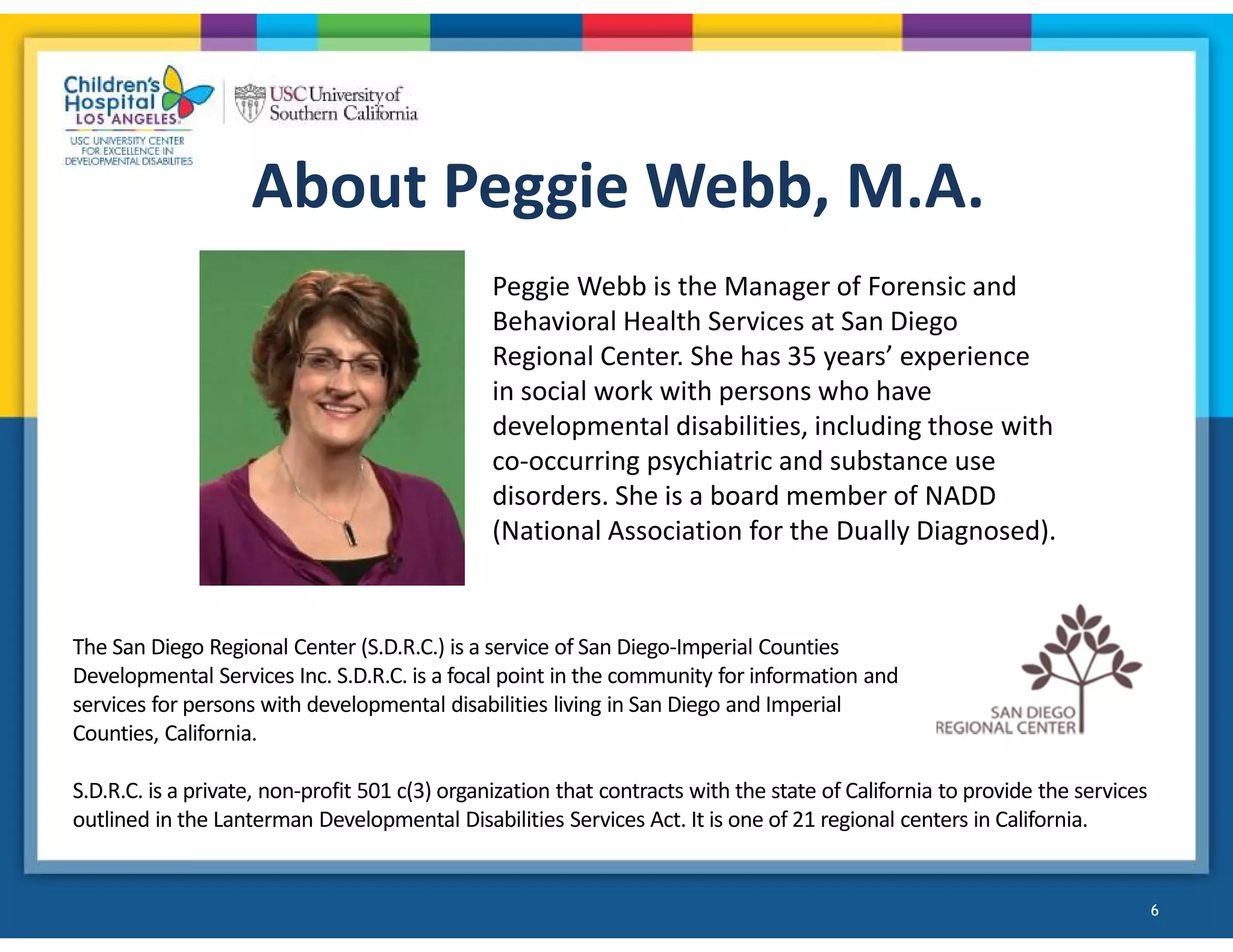
About Peggie Webb, M.A.
Peggie Webb is the Manager of Forensic and
Behavioral Health Services at San Diego
Regional Center. She has 35 years’ experience
in social work with persons who have
developmental disabilities, including those with
co-occurring psychiatric and substance use
disorders. She is a board member of NADD
(National Association for the Dually Diagnosed).
The San Diego Regional Center (S.D.R.C.) is a service of San Diego-Imperial Counties
Developmental Services Inc. S.D.R.C. is a focal point in the community for information and
services for persons with developmental disabilities living in San Diego and Imperial
Counties, California.
S.D.R.C. is a private, non-profit 501 c(3) organization that contracts with the state of California to provide the services
outlined in the Lanterman Developmental Disabilities Services Act. It is one of 21 regional centers in California.
6
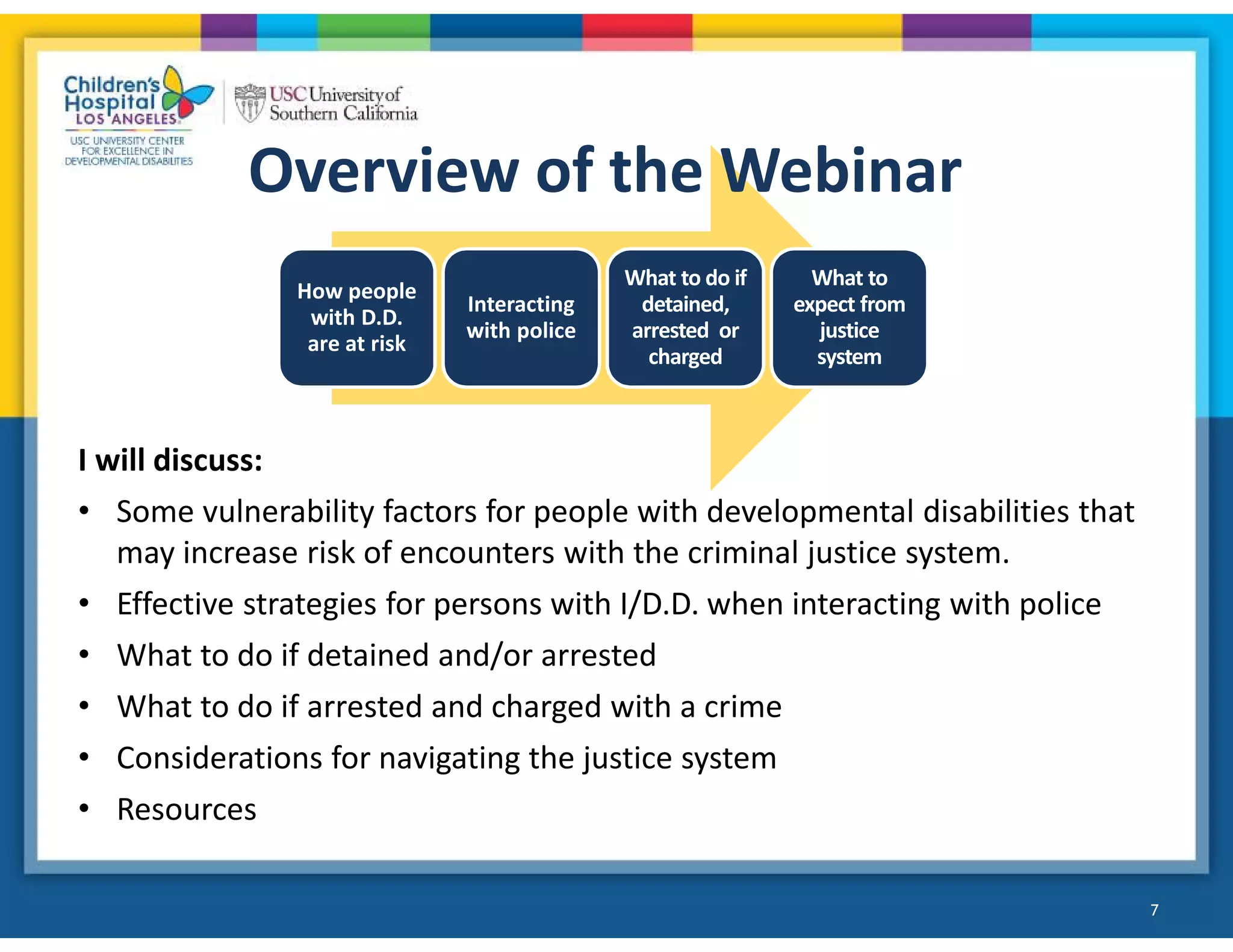
How people
with D.D.
are at risk
Interacting
with police
What to do if
detained,
arrested or
charged
What to
expect from
justice
system
Overview of the Webinar
7
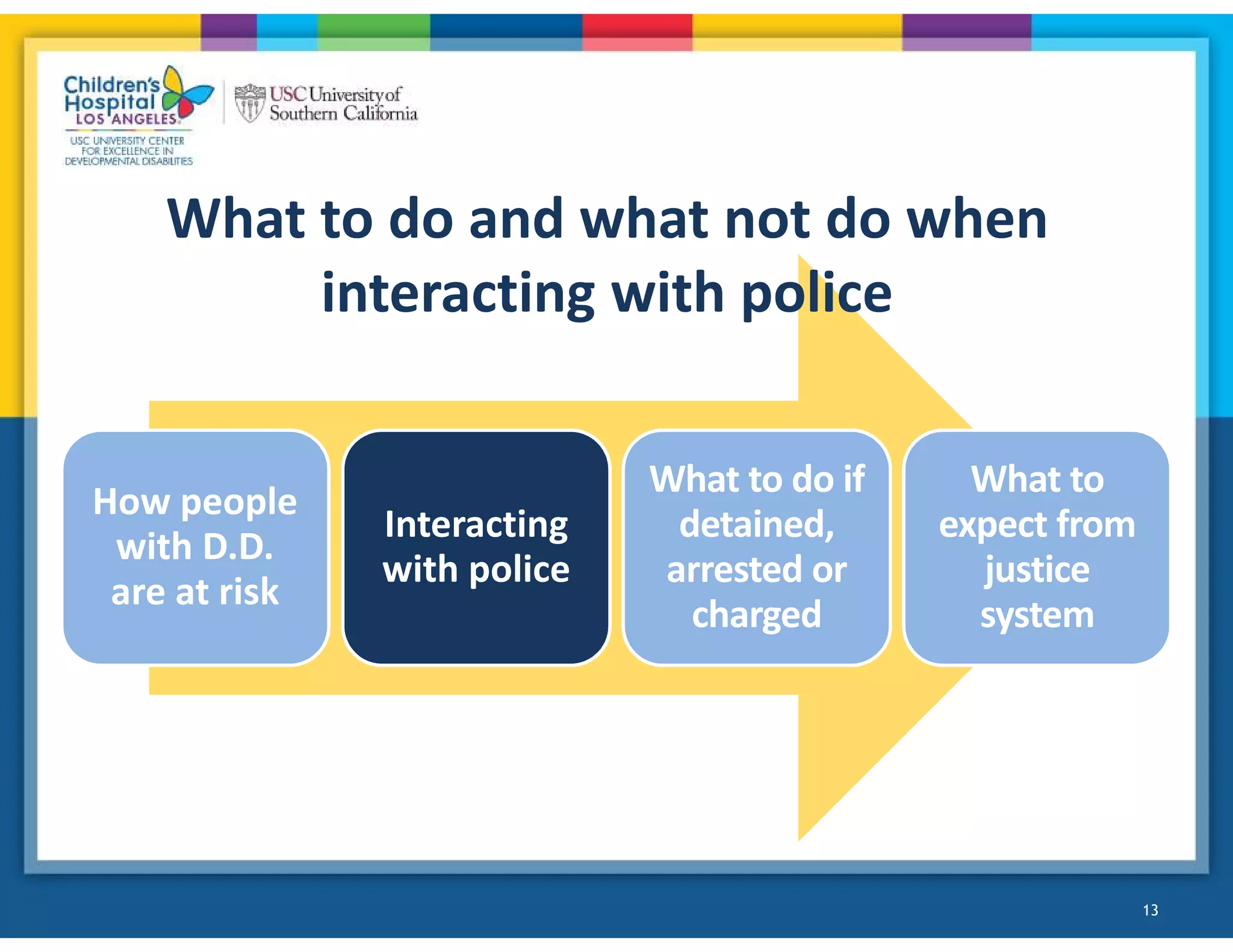
I will discuss:
• Some vulnerability factors for people with developmental disabilities that
may increase risk of encounters with the criminal justice system.
• Effective strategies for persons with I/D.D. when interacting with police
• What to do if detained and/or arrested
• What to do if arrested and charged with a crime
• Considerations for navigating the justice system
• Resources
8
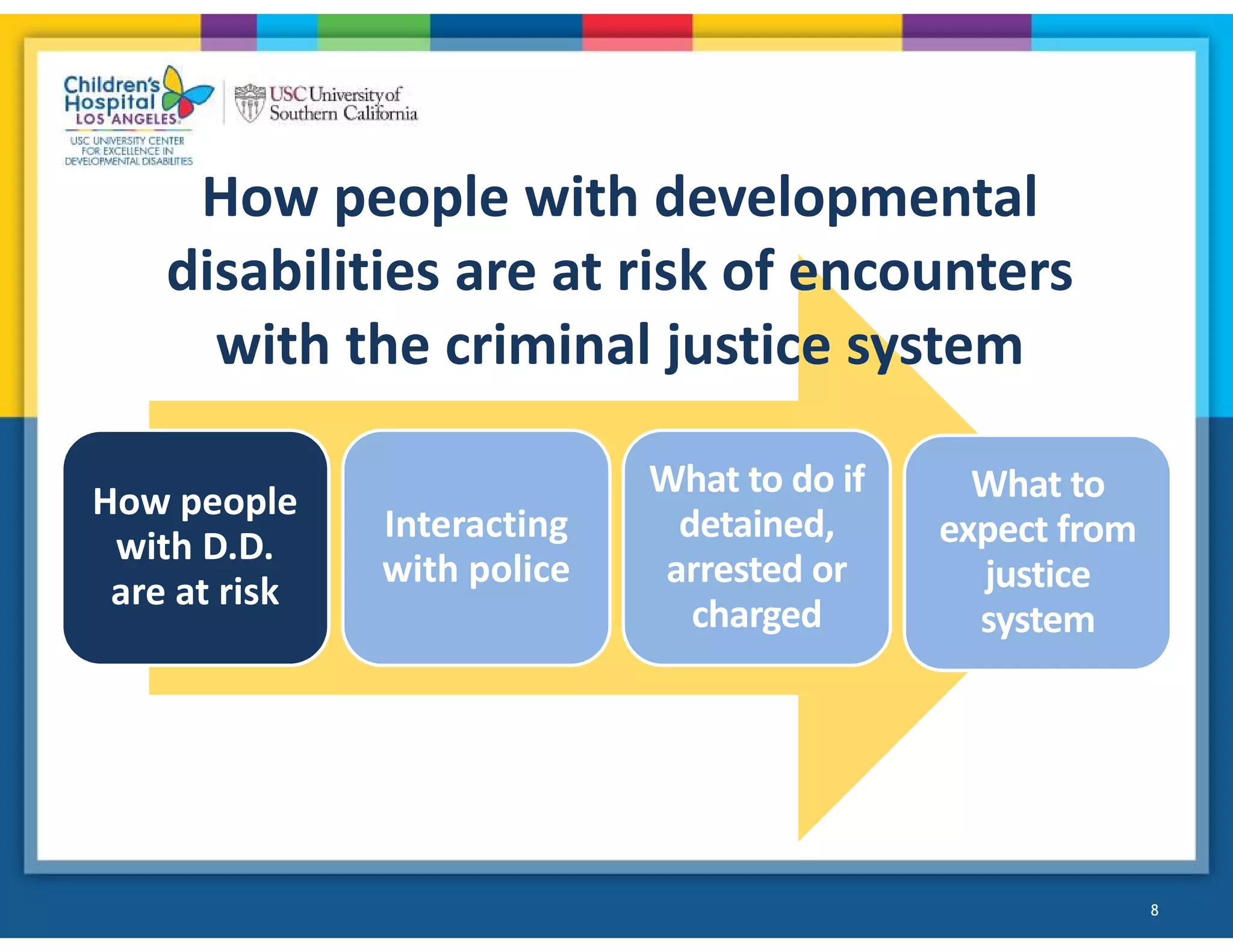
How people
with D.D.
are at risk
Interacting
with police
What to do if
detained,
arrested or
charged
What to
expect from
justice
system
How people with developmental
disabilities are at risk of encounters
with the criminal justice system
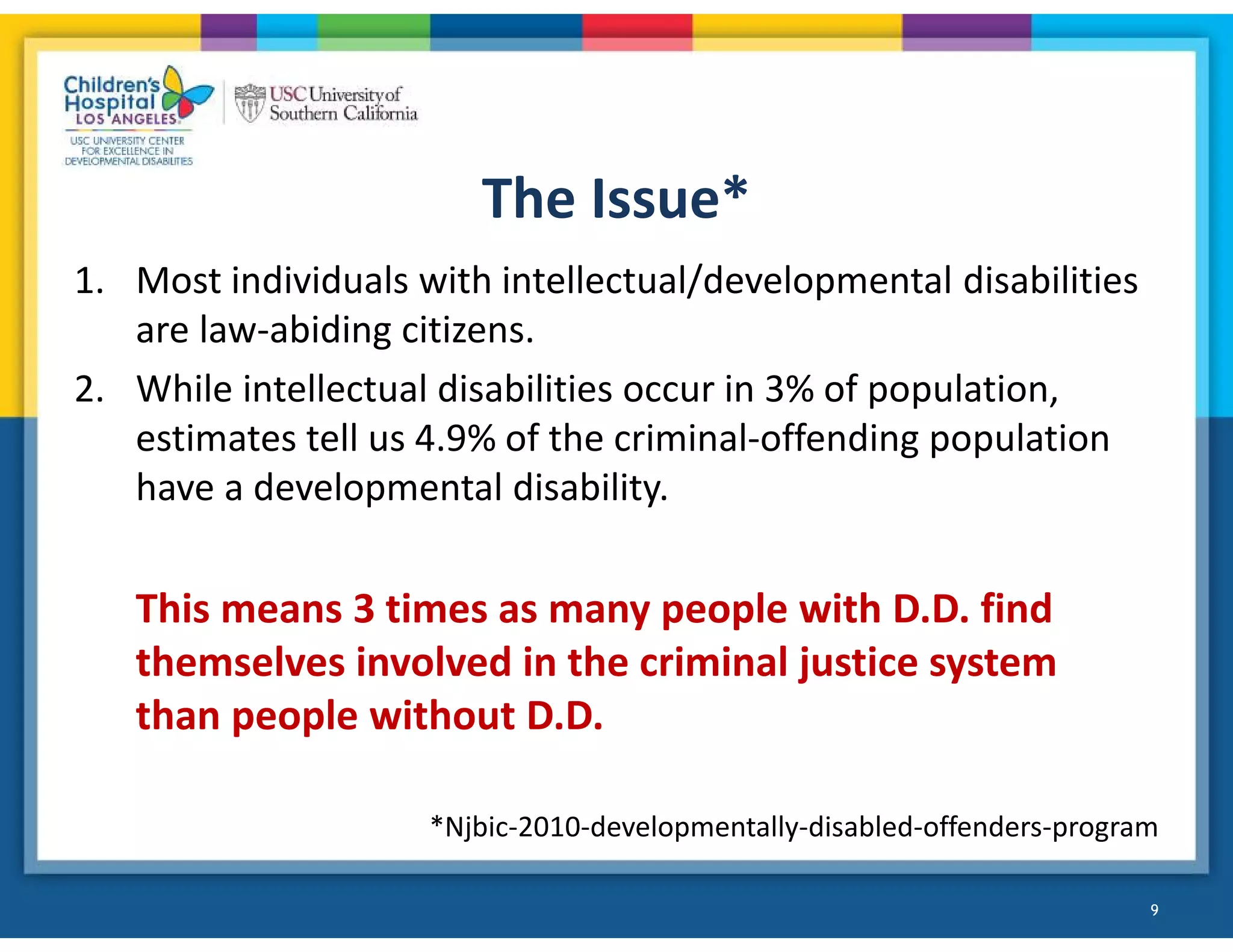
The Issue*
1. Most individuals with intellectual/developmental disabilities
are law-abiding citizens.
2. While intellectual disabilities occur in 3% of population,
estimates tell us 4.9% of the criminal-offending population
have a developmental disability.
This means 3 times as many people with D.D. find
themselves involved in the criminal justice system
than people without D.D.
*Njbic-2010-developmentally-disabled-offenders-program
9
Risk Factors
• Expressive Communication for persons with I/D.D. may be
unique, making interactions with others/strangers more
complex and often, more time-consuming
• Receptive Communication may be atypical, requiring different
ways for the other party to frame their own questions or
responses.
• The uninformed listener (i.e. law enforcement) may not
realize that either of the above may dramatically affect the
conversation/outcome.
10
Other Risk Factors
• Emotional Dysregulation:
If the person has a co-occurring psychiatric or substance-use
disorder (or both), they may have trouble keeping their
emotions in check, or may have poor impulse control.
• Impairments in executive functioning
• Stress Vulnerability Model
• National Core Indicators Data
11
!
Other Risk Factors:
Socio-Economic Status
Individuals with intellectual/developmental disabilities are often
on a fixed income (S.S.I.) or receiving lower-paying wages.
• May affect where they live
• May have increased exposure to violence
• May have increased interactions with law enforcement
http://www.apa.org/pi/ses/resources/publications/factsheet-violence.pdf
12
!
13
How people
with D.D.
are at risk
Interacting
with police
What to do if
detained,
arrested or
charged
What to
expect from
justice
system
What to do and what not do when
interacting with police
Police
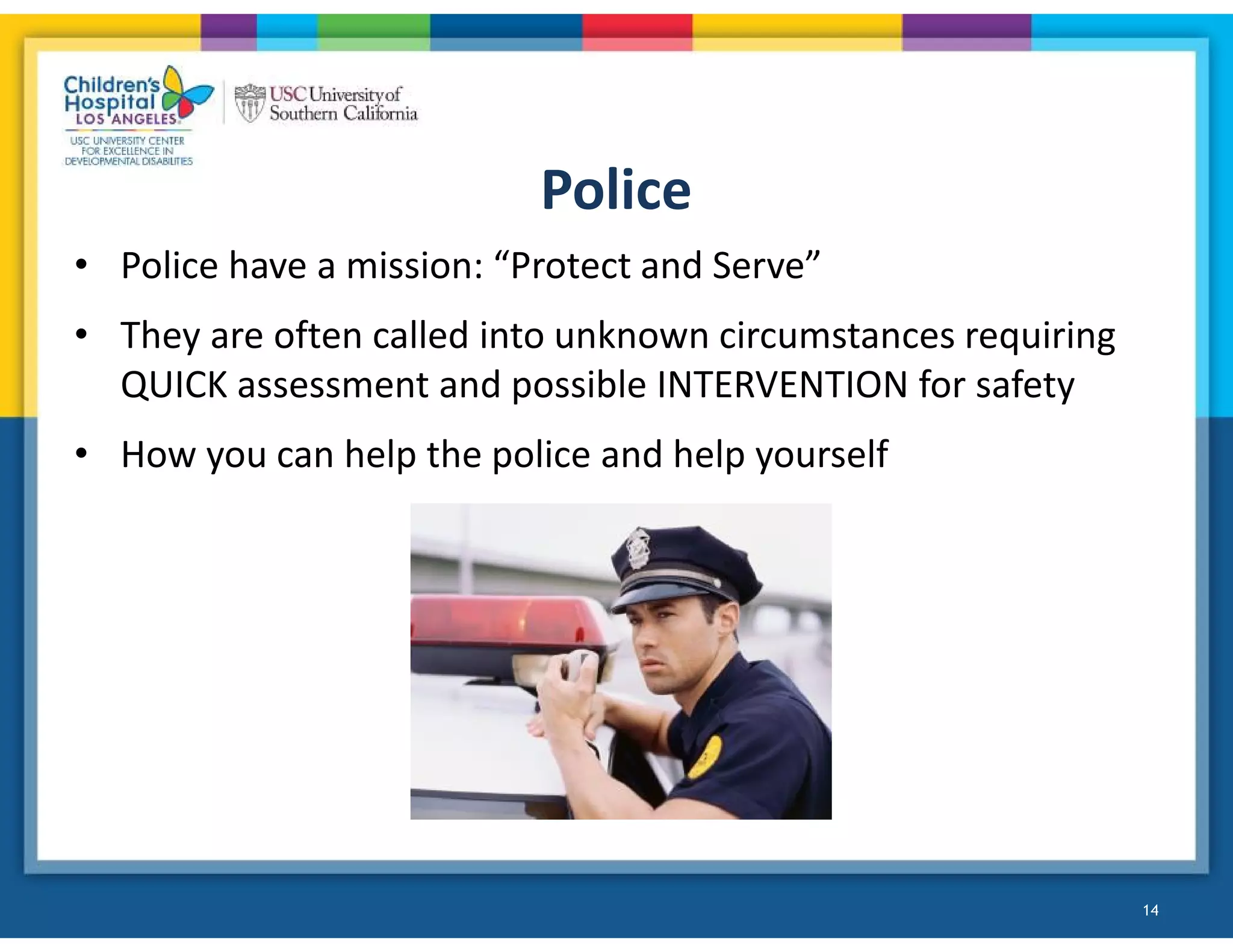
• Police have a mission: “Protect and Serve”
• They are often called into unknown circumstances requiring
QUICK assessment and possible INTERVENTION for safety
• How you can help the police and help yourself
14
Some Examples of When to Call 911
• I am feeling I may harm myself or someone else.
• I am feeling that someone near me may harm me or
someone else.
• I am feeling that I need emergency medical care due to my
mental health.
• I am feeling that I need emergency medical care due to a
physical injury or physical pain I do not understand.
• I am feeling unsafe.
– Strange behavior nearby
– Violent behavior nearby
15
Calling 911 or Emergency Dispatch
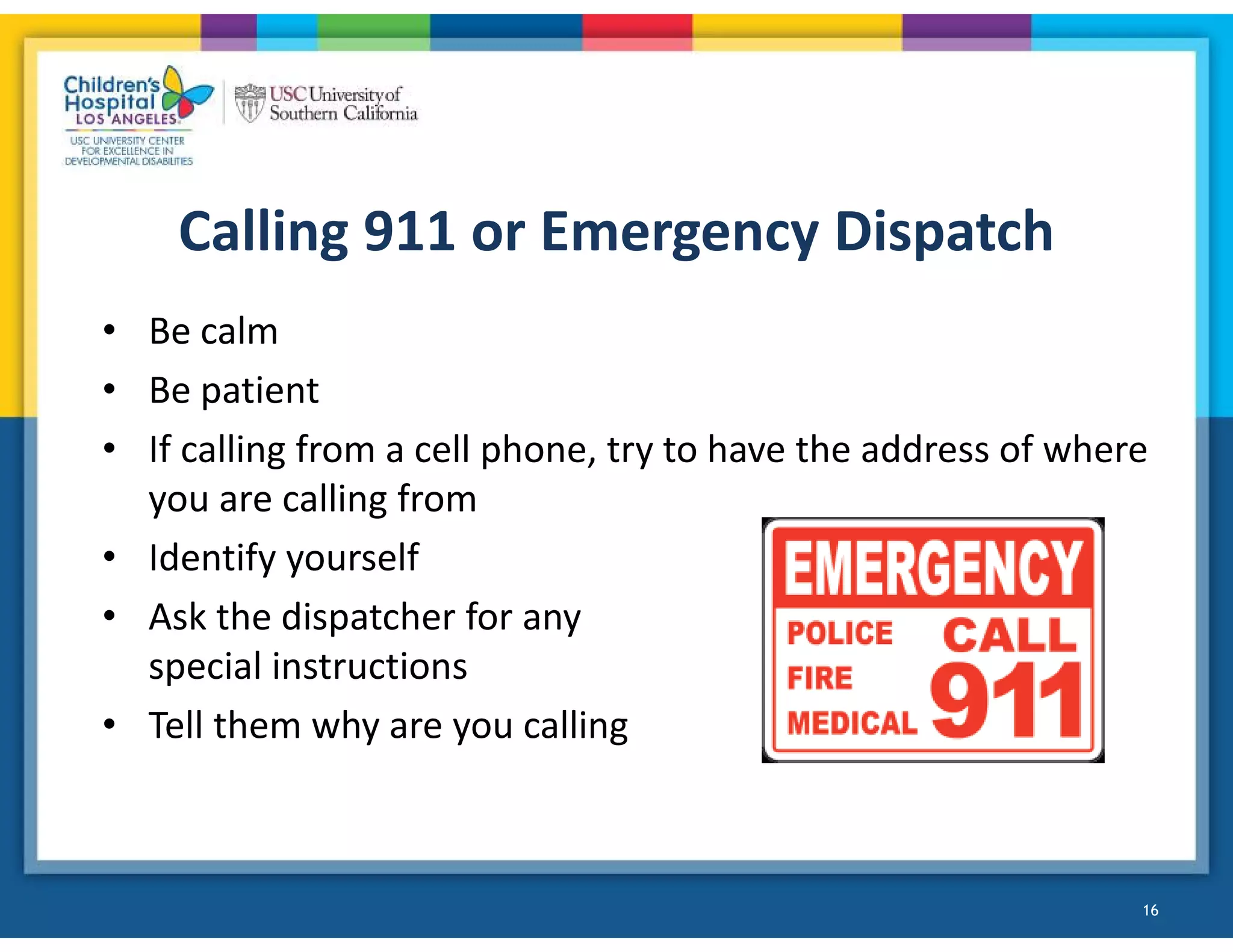
• Be calm
• Be patient
• If calling from a cell phone, try to have the address of where
you are calling from
• Identify yourself
• Ask the dispatcher for any
special instructions
• Tell them why are you calling
16
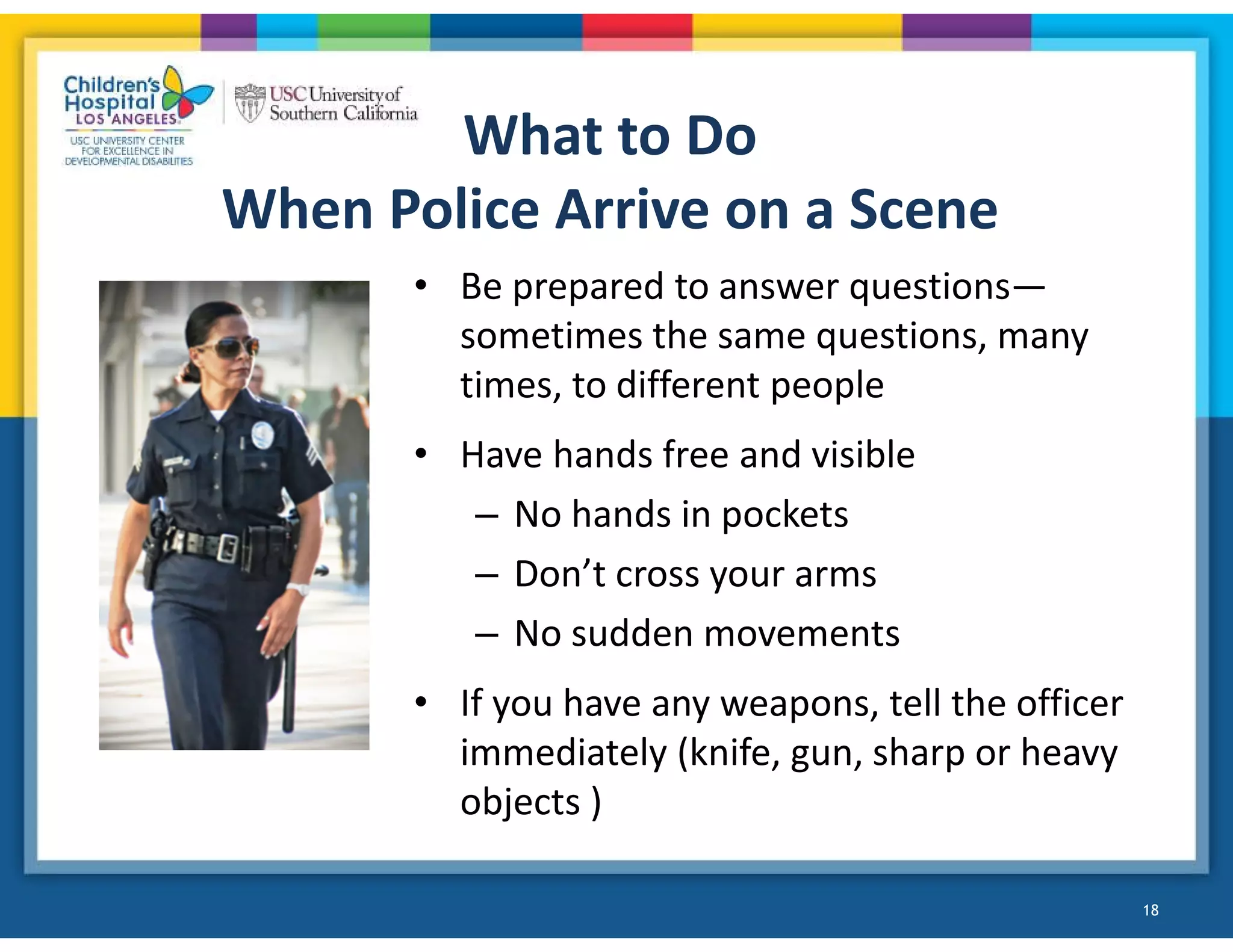
What to Do
When Police Arrive on a Scene
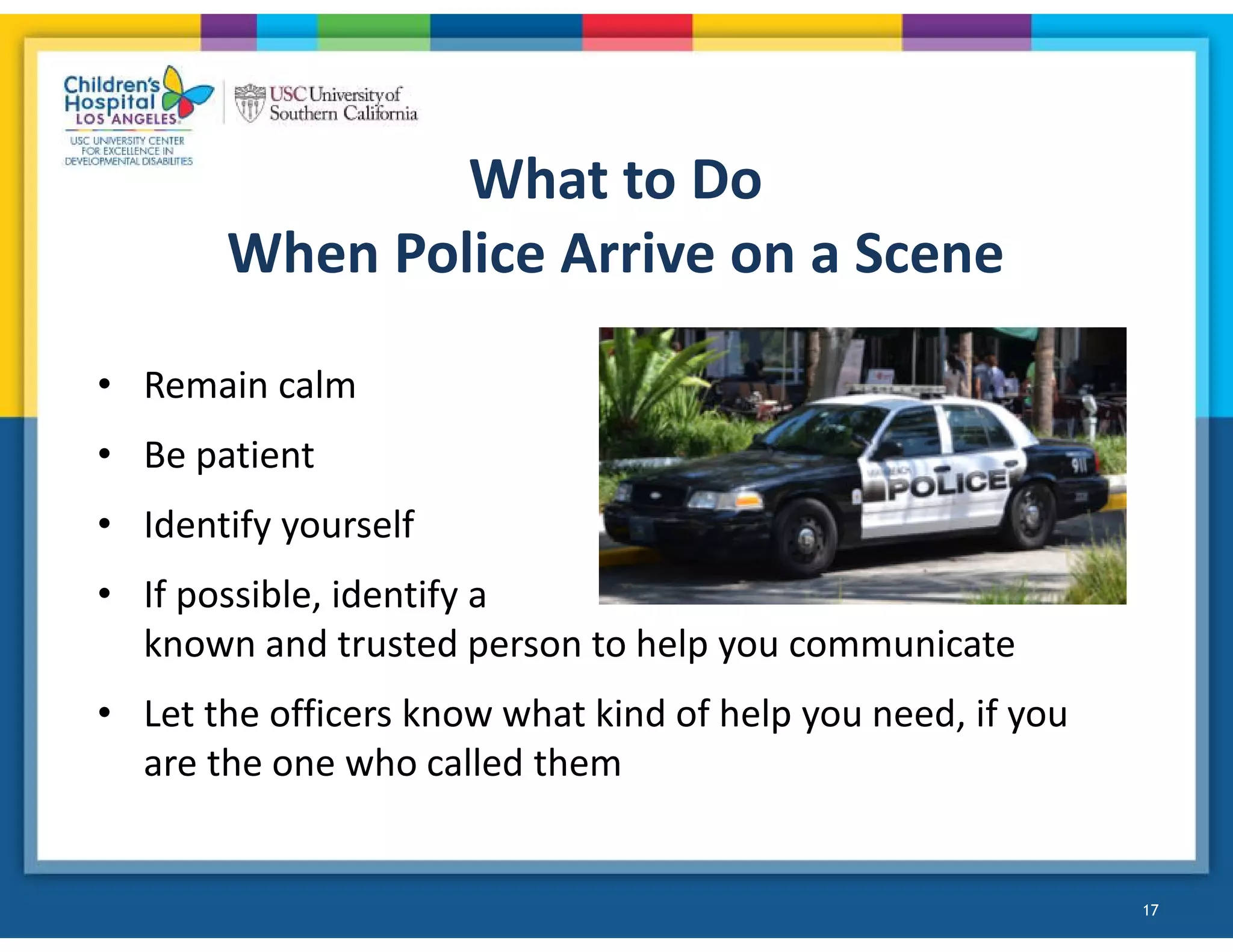
• Remain calm
• Be patient
• Identify yourself
• If possible, identify a
known and trusted person to help you communicate
• Let the officers know what kind of help you need, if you
are the one who called them
17
• Be prepared to answer questions—
sometimes the same questions, many
times, to different people
• Have hands free and visible
– No hands in pockets
– Don’t cross your arms
– No sudden movements
• If you have any weapons, tell the officer
immediately (knife, gun, sharp or heavy
objects )
18
What to Do
When Police Arrive on a Scene
What NOT to Do
• Do not argue with the police
• Do not raise your voice – remain calm
• Do not run away
• Do not disobey an officer
• Do not lie to protect someone else – tell the truth
• Do not tell the officer what you think s/he wants to hear
19
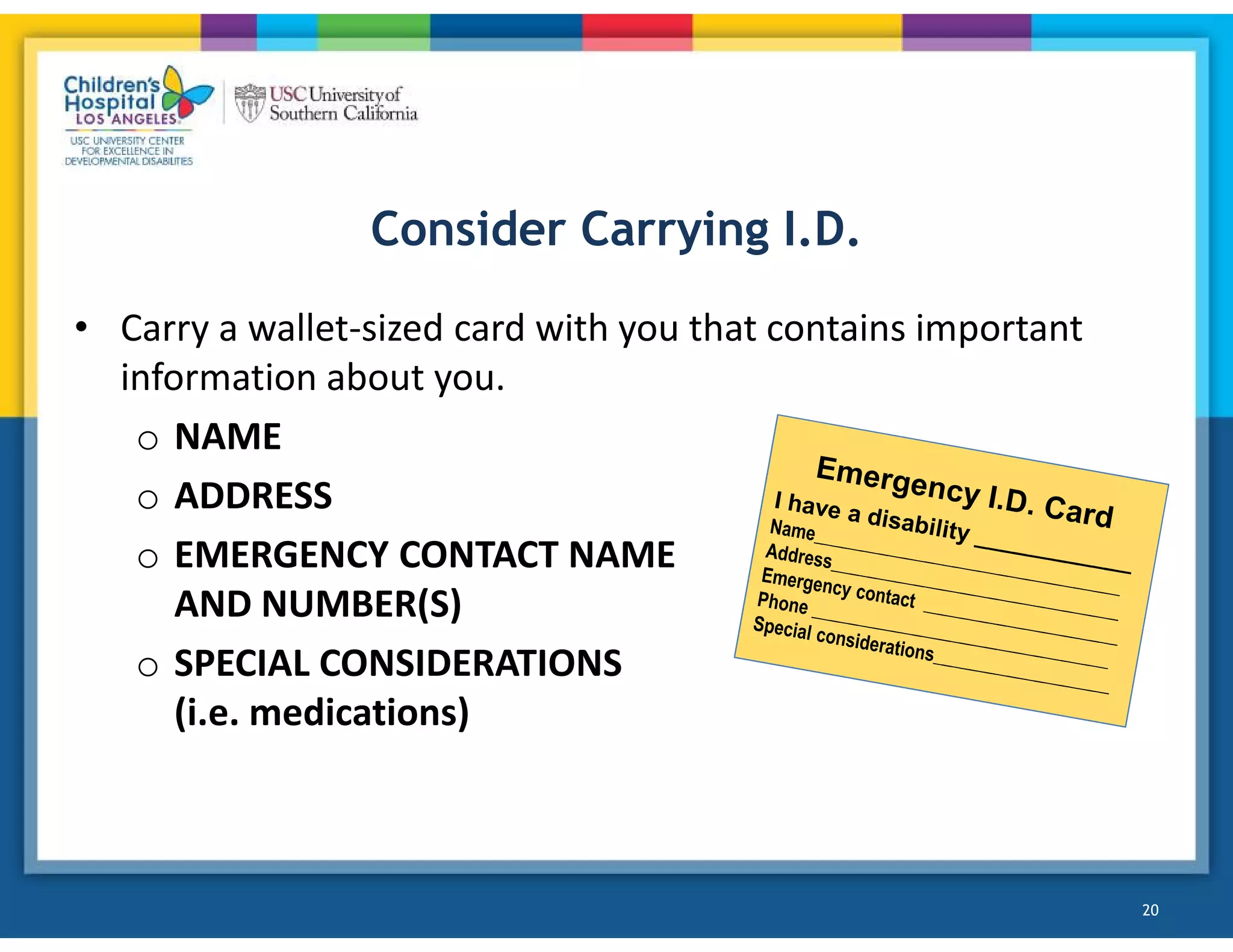
Consider Carrying I.D.
• Carry a wallet-sized card with you that contains important
information about you.
o NAME
o ADDRESS
o EMERGENCY CONTACT NAME
AND NUMBER(S)
o SPECIAL CONSIDERATIONS
(i.e. medications)
20
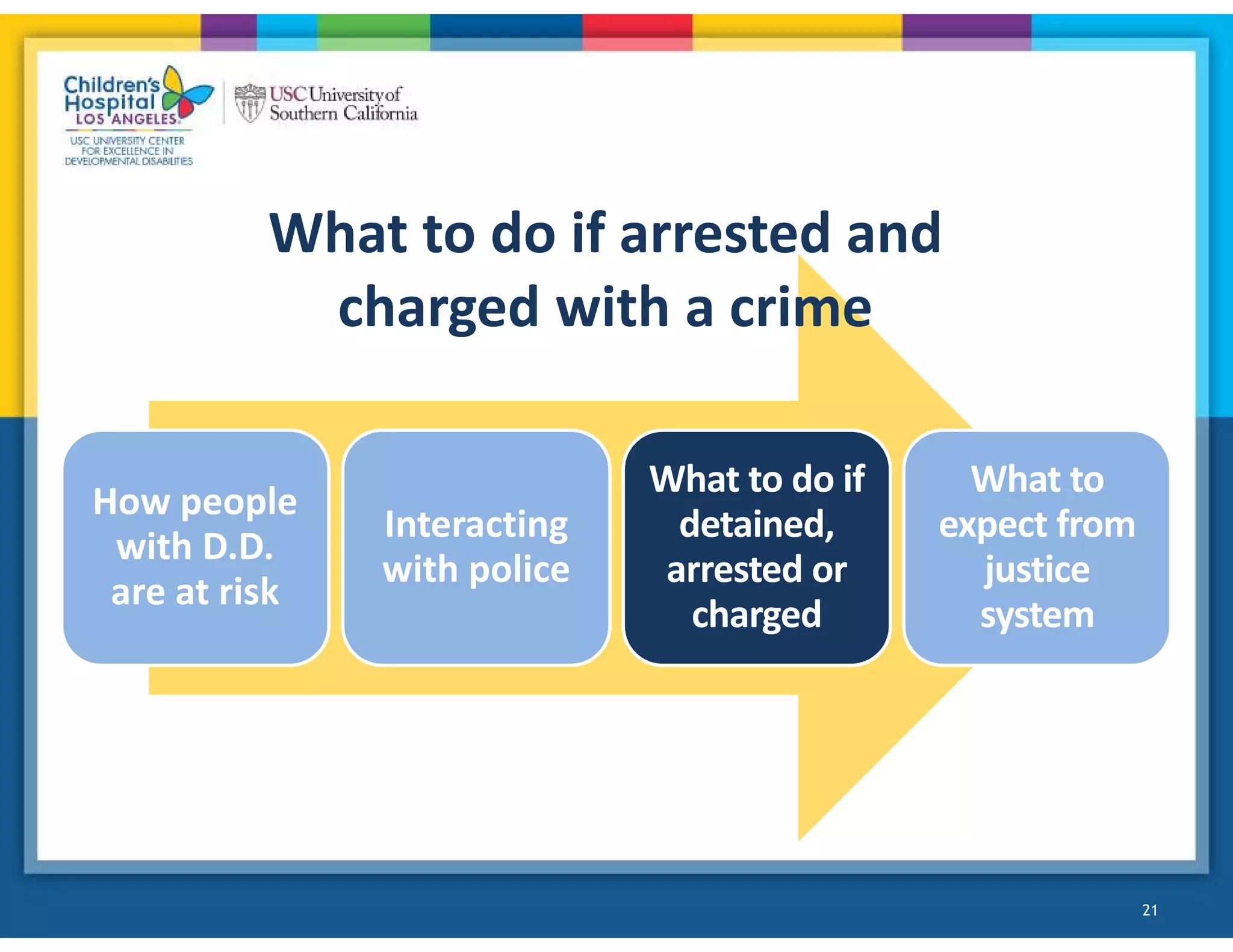
21
How people
with D.D.
are at risk
Interacting
with police
What to do if
detained,
arrested or
charged
What to
expect from
justice
system
What to do if arrested and
charged with a crime
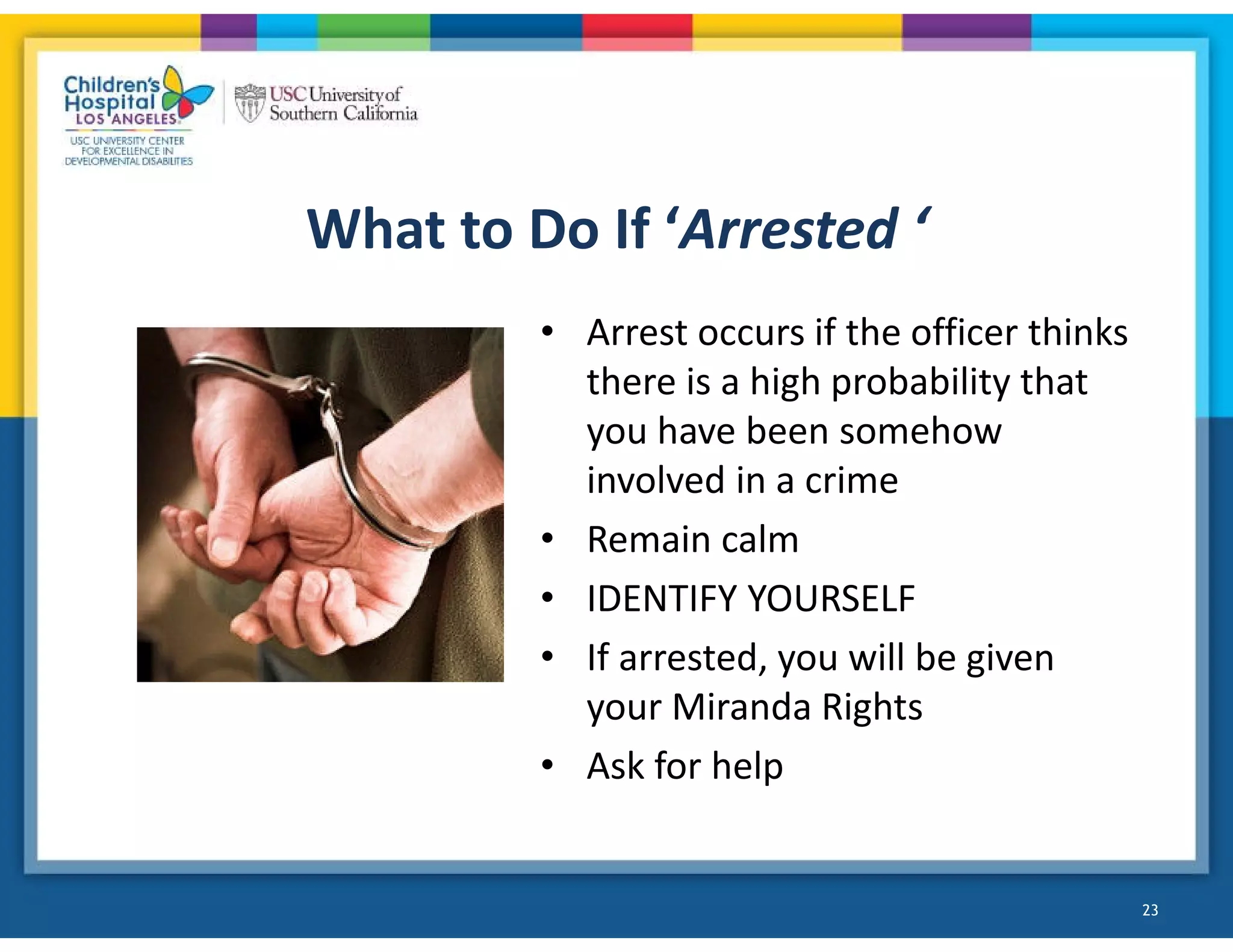
What to Do If ‘Detained’
• Detention is NOT ARREST
• Police may detain (stop) you and may even handcuff you for
protection (yours and theirs) – this is NOT arrest―remain
calm
• Police may ‘pat you down‘ for safety
• Remain calm
• IDENTIFY YOURSELF
22
What to Do If ‘Arrested ‘
• Arrest occurs if the officer thinks
there is a high probability that
you have been somehow
involved in a crime
• Remain calm
• IDENTIFY YOURSELF
• If arrested, you will be given
your Miranda Rights
• Ask for help
23
What Happens Next
• If arrested and charged: You will be ‘booked’
• Booking means entering your personal information into a
system so that you can be identified by the corrections officers.
• You must now wait for ‘Arraignment’ – this may happen that
day, or you may need to wait overnight or over the weekend.
• Identify your needs
– Your disability
– Separated from others?
– Medication?
– Name of a known and trusted caregiver to help
24
Information for Family & Caregivers
• You can tell if someone is in jail by using the internet and searching
for “who is in jail” and your county. See the Resources slide at the
end for a link to a site for Los Angeles County.
• You will be asked to enter the first and last name.
• If your loved one is in jail, the information will appear, including:
• Date arrested Location of the jail Bail?
• Charges Court date
• If the individual receives services from a regional center, there may
be a social worker on staff to provide support and information. Call
the RC’s general number or the service coordinator to inquire.
25
26
How people
with D.D.
are at risk
Interacting
with police
What to do if
detained,
arrested or
charged
What to
expect from
justice
system
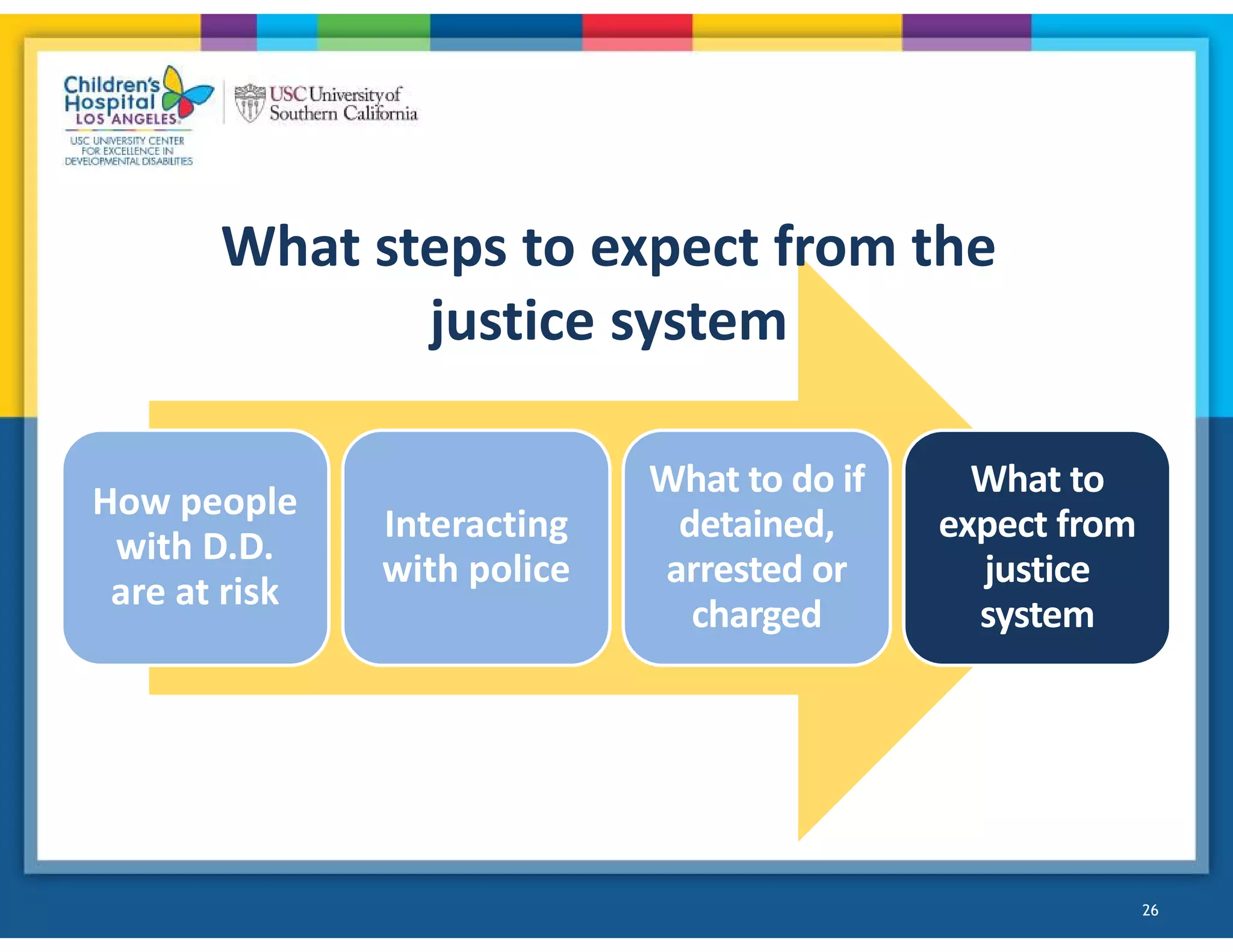
What steps to expect from the
justice system
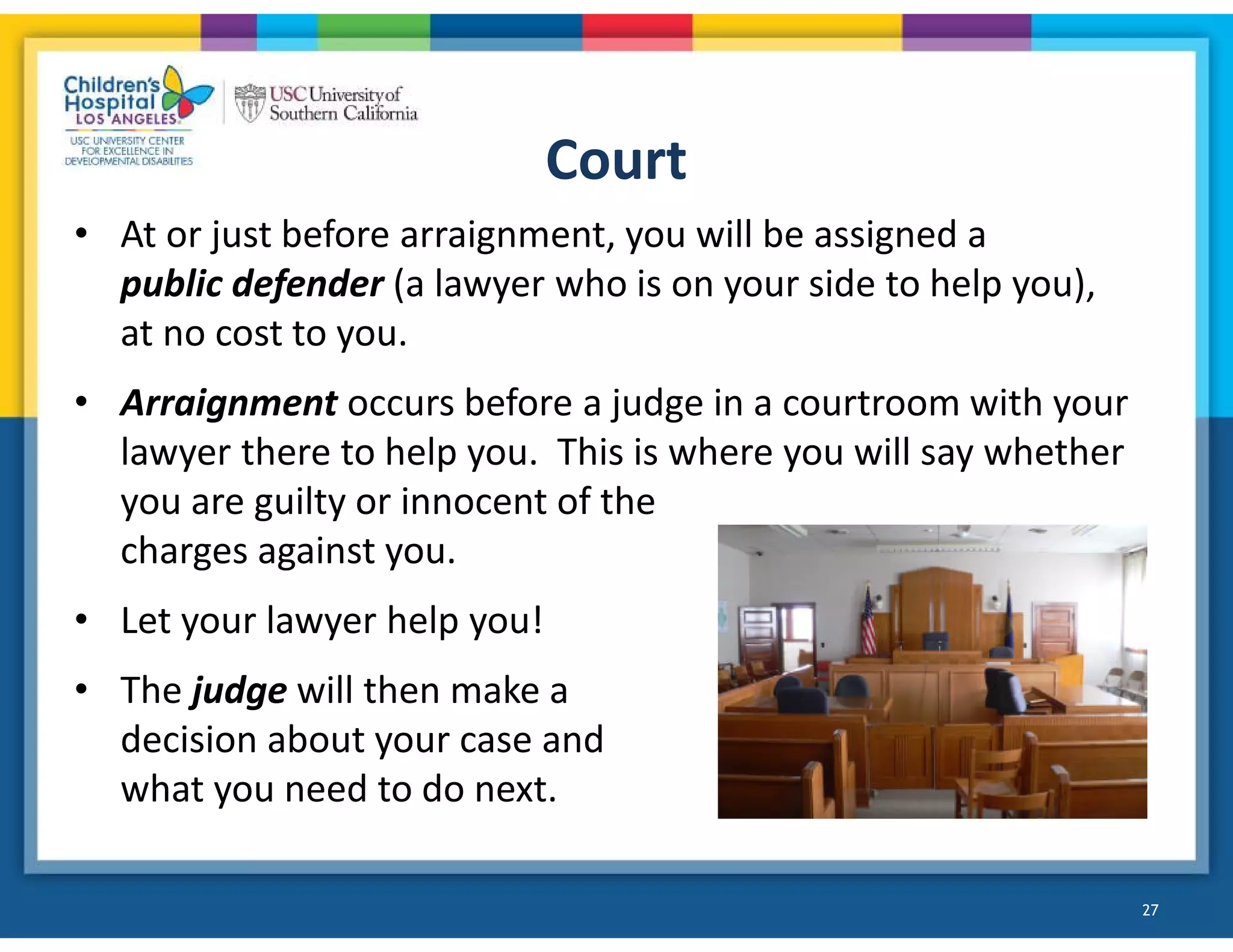
Court
• At or just before arraignment, you will be assigned a
public defender (a lawyer who is on your side to help you),
at no cost to you.
• Arraignment occurs before a judge in a courtroom with your
lawyer there to help you. This is where you will say whether
you are guilty or innocent of the
charges against you.
• Let your lawyer help you!
• The judge will then make a
decision about your case and
what you need to do next.
27
If You Are a Juvenile
• If you are under the age of 18, you are technically considered
a juvenile by the criminal justice system.
• In most states, if you are arrested, a juvenile will be housed in
Juvenile Hall, not jail.
• Juvenile courts make a special effort to include the family and
provide support and referral to social services to assist the
individual in remaining a law-abiding citizen.
28
Remember
• STAY CALM
• Be patient
• Identify yourself and any special needs
• Inform the police, jail, lawyer, or court of a known and trusted
family member, caregiver or social worker who can help them
help you.
• Your lawyer can help you – tell him/her the truth
29
Be Proactive
• Moving to a new neighborhood? – meet the local police
• Working in a new location? – meet the police
• Going on vacation? – where is the nearest police station?
30
Information for
Law Enforcement, Lawyers & Court
• What is a Developmental Disability?
• Who provides support for persons with Developmental
Disability in your area?
• What is their phone number?
• Make several copies of the Communication Tips on the
following slides
31
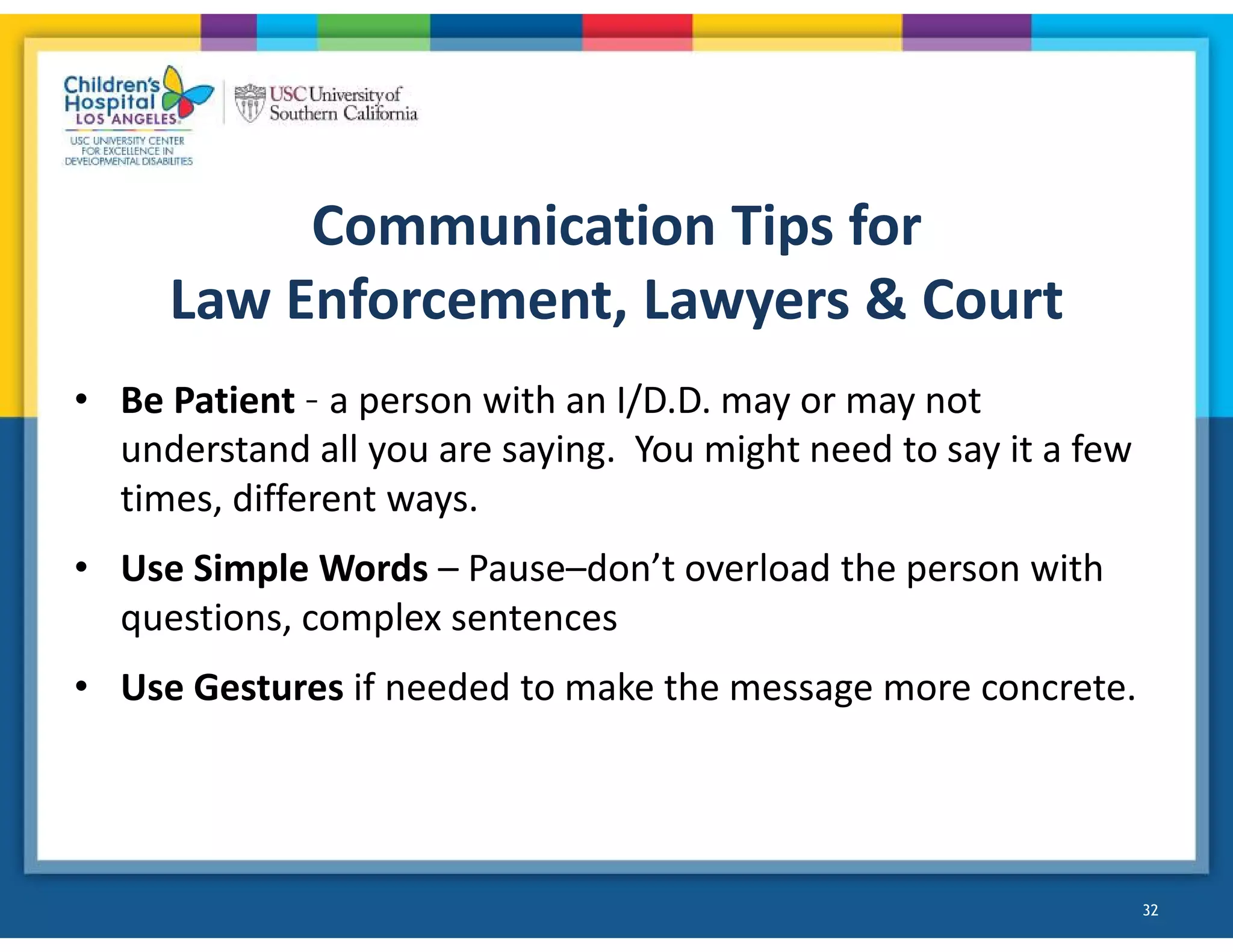
Communication Tips for
Law Enforcement, Lawyers & Court
• Be Patient – a person with an I/D.D. may or may not
understand all you are saying. You might need to say it a few
times, different ways.
• Use Simple Words – Pause–don’t overload the person with
questions, complex sentences
• Use Gestures if needed to make the message more concrete.
32
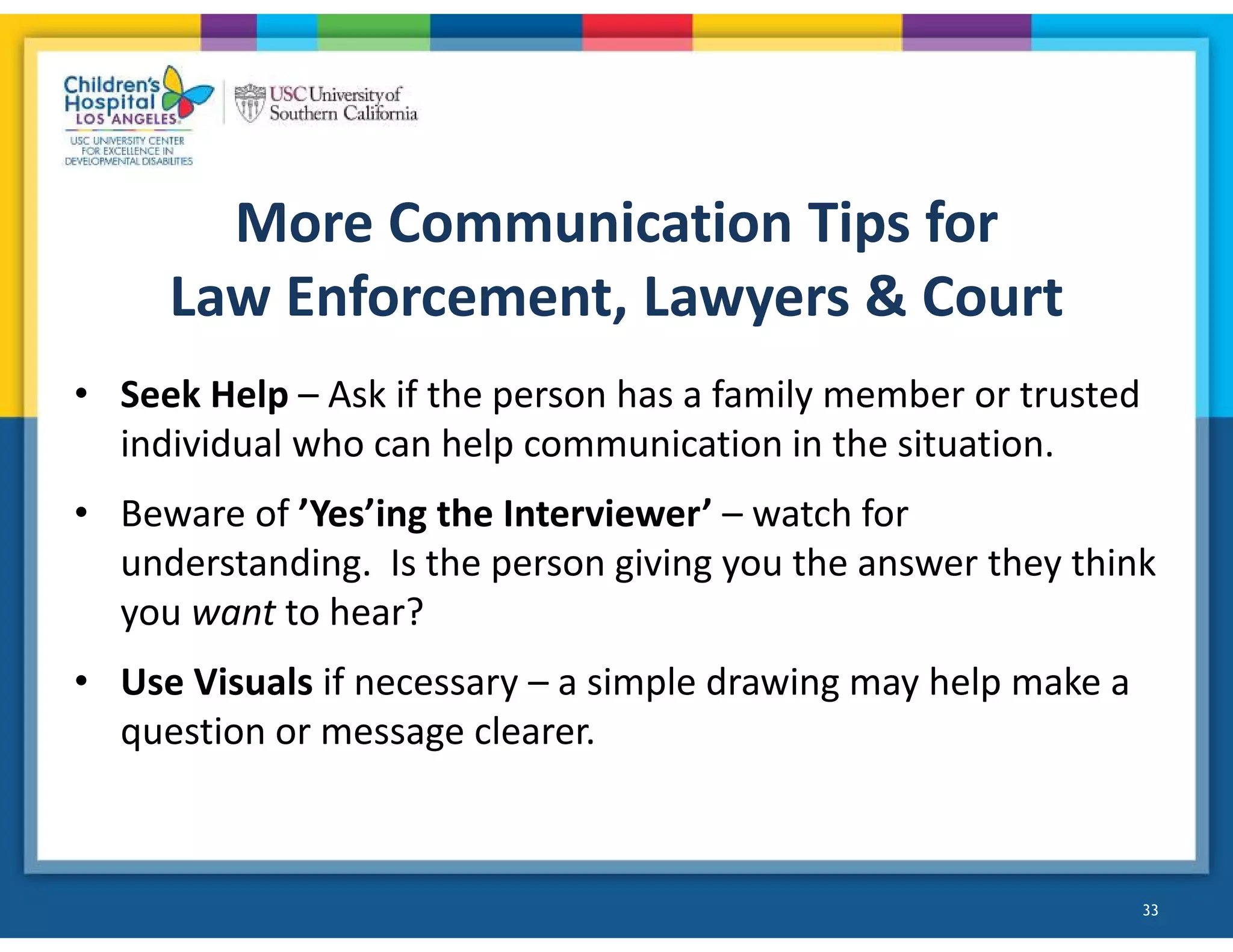
• Seek Help – Ask if the person has a family member or trusted
individual who can help communication in the situation.
• Beware of ’Yes’ing the Interviewer’ – watch for
understanding. Is the person giving you the answer they think
you want to hear?
• Use Visuals if necessary – a simple drawing may help make a
question or message clearer.
33
More Communication Tips for
Law Enforcement, Lawyers & Court
FREEDOM AND RESPONSIBILITY
34
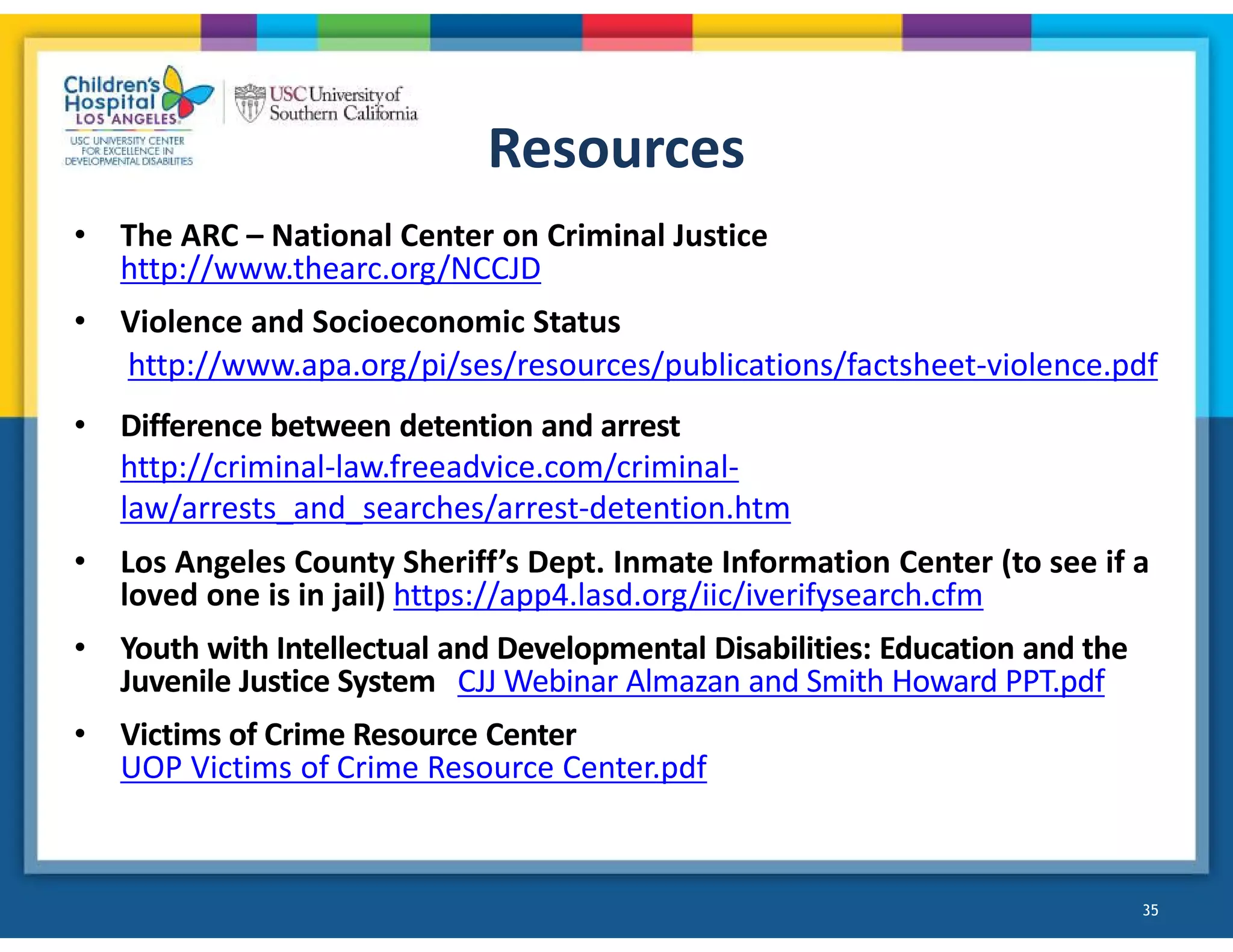
Resources
• The ARC – National Center on Criminal Justice
http://www.thearc.org/NCCJD
• Violence and Socioeconomic Status
http://www.apa.org/pi/ses/resources/publications/factsheet-violence.pdf
• Difference between detention and arrest
http://criminal-law.freeadvice.com/criminal-
law/arrests_and_searches/arrest-detention.htm
• Los Angeles County Sheriff’s Dept. Inmate Information Center (to see if a
loved one is in jail) https://app4.lasd.org/iic/iverifysearch.cfm
• Youth with Intellectual and Developmental Disabilities: Education and the
Juvenile Justice System CJJ Webinar Almazan and Smith Howard PPT.pdf
• Victims of Crime Resource Center
UOP Victims of Crime Resource Center.pdf
35
Poll:
Do you now have a better understanding of law
enforcement and the criminal justice system, as it
relates to people with disabilities?
36
Ask Us a Question
Please type your questions
(Top-left corner of your MeetingBurner screen)
37
Thank you for attending
and interacting!!
You have access to webinar slides, handouts and video recording.
Don’t leave yet!! Please take 3 minutes to answer a survey about
your experience with this webinar.
UCEDD
SlideShare Page
UCEDD YouTube
Playlist
Webinar Evaluation
Survey
38

Webinar: Navigating the Criminal Justice System for People with I/DD

  • 1.
    Welcome to theU.S.C. UCEDD Webinar Series for Individuals with Disabilities & Parents funded by grant #90DD0695 from the Administration on Intellectual and Developmental Disabilities (A.I.D.D.) Administration on Community Living October 27, 2016
  • 2.
    Your Moderator 2 Susan Kanegawa U.S.C.UCEDD Family Support Coordinator skanegawa@chla.usc.edu www.uscucedd.org The USC University Center of Excellence in Developmental Disabilities at Children’s Hospital Los Angeles (U.S.C. UCEDD) is one of 68 UCEDDs funded to promote systemic change, advocacy, and capacity building in states on behalf of individuals with, or at risk for, developmental, behavioral and/or special health care needs, and their families. The U.S.C. UCEDD Webinar series is designed to educate the community about current policy issues which impact the lives of people we serve and their families. Our primary audience is individuals with special needs and their families. At this time, our webinars are in English only. We are exploring methods to make this series available in other languages in the future. 2
  • 3.
    Structure and Logistics 3 Takenotes Type your questions Download slides Watch and Share Take Survey During the Webinar After the Webinar Give your opinion 3
  • 4.
    Poll: Can you hearSusan and Peggie? •4 Let us know in the chat box if we need to speak louder. 4
  • 5.
    Navigating the Criminal JusticeSystem For People with Intellectual & Developmental Disabilities Peggie Webb, M.A. Manager, Forensic and Behavioral Health Services at San Diego Regional Center October 27, 2016 The views and opinions expressed in this presentation are the speaker’s own and do not necessarily reflect the views and opinions of the U.S.C. UCEDD or C.H.L.A. 5
  • 6.
    About Peggie Webb,M.A. Peggie Webb is the Manager of Forensic and Behavioral Health Services at San Diego Regional Center. She has 35 years’ experience in social work with persons who have developmental disabilities, including those with co-occurring psychiatric and substance use disorders. She is a board member of NADD (National Association for the Dually Diagnosed). The San Diego Regional Center (S.D.R.C.) is a service of San Diego-Imperial Counties Developmental Services Inc. S.D.R.C. is a focal point in the community for information and services for persons with developmental disabilities living in San Diego and Imperial Counties, California. S.D.R.C. is a private, non-profit 501 c(3) organization that contracts with the state of California to provide the services outlined in the Lanterman Developmental Disabilities Services Act. It is one of 21 regional centers in California. 6
  • 7.
    How people with D.D. areat risk Interacting with police What to do if detained, arrested or charged What to expect from justice system Overview of the Webinar 7 I will discuss: • Some vulnerability factors for people with developmental disabilities that may increase risk of encounters with the criminal justice system. • Effective strategies for persons with I/D.D. when interacting with police • What to do if detained and/or arrested • What to do if arrested and charged with a crime • Considerations for navigating the justice system • Resources
  • 8.
    8 How people with D.D. areat risk Interacting with police What to do if detained, arrested or charged What to expect from justice system How people with developmental disabilities are at risk of encounters with the criminal justice system
  • 9.
    The Issue* 1. Mostindividuals with intellectual/developmental disabilities are law-abiding citizens. 2. While intellectual disabilities occur in 3% of population, estimates tell us 4.9% of the criminal-offending population have a developmental disability. This means 3 times as many people with D.D. find themselves involved in the criminal justice system than people without D.D. *Njbic-2010-developmentally-disabled-offenders-program 9
  • 10.
    Risk Factors • ExpressiveCommunication for persons with I/D.D. may be unique, making interactions with others/strangers more complex and often, more time-consuming • Receptive Communication may be atypical, requiring different ways for the other party to frame their own questions or responses. • The uninformed listener (i.e. law enforcement) may not realize that either of the above may dramatically affect the conversation/outcome. 10
  • 11.
    Other Risk Factors •Emotional Dysregulation: If the person has a co-occurring psychiatric or substance-use disorder (or both), they may have trouble keeping their emotions in check, or may have poor impulse control. • Impairments in executive functioning • Stress Vulnerability Model • National Core Indicators Data 11 !
  • 12.
    Other Risk Factors: Socio-EconomicStatus Individuals with intellectual/developmental disabilities are often on a fixed income (S.S.I.) or receiving lower-paying wages. • May affect where they live • May have increased exposure to violence • May have increased interactions with law enforcement http://www.apa.org/pi/ses/resources/publications/factsheet-violence.pdf 12 !
  • 13.
    13 How people with D.D. areat risk Interacting with police What to do if detained, arrested or charged What to expect from justice system What to do and what not do when interacting with police
  • 14.
    Police • Police havea mission: “Protect and Serve” • They are often called into unknown circumstances requiring QUICK assessment and possible INTERVENTION for safety • How you can help the police and help yourself 14
  • 15.
    Some Examples ofWhen to Call 911 • I am feeling I may harm myself or someone else. • I am feeling that someone near me may harm me or someone else. • I am feeling that I need emergency medical care due to my mental health. • I am feeling that I need emergency medical care due to a physical injury or physical pain I do not understand. • I am feeling unsafe. – Strange behavior nearby – Violent behavior nearby 15
  • 16.
    Calling 911 orEmergency Dispatch • Be calm • Be patient • If calling from a cell phone, try to have the address of where you are calling from • Identify yourself • Ask the dispatcher for any special instructions • Tell them why are you calling 16
  • 17.
    What to Do WhenPolice Arrive on a Scene • Remain calm • Be patient • Identify yourself • If possible, identify a known and trusted person to help you communicate • Let the officers know what kind of help you need, if you are the one who called them 17
  • 18.
    • Be preparedto answer questions— sometimes the same questions, many times, to different people • Have hands free and visible – No hands in pockets – Don’t cross your arms – No sudden movements • If you have any weapons, tell the officer immediately (knife, gun, sharp or heavy objects ) 18 What to Do When Police Arrive on a Scene
  • 19.
    What NOT toDo • Do not argue with the police • Do not raise your voice – remain calm • Do not run away • Do not disobey an officer • Do not lie to protect someone else – tell the truth • Do not tell the officer what you think s/he wants to hear 19
  • 20.
    Consider Carrying I.D. •Carry a wallet-sized card with you that contains important information about you. o NAME o ADDRESS o EMERGENCY CONTACT NAME AND NUMBER(S) o SPECIAL CONSIDERATIONS (i.e. medications) 20
  • 21.
    21 How people with D.D. areat risk Interacting with police What to do if detained, arrested or charged What to expect from justice system What to do if arrested and charged with a crime
  • 22.
    What to DoIf ‘Detained’ • Detention is NOT ARREST • Police may detain (stop) you and may even handcuff you for protection (yours and theirs) – this is NOT arrest―remain calm • Police may ‘pat you down‘ for safety • Remain calm • IDENTIFY YOURSELF 22
  • 23.
    What to DoIf ‘Arrested ‘ • Arrest occurs if the officer thinks there is a high probability that you have been somehow involved in a crime • Remain calm • IDENTIFY YOURSELF • If arrested, you will be given your Miranda Rights • Ask for help 23
  • 24.
    What Happens Next •If arrested and charged: You will be ‘booked’ • Booking means entering your personal information into a system so that you can be identified by the corrections officers. • You must now wait for ‘Arraignment’ – this may happen that day, or you may need to wait overnight or over the weekend. • Identify your needs – Your disability – Separated from others? – Medication? – Name of a known and trusted caregiver to help 24
  • 25.
    Information for Family& Caregivers • You can tell if someone is in jail by using the internet and searching for “who is in jail” and your county. See the Resources slide at the end for a link to a site for Los Angeles County. • You will be asked to enter the first and last name. • If your loved one is in jail, the information will appear, including: • Date arrested Location of the jail Bail? • Charges Court date • If the individual receives services from a regional center, there may be a social worker on staff to provide support and information. Call the RC’s general number or the service coordinator to inquire. 25
  • 26.
    26 How people with D.D. areat risk Interacting with police What to do if detained, arrested or charged What to expect from justice system What steps to expect from the justice system
  • 27.
    Court • At orjust before arraignment, you will be assigned a public defender (a lawyer who is on your side to help you), at no cost to you. • Arraignment occurs before a judge in a courtroom with your lawyer there to help you. This is where you will say whether you are guilty or innocent of the charges against you. • Let your lawyer help you! • The judge will then make a decision about your case and what you need to do next. 27
  • 28.
    If You Area Juvenile • If you are under the age of 18, you are technically considered a juvenile by the criminal justice system. • In most states, if you are arrested, a juvenile will be housed in Juvenile Hall, not jail. • Juvenile courts make a special effort to include the family and provide support and referral to social services to assist the individual in remaining a law-abiding citizen. 28
  • 29.
    Remember • STAY CALM •Be patient • Identify yourself and any special needs • Inform the police, jail, lawyer, or court of a known and trusted family member, caregiver or social worker who can help them help you. • Your lawyer can help you – tell him/her the truth 29
  • 30.
    Be Proactive • Movingto a new neighborhood? – meet the local police • Working in a new location? – meet the police • Going on vacation? – where is the nearest police station? 30
  • 31.
    Information for Law Enforcement,Lawyers & Court • What is a Developmental Disability? • Who provides support for persons with Developmental Disability in your area? • What is their phone number? • Make several copies of the Communication Tips on the following slides 31
  • 32.
    Communication Tips for LawEnforcement, Lawyers & Court • Be Patient – a person with an I/D.D. may or may not understand all you are saying. You might need to say it a few times, different ways. • Use Simple Words – Pause–don’t overload the person with questions, complex sentences • Use Gestures if needed to make the message more concrete. 32
  • 33.
    • Seek Help– Ask if the person has a family member or trusted individual who can help communication in the situation. • Beware of ’Yes’ing the Interviewer’ – watch for understanding. Is the person giving you the answer they think you want to hear? • Use Visuals if necessary – a simple drawing may help make a question or message clearer. 33 More Communication Tips for Law Enforcement, Lawyers & Court
  • 34.
  • 35.
    Resources • The ARC– National Center on Criminal Justice http://www.thearc.org/NCCJD • Violence and Socioeconomic Status http://www.apa.org/pi/ses/resources/publications/factsheet-violence.pdf • Difference between detention and arrest http://criminal-law.freeadvice.com/criminal- law/arrests_and_searches/arrest-detention.htm • Los Angeles County Sheriff’s Dept. Inmate Information Center (to see if a loved one is in jail) https://app4.lasd.org/iic/iverifysearch.cfm • Youth with Intellectual and Developmental Disabilities: Education and the Juvenile Justice System CJJ Webinar Almazan and Smith Howard PPT.pdf • Victims of Crime Resource Center UOP Victims of Crime Resource Center.pdf 35
  • 36.
    Poll: Do you nowhave a better understanding of law enforcement and the criminal justice system, as it relates to people with disabilities? 36
  • 37.
    Ask Us aQuestion Please type your questions (Top-left corner of your MeetingBurner screen) 37
  • 38.
    Thank you forattending and interacting!! You have access to webinar slides, handouts and video recording. Don’t leave yet!! Please take 3 minutes to answer a survey about your experience with this webinar. UCEDD SlideShare Page UCEDD YouTube Playlist Webinar Evaluation Survey 38