BUSINESS CONTINUITY MANAGEMENT
SYSTEM (BCMS)
By
Akinbami J. Babatunde (ABCP)
*
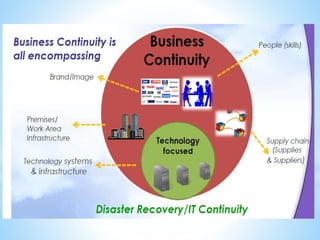
Business Continuity is the capability of the organization to
continue delivery of products or services at acceptable
predefined levels following a disruptive incident
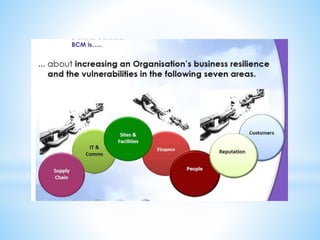
“Business Continuity Management (BCM) is an holistic process that identifies
potential threats to an organisation and the impacts to business operations
that those threats, if realised, might cause. It provides a framework for
building organisational resilience with the capability for an effective
response that safeguards the interests of key stakeholders, reputation,
brand and value-creating activities.” (BCI)
Business Continuity Management System is the overall
organizational management system, which establishes,
implements, operates, reviews, monitors, maintains, and
improves business continuity capability to ensure Continuation of
critical business processes in the event of a disaster
Minimum Business Continuity Objective (MBCO) - The
minimum acceptable level of service.
Recovery Time Objective (RTO) - How soon must the
business function be restored in order to provide the
minimum acceptable level of service?
Recovery Point Objective (RPO) – To what point must
the business function be recovered to provide the
minimum acceptable level of service.
Maximum acceptable outage (MAO) I maximum
tolerable downtime (MTD)?
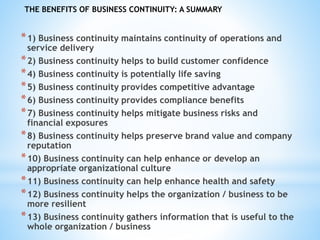
*1) Business continuity maintains continuity of operations and
service delivery
*2) Business continuity helps to build customer confidence
*4) Business continuity is potentially life saving
*5) Business continuity provides competitive advantage
*6) Business continuity provides compliance benefits
*7) Business continuity helps mitigate business risks and
financial exposures
*8) Business continuity helps preserve brand value and company
reputation
*10) Business continuity can help enhance or develop an
appropriate organizational culture
*11) Business continuity can help enhance health and safety
*12) Business continuity helps the organization / business to be
more resilient
*13) Business continuity gathers information that is useful to the
whole organization / business
THE BENEFITS OF BUSINESS CONTINUITY: A SUMMARY
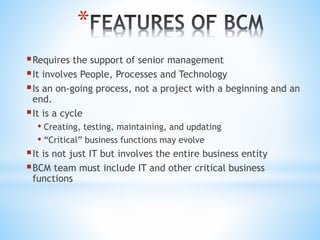
Requires the support of senior management
It involves People, Processes and Technology
Is an on-going process, not a project with a beginning and an
end.
It is a cycle
• Creating, testing, maintaining, and updating
• “Critical” business functions may evolve
It is not just IT but involves the entire business entity
BCM team must include IT and other critical business
functions
*
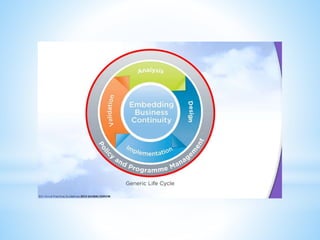
*Policy and Programme Management – This defines the organizational
policy relating to BCM and how the policy will be implemented,
controlled and validated through a BCM programme
*Embedding Business Continuity – This seeks to integrate BC into day-
to-day business activities and organizational culture
*Analysis – This seeks to review and assess an organization in terms of
what its objectives are, how it functions, and the constraints of the
environment in which it operates
*Design – This identifies and selects appropriate strategies and tactics
to determine how continuity and recovery from disruptions can be
achieved
*Implementation – This deals with executing the agreed strategies and
tactics through the process of developing the Business continuity plan
(BCP)
*Validation – This confirms that the BCM programme meets the
objectives set in the BC policy and that the organization’s BCP is fit
for purpose
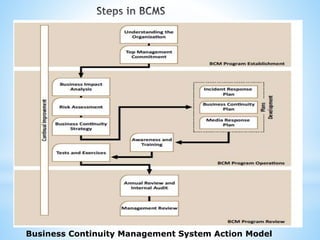
Business Continuity Management System Action Model

BCMS Presentation1

  • 1.
    BUSINESS CONTINUITY MANAGEMENT SYSTEM(BCMS) By Akinbami J. Babatunde (ABCP)
  • 2.
    * Business Continuity isthe capability of the organization to continue delivery of products or services at acceptable predefined levels following a disruptive incident “Business Continuity Management (BCM) is an holistic process that identifies potential threats to an organisation and the impacts to business operations that those threats, if realised, might cause. It provides a framework for building organisational resilience with the capability for an effective response that safeguards the interests of key stakeholders, reputation, brand and value-creating activities.” (BCI) Business Continuity Management System is the overall organizational management system, which establishes, implements, operates, reviews, monitors, maintains, and improves business continuity capability to ensure Continuation of critical business processes in the event of a disaster
  • 3.
    Minimum Business ContinuityObjective (MBCO) - The minimum acceptable level of service. Recovery Time Objective (RTO) - How soon must the business function be restored in order to provide the minimum acceptable level of service? Recovery Point Objective (RPO) – To what point must the business function be recovered to provide the minimum acceptable level of service. Maximum acceptable outage (MAO) I maximum tolerable downtime (MTD)?
  • 4.
    *1) Business continuitymaintains continuity of operations and service delivery *2) Business continuity helps to build customer confidence *4) Business continuity is potentially life saving *5) Business continuity provides competitive advantage *6) Business continuity provides compliance benefits *7) Business continuity helps mitigate business risks and financial exposures *8) Business continuity helps preserve brand value and company reputation *10) Business continuity can help enhance or develop an appropriate organizational culture *11) Business continuity can help enhance health and safety *12) Business continuity helps the organization / business to be more resilient *13) Business continuity gathers information that is useful to the whole organization / business THE BENEFITS OF BUSINESS CONTINUITY: A SUMMARY
  • 5.
    Requires the supportof senior management It involves People, Processes and Technology Is an on-going process, not a project with a beginning and an end. It is a cycle • Creating, testing, maintaining, and updating • “Critical” business functions may evolve It is not just IT but involves the entire business entity BCM team must include IT and other critical business functions *
  • 10.
    *Policy and ProgrammeManagement – This defines the organizational policy relating to BCM and how the policy will be implemented, controlled and validated through a BCM programme *Embedding Business Continuity – This seeks to integrate BC into day- to-day business activities and organizational culture *Analysis – This seeks to review and assess an organization in terms of what its objectives are, how it functions, and the constraints of the environment in which it operates *Design – This identifies and selects appropriate strategies and tactics to determine how continuity and recovery from disruptions can be achieved *Implementation – This deals with executing the agreed strategies and tactics through the process of developing the Business continuity plan (BCP) *Validation – This confirms that the BCM programme meets the objectives set in the BC policy and that the organization’s BCP is fit for purpose
  • 11.
    Business Continuity ManagementSystem Action Model

Editor's Notes

  • #3 BCM includes Disaster Recovery, Business Recovery, Crisis Management, Incident Management, Emergency Management and Contingency Management
  • #4 BCM includes Disaster Recovery, Business Recovery, Crisis Management, Incident Management, Emergency Management and Contingency Management
  • #5 BCM includes Disaster Recovery, Business Recovery, Crisis Management, Incident Management, Emergency Management and Contingency Management
  • #7 We want to discourage people from legging”
  • #10 Talk about Frequently asked Questions