Presented by:
• Tony Drewitt, Managing Director
• IT Governance Ltd
• 19 April 2018
Business Continuity Management: How to get started
• Tony Drewitt - Managing Director: IT Governance UK and EU
• One of the first BCM consultants to achieve certification to BS 25999-2:2017, superceded by
ISO 22301.
• Extensive consultancy experience in delivering ISO 27001 and ISO 22301 implementation
projects.
• Author of several books, including A Manager’s Guide to ISO22301, ISO22301 - A Pocket
Guide, and Everything you want to know about Business Continuity
Introduction
Copyright IT Governance Ltd – v 0.1
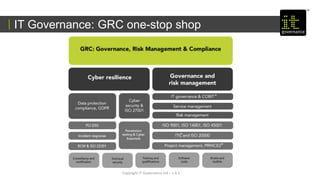
IT Governance: GRC one-stop shop
Copyright IT Governance Ltd – v 0.1
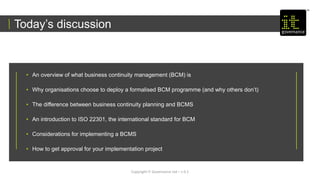
• An overview of what business continuity management (BCM) is
• Why organisations choose to deploy a formalised BCM programme (and why others don’t)
• The difference between business continuity planning and BCMS
• An introduction to ISO 22301, the international standard for BCM
• Considerations for implementing a BCMS
• How to get approval for your implementation project
Today’s discussion
Copyright IT Governance Ltd – v 0.1
The BCM landscape
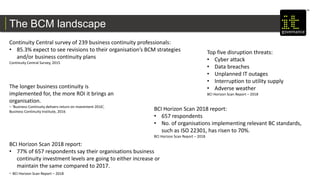
BCI Horizon Scan 2018 report:
• 77% of 657 respondents say their organisations business
continuity investment levels are going to either increase or
maintain the same compared to 2017.
- BCI Horizon Scan Report – 2018
The longer business continuity is
implemented for, the more ROI it brings an
organisation.
– ‘Business Continuity delivers return on investment 2016’,
Business Continuity Institute, 2016
Top five disruption threats:
• Cyber attack
• Data breaches
• Unplanned IT outages
• Interruption to utility supply
• Adverse weather
BCI Horizon Scan Report – 2018
Continuity Central survey of 239 business continuity professionals:
• 85.3% expect to see revisions to their organisation’s BCM strategies
and/or business continuity plans
Continuity Central Survey, 2015
BCI Horizon Scan 2018 report:
• 657 respondents
• No. of organisations implementing relevant BC standards,
such as ISO 22301, has risen to 70%.
BCI Horizon Scan Report – 2018
What is business continuity management (BCM)?
Copyright IT Governance Ltd – v 0.1
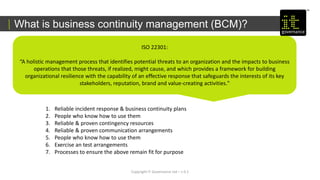
ISO 22301:
“A holistic management process that identifies potential threats to an organization and the impacts to business
operations that those threats, if realized, might cause, and which provides a framework for building
organizational resilience with the capability of an effective response that safeguards the interests of its key
stakeholders, reputation, brand and value-creating activities."
1. Reliable incident response & business continuity plans
2. People who know how to use them
3. Reliable & proven contingency resources
4. Reliable & proven communication arrangements
5. People who know how to use them
6. Exercise an test arrangements
7. Processes to ensure the above remain fit for purpose
Copyright IT Governance Ltd - v 0.1
What is a BCMS?
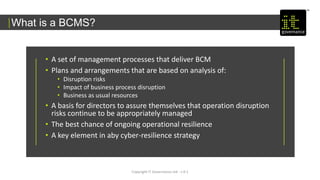
• A set of management processes that deliver BCM
• Plans and arrangements that are based on analysis of:
• Disruption risks
• Impact of business process disruption
• Business as usual resources
• A basis for directors to assure themselves that operation disruption
risks continue to be appropriately managed
• The best chance of ongoing operational resilience
• A key element in aby cyber-resilience strategy
Copyright IT Governance Ltd – v 0.1
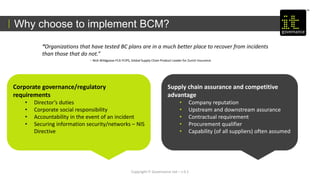
Why choose to implement BCM?
Corporate governance/regulatory
requirements
• Director’s duties
• Corporate social responsibility
• Accountability in the event of an incident
• Securing information security/networks – NIS
Directive
Supply chain assurance and competitive
advantage
• Company reputation
• Upstream and downstream assurance
• Contractual requirement
• Procurement qualifier
• Capability (of all suppliers) often assumed
“Organizations that have tested BC plans are in a much better place to recover from incidents
than those that do not.”
- Nick Wildgoose FCA FCIPS, Global Supply Chain Product Leader for Zurich Insurance
Copyright IT Governance Ltd - v 0.1
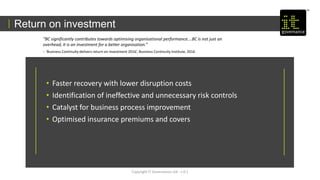
Return on investment
• Faster recovery with lower disruption costs
• Identification of ineffective and unnecessary risk controls
• Catalyst for business process improvement
• Optimised insurance premiums and covers
“BC significantly contributes towards optimising organisational performance….BC is not just an
overhead, it is an investment for a better organisation.”
- ‘Business Continuity delivers return on investment 2016’, Business Continuity Institute, 2016
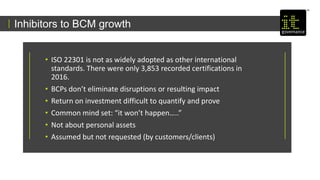
Inhibitors to BCM growth
• ISO 22301 is not as widely adopted as other international
standards. There were only 3,853 recorded certifications in
2016.
• BCPs don’t eliminate disruptions or resulting impact
• Return on investment difficult to quantify and prove
• Common mind set: “it won’t happen…..”
• Not about personal assets
• Assumed but not requested (by customers/clients)
Copyright IT Governance Ltd - v 0.1
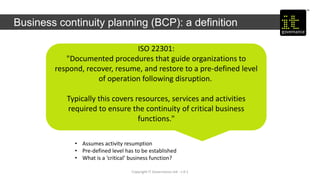
Business continuity planning (BCP): a definition
ISO 22301:
"Documented procedures that guide organizations to
respond, recover, resume, and restore to a pre-defined level
of operation following disruption.
Typically this covers resources, services and activities
required to ensure the continuity of critical business
functions."
• Assumes activity resumption
• Pre-defined level has to be established
• What is a ‘critical’ business function?
Copyright IT Governance Ltd – v 0.1
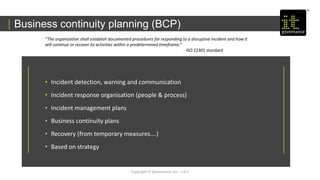
Business continuity planning (BCP)
• Incident detection, warning and communication
• Incident response organisation (people & process)
• Incident management plans
• Business continuity plans
• Recovery (from temporary measures….)
• Based on strategy
“The organization shall establish documented procedures for responding to a disruptive incident and how it
will continue or recover its activities within a predetermined timeframe.”
- ISO 22301 standard
Copyright IT Governance Ltd - v 0.1
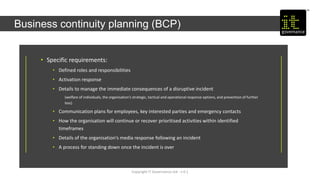
Business continuity planning (BCP)
• Specific requirements:
• Defined roles and responsibilities
• Activation response
• Details to manage the immediate consequences of a disruptive incident
(welfare of individuals, the organisation’s strategic, tactical and operational response options, and prevention of further
loss)
• Communication plans for employees, key interested parties and emergency contacts
• How the organisation will continue or recover prioritised activities within identified
timeframes
• Details of the organisation’s media response following an incident
• A process for standing down once the incident is over
Copyright IT Governance Ltd - v 0.1
Business continuity management system (BCMS): a definition
ISO 22301:
“Part of the overall management system that establishes, implements,
operates, monitors, reviews, maintains and improves business continuity.
The management system includes organizational structure, policies,
planning activities, responsibilities, procedures, processes and resources.
Optimised incident response and business continuity arrangements:
• Based on comprehensive analysis Vs. subjective intuition
• For all identified unacceptable disruption risk scenarios
• Proven competent responders
• Continual assurance that all operational disruptions risks are being appropriately
managed
Copyright IT Governance Ltd - v 0.1
A comprehensive approach to developing organisational resilience
• Should utilise a cross functional team, committee or group including:
• Senior manager/director(s)
• Programme executive
• Functional representatives
• Resource providers (internal)
• Can contain numerous BCPs, based on conducting a risk assessment
• Collaboration in various elements, including:
• Competencies
• Training & awareness programmes
• Management review and audits
• Documentation management
• Most effective when aligned with the international standard, ISO 22301
Business continuity management system (BCMS)
Copyright IT Governance Ltd - v 0.1
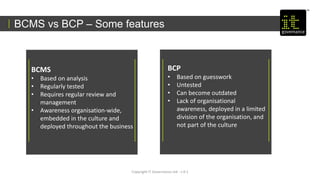
BCMS vs BCP – Some features
BCMS
• Based on analysis
• Regularly tested
• Requires regular review and
management
• Awareness organisation-wide,
embedded in the culture and
deployed throughout the business
BCP
• Based on guesswork
• Untested
• Can become outdated
• Lack of organisational
awareness, deployed in a limited
division of the organisation, and
not part of the culture
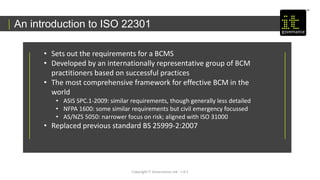
An introduction to ISO 22301
Copyright IT Governance Ltd - v 0.1
• Sets out the requirements for a BCMS
• Developed by an internationally representative group of BCM
practitioners based on successful practices
• The most comprehensive framework for effective BCM in the
world
• ASIS SPC.1-2009: similar requirements, though generally less detailed
• NFPA 1600: some similar requirements but civil emergency focussed
• AS/NZS 5050: narrower focus on risk; aligned with ISO 31000
• Replaced previous standard BS 25999-2:2007
Copyright IT Governance Ltd – v 0.1
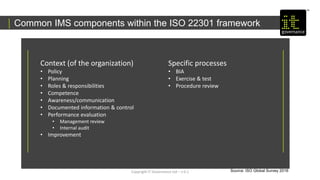
Common IMS components within the ISO 22301 framework
Source: ISO Global Survey 2016
Context (of the organization)
• Policy
• Planning
• Roles & responsibilities
• Competence
• Awareness/communication
• Documented information & control
• Performance evaluation
• Management review
• Internal audit
• Improvement
Specific processes
• BIA
• Exercise & test
• Procedure review
Copyright IT Governance Ltd - v 0.1
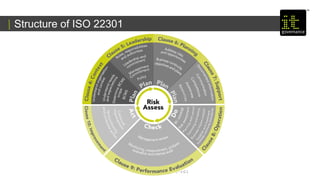
Structure of ISO 22301
Copyright IT Governance Ltd – v 0.1
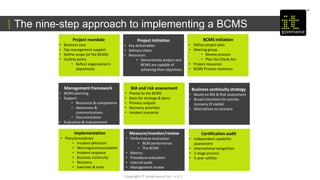
The nine-step approach to implementing a BCMS
Project mandate
• Business case
• Top management support
• Define scope (of the BCMS)
• Outline policy
• Reflect organisation’s
objective(s)
Project initiation
• Key deliverables
• Delivery dates
• Resources
• Demonstrate project and
BCMS are capable of
achieving their objectives
BCMS initiation
• Define project plan
• Steering group
• Review process
• Plan-Do-Check-Act
• Project resources
• BCMS Process inventory
Management framework
• BCMS planning
• Support
• Resources & competence
• Awareness &
communications
• Documentation
• Evaluation & improvement
BIA and risk assessment
• Pivotal to the BCMS
• Basis for strategy & plans
• Primary outputs
• Recovery priorities
• Incident scenarios
Business continuity strategy
• Based on BIA & Risk assessment
• Broad intentions for activity
recovery (if viable)
• Alternatives to recovery
Implementation
• Plans/procedures
• Incident detection
• Warning/communication
• Incident response
• Business continuity
• Recovery
• Exercises & tests
Measure/monitor/review
• Performance evaluation
• BCM performance
• The BCMS
• Metrics
• Procedure evaluation
• Internal audit
• Management review
Certification audit
• Independent capability
assessment
• International recognition
• 2-stage process
• 3-year validity
Copyright IT Governance Ltd - v 0.1
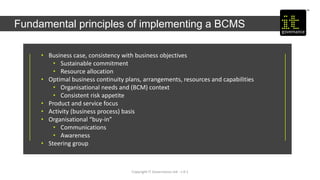
Fundamental principles of implementing a BCMS
• Business case, consistency with business objectives
• Sustainable commitment
• Resource allocation
• Optimal business continuity plans, arrangements, resources and capabilities
• Organisational needs and (BCM) context
• Consistent risk appetite
• Product and service focus
• Activity (business process) basis
• Organisational “buy-in”
• Communications
• Awareness
• Steering group
Copyright IT Governance Ltd - v 0.1
Top management support
ISO 22301:
• demonstrate leadership and commitment with respect to the BCMS
• provide evidence...
• Ensure responsibilities and authorities for relevant roles…
Why?
Copyright IT Governance Ltd - v 0.1
Top management support
• Establish policies & objectives
• Ensure integration of BCMS processes with (other) business processes
• Provide resources
• Communicate importance
• Ensure BCMS achieves its outcomes
• Direct & support
• Promote continual improvement
Copyright IT Governance Ltd - v 0.1
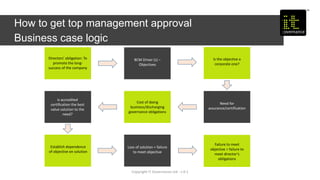
How to get top management approval
Business case logic
Directors’ obligation: To
promote the long-
success of the company
BCM Driver (s) –
Objectives
Is the objective a
corporate one?
Need for
assurance/certification
Cost of doing
business/discharging
governance obligations
Is accredited
certification the best
value solution to the
need?
Establish dependence
of objective on solution
Loss of solution = failure
to meet objective
Failure to meet
objective = failure to
meet director’s
obligations
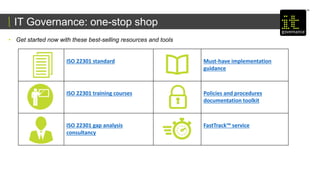
IT Governance: one-stop shop
• Get started now with these best-selling resources and tools
ISO 22301 standard Must-have implementation
guidance
ISO 22301 training courses Policies and procedures
documentation toolkit
ISO 22301 gap analysis
consultancy
FastTrack™ service
Copyright IT Governance Ltd - v 0.1
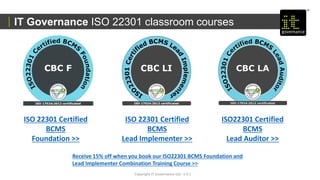
IT Governance ISO 22301 classroom courses
ISO 22301 Certified
BCMS
Lead Implementer >>
ISO 22301 Certified
BCMS
Foundation >>
ISO22301 Certified
BCMS
Lead Auditor >>
Receive 15% off when you book our ISO22301 BCMS Foundation and
Lead Implementer Combination Training Course >>
How to get in touch
Copyright IT Governance Ltd – v 0.1
Call us toll free at
(0)333 800 7000
Email us
servicecentre@itgovernance.co.uk
Visit our website
https://www.itgovernance.co.uk
Like us on Facebook
/ITGovernanceLtd
Follow us on Twitter
/itgovernance
Join us on LinkedIn
/company/it-governance
Contact an ISO 22301 specialist
https://www.itgovernance.co.uk/speak-to-a-bcm-
expert
Questions

Business Continuity Management: How to get started

  • 1.
    Presented by: • TonyDrewitt, Managing Director • IT Governance Ltd • 19 April 2018 Business Continuity Management: How to get started
  • 2.
    • Tony Drewitt- Managing Director: IT Governance UK and EU • One of the first BCM consultants to achieve certification to BS 25999-2:2017, superceded by ISO 22301. • Extensive consultancy experience in delivering ISO 27001 and ISO 22301 implementation projects. • Author of several books, including A Manager’s Guide to ISO22301, ISO22301 - A Pocket Guide, and Everything you want to know about Business Continuity Introduction Copyright IT Governance Ltd – v 0.1
  • 3.
    IT Governance: GRCone-stop shop Copyright IT Governance Ltd – v 0.1
  • 4.
    • An overviewof what business continuity management (BCM) is • Why organisations choose to deploy a formalised BCM programme (and why others don’t) • The difference between business continuity planning and BCMS • An introduction to ISO 22301, the international standard for BCM • Considerations for implementing a BCMS • How to get approval for your implementation project Today’s discussion Copyright IT Governance Ltd – v 0.1
  • 5.
    The BCM landscape BCIHorizon Scan 2018 report: • 77% of 657 respondents say their organisations business continuity investment levels are going to either increase or maintain the same compared to 2017. - BCI Horizon Scan Report – 2018 The longer business continuity is implemented for, the more ROI it brings an organisation. – ‘Business Continuity delivers return on investment 2016’, Business Continuity Institute, 2016 Top five disruption threats: • Cyber attack • Data breaches • Unplanned IT outages • Interruption to utility supply • Adverse weather BCI Horizon Scan Report – 2018 Continuity Central survey of 239 business continuity professionals: • 85.3% expect to see revisions to their organisation’s BCM strategies and/or business continuity plans Continuity Central Survey, 2015 BCI Horizon Scan 2018 report: • 657 respondents • No. of organisations implementing relevant BC standards, such as ISO 22301, has risen to 70%. BCI Horizon Scan Report – 2018
  • 6.
    What is businesscontinuity management (BCM)? Copyright IT Governance Ltd – v 0.1 ISO 22301: “A holistic management process that identifies potential threats to an organization and the impacts to business operations that those threats, if realized, might cause, and which provides a framework for building organizational resilience with the capability of an effective response that safeguards the interests of its key stakeholders, reputation, brand and value-creating activities." 1. Reliable incident response & business continuity plans 2. People who know how to use them 3. Reliable & proven contingency resources 4. Reliable & proven communication arrangements 5. People who know how to use them 6. Exercise an test arrangements 7. Processes to ensure the above remain fit for purpose
  • 7.
    Copyright IT GovernanceLtd - v 0.1 What is a BCMS? • A set of management processes that deliver BCM • Plans and arrangements that are based on analysis of: • Disruption risks • Impact of business process disruption • Business as usual resources • A basis for directors to assure themselves that operation disruption risks continue to be appropriately managed • The best chance of ongoing operational resilience • A key element in aby cyber-resilience strategy
  • 8.
    Copyright IT GovernanceLtd – v 0.1 Why choose to implement BCM? Corporate governance/regulatory requirements • Director’s duties • Corporate social responsibility • Accountability in the event of an incident • Securing information security/networks – NIS Directive Supply chain assurance and competitive advantage • Company reputation • Upstream and downstream assurance • Contractual requirement • Procurement qualifier • Capability (of all suppliers) often assumed “Organizations that have tested BC plans are in a much better place to recover from incidents than those that do not.” - Nick Wildgoose FCA FCIPS, Global Supply Chain Product Leader for Zurich Insurance
  • 9.
    Copyright IT GovernanceLtd - v 0.1 Return on investment • Faster recovery with lower disruption costs • Identification of ineffective and unnecessary risk controls • Catalyst for business process improvement • Optimised insurance premiums and covers “BC significantly contributes towards optimising organisational performance….BC is not just an overhead, it is an investment for a better organisation.” - ‘Business Continuity delivers return on investment 2016’, Business Continuity Institute, 2016
  • 10.
    Inhibitors to BCMgrowth • ISO 22301 is not as widely adopted as other international standards. There were only 3,853 recorded certifications in 2016. • BCPs don’t eliminate disruptions or resulting impact • Return on investment difficult to quantify and prove • Common mind set: “it won’t happen…..” • Not about personal assets • Assumed but not requested (by customers/clients)
  • 11.
    Copyright IT GovernanceLtd - v 0.1 Business continuity planning (BCP): a definition ISO 22301: "Documented procedures that guide organizations to respond, recover, resume, and restore to a pre-defined level of operation following disruption. Typically this covers resources, services and activities required to ensure the continuity of critical business functions." • Assumes activity resumption • Pre-defined level has to be established • What is a ‘critical’ business function?
  • 12.
    Copyright IT GovernanceLtd – v 0.1 Business continuity planning (BCP) • Incident detection, warning and communication • Incident response organisation (people & process) • Incident management plans • Business continuity plans • Recovery (from temporary measures….) • Based on strategy “The organization shall establish documented procedures for responding to a disruptive incident and how it will continue or recover its activities within a predetermined timeframe.” - ISO 22301 standard
  • 13.
    Copyright IT GovernanceLtd - v 0.1 Business continuity planning (BCP) • Specific requirements: • Defined roles and responsibilities • Activation response • Details to manage the immediate consequences of a disruptive incident (welfare of individuals, the organisation’s strategic, tactical and operational response options, and prevention of further loss) • Communication plans for employees, key interested parties and emergency contacts • How the organisation will continue or recover prioritised activities within identified timeframes • Details of the organisation’s media response following an incident • A process for standing down once the incident is over
  • 14.
    Copyright IT GovernanceLtd - v 0.1 Business continuity management system (BCMS): a definition ISO 22301: “Part of the overall management system that establishes, implements, operates, monitors, reviews, maintains and improves business continuity. The management system includes organizational structure, policies, planning activities, responsibilities, procedures, processes and resources. Optimised incident response and business continuity arrangements: • Based on comprehensive analysis Vs. subjective intuition • For all identified unacceptable disruption risk scenarios • Proven competent responders • Continual assurance that all operational disruptions risks are being appropriately managed
  • 15.
    Copyright IT GovernanceLtd - v 0.1 A comprehensive approach to developing organisational resilience • Should utilise a cross functional team, committee or group including: • Senior manager/director(s) • Programme executive • Functional representatives • Resource providers (internal) • Can contain numerous BCPs, based on conducting a risk assessment • Collaboration in various elements, including: • Competencies • Training & awareness programmes • Management review and audits • Documentation management • Most effective when aligned with the international standard, ISO 22301 Business continuity management system (BCMS)
  • 16.
    Copyright IT GovernanceLtd - v 0.1 BCMS vs BCP – Some features BCMS • Based on analysis • Regularly tested • Requires regular review and management • Awareness organisation-wide, embedded in the culture and deployed throughout the business BCP • Based on guesswork • Untested • Can become outdated • Lack of organisational awareness, deployed in a limited division of the organisation, and not part of the culture
  • 17.
    An introduction toISO 22301 Copyright IT Governance Ltd - v 0.1 • Sets out the requirements for a BCMS • Developed by an internationally representative group of BCM practitioners based on successful practices • The most comprehensive framework for effective BCM in the world • ASIS SPC.1-2009: similar requirements, though generally less detailed • NFPA 1600: some similar requirements but civil emergency focussed • AS/NZS 5050: narrower focus on risk; aligned with ISO 31000 • Replaced previous standard BS 25999-2:2007
  • 18.
    Copyright IT GovernanceLtd – v 0.1 Common IMS components within the ISO 22301 framework Source: ISO Global Survey 2016 Context (of the organization) • Policy • Planning • Roles & responsibilities • Competence • Awareness/communication • Documented information & control • Performance evaluation • Management review • Internal audit • Improvement Specific processes • BIA • Exercise & test • Procedure review
  • 19.
    Copyright IT GovernanceLtd - v 0.1 Structure of ISO 22301
  • 20.
    Copyright IT GovernanceLtd – v 0.1 The nine-step approach to implementing a BCMS Project mandate • Business case • Top management support • Define scope (of the BCMS) • Outline policy • Reflect organisation’s objective(s) Project initiation • Key deliverables • Delivery dates • Resources • Demonstrate project and BCMS are capable of achieving their objectives BCMS initiation • Define project plan • Steering group • Review process • Plan-Do-Check-Act • Project resources • BCMS Process inventory Management framework • BCMS planning • Support • Resources & competence • Awareness & communications • Documentation • Evaluation & improvement BIA and risk assessment • Pivotal to the BCMS • Basis for strategy & plans • Primary outputs • Recovery priorities • Incident scenarios Business continuity strategy • Based on BIA & Risk assessment • Broad intentions for activity recovery (if viable) • Alternatives to recovery Implementation • Plans/procedures • Incident detection • Warning/communication • Incident response • Business continuity • Recovery • Exercises & tests Measure/monitor/review • Performance evaluation • BCM performance • The BCMS • Metrics • Procedure evaluation • Internal audit • Management review Certification audit • Independent capability assessment • International recognition • 2-stage process • 3-year validity
  • 21.
    Copyright IT GovernanceLtd - v 0.1 Fundamental principles of implementing a BCMS • Business case, consistency with business objectives • Sustainable commitment • Resource allocation • Optimal business continuity plans, arrangements, resources and capabilities • Organisational needs and (BCM) context • Consistent risk appetite • Product and service focus • Activity (business process) basis • Organisational “buy-in” • Communications • Awareness • Steering group
  • 22.
    Copyright IT GovernanceLtd - v 0.1 Top management support ISO 22301: • demonstrate leadership and commitment with respect to the BCMS • provide evidence... • Ensure responsibilities and authorities for relevant roles… Why?
  • 23.
    Copyright IT GovernanceLtd - v 0.1 Top management support • Establish policies & objectives • Ensure integration of BCMS processes with (other) business processes • Provide resources • Communicate importance • Ensure BCMS achieves its outcomes • Direct & support • Promote continual improvement
  • 24.
    Copyright IT GovernanceLtd - v 0.1 How to get top management approval Business case logic Directors’ obligation: To promote the long- success of the company BCM Driver (s) – Objectives Is the objective a corporate one? Need for assurance/certification Cost of doing business/discharging governance obligations Is accredited certification the best value solution to the need? Establish dependence of objective on solution Loss of solution = failure to meet objective Failure to meet objective = failure to meet director’s obligations
  • 25.
    IT Governance: one-stopshop • Get started now with these best-selling resources and tools ISO 22301 standard Must-have implementation guidance ISO 22301 training courses Policies and procedures documentation toolkit ISO 22301 gap analysis consultancy FastTrack™ service
  • 26.
    Copyright IT GovernanceLtd - v 0.1 IT Governance ISO 22301 classroom courses ISO 22301 Certified BCMS Lead Implementer >> ISO 22301 Certified BCMS Foundation >> ISO22301 Certified BCMS Lead Auditor >> Receive 15% off when you book our ISO22301 BCMS Foundation and Lead Implementer Combination Training Course >>
  • 27.
    How to getin touch Copyright IT Governance Ltd – v 0.1 Call us toll free at (0)333 800 7000 Email us servicecentre@itgovernance.co.uk Visit our website https://www.itgovernance.co.uk Like us on Facebook /ITGovernanceLtd Follow us on Twitter /itgovernance Join us on LinkedIn /company/it-governance Contact an ISO 22301 specialist https://www.itgovernance.co.uk/speak-to-a-bcm- expert
  • 28.