Issue 1 © Intertek QATAR www.intertek.com
1
Welcome to the Seminar on
Business ContinuityBusiness Continuity
Management SystemManagement System
ISO 22301:2012ISO 22301:2012
AN ORIENTATION
Issue 1 © Intertek QATAR www.intertek.com
2
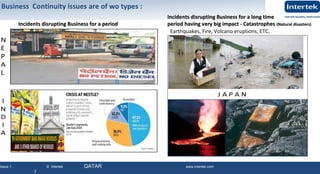
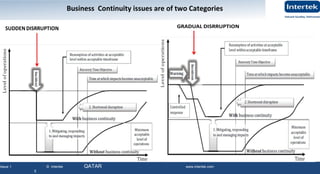
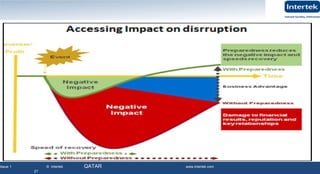
Business Continuity issues are of wo types :
Incidents disrupting Business for a periodIncidents disrupting Business for a period
Incidents disrupting Business for a long timeIncidents disrupting Business for a long time
period having very big impact - Catastrophesperiod having very big impact - Catastrophes (Natural disasters)(Natural disasters)
Earthquakes, Fire, Volcano eruptions, ETC.
Issue 1 © Intertek QATAR www.intertek.com
3
Learning Objectives
Upon completion of this presentation, on can:
• Understand …… what is BCMS;
• Understand …… why BCMS;
• Understand ……. Benefits of BCMS;
• Focus of Top Management for ISO 22301 preparation
November 2015 - QATAR Ver. 1 3
Issue 1 © Intertek QATAR www.intertek.com
4
SOME BUSINESS DISRRUPTIONS AND THEIR IMPACTS – indicating the need for BCMS - Videos
1.BLACKBERRY INCIDENT
2. GLOBAL CASES
3. AT&T
Issue 1 © Intertek QATAR www.intertek.com
5
Business Continuity issues are of two Categories
Issue 1 © Intertek QATAR www.intertek.com
6
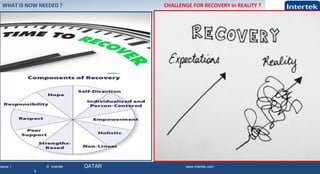
WHAT IS NOW NEEDED ? CHALLENGE FOR RECOVERY In REALITY ?
Issue 1 © Intertek QATAR www.intertek.com
7
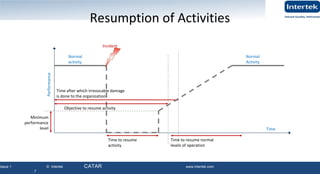
Resumption of Activities
7
Time
Performance
Normal
activity
Time to resume
activity
Time after which irrevocable damage
is done to the organization
Minimum
performance
level
Time to resume normal
levels of operation
Normal
Activity
Incident
Objective to resume activity
Issue 1 © Intertek QATAR www.intertek.com
8
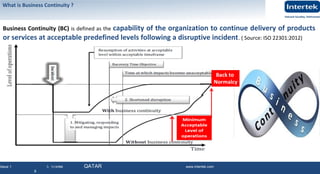
Business Continuity (BC) is defined as the capability of the organization to continue delivery of products
or services at acceptable predefined levels following a disruptive incident. ( Source: ISO 22301:2012)
November 2015 - QATAR Ver. 1 8
What is Business Continuity ?
Issue 1 © Intertek QATAR www.intertek.com
9
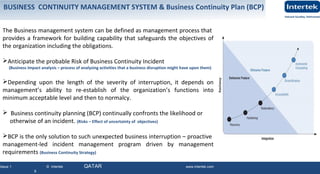
The Business management system can be defined as management process that
provides a framework for building capability that safeguards the objectives of
the organization including the obligations.
Anticipate the probable Risk of Business Continuity Incident
(Business Impact analysis – process of analyzing activities that a business disruption might have upon them)
Depending upon the length of the severity of interruption, it depends on
management’s ability to re-establish of the organization’s functions into
minimum acceptable level and then to normalcy.
 Business continuity planning (BCP) continually confronts the likelihood or
otherwise of an incident. (Risks – Effect of uncertainty of objectives)
BCP is the only solution to such unexpected business interruption – proactive
management-led incident management program driven by management
requirements (Business Continuity Strategy)
BUSINESS CONTINUITY MANAGEMENT SYSTEM & Business Continuity Plan (BCP)
Issue 1 © Intertek QATAR www.intertek.com
10
BUSINESS CONTINUITY PLAN (BCP) OBJECTIVES
 Ensure continuity and survival of the business;Ensure continuity and survival of the business;
 Provide protection to corporate assets;Provide protection to corporate assets;
 Provide management control of risks and exposures;Provide management control of risks and exposures;
 Provide preventative measures where appropriate;Provide preventative measures where appropriate;
 Take proactive management control of anyTake proactive management control of any
business interruption;business interruption;
BCP Provides a balance between acceptable potential losses and
acceptable One-time and annual costs.
Risk assessment identifies key sources of vulnerabilities having
different impacts, and taking pro-active steps in a manner to
avoid such incidents.
TESTNG OF BCP IS MANDATORY else RECOVERY WOULD BE
(Sample Testing is not enough)
NEED FOR BCP - Video
Issue 1 © Intertek QATAR www.intertek.com
11
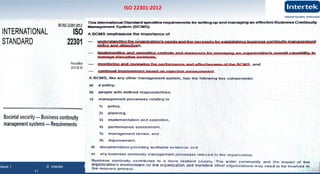
ISO 22301:2012
Issue 1 © Intertek QATAR www.intertek.com
12
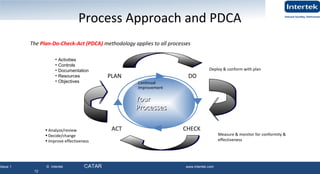
Process Approach and PDCA
12
YourYour
ProcessesProcesses
PLAN DO
CHECKACT
Continual
Improvement
The Plan-Do-Check-Act (PDCA) methodology applies to all processes
• Activities
• Controls
• Documentation
• Resources
• Objectives
• Analyze/review
• Decide/change
• Improve effectiveness
Deploy & conform with plan
Measure & monitor for conformity &
effectiveness
Issue 1 © Intertek QATAR www.intertek.com
13
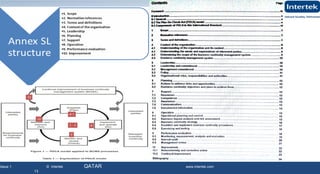
Issue 1 © Intertek QATAR www.intertek.com
14
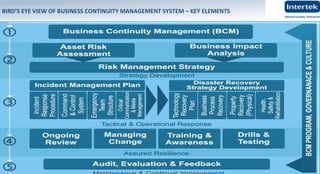
BIRD’S EYE VIEW OF BUSINESS CONTINUITY MANAGEMENT SYSTEM – KEY ELEMENTS
Issue 1 © Intertek QATAR www.intertek.com
15
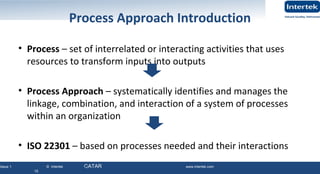
Process Approach Introduction
• Process – set of interrelated or interacting activities that uses
resources to transform inputs into outputs
• Process Approach – systematically identifies and manages the
linkage, combination, and interaction of a system of processes
within an organization
• ISO 22301 – based on processes needed and their interactions
15
Issue 1 © Intertek QATAR www.intertek.com
16
Process Approach Emphasis
The process approach emphasizes the importance of:
• Understanding and meeting requirements
• Looking at processes in terms of added value
• Obtaining results of process performance and effectiveness
• Use of objective measurements to improve processes
16
Issue 1 © Intertek QATAR www.intertek.com
17
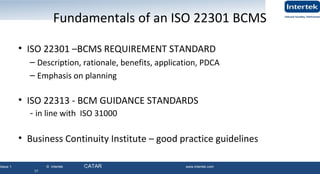
Fundamentals of an ISO 22301 BCMS
• ISO 22301 –BCMS REQUIREMENT STANDARD
– Description, rationale, benefits, application, PDCA
– Emphasis on planning
• ISO 22313 - BCM GUIDANCE STANDARDS
- in line with ISO 31000
• Business Continuity Institute – good practice guidelines
17
Issue 1 © Intertek QATAR www.intertek.com
18
Purpose of ISO 22301
• Applies to any type or size organization in any industry or sector
• Tried and tested framework for a systematic approach
• Provides a framework to meet customer, internal and statutory
and regulatory requirements
• Sets standardized requirements for business continuity
• Model for consistently meeting business needs despite
disruptions
• Basis for certification that specified requirements are met
18
Issue 1 © Intertek QATAR www.intertek.com
19
19
An ISO 22301 BCMS in Practice
• Requires internal audits
• Verifies effective management
• Ensures organization is fully in control of its
activities
• Fosters customer confidence
• Allows engaging a certification body to obtain
certificate of conformity
• Provides, via certification, the credibility of an
independent assessment
• Provides a system that adds value
ISO 22301 states what must be done; a properly documented BCMS describes how required
processes are to be done.
19
Issue 1 © Intertek QATAR www.intertek.com
20
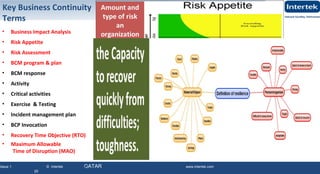
Key Business Continuity
Terms
• Business Impact Analysis
• Risk Appetite
• Risk Assessment
• BCM program & plan
• BCM response
• Activity
• Critical activities
• Exercise & Testing
• Incident management plan
• BCP Invocation
• Recovery Time Objective (RTO)
• Maximum Allowable
Time of Disruption (MAO)
20
Issue 1 © Intertek QATAR www.intertek.com
21
Issue 1 © Intertek QATAR www.intertek.com
22
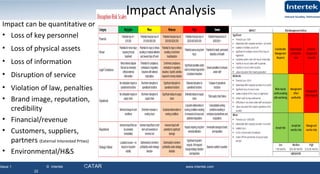
Impact can be quantitative or qualitative:
• Loss of key personnel
• Loss of physical assets
• Loss of information
• Disruption of service
• Violation of law, penalties
• Brand image, reputation,
credibility
• Financial/revenue
• Customers, suppliers,
partners (External Interested Prties)
• Environmental/H&S
22
Impact Analysis
Issue 1 © Intertek QATAR www.intertek.com
23
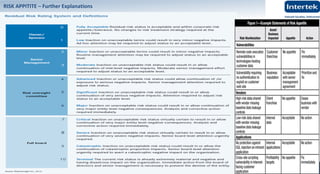
RISK APPITITE – Further Explanations
Issue 1 © Intertek QATAR www.intertek.com
24
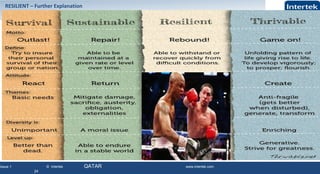
RESILIENT – Further Explanation
Issue 1 © Intertek QATAR www.intertek.com
25
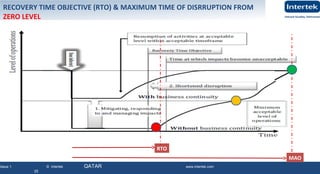
RECOVERY TIME OBJECTIVE (RTO) & MAXIMUM TIME OF DISRRUPTION FROM
ZERO LEVEL
RTO
MAO
Issue 1 © Intertek QATAR www.intertek.com
26
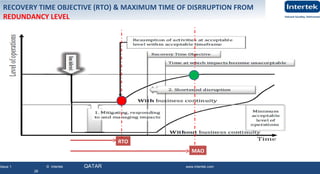
MAO
RTO
RECOVERY TIME OBJECTIVE (RTO) & MAXIMUM TIME OF DISRRUPTION FROM
REDUNDANCY LEVEL
Issue 1 © Intertek QATAR www.intertek.com
27
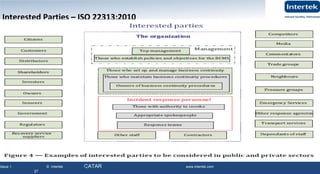
Interested Parties – ISO 22313:2010
27
Issue 1 © Intertek QATAR www.intertek.com
28
A 1 10 J
B 2 11 K
C 3 12 L
D 4 13 M
E 5 14 N
F 6 15 O
G 7 16 P
H 8 17 Q
I 9 18 R
EXTERNAL
INTERESTED
PARTIES
EXTERNAL
INTERESTED
PARTIES
INTERNAL INTERESTED PARTIES
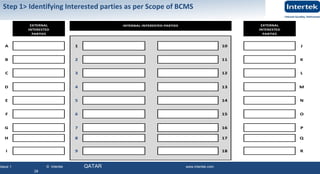
Step 1> Identifying Interested parties as per Scope of BCMS
Issue 1 © Intertek QATAR www.intertek.com
29
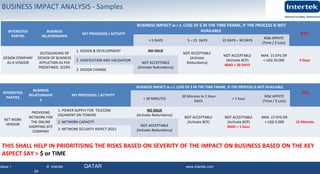
INTERESTED
PARTIES
BUSINESS
RELATIONSHIPS
KEY PROCESSES / ACTIVITY
BUSINESS IMPACT w.r.t. LOSS OF $ IN THE TIME FRAME, IF THE PROCESS IS NOT
AVAILABLE
RTO
< 5 DAYS 5 – 15 DAYS 15 DAYS – 30 DAYS
RISK APPIITE
(Time / $ Loss)
DESIGN COMPANY
AS A VENDOR
OUTSOURCING OF
DESIGN OF BUSINESS
APPLICTION AS PER
PREDEFINED SCOPE
1. DESIGN & DEVELOPMENT NO ISSUE
NOT ACCEPTABLE
(Activate
Redundancy)
NOT ACCEPTABLE
(Activate BCP)
MAO = 30 DAYS
MAX. 15 DYS OR
< USD 50,000 4 Days2. VERIFICATION AND VALIDATION
NOT ACCEPTABLE
(Activate Redundancy)
3. DESIGN CHANGE
INTERESTED
PARTIES
BUSINESS
RELATIONSHIP
S
KEY PROCESSES / ACTIVITY
BUSINESS IMPACT w.r.t. LOSS OF $ IN THE TIME FRAME, IF THE PROCESS IS NOT AVAILABLE
RTO
< 30 MINUTES
30 Minutes to 1 Hour
DAYS
> 1 hour
RISK APPIITE
(Time / $ Loss)
NET WORK
VENDOR
PROVIDING
NETWORK FOR
THE ONLINE
SHOPPING SITE
COMPANY
1. POWER SUPPLY FOR TELECOM
EQUIMENT ON TOWERS
NO ISSUE
(Activate Redundancy)
NOT ACCEPTABLE
(Activate BCP)
NOT ACCEPTABLE
(Activate BCP)
MAO = 1 hour
MAX. 15 DYS OR
< USD 5,000 15 Minutes2. NETWORK CAPACITY
NOT ACCEPTABLE
(Activate Redundancy)3. NETWORK SECURITY ASPECT (SOC)
BUSINESS IMPACT ANALYSIS - Samples
THIS SHALL HELP IN PRIORITISING THE RISKS BASED ON SEVERITY OF THE IMPACT ON BUSINESS BASED ON THE KEY
ASPECT SAY > $ or TIME
Issue 1 © Intertek QATAR www.intertek.com
30
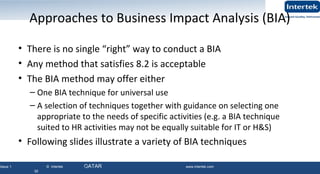
Approaches to Business Impact Analysis (BIA)
• There is no single “right” way to conduct a BIA
• Any method that satisfies 8.2 is acceptable
• The BIA method may offer either
– One BIA technique for universal use
– A selection of techniques together with guidance on selecting one
appropriate to the needs of specific activities (e.g. a BIA technique
suited to HR activities may not be equally suitable for IT or H&S)
• Following slides illustrate a variety of BIA techniques
30
Issue 1 © Intertek QATAR www.intertek.com
31
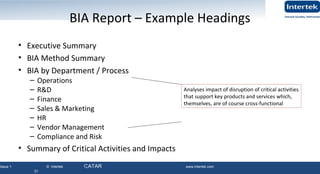
BIA Report – Example Headings
• Executive Summary
• BIA Method Summary
• BIA by Department / Process
– Operations
– R&D
– Finance
– Sales & Marketing
– HR
– Vendor Management
– Compliance and Risk
• Summary of Critical Activities and Impacts
31
Analyses impact of disruption of critical activities
that support key products and services which,
themselves, are of course cross-functional
Issue 1 © Intertek QATAR www.intertek.com
32
Identify Risks and Opportunities
• Implementation of a BCMS assists in providing controls to
mitigate risks
• Ensure review of risks and opportunities when assessing your
current system and performing a gap analysis
• Determine appropriate risk and opportunity treatments
You may find these useful:
• ISO 31000:2009, Risk management – Principles and guidelines
• ISO/IEC 31010:2009, Risk management – Risk assessment techniques
32
Issue 1 © Intertek QATAR www.intertek.com
33
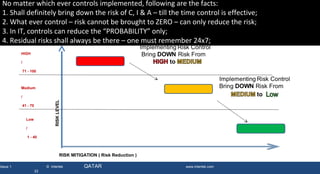
RISKLEVEL
HIGH
/
71 - 100
Medium
/
41 - 70
Low
/
1 - 40
RISK MITIGATION ( Risk Reduction )
Risk Mitigation – Implemeting Controls for Risk
Reduction
No matter which ever controls implemented, following are the facts:
1. Shall definitely bring down the risk of C, I & A – till the time control is effective;
2. What ever control – risk cannot be brought to ZERO – can only reduce the risk;
3. In IT, controls can reduce the “PROBABILITY” only;
4. Residual risks shall always be there – one must remember 24x7;
Issue 1 © Intertek QATAR www.intertek.com
34
BUSINESS CONTINUITY PLAN - VIDEO
BUSINESS CONTINUTIY PLANS – as per anticipated risks
Take away > Redundancy is the SECTRET OF SUCCESS OF BUSINESS CONTINUITY PLANS
Issue 1 © Intertek QATAR www.intertek.com
35
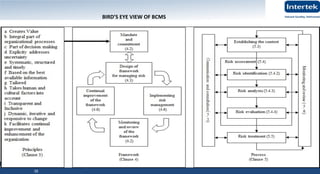
BIRD’S EYE VIEW OF BCMS
Issue 1 © Intertek QATAR www.intertek.com
36
Critical BC Focus Aspects of Organization
(anticipate maximum disruptions)
All Single Point of Failures [No Redundancies]
Residual Risks Identified in Risk Assessments
[after considering all the controls]
 Unknown causes of redundancy failures
 No actions taken on BC Testing failures
 Unknown / Ignored Risks
Issue 1 © Intertek QATAR www.intertek.com
37
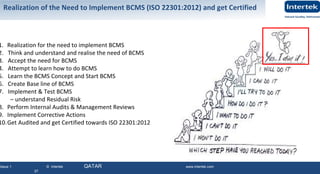
1. Realization for the need to implement BCMS
2. Think and understand and realise the need of BCMS
3. Accept the need for BCMS
4. Attempt to learn how to do BCMS
5. Learn the BCMS Concept and Start BCMS
6. Create Base line of BCMS
7. Implement & Test BCMS
– understand Residual Risk
8. Perform Internal Audits & Management Reviews
9. Implement Corrective Actions
10.Get Audited and get Certified towards ISO 22301:2012
Realization of the Need to Implement BCMS (ISO 22301:2012) and get Certified
Issue 1 © Intertek QATAR www.intertek.com
38
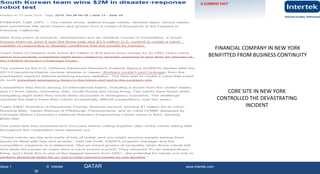
A CURRENT FACT
FINANCIAL COMPANY IN NEW YORK
BENIFITTED FROM BUSINESS CONTINUITY
CORE SITE IN NEW YORK
CONTROLLED THE DEVASTRATING
INCIDENT
Issue 1 © Intertek QATAR www.intertek.com
39
Thank You!
Any Questions !

Business continuity management system overveiw

  • 1.
    Issue 1 ©Intertek QATAR www.intertek.com 1 Welcome to the Seminar on Business ContinuityBusiness Continuity Management SystemManagement System ISO 22301:2012ISO 22301:2012 AN ORIENTATION
  • 2.
    Issue 1 ©Intertek QATAR www.intertek.com 2 Business Continuity issues are of wo types : Incidents disrupting Business for a periodIncidents disrupting Business for a period Incidents disrupting Business for a long timeIncidents disrupting Business for a long time period having very big impact - Catastrophesperiod having very big impact - Catastrophes (Natural disasters)(Natural disasters) Earthquakes, Fire, Volcano eruptions, ETC.
  • 3.
    Issue 1 ©Intertek QATAR www.intertek.com 3 Learning Objectives Upon completion of this presentation, on can: • Understand …… what is BCMS; • Understand …… why BCMS; • Understand ……. Benefits of BCMS; • Focus of Top Management for ISO 22301 preparation November 2015 - QATAR Ver. 1 3
  • 4.
    Issue 1 ©Intertek QATAR www.intertek.com 4 SOME BUSINESS DISRRUPTIONS AND THEIR IMPACTS – indicating the need for BCMS - Videos 1.BLACKBERRY INCIDENT 2. GLOBAL CASES 3. AT&T
  • 5.
    Issue 1 ©Intertek QATAR www.intertek.com 5 Business Continuity issues are of two Categories
  • 6.
    Issue 1 ©Intertek QATAR www.intertek.com 6 WHAT IS NOW NEEDED ? CHALLENGE FOR RECOVERY In REALITY ?
  • 7.
    Issue 1 ©Intertek QATAR www.intertek.com 7 Resumption of Activities 7 Time Performance Normal activity Time to resume activity Time after which irrevocable damage is done to the organization Minimum performance level Time to resume normal levels of operation Normal Activity Incident Objective to resume activity
  • 8.
    Issue 1 ©Intertek QATAR www.intertek.com 8 Business Continuity (BC) is defined as the capability of the organization to continue delivery of products or services at acceptable predefined levels following a disruptive incident. ( Source: ISO 22301:2012) November 2015 - QATAR Ver. 1 8 What is Business Continuity ?
  • 9.
    Issue 1 ©Intertek QATAR www.intertek.com 9 The Business management system can be defined as management process that provides a framework for building capability that safeguards the objectives of the organization including the obligations. Anticipate the probable Risk of Business Continuity Incident (Business Impact analysis – process of analyzing activities that a business disruption might have upon them) Depending upon the length of the severity of interruption, it depends on management’s ability to re-establish of the organization’s functions into minimum acceptable level and then to normalcy.  Business continuity planning (BCP) continually confronts the likelihood or otherwise of an incident. (Risks – Effect of uncertainty of objectives) BCP is the only solution to such unexpected business interruption – proactive management-led incident management program driven by management requirements (Business Continuity Strategy) BUSINESS CONTINUITY MANAGEMENT SYSTEM & Business Continuity Plan (BCP)
  • 10.
    Issue 1 ©Intertek QATAR www.intertek.com 10 BUSINESS CONTINUITY PLAN (BCP) OBJECTIVES  Ensure continuity and survival of the business;Ensure continuity and survival of the business;  Provide protection to corporate assets;Provide protection to corporate assets;  Provide management control of risks and exposures;Provide management control of risks and exposures;  Provide preventative measures where appropriate;Provide preventative measures where appropriate;  Take proactive management control of anyTake proactive management control of any business interruption;business interruption; BCP Provides a balance between acceptable potential losses and acceptable One-time and annual costs. Risk assessment identifies key sources of vulnerabilities having different impacts, and taking pro-active steps in a manner to avoid such incidents. TESTNG OF BCP IS MANDATORY else RECOVERY WOULD BE (Sample Testing is not enough) NEED FOR BCP - Video
  • 11.
    Issue 1 ©Intertek QATAR www.intertek.com 11 ISO 22301:2012
  • 12.
    Issue 1 ©Intertek QATAR www.intertek.com 12 Process Approach and PDCA 12 YourYour ProcessesProcesses PLAN DO CHECKACT Continual Improvement The Plan-Do-Check-Act (PDCA) methodology applies to all processes • Activities • Controls • Documentation • Resources • Objectives • Analyze/review • Decide/change • Improve effectiveness Deploy & conform with plan Measure & monitor for conformity & effectiveness
  • 13.
    Issue 1 ©Intertek QATAR www.intertek.com 13
  • 14.
    Issue 1 ©Intertek QATAR www.intertek.com 14 BIRD’S EYE VIEW OF BUSINESS CONTINUITY MANAGEMENT SYSTEM – KEY ELEMENTS
  • 15.
    Issue 1 ©Intertek QATAR www.intertek.com 15 Process Approach Introduction • Process – set of interrelated or interacting activities that uses resources to transform inputs into outputs • Process Approach – systematically identifies and manages the linkage, combination, and interaction of a system of processes within an organization • ISO 22301 – based on processes needed and their interactions 15
  • 16.
    Issue 1 ©Intertek QATAR www.intertek.com 16 Process Approach Emphasis The process approach emphasizes the importance of: • Understanding and meeting requirements • Looking at processes in terms of added value • Obtaining results of process performance and effectiveness • Use of objective measurements to improve processes 16
  • 17.
    Issue 1 ©Intertek QATAR www.intertek.com 17 Fundamentals of an ISO 22301 BCMS • ISO 22301 –BCMS REQUIREMENT STANDARD – Description, rationale, benefits, application, PDCA – Emphasis on planning • ISO 22313 - BCM GUIDANCE STANDARDS - in line with ISO 31000 • Business Continuity Institute – good practice guidelines 17
  • 18.
    Issue 1 ©Intertek QATAR www.intertek.com 18 Purpose of ISO 22301 • Applies to any type or size organization in any industry or sector • Tried and tested framework for a systematic approach • Provides a framework to meet customer, internal and statutory and regulatory requirements • Sets standardized requirements for business continuity • Model for consistently meeting business needs despite disruptions • Basis for certification that specified requirements are met 18
  • 19.
    Issue 1 ©Intertek QATAR www.intertek.com 19 19 An ISO 22301 BCMS in Practice • Requires internal audits • Verifies effective management • Ensures organization is fully in control of its activities • Fosters customer confidence • Allows engaging a certification body to obtain certificate of conformity • Provides, via certification, the credibility of an independent assessment • Provides a system that adds value ISO 22301 states what must be done; a properly documented BCMS describes how required processes are to be done. 19
  • 20.
    Issue 1 ©Intertek QATAR www.intertek.com 20 Key Business Continuity Terms • Business Impact Analysis • Risk Appetite • Risk Assessment • BCM program & plan • BCM response • Activity • Critical activities • Exercise & Testing • Incident management plan • BCP Invocation • Recovery Time Objective (RTO) • Maximum Allowable Time of Disruption (MAO) 20
  • 21.
    Issue 1 ©Intertek QATAR www.intertek.com 21
  • 22.
    Issue 1 ©Intertek QATAR www.intertek.com 22 Impact can be quantitative or qualitative: • Loss of key personnel • Loss of physical assets • Loss of information • Disruption of service • Violation of law, penalties • Brand image, reputation, credibility • Financial/revenue • Customers, suppliers, partners (External Interested Prties) • Environmental/H&S 22 Impact Analysis
  • 23.
    Issue 1 ©Intertek QATAR www.intertek.com 23 RISK APPITITE – Further Explanations
  • 24.
    Issue 1 ©Intertek QATAR www.intertek.com 24 RESILIENT – Further Explanation
  • 25.
    Issue 1 ©Intertek QATAR www.intertek.com 25 RECOVERY TIME OBJECTIVE (RTO) & MAXIMUM TIME OF DISRRUPTION FROM ZERO LEVEL RTO MAO
  • 26.
    Issue 1 ©Intertek QATAR www.intertek.com 26 MAO RTO RECOVERY TIME OBJECTIVE (RTO) & MAXIMUM TIME OF DISRRUPTION FROM REDUNDANCY LEVEL
  • 27.
    Issue 1 ©Intertek QATAR www.intertek.com 27 Interested Parties – ISO 22313:2010 27
  • 28.
    Issue 1 ©Intertek QATAR www.intertek.com 28 A 1 10 J B 2 11 K C 3 12 L D 4 13 M E 5 14 N F 6 15 O G 7 16 P H 8 17 Q I 9 18 R EXTERNAL INTERESTED PARTIES EXTERNAL INTERESTED PARTIES INTERNAL INTERESTED PARTIES Step 1> Identifying Interested parties as per Scope of BCMS
  • 29.
    Issue 1 ©Intertek QATAR www.intertek.com 29 INTERESTED PARTIES BUSINESS RELATIONSHIPS KEY PROCESSES / ACTIVITY BUSINESS IMPACT w.r.t. LOSS OF $ IN THE TIME FRAME, IF THE PROCESS IS NOT AVAILABLE RTO < 5 DAYS 5 – 15 DAYS 15 DAYS – 30 DAYS RISK APPIITE (Time / $ Loss) DESIGN COMPANY AS A VENDOR OUTSOURCING OF DESIGN OF BUSINESS APPLICTION AS PER PREDEFINED SCOPE 1. DESIGN & DEVELOPMENT NO ISSUE NOT ACCEPTABLE (Activate Redundancy) NOT ACCEPTABLE (Activate BCP) MAO = 30 DAYS MAX. 15 DYS OR < USD 50,000 4 Days2. VERIFICATION AND VALIDATION NOT ACCEPTABLE (Activate Redundancy) 3. DESIGN CHANGE INTERESTED PARTIES BUSINESS RELATIONSHIP S KEY PROCESSES / ACTIVITY BUSINESS IMPACT w.r.t. LOSS OF $ IN THE TIME FRAME, IF THE PROCESS IS NOT AVAILABLE RTO < 30 MINUTES 30 Minutes to 1 Hour DAYS > 1 hour RISK APPIITE (Time / $ Loss) NET WORK VENDOR PROVIDING NETWORK FOR THE ONLINE SHOPPING SITE COMPANY 1. POWER SUPPLY FOR TELECOM EQUIMENT ON TOWERS NO ISSUE (Activate Redundancy) NOT ACCEPTABLE (Activate BCP) NOT ACCEPTABLE (Activate BCP) MAO = 1 hour MAX. 15 DYS OR < USD 5,000 15 Minutes2. NETWORK CAPACITY NOT ACCEPTABLE (Activate Redundancy)3. NETWORK SECURITY ASPECT (SOC) BUSINESS IMPACT ANALYSIS - Samples THIS SHALL HELP IN PRIORITISING THE RISKS BASED ON SEVERITY OF THE IMPACT ON BUSINESS BASED ON THE KEY ASPECT SAY > $ or TIME
  • 30.
    Issue 1 ©Intertek QATAR www.intertek.com 30 Approaches to Business Impact Analysis (BIA) • There is no single “right” way to conduct a BIA • Any method that satisfies 8.2 is acceptable • The BIA method may offer either – One BIA technique for universal use – A selection of techniques together with guidance on selecting one appropriate to the needs of specific activities (e.g. a BIA technique suited to HR activities may not be equally suitable for IT or H&S) • Following slides illustrate a variety of BIA techniques 30
  • 31.
    Issue 1 ©Intertek QATAR www.intertek.com 31 BIA Report – Example Headings • Executive Summary • BIA Method Summary • BIA by Department / Process – Operations – R&D – Finance – Sales & Marketing – HR – Vendor Management – Compliance and Risk • Summary of Critical Activities and Impacts 31 Analyses impact of disruption of critical activities that support key products and services which, themselves, are of course cross-functional
  • 32.
    Issue 1 ©Intertek QATAR www.intertek.com 32 Identify Risks and Opportunities • Implementation of a BCMS assists in providing controls to mitigate risks • Ensure review of risks and opportunities when assessing your current system and performing a gap analysis • Determine appropriate risk and opportunity treatments You may find these useful: • ISO 31000:2009, Risk management – Principles and guidelines • ISO/IEC 31010:2009, Risk management – Risk assessment techniques 32
  • 33.
    Issue 1 ©Intertek QATAR www.intertek.com 33 RISKLEVEL HIGH / 71 - 100 Medium / 41 - 70 Low / 1 - 40 RISK MITIGATION ( Risk Reduction ) Risk Mitigation – Implemeting Controls for Risk Reduction No matter which ever controls implemented, following are the facts: 1. Shall definitely bring down the risk of C, I & A – till the time control is effective; 2. What ever control – risk cannot be brought to ZERO – can only reduce the risk; 3. In IT, controls can reduce the “PROBABILITY” only; 4. Residual risks shall always be there – one must remember 24x7;
  • 34.
    Issue 1 ©Intertek QATAR www.intertek.com 34 BUSINESS CONTINUITY PLAN - VIDEO BUSINESS CONTINUTIY PLANS – as per anticipated risks Take away > Redundancy is the SECTRET OF SUCCESS OF BUSINESS CONTINUITY PLANS
  • 35.
    Issue 1 ©Intertek QATAR www.intertek.com 35 BIRD’S EYE VIEW OF BCMS
  • 36.
    Issue 1 ©Intertek QATAR www.intertek.com 36 Critical BC Focus Aspects of Organization (anticipate maximum disruptions) All Single Point of Failures [No Redundancies] Residual Risks Identified in Risk Assessments [after considering all the controls]  Unknown causes of redundancy failures  No actions taken on BC Testing failures  Unknown / Ignored Risks
  • 37.
    Issue 1 ©Intertek QATAR www.intertek.com 37 1. Realization for the need to implement BCMS 2. Think and understand and realise the need of BCMS 3. Accept the need for BCMS 4. Attempt to learn how to do BCMS 5. Learn the BCMS Concept and Start BCMS 6. Create Base line of BCMS 7. Implement & Test BCMS – understand Residual Risk 8. Perform Internal Audits & Management Reviews 9. Implement Corrective Actions 10.Get Audited and get Certified towards ISO 22301:2012 Realization of the Need to Implement BCMS (ISO 22301:2012) and get Certified
  • 38.
    Issue 1 ©Intertek QATAR www.intertek.com 38 A CURRENT FACT FINANCIAL COMPANY IN NEW YORK BENIFITTED FROM BUSINESS CONTINUITY CORE SITE IN NEW YORK CONTROLLED THE DEVASTRATING INCIDENT
  • 39.
    Issue 1 ©Intertek QATAR www.intertek.com 39 Thank You! Any Questions !

Editor's Notes

  • #8 Note self-running animation The real issue for organizations is meeting minimum level of service. If this is met before ‘Objective to resume activity’ then fine and the irrevocable damage is irrelevant. The problems start when the organization does not meet the ‘Objective to resume activity’. Provided they reach the minimum level of service before they reach the irrevocable damage time that is acceptable. What is disastrous is when they – in theory – do not meet the ‘Objective to resume activity’ OR the irrevocable time. This basically means they are dead in the water so to speak. ISO 22301 Clause 8.2.2.c specifically asks for both of these times to be considered. Note that while this diagram demonstrates a sudden disruption, it is also possible for gradual disruptions to occur (e.g. an outbreak of flu that gradually reduces workforces, slowly-increasing regional flooding, reduction in availability/price of fuel oils/gasoline). Also note that this is an idealized graphical representation, and where on a timeline and at what level acceptable production/service is positioned is dependent on the organization&amp;apos;s own BIA.
  • #13 The process approach also emphasizes the importance of: Understanding and meeting requirements Looking at processes in terms of added value Obtaining results of process performance Continual improvement of processes Walk participants through an example most appropriate for the culture (making beer, making tea, making coffee – something everyone can relate to and all will know the steps to complete the process)
  • #16 Note Animation
  • #21 As a follow-up to the exercise on definitions, you may have participants provide definitions for the terms on this slide, or just point out to them that they are some key terms and perhaps discuss some of them.
  • #28 The Organization includes: Management Top Management Those accountable for BCM policy and its implementation Those who implement and maintain the BCMS Those who maintain BC procedures Owners of BC procedures Incident Response Staff Those with responsibility to invoke Assigned Spokespeople Response Teams Other Staff Contractors
  • #33 One of the main drivers for the introduction of a management system should be to provide controls that will help to mitigate the risks that all organizations have to deal with on a day to day basis. These risks can have both a positive and negative effect on an organization, so it is worth finding out where those risks are, and then deciding what controls are required and reducing the risks as much as is financially appropriate i.e. there is no point spending large amounts on a risk if the impact of that risk is small. Likewise, a competitor going out of business could be an opportunity but could also be a risk if the organization’s own customers suffer due to the increased pressure placed on the organization of more customers! ISO 9001 does not make reference to a specific Risk Management standard. If an organization does not already practice a standard form of Risk Management or Risk Assessment, the following might be of use: ISO 31000:2009 Risk management – Principles and guidelines ISO/IEC 31010:2009 Risk management – Risk assessment techniques ISO Guide 73:2009 Risk management – Vocabulary