The Business Continuity Institute
The Good Practice Guidelines – Real life
          Implementations


         Muhammad Ghazali
MBCI, CBCI, ISMS ISO 27001LA, BS25999 LA
   Associate Director – Head of BCM Service
       Protiviti Member firm Middle East
The Good Practice Guidelines

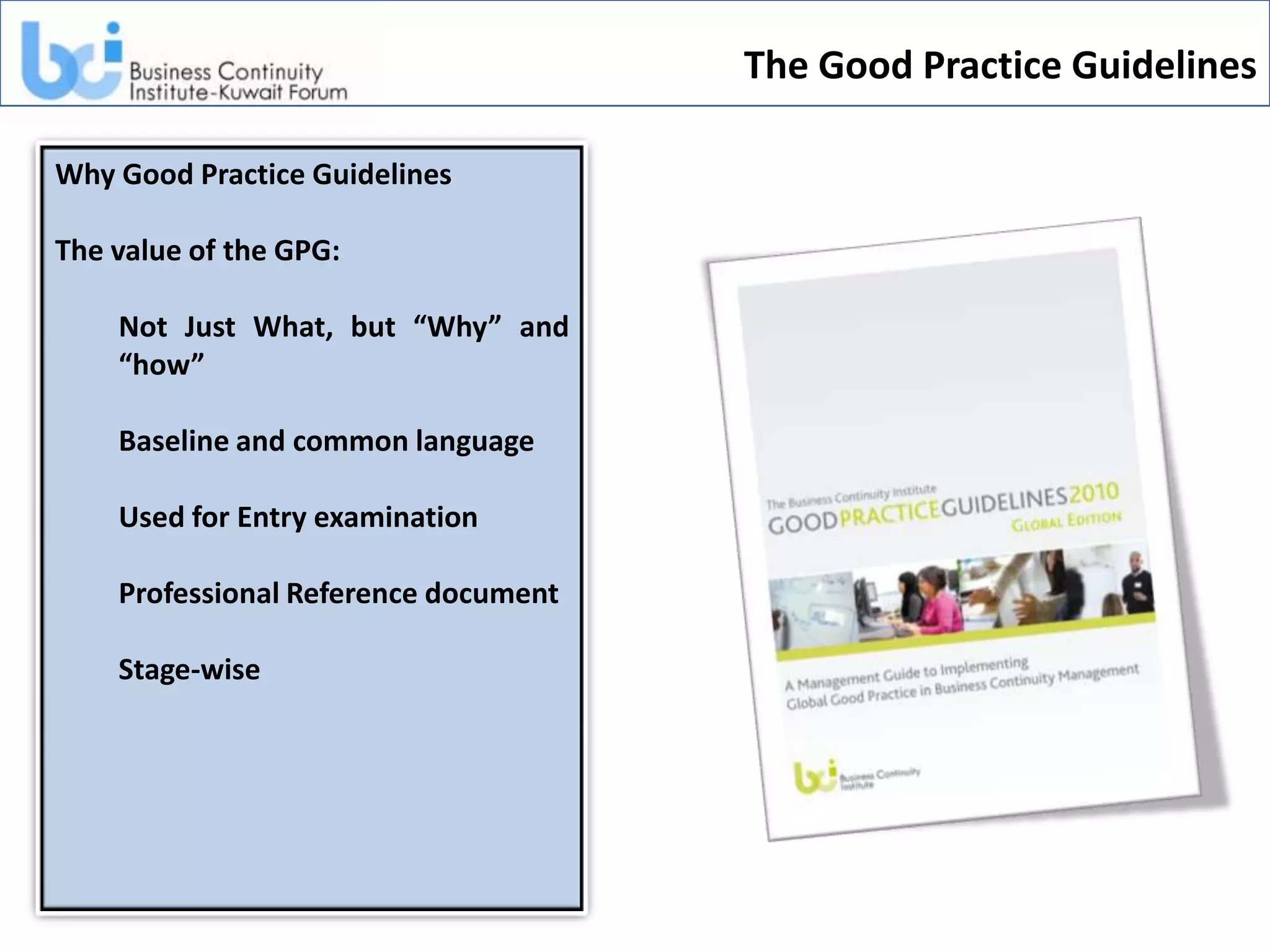
Why Good Practice Guidelines

The value of the GPG:

    Not Just What, but “Why” and
    “how”

    Baseline and common language

    Used for Entry examination

    Professional Reference document

    Stage-wise
The Good Practice Guidelines


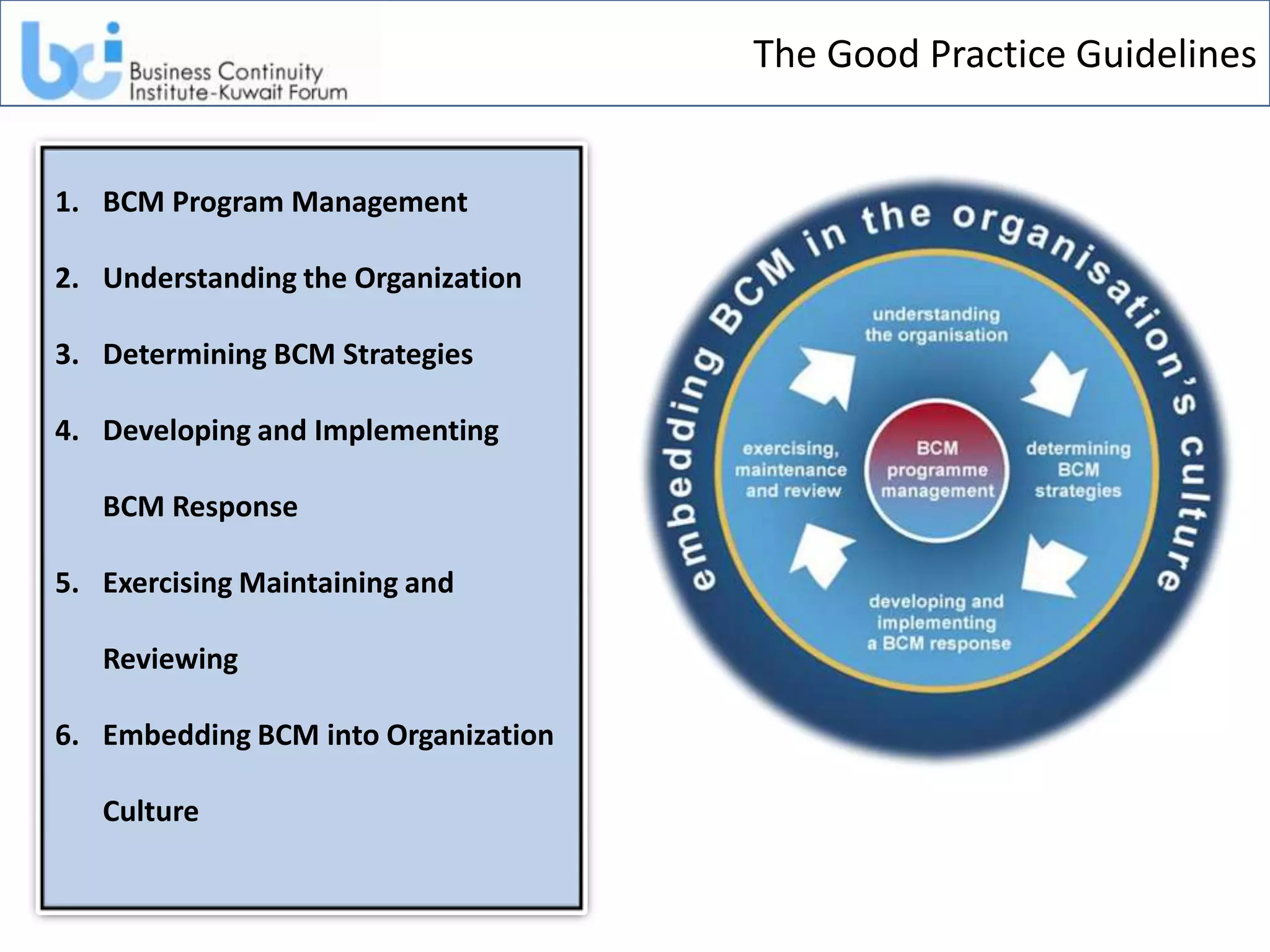
1. BCM Program Management

2. Understanding the Organization

3. Determining BCM Strategies

4. Developing and Implementing

   BCM Response

5. Exercising Maintaining and

   Reviewing

6. Embedding BCM into Organization

   Culture
BCM Program Management


                        What                                            Why
1.   Develop the BCM Program
                                                        Objectives, Mission, Vision, Key
2.   Identification of owner/member and
                                                        Service, Product, future strategy,
     participants of Program
                                                        acquisitions, geographical scale,
3.   Development of BCM Policy of the organization
                                                        competitor strategy, regulatory
4.   Identification of inclusion and exclusion of the
                                                        obligation etc. etc..
     BCM Program
                                                                        How
5. Define and approve the scope of the program
                                                        Involve the Top Management
Examples:
                                                        team
         BCM Head – That’s probably you…
                                                        Review documents produced by
         BCM Steering Committee -Management
                                                        the organization
         BCM Roles – Strategic, Tactical and
                                                        • Business plans
         Operational
                                                        • Strategic plans
         BCM Forum – Selected team members
                                                        • Annual report
                                                        • Marketing report
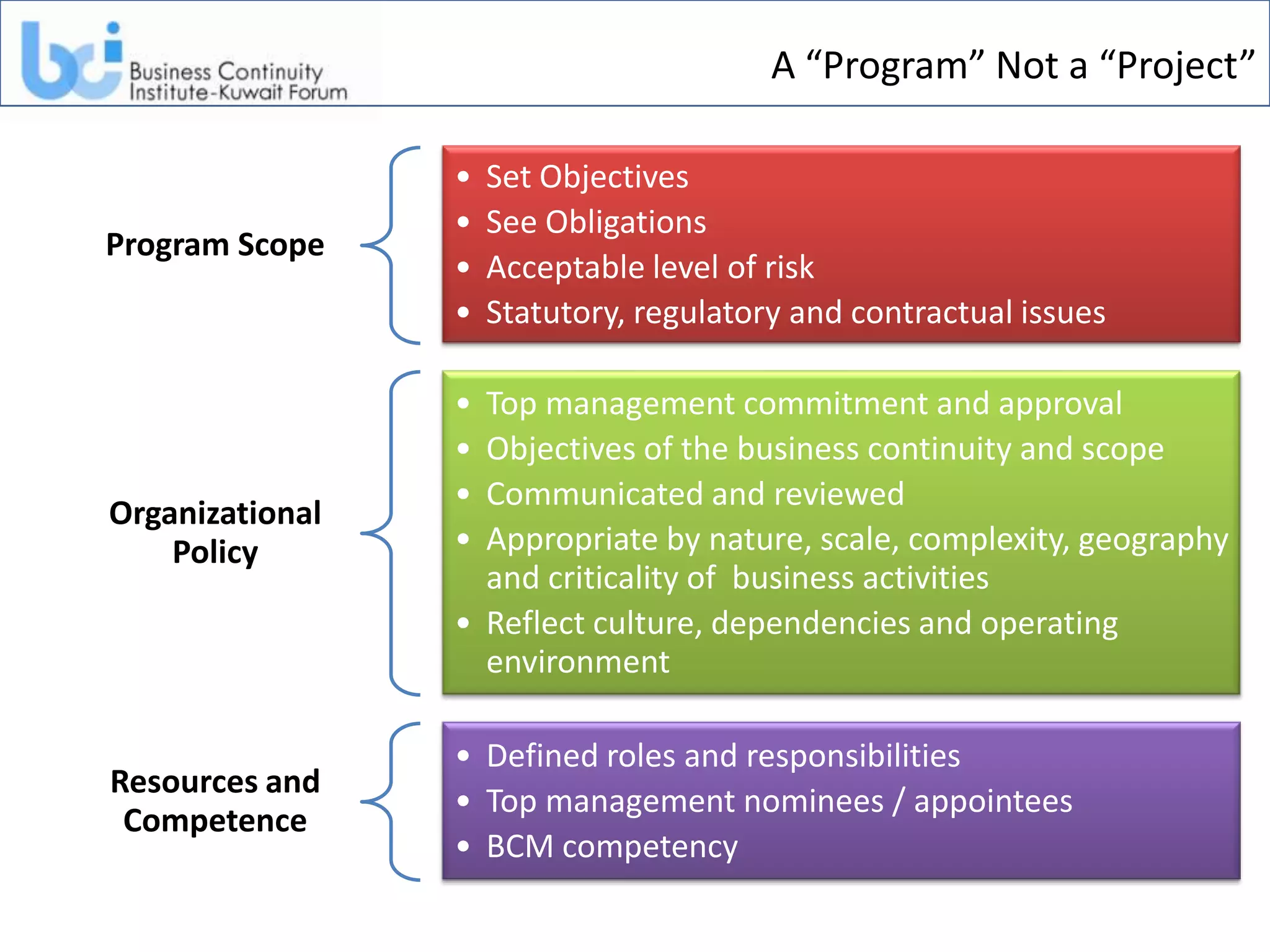
A “Program” Not a “Project”

                 •   Set Objectives
                 •   See Obligations
Program Scope
                 •   Acceptable level of risk
                 •   Statutory, regulatory and contractual issues

                 • Top management commitment and approval
                 • Objectives of the business continuity and scope
                 • Communicated and reviewed
Organizational
    Policy       • Appropriate by nature, scale, complexity, geography
                   and criticality of business activities
                 • Reflect culture, dependencies and operating
                   environment

                 • Defined roles and responsibilities
Resources and
                 • Top management nominees / appointees
 Competence
                 • BCM competency
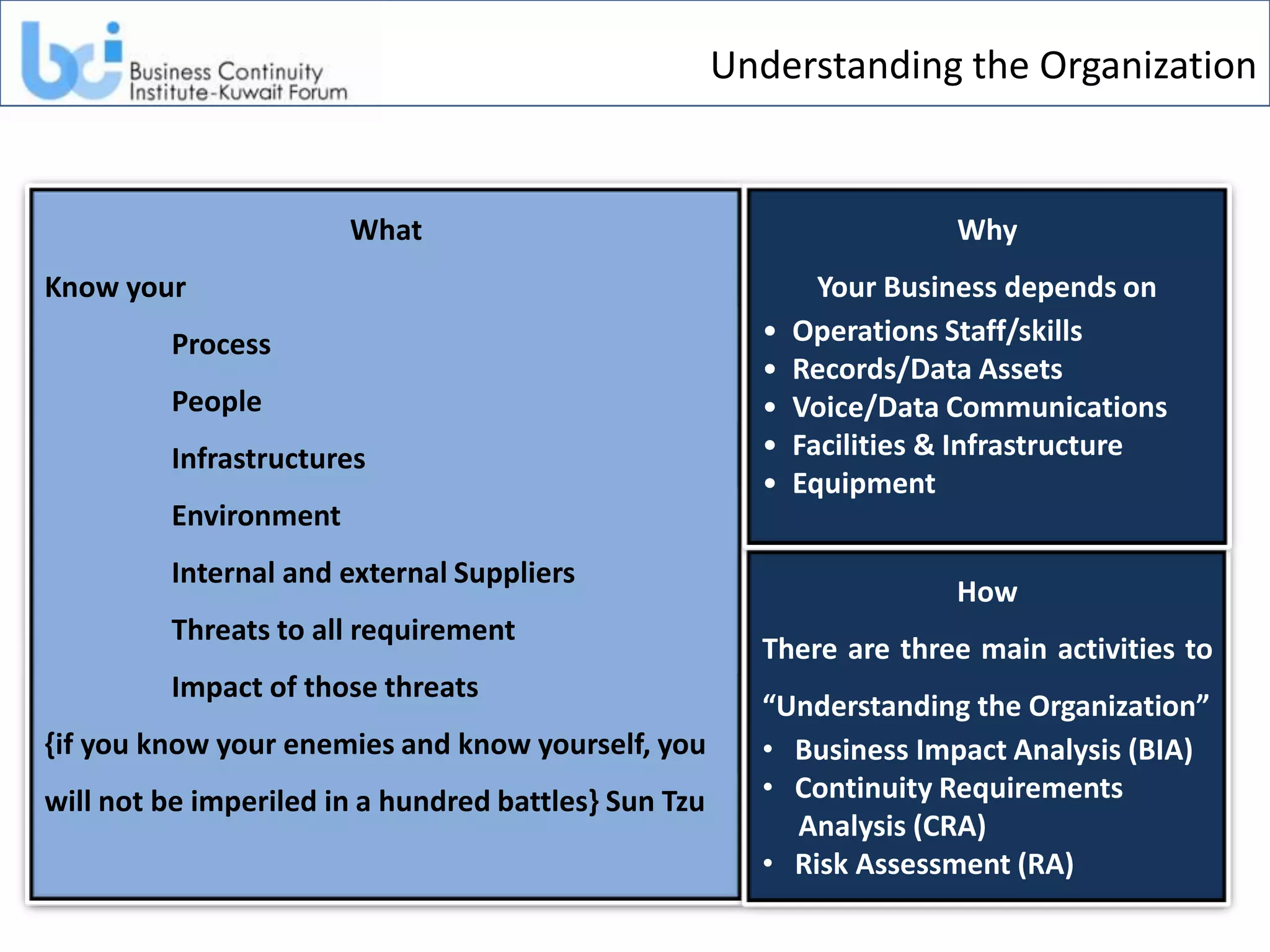
Understanding the Organization


                       What                                            Why
Know your                                                     Your Business depends on
         Process                                        •   Operations Staff/skills
                                                        •   Records/Data Assets
         People                                         •   Voice/Data Communications
         Infrastructures                                •   Facilities & Infrastructure
                                                        •   Equipment
         Environment
         Internal and external Suppliers
                                                                       How
         Threats to all requirement
                                                        There are three main activities to
         Impact of those threats
                                                        “Understanding the Organization”
{if you know your enemies and know yourself, you        • Business Impact Analysis (BIA)
will not be imperiled in a hundred battles} Sun Tzu     • Continuity Requirements
                                                          Analysis (CRA)
                                                        • Risk Assessment (RA)
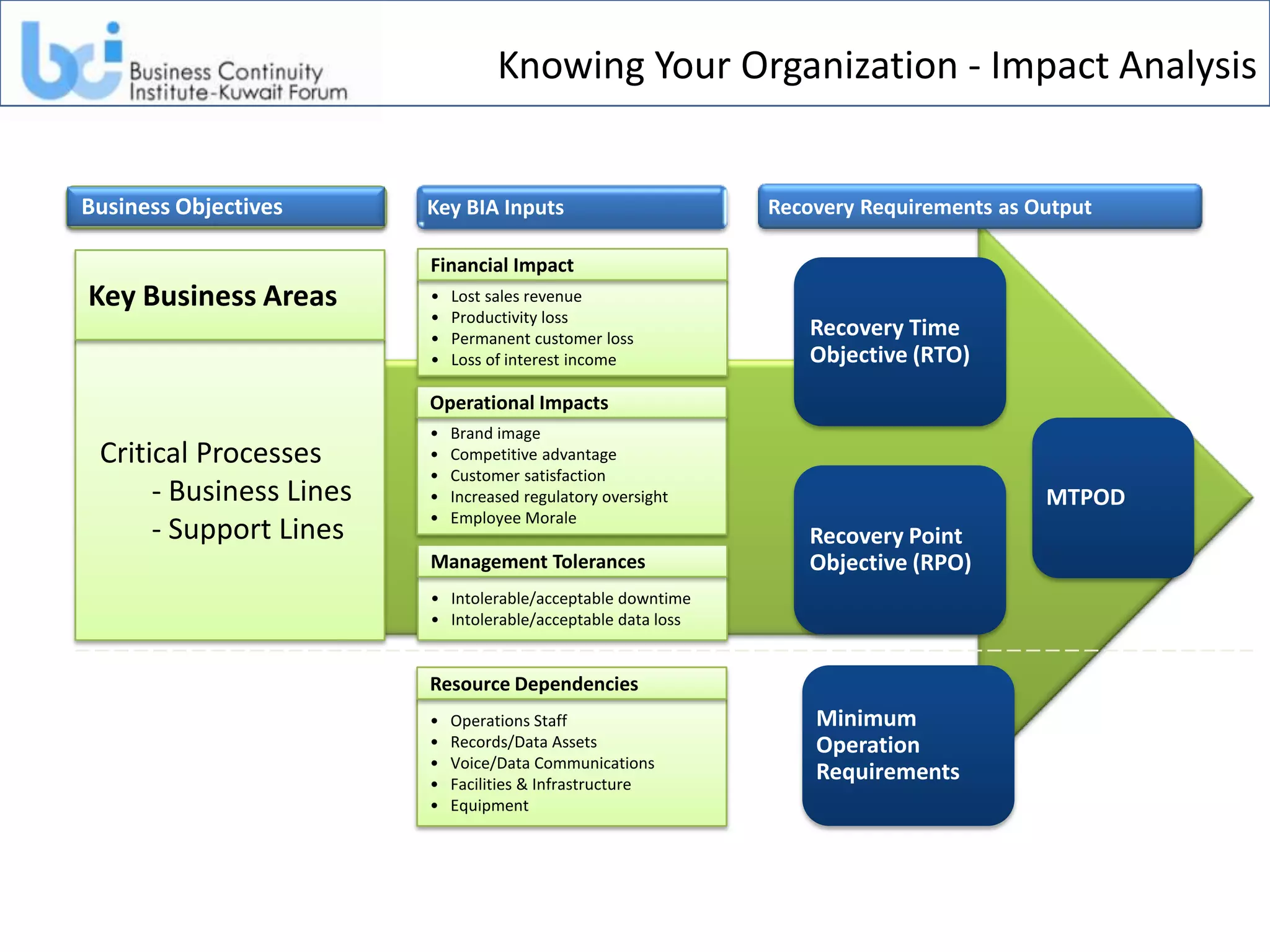
Knowing Your Organization - Impact Analysis


Business Objectives      Key BIA Inputs                       Recovery Requirements as Output

                         Financial Impact
Key Business Areas       •   Lost sales revenue
                         •   Productivity loss
                         •   Permanent customer loss
                                                                  Recovery Time
                         •   Loss of interest income              Objective (RTO)
                         Operational Impacts
                         •   Brand image
 Critical Processes      •   Competitive advantage
                         •   Customer satisfaction
      - Business Lines   •   Increased regulatory oversight                             MTPOD
                         •   Employee Morale
      - Support Lines                                            Recovery Point
                         Management Tolerances                   Objective (RPO)
                         • Intolerable/acceptable downtime
                         • Intolerable/acceptable data loss


                         Resource Dependencies
                         •   Operations Staff                     Minimum
                         •   Records/Data Assets                  Operation
                         •   Voice/Data Communications
                         •   Facilities & Infrastructure
                                                                  Requirements
                         •   Equipment
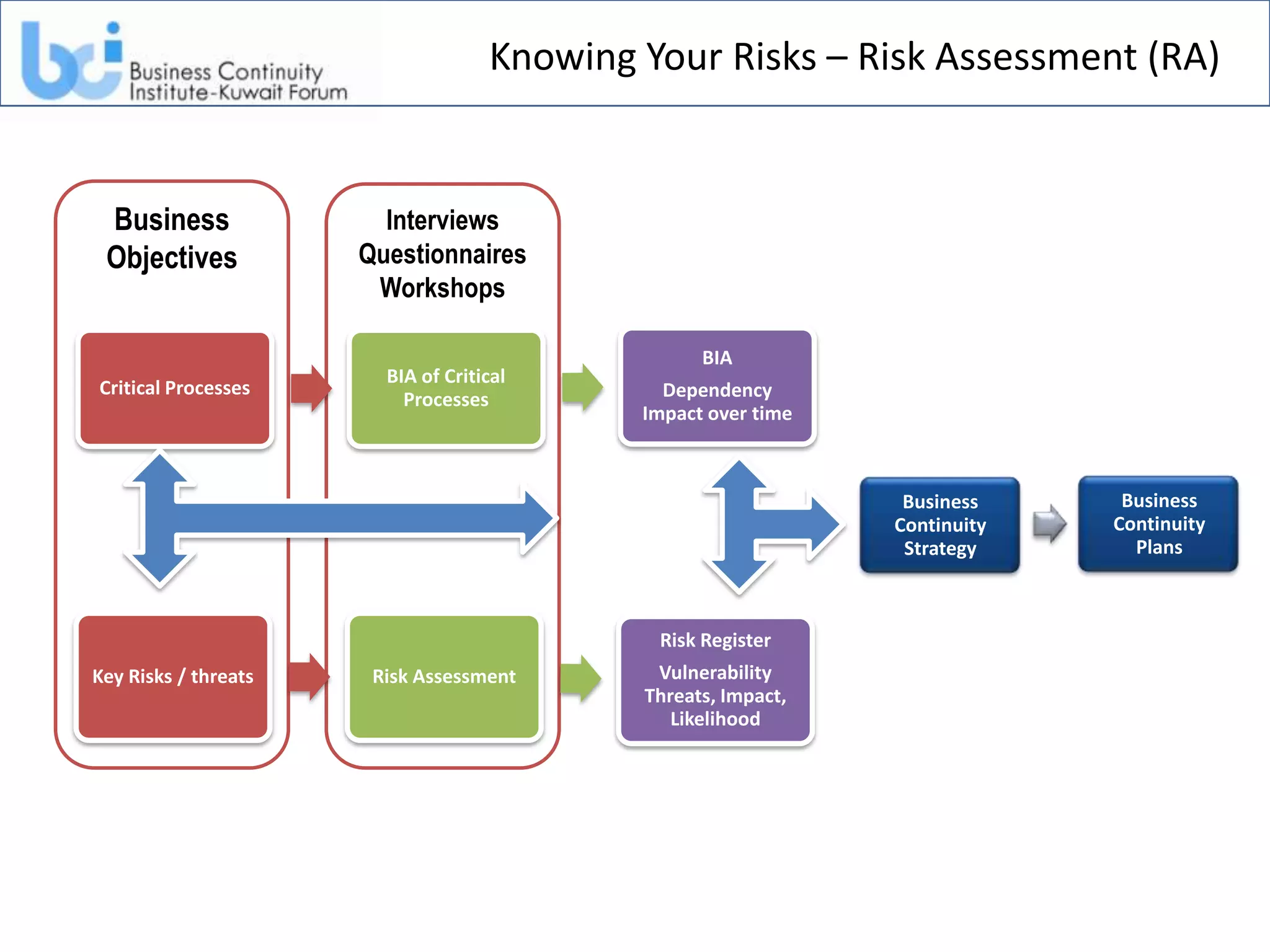
Knowing Your Risks – Risk Assessment (RA)


 Business               Interviews
 Objectives           Questionnaires
                       Workshops

                                                  BIA
                        BIA of Critical
Critical Processes                            Dependency
                          Processes
                                            Impact over time


                                                                Business     Business
                                                               Continuity   Continuity
                                                                Strategy      Plans


                                             Risk Register
Key Risks / threats    Risk Assessment       Vulnerability
                                            Threats, Impact,
                                               Likelihood
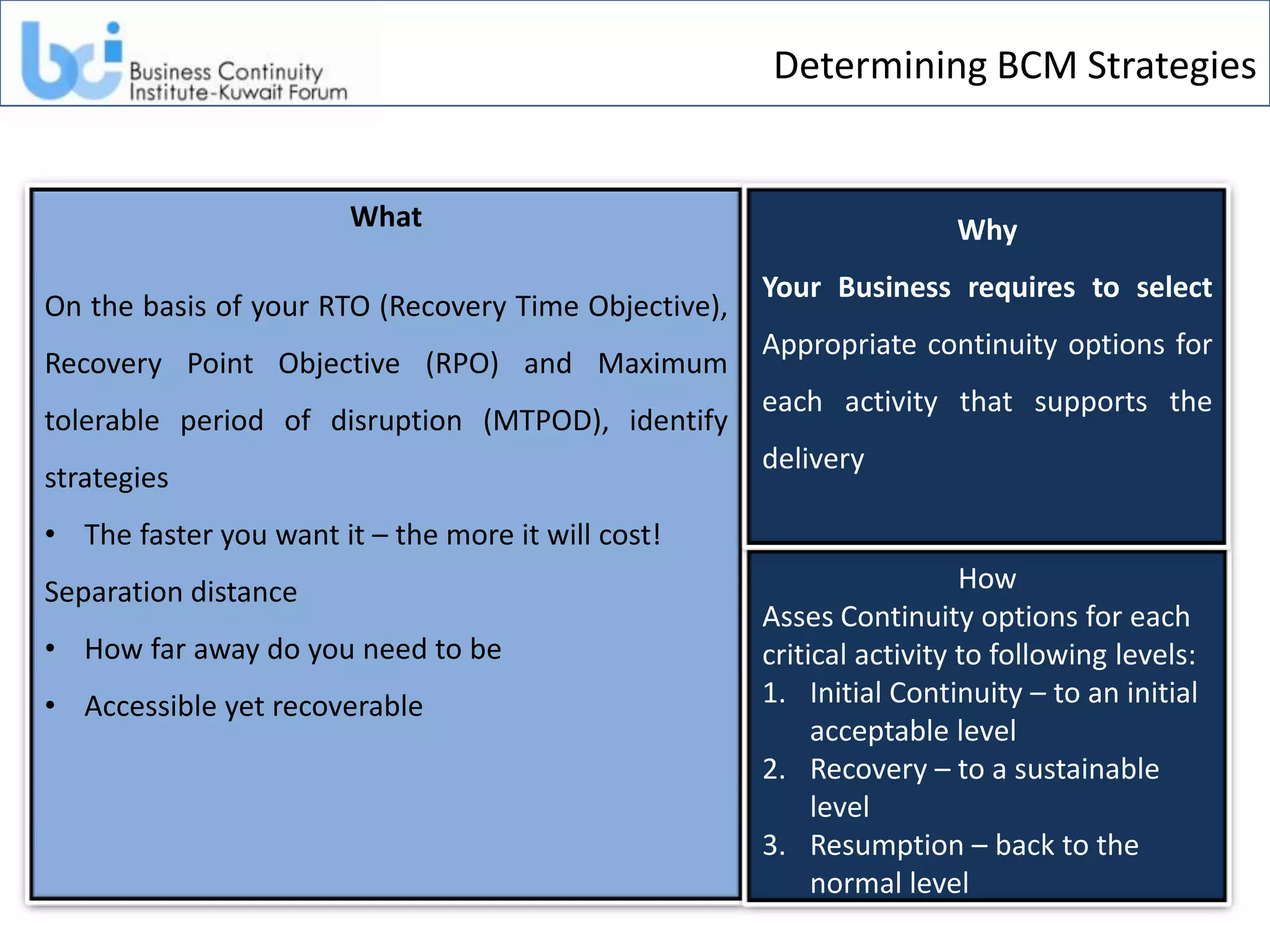
Determining BCM Strategies


                        What                                          Why
                                                      Your Business requires to select
On the basis of your RTO (Recovery Time Objective),
                                                      Appropriate continuity options for
Recovery Point Objective (RPO) and Maximum
                                                      each activity that supports the
tolerable period of disruption (MTPOD), identify
                                                      delivery
strategies
• The faster you want it – the more it will cost!
Separation distance                                                     How
                                                      Asses Continuity options for each
• How far away do you need to be                      critical activity to following levels:
• Accessible yet recoverable                          1. Initial Continuity – to an initial
                                                           acceptable level
                                                      2. Recovery – to a sustainable
                                                           level
                                                      3. Resumption – back to the
                                                           normal level
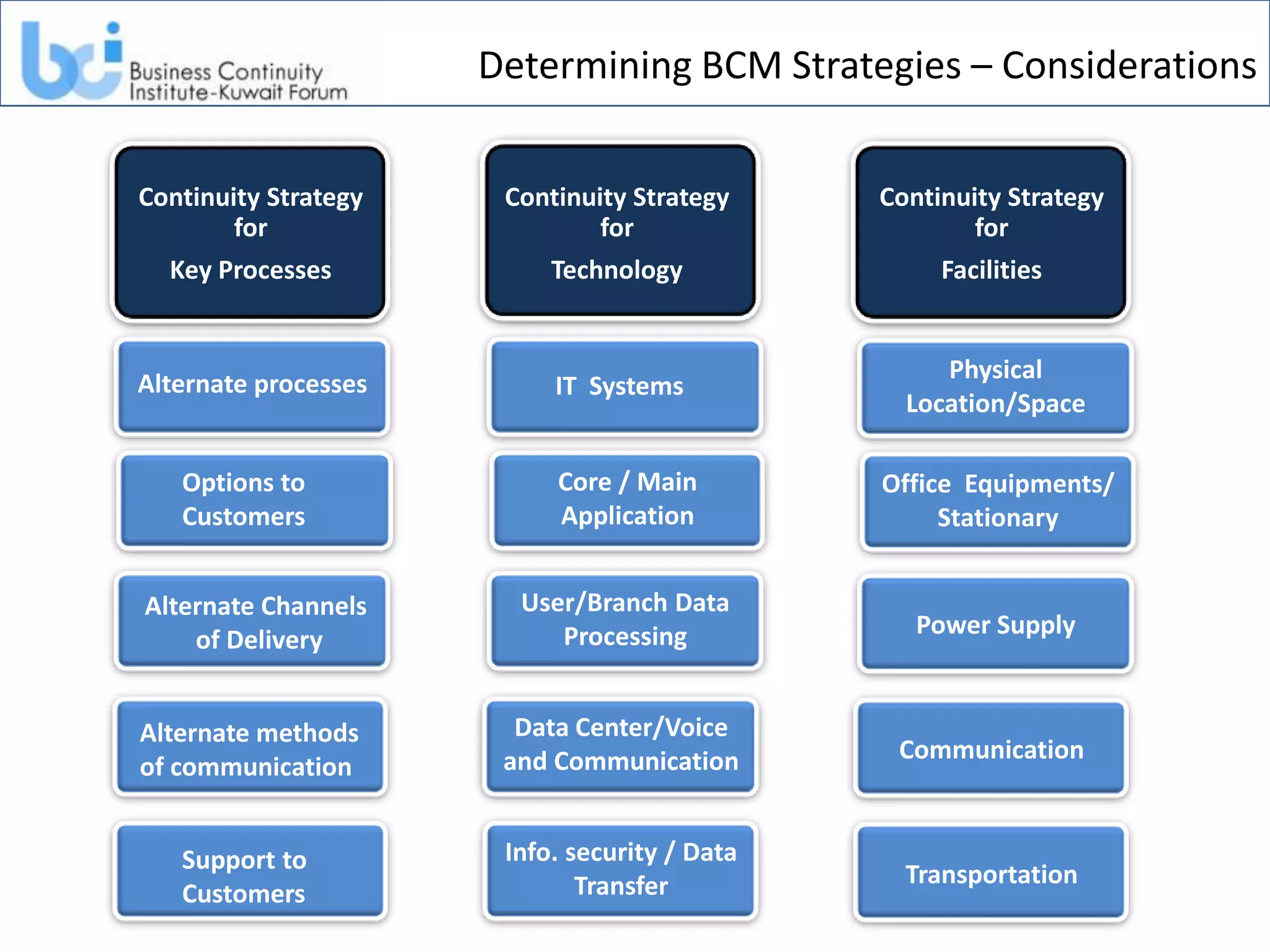
Determining BCM Strategies – Considerations


Continuity Strategy    Continuity Strategy     Continuity Strategy
        for                    for                     for
  Key Processes            Technology               Facilities


                                                    Physical
Alternate processes        IT Systems
                                                 Location/Space

   Options to              Core / Main         Office Equipments/
   Customers               Application              Stationary


Alternate Channels      User/Branch Data
                           Processing             Power Supply
    of Delivery


Alternate methods       Data Center/Voice
                       and Communication        Communication
of communication


   Support to          Info. security / Data
                              Transfer           Transportation
   Customers
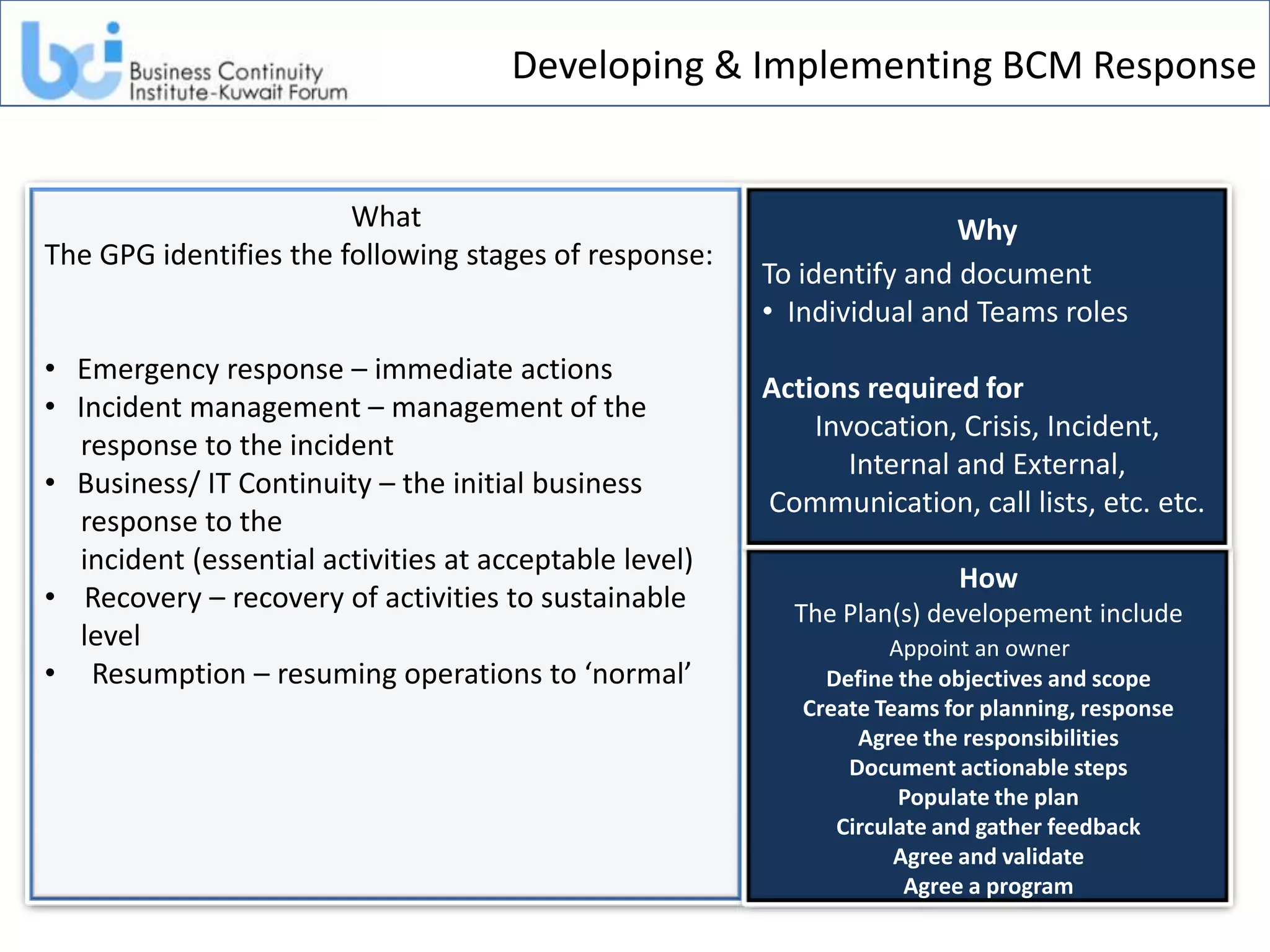
Developing & Implementing BCM Response


                        What                                            Why
The GPG identifies the following stages of response:
                                                        To identify and document
                                                        • Individual and Teams roles
• Emergency response – immediate actions
                                                        Actions required for
• Incident management – management of the
                                                            Invocation, Crisis, Incident,
  response to the incident
                                                               Internal and External,
• Business/ IT Continuity – the initial business
                                                        Communication, call lists, etc. etc.
  response to the
  incident (essential activities at acceptable level)
                                                                         How
• Recovery – recovery of activities to sustainable        The Plan(s) developement include
  level                                                            Appoint an owner
• Resumption – resuming operations to ‘normal’               Define the objectives and scope
                                                           Create Teams for planning, response
                                                                Agree the responsibilities
                                                               Document actionable steps
                                                                    Populate the plan
                                                              Circulate and gather feedback
                                                                    Agree and validate
                                                                     Agree a program
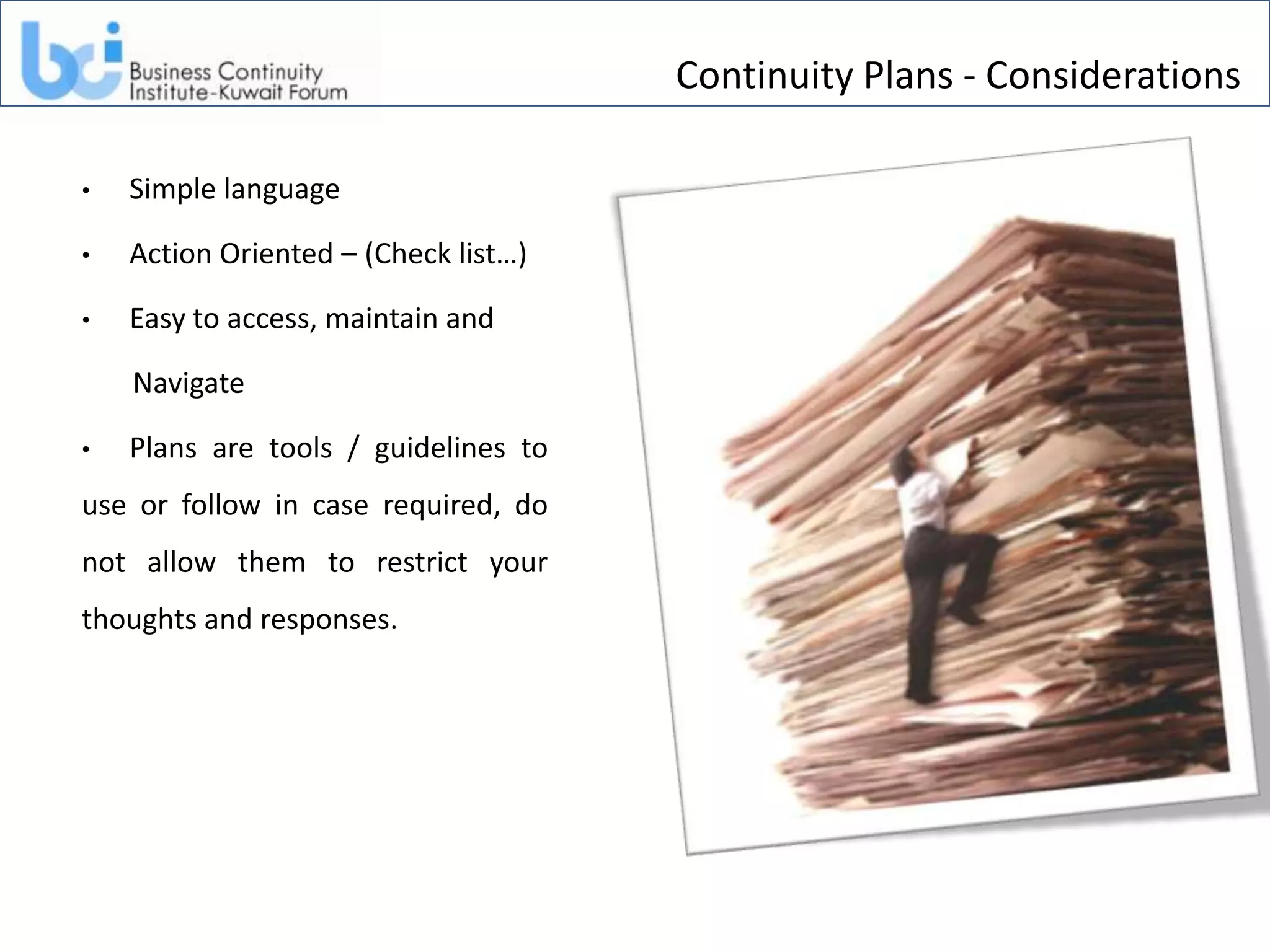
Continuity Plans - Considerations

•   Simple language

•   Action Oriented – (Check list…)

•   Easy to access, maintain and

    Navigate

•   Plans are tools / guidelines to
use or follow in case required, do
not allow them to restrict your
thoughts and responses.
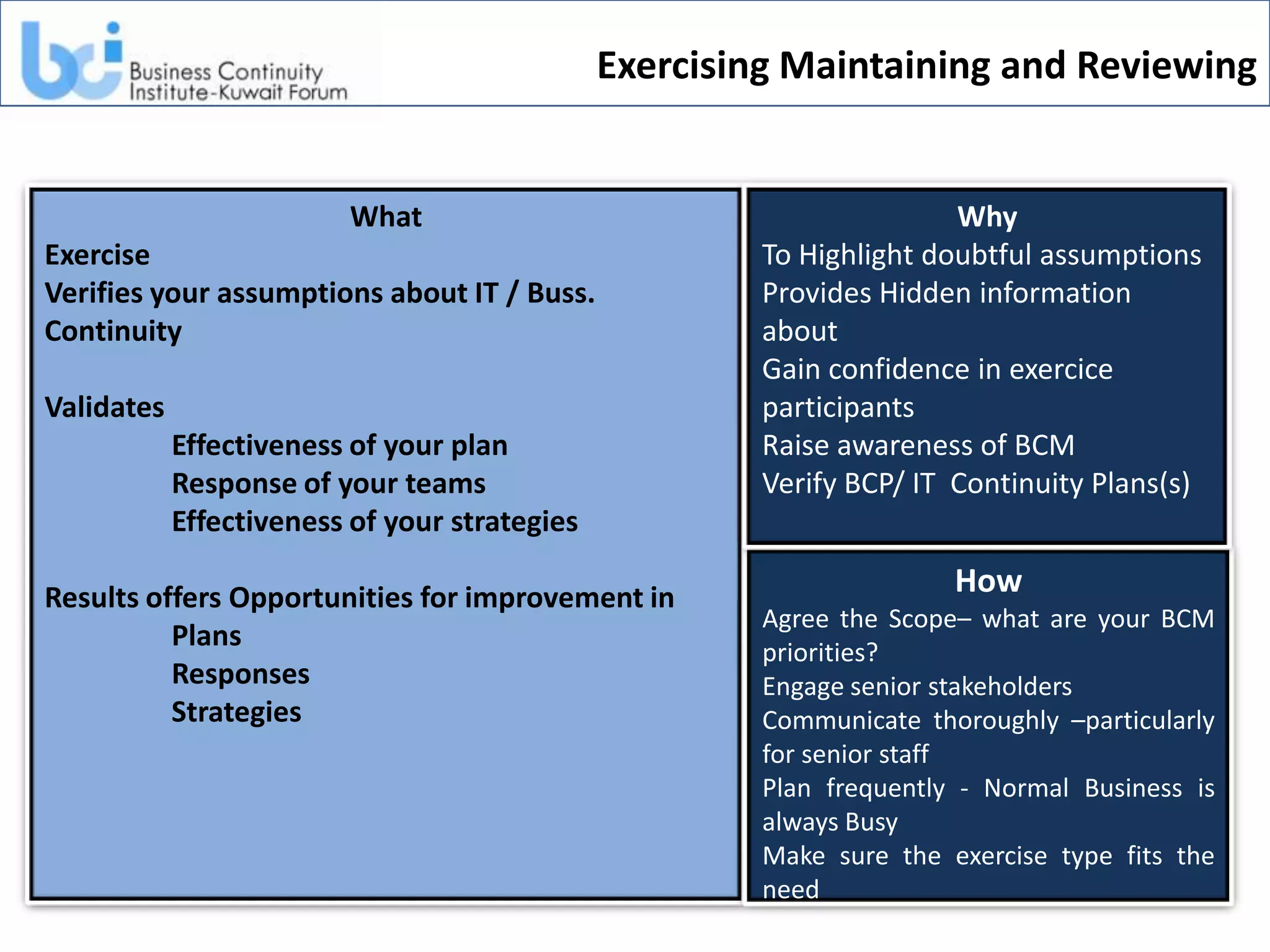
Exercising Maintaining and Reviewing


                          What                                         Why
Exercise                                                To Highlight doubtful assumptions
Verifies your assumptions about IT / Buss.              Provides Hidden information
Continuity                                              about
                                                        Gain confidence in exercice
Validates                                               participants
            Effectiveness of your plan                  Raise awareness of BCM
            Response of your teams                      Verify BCP/ IT Continuity Plans(s)
            Effectiveness of your strategies

Results offers Opportunities for improvement in                        How
                                                        Agree the Scope– what are your BCM
          Plans                                         priorities?
          Responses                                     Engage senior stakeholders
          Strategies                                    Communicate thoroughly –particularly
                                                        for senior staff
                                                        Plan frequently - Normal Business is
                                                        always Busy
                                                        Make sure the exercise type fits the
                                                        need
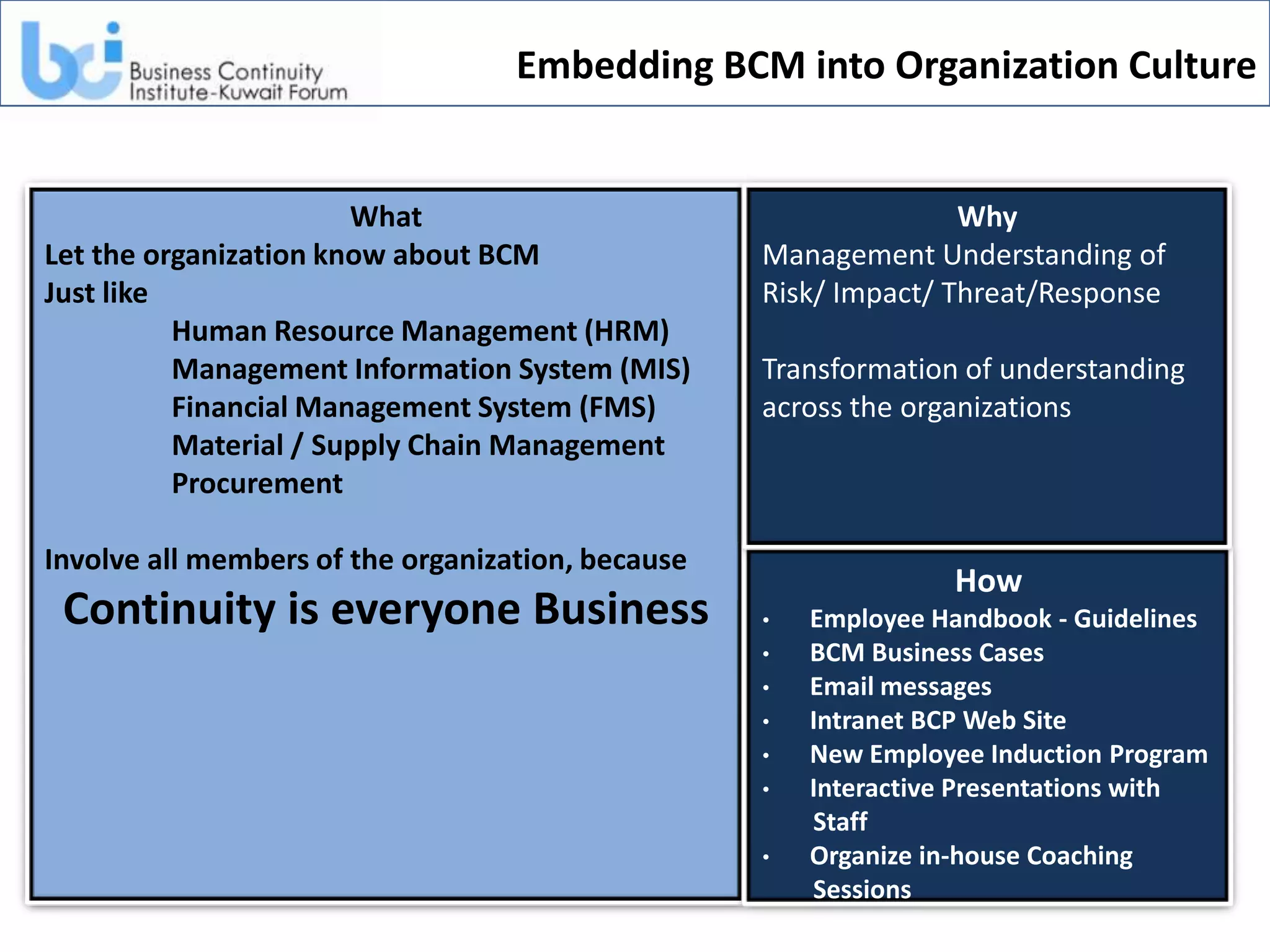
Embedding BCM into Organization Culture


                       What                                       Why
Let the organization know about BCM                Management Understanding of
Just like                                          Risk/ Impact/ Threat/Response
          Human Resource Management (HRM)
          Management Information System (MIS)      Transformation of understanding
          Financial Management System (FMS)        across the organizations
          Material / Supply Chain Management
          Procurement

Involve all members of the organization, because
                                                                 How
 Continuity is everyone Business                   •   Employee Handbook - Guidelines
                                                   •   BCM Business Cases
                                                   •   Email messages
                                                   •   Intranet BCP Web Site
                                                   •   New Employee Induction Program
                                                   •   Interactive Presentations with
                                                       Staff
                                                   •   Organize in-house Coaching
                                                       Sessions
Bci gpg2011-kwt-111214121300-phpapp02

Bci gpg2011-kwt-111214121300-phpapp02

  • 1.
    The Business ContinuityInstitute The Good Practice Guidelines – Real life Implementations Muhammad Ghazali MBCI, CBCI, ISMS ISO 27001LA, BS25999 LA Associate Director – Head of BCM Service Protiviti Member firm Middle East
  • 2.
    The Good PracticeGuidelines Why Good Practice Guidelines The value of the GPG: Not Just What, but “Why” and “how” Baseline and common language Used for Entry examination Professional Reference document Stage-wise
  • 3.
    The Good PracticeGuidelines 1. BCM Program Management 2. Understanding the Organization 3. Determining BCM Strategies 4. Developing and Implementing BCM Response 5. Exercising Maintaining and Reviewing 6. Embedding BCM into Organization Culture
  • 4.
    BCM Program Management What Why 1. Develop the BCM Program Objectives, Mission, Vision, Key 2. Identification of owner/member and Service, Product, future strategy, participants of Program acquisitions, geographical scale, 3. Development of BCM Policy of the organization competitor strategy, regulatory 4. Identification of inclusion and exclusion of the obligation etc. etc.. BCM Program How 5. Define and approve the scope of the program Involve the Top Management Examples: team BCM Head – That’s probably you… Review documents produced by BCM Steering Committee -Management the organization BCM Roles – Strategic, Tactical and • Business plans Operational • Strategic plans BCM Forum – Selected team members • Annual report • Marketing report
  • 5.
    A “Program” Nota “Project” • Set Objectives • See Obligations Program Scope • Acceptable level of risk • Statutory, regulatory and contractual issues • Top management commitment and approval • Objectives of the business continuity and scope • Communicated and reviewed Organizational Policy • Appropriate by nature, scale, complexity, geography and criticality of business activities • Reflect culture, dependencies and operating environment • Defined roles and responsibilities Resources and • Top management nominees / appointees Competence • BCM competency
  • 6.
    Understanding the Organization What Why Know your Your Business depends on Process • Operations Staff/skills • Records/Data Assets People • Voice/Data Communications Infrastructures • Facilities & Infrastructure • Equipment Environment Internal and external Suppliers How Threats to all requirement There are three main activities to Impact of those threats “Understanding the Organization” {if you know your enemies and know yourself, you • Business Impact Analysis (BIA) will not be imperiled in a hundred battles} Sun Tzu • Continuity Requirements Analysis (CRA) • Risk Assessment (RA)
  • 7.
    Knowing Your Organization- Impact Analysis Business Objectives Key BIA Inputs Recovery Requirements as Output Financial Impact Key Business Areas • Lost sales revenue • Productivity loss • Permanent customer loss Recovery Time • Loss of interest income Objective (RTO) Operational Impacts • Brand image Critical Processes • Competitive advantage • Customer satisfaction - Business Lines • Increased regulatory oversight MTPOD • Employee Morale - Support Lines Recovery Point Management Tolerances Objective (RPO) • Intolerable/acceptable downtime • Intolerable/acceptable data loss Resource Dependencies • Operations Staff Minimum • Records/Data Assets Operation • Voice/Data Communications • Facilities & Infrastructure Requirements • Equipment
  • 8.
    Knowing Your Risks– Risk Assessment (RA) Business Interviews Objectives Questionnaires Workshops BIA BIA of Critical Critical Processes Dependency Processes Impact over time Business Business Continuity Continuity Strategy Plans Risk Register Key Risks / threats Risk Assessment Vulnerability Threats, Impact, Likelihood
  • 9.
    Determining BCM Strategies What Why Your Business requires to select On the basis of your RTO (Recovery Time Objective), Appropriate continuity options for Recovery Point Objective (RPO) and Maximum each activity that supports the tolerable period of disruption (MTPOD), identify delivery strategies • The faster you want it – the more it will cost! Separation distance How Asses Continuity options for each • How far away do you need to be critical activity to following levels: • Accessible yet recoverable 1. Initial Continuity – to an initial acceptable level 2. Recovery – to a sustainable level 3. Resumption – back to the normal level
  • 10.
    Determining BCM Strategies– Considerations Continuity Strategy Continuity Strategy Continuity Strategy for for for Key Processes Technology Facilities Physical Alternate processes IT Systems Location/Space Options to Core / Main Office Equipments/ Customers Application Stationary Alternate Channels User/Branch Data Processing Power Supply of Delivery Alternate methods Data Center/Voice and Communication Communication of communication Support to Info. security / Data Transfer Transportation Customers
  • 11.
    Developing & ImplementingBCM Response What Why The GPG identifies the following stages of response: To identify and document • Individual and Teams roles • Emergency response – immediate actions Actions required for • Incident management – management of the Invocation, Crisis, Incident, response to the incident Internal and External, • Business/ IT Continuity – the initial business Communication, call lists, etc. etc. response to the incident (essential activities at acceptable level) How • Recovery – recovery of activities to sustainable The Plan(s) developement include level Appoint an owner • Resumption – resuming operations to ‘normal’ Define the objectives and scope Create Teams for planning, response Agree the responsibilities Document actionable steps Populate the plan Circulate and gather feedback Agree and validate Agree a program
  • 12.
    Continuity Plans -Considerations • Simple language • Action Oriented – (Check list…) • Easy to access, maintain and Navigate • Plans are tools / guidelines to use or follow in case required, do not allow them to restrict your thoughts and responses.
  • 13.
    Exercising Maintaining andReviewing What Why Exercise To Highlight doubtful assumptions Verifies your assumptions about IT / Buss. Provides Hidden information Continuity about Gain confidence in exercice Validates participants Effectiveness of your plan Raise awareness of BCM Response of your teams Verify BCP/ IT Continuity Plans(s) Effectiveness of your strategies Results offers Opportunities for improvement in How Agree the Scope– what are your BCM Plans priorities? Responses Engage senior stakeholders Strategies Communicate thoroughly –particularly for senior staff Plan frequently - Normal Business is always Busy Make sure the exercise type fits the need
  • 14.
    Embedding BCM intoOrganization Culture What Why Let the organization know about BCM Management Understanding of Just like Risk/ Impact/ Threat/Response Human Resource Management (HRM) Management Information System (MIS) Transformation of understanding Financial Management System (FMS) across the organizations Material / Supply Chain Management Procurement Involve all members of the organization, because How Continuity is everyone Business • Employee Handbook - Guidelines • BCM Business Cases • Email messages • Intranet BCP Web Site • New Employee Induction Program • Interactive Presentations with Staff • Organize in-house Coaching Sessions