COMMUNICATION
 Communication is the process of sending and receiving
messages verbally or in writing.
 Messages are mainly related to health awareness so that
healthy behaviour can be adopted.
 Communication is necessary to pave way for desired changes
in human behaviour and community participation to achieve
predetermined goals.
 The ultimate goal of all communication is to bring change in
the desired direction in one who receives it. These may be at-
 Cognitive level Knowledge
 Affective level Attitude
 Psychomotor level Practice
 Communication skills required in health education include—
speaking, writing, listening, reading and reasoning
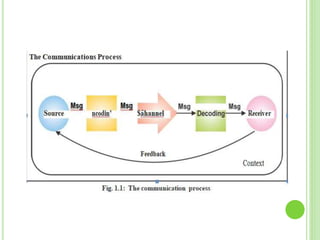
 Communication process involves a source which can be
called as sender or health worker who decides to plan and
prepare message keeping in mind target group.
 Message is of prime importance from encoding to decoding
(receiver), after that feedback from receiver to sender
completes the process of communication.
 Effective communication is:
 Need based
 Target group oriented
 In simple and clear language and should meet the
requirements of the people in need of health related
messages.

HUMAN BEHAVIOUR
 Behaviour is an observable action of an individual often
in reaction to specific circumstances or stimuli.
 It is acquired and liable to change.
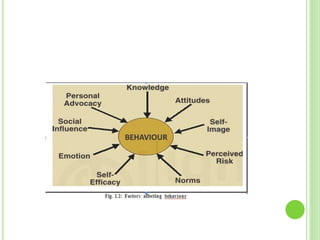
 It is affected by a number of factors like genetic, social
norms, culture, attitude, emotions, perceived risk and
benefits etc
HUMAN HEALTH BEHAVIOUR
 health behaviour as any activity undertaken for the purpose of
preventing or detecting disease or for improving health and well-
being.
 In simple words it relate to health maintenance, restoration and
improvement.
 Behaviours within this definition include medical service usage
(e.g., physician visits, vaccination, screening), compliance with
medical regimens (e.g., dietary, diabetic, antihypertensive
regimens), and self-directed health behaviours (e.g., diet, exercise,
smoking, alcohol consumption).
 The initiation and maintenance of health behaviours result from an
interaction of social, psychological, biological, and environmental
factors.
 Behaviours can be harmful to health like smoking, alcohol,
sedentary lifestyle or they can be health promoting like regular
exercise, eating habits, compliance to treatment, safe sexual habits
etc
THE HEALTH BELIEF MODEL (HBM)
 The Health Belief Model (HBM) is a psychological
model that attempts to explain and predict health
behaviours.
 This is done by focusing on the attitudes and beliefs of
individuals.
 The HBM was first developed in the 1950s by social
psychologists Hochbaum, Rosenstockand Kegels
working in theU.S. Public Health Services when social
psychologists were asked to explain why people do not
participate in health behaviours
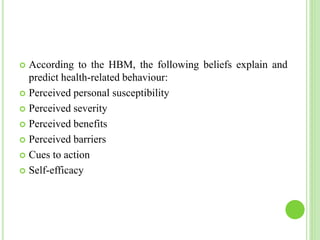
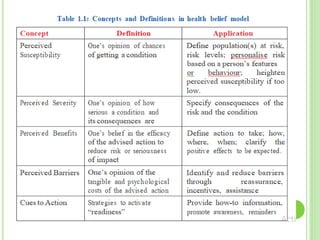
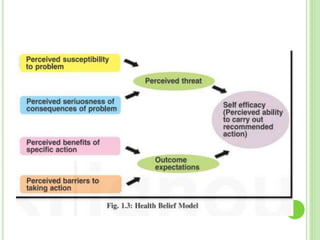
 According to the HBM, the following beliefs explain and
predict health-related behaviour:
 Perceived personal susceptibility
 Perceived severity
 Perceived benefits
 Perceived barriers
 Cues to action
 Self-efficacy
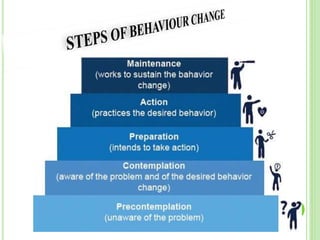
STEPS OF BEHAVIOR CHANGE
According to the transtheoretical mode of change,
there are six steps of behavior change. In this, model
changes occurs gradually and relapses may occur. In
early stage, people resists for any kind of change. This
model given us small gradual progression of steps
towards goal.
Precontemplation stage
Contemplation stage
Preparation or determination stage
Action stage
Maintenance stage
Relapse stage
Ways to Influence Behaviour
 To influence behaviour certain ways may be kept in mind as given :
 Support: It is to provide a service support and give people what they
need, want, or value. Hence, select message as per their need, availability
and in advance.
 Inform: Inform, advise, build awareness, educate, encourage, persuade
and inspire people to adopt healthy behaviour.
 Legislation: Legislate, regulate, enforce with police to force people to
adopt health promoting behaviour like following traffic rules.
 Design: Set environmental and physical context, design, engineer,
availability, distribution of infrastructure in such a way that people are
enabled to take action.
TECHNIQUES OF BEHAVIOUR CHANGE
 Information- Used with the belief that audience lacks information.
It is source dominated and one way.
 Education- It focuses on applying knowledge. Skill building
techniques like demonstrations, skill practice, do and learn are
useful methods. It build confidence and makes behaviours
convenient.
 Motivation- It is the driving force to achieve something. It is used
when information is established. Different appeals are instrumental
for motivation
 e.g. rationale appeal, emotional appeal, threat/fear appeal, joy/fun
appeal
 Reinforcement- It is used to sustain behaviour change for repetitive
types of behaviours. Need to be used with variations. Community
based resources/ mechanisms should be established to reinforce the
message.
 Social Pressure- When person in need of health services not willing
to undergo treatment is encouraged by near and dear ones to avail
health services.
GUIDING PRINCIPLES IN PLANNING BEHAVIOUR CHANGE
COMMUNICATIONS (BCC) ACTIVITY
 BCC should be integrated with programme goals from the
start.
 Formative BCC assessments must be conducted to improve
understanding of the needs of target populations, as well as of
the barriers to and supports for behaviour change .
 The target population should participate in all phases of BCC
development and in much of implementation.
 Stakeholders need to be involved from the design stage.
 Having a variety of linked communication channels is more
effective than relying on one specific one.
 Pre-testing is essential for developing effective BCC materials.
 Planning for monitoring and evaluation should be part of the
design of any BCC programme.
 BCC strategies should be positive and action-oriented.
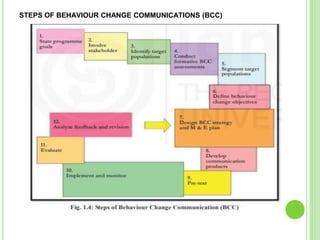
STEPS OF BEHAVIOUR CHANGE COMMUNICATIONS (BCC)
 State programme goals- Specific programme goals are
established after reviewing existing data, epidemiological
information and in-depth programme situation assessments.
 Involve stakeholders-
 Every step of the process of developing programmes and their
BCCcomponents. Stakeholders include policymakers, opinion
leaders, community leaders, religious leaders and members of
target populations.
 Identify target populations-
 Target populations are defined as primary or secondary.
Primary populations are the main groups whose behaviour the
programme is intended to influence. Secondary populations
are those groups that influence the ability of the primary
population to adopt or maintain appropriate behaviours.
 Conduct formative BCC assessments-
 A formative BCC assessment should start by seeking out all
available studies, including data from in-depth assessments
,behavioural surveillance surveys and other related studies. After
synthesising this information, a formative BCC assessment
protocol can be developed.
 The formative BCC assessment should collect information on:
 Risk situations
 Why individuals and groups practice the behaviours they do,
and why they might be motivated to change (or unable to
change) to the desired behaviours
 Perceptions of risk and risk behaviours
 Influences on behaviour, such as barriers or benefits
 Insights of opinion leaders etc
 Segment target populations- Based on the formative BCC
assessment, target populations can then be segmented. Population
segments are often defined by psychosocial and demographic
characteristics.
 Define behaviour change objectives- What changes in behaviour
does the programme intend to achieve? Observable changes in
behaviour, as specified in the behaviour change objectives, are a
final programme outcome. Such changes include:
 Knowledge change
 Attitude change
 Environmental change
 Design BCC strategy and Monitoring and Evaluation (M&E)
Plan- A plan for monitoring and evaluation needs to be drawn up
during the initial stage of BCC strategy design. These include
reports, site visits and reviews of materials. Reporting tools and
protocols must be standardised to ensure consistency.
 Develop communication products and train providers- The
theme should stem from the BCC formative assessment and
further consultation.
 The theme should be positive.
 Should call attention to the campaign and link its various
elements together, functioning as a sort of umbrella.
 It should be catchy and devised in such a way that all target
populations can relate to it and identify with it.
 Conduct pre-testing- It is important to pre-test at every
stage with all audiences for whom the communication is
intended, both primary and secondary. Pre-testing
should be done of themes, messages, prototype
materials, training packages, support tools and BCC
formative assessment instruments. Pre-testing of media,
messages and themes should evaluate:
 Comprehension
 Attraction
 Persuasion
 Acceptability
 Audience members’ degree of identification
 Implement and monitor- In the implementation phase, all
elements of the strategy go into operation.. It is also
necessary during the implementation phase to review the
preceding steps in the BCC process to ascertain whether the
programme has been addressing the target audiences’
previously identified problems and needs. This can also
help identify whether behaviour change and
communication goals are being achieved, and whether
channels are being used as wisely as possible.
 Evaluate- Evaluation refers to the assessment of a project’s
implementation and its success in achieving predetermined
objectives of behaviour change.
 Elicit feedback and modify the programme-
 As programmes evolve, target populations acquire new
knowledge and behaviours, and communication needs may
change.
 The needs of target populations must be periodically
reassessed to understand where they stand along the behavior
change continuum.
 Monitoring and evaluation studies should lead directly to
modifications of the overall programme, as well as of the
BCC strategies, messages and approaches.

BCC.pptx-Behavioral Change Communication

  • 1.
  • 2.
     Communication isthe process of sending and receiving messages verbally or in writing.  Messages are mainly related to health awareness so that healthy behaviour can be adopted.  Communication is necessary to pave way for desired changes in human behaviour and community participation to achieve predetermined goals.  The ultimate goal of all communication is to bring change in the desired direction in one who receives it. These may be at-  Cognitive level Knowledge  Affective level Attitude  Psychomotor level Practice  Communication skills required in health education include— speaking, writing, listening, reading and reasoning
  • 3.
     Communication processinvolves a source which can be called as sender or health worker who decides to plan and prepare message keeping in mind target group.  Message is of prime importance from encoding to decoding (receiver), after that feedback from receiver to sender completes the process of communication.  Effective communication is:  Need based  Target group oriented  In simple and clear language and should meet the requirements of the people in need of health related messages. 
  • 5.
    HUMAN BEHAVIOUR  Behaviouris an observable action of an individual often in reaction to specific circumstances or stimuli.  It is acquired and liable to change.  It is affected by a number of factors like genetic, social norms, culture, attitude, emotions, perceived risk and benefits etc
  • 7.
    HUMAN HEALTH BEHAVIOUR health behaviour as any activity undertaken for the purpose of preventing or detecting disease or for improving health and well- being.  In simple words it relate to health maintenance, restoration and improvement.  Behaviours within this definition include medical service usage (e.g., physician visits, vaccination, screening), compliance with medical regimens (e.g., dietary, diabetic, antihypertensive regimens), and self-directed health behaviours (e.g., diet, exercise, smoking, alcohol consumption).  The initiation and maintenance of health behaviours result from an interaction of social, psychological, biological, and environmental factors.  Behaviours can be harmful to health like smoking, alcohol, sedentary lifestyle or they can be health promoting like regular exercise, eating habits, compliance to treatment, safe sexual habits etc
  • 8.
    THE HEALTH BELIEFMODEL (HBM)  The Health Belief Model (HBM) is a psychological model that attempts to explain and predict health behaviours.  This is done by focusing on the attitudes and beliefs of individuals.  The HBM was first developed in the 1950s by social psychologists Hochbaum, Rosenstockand Kegels working in theU.S. Public Health Services when social psychologists were asked to explain why people do not participate in health behaviours
  • 9.
     According tothe HBM, the following beliefs explain and predict health-related behaviour:  Perceived personal susceptibility  Perceived severity  Perceived benefits  Perceived barriers  Cues to action  Self-efficacy
  • 12.
    STEPS OF BEHAVIORCHANGE According to the transtheoretical mode of change, there are six steps of behavior change. In this, model changes occurs gradually and relapses may occur. In early stage, people resists for any kind of change. This model given us small gradual progression of steps towards goal. Precontemplation stage Contemplation stage Preparation or determination stage Action stage Maintenance stage Relapse stage
  • 14.
    Ways to InfluenceBehaviour  To influence behaviour certain ways may be kept in mind as given :  Support: It is to provide a service support and give people what they need, want, or value. Hence, select message as per their need, availability and in advance.  Inform: Inform, advise, build awareness, educate, encourage, persuade and inspire people to adopt healthy behaviour.  Legislation: Legislate, regulate, enforce with police to force people to adopt health promoting behaviour like following traffic rules.  Design: Set environmental and physical context, design, engineer, availability, distribution of infrastructure in such a way that people are enabled to take action.
  • 15.
    TECHNIQUES OF BEHAVIOURCHANGE  Information- Used with the belief that audience lacks information. It is source dominated and one way.  Education- It focuses on applying knowledge. Skill building techniques like demonstrations, skill practice, do and learn are useful methods. It build confidence and makes behaviours convenient.  Motivation- It is the driving force to achieve something. It is used when information is established. Different appeals are instrumental for motivation  e.g. rationale appeal, emotional appeal, threat/fear appeal, joy/fun appeal  Reinforcement- It is used to sustain behaviour change for repetitive types of behaviours. Need to be used with variations. Community based resources/ mechanisms should be established to reinforce the message.  Social Pressure- When person in need of health services not willing to undergo treatment is encouraged by near and dear ones to avail health services.
  • 16.
    GUIDING PRINCIPLES INPLANNING BEHAVIOUR CHANGE COMMUNICATIONS (BCC) ACTIVITY  BCC should be integrated with programme goals from the start.  Formative BCC assessments must be conducted to improve understanding of the needs of target populations, as well as of the barriers to and supports for behaviour change .  The target population should participate in all phases of BCC development and in much of implementation.  Stakeholders need to be involved from the design stage.  Having a variety of linked communication channels is more effective than relying on one specific one.  Pre-testing is essential for developing effective BCC materials.  Planning for monitoring and evaluation should be part of the design of any BCC programme.  BCC strategies should be positive and action-oriented.
  • 17.
    STEPS OF BEHAVIOURCHANGE COMMUNICATIONS (BCC)
  • 18.
     State programmegoals- Specific programme goals are established after reviewing existing data, epidemiological information and in-depth programme situation assessments.  Involve stakeholders-  Every step of the process of developing programmes and their BCCcomponents. Stakeholders include policymakers, opinion leaders, community leaders, religious leaders and members of target populations.  Identify target populations-  Target populations are defined as primary or secondary. Primary populations are the main groups whose behaviour the programme is intended to influence. Secondary populations are those groups that influence the ability of the primary population to adopt or maintain appropriate behaviours.
  • 19.
     Conduct formativeBCC assessments-  A formative BCC assessment should start by seeking out all available studies, including data from in-depth assessments ,behavioural surveillance surveys and other related studies. After synthesising this information, a formative BCC assessment protocol can be developed.  The formative BCC assessment should collect information on:  Risk situations  Why individuals and groups practice the behaviours they do, and why they might be motivated to change (or unable to change) to the desired behaviours  Perceptions of risk and risk behaviours  Influences on behaviour, such as barriers or benefits  Insights of opinion leaders etc
  • 20.
     Segment targetpopulations- Based on the formative BCC assessment, target populations can then be segmented. Population segments are often defined by psychosocial and demographic characteristics.  Define behaviour change objectives- What changes in behaviour does the programme intend to achieve? Observable changes in behaviour, as specified in the behaviour change objectives, are a final programme outcome. Such changes include:  Knowledge change  Attitude change  Environmental change  Design BCC strategy and Monitoring and Evaluation (M&E) Plan- A plan for monitoring and evaluation needs to be drawn up during the initial stage of BCC strategy design. These include reports, site visits and reviews of materials. Reporting tools and protocols must be standardised to ensure consistency.
  • 21.
     Develop communicationproducts and train providers- The theme should stem from the BCC formative assessment and further consultation.  The theme should be positive.  Should call attention to the campaign and link its various elements together, functioning as a sort of umbrella.  It should be catchy and devised in such a way that all target populations can relate to it and identify with it.
  • 22.
     Conduct pre-testing-It is important to pre-test at every stage with all audiences for whom the communication is intended, both primary and secondary. Pre-testing should be done of themes, messages, prototype materials, training packages, support tools and BCC formative assessment instruments. Pre-testing of media, messages and themes should evaluate:  Comprehension  Attraction  Persuasion  Acceptability  Audience members’ degree of identification
  • 23.
     Implement andmonitor- In the implementation phase, all elements of the strategy go into operation.. It is also necessary during the implementation phase to review the preceding steps in the BCC process to ascertain whether the programme has been addressing the target audiences’ previously identified problems and needs. This can also help identify whether behaviour change and communication goals are being achieved, and whether channels are being used as wisely as possible.  Evaluate- Evaluation refers to the assessment of a project’s implementation and its success in achieving predetermined objectives of behaviour change.
  • 24.
     Elicit feedbackand modify the programme-  As programmes evolve, target populations acquire new knowledge and behaviours, and communication needs may change.  The needs of target populations must be periodically reassessed to understand where they stand along the behavior change continuum.  Monitoring and evaluation studies should lead directly to modifications of the overall programme, as well as of the BCC strategies, messages and approaches.