PRESENTED BY:
HARJOT KAUR
BSC(N) 4th
YEAR
ROLL NO.:13
BEHAVIOR CHANGE
COMMUNICATION
INTRODUCTION
 Behavior change communication (BCC) : represent
changing specific behavior - well defined actions at the:
* household
* community
* health service levels.
 BCC is to motivate people to adapt and sustain healthy
living and well- being.
DEFINITION
 BCC is the strategic use of communication to promote
positive health outcome based on proven theories and
models of behavior change.
 BCC is the process that motivates people to adapt and
sustain healthy behavior and ways of living.
Continued…
 BCC in healthcare aims to improve people’s health and
well- being and includes education related to:
* Maternal and child care
* adolescent care
* elderly care
* family planning
* communicable and non- communicable diseases.
OBJECTIVES
 To define their own problems and needs.
 To understand solution of problem with their own
resources and external support.
 To decide appropriate action to promote healthy living
and community well- being.
BENEFITS OF BCC
BCC is a systemic process begins from formative
assessment and behavioral analysis, followed by
communication planning, implementation, monitoring,
evaluation and follow- up activities.
Audience are carefully segmented, messages and materials
are pre-tested and both mass media and interpersonal
channels are used to achieved defined behavioral
objectives.
continued….
 Enhances knowledge, attitude and skills.
 Promotes essential attitude change.
 Creates demand for information and services.
 Advocates for appropriate family health care education
policies.
 Enhances use of promotive, preventive and curative
health care services.
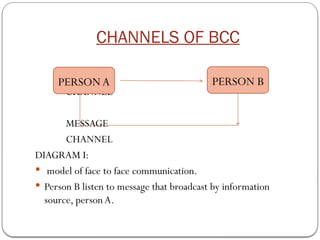
CHANNELS OF BCC
MESSAGE
CHANNEL
MESSAGE
CHANNEL
DIAGRAM I:
 model of face to face communication.
 Person B listen to message that broadcast by information
source, person A.
PERSONA PERSON B
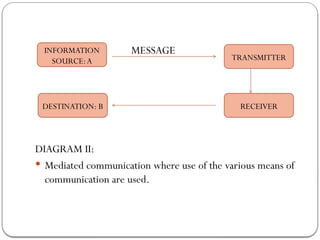
MESSAGE
DIAGRAM II:
 Mediated communication where use of the various means of
communication are used.
INFORMATION
SOURCE:A
DESTINATION: B RECEIVER
TRANSMITTER
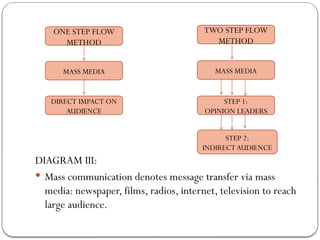
DIAGRAM III:
 Mass communication denotes message transfer via mass
media: newspaper, films, radios, internet, television to reach
large audience.
ONE STEP FLOW
METHOD
DIRECT IMPACT ON
AUDIENCE
MASS MEDIA
STEP 2:
INDIRECTAUDIENCE
STEP 1:
OPINION LEADERS
MASS MEDIA
TWO STEP FLOW
METHOD
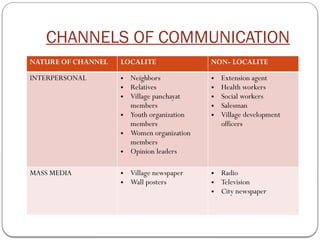
CHANNELS OF COMMUNICATION
NATURE OF CHANNEL LOCALITE NON- LOCALITE
INTERPERSONAL • Neighbors
• Relatives
• Village panchayat
members
• Youth organization
members
• Women organization
members
• Opinion leaders
• Extension agent
• Health workers
• Social workers
• Salesman
• Village development
officers
MASS MEDIA • Village newspaper
• Wall posters
• Radio
• Television
• City newspaper
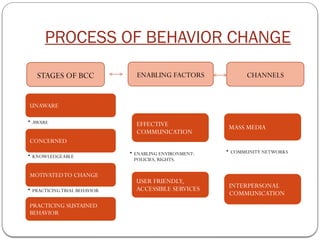
PROCESS OF BEHAVIOR CHANGE
UNAWARE
• AWARE
CONCERNED
• KNOWLEDGEABLE
MOTIVATEDTO CHANGE
• PRACTICINGTRIAL BEHAVIOR
PRACTICING SUSTAINED
BEHAVIOR
STAGES OF BCC ENABLING FACTORS CHANNELS
EFFECTIVE
COMMUNICATION
• ENABLING ENVIRONMENT:
POLICIES, RIGHTS.
USER FRIENDLY,
ACCESSIBLE SERVICES
MASS MEDIA
• COMMUNITY NETWORKS
INTERPERSONAL
COMMUNICATION
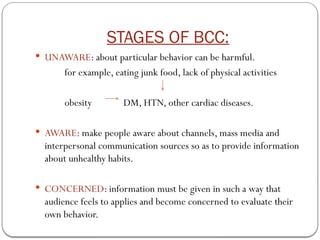
STAGES OF BCC:
 UNAWARE: about particular behavior can be harmful.
for example, eating junk food, lack of physical activities
obesity DM, HTN, other cardiac diseases.
 AWARE: make people aware about channels, mass media and
interpersonal communication sources so as to provide information
about unhealthy habits.
 CONCERNED: information must be given in such a way that
audience feels to applies and become concerned to evaluate their
own behavior.
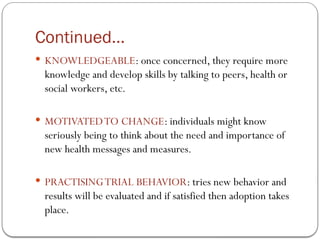
Continued…
 KNOWLEDGEABLE: once concerned, they require more
knowledge and develop skills by talking to peers, health or
social workers, etc.
 MOTIVATEDTO CHANGE: individuals might know
seriously being to think about the need and importance of
new health messages and measures.
 PRACTISINGTRIAL BEHAVIOR: tries new behavior and
results will be evaluated and if satisfied then adoption takes
place.
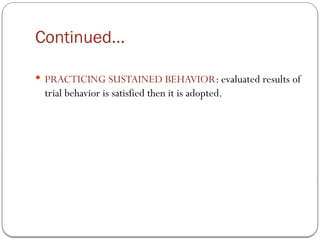
Continued…
 PRACTICING SUSTAINED BEHAVIOR: evaluated results of
trial behavior is satisfied then it is adopted.
STRATEGIES OF BCC
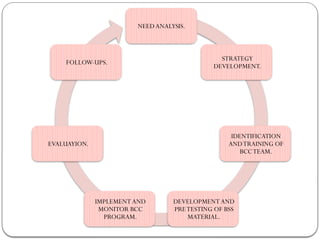
The BCC strategy uses BCC programs cycle for the
systemic implementation of BCC programs.The BCC
program cycle is as follows:
NEEDANALYSIS.
STRATEGY
DEVELOPMENT.
IDENTIFICATION
ANDTRAINING OF
BCCTEAM.
DEVELOPMENTAND
PRETESTING OF BSS
MATERIAL.
IMPLEMENTAND
MONITOR BCC
PROGRAM.
EVALUAYION.
FOLLOW-UPS.
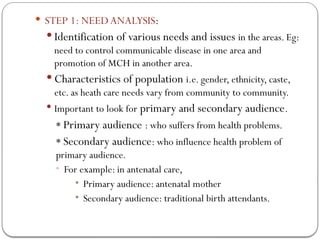
 STEP 1: NEED ANALYSIS:
 Identification of various needs and issues in the areas. Eg:
need to control communicable disease in one area and
promotion of MCH in another area.
 Characteristics of population i.e. gender, ethnicity, caste,
etc. as heath care needs vary from community to community.
 Important to look for primary and secondary audience.
* Primary audience : who suffers from health problems.
* Secondary audience: who influence health problem of
primary audience.
• For example: in antenatal care,
• Primary audience: antenatal mother
• Secondary audience: traditional birth attendants.
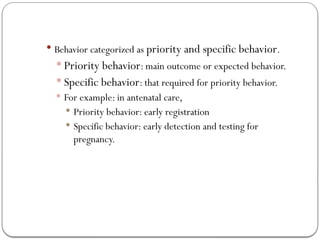
 Behavior categorized as priority and specific behavior.
 Priority behavior: main outcome or expected behavior.
 Specific behavior: that required for priority behavior.
 For example: in antenatal care,
 Priority behavior: early registration
 Specific behavior: early detection and testing for
pregnancy.
 STEP 2: STRATEGY DEVELOPMENT:
 Goals and objectives must be clearly identified. Objectives
are SMART:
S- specific
M- measurable
A- appropriate
R- realistic
T- time bound.
 Develop framework and show how activities will help in
achieving goals.
 Priortizing channels of BCC:
 Messages should be accurate and meaningful.
• Clear, concise, relevant.
 STEP 3: IDENTIFICATION ANDTRAINING OF BCC
TEAM:
 Team need to comprise health, nursing and health
related and media personnel.
 To choose media team, it should includes:
 People with technical knowledge
 generalists.
 STEP 4: DEVELOPMENT AND PRE-TESTING OF BCC
MATERIALS:
 Once team is selected, duty of the team is to prepare
material and pre-test on sample before taking it to
large audience.
 Good BCC material should be:
 Accurate
 Clear
 Relevant and need based
 Appealing
 Sensitive to gender differences.
 STEP 5: IMPLEMENTATION AND MONITORING:
 Team mobilize large number of stakeholders who
wants to provide help to implement activities and
develop sense of ownership.
 Audience involved in monitoring, assessment of BCC
material for making recommendations and further
improvements of BCC activities and materials.
 For example:
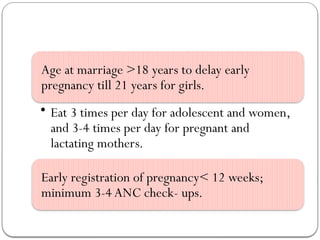
 Core trigger behavior:
Age at marriage >18 years to delay early
pregnancy till 21 years for girls.
• Eat 3 times per day for adolescent and women,
and 3-4 times per day for pregnant and
lactating mothers.
Early registration of pregnancy< 12 weeks;
minimum 3-4 ANC check- ups.
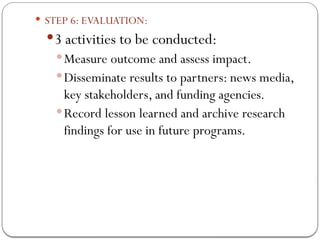
 STEP 6: EVALUATION:
3 activities to be conducted:
Measure outcome and assess impact.
Disseminate results to partners: news media,
key stakeholders, and funding agencies.
Record lesson learned and archive research
findings for use in future programs.
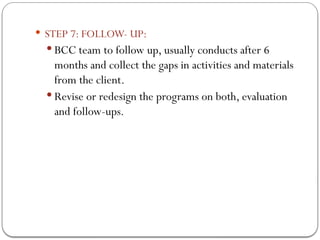
 STEP 7: FOLLOW- UP:
 BCC team to follow up, usually conducts after 6
months and collect the gaps in activities and materials
from the client.
 Revise or redesign the programs on both, evaluation
and follow-ups.
BARRIERS IN FAMILY HEALTH CARE
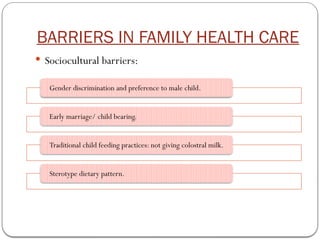
 Sociocultural barriers:
Gender discrimination and preference to male child.
Early marriage/ child bearing.
Traditional child feeding practices: not giving colostral milk.
Sterotype dietary pattern.
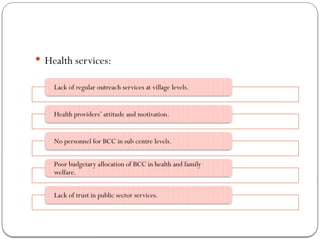
 Health services:
Lack of regular outreach services at village levels.
Health providers’ attitude and motivation.
No personnel for BCC in sub centre levels.
Poor budgetary allocation of BCC in health and family
welfare.
Lack of trust in public sector services.
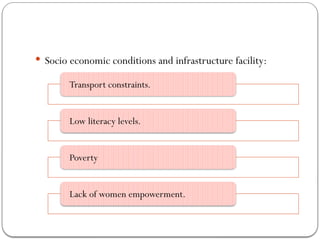
 Socio economic conditions and infrastructure facility:
Transport constraints.
Low literacy levels.
Poverty
Lack of women empowerment.
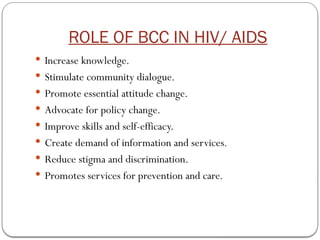
ROLE OF BCC IN HIV/ AIDS
 Increase knowledge.
 Stimulate community dialogue.
 Promote essential attitude change.
 Advocate for policy change.
 Improve skills and self-efficacy.
 Create demand of information and services.
 Reduce stigma and discrimination.
 Promotes services for prevention and care.

BEHAVIOR CHANGE COMMUNICATION IN CHN-II.pptx

  • 1.
    PRESENTED BY: HARJOT KAUR BSC(N)4th YEAR ROLL NO.:13 BEHAVIOR CHANGE COMMUNICATION
  • 2.
    INTRODUCTION  Behavior changecommunication (BCC) : represent changing specific behavior - well defined actions at the: * household * community * health service levels.  BCC is to motivate people to adapt and sustain healthy living and well- being.
  • 3.
    DEFINITION  BCC isthe strategic use of communication to promote positive health outcome based on proven theories and models of behavior change.  BCC is the process that motivates people to adapt and sustain healthy behavior and ways of living.
  • 4.
    Continued…  BCC inhealthcare aims to improve people’s health and well- being and includes education related to: * Maternal and child care * adolescent care * elderly care * family planning * communicable and non- communicable diseases.
  • 5.
    OBJECTIVES  To definetheir own problems and needs.  To understand solution of problem with their own resources and external support.  To decide appropriate action to promote healthy living and community well- being.
  • 6.
    BENEFITS OF BCC BCCis a systemic process begins from formative assessment and behavioral analysis, followed by communication planning, implementation, monitoring, evaluation and follow- up activities. Audience are carefully segmented, messages and materials are pre-tested and both mass media and interpersonal channels are used to achieved defined behavioral objectives.
  • 7.
    continued….  Enhances knowledge,attitude and skills.  Promotes essential attitude change.  Creates demand for information and services.  Advocates for appropriate family health care education policies.  Enhances use of promotive, preventive and curative health care services.
  • 8.
    CHANNELS OF BCC MESSAGE CHANNEL MESSAGE CHANNEL DIAGRAMI:  model of face to face communication.  Person B listen to message that broadcast by information source, person A. PERSONA PERSON B
  • 9.
    MESSAGE DIAGRAM II:  Mediatedcommunication where use of the various means of communication are used. INFORMATION SOURCE:A DESTINATION: B RECEIVER TRANSMITTER
  • 10.
    DIAGRAM III:  Masscommunication denotes message transfer via mass media: newspaper, films, radios, internet, television to reach large audience. ONE STEP FLOW METHOD DIRECT IMPACT ON AUDIENCE MASS MEDIA STEP 2: INDIRECTAUDIENCE STEP 1: OPINION LEADERS MASS MEDIA TWO STEP FLOW METHOD
  • 11.
    CHANNELS OF COMMUNICATION NATUREOF CHANNEL LOCALITE NON- LOCALITE INTERPERSONAL • Neighbors • Relatives • Village panchayat members • Youth organization members • Women organization members • Opinion leaders • Extension agent • Health workers • Social workers • Salesman • Village development officers MASS MEDIA • Village newspaper • Wall posters • Radio • Television • City newspaper
  • 12.
    PROCESS OF BEHAVIORCHANGE UNAWARE • AWARE CONCERNED • KNOWLEDGEABLE MOTIVATEDTO CHANGE • PRACTICINGTRIAL BEHAVIOR PRACTICING SUSTAINED BEHAVIOR STAGES OF BCC ENABLING FACTORS CHANNELS EFFECTIVE COMMUNICATION • ENABLING ENVIRONMENT: POLICIES, RIGHTS. USER FRIENDLY, ACCESSIBLE SERVICES MASS MEDIA • COMMUNITY NETWORKS INTERPERSONAL COMMUNICATION
  • 13.
    STAGES OF BCC: UNAWARE: about particular behavior can be harmful. for example, eating junk food, lack of physical activities obesity DM, HTN, other cardiac diseases.  AWARE: make people aware about channels, mass media and interpersonal communication sources so as to provide information about unhealthy habits.  CONCERNED: information must be given in such a way that audience feels to applies and become concerned to evaluate their own behavior.
  • 14.
    Continued…  KNOWLEDGEABLE: onceconcerned, they require more knowledge and develop skills by talking to peers, health or social workers, etc.  MOTIVATEDTO CHANGE: individuals might know seriously being to think about the need and importance of new health messages and measures.  PRACTISINGTRIAL BEHAVIOR: tries new behavior and results will be evaluated and if satisfied then adoption takes place.
  • 15.
    Continued…  PRACTICING SUSTAINEDBEHAVIOR: evaluated results of trial behavior is satisfied then it is adopted.
  • 16.
    STRATEGIES OF BCC TheBCC strategy uses BCC programs cycle for the systemic implementation of BCC programs.The BCC program cycle is as follows:
  • 17.
    NEEDANALYSIS. STRATEGY DEVELOPMENT. IDENTIFICATION ANDTRAINING OF BCCTEAM. DEVELOPMENTAND PRETESTING OFBSS MATERIAL. IMPLEMENTAND MONITOR BCC PROGRAM. EVALUAYION. FOLLOW-UPS.
  • 18.
     STEP 1:NEED ANALYSIS:  Identification of various needs and issues in the areas. Eg: need to control communicable disease in one area and promotion of MCH in another area.  Characteristics of population i.e. gender, ethnicity, caste, etc. as heath care needs vary from community to community.  Important to look for primary and secondary audience. * Primary audience : who suffers from health problems. * Secondary audience: who influence health problem of primary audience. • For example: in antenatal care, • Primary audience: antenatal mother • Secondary audience: traditional birth attendants.
  • 19.
     Behavior categorizedas priority and specific behavior.  Priority behavior: main outcome or expected behavior.  Specific behavior: that required for priority behavior.  For example: in antenatal care,  Priority behavior: early registration  Specific behavior: early detection and testing for pregnancy.
  • 20.
     STEP 2:STRATEGY DEVELOPMENT:  Goals and objectives must be clearly identified. Objectives are SMART: S- specific M- measurable A- appropriate R- realistic T- time bound.  Develop framework and show how activities will help in achieving goals.  Priortizing channels of BCC:  Messages should be accurate and meaningful. • Clear, concise, relevant.
  • 21.
     STEP 3:IDENTIFICATION ANDTRAINING OF BCC TEAM:  Team need to comprise health, nursing and health related and media personnel.  To choose media team, it should includes:  People with technical knowledge  generalists.
  • 22.
     STEP 4:DEVELOPMENT AND PRE-TESTING OF BCC MATERIALS:  Once team is selected, duty of the team is to prepare material and pre-test on sample before taking it to large audience.  Good BCC material should be:  Accurate  Clear  Relevant and need based  Appealing  Sensitive to gender differences.
  • 23.
     STEP 5:IMPLEMENTATION AND MONITORING:  Team mobilize large number of stakeholders who wants to provide help to implement activities and develop sense of ownership.  Audience involved in monitoring, assessment of BCC material for making recommendations and further improvements of BCC activities and materials.  For example:  Core trigger behavior:
  • 24.
    Age at marriage>18 years to delay early pregnancy till 21 years for girls. • Eat 3 times per day for adolescent and women, and 3-4 times per day for pregnant and lactating mothers. Early registration of pregnancy< 12 weeks; minimum 3-4 ANC check- ups.
  • 25.
     STEP 6:EVALUATION: 3 activities to be conducted: Measure outcome and assess impact. Disseminate results to partners: news media, key stakeholders, and funding agencies. Record lesson learned and archive research findings for use in future programs.
  • 26.
     STEP 7:FOLLOW- UP:  BCC team to follow up, usually conducts after 6 months and collect the gaps in activities and materials from the client.  Revise or redesign the programs on both, evaluation and follow-ups.
  • 27.
    BARRIERS IN FAMILYHEALTH CARE  Sociocultural barriers: Gender discrimination and preference to male child. Early marriage/ child bearing. Traditional child feeding practices: not giving colostral milk. Sterotype dietary pattern.
  • 28.
     Health services: Lackof regular outreach services at village levels. Health providers’ attitude and motivation. No personnel for BCC in sub centre levels. Poor budgetary allocation of BCC in health and family welfare. Lack of trust in public sector services.
  • 29.
     Socio economicconditions and infrastructure facility: Transport constraints. Low literacy levels. Poverty Lack of women empowerment.
  • 30.
    ROLE OF BCCIN HIV/ AIDS  Increase knowledge.  Stimulate community dialogue.  Promote essential attitude change.  Advocate for policy change.  Improve skills and self-efficacy.  Create demand of information and services.  Reduce stigma and discrimination.  Promotes services for prevention and care.