NUTRITION BEHAVIOUR CHANGE COMMUNICATION
CN 407 -2 Credits
Victoria Awuni (BSc, MPhil)
Department of Nutritional Sciences
Email: victoria.awuni@uds.edu.gh
Mobile: 0204063445
Introduction to behavior change
communication
 Learning Objectives:
At the end of the session students will:
• Be able to describe five key facts about human
behavior
• Understand the concepts of IEC and Health
Promotion and how they relate to BCC
• Be able to define BCC
• Be able to identify the three approaches to
Behavior Change
• Understand and be able to explain the elements
of each BCC approach
2
Behaviour
 Within the discipline of psychology, sociology,
anthropology and economics;
• “Anything a person does in response to
internal or external events
• Actions may be
overt (motor or verbal) and directly measurable,
or
covert (activities not viewable but involving
voluntary muscles) and indirectly measurable;
• behaviours are controlled by the brain”
The five key facts about human behaviour
1. People give meaning to information based on
the context in which they live
• Example: A married woman with three children may
be more receptive to family planning information than
a newly married woman who does not yet have
children
2. Culture and networks influence people’s
behaviour
• Example: Contraceptive use in India varies greatly by
religion and caste, though knowledge of
contraception is nearly universal
4
The five key facts about human behaviour
3. People cannot always control the issues that
determine behavior
• Example: A woman may not be able to plan and space
her pregnancies if her husband does not support her
use of contraception.
4. People’s decisions about health and well-being
compete with other priorities
• Example: Men who consume frequently meat and meat
products as a sign of masculinity regardless of the
health effects to their prostate health. The pressure to
be seen as a ‘real man’ may override health
considerations
5
The five key facts about human behaviour
5. People often make decisions based on emotional
factors, not logic
• Example: Woman with repeated, closely spaced
pregnancies may know that they are risking their lives.
But, if their desire is a male child, they may keep
trying until they achieve their goal
6
Information, Education and Communication
(IEC)
 IEC is a strategy used to inform the public about
health concerns and to maintain important
health issues on a public agenda
 It is a process of working with individuals,
communities and societies to develop
communication strategies
 These strategies support positive behaviours that
• Promote health
• Are appropriate to their settings
7
IEC
 It “combines strategies, approaches, and
methods that enable individuals, families,
groups, organizations, and communities to play
active roles in achieving, protecting, and
sustaining their own health
 Embodied in IEC is the process of learning that
empowers people to make decisions, modify
behaviours, and change social conditions”
[UNFPA, 1999]
8
IEC
 The use of health education and the mass and
multimedia to disseminate useful health
information to the public, increases awareness of
specific health issues as well as the importance
of health in development
9
IEC
 Disseminating information through multimedia
channels and health education provides
important information to individuals and the
general public
 However provision of information on its own
cannot motivate or support individuals and the
general public to take action on the information
they are given
10
Health promotion
 Health promotion is the process of enabling
people to increase control over, and to improve
their health
 Participation by individuals and community is
essential as part of the health promotion process
to sustain healthy behavior and health promotion
action
11
Health promotion
 According to the Ottawa Charter, Health
Promotion:
• Represents a comprehensive social and political
process
• It embraces actions directed at strengthening the skills
and capabilities of individuals to make healthy
behavior choices and change health behaviors
• It is also action directed towards improving social,
environmental and economic conditions to support
public and individual health (WHO, 1986).
12
The Evolution of IEC to BCC to SBCC
A. Earlier models of communication used the
“expert–learner” or “sender–receiver”
paradigm to transfer information
B. The focus then shifted to BCC, which
emphasizes analysis of behaviors and
determinants to bring about changes in
knowledge, attitudes and practices
C. Now, the focus is SBCC, which employs a more
comprehensive approach.
13
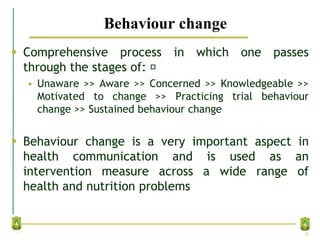
Behaviour change
 Comprehensive process in which one passes
through the stages of:
• Unaware >> Aware >> Concerned >> Knowledgeable >>
Motivated to change >> Practicing trial behaviour
change >> Sustained behaviour change
 Behaviour change is a very important aspect in
health communication and is used as an
intervention measure across a wide range of
health and nutrition problems
14
Behaviour change communication
 BCC is an interactive process with communities
(as integrated with an overall program) to
develop tailored messages and approaches
using a variety of communication channels to
develop positive behaviours; promote and
sustain individual, community and societal
behaviour change; and maintain appropriate
behaviours.
15
BCC
 BCC is a process of working with individuals, families
and communities through different communication
channels to promote positive health behaviors and
support an environment that helps to maintain
positive behaviors taken on
 BCC is a multilevel tool for promoting and sustaining
risk‐reducing behavior change in individuals and
communities by distributing tailored health messages
using a variety of communication channels.
16
BCC
 Behavior change communication (BCC) can
therefore be regarded as any communication (e.g.,
interpersonal, group talks, mass media, support
groups, visuals and print materials, videos) that
helps foster a change in behavior in individuals,
families, or communities
17
BCC
 BCC employs a systematic process beginning with
formative research and behaviour analysis, followed
by communication planning, implementation, and
monitoring and evaluation
 Audiences are carefully segmented, messages and
materials are pre-tested, and both mass media and
interpersonal channels are used to achieve defined
behavioural objectives.
18
Role of nutrition behaviour change
communication
 It seeks to influence society and human
behaviours in order to impact positively on
nutrition practices
 BCC activities should therefore be essential
component of programmes that aim at improving
maternal, infant, and young child nutrition
19
BCC moves people from awareness to action
 Though IEC programs result in improved health
knowledge they have often failed to produce
behavior change
 IEC campaigns are often better at imparting
knowledge and information than they are at
moving people from awareness to action
20
BCC moves people from awareness to
action
 To move people from awareness to action, we
need behavior change which is a complex process
motivated by many factors including:
A.A person’s awareness of the need to change
B.A person’s understanding of the benefits of such
a change
C.A person’s belief in his/her ability to change
D. A person having the confidence in his/her ability
to maintain a behavior change
21
BCC moves people from awareness to
action
 BCC must move people from awareness to action
by motivating people to believe that health
benefits will be obtained by changing behavior
and by increasing individuals’ sense of control
over their own health behavior choices.
 BCC must go beyond just providing information
to an approach that provides both information
and appeals to individuals emotions
22
BCC moves people from awareness to
action
 Key Questions
 How can we convince a mother to change her
feeding practices?
 Does telling a mother what to do lead her to
change her behavior?
23
BCC moves people from awareness to
action
 Giving someone information is not usually
enough to change behavior
 Behavior change communication is a way to
communicate with people by listening,
understanding, and negotiating so they will
change their behavior
 Promoting positive behavior change is a complex
process requiring a thorough understanding of
what motivates people to adopt or resist new
behaviors
24
BCC moves people from awareness
to action
 BCC approaches recognize that behaviour
change is more about identifying the causes and
barriers to behaviour change and overcoming the
barriers.
 BCC is also about using persuasive techniques
to demand health rights and to make public
sector health services available and accessible to
the neediest
25
Elements of BCC Process
 The following elements are crucial to the
success of BCC health messages and
programs:
1. The rational element, based on knowledge:
People need to know the basic facts about
a health issue. For example, people need to
know how HIV virus is and how likely they
are to become infected, and what they can
do to avoid infection.
26
Elements of BCC Process
2. The emotional element, based on the intensity
of attitudes or feelings: Individuals need to feel
an intense and personal vulnerability to the
virus in order to develop an emotional
commitment to the behaviors needed to avoid
it.
27
Elements of BCC Process
3. The practical element, based on personal skills
in a new behavior: People need to be
competent in practicing the new behavior and
be confident in their ability to do so. They need
a sense of self-efficacy to adopt new, health-
protective behaviors
28
Elements of BCC Process
4. The interpersonal element, or social networks:
People need to associate with and be supported
by their significant others (such as family
members and peer groups) whose knowledge,
emotions and skills can reinforce healthy
behavior changes
29
Elements of BCC Process
5. The structural element, or the social,
economic and legal context in which
behavior takes place:
 People need to have access to necessary
supplies and services (such as hand washing
facilities and voluntary counseling and
testing facilities), and to live in an
environment where safer behaviors are
accepted and promoted while risky
behaviors are discouraged
30
Guiding principles for BCC
1. Follow a systematic approach (e.g., C-
Planning)
2. Use research, not assumptions to drive your
program
3. Consider the social context
4. Keep the focus on your audience(s)
5. Use theories and models to guide decisions
(e.g., the socio-ecological model)
31
Guiding principles for BCC
6. Involve partners and communities
throughout
7. Set realistic objectives and consider cost-
effectiveness
8. Use mutually reinforcing materials and
activities at many levels
9. Choose strategies that are motivational and
action-oriented
10.Ensure quality at every step
32
THANK YOU
33

4_5785326174687201706.pptx

  • 1.
    NUTRITION BEHAVIOUR CHANGECOMMUNICATION CN 407 -2 Credits Victoria Awuni (BSc, MPhil) Department of Nutritional Sciences Email: victoria.awuni@uds.edu.gh Mobile: 0204063445
  • 2.
    Introduction to behaviorchange communication  Learning Objectives: At the end of the session students will: • Be able to describe five key facts about human behavior • Understand the concepts of IEC and Health Promotion and how they relate to BCC • Be able to define BCC • Be able to identify the three approaches to Behavior Change • Understand and be able to explain the elements of each BCC approach 2
  • 3.
    Behaviour  Within thediscipline of psychology, sociology, anthropology and economics; • “Anything a person does in response to internal or external events • Actions may be overt (motor or verbal) and directly measurable, or covert (activities not viewable but involving voluntary muscles) and indirectly measurable; • behaviours are controlled by the brain”
  • 4.
    The five keyfacts about human behaviour 1. People give meaning to information based on the context in which they live • Example: A married woman with three children may be more receptive to family planning information than a newly married woman who does not yet have children 2. Culture and networks influence people’s behaviour • Example: Contraceptive use in India varies greatly by religion and caste, though knowledge of contraception is nearly universal 4
  • 5.
    The five keyfacts about human behaviour 3. People cannot always control the issues that determine behavior • Example: A woman may not be able to plan and space her pregnancies if her husband does not support her use of contraception. 4. People’s decisions about health and well-being compete with other priorities • Example: Men who consume frequently meat and meat products as a sign of masculinity regardless of the health effects to their prostate health. The pressure to be seen as a ‘real man’ may override health considerations 5
  • 6.
    The five keyfacts about human behaviour 5. People often make decisions based on emotional factors, not logic • Example: Woman with repeated, closely spaced pregnancies may know that they are risking their lives. But, if their desire is a male child, they may keep trying until they achieve their goal 6
  • 7.
    Information, Education andCommunication (IEC)  IEC is a strategy used to inform the public about health concerns and to maintain important health issues on a public agenda  It is a process of working with individuals, communities and societies to develop communication strategies  These strategies support positive behaviours that • Promote health • Are appropriate to their settings 7
  • 8.
    IEC  It “combinesstrategies, approaches, and methods that enable individuals, families, groups, organizations, and communities to play active roles in achieving, protecting, and sustaining their own health  Embodied in IEC is the process of learning that empowers people to make decisions, modify behaviours, and change social conditions” [UNFPA, 1999] 8
  • 9.
    IEC  The useof health education and the mass and multimedia to disseminate useful health information to the public, increases awareness of specific health issues as well as the importance of health in development 9
  • 10.
    IEC  Disseminating informationthrough multimedia channels and health education provides important information to individuals and the general public  However provision of information on its own cannot motivate or support individuals and the general public to take action on the information they are given 10
  • 11.
    Health promotion  Healthpromotion is the process of enabling people to increase control over, and to improve their health  Participation by individuals and community is essential as part of the health promotion process to sustain healthy behavior and health promotion action 11
  • 12.
    Health promotion  Accordingto the Ottawa Charter, Health Promotion: • Represents a comprehensive social and political process • It embraces actions directed at strengthening the skills and capabilities of individuals to make healthy behavior choices and change health behaviors • It is also action directed towards improving social, environmental and economic conditions to support public and individual health (WHO, 1986). 12
  • 13.
    The Evolution ofIEC to BCC to SBCC A. Earlier models of communication used the “expert–learner” or “sender–receiver” paradigm to transfer information B. The focus then shifted to BCC, which emphasizes analysis of behaviors and determinants to bring about changes in knowledge, attitudes and practices C. Now, the focus is SBCC, which employs a more comprehensive approach. 13
  • 14.
    Behaviour change  Comprehensiveprocess in which one passes through the stages of: • Unaware >> Aware >> Concerned >> Knowledgeable >> Motivated to change >> Practicing trial behaviour change >> Sustained behaviour change  Behaviour change is a very important aspect in health communication and is used as an intervention measure across a wide range of health and nutrition problems 14
  • 15.
    Behaviour change communication BCC is an interactive process with communities (as integrated with an overall program) to develop tailored messages and approaches using a variety of communication channels to develop positive behaviours; promote and sustain individual, community and societal behaviour change; and maintain appropriate behaviours. 15
  • 16.
    BCC  BCC isa process of working with individuals, families and communities through different communication channels to promote positive health behaviors and support an environment that helps to maintain positive behaviors taken on  BCC is a multilevel tool for promoting and sustaining risk‐reducing behavior change in individuals and communities by distributing tailored health messages using a variety of communication channels. 16
  • 17.
    BCC  Behavior changecommunication (BCC) can therefore be regarded as any communication (e.g., interpersonal, group talks, mass media, support groups, visuals and print materials, videos) that helps foster a change in behavior in individuals, families, or communities 17
  • 18.
    BCC  BCC employsa systematic process beginning with formative research and behaviour analysis, followed by communication planning, implementation, and monitoring and evaluation  Audiences are carefully segmented, messages and materials are pre-tested, and both mass media and interpersonal channels are used to achieve defined behavioural objectives. 18
  • 19.
    Role of nutritionbehaviour change communication  It seeks to influence society and human behaviours in order to impact positively on nutrition practices  BCC activities should therefore be essential component of programmes that aim at improving maternal, infant, and young child nutrition 19
  • 20.
    BCC moves peoplefrom awareness to action  Though IEC programs result in improved health knowledge they have often failed to produce behavior change  IEC campaigns are often better at imparting knowledge and information than they are at moving people from awareness to action 20
  • 21.
    BCC moves peoplefrom awareness to action  To move people from awareness to action, we need behavior change which is a complex process motivated by many factors including: A.A person’s awareness of the need to change B.A person’s understanding of the benefits of such a change C.A person’s belief in his/her ability to change D. A person having the confidence in his/her ability to maintain a behavior change 21
  • 22.
    BCC moves peoplefrom awareness to action  BCC must move people from awareness to action by motivating people to believe that health benefits will be obtained by changing behavior and by increasing individuals’ sense of control over their own health behavior choices.  BCC must go beyond just providing information to an approach that provides both information and appeals to individuals emotions 22
  • 23.
    BCC moves peoplefrom awareness to action  Key Questions  How can we convince a mother to change her feeding practices?  Does telling a mother what to do lead her to change her behavior? 23
  • 24.
    BCC moves peoplefrom awareness to action  Giving someone information is not usually enough to change behavior  Behavior change communication is a way to communicate with people by listening, understanding, and negotiating so they will change their behavior  Promoting positive behavior change is a complex process requiring a thorough understanding of what motivates people to adopt or resist new behaviors 24
  • 25.
    BCC moves peoplefrom awareness to action  BCC approaches recognize that behaviour change is more about identifying the causes and barriers to behaviour change and overcoming the barriers.  BCC is also about using persuasive techniques to demand health rights and to make public sector health services available and accessible to the neediest 25
  • 26.
    Elements of BCCProcess  The following elements are crucial to the success of BCC health messages and programs: 1. The rational element, based on knowledge: People need to know the basic facts about a health issue. For example, people need to know how HIV virus is and how likely they are to become infected, and what they can do to avoid infection. 26
  • 27.
    Elements of BCCProcess 2. The emotional element, based on the intensity of attitudes or feelings: Individuals need to feel an intense and personal vulnerability to the virus in order to develop an emotional commitment to the behaviors needed to avoid it. 27
  • 28.
    Elements of BCCProcess 3. The practical element, based on personal skills in a new behavior: People need to be competent in practicing the new behavior and be confident in their ability to do so. They need a sense of self-efficacy to adopt new, health- protective behaviors 28
  • 29.
    Elements of BCCProcess 4. The interpersonal element, or social networks: People need to associate with and be supported by their significant others (such as family members and peer groups) whose knowledge, emotions and skills can reinforce healthy behavior changes 29
  • 30.
    Elements of BCCProcess 5. The structural element, or the social, economic and legal context in which behavior takes place:  People need to have access to necessary supplies and services (such as hand washing facilities and voluntary counseling and testing facilities), and to live in an environment where safer behaviors are accepted and promoted while risky behaviors are discouraged 30
  • 31.
    Guiding principles forBCC 1. Follow a systematic approach (e.g., C- Planning) 2. Use research, not assumptions to drive your program 3. Consider the social context 4. Keep the focus on your audience(s) 5. Use theories and models to guide decisions (e.g., the socio-ecological model) 31
  • 32.
    Guiding principles forBCC 6. Involve partners and communities throughout 7. Set realistic objectives and consider cost- effectiveness 8. Use mutually reinforcing materials and activities at many levels 9. Choose strategies that are motivational and action-oriented 10.Ensure quality at every step 32
  • 33.