PENELOPE BISE
Battery Management
System an Introduction
Content
• Motivation
• Safe Operation Area
• Battery Management System
• BMS Key Functions
• General Functions
• Balancing
• Performance
• Conclusion
08.10.2013 NEXT ENERGY 2
Motivation
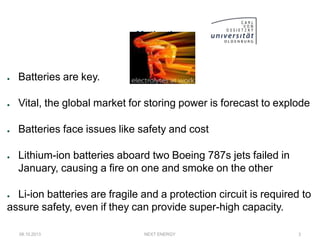
● Batteries are key.
● Vital, the global market for storing power is forecast to explode
● Batteries face issues like safety and cost
● Lithium-ion batteries aboard two Boeing 787s jets failed in
January, causing a fire on one and smoke on the other
● Li-ion batteries are fragile and a protection circuit is required to
assure safety, even if they can provide super-high capacity.
08.10.2013 NEXT ENERGY 3
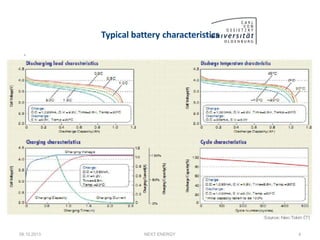
Typical battery characteristics
08.10.2013 NEXT ENERGY 4
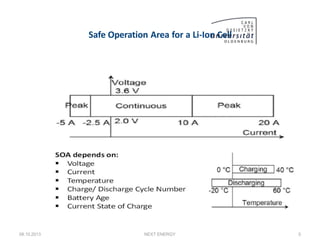
Safe Operation Area for a Li-Ion Cell
08.10.2013 NEXT ENERGY 5
Battery Management System (BMS)
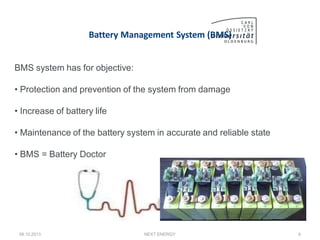
BMS system has for objective:
• Protection and prevention of the system from damage
• Increase of battery life
• Maintenance of the battery system in accurate and reliable state
• BMS = Battery Doctor
08.10.2013 NEXT ENERGY 6
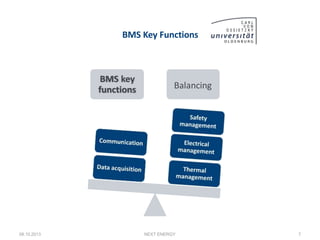
BMS Key Functions
BMS key
functions Balancing
08.10.2013 NEXT ENERGY 7
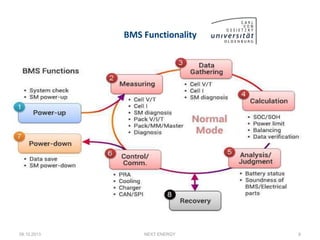
BMS Functionality
08.10.2013 NEXT ENERGY 8
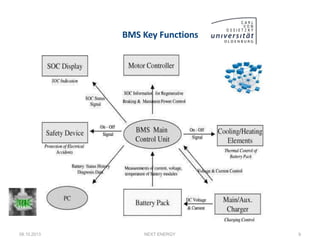
BMS Key Functions
08.10.2013 NEXT ENERGY 9
State of Charge (SOC)
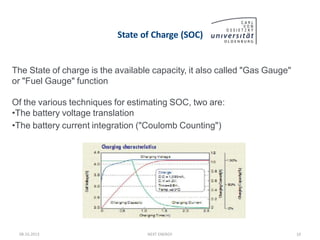
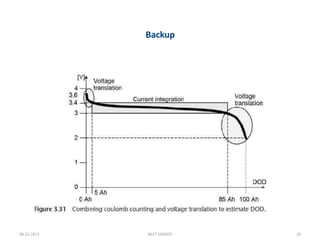
The State of charge is the available capacity, it also called "Gas Gauge"
or "Fuel Gauge" function
Of the various techniques for estimating SOC, two are:
•The battery voltage translation
•The battery current integration ("Coulomb Counting")
08.10.2013 NEXT ENERGY 10
State of Charge
A major factors that can influence the SOC of a Lithium Batteries is the
useable capacity of a cell, is not constant but varies significantly with
temperature
The ratio of the currently available capacity to the maximum capacity
can be expressed as SOC
Where i is the current, and n C is the maximum capacity that the
battery can hold.
08.10.2013 NEXT ENERGY 11
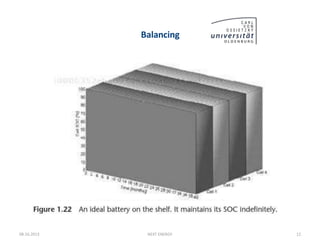
Balancing
08.10.2013 NEXT ENERGY 12
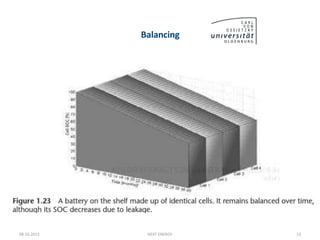
Balancing
08.10.2013 NEXT ENERGY 13
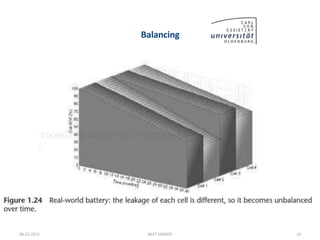
Balancing
08.10.2013 NEXT ENERGY 14
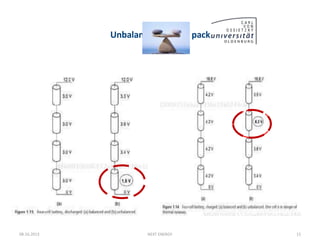
Unbalanced battery pack
08.10.2013 NEXT ENERGY 15
Balancing
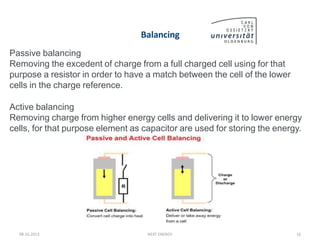
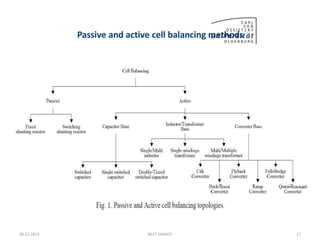
Passive balancing
Removing the excedent of charge from a full charged cell using for that
purpose a resistor in order to have a match between the cell of the lower
cells in the charge reference.
Active balancing
Removing charge from higher energy cells and delivering it to lower energy
cells, for that purpose element as capacitor are used for storing the energy.
08.10.2013 NEXT ENERGY 16
Passive and active cell balancing methods
08.10.2013 NEXT ENERGY 17
State of Health (SOH)
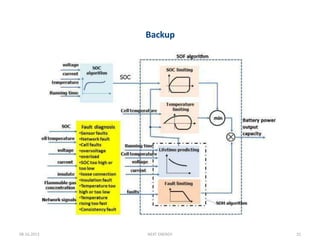
•Is a measure to analyze aging processes of the battery
•Is used to evaluate the battery value degradation
•Is an indicator of whether maintenance actions are needed
There are various methods to calculate the battery SOH using:
• battery impedance,
• battery capacity,
• charge/discharge cycles
• and calendar life
The aim is to predict the battery's healthy state
08.10.2013 NEXT ENERGY 18
BMS Implementation
Source:http://www.mpoweruk.com/bms.htm
08.10.2013 NEXT ENERGY 19
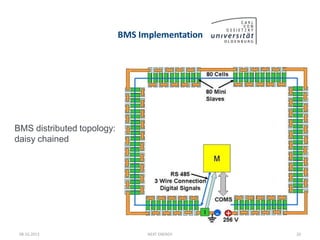
The Slaves –
Each cell has a
temperature sensor as
well as connections to
measure the voltage, all
of which are connected
to the slave which
monitors the condition of
the cell and implements
the cell balancing
BMS Implementation
BMS distributed topology:
daisy chained
08.10.2013 NEXT ENERGY 20
Conclusion
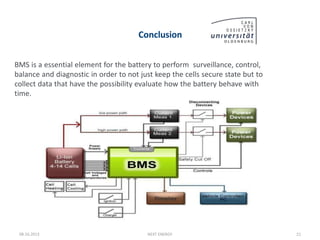
BMS is a essential element for the battery to perform surveillance, control,
balance and diagnostic in order to not just keep the cells secure state but to
collect data that have the possibility evaluate how the battery behave with
time.
08.10.2013 NEXT ENERGY 21
References
08.10.2013 NEXT ENERGY 22
[1]
[2]
Davide A. (2010): Battery Management Systems for Large Lithium Ion Battery Packs; Artech House, ISBN
1608071049
Speltino C. (2010): The Lithium-Ion Cell: Model State of Charge Estimation and Battery Management System;
Presentation at the University of Sannio Benevento
Lu l. et al. (2013) A review on the key issues for lithium-ion battery management in electric vehicles; Journal of
Power Sources 226 (2013) 272e288
Dai H. et al. (2012), A Hardware-in-the-Loop System for Development of Automotive Battery Management
System
Measuring Technology and Mechatronics Automation in Electrical Engineering Lecture Notes in Electrical
Engineering Volume 135, 2012, pp 27-36
Balakrishnan P. et al. (2006): Safety mechanisms in lithium-ion batteries; Journal of Power Sources 155
401– 414
Chiu P. et al. (2005): B#: a Battery Emulator and Power Profiling Instrument; IEEE Design & Test of
Computers March–April
Nec-Tokin (2009): Characteristics of Li-Ion Batteries; www.nec-tokin.com
Jossen A. et al. (2010) Reliable Battery Operation – A Challenge For the BMS; Journal of Power Sources
[3]
[4]
[5]
[6]
[7]
[8]
Thanks for your attention!
08.10.2013 NEXT ENERGY 23
Backup
08.10.2013 NEXT ENERGY 24
Backup
08.10.2013 NEXT ENERGY 25

battery management system.ppt

  • 1.
  • 2.
    Content • Motivation • SafeOperation Area • Battery Management System • BMS Key Functions • General Functions • Balancing • Performance • Conclusion 08.10.2013 NEXT ENERGY 2
  • 3.
    Motivation ● Batteries arekey. ● Vital, the global market for storing power is forecast to explode ● Batteries face issues like safety and cost ● Lithium-ion batteries aboard two Boeing 787s jets failed in January, causing a fire on one and smoke on the other ● Li-ion batteries are fragile and a protection circuit is required to assure safety, even if they can provide super-high capacity. 08.10.2013 NEXT ENERGY 3
  • 4.
  • 5.
    Safe Operation Areafor a Li-Ion Cell 08.10.2013 NEXT ENERGY 5
  • 6.
    Battery Management System(BMS) BMS system has for objective: • Protection and prevention of the system from damage • Increase of battery life • Maintenance of the battery system in accurate and reliable state • BMS = Battery Doctor 08.10.2013 NEXT ENERGY 6
  • 7.
    BMS Key Functions BMSkey functions Balancing 08.10.2013 NEXT ENERGY 7
  • 8.
  • 9.
  • 10.
    State of Charge(SOC) The State of charge is the available capacity, it also called "Gas Gauge" or "Fuel Gauge" function Of the various techniques for estimating SOC, two are: •The battery voltage translation •The battery current integration ("Coulomb Counting") 08.10.2013 NEXT ENERGY 10
  • 11.
    State of Charge Amajor factors that can influence the SOC of a Lithium Batteries is the useable capacity of a cell, is not constant but varies significantly with temperature The ratio of the currently available capacity to the maximum capacity can be expressed as SOC Where i is the current, and n C is the maximum capacity that the battery can hold. 08.10.2013 NEXT ENERGY 11
  • 12.
  • 13.
  • 14.
  • 15.
  • 16.
    Balancing Passive balancing Removing theexcedent of charge from a full charged cell using for that purpose a resistor in order to have a match between the cell of the lower cells in the charge reference. Active balancing Removing charge from higher energy cells and delivering it to lower energy cells, for that purpose element as capacitor are used for storing the energy. 08.10.2013 NEXT ENERGY 16
  • 17.
    Passive and activecell balancing methods 08.10.2013 NEXT ENERGY 17
  • 18.
    State of Health(SOH) •Is a measure to analyze aging processes of the battery •Is used to evaluate the battery value degradation •Is an indicator of whether maintenance actions are needed There are various methods to calculate the battery SOH using: • battery impedance, • battery capacity, • charge/discharge cycles • and calendar life The aim is to predict the battery's healthy state 08.10.2013 NEXT ENERGY 18
  • 19.
    BMS Implementation Source:http://www.mpoweruk.com/bms.htm 08.10.2013 NEXTENERGY 19 The Slaves – Each cell has a temperature sensor as well as connections to measure the voltage, all of which are connected to the slave which monitors the condition of the cell and implements the cell balancing
  • 20.
    BMS Implementation BMS distributedtopology: daisy chained 08.10.2013 NEXT ENERGY 20
  • 21.
    Conclusion BMS is aessential element for the battery to perform surveillance, control, balance and diagnostic in order to not just keep the cells secure state but to collect data that have the possibility evaluate how the battery behave with time. 08.10.2013 NEXT ENERGY 21
  • 22.
    References 08.10.2013 NEXT ENERGY22 [1] [2] Davide A. (2010): Battery Management Systems for Large Lithium Ion Battery Packs; Artech House, ISBN 1608071049 Speltino C. (2010): The Lithium-Ion Cell: Model State of Charge Estimation and Battery Management System; Presentation at the University of Sannio Benevento Lu l. et al. (2013) A review on the key issues for lithium-ion battery management in electric vehicles; Journal of Power Sources 226 (2013) 272e288 Dai H. et al. (2012), A Hardware-in-the-Loop System for Development of Automotive Battery Management System Measuring Technology and Mechatronics Automation in Electrical Engineering Lecture Notes in Electrical Engineering Volume 135, 2012, pp 27-36 Balakrishnan P. et al. (2006): Safety mechanisms in lithium-ion batteries; Journal of Power Sources 155 401– 414 Chiu P. et al. (2005): B#: a Battery Emulator and Power Profiling Instrument; IEEE Design & Test of Computers March–April Nec-Tokin (2009): Characteristics of Li-Ion Batteries; www.nec-tokin.com Jossen A. et al. (2010) Reliable Battery Operation – A Challenge For the BMS; Journal of Power Sources [3] [4] [5] [6] [7] [8]
  • 23.
    Thanks for yourattention! 08.10.2013 NEXT ENERGY 23
  • 24.
  • 25.