International Research Journal of Engineering and Technology (IRJET) e-ISSN: 2395-0056
Volume: 09 Issue: 04 | Apr 2022 www.irjet.net p-ISSN: 2395-0072
© 2022, IRJET | Impact Factor value: 7.529 | ISO 9001:2008 Certified Journal | Page 512
Battery Management System – Hardware Design
Raj Patel1, Seema Talmale2
1Student, Dept of Electronics Engineering, K.J. Somaiya College of Engineering, Mumbai, India
2Professor, Dept of Electronics Engineering, K.J. Somaiya College of Engineering, Mumbai, India
---------------------------------------------------------------------***---------------------------------------------------------------------
Abstract — Battery management system (BMS) is used in
Electric Vehicles (EV) and Energy Storage Systems to
monitor and control the charging and discharging of
rechargeable batteries. BMS keeps the battery safe and
reliable and increases the stability without going into
damaging state. The state of the battery is maintained by
monitoring voltage, current, and the ambient temperature.
For monitoring purpose, data is obtained from various
analog/digital sensors and processed through the
microcontroller.
Introduction
In the imminent future, Electric Vehicles will be the leading
form of transportation.Lithium-basedrechargeable batteries
will be widely used. These battery packs will need to be
constantly monitored and managed in order to maintain the
safety, efficiency and reliability of the whole electric vehicle.
A battery management system consists of: (1) a battery level
monitoring system (2) optimal charging algorithm and (3) a
cell/thermal balancing circuitry. The voltage, current and
temperature measurements are used to estimate all crucial
states and parameters of the battery system, such as the
battery impedance and capacity, state of health, state of
charge, and the remaining useful life.
BMS
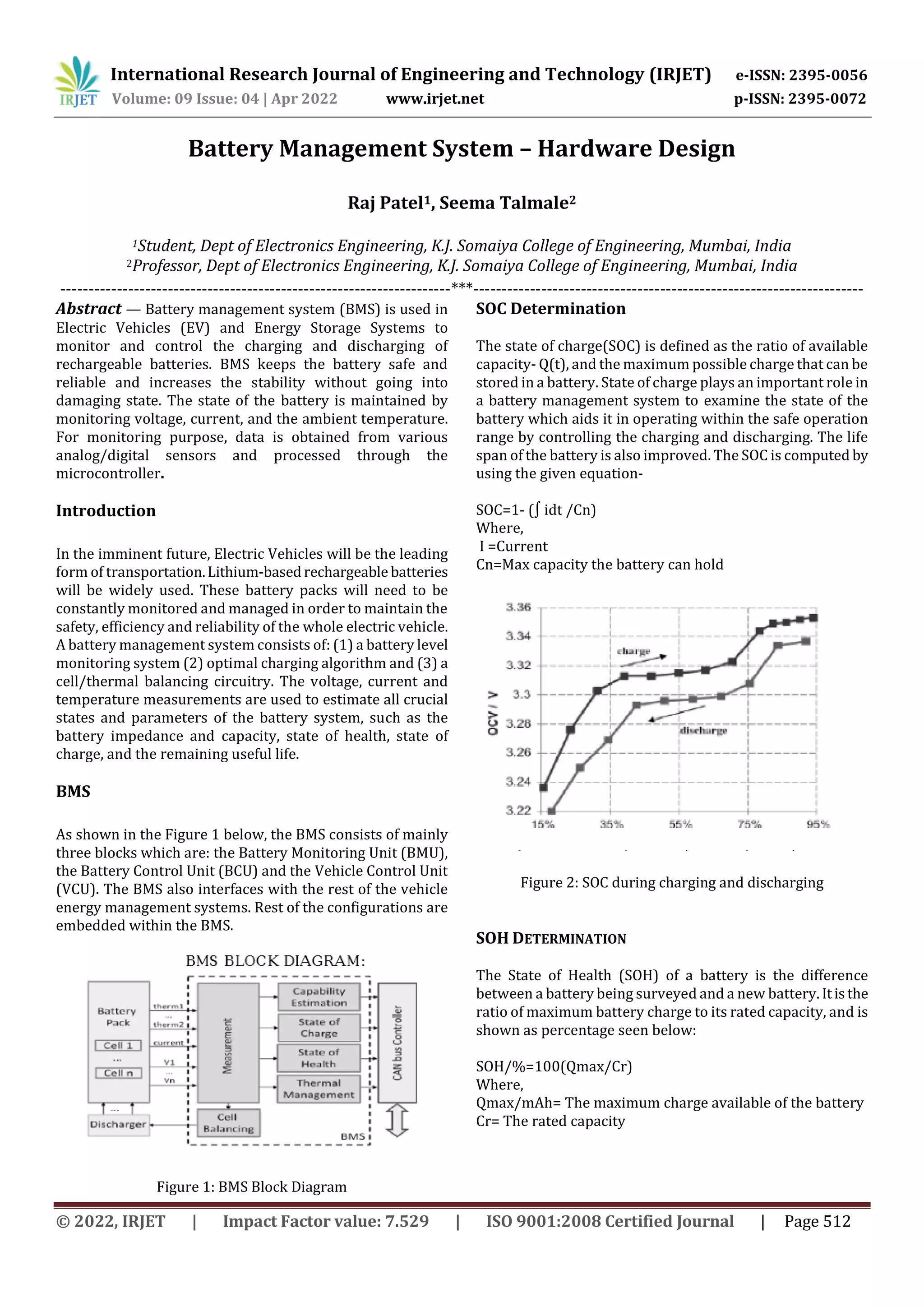
As shown in the Figure 1 below, the BMS consists of mainly
three blocks which are: the Battery Monitoring Unit (BMU),
the Battery Control Unit (BCU) and the Vehicle Control Unit
(VCU). The BMS also interfaces with the rest of the vehicle
energy management systems. Rest of the configurations are
embedded within the BMS.
Figure 1: BMS Block Diagram
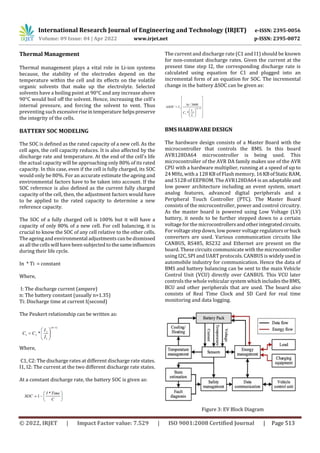
SOC Determination
The state of charge(SOC) is defined as the ratio of available
capacity- Q(t), and the maximum possible charge that can be
stored in a battery. State of charge plays an important role in
a battery management system to examine the state of the
battery which aids it in operating within the safe operation
range by controlling the charging and discharging. The life
span of the battery is also improved. The SOC is computed by
using the given equation-
SOC=1- (∫ idt /Cn)
Where,
I =Current
Cn=Max capacity the battery can hold
Figure 2: SOC during charging and discharging
SOH DETERMINATION
The State of Health (SOH) of a battery is the difference
between a battery being surveyed and a new battery. Itisthe
ratio of maximum battery charge to its rated capacity, and is
shown as percentage seen below:
SOH/%=100(Qmax/Cr)
Where,
Qmax/mAh= The maximum charge available of the battery
Cr= The rated capacity
International Research Journal of Engineering and Technology (IRJET) e-ISSN: 2395-0056
Volume: 09 Issue: 04 | Apr 2022 www.irjet.net p-ISSN: 2395-0072
© 2022, IRJET | Impact Factor value: 7.529 | ISO 9001:2008 Certified Journal | Page 513
Thermal Management
Thermal management plays a vital role in Li-ion systems
because, the stability of the electrodes depend on the
temperature within the cell and its effects on the volatile
organic solvents that make up the electrolyte. Selected
solvents have a boiling point at 90°C and any increase above
90°C would boil off the solvent. Hence, increasing the cell's
internal pressure, and forcing the solvent to vent. Thus
preventing such excessiveriseintemperature helpspreserve
the integrity of the cells.
BATTERY SOC MODELING
The SOC is defined as the rated capacity of a new cell. As the
cell ages, the cell capacity reduces. It is also affected by the
discharge rate and temperature. At the end of the cell's life
the actual capacity will be approaching only 80% of its rated
capacity. In this case, even if the cell is fully charged, its SOC
would only be 80%. For an accurate estimate the ageing and
environmental factors have to be taken into account. If the
SOC reference is also defined as the current fully charged
capacity of the cell, then, the adjustment factors would have
to be applied to the rated capacity to determine a new
reference capacity.
The SOC of a fully charged cell is 100% but it will have a
capacity of only 80% of a new cell. For cell balancing, it is
crucial to know the SOC of any cell relative to the other cells.
The ageing and environmental adjustments can be dismissed
asall the cells will have been subjected to the sameinfluences
during their life cycle.
In * Ti = constant
Where,
I: The discharge current (ampere)
n: The battery constant (usually n=1.35)
Ti: Discharge time at current I(second)
The Peukert relationship can be written as:
Where,
C1, C2: The discharge rates at different discharge rate states.
I1, I2: The current at the two different discharge rate states.
At a constant discharge rate, the battery SOC is given as:
The current and discharge rate (C1 and I1) should be known
for non-constant discharge rates. Given the current at the
present time step I2, the corresponding discharge rate is
calculated using equation for C1 and plugged into an
incremental form of an equation for SOC. The incremental
change in the battery ΔSOC can be given as:
BMS HARDWARE DESIGN
The hardware design consists of a Master Board with the
microcontroller that controls the BMS. In this board
AVR128DA64 microcontroller is being used. This
microcontroller of the AVR DA family makes use of the AVR
CPU with a hardware multiplier, running at a speed of up to
24 MHz, with a 128 KB of Flash memory, 16KBofStaticRAM,
and 512B of EEPROM. The AVR128DA64 is an adaptable and
low power architecture including an event system, smart
analog features, advanced digital peripherals and a
Peripheral Touch Controller (PTC). The Master Board
consists of the microcontroller, power and control circuitry.
As the master board is powered using Low Voltage (LV)
battery, it needs to be further stepped down to a certain
voltage for the microcontrollersandotherintegratedcircuits.
For voltage step down, low power voltage regulatorsorbuck
converters are used. Various communication circuits like
CANBUS, RS485, RS232 and Ethernet are present on the
board. These circuits communicate with the microcontroller
using I2C, SPI and UART protocols. CANBUS is widelyusedin
automobile industry for communication. Hence the data of
BMS and battery balancing can be sent to the main Vehicle
Control Unit (VCU) directly over CANBUS. This VCU later
controls the whole vehicular system whichincludestheBMS,
BCU and other peripherals that are used. The board also
consists of Real Time Clock and SD Card for real time
monitoring and data logging.
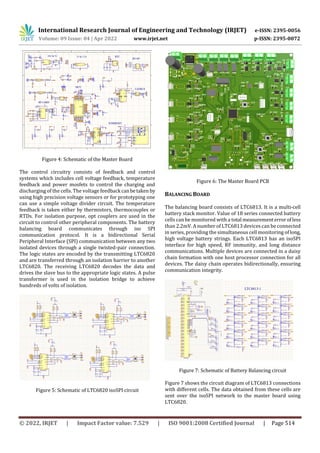
Figure 3: EV Block Diagram
International Research Journal of Engineering and Technology (IRJET) e-ISSN: 2395-0056
Volume: 09 Issue: 04 | Apr 2022 www.irjet.net p-ISSN: 2395-0072
© 2022, IRJET | Impact Factor value: 7.529 | ISO 9001:2008 Certified Journal | Page 514
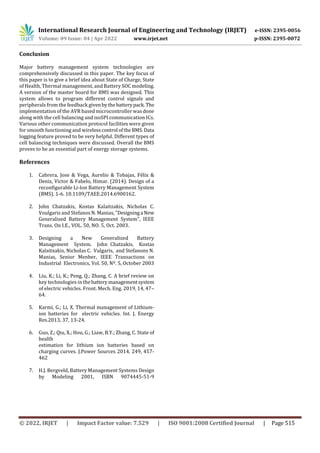
Figure 4: Schematic of the Master Board
The control circuitry consists of feedback and control
systems which includes cell voltage feedback, temperature
feedback and power mosfets to control the charging and
discharging of the cells. The voltage feedback canbetaken by
using high precision voltage sensors or for prototyping one
can use a simple voltage divider circuit. The temperature
feedback is taken either by thermistors, thermocouples or
RTDs. For isolation purpose, opt couplers are used in the
circuit to control other peripheral components. The battery
balancing board communicates through iso SPI
communication protocol. It is a bidirectional Serial
Peripheral Interface (SPI) communication between any two
isolated devices through a single twisted-pair connection.
The logic states are encoded by the transmitting LTC6820
and are transferred through an isolation barrier to another
LTC6820. The receiving LTC6820 decodes the data and
drives the slave bus to the appropriate logic states. A pulse
transformer is used in the isolation bridge to achieve
hundreds of volts of isolation.
Figure 5: Schematic of LTC6820 isoSPI circuit
Figure 6: The Master Board PCB
BALANCING BOARD
The balancing board consists of LTC6813. It is a multi-cell
battery stack monitor. Value of 18 series connected battery
cells can be monitored with a total measurementerrorofless
than 2.2mV. A number of LTC6813 devices can be connected
in series, providing the simultaneous cell monitoring oflong,
high voltage battery strings. Each LTC6813 has an isoSPI
interface for high speed, RF immunity, and long distance
communications. Multiple devices are connected in a daisy
chain formation with one host processor connection for all
devices. The daisy chain operates bidirectionally, ensuring
communication integrity.
Figure 7: Schematic of Battery Balancing circuit
Figure 7 shows the circuit diagram of LTC6813 connections
with different cells. The data obtained from these cells are
sent over the isoSPI network to the master board using
LTC6820.
International Research Journal of Engineering and Technology (IRJET) e-ISSN: 2395-0056
Volume: 09 Issue: 04 | Apr 2022 www.irjet.net p-ISSN: 2395-0072
© 2022, IRJET | Impact Factor value: 7.529 | ISO 9001:2008 Certified Journal | Page 515
Conclusion
Major battery management system technologies are
comprehensively discussed in this paper. The key focus of
this paper is to give a brief idea about State of Charge, State
of Health, Thermal management, and Battery SOC modeling.
A version of the master board for BMS was designed. This
system allows to program different control signals and
peripherals from the feedback givenbythebatterypack. The
implementation of the AVR based microcontroller was done
along with the cell balancing and isoSPI communication ICs.
Various other communication protocol facilities were given
for smooth functioning and wirelesscontrol oftheBMS. Data
logging feature proved to be very helpful. Different types of
cell balancing techniques were discussed. Overall the BMS
proves to be an essential part of energy storage systems.
References
1. Cabrera, Jose & Vega, Aurelio & Tobajas, Félix &
Deniz, Victor & Fabelo, Himar. (2014). Design of a
reconfigurable Li-Ion Battery Management System
(BMS). 1-6. 10.1109/TAEE.2014.6900162.
2. John Chatzakis, Kostas Kalaitzakis, Nicholas C.
Voulgaris and Stefanos N. Manias, "Designinga New
Generalized Battery Management System", IEEE
Trans. On I.E., VOL. 50, NO. 5, Oct. 2003.
3. Designing a New Generalized Battery
Management System. John Chatzakis, Kostas
Kalaitxakis, Nicholas C. Vulgaris, and Stefanons N.
Manias, Senior Menber, IEEE Transactions on
Industrial Electronics, Vol. 50, Nº. 5, October 2003
4. Liu, K.; Li, K.; Peng, Q.; Zhang, C. A brief review on
key technologies in the batterymanagementsystem
of electric vehicles. Front. Mech. Eng. 2019, 14, 47–
64.
5. Karmi, G.; Li, X. Thermal management of Lithium-
ion batteries for electric vehicles. Int. J. Energy
Res.2013, 37, 13-24.
6. Guo, Z.; Qiu, X.; Hou, G.; Liaw, B.Y.; Zhang, C. State of
health
estimation for lithium ion batteries based on
charging curves. J.Power Sources 2014, 249, 457-
462
7. H.J. Bergveld, Battery Management Systems Design
by Modeling 2001, ISBN 9074445-51-9

Battery Management System– Hardware Design

  • 1.
    International Research Journalof Engineering and Technology (IRJET) e-ISSN: 2395-0056 Volume: 09 Issue: 04 | Apr 2022 www.irjet.net p-ISSN: 2395-0072 © 2022, IRJET | Impact Factor value: 7.529 | ISO 9001:2008 Certified Journal | Page 512 Battery Management System – Hardware Design Raj Patel1, Seema Talmale2 1Student, Dept of Electronics Engineering, K.J. Somaiya College of Engineering, Mumbai, India 2Professor, Dept of Electronics Engineering, K.J. Somaiya College of Engineering, Mumbai, India ---------------------------------------------------------------------***--------------------------------------------------------------------- Abstract — Battery management system (BMS) is used in Electric Vehicles (EV) and Energy Storage Systems to monitor and control the charging and discharging of rechargeable batteries. BMS keeps the battery safe and reliable and increases the stability without going into damaging state. The state of the battery is maintained by monitoring voltage, current, and the ambient temperature. For monitoring purpose, data is obtained from various analog/digital sensors and processed through the microcontroller. Introduction In the imminent future, Electric Vehicles will be the leading form of transportation.Lithium-basedrechargeable batteries will be widely used. These battery packs will need to be constantly monitored and managed in order to maintain the safety, efficiency and reliability of the whole electric vehicle. A battery management system consists of: (1) a battery level monitoring system (2) optimal charging algorithm and (3) a cell/thermal balancing circuitry. The voltage, current and temperature measurements are used to estimate all crucial states and parameters of the battery system, such as the battery impedance and capacity, state of health, state of charge, and the remaining useful life. BMS As shown in the Figure 1 below, the BMS consists of mainly three blocks which are: the Battery Monitoring Unit (BMU), the Battery Control Unit (BCU) and the Vehicle Control Unit (VCU). The BMS also interfaces with the rest of the vehicle energy management systems. Rest of the configurations are embedded within the BMS. Figure 1: BMS Block Diagram SOC Determination The state of charge(SOC) is defined as the ratio of available capacity- Q(t), and the maximum possible charge that can be stored in a battery. State of charge plays an important role in a battery management system to examine the state of the battery which aids it in operating within the safe operation range by controlling the charging and discharging. The life span of the battery is also improved. The SOC is computed by using the given equation- SOC=1- (∫ idt /Cn) Where, I =Current Cn=Max capacity the battery can hold Figure 2: SOC during charging and discharging SOH DETERMINATION The State of Health (SOH) of a battery is the difference between a battery being surveyed and a new battery. Itisthe ratio of maximum battery charge to its rated capacity, and is shown as percentage seen below: SOH/%=100(Qmax/Cr) Where, Qmax/mAh= The maximum charge available of the battery Cr= The rated capacity
  • 2.
    International Research Journalof Engineering and Technology (IRJET) e-ISSN: 2395-0056 Volume: 09 Issue: 04 | Apr 2022 www.irjet.net p-ISSN: 2395-0072 © 2022, IRJET | Impact Factor value: 7.529 | ISO 9001:2008 Certified Journal | Page 513 Thermal Management Thermal management plays a vital role in Li-ion systems because, the stability of the electrodes depend on the temperature within the cell and its effects on the volatile organic solvents that make up the electrolyte. Selected solvents have a boiling point at 90°C and any increase above 90°C would boil off the solvent. Hence, increasing the cell's internal pressure, and forcing the solvent to vent. Thus preventing such excessiveriseintemperature helpspreserve the integrity of the cells. BATTERY SOC MODELING The SOC is defined as the rated capacity of a new cell. As the cell ages, the cell capacity reduces. It is also affected by the discharge rate and temperature. At the end of the cell's life the actual capacity will be approaching only 80% of its rated capacity. In this case, even if the cell is fully charged, its SOC would only be 80%. For an accurate estimate the ageing and environmental factors have to be taken into account. If the SOC reference is also defined as the current fully charged capacity of the cell, then, the adjustment factors would have to be applied to the rated capacity to determine a new reference capacity. The SOC of a fully charged cell is 100% but it will have a capacity of only 80% of a new cell. For cell balancing, it is crucial to know the SOC of any cell relative to the other cells. The ageing and environmental adjustments can be dismissed asall the cells will have been subjected to the sameinfluences during their life cycle. In * Ti = constant Where, I: The discharge current (ampere) n: The battery constant (usually n=1.35) Ti: Discharge time at current I(second) The Peukert relationship can be written as: Where, C1, C2: The discharge rates at different discharge rate states. I1, I2: The current at the two different discharge rate states. At a constant discharge rate, the battery SOC is given as: The current and discharge rate (C1 and I1) should be known for non-constant discharge rates. Given the current at the present time step I2, the corresponding discharge rate is calculated using equation for C1 and plugged into an incremental form of an equation for SOC. The incremental change in the battery ΔSOC can be given as: BMS HARDWARE DESIGN The hardware design consists of a Master Board with the microcontroller that controls the BMS. In this board AVR128DA64 microcontroller is being used. This microcontroller of the AVR DA family makes use of the AVR CPU with a hardware multiplier, running at a speed of up to 24 MHz, with a 128 KB of Flash memory, 16KBofStaticRAM, and 512B of EEPROM. The AVR128DA64 is an adaptable and low power architecture including an event system, smart analog features, advanced digital peripherals and a Peripheral Touch Controller (PTC). The Master Board consists of the microcontroller, power and control circuitry. As the master board is powered using Low Voltage (LV) battery, it needs to be further stepped down to a certain voltage for the microcontrollersandotherintegratedcircuits. For voltage step down, low power voltage regulatorsorbuck converters are used. Various communication circuits like CANBUS, RS485, RS232 and Ethernet are present on the board. These circuits communicate with the microcontroller using I2C, SPI and UART protocols. CANBUS is widelyusedin automobile industry for communication. Hence the data of BMS and battery balancing can be sent to the main Vehicle Control Unit (VCU) directly over CANBUS. This VCU later controls the whole vehicular system whichincludestheBMS, BCU and other peripherals that are used. The board also consists of Real Time Clock and SD Card for real time monitoring and data logging. Figure 3: EV Block Diagram
  • 3.
    International Research Journalof Engineering and Technology (IRJET) e-ISSN: 2395-0056 Volume: 09 Issue: 04 | Apr 2022 www.irjet.net p-ISSN: 2395-0072 © 2022, IRJET | Impact Factor value: 7.529 | ISO 9001:2008 Certified Journal | Page 514 Figure 4: Schematic of the Master Board The control circuitry consists of feedback and control systems which includes cell voltage feedback, temperature feedback and power mosfets to control the charging and discharging of the cells. The voltage feedback canbetaken by using high precision voltage sensors or for prototyping one can use a simple voltage divider circuit. The temperature feedback is taken either by thermistors, thermocouples or RTDs. For isolation purpose, opt couplers are used in the circuit to control other peripheral components. The battery balancing board communicates through iso SPI communication protocol. It is a bidirectional Serial Peripheral Interface (SPI) communication between any two isolated devices through a single twisted-pair connection. The logic states are encoded by the transmitting LTC6820 and are transferred through an isolation barrier to another LTC6820. The receiving LTC6820 decodes the data and drives the slave bus to the appropriate logic states. A pulse transformer is used in the isolation bridge to achieve hundreds of volts of isolation. Figure 5: Schematic of LTC6820 isoSPI circuit Figure 6: The Master Board PCB BALANCING BOARD The balancing board consists of LTC6813. It is a multi-cell battery stack monitor. Value of 18 series connected battery cells can be monitored with a total measurementerrorofless than 2.2mV. A number of LTC6813 devices can be connected in series, providing the simultaneous cell monitoring oflong, high voltage battery strings. Each LTC6813 has an isoSPI interface for high speed, RF immunity, and long distance communications. Multiple devices are connected in a daisy chain formation with one host processor connection for all devices. The daisy chain operates bidirectionally, ensuring communication integrity. Figure 7: Schematic of Battery Balancing circuit Figure 7 shows the circuit diagram of LTC6813 connections with different cells. The data obtained from these cells are sent over the isoSPI network to the master board using LTC6820.
  • 4.
    International Research Journalof Engineering and Technology (IRJET) e-ISSN: 2395-0056 Volume: 09 Issue: 04 | Apr 2022 www.irjet.net p-ISSN: 2395-0072 © 2022, IRJET | Impact Factor value: 7.529 | ISO 9001:2008 Certified Journal | Page 515 Conclusion Major battery management system technologies are comprehensively discussed in this paper. The key focus of this paper is to give a brief idea about State of Charge, State of Health, Thermal management, and Battery SOC modeling. A version of the master board for BMS was designed. This system allows to program different control signals and peripherals from the feedback givenbythebatterypack. The implementation of the AVR based microcontroller was done along with the cell balancing and isoSPI communication ICs. Various other communication protocol facilities were given for smooth functioning and wirelesscontrol oftheBMS. Data logging feature proved to be very helpful. Different types of cell balancing techniques were discussed. Overall the BMS proves to be an essential part of energy storage systems. References 1. Cabrera, Jose & Vega, Aurelio & Tobajas, Félix & Deniz, Victor & Fabelo, Himar. (2014). Design of a reconfigurable Li-Ion Battery Management System (BMS). 1-6. 10.1109/TAEE.2014.6900162. 2. John Chatzakis, Kostas Kalaitzakis, Nicholas C. Voulgaris and Stefanos N. Manias, "Designinga New Generalized Battery Management System", IEEE Trans. On I.E., VOL. 50, NO. 5, Oct. 2003. 3. Designing a New Generalized Battery Management System. John Chatzakis, Kostas Kalaitxakis, Nicholas C. Vulgaris, and Stefanons N. Manias, Senior Menber, IEEE Transactions on Industrial Electronics, Vol. 50, Nº. 5, October 2003 4. Liu, K.; Li, K.; Peng, Q.; Zhang, C. A brief review on key technologies in the batterymanagementsystem of electric vehicles. Front. Mech. Eng. 2019, 14, 47– 64. 5. Karmi, G.; Li, X. Thermal management of Lithium- ion batteries for electric vehicles. Int. J. Energy Res.2013, 37, 13-24. 6. Guo, Z.; Qiu, X.; Hou, G.; Liaw, B.Y.; Zhang, C. State of health estimation for lithium ion batteries based on charging curves. J.Power Sources 2014, 249, 457- 462 7. H.J. Bergveld, Battery Management Systems Design by Modeling 2001, ISBN 9074445-51-9