Abstract
 Accurate measurement of Li-Ion battery cycles for Battery Management
Systems (BMS).
 A machine learning model is created to establish the relationship between
the Health Index (HI) and the State of Health (SOH)
 This study offers an analysis of the methodologies used to estimate the
state of health (SOH) of batteries, highlighting their primary benefits and
identifying their limits in terms of real-time compatibility with automotive
systems, particularly in hybrid electric applications.
S. Karthkikumar et. al. ICEEICT 2024
 Subsequently, a machine learning model is constructed to establish the
correlation between the HI and SOH
 This paper suggests utilizing a partial charge and discharge current
sequence based on data analytics of battery aging data
 The estimation accuracy is fully tested by considering the selected
charging and discharging capacity
S. Karthkikumar et. al. ICEEICT 2024
Introduction
Working of lithium ion Battery
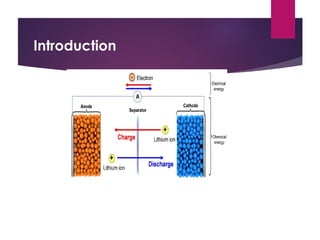
 When the battery is charging up, the lithium-cobalt oxide,
positiveelectrode gives up some of its lithium ions, which move
through the electrolyte to the negative, graphite electrode and
remain there. The battery takes in and stores energy during this
process. When the battery is discharging, the lithium ions move
back across the electrolyte to the positive electrode, producing
the energy that powers the battery. In both cases, electrons flow
in the opposite direction to the ions around the outer circuit.
Electrons do not flow through the electrolyte: it's effectively an
insulating barrier, so far as electrons are concerned.
S. Karthkikumar et. al. ICEEICT 2024
A Battery Management System (BMS)
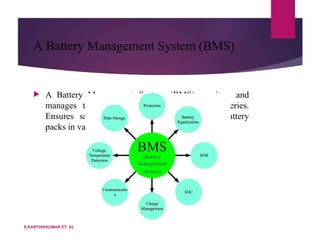
 A Battery Management System (BMS) monitors and
manages the performance of rechargeable batteries.
Ensures safety, efficiency, and longevity of battery
packs in various applications
S.KARTHIKKUMAR ET. AL
 A battery management system (BMS) is an electronic
system that manages a rechargeable battery by monitoring
its state, calculating its secondary data, reporting that data
and controlling its environment ¹.
 The functions of a BMS include Monitoring the battery
voltage, temperature, coolant flow and current- Computing
the battery's state of charge, state of health, state of power
and safety- Communicating with other devices
 Protecting the battery from damage- Balancing the voltage
of the cells in the battery A BMS can be used to prevent a
battery from operating outside its safe operating area, such
as Overcharging- Over-discharging- Overheating- Over-
current- Under-voltage
S.KARTHIKKUMAR ET. AL
 Battery Management System (BMS) performs the following
functions:
 Monitoring: - Voltage - Temperature - Current - State of
Charge (SOC) - State of Health (SOH) - State of Power (SOP)
 Cell Balancing: - Ensures equal voltage across all cells in a
battery pack
 Overcharge/Over-discharge Protection: - Prevents damage from
excessive charging or discharging
 Overheating Protection: - Monitors temperature and prevents
damage from excessive heat
 Short Circuit Protection: - Detects and prevents short circuits6.
S.KARTHIKKUMAR ET. AL
 Ground Fault Detection: - Detects electrical faults in the battery
or connected equipment
 Charge/Discharge Control: - Regulates charging and discharging
rates
 Communication: - Provides data to external devices (e.g.,
vehicles, inverters, or charging stations)
 Safety Functions: - Shutdown or warning in case of malfunction
or error
 Diagnostic and Maintenance: - Self-diagnostic capabilities and
maintenance alertsBy performing these functions, a BMS ensures
safe, efficient, and reliable operation of batteries in various
applications.
s.karthikkumar et. al
Battery Management Systems (BMS) can be
connected with Artificial Intelligence (AI)
 Predictive Maintenance: AI algorithms can analyze data from the BMS to
predict potential battery failures or degradation, allowing for proactive
maintenance.
 Optimized Charging: AI can optimize charging schedules based on usage
patterns, reducing wear and tear on the battery.
 State of Charge (SOC) Estimation: AI algorithms can improve SOC estimation,
ensuring accurate battery state monitoring.
 Anomaly Detection: AI-powered BMS can detect unusual battery behavior,
indicating potential issues.
 Cell Balancing: AI can optimize cell balancing, ensuring equal wear and
extending battery lifespan.
 Energy Optimization: AI can optimize energy usage and storage, reducing
waste and improving efficiency.
 Battery Health Assessment: AI can evaluate battery health and provide
recommendations for improvement.
. Pragaspathy et. al. ICPECTS 2022
 Smart Grid Integration: AI-enabled BMS can interact with
smart grids, optimizing energy distribution and storage.
 Autonomous Vehicles: AI-powered BMS can enhance electric
vehicle performance, range, and safety.
 Data Analytics: AI can provide insights into battery
performance, usage patterns, and maintenance needs.
S.KARTHIKKUMAR ET. AL
The K-Nearest Neighbor (KNN) algorithm is a machine learning
technique used in battery management systems (BMS)
 -tate of Charge (SOC) Estimation: KNN can estimate the SOC of lithium-ion
batteries with high accuracy, outperforming traditional methods like the
extended Kalman filter (EKF).-
 Anomaly Detection: KNN can identify unusual patterns in battery behavior,
enabling the detection of anomalies and potential faults.-
 Cell Balancing: KNN can help balance battery cells by predicting the state of
charge and state of health of individual cells.-
 Remaining Useful Life (RUL) Prediction: KNN can estimate the remaining
lifespan of batteries based on their usage and degradation patterns.
 - Temperature Estimation: KNN can predict battery temperatures, which is
essential for safe and efficient battery operation.-
 Capacity Estimation: KNN can estimate the capacity of lithium-ion batteries,
which is crucial for determining the state of charge and state of health.-
 Health Diagnosis: KNN can diagnose battery health by analyzing various
parameters and predicting potential issues.
 Power Prediction: KNN can forecast the available power of batteries, enabling
optimal battery utilization.
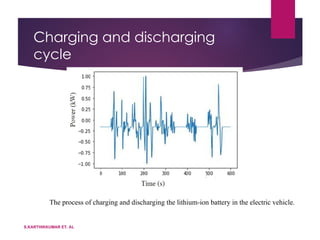
Charging and discharging
cycle
S.KARTHIKKUMAR ET. AL
The process of charging and discharging the lithium-ion battery in the electric vehicle.
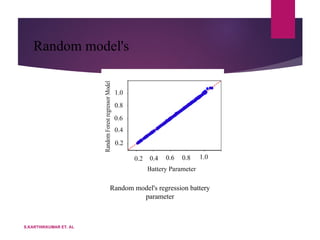
Random model's
S.KARTHIKKUMAR ET. AL
Random model's regression battery
parameter
Random model's
 Machine-learning based methods have been widely
used for battery health state monitoring.
 The random forest regression is solely based on
signals, such as the measured current, voltage and
time, that are available onboard during typical
battery operation. The collected raw data can be
directly fed into the trained model without any pre-
processing, leading to a low computational cost.
S.KARTHIKKUMAR ET. AL
Conclusion
The state of the Li-ion battery may be accurately
determined by utilizing random forest regression.
As the dataset grows larger, a comparable
application with improved features and more
samples may necessitate greater computational
power and complexity.
S.KARTHIKKUMAR ET. AL

AI-powered algorithms analyze medical images

  • 1.
    Abstract  Accurate measurementof Li-Ion battery cycles for Battery Management Systems (BMS).  A machine learning model is created to establish the relationship between the Health Index (HI) and the State of Health (SOH)  This study offers an analysis of the methodologies used to estimate the state of health (SOH) of batteries, highlighting their primary benefits and identifying their limits in terms of real-time compatibility with automotive systems, particularly in hybrid electric applications. S. Karthkikumar et. al. ICEEICT 2024
  • 2.
     Subsequently, amachine learning model is constructed to establish the correlation between the HI and SOH  This paper suggests utilizing a partial charge and discharge current sequence based on data analytics of battery aging data  The estimation accuracy is fully tested by considering the selected charging and discharging capacity S. Karthkikumar et. al. ICEEICT 2024
  • 3.
  • 4.
    Working of lithiumion Battery  When the battery is charging up, the lithium-cobalt oxide, positiveelectrode gives up some of its lithium ions, which move through the electrolyte to the negative, graphite electrode and remain there. The battery takes in and stores energy during this process. When the battery is discharging, the lithium ions move back across the electrolyte to the positive electrode, producing the energy that powers the battery. In both cases, electrons flow in the opposite direction to the ions around the outer circuit. Electrons do not flow through the electrolyte: it's effectively an insulating barrier, so far as electrons are concerned. S. Karthkikumar et. al. ICEEICT 2024
  • 5.
    A Battery ManagementSystem (BMS)  A Battery Management System (BMS) monitors and manages the performance of rechargeable batteries. Ensures safety, efficiency, and longevity of battery packs in various applications S.KARTHIKKUMAR ET. AL
  • 6.
     A batterymanagement system (BMS) is an electronic system that manages a rechargeable battery by monitoring its state, calculating its secondary data, reporting that data and controlling its environment ¹.  The functions of a BMS include Monitoring the battery voltage, temperature, coolant flow and current- Computing the battery's state of charge, state of health, state of power and safety- Communicating with other devices  Protecting the battery from damage- Balancing the voltage of the cells in the battery A BMS can be used to prevent a battery from operating outside its safe operating area, such as Overcharging- Over-discharging- Overheating- Over- current- Under-voltage S.KARTHIKKUMAR ET. AL
  • 7.
     Battery ManagementSystem (BMS) performs the following functions:  Monitoring: - Voltage - Temperature - Current - State of Charge (SOC) - State of Health (SOH) - State of Power (SOP)  Cell Balancing: - Ensures equal voltage across all cells in a battery pack  Overcharge/Over-discharge Protection: - Prevents damage from excessive charging or discharging  Overheating Protection: - Monitors temperature and prevents damage from excessive heat  Short Circuit Protection: - Detects and prevents short circuits6. S.KARTHIKKUMAR ET. AL
  • 8.
     Ground FaultDetection: - Detects electrical faults in the battery or connected equipment  Charge/Discharge Control: - Regulates charging and discharging rates  Communication: - Provides data to external devices (e.g., vehicles, inverters, or charging stations)  Safety Functions: - Shutdown or warning in case of malfunction or error  Diagnostic and Maintenance: - Self-diagnostic capabilities and maintenance alertsBy performing these functions, a BMS ensures safe, efficient, and reliable operation of batteries in various applications. s.karthikkumar et. al
  • 9.
    Battery Management Systems(BMS) can be connected with Artificial Intelligence (AI)  Predictive Maintenance: AI algorithms can analyze data from the BMS to predict potential battery failures or degradation, allowing for proactive maintenance.  Optimized Charging: AI can optimize charging schedules based on usage patterns, reducing wear and tear on the battery.  State of Charge (SOC) Estimation: AI algorithms can improve SOC estimation, ensuring accurate battery state monitoring.  Anomaly Detection: AI-powered BMS can detect unusual battery behavior, indicating potential issues.  Cell Balancing: AI can optimize cell balancing, ensuring equal wear and extending battery lifespan.  Energy Optimization: AI can optimize energy usage and storage, reducing waste and improving efficiency.  Battery Health Assessment: AI can evaluate battery health and provide recommendations for improvement. . Pragaspathy et. al. ICPECTS 2022
  • 10.
     Smart GridIntegration: AI-enabled BMS can interact with smart grids, optimizing energy distribution and storage.  Autonomous Vehicles: AI-powered BMS can enhance electric vehicle performance, range, and safety.  Data Analytics: AI can provide insights into battery performance, usage patterns, and maintenance needs. S.KARTHIKKUMAR ET. AL
  • 11.
    The K-Nearest Neighbor(KNN) algorithm is a machine learning technique used in battery management systems (BMS)  -tate of Charge (SOC) Estimation: KNN can estimate the SOC of lithium-ion batteries with high accuracy, outperforming traditional methods like the extended Kalman filter (EKF).-  Anomaly Detection: KNN can identify unusual patterns in battery behavior, enabling the detection of anomalies and potential faults.-  Cell Balancing: KNN can help balance battery cells by predicting the state of charge and state of health of individual cells.-  Remaining Useful Life (RUL) Prediction: KNN can estimate the remaining lifespan of batteries based on their usage and degradation patterns.  - Temperature Estimation: KNN can predict battery temperatures, which is essential for safe and efficient battery operation.-  Capacity Estimation: KNN can estimate the capacity of lithium-ion batteries, which is crucial for determining the state of charge and state of health.-  Health Diagnosis: KNN can diagnose battery health by analyzing various parameters and predicting potential issues.  Power Prediction: KNN can forecast the available power of batteries, enabling optimal battery utilization.
  • 12.
    Charging and discharging cycle S.KARTHIKKUMARET. AL The process of charging and discharging the lithium-ion battery in the electric vehicle.
  • 13.
    Random model's S.KARTHIKKUMAR ET.AL Random model's regression battery parameter
  • 14.
    Random model's  Machine-learningbased methods have been widely used for battery health state monitoring.  The random forest regression is solely based on signals, such as the measured current, voltage and time, that are available onboard during typical battery operation. The collected raw data can be directly fed into the trained model without any pre- processing, leading to a low computational cost. S.KARTHIKKUMAR ET. AL
  • 15.
    Conclusion The state ofthe Li-ion battery may be accurately determined by utilizing random forest regression. As the dataset grows larger, a comparable application with improved features and more samples may necessitate greater computational power and complexity. S.KARTHIKKUMAR ET. AL