




CA NAMRATA DEDHIA
Basics of Transfer Pricing
BY DADAR (E) CPE STUDY CIRCLE OF ICAI
Scope
1st November 2011N D S & Associates2
Background
Objective
Legal Framework
 OECD Framework
 Indian Regulations
Overview of Transfer
Pricing
 Identifying AEs
 International Transactions
 Selection of Most
Appropriate Method
 Tested Party
 Benchmarking
 Compliance
N D S & Associates 1st November 20113
Introduction
Background
1st November 2011N D S & Associates4
Transfer price refers to “price” charged for “transfer” –
of goods, services, tangible or intangible property, etc.
Several economic factors affect determination of
transfer prices –
 Nature of product
 Market price
 Cost
 Target profitability – ROS, ROCE, ROI
 Capacity Utilisation
 Opportunity Cost
Background
1st November 2011N D S & Associates5
Current regulations introduced in Finance Act, 2001
Prior to that, Section 92 read as under –
“Where a business is carried on between a resident and a non-
resident and it appears to the Assessing Officer that, owing to the
close connection between them, the course of business is so
arranged that the business transacted between them produces to
the resident either no profits or less than the ordinary profits
which might be expected to arise in that business, the Assessing
Officer shall determine the amount of profits which may
reasonably be deemed to have been derived therefrom and
include such amount in the total income of the resident.”
Objective
1st November 2011N D S & Associates6
Relevant extract of the Budget Speech
“The presence of multinational enterprises in India and their
ability to allocate profits in different jurisdictions by controlling
prices in intra-group transactions has made the issue of transfer
pricing a matter of serious concern. I had set up an Expert Group
in November 1999 to examine the issues relating to transfer
pricing. Their report has been received, proposing a detailed
structure for transfer pricing legislation. Necessary legislative
changes are being made in the Finance Bill based on these
recommendations.”
Objective
1st November 2011N D S & Associates7
M Co. Mauritius owns 100% equity stake in I Co. India.
Effective Tax Rates : India – 30.9%, Mauritius – 3%
M Co. supplies raw material to I Co. at Rs. 15 mn., which
can be procured by the latter from indigenous parties at
Rs.10 mn.
I Co. sells finished goods to M Co. at Rs. 40 mn. Buyers in
US are ready to buy the same goods at Rs. 55 mn.
Profits are understated in India and overstated in Mauritius
to the extent of Rs. 20 mn.
Effective tax reduction = 20 mn*(30.9 – 3)% = Rs. 5.58 mn.
Objective
1st November 2011N D S & Associates8
As per Para 1.2 of OECD Guidelines –
“Tax administrations should not automatically assume that
associated enterprises have sought to manipulate their
profits. There may be a genuine difficulty in accurately
determining a market price in the absence of market forces
or when adopting a particular commercial strategy. It is
important to bear in mind that the need to make adjustments
to approximate arm's length transactions arises irrespective
of any contractual obligation undertaken by the parties to
pay a particular price or of any intention of the parties to
minimize tax.…
Objective
1st November 2011N D S & Associates9
…Thus, a tax adjustment under the arm's length principle
would not affect the underlying contractual obligations for
non-tax purposes between the associated enterprises, and
may be appropriate even where there is no intent to
minimize or avoid tax. The consideration of transfer pricing
should not be confused with the consideration of problems
of tax fraud or tax avoidance, even though transfer pricing
policies may be used for such purposes.”
N D S & Associates 1st November 201110
Legal Framework
OECD Framework Indian Regulations
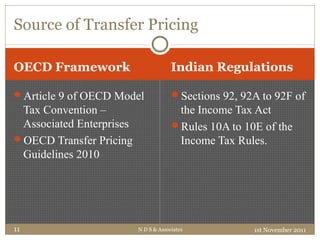
Article 9 of OECD Model
Tax Convention –
Associated Enterprises
OECD Transfer Pricing
Guidelines 2010
Sections 92, 92A to 92F of
the Income Tax Act
Rules 10A to 10E of the
Income Tax Rules.
Source of Transfer Pricing
1st November 2011N D S & Associates11
OECD Framework
ARTICLE 9 - ASSOCIATED ENTERPRISES
“1. Where
a) an enterprise of a Contracting State participates directly or indirectly in
the management, control or capital of an enterprise of the other Contracting
State, or
b) the same persons participate directly or indirectly in the management,
control or capital of an enterprise of a Contracting State and an enterprise of
the other Contracting State,
and in either case conditions are made or imposed between the two
enterprises in their commercial or financial relations which differ from those
which would be made between independent enterprises, then any profits
which would, but for those conditions, have accrued to one of the
enterprises, but, by reason of those conditions, have not so accrued, may be
included in the profits of that enterprise and taxed accordingly.
1st November 2011N D S & Associates12
OECD Framework
ARTICLE 9 - ASSOCIATED ENTERPRISES
2. Where a Contracting State includes in the profits of an enterprise of that
State — and taxes accordingly — profits on which an enterprise of the other
Contracting State has been charged to tax in that other State and the profits
so included are profits which would have accrued to the enterprise of the
first-mentioned State if the conditions made between the two enterprises had
been those which would have been made between independent enterprises,
then that other State shall make an appropriate adjustment to the amount of
the tax charged therein on those profits. In determining such adjustment, due
regard shall be had to the other provisions of this Convention and the
competent authorities of the Contracting States shall if necessary consult
each other.”
1st November 2011N D S & Associates13
OECD Transfer Pricing Guidelines
Guidelines for Multinational Enterprises and Tax
Administrations issued in July 2010.
Justifies and emphasizes on use of “Arm’s Length
Principle”, while rejecting any alternative approaches to
Transfer Pricing.
Provides guidance for applying Arm’s Length Principle.
Describes five transfer pricing methods and their
applications.
Describes process of comparability analysis.
1st November 2011N D S & Associates14
OECD Transfer Pricing Guidelines
Suggests administrative approaches to avoiding and
resolving TP disputes, including MAP, Safe Harbour,
APAs and arbitration.
Provides recommendations on maintenance of
documentation.
Deals with special considerations relating to –
 Intangible Property
 Intra-Group services
 Cost Contribution Arrangements
 Business Restructuring
1st November 2011N D S & Associates15
Indian Regulations
S. 92 – Computation of income from international
transaction having regard to Arm’s Length Price (ALP)
S. 92A – Meaning of Associated Enterprise
S. 92B – Meaning of International Transaction
S. 92C – Computation of ALP
S. 92CA – Reference to Transfer Pricing Officer
S. 92CB – Safe Harbour Rules
S. 92D – Maintenance of documentation
S. 92E – Accountant’s report
S. 92F – Certain definitions
1st November 2011N D S & Associates16
Indian Regulations
R. 10A – Meaning of expressions used in computation
of ALP
R. 10B – Determination of ALP u/s. 92C
R. 10C – Most appropriate method
R. 10D – Information and documents to be maintained
u/s. 92D
R. 10E – Accountant’s report u/s. 92E – Form 3CEB
1st November 2011N D S & Associates17
Computation of Income as per ALP
92(1) – Any income, expense or interest arising from an
international transaction to be determined having regard
to arm’s length price.
92(2) – Any cost or expense allocated or apportioned or
contributed under a mutual agreement to be determined
having regard to the ALP of the benefit, service or
facility provided under such agreement.
92(3) – This section not to apply where it results in
reduction of taxable income or increase in loss.
1st November 2011N D S & Associates18
Associated Enterprise
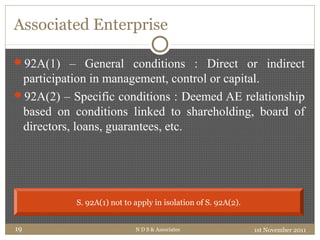
92A(1) – General conditions : Direct or indirect
participation in management, control or capital.
92A(2) – Specific conditions : Deemed AE relationship
based on conditions linked to shareholding, board of
directors, loans, guarantees, etc.
1st November 2011N D S & Associates19
S. 92A(1) not to apply in isolation of S. 92A(2).
Associated Enterprise
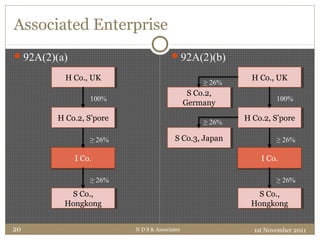
92A(2)(a) 92A(2)(b)
1st November 2011N D S & Associates20
H Co., UKH Co., UK
I Co.
S Co.,
Hongkong
S Co.,
Hongkong
H Co.2, S’poreH Co.2, S’pore
100%
≥ 26%
≥ 26%
H Co., UKH Co., UK
I Co.
S Co.,
Hongkong
S Co.,
Hongkong
H Co.2, S’poreH Co.2, S’pore
100%
≥ 26%
≥ 26%
S Co.2,
Germany
S Co.2,
Germany
S Co.3, JapanS Co.3, Japan
≥ 26%
≥ 26%
Associated Enterprise
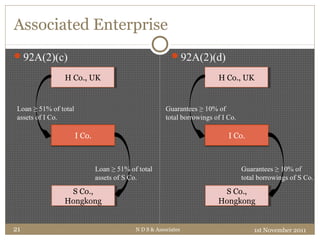
92A(2)(c) 92A(2)(d)
1st November 2011N D S & Associates21
H Co., UKH Co., UK
I Co.
S Co.,
Hongkong
S Co.,
Hongkong
Loan ≥ 51% of total
assets of I Co.
Loan ≥ 51% of total
assets of S Co.
H Co., UKH Co., UK
I Co.
S Co.,
Hongkong
S Co.,
Hongkong
Guarantees ≥ 10% of
total borrowings of I Co.
Guarantees ≥ 10% of
total borrowings of S Co.
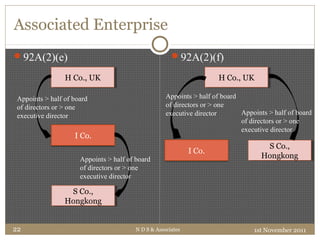
Associated Enterprise
92A(2)(e) 92A(2)(f)
1st November 2011N D S & Associates22
H Co., UKH Co., UK
I Co.
S Co.,
Hongkong
S Co.,
Hongkong
Appoints > half of board
of directors or > one
executive director
H Co., UKH Co., UK
I Co.
S Co.,
Hongkong
S Co.,
HongkongAppoints > half of board
of directors or > one
executive director
Appoints > half of board
of directors or > one
executive director Appoints > half of board
of directors or > one
executive director
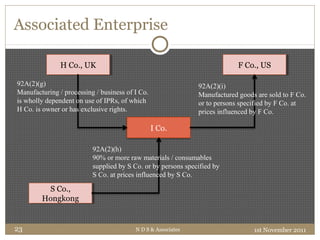
Associated Enterprise
1st November 2011N D S & Associates23
H Co., UKH Co., UK
I Co.
S Co.,
Hongkong
S Co.,
Hongkong
F Co., USF Co., US
92A(2)(g)
Manufacturing / processing / business of I Co.
is wholly dependent on use of IPRs, of which
H Co. is owner or has exclusive rights.
92A(2)(h)
90% or more raw materials / consumables
supplied by S Co. or by persons specified by
S Co. at prices influenced by S Co.
92A(2)(i)
Manufactured goods are sold to F Co.
or to persons specified by F Co. at
prices influenced by F Co.
Associated Enterprise
92A(2)(j) and 92A(2)(k) 92A(2)(l)
1st November 2011N D S & Associates24
I Co. H Co., UKH Co., UK
Control by Mr.
A / A(HUF)
Control by –
Mr. A and/or his
relative;
Member of A(HUF)
and/or his relative
I & Co.
[Firm / AOP / BOI]
H Co., UKH Co., UK
≥ 10% interest
Associated Enterprise
Whether covered?
 Foreign Company and Indian branch
 Indian Company and Foreign branch
1st November 2011N D S & Associates25
International Transaction
S. 92B(1) - International transaction means
 A transaction between two or more AEs, either or both of
whom are non-residents,
 In the nature of purchase, sale or lease of tangible or intangible
property, or provision of services, or lending or borrowing
money, or any other transaction having a bearing on the profits,
income, losses or assets of such enterprises
 Includes a cost allocation / apportionment / contribution
arrangement
1st November 2011N D S & Associates26
International Transaction
S. 92B(2) – Transaction with a non-AE deemed to be
international transaction if
 there exists a prior agreement in relation to the relevant
transaction between such other person and the AE, or
 the terms of the relevant transaction are determined in
substance between such other person and the AE
1st November 2011N D S & Associates27
S. 92B(2) creates deemed international transaction without creating deemed
AE relationship.
International Transaction
Whether international transactions?
 Principal amount of Loan
 Subscription to Equity Share Capital
 Corporate Guarantee
 Advance given / received
 Pre-incorporation expenditure
1st November 2011N D S & Associates28
Computation of ALP
92C(1) – ALP to be determined using the most
appropriate method out of –
 Comparable Uncontrolled Price (CUP) Method
 Resale Price Method (RPM)
 Cost Plus Method (CPM)
 Profit Split Method (PSM)
 Transactional Net Margin Method (TNMM)
 Other prescribed method
1st November 2011N D S & Associates29
Computation of ALP
92C(2) – Most appropriate method (MAM) to be
adopted as per R. 10C
 ALP to be determined at arithmetical mean, where more than
one price is determined as per most appropriate method.
 If difference between ALP and actual price does not exceed 5%
of the actual price, then actual price shall be deemed to be ALP.
1st November 2011N D S & Associates30
Most countries accept the Inter-Quartile Range as the permissible range
within which Arm’s Length Price can lie.
Computation of ALP
S. 92C(3) – AO to determine ALP on the basis of
material available with him
S. 92C(4) – AO to compute total income of assessee on
the basis of ALP determined u/s. 92C(3)
 No deduction u/s. 10A / 10AA / 10B in respect of enhanced
total income
 No corresponding relief in computing income of AE.
1st November 2011N D S & Associates31
Most Appropriate Method
To be adopted based on facts of each transaction, taking into account –
 nature and class of the international transaction;
 the class or classes of AEs entering into the transaction and the functions
performed by them taking into account assets employed and risks assumed;
 the availability, coverage and reliability of necessary data;
 the degree of comparability existing between the international transaction
and the uncontrolled transaction and between the enterprises entering into
such transactions;
 the extent to which reliable and accurate adjustments can be made to
account for differences, if any, between the international transaction and the
comparable uncontrolled transaction or between the enterprises entering
into such transactions;
 the nature, extent and reliability of assumptions required to be made in
application of a method.
1st November 2011N D S & Associates32
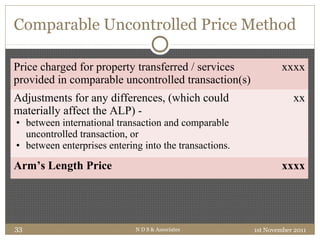
Comparable Uncontrolled Price Method
Price charged for property transferred / services
provided in comparable uncontrolled transaction(s)
xxxx
Adjustments for any differences, (which could
materially affect the ALP) -
• between international transaction and comparable
uncontrolled transaction, or
• between enterprises entering into the transactions.
xx
Arm’s Length Price xxxx
1st November 2011N D S & Associates33
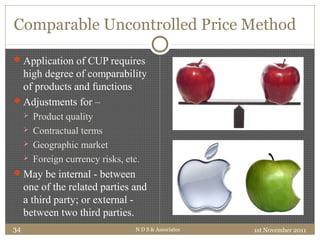
Comparable Uncontrolled Price Method
Application of CUP requires
high degree of comparability
of products and functions
Adjustments for –
 Product quality
 Contractual terms
 Geographic market
 Foreign currency risks, etc.
May be internal - between
one of the related parties and
a third party; or external -
between two third parties.
1st November 2011N D S & Associates34
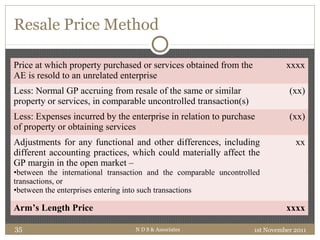
Resale Price Method
Price at which property purchased or services obtained from the
AE is resold to an unrelated enterprise
xxxx
Less: Normal GP accruing from resale of the same or similar
property or services, in comparable uncontrolled transaction(s)
(xx)
Less: Expenses incurred by the enterprise in relation to purchase
of property or obtaining services
(xx)
Adjustments for any functional and other differences, including
different accounting practices, which could materially affect the
GP margin in the open market –
•between the international transaction and the comparable uncontrolled
transactions, or
•between the enterprises entering into such transactions
xx
Arm’s Length Price xxxx
1st November 2011N D S & Associates35
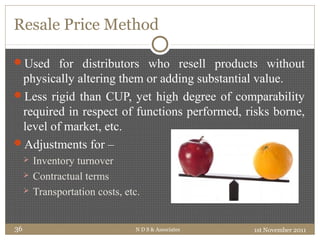
Resale Price Method
Used for distributors who resell products without
physically altering them or adding substantial value.
Less rigid than CUP, yet high degree of comparability
required in respect of functions performed, risks borne,
level of market, etc.
Adjustments for –
 Inventory turnover
 Contractual terms
 Transportation costs, etc.
1st November 2011N D S & Associates36
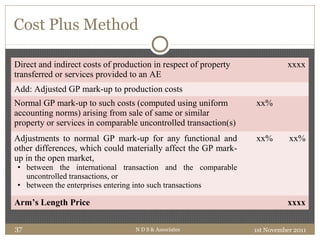
Cost Plus Method
Direct and indirect costs of production in respect of property
transferred or services provided to an AE
xxxx
Add: Adjusted GP mark-up to production costs
Normal GP mark-up to such costs (computed using uniform
accounting norms) arising from sale of same or similar
property or services in comparable uncontrolled transaction(s)
xx%
Adjustments to normal GP mark-up for any functional and
other differences, which could materially affect the GP mark-
up in the open market,
• between the international transaction and the comparable
uncontrolled transactions, or
• between the enterprises entering into such transactions
xx% xx%
Arm’s Length Price xxxx
1st November 2011N D S & Associates37
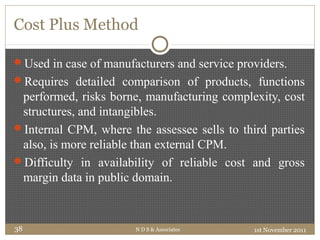
Cost Plus Method
Used in case of manufacturers and service providers.
Requires detailed comparison of products, functions
performed, risks borne, manufacturing complexity, cost
structures, and intangibles.
Internal CPM, where the assessee sells to third parties
also, is more reliable than external CPM.
Difficulty in availability of reliable cost and gross
margin data in public domain.
1st November 2011N D S & Associates38
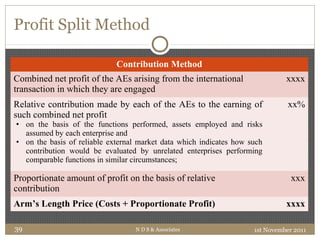
Profit Split Method
Contribution Method
Combined net profit of the AEs arising from the international
transaction in which they are engaged
xxxx
Relative contribution made by each of the AEs to the earning of
such combined net profit
• on the basis of the functions performed, assets employed and risks
assumed by each enterprise and
• on the basis of reliable external market data which indicates how such
contribution would be evaluated by unrelated enterprises performing
comparable functions in similar circumstances;
xx%
Proportionate amount of profit on the basis of relative
contribution
xxx
Arm’s Length Price (Costs + Proportionate Profit) xxxx
1st November 2011N D S & Associates39
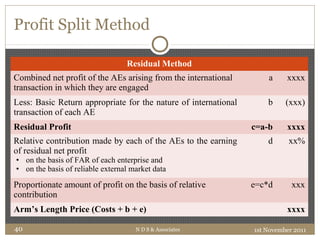
Profit Split Method
Residual Method
Combined net profit of the AEs arising from the international
transaction in which they are engaged
a xxxx
Less: Basic Return appropriate for the nature of international
transaction of each AE
b (xxx)
Residual Profit c=a-b xxxx
Relative contribution made by each of the AEs to the earning
of residual net profit
• on the basis of FAR of each enterprise and
• on the basis of reliable external market data
d xx%
Proportionate amount of profit on the basis of relative
contribution
e=c*d xxx
Arm’s Length Price (Costs + b + e) xxxx
1st November 2011N D S & Associates40
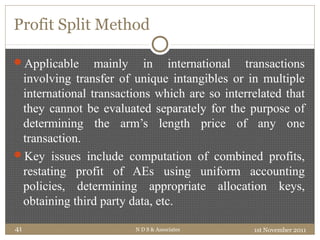
Profit Split Method
Applicable mainly in international transactions
involving transfer of unique intangibles or in multiple
international transactions which are so interrelated that
they cannot be evaluated separately for the purpose of
determining the arm’s length price of any one
transaction.
Key issues include computation of combined profits,
restating profit of AEs using uniform accounting
policies, determining appropriate allocation keys,
obtaining third party data, etc.
1st November 2011N D S & Associates41
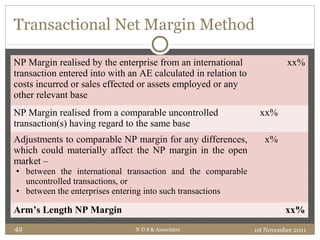
Transactional Net Margin Method
NP Margin realised by the enterprise from an international
transaction entered into with an AE calculated in relation to
costs incurred or sales effected or assets employed or any
other relevant base
xx%
NP Margin realised from a comparable uncontrolled
transaction(s) having regard to the same base
xx%
Adjustments to comparable NP margin for any differences,
which could materially affect the NP margin in the open
market –
• between the international transaction and the comparable
uncontrolled transactions, or
• between the enterprises entering into such transactions
x%
Arm’s Length NP Margin xx%
1st November 2011N D S & Associates42
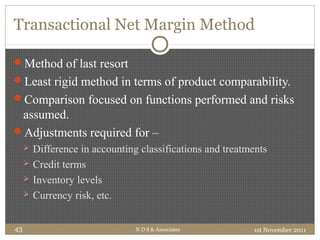
Transactional Net Margin Method
Method of last resort
Least rigid method in terms of product comparability.
Comparison focused on functions performed and risks
assumed.
Adjustments required for –
 Difference in accounting classifications and treatments
 Credit terms
 Inventory levels
 Currency risk, etc.
1st November 2011N D S & Associates43
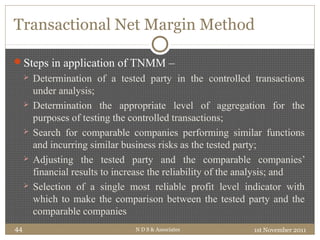
Transactional Net Margin Method
Steps in application of TNMM –
 Determination of a tested party in the controlled transactions
under analysis;
 Determination the appropriate level of aggregation for the
purposes of testing the controlled transactions;
 Search for comparable companies performing similar functions
and incurring similar business risks as the tested party;
 Adjusting the tested party and the comparable companies’
financial results to increase the reliability of the analysis; and
 Selection of a single most reliable profit level indicator with
which to make the comparison between the tested party and the
comparable companies
1st November 2011N D S & Associates44
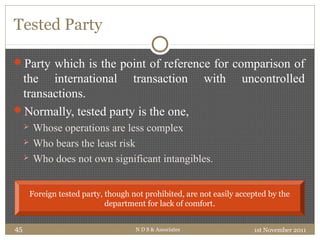
Tested Party
Party which is the point of reference for comparison of
the international transaction with uncontrolled
transactions.
Normally, tested party is the one,
 Whose operations are less complex
 Who bears the least risk
 Who does not own significant intangibles.
1st November 2011N D S & Associates45
Foreign tested party, though not prohibited, are not easily accepted by the
department for lack of comfort.
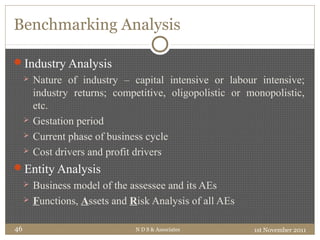
Benchmarking Analysis
Industry Analysis
 Nature of industry – capital intensive or labour intensive;
industry returns; competitive, oligopolistic or monopolistic,
etc.
 Gestation period
 Current phase of business cycle
 Cost drivers and profit drivers
Entity Analysis
 Business model of the assessee and its AEs
 Functions, Assets and Risk Analysis of all AEs
1st November 2011N D S & Associates46
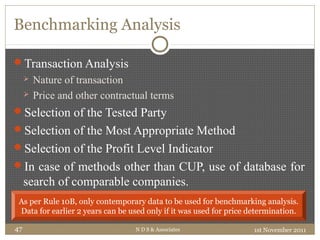
Benchmarking Analysis
Transaction Analysis
 Nature of transaction
 Price and other contractual terms
Selection of the Tested Party
Selection of the Most Appropriate Method
Selection of the Profit Level Indicator
In case of methods other than CUP, use of database for
search of comparable companies.
1st November 2011N D S & Associates47
As per Rule 10B, only contemporary data to be used for benchmarking analysis.
Data for earlier 2 years can be used only if it was used for price determination.
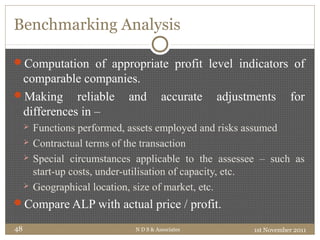
Benchmarking Analysis
Computation of appropriate profit level indicators of
comparable companies.
Making reliable and accurate adjustments for
differences in –
 Functions performed, assets employed and risks assumed
 Contractual terms of the transaction
 Special circumstances applicable to the assessee – such as
start-up costs, under-utilisation of capacity, etc.
 Geographical location, size of market, etc.
Compare ALP with actual price / profit.
1st November 2011N D S & Associates48
Documentation
S. 92D r.w. R. 10D –
Mandatory documentation requirements in case where
aggregate of international transactions, as recorded in the
books, exceeds Rs. 1 crore.
Even in cases where aggregate value of transactions is
below Rs. 1 crore, assessee is required to maintain
adequate material to substantiate the arm’s length nature
of the transactions.
Documents to be maintained for 8 years from the end of
the assessment year.
1st November 2011N D S & Associates49
Documentation
Mandatory documentation requirement includes –
 ownership structure of the assessee with details of shares or
other ownership interest held therein by other enterprises;
 a profile of the multinational group of which the assessee
enterprise is a part;
 broad description of the business of the assessee and the AEs
and the industry in which the assessee operates;
 the nature and terms (including prices) of international
transactions entered into with each AE, details of property
transferred or services provided and the quantum and the value
of each such transaction or class of such transaction;
1st November 2011N D S & Associates50
Documentation
 description of the functions performed, risks assumed and
assets employed by the assessee and by the AEs;
 record of the economic and market analyses, forecasts, budgets
or any other financial estimates prepared by the assessee,
which may have a bearing on the international transactions;
 record of uncontrolled transactions considered for
comparability analysis, including nature, terms and conditions
relating to any uncontrolled transaction with third parties
which may be of relevance to the pricing of the international
transactions;
 record of the comparability analysis performed;
1st November 2011N D S & Associates51
Documentation
 description of the methods considered for determining the ALP,
the method selected as the most appropriate method along with
explanations, and how such method was applied in each case;
 record of the actual working carried out for determining ALP,
including details of the comparable data and financial
information used, and adjustments made for differences;
 the assumptions, policies and price negotiations, if any, which
have critically affected the determination of the ALP;
 details of the adjustments made to transfer prices to align them
with ALP;
 any other information, data or document relevant for
determination of the ALP.
1st November 2011N D S & Associates52
Documentation
Supporting documents to be maintained –
 official publications, reports, studies and data bases from the
Government of the country of residence of the AE, or of any
other country;
 reports of market research studies carried out and technical
publications brought out by institutions of national or
international repute;
 price publications including stock exchange and commodity
market quotations;
 published accounts and financial statements relating to the
business affairs of the AEs;
1st November 2011N D S & Associates53
Documentation
Supporting documents to be maintained –
 agreements and contracts entered into with AEs or with
unrelated enterprises in respect of transactions similar to the
international transactions;
 letters and other correspondence documenting any terms
negotiated between the assessee and the AE;
 documents normally issued in connection with various
transactions under the accounting practices followed.
1st November 2011N D S & Associates54
Documentation
All documentation to be contemporaneous as far as possible.
In case of an international transaction having effect over more
than one year, fresh documentation need not be maintained
unless there is any significant change affecting the price.
Documentation to be produced before the AO or
Commissioner (Appeals) within 30 days of receipt of notice
for the same.
1st November 2011N D S & Associates55
Penalty u/s. 271AA for failure to maintain documents and u/s. 271G for failure
to furnish documents at 2% of value of international transaction each.
Accountant’s Report
Accountant’s Report to be obtained in Form 3CEB and
submitted before due date of filing return of income.
Due date in case of assessees to whom S. 92E applies is
30th
November w.e.f. 1st
April 2011.
1st November 2011N D S & Associates56
Failure to furnish report u/s. 92E attracts penalty of Rs. 1 lakh.
1st November 2011N D S & Associates57
1st November 201158
THANK YOU
CA NAMRATA DEDHIA
N D S & Associates
+91 9987123626
canamratashah@gmail.com
N D S & Associates

Basics of Transfer Pricing

  • 1.
    CA NAMRATA DEDHIA Basicsof Transfer Pricing BY DADAR (E) CPE STUDY CIRCLE OF ICAI
  • 2.
    Scope 1st November 2011ND S & Associates2 Background Objective Legal Framework  OECD Framework  Indian Regulations Overview of Transfer Pricing  Identifying AEs  International Transactions  Selection of Most Appropriate Method  Tested Party  Benchmarking  Compliance
  • 3.
    N D S& Associates 1st November 20113 Introduction
  • 4.
    Background 1st November 2011ND S & Associates4 Transfer price refers to “price” charged for “transfer” – of goods, services, tangible or intangible property, etc. Several economic factors affect determination of transfer prices –  Nature of product  Market price  Cost  Target profitability – ROS, ROCE, ROI  Capacity Utilisation  Opportunity Cost
  • 5.
    Background 1st November 2011ND S & Associates5 Current regulations introduced in Finance Act, 2001 Prior to that, Section 92 read as under – “Where a business is carried on between a resident and a non- resident and it appears to the Assessing Officer that, owing to the close connection between them, the course of business is so arranged that the business transacted between them produces to the resident either no profits or less than the ordinary profits which might be expected to arise in that business, the Assessing Officer shall determine the amount of profits which may reasonably be deemed to have been derived therefrom and include such amount in the total income of the resident.”
  • 6.
    Objective 1st November 2011ND S & Associates6 Relevant extract of the Budget Speech “The presence of multinational enterprises in India and their ability to allocate profits in different jurisdictions by controlling prices in intra-group transactions has made the issue of transfer pricing a matter of serious concern. I had set up an Expert Group in November 1999 to examine the issues relating to transfer pricing. Their report has been received, proposing a detailed structure for transfer pricing legislation. Necessary legislative changes are being made in the Finance Bill based on these recommendations.”
  • 7.
    Objective 1st November 2011ND S & Associates7 M Co. Mauritius owns 100% equity stake in I Co. India. Effective Tax Rates : India – 30.9%, Mauritius – 3% M Co. supplies raw material to I Co. at Rs. 15 mn., which can be procured by the latter from indigenous parties at Rs.10 mn. I Co. sells finished goods to M Co. at Rs. 40 mn. Buyers in US are ready to buy the same goods at Rs. 55 mn. Profits are understated in India and overstated in Mauritius to the extent of Rs. 20 mn. Effective tax reduction = 20 mn*(30.9 – 3)% = Rs. 5.58 mn.
  • 8.
    Objective 1st November 2011ND S & Associates8 As per Para 1.2 of OECD Guidelines – “Tax administrations should not automatically assume that associated enterprises have sought to manipulate their profits. There may be a genuine difficulty in accurately determining a market price in the absence of market forces or when adopting a particular commercial strategy. It is important to bear in mind that the need to make adjustments to approximate arm's length transactions arises irrespective of any contractual obligation undertaken by the parties to pay a particular price or of any intention of the parties to minimize tax.…
  • 9.
    Objective 1st November 2011ND S & Associates9 …Thus, a tax adjustment under the arm's length principle would not affect the underlying contractual obligations for non-tax purposes between the associated enterprises, and may be appropriate even where there is no intent to minimize or avoid tax. The consideration of transfer pricing should not be confused with the consideration of problems of tax fraud or tax avoidance, even though transfer pricing policies may be used for such purposes.”
  • 10.
    N D S& Associates 1st November 201110 Legal Framework
  • 11.
    OECD Framework IndianRegulations Article 9 of OECD Model Tax Convention – Associated Enterprises OECD Transfer Pricing Guidelines 2010 Sections 92, 92A to 92F of the Income Tax Act Rules 10A to 10E of the Income Tax Rules. Source of Transfer Pricing 1st November 2011N D S & Associates11
  • 12.
    OECD Framework ARTICLE 9- ASSOCIATED ENTERPRISES “1. Where a) an enterprise of a Contracting State participates directly or indirectly in the management, control or capital of an enterprise of the other Contracting State, or b) the same persons participate directly or indirectly in the management, control or capital of an enterprise of a Contracting State and an enterprise of the other Contracting State, and in either case conditions are made or imposed between the two enterprises in their commercial or financial relations which differ from those which would be made between independent enterprises, then any profits which would, but for those conditions, have accrued to one of the enterprises, but, by reason of those conditions, have not so accrued, may be included in the profits of that enterprise and taxed accordingly. 1st November 2011N D S & Associates12
  • 13.
    OECD Framework ARTICLE 9- ASSOCIATED ENTERPRISES 2. Where a Contracting State includes in the profits of an enterprise of that State — and taxes accordingly — profits on which an enterprise of the other Contracting State has been charged to tax in that other State and the profits so included are profits which would have accrued to the enterprise of the first-mentioned State if the conditions made between the two enterprises had been those which would have been made between independent enterprises, then that other State shall make an appropriate adjustment to the amount of the tax charged therein on those profits. In determining such adjustment, due regard shall be had to the other provisions of this Convention and the competent authorities of the Contracting States shall if necessary consult each other.” 1st November 2011N D S & Associates13
  • 14.
    OECD Transfer PricingGuidelines Guidelines for Multinational Enterprises and Tax Administrations issued in July 2010. Justifies and emphasizes on use of “Arm’s Length Principle”, while rejecting any alternative approaches to Transfer Pricing. Provides guidance for applying Arm’s Length Principle. Describes five transfer pricing methods and their applications. Describes process of comparability analysis. 1st November 2011N D S & Associates14
  • 15.
    OECD Transfer PricingGuidelines Suggests administrative approaches to avoiding and resolving TP disputes, including MAP, Safe Harbour, APAs and arbitration. Provides recommendations on maintenance of documentation. Deals with special considerations relating to –  Intangible Property  Intra-Group services  Cost Contribution Arrangements  Business Restructuring 1st November 2011N D S & Associates15
  • 16.
    Indian Regulations S. 92– Computation of income from international transaction having regard to Arm’s Length Price (ALP) S. 92A – Meaning of Associated Enterprise S. 92B – Meaning of International Transaction S. 92C – Computation of ALP S. 92CA – Reference to Transfer Pricing Officer S. 92CB – Safe Harbour Rules S. 92D – Maintenance of documentation S. 92E – Accountant’s report S. 92F – Certain definitions 1st November 2011N D S & Associates16
  • 17.
    Indian Regulations R. 10A– Meaning of expressions used in computation of ALP R. 10B – Determination of ALP u/s. 92C R. 10C – Most appropriate method R. 10D – Information and documents to be maintained u/s. 92D R. 10E – Accountant’s report u/s. 92E – Form 3CEB 1st November 2011N D S & Associates17
  • 18.
    Computation of Incomeas per ALP 92(1) – Any income, expense or interest arising from an international transaction to be determined having regard to arm’s length price. 92(2) – Any cost or expense allocated or apportioned or contributed under a mutual agreement to be determined having regard to the ALP of the benefit, service or facility provided under such agreement. 92(3) – This section not to apply where it results in reduction of taxable income or increase in loss. 1st November 2011N D S & Associates18
  • 19.
    Associated Enterprise 92A(1) –General conditions : Direct or indirect participation in management, control or capital. 92A(2) – Specific conditions : Deemed AE relationship based on conditions linked to shareholding, board of directors, loans, guarantees, etc. 1st November 2011N D S & Associates19 S. 92A(1) not to apply in isolation of S. 92A(2).
  • 20.
    Associated Enterprise 92A(2)(a) 92A(2)(b) 1stNovember 2011N D S & Associates20 H Co., UKH Co., UK I Co. S Co., Hongkong S Co., Hongkong H Co.2, S’poreH Co.2, S’pore 100% ≥ 26% ≥ 26% H Co., UKH Co., UK I Co. S Co., Hongkong S Co., Hongkong H Co.2, S’poreH Co.2, S’pore 100% ≥ 26% ≥ 26% S Co.2, Germany S Co.2, Germany S Co.3, JapanS Co.3, Japan ≥ 26% ≥ 26%
  • 21.
    Associated Enterprise 92A(2)(c) 92A(2)(d) 1stNovember 2011N D S & Associates21 H Co., UKH Co., UK I Co. S Co., Hongkong S Co., Hongkong Loan ≥ 51% of total assets of I Co. Loan ≥ 51% of total assets of S Co. H Co., UKH Co., UK I Co. S Co., Hongkong S Co., Hongkong Guarantees ≥ 10% of total borrowings of I Co. Guarantees ≥ 10% of total borrowings of S Co.
  • 22.
    Associated Enterprise 92A(2)(e) 92A(2)(f) 1stNovember 2011N D S & Associates22 H Co., UKH Co., UK I Co. S Co., Hongkong S Co., Hongkong Appoints > half of board of directors or > one executive director H Co., UKH Co., UK I Co. S Co., Hongkong S Co., HongkongAppoints > half of board of directors or > one executive director Appoints > half of board of directors or > one executive director Appoints > half of board of directors or > one executive director
  • 23.
    Associated Enterprise 1st November2011N D S & Associates23 H Co., UKH Co., UK I Co. S Co., Hongkong S Co., Hongkong F Co., USF Co., US 92A(2)(g) Manufacturing / processing / business of I Co. is wholly dependent on use of IPRs, of which H Co. is owner or has exclusive rights. 92A(2)(h) 90% or more raw materials / consumables supplied by S Co. or by persons specified by S Co. at prices influenced by S Co. 92A(2)(i) Manufactured goods are sold to F Co. or to persons specified by F Co. at prices influenced by F Co.
  • 24.
    Associated Enterprise 92A(2)(j) and92A(2)(k) 92A(2)(l) 1st November 2011N D S & Associates24 I Co. H Co., UKH Co., UK Control by Mr. A / A(HUF) Control by – Mr. A and/or his relative; Member of A(HUF) and/or his relative I & Co. [Firm / AOP / BOI] H Co., UKH Co., UK ≥ 10% interest
  • 25.
    Associated Enterprise Whether covered? Foreign Company and Indian branch  Indian Company and Foreign branch 1st November 2011N D S & Associates25
  • 26.
    International Transaction S. 92B(1)- International transaction means  A transaction between two or more AEs, either or both of whom are non-residents,  In the nature of purchase, sale or lease of tangible or intangible property, or provision of services, or lending or borrowing money, or any other transaction having a bearing on the profits, income, losses or assets of such enterprises  Includes a cost allocation / apportionment / contribution arrangement 1st November 2011N D S & Associates26
  • 27.
    International Transaction S. 92B(2)– Transaction with a non-AE deemed to be international transaction if  there exists a prior agreement in relation to the relevant transaction between such other person and the AE, or  the terms of the relevant transaction are determined in substance between such other person and the AE 1st November 2011N D S & Associates27 S. 92B(2) creates deemed international transaction without creating deemed AE relationship.
  • 28.
    International Transaction Whether internationaltransactions?  Principal amount of Loan  Subscription to Equity Share Capital  Corporate Guarantee  Advance given / received  Pre-incorporation expenditure 1st November 2011N D S & Associates28
  • 29.
    Computation of ALP 92C(1)– ALP to be determined using the most appropriate method out of –  Comparable Uncontrolled Price (CUP) Method  Resale Price Method (RPM)  Cost Plus Method (CPM)  Profit Split Method (PSM)  Transactional Net Margin Method (TNMM)  Other prescribed method 1st November 2011N D S & Associates29
  • 30.
    Computation of ALP 92C(2)– Most appropriate method (MAM) to be adopted as per R. 10C  ALP to be determined at arithmetical mean, where more than one price is determined as per most appropriate method.  If difference between ALP and actual price does not exceed 5% of the actual price, then actual price shall be deemed to be ALP. 1st November 2011N D S & Associates30 Most countries accept the Inter-Quartile Range as the permissible range within which Arm’s Length Price can lie.
  • 31.
    Computation of ALP S.92C(3) – AO to determine ALP on the basis of material available with him S. 92C(4) – AO to compute total income of assessee on the basis of ALP determined u/s. 92C(3)  No deduction u/s. 10A / 10AA / 10B in respect of enhanced total income  No corresponding relief in computing income of AE. 1st November 2011N D S & Associates31
  • 32.
    Most Appropriate Method Tobe adopted based on facts of each transaction, taking into account –  nature and class of the international transaction;  the class or classes of AEs entering into the transaction and the functions performed by them taking into account assets employed and risks assumed;  the availability, coverage and reliability of necessary data;  the degree of comparability existing between the international transaction and the uncontrolled transaction and between the enterprises entering into such transactions;  the extent to which reliable and accurate adjustments can be made to account for differences, if any, between the international transaction and the comparable uncontrolled transaction or between the enterprises entering into such transactions;  the nature, extent and reliability of assumptions required to be made in application of a method. 1st November 2011N D S & Associates32
  • 33.
    Comparable Uncontrolled PriceMethod Price charged for property transferred / services provided in comparable uncontrolled transaction(s) xxxx Adjustments for any differences, (which could materially affect the ALP) - • between international transaction and comparable uncontrolled transaction, or • between enterprises entering into the transactions. xx Arm’s Length Price xxxx 1st November 2011N D S & Associates33
  • 34.
    Comparable Uncontrolled PriceMethod Application of CUP requires high degree of comparability of products and functions Adjustments for –  Product quality  Contractual terms  Geographic market  Foreign currency risks, etc. May be internal - between one of the related parties and a third party; or external - between two third parties. 1st November 2011N D S & Associates34
  • 35.
    Resale Price Method Priceat which property purchased or services obtained from the AE is resold to an unrelated enterprise xxxx Less: Normal GP accruing from resale of the same or similar property or services, in comparable uncontrolled transaction(s) (xx) Less: Expenses incurred by the enterprise in relation to purchase of property or obtaining services (xx) Adjustments for any functional and other differences, including different accounting practices, which could materially affect the GP margin in the open market – •between the international transaction and the comparable uncontrolled transactions, or •between the enterprises entering into such transactions xx Arm’s Length Price xxxx 1st November 2011N D S & Associates35
  • 36.
    Resale Price Method Usedfor distributors who resell products without physically altering them or adding substantial value. Less rigid than CUP, yet high degree of comparability required in respect of functions performed, risks borne, level of market, etc. Adjustments for –  Inventory turnover  Contractual terms  Transportation costs, etc. 1st November 2011N D S & Associates36
  • 37.
    Cost Plus Method Directand indirect costs of production in respect of property transferred or services provided to an AE xxxx Add: Adjusted GP mark-up to production costs Normal GP mark-up to such costs (computed using uniform accounting norms) arising from sale of same or similar property or services in comparable uncontrolled transaction(s) xx% Adjustments to normal GP mark-up for any functional and other differences, which could materially affect the GP mark- up in the open market, • between the international transaction and the comparable uncontrolled transactions, or • between the enterprises entering into such transactions xx% xx% Arm’s Length Price xxxx 1st November 2011N D S & Associates37
  • 38.
    Cost Plus Method Usedin case of manufacturers and service providers. Requires detailed comparison of products, functions performed, risks borne, manufacturing complexity, cost structures, and intangibles. Internal CPM, where the assessee sells to third parties also, is more reliable than external CPM. Difficulty in availability of reliable cost and gross margin data in public domain. 1st November 2011N D S & Associates38
  • 39.
    Profit Split Method ContributionMethod Combined net profit of the AEs arising from the international transaction in which they are engaged xxxx Relative contribution made by each of the AEs to the earning of such combined net profit • on the basis of the functions performed, assets employed and risks assumed by each enterprise and • on the basis of reliable external market data which indicates how such contribution would be evaluated by unrelated enterprises performing comparable functions in similar circumstances; xx% Proportionate amount of profit on the basis of relative contribution xxx Arm’s Length Price (Costs + Proportionate Profit) xxxx 1st November 2011N D S & Associates39
  • 40.
    Profit Split Method ResidualMethod Combined net profit of the AEs arising from the international transaction in which they are engaged a xxxx Less: Basic Return appropriate for the nature of international transaction of each AE b (xxx) Residual Profit c=a-b xxxx Relative contribution made by each of the AEs to the earning of residual net profit • on the basis of FAR of each enterprise and • on the basis of reliable external market data d xx% Proportionate amount of profit on the basis of relative contribution e=c*d xxx Arm’s Length Price (Costs + b + e) xxxx 1st November 2011N D S & Associates40
  • 41.
    Profit Split Method Applicablemainly in international transactions involving transfer of unique intangibles or in multiple international transactions which are so interrelated that they cannot be evaluated separately for the purpose of determining the arm’s length price of any one transaction. Key issues include computation of combined profits, restating profit of AEs using uniform accounting policies, determining appropriate allocation keys, obtaining third party data, etc. 1st November 2011N D S & Associates41
  • 42.
    Transactional Net MarginMethod NP Margin realised by the enterprise from an international transaction entered into with an AE calculated in relation to costs incurred or sales effected or assets employed or any other relevant base xx% NP Margin realised from a comparable uncontrolled transaction(s) having regard to the same base xx% Adjustments to comparable NP margin for any differences, which could materially affect the NP margin in the open market – • between the international transaction and the comparable uncontrolled transactions, or • between the enterprises entering into such transactions x% Arm’s Length NP Margin xx% 1st November 2011N D S & Associates42
  • 43.
    Transactional Net MarginMethod Method of last resort Least rigid method in terms of product comparability. Comparison focused on functions performed and risks assumed. Adjustments required for –  Difference in accounting classifications and treatments  Credit terms  Inventory levels  Currency risk, etc. 1st November 2011N D S & Associates43
  • 44.
    Transactional Net MarginMethod Steps in application of TNMM –  Determination of a tested party in the controlled transactions under analysis;  Determination the appropriate level of aggregation for the purposes of testing the controlled transactions;  Search for comparable companies performing similar functions and incurring similar business risks as the tested party;  Adjusting the tested party and the comparable companies’ financial results to increase the reliability of the analysis; and  Selection of a single most reliable profit level indicator with which to make the comparison between the tested party and the comparable companies 1st November 2011N D S & Associates44
  • 45.
    Tested Party Party whichis the point of reference for comparison of the international transaction with uncontrolled transactions. Normally, tested party is the one,  Whose operations are less complex  Who bears the least risk  Who does not own significant intangibles. 1st November 2011N D S & Associates45 Foreign tested party, though not prohibited, are not easily accepted by the department for lack of comfort.
  • 46.
    Benchmarking Analysis Industry Analysis Nature of industry – capital intensive or labour intensive; industry returns; competitive, oligopolistic or monopolistic, etc.  Gestation period  Current phase of business cycle  Cost drivers and profit drivers Entity Analysis  Business model of the assessee and its AEs  Functions, Assets and Risk Analysis of all AEs 1st November 2011N D S & Associates46
  • 47.
    Benchmarking Analysis Transaction Analysis Nature of transaction  Price and other contractual terms Selection of the Tested Party Selection of the Most Appropriate Method Selection of the Profit Level Indicator In case of methods other than CUP, use of database for search of comparable companies. 1st November 2011N D S & Associates47 As per Rule 10B, only contemporary data to be used for benchmarking analysis. Data for earlier 2 years can be used only if it was used for price determination.
  • 48.
    Benchmarking Analysis Computation ofappropriate profit level indicators of comparable companies. Making reliable and accurate adjustments for differences in –  Functions performed, assets employed and risks assumed  Contractual terms of the transaction  Special circumstances applicable to the assessee – such as start-up costs, under-utilisation of capacity, etc.  Geographical location, size of market, etc. Compare ALP with actual price / profit. 1st November 2011N D S & Associates48
  • 49.
    Documentation S. 92D r.w.R. 10D – Mandatory documentation requirements in case where aggregate of international transactions, as recorded in the books, exceeds Rs. 1 crore. Even in cases where aggregate value of transactions is below Rs. 1 crore, assessee is required to maintain adequate material to substantiate the arm’s length nature of the transactions. Documents to be maintained for 8 years from the end of the assessment year. 1st November 2011N D S & Associates49
  • 50.
    Documentation Mandatory documentation requirementincludes –  ownership structure of the assessee with details of shares or other ownership interest held therein by other enterprises;  a profile of the multinational group of which the assessee enterprise is a part;  broad description of the business of the assessee and the AEs and the industry in which the assessee operates;  the nature and terms (including prices) of international transactions entered into with each AE, details of property transferred or services provided and the quantum and the value of each such transaction or class of such transaction; 1st November 2011N D S & Associates50
  • 51.
    Documentation  description ofthe functions performed, risks assumed and assets employed by the assessee and by the AEs;  record of the economic and market analyses, forecasts, budgets or any other financial estimates prepared by the assessee, which may have a bearing on the international transactions;  record of uncontrolled transactions considered for comparability analysis, including nature, terms and conditions relating to any uncontrolled transaction with third parties which may be of relevance to the pricing of the international transactions;  record of the comparability analysis performed; 1st November 2011N D S & Associates51
  • 52.
    Documentation  description ofthe methods considered for determining the ALP, the method selected as the most appropriate method along with explanations, and how such method was applied in each case;  record of the actual working carried out for determining ALP, including details of the comparable data and financial information used, and adjustments made for differences;  the assumptions, policies and price negotiations, if any, which have critically affected the determination of the ALP;  details of the adjustments made to transfer prices to align them with ALP;  any other information, data or document relevant for determination of the ALP. 1st November 2011N D S & Associates52
  • 53.
    Documentation Supporting documents tobe maintained –  official publications, reports, studies and data bases from the Government of the country of residence of the AE, or of any other country;  reports of market research studies carried out and technical publications brought out by institutions of national or international repute;  price publications including stock exchange and commodity market quotations;  published accounts and financial statements relating to the business affairs of the AEs; 1st November 2011N D S & Associates53
  • 54.
    Documentation Supporting documents tobe maintained –  agreements and contracts entered into with AEs or with unrelated enterprises in respect of transactions similar to the international transactions;  letters and other correspondence documenting any terms negotiated between the assessee and the AE;  documents normally issued in connection with various transactions under the accounting practices followed. 1st November 2011N D S & Associates54
  • 55.
    Documentation All documentation tobe contemporaneous as far as possible. In case of an international transaction having effect over more than one year, fresh documentation need not be maintained unless there is any significant change affecting the price. Documentation to be produced before the AO or Commissioner (Appeals) within 30 days of receipt of notice for the same. 1st November 2011N D S & Associates55 Penalty u/s. 271AA for failure to maintain documents and u/s. 271G for failure to furnish documents at 2% of value of international transaction each.
  • 56.
    Accountant’s Report Accountant’s Reportto be obtained in Form 3CEB and submitted before due date of filing return of income. Due date in case of assessees to whom S. 92E applies is 30th November w.e.f. 1st April 2011. 1st November 2011N D S & Associates56 Failure to furnish report u/s. 92E attracts penalty of Rs. 1 lakh.
  • 57.
    1st November 2011ND S & Associates57
  • 58.
    1st November 201158 THANKYOU CA NAMRATA DEDHIA N D S & Associates +91 9987123626 canamratashah@gmail.com N D S & Associates