1
At the end of this session, participants will be able to:
 Define STI and RTI.
 Name some common STI and RTI.
 List the modes of transmission of STI and RTI.
 Describe conditions that put people at greater risk of STI and
RTI.
 Correct common misconceptions related to transmission of
STI.
 Counsel clients on getting diagnosed and treated for STI/RTI.
 Refer clients for further follow up to the STI clinics.
2
STI RTI
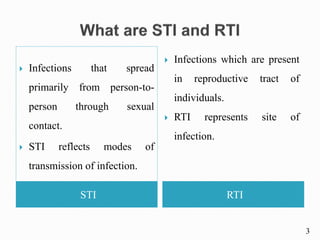
 Infections that spread
primarily from person-to-
person through sexual
contact.
 STI reflects modes of
transmission of infection.
 Infections which are present
in reproductive tract of
individuals.
 RTI represents site of
infection.
3
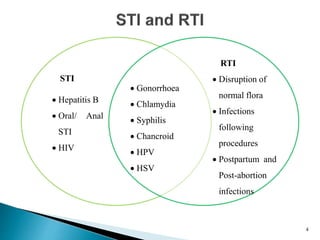
STI
 Hepatitis B
 Oral/ Anal
STI
 HIV
 Gonorrhoea
 Chlamydia
 Syphilis
 Chancroid
 HPV
 HSV
RTI
 Disruption of
normal flora
 Infections
following
procedures
 Postpartum and
Post-abortion
infections
4
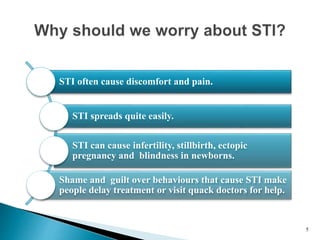
STI often cause discomfort and pain.
STI spreads quite easily.
STI can cause infertility, stillbirth, ectopic
pregnancy and blindness in newborns.
Shame and guilt over behaviours that cause STI make
people delay treatment or visit quack doctors for help.
5
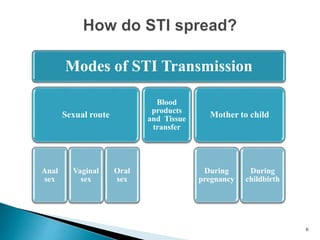
Modes of STI Transmission
Sexual route
Anal
sex
Vaginal
sex
Oral
sex
Blood
products
and Tissue
transfer
Mother to child
During
pregnancy
During
childbirth
6
 Anyone who has unprotected sexual contact with a
person infected with STI.
◦ Some people are more prone to STI :
 People who have multiple sexual partners.
 People who frequently change their sexual partners.
 People who have multiple sexual encounters of sex
without using condoms.
7
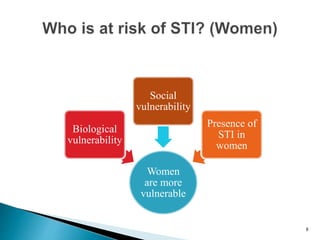
Women
are more
vulnerable
Biological
vulnerability
Social
vulnerability
Presence of
STI in
women
8
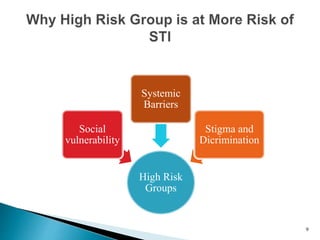
High Risk
Groups
Social
vulnerability
Systemic
Barriers
Stigma and
Dicrimination
9
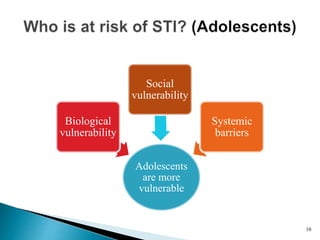
Adolescents
are more
vulnerable
Biological
vulnerability
Social
vulnerability
Systemic
barriers
10
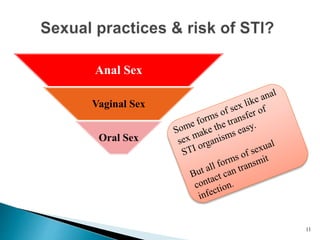
Anal Sex
Vaginal Sex
Oral Sex
11
 Sexually Transmitted Infections (STI) are infections that are
spread primarily through person-to-person sexual contact.
 STI reflects modes of transmission of infection.
 Reproductive Tract Infections (RTI) are infections which are
present in the reproductive tract of males or females.
 RTI represents site of infection.
 Not all reproductive tract infections are sexually transmitted and not
all sexually transmitted infections are always located in the
reproductive tract.
12
 More than 50% of STI in women are without symptoms!
 Women are more easily infected than men.
 Untreated STI/RTI in women can lead to a number of
complications like infertility, cervical cancer, abortions and so
on.
 STI/RTI in women can affect her child: still born, abortions,
eye infections at birth.
 Presence of an STI can increase risk of acquisition and
transmission of HIV 5 to 10 times!
 Explain and encourage HIV testing to a client presenting with
STI/RTI.
 Establish referral services to other centres.
13
 Shame and guilt over STI / RTI make people delay treatment
or visit quacks for help. So it is important for the counsellor to
be respectful and nonjudgmental with every client to get the
required treatment and emphasize the importance of complete
treatment.
 Make sure that during counselling you address any
misconceptions such as, “patients cannot have more than one
STI at a time,” or “sex with a menstruating woman causes
STI.”
 Some forms of sex like anal sex make the transfer of STI
organisms easier. But all forms of sexual contact can transmit
infection.
 Women and adolescents are more prone to get STI.
14
1
Thank You

Basics of STI RTI.pptx

  • 1.
  • 2.
    At the endof this session, participants will be able to:  Define STI and RTI.  Name some common STI and RTI.  List the modes of transmission of STI and RTI.  Describe conditions that put people at greater risk of STI and RTI.  Correct common misconceptions related to transmission of STI.  Counsel clients on getting diagnosed and treated for STI/RTI.  Refer clients for further follow up to the STI clinics. 2
  • 3.
    STI RTI  Infectionsthat spread primarily from person-to- person through sexual contact.  STI reflects modes of transmission of infection.  Infections which are present in reproductive tract of individuals.  RTI represents site of infection. 3
  • 4.
    STI  Hepatitis B Oral/ Anal STI  HIV  Gonorrhoea  Chlamydia  Syphilis  Chancroid  HPV  HSV RTI  Disruption of normal flora  Infections following procedures  Postpartum and Post-abortion infections 4
  • 5.
    STI often causediscomfort and pain. STI spreads quite easily. STI can cause infertility, stillbirth, ectopic pregnancy and blindness in newborns. Shame and guilt over behaviours that cause STI make people delay treatment or visit quack doctors for help. 5
  • 6.
    Modes of STITransmission Sexual route Anal sex Vaginal sex Oral sex Blood products and Tissue transfer Mother to child During pregnancy During childbirth 6
  • 7.
     Anyone whohas unprotected sexual contact with a person infected with STI. ◦ Some people are more prone to STI :  People who have multiple sexual partners.  People who frequently change their sexual partners.  People who have multiple sexual encounters of sex without using condoms. 7
  • 8.
  • 9.
  • 10.
  • 11.
  • 12.
     Sexually TransmittedInfections (STI) are infections that are spread primarily through person-to-person sexual contact.  STI reflects modes of transmission of infection.  Reproductive Tract Infections (RTI) are infections which are present in the reproductive tract of males or females.  RTI represents site of infection.  Not all reproductive tract infections are sexually transmitted and not all sexually transmitted infections are always located in the reproductive tract. 12
  • 13.
     More than50% of STI in women are without symptoms!  Women are more easily infected than men.  Untreated STI/RTI in women can lead to a number of complications like infertility, cervical cancer, abortions and so on.  STI/RTI in women can affect her child: still born, abortions, eye infections at birth.  Presence of an STI can increase risk of acquisition and transmission of HIV 5 to 10 times!  Explain and encourage HIV testing to a client presenting with STI/RTI.  Establish referral services to other centres. 13
  • 14.
     Shame andguilt over STI / RTI make people delay treatment or visit quacks for help. So it is important for the counsellor to be respectful and nonjudgmental with every client to get the required treatment and emphasize the importance of complete treatment.  Make sure that during counselling you address any misconceptions such as, “patients cannot have more than one STI at a time,” or “sex with a menstruating woman causes STI.”  Some forms of sex like anal sex make the transfer of STI organisms easier. But all forms of sexual contact can transmit infection.  Women and adolescents are more prone to get STI. 14
  • 15.

Editor's Notes

  • #3 Read out objectives.
  • #4 What are STI? Sexually transmitted infections (STI) are infections that are spread primarily from person-to-person through sexual contact. STI reflects modes of transmission of infection (i.e., how the infection is spread). Several, in particular HIV and syphilis, can also be transmitted from mother to child during pregnancy and childbirth, and through blood products and tissue transfer. What are RTI? Reproductive tract infections (RTI) are infections which are present in the reproductive tract of individuals. RTI represents site of infection – that is the reproductive tract. Some RTI are caused in the same way as STI. But RTI could also be caused by overgrowth of normal organisms in the reproductive system (e.g., bacterial vaginosis) or they could be infections caused by improper medical procedures such as catheterisation, termination of pregnancy or IUD insertion.
  • #5 STI and RTI Not all reproductive tract infections are sexually transmitted and not all sexually transmitted infections are located in the reproductive tract. Review the list of conditions. There are more than 30 different types of STI. They are caused by bacteria, viruses and parasites. We will see later that we do not need to learn all these different names because the National AIDS Control Programme uses the Syndromic Management approach. Key point to emphasise: Even though the text may say counsellors need not remember names of diseases, many of them may already be familiar with them from written prescriptions of the doctor. Explain that syndromic management which will be discussed in a separate session does not require the clinician to know the name of the infection before treating. It is a public health approach. Note: Questions about syndromic management may be noted down on a chart paper for answering in the later session. To introduce the next section, ask the question: How do STI spread? Give feedback on the right answers. The answers are on the diagram in the handouts
  • #6 Why should we worry about STI? STI often (but not always) cause discomfort and pain to people who have them. STI spread quite easily to other people. STI can cause serious health problems such as infertility, stillbirth, ectopic pregnancy and blindness in newborns. Shame and guilt over behaviours that cause STI make people delay treatment or visit quack doctors for help. So it is important for you, the counsellor, to help every person coming to your clinic to get the treatment they require and to emphasise to them the importance of complete treatment.
  • #7 How do STI spread? Review Modes of STI Transmission Sexual Route Anal sex Vaginal sex Oral sex Blood Products & Tissue Transfer Mother to child During pregnancy During Childbirth Though STI mainly spread through sexual contact, there are other ways of transmission. Since a pregnant woman could spread STI to her unborn child, it becomes important to screen her and treat her. That is why, DSRC counsellors should spend some of their working time with women in ante-natal care (ANC). When you look at the diagram, you also recognise that the sexual route could be through vaginal sex, oral sex or anal sex. Before you counsel someone, you must be sure you know what each of these terms mean. Also make sure that during counselling you address any misconceptions such as, “Patients cannot have more than one STI at a time,” or “Sex with a menstruating woman causes STI.”
  • #8 Anyone who has unprotected sexual contact with a person infected with an STI is at risk of STI. They may also get STI such as syphilis if they receive a blood transfusion from that person. For this reason all units of blood in the blood bank are screened for major STI such as syphilis, hepatitis and HIV. But some people are more prone to STI such as: People who have multiple sexual partners People who frequently change their sexual partners People who have multiple sexual encounters of sex without using condoms. Key point to emphasise: Ask if there are any doubts on this point. Then ask, ‘What is the relation between the text given above and the work of HIV counsellors?’ The answer is that they must spend some time with people who are at risk of STI through frequent change of partners, or through unsafe sex. This is the reason why they have to have a good relationship with the TI projects and clients who come from these projects. Ask if it would be easy for such patients to visit the hospital for STI services. The answer is No. STI are often accompanied by shame and guilt. So it is important to take the extra step towards clients with STI. This is why counsellors are asked to do outreach – so that they can build a closer relationship with the members of these Most-At-Risk Populations.
  • #9 Women are more prone to get STI. The reasons are: Biological vulnerability: During sex, their sexual organs offer a greater surface area for transfer of STI organisms. Social vulnerability: Women are socially less able to refuse unwanted sexual contact. Another important difference between men and women is: Appearance of STI in women: STI in women may not be visible because there may not be any obvious signs and symptoms. In other words, women may be asymptomatic. So they are less likely than men to receive treatment.
  • #10 Similarly High Risk Groups are also more prone to get STI. Read from the slide
  • #11 Adolescents are more prone to get STI. The reasons are: Biological vulnerability: The genital organs in adolescent girls are not mature or fully developed, and this makes them more susceptible to gonorrhoea, chlamydia and HIV. Social vulnerability: Adolescents may have little control over choosing their partners, number of partners, and context of sexual activity. They face barriers to accessing condoms which could help to protect them from unsafe sexual activity. Moreover, once they are infected they face: Systemic barriers: They may not be able to access health services and treat their STI/RTI. Key point to emphasise: Explain that biology is only one risk factor for spread of infection. Other factors are social vulnerability and barriers in accessing services. Ask, “What is the relation between the facts just read and the work of counsellors?” In the case of women, they may have to probe deeper and spend more time explaining the need for treatment and screening, especially in the absence of symptoms. In the case of adolescents, one key prevention message is to tell them to delay sexual initiation till their bodies mature. Also, some counsellors are social workers. They should support the idea of ensuring that youth do not marry till after they cross the legal age of marriage. Further, youth often have many needs which require special attention. In recognition of this fact, the government has set up ARSH services. Counsellors have to be familiar with what is available in their district.
  • #12 Type of sexual contact Some forms of sex like anal sex make the transfer of STI organisms easy. But all forms of sexual contact can transmit infection.