2
Where anyincome of a person is subject to taxation pursuant to this Act (Income Tax Act, 2058) or
other prevailing law and the same income is subject to tax in any foreign country, Government of
Nepal may conclude an agreement with foreign country in order to avoid such double taxation [Sec.
73 (1) of Income Tax Act, 2058]
Legal Basis for DTAA
3.
3
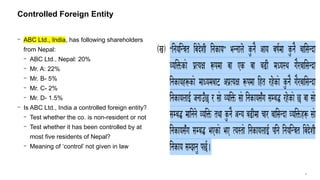
− ABC Ltd.,India, has following shareholders
from Nepal:
− ABC Ltd., Nepal: 20%
− Mr. A: 22%
− Mr. B- 5%
− Mr. C- 2%
− Mr. D- 1.5%
− Is ABC Ltd., India a controlled foreign entity?
− Test whether the co. is non-resident or not?
− Test whether it has been controlled by at
most five residents of Nepal?
− Meaning of ‘control’ not given in law
Controlled Foreign Entity
Click icon to add picture
5
where twoStates subject the same person to tax on his worldwide income or capital (concurrent full
liability to tax) [Dual Residency]
where a person is a resident of one State and derives income from, or owns capital in, the other State
and both States impose tax on that income or capital
where each State subjects the same person, not being a resident of either State to tax on income
derived from, or capital owned in, a State; this may result, for instance, in the case where a non-
resident person has a permanent establishment in one State through which he derives income from,
or owns capital in, the other State (S) (concurrent limited tax liability)
Reasons for Double Taxation
6.
6
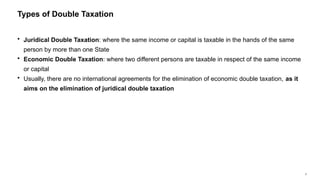
Juridical DoubleTaxation: where the same income or capital is taxable in the hands of the same
person by more than one State
Economic Double Taxation: where two different persons are taxable in respect of the same income
or capital
Usually, there are no international agreements for the elimination of economic double taxation, as it
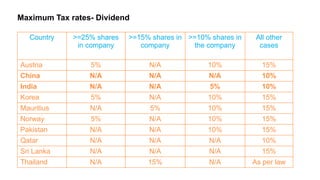
aims on the elimination of juridical double taxation
Types of Double Taxation
7.
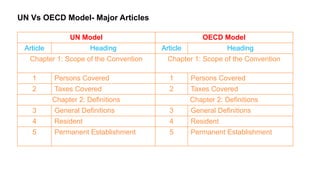
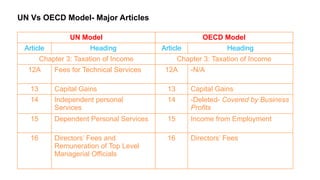
UN Vs OECDModel- Major Articles
UN Model OECD Model
Article Heading Article Heading
Chapter 1: Scope of the Convention Chapter 1: Scope of the Convention
1 Persons Covered 1 Persons Covered
2 Taxes Covered 2 Taxes Covered
Chapter 2: Definitions Chapter 2: Definitions
3 General Definitions 3 General Definitions
4 Resident 4 Resident
5 Permanent Establishment 5 Permanent Establishment
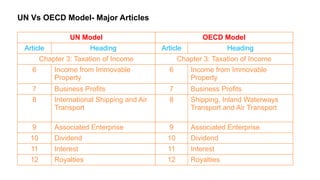
8.
UN Vs OECDModel- Major Articles
UN Model OECD Model
Article Heading Article Heading
Chapter 3: Taxation of Income Chapter 3: Taxation of Income
6 Income from Immovable
Property
6 Income from Immovable
Property
7 Business Profits 7 Business Profits
8 International Shipping and Air
Transport
8 Shipping, Inland Waterways
Transport and Air Transport
9 Associated Enterprise 9 Associated Enterprise
10 Dividend 10 Dividend
11 Interest 11 Interest
12 Royalties 12 Royalties
9.
UN Vs OECDModel- Major Articles
UN Model OECD Model
Article Heading Article Heading
Chapter 3: Taxation of Income Chapter 3: Taxation of Income
12A Fees for Technical Services 12A -N/A
13 Capital Gains 13 Capital Gains
14 Independent personal
Services
14 -Deleted- Covered by Business
Profits
15 Dependent Personal Services 15 Income from Employment
16 Directors’ Fees and
Remuneration of Top Level
Managerial Officials
16 Directors’ Fees
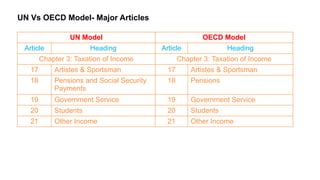
10.
UN Vs OECDModel- Major Articles
UN Model OECD Model
Article Heading Article Heading
Chapter 3: Taxation of Income Chapter 3: Taxation of Income
17 Artistes & Sportsman 17 Artistes & Sportsman
18 Pensions and Social Security
Payments
18 Pensions
19 Government Service 19 Government Service
20 Students 20 Students
21 Other Income 21 Other Income
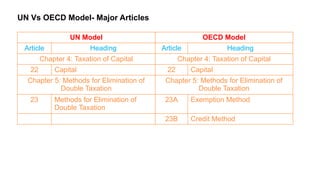
11.
UN Vs OECDModel- Major Articles
UN Model OECD Model
Article Heading Article Heading
Chapter 4: Taxation of Capital Chapter 4: Taxation of Capital
22 Capital 22 Capital
Chapter 5: Methods for Elimination of
Double Taxation
Chapter 5: Methods for Elimination of
Double Taxation
23 Methods for Elimination of
Double Taxation
23A Exemption Method
23B Credit Method
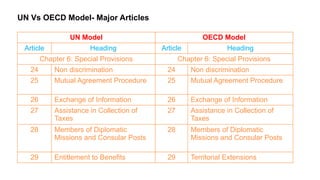
12.
UN Vs OECDModel- Major Articles
UN Model OECD Model
Article Heading Article Heading
Chapter 6: Special Provisions Chapter 6: Special Provisions
24 Non discrimination 24 Non discrimination
25 Mutual Agreement Procedure 25 Mutual Agreement Procedure
26 Exchange of Information 26 Exchange of Information
27 Assistance in Collection of
Taxes
27 Assistance in Collection of
Taxes
28 Members of Diplomatic
Missions and Consular Posts
28 Members of Diplomatic
Missions and Consular Posts
29 Entitlement to Benefits 29 Territorial Extensions
13.
UN Vs OECDModel- Major Articles
UN Model OECD Model
Article Heading Article Heading
Chapter 7: Final Provisions Chapter 7: Final Provisions
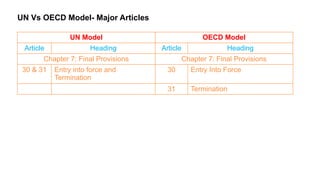
30 & 31 Entry into force and
Termination
30 Entry Into Force
31 Termination
14.
14
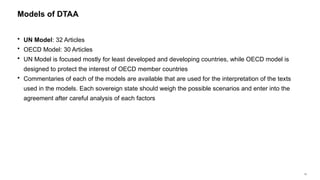
UN Model:32 Articles
OECD Model: 30 Articles
UN Model is focused mostly for least developed and developing countries, while OECD model is
designed to protect the interest of OECD member countries
Commentaries of each of the models are available that are used for the interpretation of the texts
used in the models. Each sovereign state should weigh the possible scenarios and enter into the
agreement after careful analysis of each factors
Models of DTAA
15.
15
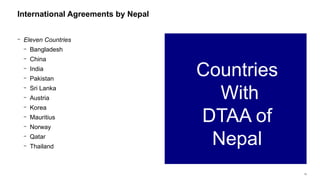
− Eleven Countries
−Bangladesh
− China
− India
− Pakistan
− Sri Lanka
− Austria
− Korea
− Mauritius
− Norway
− Qatar
− Thailand
International Agreements by Nepal
Countries
With
DTAA of
Nepal
16.
16
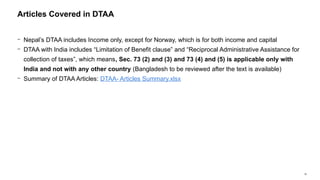
− Nepal’s DTAAincludes Income only, except for Norway, which is for both income and capital
− DTAA with India includes “Limitation of Benefit clause” and “Reciprocal Administrative Assistance for
collection of taxes”, which means, Sec. 73 (2) and (3) and 73 (4) and (5) is applicable only with
India and not with any other country (Bangladesh to be reviewed after the text is available)
− Summary of DTAA Articles: DTAA- Articles Summary.xlsx
Articles Covered in DTAA
18
DTAA isapplied to persons who are residents of one or both of the Contracting states.
Applicability to residents and not on Citizens
Residential status is determined by the taxation law of the country. The reference shall be given to the applicable taxation laws
− Mr. Goyal is resident of both Nepal and India in FY 2078/79. He has residential house in both countries. He earned income of Rs. 50
lakhs from his own Restaurant business in Bhutan during this year. Mr. Goyal has no permanent establishment to conduct the business
in Nepal. However, he has earned rental income of Rs. 5 lakhs from the house situated in Birtamod, Jhapa, Nepal. He stays in the house
during his visit to Nepal. Determine with reasons whether the business income of Mr. Goyal in Bhutan is taxable in Nepal. 5
− Section 73(4) shall be applicable if any international agreement contains a provision under which Nepal has to exempt income or
payment or has to apply the reduced tax rate to income or payment. Where, Nepal has entered
− Double Taxation Avoidance Agreement with foreign country, the provision of that agreement shall be applicable. In the given
case, Mr. Goyal is resident of both Nepal and India. DTAA with India is applicable only if Mr. Goyal would have earned income
either in India or in Nepal. In the given case Mr. Goyal has earned income from Bhutan NO DTAA with bhutan therefore such
income shall be taxable in Nepal. Further, rental income earned in Nepal is also taxable in Nepal subject to Section 92 of Income
Tax Act, 2058.
Article 1- Persons Covered
19.
19
− The agreementis applicable to taxes on income (and capital, in case of Norway) imposed by the state or
political sub-divisions (not present in China, Mauritius, Pakistan, Qatar, SL, Thailand) , or local
authorities (not in Mauritius, Pakistan, Qatar, SL) irrespective of the manner in which they are levied
(Clause not present in Korea,
− Taxes on income includes (Clause not present in Korea)
− On total income, or
− On total capital or elements of capital (in case of Norway only)
− On elements of income, including
− Taxes on gain from alienation of movable or immovable property,
− Taxes on the total amounts of wages or salaries paid by the enterprises, (not in Pakistan, Qatar, SL )
− Taxes on capital appreciation (not in Pakistan, Qatar, SL)
− Specific Taxes imposed under specific laws are covered by this Article and a sub-article to include “any
identical or substantially similar taxes on income which are imposed after the date of agreement” is also
present. This has imposed an obligation to competent authority to notify the counterpart in such changes
Article 2: Taxes Covered
20.
20
− Usually, thisarticle defines
− The terms of each country, for example, the term “Nepal” means XXXX
− “a contracting state” and “the other contracting state”
− Person
− Company
− “enterprise of a contracting state” and “enterprise of the other contracting state”
− “international Traffic”
− “Competent authority”
− “National”
− Terms not defined by the agreement bears the meaning as per the law of respective country
Article 3: General Definitions
21.
21
− “Resident ofa contracting state” means any person, who under the laws of that state, is liable to tax therein by reason of his
domicile, residence, place of management or any other criteria of a similar nature, and also includes the political sub-
division and local body of that state. It does not include such persons who pay tax only of income from sources in that state.
[Respective Law defines resident person]
− Where a natural person is resident of both the states, the dual residency is eliminated by following tests in descending order:
• Permanent Home
• Permanent Home in both states: state with which his personal and economic relations are closer (center of vital
interest)
• Center of Vital Interest cannot be determined: Place of habitual abode
• Permanent Home in neither of the states: Place of habitual abode
• Habitual place of abode in both the states: Nationality test
• Habitual place of abode in neither of the states: Nationality Test
• National of both or none: Mutual Agreement
• Where a person other than natural person is resident of both the states, the dual residency is eliminated by effective
management test
Article 4: Resident SAME FOR DTAA WITH ALL
22.
22
− family andsocial relations,
− his occupations,
− his political, cultural or other activities,
− his place of business,
− the place from which he administers his property, etc.
− The circumstances must be examined as a whole, but it
is nevertheless obvious that considerations based on
the personal acts of the individual must receive special
attention.
− If a person who has a home in one State sets up a
second in the other State while retaining the first, the
fact that he retains the first in the environment where he
has always lived, where he has worked, and where he
has his family and possessions, can, together with other
elements, go to demonstrate that he has retained his
centre of vital interests in the first State.
Center of Vital Interest- Due Considerations
23.
23
− The placeof effective management is the place
where key management and commercial
decisions that are necessary for the conduct of
the entity’s business as a whole are in
substance made.
− An entity may have more than one place of
management, but it can have only one place of
effective management at any one time.
Effective Management
− Considerations may be given to:
− where the meetings of its board of directors or
equivalent body are usually held,
− where the chief executive officer and other senior
executives usually carry on their activities,
− where the senior day-to-day management of the
person is carried on,
− where the person’s headquarters are located, which
country’s laws govern the legal status of the person,
− where its accounting records are kept,
− whether determining that the legal person is a
resident of one of the Contracting States but not of
the other for the purpose of the Convention would
carry the risk of an improper use of the provisions of
the Convention etc.
24.
24
− a fixedplace of business through which the business of an enterprise is wholly or partly carried on
− Includes
− a place of management
− a branch
− an office
− a factory
− a workshop
− a mine, an oil or gas well, a quarry or any other place of extraction of natural resources
− a warehouse (in relation to providing storage facilities for others- India) (not included in Korea)
− a farm or plantation (or other place where agricultural, forestry, plantation or related activities are carried
on- India) (not included in Korea, Norway)
− (An installation or structure used for the exploration of natural resources- in case of Mauritius)
− (Sales Outlet- Pakistan, Qatar)
Article 5: Permanent Establishment
25.
25
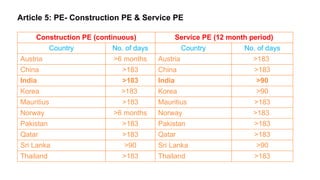
− a buildingsite, construction, assembly or installation project, or an installation or drilling rig or
ship used for the exploration or development of natural resources, including supervisory
activities in connection therewith, but only if that site, project, or use lasts or those
activities last more than six months
− the furnishing of services, including consultancy services, by an enterprise through
employees or other personnel engaged by the enterprise for such purpose, but only where
activities of that nature continue (for the same or a connected project) within the country for a
period or periods aggregating more than 183 days within any twelve month period
Article 5: Permanent Establishment
26.
Article 5: PE-Construction PE & Service PE
Construction PE (continuous) Service PE (12 month period)
Country No. of days Country No. of days
Austria >6 months Austria >183
China >183 China >183
India >183 India >90
Korea >183 Korea >90
Mauritius >183 Mauritius >183
Norway >6 months Norway >183
Pakistan >183 Pakistan >183
Qatar >183 Qatar >183
Sri Lanka >90 Sri Lanka >90
Thailand >183 Thailand >183
27.
27
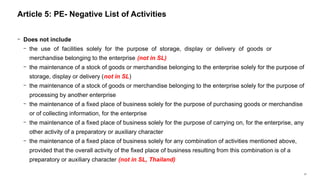
− Does notinclude
− the use of facilities solely for the purpose of storage, display or delivery of goods or
merchandise belonging to the enterprise (not in SL)
− the maintenance of a stock of goods or merchandise belonging to the enterprise solely for the purpose of
storage, display or delivery (not in SL)
− the maintenance of a stock of goods or merchandise belonging to the enterprise solely for the purpose of
processing by another enterprise
− the maintenance of a fixed place of business solely for the purpose of purchasing goods or merchandise
or of collecting information, for the enterprise
− the maintenance of a fixed place of business solely for the purpose of carrying on, for the enterprise, any
other activity of a preparatory or auxiliary character
− the maintenance of a fixed place of business solely for any combination of activities mentioned above,
provided that the overall activity of the fixed place of business resulting from this combination is of a
preparatory or auxiliary character (not in SL, Thailand)
Article 5: PE- Negative List of Activities
28.
28
− Does notinclude
− An enterprise of a Contracting State shall not be deemed to have a permanent establishment
in the other Contracting State merely because it carries on business in that State through a
broker, general commission agent or any other agent of an independent status, provided that
such persons are acting in the ordinary course of their business
− Agent of Independent Status
when the activities of such an agent are devoted wholly or principally on behalf of that
enterprise, he shall not be considered an agent of an independent status, if it is shown
that the transactions between the agent and the enterprise were not made under arm's
length conditions
if it is shown that the transactions between the agent and the enterprise were
made under arm's length conditions, it is not considered PE
Article 5: PE- Negative List of Activities
29.
29
− The factthat a company which is a resident of a Contracting State controls or is controlled by a
company which is a resident of the other Contracting State, or which carries on business in that
other State (whether through a permanent establishment or otherwise), shall not of itself
constitute either company a permanent establishment of the other
Article 5: PE- Negative List of Activities
30.
30
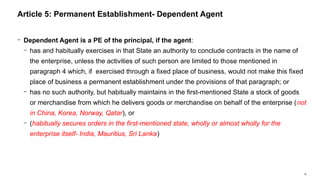
− Dependent Agentis a PE of the principal, if the agent:
− has and habitually exercises in that State an authority to conclude contracts in the name of
the enterprise, unless the activities of such person are limited to those mentioned in
paragraph 4 which, if exercised through a fixed place of business, would not make this fixed
place of business a permanent establishment under the provisions of that paragraph; or
− has no such authority, but habitually maintains in the first-mentioned State a stock of goods
or merchandise from which he delivers goods or merchandise on behalf of the enterprise (not
in China, Korea, Norway, Qatar), or
− (habitually secures orders in the first-mentioned state, wholly or almost wholly for the
enterprise itself- India, Mauritius, Sri Lanka)
Article 5: Permanent Establishment- Dependent Agent
31.
31
− an insuranceenterprise of a Contracting State shall, except with regard to reinsurance, be
deemed to have a permanent establishment in the other Contracting State if
− it collects premiums in the territory of that other State through a person other than an
agent of an independent status, or
− insures risks situated therein through a person other than an agent of an
independent status
Article 5: Permanent Establishment- Insurance Enterprise
32.
32
− General logicsare person is of course taxed in that contracting
state(resident state one as one state determined using the principle);
whether same person be taxed on other contracting state(i.e. source
state)???
33.
33
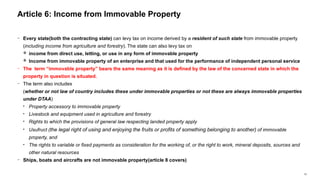
− Every state(boththe contracting state) can levy tax on income derived by a resident of such state from immovable property
(including income from agriculture and forestry). The state can also levy tax on
income from direct use, letting, or use in any form of immovable property
Income from immovable property of an enterprise and that used for the performance of independent personal service
− The term “immovable property” bears the same meaning as it is defined by the law of the concerned state in which the
property in question is situated.
− The term also includes
(whether or not law of country includes these under immovable properties or not these are always immovable properties
under DTAA)
• Property accessory to immovable property
• Livestock and equipment used in agriculture and forestry
• Rights to which the provisions of general law respecting landed property apply
• Usufruct (the legal right of using and enjoying the fruits or profits of something belonging to another) of immovable
property, and
• The rights to variable or fixed payments as consideration for the working of, or the right to work, mineral deposits, sources and
other natural resources
− Ships, boats and aircrafts are not immovable property(article 8 covers)
Article 6: Income from Immovable Property
34.
34
− General Condition:Profit of an enterprise of one state shall be taxable only in that state(resident vako country ma
matra tax lagxa; India ko resident Nepal ma tax lagauna vayena)
− Taxable in another state only If generated through Permanent Establishment situated in such state(e.g. India ko
resident NEPAL ma PE xa vane lagyo Nepal ma pani under Article 5 of DTAA and viceversa for Resident of
Nepal having PE In India)
− Taxable income shall be only so much of them as is attributable to that PE(not on worldwide income like normal
resident rather only attributable hai same principle in NEPAL for FPE’s only 25% in income in nepal)
(in case of Qatar, Sri Lanka and Thailand: income attributable to sales in the other state of goods or merchandise of the
same or similar kinds as those sold through PE, or attributable to other business activities carried on in the other state
of the same or similar kinds as those affected through the PE, is also taxable)
− Permanent Establishment shall be treated as a distinct and separate enterprise engaged in the same or similar
activities under the same or similar condition and dealing wholly independently with the enterprise of which it is a
PE, and the profit shall be attributed accordingly (i.e. PE and person owning PE are different person for tax purpose)
Article 7: Business Profits OF AN ENTERPRISE(INDIVIDUAL)
35.
35
− The Expensesallowable under the provisions of domestic law and which are incurred for the purposes of the business of the PE shall be
deductible, which includes:
Executive and General Administrative Expense so incurred whether in the state in which PE is situated or elsewhere,
(e.g: Indian PE in Nepal can deduct certain executive and general admin exp made for it in other than Nepal also)
− The following Payment by PE to Head office (otherwise than towards reimbursement of actual expenses), and vice-versa, are specifically
not deductible (not in Korea):
− by way of, royalties, fees or other similar payments in return for the use of patent, (knowhow- India) or other rights,
− By way of commission, for specific services performed or for management,
− Except in case of banking enterprise, by way of interest on money lent to PE
− If it is customary to determine profit on the basis of apportionment of total profits of an enterprises to its various parts, the state can do
so, but it shall be in accordance with the principles mentioned in Article 7 of DTAA (not in Korea)
− There should be consistency in method for determination of profit, unless there is good and sufficient reason in the contrary
− Other Articles are superior to this Article (i.e. Article 8 to 15)
− No profits shall be attributed to a PE by reason of the mere purchase by that PE of goods or merchandise for the enterprise (not in Sri
Lanka)
Article 7: Business Profits- Specific Deductions under DTAA
36.
36
− Profit fromthe operation of ships or aircrafts (including profit from the participation in a pool, a joint business or an international operating agency)
in international traffic :
shall be taxable only in that state in which the place of effective management (or head office(sec. 70 HO outside nepal, in case of china) of the
enterprise is situated and in case of India, Korea, Norway, only in that contracting state in which the enterprise i.e. say india(S.70 Ho outside
Nepal) is situated
− Profit derived by Transportation enterprise which is resident of one state from the use, maintenance or rental of containers
(including trailers and other equipment for the transport of containers) used for the transport of goods or merchandise in
international traffic, which is supplementary or incidental to operation to its ships or aircraft in international traffic, shall only be
taxable in the country of residence unless the containers are used solely within the country of source (only in case of
India and Norway)-
− interest on investment directly connected with operation of ship or air transport in international traffic, Article 11 not applicable,
deemed as income from international traffic (in case of India Only)
− Joint Norwegian, Danish and Swedish Air Transport consortium Scandinavian Airlines system to the extent profit derived by DNL, in proportion to its share (in case of Norway)
− Determination of effective management of a shipping enterprise (Not included in China, India, Korea, Norway, Pakistan, Qatar, Sri Lanka, Thailand)
− In the state where the home harbor of the ship is situated, or
− Where there is no home harbor, the state where the operator of ship is resident
Article 8: Shipping & Air Transport
37.
37
− In caseof Pakistan and Sri Lanka and Thailand, the source country has the right to tax (i.e. Resident country ley tw payo in addition
source country ley nee payo) the profits from the operation of ships or aircrafts (including profit from the participation in a pool, a joint business or
an international operating agency), but with reduction of tax rate to 50% of applicable tax rate.
− SUMMARY:
− Article 8 of “The Avoidance of Double Taxation and The Prevention of Fiscal Evasion with respect To Taxes on Income
between India and Nepal” Shipping and Air Transport applicable provisions are:
− 1. Profits derived by an enterprise of a Contracting State from the operation of ships or aircraft in international traffic shall be
taxable only in that Contracting State (residence enterprise location)
− 2. Profits derived by a transportation enterprise which is a resident of a Contracting State from the use, maintenance, or rental
of containers (including trailers and other equipment for the transport of containers) used for the transport of goods or
merchandise in international traffic which is supplementary or incidental to operation of its ships or aircraft in
international traffic shall be taxable only in that Contracting State(residence country) unless the containers are used solely
within the other Contracting State(source country).
− 3. For the purposes of this Article interest on investments directly connected with the Operation of ships or aircraft in
international traffic shall be regarded as profits derived from the operation of such ships or aircraft if they are integral to the
carrying on of such business, and the provisions of Article 11 shall not apply in relation to such interest.
− 4. The provisions of paragraph 1 shall also apply to profits from the participation in a pool, a joint business or an international
operating agency.
Article 8: Shipping & Air Transport
38.
38
− Non Arms’Length Transactions (conditions made or imposed between two enterprises in their commercial
or financial relations which differ from those which would be made between associated enterprises) may be
adjusted and taxed accordingly in case following conditions prevail:
− An enterprise of one state that participates directly or indirectly in the management, control or capital of
an enterprise of another state (transaction between holding-subsidiary), or
− The same person participates directly or indirectly in the management, or control or capital of both the
states (transaction between two subsidiaries of same holding company)
− Corresponding tax adjustment should be made in the other state, if one state adjusts its profits and tax
due to the reason as mentioned above (NO loss of taxation, and no double taxation in the same income-
difficult to agree whether arms’ length or not), consultation of competent authorities are recommended by
DTAA in case of application of this article [Not available in case of Norway]- it leads to simultaneous
tax examination in both the countries- In case of Sri Lanka and Thailand, there is no corresponding
effect after the expiry of time mentioned in domestic law
Article 9: Associated Enterprises- Adjustment of Non
Arms’ Length Transactions
39.
39
− Dividend fromsource country to a resident of another country may be taxed in country of
residence
− Dividend tax may be levied in the source country as well, the maximum percentage of tax is
given in next slide
− Meaning of dividend
− Income from shares, “jouissance” shares, or “jouissance” rights, founders’ shares or other rights, not
being debt-claims, participating in profits,
− Income from other corporate rights which is subjected to the same taxation treatment as income
from shares by the laws of the state of which the company making the distribution is a resident
− Source country cannot levy tax to a resident of other contracting state,
if the business is carried out through a permanent establishment in source state, or if the resident of
other contracting state performs independent personal services from a fixed based in source
country, when paragraph 7 and 14 are applicable
Article 10: Dividends
40.
Maximum Tax rates-Dividend
Country >=25% shares
in company
>=15% shares in
company
>=10% shares in
the company
All other
cases
Austria 5% N/A 10% 15%
China N/A N/A N/A 10%
India N/A N/A 5% 10%
Korea 5% N/A 10% 15%
Mauritius N/A 5% 10% 15%
Norway 5% N/A 10% 15%
Pakistan N/A N/A 10% 15%
Qatar N/A N/A N/A 10%
Sri Lanka N/A N/A N/A 15%
Thailand N/A 15% N/A As per law
41.
41
− Right totaxation of both the countries
− Income from source country to a resident of another country may be taxed in country of residence
− Interest tax may be levied in the source country as well, the maximum percentage of tax is given in next slide
− Exemption of tax on Interest, in following cases:
− Interest to Government of the other state,
− The central bank of the other state, or
− any financial institution controlled by the government of the other state
− Exclusive right of taxation to the country of residence:
− In case of Austria, Interest arising in a state on a loan guaranteed by any of the bodies mentioned above and paid to the resident of other state, shall be
taxable in that other state
− Meaning of Interest
− Income from debt claims of every kinds, whether or not secured by mortgage and whether or not carrying a right to participate in the debtor’s profit
− Income from government securities, and
− Income from bonds or debentures, including premiums or prizes attaching to securities, bonds or debentures
Penalty for late payment is not treated as interest
Article 11: Interest
42.
42
− Source countrycannot levy tax to a resident of other contracting state,
if the business is carried out through a permanent establishment in source state, or if the resident of other
contracting state performs independent personal services from a fixed based in source country, when
paragraph 7 and 14 are applicable (similar to article 10 Dividend)
− Interest is deemed to arise in a contracting state when:
− The payer is that state itself, or
− a political sub-division or a local body, or
− a resident of that state (as defined by Income Tax Act)
− In case a permanent establishment or fixed base incurs interest expense, the interest is deemed to arise in the
state where such PE or FB is situated.
− If the interest is paid in excess of market interest rate by associated persons, this article is applicable to
arms’ length interest only. (amnesty as per Article 11 applicable only to the extent of market interest rate)
The excess should be characterised otherwise and taxed accordingly
Article 11: Interest- contd….
43.
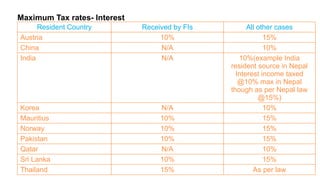
Maximum Tax rates-Interest
Resident Country Received by FIs All other cases
Austria 10% 15%
China N/A 10%
India N/A 10%(example India
resident source in Nepal
Interest income taxed
@10% max in Nepal
though as per Nepal law
@15%)
Korea N/A 10%
Mauritius 10% 15%
Norway 10% 15%
Pakistan 10% 15%
Qatar N/A 10%
Sri Lanka 10% 15%
Thailand 15% As per law
44.
44
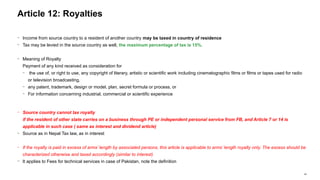
− Income fromsource country to a resident of another country may be taxed in country of residence
− Tax may be levied in the source country as well, the maximum percentage of tax is 15%.
− Meaning of Royalty
Payment of any kind received as consideration for
− the use of, or right to use, any copyright of literary, artistic or scientific work including cinematographic films or films or tapes used for radio
or television broadcasting,
− any patent, trademark, design or model, plan, secret formula or process, or
− For information concerning industrial, commercial or scientific experience
− Source country cannot tax royalty
if the resident of other state carries on a business through PE or independent personal service from FB, and Article 7 or 14 is
applicable in such case ( same as interest and dividend article)
− Source as in Nepal Tax law, as in interest
− If the royalty is paid in excess of arms’ length by associated persons, this article is applicable to arms’ length royalty only. The excess should be
characterized otherwise and taxed accordingly (similar to interest)
− It applies to Fees for technical services in case of Pakistan, note the definition
Article 12: Royalties
45.
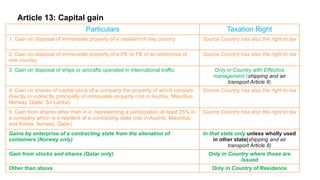
Article 13: Capitalgain
Particulars Taxation Right
1. Gain on disposal of immovable property of a resident of one country Source Country has also the right to tax
2. Gain on disposal of immovable property of a PE or FB of an enterprise of
one country
Source Country has also the right to tax
3. Gain on disposal of ships or aircrafts operated in international traffic Only in Country with Effective
management (shipping and air
transport Article 8)
4. Gain on shares of capital stock of a company the property of which consists
directly or indirectly principally of immovable property (not in Austria, Mauritius,
Norway, Qatar, Sri Lanka)
Source Country has also the right to tax
5. Gain from shares other than in 4, representing a participation at least 25% in
a company which is a resident of a contracting state (not in Austria, Mauritius
and Korea, Norway, Qatar)
Source Country has also the right to tax
Gains by enterprise of a contracting state from the alienation of
containers (Norway only)
In that state only unless wholly used
in other state(shipping and air
transport Article 8)
Gain from stocks and shares (Qatar only) Only in Country where those are
issued
Other than above Only in Country of Residence
46.
46
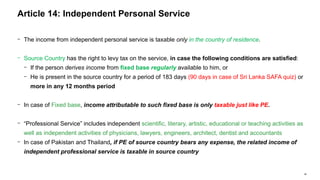
− The incomefrom independent personal service is taxable only in the country of residence.
− Source Country has the right to levy tax on the service, in case the following conditions are satisfied:
− If the person derives income from fixed base regularly available to him, or
− He is present in the source country for a period of 183 days (90 days in case of Sri Lanka SAFA quiz) or
more in any 12 months period
− In case of Fixed base, income attributable to such fixed base is only taxable just like PE.
− “Professional Service” includes independent scientific, literary, artistic, educational or teaching activities as
well as independent activities of physicians, lawyers, engineers, architect, dentist and accountants
− In case of Pakistan and Thailand, if PE of source country bears any expense, the related income of
independent professional service is taxable in source country
Article 14: Independent Personal Service
47.
47
− This Articleis not applicable in case of
− directors’ fee, pension and social security payments, government service and students and trainees (covered by other article),
(teachers and researchers as well- in case of India and China, Korea) (Mauritius rescinds the right of non-application of this article in case of students and
trainees and teachers and researchers)
− Employment income of an individual may be taxable in source country
− The employment income is exclusively taxable in the country of residence, if all the following conditions are satisfied:
− The person is present in the source country for less than 183 days (90 days in case of Sri Lanka SAFA quiz) in any 12 months’ period, (source country
mah resident chai navako condition mah)
− The payment is made by employer, who is not resident of source country (and whose activity does not consist of the hiring out of labour- in case of
Norway), and
− The remuneration is not borne by the PE of source country.
− The remuneration income of employees working aboard in ship, aircraft operated in international flight may be taxable in the
country where the effective management is situated (additional clause in Norway, please focus like article 8 here effective management)
− We have an Indian resident (he was resident in India immediately before he visits Nepal) who works for a PE of Indian Co. His salary is INR
200,000 per month? Is his salary taxable in Nepal?
Article 15: Dependent Personal Service
48.
48
− Source Countryalso has the right to tax directors’ fee residence country tw xadai xa but resident
is also source for this article.
− Source country has the right to tax Salaries, wages and similar remunerations by a resident of other
state in the capacity of top-level management (in case of Mauritius, Pakistan, Qatar, Sri Lanka,
Thailand)
− Source Country (for this article purpose): country in which the company is resident
Article 16: Directors’ Fee of Directors of Resident
Company of one contracting State
49.
49
− This articleprevails over Article 7, 14 and 15 for income derived by a resident of one state as an entertainer, such as
theatre, motion picture, radio or television artistes, or a musician, or as a sportsman, from personal activities
− Source country has the right to tax such income (Nepal ma aayo marshmello balti lera Nepal ley tax tatayo)
− If such income is not accrued to the entertainer (individual) but to a another person, such income may also be taxed in source
country (notwithstanding Article 7, 14 & 15)
− Exemption in Source Country:
− If such income is from entertainment performed under cultural agreement or arrangement between the Contracting States,
if the program is wholly or substantially funded by either contracting states, a local authority or public institution thereof
(in case of China, Korea, Pakistan, funding by Government only). (Such income is taxable in the country of residence-
DTAA India, Norway)
− In case of Thailand, source country cannot levy tax (but residence country has the right) on remuneration or profits,
salaries, wages to entertainer and sportsman if the visit to the state is substantially supported by public funds of other
state. (If a Thai maal entertainer or sportsman visit Nepal or vice-versa and the payment of such entertainer or sportsman
is paid from public funds of Thailand (Nepali Thailand gaeko awastha ma Nepal), only the country where such entertainer
or sportsman is resident can levy tax.)
Article 17: Artiste and Sportsman (Entertainers, may be)
50.
50
− In respectof all countries, except Norway:
− Country of residence(unique) has the right to tax, only if the recipient is
1. resident and
2. national of the country of residence, but pensions paid and other payments made under a public scheme which is part of the
social security system of a state cannot be taxable in another state (update it)
− Source Country has also the right to tax, in case it is paid by resident of the source country or PE situated therein
(relate article 15 exemption)
− In respect of Norway
− Country of residence has exclusive right to tax this income
− Ram Maya was a teacher who derives pension from public fund of India. What if she derived pension from resident of Nepal(then source
country can also tax) .She is an Indian national but a resident of Nepal. She derives NRs. 20 lakhs as income during Income Year 2079/80.
Calculate tax liability.:
As per DTAA between Nepal and India, since, she is not Nepali national, her income cannot be subjected to taxation in Nepal (joint
reading of Art. 18 and Para 2 of Article 19 of DTAA) . Only india has right to tax.
Article 18: Pensions and social Security Payments
51.
51
− Other thanPension:
− Salaries, wages, and other similar remuneration other than pension paid by a country or a political sub-division
or a local authority in respect of services rendered in that state, is exclusively taxable only in that state.
− Such salary and wages are taxable (income of employee of one state) in another state, when all following
conditions are satisfied: obvious india mah kaam, india ko national and resident surely taxed
− Employment is exercised in that another state, (india)
− The recipient is national of that another state,(Indian) and
− The recipient become a resident of that another state not solely for the purpose of rendering services
(India resident pahilai dekhi) (otherwise tw exempt clause xa Nepal mah u/s 10(kha)(ga))
− In case of pension, paid out of funds of a country or a political sub-division or a local authority is taxable only in that
state, but may be taxable in another state, if the individual is both resident and national of the other state (like
article 18)
− In case of business carried out by a country or a political sub-division or a local authority is tested to taxation under
articles 15, 16, 17, 18
Article 19: Government Service
52.
52
− China, India,Mauritius, Qatar, Sri Lanka
− Exemption from tax in source country for two years from the date of first arrival in the source country :(in
case of Qatar(World cup vara ho kya: taxable if the payment is made by the source country i.e. hamle
tire tax lauaxau)
if all the following conditions are satisfied:
− The individual was resident of the other country immediately before visiting the source country,
− The presence in the source country is primarily for the purpose of teaching, giving lectures or conducting
research at university, college, school, or educational institution or scientific research institution (in case
of Qatar, Museum or other cultural institution as well) recognized by Government of source country,
− Income is derived solely for the purpose of such teaching, lectures or research, and
− The research is undertaken in public interest and not primarily for the private benefit of a specific
person or persons
− In case of India, the individual is deemed to be resident of the state in which he was resident
immediately before the visit
Article 20: Teachers, Professors and Researchers
53.
53
− The followingincome are exempt from taxation in the country where such student or trainee is residing, if all
the following conditions are satisfied:
− Income:
− Remittance from abroad for the purpose of maintenance, education, study, research or training,
− The grant, allowance or award, or
− Income which he derives from the employment which he exercises in the state for the purpose of
practical training for not longer than six months in any tax year.
(PWC not more than six months)
− Conditions ( same as previous article)
− He was resident of the other state immediately before the visit of the state,
− The visit is for the purpose of studying at a university, college or school or other recognized educational
institutions, or to secure training to qualify him to practice a profession or trade, or studying or carrying
out research as a recipient of grant, allowance or award from governmental, religious, charitable,
scientific, literary or educational organization
Article 20 (or 21): Students and Trainees- AI Austria, India
54.
54
− Payments whicha student, business apprentice or trainee who is or was immediately before
visiting a Contracting State(Nepal) a resident of the other Contracting State(china) and who is
present in the first- mentioned State(Nepal) solely for the purpose of his education or training
receives for the purpose of his maintenance, education or training shall not be taxed in that
State, provided that such payments arise from sources outside that State.
− In respect of grants, scholarships and remuneration from employment not covered by above, a
student, business apprentice or trainee described above shall, in addition, be entitled during
such education or training to the same exemptions, reliefs or reductions in respect of taxes
available to residents of the State which he is visiting.
Article 20 (or 21): Students and Trainees- China
55.
55
− Different fordifferent country, please refer DTAA
Article 20 (or 21): Students and Trainees
56.
56
− Country ofResidence and Source Country has the right to tax the income other than those
mentioned in the specific articles of DTAA
− Due consideration should be given by Source country to tax any income, whether or not derived
through PE or FB
− Country of Residence may not tax any income under legal claim to maintenance from another state
(Source Country), if the same income is exempt in source country
Article 21 (or 22): Other Income
57.
57
− The lawsin force in either of the Contracting States shall continue to govern the taxation of income in the
respective Contracting States except where provisions to the contrary are made in this Agreement.
− Where income is subject to tax in both Contracting States, relief from double taxation shall be given in
accordance with the following paragraphs of this Article.
− Double Taxation shall be eliminated in Nepal as follows:
− Where a resident of Nepal derives income which, in accordance with the provisions of this Agreement,
may be taxed in India, Nepal shall allow as a deduction from the tax on the income of that resident, an
amount equal to the tax paid in India. Such deduction shall not, however, exceed that portion of the
tax as computed before the deduction is given, which is attributable, as the case may be, to the income
which may be taxed in India.
− Where in accordance with any provision of the Agreement, income derived by a resident of Nepal is
exempt from tax in Nepal, Nepal may nevertheless, in calculating the amount of tax on the remaining
income of such resident, take into account the exempted income.
Article 22 (or 23): Methods for Elimination of Double Taxation
58.
58
− Double Taxationshall be eliminated in India as follows (same as Nepal)
− Where a resident of India derives income which, in accordance with the provisions of this
Agreement, may be taxed in Nepal, India shall allow as a deduction from the tax on the income of
that resident, an amount equal to the tax paid in Nepal. Such deduction shall not, however, exceed
that portion of the tax as computed before the deduction is given, which is attributable, as the case
may be, to the income which may be taxed in Nepal.
− Where in accordance with any provision of the Agreement, income derived by a resident of India is
exempt from tax in India, India may nevertheless, in calculating the amount of tax on the remaining
income of such resident, take into account the exempted income.
Article 22 (or 23): Methods for Elimination of Double Taxation
59.
59
− Nationals ofa State(Nepal) shall not be subjected in the other State(other country) to any taxation or any
requirement connected therewith, which is other or more burdensome than the taxation and connected
requirements to which nationals of that other State in the same circumstances, in particular with respect to
residence, are or may be subjected.
− Applies to national unlike other clause which are applicable to resident.
− Non discrimination clause shall also apply to persons who are not residents of one or both of the Contracting
States.
− The taxation on a permanent establishment which an enterprise of a Contracting State has in the other Contracting
State shall not be less favorably levied in that other State than the taxation levied on enterprises of that other
State carrying on the same activities. (PE lai 40, other entity 25 vayena garna)
− This provision shall not be interpretated(construed) as obliging a Contracting State to grant to residents of the other
Contracting State any personal allowances, reliefs and reductions for taxation purposes on account of civil status
or family responsibilities which it grants to its own residents.
Article 23 (or 24): Non Discrimination
60.
60
− This provisionshall not be construed as preventing a Contracting State from charging the profits of a permanent
establishment which a company of the other Contracting State has in the first mentioned State at a rate of tax
which is higher than that imposed on the profits of similar company of the first mentioned Contracting State, nor
as being in conflict with the provisions of paragraph 3 of Article 7.
− Except where the provisions of paragraph 1 of Article 9, paragraph 7 of Article 11, or paragraph 6 of Article 12,
apply, interest, royalties and other disbursements paid by an enterprise of a Contracting State to a resident of
the other Contracting State shall, for the purpose of determining the taxable profits of such enterprise, be
deductible under the same conditions as if they had been paid to a resident of the first-mentioned State.
− Enterprises of a Contracting State, the capital of which is wholly or partly owned or controlled, directly or
indirectly, by one or more residents of the other Contracting State, shall not be subjected in the first-mentioned
State to any taxation or any requirement connected therewith which is other or more burdensome than the
taxation and connected requirements to which other similar enterprises of the first-mentioned State are or may be
subjected.
− The provisions of this Article shall apply to taxes covered by this Agreement.
Article 23 (or 24): Non Discrimination
61.
61
− Where aperson considers that the actions of one or both of the Contracting States result or will result for him in taxation not in accordance with the
provisions of this Agreement, he may, irrespective of the remedies provided by the domestic law of those States,
− present his case to the competent authority of the Contracting State of which he is a resident (MOF in case of Nepal for DTAA with INDIA) or,
− if his case comes under ARTICLE REATED TO NON-DISCRIMINATION, to that of the Contracting State of which he is a national.
− The case must be presented within three years from the first notification of the action resulting in taxation not in accordance with the provisions of the
Agreement.
− The competent authority shall endeavour, if the objection appears to it to be justified and if it is not itself able to arrive at a satisfactory solution, to resolve
the case by mutual agreement with the competent authority of the other Contracting State, with a view to the avoidance of taxation which is not in
accordance with the Agreement.
Any agreement reached shall be implemented notwithstanding any time limits in the domestic law of the Contracting States.
− The competent authorities of the Contracting States shall endeavour to resolve by mutual agreement any difficulties or doubts arising as to the
interpretation or application of the Agreement. They may also consult together for the elimination of double taxation in cases not provided for in the
Agreement.
− The competent authorities of the Contracting States may communicate with each other directly, including through a joint commission consisting of
themselves or their representatives, for the purpose of reaching an agreement in the sense of the preceding paragraphs.
− The competent authorities, through consultations, shall develop appropriate bilateral procedures, conditions, methods, and techniques for the
implementation of the mutual agreement procedure provided for in this Article.
Article 24 (or 25): Mutual Agreement Procedure
62.
62
− The competentauthorities of the Contracting States shall exchange such information, including documents or certified
copies thereof, as is foreseeably relevant for carrying out the provisions of this Agreement or to the administration or
enforcement of domestic laws concerning taxes of every kind and description imposed on behalf or of their political
subdivisions or local authorities, insofar as the taxation thereunder is not contrary to the Agreement. The exchange of
information is not restricted by Articles 1 and 2.
− Any information received by a Contracting State shall be treated as secret in the same manner as information
obtained under the domestic laws of that Contracting State and shall be disclosed only to persons or authorities
(including courts and administrative bodies) concerned with the assessment or collection of, the enforcement or
prosecution in respect of, or the determination of appeals in relation to the taxes, or the oversight of the above.
− Such persons or authorities (including courts and administrative bodies) shall use the information only for such purposes.
They may disclose the information in public court proceedings or in judicial decisions.
− Notwithstanding the foregoing, Information received by a Contracting States may be used for other purposes when such
information may be used for such other purposes under the laws of both States and the competent authority of the
supplying Contracting States authorizes such use.
Article 25 (or 26): Exchange of Information
63.
63
− In nocase shall the provisions be construed so as to impose on a Contracting State the obligation:
− To carry out administrative measures at variance with the laws and administrative practice of that or of the other
Contracting State;
− To supply information including documents and certified copies thereof which is not obtainable under the laws or in the
normal course of the administration of that or of the other Contracting State;
− To supply information which would disclose any trade, business, industrial, commercial or professional secret or trade
process, or information, the disclosure of which would be contrary to public policy (ordre public).
− If information is requested by a Contracting State in accordance with this Article, the other Contracting State shall use its
information gathering measures to obtain the requested information, even though that other State may not need such
information for its own tax purposes. The obligation contained in the preceding sentence is subject to the limitations
described above (first point of this slide) but in no case shall such limitations be construed to permit a Contracting State to
decline to supply information solely because it has no domestic interest in such information.
− In no case shall the provisions of described above (first point of this slide) be construed to permit a Contracting State to
decline to supply information solely because the information is held by a bank, other financial institution, nominee or person
acting in an agency or a fiduciary capacity or because it relates to ownership interests in a person.
Article 25 (or 26): Exchange of Information
64.
64
− Where InlandRevenue Department receives a request pursuant to an international agreement
from the competent authority of another country for the collection in Nepal of an amount
payable by a person ("tax debtor") under the tax laws of the other country; IRD may, by service
of a notice in writing, require the tax debtor to pay the amount to IRD by the date specified in
the notice and for transmission to the competent authority.
− It means, where there is agreement between Nepal and any foreign country and a person who
is tax debtor of such foreign country is residing in Nepal; the foreign country may request IRD
for collection of tax from such defaulter and IRD has the right to summon a notice to collect
such tax from defaulter. Such act is lawful under the law of Nepal, though the defaulter of
another country has not committed any tax related offences in Nepal (It cannot be
implemented if there is no clause in DTAA for the same)
Reciprocal Administrative Assistance- Sec. 73 (2) and (3)
65.
65
− This Articleis present only in case of DTAA with India, and not with any other country.
− The Contracting States shall lend assistance to each other in the collection of revenue claims. This assistance is not
restricted by Articles 1 & 2. The competent authorities of the Contracting States may by mutual agreement settle the mode
of application of this Article.
− The term “revenue claim” as used in this Article means an amount owed in respect of taxes of every kind and description
imposed on behalf of the Contracting States, or of their political subdivisions or local authorities, insofar as the taxation
thereunder is not contrary to this Agreement or any other instrument to which the Contracting States are parties, as well as
interest, administrative penalties and costs of collection or conservancy related to such amount.
− When a revenue claim of a Contracting State is enforceable under the laws of that State and is owed by a person
who, at that time, cannot, under the laws of that State, prevent its collection, that revenue claim shall, at the request of the
competent authority of that State, be accepted for purposes of collection by the competent authority of the other
Contracting State.
That revenue claim shall be collected by that other State in accordance with the provisions of its laws applicable to
the enforcement and collection of its own taxes as if the revenue claim were a revenue claim of that other State.
Article 27 of DTA with India: Assistance in Collection of Taxes
66.
66
− When arevenue claim of a Contracting State is a claim in respect of which that State may, under its law, take measures
of conservancy with a view to ensure its collection, that revenue claim shall, at the request of the competent authority of
that State, be accepted for purposes of taking measures of conservancy by the competent authority of the other
Contracting State. That other State shall take measures of conservancy in respect of that revenue claim in accordance
with the provisions of its laws as if the revenue claim were a revenue claim of that other State even if, at the time when
such measures are applied, the revenue claim is not enforceable in the first-mentioned State or is owed by a person
who has a right to prevent its collection.
− Notwithstanding the provisions of paragraphs 3 and 4, a revenue claim accepted by a Contracting State for purposes of
paragraph 3 or 4 shall not, in that State, be subject to the time limits or accorded any priority applicable to a revenue
claim under the laws of that State by reason of its nature as such. In addition, a revenue claim accepted by a
Contracting State for the purposes of paragraph 3 or 4 shall not, in that State, have any priority applicable to that
revenue claim under the laws of the other Contracting State.
− Proceedings with respect to the existence, validity or the amount of a revenue claim of a Contracting State shall only be
brought before the courts or administrative bodies of that State. Nothing in this Article shall be construed as creating or
providing any right to such proceedings before any court or administrative body of the other Contracting State.
Article 27 of DTA with India: Assistance in Collection of Taxes
67.
67
− Where, atany time after a request has been made by a Contracting State under paragraph 3 or 4 and before the other Contracting
State has collected and remitted the relevant revenue claim to the first-mentioned State, the relevant revenue claim ceases to be -
− in the case of a request under paragraph 3, a revenue claim of the first- mentioned State that is enforceable under the laws of
that State and is owed by a person who, at that time, cannot, under the laws of that State, prevent its collection, or
− in the case of a request under paragraph 4, a revenue claim of the first-mentioned State in respect of which that State may,
under its laws, take measures of conservancy with a view to ensure its collection, the competent authority of the first-mentioned
State shall promptly notify the competent authority of the other State of that fact and, at the option of the other State, the first-
mentioned State shall either suspend or withdraw its request.
− In no case shall the provisions of this Article be construed so as to impose on a Contracting State the obligation:
− to carry out administrative measures at variance with the laws and administrative practice of that or of the other Contracting
State;
− to carry out measures which would be contrary to public policy (ordre public);
− to provide assistance if the other Contracting State has not pursued all reasonable measures of collection or conservancy, as
the case may be, available under its laws or administrative practice;
− to provide assistance in those cases where the administrative burden for that State is clearly disproportionate to the benefit to
be derived by the other Contracting State.
Article 27 of DTA with India: Assistance in Collection of Taxes
68.
68
− Treaty Act,Sec. 9: Treaty provisions are applicable before the application of provisions of
national legislations and treaty should be treated valid when in contradiction with national
legislation
− In case where an international agreement provides Nepal will exempt income or a payment
or subject income or a payment to reduced tax; the exemption or reduction is not available
to any entity:
− Who, for the purpose of the agreement, is the resident of the other contracting state(say,
Indian resident); and
− 50 percent or more of whose underlying ownership is owned by individuals or entities in
which no individual has an interest who, for the purposes of the agreement, are not residents
of the other contracting state or Nepal. {(Nepal Tax Provision, Sec. 73 (4) and (5)}
Limitation of Benefit- Sec. 73 (4) and 5
69.
69
− Company “I”is resident company of India. The shareholders of the company are:
− Mr. Ramaswamy, Resident of India- 25%
− M/s G, resident company Germany- 75%
When the beneficiaries of Company G was identified, the company is, in substance, owned by individual who are not
resident of both Nepal and India.
Can Company “I” get DTAA relief under DTA between Nepal and India and u/s 73 (4) & (5) of ITA, 2058?
− In case where DTA between Nepal and India provides Nepal will exempt income or a payment or subject income
or a payment to reduced tax; the exemption or reduction is not available to any entity:
− Who, for the purpose of the agreement, is the resident of India; and
− 50 percent or more of whose underlying ownership is owned by individuals or entities in which no individual
has an interest who, for the purposes of the agreement, are not residents of the other contracting state or
Nepal. (Nepal Tax Provision, Sec. 73 (4) and (5)}, 50% or more of the underlying ownership of Company “I” is
held by Company G, that have interest individuals but who are not resident of both Nepal and India
Therefore, DTA relief is not available to company “I”
Limitation of Benefit- EXAMPLE
70.
70
− A residentof a Contracting State shall not be entitled to the benefits of this Agreement if its affairs
were arranged in such a manner as if it was the main purpose or one of the main purposes to take the
benefits of this Agreement. The case of legal entities not having bonafide business activities shall be
covered by the provisions of this Article.
Article 28 of DTA with India: LIMITATION OF BENEFITS
71.
71
− Nothing inthis Agreement shall affect the fiscal privileges of members of diplomatic mission or
consular posts under the general rules of international law or under the provisions of special
Agreements.
Article 27 (or 28 or 30): Members of Diplomatic Missions or Consular
Posts

![2
Where any income of a person is subject to taxation pursuant to this Act (Income Tax Act, 2058) or
other prevailing law and the same income is subject to tax in any foreign country, Government of
Nepal may conclude an agreement with foreign country in order to avoid such double taxation [Sec.
73 (1) of Income Tax Act, 2058]
Legal Basis for DTAA](https://image.slidesharecdn.com/class25-icanrevisionclass-dtaa-250714093047-a8c82b4e/85/Class-25-ICAN-Revision-Class-DTAA-pptx-2-320.jpg)
![5
where two States subject the same person to tax on his worldwide income or capital (concurrent full
liability to tax) [Dual Residency]
where a person is a resident of one State and derives income from, or owns capital in, the other State
and both States impose tax on that income or capital
where each State subjects the same person, not being a resident of either State to tax on income
derived from, or capital owned in, a State; this may result, for instance, in the case where a non-
resident person has a permanent establishment in one State through which he derives income from,
or owns capital in, the other State (S) (concurrent limited tax liability)
Reasons for Double Taxation](https://image.slidesharecdn.com/class25-icanrevisionclass-dtaa-250714093047-a8c82b4e/85/Class-25-ICAN-Revision-Class-DTAA-pptx-5-320.jpg)


![21
− “Resident of a contracting state” means any person, who under the laws of that state, is liable to tax therein by reason of his
domicile, residence, place of management or any other criteria of a similar nature, and also includes the political sub-
division and local body of that state. It does not include such persons who pay tax only of income from sources in that state.
[Respective Law defines resident person]
− Where a natural person is resident of both the states, the dual residency is eliminated by following tests in descending order:
• Permanent Home
• Permanent Home in both states: state with which his personal and economic relations are closer (center of vital
interest)
• Center of Vital Interest cannot be determined: Place of habitual abode
• Permanent Home in neither of the states: Place of habitual abode
• Habitual place of abode in both the states: Nationality test
• Habitual place of abode in neither of the states: Nationality Test
• National of both or none: Mutual Agreement
• Where a person other than natural person is resident of both the states, the dual residency is eliminated by effective
management test
Article 4: Resident SAME FOR DTAA WITH ALL](https://image.slidesharecdn.com/class25-icanrevisionclass-dtaa-250714093047-a8c82b4e/85/Class-25-ICAN-Revision-Class-DTAA-pptx-21-320.jpg)






![38
− Non Arms’ Length Transactions (conditions made or imposed between two enterprises in their commercial
or financial relations which differ from those which would be made between associated enterprises) may be
adjusted and taxed accordingly in case following conditions prevail:
− An enterprise of one state that participates directly or indirectly in the management, control or capital of
an enterprise of another state (transaction between holding-subsidiary), or
− The same person participates directly or indirectly in the management, or control or capital of both the
states (transaction between two subsidiaries of same holding company)
− Corresponding tax adjustment should be made in the other state, if one state adjusts its profits and tax
due to the reason as mentioned above (NO loss of taxation, and no double taxation in the same income-
difficult to agree whether arms’ length or not), consultation of competent authorities are recommended by
DTAA in case of application of this article [Not available in case of Norway]- it leads to simultaneous
tax examination in both the countries- In case of Sri Lanka and Thailand, there is no corresponding
effect after the expiry of time mentioned in domestic law
Article 9: Associated Enterprises- Adjustment of Non
Arms’ Length Transactions](https://image.slidesharecdn.com/class25-icanrevisionclass-dtaa-250714093047-a8c82b4e/85/Class-25-ICAN-Revision-Class-DTAA-pptx-38-320.jpg)