Basics of Fluid
Mechanics
Let the fun begin…
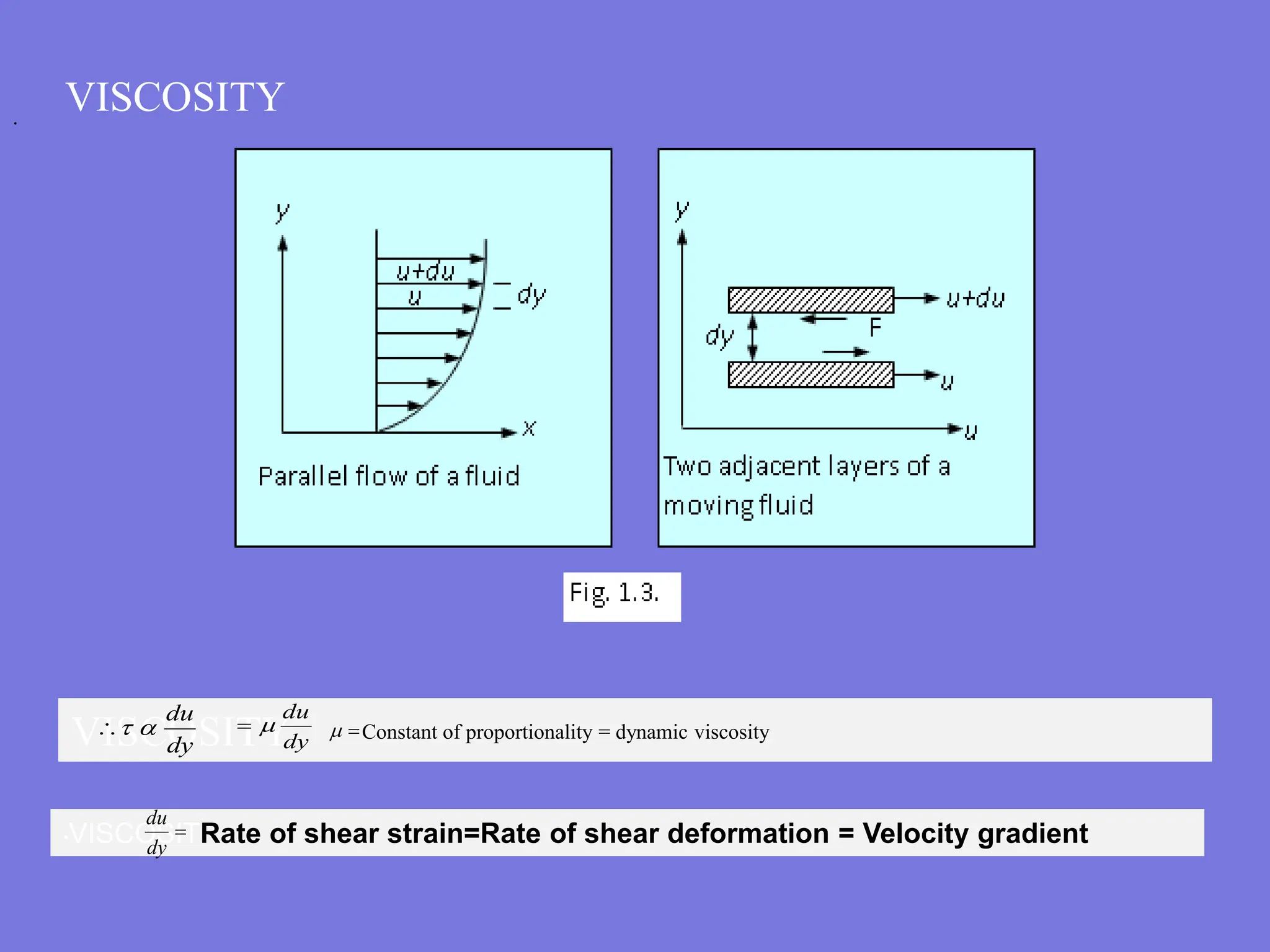
VISCOSITY
.


VISCOSITY
dy
du



dy
du

 Constant of proportionality = dynamic viscosity


•VISCOSITRate of shear strain=Rate of shear deformation = Velocity gradient

dy
du
Viscosity
Rate of shear strain
= Rate of shear deformation
= Velocity gradient
Constant of proportionality
= dynamic viscosity
 dy
du

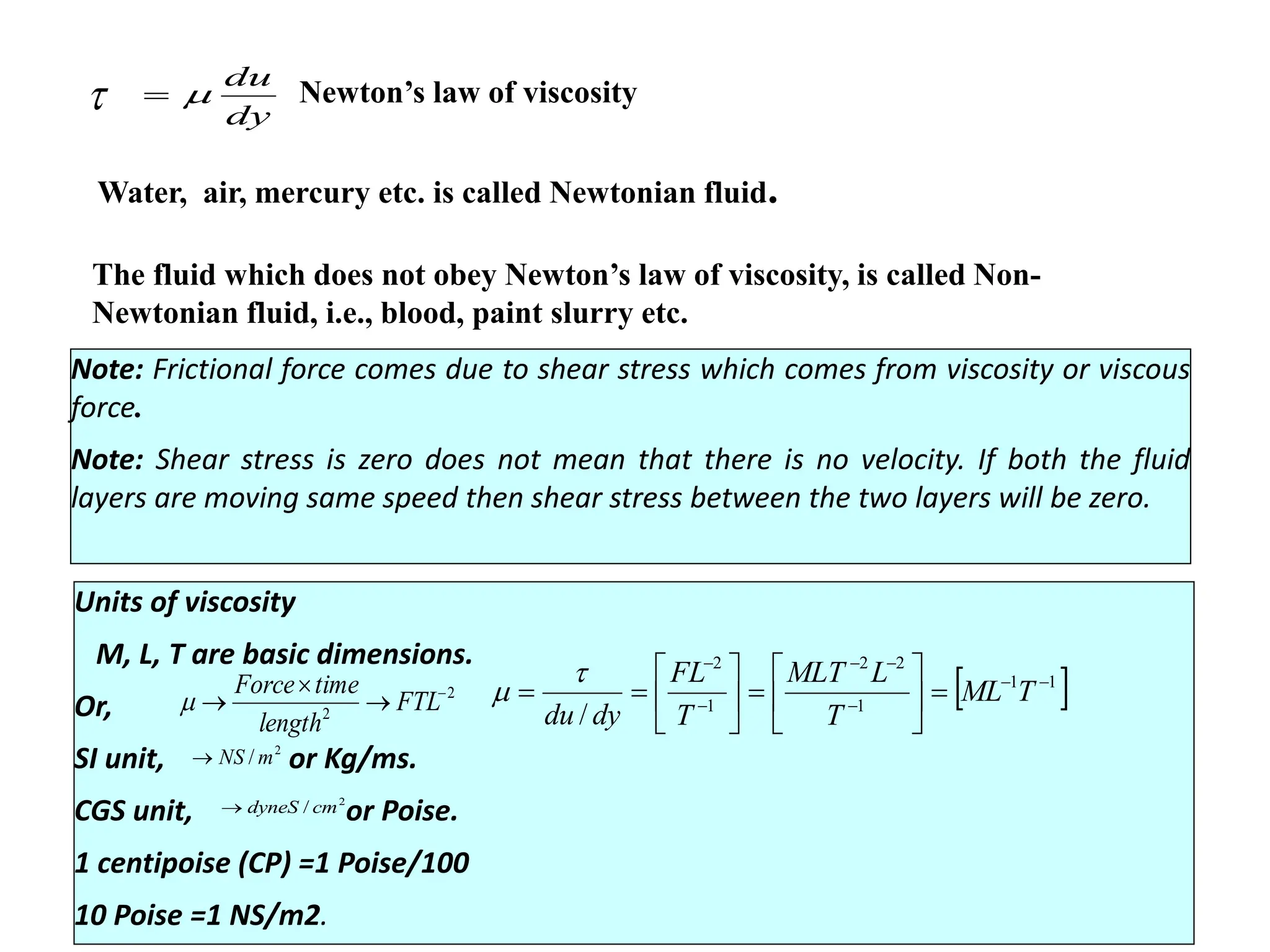
 Newton’s law of viscosity
Water, air, mercury etc. is called Newtonian fluid.
The fluid which does not obey Newton’s law of viscosity, is called Non-
Newtonian fluid, i.e., blood, paint slurry etc.
Note: Frictional force comes due to shear stress which comes from viscosity or viscous
force.
Note: Shear stress is zero does not mean that there is no velocity. If both the fluid
layers are moving same speed then shear stress between the two layers will be zero.
Units of viscosity
M, L, T are basic dimensions.
Or,
SI unit, or Kg/ms.
CGS unit, or Poise.
1 centipoise (CP) =1 Poise/100
10 Poise =1 NS/m2.
 
1
1
1
2
2
1
2
/






















 T
ML
T
L
MLT
T
FL
dy
du


2
2



 FTL
length
time
Force

2
/ m
NS

2
/ cm
dyneS


Basics of fluid properties: viscosity and types

  • 1.
  • 2.
    VISCOSITY .   VISCOSITY dy du    dy du   Constant ofproportionality = dynamic viscosity   •VISCOSITRate of shear strain=Rate of shear deformation = Velocity gradient  dy du
  • 3.
    Viscosity Rate of shearstrain = Rate of shear deformation = Velocity gradient Constant of proportionality = dynamic viscosity  dy du   Newton’s law of viscosity Water, air, mercury etc. is called Newtonian fluid. The fluid which does not obey Newton’s law of viscosity, is called Non- Newtonian fluid, i.e., blood, paint slurry etc. Note: Frictional force comes due to shear stress which comes from viscosity or viscous force. Note: Shear stress is zero does not mean that there is no velocity. If both the fluid layers are moving same speed then shear stress between the two layers will be zero. Units of viscosity M, L, T are basic dimensions. Or, SI unit, or Kg/ms. CGS unit, or Poise. 1 centipoise (CP) =1 Poise/100 10 Poise =1 NS/m2.   1 1 1 2 2 1 2 /                        T ML T L MLT T FL dy du   2 2     FTL length time Force  2 / m NS  2 / cm dyneS 