Richard DeRienzo, CPA
Judith Ventura Enright, CPA
Agenda
• Risks in the Construction Industry
• Headlines
• Financial Reporting
• Percentage of Completion
– Example
• Resources
RISKY BUSINESS
Risky Business
• Competitive bidding and low margins – generating a profit
while covering costs
• Estimating and job cost – can’t leave costs on the table
• Unique accounting requiring specialized systems – timely
and accurate financial information is critical to make sound
business decisions
• Work in a new geographical location - unfamiliar laws,
suppliers, and subcontractors, as well managing a project
that is miles away
Risky Business (continued)
• New types of work – each type of construction takes unique
talents and specialties
• Contracts with incentive, penalty, or other provisions
• Informal estimating procedures – may influence the ability
of a Company to produce reasonably dependable estimates
• Investment in capital that is often leveraged
Risky Business (continued)
• Unmanaged cash flow (dependent on multiple parties to get
paid)
• Construction company business failures are higher than
other industries
• On unbonded projects, often the lender pays when a
contractor fails
Bonding
• Purpose – guarantee owner/lender that should the contractor fail
to finish the project, the funds will be available to hire
replacement
• Capacity is based upon financial statements
• Types:
– Bid bond
– Contract
– Performance/Completion
– Labor and Material Payment
– Maintenance
– Subcontractor
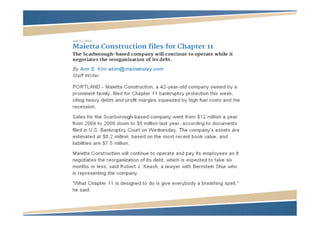
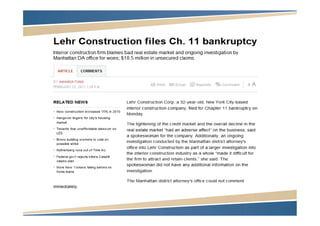
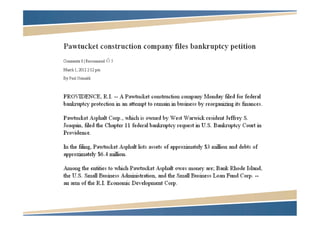
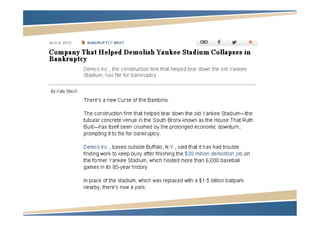
HEADLINES
FINANCIAL REPORTING
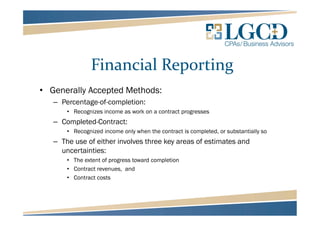
Financial Reporting
• Generally Accepted Methods:
– Percentage-of-completion:
• Recognizes income as work on a contract progresses
– Completed-Contract:
• Recognized income only when the contract is completed, or substantially so
– The use of either involves three key areas of estimates and
uncertainties:
• The extent of progress toward completion
• Contract revenues, and
• Contract costs
Financial Reporting (continued)
• Two methods should not be used for the same
circumstances as acceptable alternatives
• Ordinarily should use percentage-of-completion method,
except in two circumstances:
– Where reasonably reliable estimates cannot be made; or
– Where the results of using the completed contract method do not
differ materially from those obtained by using the percentage-of-
completion method
Financial Reporting (continued)
• GAAP interpretation:
– For entities engaged on a continuing basis in the production and
delivery of goods/services under contractual arrangements and for
whom contracting represents a significant part of their operations,
the presumption is that they have the ability to make estimates that
are sufficiently dependable to justify the use of the percentage-of-
completion method of accounting.
PERCENTAGE-OF-
COMPLETION
Percentage-of-Completion
(continued)
• First, need to measure extent of progress toward completion
• Methods:
– Incurred costs to date over estimated total costs of the contract
(typical)
– Other measures as may be appropriate “having due regard for work
performed” (i.e. labor dollars, hours of labor)
– Should be applied consistently to all contracts having similar
characteristics
– Disclosed in the financial statements
Percentage-of-Completion
(continued)
• Measures:
– Input measures – based on costs and efforts expended (i.e. costs)
• Drawback – relationship of measures to productivity may not
hold true due to inefficiencies
– Output measures – based on units produced or delivered, contract
milestones, and value added
• Drawback – measures can often not be established
Percentage-of-Completion
(continued)
• Cost to Cost Method:
– Total estimated costs (costs to date plus estimated costs to
complete) is significant variable in determining gross profit
– Significant costs of materials purchased but not installed should not
be included in costs incurred
– Estimates must be periodically revised throughout life of contract
Percentage-of-Completion
(continued)
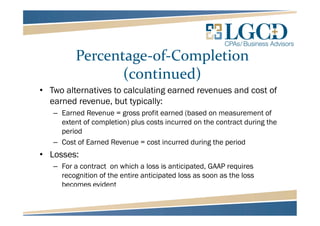
• Components of calculation:
– Gross Profit = total estimated contract revenue –total estimated
contract cost
– Measurement of extent of progress toward completion (i.e. cost to
cost)
– Total costs to date
– Total billings to date
Percentage-of-Completion
(continued)
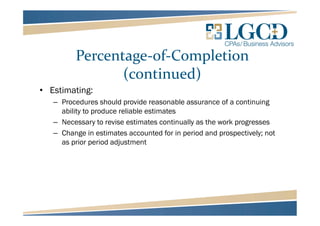
• Two alternatives to calculating earned revenues and cost of
earned revenue, but typically:
– Earned Revenue = gross profit earned (based on measurement of
extent of completion) plus costs incurred on the contract during the
period
– Cost of Earned Revenue = cost incurred during the period
• Losses:
– For a contract on which a loss is anticipated, GAAP requires
recognition of the entire anticipated loss as soon as the loss
becomes evident
Percentage-of-Completion
(continued)
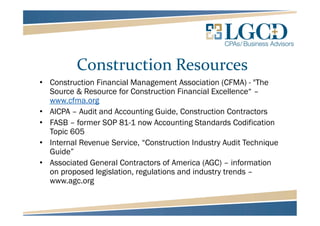
• Estimating:
– Procedures should provide reasonable assurance of a continuing
ability to produce reliable estimates
– Necessary to revise estimates continually as the work progresses
– Change in estimates accounted for in period and prospectively; not
as prior period adjustment
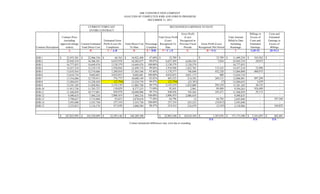
EXAMPLE
Construction Resources
• Construction Financial Management Association (CFMA) - "The
Source & Resource for Construction Financial Excellence“ –
www.cfma.org
• AICPA – Audit and Accounting Guide, Construction Contractors
• FASB – former SOP 81-1 now Accounting Standards Codification
Topic 605
• Internal Revenue Service, “Construction Industry Audit Technique
Guide”
• Associated General Contractors of America (AGC) – information
on proposed legislation, regulations and industry trends –
www.agc.org
Questions?
Contract Description
Contract Price
(including
approved change
orders)
Current Estimated
Total Direct Cost
Estimated Gross
Profit (Loss) On
Completion
Total Direct Cost
To Date
Percentage
Complete
Total Gross Profit
(Loss)
Recognized To
Date
Gross Profit
(Loss)
Recognized in
Previous Fiscal
Periods
Gross Profit (Loss)
Recognized This Period
Total Amount
Billed to Date
Including
Retainage
Billings in
Excess of
Costs and
Estimated
Earnings
Costs and
Estimated
Earnings in
Excess of
Billings
A B C = A-B D E = D/B F = C x E G H = F-G I I-(D+F) (D+F)-I
JOB 1 22,975,301$ 22,906,536$ 68,765$ 10,922,498$ 47.68% 32,789$ -$ 32,789$ 11,499,229$ 543,942$ -$
JOB 2 22,942,319 16,306,341 6,635,978 16,285,677 99.87% 6,627,569 6,620,545 7,024 22,942,319 29,073 -
JOB 3 16,777,855 14,649,476 2,128,379 14,649,476 100.00% 2,128,379 2,128,379 - 16,777,855 - -
JOB 4 14,457,218 12,519,174 1,938,044 12,499,174 99.84% 1,934,948 1,822,785 112,163 14,457,218 23,096 -
JOB 5 13,635,416 12,374,606 1,260,810 11,565,546 93.46% 1,178,377 746,049 432,328 13,604,898 860,975 -
JOB 6 13,634,734 9,602,681 4,032,053 9,602,681 100.00% 4,032,053 4,031,173 880 13,634,734 - -
JOB 7 13,316,686 12,739,911 576,775 10,680,149 83.83% 483,523 214,392 269,131 12,060,881 897,209 -
JOB 8 13,204,635 13,228,429 (23,794) 13,224,770 99.97% (23,794) (23,787) (7) 13,204,635 3,659 -
JOB 9 13,181,102 11,028,963 2,152,139 11,003,748 99.77% 2,147,219 1,852,009 295,210 13,181,102 30,135 -
JOB 10 11,913,756 11,783,727 130,029 8,377,333 71.09% 92,441 2,961 89,480 9,394,263 924,489 -
JOB 11 11,568,859 10,717,881 850,978 10,690,908 99.75% 848,836 745,365 103,471 11,568,859 29,115 -
JOB 12 9,490,635 7,484,216 2,006,419 7,484,216 100.00% 2,006,419 2,006,419 - 9,490,635 - -
JOB 13 3,798,627 3,715,004 83,623 2,878,618 77.49% 64,796 12 64,784 2,645,846 - 297,568
JOB 14 3,593,040 3,355,730 237,310 3,355,730 100.00% 237,310 255,323 (18,013) 3,593,040 - -
JOB 15 3,333,812 3,116,174 217,638 3,068,584 98.47% 214,314 216,479 (2,165) 3,118,066 - 164,832
187,823,995$ 165,528,849$ 22,295,146$ 146,289,108$ 22,005,180$ 20,618,104$ 1,387,076$ 171,173,580$ 3,341,693$ 462,401$
F/S F/S F/S
Certain immaterial differences may exist due to rounding.
ENTIRE CONTRACT
ABC CONSTRUCTION COMPANY
ANALYSIS OF COMPLETED JOBS AND JOBS IN PROGRESS
DECEMBER 31, 2011
CURRENT FORECAST RECOGNIZED EARNINGS TO DATE

Basics of construction accouting

  • 1.
    Richard DeRienzo, CPA JudithVentura Enright, CPA
  • 2.
    Agenda • Risks inthe Construction Industry • Headlines • Financial Reporting • Percentage of Completion – Example • Resources
  • 3.
  • 4.
    Risky Business • Competitivebidding and low margins – generating a profit while covering costs • Estimating and job cost – can’t leave costs on the table • Unique accounting requiring specialized systems – timely and accurate financial information is critical to make sound business decisions • Work in a new geographical location - unfamiliar laws, suppliers, and subcontractors, as well managing a project that is miles away
  • 5.
    Risky Business (continued) •New types of work – each type of construction takes unique talents and specialties • Contracts with incentive, penalty, or other provisions • Informal estimating procedures – may influence the ability of a Company to produce reasonably dependable estimates • Investment in capital that is often leveraged
  • 6.
    Risky Business (continued) •Unmanaged cash flow (dependent on multiple parties to get paid) • Construction company business failures are higher than other industries • On unbonded projects, often the lender pays when a contractor fails
  • 7.
    Bonding • Purpose –guarantee owner/lender that should the contractor fail to finish the project, the funds will be available to hire replacement • Capacity is based upon financial statements • Types: – Bid bond – Contract – Performance/Completion – Labor and Material Payment – Maintenance – Subcontractor
  • 8.
  • 15.
  • 16.
    Financial Reporting • GenerallyAccepted Methods: – Percentage-of-completion: • Recognizes income as work on a contract progresses – Completed-Contract: • Recognized income only when the contract is completed, or substantially so – The use of either involves three key areas of estimates and uncertainties: • The extent of progress toward completion • Contract revenues, and • Contract costs
  • 17.
    Financial Reporting (continued) •Two methods should not be used for the same circumstances as acceptable alternatives • Ordinarily should use percentage-of-completion method, except in two circumstances: – Where reasonably reliable estimates cannot be made; or – Where the results of using the completed contract method do not differ materially from those obtained by using the percentage-of- completion method
  • 18.
    Financial Reporting (continued) •GAAP interpretation: – For entities engaged on a continuing basis in the production and delivery of goods/services under contractual arrangements and for whom contracting represents a significant part of their operations, the presumption is that they have the ability to make estimates that are sufficiently dependable to justify the use of the percentage-of- completion method of accounting.
  • 19.
  • 20.
    Percentage-of-Completion (continued) • First, needto measure extent of progress toward completion • Methods: – Incurred costs to date over estimated total costs of the contract (typical) – Other measures as may be appropriate “having due regard for work performed” (i.e. labor dollars, hours of labor) – Should be applied consistently to all contracts having similar characteristics – Disclosed in the financial statements
  • 21.
    Percentage-of-Completion (continued) • Measures: – Inputmeasures – based on costs and efforts expended (i.e. costs) • Drawback – relationship of measures to productivity may not hold true due to inefficiencies – Output measures – based on units produced or delivered, contract milestones, and value added • Drawback – measures can often not be established
  • 22.
    Percentage-of-Completion (continued) • Cost toCost Method: – Total estimated costs (costs to date plus estimated costs to complete) is significant variable in determining gross profit – Significant costs of materials purchased but not installed should not be included in costs incurred – Estimates must be periodically revised throughout life of contract
  • 23.
    Percentage-of-Completion (continued) • Components ofcalculation: – Gross Profit = total estimated contract revenue –total estimated contract cost – Measurement of extent of progress toward completion (i.e. cost to cost) – Total costs to date – Total billings to date
  • 24.
    Percentage-of-Completion (continued) • Two alternativesto calculating earned revenues and cost of earned revenue, but typically: – Earned Revenue = gross profit earned (based on measurement of extent of completion) plus costs incurred on the contract during the period – Cost of Earned Revenue = cost incurred during the period • Losses: – For a contract on which a loss is anticipated, GAAP requires recognition of the entire anticipated loss as soon as the loss becomes evident
  • 25.
    Percentage-of-Completion (continued) • Estimating: – Proceduresshould provide reasonable assurance of a continuing ability to produce reliable estimates – Necessary to revise estimates continually as the work progresses – Change in estimates accounted for in period and prospectively; not as prior period adjustment
  • 26.
  • 27.
    Construction Resources • ConstructionFinancial Management Association (CFMA) - "The Source & Resource for Construction Financial Excellence“ – www.cfma.org • AICPA – Audit and Accounting Guide, Construction Contractors • FASB – former SOP 81-1 now Accounting Standards Codification Topic 605 • Internal Revenue Service, “Construction Industry Audit Technique Guide” • Associated General Contractors of America (AGC) – information on proposed legislation, regulations and industry trends – www.agc.org
  • 28.
  • 29.
    Contract Description Contract Price (including approvedchange orders) Current Estimated Total Direct Cost Estimated Gross Profit (Loss) On Completion Total Direct Cost To Date Percentage Complete Total Gross Profit (Loss) Recognized To Date Gross Profit (Loss) Recognized in Previous Fiscal Periods Gross Profit (Loss) Recognized This Period Total Amount Billed to Date Including Retainage Billings in Excess of Costs and Estimated Earnings Costs and Estimated Earnings in Excess of Billings A B C = A-B D E = D/B F = C x E G H = F-G I I-(D+F) (D+F)-I JOB 1 22,975,301$ 22,906,536$ 68,765$ 10,922,498$ 47.68% 32,789$ -$ 32,789$ 11,499,229$ 543,942$ -$ JOB 2 22,942,319 16,306,341 6,635,978 16,285,677 99.87% 6,627,569 6,620,545 7,024 22,942,319 29,073 - JOB 3 16,777,855 14,649,476 2,128,379 14,649,476 100.00% 2,128,379 2,128,379 - 16,777,855 - - JOB 4 14,457,218 12,519,174 1,938,044 12,499,174 99.84% 1,934,948 1,822,785 112,163 14,457,218 23,096 - JOB 5 13,635,416 12,374,606 1,260,810 11,565,546 93.46% 1,178,377 746,049 432,328 13,604,898 860,975 - JOB 6 13,634,734 9,602,681 4,032,053 9,602,681 100.00% 4,032,053 4,031,173 880 13,634,734 - - JOB 7 13,316,686 12,739,911 576,775 10,680,149 83.83% 483,523 214,392 269,131 12,060,881 897,209 - JOB 8 13,204,635 13,228,429 (23,794) 13,224,770 99.97% (23,794) (23,787) (7) 13,204,635 3,659 - JOB 9 13,181,102 11,028,963 2,152,139 11,003,748 99.77% 2,147,219 1,852,009 295,210 13,181,102 30,135 - JOB 10 11,913,756 11,783,727 130,029 8,377,333 71.09% 92,441 2,961 89,480 9,394,263 924,489 - JOB 11 11,568,859 10,717,881 850,978 10,690,908 99.75% 848,836 745,365 103,471 11,568,859 29,115 - JOB 12 9,490,635 7,484,216 2,006,419 7,484,216 100.00% 2,006,419 2,006,419 - 9,490,635 - - JOB 13 3,798,627 3,715,004 83,623 2,878,618 77.49% 64,796 12 64,784 2,645,846 - 297,568 JOB 14 3,593,040 3,355,730 237,310 3,355,730 100.00% 237,310 255,323 (18,013) 3,593,040 - - JOB 15 3,333,812 3,116,174 217,638 3,068,584 98.47% 214,314 216,479 (2,165) 3,118,066 - 164,832 187,823,995$ 165,528,849$ 22,295,146$ 146,289,108$ 22,005,180$ 20,618,104$ 1,387,076$ 171,173,580$ 3,341,693$ 462,401$ F/S F/S F/S Certain immaterial differences may exist due to rounding. ENTIRE CONTRACT ABC CONSTRUCTION COMPANY ANALYSIS OF COMPLETED JOBS AND JOBS IN PROGRESS DECEMBER 31, 2011 CURRENT FORECAST RECOGNIZED EARNINGS TO DATE