Share
What isthe video all about?
Why did Adande cheat?
How did his friend react to his
cheating?
What happened to his grades?
How did the video end?
5.
Further thinking…
Whatcan we learn from this video?
What can serve as our guide in doing the
right thing?
If you were the one who saw Adande cheat
off of Josh, what would you have done? Why?
Is it always easy to do the right thing? Why?
Why not?
In the end, what matters most when faced
with an ethical dilemma?
6.
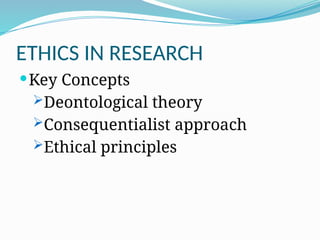
ETHICS IN RESEARCH
KeyConcepts
Deontological theory
Consequentialist approach
Ethical principles
7.
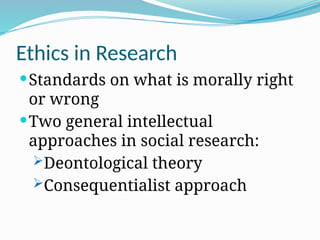
Ethics in Research
Standardson what is morally right
or wrong
Two general intellectual
approaches in social research:
Deontological theory
Consequentialist approach
8.
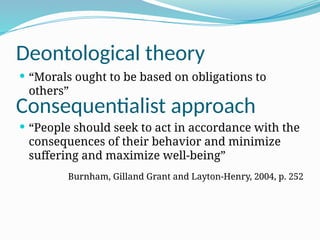
Deontological theory
“Moralsought to be based on obligations to
others”
Consequentialist approach
“People should seek to act in accordance with the
consequences of their behavior and minimize
suffering and maximize well-being”
Burnham, Gilland Grant and Layton-Henry, 2004, p. 252
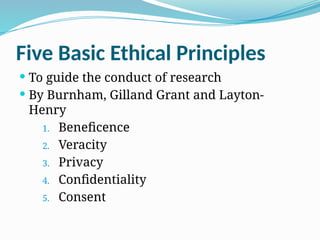
Five Basic EthicalPrinciples
To guide the conduct of research
By Burnham, Gilland Grant and Layton-
Henry
1. Beneficence
2. Veracity
3. Privacy
4. Confidentiality
5. Consent
11.
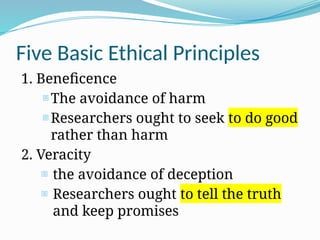
Five Basic EthicalPrinciples
1. Beneficence
- The avoidance of harm
- Researchers ought to seek to do good
rather than harm
2. Veracity
- the avoidance of deception
- Researchers ought to tell the truth
and keep promises
12.
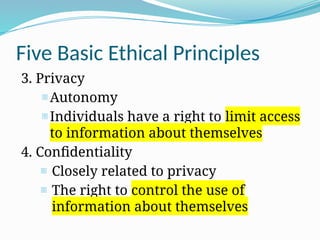
Five Basic EthicalPrinciples
3. Privacy
- Autonomy
- Individuals have a right to limit access
to information about themselves
4. Confidentiality
- Closely related to privacy
- The right to control the use of
information about themselves
13.
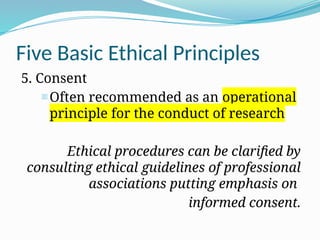
Five Basic EthicalPrinciples
5. Consent
- Often recommended as an operational
principle for the conduct of research
Ethical procedures can be clarified by
consulting ethical guidelines of professional
associations putting emphasis on
informed consent.
14.
Informed consent (Silverman2001)
1. Giving information about the research
which is relevant to the subjects’
decision whether to participate or not;
2. Making sure that subjects understand
the information;
3. Ensuring that participation is voluntary;
4. Where subjects are not competent to
agree, obtain consent by proxy.
15.
Ethical use ofsource material
Avoiding Plagiarism
Quote Accurately
Acknowledge Quotations Carefully
16.
Avoiding Plagiarism
Plagiarismincludes quoting directly
without acknowledging the source and
constructing a paraphrase that closely
resembles the original in language and
syntax.
17.
Quote Accurately
Quotedirectly from a source when the original
language is distinctive enough to enhance your
agreement and rewording would lessen its
impact.
Failing to signal the presence of a quotation
skillfully can lead to confusion.
Acknowledge Quotations Carefully
18.
Unethical practices inresearch
1. Deceiving a respondent about the true
purpose of a study.
2. Asking a respondent questions that cause
him or her extreme embarrassment; guilt
emotional turmoil by reminding him or her
of an unpleasant experience.
3. Invading the privacy of a respondent.
19.
Unethical practices inresearch
4. Studying the respondents or research
subjects without their knowledge.
5. When analyzing the data – revealing only
parts of the facts, presenting facts out of
context, falsifying findings or offering
misleading presentation such as lying with
statistics.
20.
Group time!
ROLE PLAY.
Actout the scene where there is an
ethical breach while conducting your
research. End with how this breach is
resolved.
5 minutes planning
3 minutes to act
21.
In ¼ sheetof paper, write the
names of your group members.
Write the following:
A.Topics & Type of Research
B.Role Play – Ethics in Research
22.
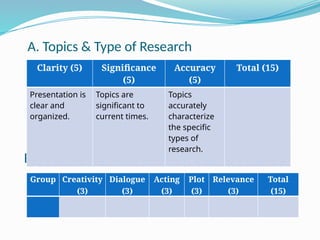
B. Role Play- Rubric
Group Creativity
(3)
Dialogue
(3)
Acting
(3)
Plot
(3)
Relevance
(3)
Total
(15)
Clarity (5) Significance
(5)
Accuracy
(5)
Total (15)
Presentation is
clear and
organized.
Topics are
significant to
current times.
Topics
accurately
characterize
the specific
types of
research.
A. Topics & Type of Research
23.
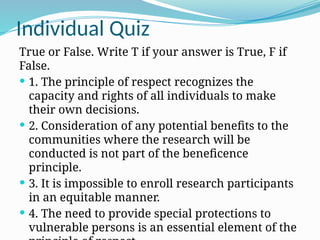
Individual Quiz
True orFalse. Write T if your answer is True, F if
False.
1. The principle of respect recognizes the
capacity and rights of all individuals to make
their own decisions.
2. Consideration of any potential benefits to the
communities where the research will be
conducted is not part of the beneficence
principle.
3. It is impossible to enroll research participants
in an equitable manner.
4. The need to provide special protections to
vulnerable persons is an essential element of the
24.
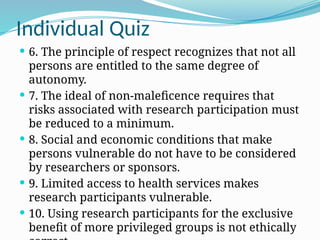
Individual Quiz
6.The principle of respect recognizes that not all
persons are entitled to the same degree of
autonomy.
7. The ideal of non-maleficence requires that
risks associated with research participation must
be reduced to a minimum.
8. Social and economic conditions that make
persons vulnerable do not have to be considered
by researchers or sponsors.
9. Limited access to health services makes
research participants vulnerable.
10. Using research participants for the exclusive
benefit of more privileged groups is not ethically