PREAMBLEPREAMBLEPREAMBLEPREAMBLE
Stay safe and take responsibility. Apply all prescribed safety guidelines and remainStay safe and take responsibility. Apply all prescribed safety guidelines and remainStay safe and take responsibility. Apply all prescribed safety guidelines and remainStay safe and take responsibility. Apply all prescribed safety guidelines and remain
free from COVDfree from COVDfree from COVDfree from COVD----19,19,19,19, tttthe reason for this mode of study (Ehe reason for this mode of study (Ehe reason for this mode of study (Ehe reason for this mode of study (E----Learning). Stay safe, please. ILearning). Stay safe, please. ILearning). Stay safe, please. ILearning). Stay safe, please. I
love you all.love you all.love you all.love you all.
C R E A T E D B Y L A W R E N E C I G E N E W A R I
BASIC TYPES OF LAN
INTRODUCTION
From our previous knowledge of Network
Topologies, we are aware the networks can be
implemented using any suitable layout, namely
Bus, Ring, Star, Mesh or Hybrid topology.Bus, Ring, Star, Mesh or Hybrid topology.
However, as a result of the numerous
advantages of Star topology, it the most widely
used topology. In this topic, we shall examine
the two basic ways of implementing a Local Are
Network (LAN). They are: Peer-to-peer and
Server based LAN
Created by Lawrenec Igenewari
Peer-to-peer (P2P) Network
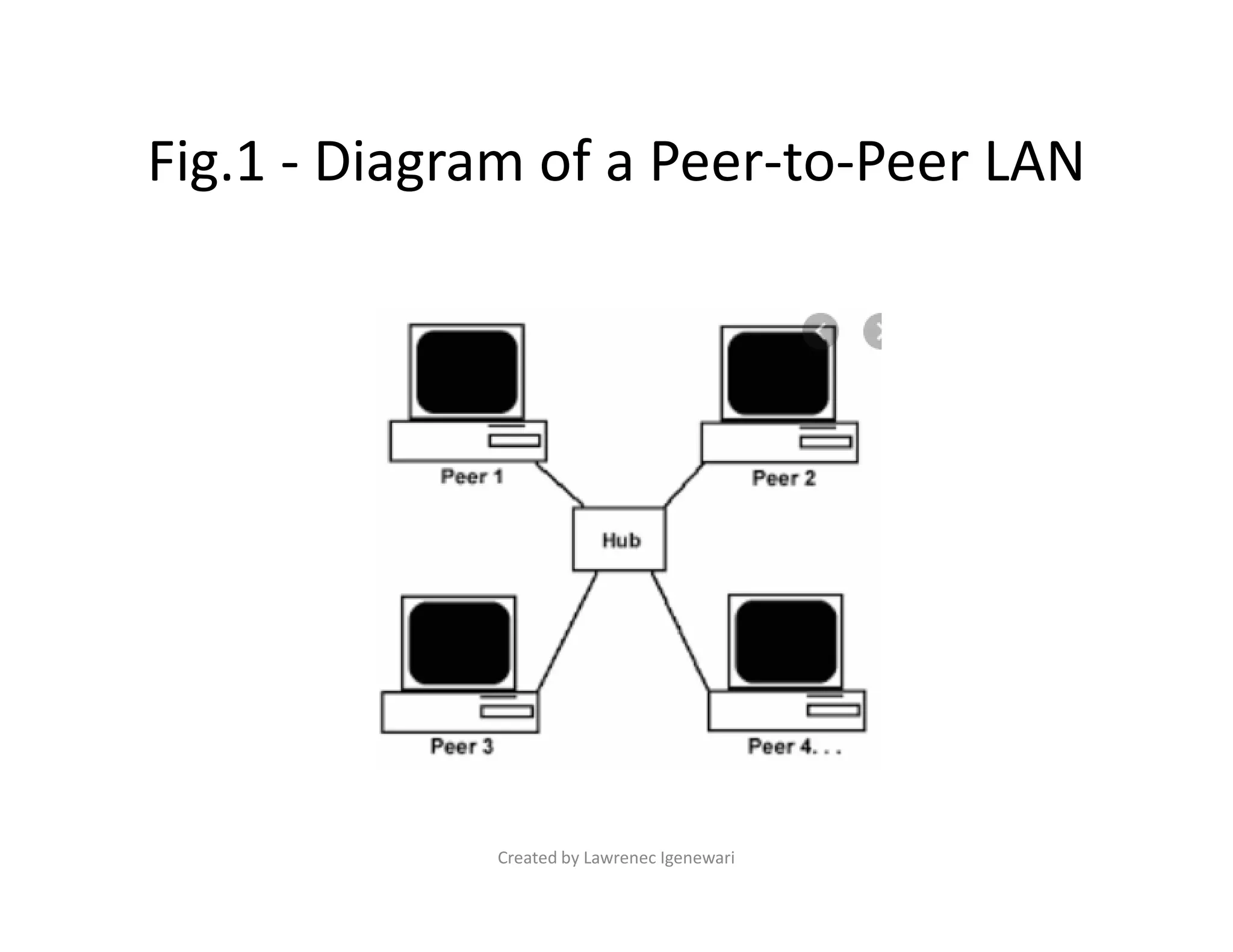
In a Peer-to-peer network, all the computers in the network
have equal privileges. They all have the same abilities to use the
resources available on the network. The operating systems allow
users to share resources and files located on their computers
and to access shared resources found on other computers.
However, they do not have a file server or a centralized
Created by Lawrenec Igenewari
However, they do not have a file server or a centralized
management source. In a peer-to-peer network, all computers
are considered equal; In a p2p each computer must be
configured with individual user identification (userids) and
passwords. Peer-to-peer networks are designed primarily for
small to medium local area networks. AppleShare and Windows
for Workgroups such as Home Edition of Windows are
examples of operating systems that can used for peer-to-peer
local area network (LAN)
Fig.1 - Diagram of a Peer-to-Peer LAN
Created by Lawrenec Igenewari
Advantages of Peer-
CreatedbyLawrenecIgenewari
Advantages of Peer-
to-peer Network
Less initial expense - No need for a dedicated server.
Setup - An operating system (such as Windows XP) already in place may only
need to be reconfigured for peer-to-peer operations.
CreatedbyLawrenecIgenewari
Disadvantages of P2P
Decentralized - No central repository for
files and applications.files and applications.
Security - Does not provide the security
available on a client/server network.
Created by Lawrenec Igenewari
Server based LAN (Client/Server) Network
A Server-based network or LAN has a dedicated computer known as
a Server. The Server usually have high speed processor, Large
Primary memory (RAM) and very large sized Hard Disk Drive
(Secondary memory). The operating System in a Server is called
Network Operating Systems (NOS). For these reasons a Sever is
relatively expensive. The NOS allow the network to centralize
functions and applications in one or more dedicated file servers. The
Created by Lawrenec Igenewari
functions and applications in one or more dedicated file servers. The
file servers become the heart of the system, providing access to
resources and providing security. The other computers referred to as
workstations or clients have access to the resources available on the
file servers. The network operating system provides the mechanism
to integrate all the components of the network and allow multiple
users to simultaneously share the same resources irrespective of
physical location. Novell Netware, Sever 2000 and Server 2012 are
examples of network operating systems.
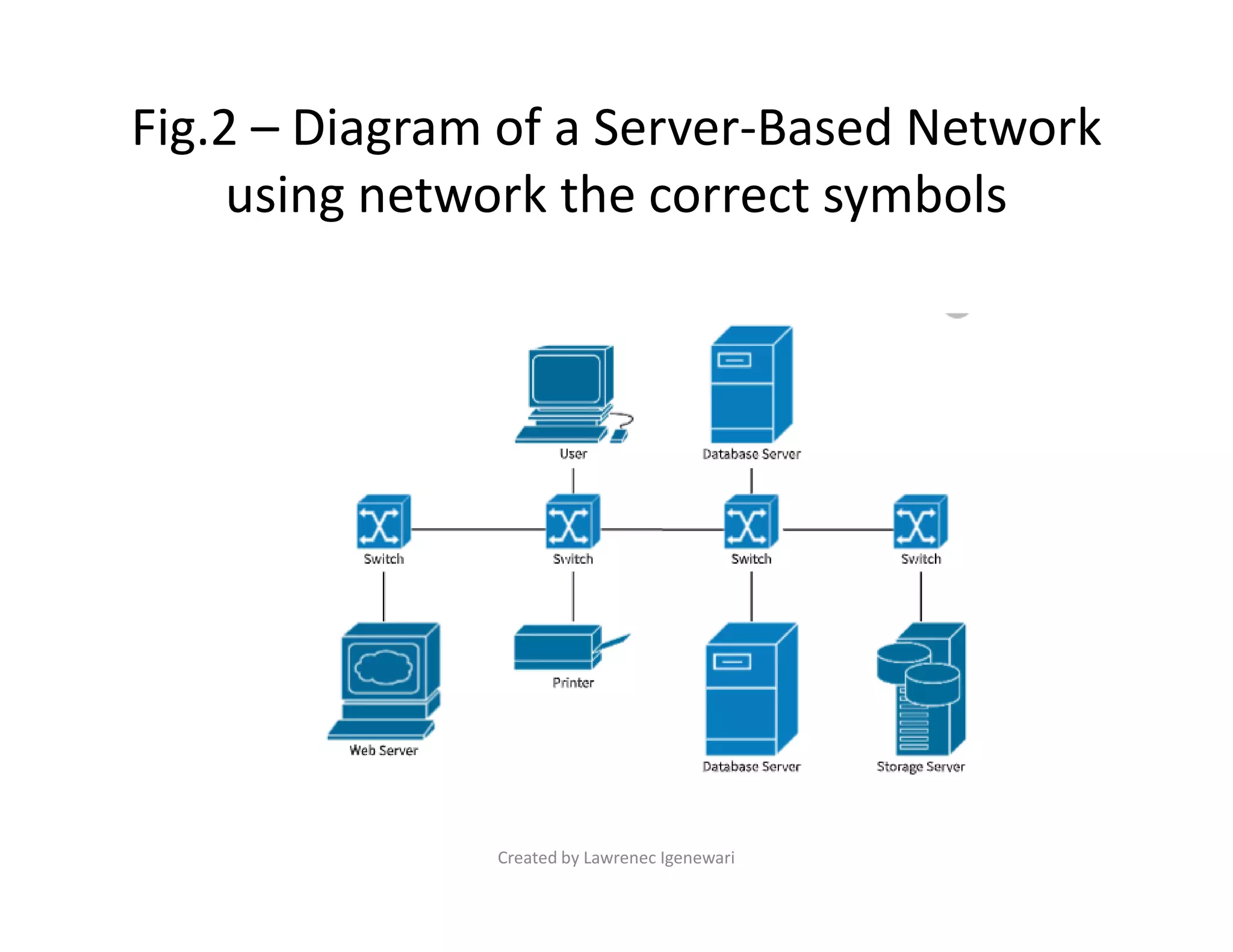
Fig.2 – Diagram of a Server-Based Network
using network the correct symbols
Created by Lawrenec Igenewari
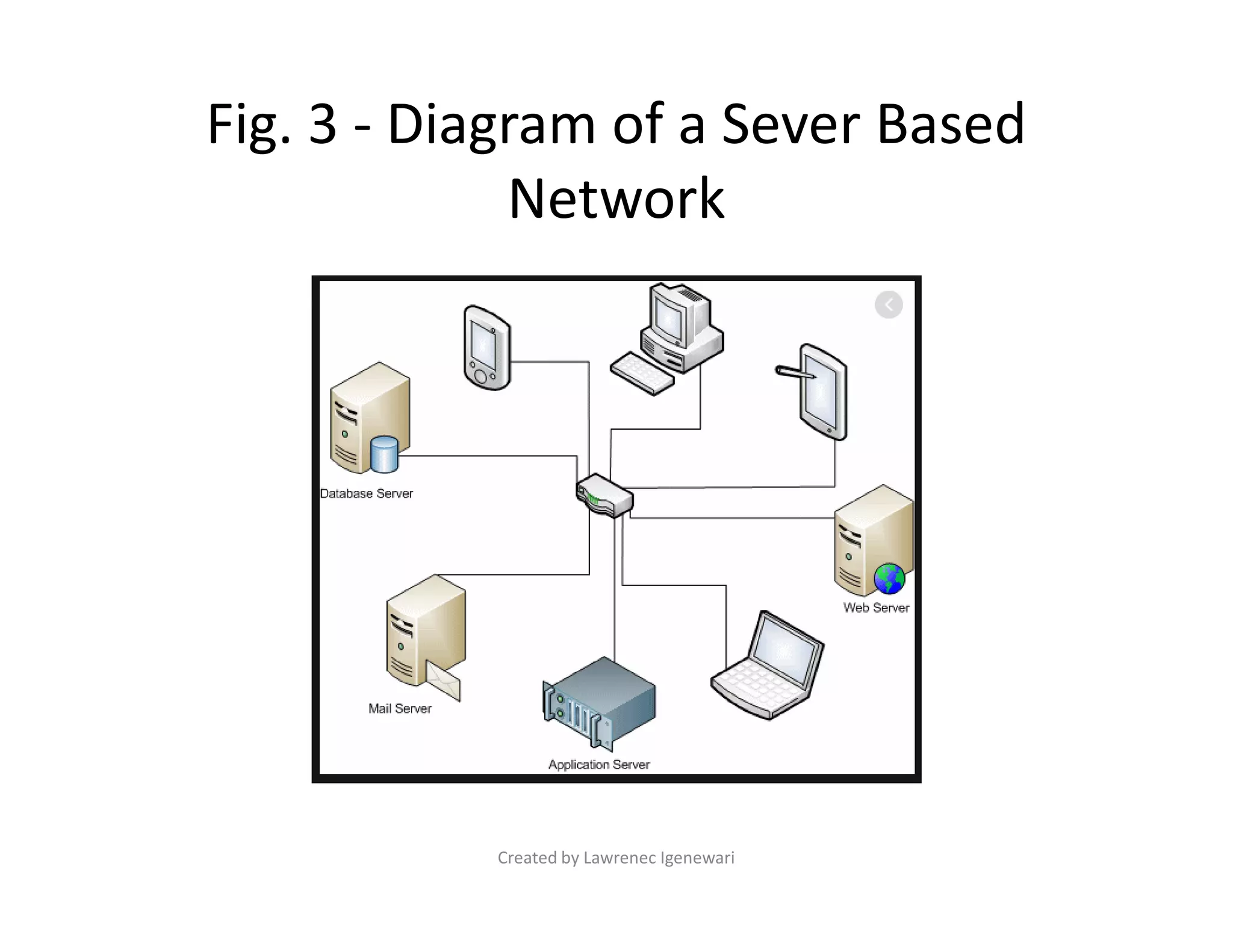
Fig. 3 - Diagram of a Sever Based
Network
Created by Lawrenec Igenewari
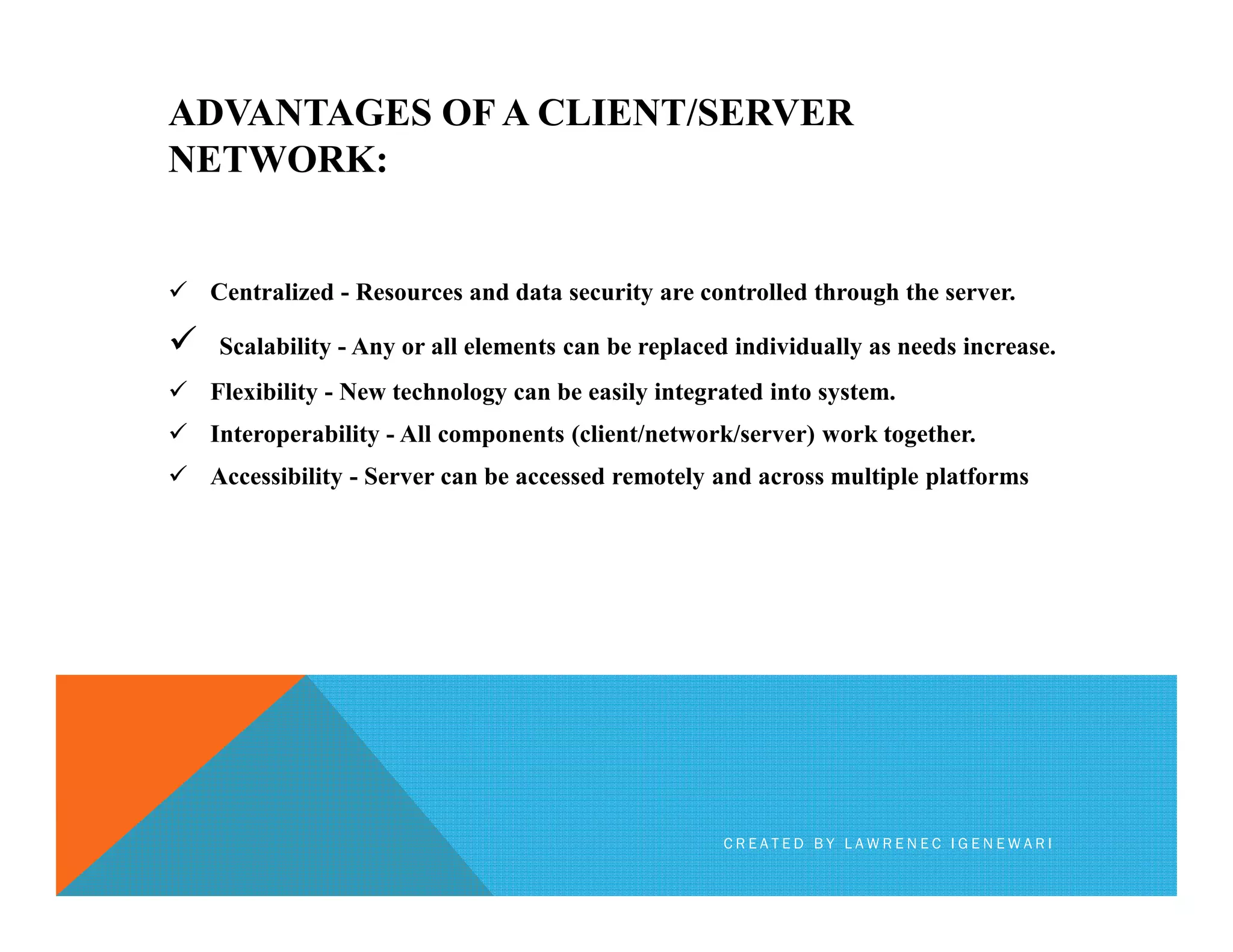
ADVANTAGES OF A CLIENT/SERVER
NETWORK:
Centralized - Resources and data security are controlled through the server.
Scalability - Any or all elements can be replaced individually as needs increase.
Flexibility - New technology can be easily integrated into system.
Interoperability - All components (client/network/server) work together.
Accessibility - Server can be accessed remotely and across multiple platformsAccessibility - Server can be accessed remotely and across multiple platforms
C R E A T E D B Y L A W R E N E C I G E N E W A R I
Expense - Requires initial investment in dedicated
server.
Maintenance - Large networks will require a staff toMaintenance - Large networks will require a staff to
ensure efficient operation.
Dependence - When server goes down, operations
will cease across the network.
Requires highly skilled personnel to implement
Created by Lawrenec Igenewari

Basic LAN types

  • 1.
    PREAMBLEPREAMBLEPREAMBLEPREAMBLE Stay safe andtake responsibility. Apply all prescribed safety guidelines and remainStay safe and take responsibility. Apply all prescribed safety guidelines and remainStay safe and take responsibility. Apply all prescribed safety guidelines and remainStay safe and take responsibility. Apply all prescribed safety guidelines and remain free from COVDfree from COVDfree from COVDfree from COVD----19,19,19,19, tttthe reason for this mode of study (Ehe reason for this mode of study (Ehe reason for this mode of study (Ehe reason for this mode of study (E----Learning). Stay safe, please. ILearning). Stay safe, please. ILearning). Stay safe, please. ILearning). Stay safe, please. I love you all.love you all.love you all.love you all. C R E A T E D B Y L A W R E N E C I G E N E W A R I
  • 2.
    BASIC TYPES OFLAN INTRODUCTION From our previous knowledge of Network Topologies, we are aware the networks can be implemented using any suitable layout, namely Bus, Ring, Star, Mesh or Hybrid topology.Bus, Ring, Star, Mesh or Hybrid topology. However, as a result of the numerous advantages of Star topology, it the most widely used topology. In this topic, we shall examine the two basic ways of implementing a Local Are Network (LAN). They are: Peer-to-peer and Server based LAN Created by Lawrenec Igenewari
  • 3.
    Peer-to-peer (P2P) Network Ina Peer-to-peer network, all the computers in the network have equal privileges. They all have the same abilities to use the resources available on the network. The operating systems allow users to share resources and files located on their computers and to access shared resources found on other computers. However, they do not have a file server or a centralized Created by Lawrenec Igenewari However, they do not have a file server or a centralized management source. In a peer-to-peer network, all computers are considered equal; In a p2p each computer must be configured with individual user identification (userids) and passwords. Peer-to-peer networks are designed primarily for small to medium local area networks. AppleShare and Windows for Workgroups such as Home Edition of Windows are examples of operating systems that can used for peer-to-peer local area network (LAN)
  • 4.
    Fig.1 - Diagramof a Peer-to-Peer LAN Created by Lawrenec Igenewari
  • 5.
    Advantages of Peer- CreatedbyLawrenecIgenewari Advantagesof Peer- to-peer Network Less initial expense - No need for a dedicated server. Setup - An operating system (such as Windows XP) already in place may only need to be reconfigured for peer-to-peer operations. CreatedbyLawrenecIgenewari
  • 6.
    Disadvantages of P2P Decentralized- No central repository for files and applications.files and applications. Security - Does not provide the security available on a client/server network. Created by Lawrenec Igenewari
  • 7.
    Server based LAN(Client/Server) Network A Server-based network or LAN has a dedicated computer known as a Server. The Server usually have high speed processor, Large Primary memory (RAM) and very large sized Hard Disk Drive (Secondary memory). The operating System in a Server is called Network Operating Systems (NOS). For these reasons a Sever is relatively expensive. The NOS allow the network to centralize functions and applications in one or more dedicated file servers. The Created by Lawrenec Igenewari functions and applications in one or more dedicated file servers. The file servers become the heart of the system, providing access to resources and providing security. The other computers referred to as workstations or clients have access to the resources available on the file servers. The network operating system provides the mechanism to integrate all the components of the network and allow multiple users to simultaneously share the same resources irrespective of physical location. Novell Netware, Sever 2000 and Server 2012 are examples of network operating systems.
  • 8.
    Fig.2 – Diagramof a Server-Based Network using network the correct symbols Created by Lawrenec Igenewari
  • 9.
    Fig. 3 -Diagram of a Sever Based Network Created by Lawrenec Igenewari
  • 10.
    ADVANTAGES OF ACLIENT/SERVER NETWORK: Centralized - Resources and data security are controlled through the server. Scalability - Any or all elements can be replaced individually as needs increase. Flexibility - New technology can be easily integrated into system. Interoperability - All components (client/network/server) work together. Accessibility - Server can be accessed remotely and across multiple platformsAccessibility - Server can be accessed remotely and across multiple platforms C R E A T E D B Y L A W R E N E C I G E N E W A R I
  • 11.
    Expense - Requiresinitial investment in dedicated server. Maintenance - Large networks will require a staff toMaintenance - Large networks will require a staff to ensure efficient operation. Dependence - When server goes down, operations will cease across the network. Requires highly skilled personnel to implement Created by Lawrenec Igenewari