Department of Education
Prospects of the K to 12 Basic
Education Program in
Bicol Region
Ramon Fiel G. Abcede
Assistant Regional Director
Officer-In-Charge
Dep ED RO V
Presentation Outline:
I.
II.

The K to 12 Law & Its IRR
Status of Implementation of the
K to 12 Enhanced Basic
Education Program
III. Preparations for Senior High
School
IV. Projection and Prospects of
Senior High for Bicol Region
Part I
The K to 12 Law
& Its Implementing Rules and
Regulations
Republic Act 10533
(The K to 12 Law)
An Act Enhancing The Philippine Basic
Education System by Strengthening Its
Curriculum and Increasing The Number of
Years for Basic Education, Appropriating Funds
Therefor And For Other Purposes
Enhanced Basic Education Act of 2013
Salient Points of RA 10533
1. Philippine basic education graduates as
EMPOWERED INDIVIDUALS
One who has acquired life-long learning,
earned competence for productivity,
able to coexist in harmony with others,
engaged in independent, creative &
critical thinking,
& willing to transform others and self
Salient Points of RA 10533
2. Duties of the State in creating a
functional basic education system
a) Provide opportunity to receive quality
education
b) Broaden the goals of high school education
c) Make education learner-oriented
Salient Points of RA 10533
3. Clarification of the Objective and Scope
of Basic Education
Objective:

Able to meet basic learning needs from
which subsequent learning can be based
Scope:

Kindergarten,
Elementary,
Secondary,
Alternative Learning Systems & SPED
Salient Points of RA 10533
4. Definition of the coverage of the
Enhanced Basic Education Program
1 year Kindergarten
6 years Elementary Education
6 years Secondary Education:
4 years of Junior High School (JHS), and
2 years of Senior High School (SHS)
Salient Points of RA 10533
5. Basic education shall be delivered in
languages understood by the learners
Kinder to Grade 3 – Regional native language of
the learner (Mother Tongue)
Grade 4 to 6 – Transition from Mother Tongue to
Filipino and English
Secondary Level – Filipino and English as
primary languages of instruction
Salient Points of RA 10533
6. Coordination among government and
non-government agencies in the
development of the curriculum
For harmonization, students’ readiness and to
avoid duplication of subjects, curriculum
design work with CHED and TESDA

For effectiveness of the curricconsultations with
DOLE, PRC, student & teacher associations,
PTAs, chambers of commerce, etc.
Salient Points of RA 10533
7. Curriculum standards and principles to
be strictly adhered to by DepED
 learner-centered,
inclusive
and
developmentally
appropriate
 relevant, responsive and
research-based
 culture-sensitive
 Contextualized
and
global

 flexible enough to be
localized/ indigenized
 use constructivist, inquirybased,
reflective,
collaborative & integrative
approaches
 use MTB-MLE principles
 Use spiral progression
approach
Salient Points of RA 10533
8. Identification of members of a
Curriculum Consultative Committee

Task: To oversee the review and implementation
of the basic education curriculum
Members: DepED (Chair), CHED, TESDA, DOLE,
PRC, DOST, Business Chambers
Salient Points of RA 10533
9. Preparation of Human Resources that
ensures compliance to the expectation
for quality teachers and school leaders
Task: To oversee the review and implementation
of the basic education curriculum
a) In-service Training of Teachers on Content
and Pedagogy
b) Training of New Teachers
c) Training on School Leadership
Salient Points of RA 10533
10. Significance of Career Guidance and
Counseling in order to guide students
in choosing the career tracks they
intend to pursue
In coordination with DOLE, TESDA and the CHED
shall regularly conduct career advocacy
activities for secondary level students
Training of career advocates and guidance
counselors will be developed and
accredited by DepED
Salient Points of RA 10533
11. Expansion of the benefits of Government
Assistance to Students and Teachers in
Private Education Act (GASTPE)
GASTPE grant will be extended to private
schools offering SHS
(based on the principle of public-private
partnership)
Salient Points of RA 10533
12. Program Funding

Initial funding is through current
appropriations of DepED;
Later to be included in the annual
General Appropriations Act
Salient Points of RA 10533
13. Ensure details of transition from the
existing ten (10) years basic education
cycle to the enhanced basic education
(K to 12) cycle
Smooth transitions shall be facilitated by
DepED, CHED and TESDA along physical
infrastructure, manpower, organizational
and structural concerns
Faculty of HEIs shall be given priority in hiring
for the duration of the transition period
Salient Points of RA 10533
14. Creation of a Joint Congressional
Oversight Committee to oversee, monitor
and evaluate the implementation
of the Act
Composition: Five members each from the Senate
and House of Representatives including the
Chairs of the Committees on Education, Arts
and Culture and Finance of both Houses.
There shall have at least two opposition
or minority members
Salient Points of RA 10533
15. Evaluation and review by DepED and
submission of a status report to Congress
on the implementation
A report must be submitted at the end of SY 2014-2015

It shall focus on closing the shortages on teachers,
classrooms, textbooks, seats, toilets and other
concerns that should be addressed
This aside from other metrics of access to
quality of basic education
Salient Points of RA 10533
16. Commitment to international
benchmarks

(The IRR specifically defines the
expectations from DepED in this
Section)
Salient Points of RA 10533
17. Repeal of laws, decrees, executive
orders and rules and regulations contrary
to or inconsistent with it
This includes provisions that are not relevant
from the following:
B.P. Blg. 232- “Education Act of 1982”,
RA No. 9155 - “ Governance of Basic Education
Act of 2001”,
RA No. 9258 and RA No, 7836
IMPLEMENTING
RULES AND REGULATIONS
of the

Enhanced Basic Education Act of 2013

Issued by DepED, CHED & TESDA
(Effective September 24, 2013)
K to 12 IRR

Rule I:
General
Provisions

Scope and
Application

This IRR applies to
ALL public
and private
basic education
institutions,
HEIs, TVIs,
recognized
organizations
acting
as
TEIs
and
foundations
K to 12 IRR

Rule I:
General
Provisions

Adoption
of the
EBEP by
Private
Schools

Private educational
institutions must
comply with DepED
prescribed minimum
standards
consistent with the
Act
K to 12 IRR

Rule I:
General
Provisions

Compulsory
Basic
Education

All children must
be enrolled in
basic education
irrespective of
delivery modes
until its
completion
K to 12 IRR

Rule I:
General
Provisions
Inclusiveness
of Enhanced
Basic
Education

Including
Madrasah, IP
Education, Gifted
and Talented,
Learners with
Disabilities &
Learners under
Difficult
Circumstances
K to 12 IRR

Rule 1:
General
Provisions

Acceleration

Acceleration of
learners in public
and private basic
educational
institutions shall be
allowed consistent
with DepED rules
and regulations
K to 12 IRR

Rule II:
Curriculum

Curriculum
Development

Curriculum
standards and
principles,
production and
development of
materials and
medium of
instruction are as
specified in the
Act
K to 12 IRR

Rule 2:
Curriculum

Curriculum
Consultative
Committee

DepED (Chair)
CHED
TESDA
DOLE
PRC
DOST
Business Chambers
K to 12 IRR
Rule III:
Teacher
Qualifications,
Training and
Continuing
Professional
Development

Teacher
Education
and
Training

ALS
Coordinators,
Instructional
Managers, Mobile
Teachers and
Learning
Facilitators are
included
K to 12 IRR

Rule III:
Teacher
Qualifications,
Training and
Continuing
Professional
Development

Hiring of
Teachers

Hiring of teachers
shall be with
relevance to the
subject to be
taught
K to 12 IRR

Rule IV:
Private
Educational
Institutions

Reasonable
Supervision
and
Regulation

There shall
always be a
recognition of the
complementary
roles of public
and private
institutions
in the
organizational
system
K to 12 IRR
Rule IV:
Private
Educational
Institutions

Issuance and
Revocation
of Permits
and/or
Recognition
of Private
SHS

DepEd shall
prescribe the
guidelines on the
issuance and
revocation of
permits and/or
recognition of
SHS
K to 12 IRR

Rule IV:
Private
Educational
Institutions
Specialization
of Private

SHS

Specialization
will be allowed if
they are essential
to the economic
and social
development of
the nation,
region or locality
K to 12 IRR

Rule V:
Career
Guidance and
Counseling
Advocacy
Career
Guidance and
Counseling
Programs

DepED will coordinate
with GOs and NGOs to
pursue exposure
programs for students
and develop the
capability of career
counselors and
advocates to guide the
students and equip
them with life skills
and values
K to 12 IRR

Rule V:
Career
Guidance and
Counseling
Advocacy
Career
Advocacy
Activities

Provision of career
information and
experiences such as
career talks, career
and job fairs,
parents’
orientations and
seminar-workshops
on career decisionmaking
K to 12 IRR

Rule V:
Career
Guidance and
Counseling
Advocacy
Career
Advocates

Career and
employment
guidance counselors
who are not
registered and
licensed guidance
counselors who
implement career
advocacy activities
K to 12 IRR

Rule V:
Career
Guidance and
Counseling
Advocacy
Role of DepED

 curriculum integration

 conduct career
assessments and career
advocacy activities
 develop and implement
training programs on
career advocacy
 establish a career
advocacy unit
 designate guidance
supervisors at the
division level and career
advocates at the school
level
K to 12 IRR
Rule VI:
E-GASTPE
BENEFICIARIES AND
OTHER FINANCING
ARRANGEMENTS
WITH PRIVATE
EDUCATIONAL
INSTITUTIONS AND
NON-DEPED PUBLIC
SCHOOLS

Expansion of
E-GASTPE
Beneficiaries

The benefits will
be extended to
qualified
students
enrolled in the
Senior High
School
K to 12 IRR
Rule VI:
E-GASTPE
BENEFICIARIES
AND OTHER
FINANCING
ARRANGEMENTS
WITH PRIVATE
EDUCATIONAL
INSTITUTIONS
AND NON-DEPED
PUBLIC SCHOOLS

Criteria for
Assistance to
Qualified
Students

They are students
who completed JHS
whether or not they
are E-GASTPE
beneficiaries in JHS,
subject to compliance
with the qualifications
and guidelines to be
determined by DepED
K to 12 IRR
Rule VI:
E-GASTPE
BENEFICIARIES
AND OTHER
FINANCING
ARRANGEMENTS
WITH PRIVATE
EDUCATIONAL
INSTITUTIONS
AND NON-DEPED
PUBLIC SCHOOLS

Forms and
Amount of
Assistance

a) A voucher system where
coupons are directly issued
to students
b) Education service
Contracting Scheme (ESC)
– tuition fee subsidy in
private high schools
c) Management contracts –
management of school
operations under agreed
performance targets
d) Forms of assistance
provided in RA No. 8545
e) Other forms consistent
with the principles of
public- private
partnerships
K to 12 IRR
Rule VI:
E-GASTPE
BENEFICIARIES
AND OTHER
FINANCING
ARRANGEMENTS
WITH PRIVATE
EDUCATIONAL
INSTITUTIONS
AND NON-DEPED
PUBLIC SCHOOLS

Participating
Schools

The continued
participation of
providers in JHS is
subject to their
meeting minimum
requirement and
standards, including
student performance,
as determined by
DepED; others may
apply and may allowed
grant if qualified
K to 12 IRR
Rule VI:
E-GASTPE
BENEFICIARIES
AND OTHER
FINANCING
ARRANGEMENTS
WITH PRIVATE
EDUCATIONAL
INSTITUTIONS
AND NON-DEPED
PUBLIC SCHOOLS

Implementing
Mechanisms

DepEd shall:
•issue guidelines
•ensure transparency
and accountability in
the implementation
•implement
information and
advocacy programs
•periodically review
the program and
make adjustments
K to 12 IRR
Rule VI:
E-GASTPE
BENEFICIARIES
AND OTHER
FINANCING
ARRANGEMENTS
WITH PRIVATE
EDUCATIONAL
INSTITUTIONS
AND NON-DEPED
PUBLIC SCHOOLS

Funding
Requirements

Funding shall be
ensured by the
national government

Private and corporate
donors are
encouraged to
support programs of
assistance
(e.g. The Adopt-ASchool Program)
K to 12 IRR
Rule VI:
E-GASTPE
BENEFICIARIES
AND OTHER
FINANCING
ARRANGEMENTS
WITH PRIVATE
EDUCATIONAL
INSTITUTIONS
AND NON-DEPED
PUBLIC SCHOOLS

Timeframe

Implementation of
the programs under
this rule
will be not later that
the start of the SY
2016-2017
K to 12 IRR
Rule VI:
E-GASTPE
BENEFICIARIES
AND OTHER
FINANCING
ARRANGEMENTS
WITH PRIVATE
EDUCATIONAL
INSTITUTIONS
AND NON-DEPED
PUBLIC SCHOOLS

Additional
Beneficiaries

DepED may develop
forms of assistance for
Kindergarten and
elementary pupils and
ALS learners, taking
into account the need
and capacities of public
and private
educational institutions
K to 12 IRR
Rule VII:
Transitory
Provisions

Private
Basic
Educational
Institutions’
Transition
to the EBEP

Private schools should
develop transition plans;
DepED shall appropriate
guidelines on the
evaluation of the
transition plans
Private schools with
existing 12 to 13 years
of basic education shall
submit transition plan
within 12 months after
issuance of IRR
K to 12 IRR

Rule VII:
Transitory
Provisions
Implementation

of

Mechanisms
and
Strategies

Other than those
already included in the
Act,

Modelling program
may be considered n
the nationwide
implementation of the
SHS Program in SY
2016-2017
K to 12 IRR

Rule VII:
Transitory
Provisions
Partnership
with HEIs
and TVIs

Terms of partnership
with HEIs and TVIs
are already stated in
the Act
K to 12 IRR
Rule VII:
Transitory
Provisions

Partnership
Financing
Framework for
State
Universities
and Colleges
During the
Transition
Period

CHED and DBM shall
review the financing
policy framework for
SUCs in light of the Act
with the end in view of
optimizing the use of
government resources for
education,
the results of which shall
be covered by a joint
administrative issuance
K to 12 IRR
Rule VII:
Transitory
Provisions
Effects of
Initial

Implementation

on Industry
Human
Resource
Requirements

DOLE, CHED, DepED,
TESDA and PRC in
coordination with
chambers of commerce
shall develop contingency
plan not later than the
start of SY 2015-2016
on the potential
reduction or absence of
college graduates to
meet human resource
requirements of the
industry
K to 12 IRR

Rule VII:
Transitory
Provisions
Labor and
Management
Results

It is DOLE’s task to
convene a technical panel
with representatives
from DepED, CHED and
TESDA, non-teaching
and teaching personnel
organizations and school
administrators to ensure
the sustainability of the
private and public
educational institutions,
and the promotion of
rights, interests and
welfare of teaching and
non-teaching personnel
K to 12 IRR

Rule VII:
Transitory
Provisions
Transition
Period

Begins with the date of
the approval of the IRR
(September 4, 2013)
until the end of School
Year 2021-2022
K to 12 IRR

Rule X:
Commitment
to
International
Benchmarks

DepED shall seek to:
a) engage LGUs to efficiently
use SEF and other funds to
advance ad promote basic
education
b) Implement programs that
will enhance private sector
participation and
partnership
c) Propose an annual budget
allocation in accordance
with the goals above;
develop multi-year spending
plan to ensure that
UNESCO-prescribed
standards on education are
attained
K to 12 IRR

Rule XI:
Final
Provisions

Implementing

Details

DepED, CHED and
TESDA may issue
policies and
guidelines as may be
necessary to further
implement the IRR
K to 12 IRR

Rule XI:
Final
Provisions

Amendment

Amendments to the
IRR shall be jointly
promulgated by the
DepED Secretary,
CHED Chairperson,
and the TESDA
Director-General
Part II
Status of the Implementation
of the K to 12
Enhanced Basic Education
Program
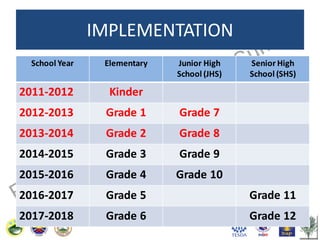
IMPLEMENTATION
Implementation:
School Year

Elementary

Junior High
School (JHS)

Senior High
School (SHS)

2011-2012

Kinder

2012-2013

Grade 1

Grade 7

2013-2014

Grade 2

Grade 8

2014-2015

Grade 3

Grade 9

2015-2016

Grade 4

Grade 10

2016-2017

Grade 5

Grade 11

2017-2018

Grade 6

Grade 12
Mother Tongue-Based Multilingual
Education
Preparations :
1. Development of orthographies and teachinglearning materials in 12 major languages
including Bikol (Central)
2. Contextualization of existing teaching-learning
materials
3. Pilot implementation in 24 schools across Bicol
Region
DepED ISSUANCES on K to 12 Implementation

DepEd Order

Dep Order

No. 31,s. 2012

No. 73, s. 2012

DepEd Memo

Policy Guidelines on
the Implementation
of Grades 1 to 10 of
the K to 12 Basic
Education
Curriculum Effective
School Year 20122013

Guidelines on
Assessment and
Rating of Learning
Outcomes Under
the K to 12
Curriculum

No. 196, s. 2012
Monitoring of
Grades 1 and 7
Classes of the K to
12 Program
Dep Ed Order No. 31, s. 2012
General Guidelines on Implementation
Design of the
Curriculum

Desired
Outcomes

Learning
Area and Its
Description

Medium of
Instruction

Time
Allotment

Sample Class
Program

Learning
Resources

Assessment
and Rating
of Outcomes

Culminating
Activities/
Performances
MONITORING OF IMPLEMENTATION
Objectives:
 Track progress of implementation
 Assess effectiveness and efficiency
 For improvement of curriculum and
instructional processes & approaches
 For policy formulation
MONITORING OF IMPLEMENTATION
School visits

survey

FGD with
teachers

Division
Monitoring
Team

FGD with
parents

FGD with
pupils/students

Regional
Office
Monitoring
Team

Central office
Monitoring
Team
Part III
Preparations for
Senior High School
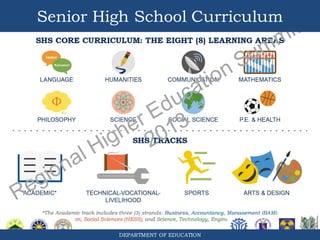
SENIOR HIGH SCHOOL
Two years of specialized
upper secondary education where
students may choose a specialization
based on aptitude, interest and
school capacity
Senior High School Curriculum

DEPARTMENT OF EDUCATION
SHS PLANNING WORKSHOPS

Regional Orientation
with DepED

Division & Region

Undersecretary Mario
Derequito

(August to October
2013)

(August 5, 2013)
External Assessment
Formation of SHS
Implementation
Team/Task Force

Internal Assessment
Planning Proper

Collation of Reports by
the Central Office
Processing of Reports
as Inputs to Senior High
School Implementation
in SY 2016-2017
SHS ROADMAP TO 2016
2013










Pre-Planning for
SHS and FY 2015
Planning
RA 10533 IRR
Complete K to 12
Curriculum
Guidelines
for
Non-DepED SHS
Criteria
for
Locating
DepEd
SHS
Decision on Grade
10
Certificate/Grade
12 Diploma
Engagement
of
potential partners

2014









Finish FY 2015
Budget
Requirements
Infrastructure
Plan, Location of
SHS, and Resource
Requirements
determined
IM Development
Procurement
of
certain resources
Teacher training &
assessment
FY 2016 Planning
and Budgeting
Refinement
of
partnerships

2015










Construction starts 
for majority of
infrastructure

Requirements
Voucher Scheme
financing
and
mechanism set

Refinement
and
finalization
of
arrangements with
partners
Preparation for SY
2017-2018
Procurement
continues
FY 2017 Planning
and Budgeting

2016
Start
of
SHS
Implementation
DepEd and nonDepEd providers
ready at the start
of SY 2016-2017
Continuous
preparations for
SY 2017-2018
Part IV
Projection and Prospects
of Senior High School
for Bicol Region
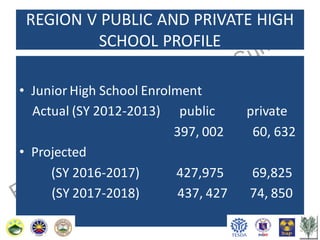
REGION V PUBLIC AND PRIVATE HIGH
SCHOOL PROFILE
• Junior High School Enrolment
Actual (SY 2012-2013) public
397, 002
• Projected
(SY 2016-2017)
427,975
(SY 2017-2018)
437, 427

private
60, 632
69,825
74, 850
REGION V PUBLIC AND PRIVATE HIGH
SCHOOL PROFILE
• SHS 1 Projected
(SY 2016-2017)
(SY 2017-2018)
• SHS 2 Projected
(SY 2017-2018)
Total Enrolment for SHS
(SY 2016-2017)
(SY 2017-2018)
Total JHS and SHS Enrolment
(SY 2016-2017)
(SY 2017-2018)

public
75, 828
77,593

private
14, 448
14,448

65,406

11,992

75, 828
77,593

14, 448
14,448

503, 803
580,426

84, 273
101,290
DATA BANK AND SURVEY RESULTS
Number of Schools to offer SHS
Public – 452 or 70.73% of 639 schools
(187 no SHS)
Private – 130 or 69.14% of 188 schools
(58 no SHS)
Number of enrolees per track
public
Academic
36,027
Tech-Voc
30, 784
Sports & Arts
11, 640
Total
78,451

private
5,956
3, 372
1,382
10, 710
IMPLICATION – NEEDS for SHS
Resources
Needed

School Year

Public
Schools

Private
Schools

Classrooms

2016-2017
2017-2018
2016-2017
2017-2018
2016-2017
2017-2018

1,897
1,940
3, 162
2,797
75,868
77, 593

361
300
602
500
14,593
14, 448

Teachers
Chairs
ISSUES AND CONCERNS
Regional Office

MATERIAL RESOURCES
e.g. classrooms, chairs,
laboratory equipment
HUMAN RESOURCES
Teachers, Supervisors

Central Office
CURRICULUM
DEVELOPMENT
FUNDING SCHEMES
WHAT WE HAVE DONE
Division Offices & Regional Office
 Orient School Officials
 Organized Division and School SHS Implementation
Teams
 Launched advocacy campaign
 Conducted consultative conferences with
stakeholders
 Coordinated with other government agencies
 Benchmarked pilot high school implementers
 Formulated action plans by schools
 Strengthened Career Guidance Program
WHAT WE INTEND TO DO
Strengthen partnerships
with our stakeholders
Local Government Units, Industries
Private Secondary Schools
HEIs, TVIs, Local Colleges
Thank you.
Contacts:
www.deped.gov.ph
depedregion5.ph

Telephone Numbers:
Directorate
482-0046
Elementary Division 482-0310
Secondary Division 482-0701
ALS Division
482-0369

Basic Ed Paper

  • 1.
  • 2.
    Prospects of theK to 12 Basic Education Program in Bicol Region Ramon Fiel G. Abcede Assistant Regional Director Officer-In-Charge Dep ED RO V
  • 3.
    Presentation Outline: I. II. The Kto 12 Law & Its IRR Status of Implementation of the K to 12 Enhanced Basic Education Program III. Preparations for Senior High School IV. Projection and Prospects of Senior High for Bicol Region
  • 4.
    Part I The Kto 12 Law & Its Implementing Rules and Regulations
  • 5.
    Republic Act 10533 (TheK to 12 Law) An Act Enhancing The Philippine Basic Education System by Strengthening Its Curriculum and Increasing The Number of Years for Basic Education, Appropriating Funds Therefor And For Other Purposes Enhanced Basic Education Act of 2013
  • 6.
    Salient Points ofRA 10533 1. Philippine basic education graduates as EMPOWERED INDIVIDUALS One who has acquired life-long learning, earned competence for productivity, able to coexist in harmony with others, engaged in independent, creative & critical thinking, & willing to transform others and self
  • 7.
    Salient Points ofRA 10533 2. Duties of the State in creating a functional basic education system a) Provide opportunity to receive quality education b) Broaden the goals of high school education c) Make education learner-oriented
  • 8.
    Salient Points ofRA 10533 3. Clarification of the Objective and Scope of Basic Education Objective: Able to meet basic learning needs from which subsequent learning can be based Scope: Kindergarten, Elementary, Secondary, Alternative Learning Systems & SPED
  • 9.
    Salient Points ofRA 10533 4. Definition of the coverage of the Enhanced Basic Education Program 1 year Kindergarten 6 years Elementary Education 6 years Secondary Education: 4 years of Junior High School (JHS), and 2 years of Senior High School (SHS)
  • 10.
    Salient Points ofRA 10533 5. Basic education shall be delivered in languages understood by the learners Kinder to Grade 3 – Regional native language of the learner (Mother Tongue) Grade 4 to 6 – Transition from Mother Tongue to Filipino and English Secondary Level – Filipino and English as primary languages of instruction
  • 11.
    Salient Points ofRA 10533 6. Coordination among government and non-government agencies in the development of the curriculum For harmonization, students’ readiness and to avoid duplication of subjects, curriculum design work with CHED and TESDA For effectiveness of the curricconsultations with DOLE, PRC, student & teacher associations, PTAs, chambers of commerce, etc.
  • 12.
    Salient Points ofRA 10533 7. Curriculum standards and principles to be strictly adhered to by DepED  learner-centered, inclusive and developmentally appropriate  relevant, responsive and research-based  culture-sensitive  Contextualized and global  flexible enough to be localized/ indigenized  use constructivist, inquirybased, reflective, collaborative & integrative approaches  use MTB-MLE principles  Use spiral progression approach
  • 13.
    Salient Points ofRA 10533 8. Identification of members of a Curriculum Consultative Committee Task: To oversee the review and implementation of the basic education curriculum Members: DepED (Chair), CHED, TESDA, DOLE, PRC, DOST, Business Chambers
  • 14.
    Salient Points ofRA 10533 9. Preparation of Human Resources that ensures compliance to the expectation for quality teachers and school leaders Task: To oversee the review and implementation of the basic education curriculum a) In-service Training of Teachers on Content and Pedagogy b) Training of New Teachers c) Training on School Leadership
  • 15.
    Salient Points ofRA 10533 10. Significance of Career Guidance and Counseling in order to guide students in choosing the career tracks they intend to pursue In coordination with DOLE, TESDA and the CHED shall regularly conduct career advocacy activities for secondary level students Training of career advocates and guidance counselors will be developed and accredited by DepED
  • 16.
    Salient Points ofRA 10533 11. Expansion of the benefits of Government Assistance to Students and Teachers in Private Education Act (GASTPE) GASTPE grant will be extended to private schools offering SHS (based on the principle of public-private partnership)
  • 17.
    Salient Points ofRA 10533 12. Program Funding Initial funding is through current appropriations of DepED; Later to be included in the annual General Appropriations Act
  • 18.
    Salient Points ofRA 10533 13. Ensure details of transition from the existing ten (10) years basic education cycle to the enhanced basic education (K to 12) cycle Smooth transitions shall be facilitated by DepED, CHED and TESDA along physical infrastructure, manpower, organizational and structural concerns Faculty of HEIs shall be given priority in hiring for the duration of the transition period
  • 19.
    Salient Points ofRA 10533 14. Creation of a Joint Congressional Oversight Committee to oversee, monitor and evaluate the implementation of the Act Composition: Five members each from the Senate and House of Representatives including the Chairs of the Committees on Education, Arts and Culture and Finance of both Houses. There shall have at least two opposition or minority members
  • 20.
    Salient Points ofRA 10533 15. Evaluation and review by DepED and submission of a status report to Congress on the implementation A report must be submitted at the end of SY 2014-2015 It shall focus on closing the shortages on teachers, classrooms, textbooks, seats, toilets and other concerns that should be addressed This aside from other metrics of access to quality of basic education
  • 21.
    Salient Points ofRA 10533 16. Commitment to international benchmarks (The IRR specifically defines the expectations from DepED in this Section)
  • 22.
    Salient Points ofRA 10533 17. Repeal of laws, decrees, executive orders and rules and regulations contrary to or inconsistent with it This includes provisions that are not relevant from the following: B.P. Blg. 232- “Education Act of 1982”, RA No. 9155 - “ Governance of Basic Education Act of 2001”, RA No. 9258 and RA No, 7836
  • 23.
    IMPLEMENTING RULES AND REGULATIONS ofthe Enhanced Basic Education Act of 2013 Issued by DepED, CHED & TESDA (Effective September 24, 2013)
  • 24.
    K to 12IRR Rule I: General Provisions Scope and Application This IRR applies to ALL public and private basic education institutions, HEIs, TVIs, recognized organizations acting as TEIs and foundations
  • 25.
    K to 12IRR Rule I: General Provisions Adoption of the EBEP by Private Schools Private educational institutions must comply with DepED prescribed minimum standards consistent with the Act
  • 26.
    K to 12IRR Rule I: General Provisions Compulsory Basic Education All children must be enrolled in basic education irrespective of delivery modes until its completion
  • 27.
    K to 12IRR Rule I: General Provisions Inclusiveness of Enhanced Basic Education Including Madrasah, IP Education, Gifted and Talented, Learners with Disabilities & Learners under Difficult Circumstances
  • 28.
    K to 12IRR Rule 1: General Provisions Acceleration Acceleration of learners in public and private basic educational institutions shall be allowed consistent with DepED rules and regulations
  • 29.
    K to 12IRR Rule II: Curriculum Curriculum Development Curriculum standards and principles, production and development of materials and medium of instruction are as specified in the Act
  • 30.
    K to 12IRR Rule 2: Curriculum Curriculum Consultative Committee DepED (Chair) CHED TESDA DOLE PRC DOST Business Chambers
  • 31.
    K to 12IRR Rule III: Teacher Qualifications, Training and Continuing Professional Development Teacher Education and Training ALS Coordinators, Instructional Managers, Mobile Teachers and Learning Facilitators are included
  • 32.
    K to 12IRR Rule III: Teacher Qualifications, Training and Continuing Professional Development Hiring of Teachers Hiring of teachers shall be with relevance to the subject to be taught
  • 33.
    K to 12IRR Rule IV: Private Educational Institutions Reasonable Supervision and Regulation There shall always be a recognition of the complementary roles of public and private institutions in the organizational system
  • 34.
    K to 12IRR Rule IV: Private Educational Institutions Issuance and Revocation of Permits and/or Recognition of Private SHS DepEd shall prescribe the guidelines on the issuance and revocation of permits and/or recognition of SHS
  • 35.
    K to 12IRR Rule IV: Private Educational Institutions Specialization of Private SHS Specialization will be allowed if they are essential to the economic and social development of the nation, region or locality
  • 36.
    K to 12IRR Rule V: Career Guidance and Counseling Advocacy Career Guidance and Counseling Programs DepED will coordinate with GOs and NGOs to pursue exposure programs for students and develop the capability of career counselors and advocates to guide the students and equip them with life skills and values
  • 37.
    K to 12IRR Rule V: Career Guidance and Counseling Advocacy Career Advocacy Activities Provision of career information and experiences such as career talks, career and job fairs, parents’ orientations and seminar-workshops on career decisionmaking
  • 38.
    K to 12IRR Rule V: Career Guidance and Counseling Advocacy Career Advocates Career and employment guidance counselors who are not registered and licensed guidance counselors who implement career advocacy activities
  • 39.
    K to 12IRR Rule V: Career Guidance and Counseling Advocacy Role of DepED  curriculum integration  conduct career assessments and career advocacy activities  develop and implement training programs on career advocacy  establish a career advocacy unit  designate guidance supervisors at the division level and career advocates at the school level
  • 40.
    K to 12IRR Rule VI: E-GASTPE BENEFICIARIES AND OTHER FINANCING ARRANGEMENTS WITH PRIVATE EDUCATIONAL INSTITUTIONS AND NON-DEPED PUBLIC SCHOOLS Expansion of E-GASTPE Beneficiaries The benefits will be extended to qualified students enrolled in the Senior High School
  • 41.
    K to 12IRR Rule VI: E-GASTPE BENEFICIARIES AND OTHER FINANCING ARRANGEMENTS WITH PRIVATE EDUCATIONAL INSTITUTIONS AND NON-DEPED PUBLIC SCHOOLS Criteria for Assistance to Qualified Students They are students who completed JHS whether or not they are E-GASTPE beneficiaries in JHS, subject to compliance with the qualifications and guidelines to be determined by DepED
  • 42.
    K to 12IRR Rule VI: E-GASTPE BENEFICIARIES AND OTHER FINANCING ARRANGEMENTS WITH PRIVATE EDUCATIONAL INSTITUTIONS AND NON-DEPED PUBLIC SCHOOLS Forms and Amount of Assistance a) A voucher system where coupons are directly issued to students b) Education service Contracting Scheme (ESC) – tuition fee subsidy in private high schools c) Management contracts – management of school operations under agreed performance targets d) Forms of assistance provided in RA No. 8545 e) Other forms consistent with the principles of public- private partnerships
  • 43.
    K to 12IRR Rule VI: E-GASTPE BENEFICIARIES AND OTHER FINANCING ARRANGEMENTS WITH PRIVATE EDUCATIONAL INSTITUTIONS AND NON-DEPED PUBLIC SCHOOLS Participating Schools The continued participation of providers in JHS is subject to their meeting minimum requirement and standards, including student performance, as determined by DepED; others may apply and may allowed grant if qualified
  • 44.
    K to 12IRR Rule VI: E-GASTPE BENEFICIARIES AND OTHER FINANCING ARRANGEMENTS WITH PRIVATE EDUCATIONAL INSTITUTIONS AND NON-DEPED PUBLIC SCHOOLS Implementing Mechanisms DepEd shall: •issue guidelines •ensure transparency and accountability in the implementation •implement information and advocacy programs •periodically review the program and make adjustments
  • 45.
    K to 12IRR Rule VI: E-GASTPE BENEFICIARIES AND OTHER FINANCING ARRANGEMENTS WITH PRIVATE EDUCATIONAL INSTITUTIONS AND NON-DEPED PUBLIC SCHOOLS Funding Requirements Funding shall be ensured by the national government Private and corporate donors are encouraged to support programs of assistance (e.g. The Adopt-ASchool Program)
  • 46.
    K to 12IRR Rule VI: E-GASTPE BENEFICIARIES AND OTHER FINANCING ARRANGEMENTS WITH PRIVATE EDUCATIONAL INSTITUTIONS AND NON-DEPED PUBLIC SCHOOLS Timeframe Implementation of the programs under this rule will be not later that the start of the SY 2016-2017
  • 47.
    K to 12IRR Rule VI: E-GASTPE BENEFICIARIES AND OTHER FINANCING ARRANGEMENTS WITH PRIVATE EDUCATIONAL INSTITUTIONS AND NON-DEPED PUBLIC SCHOOLS Additional Beneficiaries DepED may develop forms of assistance for Kindergarten and elementary pupils and ALS learners, taking into account the need and capacities of public and private educational institutions
  • 48.
    K to 12IRR Rule VII: Transitory Provisions Private Basic Educational Institutions’ Transition to the EBEP Private schools should develop transition plans; DepED shall appropriate guidelines on the evaluation of the transition plans Private schools with existing 12 to 13 years of basic education shall submit transition plan within 12 months after issuance of IRR
  • 49.
    K to 12IRR Rule VII: Transitory Provisions Implementation of Mechanisms and Strategies Other than those already included in the Act, Modelling program may be considered n the nationwide implementation of the SHS Program in SY 2016-2017
  • 50.
    K to 12IRR Rule VII: Transitory Provisions Partnership with HEIs and TVIs Terms of partnership with HEIs and TVIs are already stated in the Act
  • 51.
    K to 12IRR Rule VII: Transitory Provisions Partnership Financing Framework for State Universities and Colleges During the Transition Period CHED and DBM shall review the financing policy framework for SUCs in light of the Act with the end in view of optimizing the use of government resources for education, the results of which shall be covered by a joint administrative issuance
  • 52.
    K to 12IRR Rule VII: Transitory Provisions Effects of Initial Implementation on Industry Human Resource Requirements DOLE, CHED, DepED, TESDA and PRC in coordination with chambers of commerce shall develop contingency plan not later than the start of SY 2015-2016 on the potential reduction or absence of college graduates to meet human resource requirements of the industry
  • 53.
    K to 12IRR Rule VII: Transitory Provisions Labor and Management Results It is DOLE’s task to convene a technical panel with representatives from DepED, CHED and TESDA, non-teaching and teaching personnel organizations and school administrators to ensure the sustainability of the private and public educational institutions, and the promotion of rights, interests and welfare of teaching and non-teaching personnel
  • 54.
    K to 12IRR Rule VII: Transitory Provisions Transition Period Begins with the date of the approval of the IRR (September 4, 2013) until the end of School Year 2021-2022
  • 55.
    K to 12IRR Rule X: Commitment to International Benchmarks DepED shall seek to: a) engage LGUs to efficiently use SEF and other funds to advance ad promote basic education b) Implement programs that will enhance private sector participation and partnership c) Propose an annual budget allocation in accordance with the goals above; develop multi-year spending plan to ensure that UNESCO-prescribed standards on education are attained
  • 56.
    K to 12IRR Rule XI: Final Provisions Implementing Details DepED, CHED and TESDA may issue policies and guidelines as may be necessary to further implement the IRR
  • 57.
    K to 12IRR Rule XI: Final Provisions Amendment Amendments to the IRR shall be jointly promulgated by the DepED Secretary, CHED Chairperson, and the TESDA Director-General
  • 58.
    Part II Status ofthe Implementation of the K to 12 Enhanced Basic Education Program
  • 59.
    IMPLEMENTATION Implementation: School Year Elementary Junior High School(JHS) Senior High School (SHS) 2011-2012 Kinder 2012-2013 Grade 1 Grade 7 2013-2014 Grade 2 Grade 8 2014-2015 Grade 3 Grade 9 2015-2016 Grade 4 Grade 10 2016-2017 Grade 5 Grade 11 2017-2018 Grade 6 Grade 12
  • 60.
    Mother Tongue-Based Multilingual Education Preparations: 1. Development of orthographies and teachinglearning materials in 12 major languages including Bikol (Central) 2. Contextualization of existing teaching-learning materials 3. Pilot implementation in 24 schools across Bicol Region
  • 61.
    DepED ISSUANCES onK to 12 Implementation DepEd Order Dep Order No. 31,s. 2012 No. 73, s. 2012 DepEd Memo Policy Guidelines on the Implementation of Grades 1 to 10 of the K to 12 Basic Education Curriculum Effective School Year 20122013 Guidelines on Assessment and Rating of Learning Outcomes Under the K to 12 Curriculum No. 196, s. 2012 Monitoring of Grades 1 and 7 Classes of the K to 12 Program
  • 62.
    Dep Ed OrderNo. 31, s. 2012 General Guidelines on Implementation Design of the Curriculum Desired Outcomes Learning Area and Its Description Medium of Instruction Time Allotment Sample Class Program Learning Resources Assessment and Rating of Outcomes Culminating Activities/ Performances
  • 63.
    MONITORING OF IMPLEMENTATION Objectives: Track progress of implementation  Assess effectiveness and efficiency  For improvement of curriculum and instructional processes & approaches  For policy formulation
  • 64.
    MONITORING OF IMPLEMENTATION Schoolvisits survey FGD with teachers Division Monitoring Team FGD with parents FGD with pupils/students Regional Office Monitoring Team Central office Monitoring Team
  • 65.
  • 66.
    SENIOR HIGH SCHOOL Twoyears of specialized upper secondary education where students may choose a specialization based on aptitude, interest and school capacity
  • 67.
    Senior High SchoolCurriculum DEPARTMENT OF EDUCATION
  • 68.
    SHS PLANNING WORKSHOPS RegionalOrientation with DepED Division & Region Undersecretary Mario Derequito (August to October 2013) (August 5, 2013) External Assessment Formation of SHS Implementation Team/Task Force Internal Assessment Planning Proper Collation of Reports by the Central Office Processing of Reports as Inputs to Senior High School Implementation in SY 2016-2017
  • 69.
    SHS ROADMAP TO2016 2013        Pre-Planning for SHS and FY 2015 Planning RA 10533 IRR Complete K to 12 Curriculum Guidelines for Non-DepED SHS Criteria for Locating DepEd SHS Decision on Grade 10 Certificate/Grade 12 Diploma Engagement of potential partners 2014        Finish FY 2015 Budget Requirements Infrastructure Plan, Location of SHS, and Resource Requirements determined IM Development Procurement of certain resources Teacher training & assessment FY 2016 Planning and Budgeting Refinement of partnerships 2015       Construction starts  for majority of infrastructure  Requirements Voucher Scheme financing and mechanism set  Refinement and finalization of arrangements with partners Preparation for SY 2017-2018 Procurement continues FY 2017 Planning and Budgeting 2016 Start of SHS Implementation DepEd and nonDepEd providers ready at the start of SY 2016-2017 Continuous preparations for SY 2017-2018
  • 70.
    Part IV Projection andProspects of Senior High School for Bicol Region
  • 71.
    REGION V PUBLICAND PRIVATE HIGH SCHOOL PROFILE • Junior High School Enrolment Actual (SY 2012-2013) public 397, 002 • Projected (SY 2016-2017) 427,975 (SY 2017-2018) 437, 427 private 60, 632 69,825 74, 850
  • 72.
    REGION V PUBLICAND PRIVATE HIGH SCHOOL PROFILE • SHS 1 Projected (SY 2016-2017) (SY 2017-2018) • SHS 2 Projected (SY 2017-2018) Total Enrolment for SHS (SY 2016-2017) (SY 2017-2018) Total JHS and SHS Enrolment (SY 2016-2017) (SY 2017-2018) public 75, 828 77,593 private 14, 448 14,448 65,406 11,992 75, 828 77,593 14, 448 14,448 503, 803 580,426 84, 273 101,290
  • 73.
    DATA BANK ANDSURVEY RESULTS Number of Schools to offer SHS Public – 452 or 70.73% of 639 schools (187 no SHS) Private – 130 or 69.14% of 188 schools (58 no SHS) Number of enrolees per track public Academic 36,027 Tech-Voc 30, 784 Sports & Arts 11, 640 Total 78,451 private 5,956 3, 372 1,382 10, 710
  • 74.
    IMPLICATION – NEEDSfor SHS Resources Needed School Year Public Schools Private Schools Classrooms 2016-2017 2017-2018 2016-2017 2017-2018 2016-2017 2017-2018 1,897 1,940 3, 162 2,797 75,868 77, 593 361 300 602 500 14,593 14, 448 Teachers Chairs
  • 75.
    ISSUES AND CONCERNS RegionalOffice MATERIAL RESOURCES e.g. classrooms, chairs, laboratory equipment HUMAN RESOURCES Teachers, Supervisors Central Office CURRICULUM DEVELOPMENT FUNDING SCHEMES
  • 76.
    WHAT WE HAVEDONE Division Offices & Regional Office  Orient School Officials  Organized Division and School SHS Implementation Teams  Launched advocacy campaign  Conducted consultative conferences with stakeholders  Coordinated with other government agencies  Benchmarked pilot high school implementers  Formulated action plans by schools  Strengthened Career Guidance Program
  • 77.
    WHAT WE INTENDTO DO Strengthen partnerships with our stakeholders Local Government Units, Industries Private Secondary Schools HEIs, TVIs, Local Colleges
  • 79.
  • 80.