Challenges and
opportunities on the
pathways to A2M
Veriano Terto Jr
Vice Director President ABIA
Member of GTPI
PhD in Collective Health
Rio de Janeiro - Brasil
Background
• I talk from the perspective of a long-time Brazilian activist Living
with HIV/AIDS and an AIDS social researcher
• This presentation addresses challenges and opportunities for
the activism on A2M on the current political context
• Explores relations with global economical trends and
governmental and donors policies
• And discusses some challenges within and among social
movements agendas
Challenges in the field of
governments
• In the last years populist and authoritarian administrations spread around the planet
• Threats on the long stablished democratic cultures, but especially on new democratic
cultures in MIC and LDC, resulting on violations of individual and collective rights
• Growing mistrust and discredit concerning democratic institutions and organizations (i.e.,
congress, law sector, etc.)
• Rebirth of neoliberal economic policies in MICs, which reintroduce or reinforce, austerity
measures, privatization, and FTAs as solutions for MIC developmental obstacles
• Consequently local societies regulated by market values in detriment of social welfare values
• Public arena=unproductive, expensive, old fashioned, inefficient X market/private
sector=productive, modern, cost-effective, efficient
• In this context, how to use TRIPS flexibilities or confront TRIPS reinforcements? How to
keep (or to put) HR on the top of the political agenda?
Challenges in the field of social
movements
• Related to neoliberal socio-economical environment, fragmentation and mistrust affect social
movements and civil society initiatives
• Difficulties to find common issues and stablish alliances and politics of solidarity with different
progressive social movements and sectors
• Lack of resources for advocacy, and consequently reinforcement of competition for funds
• Discontinued and non-coordinated funding policies practiced by donors, cooperation and
multilateral agencies affect civil society responses and lives of people (i.e, Venezuela and GF case)
• Cooptation of progressive sector of societies by state-centered governments and international
agencies, i.e., for executing their gov. project agenda or paying lip-service to the importance of civil
society, asking for our help to lobby for their funding levels [Fully Fund the Global Fund, etc]
• And at the same non recognition of civil society as a meaningful player in a country governance and
in their decision making processes.
Opportunities for activism on A2M
• Despite growing discredit of institutions and conservative political environment, community
activism can still catalyze social demands and aspirations, including those for health and
universal access to medicines and make a difference (Brazil, Thailand, India, Malaysia,
among others)
• Community organizations and activism are still a power that must be recognized for the
promotion and sustainability of fairer health policies, including universal A2M X executors of
governmental or donors projects
• Our work must also foster solidarity and construction of democracy, in a sense of equal and
authonomous participation in the collective decision making processes for the promotion of
individual and collective health
• Principles and values such as universality, social justice, equity, participation, social welfare
and human rights framework are still worthy and must go on informing our current and future
actions and goals on A2M
Conclusion
• Those principles are crucial for our urgent task of bridging and forming
alliances with other potential partners, in order to confront political
fragmentation, stop mistrust and reach an unified common agenda for a
fairer A2M in the developing world
• They are also the framework to denounce abuses of TRIPS and market
policies and put pressure to hold corporations accountable and on
governments to work for collective welfare(and not only for their own
private interests and projects of power!!)
• They are the basis to demand national and international institutions for
guaranteeing human rights, developing social welfare and democratic
policies, which include a high standard public health for everybody.
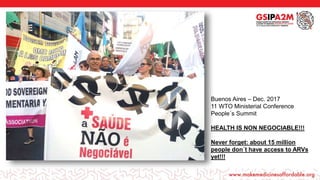
Buenos Aires – Dec. 2017
11 WTO Ministerial Conference
People´s Summit
HEALTH IS NON NEGOCIABLE!!!
Never forget: about 15 million
people don´t have access to ARVs
yet!!!

GSIPA2M Opening session - Veriano Terto

  • 1.
    Challenges and opportunities onthe pathways to A2M Veriano Terto Jr Vice Director President ABIA Member of GTPI PhD in Collective Health Rio de Janeiro - Brasil
  • 2.
    Background • I talkfrom the perspective of a long-time Brazilian activist Living with HIV/AIDS and an AIDS social researcher • This presentation addresses challenges and opportunities for the activism on A2M on the current political context • Explores relations with global economical trends and governmental and donors policies • And discusses some challenges within and among social movements agendas
  • 3.
    Challenges in thefield of governments • In the last years populist and authoritarian administrations spread around the planet • Threats on the long stablished democratic cultures, but especially on new democratic cultures in MIC and LDC, resulting on violations of individual and collective rights • Growing mistrust and discredit concerning democratic institutions and organizations (i.e., congress, law sector, etc.) • Rebirth of neoliberal economic policies in MICs, which reintroduce or reinforce, austerity measures, privatization, and FTAs as solutions for MIC developmental obstacles • Consequently local societies regulated by market values in detriment of social welfare values • Public arena=unproductive, expensive, old fashioned, inefficient X market/private sector=productive, modern, cost-effective, efficient • In this context, how to use TRIPS flexibilities or confront TRIPS reinforcements? How to keep (or to put) HR on the top of the political agenda?
  • 4.
    Challenges in thefield of social movements • Related to neoliberal socio-economical environment, fragmentation and mistrust affect social movements and civil society initiatives • Difficulties to find common issues and stablish alliances and politics of solidarity with different progressive social movements and sectors • Lack of resources for advocacy, and consequently reinforcement of competition for funds • Discontinued and non-coordinated funding policies practiced by donors, cooperation and multilateral agencies affect civil society responses and lives of people (i.e, Venezuela and GF case) • Cooptation of progressive sector of societies by state-centered governments and international agencies, i.e., for executing their gov. project agenda or paying lip-service to the importance of civil society, asking for our help to lobby for their funding levels [Fully Fund the Global Fund, etc] • And at the same non recognition of civil society as a meaningful player in a country governance and in their decision making processes.
  • 5.
    Opportunities for activismon A2M • Despite growing discredit of institutions and conservative political environment, community activism can still catalyze social demands and aspirations, including those for health and universal access to medicines and make a difference (Brazil, Thailand, India, Malaysia, among others) • Community organizations and activism are still a power that must be recognized for the promotion and sustainability of fairer health policies, including universal A2M X executors of governmental or donors projects • Our work must also foster solidarity and construction of democracy, in a sense of equal and authonomous participation in the collective decision making processes for the promotion of individual and collective health • Principles and values such as universality, social justice, equity, participation, social welfare and human rights framework are still worthy and must go on informing our current and future actions and goals on A2M
  • 6.
    Conclusion • Those principlesare crucial for our urgent task of bridging and forming alliances with other potential partners, in order to confront political fragmentation, stop mistrust and reach an unified common agenda for a fairer A2M in the developing world • They are also the framework to denounce abuses of TRIPS and market policies and put pressure to hold corporations accountable and on governments to work for collective welfare(and not only for their own private interests and projects of power!!) • They are the basis to demand national and international institutions for guaranteeing human rights, developing social welfare and democratic policies, which include a high standard public health for everybody.
  • 7.
    Buenos Aires –Dec. 2017 11 WTO Ministerial Conference People´s Summit HEALTH IS NON NEGOCIABLE!!! Never forget: about 15 million people don´t have access to ARVs yet!!!