BarCharts QuickStudy PowerPoint XP John Hales
download
https://ebookgate.com/product/barcharts-quickstudy-powerpoint-xp-
john-hales/
Get Instant Ebook Downloads – Browse at https://ebookgate.com
Get Your Digital Files Instantly: PDF, ePub, MOBI and More
Quick Digital Downloads: PDF, ePub, MOBI and Other Formats
Surface Anatomy BarCharts QuickStudy 1st Edition Inc.
Barcharts
https://ebookgate.com/product/surface-anatomy-barcharts-
quickstudy-1st-edition-inc-barcharts/
Calculus 2 BarCharts QuickStudy 1st Edition Inc.
Barcharts
https://ebookgate.com/product/calculus-2-barcharts-
quickstudy-1st-edition-inc-barcharts/
Chemistry Equations Answers BarCharts QuickStudy 1st
Edition Inc. Barcharts
https://ebookgate.com/product/chemistry-equations-answers-
barcharts-quickstudy-1st-edition-inc-barcharts/
BarChart QuickStudy Access 2003 World s Quick Reference
Software Guide John Hales
https://ebookgate.com/product/barchart-quickstudy-
access-2003-world-s-quick-reference-software-guide-john-hales/
BarCharts QuickStudy Introduction to Health Care
Corinne B. Linton Md
https://ebookgate.com/product/barcharts-quickstudy-introduction-
to-health-care-corinne-b-linton-md/
Calculus Equations Answers BarCharts QuickStudy 1st
Edition Stephen V. Kizlik
https://ebookgate.com/product/calculus-equations-answers-
barcharts-quickstudy-1st-edition-stephen-v-kizlik/
Biology The Basic Principles Of Biology BarCharts
QuickStudy 1st Edition Randy Brooks
https://ebookgate.com/product/biology-the-basic-principles-of-
biology-barcharts-quickstudy-1st-edition-randy-brooks/
QuickStudy Money Banking 1st Edition John C. Mijares
https://ebookgate.com/product/quickstudy-money-banking-1st-
edition-john-c-mijares/
Microsoft Windows XP Power Optimization 1st Edition
John Paul Mueller
https://ebookgate.com/product/microsoft-windows-xp-power-
optimization-1st-edition-john-paul-mueller/
BarCharts, Inc.® WORLD’S #1 QUICK REFERENCE SOFTWARE GUIDE
PowerPoint XP (also known as PowerPoint 2002 and PowerPoint 10) offers many
new features over PowerPoint 2000. Some of the new and improved features are:
• Application Recovery, a feature in all Office XP products, allows the application to
be ended when it is unresponsive (crashed) (using Start, Programs, Office Tools,
Microsoft Office Application Recovery). If the application crashes, this feature
automatically appears, giving the user the option to save the document and restart
PowerPoint, then reopen the document. Either method preserves any presentations
that were open, and optionally alerts either IT or Microsoft of the crash.
• AutoFit Options Smart Tags automatically appear when PowerPoint reduces the size
of text entered to fit the available space. If the size of the text is reduced, the Smart
Tag shown here will appear near the modified text. Clicking on it will allow the
user to keep the modification or let the text overflow the placeholder.
• Automatic Layout Options Smart Tags automatically appear when PowerPoint
changes the slide layout to reflect the type of content on the slide. If a graphic is
added to a slide designed for text, for example, the layout will automatically be
adjusted to accommodate the graphic instead of the text, and the Smart Tag shown
here will appear near the object. Clicking on it will allow the user to keep the
layout modification or let the original layout stand with the new object added.
• Auto Recover, featured in Word for many versions, has been added to PowerPoint
XP. It automatically saves your work periodically (in case you forget).
• Several new task panes have been added, making it easier to design and customize
slides. Probably the most useful is the Slide Design task pane, which allows the
basic slide design (text, bulleted points, graphic, etc.) to be quickly set. Animations
can also be quickly set up and customized using the Animation Schemes task pane.
They can be customized (determining which objects move when and how, for
example) using the Custom Animation task pane.
• Multiple Masters can now be applied to a single presentation. A Master determines
the basic look of the presentation. In the past, only one was allowable for the
presentation. The ability to have more than one is great if several related
presentations are combined into a single presentation.
• Presenter Tools, which are actually several related features, allow the presenter to
view what the next slide is, jump to any other slide in the presentation, view speaker
notes, etc. while the presentation is ongoing. This feature requires at least two
monitors and a computer that supports multiple monitors. This is a common ability
in many notebooks, where the presenter can use the notebook’s built-in screen to
view notes, etc. and use the LCD projector for the presentation.
• Print Preview, a feature of almost every program, has finally made it to PowerPoint.
• Graphics can be compressed to save space in a file by optimizing the way the
presentation will be viewed (in print, on screen, etc.). This is a feature common in
all Office XP programs.
• Individual components of a grouped object can be formatted without having to
ungroup, format, and regroup the object.
New Features in PowerPoint XP
1. Menu Bar. The menus
available in PowerPoint XP
are displayed here.
2. Toolbars. Each toolbar
provides fast access to many
of the features and functions
of PowerPoint XP. The
toolbars can be customized.
3. Outline. Slides included in
a presentation are displayed
in this windowpane by name
and content summary. To
display a slide, click the slide
name/summary. The order
slides appear in a
presentation can be changed
by selecting the slide to be
moved and dragging it to the
new position. This can also
be accomplished in Slide
Sorter view.A preview of the
slides can be viewed by
clicking on the Slides tab.
4. Outline/Slide Scroll
Bar. Allows for scrolling
through the list of slides or the outline, depending on the selected tab.
5. Slide Preview. Once a slide name or description is selected in the left
pane of the window, the contents of the slide are displayed in this pane.
6. AutoShape. PowerPoint XP provides the ability to create geometric
shapes that can be placed in a presentation. These shapes can be filled with
color, and text can be in inserted into the shape.
7. WordArt. PowerPoint XP provides the ability to create word-based
graphics and insert these graphics into a presentation. This is accomplished
by selecting WordArt from the Insert menu.
8. Clip Art. PowerPoint XP
includes an online Clip Gallery
for inserting clip art into a
presentation.
9. Ask a Question. Provides
quick and easy access to the
Help system.
10. Preview Scroll Bar. Allows
for scrolling through the
preview pane.
11. Slide Show. Clicking this
icon causes the presentation to
play, starting with the currently
selected slide. To advance to the
next slide, click the left mouse
button or press the space bar.
12. Slide Sorter View.
Clicking this icon causes the
window to display thumbnails
of each slide within a
presentation. To change the
order of a slide in Slide Sorter
view, drag the slide to be moved
to its new location.
Contents
Pg. 1 Main Window, New Features
Pg. 2 Getting Help, Terminology, Standard Toolbar, Creating a New Presentation
Pg. 3 Opening, Saving & Printing Presentations, Spelling Check, Formatting
Toolbar, Font Formatting
Pg. 4 Applying Design Templates, Slide Layout, Using Views
Pg. 5 Speaker Notes, Drawing Toolbar, AutoShapes
Pg. 6 Picture Toolbar, Inserting Clip Art, Rotating Graphic Objects, Toolbars,
Viewing & Positioning Toolbars
1
13.Normal View. Clicking this icon causes the window to be displayed in
Normal view (also called Tri-Pane view). The illustration above is an
example of Normal View.
14.Design Template Name. When a Design Template is applied to a
presentation, the design’s name is displayed in this area.
15. Drawing Toolbar. The Drawing toolbar is displayed in this area by
default.
16. Slide Notes. PowerPoint XP allows for notes to be added to slides
within a presentation. To add notes to a slide, type in this field.
2
Main Window
6 7
5
4
3 8 9 10
11
12
13
14
16
15
1
Design Template. A file which contains appearance and font formatting
that can be applied to other presentations.
Drop Down Menu. A menu of choices that appears in dialog boxes and
next to some icons; accessed by clicking the downward facing triangle .
Hyperlink. Text that is linked to additional information such as another
presentation, Office XP document or Internet Web site.
Notes. Text that is added to a slide that does not appear when the
presentation is viewed, but can be printed to aid the presenter during the
slide show.
Presentation. A PowerPoint XP file that contains a slide show.
ScreenTip. Text that appears when an icon, hyperlink, etc. is pointed
at, but not clicked. In this example, the text “Save.”
Slide. A page of a presentation that can contain text, graphics,
graphs, charts, sounds and movies.
Slide Show. This view is what PowerPoint is designed for. It is used to
give a presentation before an audience.
Toolbar. A toolbar is a bar located under the main Menu Bar providing
quick access to common features of PowerPoint XP.
PowerPoint XP Terminology
To create a new, blank presentation, simply press the icon. Help in creating
specific types of presentations is available by using templates in the New
Presentation task pane.
To create a new presentation using a template:
• Click New in the File menu. The New Presentation
task pane will appear as shown.
• In the New from template section, click on the
General Templates hyperlink. A list of new
presentations will appear, separated into different
categories on three tabs (or more if previous
versions of PowerPoint were installed).
• Select the General Tab to create either a blank
presentation or to use the AutoContent wizard,
which can help you design many different types of
presentations.
OR
• Select the Design Templates Tab to use one of the
predefined templates installed with PowerPoint.
These templates do not provide any help on content, only on “look and feel”
issues.
OR
• Select the Presentations Tab to use a predefined template with some
content help. Many of the same template types presented in the AutoContent
wizard are listed here as well, only the help provided by the AutoContent
wizard is not listed.
• Select the desired template and click OK.
Creating a New Presentation
Copy copies the currently selected text, object, or slides, placing them on the
clipboard for pasting.
Paste places the contents of the clipboard into the current slide (if the
clipboard contains a part of a slide) or inserts the slide at the current location
if entire slides are on the clipboard.
Format Painter picks up the formatting of the currently selected text and
allows it to be applied on text highlighted while the format painter icon is
the cursor. When single clicked, the next text highlighted will be changed and
the cursor returned to normal. When double clicked, format painter will remain
active until the format painter icon is clicked off.
Undo reverses the last action (typing or formatting) taken. Remembers the
last 99 actions. Multiple items can be undone in order by selecting them from
the drop down menu.
Redo undoes the last undo. Remembers the last 99 Undo actions. Multiple
items can be redone in order by selecting them from the drop down menu.
Insert Chart opens a sample chart that can be populated with the desired
data using a mini spreadsheet. Not available in slide sorter view.
Insert Table inserts a table at the current cursor position. A box will appear
in the toolbar allowing the selection of the number of rows and columns in the
table. Not available in Slide Sorter view.
Tables and Borders displays the Tables and Borders toolbar. Not available
in Slide Sorter view.
Insert Hyperlink inserts a hyperlink to a Web address. Not available in Slide
Sorter view.
Expand All displays (or if displayed, hides) the body text under the titles of
the slides (titles are always visible). Only available when the outline is visible.
Show Formatting in Normal view, displays or hides the formatting of the
text in the outline pane. In Slide Sorter view, displays the title of the slide only
or all objects and formatting on the slide.
Show/Hide Grid in Normal view, displays or hides a grid that can be used to
size and align objects more precisely. Does not print. Not available in Slide
Sorter view.
Color/Grayscale displays the presentation in color, grayscale, or black and
white only.
Zoom allows selection of percentage of printed size that the slide(s)
will appear on the screen. Other sizes can be selected from the drop down
menu.
Microsoft PowerPoint Help displays the Help window.
Standard Toolbar
The following describes the icons on the Standard toolbar:
New creates a new PowerPoint XP presentation.
Open displays the standard Open File window, which provides the ability to
open a previously saved PowerPoint XP file.
Save saves the currently displayed presentation.
E-Mail opens a form to fill in an email header to mail the current presentation.
Search allows searching for files that meet specified conditions (ex.
containing a certain phrase) in specified locations and of specified types.
Print prints the current presentation (the slides; 1/page) to the printer used
last (or the default if one hasn’t been used yet). The printer will be displayed in
parenthesis in the ScreenTip.
Print Preview displays how the presentation will look when printed on the screen.
Spelling opens the spelling checker.
Cut removes the currently selected text or object from the slide (in slide view)
or the selected slide(s) in slide sorter view and places it/them on the clipboard
for pasting.
Standard Toolbar
Getting Help
2
PowerPoint XP offers an extensive help system that can be displayed by clicking
the icon on the Standard Toolbar.
To use the Ask a Question feature:
• Enter the question in the Type a question for help field (on the right side of the
menu bar) and press Enter.
• A window will be displayed containing the results. Click the hyperlink for the
desired article, and the help window for that topic will be displayed. This
window contains two panes. The left pane lists additional topics within the help
system that may be relevant to the question that was posed. The right pane of
the window contains the contents of the selected topic.
• To display the contents of additional topics, click the desired topic in the left
pane of the window.
To display an index of the online help system:
• Click the icon, select Microsoft PowerPoint Help from the Help menu, or
press the F1 key, and the Help window will be displayed.
• Click the Index tab located at the top of the left pane of the window.
• Choose a keyword from the keyword list or enter a word or phrase in the Type
Keywords field. Once the word or phrase has been entered, click the Search button.
• A list of topics that contain the word or phrase is listed in the bottom portion
of the left pane of the window.
• To display the contents of a topic, click the desired topic in the bottom portion of
the left pane, and the contents will be displayed in the right pane of the window.
PowerPoint XP provides a fast and convenient way to access the most up-to-date
help information for PowerPoint XP on the Internet.
To display the Internet help:
• Select Office on the Web from the Help menu.
• The default Internet browser that is defined within the operating system will
be launched and an Internet connection established. Once the Microsoft site is
accessed, the Office XP Assistance Center (help) page will be displayed.
A
3
The New Presentation task pane can also be used to open a presentation by
selecting a recently used presentation from the list in the Open a presentation
section. The icon can also be used to open any presentation. This icon is also
available on the Standard toolbar. The same list of recently accessed files is
available at the bottom of the File menu.
To open a file not recently used:
• Select Open from the File menu or click the button.
• Navigate to the desired folder in the right pane of the Open window.
• Select the name from the list.
• If the file doesn’t appear in the list because it is not a PowerPoint
presentation, but is a different type (such as a Harvard Graphics or
Freelance presentation), select the correct type of file in the Files of type
drop down list (types will vary depending on installed options).
• Click the Open button.
It is very important to save your presentations frequently to prevent data loss.
Once a presentation has been named and saved for the first time, PowerPoint will
not prompt for a name again; rather it will update the file each time it is saved. If
a copy of a file is needed, use the Save As command to make a copy with a new
name and/or location.
To save a file in a folder:
• Select Save or Save As from the File menu.
• Navigate to the desired folder in the right pane of the Save As window.
• Enter a name in the File name field.
• Select the type of file (PowerPoint, Text, Web page, Template, graphics format
(such as GIF, BMP, or JPEG, etc.) in the Save as type drop down list (types will
vary depending on installed options).
• Click the Save button.
Saving a Presentation
A
PowerPoint XP provides an extensive online dictionary for checking the
spelling of words within a presentation. Many common spelling mistakes
never get flagged at all, however, due to AutoCorrect. This feature fixes many
common problems as you type.
To check the spelling of a presentation:
• Select Spelling from the Tools menu or press the icon.
• Suggestions for the correct spelling of the highlighted word are
displayed in the Suggestions pane of the window. To insert a word from
the list, double click the word.
To use AutoCorrect:
Type as normal. If you misspell a word (for example teh) AutoCorrect will
automatically replace it with the correct spelling, (in this case, the).
Spelling Check
Formatting Toolbar
The following describes the icons on the Formatting toolbar:
Font displays the font of the currently selected text and allows
it to be changed to any installed font in the drop down menu.
Font Size displays the size of the selected text and allows it to be
changed by selecting from the drop down menu or typing in a number.
Bold changes the selected text to bold.
Italic italicizes the selected text.
Underline underlines the selected text.
Shadow s
sh
ha
ad
do
ow
ws
s the selected text.
Align Left formats the selected text to have an even left margin and a
ragged right margin.
Center centers the selected text between the left and right margins,
leaving both margins ragged.
Align Right formats the selected text to have a ragged left margin and
an even right margin.
Numbering places a number in front of each paragraph in the selected text.
Bullets places a bullet in front of each paragraph in the selected text.
Increase Font Size increases the font size of the selected text to the next
larger size listed in the Font size drop down menu.
Decrease Font Size decreases the font size of the selected text to the
next smaller size listed in the Font size drop down menu.
Decrease Indent reduces the left margin indent of the selected
paragraph(s) by 1/2 inch.
Increase Indent increases the left margin indent of the selected
paragraph(s) by 1/2 inch.
Font Color changes the text color of the selected text to 1 of a few
predefined colors (based on those in the design template and others used in the
presentation), or a custom color may be selected from the drop down menu.
Slide Design opens the Slide Design task pane to provide quick
access to design templates (backgrounds, font styles, etc.), colors, and
animations.
New Slide adds a new slide after the current slide and displays the
Slide Layout task pane to pick the style of the slide (title slide, bulleted
text, graph, etc.).
There are many options available
when a presentation is printed. If you
want a single copy of all the slides
printed (with 1 slide per page) to
the printer last used (usually the
system’s default printer), the
icon may be used.
To print a presentation:
• Select Print from the File menu and
the window shown at right will be
displayed.
• Select the printer you wish to use
and observe its status (Idle, Needs
Attention, or the number of
documents waiting to be printed on that printer). Click the Properties button if
printing properties (paper tray, contrast, etc.) need to be set.
• Select the number of copies desired and check the Collate box if you want
multiple copies collated.
• Specify what is to be printed from the Print what drop down menu (slides,
handouts, notes, or the outline of the presentation). If Handouts is selected,
specify the number of slides to print per page and their arrangement (3 is often
selected, as lined space is provided to the right of each slide for note-taking).
• Specify whether to print in color, grayscale, or pure black and white.
• Click OK to print the presentation.
Printing a Presentation
Font Formatting
To specify font options:
• Select the text to be formatted.
• Click the button to change the font, the button to
change the font size, the button to bold the text, the button to
italicize the text the button to underline the text, and/or the to place
a shadow around the text.
OR
• Select Font from the Format menu, and the window illustrated above will
be displayed.
• Specify the font, style, size, effects, and color by using the drop down
menus and check boxes.
• Click OK.
Opening a Presentation
4
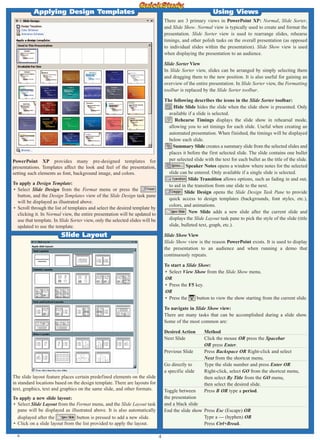
PowerPoint XP provides many pre-designed templates for
presentations. Templates affect the look and feel of the presentation,
setting such elements as font, background image, and colors.
To apply a Design Template:
• Select Slide Design from the Format menu or press the
button, and the Design Templates view of the Slide Design task pane
will be displayed as illustrated above.
• Scroll through the list of templates and select the desired template by
clicking it. In Normal view, the entire presentation will be updated to
use that template. In Slide Sorter view, only the selected slides will be
updated to use the template.
Applying Design Templates
Slide Layout
The slide layout feature places certain predefined elements on the slide
in standard locations based on the design template. There are layouts for
text, graphics, text and graphics on the same slide, and other formats.
To apply a new slide layout:
• Select Slide Layout from the Format menu, and the Slide Layout task
pane will be displayed as illustrated above. It is also automatically
displayed after the button is pressed to add a new slide.
• Click on a slide layout from the list provided to apply the layout.
There are 3 primary views in PowerPoint XP: Normal, Slide Sorter,
and Slide Show. Normal view is typically used to create and format the
presentation. Slide Sorter view is used to rearrange slides, rehearse
timings, and other polish tasks on the overall presentation (as opposed
to individual slides within the presentation). Slide Show view is used
when displaying the presentation to an audience.
Slide Sorter View
In Slide Sorter view, slides can be arranged by simply selecting them
and dragging them to the new position. It is also useful for gaining an
overview of the entire presentation. In Slide Sorter view, the Formatting
toolbar is replaced by the Slide Sorter toolbar.
The following describes the icons in the Slide Sorter toolbar:
Hide Slide hides the slide when the slide show is presented. Only
available if a slide is selected.
Rehearse Timings displays the slide show in rehearsal mode,
allowing you to set timings for each slide. Useful when creating an
automated presentation. When finished, the timings will be displayed
below each slide.
Summary Slide creates a summary slide from the selected slides and
places it before the first selected slide. The slide contains one bullet
per selected slide with the text for each bullet as the title of the slide.
Speaker Notes opens a window where notes for the selected
slide can be entered. Only available if a single slide is selected.
Slide Transition allows options, such as fading in and out,
to aid in the transition from one slide to the next.
Slide Design opens the Slide Design Task Pane to provide
quick access to design templates (backgrounds, font styles, etc.),
colors, and animations.
New Slide adds a new slide after the current slide and
displays the Slide Layout task pane to pick the style of the slide (title
slide, bulleted text, graph, etc.).
Slide Show View
Slide Show view is the reason PowerPoint exists. It is used to display
the presentation to an audience and when running a demo that
continuously repeats.
To start a Slide Show:
• Select View Show from the Slide Show menu.
OR
• Press the F5 key.
OR
• Press the button to view the show starting from the current slide.
To navigate in Slide Show view:
There are many tasks that can be accomplished during a slide show.
Some of the most common are:
Desired Action Method
Next Slide Click the mouse OR press the Spacebar
OR press Enter.
Previous Slide Press Backspace OR Right-click and select
Next from the shortcut menu.
Go directly to Type the slide number and press Enter OR
a specific slide Right-click, select GO from the shortcut menu,
then select By Title from the GO menu,
then select the desired slide.
Toggle between Press B OR type a period.
the presentation
and a black slide
End the slide show Press Esc (Escape) OR
Type a — (hyphen) OR
Press Ctrl+Break.
Using Views
A
5
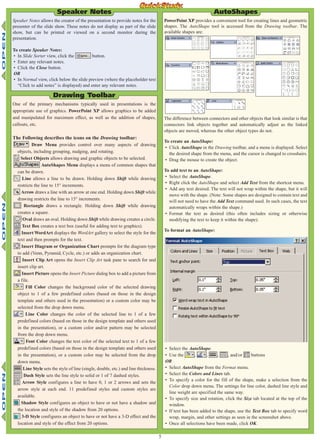
Speaker Notes allows the creator of the presentation to provide notes for the
presenter of the slide show. These notes do not display as part of the slide
show, but can be printed or viewed on a second monitor during the
presentation.
To create Speaker Notes:
• In Slide Sorter view, click the button.
• Enter any relevant notes.
• Click the Close button.
OR
• In Normal view, click below the slide preview (where the placeholder text
“Click to add notes” is displayed) and enter any relevant notes.
Speaker Notes
One of the primary mechanisms typically used in presentations is the
appropriate use of graphics. PowerPoint XP allows graphics to be added
and manipulated for maximum effect, as well as the addition of shapes,
callouts, etc.
The Following describes the icons on the Drawing toolbar:
Draw Menu provides control over many aspects of drawing
objects, including grouping, nudging, and rotating.
Select Objects allows drawing and graphic objects to be selected.
AutoShapes Menu displays a menu of common shapes that
can be drawn.
Line allows a line to be drawn. Holding down Shift while drawing
restricts the line to 15° increments.
Arrow draws a line with an arrow at one end. Holding down Shift while
drawing restricts the line to 15° increments.
Rectangle draws a rectangle. Holding down Shift while drawing
creates a square.
Oval draws an oval. Holding down Shift while drawing creates a circle.
Text Box creates a text box (useful for adding text to graphics).
Insert WordArt displays the WordArt gallery to select the style for the
text and then prompts for the text.
Insert Diagram or Organization Chart prompts for the diagram type
to add (Venn, Pyramid, Cycle, etc.) or adds an organization chart.
Insert Clip Art opens the Insert Clip Art task pane to search for and
insert clip art.
Insert Picture opens the Insert Picture dialog box to add a picture from
a file.
Fill Color changes the background color of the selected drawing
object to 1 of a few predefined colors (based on those in the design
template and others used in the presentation) or a custom color may be
selected from the drop down menu.
Line Color changes the color of the selected line to 1 of a few
predefined colors (based on those in the design template and others used
in the presentation), or a custom color and/or pattern may be selected
from the drop down menu.
Font Color changes the text color of the selected text to 1 of a few
predefined colors (based on those in the design template and others used
in the presentation), or a custom color may be selected from the drop
down menu.
Line Style sets the style of line (single, double, etc.) and line thickness.
Dash Style sets the line style to solid or 1 of 7 dashed styles.
Arrow Style configures a line to have 0, 1 or 2 arrows and sets the
arrow style at each end. 11 predefined styles and custom styles are
available.
Shadow Style configures an object to have or not have a shadow and
the location and style of the shadow from 20 options.
3-D Style configures an object to have or not have a 3-D effect and the
location and style of the effect from 20 options.
Drawing Toolbar
PowerPoint XP provides a convenient tool for creating lines and geometric
shapes. The AutoShape tool is accessed from the Drawing toolbar. The
available shapes are:
The difference between connectors and other objects that look similar is that
connectors link objects together and automatically adjust as the linked
objects are moved, whereas the other object types do not.
To create an AutoShape:
• Click AutoShape in the Drawing toolbar, and a menu is displayed. Select
the desired shape from the menu, and the cursor is changed to crosshairs.
• Drag the mouse to create the object.
To add text to an AutoShape:
• Select the AutoShape.
• Right click the AutoShape and select Add Text from the shortcut menu.
• Add any text desired. The text will not wrap within the shape, but it will
move with the shape. (Note: Some shapes are designed to contain text and
will not need to have the Add Text command used. In such cases, the text
automatically wraps within the shape.)
• Format the text as desired (this often includes sizing or otherwise
modifying the text to keep it within the shape).
To format an AutoShape:
• Select the AutoShape.
• Use the , , , , and/or buttons
OR
• Select AutoShape from the Format menu.
• Select the Colors and Lines tab.
• To specify a color for the fill of the shape, make a selection from the
Color drop down menu. The settings for line color, dashed line style and
line weight are specified the same way.
• To specify size and rotation, click the Size tab located at the top of the
window.
• If text has been added to the shape, use the Text Box tab to specify word
wrap, margin, and other settings as seen in the screenshot above.
• Once all selections have been made, click OK.
AutoShapes
6
visit us at
quickstudy.com
Author: John Hales
Screen representations may vary
depending on the version of the
software installed. This guide is based
on the software version shipping at
the time of publication and is accurate
to that version. For specific changes
to a software application, see the
Read-Me file provided with the
software application. Screen
representations appear courtesy of
Microsoft Corporation, Redmond,
Washington.
© 2001 BarCharts, Inc.
Boca Raton, FL
October 2001
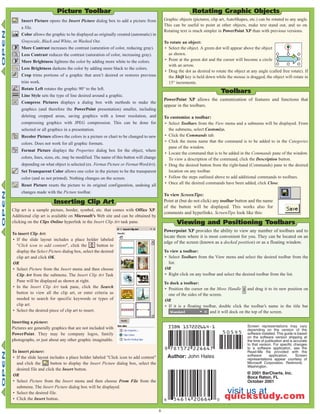
Picture Toolbar
Clip art is a sample picture, border, symbol, etc. that comes with Office XP.
Additional clip art is available on Microsoft’s Web site and can be obtained by
clicking on the Clips Online hyperlink in the Insert Clip Art task pane.
To insert Clip Art:
• If the slide layout includes a place holder labeled
"Click icon to add content", click the button to
display the Select Picture dialog box, select the desired
clip art and click OK.
OR
• Select Picture from the Insert menu and then choose
Clip Art from the submenu. The Insert Clip Art Task
Pane will be displayed as shown at right.
• In the Insert Clip Art task pane, click the Search
button to view all the clip art, or enter criteria as
needed to search for specific keywords or types of
clip art.
• Select the desired piece of clip art to insert.
Inserting a picture:
Pictures are generally graphics that are not included with
PowerPoint. They may be company logos, family
photographs, or just about any other graphic imaginable.
To insert picture:
• If the slide layout includes a place holder labeled "Click icon to add content"
and click the button to display the Insert Picture dialog box, select the
desired file and click the Insert button.
OR
• Select Picture from the Insert menu and then choose From File from the
submenu. The Insert Picture dialog box will be displayed.
• Select the desired file.
• Click the Insert button.
Inserting Clip Art
Graphic objects (pictures, clip art, AutoShapes, etc.) can be rotated to any angle.
This can be useful to point at other objects, make text stand out, and so on.
Rotating text is much simpler in PowerPoint XP than with previous versions.
To rotate an object:
• Select the object. A green dot will appear above the object
as shown.
• Point at the green dot and the cursor will become a circle
with an arrow.
• Drag the dot as desired to rotate the object at any angle (called free rotate). If
the Shift key is held down while the mouse is dragged, the object will rotate in
15° increments.
Rotating Graphic Objects
Insert Picture opens the Insert Picture dialog box to add a picture from
a file.
Color allows the graphic to be displayed as originally created (automatic) in
Grayscale, Black and White, or Washed Out.
More Contrast increases the contrast (saturation of color, reducing gray).
Less Contrast reduces the contrast (saturation of color, increasing gray).
More Brightness lightens the color by adding more white to the colors.
Less Brightness darkens the color by adding more black to the colors.
Crop trims portions of a graphic that aren’t desired or restores previous
trim work.
Rotate Left rotates the graphic 90° to the left.
Line Style sets the type of line desired around a graphic.
Compress Pictures displays a dialog box with methods to make the
graphics (and therefore the PowerPoint presentation) smaller, including
deleting cropped areas, saving graphics with a lower resolution, and
compressing graphics with JPEG compression. This can be done for
selected or all graphics in a presentation.
Recolor Picture allows the colors in a picture or chart to be changed to new
colors. Does not work for all graphic formats.
Format Picture displays the Properties dialog box for the object, where
colors, lines, sizes, etc. may be modified. The name of this button will change
depending on what object is selected (ex. Format Picture or Format WordArt).
Set Transparent Color allows one color in the picture to be the transparent
color (and so not printed). Nothing changes on the screen.
Reset Picture resets the picture to its original configuration, undoing all
changes made with the Picture toolbar.
PowerPoint XP allows the customization of features and functions that
appear in the toolbars.
To customize a toolbar:
• Select Toolbars from the View menu and a submenu will be displayed. From
the submenu, select Customize.
• Click the Commands tab.
• Click the menu name that the command is to be added to in the Categories
pane of the window.
• Locate the command that is to be added in the Commands pane of the window.
To view a description of the command, click the Description button.
• Drag the desired button from the right-hand (Commands) pane to the desired
location on any toolbar.
• Follow the steps outlined above to add additional commands to toolbars.
• Once all the desired commands have been added, click Close.
To view ScreenTips:
Point at (but do not click) any toolbar button and the name
of the button will be displayed. This works also for
comments and hyperlinks. ScreenTips look like this:
Toolbars
Powerpoint XP provides the ability to view any number of toolbars and to
locate them where it is most convenient for you. They can be located on an
edge of the screen (known as a docked position) or as a floating window.
To view a toolbar:
• Select Toolbars from the View menu and select the desired toolbar from the
list.
OR
• Right click on any toolbar and select the desired toolbar from the list.
To dock a toolbar:
• Position the cursor on the Move Handle and drag it to its new position on
one of the sides of the screen.
OR
• If it is a floating toolbar, double click the toolbar’s name in the title bar
and it will dock on the top of the screen.
Viewing and Positioning Toolbars
Discovering Diverse Content Through
Random Scribd Documents
harassing associations, even from the presence of the bright-haired and
pale-faced girl who so lovingly watched and soothed his pillow, the mind of
the young officer flashed back, as if touched by an electric wire, to his
once-happy home. Again his manly father's smile approved of some task or
feat of skill performed by bridle, gun, or rod; again his mother's dark eyes
seemed to look softly into his; the willowed valley (that opened between
steep and ruin-crowned cliffs towards the billowy Cornish sea), the little
world of all his childhood's cares and joys, was with him now, and with that
world he was mingling over again in fancy, though death and distress had
been there as elsewhere; the hearth was desolate, or strangers sat around it;
their household gods were scattered, and home was home no longer, save in
the heart, the memory, of the dying exile.
And so, for a time, his thoughts were far away even from Rose and the
present scene. Far from the images that were full of the warlike and perilous
present, he was revelling in the past, and talked fluently, confidently, and
smilingly with the absent, the lost, and the dead. Often he said—
"Lift my head, dearest mother; place your kind arm round my neck and
kiss me once again."
And Rose obeyed him, and he seemed to smile upward into her face; and
yet he knew her not, or saw another there.
Then he talked deliriously of his father's rights, of his mother's wrongs,
and of his cousin, Audley Trevelyan, till his voice sank into whispers and
anon ceased.
This was what Shakspeare describes as the
"Vanity of sickness! fierce extremes,
In their continuance, will not feel themselves.
Death having preyed upon the outward parts,
Leaves them invisible; and his siege is now
Against the mind, which he pricks and wounds
With many legions of strange fantasies,
Which, in their throng and press to that last hold,
Confound themselves."
He fell asleep; and, without prolonging our description further, suffice it
that poor Denzil never woke again, but passed peacefully away...
Rose sat for a time in a stupor, like one in a dream. Summoned by her
first wild cry, the Khanum was by her side now.
Denzil, so long her care, her soul, her all, lay there, it would seem, as
usual—lay there as she had seen him for many days; yet why was it that his
presence, and that rigid angularity and stillness of outline, so appalled her
now?
As the crisis so evidently had drawn near, strongly and wildly in the
girl's heart came the crave for medical, for religious, for any Christian aid or
advice; but there none could be had, any more than if she had stood by the
savage shores of the Albert Nyanza; and now the dread crisis was past!
So, from time to time the pale girl found herself gazing on the paler face
of the dead—of him who had so loved her—gazing with that mingled
emotion of incredulity, wonder, and terror, awe and sorrow, which passeth
all experience or description.
There was no change in the air; there was no change in the light: one was
still and calm, and laden with perfume; the other as bright and clear as ever:
and the blaze of yellow sunshine poured into the room precisely as it did an
hour ago; but now it fell on the face of the dead!
And the clear voice of the pagoda-thrush sang on; but how
monotonously now!
Rose was stunned, and sat crouching on the floor, with her face covered
by her hands, her head between her knees, and her bright dishevelled hair
falling forward in silky volume well nigh to her feet. Ignorant of what to
say, or how to soothe grief so passionate, the Khanum, unveiled, hung over
her in kindness of heart, but with one prevailing idea—that the death of an
idolater must be very terrible; that already the fiends must be contesting for
the possession of his soul; that the prescribed portion of the Koran had not
been read to him; and even if it had been, what would it avail now, till that
day when the solid mountains and the soft white clouds should be rolled
away together by the blast of the trumpet of Azrael?
So his last thoughts had been of his dead mother, as Rose remembered,
and not of her. Her father was dead; Mabel was gone to Toorkistan, too
surely beyond ransom or redemption: oh, why was she left to live?
If the sense of exile is so strong in the heart of the Anglo-Indian, even
amid all the luxuries and splendours of Calcutta, the city of palaces—amid
the gaieties and frivolities of Chowringhee,—what must that sense have
been to the heart of this lonely English girl, far away beyond Peshawur, the
gate of Western India, beyond the Indus, fifteen hundred English miles, as
the crow flies, "up-country," from the mouth of the Hooghley and the shore
of Bengal—where the railway whistle will long be unheard, and where
Murray, Cook, and Bradshaw may never yet be known!
Notwithstanding all that Rose had undergone of late, and all that she had
schooled herself to anticipate as but too probable, she was still unable fully
to realise the actual extent of the misfortunes that threatened her. Much of
that deep misery which Sybil had endured elsewhere, when crouching in the
damp and mist outside her mother's door, came over Rose's spirit now.
Henceforward, she felt that life must be objectless; that safety or pursuit,
freedom or captivity, sea or land, must be all alike to her; and for a time her
poor brain, so long oppressed by successive sorrows and excitements,
became almost unconscious of external impressions, and she sat as one in a
dream, hearing only the buzz of the summer flies and the voice of the
pagoda-thrush.
Suddenly another sound seemed to mingle with the notes of the birds; it
came on the air from a great distance. She started and looked wildly up—
her once-clear hazel eyes all bloodshot and tearless now.
What was it? what is it? for the sound was there, and she seemed to hear
it still, and the Khanum heard it too!
Nearer it came, and nearer.
It was the sound of drums—drums beaten in regular marching cadence,
coming on the wind of evening down from the rocky pass in the hills of
Siah Sung.
Oh, there could be no mistake in the measure—British troops were
coming on; and how welcome once would that sound have been to the
young soldier who lay on his pallet there, and whose ear could hear the
English drum no more!
She started to the window, and looked forth to the black mountains,
which, though distant from it, towered high above the Kuzzilbashes' fort.
The dark Pass lay there, its shadows seeming blue rather than any other tint,
as the receding rays of the setting sun left it behind; but her eyes were dim
with weeping and with watching now, so Rose, with all her pulseless
eagerness, failed to see the serried bayonets, the shot-riven colours tossing
in the breeze, or the moving ranks in scarlet, that showed where the
victorious brigades of Pollock, Sale, and Nott were once more defiling
down into the plain that led to humbled Cabul.
Welcome though their sound, they had come, alas, too late!
The drums were still ringing in her ears; and this familiar sound, like the
voices of old friends, caused her now to weep plentifully. Once again she
turned to the bed where Denzil lay so pale and still, his sharpened features
acutely defined in the last light of the sun; and she felt in her heart as she
pressed her interlaced hands on her lips, seeking to crush down emotion—
"So the dream it is fled, and the day it is done,
And my lips still murmur the name of one
Who will never come back to me!"
CHAPTER XXI.
THE PURSUIT.
The same evening of this event saw the Union Jack floating on the
summit of the Bala Hissar, and our troops in or around Cabul, in the narrow
and once-crowded thoroughfares of which—even in the spacious and once-
brilliant bazaar—the most desolate silence prevailed. The houses of Sir
Alexander Burnes, of Sir William Macnaghten, and all other British
residents were now mere heaps of ashes, and their once-beautiful gardens
were waste. Human bones lay in some; whose they were none knew, but
they remained among the parterres of flowers as terrible mementos of the
past.
Having, among many other trophies, the magnificent and ancient gates
of Hindoo Somnath with them, the victorious troops of General Nott were
encamped around the stately marble tomb of the Emperor Baber, where the
British were watering their horses at the Holy Well, quietly cooking their
rations of fat-tailed dhoombas or of beef, newly shot, flayed, and cut up,
after a long route; and the natives were gravely boiling their rice and otta;
while the staff officers, Generals Pollock, Sale, Nott, Macaskill, and others,
some on foot and some on horseback, were in deep conference about a map
of Western India, and Bokhara, and as to where the hostages were, and what
was to be done for their relief, if they still lived.
Waller, who in his energy and anxiety had come on with the advanced
guard of cavalry, looked around him with peculiar sadness. Save Doctor
Brydone and one or two others, he alone seemed to survive of all the
original Cabul force; and every feature of the place before him was full of
melancholy memories and suggestions of those he could never see again,
and of the past that could come no more.
To Sir Richmond Shakespere, his new friend, he could not resist the
temptation of speaking affectionately and regretfully of the dead, and the
places associated with them. He found a relief to his mind in doing so.
"A time may come," said he, as they sat in their saddles twisting up
cigarettes, and passing a flask of Cabul wine between them, while the syces
gave each of their unbitted nags a tobrah of fresh corn, "when these Passes
of the Khyber Mountains may be as familiar to the English tourist as those
of Glencoe and Killycrankie are now—for there was a day when even the
land beyond them was a terra incognita to us; and a time may come when
the lines of railway shall extend from Lahore even to Peshawar—ay, and
further—perhaps to the gates of Herat—though it may not be our luck to
see it; but I can scarcely realise that in our age of the world, an age usually
so prosaic and deemed matter-of-fact, men should see and undergo all that
we have undergone and seen, and in a space of time so short too!"
Would a quiet home, a peaceful life, after a happy marriage, ever be the
lot of him and Mabel? Loving her fondly and tenderly, with all the strength
that separation, dread, and doubt and sorrow, could add to the secret tie
between them, he had almost ceased to have visions of her associated with
admonitions and prayer from a lawn-sleeved ecclesiastic; a merry marriage-
breakfast; a bride in her white bonnet and delicate laces, and smiling
bridesmaids in tulle. Such day-dreams had been his at one time; but amid
rapine and slaughter, battle and suffering, they had become dim and
indistinct, if not forgotten!
"Yes, Waller," replied his companion, after a pause, "a British army—we
have actually seen a British army, with all its accessories and
appurtenances, exterminated at one fell swoop!"
"All this place is full of peculiarly sad memories to me, Sir Richmond."
"Doubtless; and, like me, you won't be sorry when we all turn our backs
on it for ever, as we shall do soon."
"True. See! yonder lie our cantonments, ruined walls and blackened
ashes now; beyond them are the hills where, with my company—not one
man of which is now surviving, myself excepted—I scoured the fanatical
Ghazees from rock to rock, and far over the Cabul river, so victoriously!
Here, by that old tomb and ruined musjid, we once had a jolly picnic: half
the fellows in the garrison, and all the ladies were there—the band of the
poor 44th too. By Jove! I can still see the scattered fragments of broken
bottles and chicken bones lying among the grass."
"I have felt something of this regret when coming on the remembered
scene of an old pig-sticking party or bivouac," replied Sir Richmond, with a
half-smile at the unwonted earnestness of Waller, who had seemed to him
always a remarkably cool and self-possessed man of the world; but he knew
not the deeper cause he had for feeling in these matters. "You may say, as
an old poem has it—
'Now the long tubes no longer wisdom quaff,
Or jolly soldiers raise the jocund laugh;
The scene is changed, but scattered fragments tell
Where Bacchanalian joys were wont to dwell.'
Is it not so, Waller?"
"By this road I smoked a last cigar with Jack Polwhele, of ours, and
Harry Burgoyne, of the 37th," resumed Waller. He remembered, but he did
not care to add, how broadly they had bantered him about Mabel Trecarrel
on the evening in question. "And all round here," he resumed, pursuing his
own thoughts aloud, "are the scenes of many a pleasant ride and happy
drive. Here I betted and lost a box of gloves with the Trecarrels."
"You seem to have always been betting on something with those ladies,
and with a gentleman's privilege of losing."
"It was on the Envoy's blood mare against Jack Polwhele's bay filly, in
the race when Daly, of the 4th Dragoons, won the sword given by Shah
Sujah," said Waller, colouring a little. "There, by those cypresses, I once
met the sisters half fainting, one day, with heat, their palanquin placed in
the shade by the gasping dhooley-wallahs; so, at the risk of a brain fever, I
galloped to the Char-chowk for a flask of Persian rose-water, fans, and so
forth."
"The Trecarrels again! By the way, it seems to me," said the other, "that
of all the friends you have lost, those two young ladies—one especially
——"
What the military secretary of General Pollock was about to say, with a
somewhat meaning smile, we know not, save that he was heightening the
colour of Waller's face by his pause; but a change was given to the
conversation by the opportune arrival of Shireen Khan, of the Kuzzilbashes,
mounted, as usual, on his tall camel, and accompanied by a few well-
appointed horsemen. He had ascertained that "Shakespere Sahib" was the
katib, or secretary, to the victorious Feringhee general, and had come to
tender, through him, his services to the family of the fallen Shah, to the
conquerors, to the Queen they served, and, generally, to the powers that
were uppermost.
Many of the Afghan chiefs, who, with their people, had acted most
savagely against us, were now extremely anxious to make their peace with
General Pollock; and though it can scarcely be said that towards the end
(after his own jealousy of Ackbar's influence, fear of his growing power that
curbed all private ambition, caused a coolness in the Sirdir's cause) Shireen
and his Kuzzilbashes had been our most bitter enemies, yet he and they
were among the first now to meet and welcome the conquerors of Ackbar,
against whom they had turned, not as we have seen Saleh Mohammed
meanly do, in the time of his undoubted humiliation and defeat, but when in
the zenith of his power; and now this wary old fellow, who played the game
of life as carefully and coolly as ever he played that of chess, knew that the
protection he had afforded to Rose Trecarrel and to Denzil—the supposed
Nawab—must prove his best moves on the board—his trump cards, in fact;
and as a conclusive offer of friendship, he now offered six hundred chosen
Kuzzilbash horsemen to follow on the track of Saleh Mohammed, and
rescue the whole of the prisoners, a duty on which Shakespere and Waller at
once joyfully volunteered to accompany them.
"Shabash!" he exclaimed, stroking his beard in token of faith and
promise, "punah-be-Kodah!—it is as good as done; and the head of the
Dooranee dog shall replace that of the Envoy in the Char-chowk!"
Waller soon divined that the lady now residing in Shireen's fort must be
no other than the younger daughter of "the Sirdir Trecarrel," who was
spirited away on the retreat through the Passes, on that night when the
Shah's 6th Regiment deserted; but of who "the Nawab" could be he had not
the faintest idea, until he and Shakespere galloped there, saw the living and
the dead, and heard all their sad story unravelled.
With her head, sick and aching, nestling on the broad shoulder of Bob
Waller, as if he was her only and dearest brother, Rose told all her story
without reserve, and it moved Waller and his companion deeply, to see a
handsome and once-bright English girl so crushed and reduced by grief and
long-suffering; yet her case was only one of many in the history of that
disastrous war. She ended by imploring them to lose no time in following
the track of those who had borne off her sister and the other hostages.
No words or entreaties of hers were necessary to urge either Waller or
Shakespere on this exciting path; and instant action became all the more
imperative when Shireen announced that he had sure tidings from Taj
Mohammed Khan, and also from Nouradeen Lal, the farmer, who had been
purchasing horses on the frontier, that all the lawless Hazarees were in arms
to cut off the entire convoy; and that if a junction were once effected
between them and the Toorkomans of Zoolficar Khan, all hope of rescue
would be at an end.
The permission of the general was, of course, at once asked and
accorded, and it was arranged, that, immediately upon their departure, a
body of cavalry and light infantry should follow with all speed to second
and support them.
Kind-hearted Bob Waller waited only to attend the obsequies of his
young comrade (while the Kuzzilbashes were preparing); and over these we
shall hasten, though of all the Cabul army he was, perhaps, the only one
interred with the honours of war; the battle-smoke had been the pall, the
wolf and the raven the sextons, of all the rest!
The spot chosen was a little way outside the Kuzzilbashes' fort, on the
sunny and green grassy slope of a hill, where a grove of wild cherry-trees
rendered the place pleasant to the eye. From her window Rose could alike
see and hear the rapid ceremony; for by the stern pressure of circumstances
it was both brief and rapid. No prayer was said; no service performed; no
solemn dropping of dust upon dust; no requiem was there, but the drums as
they beat the "Point of War," after the last notes of the Dead March had died
away.
The quick, formal commands of the officer came distinctly to her
overstrained ear, as the hurriedly constructed coffin of unblackened deal,
covered by the colour of the 44th Regiment, was being lowered, as she
knew, for ever, into its narrow bed; the steel ramrods rang in the distance
like silver bells, and flashed in the sunshine; then a volley rang sharply in
the air, finding a terrible echo in her heart, while the thin blue smoke eddied
upward in the sunshine; another and another succeeded, and Rose—the
widowed in spirit—as she crouched on her knees, knew then that all was
over, and the smoke of the last farewell volley would be curling amid the
damp mould that was now to cover her lost one.
Anon the drums beat merrily as the firing party, after closing their ranks,
wheeled off by sections, with bayonets fixed, and Denzil Devereaux was
left alone in his solitary and unmarked grave, just as the sun set in all his
evening beauty; and a double gloom sank over the soul of Rose Trecarrel.
CHAPTER XXII.
THE HOSTAGES.
Swiftly rode Shakespere, Waller, and their six hundred Kuzzilbashes on
their errand of mercy, and midnight saw them far from the mountains that
look down on Cabul. Of all his five thousand horse, old Shireen had
certainly chosen the flower. All these men rode their own chargers, and all
were armed with lance and sword, matchlock and pistols; all had their
persons bristling with the usual number of daggers, knives, powder-flasks,
and bullet-bags, in which the Afghan warrior delights to invest himself; and
all wore the peculiar cap from which they take their name—a low squat
busby, of black lambs'-wool, not unlike those now worn by our Hussars,
and having, like them, a bag of scarlet cloth hanging from the crown
thereof.
To avoid all suspicion or attention en route, Waller and Shakespere had
cast their uniforms aside, and rode at their head à la Kussilbashe, dressed in
poshteen and chogah, and armed with lance and sabre.
The discovery of Rose Trecarrel—an event so unexpected and unlooked
for after all that had occurred—seemed to Waller as an omen of future good
fortune, and his naturally buoyant spirits rose as he rode on. The expedition
was full of excitement, especially for a time: it was an act of courage,
mercy, and chivalry, that all Britain should eventually hear of; and Mabel
was at the bourne, for which they were all bound. Even poor Denzil, so
recently interred, was partially forgotten: soldiers cannot brood long over
the casualties of war, especially while amid them; and Denzil's death was
only one item in a strife that had now seen nearly fifty thousand perish on
both sides.
However, let it not for a moment be thought that Waller was careless of
his friend's untimely end, his memory, or his strange story; for, ere he left
Rose, he had promised that as soon as he could write, or get "down country"
again, one of his first acts should be to seek out and succour "this only
sister" of whom poor Devereaux had always spoken so much and so
affectionately.
When he parted from Rose, leaving her in the safe and more congenial
protection afforded by the European camp, she had not been without one
predominant fear. As friends had come too late to save or succour Denzil,
they might now, perhaps, be too late to rescue Mabel and her companions
from this new conjunction of enemies against them, even in Toorkistan.
Besides, Ackbar the Terrible, with the ruins of his infuriated army, was to
fall back on the deserts by the way of Bameean, and thus, to avoid him, the
two British officers, with their Kuzzilbashes, at one time made a judicious
detour among the hills.
At Killi-Hadji, they found traces of the first halt made by the caravan
outside the old fort, where a shepherd had, as he told them, seen the
captives; thence by the mountain pass and the fair valley of Maidan, where
a Hadji bound afoot for the shrine of Ahmed Shah at Candahar, the scene of
many a pilgrimage, told them that the risk they ran was great, as the
Hazarees were undoubtedly drawing to a head in the Balkh; and this was far
from reassuring, as they were conscious of having far outridden their
promised supports.
"Let us push on, for God's sake!" was ever Waller's impatient
exclamation at every halt, however brief; and even Sir Richmond
Shakespere, with all his activity and energy, was at times amused by the
restlessness of one who seemed by nature to be a rather quiet and easy-
going Englishman.
"These are tough rations, certainly," said he, as they halted for the last
time near the Kaloo Mountain, and masticated a piece of kid broiled on a
ramrod at a hasty fire (broiled ere the flesh of the shot animal had time to
cool), and washed it down by a draught from the nearest stream.
"Tough, certainly; but we get all that is good for us."
"If not more," added Shakespere, pithily; "for this is feeding like savages
—or Toorkomans, who drink the blood of their horses."
"At a halt, when marching up country, I always used, if possible, like a
knowing bachelor, to tiff with a married man."
"Why?"
"You will be sure to find that he has some daintily made sandwiches,
cold fowl, or so forth, in his haversack: the women, God bless them, always
look after these little things. But that is all over now; we are no longer in
Hindostan. A little time must solve all this—the safety of our friends——"
added Waller, looking thoughtfully to the distant landscape; and as if
repenting of a momentary lightness of heart, "I would give all I have in the
world——"
"Say all you owe," suggested Shakespere, smiling.
"Well, Sir Richmond, that would be a round sum perhaps—to see them
all within musket shot of us. As for ransom, I have but my sword at their
service. I can't do even a bill on a Hindoo schroff, or raise money on a
whisker, as John de Castro did at Goa; but I can polish off a few of those
savages, as they deserve to be."
The dawn of a second day saw them descending the mighty ridges of the
Indian Caucasus, and a picturesque body they were, with their bright
particoloured garments floating backward on the wind; their black fur caps
with scarlet bags, their dark, keen visages and sable beards, their polished
weapons and tall tasselled lances flashing in the uprisen sun, as they
galloped, without much order certainly, at an easy but swinging pace, over
green waste and grey rocky plateau, up one hill-side and down another, now
splashing merrily, and more than girth deep, through the clear, sparkling
current of some brawling mountain nullah whose waters had been
imbridged since Time was born—their horses light in body, with high
withers, fine and muscular limbs, square foreheads, small ears, and brilliant
eyes, and to all appearance fall of speed, spirit, and a strength that seemed
never to flag.
And sooth to say, the gallant Kuzzilbashes took every care to preserve
those qualities so desirable alike for pursuit or flight.
At every brief halt, they were carefully unbitted, unsaddled, groomed,
and lightly fed, and picketed in the old Indian fashion, with the V-ended
heel-rope fastened round both hind fetlocks and secured to a single pin;
near cuts over the hills were taken, but rivers were never forded or swum,
unless the horses were perfectly cool; once or twice, pieces of goat's flesh
were rolled round their bridle-bits; and hence by all this care, the cattle of
the whole troop, unblown and ungalled, were in excellent order, when, on
the fourth day—for their progress had been swifter than that of Saleh
Mohammed, as they were unincumbered by women, children, camels, and
ponies—they left the Kaloo Mountain behind, and ere long, without seeing
aught of Hazarees or Toorkomans, though always prepared for them, they
came in sight of Bameean, towering on its green mountain, its elaborate but
silent temples and great solemn giants of stone reddened by the bright flood
of light shed far across the plain by the sun, which was setting amid a sea of
clouds that were all of crimson flame.
In deepest purple the shadows fell far eastward; the gleam of arms
appeared on the walls of the old fort in the foreground, when Waller and Sir
Richmond Shakespere darted forward, by a vigorous use of the spur, far
outstripping their less enthusiastic followers. After they had carefully
reconnoitred the fort through their field-glasses, Shakespere began to rein in
his horse, and check its pace.
"Waller," said he, "a red flag has replaced Ackbar's invariable green, one
on the fort. We had better parley."
"But we have neither trumpet nor drum."
"Nor would those fellows understand the sound of either, if we had; but
look out—pull up, or, by Heaven, we shall be fired upon! You are rash,
Waller, and in action seem quite to lose your head."
"But my hand is ever steady—ay, as if this sword were but a cricket bat,"
retorted Waller, whose blue eyes were sparkling with light.
"True, my dear fellow; but to be potted now, when within arm's length of
those we have risked so much to save, would be a sad mistake."
"Egad, yes; and that old devil with his jingall—for a jingall it is—may
speedily send one of us into that place so vaguely known as the next
world," responded Waller, as he tied a white handkerchief to the point of his
sword, and then Saleh Mohammed Khan was seen to unwind and wave the
cloth of his turban in response.
By this action they knew that all idea of resistance was at an end, and
that they should be received as friends. The gates of the fort were
unbarricaded and thrown open, and many of the ladies now began to appear,
timidly but curiously and expectantly, thronging forward to meet those
whom they had been told were come "to meet and to save them."
Waller, who had manifested an air of blunt and soldierly resolution and
energy up to this period, now felt his emotions somewhat overpowering, or
perhaps he wished to see and hear something of Mabel, before making
himself known; so checking his horse, he permitted Sir Richmond
Shakespere, as his leader, to ride forward.
Lifting his Kuzzilbash cap, his frank English face, though sunburned and
lined, beaming with pleasure and joy the while,
"Rejoice," he cried, enthusiastically, "rejoice, ladies! Your delivery is
accomplished. Dear ladies and comrades, all your fears and your sufferings
are at an end!"
There was no loud or noisy response; the emotions of all were too deep
and heartfelt for such utterances; and, with feelings which no description
can convey to the imagination, Waller and Shakespere found themselves
surrounded by the captives, male and female, exactly one hundred and six
in number, of all ranks—captives whom by their energy, activity, and rapid
expedition they had saved from a fate that might never have been known;
for the news of their arrival caused Hazarees and Toorkomans alike to
disperse, and even Zoolficar Khan abandoned all idea of attempting to carry
them off.
The happiest moments of existence are perhaps the most difficult to
delineate on paper; but Bob Waller, as he folded Mabel Trecarrel sobbing
hysterically to his breast, laughing and weeping at the same moment,
despite and heedless of all the eyes that looked thereon—he a thorough-
bred Englishman, and as such innately abhorrent of "a scene"—forgot the
crowd, the Kuzzilbashes, the Dooranees, the grinning grooms and dhooley-
wallahs—he forgot all in the joy of the moment, or by a chain of thought
remembered only a passage of "Othello," when, in garrison theatricals, he
had once figured as the Moor, with Harry Burgoyne for a Desdemona—
"If it were now to die,
'Twere now to be most happy; for I fear
My soul hath her content so absolute
That not another comfort like to this
Succeeds in unknown fate."
And Sir Richmond Shakespere, as he stood smiling by the centre and
blissful-looking group (now beginning clamorously to pour questions upon
him), ladies and officers, hollow-eyed, haggard, and pale, began to perceive
what had made Captain Robert Waller, of the Cornish Light Infantry, take
so deep an interest in the Trecarrels, and why he had been the most active,
energetic, and, so far as danger went, the most reckless staff officer during
our perilous advance up the Passes and in the subsequent pursuit.
Waller did not find Mabel quite so much changed as he had feared she
might be; yet she was the wreck of what she had been in happier times—the
tall, full-bosomed, and statuesque-looking English girl, with clear, calm,
bright, and confident eyes. The latter were still bright, but their lustre was
unnatural; their expression was a wild and hunted one; her colour was gone,
and her cheeks were deathly pale. But all in the group of hostages were
alike in those respects. For many months, had they not been daily,
sometimes hourly, face to face with death?
But Waller, as she hung on his breast and looked with eyes upturned
upon him, had never seemed so handsome in her sight: his form and face
were to her as the beau-ideal of Saxon manliness and beauty; but his
complexion, once nearly as fair as her own, was burned red now, by the
exposure consequent to the two last campaigns; his forehead clear and
open, his nose straight, his mouth large perhaps, but well-shaped and
laughing; and then he had in greater luxuriance than ever his long, fair, fly-
away whiskers; and, save his Afghan dress, he looked every inch the jolly,
frank, and burly Bob Waller of other times, especially when, as if he
thought "the scene" had lasted long enough, he drew Mabel's arm through
his, led her a little way apart, and proceeded leisurely to prepare a cigar for
smoking.
"So Bob, dear, dear Bob, my presentiment has come true after all," she
exclaimed; "and this horrid Bameean has seen the end of all our sorrows!"
"But it was not such an end as this your foreboding heart had anticipated,
Mabel," replied Waller, caressing her hand in his, and pressing it against his
heart.
Major Pottinger, who had now the command, ordered that all must
prepare at once to quit Bameean, and avoid further risks by falling back on
their supports, lest Ackbar Khan might come on them after all.
To lessen the chance of that, however, the wily Saleh Mohammed, who
knew by sure intelligence from his scouts that Ackbar was to proceed, with
the relics of his army, through the Akrobat Pass into the Balkh, advised that
all should take a circuitous route towards Cabul; and this suggestion was at
once adopted by the now-happy hostages and the escort.
Two days afterwards, as they were traversing the summit of a little
mountain pass, their long and winding train of horse and foot guarded by
Kuzzilbash Lancers and the wilder-looking Dooranees, they came suddenly
in sight of those whom General Pollock had sent to meet and, if necessary,
to succour them.
These were Her Majesty's 3rd Light Dragoons, the 1st Bengal Cavalry,
and Captain Backhouse's train of mountain guns, all led by Sir Robert Sale
in person; and who might describe the joy of that meeting, when the
rescued hostages cast their eager eyes and hands towards them in joy, and
when they saw the old familiar uniforms covering all the green slope, while
the cavalry came galloping and the infantry rushing tumultuously towards
them!
The dragoons sprang from their horses, the infantry broke their ranks,
and the men of the 13th Light Infantry crowded round the wife of their
colonel and the other rescued ladies, holding out their hard brown hands in
welcome; eyes were glistening, lips quivering, and many a hurrah was, for a
time, half choked by emotion and sympathy, while officers and soldiers
again and again shook hands like brothers that had been long parted.
Friends now met friends from whom they had been so long and painfully
separated; wives threw themselves exultingly and passionately into the arms
of their husbands; daughters leaned upon their fathers' breasts and wept.
Many there were whose widowed hearts had none to meet them there; and
many an orphan child stretched forth its little hands to the ranks wherein its
father marched no more, though some might give a kiss or a caress to "Tom
Brown's little 'un—Tom that was killed at Ghuznee," or to the "little lass of
Corporal Smith—poor Jack that was killed with his missus at Khoord
Cabul;" but these sad episodes were soon forgotten amid the general joy.
Wheeled round on the mountain slope, the artillery thundered forth a
royal salute; muskets and swords were brandished in the sunshine; caps
tossed up, to be caught and tossed up again; reiterated English cheers woke
the echoes of the hills of Jubeaiz, which seemed to repeat the sounds of joy
to the winds again and again.
CHAPTER XXIII.
THE DURBAR.
"Coincidence," saith Ouida, "is a god that greatly influences human
affairs;" and the sequel to our story will prove the truth of this trite
aphorism, when we now change the scene from Cabul to our cantonment, in
the territory between the Sutledge and the Jumna—to the Court Sanatorium
of Bengal—the country mansion of the Governor-General at Simla, a
beautiful little town of some five hundred houses, built on the slope of the
mighty Himalayas, where, amid a veritable forest of oak, evergreens, and
rhododendron, and the loveliest flora a temperate zone can produce,
surrounded by that wondrous assemblage of snow-covered peaks that rise in
every imaginable shape (a portion of those bulwarks of the world, that slope
from the left bank of the Indus away to the steppes of Tartary and the
marshes of Siberia), the representative of the Queen retires periodically to
refresh exhausted nature, and mature the plans of government in those cool
and pleasant recesses, where the punkah is no longer requisite; where one
may sleep without dread of mosquitos and green bugs, nor welcome cold
tea at noon as preferable to iced champagne.
By the time that Audley Trevelyan had reached this occasional seat of
government—the Balmoral of India—Lord Auckland, whose vacillation
and mismanagement of the Cabul campaign gave great umbrage, had
returned to Britain, and another Governor-General had arrived—one who
boldly stigmatised the Afghan project of his predecessor (now created an
earl) "as a folly, and that it yet remained to be seen whether it might not
prove a crime;" and so Audley presented, of necessity, the reports and
Jellalabad despatches of Sir Robert Sale to this new Viceroy, whose
firmness of character and past promise as a statesman gave a guerdon that
we should yet retrieve all that we had lost of prestige beyond the Indus; to
which end he took the executive power from the weak hands of those
secretaries to whom it had been previously committed, and resolved to
wield it himself, though he found in India a treasury well-nigh empty, an
army exasperated, and the hearts of men depressed by fears for the future.
But tidings of the storming of Ghuznee by General Nott, of the advance
upon Cabul, the recapture of it after our victory at Tizeen, and the rescue of
the hostages, followed so quickly upon each other to Simla, that soon after
the arrival of Audley, he was informed that as there would be no necessity
for his return to Jellalabad, he was to remain provisionally attached to the
staff, either till he could rejoin his regiment, or our troops re-entered the
Punjaub—a little slice of India, having a population equal to all that of
England. So by this arrangement he found himself a mere idler, a dangler
attached to the Viceregal court, where now the glorious war that Napier was
to inaugurate against the treacherous Ameers of Scinde was schemed out,
and where a series of reviews, dinners, balls, and a durbar, or assembly of
the native princes, was proposed to welcome Pollock's troops when they
came down country, and were once again, as the Viceroy expressed it, in
"our native territories;" and the programme of all those gayeties was to be
fully arranged when his lady and other ladies of the mimic court arrived,
after the rainy season, which continues there from June till the middle of
September, was nearly over.
On the first day of October, when her ladyship and the suite were to
arrive, the durbar of native princes was to be held, and the final
proclamation of the Governor-General concerning the affairs of Afghanistan
was to be read aloud and issued. As this was but an instance of Anglo-
Indian pageantry, though Audley Trevelyan rode amid the brilliant staff of
his Excellency, and it all led to something of more interest, we shall only
notice it briefly.
The durbar was, indeed, a magnificent spectacle! On a great plateau of
brilliant green, smooth as English turf, that lies near the ridge which is
crowned by the white plastered mansions of Simla, dotted here and there
and finally bordered by dark clumps of heavily foliaged oaks, towering
rhododendrons, and over all by mighty, spire-like Himalayan pines; it took
place under a clear and lovely sky, and the locality was indeed picturesque
and impressive; for in the distance, as a background, towered that
wonderful sea of snow-clad peaks, covered with eternal whiteness—peaks
between which lie the deep paths and passes that lead to Chinese Tartary,
the wilderness of Lop, and the deserts of Gobi. Here and there amid the
green clumps and gardens full of rare trees and lovely flowers, a white
marble dome, or a tall and needle-like minaret, each stone thereof a miracle
of carving, broke the line of the clear blue cloudless sky.
On this auspicious occasion all the Rajahs, Maharajahs, chiefs, Maliks,
Sirdirs, and other men of rank, from the protected Sikh territory that lies
between the Sutledge and the Jumna, and even from beyond it, were present
with their trains of followers, in all the gorgeous richness of oriental
costume, bright with plumage, silks, and satins, brilliant with arms and the
jewels of a land where sapphires and diamonds, rubies and opals, seem to
be plentiful as pebbles are by the wayside in Europe.
At the extreme end of the plateau stood the lofty, parti-coloured tent of
the Viceroy, with its cords of silk and cotton; within it was placed a dais that
was spread with cloth of gold, and covered by a crimson canopy. On each
side of his throne, ranged in the form of an ellipse, were divans or seats for
six hundred Indians of the highest rank, while all the officers of the
garrison, the guards, and the staff, in their full uniform, with all their medals
and orders, added to the splendour of the spectacle, when chief after chief
was introduced, duly presented, and marshalled to his seat in succession,
amid the sound of many trumpets.
Opposite this ellipse were ranged their followers, on foot or horseback;
and immediately in the centre of all, were drawn up in line more than fifty
elephants, stolid, and well-nigh motionless, trapped in velvet and gold from
the saddle to their huge, unwieldy feet, bearing lofty and gilded howdahs,
some like castles of silver, wherein were the wives and families of some of
the princes present. All around glittered spears and arms; scores of dancing-
girls were there too, richly dressed, singing the soft monotonous airs of the
land in Persic or Hindoo-Persic; and a mighty throng of copper-coloured
natives, turbaned and scantily clad in a cummerbund or the dhottie at most,
made up minor accessories of the general picture.
Over all this, Audley, on foot and leaning on his sword, was looking,
glass in eye, with somewhat of the listlessness of the blasé Englishman; for
he had been amid scenes so stirring of late, that mere pageantry failed alike
to impress or interest him. Neither cared he, assuredly, for the address of the
Governor-General, who was announcing in the Oordoo language that, the
disasters in Afghanistan having been fully avenged, the army of the Queen
would be withdrawn for ever to the eastern bank of the Sutledge; then his
glances began to wander over the bright group of English ladies, so
brilliantly dressed, so exquisitely fair, to the eye accustomed so long to
Indian dusk, and who now attended the recently arrived wife of the
representative of British royalty.
Among them was one whose face and figure woke a strong interest in his
heart. Her dress was very plain, even to simplicity—too much so for such a
place; her ornaments were very few, all of jet, and rather meagre. All this
his practised eye could take in at a glance; but there was something about
her that fascinated and riveted his attention.
Not much over nineteen, apparently, and rather petite in stature, she
looked consequently younger—more girlish than her years; but her figure
was graceful, her air indescribably high-bred, and having in it a hauteur
that, being quite unconscious, was becoming. Her eyes were dark, her
lashes long and black, her complexion colourless and pure, and her thick
hair was in waves and masses, dressed Audley scarcely knew in what
fashion, but in a somewhat negligent mode that was sorely bewitching.
Her face was always half turned away from where he stood; for she,
utterly oblivious of the Oordoo harangue of his Excellency, was toying with
her fan or the white silk tassels of her gloves, while chatting gaily,
confidently, and with a downcast smile to a young officer of the Anglo-
Indian Staff, and clad in the gorgeous uniform of the Bengal Irregular
Cavalry.
That she was a beautiful girl, a little proud, perhaps, of the sang-azure in
her veins, was pretty evident; that she might be impulsive, too, and quick to
ire, was also evident, from the little impatient glances she gave about her,
by a quivering of the white eyelid, and an occasional short respiration; that
she might be a little passionate too, if thwarted, was suggested by the curve
of her lips and chin. For the critical eye of Master Audley Trevelyan saw all
this; but his spirit was seriously perplexed: he had certainly seen this
attractive little fair one before—but where?
He was about to turn and ask some one near concerning her, when a
hand was laid on his shoulder, and a young officer, whose new scarlet coat,
untarnished epaulettes, and fair ruddy face announced him fresh from
Europe, said smilingly,
"Ah, Trevelyan, how d'ye do?—remember me, don't you?"
"I think so: surely we met at Maidstone, when I first joined."
"Maidstone! why, you griff, I should think so. Don't you remember
leaving us at Allahabad, after Jack Delamere died?"
"By Jove, Stapylton—Stapylton, of the 14th! How are you, old fellow?"
"The same;" and they shook hands, as he now recognised a brother
subaltern of his old Hussar corps.
"And you are here on the staff?" said Stapylton.
"Like yourself; but pro tem. till sent off to headquarters. You came up
country with her ladyship?"
"Ah—yes."
"Who is that lovely girl near her?"
"Which?"
"She in the white silk, and lace trimmed with black—a kind of second
mourning I take it to be."
"Oh, you needn't ask with any interested views. A proud, reserved minx
is that little party; but she has been going the pace with that fellow of the
Irregular Horse, to whom she is talking and smiling now, and did so all the
way out overland. It was an awful case of spoon in the Red Sea, just where
Pharaoh was swallowed up; and the Viceroy's wife is very anxious to make
a match of it, as a plea for an extra ball."
"But who is she?"
"Oh, some interesting orphan."
"But her name?"
"A Miss Devereaux—Sybil Devereaux. I made an acrostic on it off the
Point de Galle," added the ex-Hussar, as the object of their mutual interest
turned at that moment casually towards them, and for the first time looked
fully in their direction; and then Audley, while he almost held his breath,
recognised the dark eyes, the minute little face, the firm lips, and even now
could hear the once-familiar voice of Sybil; but she was talking smilingly to
another; and as the words of the heedless Stapylton began to rankle in his
heart, something of anger, jealousy and pique mingled with his
astonishment.
Another was now playing with Sybil the very part that he had done at
Cabul with Rose, to the exasperation of poor Denzil, whom, for months
before he really died, Sybil had schooled herself to number as among the
slain in Afghanistan; hence her little jet ornaments and black trimmings, the
only tribute she could pay his memory now.
CHAPTER XXIV.
THE LAMP OF LOVE.
And this fellow of the Irregular Horse—this fellow who was so
insufferably good-looking, and seemed to know it too—this interloper, for
so Audley Trevelyan chose to consider him—what manner of advances had
he already made, and how had she received them, on that overland route, so
perilous from the propinquity and the hourly chances it affords of
acquaintance ripening into friendship, and of friendship into love?
Was he only to meet her unexpectedly, and, by that strange influence of
coincidence already referred to, to find himself supplemented, it might be,
and on the verge of losing, if he had not already—deservedly as he felt—
lost her?
Did it never occur to the Honourable Mr. Audley Trevelyan that,
separating as they did, there were a thousand chances to one against their
ever meeting again in this world, and, more than all, the world of India?
He watched long and anxiously; there was no sign of her seeing or
recognising him, and, placed where they were, apart, he had neither excuse
nor opportunity for drawing nearer her. The durbar closed at last; a banquet,
solemn and magnificent, followed; then, on lumbering elephants and
beautiful horses, the various dignitaries withdrew, each followed by his
noisy and half-nude suwarri. A small but select evening party of Europeans
was invited that night to the house of the Viceroy; thither went Audley; and
there, as he had quite anticipated, they met, not in the suite of rooms,
however, but in the magnificent gardens, where there was a display of those
wonderful rockets, stars, wooden shells that burst in mid air, displaying a
thousand prismatic hues, and many others of those pyrotechnic efforts, in
which the Indians so peculiarly excel.
In a walk of the garden, while actually seeking for her, he met Sybil face
to face, but leaning on the arm of the same brilliantly dressed officer; for no
uniform is more gorgeous or lavish than that of the Irregular Horse, for
fancy, vanity, and the army-tailor "run riot" together. He was carrying his
cap under his other arm, and seemed entirely satisfied with himself and his
companion, in whose pretty ear he was whispering, while smiling, with all
the provoking air of a privileged man.
Welcome to Our Bookstore - The Ultimate Destination for Book Lovers
Are you passionate about books and eager to explore new worlds of
knowledge? At our website, we offer a vast collection of books that
cater to every interest and age group. From classic literature to
specialized publications, self-help books, and children’s stories, we
have it all! Each book is a gateway to new adventures, helping you
expand your knowledge and nourish your soul
Experience Convenient and Enjoyable Book Shopping Our website is more
than just an online bookstore—it’s a bridge connecting readers to the
timeless values of culture and wisdom. With a sleek and user-friendly
interface and a smart search system, you can find your favorite books
quickly and easily. Enjoy special promotions, fast home delivery, and
a seamless shopping experience that saves you time and enhances your
love for reading.
Let us accompany you on the journey of exploring knowledge and
personal growth!
ebookgate.com
BarCharts QuickStudy PowerPoint XP John Hales

  • 1.
    BarCharts QuickStudy PowerPointXP John Hales download https://ebookgate.com/product/barcharts-quickstudy-powerpoint-xp- john-hales/ Get Instant Ebook Downloads – Browse at https://ebookgate.com
  • 2.
    Get Your DigitalFiles Instantly: PDF, ePub, MOBI and More Quick Digital Downloads: PDF, ePub, MOBI and Other Formats Surface Anatomy BarCharts QuickStudy 1st Edition Inc. Barcharts https://ebookgate.com/product/surface-anatomy-barcharts- quickstudy-1st-edition-inc-barcharts/ Calculus 2 BarCharts QuickStudy 1st Edition Inc. Barcharts https://ebookgate.com/product/calculus-2-barcharts- quickstudy-1st-edition-inc-barcharts/ Chemistry Equations Answers BarCharts QuickStudy 1st Edition Inc. Barcharts https://ebookgate.com/product/chemistry-equations-answers- barcharts-quickstudy-1st-edition-inc-barcharts/ BarChart QuickStudy Access 2003 World s Quick Reference Software Guide John Hales https://ebookgate.com/product/barchart-quickstudy- access-2003-world-s-quick-reference-software-guide-john-hales/
  • 3.
    BarCharts QuickStudy Introductionto Health Care Corinne B. Linton Md https://ebookgate.com/product/barcharts-quickstudy-introduction- to-health-care-corinne-b-linton-md/ Calculus Equations Answers BarCharts QuickStudy 1st Edition Stephen V. Kizlik https://ebookgate.com/product/calculus-equations-answers- barcharts-quickstudy-1st-edition-stephen-v-kizlik/ Biology The Basic Principles Of Biology BarCharts QuickStudy 1st Edition Randy Brooks https://ebookgate.com/product/biology-the-basic-principles-of- biology-barcharts-quickstudy-1st-edition-randy-brooks/ QuickStudy Money Banking 1st Edition John C. Mijares https://ebookgate.com/product/quickstudy-money-banking-1st- edition-john-c-mijares/ Microsoft Windows XP Power Optimization 1st Edition John Paul Mueller https://ebookgate.com/product/microsoft-windows-xp-power- optimization-1st-edition-john-paul-mueller/
  • 4.
    BarCharts, Inc.® WORLD’S#1 QUICK REFERENCE SOFTWARE GUIDE PowerPoint XP (also known as PowerPoint 2002 and PowerPoint 10) offers many new features over PowerPoint 2000. Some of the new and improved features are: • Application Recovery, a feature in all Office XP products, allows the application to be ended when it is unresponsive (crashed) (using Start, Programs, Office Tools, Microsoft Office Application Recovery). If the application crashes, this feature automatically appears, giving the user the option to save the document and restart PowerPoint, then reopen the document. Either method preserves any presentations that were open, and optionally alerts either IT or Microsoft of the crash. • AutoFit Options Smart Tags automatically appear when PowerPoint reduces the size of text entered to fit the available space. If the size of the text is reduced, the Smart Tag shown here will appear near the modified text. Clicking on it will allow the user to keep the modification or let the text overflow the placeholder. • Automatic Layout Options Smart Tags automatically appear when PowerPoint changes the slide layout to reflect the type of content on the slide. If a graphic is added to a slide designed for text, for example, the layout will automatically be adjusted to accommodate the graphic instead of the text, and the Smart Tag shown here will appear near the object. Clicking on it will allow the user to keep the layout modification or let the original layout stand with the new object added. • Auto Recover, featured in Word for many versions, has been added to PowerPoint XP. It automatically saves your work periodically (in case you forget). • Several new task panes have been added, making it easier to design and customize slides. Probably the most useful is the Slide Design task pane, which allows the basic slide design (text, bulleted points, graphic, etc.) to be quickly set. Animations can also be quickly set up and customized using the Animation Schemes task pane. They can be customized (determining which objects move when and how, for example) using the Custom Animation task pane. • Multiple Masters can now be applied to a single presentation. A Master determines the basic look of the presentation. In the past, only one was allowable for the presentation. The ability to have more than one is great if several related presentations are combined into a single presentation. • Presenter Tools, which are actually several related features, allow the presenter to view what the next slide is, jump to any other slide in the presentation, view speaker notes, etc. while the presentation is ongoing. This feature requires at least two monitors and a computer that supports multiple monitors. This is a common ability in many notebooks, where the presenter can use the notebook’s built-in screen to view notes, etc. and use the LCD projector for the presentation. • Print Preview, a feature of almost every program, has finally made it to PowerPoint. • Graphics can be compressed to save space in a file by optimizing the way the presentation will be viewed (in print, on screen, etc.). This is a feature common in all Office XP programs. • Individual components of a grouped object can be formatted without having to ungroup, format, and regroup the object. New Features in PowerPoint XP 1. Menu Bar. The menus available in PowerPoint XP are displayed here. 2. Toolbars. Each toolbar provides fast access to many of the features and functions of PowerPoint XP. The toolbars can be customized. 3. Outline. Slides included in a presentation are displayed in this windowpane by name and content summary. To display a slide, click the slide name/summary. The order slides appear in a presentation can be changed by selecting the slide to be moved and dragging it to the new position. This can also be accomplished in Slide Sorter view.A preview of the slides can be viewed by clicking on the Slides tab. 4. Outline/Slide Scroll Bar. Allows for scrolling through the list of slides or the outline, depending on the selected tab. 5. Slide Preview. Once a slide name or description is selected in the left pane of the window, the contents of the slide are displayed in this pane. 6. AutoShape. PowerPoint XP provides the ability to create geometric shapes that can be placed in a presentation. These shapes can be filled with color, and text can be in inserted into the shape. 7. WordArt. PowerPoint XP provides the ability to create word-based graphics and insert these graphics into a presentation. This is accomplished by selecting WordArt from the Insert menu. 8. Clip Art. PowerPoint XP includes an online Clip Gallery for inserting clip art into a presentation. 9. Ask a Question. Provides quick and easy access to the Help system. 10. Preview Scroll Bar. Allows for scrolling through the preview pane. 11. Slide Show. Clicking this icon causes the presentation to play, starting with the currently selected slide. To advance to the next slide, click the left mouse button or press the space bar. 12. Slide Sorter View. Clicking this icon causes the window to display thumbnails of each slide within a presentation. To change the order of a slide in Slide Sorter view, drag the slide to be moved to its new location. Contents Pg. 1 Main Window, New Features Pg. 2 Getting Help, Terminology, Standard Toolbar, Creating a New Presentation Pg. 3 Opening, Saving & Printing Presentations, Spelling Check, Formatting Toolbar, Font Formatting Pg. 4 Applying Design Templates, Slide Layout, Using Views Pg. 5 Speaker Notes, Drawing Toolbar, AutoShapes Pg. 6 Picture Toolbar, Inserting Clip Art, Rotating Graphic Objects, Toolbars, Viewing & Positioning Toolbars 1 13.Normal View. Clicking this icon causes the window to be displayed in Normal view (also called Tri-Pane view). The illustration above is an example of Normal View. 14.Design Template Name. When a Design Template is applied to a presentation, the design’s name is displayed in this area. 15. Drawing Toolbar. The Drawing toolbar is displayed in this area by default. 16. Slide Notes. PowerPoint XP allows for notes to be added to slides within a presentation. To add notes to a slide, type in this field. 2 Main Window 6 7 5 4 3 8 9 10 11 12 13 14 16 15 1
  • 5.
    Design Template. Afile which contains appearance and font formatting that can be applied to other presentations. Drop Down Menu. A menu of choices that appears in dialog boxes and next to some icons; accessed by clicking the downward facing triangle . Hyperlink. Text that is linked to additional information such as another presentation, Office XP document or Internet Web site. Notes. Text that is added to a slide that does not appear when the presentation is viewed, but can be printed to aid the presenter during the slide show. Presentation. A PowerPoint XP file that contains a slide show. ScreenTip. Text that appears when an icon, hyperlink, etc. is pointed at, but not clicked. In this example, the text “Save.” Slide. A page of a presentation that can contain text, graphics, graphs, charts, sounds and movies. Slide Show. This view is what PowerPoint is designed for. It is used to give a presentation before an audience. Toolbar. A toolbar is a bar located under the main Menu Bar providing quick access to common features of PowerPoint XP. PowerPoint XP Terminology To create a new, blank presentation, simply press the icon. Help in creating specific types of presentations is available by using templates in the New Presentation task pane. To create a new presentation using a template: • Click New in the File menu. The New Presentation task pane will appear as shown. • In the New from template section, click on the General Templates hyperlink. A list of new presentations will appear, separated into different categories on three tabs (or more if previous versions of PowerPoint were installed). • Select the General Tab to create either a blank presentation or to use the AutoContent wizard, which can help you design many different types of presentations. OR • Select the Design Templates Tab to use one of the predefined templates installed with PowerPoint. These templates do not provide any help on content, only on “look and feel” issues. OR • Select the Presentations Tab to use a predefined template with some content help. Many of the same template types presented in the AutoContent wizard are listed here as well, only the help provided by the AutoContent wizard is not listed. • Select the desired template and click OK. Creating a New Presentation Copy copies the currently selected text, object, or slides, placing them on the clipboard for pasting. Paste places the contents of the clipboard into the current slide (if the clipboard contains a part of a slide) or inserts the slide at the current location if entire slides are on the clipboard. Format Painter picks up the formatting of the currently selected text and allows it to be applied on text highlighted while the format painter icon is the cursor. When single clicked, the next text highlighted will be changed and the cursor returned to normal. When double clicked, format painter will remain active until the format painter icon is clicked off. Undo reverses the last action (typing or formatting) taken. Remembers the last 99 actions. Multiple items can be undone in order by selecting them from the drop down menu. Redo undoes the last undo. Remembers the last 99 Undo actions. Multiple items can be redone in order by selecting them from the drop down menu. Insert Chart opens a sample chart that can be populated with the desired data using a mini spreadsheet. Not available in slide sorter view. Insert Table inserts a table at the current cursor position. A box will appear in the toolbar allowing the selection of the number of rows and columns in the table. Not available in Slide Sorter view. Tables and Borders displays the Tables and Borders toolbar. Not available in Slide Sorter view. Insert Hyperlink inserts a hyperlink to a Web address. Not available in Slide Sorter view. Expand All displays (or if displayed, hides) the body text under the titles of the slides (titles are always visible). Only available when the outline is visible. Show Formatting in Normal view, displays or hides the formatting of the text in the outline pane. In Slide Sorter view, displays the title of the slide only or all objects and formatting on the slide. Show/Hide Grid in Normal view, displays or hides a grid that can be used to size and align objects more precisely. Does not print. Not available in Slide Sorter view. Color/Grayscale displays the presentation in color, grayscale, or black and white only. Zoom allows selection of percentage of printed size that the slide(s) will appear on the screen. Other sizes can be selected from the drop down menu. Microsoft PowerPoint Help displays the Help window. Standard Toolbar The following describes the icons on the Standard toolbar: New creates a new PowerPoint XP presentation. Open displays the standard Open File window, which provides the ability to open a previously saved PowerPoint XP file. Save saves the currently displayed presentation. E-Mail opens a form to fill in an email header to mail the current presentation. Search allows searching for files that meet specified conditions (ex. containing a certain phrase) in specified locations and of specified types. Print prints the current presentation (the slides; 1/page) to the printer used last (or the default if one hasn’t been used yet). The printer will be displayed in parenthesis in the ScreenTip. Print Preview displays how the presentation will look when printed on the screen. Spelling opens the spelling checker. Cut removes the currently selected text or object from the slide (in slide view) or the selected slide(s) in slide sorter view and places it/them on the clipboard for pasting. Standard Toolbar Getting Help 2 PowerPoint XP offers an extensive help system that can be displayed by clicking the icon on the Standard Toolbar. To use the Ask a Question feature: • Enter the question in the Type a question for help field (on the right side of the menu bar) and press Enter. • A window will be displayed containing the results. Click the hyperlink for the desired article, and the help window for that topic will be displayed. This window contains two panes. The left pane lists additional topics within the help system that may be relevant to the question that was posed. The right pane of the window contains the contents of the selected topic. • To display the contents of additional topics, click the desired topic in the left pane of the window. To display an index of the online help system: • Click the icon, select Microsoft PowerPoint Help from the Help menu, or press the F1 key, and the Help window will be displayed. • Click the Index tab located at the top of the left pane of the window. • Choose a keyword from the keyword list or enter a word or phrase in the Type Keywords field. Once the word or phrase has been entered, click the Search button. • A list of topics that contain the word or phrase is listed in the bottom portion of the left pane of the window. • To display the contents of a topic, click the desired topic in the bottom portion of the left pane, and the contents will be displayed in the right pane of the window. PowerPoint XP provides a fast and convenient way to access the most up-to-date help information for PowerPoint XP on the Internet. To display the Internet help: • Select Office on the Web from the Help menu. • The default Internet browser that is defined within the operating system will be launched and an Internet connection established. Once the Microsoft site is accessed, the Office XP Assistance Center (help) page will be displayed. A
  • 6.
    3 The New Presentationtask pane can also be used to open a presentation by selecting a recently used presentation from the list in the Open a presentation section. The icon can also be used to open any presentation. This icon is also available on the Standard toolbar. The same list of recently accessed files is available at the bottom of the File menu. To open a file not recently used: • Select Open from the File menu or click the button. • Navigate to the desired folder in the right pane of the Open window. • Select the name from the list. • If the file doesn’t appear in the list because it is not a PowerPoint presentation, but is a different type (such as a Harvard Graphics or Freelance presentation), select the correct type of file in the Files of type drop down list (types will vary depending on installed options). • Click the Open button. It is very important to save your presentations frequently to prevent data loss. Once a presentation has been named and saved for the first time, PowerPoint will not prompt for a name again; rather it will update the file each time it is saved. If a copy of a file is needed, use the Save As command to make a copy with a new name and/or location. To save a file in a folder: • Select Save or Save As from the File menu. • Navigate to the desired folder in the right pane of the Save As window. • Enter a name in the File name field. • Select the type of file (PowerPoint, Text, Web page, Template, graphics format (such as GIF, BMP, or JPEG, etc.) in the Save as type drop down list (types will vary depending on installed options). • Click the Save button. Saving a Presentation A PowerPoint XP provides an extensive online dictionary for checking the spelling of words within a presentation. Many common spelling mistakes never get flagged at all, however, due to AutoCorrect. This feature fixes many common problems as you type. To check the spelling of a presentation: • Select Spelling from the Tools menu or press the icon. • Suggestions for the correct spelling of the highlighted word are displayed in the Suggestions pane of the window. To insert a word from the list, double click the word. To use AutoCorrect: Type as normal. If you misspell a word (for example teh) AutoCorrect will automatically replace it with the correct spelling, (in this case, the). Spelling Check Formatting Toolbar The following describes the icons on the Formatting toolbar: Font displays the font of the currently selected text and allows it to be changed to any installed font in the drop down menu. Font Size displays the size of the selected text and allows it to be changed by selecting from the drop down menu or typing in a number. Bold changes the selected text to bold. Italic italicizes the selected text. Underline underlines the selected text. Shadow s sh ha ad do ow ws s the selected text. Align Left formats the selected text to have an even left margin and a ragged right margin. Center centers the selected text between the left and right margins, leaving both margins ragged. Align Right formats the selected text to have a ragged left margin and an even right margin. Numbering places a number in front of each paragraph in the selected text. Bullets places a bullet in front of each paragraph in the selected text. Increase Font Size increases the font size of the selected text to the next larger size listed in the Font size drop down menu. Decrease Font Size decreases the font size of the selected text to the next smaller size listed in the Font size drop down menu. Decrease Indent reduces the left margin indent of the selected paragraph(s) by 1/2 inch. Increase Indent increases the left margin indent of the selected paragraph(s) by 1/2 inch. Font Color changes the text color of the selected text to 1 of a few predefined colors (based on those in the design template and others used in the presentation), or a custom color may be selected from the drop down menu. Slide Design opens the Slide Design task pane to provide quick access to design templates (backgrounds, font styles, etc.), colors, and animations. New Slide adds a new slide after the current slide and displays the Slide Layout task pane to pick the style of the slide (title slide, bulleted text, graph, etc.). There are many options available when a presentation is printed. If you want a single copy of all the slides printed (with 1 slide per page) to the printer last used (usually the system’s default printer), the icon may be used. To print a presentation: • Select Print from the File menu and the window shown at right will be displayed. • Select the printer you wish to use and observe its status (Idle, Needs Attention, or the number of documents waiting to be printed on that printer). Click the Properties button if printing properties (paper tray, contrast, etc.) need to be set. • Select the number of copies desired and check the Collate box if you want multiple copies collated. • Specify what is to be printed from the Print what drop down menu (slides, handouts, notes, or the outline of the presentation). If Handouts is selected, specify the number of slides to print per page and their arrangement (3 is often selected, as lined space is provided to the right of each slide for note-taking). • Specify whether to print in color, grayscale, or pure black and white. • Click OK to print the presentation. Printing a Presentation Font Formatting To specify font options: • Select the text to be formatted. • Click the button to change the font, the button to change the font size, the button to bold the text, the button to italicize the text the button to underline the text, and/or the to place a shadow around the text. OR • Select Font from the Format menu, and the window illustrated above will be displayed. • Specify the font, style, size, effects, and color by using the drop down menus and check boxes. • Click OK. Opening a Presentation
  • 7.
    4 PowerPoint XP providesmany pre-designed templates for presentations. Templates affect the look and feel of the presentation, setting such elements as font, background image, and colors. To apply a Design Template: • Select Slide Design from the Format menu or press the button, and the Design Templates view of the Slide Design task pane will be displayed as illustrated above. • Scroll through the list of templates and select the desired template by clicking it. In Normal view, the entire presentation will be updated to use that template. In Slide Sorter view, only the selected slides will be updated to use the template. Applying Design Templates Slide Layout The slide layout feature places certain predefined elements on the slide in standard locations based on the design template. There are layouts for text, graphics, text and graphics on the same slide, and other formats. To apply a new slide layout: • Select Slide Layout from the Format menu, and the Slide Layout task pane will be displayed as illustrated above. It is also automatically displayed after the button is pressed to add a new slide. • Click on a slide layout from the list provided to apply the layout. There are 3 primary views in PowerPoint XP: Normal, Slide Sorter, and Slide Show. Normal view is typically used to create and format the presentation. Slide Sorter view is used to rearrange slides, rehearse timings, and other polish tasks on the overall presentation (as opposed to individual slides within the presentation). Slide Show view is used when displaying the presentation to an audience. Slide Sorter View In Slide Sorter view, slides can be arranged by simply selecting them and dragging them to the new position. It is also useful for gaining an overview of the entire presentation. In Slide Sorter view, the Formatting toolbar is replaced by the Slide Sorter toolbar. The following describes the icons in the Slide Sorter toolbar: Hide Slide hides the slide when the slide show is presented. Only available if a slide is selected. Rehearse Timings displays the slide show in rehearsal mode, allowing you to set timings for each slide. Useful when creating an automated presentation. When finished, the timings will be displayed below each slide. Summary Slide creates a summary slide from the selected slides and places it before the first selected slide. The slide contains one bullet per selected slide with the text for each bullet as the title of the slide. Speaker Notes opens a window where notes for the selected slide can be entered. Only available if a single slide is selected. Slide Transition allows options, such as fading in and out, to aid in the transition from one slide to the next. Slide Design opens the Slide Design Task Pane to provide quick access to design templates (backgrounds, font styles, etc.), colors, and animations. New Slide adds a new slide after the current slide and displays the Slide Layout task pane to pick the style of the slide (title slide, bulleted text, graph, etc.). Slide Show View Slide Show view is the reason PowerPoint exists. It is used to display the presentation to an audience and when running a demo that continuously repeats. To start a Slide Show: • Select View Show from the Slide Show menu. OR • Press the F5 key. OR • Press the button to view the show starting from the current slide. To navigate in Slide Show view: There are many tasks that can be accomplished during a slide show. Some of the most common are: Desired Action Method Next Slide Click the mouse OR press the Spacebar OR press Enter. Previous Slide Press Backspace OR Right-click and select Next from the shortcut menu. Go directly to Type the slide number and press Enter OR a specific slide Right-click, select GO from the shortcut menu, then select By Title from the GO menu, then select the desired slide. Toggle between Press B OR type a period. the presentation and a black slide End the slide show Press Esc (Escape) OR Type a — (hyphen) OR Press Ctrl+Break. Using Views A
  • 8.
    5 Speaker Notes allowsthe creator of the presentation to provide notes for the presenter of the slide show. These notes do not display as part of the slide show, but can be printed or viewed on a second monitor during the presentation. To create Speaker Notes: • In Slide Sorter view, click the button. • Enter any relevant notes. • Click the Close button. OR • In Normal view, click below the slide preview (where the placeholder text “Click to add notes” is displayed) and enter any relevant notes. Speaker Notes One of the primary mechanisms typically used in presentations is the appropriate use of graphics. PowerPoint XP allows graphics to be added and manipulated for maximum effect, as well as the addition of shapes, callouts, etc. The Following describes the icons on the Drawing toolbar: Draw Menu provides control over many aspects of drawing objects, including grouping, nudging, and rotating. Select Objects allows drawing and graphic objects to be selected. AutoShapes Menu displays a menu of common shapes that can be drawn. Line allows a line to be drawn. Holding down Shift while drawing restricts the line to 15° increments. Arrow draws a line with an arrow at one end. Holding down Shift while drawing restricts the line to 15° increments. Rectangle draws a rectangle. Holding down Shift while drawing creates a square. Oval draws an oval. Holding down Shift while drawing creates a circle. Text Box creates a text box (useful for adding text to graphics). Insert WordArt displays the WordArt gallery to select the style for the text and then prompts for the text. Insert Diagram or Organization Chart prompts for the diagram type to add (Venn, Pyramid, Cycle, etc.) or adds an organization chart. Insert Clip Art opens the Insert Clip Art task pane to search for and insert clip art. Insert Picture opens the Insert Picture dialog box to add a picture from a file. Fill Color changes the background color of the selected drawing object to 1 of a few predefined colors (based on those in the design template and others used in the presentation) or a custom color may be selected from the drop down menu. Line Color changes the color of the selected line to 1 of a few predefined colors (based on those in the design template and others used in the presentation), or a custom color and/or pattern may be selected from the drop down menu. Font Color changes the text color of the selected text to 1 of a few predefined colors (based on those in the design template and others used in the presentation), or a custom color may be selected from the drop down menu. Line Style sets the style of line (single, double, etc.) and line thickness. Dash Style sets the line style to solid or 1 of 7 dashed styles. Arrow Style configures a line to have 0, 1 or 2 arrows and sets the arrow style at each end. 11 predefined styles and custom styles are available. Shadow Style configures an object to have or not have a shadow and the location and style of the shadow from 20 options. 3-D Style configures an object to have or not have a 3-D effect and the location and style of the effect from 20 options. Drawing Toolbar PowerPoint XP provides a convenient tool for creating lines and geometric shapes. The AutoShape tool is accessed from the Drawing toolbar. The available shapes are: The difference between connectors and other objects that look similar is that connectors link objects together and automatically adjust as the linked objects are moved, whereas the other object types do not. To create an AutoShape: • Click AutoShape in the Drawing toolbar, and a menu is displayed. Select the desired shape from the menu, and the cursor is changed to crosshairs. • Drag the mouse to create the object. To add text to an AutoShape: • Select the AutoShape. • Right click the AutoShape and select Add Text from the shortcut menu. • Add any text desired. The text will not wrap within the shape, but it will move with the shape. (Note: Some shapes are designed to contain text and will not need to have the Add Text command used. In such cases, the text automatically wraps within the shape.) • Format the text as desired (this often includes sizing or otherwise modifying the text to keep it within the shape). To format an AutoShape: • Select the AutoShape. • Use the , , , , and/or buttons OR • Select AutoShape from the Format menu. • Select the Colors and Lines tab. • To specify a color for the fill of the shape, make a selection from the Color drop down menu. The settings for line color, dashed line style and line weight are specified the same way. • To specify size and rotation, click the Size tab located at the top of the window. • If text has been added to the shape, use the Text Box tab to specify word wrap, margin, and other settings as seen in the screenshot above. • Once all selections have been made, click OK. AutoShapes
  • 9.
    6 visit us at quickstudy.com Author:John Hales Screen representations may vary depending on the version of the software installed. This guide is based on the software version shipping at the time of publication and is accurate to that version. For specific changes to a software application, see the Read-Me file provided with the software application. Screen representations appear courtesy of Microsoft Corporation, Redmond, Washington. © 2001 BarCharts, Inc. Boca Raton, FL October 2001 Picture Toolbar Clip art is a sample picture, border, symbol, etc. that comes with Office XP. Additional clip art is available on Microsoft’s Web site and can be obtained by clicking on the Clips Online hyperlink in the Insert Clip Art task pane. To insert Clip Art: • If the slide layout includes a place holder labeled "Click icon to add content", click the button to display the Select Picture dialog box, select the desired clip art and click OK. OR • Select Picture from the Insert menu and then choose Clip Art from the submenu. The Insert Clip Art Task Pane will be displayed as shown at right. • In the Insert Clip Art task pane, click the Search button to view all the clip art, or enter criteria as needed to search for specific keywords or types of clip art. • Select the desired piece of clip art to insert. Inserting a picture: Pictures are generally graphics that are not included with PowerPoint. They may be company logos, family photographs, or just about any other graphic imaginable. To insert picture: • If the slide layout includes a place holder labeled "Click icon to add content" and click the button to display the Insert Picture dialog box, select the desired file and click the Insert button. OR • Select Picture from the Insert menu and then choose From File from the submenu. The Insert Picture dialog box will be displayed. • Select the desired file. • Click the Insert button. Inserting Clip Art Graphic objects (pictures, clip art, AutoShapes, etc.) can be rotated to any angle. This can be useful to point at other objects, make text stand out, and so on. Rotating text is much simpler in PowerPoint XP than with previous versions. To rotate an object: • Select the object. A green dot will appear above the object as shown. • Point at the green dot and the cursor will become a circle with an arrow. • Drag the dot as desired to rotate the object at any angle (called free rotate). If the Shift key is held down while the mouse is dragged, the object will rotate in 15° increments. Rotating Graphic Objects Insert Picture opens the Insert Picture dialog box to add a picture from a file. Color allows the graphic to be displayed as originally created (automatic) in Grayscale, Black and White, or Washed Out. More Contrast increases the contrast (saturation of color, reducing gray). Less Contrast reduces the contrast (saturation of color, increasing gray). More Brightness lightens the color by adding more white to the colors. Less Brightness darkens the color by adding more black to the colors. Crop trims portions of a graphic that aren’t desired or restores previous trim work. Rotate Left rotates the graphic 90° to the left. Line Style sets the type of line desired around a graphic. Compress Pictures displays a dialog box with methods to make the graphics (and therefore the PowerPoint presentation) smaller, including deleting cropped areas, saving graphics with a lower resolution, and compressing graphics with JPEG compression. This can be done for selected or all graphics in a presentation. Recolor Picture allows the colors in a picture or chart to be changed to new colors. Does not work for all graphic formats. Format Picture displays the Properties dialog box for the object, where colors, lines, sizes, etc. may be modified. The name of this button will change depending on what object is selected (ex. Format Picture or Format WordArt). Set Transparent Color allows one color in the picture to be the transparent color (and so not printed). Nothing changes on the screen. Reset Picture resets the picture to its original configuration, undoing all changes made with the Picture toolbar. PowerPoint XP allows the customization of features and functions that appear in the toolbars. To customize a toolbar: • Select Toolbars from the View menu and a submenu will be displayed. From the submenu, select Customize. • Click the Commands tab. • Click the menu name that the command is to be added to in the Categories pane of the window. • Locate the command that is to be added in the Commands pane of the window. To view a description of the command, click the Description button. • Drag the desired button from the right-hand (Commands) pane to the desired location on any toolbar. • Follow the steps outlined above to add additional commands to toolbars. • Once all the desired commands have been added, click Close. To view ScreenTips: Point at (but do not click) any toolbar button and the name of the button will be displayed. This works also for comments and hyperlinks. ScreenTips look like this: Toolbars Powerpoint XP provides the ability to view any number of toolbars and to locate them where it is most convenient for you. They can be located on an edge of the screen (known as a docked position) or as a floating window. To view a toolbar: • Select Toolbars from the View menu and select the desired toolbar from the list. OR • Right click on any toolbar and select the desired toolbar from the list. To dock a toolbar: • Position the cursor on the Move Handle and drag it to its new position on one of the sides of the screen. OR • If it is a floating toolbar, double click the toolbar’s name in the title bar and it will dock on the top of the screen. Viewing and Positioning Toolbars
  • 10.
    Discovering Diverse ContentThrough Random Scribd Documents
  • 11.
    harassing associations, evenfrom the presence of the bright-haired and pale-faced girl who so lovingly watched and soothed his pillow, the mind of the young officer flashed back, as if touched by an electric wire, to his once-happy home. Again his manly father's smile approved of some task or feat of skill performed by bridle, gun, or rod; again his mother's dark eyes seemed to look softly into his; the willowed valley (that opened between steep and ruin-crowned cliffs towards the billowy Cornish sea), the little world of all his childhood's cares and joys, was with him now, and with that world he was mingling over again in fancy, though death and distress had been there as elsewhere; the hearth was desolate, or strangers sat around it; their household gods were scattered, and home was home no longer, save in the heart, the memory, of the dying exile. And so, for a time, his thoughts were far away even from Rose and the present scene. Far from the images that were full of the warlike and perilous present, he was revelling in the past, and talked fluently, confidently, and smilingly with the absent, the lost, and the dead. Often he said— "Lift my head, dearest mother; place your kind arm round my neck and kiss me once again." And Rose obeyed him, and he seemed to smile upward into her face; and yet he knew her not, or saw another there. Then he talked deliriously of his father's rights, of his mother's wrongs, and of his cousin, Audley Trevelyan, till his voice sank into whispers and anon ceased. This was what Shakspeare describes as the "Vanity of sickness! fierce extremes, In their continuance, will not feel themselves. Death having preyed upon the outward parts, Leaves them invisible; and his siege is now Against the mind, which he pricks and wounds With many legions of strange fantasies, Which, in their throng and press to that last hold, Confound themselves."
  • 12.
    He fell asleep;and, without prolonging our description further, suffice it that poor Denzil never woke again, but passed peacefully away... Rose sat for a time in a stupor, like one in a dream. Summoned by her first wild cry, the Khanum was by her side now. Denzil, so long her care, her soul, her all, lay there, it would seem, as usual—lay there as she had seen him for many days; yet why was it that his presence, and that rigid angularity and stillness of outline, so appalled her now? As the crisis so evidently had drawn near, strongly and wildly in the girl's heart came the crave for medical, for religious, for any Christian aid or advice; but there none could be had, any more than if she had stood by the savage shores of the Albert Nyanza; and now the dread crisis was past! So, from time to time the pale girl found herself gazing on the paler face of the dead—of him who had so loved her—gazing with that mingled emotion of incredulity, wonder, and terror, awe and sorrow, which passeth all experience or description. There was no change in the air; there was no change in the light: one was still and calm, and laden with perfume; the other as bright and clear as ever: and the blaze of yellow sunshine poured into the room precisely as it did an hour ago; but now it fell on the face of the dead! And the clear voice of the pagoda-thrush sang on; but how monotonously now! Rose was stunned, and sat crouching on the floor, with her face covered by her hands, her head between her knees, and her bright dishevelled hair falling forward in silky volume well nigh to her feet. Ignorant of what to say, or how to soothe grief so passionate, the Khanum, unveiled, hung over her in kindness of heart, but with one prevailing idea—that the death of an idolater must be very terrible; that already the fiends must be contesting for the possession of his soul; that the prescribed portion of the Koran had not
  • 13.
    been read tohim; and even if it had been, what would it avail now, till that day when the solid mountains and the soft white clouds should be rolled away together by the blast of the trumpet of Azrael? So his last thoughts had been of his dead mother, as Rose remembered, and not of her. Her father was dead; Mabel was gone to Toorkistan, too surely beyond ransom or redemption: oh, why was she left to live? If the sense of exile is so strong in the heart of the Anglo-Indian, even amid all the luxuries and splendours of Calcutta, the city of palaces—amid the gaieties and frivolities of Chowringhee,—what must that sense have been to the heart of this lonely English girl, far away beyond Peshawur, the gate of Western India, beyond the Indus, fifteen hundred English miles, as the crow flies, "up-country," from the mouth of the Hooghley and the shore of Bengal—where the railway whistle will long be unheard, and where Murray, Cook, and Bradshaw may never yet be known! Notwithstanding all that Rose had undergone of late, and all that she had schooled herself to anticipate as but too probable, she was still unable fully to realise the actual extent of the misfortunes that threatened her. Much of that deep misery which Sybil had endured elsewhere, when crouching in the damp and mist outside her mother's door, came over Rose's spirit now. Henceforward, she felt that life must be objectless; that safety or pursuit, freedom or captivity, sea or land, must be all alike to her; and for a time her poor brain, so long oppressed by successive sorrows and excitements, became almost unconscious of external impressions, and she sat as one in a dream, hearing only the buzz of the summer flies and the voice of the pagoda-thrush. Suddenly another sound seemed to mingle with the notes of the birds; it came on the air from a great distance. She started and looked wildly up— her once-clear hazel eyes all bloodshot and tearless now. What was it? what is it? for the sound was there, and she seemed to hear it still, and the Khanum heard it too! Nearer it came, and nearer.
  • 14.
    It was thesound of drums—drums beaten in regular marching cadence, coming on the wind of evening down from the rocky pass in the hills of Siah Sung. Oh, there could be no mistake in the measure—British troops were coming on; and how welcome once would that sound have been to the young soldier who lay on his pallet there, and whose ear could hear the English drum no more! She started to the window, and looked forth to the black mountains, which, though distant from it, towered high above the Kuzzilbashes' fort. The dark Pass lay there, its shadows seeming blue rather than any other tint, as the receding rays of the setting sun left it behind; but her eyes were dim with weeping and with watching now, so Rose, with all her pulseless eagerness, failed to see the serried bayonets, the shot-riven colours tossing in the breeze, or the moving ranks in scarlet, that showed where the victorious brigades of Pollock, Sale, and Nott were once more defiling down into the plain that led to humbled Cabul. Welcome though their sound, they had come, alas, too late! The drums were still ringing in her ears; and this familiar sound, like the voices of old friends, caused her now to weep plentifully. Once again she turned to the bed where Denzil lay so pale and still, his sharpened features acutely defined in the last light of the sun; and she felt in her heart as she pressed her interlaced hands on her lips, seeking to crush down emotion— "So the dream it is fled, and the day it is done, And my lips still murmur the name of one Who will never come back to me!" CHAPTER XXI.
  • 15.
    THE PURSUIT. The sameevening of this event saw the Union Jack floating on the summit of the Bala Hissar, and our troops in or around Cabul, in the narrow and once-crowded thoroughfares of which—even in the spacious and once- brilliant bazaar—the most desolate silence prevailed. The houses of Sir Alexander Burnes, of Sir William Macnaghten, and all other British residents were now mere heaps of ashes, and their once-beautiful gardens were waste. Human bones lay in some; whose they were none knew, but they remained among the parterres of flowers as terrible mementos of the past. Having, among many other trophies, the magnificent and ancient gates of Hindoo Somnath with them, the victorious troops of General Nott were encamped around the stately marble tomb of the Emperor Baber, where the British were watering their horses at the Holy Well, quietly cooking their rations of fat-tailed dhoombas or of beef, newly shot, flayed, and cut up, after a long route; and the natives were gravely boiling their rice and otta; while the staff officers, Generals Pollock, Sale, Nott, Macaskill, and others, some on foot and some on horseback, were in deep conference about a map of Western India, and Bokhara, and as to where the hostages were, and what was to be done for their relief, if they still lived. Waller, who in his energy and anxiety had come on with the advanced guard of cavalry, looked around him with peculiar sadness. Save Doctor Brydone and one or two others, he alone seemed to survive of all the original Cabul force; and every feature of the place before him was full of melancholy memories and suggestions of those he could never see again, and of the past that could come no more. To Sir Richmond Shakespere, his new friend, he could not resist the temptation of speaking affectionately and regretfully of the dead, and the places associated with them. He found a relief to his mind in doing so. "A time may come," said he, as they sat in their saddles twisting up cigarettes, and passing a flask of Cabul wine between them, while the syces gave each of their unbitted nags a tobrah of fresh corn, "when these Passes
  • 16.
    of the KhyberMountains may be as familiar to the English tourist as those of Glencoe and Killycrankie are now—for there was a day when even the land beyond them was a terra incognita to us; and a time may come when the lines of railway shall extend from Lahore even to Peshawar—ay, and further—perhaps to the gates of Herat—though it may not be our luck to see it; but I can scarcely realise that in our age of the world, an age usually so prosaic and deemed matter-of-fact, men should see and undergo all that we have undergone and seen, and in a space of time so short too!" Would a quiet home, a peaceful life, after a happy marriage, ever be the lot of him and Mabel? Loving her fondly and tenderly, with all the strength that separation, dread, and doubt and sorrow, could add to the secret tie between them, he had almost ceased to have visions of her associated with admonitions and prayer from a lawn-sleeved ecclesiastic; a merry marriage- breakfast; a bride in her white bonnet and delicate laces, and smiling bridesmaids in tulle. Such day-dreams had been his at one time; but amid rapine and slaughter, battle and suffering, they had become dim and indistinct, if not forgotten! "Yes, Waller," replied his companion, after a pause, "a British army—we have actually seen a British army, with all its accessories and appurtenances, exterminated at one fell swoop!" "All this place is full of peculiarly sad memories to me, Sir Richmond." "Doubtless; and, like me, you won't be sorry when we all turn our backs on it for ever, as we shall do soon." "True. See! yonder lie our cantonments, ruined walls and blackened ashes now; beyond them are the hills where, with my company—not one man of which is now surviving, myself excepted—I scoured the fanatical Ghazees from rock to rock, and far over the Cabul river, so victoriously! Here, by that old tomb and ruined musjid, we once had a jolly picnic: half the fellows in the garrison, and all the ladies were there—the band of the poor 44th too. By Jove! I can still see the scattered fragments of broken bottles and chicken bones lying among the grass."
  • 17.
    "I have feltsomething of this regret when coming on the remembered scene of an old pig-sticking party or bivouac," replied Sir Richmond, with a half-smile at the unwonted earnestness of Waller, who had seemed to him always a remarkably cool and self-possessed man of the world; but he knew not the deeper cause he had for feeling in these matters. "You may say, as an old poem has it— 'Now the long tubes no longer wisdom quaff, Or jolly soldiers raise the jocund laugh; The scene is changed, but scattered fragments tell Where Bacchanalian joys were wont to dwell.' Is it not so, Waller?" "By this road I smoked a last cigar with Jack Polwhele, of ours, and Harry Burgoyne, of the 37th," resumed Waller. He remembered, but he did not care to add, how broadly they had bantered him about Mabel Trecarrel on the evening in question. "And all round here," he resumed, pursuing his own thoughts aloud, "are the scenes of many a pleasant ride and happy drive. Here I betted and lost a box of gloves with the Trecarrels." "You seem to have always been betting on something with those ladies, and with a gentleman's privilege of losing." "It was on the Envoy's blood mare against Jack Polwhele's bay filly, in the race when Daly, of the 4th Dragoons, won the sword given by Shah Sujah," said Waller, colouring a little. "There, by those cypresses, I once met the sisters half fainting, one day, with heat, their palanquin placed in the shade by the gasping dhooley-wallahs; so, at the risk of a brain fever, I galloped to the Char-chowk for a flask of Persian rose-water, fans, and so forth." "The Trecarrels again! By the way, it seems to me," said the other, "that of all the friends you have lost, those two young ladies—one especially ——" What the military secretary of General Pollock was about to say, with a somewhat meaning smile, we know not, save that he was heightening the colour of Waller's face by his pause; but a change was given to the
  • 18.
    conversation by theopportune arrival of Shireen Khan, of the Kuzzilbashes, mounted, as usual, on his tall camel, and accompanied by a few well- appointed horsemen. He had ascertained that "Shakespere Sahib" was the katib, or secretary, to the victorious Feringhee general, and had come to tender, through him, his services to the family of the fallen Shah, to the conquerors, to the Queen they served, and, generally, to the powers that were uppermost. Many of the Afghan chiefs, who, with their people, had acted most savagely against us, were now extremely anxious to make their peace with General Pollock; and though it can scarcely be said that towards the end (after his own jealousy of Ackbar's influence, fear of his growing power that curbed all private ambition, caused a coolness in the Sirdir's cause) Shireen and his Kuzzilbashes had been our most bitter enemies, yet he and they were among the first now to meet and welcome the conquerors of Ackbar, against whom they had turned, not as we have seen Saleh Mohammed meanly do, in the time of his undoubted humiliation and defeat, but when in the zenith of his power; and now this wary old fellow, who played the game of life as carefully and coolly as ever he played that of chess, knew that the protection he had afforded to Rose Trecarrel and to Denzil—the supposed Nawab—must prove his best moves on the board—his trump cards, in fact; and as a conclusive offer of friendship, he now offered six hundred chosen Kuzzilbash horsemen to follow on the track of Saleh Mohammed, and rescue the whole of the prisoners, a duty on which Shakespere and Waller at once joyfully volunteered to accompany them. "Shabash!" he exclaimed, stroking his beard in token of faith and promise, "punah-be-Kodah!—it is as good as done; and the head of the Dooranee dog shall replace that of the Envoy in the Char-chowk!" Waller soon divined that the lady now residing in Shireen's fort must be no other than the younger daughter of "the Sirdir Trecarrel," who was spirited away on the retreat through the Passes, on that night when the Shah's 6th Regiment deserted; but of who "the Nawab" could be he had not the faintest idea, until he and Shakespere galloped there, saw the living and the dead, and heard all their sad story unravelled.
  • 19.
    With her head,sick and aching, nestling on the broad shoulder of Bob Waller, as if he was her only and dearest brother, Rose told all her story without reserve, and it moved Waller and his companion deeply, to see a handsome and once-bright English girl so crushed and reduced by grief and long-suffering; yet her case was only one of many in the history of that disastrous war. She ended by imploring them to lose no time in following the track of those who had borne off her sister and the other hostages. No words or entreaties of hers were necessary to urge either Waller or Shakespere on this exciting path; and instant action became all the more imperative when Shireen announced that he had sure tidings from Taj Mohammed Khan, and also from Nouradeen Lal, the farmer, who had been purchasing horses on the frontier, that all the lawless Hazarees were in arms to cut off the entire convoy; and that if a junction were once effected between them and the Toorkomans of Zoolficar Khan, all hope of rescue would be at an end. The permission of the general was, of course, at once asked and accorded, and it was arranged, that, immediately upon their departure, a body of cavalry and light infantry should follow with all speed to second and support them. Kind-hearted Bob Waller waited only to attend the obsequies of his young comrade (while the Kuzzilbashes were preparing); and over these we shall hasten, though of all the Cabul army he was, perhaps, the only one interred with the honours of war; the battle-smoke had been the pall, the wolf and the raven the sextons, of all the rest! The spot chosen was a little way outside the Kuzzilbashes' fort, on the sunny and green grassy slope of a hill, where a grove of wild cherry-trees rendered the place pleasant to the eye. From her window Rose could alike see and hear the rapid ceremony; for by the stern pressure of circumstances it was both brief and rapid. No prayer was said; no service performed; no solemn dropping of dust upon dust; no requiem was there, but the drums as they beat the "Point of War," after the last notes of the Dead March had died away.
  • 20.
    The quick, formalcommands of the officer came distinctly to her overstrained ear, as the hurriedly constructed coffin of unblackened deal, covered by the colour of the 44th Regiment, was being lowered, as she knew, for ever, into its narrow bed; the steel ramrods rang in the distance like silver bells, and flashed in the sunshine; then a volley rang sharply in the air, finding a terrible echo in her heart, while the thin blue smoke eddied upward in the sunshine; another and another succeeded, and Rose—the widowed in spirit—as she crouched on her knees, knew then that all was over, and the smoke of the last farewell volley would be curling amid the damp mould that was now to cover her lost one. Anon the drums beat merrily as the firing party, after closing their ranks, wheeled off by sections, with bayonets fixed, and Denzil Devereaux was left alone in his solitary and unmarked grave, just as the sun set in all his evening beauty; and a double gloom sank over the soul of Rose Trecarrel. CHAPTER XXII. THE HOSTAGES. Swiftly rode Shakespere, Waller, and their six hundred Kuzzilbashes on their errand of mercy, and midnight saw them far from the mountains that look down on Cabul. Of all his five thousand horse, old Shireen had certainly chosen the flower. All these men rode their own chargers, and all were armed with lance and sword, matchlock and pistols; all had their persons bristling with the usual number of daggers, knives, powder-flasks, and bullet-bags, in which the Afghan warrior delights to invest himself; and all wore the peculiar cap from which they take their name—a low squat busby, of black lambs'-wool, not unlike those now worn by our Hussars, and having, like them, a bag of scarlet cloth hanging from the crown thereof.
  • 21.
    To avoid allsuspicion or attention en route, Waller and Shakespere had cast their uniforms aside, and rode at their head à la Kussilbashe, dressed in poshteen and chogah, and armed with lance and sabre. The discovery of Rose Trecarrel—an event so unexpected and unlooked for after all that had occurred—seemed to Waller as an omen of future good fortune, and his naturally buoyant spirits rose as he rode on. The expedition was full of excitement, especially for a time: it was an act of courage, mercy, and chivalry, that all Britain should eventually hear of; and Mabel was at the bourne, for which they were all bound. Even poor Denzil, so recently interred, was partially forgotten: soldiers cannot brood long over the casualties of war, especially while amid them; and Denzil's death was only one item in a strife that had now seen nearly fifty thousand perish on both sides. However, let it not for a moment be thought that Waller was careless of his friend's untimely end, his memory, or his strange story; for, ere he left Rose, he had promised that as soon as he could write, or get "down country" again, one of his first acts should be to seek out and succour "this only sister" of whom poor Devereaux had always spoken so much and so affectionately. When he parted from Rose, leaving her in the safe and more congenial protection afforded by the European camp, she had not been without one predominant fear. As friends had come too late to save or succour Denzil, they might now, perhaps, be too late to rescue Mabel and her companions from this new conjunction of enemies against them, even in Toorkistan. Besides, Ackbar the Terrible, with the ruins of his infuriated army, was to fall back on the deserts by the way of Bameean, and thus, to avoid him, the two British officers, with their Kuzzilbashes, at one time made a judicious detour among the hills. At Killi-Hadji, they found traces of the first halt made by the caravan outside the old fort, where a shepherd had, as he told them, seen the captives; thence by the mountain pass and the fair valley of Maidan, where a Hadji bound afoot for the shrine of Ahmed Shah at Candahar, the scene of many a pilgrimage, told them that the risk they ran was great, as the Hazarees were undoubtedly drawing to a head in the Balkh; and this was far
  • 22.
    from reassuring, asthey were conscious of having far outridden their promised supports. "Let us push on, for God's sake!" was ever Waller's impatient exclamation at every halt, however brief; and even Sir Richmond Shakespere, with all his activity and energy, was at times amused by the restlessness of one who seemed by nature to be a rather quiet and easy- going Englishman. "These are tough rations, certainly," said he, as they halted for the last time near the Kaloo Mountain, and masticated a piece of kid broiled on a ramrod at a hasty fire (broiled ere the flesh of the shot animal had time to cool), and washed it down by a draught from the nearest stream. "Tough, certainly; but we get all that is good for us." "If not more," added Shakespere, pithily; "for this is feeding like savages —or Toorkomans, who drink the blood of their horses." "At a halt, when marching up country, I always used, if possible, like a knowing bachelor, to tiff with a married man." "Why?" "You will be sure to find that he has some daintily made sandwiches, cold fowl, or so forth, in his haversack: the women, God bless them, always look after these little things. But that is all over now; we are no longer in Hindostan. A little time must solve all this—the safety of our friends——" added Waller, looking thoughtfully to the distant landscape; and as if repenting of a momentary lightness of heart, "I would give all I have in the world——" "Say all you owe," suggested Shakespere, smiling. "Well, Sir Richmond, that would be a round sum perhaps—to see them all within musket shot of us. As for ransom, I have but my sword at their service. I can't do even a bill on a Hindoo schroff, or raise money on a
  • 23.
    whisker, as Johnde Castro did at Goa; but I can polish off a few of those savages, as they deserve to be." The dawn of a second day saw them descending the mighty ridges of the Indian Caucasus, and a picturesque body they were, with their bright particoloured garments floating backward on the wind; their black fur caps with scarlet bags, their dark, keen visages and sable beards, their polished weapons and tall tasselled lances flashing in the uprisen sun, as they galloped, without much order certainly, at an easy but swinging pace, over green waste and grey rocky plateau, up one hill-side and down another, now splashing merrily, and more than girth deep, through the clear, sparkling current of some brawling mountain nullah whose waters had been imbridged since Time was born—their horses light in body, with high withers, fine and muscular limbs, square foreheads, small ears, and brilliant eyes, and to all appearance fall of speed, spirit, and a strength that seemed never to flag. And sooth to say, the gallant Kuzzilbashes took every care to preserve those qualities so desirable alike for pursuit or flight. At every brief halt, they were carefully unbitted, unsaddled, groomed, and lightly fed, and picketed in the old Indian fashion, with the V-ended heel-rope fastened round both hind fetlocks and secured to a single pin; near cuts over the hills were taken, but rivers were never forded or swum, unless the horses were perfectly cool; once or twice, pieces of goat's flesh were rolled round their bridle-bits; and hence by all this care, the cattle of the whole troop, unblown and ungalled, were in excellent order, when, on the fourth day—for their progress had been swifter than that of Saleh Mohammed, as they were unincumbered by women, children, camels, and ponies—they left the Kaloo Mountain behind, and ere long, without seeing aught of Hazarees or Toorkomans, though always prepared for them, they came in sight of Bameean, towering on its green mountain, its elaborate but silent temples and great solemn giants of stone reddened by the bright flood of light shed far across the plain by the sun, which was setting amid a sea of clouds that were all of crimson flame. In deepest purple the shadows fell far eastward; the gleam of arms appeared on the walls of the old fort in the foreground, when Waller and Sir
  • 24.
    Richmond Shakespere dartedforward, by a vigorous use of the spur, far outstripping their less enthusiastic followers. After they had carefully reconnoitred the fort through their field-glasses, Shakespere began to rein in his horse, and check its pace. "Waller," said he, "a red flag has replaced Ackbar's invariable green, one on the fort. We had better parley." "But we have neither trumpet nor drum." "Nor would those fellows understand the sound of either, if we had; but look out—pull up, or, by Heaven, we shall be fired upon! You are rash, Waller, and in action seem quite to lose your head." "But my hand is ever steady—ay, as if this sword were but a cricket bat," retorted Waller, whose blue eyes were sparkling with light. "True, my dear fellow; but to be potted now, when within arm's length of those we have risked so much to save, would be a sad mistake." "Egad, yes; and that old devil with his jingall—for a jingall it is—may speedily send one of us into that place so vaguely known as the next world," responded Waller, as he tied a white handkerchief to the point of his sword, and then Saleh Mohammed Khan was seen to unwind and wave the cloth of his turban in response. By this action they knew that all idea of resistance was at an end, and that they should be received as friends. The gates of the fort were unbarricaded and thrown open, and many of the ladies now began to appear, timidly but curiously and expectantly, thronging forward to meet those whom they had been told were come "to meet and to save them." Waller, who had manifested an air of blunt and soldierly resolution and energy up to this period, now felt his emotions somewhat overpowering, or perhaps he wished to see and hear something of Mabel, before making himself known; so checking his horse, he permitted Sir Richmond Shakespere, as his leader, to ride forward.
  • 25.
    Lifting his Kuzzilbashcap, his frank English face, though sunburned and lined, beaming with pleasure and joy the while, "Rejoice," he cried, enthusiastically, "rejoice, ladies! Your delivery is accomplished. Dear ladies and comrades, all your fears and your sufferings are at an end!" There was no loud or noisy response; the emotions of all were too deep and heartfelt for such utterances; and, with feelings which no description can convey to the imagination, Waller and Shakespere found themselves surrounded by the captives, male and female, exactly one hundred and six in number, of all ranks—captives whom by their energy, activity, and rapid expedition they had saved from a fate that might never have been known; for the news of their arrival caused Hazarees and Toorkomans alike to disperse, and even Zoolficar Khan abandoned all idea of attempting to carry them off. The happiest moments of existence are perhaps the most difficult to delineate on paper; but Bob Waller, as he folded Mabel Trecarrel sobbing hysterically to his breast, laughing and weeping at the same moment, despite and heedless of all the eyes that looked thereon—he a thorough- bred Englishman, and as such innately abhorrent of "a scene"—forgot the crowd, the Kuzzilbashes, the Dooranees, the grinning grooms and dhooley- wallahs—he forgot all in the joy of the moment, or by a chain of thought remembered only a passage of "Othello," when, in garrison theatricals, he had once figured as the Moor, with Harry Burgoyne for a Desdemona— "If it were now to die, 'Twere now to be most happy; for I fear My soul hath her content so absolute That not another comfort like to this Succeeds in unknown fate." And Sir Richmond Shakespere, as he stood smiling by the centre and blissful-looking group (now beginning clamorously to pour questions upon him), ladies and officers, hollow-eyed, haggard, and pale, began to perceive what had made Captain Robert Waller, of the Cornish Light Infantry, take so deep an interest in the Trecarrels, and why he had been the most active,
  • 26.
    energetic, and, sofar as danger went, the most reckless staff officer during our perilous advance up the Passes and in the subsequent pursuit. Waller did not find Mabel quite so much changed as he had feared she might be; yet she was the wreck of what she had been in happier times—the tall, full-bosomed, and statuesque-looking English girl, with clear, calm, bright, and confident eyes. The latter were still bright, but their lustre was unnatural; their expression was a wild and hunted one; her colour was gone, and her cheeks were deathly pale. But all in the group of hostages were alike in those respects. For many months, had they not been daily, sometimes hourly, face to face with death? But Waller, as she hung on his breast and looked with eyes upturned upon him, had never seemed so handsome in her sight: his form and face were to her as the beau-ideal of Saxon manliness and beauty; but his complexion, once nearly as fair as her own, was burned red now, by the exposure consequent to the two last campaigns; his forehead clear and open, his nose straight, his mouth large perhaps, but well-shaped and laughing; and then he had in greater luxuriance than ever his long, fair, fly- away whiskers; and, save his Afghan dress, he looked every inch the jolly, frank, and burly Bob Waller of other times, especially when, as if he thought "the scene" had lasted long enough, he drew Mabel's arm through his, led her a little way apart, and proceeded leisurely to prepare a cigar for smoking. "So Bob, dear, dear Bob, my presentiment has come true after all," she exclaimed; "and this horrid Bameean has seen the end of all our sorrows!" "But it was not such an end as this your foreboding heart had anticipated, Mabel," replied Waller, caressing her hand in his, and pressing it against his heart. Major Pottinger, who had now the command, ordered that all must prepare at once to quit Bameean, and avoid further risks by falling back on their supports, lest Ackbar Khan might come on them after all. To lessen the chance of that, however, the wily Saleh Mohammed, who knew by sure intelligence from his scouts that Ackbar was to proceed, with
  • 27.
    the relics ofhis army, through the Akrobat Pass into the Balkh, advised that all should take a circuitous route towards Cabul; and this suggestion was at once adopted by the now-happy hostages and the escort. Two days afterwards, as they were traversing the summit of a little mountain pass, their long and winding train of horse and foot guarded by Kuzzilbash Lancers and the wilder-looking Dooranees, they came suddenly in sight of those whom General Pollock had sent to meet and, if necessary, to succour them. These were Her Majesty's 3rd Light Dragoons, the 1st Bengal Cavalry, and Captain Backhouse's train of mountain guns, all led by Sir Robert Sale in person; and who might describe the joy of that meeting, when the rescued hostages cast their eager eyes and hands towards them in joy, and when they saw the old familiar uniforms covering all the green slope, while the cavalry came galloping and the infantry rushing tumultuously towards them! The dragoons sprang from their horses, the infantry broke their ranks, and the men of the 13th Light Infantry crowded round the wife of their colonel and the other rescued ladies, holding out their hard brown hands in welcome; eyes were glistening, lips quivering, and many a hurrah was, for a time, half choked by emotion and sympathy, while officers and soldiers again and again shook hands like brothers that had been long parted. Friends now met friends from whom they had been so long and painfully separated; wives threw themselves exultingly and passionately into the arms of their husbands; daughters leaned upon their fathers' breasts and wept. Many there were whose widowed hearts had none to meet them there; and many an orphan child stretched forth its little hands to the ranks wherein its father marched no more, though some might give a kiss or a caress to "Tom Brown's little 'un—Tom that was killed at Ghuznee," or to the "little lass of Corporal Smith—poor Jack that was killed with his missus at Khoord Cabul;" but these sad episodes were soon forgotten amid the general joy. Wheeled round on the mountain slope, the artillery thundered forth a royal salute; muskets and swords were brandished in the sunshine; caps tossed up, to be caught and tossed up again; reiterated English cheers woke
  • 28.
    the echoes ofthe hills of Jubeaiz, which seemed to repeat the sounds of joy to the winds again and again. CHAPTER XXIII. THE DURBAR. "Coincidence," saith Ouida, "is a god that greatly influences human affairs;" and the sequel to our story will prove the truth of this trite aphorism, when we now change the scene from Cabul to our cantonment, in the territory between the Sutledge and the Jumna—to the Court Sanatorium of Bengal—the country mansion of the Governor-General at Simla, a beautiful little town of some five hundred houses, built on the slope of the mighty Himalayas, where, amid a veritable forest of oak, evergreens, and rhododendron, and the loveliest flora a temperate zone can produce, surrounded by that wondrous assemblage of snow-covered peaks that rise in every imaginable shape (a portion of those bulwarks of the world, that slope from the left bank of the Indus away to the steppes of Tartary and the marshes of Siberia), the representative of the Queen retires periodically to refresh exhausted nature, and mature the plans of government in those cool and pleasant recesses, where the punkah is no longer requisite; where one may sleep without dread of mosquitos and green bugs, nor welcome cold tea at noon as preferable to iced champagne. By the time that Audley Trevelyan had reached this occasional seat of government—the Balmoral of India—Lord Auckland, whose vacillation and mismanagement of the Cabul campaign gave great umbrage, had returned to Britain, and another Governor-General had arrived—one who boldly stigmatised the Afghan project of his predecessor (now created an earl) "as a folly, and that it yet remained to be seen whether it might not prove a crime;" and so Audley presented, of necessity, the reports and Jellalabad despatches of Sir Robert Sale to this new Viceroy, whose
  • 29.
    firmness of characterand past promise as a statesman gave a guerdon that we should yet retrieve all that we had lost of prestige beyond the Indus; to which end he took the executive power from the weak hands of those secretaries to whom it had been previously committed, and resolved to wield it himself, though he found in India a treasury well-nigh empty, an army exasperated, and the hearts of men depressed by fears for the future. But tidings of the storming of Ghuznee by General Nott, of the advance upon Cabul, the recapture of it after our victory at Tizeen, and the rescue of the hostages, followed so quickly upon each other to Simla, that soon after the arrival of Audley, he was informed that as there would be no necessity for his return to Jellalabad, he was to remain provisionally attached to the staff, either till he could rejoin his regiment, or our troops re-entered the Punjaub—a little slice of India, having a population equal to all that of England. So by this arrangement he found himself a mere idler, a dangler attached to the Viceregal court, where now the glorious war that Napier was to inaugurate against the treacherous Ameers of Scinde was schemed out, and where a series of reviews, dinners, balls, and a durbar, or assembly of the native princes, was proposed to welcome Pollock's troops when they came down country, and were once again, as the Viceroy expressed it, in "our native territories;" and the programme of all those gayeties was to be fully arranged when his lady and other ladies of the mimic court arrived, after the rainy season, which continues there from June till the middle of September, was nearly over. On the first day of October, when her ladyship and the suite were to arrive, the durbar of native princes was to be held, and the final proclamation of the Governor-General concerning the affairs of Afghanistan was to be read aloud and issued. As this was but an instance of Anglo- Indian pageantry, though Audley Trevelyan rode amid the brilliant staff of his Excellency, and it all led to something of more interest, we shall only notice it briefly. The durbar was, indeed, a magnificent spectacle! On a great plateau of brilliant green, smooth as English turf, that lies near the ridge which is crowned by the white plastered mansions of Simla, dotted here and there and finally bordered by dark clumps of heavily foliaged oaks, towering
  • 30.
    rhododendrons, and overall by mighty, spire-like Himalayan pines; it took place under a clear and lovely sky, and the locality was indeed picturesque and impressive; for in the distance, as a background, towered that wonderful sea of snow-clad peaks, covered with eternal whiteness—peaks between which lie the deep paths and passes that lead to Chinese Tartary, the wilderness of Lop, and the deserts of Gobi. Here and there amid the green clumps and gardens full of rare trees and lovely flowers, a white marble dome, or a tall and needle-like minaret, each stone thereof a miracle of carving, broke the line of the clear blue cloudless sky. On this auspicious occasion all the Rajahs, Maharajahs, chiefs, Maliks, Sirdirs, and other men of rank, from the protected Sikh territory that lies between the Sutledge and the Jumna, and even from beyond it, were present with their trains of followers, in all the gorgeous richness of oriental costume, bright with plumage, silks, and satins, brilliant with arms and the jewels of a land where sapphires and diamonds, rubies and opals, seem to be plentiful as pebbles are by the wayside in Europe. At the extreme end of the plateau stood the lofty, parti-coloured tent of the Viceroy, with its cords of silk and cotton; within it was placed a dais that was spread with cloth of gold, and covered by a crimson canopy. On each side of his throne, ranged in the form of an ellipse, were divans or seats for six hundred Indians of the highest rank, while all the officers of the garrison, the guards, and the staff, in their full uniform, with all their medals and orders, added to the splendour of the spectacle, when chief after chief was introduced, duly presented, and marshalled to his seat in succession, amid the sound of many trumpets. Opposite this ellipse were ranged their followers, on foot or horseback; and immediately in the centre of all, were drawn up in line more than fifty elephants, stolid, and well-nigh motionless, trapped in velvet and gold from the saddle to their huge, unwieldy feet, bearing lofty and gilded howdahs, some like castles of silver, wherein were the wives and families of some of the princes present. All around glittered spears and arms; scores of dancing- girls were there too, richly dressed, singing the soft monotonous airs of the land in Persic or Hindoo-Persic; and a mighty throng of copper-coloured
  • 31.
    natives, turbaned andscantily clad in a cummerbund or the dhottie at most, made up minor accessories of the general picture. Over all this, Audley, on foot and leaning on his sword, was looking, glass in eye, with somewhat of the listlessness of the blasé Englishman; for he had been amid scenes so stirring of late, that mere pageantry failed alike to impress or interest him. Neither cared he, assuredly, for the address of the Governor-General, who was announcing in the Oordoo language that, the disasters in Afghanistan having been fully avenged, the army of the Queen would be withdrawn for ever to the eastern bank of the Sutledge; then his glances began to wander over the bright group of English ladies, so brilliantly dressed, so exquisitely fair, to the eye accustomed so long to Indian dusk, and who now attended the recently arrived wife of the representative of British royalty. Among them was one whose face and figure woke a strong interest in his heart. Her dress was very plain, even to simplicity—too much so for such a place; her ornaments were very few, all of jet, and rather meagre. All this his practised eye could take in at a glance; but there was something about her that fascinated and riveted his attention. Not much over nineteen, apparently, and rather petite in stature, she looked consequently younger—more girlish than her years; but her figure was graceful, her air indescribably high-bred, and having in it a hauteur that, being quite unconscious, was becoming. Her eyes were dark, her lashes long and black, her complexion colourless and pure, and her thick hair was in waves and masses, dressed Audley scarcely knew in what fashion, but in a somewhat negligent mode that was sorely bewitching. Her face was always half turned away from where he stood; for she, utterly oblivious of the Oordoo harangue of his Excellency, was toying with her fan or the white silk tassels of her gloves, while chatting gaily, confidently, and with a downcast smile to a young officer of the Anglo- Indian Staff, and clad in the gorgeous uniform of the Bengal Irregular Cavalry. That she was a beautiful girl, a little proud, perhaps, of the sang-azure in her veins, was pretty evident; that she might be impulsive, too, and quick to
  • 32.
    ire, was alsoevident, from the little impatient glances she gave about her, by a quivering of the white eyelid, and an occasional short respiration; that she might be a little passionate too, if thwarted, was suggested by the curve of her lips and chin. For the critical eye of Master Audley Trevelyan saw all this; but his spirit was seriously perplexed: he had certainly seen this attractive little fair one before—but where? He was about to turn and ask some one near concerning her, when a hand was laid on his shoulder, and a young officer, whose new scarlet coat, untarnished epaulettes, and fair ruddy face announced him fresh from Europe, said smilingly, "Ah, Trevelyan, how d'ye do?—remember me, don't you?" "I think so: surely we met at Maidstone, when I first joined." "Maidstone! why, you griff, I should think so. Don't you remember leaving us at Allahabad, after Jack Delamere died?" "By Jove, Stapylton—Stapylton, of the 14th! How are you, old fellow?" "The same;" and they shook hands, as he now recognised a brother subaltern of his old Hussar corps. "And you are here on the staff?" said Stapylton. "Like yourself; but pro tem. till sent off to headquarters. You came up country with her ladyship?" "Ah—yes." "Who is that lovely girl near her?" "Which?" "She in the white silk, and lace trimmed with black—a kind of second mourning I take it to be."
  • 33.
    "Oh, you needn'task with any interested views. A proud, reserved minx is that little party; but she has been going the pace with that fellow of the Irregular Horse, to whom she is talking and smiling now, and did so all the way out overland. It was an awful case of spoon in the Red Sea, just where Pharaoh was swallowed up; and the Viceroy's wife is very anxious to make a match of it, as a plea for an extra ball." "But who is she?" "Oh, some interesting orphan." "But her name?" "A Miss Devereaux—Sybil Devereaux. I made an acrostic on it off the Point de Galle," added the ex-Hussar, as the object of their mutual interest turned at that moment casually towards them, and for the first time looked fully in their direction; and then Audley, while he almost held his breath, recognised the dark eyes, the minute little face, the firm lips, and even now could hear the once-familiar voice of Sybil; but she was talking smilingly to another; and as the words of the heedless Stapylton began to rankle in his heart, something of anger, jealousy and pique mingled with his astonishment. Another was now playing with Sybil the very part that he had done at Cabul with Rose, to the exasperation of poor Denzil, whom, for months before he really died, Sybil had schooled herself to number as among the slain in Afghanistan; hence her little jet ornaments and black trimmings, the only tribute she could pay his memory now. CHAPTER XXIV. THE LAMP OF LOVE.
  • 34.
    And this fellowof the Irregular Horse—this fellow who was so insufferably good-looking, and seemed to know it too—this interloper, for so Audley Trevelyan chose to consider him—what manner of advances had he already made, and how had she received them, on that overland route, so perilous from the propinquity and the hourly chances it affords of acquaintance ripening into friendship, and of friendship into love? Was he only to meet her unexpectedly, and, by that strange influence of coincidence already referred to, to find himself supplemented, it might be, and on the verge of losing, if he had not already—deservedly as he felt— lost her? Did it never occur to the Honourable Mr. Audley Trevelyan that, separating as they did, there were a thousand chances to one against their ever meeting again in this world, and, more than all, the world of India? He watched long and anxiously; there was no sign of her seeing or recognising him, and, placed where they were, apart, he had neither excuse nor opportunity for drawing nearer her. The durbar closed at last; a banquet, solemn and magnificent, followed; then, on lumbering elephants and beautiful horses, the various dignitaries withdrew, each followed by his noisy and half-nude suwarri. A small but select evening party of Europeans was invited that night to the house of the Viceroy; thither went Audley; and there, as he had quite anticipated, they met, not in the suite of rooms, however, but in the magnificent gardens, where there was a display of those wonderful rockets, stars, wooden shells that burst in mid air, displaying a thousand prismatic hues, and many others of those pyrotechnic efforts, in which the Indians so peculiarly excel. In a walk of the garden, while actually seeking for her, he met Sybil face to face, but leaning on the arm of the same brilliantly dressed officer; for no uniform is more gorgeous or lavish than that of the Irregular Horse, for fancy, vanity, and the army-tailor "run riot" together. He was carrying his cap under his other arm, and seemed entirely satisfied with himself and his companion, in whose pretty ear he was whispering, while smiling, with all the provoking air of a privileged man.
  • 35.
    Welcome to OurBookstore - The Ultimate Destination for Book Lovers Are you passionate about books and eager to explore new worlds of knowledge? At our website, we offer a vast collection of books that cater to every interest and age group. From classic literature to specialized publications, self-help books, and children’s stories, we have it all! Each book is a gateway to new adventures, helping you expand your knowledge and nourish your soul Experience Convenient and Enjoyable Book Shopping Our website is more than just an online bookstore—it’s a bridge connecting readers to the timeless values of culture and wisdom. With a sleek and user-friendly interface and a smart search system, you can find your favorite books quickly and easily. Enjoy special promotions, fast home delivery, and a seamless shopping experience that saves you time and enhances your love for reading. Let us accompany you on the journey of exploring knowledge and personal growth! ebookgate.com