Prof. Sawsan Aboul-Fotouh
Department of pharmacology, faculty of Medicine, Ain shams University
Barbiturates &
GHB “Date-Rape Drug”
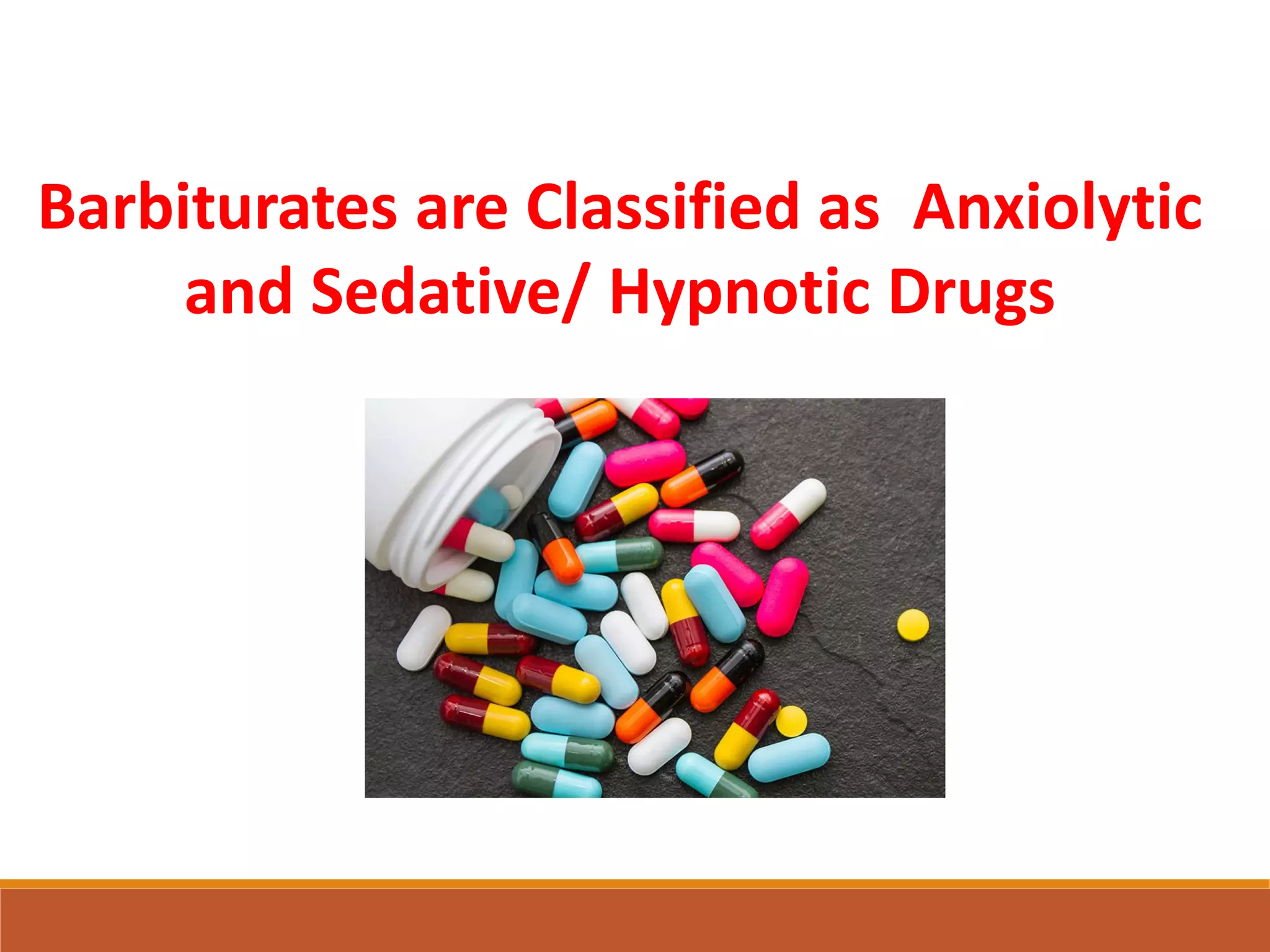
Barbiturates are Classified as Anxiolytic
and Sedative/ Hypnotic Drugs
1. Facilitate GABA-A receptor action (as BZD).
2. GABA-mimetic effects (In high conc).
3. Inhibit glutamate receptors “AMPA” (?!). (In high conc)
4. Block Na channel directly (in Higher doses?!)
Mechanism of action of Barbiturates
↑duration of opening Cl- channel
Katzung & Trevor’s Pharmacology Examination & Board Review 12th Edition, 2019
1. Depression of CNS:
Sedation→ Hypnosis → Anesthesia → Finally,
Coma & death.
2. Respiration and CVS depression (Medullary depression)
depression of Resp. center (↓response to CO2) and
VMC. In overdose → death.
Pharmacological actions of Barbiturates
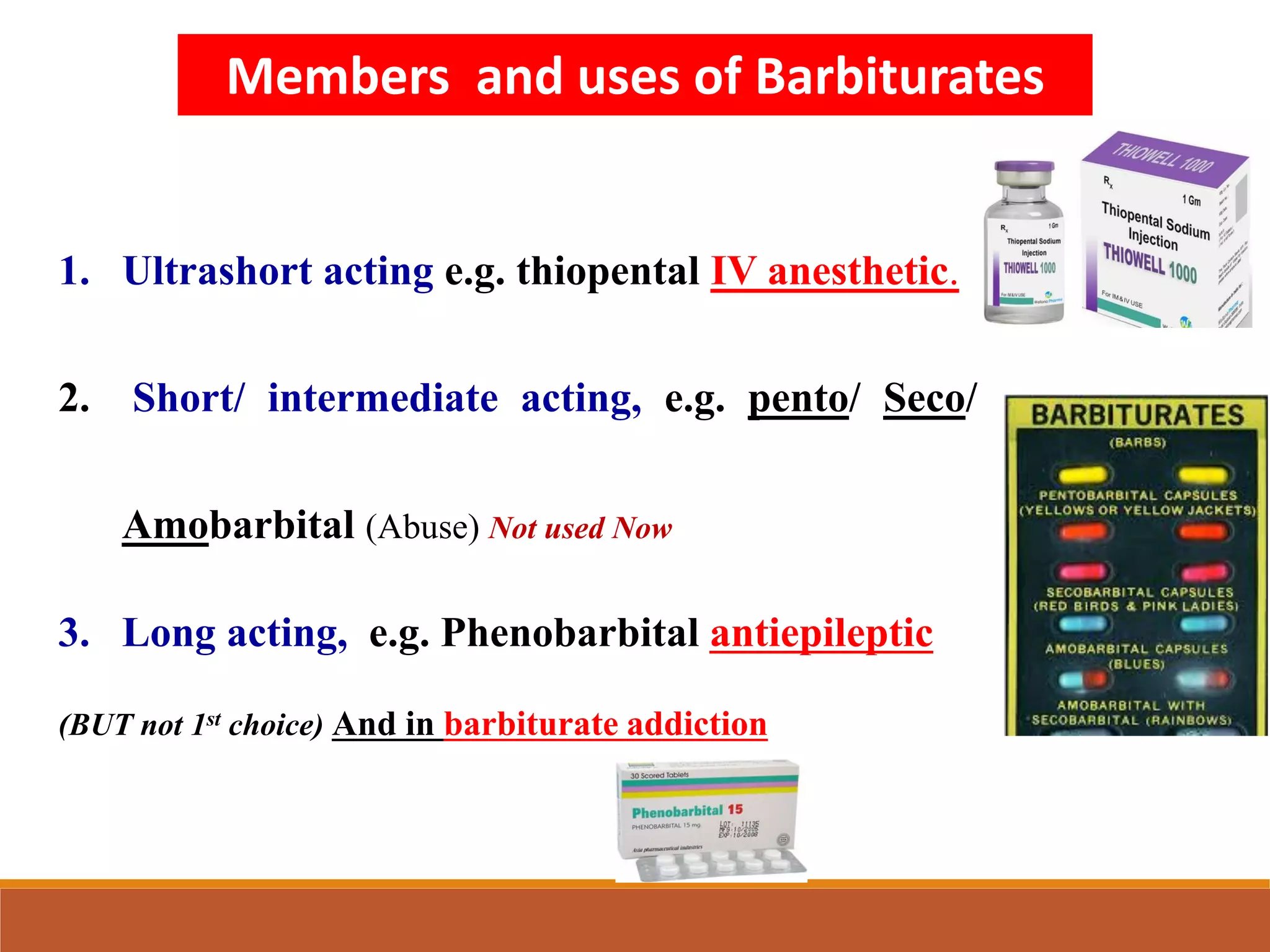
1. Ultrashort acting e.g. thiopental IV anesthetic.
2. Short/ intermediate acting, e.g. pento/ Seco/
Amobarbital (Abuse) Not used Now
3. Long acting, e.g. Phenobarbital antiepileptic
(BUT not 1st choice) And in barbiturate addiction
Members and uses of Barbiturates
1. Narrow Therapeutic Index
2. No Antidote
Adverse effects of Barbiturates
3. Drug tolerance & dependence
tolerance of barbiturates (kinetic & -dynamic) > BZDs
(dynamic only “GABA receptors”).
4. Enzyme induction  drug interactions
And Kinetic tolerance (not with BZDs).
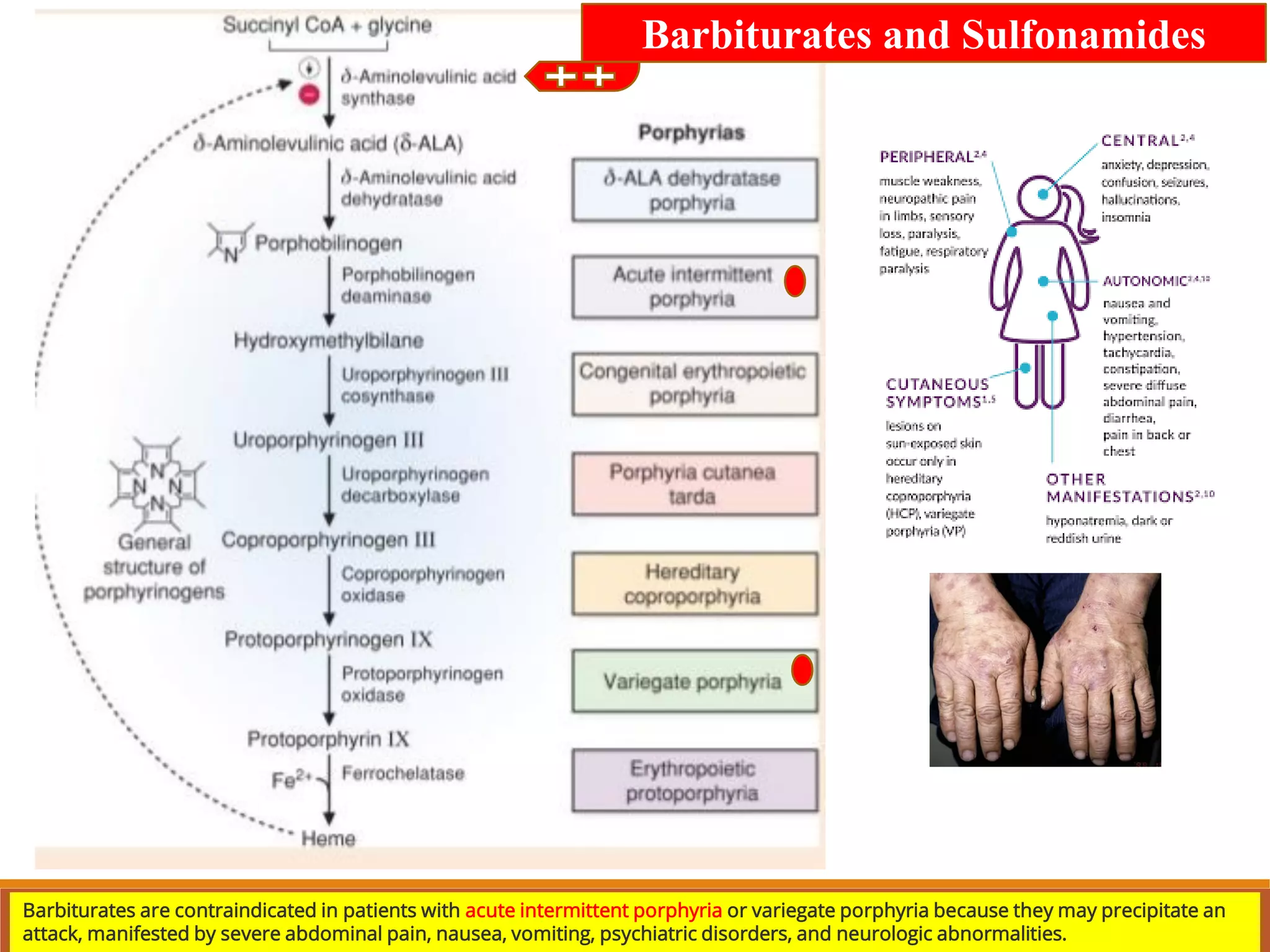
5. Acute porphyria ?!
CYPs 1A2, 2C9,
2C19,,3A4
(ALA) synthetase induction
Adverse effects of Barbiturates
Barbiturates and Sulfonamides
Barbiturates are contraindicated in patients with acute intermittent porphyria or variegate porphyria because they may precipitate an
attack, manifested by severe abdominal pain, nausea, vomiting, psychiatric disorders, and neurologic abnormalities.
Therefore, In 1950. Benzodiazepines are used in placed of barbiturates for
treatment of anxiety and sleep disorders
(Lippincott 7th ed., 2018)
Pharmacodynamic
↑↑ CNS depression with sedative drugs e.g. alcohols,
antihistaminics, antipsychotics antidepressants & BZD…
Pharmacokinetic
Drug interactions of Barbiturates
Absorption
Metabolism
CYP
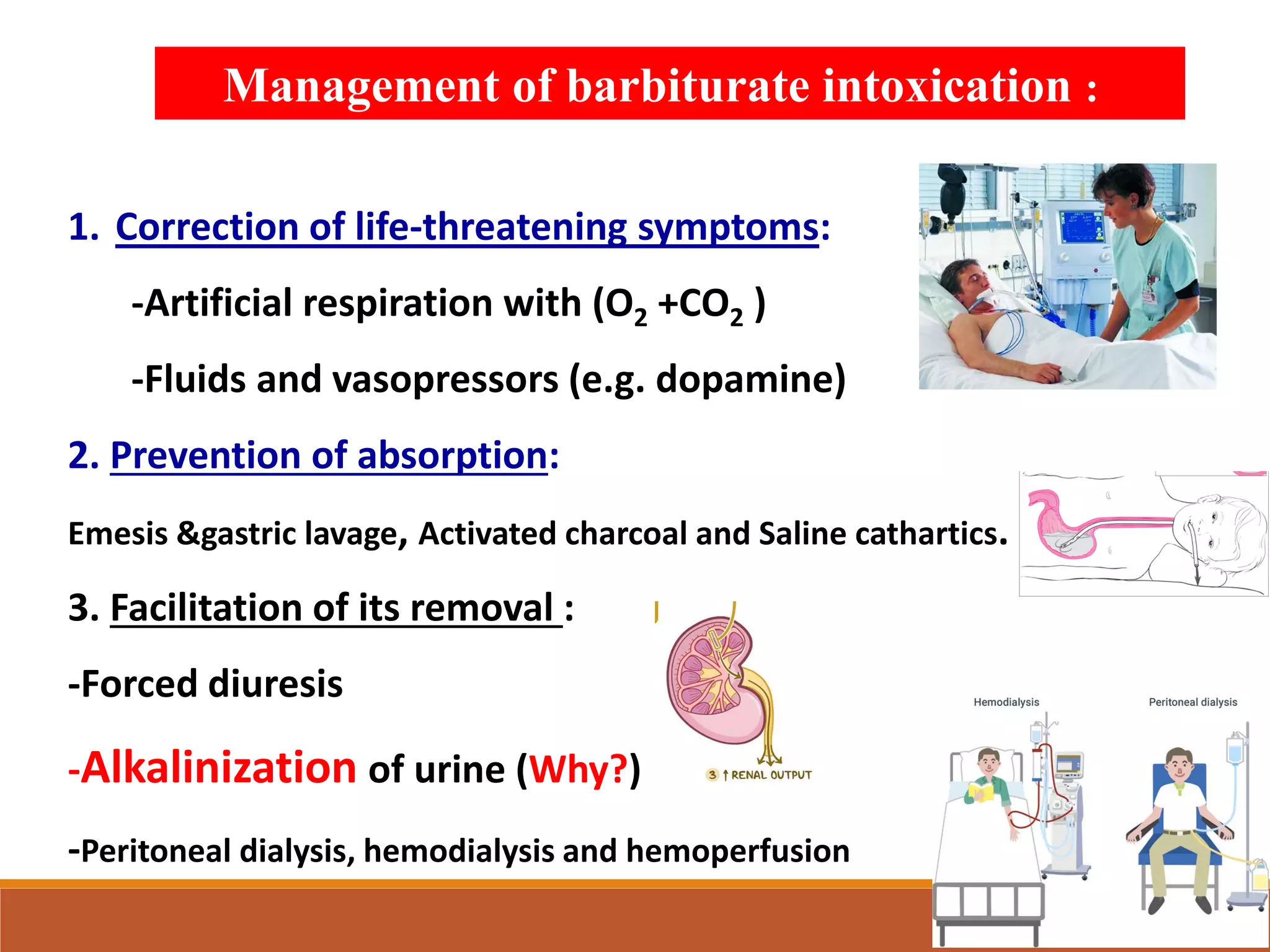
1. Correction of life-threatening symptoms:
-Artificial respiration with (O2 +CO2 )
-Fluids and vasopressors (e.g. dopamine)
2. Prevention of absorption:
Emesis &gastric lavage, Activated charcoal and Saline cathartics.
3. Facilitation of its removal :
-Forced diuresis
-Alkalinization of urine (Why?)
-Peritoneal dialysis, hemodialysis and hemoperfusion
Management of barbiturate intoxication :
- C/P: Excitement, insomnia, convulsions, sweating, delirium
hallucinations & toxic psychosis. In first 3 days of abstinence.
Treatment
A. Symptomatically by:
• Antipsychotics e.g. haloperidol (injection in agitated patients), olanzapine,
• Anti-epileptics e.g. Valproate, Carbamazepine (also to ↓ impulsivity).
B. Phenobarbitone stabilization then, gradual reduction over 3-4 weeks.
[Replace short-acting by a longer-acting  ↓withdrawal Symptoms]
Management of Barbiturate Abuse & Withdrawal:
GHB
“Date-Rape Drug”
Date-Rape Drugs
Rohypnol (flunitrazepam): BZD
Mexican Valium, circles, Roofies, Rope , Roche
GHB (gamma-hydroxybutyric acid ).
Easy lay, liquid X, liquid ecstasy, liquid E, scoop,
soap, salty water, or fantasy.
Ketamine ”dissociative drug” NMDA-blocker
Special K, vitamin K, and cat Valium.
“colorless, odorless, tasteless ”
GHB
“Gamma Hydroxyl Butyrate”
Date-Rape drug “Names” :Fantasy or Liquid ecstacy, Gamma 10
➢ Colorless, odorless, tasteless.
➢ Euphoric, Amnesia, Hypnosis
➢ Muscle Relaxation
➢ Dream-like feeling
➢ ↑ sex drive (aphrodisiac or
sex stimulant effect).
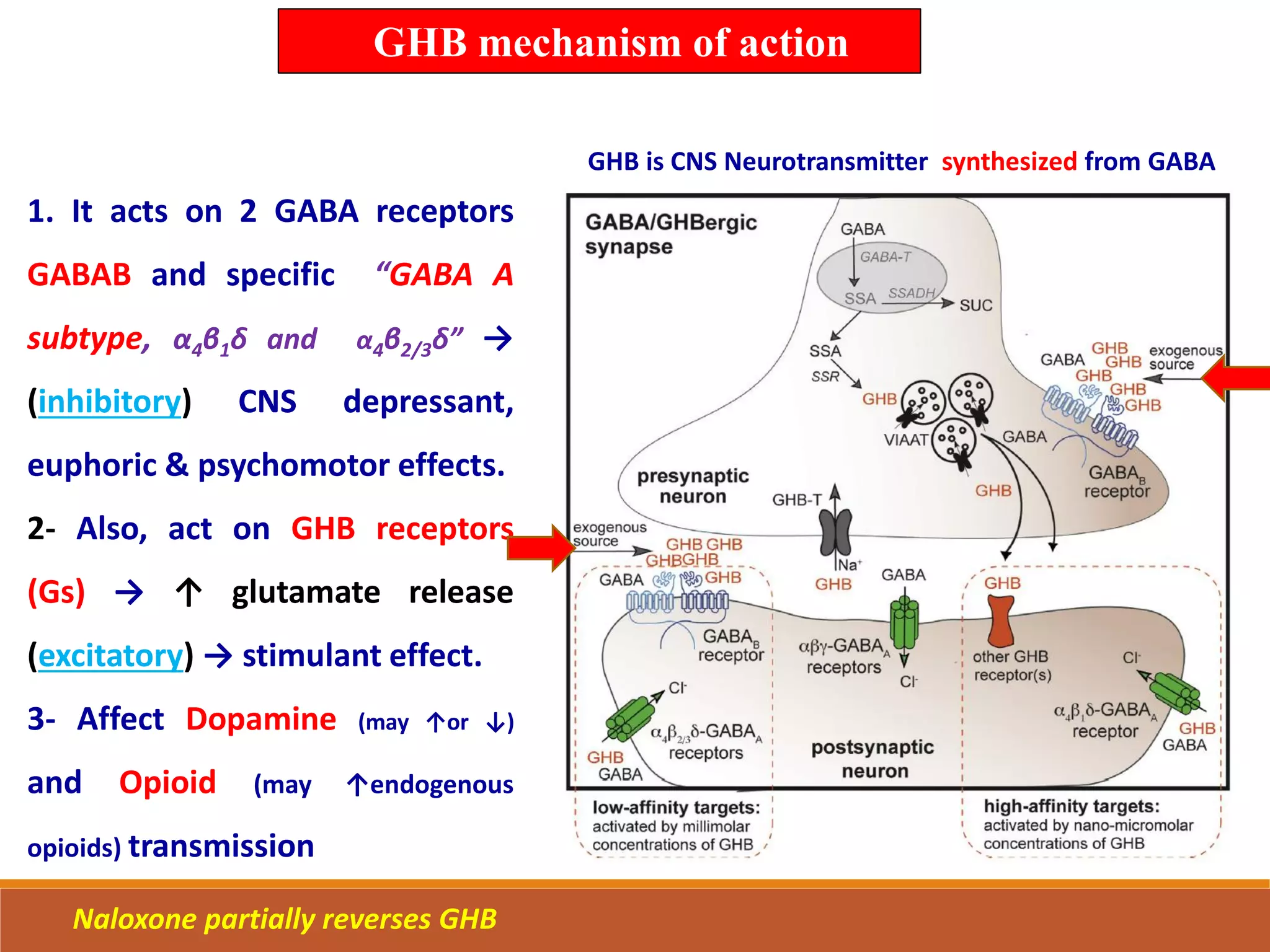
1. It acts on 2 GABA receptors
GABAB and specific “GABA A
subtype, α4β1δ and α4β2/3δ” →
(inhibitory) CNS depressant,
euphoric & psychomotor effects.
2- Also, act on GHB receptors
(Gs) → ↑ glutamate release
(excitatory) → stimulant effect.
3- Affect Dopamine (may ↑or ↓)
and Opioid (may ↑endogenous
opioids) transmission
Naloxone partially reverses GHB
GHB mechanism of action
GHB is CNS Neurotransmitter synthesized from GABA
GABA A & B (??!!) in the reward system (VTA) inhibits the inhibitory GABAergic
neurons→ stimulating Dopaminergic neurons →↑ Dopamine in NAc → Euphoria
Converging actions of drugs of abuse on the
ventral tegmental area (VTA) and the nucleus accumbens (NAc)
(Cocaine)
Cannabinoids -
- -
GHB
Pleasure center
(NAc)
GHB → ↑ Dopamine in NAc → Euphoria
(VTA)
GHB act on Reward System
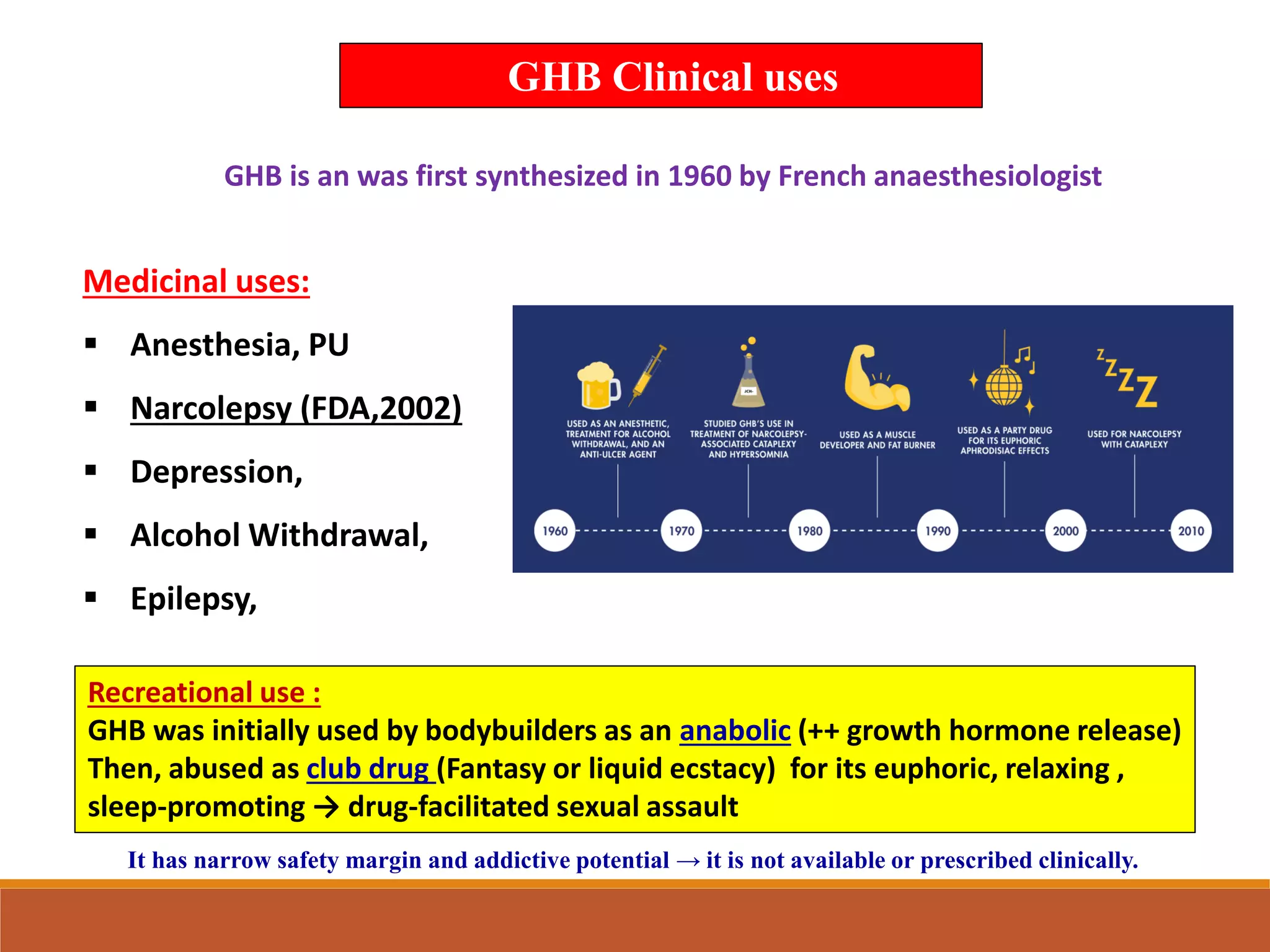
Medicinal uses:
▪ Anesthesia, PU
▪ Narcolepsy (FDA,2002)
▪ Depression,
▪ Alcohol Withdrawal,
▪ Epilepsy,
GHB is an was first synthesized in 1960 by French anaesthesiologist
Recreational use :
GHB was initially used by bodybuilders as an anabolic (++ growth hormone release)
Then, abused as club drug (Fantasy or liquid ecstacy) for its euphoric, relaxing ,
sleep-promoting → drug-facilitated sexual assault
GHB Clinical uses
It has narrow safety margin and addictive potential → it is not available or prescribed clinically.
Side Effects Of GHB:
▪ Sweating , Nausea, Vomiting,
▪ Auditory & Visual Hallucinations,
▪ Aggressive Behavior
▪ Seizure-like Phenomenon,
▪ Headaches, Exhaustion,
▪ Amnesia, Confusion, Clumsiness
▪ Respiratory depression
▪ Unconsciousness (69 % Of Users), Coma.
GHB
“Gamma Hydroxyl Butyrate”
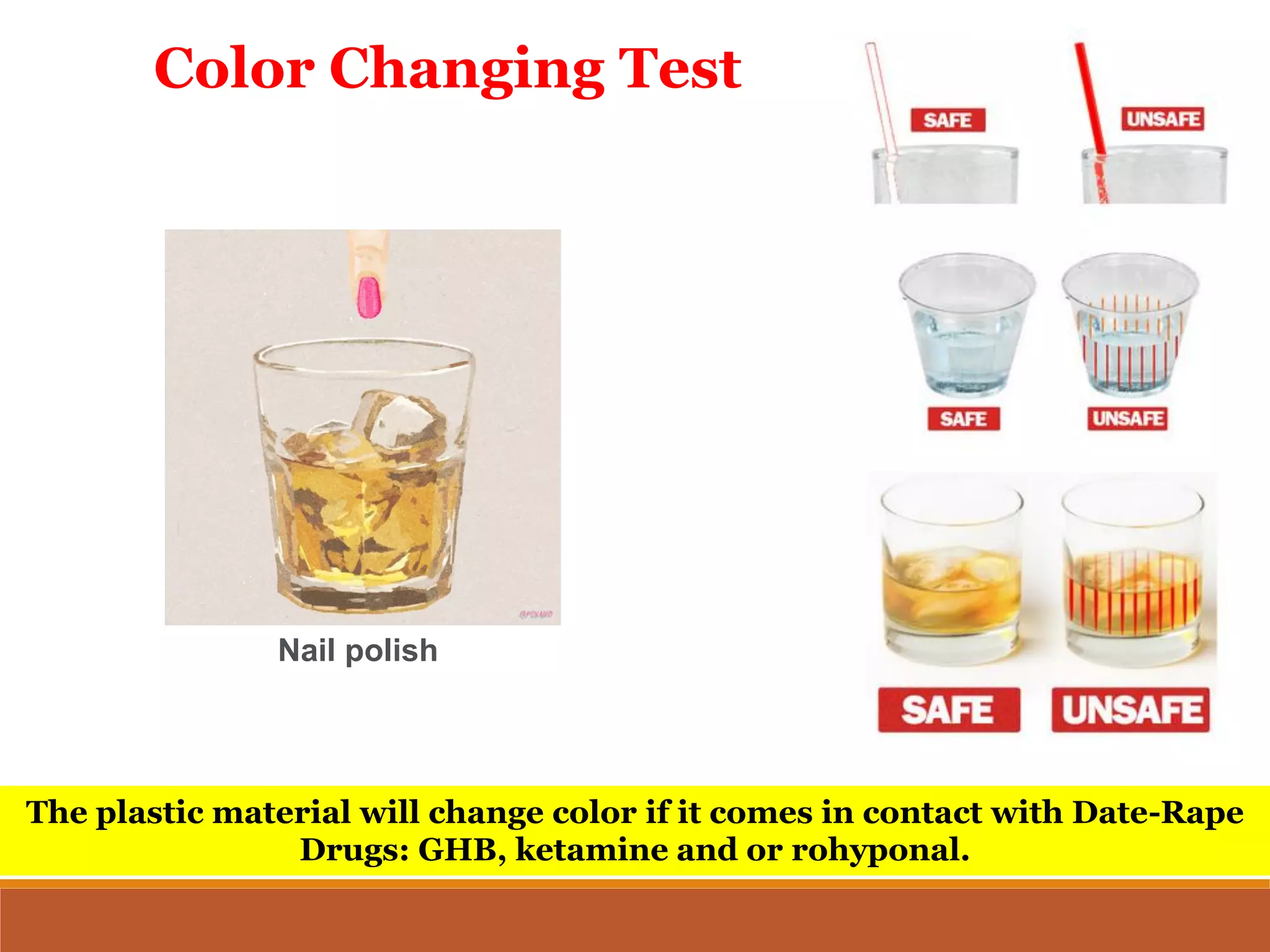
Color Changing Test
The plastic material will change color if it comes in contact with Date-Rape
Drugs: GHB, ketamine and or rohyponal.
Nail polish
Barbiturates &  GHB “Date-Rape Drug”

Barbiturates & GHB “Date-Rape Drug”

  • 1.
    Prof. Sawsan Aboul-Fotouh Departmentof pharmacology, faculty of Medicine, Ain shams University Barbiturates & GHB “Date-Rape Drug”
  • 2.
    Barbiturates are Classifiedas Anxiolytic and Sedative/ Hypnotic Drugs
  • 3.
    1. Facilitate GABA-Areceptor action (as BZD). 2. GABA-mimetic effects (In high conc). 3. Inhibit glutamate receptors “AMPA” (?!). (In high conc) 4. Block Na channel directly (in Higher doses?!) Mechanism of action of Barbiturates ↑duration of opening Cl- channel
  • 4.
    Katzung & Trevor’sPharmacology Examination & Board Review 12th Edition, 2019
  • 5.
    1. Depression ofCNS: Sedation→ Hypnosis → Anesthesia → Finally, Coma & death. 2. Respiration and CVS depression (Medullary depression) depression of Resp. center (↓response to CO2) and VMC. In overdose → death. Pharmacological actions of Barbiturates
  • 6.
    1. Ultrashort actinge.g. thiopental IV anesthetic. 2. Short/ intermediate acting, e.g. pento/ Seco/ Amobarbital (Abuse) Not used Now 3. Long acting, e.g. Phenobarbital antiepileptic (BUT not 1st choice) And in barbiturate addiction Members and uses of Barbiturates
  • 7.
    1. Narrow TherapeuticIndex 2. No Antidote Adverse effects of Barbiturates
  • 8.
    3. Drug tolerance& dependence tolerance of barbiturates (kinetic & -dynamic) > BZDs (dynamic only “GABA receptors”). 4. Enzyme induction  drug interactions And Kinetic tolerance (not with BZDs). 5. Acute porphyria ?! CYPs 1A2, 2C9, 2C19,,3A4 (ALA) synthetase induction Adverse effects of Barbiturates
  • 9.
    Barbiturates and Sulfonamides Barbituratesare contraindicated in patients with acute intermittent porphyria or variegate porphyria because they may precipitate an attack, manifested by severe abdominal pain, nausea, vomiting, psychiatric disorders, and neurologic abnormalities.
  • 10.
    Therefore, In 1950.Benzodiazepines are used in placed of barbiturates for treatment of anxiety and sleep disorders (Lippincott 7th ed., 2018)
  • 11.
    Pharmacodynamic ↑↑ CNS depressionwith sedative drugs e.g. alcohols, antihistaminics, antipsychotics antidepressants & BZD… Pharmacokinetic Drug interactions of Barbiturates Absorption Metabolism CYP
  • 12.
    1. Correction oflife-threatening symptoms: -Artificial respiration with (O2 +CO2 ) -Fluids and vasopressors (e.g. dopamine) 2. Prevention of absorption: Emesis &gastric lavage, Activated charcoal and Saline cathartics. 3. Facilitation of its removal : -Forced diuresis -Alkalinization of urine (Why?) -Peritoneal dialysis, hemodialysis and hemoperfusion Management of barbiturate intoxication :
  • 13.
    - C/P: Excitement,insomnia, convulsions, sweating, delirium hallucinations & toxic psychosis. In first 3 days of abstinence. Treatment A. Symptomatically by: • Antipsychotics e.g. haloperidol (injection in agitated patients), olanzapine, • Anti-epileptics e.g. Valproate, Carbamazepine (also to ↓ impulsivity). B. Phenobarbitone stabilization then, gradual reduction over 3-4 weeks. [Replace short-acting by a longer-acting  ↓withdrawal Symptoms] Management of Barbiturate Abuse & Withdrawal:
  • 14.
  • 15.
    Date-Rape Drugs Rohypnol (flunitrazepam):BZD Mexican Valium, circles, Roofies, Rope , Roche GHB (gamma-hydroxybutyric acid ). Easy lay, liquid X, liquid ecstasy, liquid E, scoop, soap, salty water, or fantasy. Ketamine ”dissociative drug” NMDA-blocker Special K, vitamin K, and cat Valium. “colorless, odorless, tasteless ”
  • 16.
    GHB “Gamma Hydroxyl Butyrate” Date-Rapedrug “Names” :Fantasy or Liquid ecstacy, Gamma 10 ➢ Colorless, odorless, tasteless. ➢ Euphoric, Amnesia, Hypnosis ➢ Muscle Relaxation ➢ Dream-like feeling ➢ ↑ sex drive (aphrodisiac or sex stimulant effect).
  • 18.
    1. It actson 2 GABA receptors GABAB and specific “GABA A subtype, α4β1δ and α4β2/3δ” → (inhibitory) CNS depressant, euphoric & psychomotor effects. 2- Also, act on GHB receptors (Gs) → ↑ glutamate release (excitatory) → stimulant effect. 3- Affect Dopamine (may ↑or ↓) and Opioid (may ↑endogenous opioids) transmission Naloxone partially reverses GHB GHB mechanism of action GHB is CNS Neurotransmitter synthesized from GABA
  • 19.
    GABA A &B (??!!) in the reward system (VTA) inhibits the inhibitory GABAergic neurons→ stimulating Dopaminergic neurons →↑ Dopamine in NAc → Euphoria Converging actions of drugs of abuse on the ventral tegmental area (VTA) and the nucleus accumbens (NAc) (Cocaine) Cannabinoids - - - GHB Pleasure center (NAc) GHB → ↑ Dopamine in NAc → Euphoria (VTA) GHB act on Reward System
  • 20.
    Medicinal uses: ▪ Anesthesia,PU ▪ Narcolepsy (FDA,2002) ▪ Depression, ▪ Alcohol Withdrawal, ▪ Epilepsy, GHB is an was first synthesized in 1960 by French anaesthesiologist Recreational use : GHB was initially used by bodybuilders as an anabolic (++ growth hormone release) Then, abused as club drug (Fantasy or liquid ecstacy) for its euphoric, relaxing , sleep-promoting → drug-facilitated sexual assault GHB Clinical uses It has narrow safety margin and addictive potential → it is not available or prescribed clinically.
  • 21.
    Side Effects OfGHB: ▪ Sweating , Nausea, Vomiting, ▪ Auditory & Visual Hallucinations, ▪ Aggressive Behavior ▪ Seizure-like Phenomenon, ▪ Headaches, Exhaustion, ▪ Amnesia, Confusion, Clumsiness ▪ Respiratory depression ▪ Unconsciousness (69 % Of Users), Coma. GHB “Gamma Hydroxyl Butyrate”
  • 22.
    Color Changing Test Theplastic material will change color if it comes in contact with Date-Rape Drugs: GHB, ketamine and or rohyponal. Nail polish