BARANGAY INFORMATION NETWORK (BIN)
CONCEPT OF UTILIZATION
•BRIEF OVERVIEW OF THE LOCAL COMMUNIST MOVEMENT (LCM)
•Introduction to intelligence
•Information Gathering
•The Intelligence Cycle
•Various Crimes Information
• Report Writing and Practical Exercise
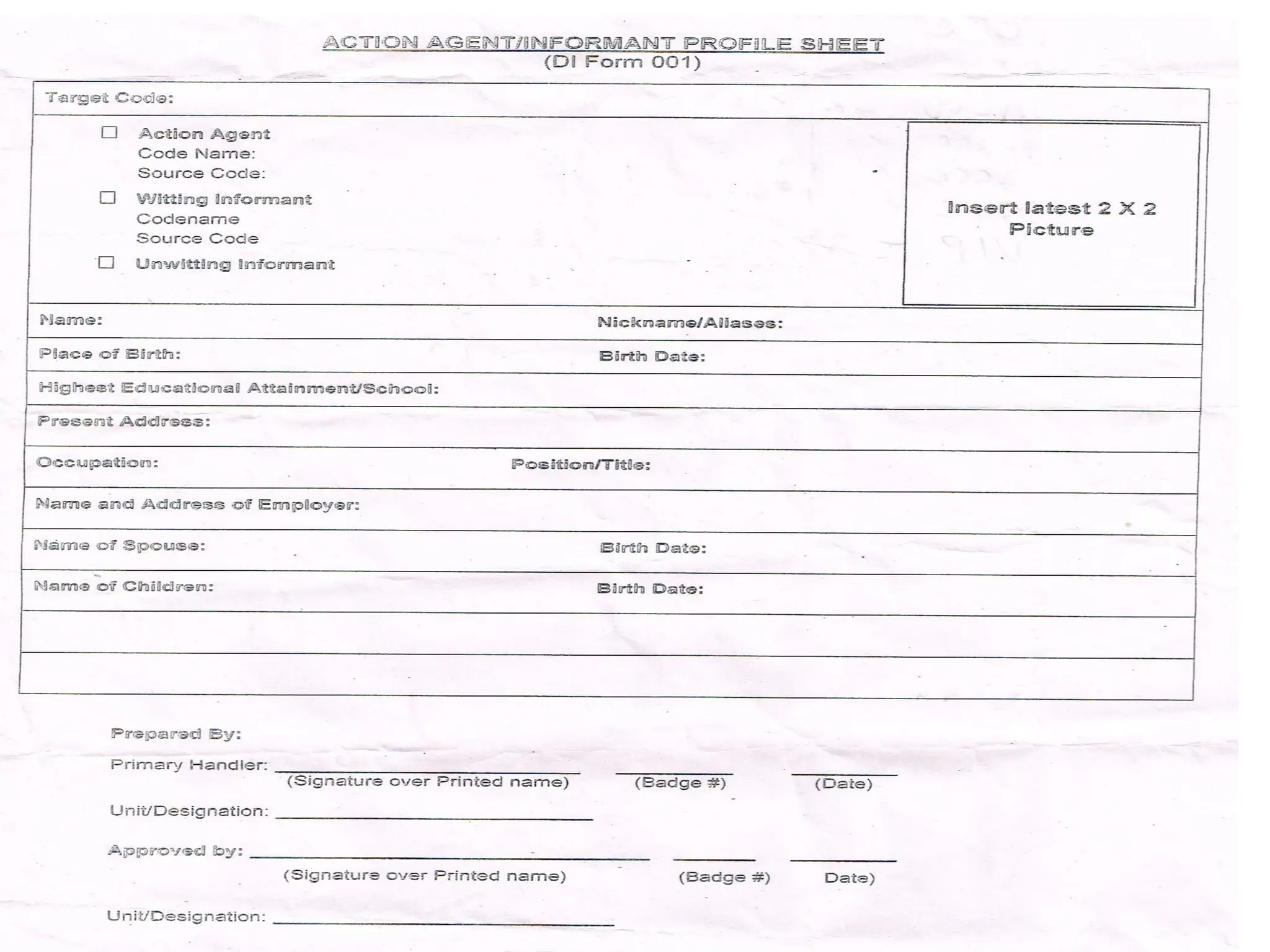
•DOCUMENTATION OF AAs/EBs
•Syndicated Crime Groups
PRESENTED BY:
MA. CRISTINA G. CARIÑO
Training Officer
REFERENCES:
•PNP INTEL PLAN: BIN dated 23 June 1995
•EO No. 546
•Annex “A” to Intel Guidelines to LOI 38/Y2 (Action
Plan “AGAP”)
*EO 546 directs the PNP to undertake
active role on ISO, there is now a need to
further enhance the existing BIN.
The BIN seeks to develop a responsive and effective
people-based intel network in order to provide the
necessary tactical intel requirements supportive of
the functions of the PNP and AFP field units directly
involved in ISO and anti-criminality campaign.
OBJECTIVES:
1. To tap and train selected local residents in the intel
collection opn.
2. To detect and neutralize enemy efforts at its early stage
to infiltrate unaffected areas/brgys.
3. To identify and isolate EN infrastructure, organs of
political power in affected areas and prevent the establishment
of a well-entrenched network in the nearby areas.
4. To preempt or thwart the projected activities of criminal
elements and other threat groups to include the establishment
of a base for their opns.
5. To identify the existence/presence of network being
used by the CTM, criminal elements and other threat groups in
the area.
* Specifically, the object of the BIN is to provide the COP
MPS, GC, PMG and PD, PPO with a clandestine apparatus to
collect usable data on the enemy’s political, military and united
front or alliance building activities in their respective AOR.
CONCEPTUAL FRAMEWORK:
In support of the AFP’s fundamental thrust of security operations,
the PNP shall intensify and broaden intel covrage in:
DETECTING, MONITORING and NEUTRALIZING the LCM,
criminality and other threat grps with emphasis on the brgy as the
breeding ground of basic party organs and mass base.
The PNP intel community shall undertake the following:
1. Establish info networks in all brgys, if possible, to
neutralize insurgency and criminality at all levels and denying the
EN access to brgy manpower and material resources.
2. With the PN P Speakers Bureau, local leaders and key
communicators in the area to take active participation and
keeping the people on the side of the govt and involving them in
the fight against insurgency/criminality.
3. Disseminate info in order to develop the territorial and
tactical units into well-motivated and well-informed counter-
insurgent and anti-criminality forces.
THREATS TO NATIONAL SECURITY
SUBVERSION
 Act to overthrow
 Activity carried out by individuals or group of individuals, which
seek to alter the form of government thru unconstitutional means.
 Action principally clandestine or covert, designed to undermine
the military, economic psychological, moral or political strength of a
regime.
INSURGENCY
 A condition of revolt against a government that is less than an
organized revolution and is not recognized as belligerency. This
definition is used in conjunction with the condition of insurgent war.
Within the present context, subversive insurgency is communist led and
inspired.
 Has a more political color and social color combined with military
activities. It covers guerilla warfare, which is only a part of its movement.
The Local Communist Movement is
currently divided into two groups
the Mainstream CPP/NPA/NDF of
Reaffirmist and the breakaway anti-
SISON Rejectionist faction.
1. REAFFIRMIST - SISON Group
Party: Communist Party of the Phil
Leader: Jose Ma SISON
Armed Group: New Peoples’ Army (NPA)
United Front: National Democratic Front (NDF)
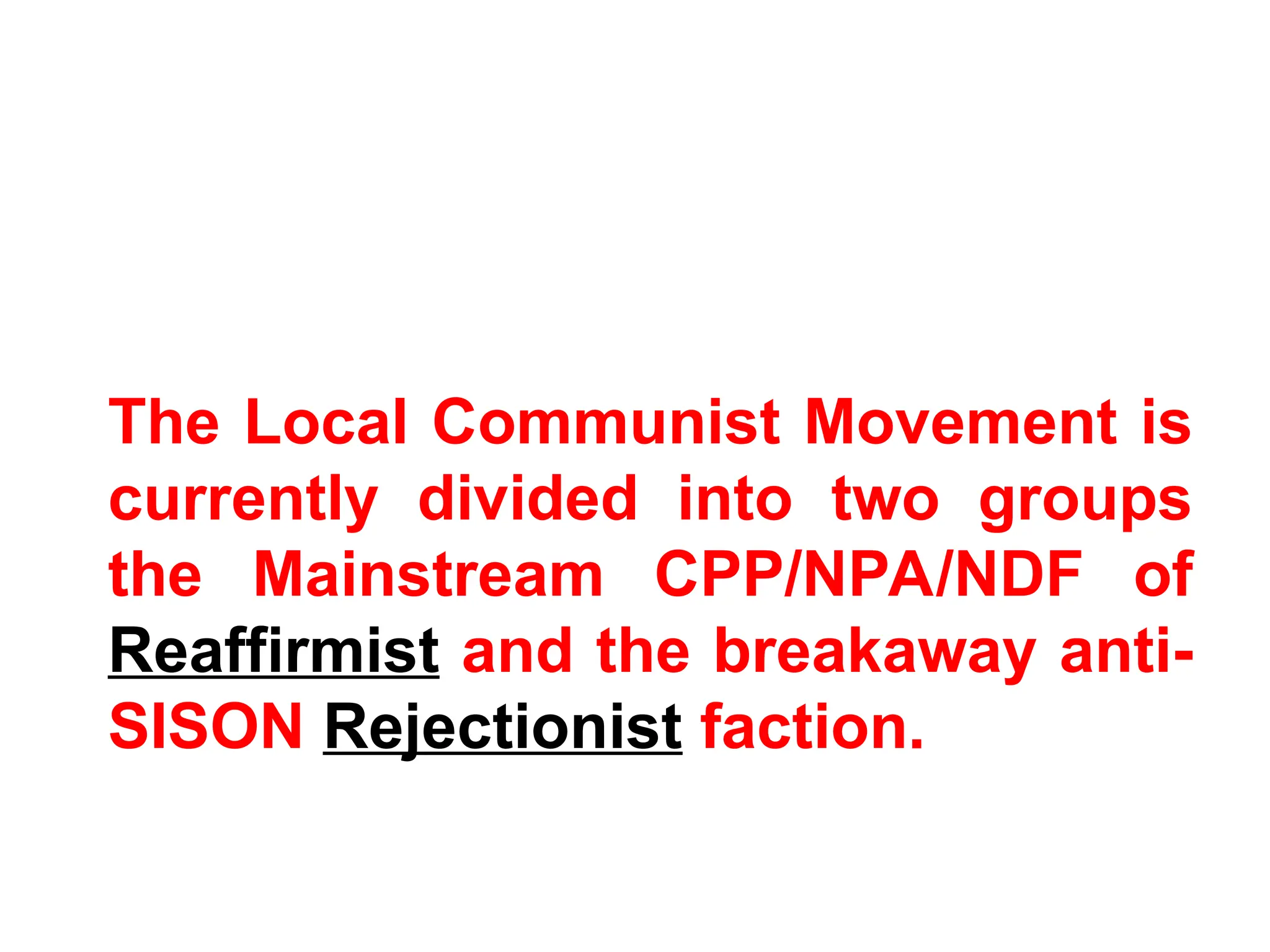
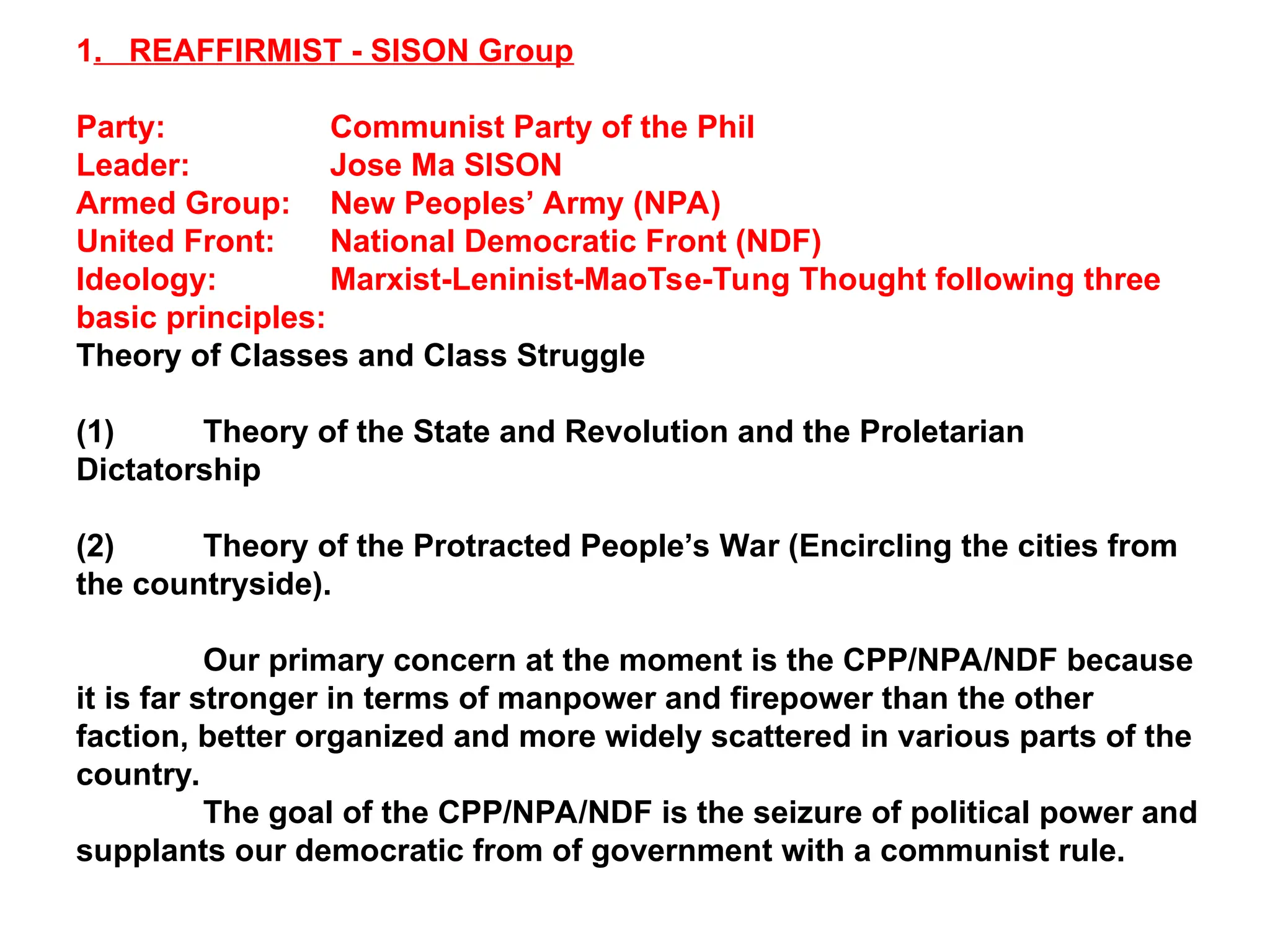
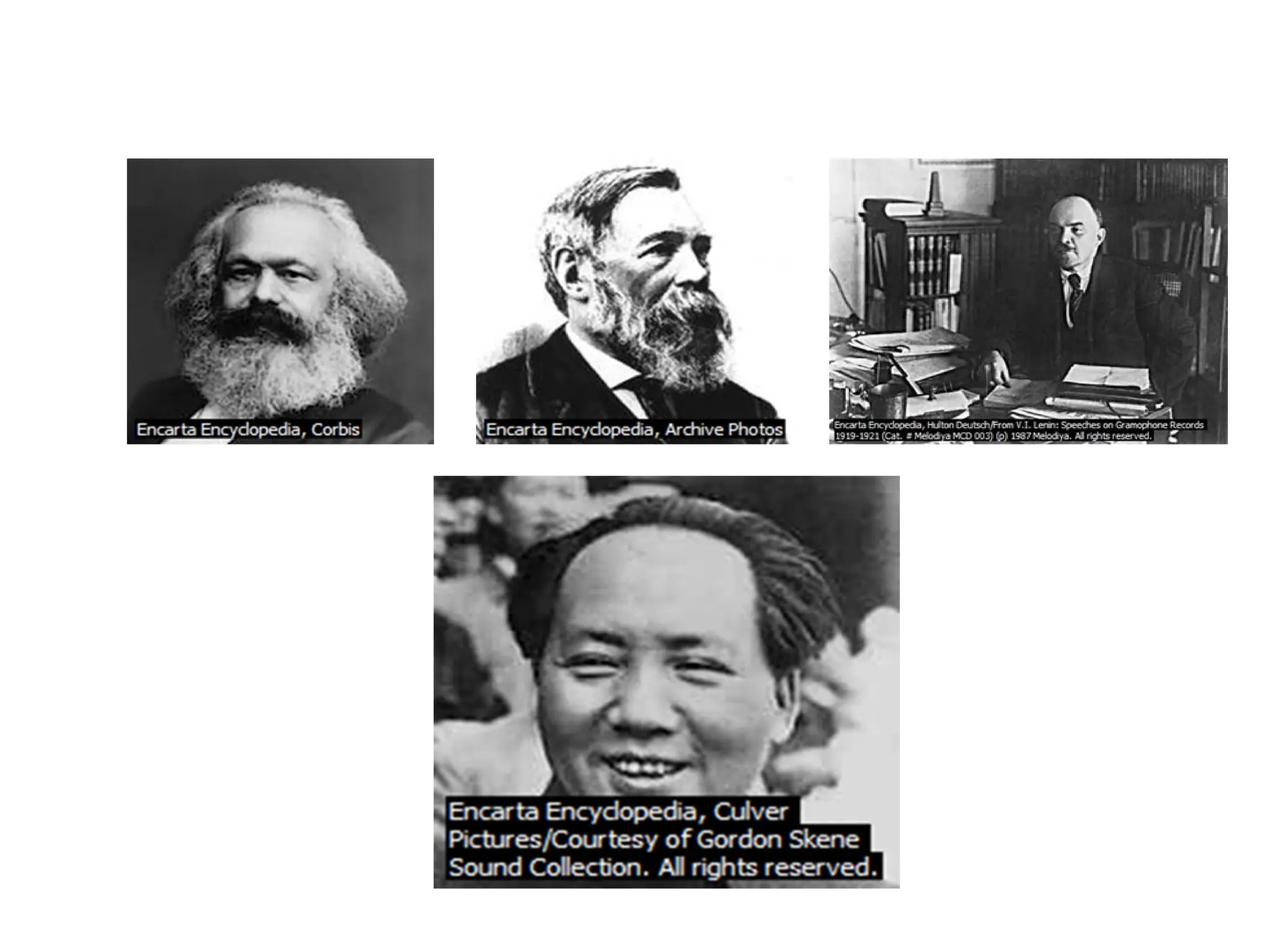
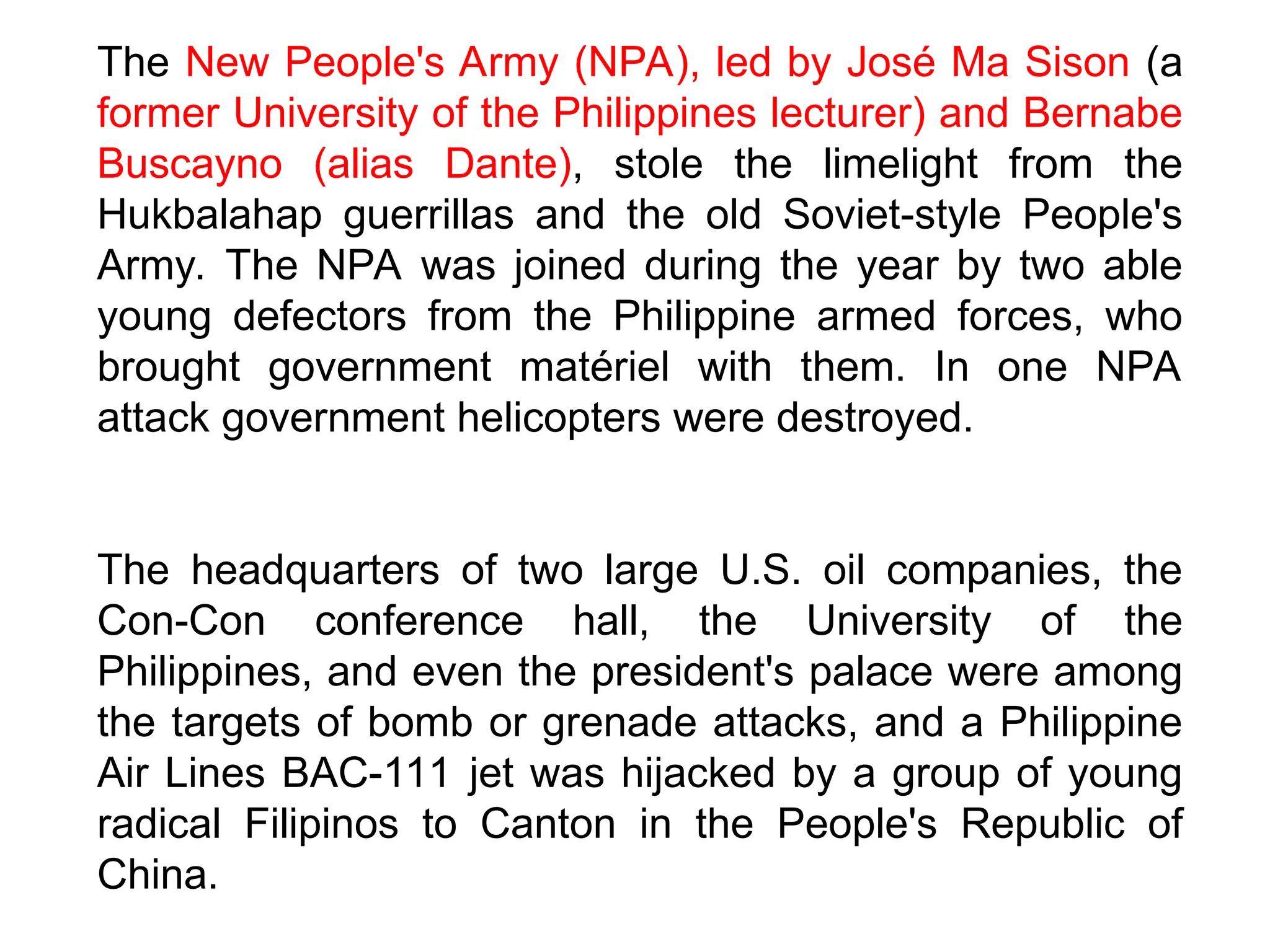
Ideology: Marxist-Leninist-MaoTse-Tung Thought following three
basic principles:
Theory of Classes and Class Struggle
(1) Theory of the State and Revolution and the Proletarian
Dictatorship
(2) Theory of the Protracted People’s War (Encircling the cities from
the countryside).
Our primary concern at the moment is the CPP/NPA/NDF because
it is far stronger in terms of manpower and firepower than the other
faction, better organized and more widely scattered in various parts of the
country.
The goal of the CPP/NPA/NDF is the seizure of political power and
supplants our democratic from of government with a communist rule.
The New People's Army (NPA), led by José Ma Sison (a
former University of the Philippines lecturer) and Bernabe
Buscayno (alias Dante), stole the limelight from the
Hukbalahap guerrillas and the old Soviet-style People's
Army. The NPA was joined during the year by two able
young defectors from the Philippine armed forces, who
brought government matériel with them. In one NPA
attack government helicopters were destroyed.
The headquarters of two large U.S. oil companies, the
Con-Con conference hall, the University of the
Philippines, and even the president's palace were among
the targets of bomb or grenade attacks, and a Philippine
Air Lines BAC-111 jet was hijacked by a group of young
radical Filipinos to Canton in the People's Republic of
China.
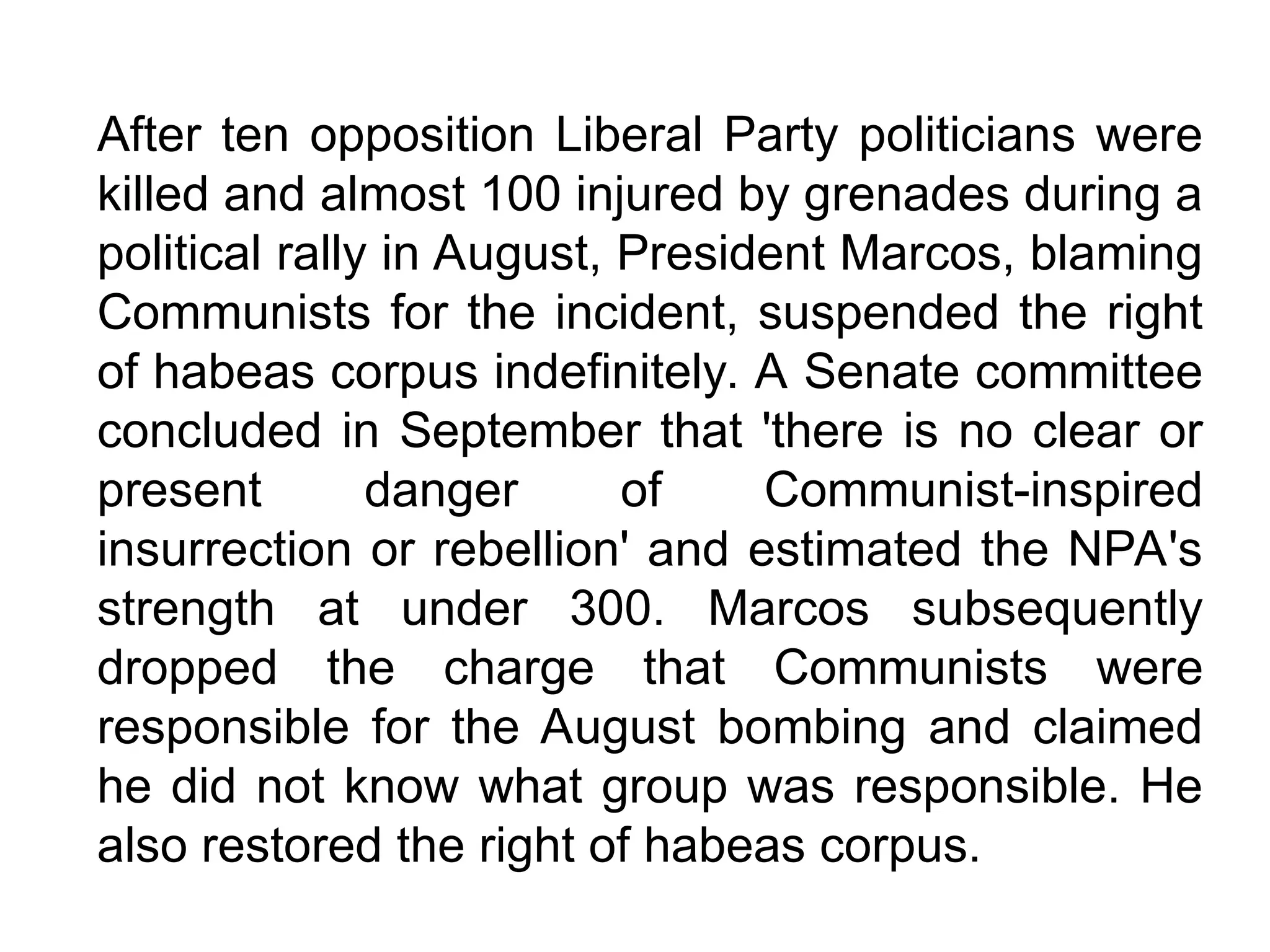
After ten opposition Liberal Party politicians were
killed and almost 100 injured by grenades during a
political rally in August, President Marcos, blaming
Communists for the incident, suspended the right
of habeas corpus indefinitely. A Senate committee
concluded in September that 'there is no clear or
present danger of Communist-inspired
insurrection or rebellion' and estimated the NPA's
strength at under 300. Marcos subsequently
dropped the charge that Communists were
responsible for the August bombing and claimed
he did not know what group was responsible. He
also restored the right of habeas corpus.
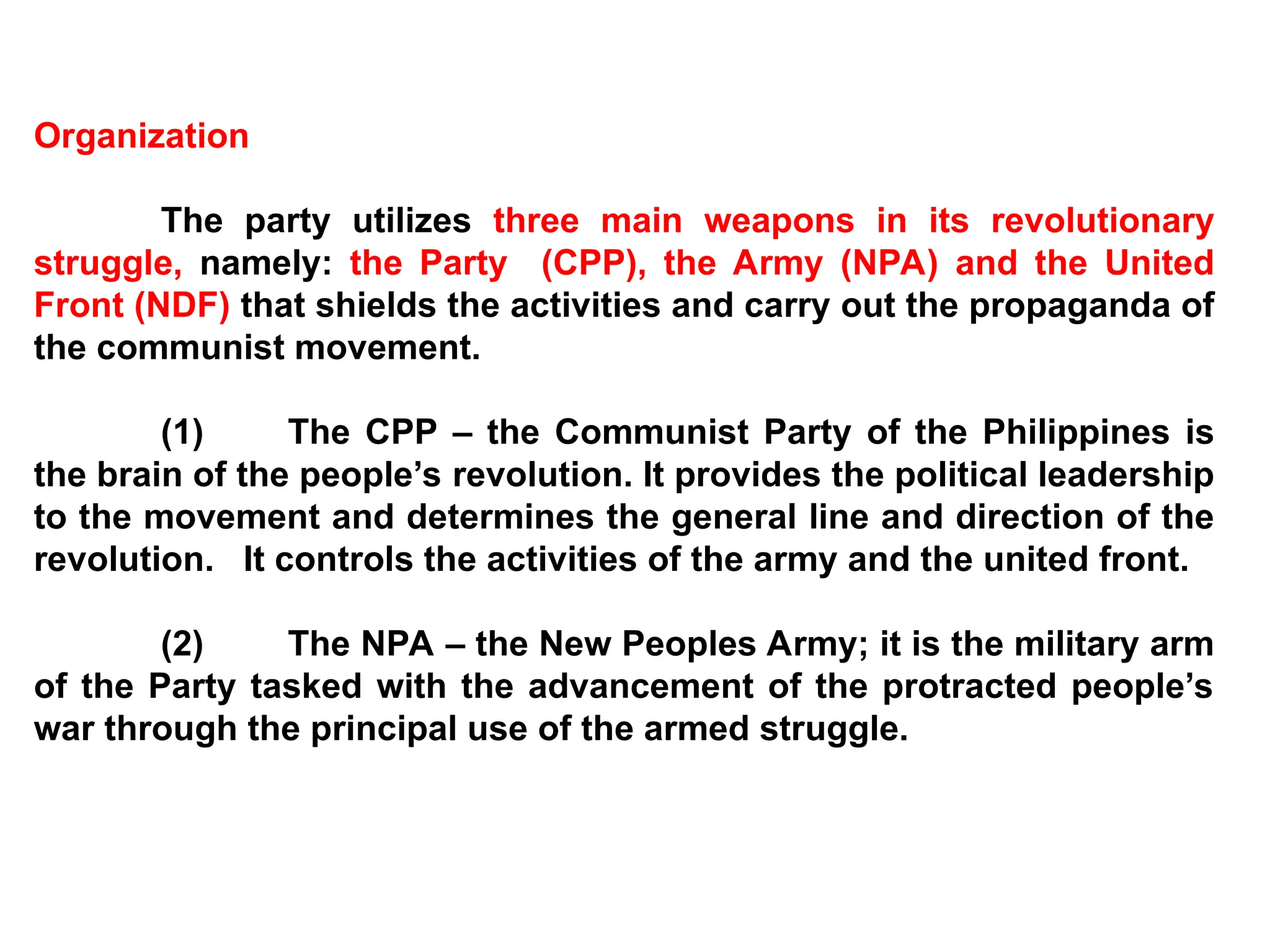
Organization
The party utilizes three main weapons in its revolutionary
struggle, namely: the Party (CPP), the Army (NPA) and the United
Front (NDF) that shields the activities and carry out the propaganda of
the communist movement.
(1) The CPP – the Communist Party of the Philippines is
the brain of the people’s revolution. It provides the political leadership
to the movement and determines the general line and direction of the
revolution. It controls the activities of the army and the united front.
(2) The NPA – the New Peoples Army; it is the military arm
of the Party tasked with the advancement of the protracted people’s
war through the principal use of the armed struggle.
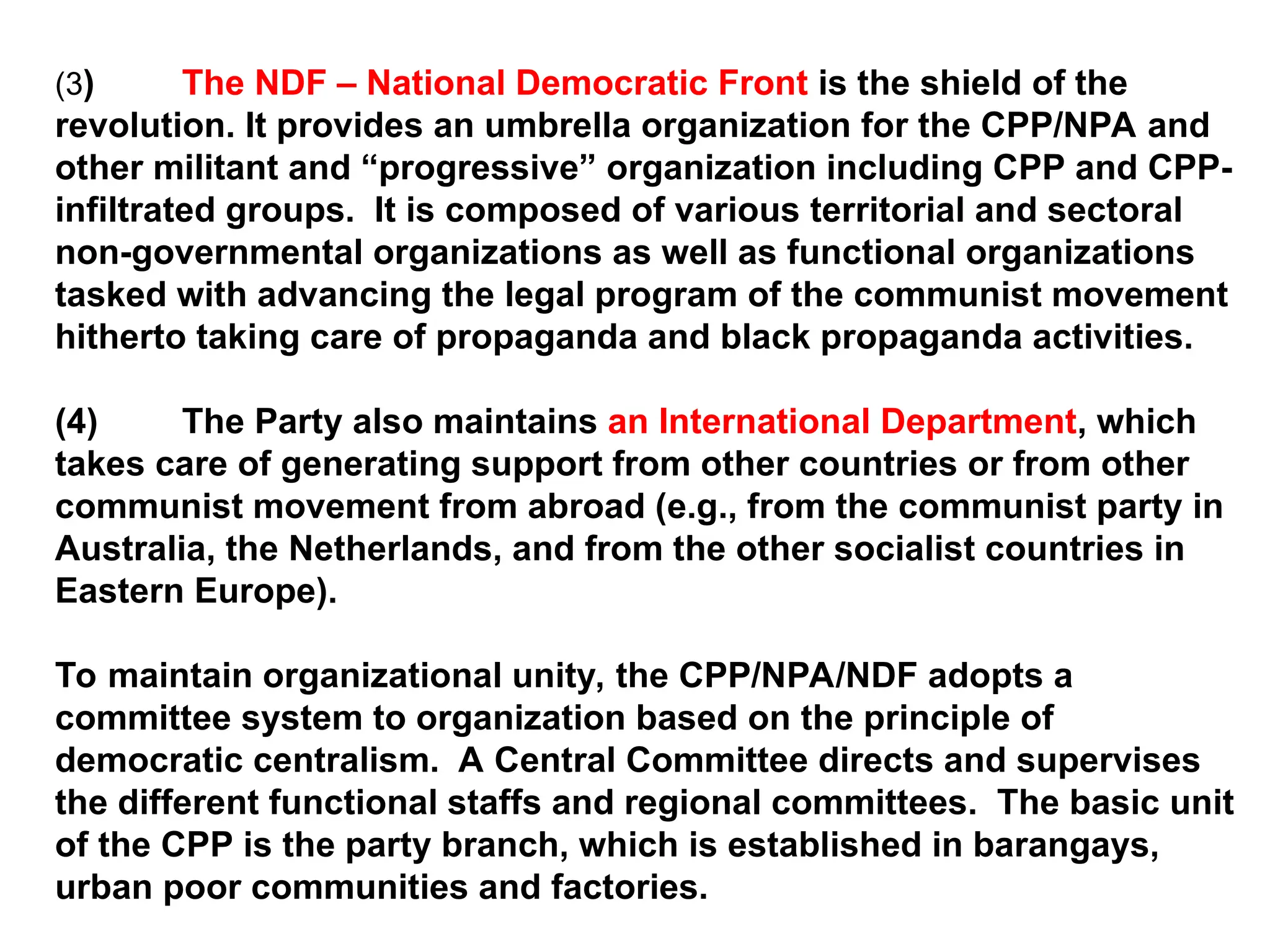
(3) The NDF – National Democratic Front is the shield of the
revolution. It provides an umbrella organization for the CPP/NPA and
other militant and “progressive” organization including CPP and CPP-
infiltrated groups. It is composed of various territorial and sectoral
non-governmental organizations as well as functional organizations
tasked with advancing the legal program of the communist movement
hitherto taking care of propaganda and black propaganda activities.
(4) The Party also maintains an International Department, which
takes care of generating support from other countries or from other
communist movement from abroad (e.g., from the communist party in
Australia, the Netherlands, and from the other socialist countries in
Eastern Europe).
To maintain organizational unity, the CPP/NPA/NDF adopts a
committee system to organization based on the principle of
democratic centralism. A Central Committee directs and supervises
the different functional staffs and regional committees. The basic unit
of the CPP is the party branch, which is established in barangays,
urban poor communities and factories.
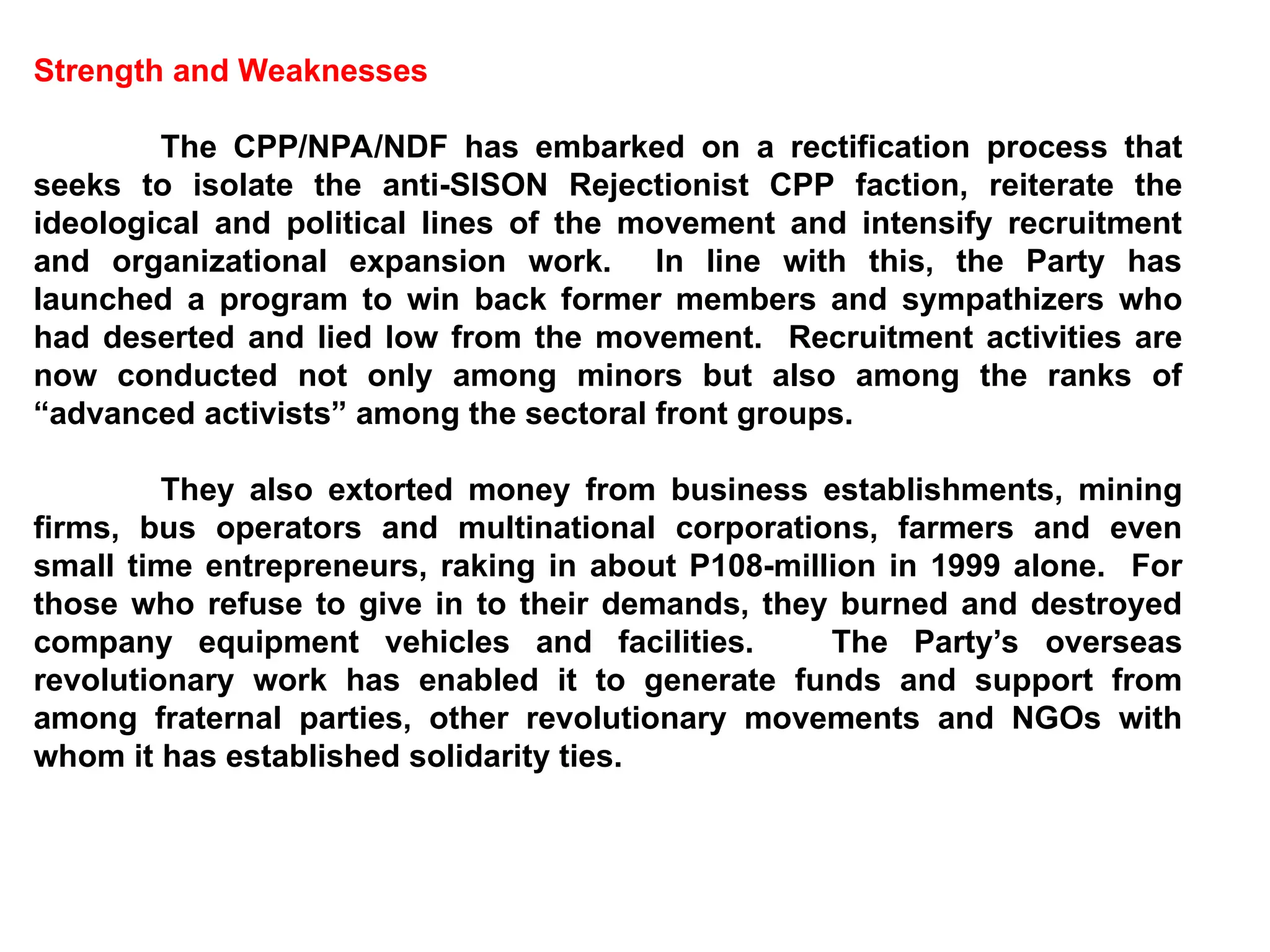
Strength and Weaknesses
The CPP/NPA/NDF has embarked on a rectification process that
seeks to isolate the anti-SISON Rejectionist CPP faction, reiterate the
ideological and political lines of the movement and intensify recruitment
and organizational expansion work. In line with this, the Party has
launched a program to win back former members and sympathizers who
had deserted and lied low from the movement. Recruitment activities are
now conducted not only among minors but also among the ranks of
“advanced activists” among the sectoral front groups.
They also extorted money from business establishments, mining
firms, bus operators and multinational corporations, farmers and even
small time entrepreneurs, raking in about P108-million in 1999 alone. For
those who refuse to give in to their demands, they burned and destroyed
company equipment vehicles and facilities. The Party’s overseas
revolutionary work has enabled it to generate funds and support from
among fraternal parties, other revolutionary movements and NGOs with
whom it has established solidarity ties.
(1) internal rift
(2) health problems of guerrilla
fighters
(3) limited number of qualified and
reliable party cadres and
organizers
(4) deteriorating quality of recruits
(5) drying up of logistical base
(6) financial opportunism of some
regional and staff leaders
However, despite the organiza-tional inroads of the DTs, the LCM remains
beset by the following problems and weaknesses:
The CPP/NPA/NDF has the following capabilities:
(1) Intensify tactical armed offensives in the countryside complemented by
occasional urban armed activities against selected targets;
(2) Intensify organizational expansion work, broaden their mass base and
expand operational areas;
(3) Recruit more members and procure more firearms and other logistical
supports;
(4) Intensify agitation-propa-ganda activities harping mainly on popular but
provocative issues and problems gripping the nation to rally more
supporters/sympathizers and alienate the people from the government;
(5) Embark on wide-scale fund-raising drive to support the increasing
tempo of the insurgent activities;
(6) Covertly work for the resumption of the GRP-NDF peace talks for
tactical expedience; belittle and if possible derail the government’s
peace initiatives with individual insurgent leaders in the field;
(7) Mount counter propaganda blitz to neutralize the bad publicity against
the top CPP/NPA/NDF leadership and the insurgents’ terrorist and
bandit-like activities;
(8) Intensify vilification drive to marginalize the anti-SISON Rejection
group; and,
(9) Strengthen the ideological mooring of the insurgents.
2. REJECTIONIST GROUPS
This faction disagrees with the CPP/NPA/NDF’s strict adherence to
the Maoist Concept of protracted people’s war and is instead advocating the
Nicaraguan model of insurrectionary strategy and tactics aimed at creating a
revolutionary situation by staging crippling strikes and urban terrorism. It
has been polarized into NINE (9) sub-groups due to personal and policy
differences, to wit:
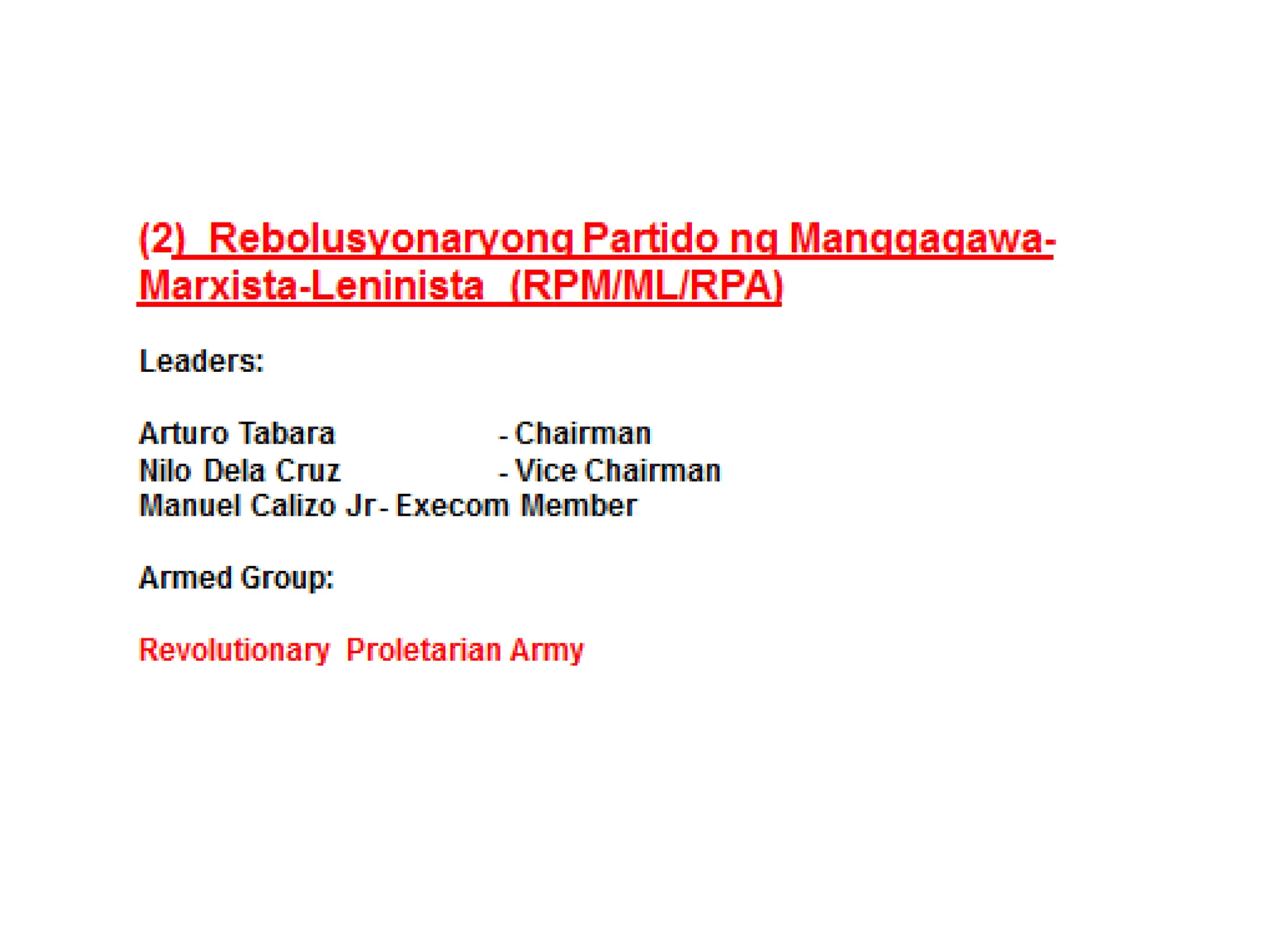
(1) PMP (Partido ng Manggaga-wang Pilipino)
Leader: Filemon LAGMAN - Chairman
Date Established: 30 Jan 1999
Front Orgns: SANLAKAS (Sandigan ng Kalayaan at Demokrasya
para sa Sambayanan; BMP (Bukluran ng Manggagawang Pilipino),
KAMALAYAN
Armed Group: Armadong Partisano ng Paggawa (APP).
The group is composed of an undetermined number of Negros-trained
members and former ABB members previously neutralized by the
government. It also intends to conduct sabotage operations in Metro Manila
particularly the bombing of oil companies, small and undermanned
police/military stations/detachments, and “agaw-armas” operations.
PMP Composition and Leadership:
The PMP, formerly known as the Worker’s Revolutionary Party-Manila
Rizal Regional Committee (WRP-MRRC), was launched during a secret
congress in Bato-Bato, Brgy Bucal, Calamba, Laguna on 30 Jan – 05 Feb 1999.
During said congress, Filemon “Popoy” Lagman was elected as Chairman.
The organization has more than 1,500 founding members who consider
themselves as “survivors” of the revolutionary movement in the country,
which is currently characterized by factionalism. At least six (6) regional
committees have already been established, namely: 1) Metro-Manila-Rizal
Party Committee, 2 Calaba (Cavite, Laguna, and Batangas) Party Committee,
3) Cebu Party Committee, 4) Negros Party Committee and 5) Panay Party
Committee, 6) Central Mindanao Party Committee.
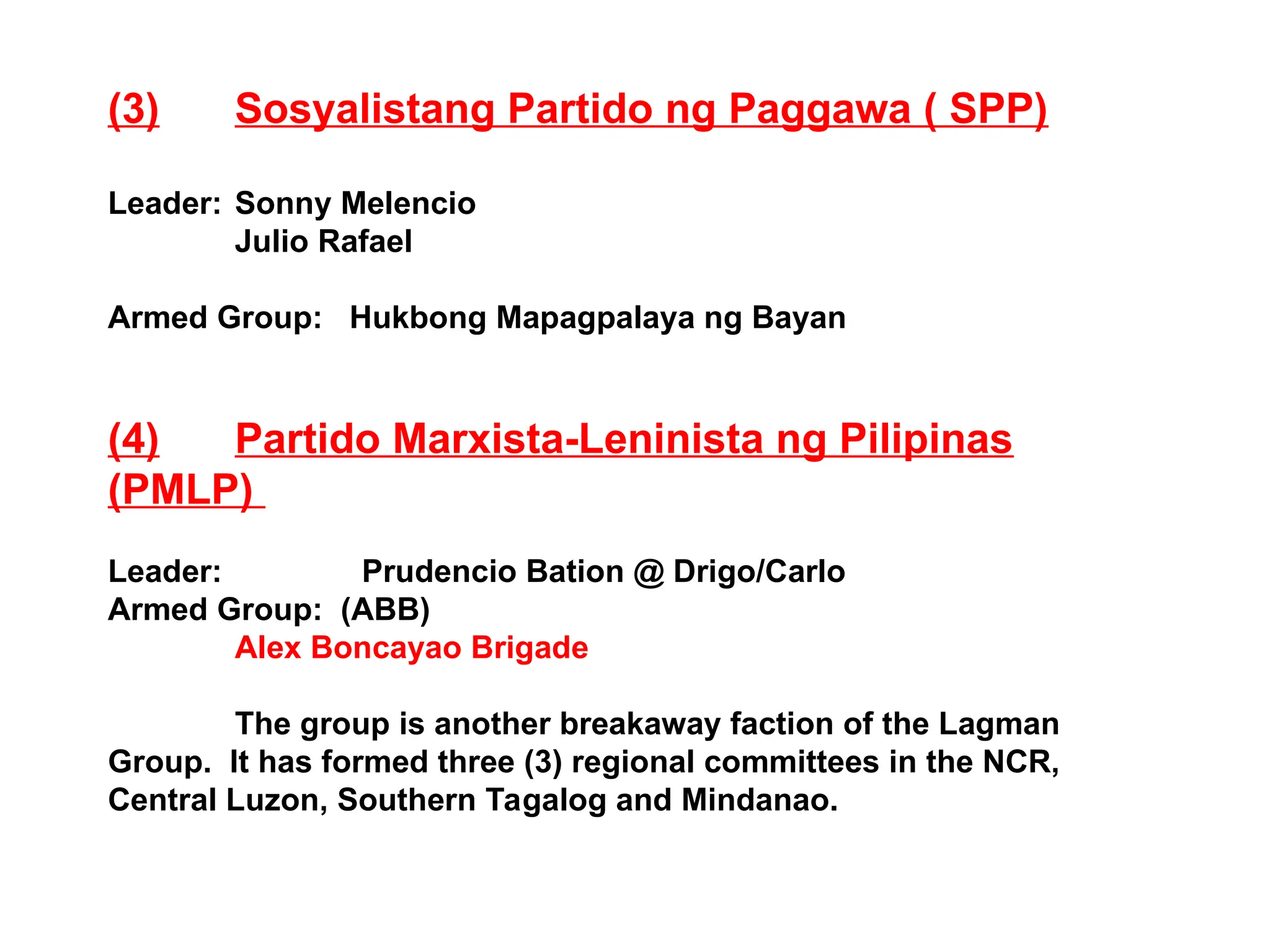
(3) Sosyalistang Partido ng Paggawa ( SPP)
Leader: Sonny Melencio
Julio Rafael
Armed Group: Hukbong Mapagpalaya ng Bayan
(4) Partido Marxista-Leninista ng Pilipinas
(PMLP)
Leader: Prudencio Bation @ Drigo/Carlo
Armed Group: (ABB)
Alex Boncayao Brigade
The group is another breakaway faction of the Lagman
Group. It has formed three (3) regional committees in the NCR,
Central Luzon, Southern Tagalog and Mindanao.
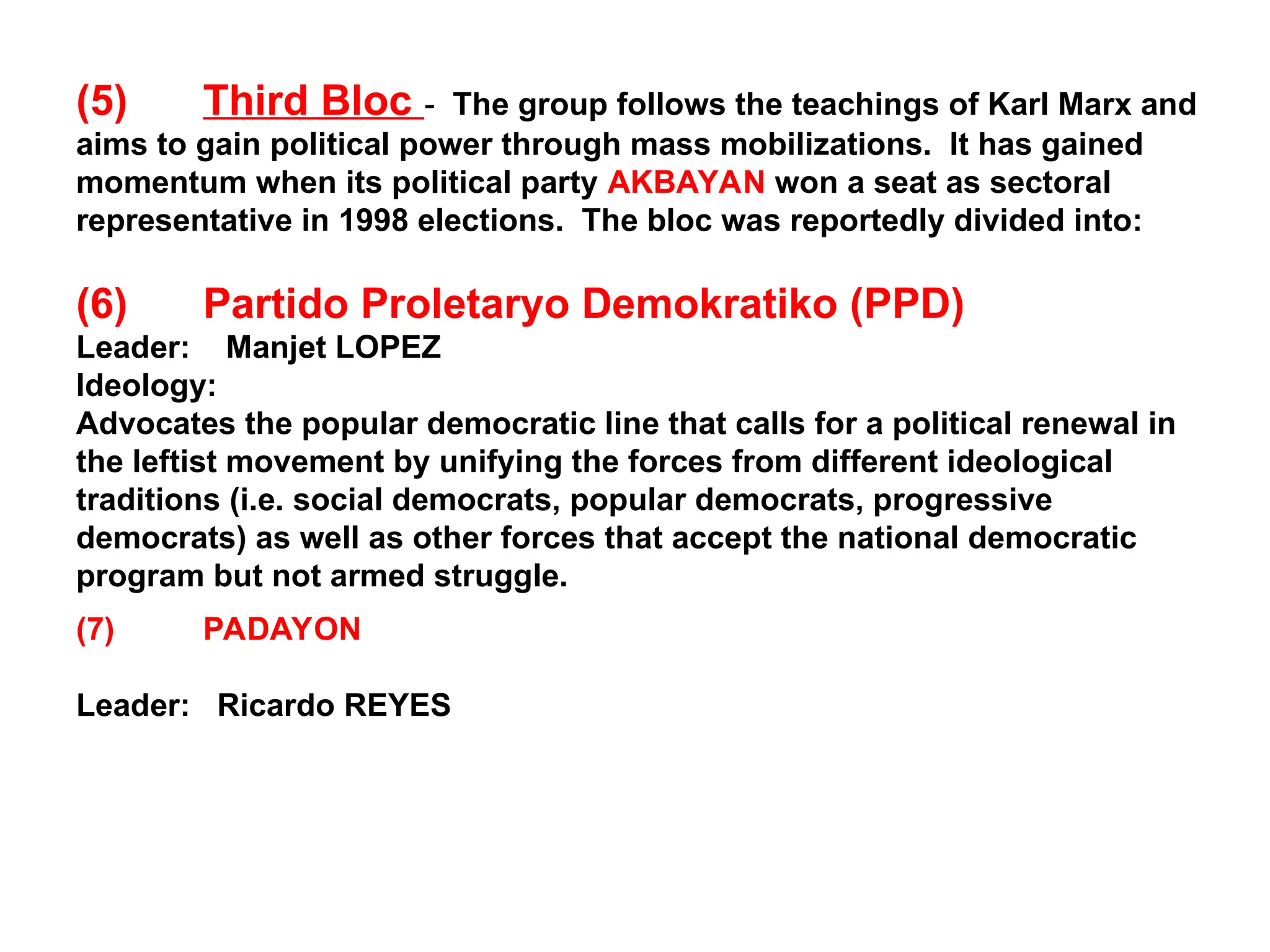
(5) Third Bloc - The group follows the teachings of Karl Marx and
aims to gain political power through mass mobilizations. It has gained
momentum when its political party AKBAYAN won a seat as sectoral
representative in 1998 elections. The bloc was reportedly divided into:
(6) Partido Proletaryo Demokratiko (PPD)
Leader: Manjet LOPEZ
Ideology:
Advocates the popular democratic line that calls for a political renewal in
the leftist movement by unifying the forces from different ideological
traditions (i.e. social democrats, popular democrats, progressive
democrats) as well as other forces that accept the national democratic
program but not armed struggle.
(7) PADAYON
Leader: Ricardo REYES
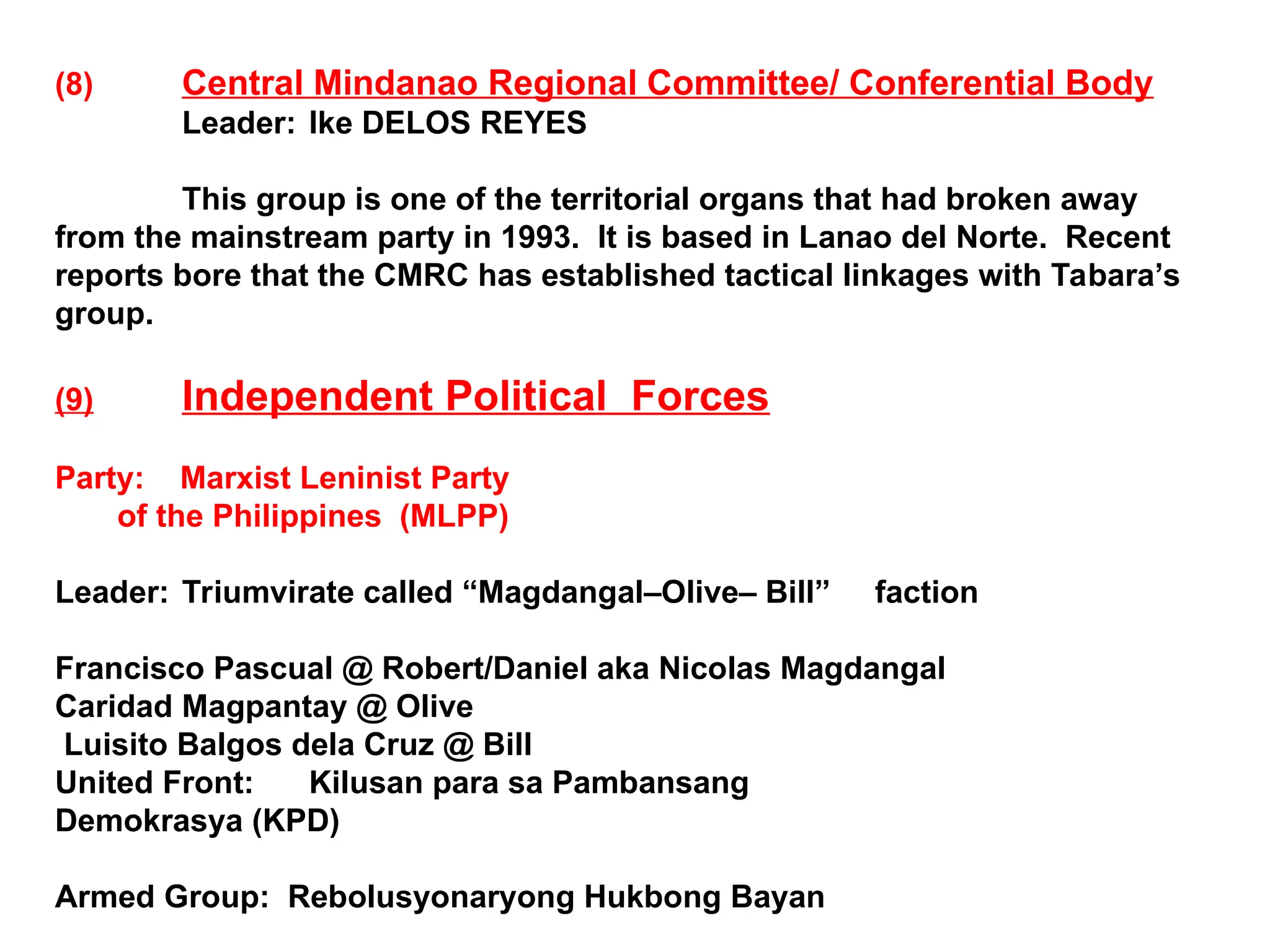
(8) Central Mindanao Regional Committee/ Conferential Body
Leader: Ike DELOS REYES
This group is one of the territorial organs that had broken away
from the mainstream party in 1993. It is based in Lanao del Norte. Recent
reports bore that the CMRC has established tactical linkages with Tabara’s
group.
(9) Independent Political Forces
Party: Marxist Leninist Party
of the Philippines (MLPP)
Leader: Triumvirate called “Magdangal–Olive– Bill” faction
Francisco Pascual @ Robert/Daniel aka Nicolas Magdangal
Caridad Magpantay @ Olive
Luisito Balgos dela Cruz @ Bill
United Front: Kilusan para sa Pambansang
Demokrasya (KPD)
Armed Group: Rebolusyonaryong Hukbong Bayan
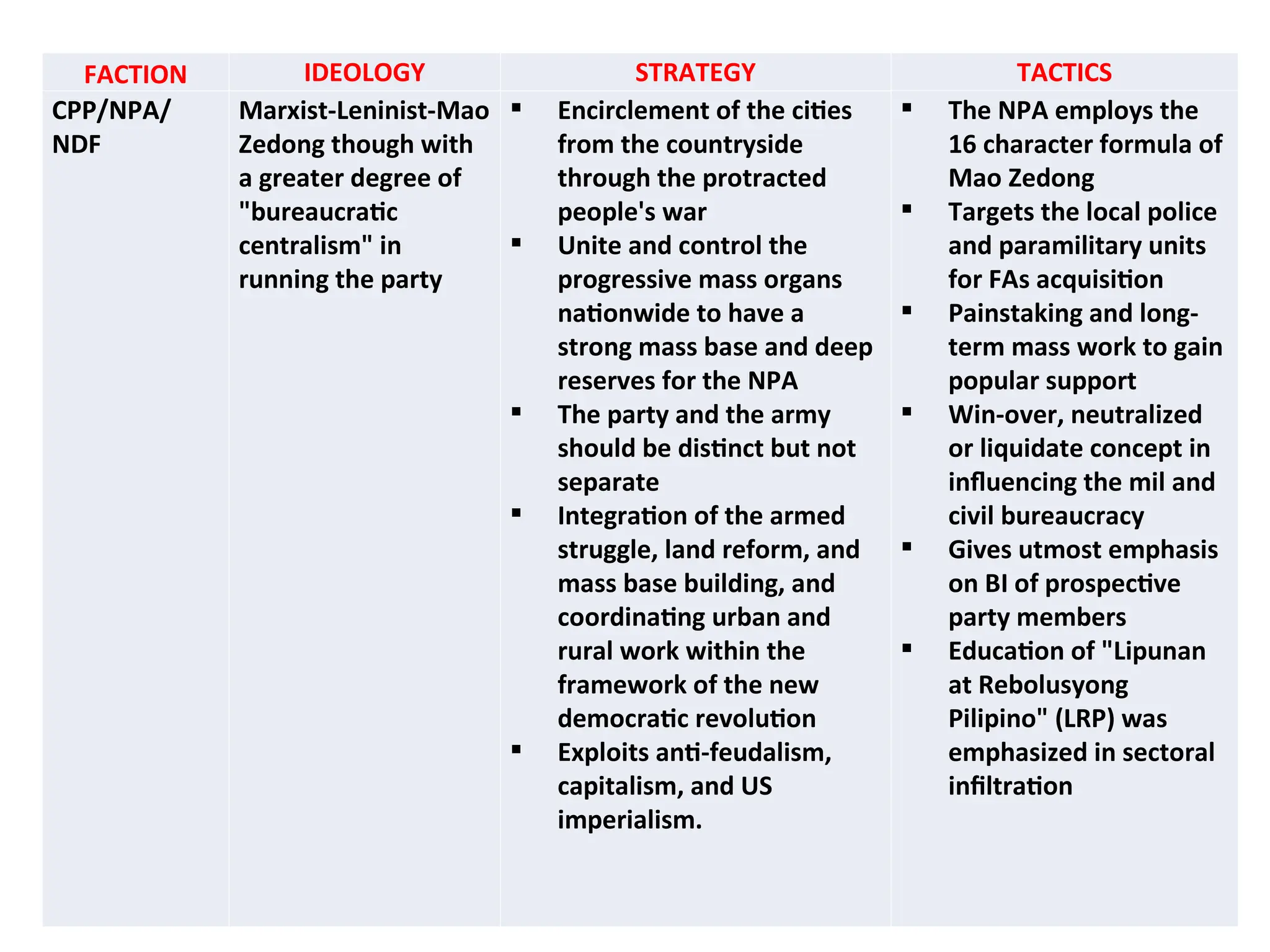
FACTION IDEOLOGY STRATEGY TACTICS
CPP/NPA/
NDF
Marxist-Leninist-Mao
Zedong though with
a greater degree of
"bureaucratic
centralism" in
running the party
 Encirclement of the cities
from the countryside
through the protracted
people's war
 Unite and control the
progressive mass organs
nationwide to have a
strong mass base and deep
reserves for the NPA
 The party and the army
should be distinct but not
separate
 Integration of the armed
struggle, land reform, and
mass base building, and
coordinating urban and
rural work within the
framework of the new
democratic revolution
 Exploits anti-feudalism,
capitalism, and US
imperialism.
 The NPA employs the
16 character formula of
Mao Zedong
 Targets the local police
and paramilitary units
for FAs acquisition
 Painstaking and long-
term mass work to gain
popular support
 Win-over, neutralized
or liquidate concept in
influencing the mil and
civil bureaucracy
 Gives utmost emphasis
on BI of prospective
party members
 Education of "Lipunan
at Rebolusyong
Pilipino" (LRP) was
emphasized in sectoral
infiltration
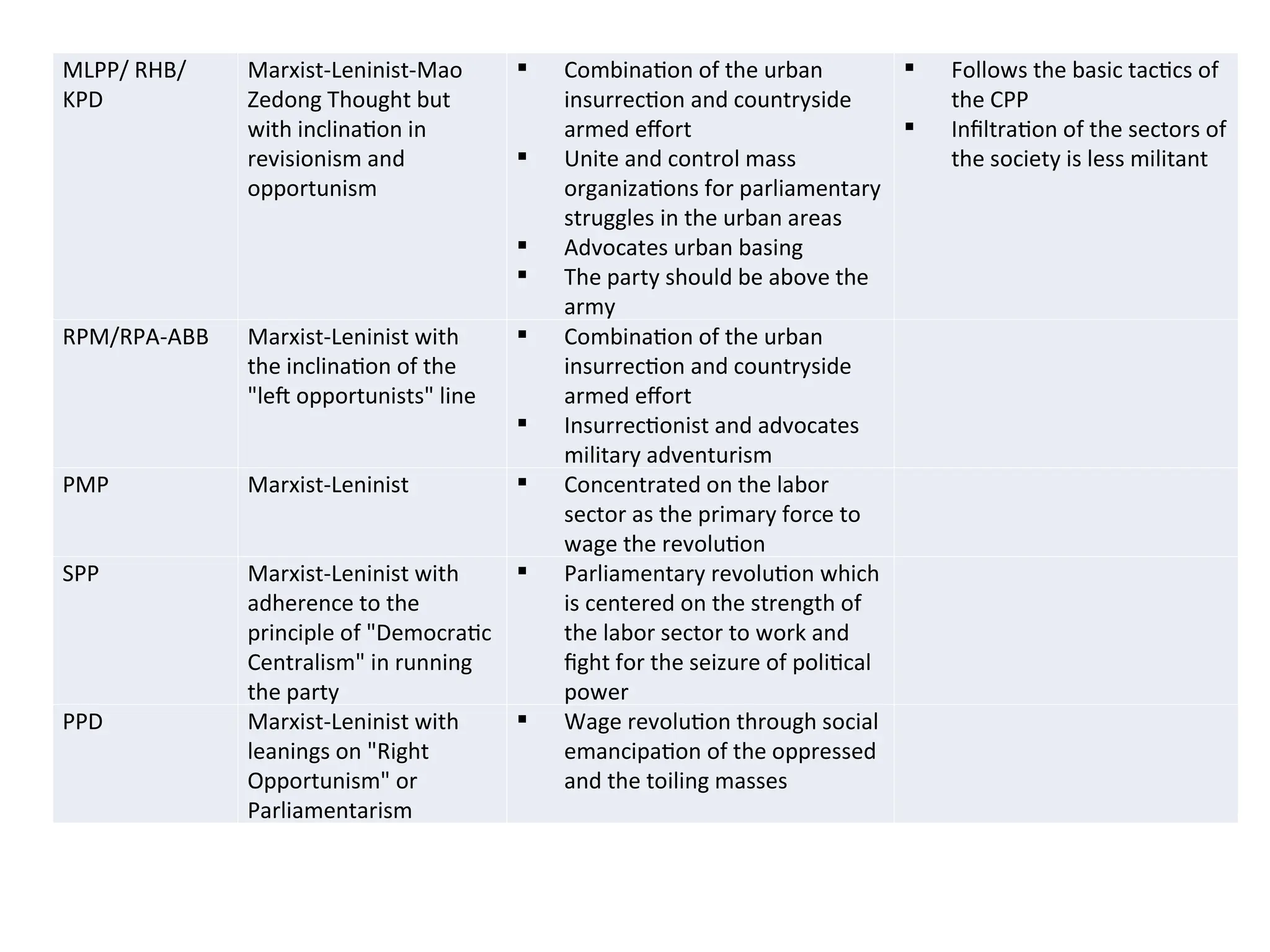
MLPP/ RHB/
KPD
Marxist-Leninist-Mao
Zedong Thought but
with inclination in
revisionism and
opportunism
 Combination of the urban
insurrection and countryside
armed effort
 Unite and control mass
organizations for parliamentary
struggles in the urban areas
 Advocates urban basing
 The party should be above the
army
 Follows the basic tactics of
the CPP
 Infiltration of the sectors of
the society is less militant
RPM/RPA-ABB Marxist-Leninist with
the inclination of the
"left opportunists" line
 Combination of the urban
insurrection and countryside
armed effort
 Insurrectionist and advocates
military adventurism
PMP Marxist-Leninist  Concentrated on the labor
sector as the primary force to
wage the revolution
SPP Marxist-Leninist with
adherence to the
principle of "Democratic
Centralism" in running
the party
 Parliamentary revolution which
is centered on the strength of
the labor sector to work and
fight for the seizure of political
power
PPD Marxist-Leninist with
leanings on "Right
Opportunism" or
Parliamentarism
 Wage revolution through social
emancipation of the oppressed
and the toiling masses
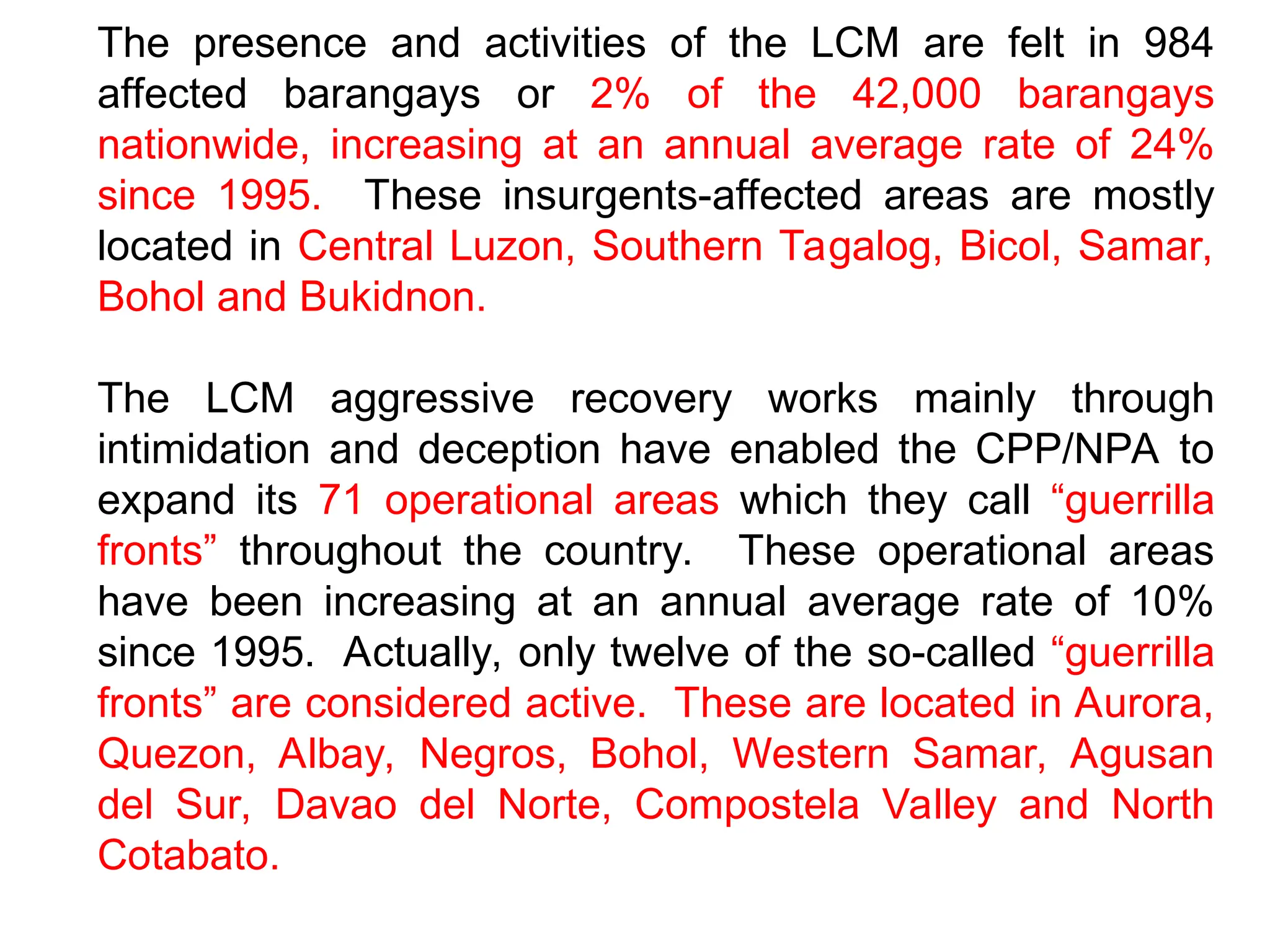
The presence and activities of the LCM are felt in 984
affected barangays or 2% of the 42,000 barangays
nationwide, increasing at an annual average rate of 24%
since 1995. These insurgents-affected areas are mostly
located in Central Luzon, Southern Tagalog, Bicol, Samar,
Bohol and Bukidnon.
The LCM aggressive recovery works mainly through
intimidation and deception have enabled the CPP/NPA to
expand its 71 operational areas which they call “guerrilla
fronts” throughout the country. These operational areas
have been increasing at an annual average rate of 10%
since 1995. Actually, only twelve of the so-called “guerrilla
fronts” are considered active. These are located in Aurora,
Quezon, Albay, Negros, Bohol, Western Samar, Agusan
del Sur, Davao del Norte, Compostela Valley and North
Cotabato.
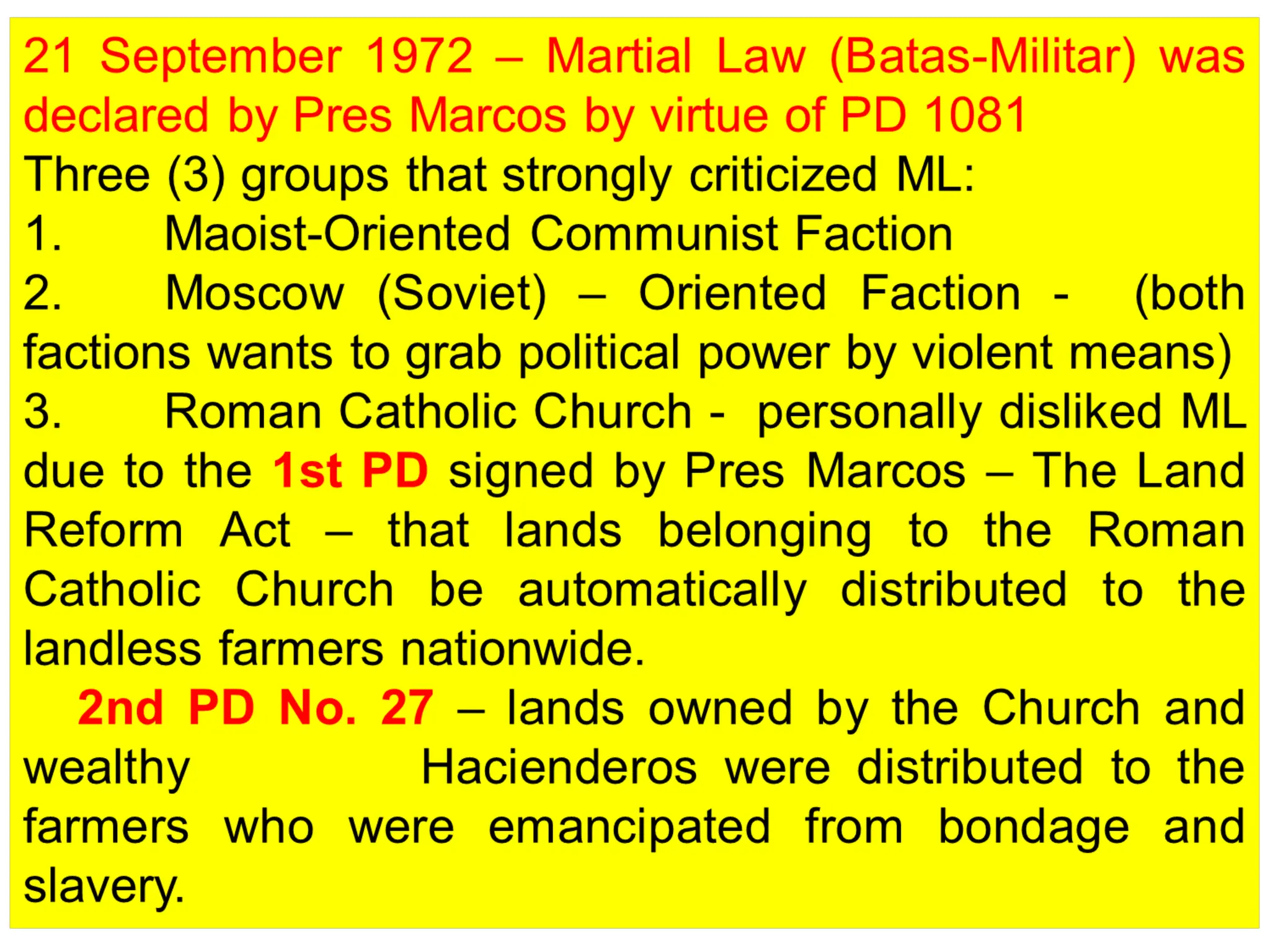
Aside from the first three groups that hated ML
were:
4. Political Party opposed to Pres Marcos who
also wanted to overthrow him
5. Wealthy businessmen who likewise lost their
vast haciendas (domains), plantations, monopoly,
business cartels.
6. Mainstream media whose their freedom of the
press was violated. These media are owned by
wealthy Oligarchs
(small governing group: a small group of people
who together govern a nation or control an
organization, often for their own purposes)
*These groups joined their forces together until Pres Marcos
was ousted on 25 Feb . It took almost 24 years before these
groups succeeded in ending ML.
*But the credit does not go alone to the above-named groups.
With the help of the CIA, Marcos was overthrown from
power.
*Contrary to popular belief, the fall of Marcos was not
attributed to the strength of these groups but with the
charisma of POPE JOHN PAUL II who asked Marcos on 17
Jan 1981 to end ML as a secret precondition of his visit to
the Philippines. Marcos voluntarily ended ML and one (1)
month after (17 Feb 1981) POPE JOHN PAUL II came to
Manila.
Two years later, Sen Ninoy Aquino returned to the country
and wanted to be President but was shot and killed at the
NIA Tarmac.
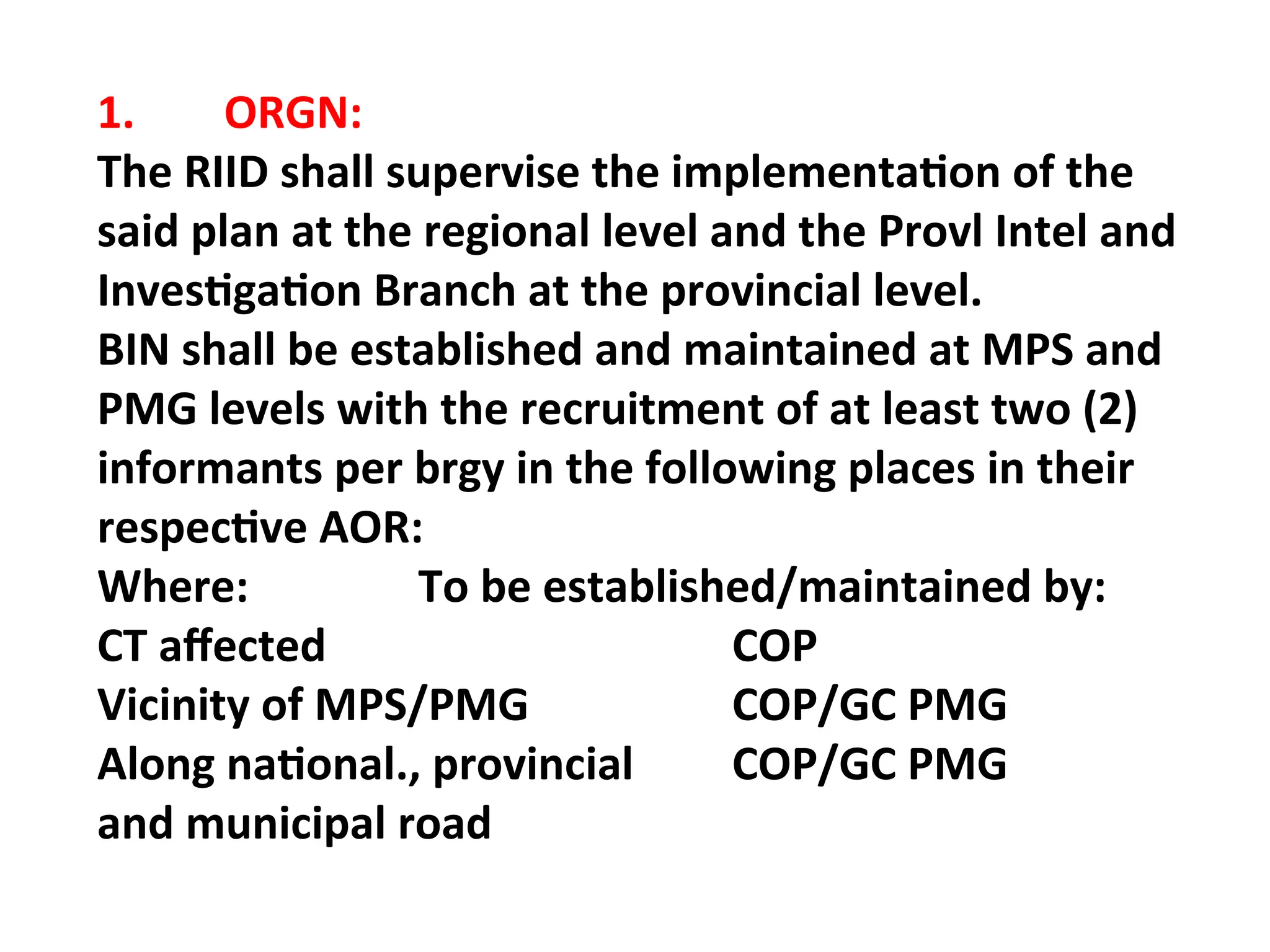
1. ORGN:
The RIID shall supervise the implementation of the
said plan at the regional level and the Provl Intel and
Investigation Branch at the provincial level.
BIN shall be established and maintained at MPS and
PMG levels with the recruitment of at least two (2)
informants per brgy in the following places in their
respective AOR:
Where: To be established/maintained by:
CT affected COP
Vicinity of MPS/PMG COP/GC PMG
Along national., provincial COP/GC PMG
and municipal road
2. OPNS:
a. Informants recruited in the above-cited areas
shall collect info related to the following:
* Contact intel (location, movements of
insurgents/criminal armed grps, camps, FAs, etc.)
* Local intel – (terrain, legal front orgns, ID of
the underground mbrs in the community and their
activities)
* Background Intel – (social, economic and
political characteristics of the area, insurgents/criminal
elements’ doctrine, strategies, tactics and orgn)
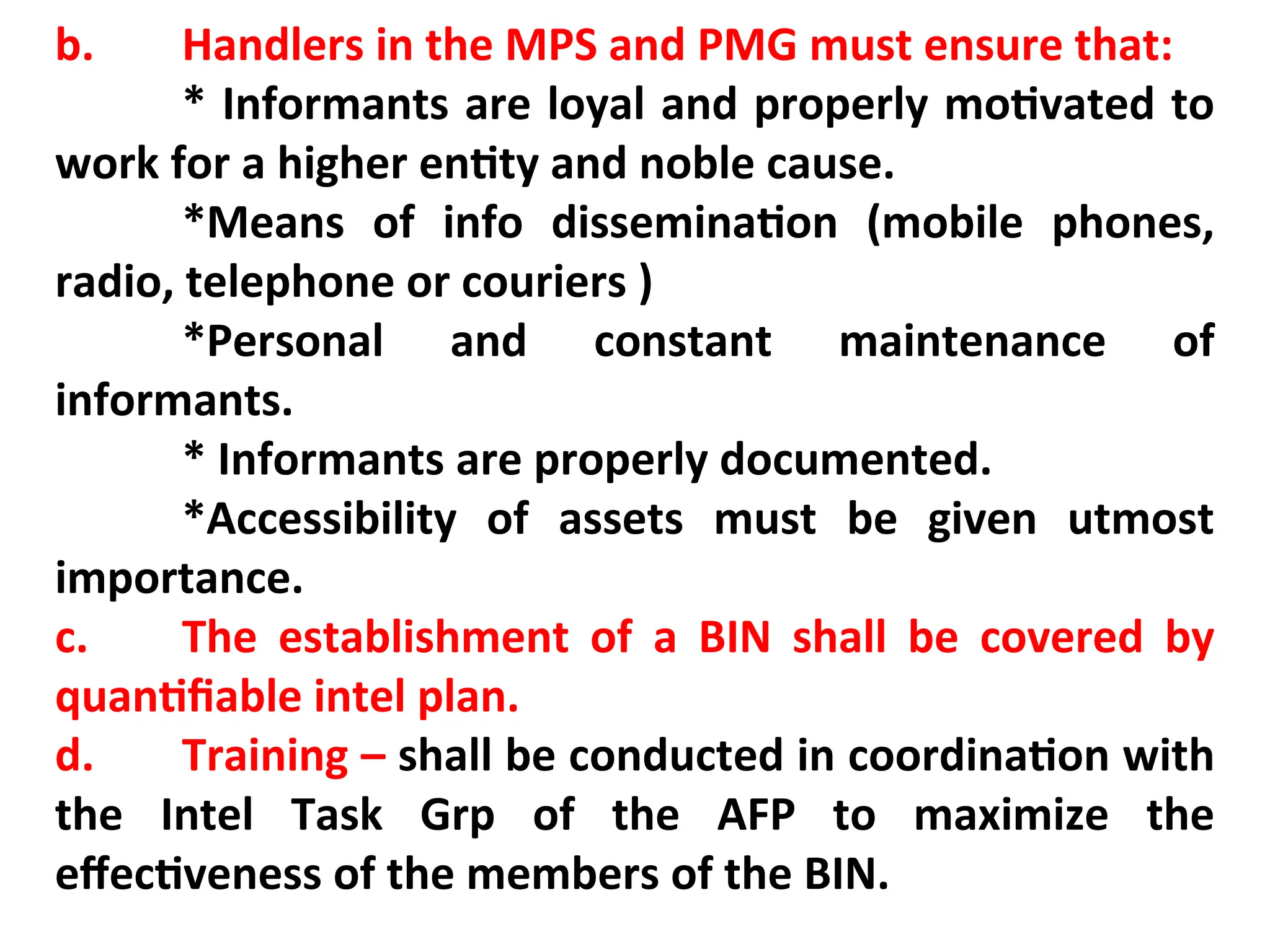
b. Handlers in the MPS and PMG must ensure that:
* Informants are loyal and properly motivated to
work for a higher entity and noble cause.
*Means of info dissemination (mobile phones,
radio, telephone or couriers )
*Personal and constant maintenance of
informants.
* Informants are properly documented.
*Accessibility of assets must be given utmost
importance.
c. The establishment of a BIN shall be covered by
quantifiable intel plan.
d. Training – shall be conducted in coordination with
the Intel Task Grp of the AFP to maximize the
effectiveness of the members of the BIN.
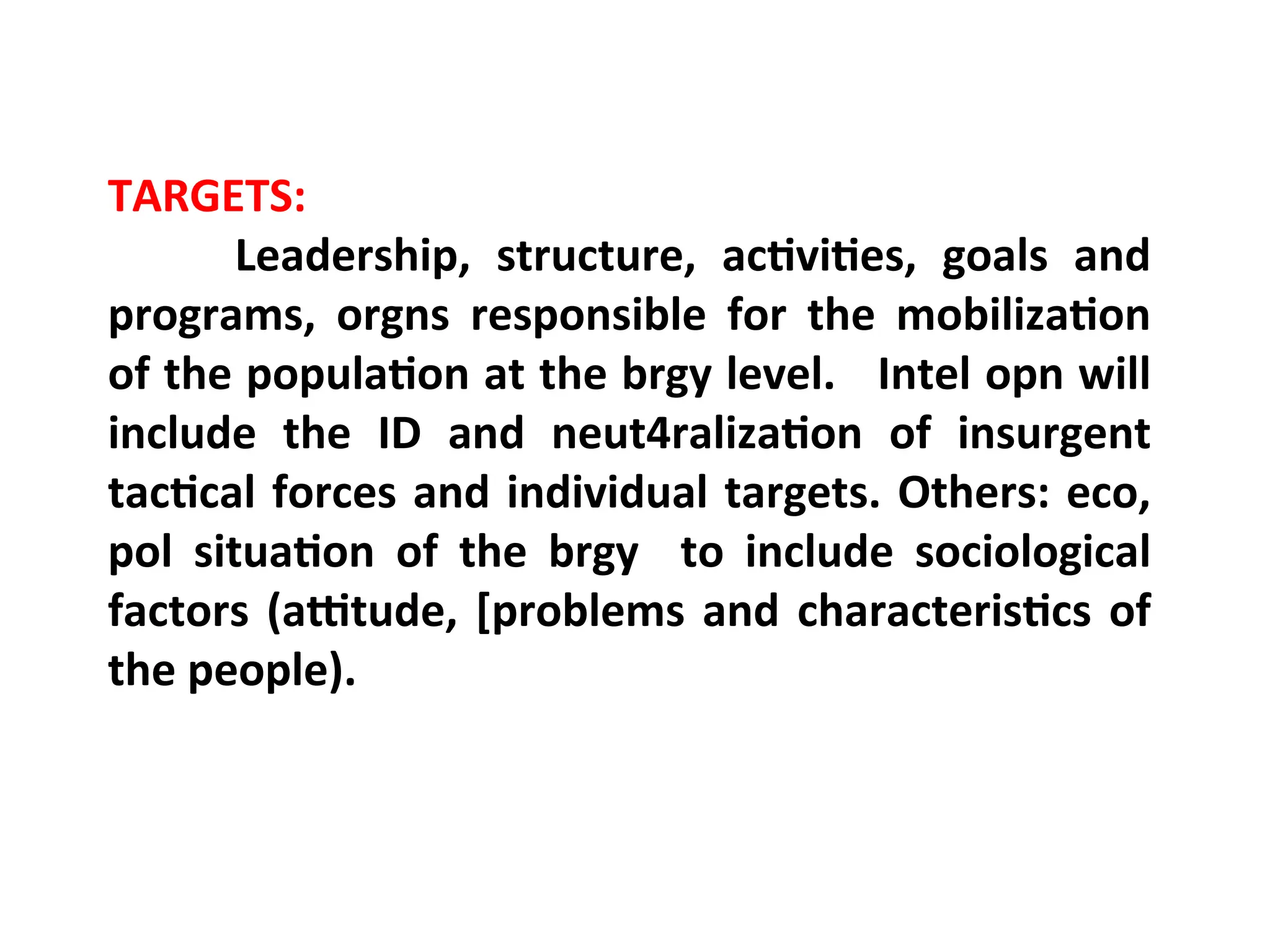
TARGETS:
Leadership, structure, activities, goals and
programs, orgns responsible for the mobilization
of the population at the brgy level. Intel opn will
include the ID and neut4ralization of insurgent
tactical forces and individual targets. Others: eco,
pol situation of the brgy to include sociological
factors (attitude, [problems and characteristics of
the people).
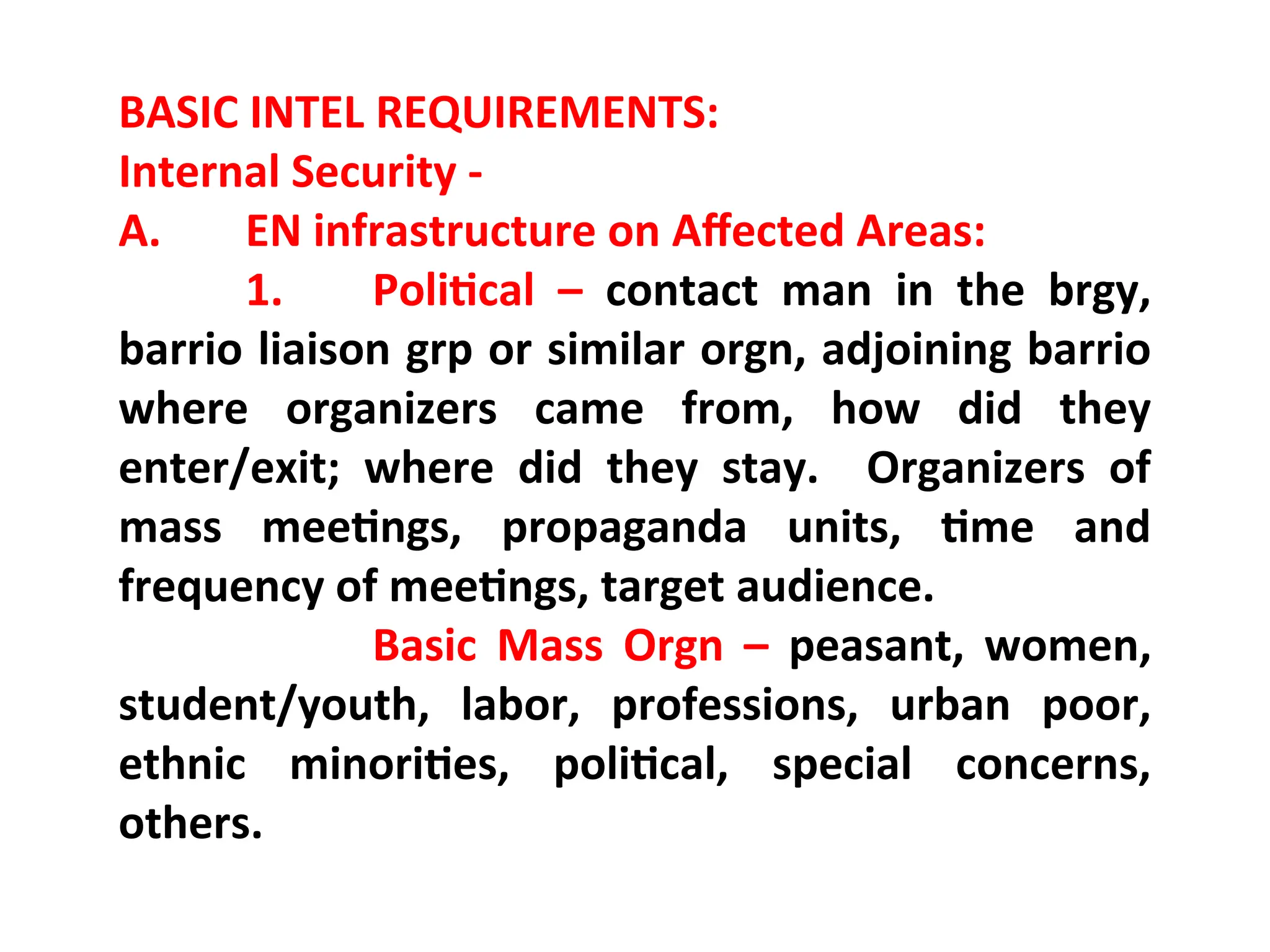
BASIC INTEL REQUIREMENTS:
Internal Security -
A. EN infrastructure on Affected Areas:
1. Political – contact man in the brgy,
barrio liaison grp or similar orgn, adjoining barrio
where organizers came from, how did they
enter/exit; where did they stay. Organizers of
mass meetings, propaganda units, time and
frequency of meetings, target audience.
Basic Mass Orgn – peasant, women,
student/youth, labor, professions, urban poor,
ethnic minorities, political, special concerns,
others.
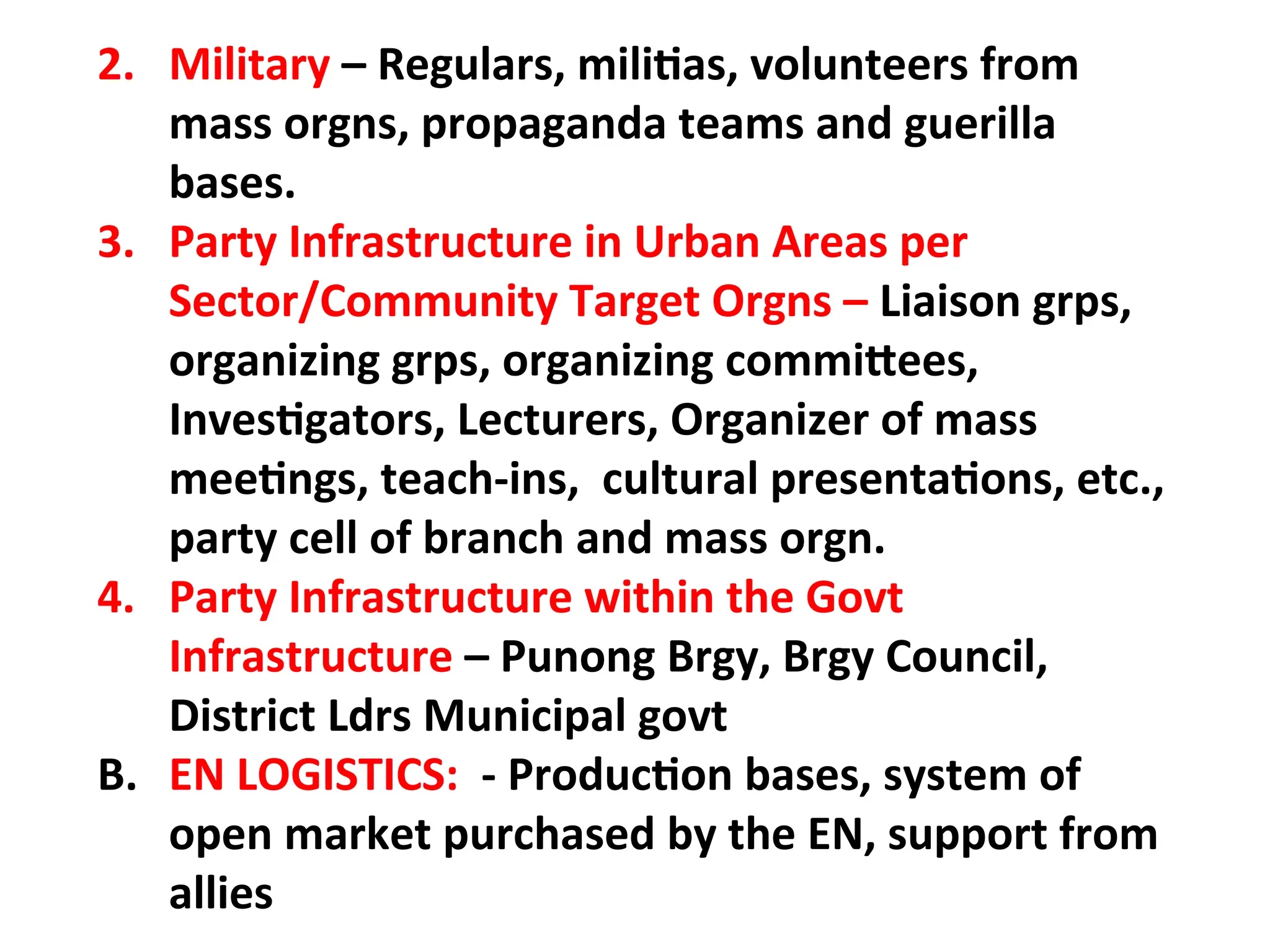
2. Military – Regulars, militias, volunteers from
mass orgns, propaganda teams and guerilla
bases.
3. Party Infrastructure in Urban Areas per
Sector/Community Target Orgns – Liaison grps,
organizing grps, organizing committees,
Investigators, Lecturers, Organizer of mass
meetings, teach-ins, cultural presentations, etc.,
party cell of branch and mass orgn.
4. Party Infrastructure within the Govt
Infrastructure – Punong Brgy, Brgy Council,
District Ldrs Municipal govt
B. EN LOGISTICS: - Production bases, system of
open market purchased by the EN, support from
allies
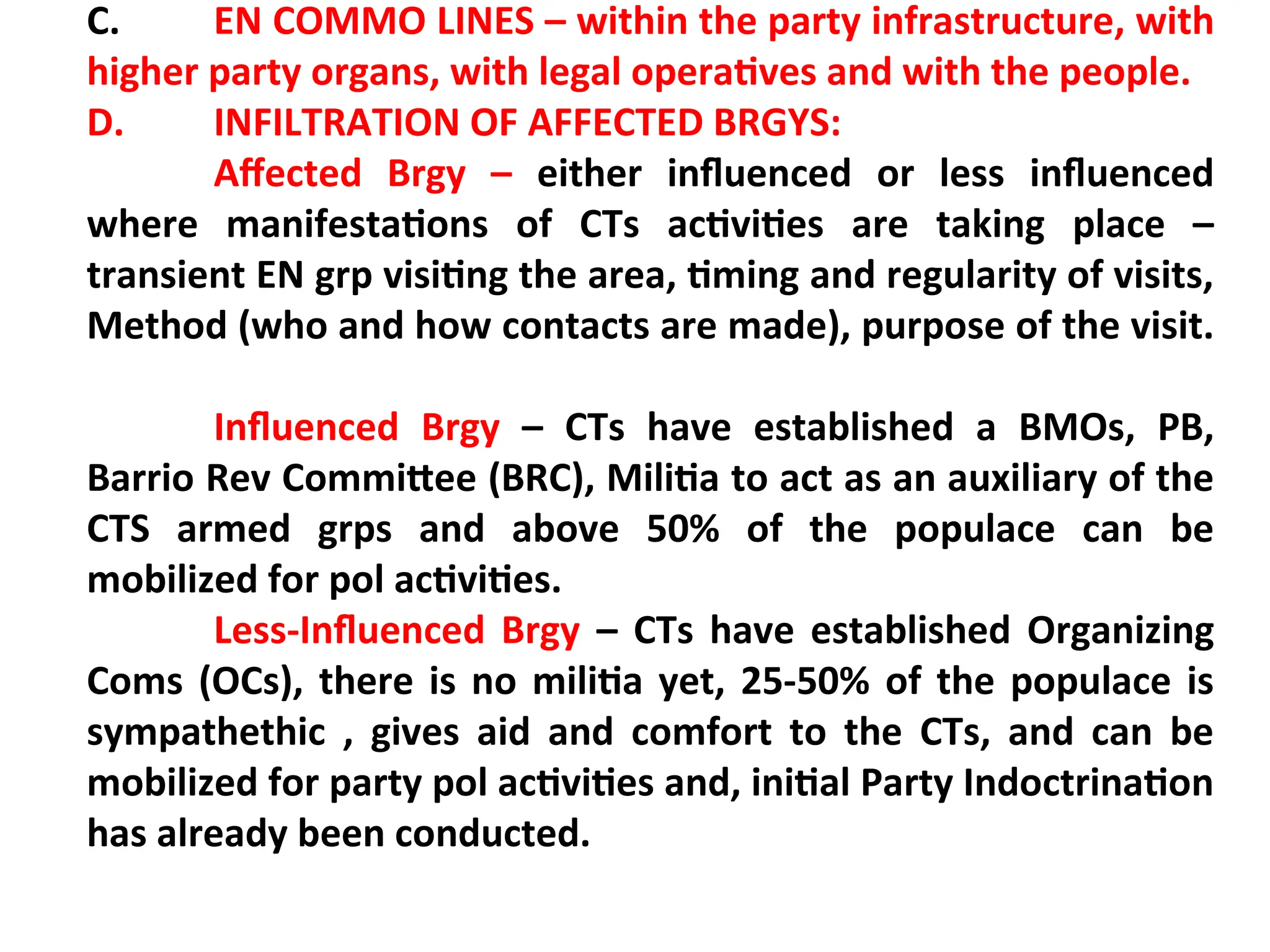
C. EN COMMO LINES – within the party infrastructure, with
higher party organs, with legal operatives and with the people.
D. INFILTRATION OF AFFECTED BRGYS:
Affected Brgy – either influenced or less influenced
where manifestations of CTs activities are taking place –
transient EN grp visiting the area, timing and regularity of visits,
Method (who and how contacts are made), purpose of the visit.
Influenced Brgy – CTs have established a BMOs, PB,
Barrio Rev Committee (BRC), Militia to act as an auxiliary of the
CTS armed grps and above 50% of the populace can be
mobilized for pol activities.
Less-Influenced Brgy – CTs have established Organizing
Coms (OCs), there is no militia yet, 25-50% of the populace is
sympathethic , gives aid and comfort to the CTs, and can be
mobilized for party pol activities and, initial Party Indoctrination
has already been conducted.
E. PRESENCE OF INTEREST GRPS/SECTORS –
grps emerge only when there are important
national issues to be resolved, objectives, Ident
personalities, Affiliationss/ leanings, Orgnl or
Opnl linkages with threat groups’ foreign links,
issues expl;oited by the group, front or legal
orgns used.
F. ATTITUDE/LOYALTY OF THE POPULATIONS
TOWARDS - local ldrs, military, PNP, self
defense force, EN, Current issues (local,
national or international)
INTRODUCTION TO INTELLIGENCE
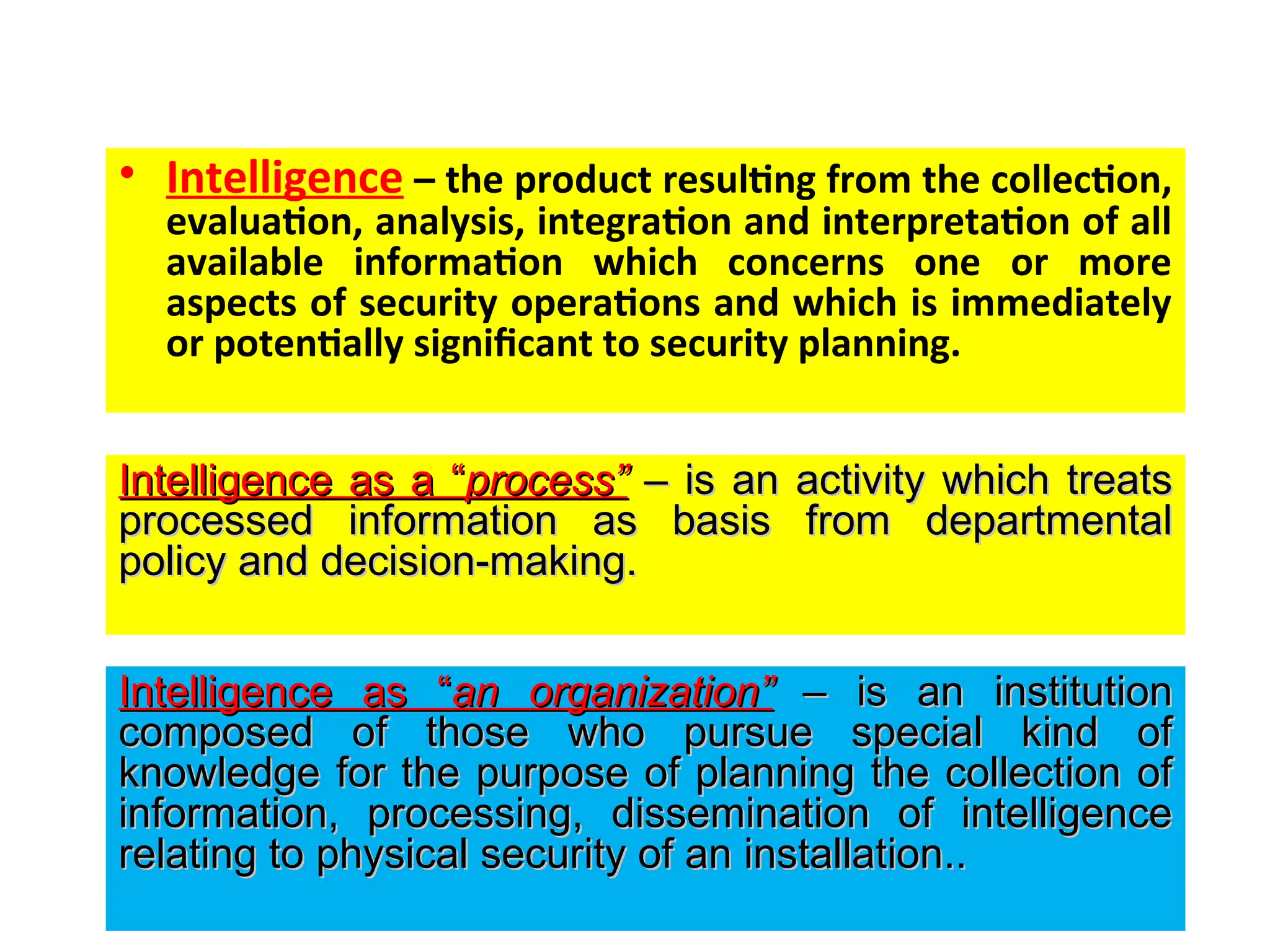
• Intelligence – the product resulting from the collection,
evaluation, analysis, integration and interpretation of all
available information which concerns one or more
aspects of security operations and which is immediately
or potentially significant to security planning.
Intelligence as a “
Intelligence as a “process”
process” – is an activity which treats
– is an activity which treats
processed information as basis from departmental
policy and decision-making.
Intelligence as “
Intelligence as “an
an organization”
organization” – is an institution
– is an institution
composed of those who pursue special kind of
knowledge for the purpose of planning the collection of
information, processing, dissemination of intelligence
relating to physical security of an installation..
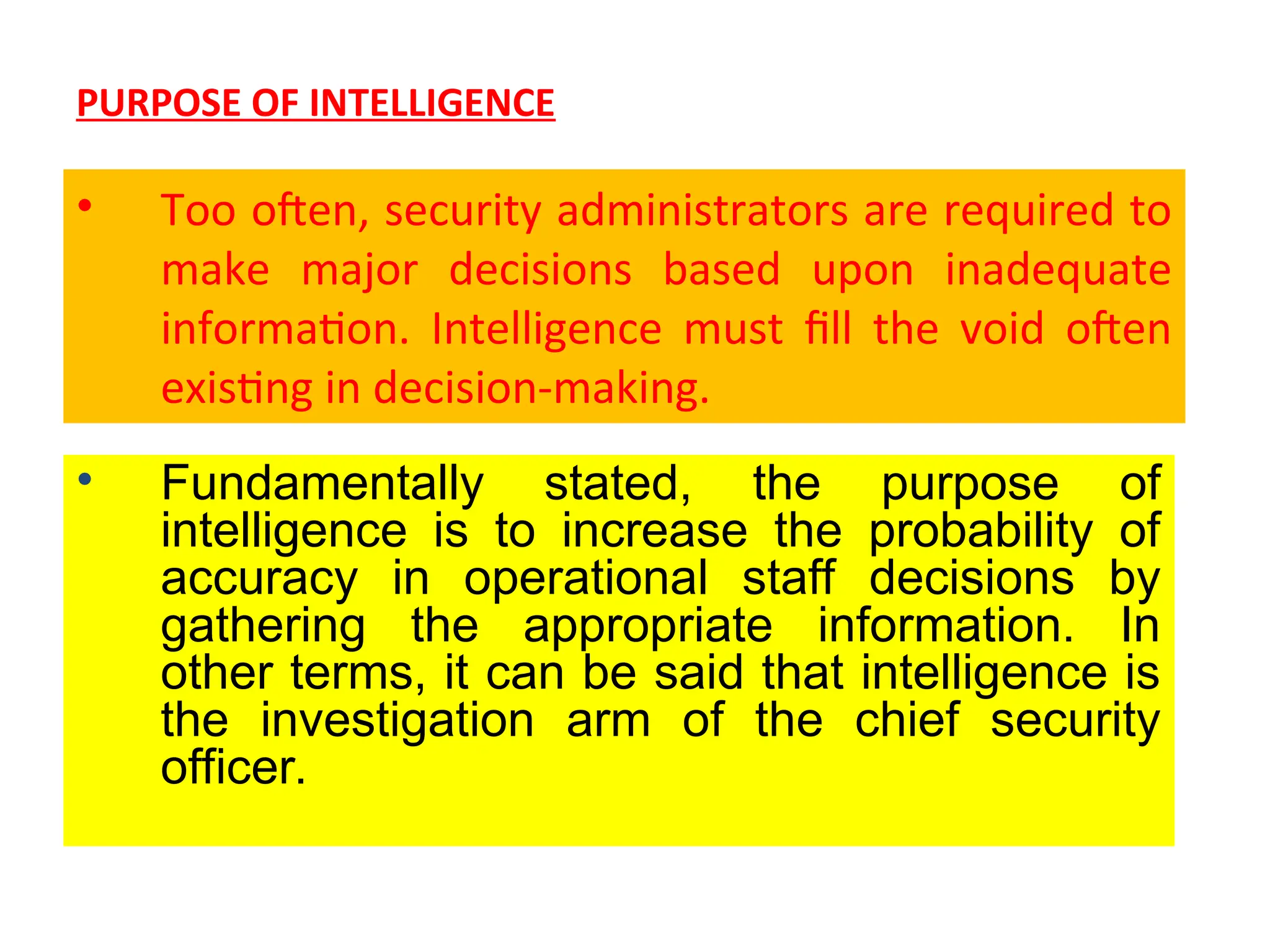
PURPOSE OF INTELLIGENCE
• Too often, security administrators are required to
make major decisions based upon inadequate
information. Intelligence must fill the void often
existing in decision-making.
• Fundamentally stated, the purpose of
intelligence is to increase the probability of
accuracy in operational staff decisions by
gathering the appropriate information. In
other terms, it can be said that intelligence is
the investigation arm of the chief security
officer.
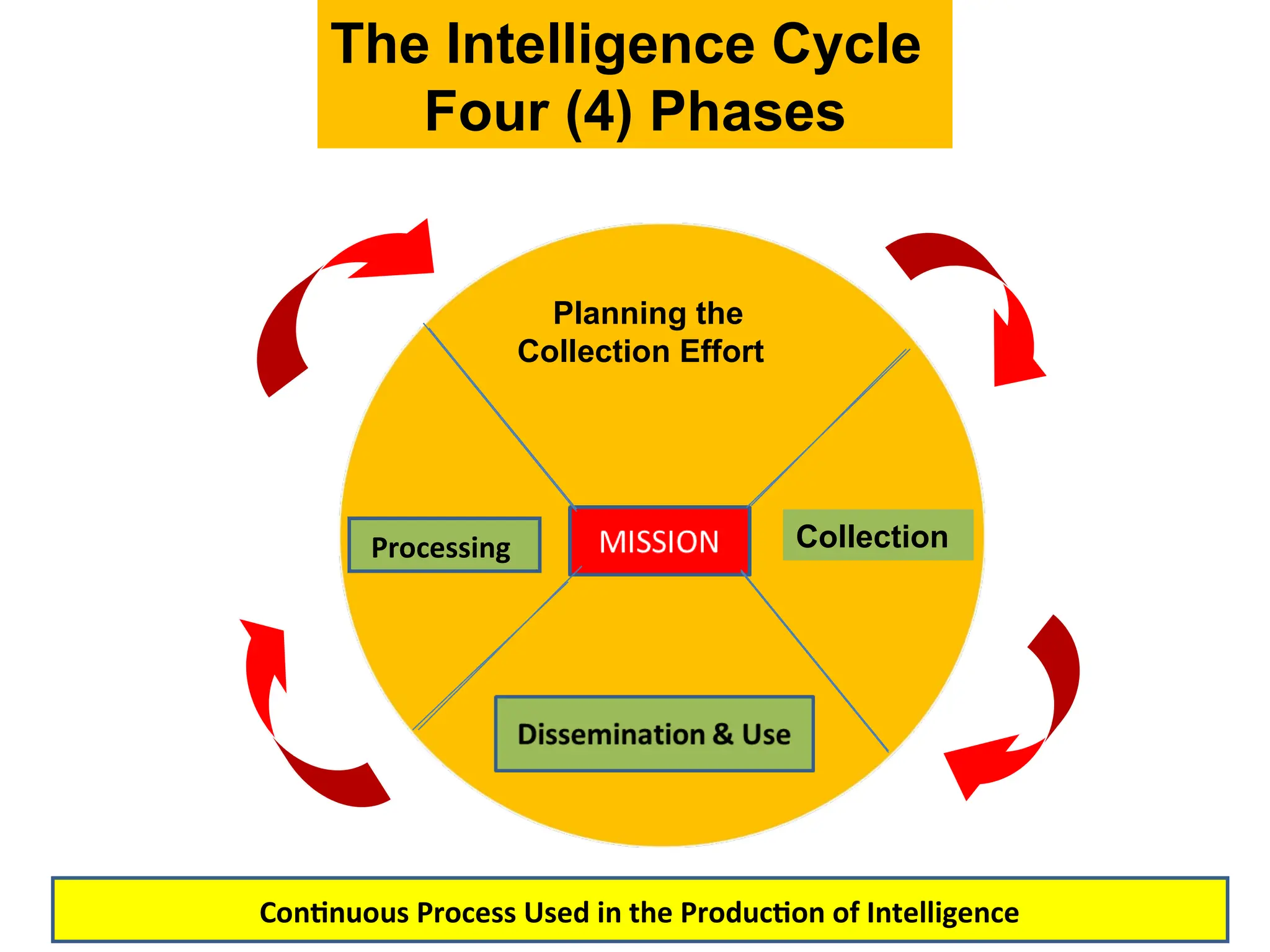
The Intelligence Cycle
Four (4) Phases
Planning the
Collection Effort
Collection
Processing
Continuous Process Used in the Production of Intelligence
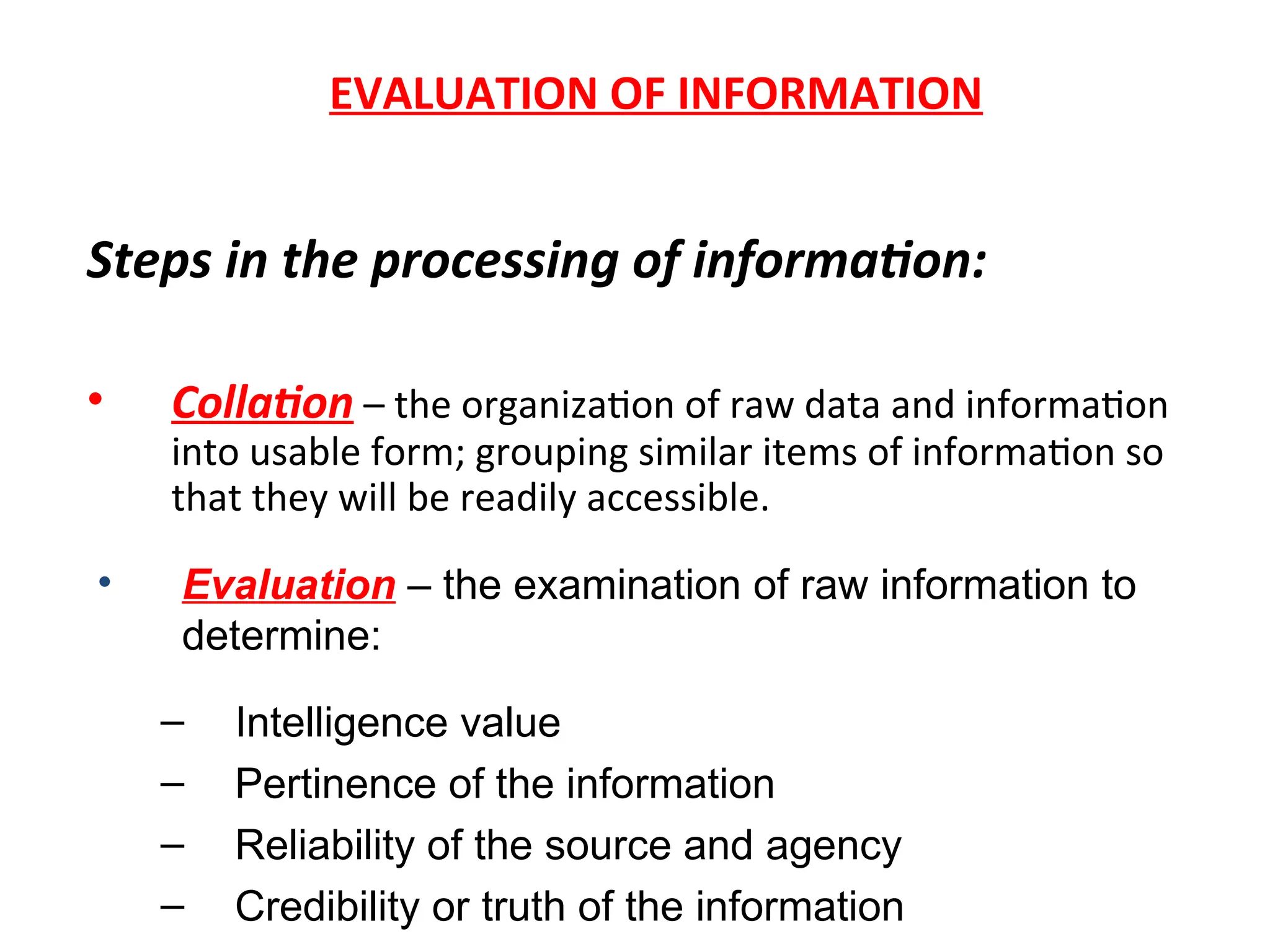
EVALUATION OF INFORMATION
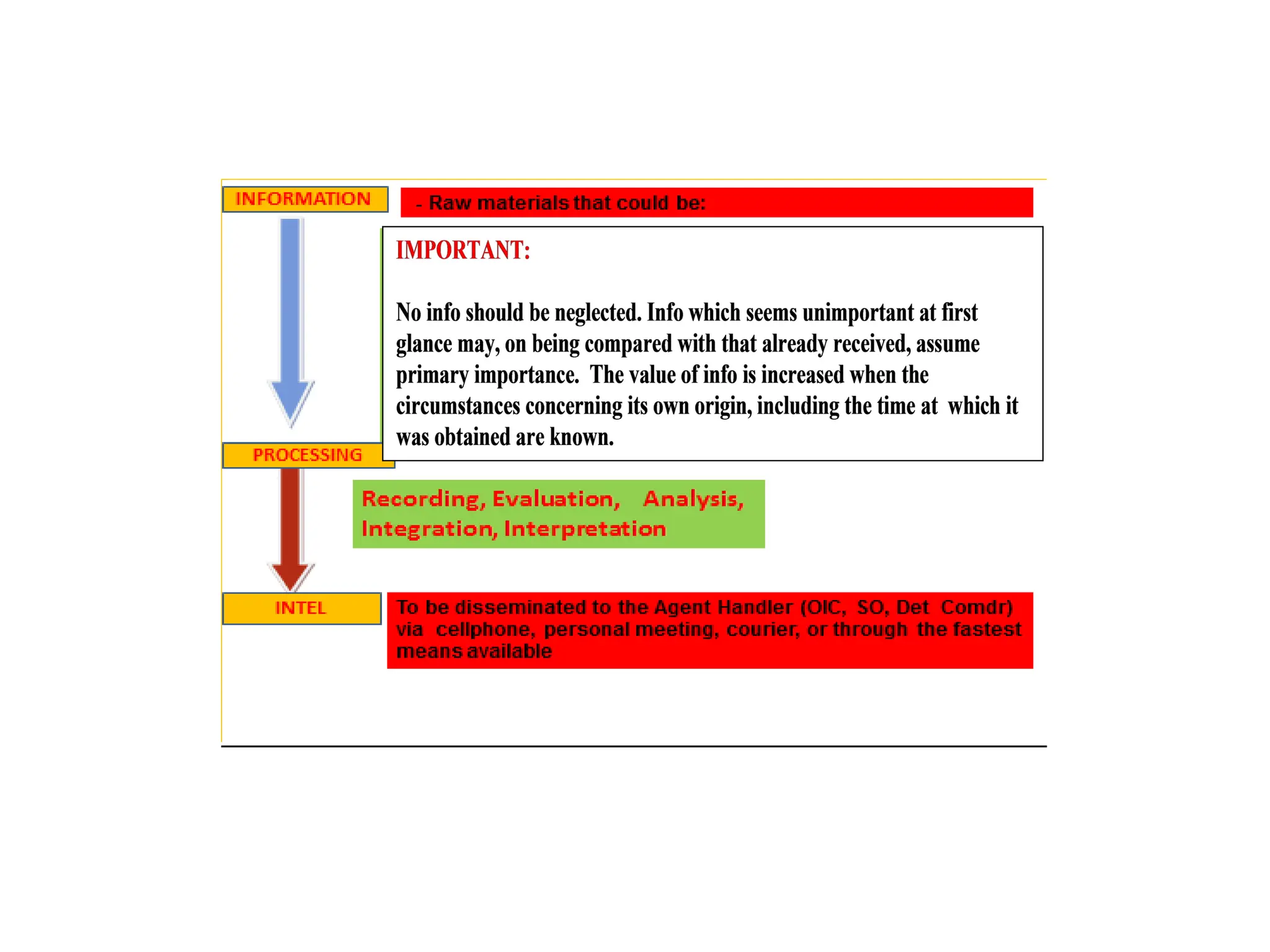
Steps in the processing of information:
• Collation – the organization of raw data and information
into usable form; grouping similar items of information so
that they will be readily accessible.
• Evaluation – the examination of raw information to
determine:
– Intelligence value
– Pertinence of the information
– Reliability of the source and agency
– Credibility or truth of the information
Interpretation:
• Analysis – shifting and isolating those
elements which have significance in
the light of the mission or objective.
• Integration – combining the elements
isolated in analysis and known information
to form a logical picture or theory.
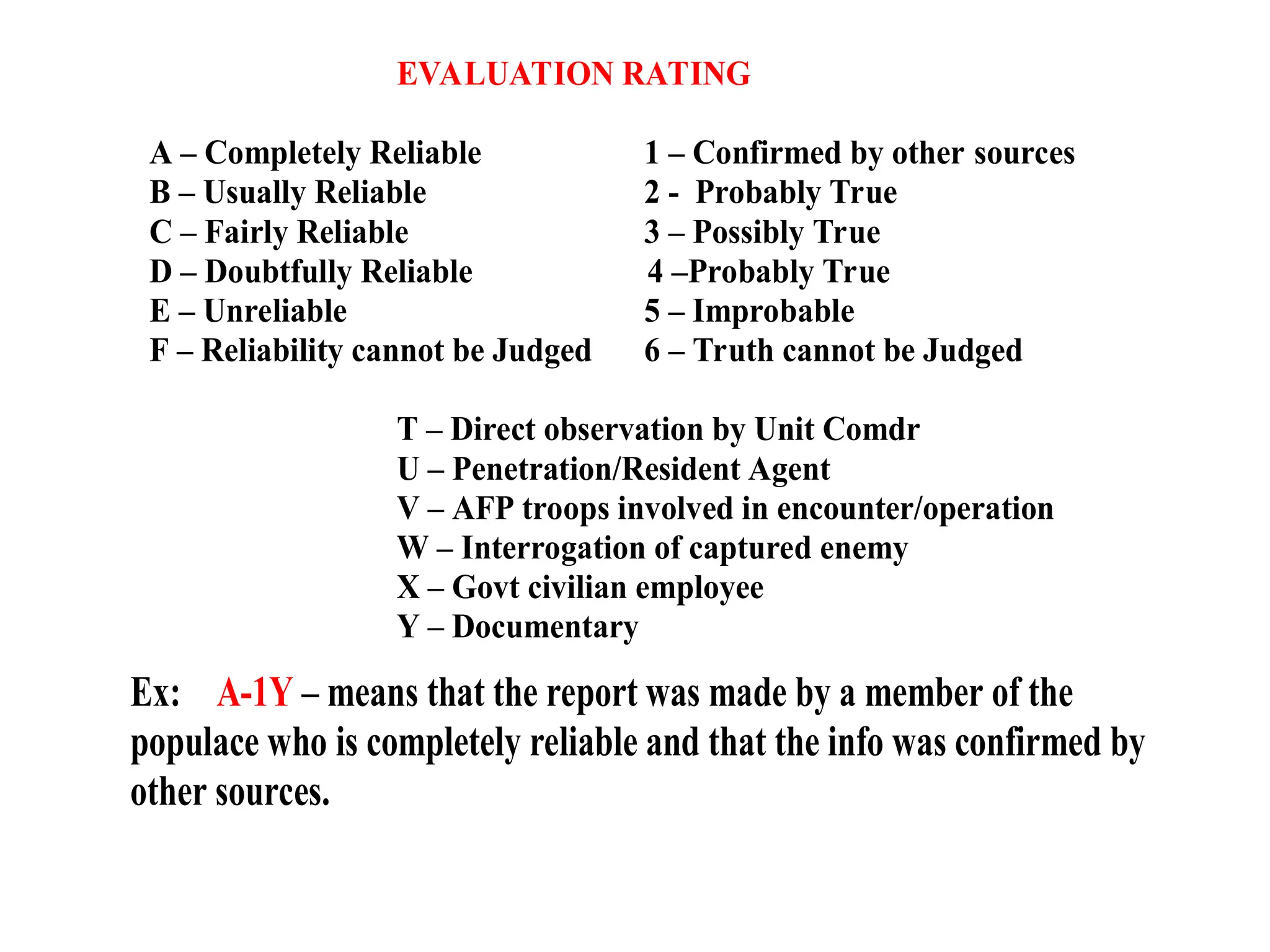
EVALUATION RATING
A – Completely Reliable 1 – Confirmed by other sources
B – Usually Reliable 2 - Probably True
C – Fairly Reliable 3 – Possibly True
D – Doubtfully Reliable 4 –Probably True
E – Unreliable 5 – Improbable
F – Reliability cannot be Judged 6 – Truth cannot be Judged
T – Direct observation by Unit Comdr
U – Penetration/Resident Agent
V – AFP troops involved in encounter/operation
W – Interrogation of captured enemy
X – Govt civilian employee
Y – Documentary
Ex: A-1Y – means that the report was made by a member of the
populace who is completely reliable and that the info was confirmed by
other sources.
INFORMATION GATHERING BY SECURITY
GUARDS AS ACTION AGENTS/EYES IN THE BRGY
VARIOUS CRIMES:
• EXTORTION
• INFILTRATION OF LEGITIMATE BUSINESS FOR
ILLEGITIMATE PURPOSES
• STOLEN SECURITIES
• BRIBERY
• MAJOR CRIMES – THEFT, BUREGLARY, KIDNAPPING,
DESTRUCTION OF PROPERTY, ROBBERY, FRAUD,
FENCING OF STOLEN PROPERTY AND ARSON
• MANUFACTURING, USE OR POSSESSION OPF
EXPLOSIVE DEVICES FOR ILLEGAL PURPOSES,
• THREATS OF VIOLENCE, OR USE OF VIOLENCE
AGAINST OR IN CONNECTION WITH PERSONS OR
PROPERTY
• COMPUTER CRIMES
• COUNTERFEITING
• IDENTITY THEFT
• ACTS OF TERRORISM – ACTS
DANGHEROUS OPF HUMAN LIFE, ACTS
INTENDED TO INFLUENCE THE POLICY OF
A GOVERNMENT OR BUSINESS BY
INTIMIDATION OR COERCION
• INFO RE INDIVIDUALS – SUSPECTED OF
BEING INVOLVED IN THE PLANNING,
ORGANIZING, FINANCING OR COMMISSION
OF A CRIMINAL ACTIVITY
• INFO RE INDIVIDUALS SUSPECTED OF
BEING INVOLVED IN CRIMINAL ACTIVITIES
IWHT KNOWN OR SUSPECTED CRIMINAL
OR SUBVERSIVE ORGNS
VARIOUS CRIMES:
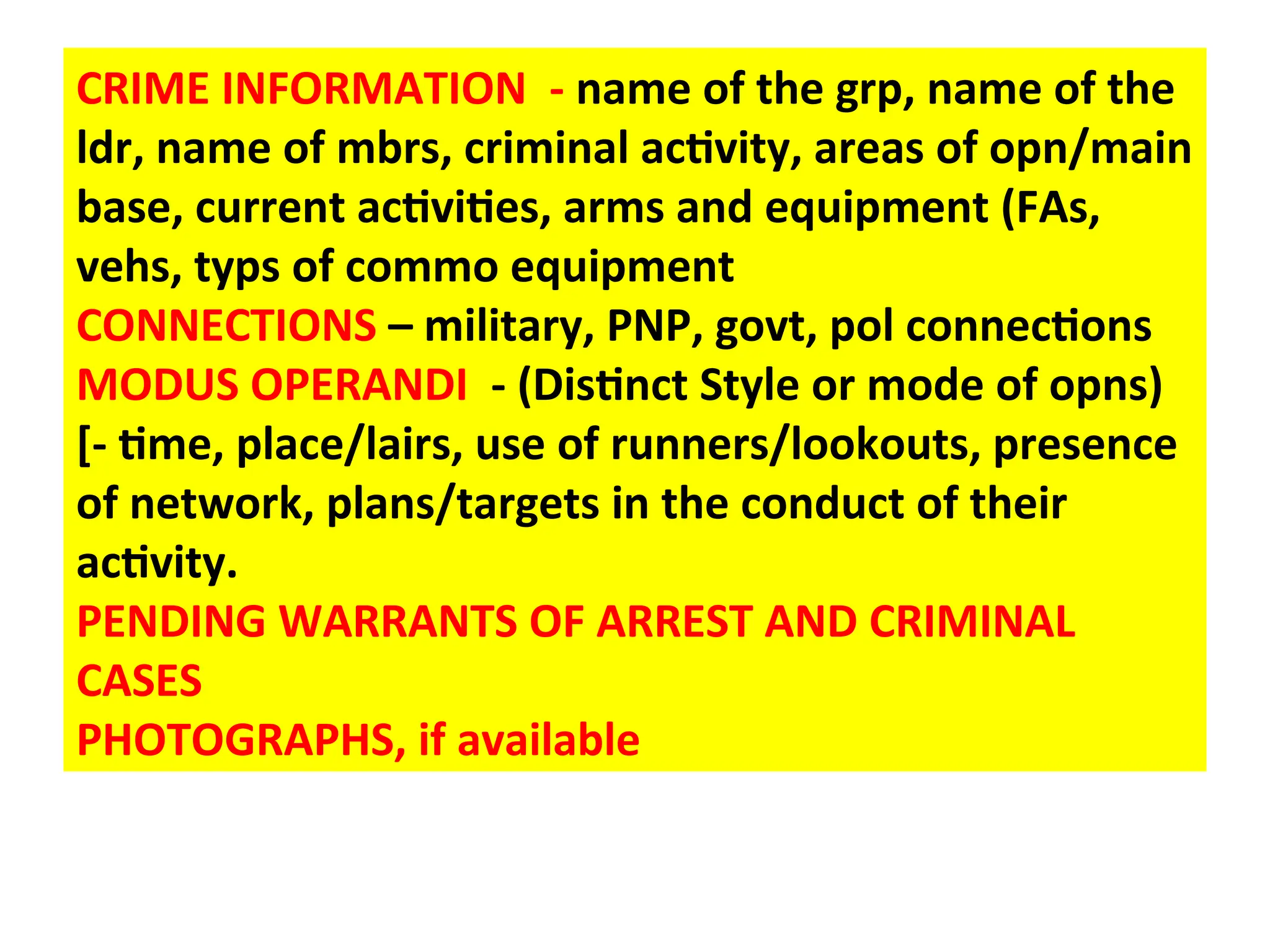
CRIME INFORMATION - name of the grp, name of the
ldr, name of mbrs, criminal activity, areas of opn/main
base, current activities, arms and equipment (FAs,
vehs, typs of commo equipment
CONNECTIONS – military, PNP, govt, pol connections
MODUS OPERANDI - (Distinct Style or mode of opns)
[- time, place/lairs, use of runners/lookouts, presence
of network, plans/targets in the conduct of their
activity.
PENDING WARRANTS OF ARREST AND CRIMINAL
CASES
PHOTOGRAPHS, if available
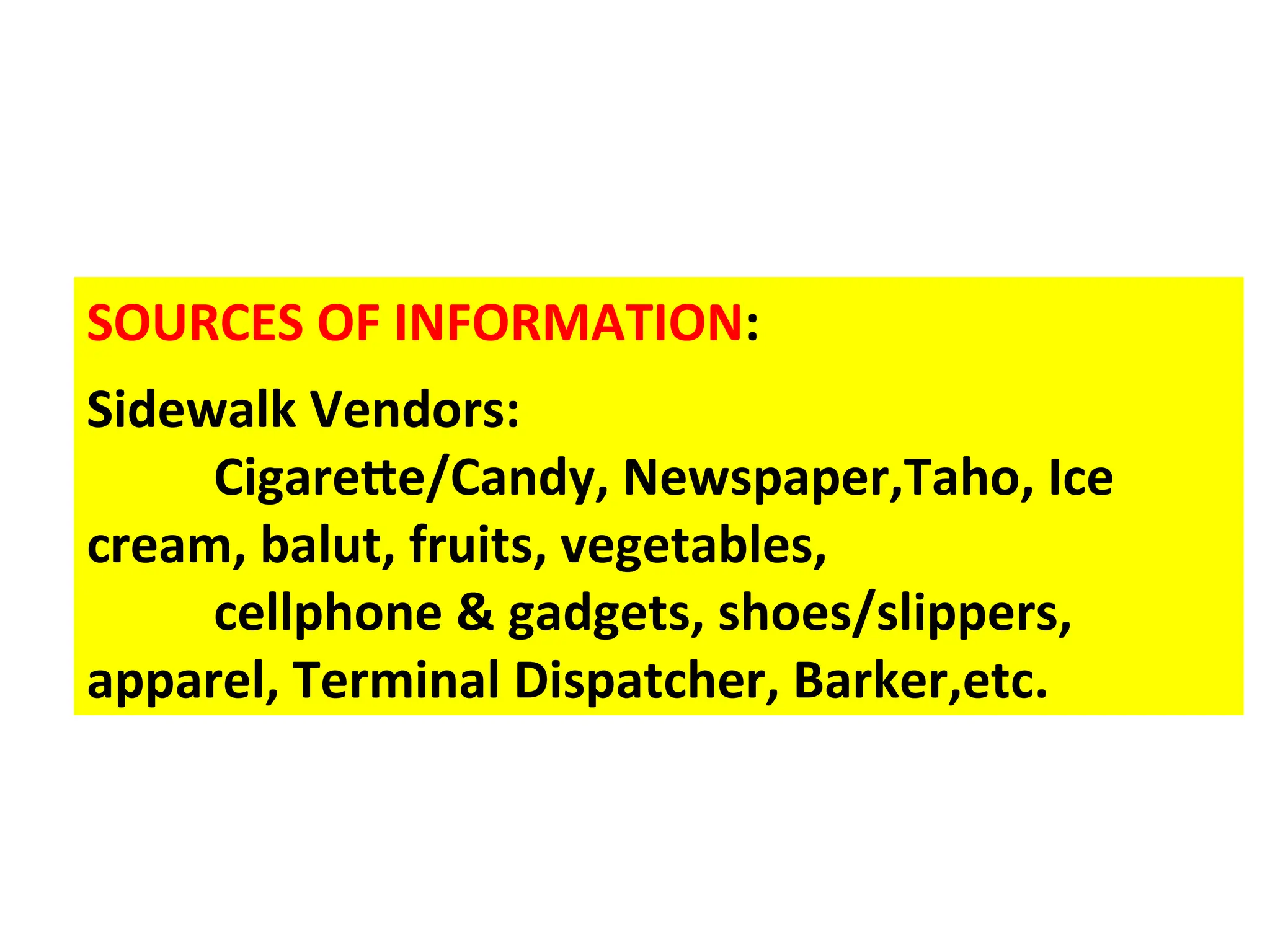
SOURCES OF INFORMATION:
Sidewalk Vendors:
Cigarette/Candy, Newspaper,Taho, Ice
cream, balut, fruits, vegetables,
cellphone & gadgets, shoes/slippers,
apparel, Terminal Dispatcher, Barker,etc.
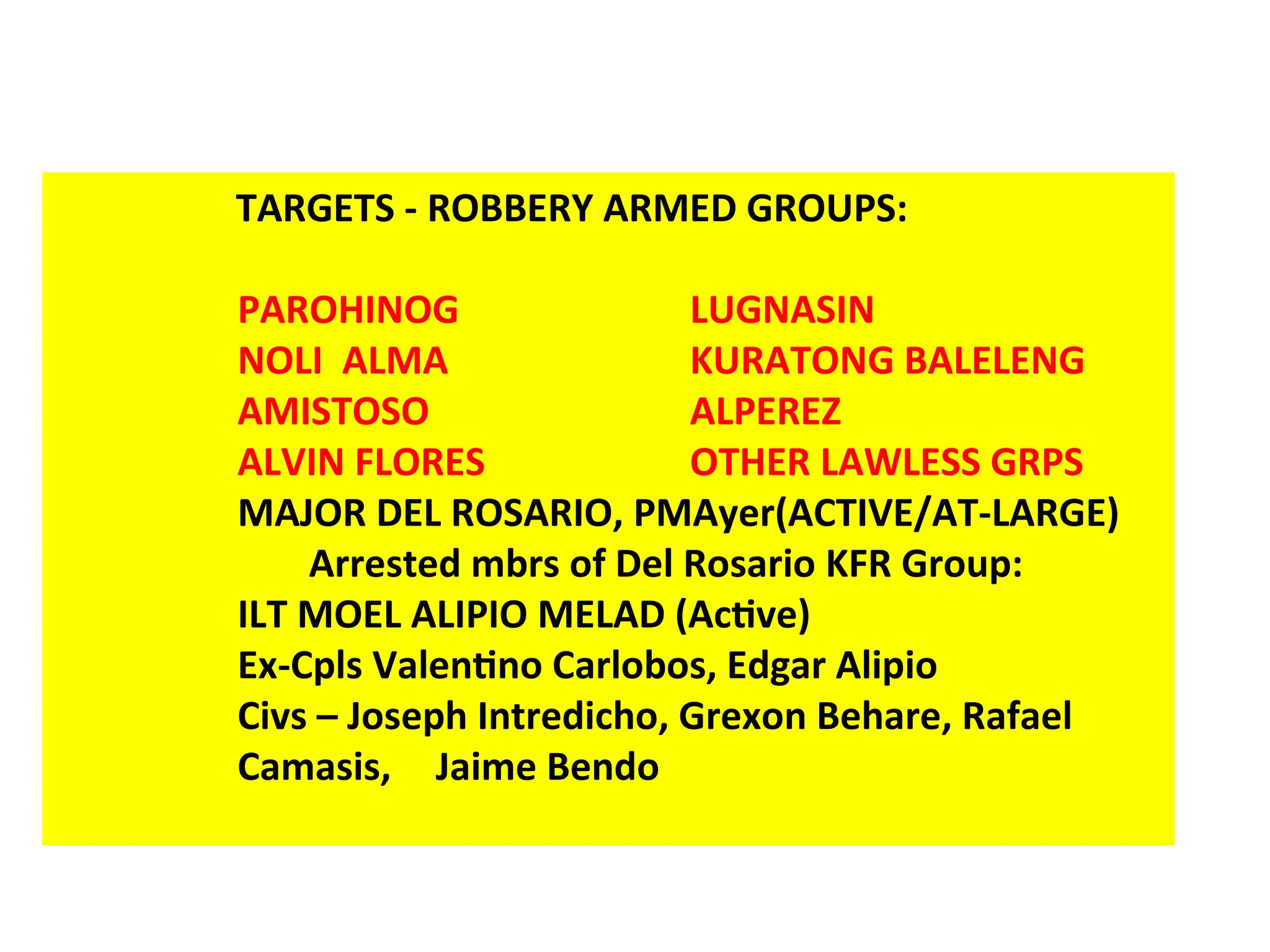
TARGETS - ROBBERY ARMED GROUPS:
PAROHINOG LUGNASIN
NOLI ALMA KURATONG BALELENG
AMISTOSO ALPEREZ
ALVIN FLORES OTHER LAWLESS GRPS
MAJOR DEL ROSARIO, PMAyer(ACTIVE/AT-LARGE)
Arrested mbrs of Del Rosario KFR Group:
ILT MOEL ALIPIO MELAD (Active)
Ex-Cpls Valentino Carlobos, Edgar Alipio
Civs – Joseph Intredicho, Grexon Behare, Rafael
Camasis, Jaime Bendo
REPORT WRITING
AND PRACTICAL EXERCISES
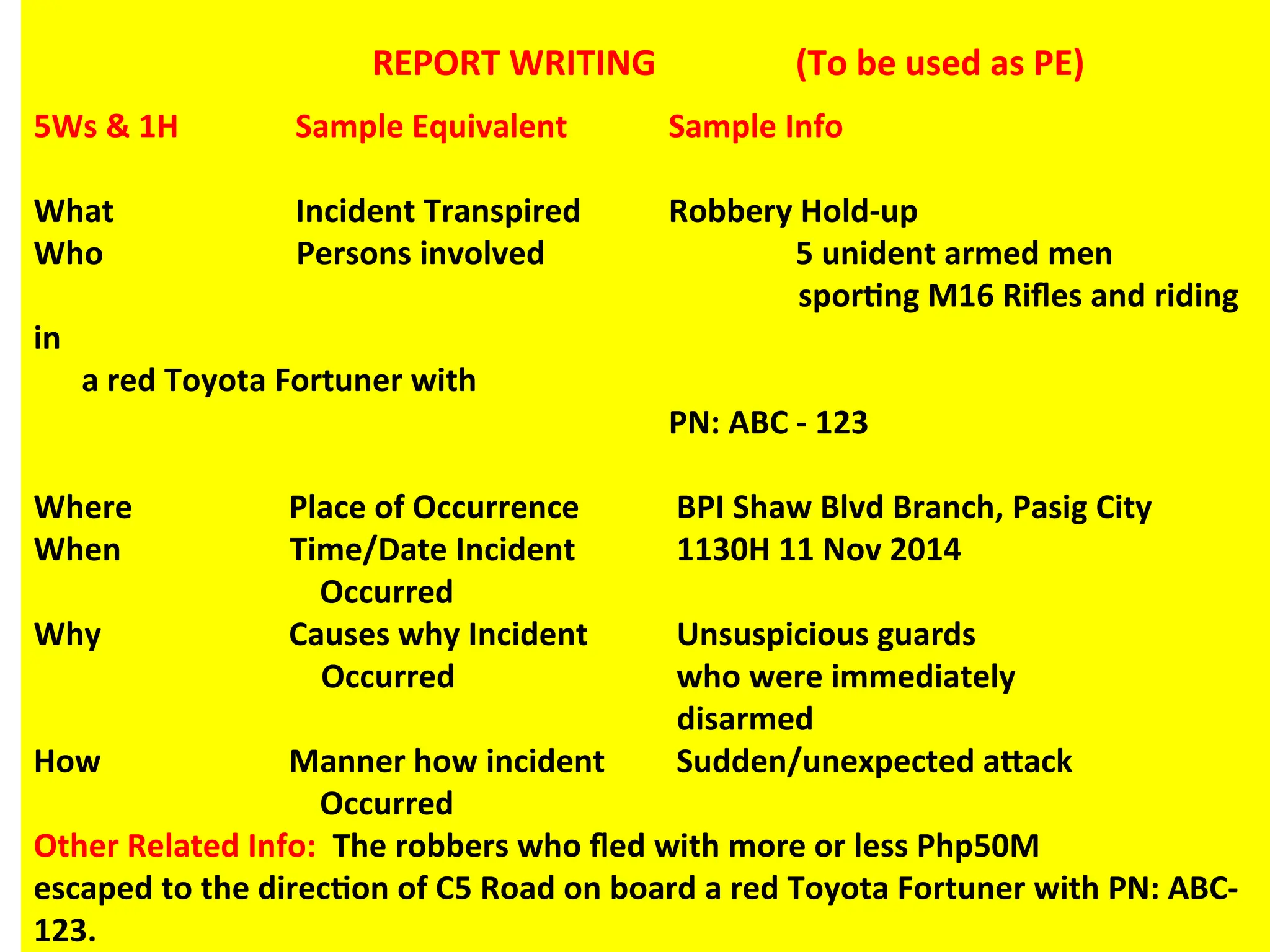
REPORT WRITING (To be used as PE)
5Ws & 1H Sample Equivalent Sample Info
What Incident Transpired Robbery Hold-up
Who Persons involved 5 unident armed men
sporting M16 Rifles and riding
in
a red Toyota Fortuner with
PN: ABC - 123
Where Place of Occurrence BPI Shaw Blvd Branch, Pasig City
When Time/Date Incident 1130H 11 Nov 2014
Occurred
Why Causes why Incident Unsuspicious guards
Occurred who were immediately
disarmed
How Manner how incident Sudden/unexpected attack
Occurred
Other Related Info: The robbers who fled with more or less Php50M
escaped to the direction of C5 Road on board a red Toyota Fortuner with PN: ABC-
123.
INFORMATION REPORT
IDENTITY OF THE SOURCE:____________________
TIME/DATE INFO ACQUIRED:__________________
MANNER INFO ACQUIRED:____________________
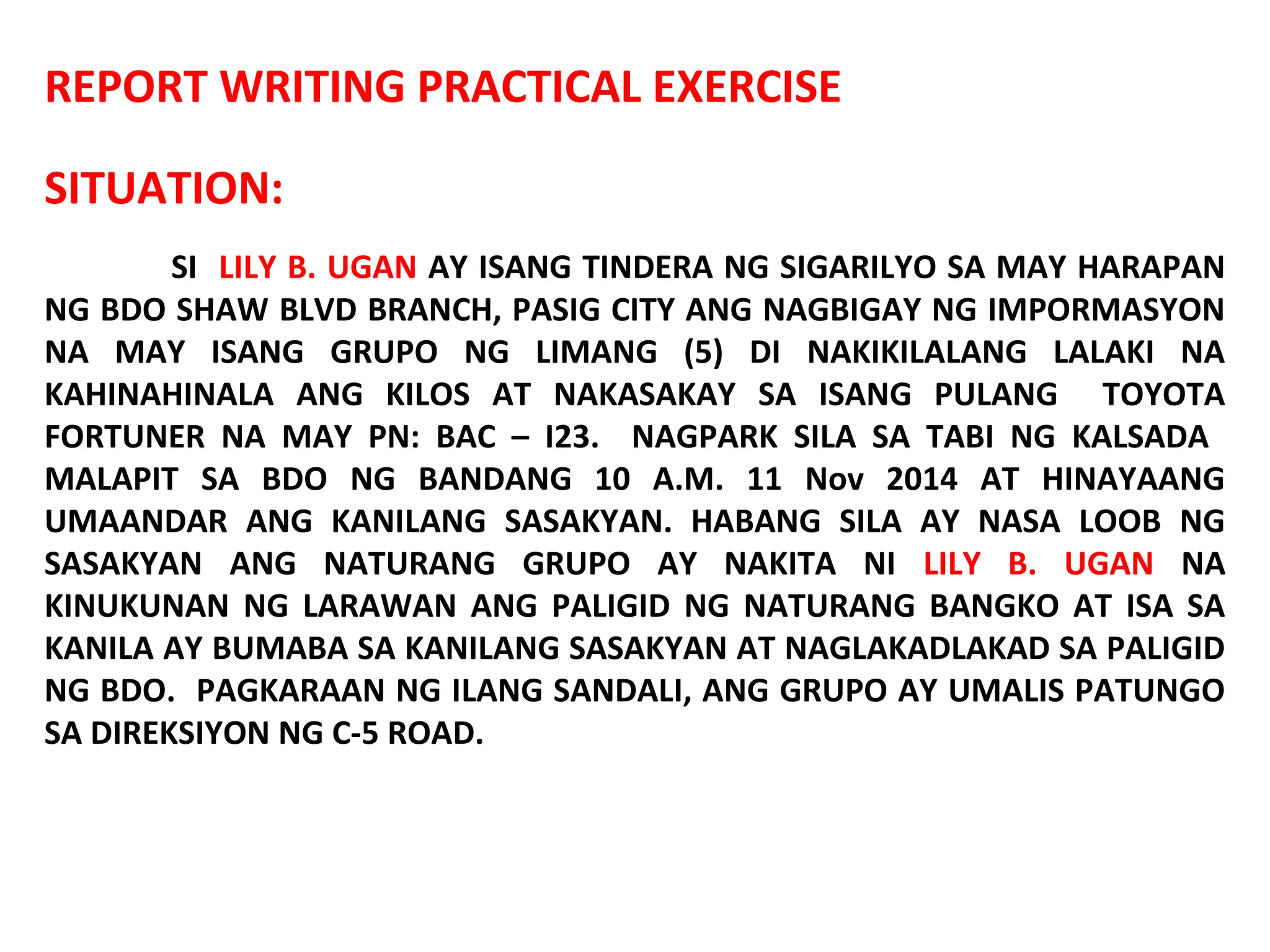
REPORT WRITING PRACTICAL EXERCISE
SITUATION:
SI LILY B. UGAN AY ISANG TINDERA NG SIGARILYO SA MAY HARAPAN
NG BDO SHAW BLVD BRANCH, PASIG CITY ANG NAGBIGAY NG IMPORMASYON
NA MAY ISANG GRUPO NG LIMANG (5) DI NAKIKILALANG LALAKI NA
KAHINAHINALA ANG KILOS AT NAKASAKAY SA ISANG PULANG TOYOTA
FORTUNER NA MAY PN: BAC – I23. NAGPARK SILA SA TABI NG KALSADA
MALAPIT SA BDO NG BANDANG 10 A.M. 11 Nov 2014 AT HINAYAANG
UMAANDAR ANG KANILANG SASAKYAN. HABANG SILA AY NASA LOOB NG
SASAKYAN ANG NATURANG GRUPO AY NAKITA NI LILY B. UGAN NA
KINUKUNAN NG LARAWAN ANG PALIGID NG NATURANG BANGKO AT ISA SA
KANILA AY BUMABA SA KANILANG SASAKYAN AT NAGLAKADLAKAD SA PALIGID
NG BDO. PAGKARAAN NG ILANG SANDALI, ANG GRUPO AY UMALIS PATUNGO
SA DIREKSIYON NG C-5 ROAD.
DOCUMENTATION OF SGS AS ACTION
AGENTS/EYES IN THE BARANGAY
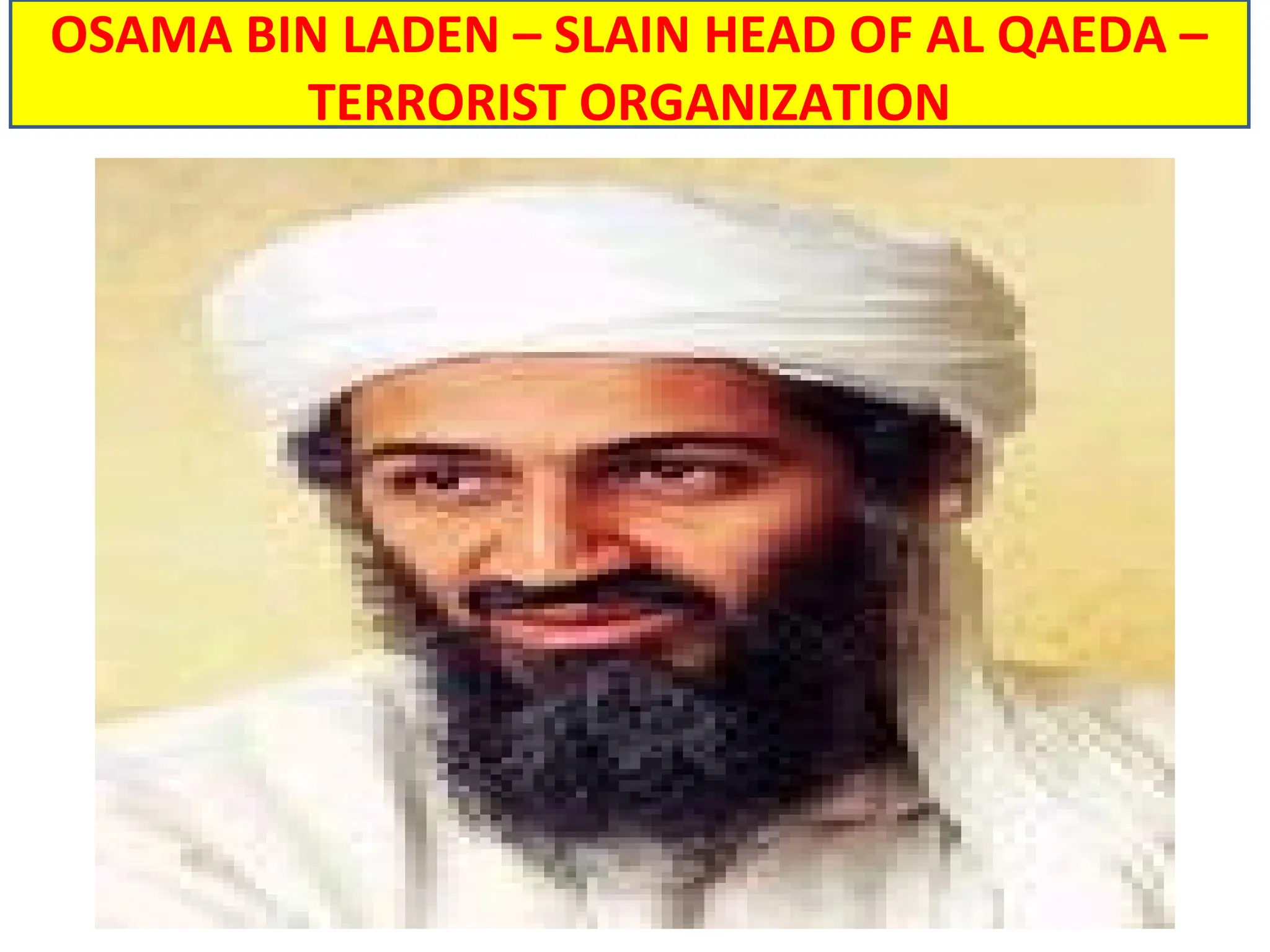
OSAMA BIN LADEN – SLAIN HEAD OF AL QAEDA –
TERRORIST ORGANIZATION
PICTURES OF ROBBERY HOLD-UP SYNDICATES
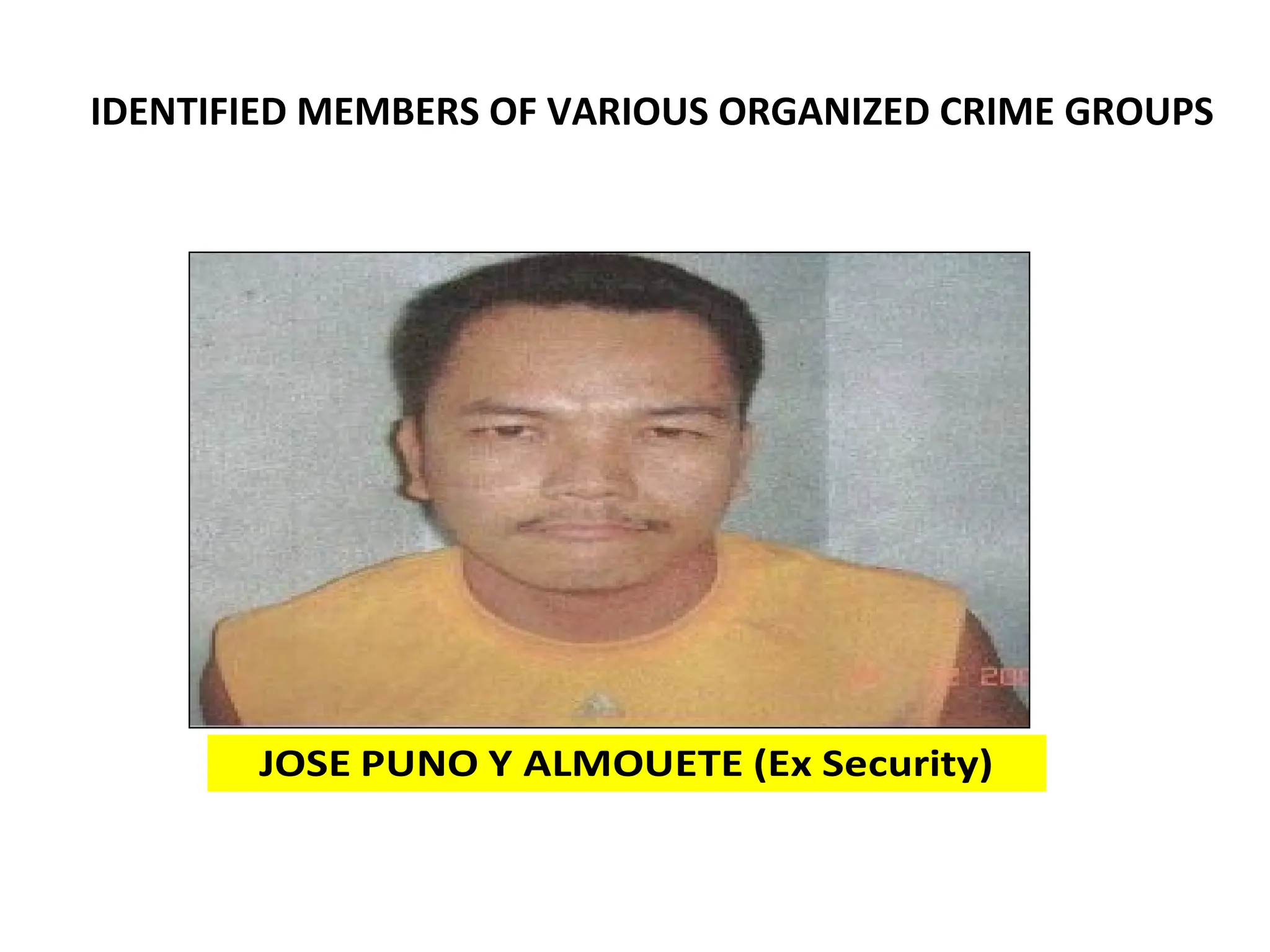
JOSE PUNO Y ALMOUETE (Ex Security)
IDENTIFIED MEMBERS OF VARIOUS ORGANIZED CRIME GROUPS
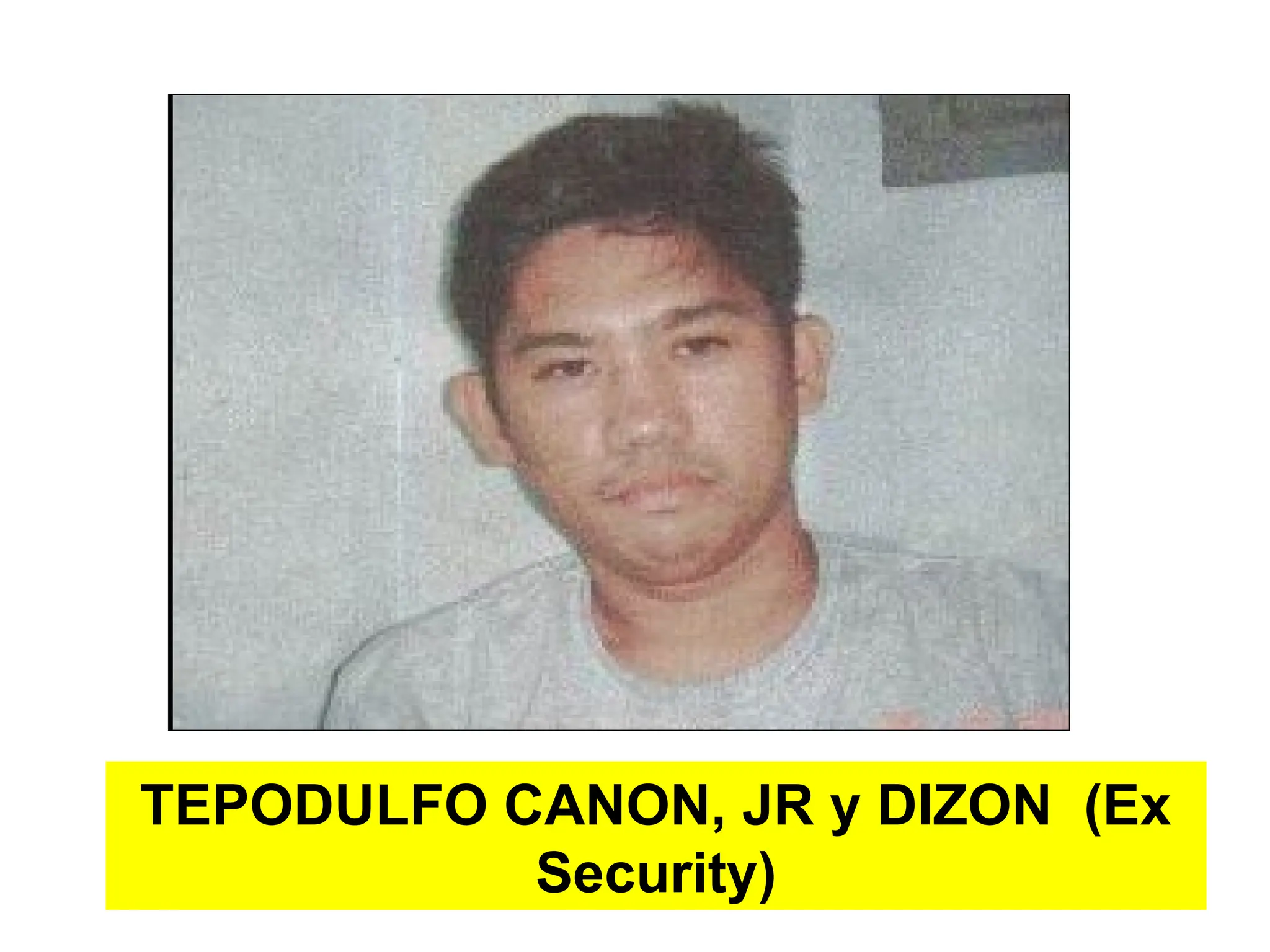
TEPODULFO CANON, JR y DIZON (Ex
Security)
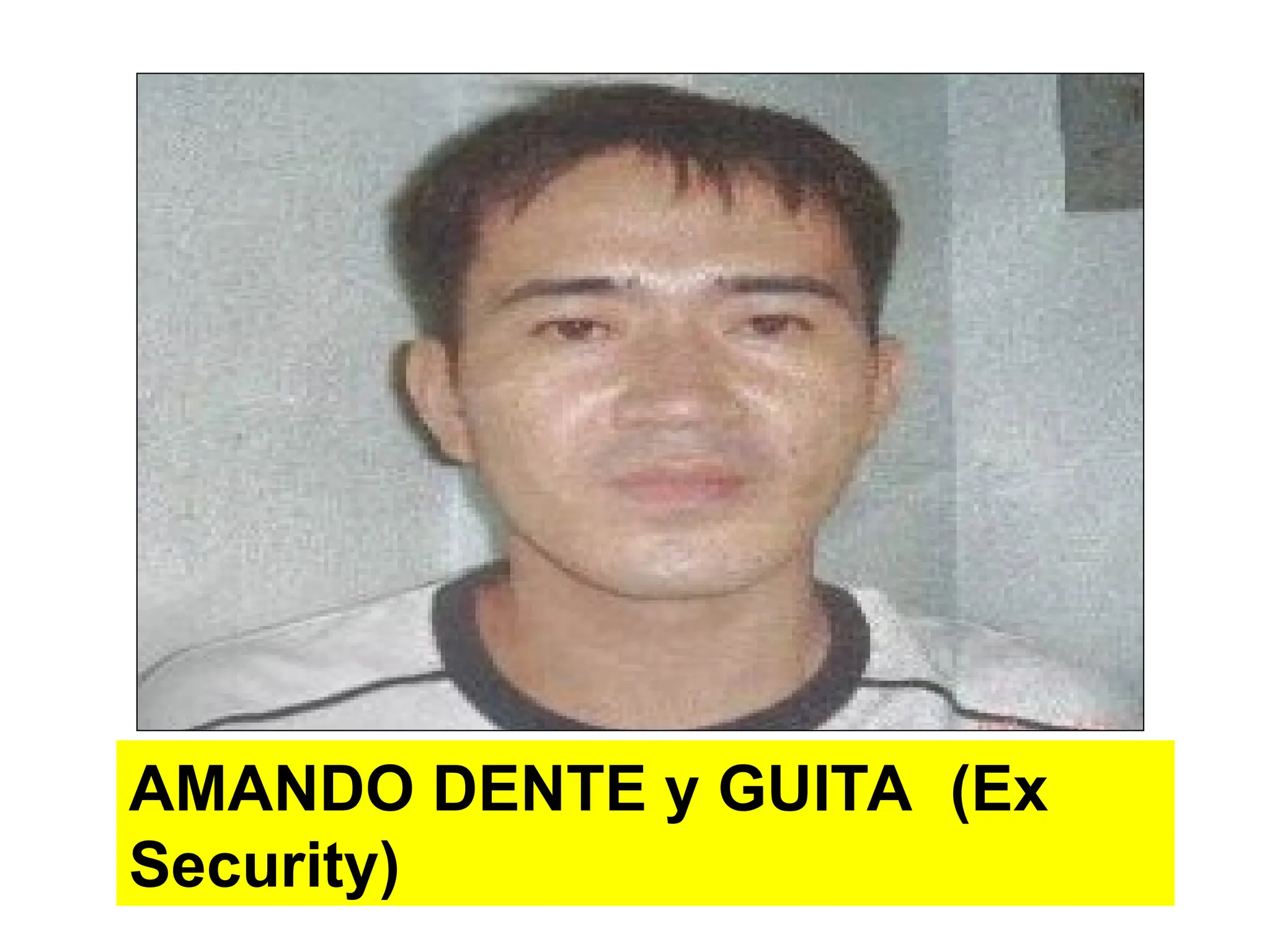
AMANDO DENTE y GUITA (Ex
Security)
EFREN PAROJINOG (Ex
Security)
TIMOTHY YUNGAO (Ex
Security)
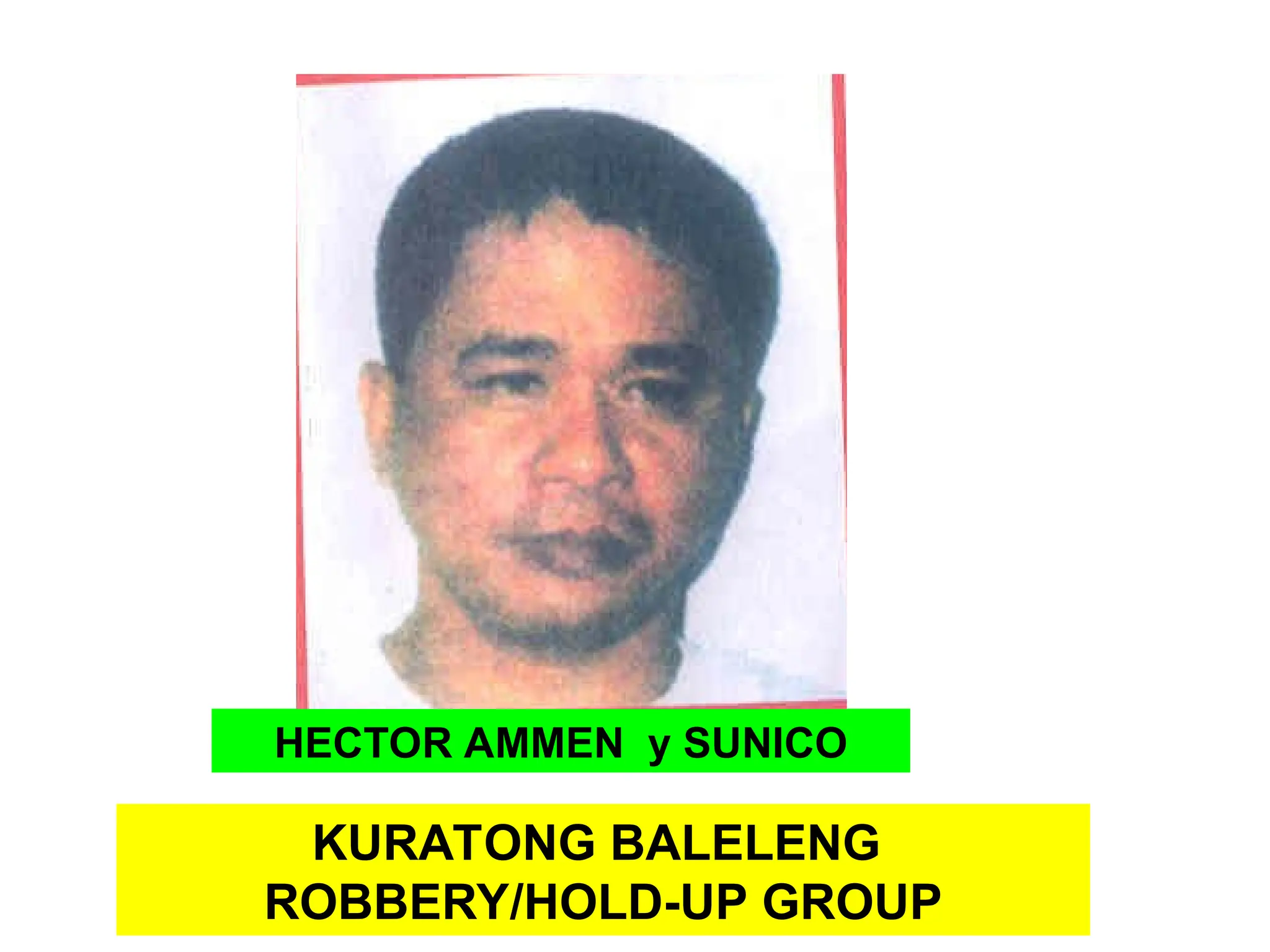
KURATONG BALELENG
ROBBERY/HOLD-UP GROUP
HECTOR AMMEN y SUNICO
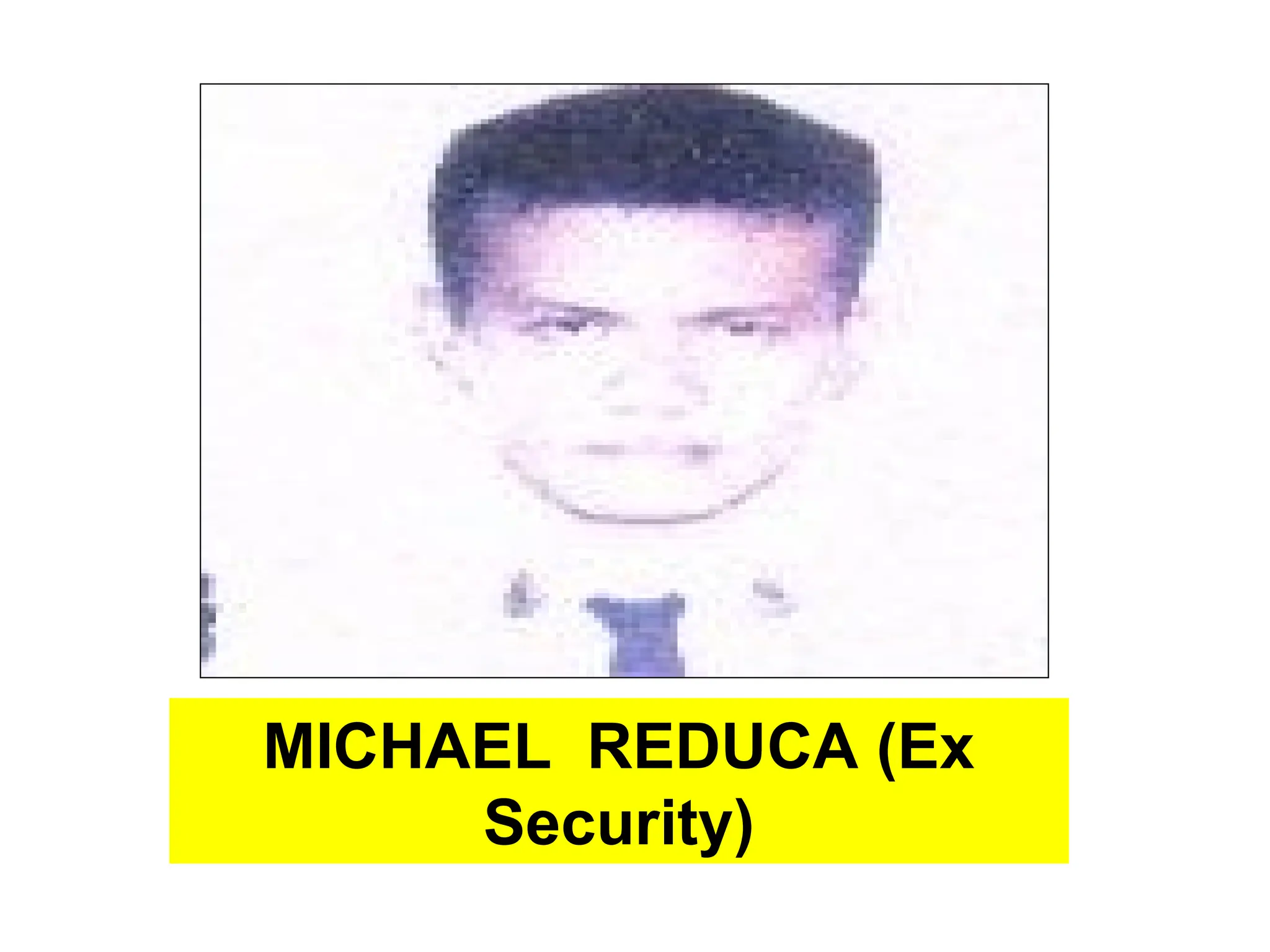
MICHAEL REDUCA (Ex
Security)
MARVIN PURA y LAROLA (Ex
Security)
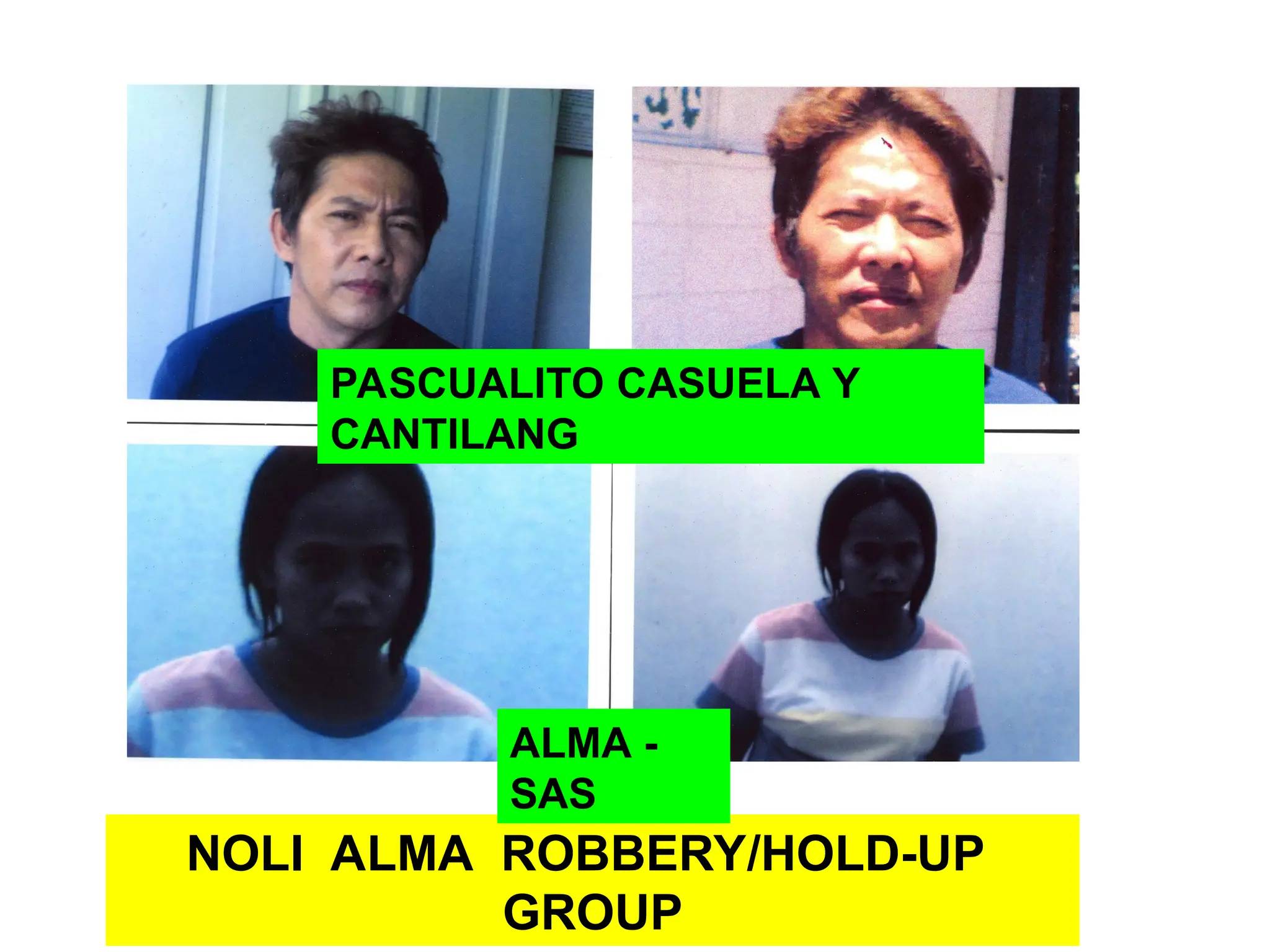
NOLI ALMA ROBBERY/HOLD-UP
GROUP
ALMA -
SAS
PASCUALITO CASUELA Y
CANTILANG
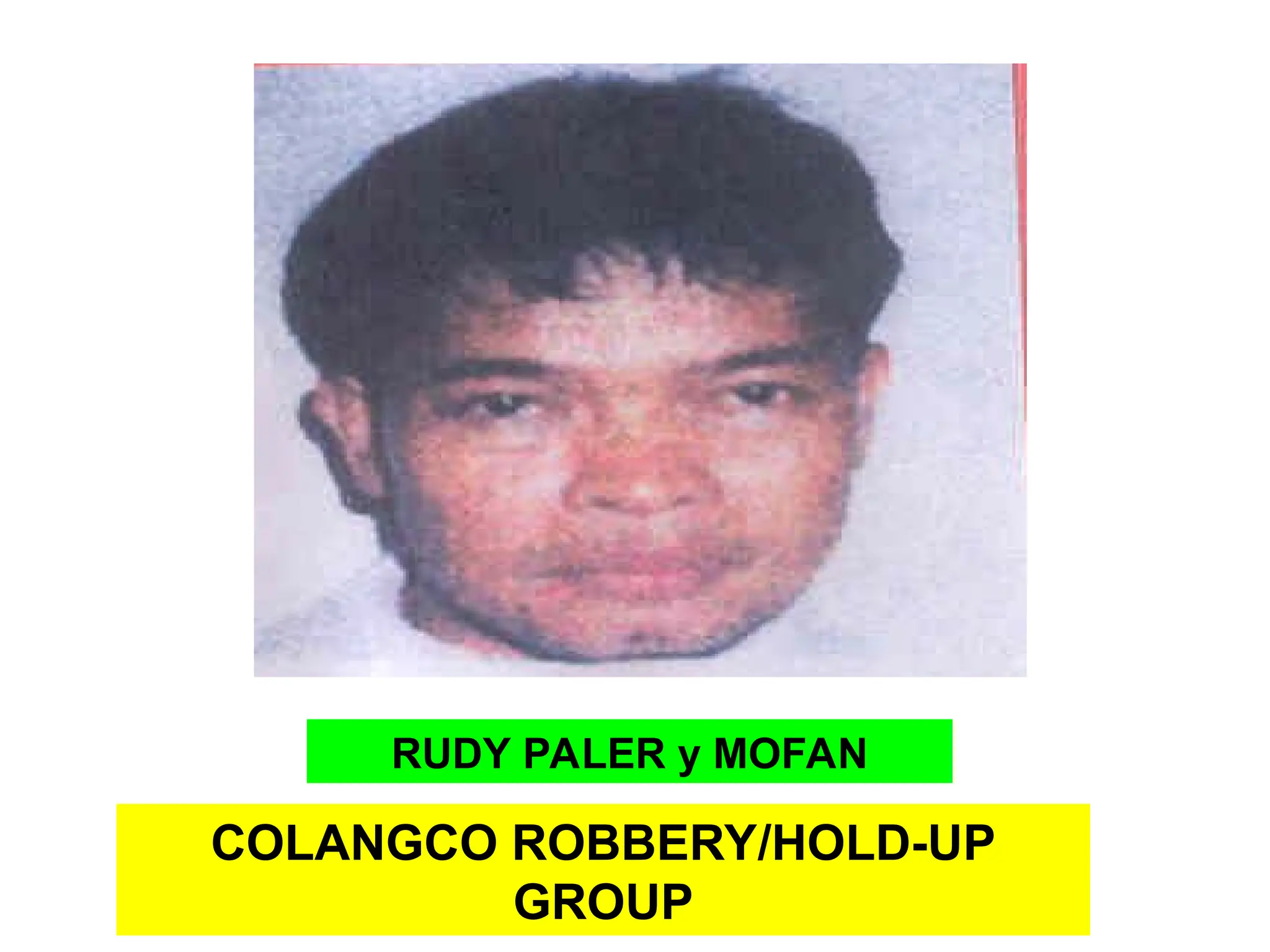
COLANGCO ROBBERY/HOLD-UP
GROUP
RUDY PALER y MOFAN
COLANGCO ROBBERY/HOLD-UP
GROUP
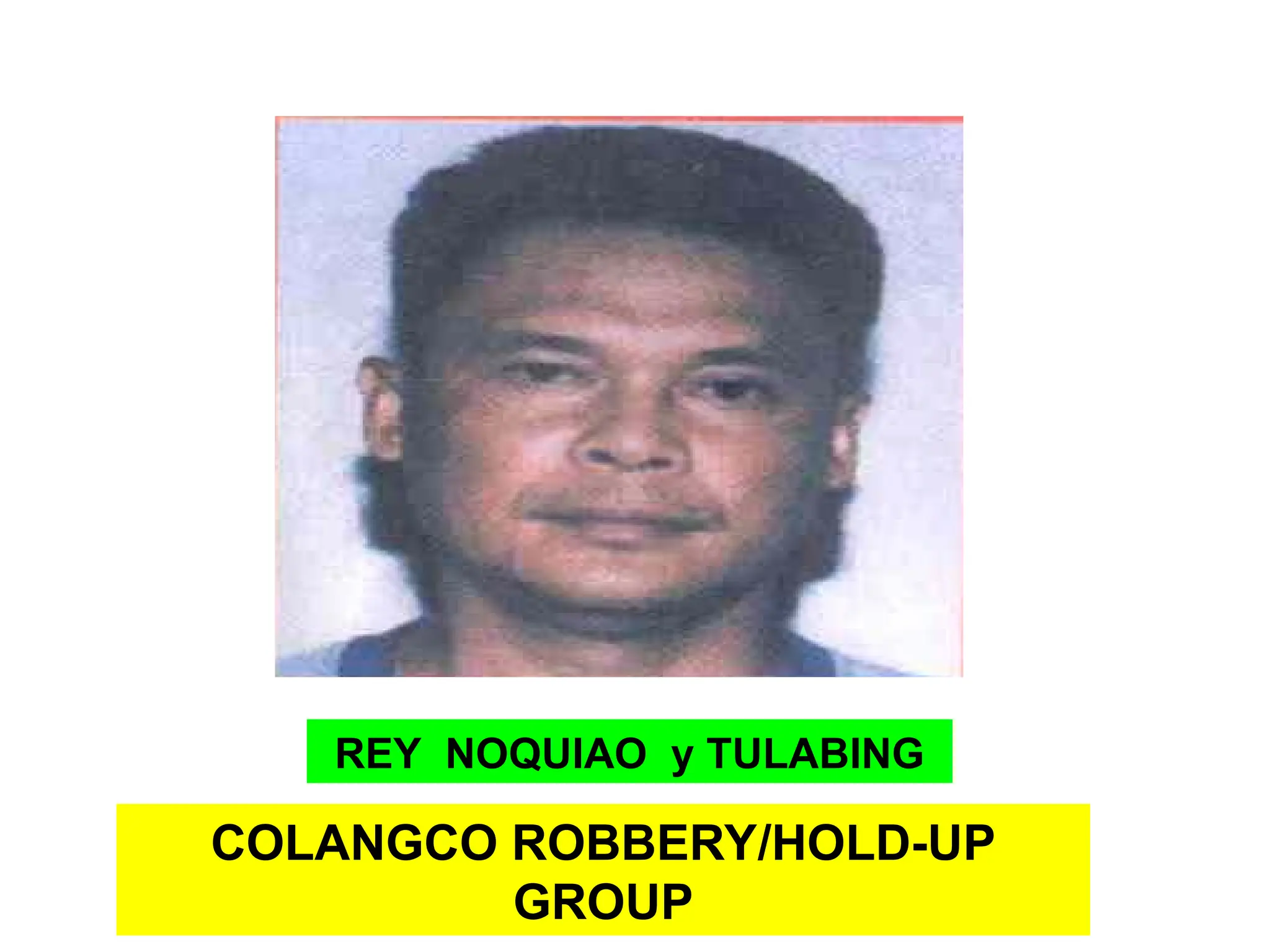
REY NOQUIAO y TULABING
COLANGCO ROBBERY/HOLD-UP
GROUP
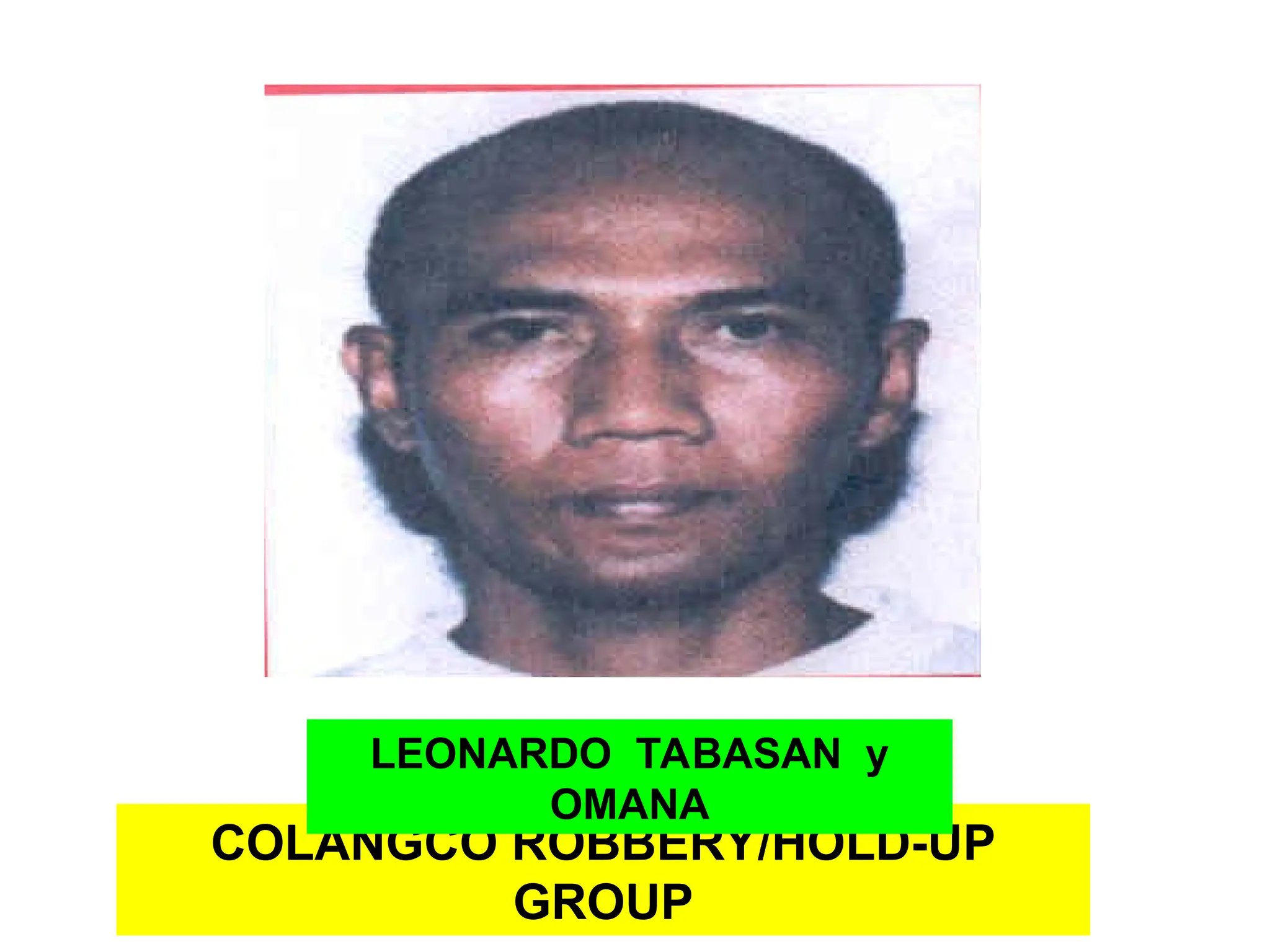
LEONARDO TABASAN y
OMANA
COLANGCO ROBBERY/HOLD-UP
GROUP
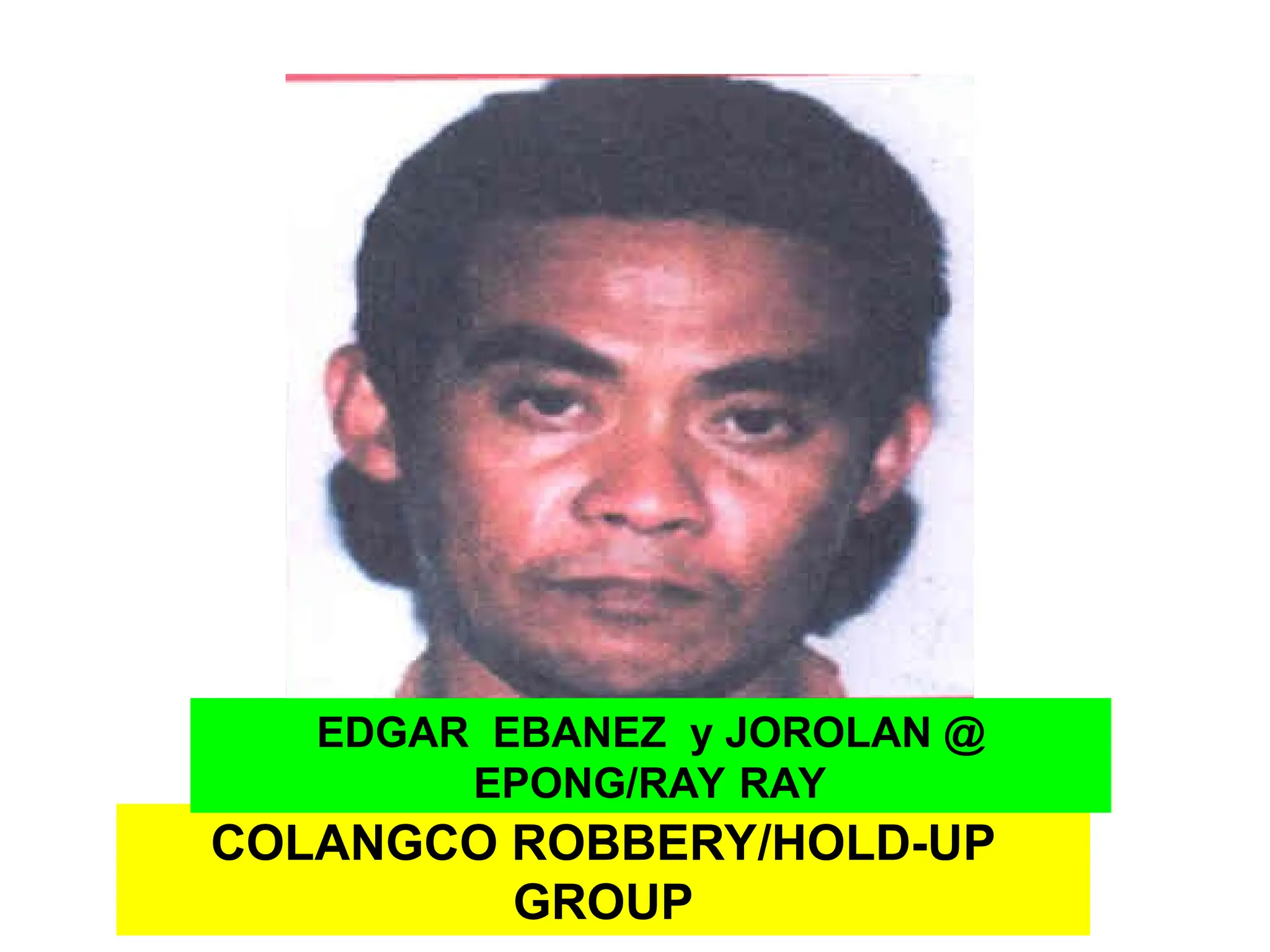
EDGAR EBANEZ y JOROLAN @
EPONG/RAY RAY
COLANGCO ROBBERY/HOLD-UP
GROUP
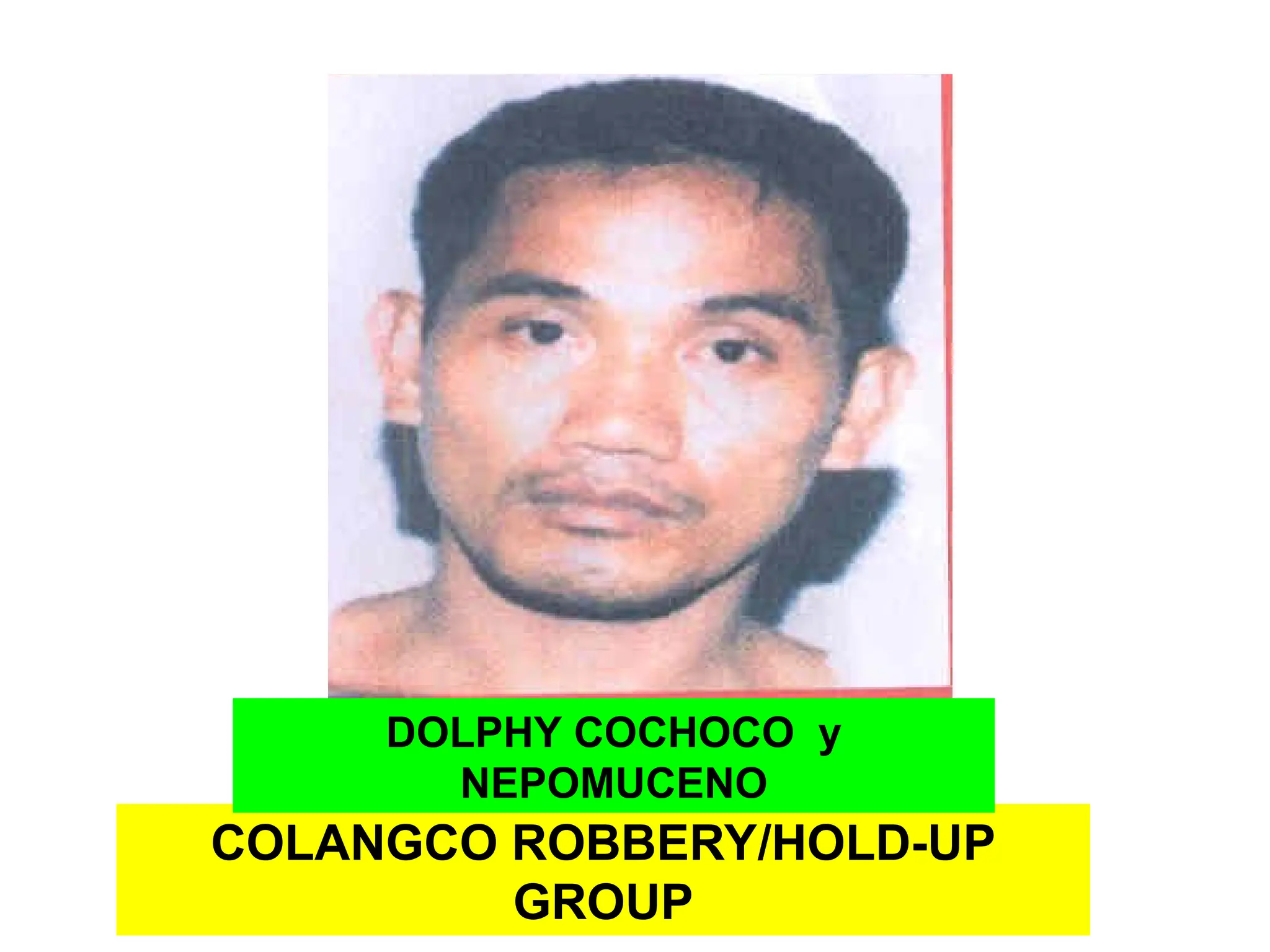
DOLPHY COCHOCO y
NEPOMUCENO
COLANGCO ROBBERY/HOLD-UP
GROUP
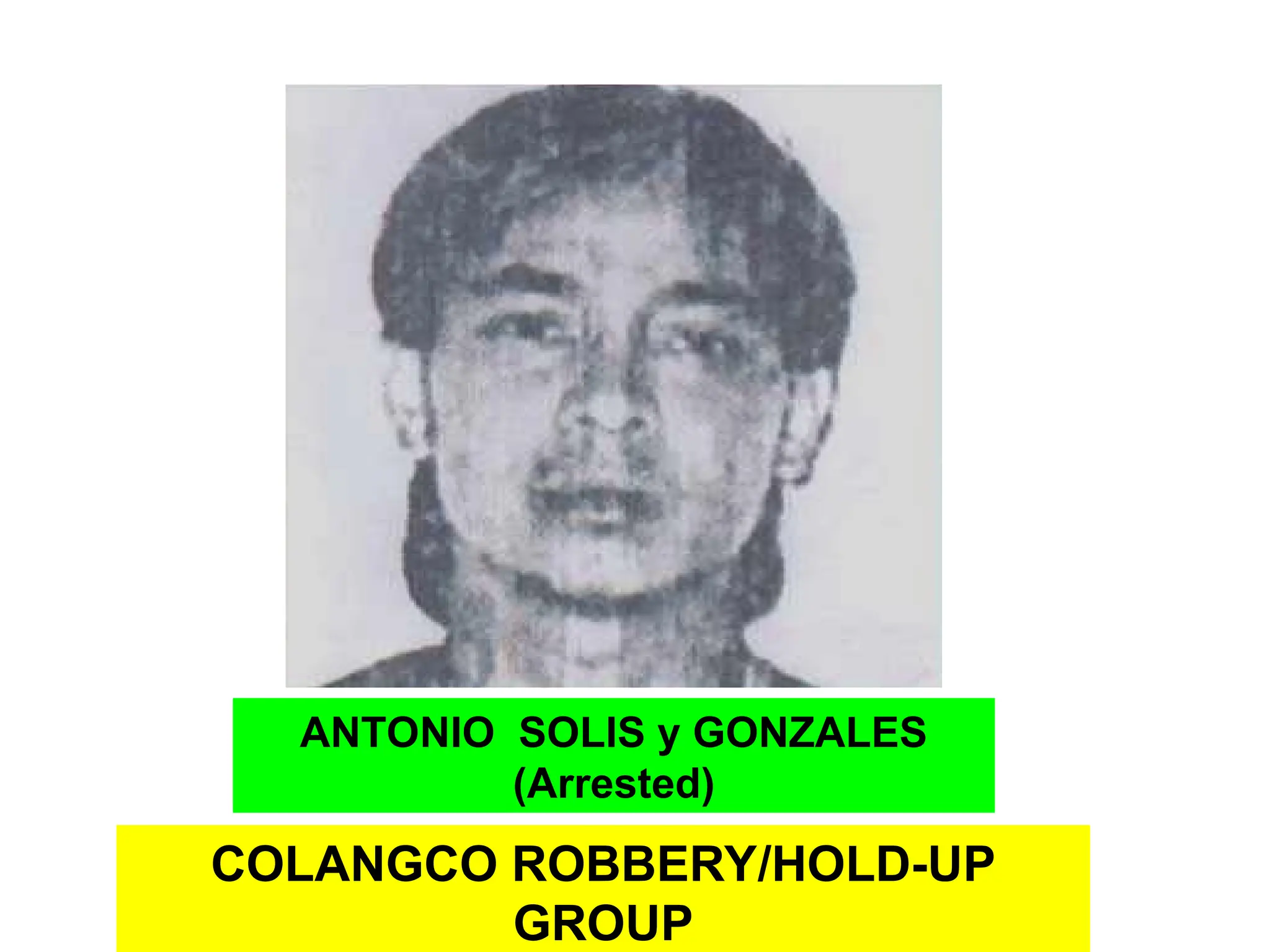
ANTONIO SOLIS y GONZALES
(Arrested)
COLANGCO ROBBERY/HOLD-UP
GROUP
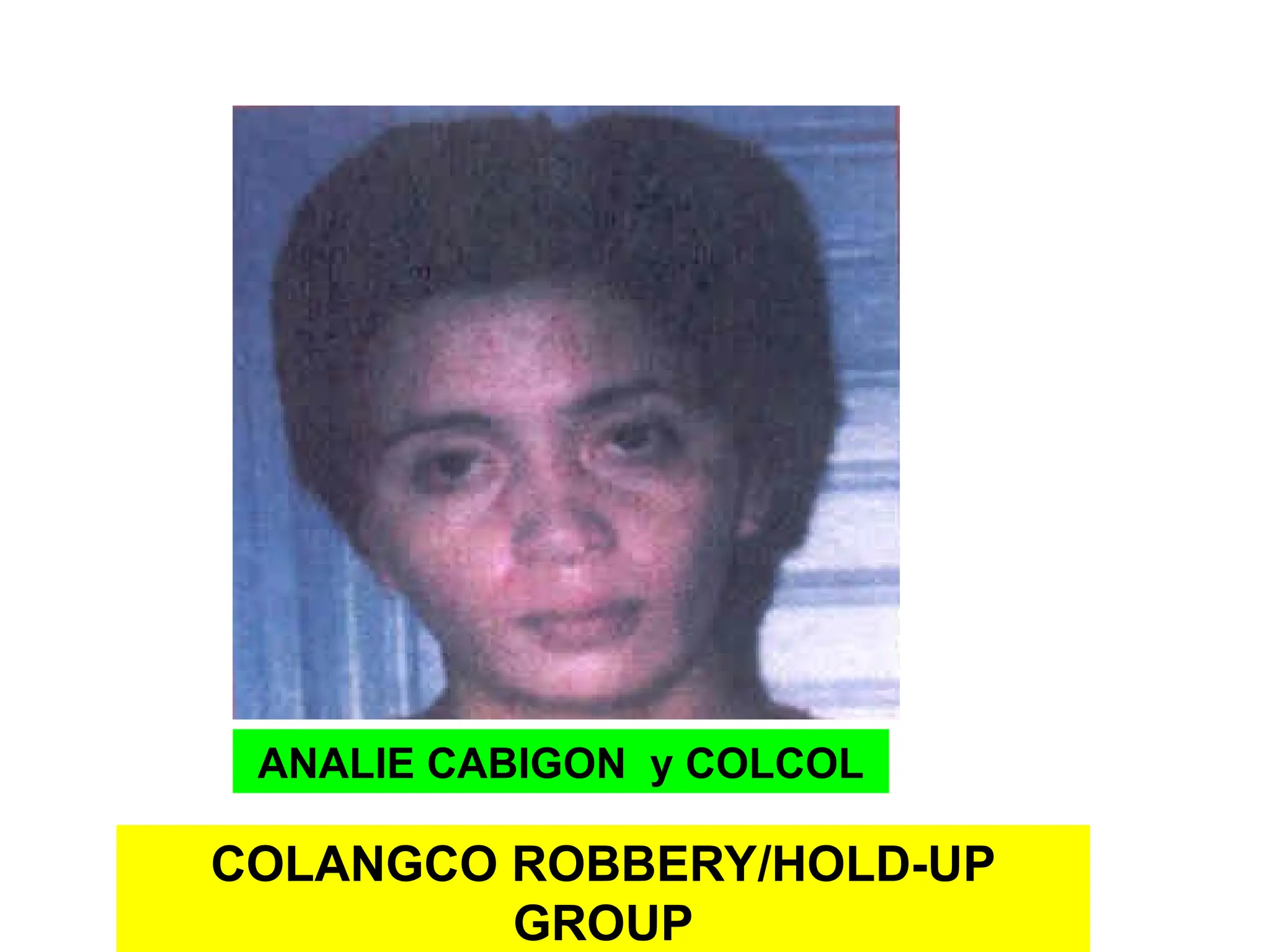
ANALIE CABIGON y COLCOL
COLANGCO ROBBERY/HOLD-UP
GROUP
ALBERT TORRES
COLANGCO ROBBERY/HOLD-UP
GROUP
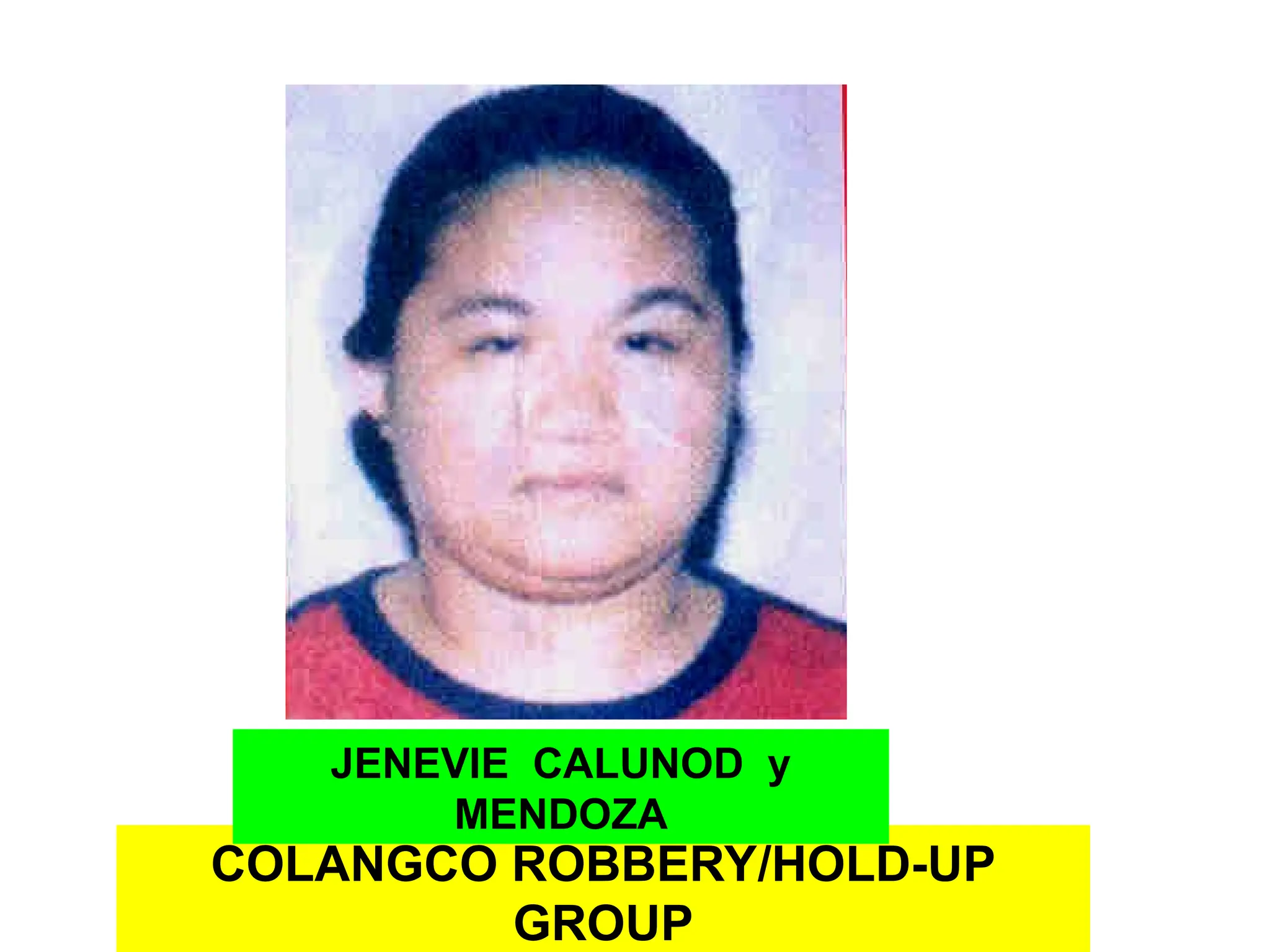
JENEVIE CALUNOD y
MENDOZA
COLANGCO ROBBERY/HOLD-UP
GROUP
a.k.a. BOGART
COLANGCO ROBBERY/HOLD-UP
GROUP
ROY GILBERT COLANGCO
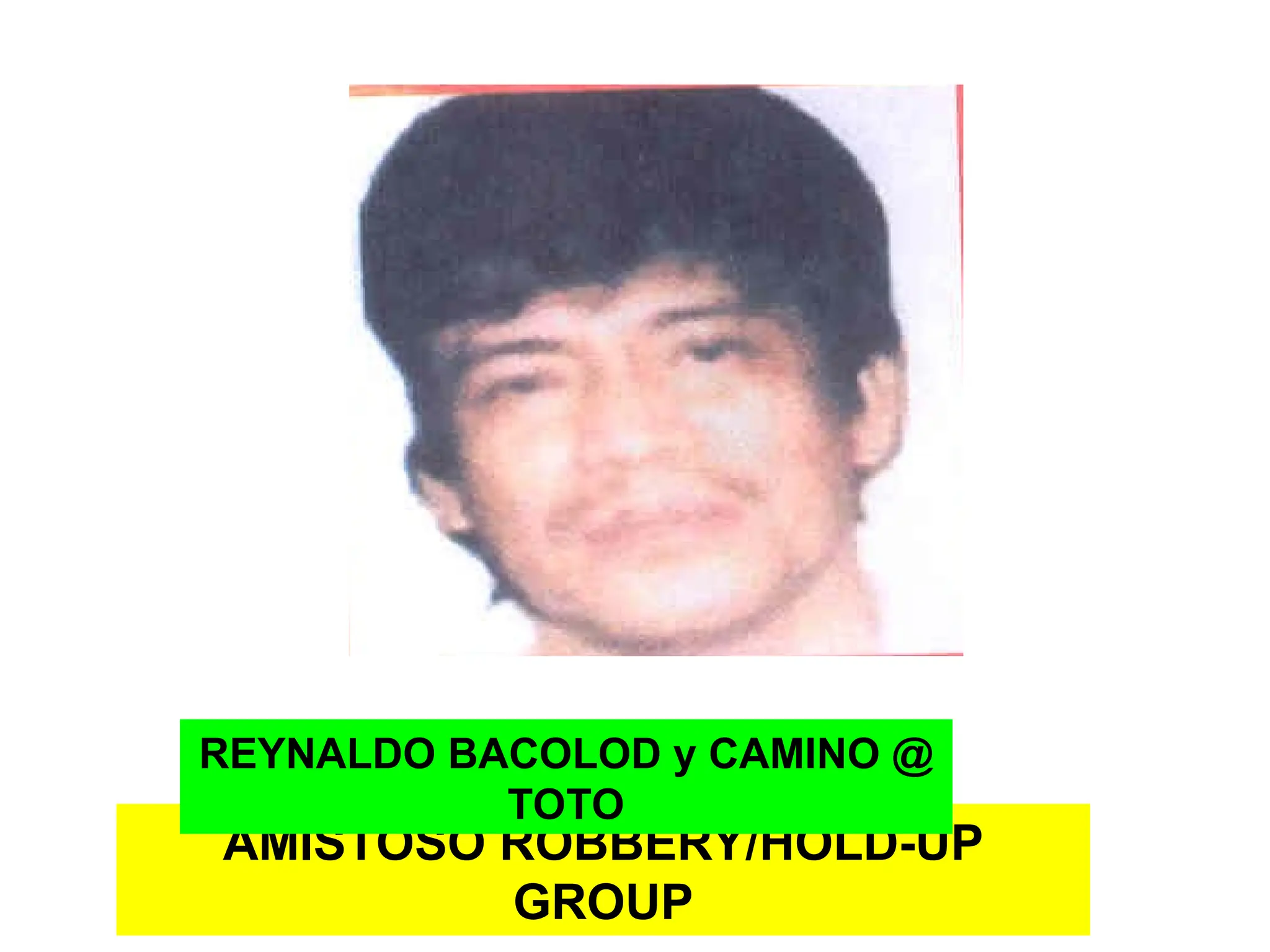
AMISTOSO ROBBERY/HOLD-UP
GROUP
RODOLFPO AMISTOSO y WAYA @
DAGDAG/SAMO HUNG
AMISTOSO ROBBERY/HOLD-UP
GROUP
EDUARDO DELA CRUZ y ANTONIO @
EDDIE/KIT
AMISTOSO ROBBERY/HOLD-UP
GROUP
REYNALDO BACOLOD y CAMINO @
TOTO
ALPEREZ ROBBERY/HOLD-UP GROUP
DIOSDADO NOBLEZA y ALPEREZ @ BOY
ALPEREZ/PIKOT
PAROHINOG ROBBERY/HOLD-UP
GROUP
AYLON PAROHINOG @
ALLON/MARLON/PAR/AL-AL
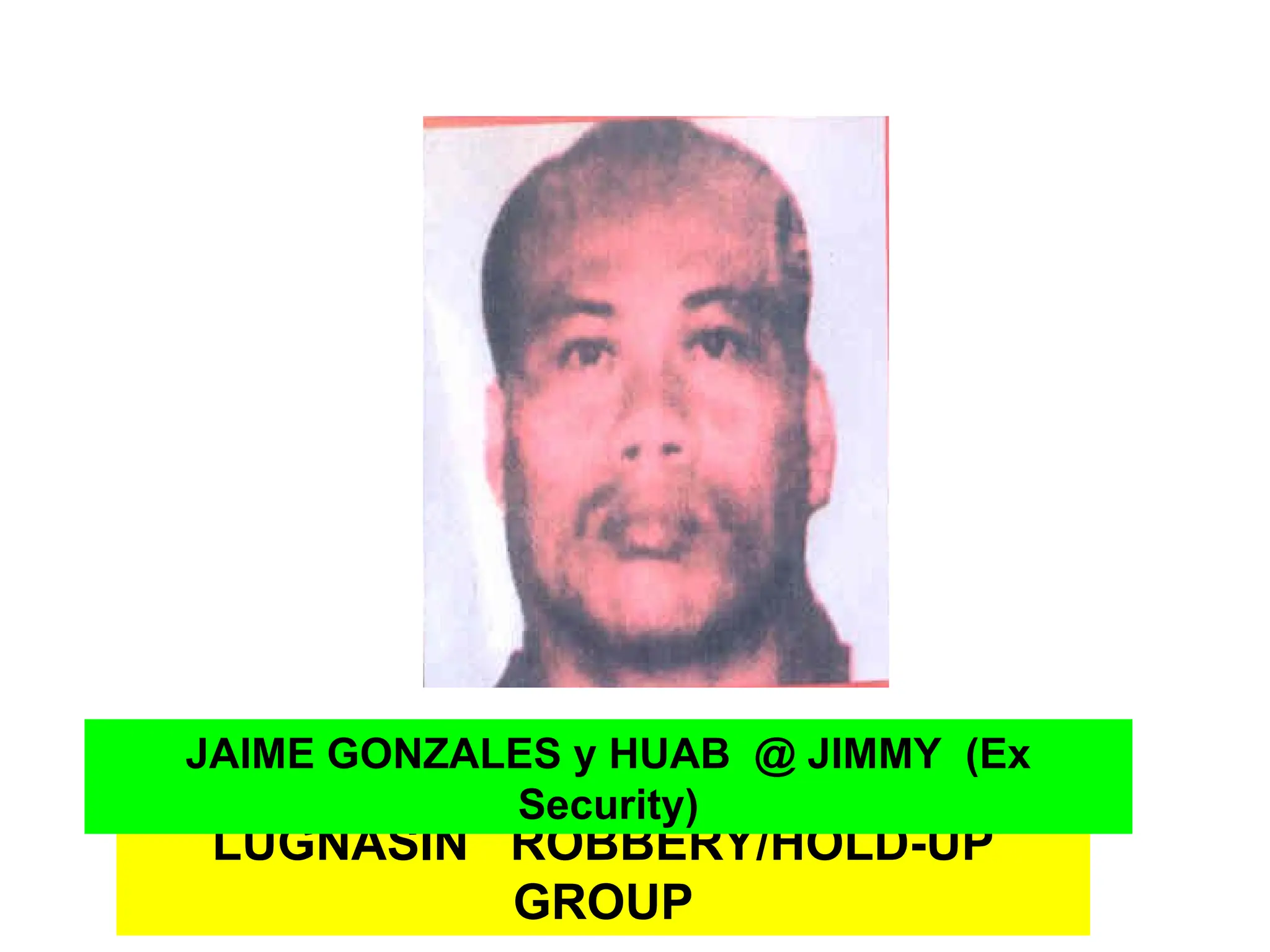
LUGNASIN ROBBERY/HOLD-UP
GROUP
JAIME GONZALES y HUAB @ JIMMY (Ex
Security)
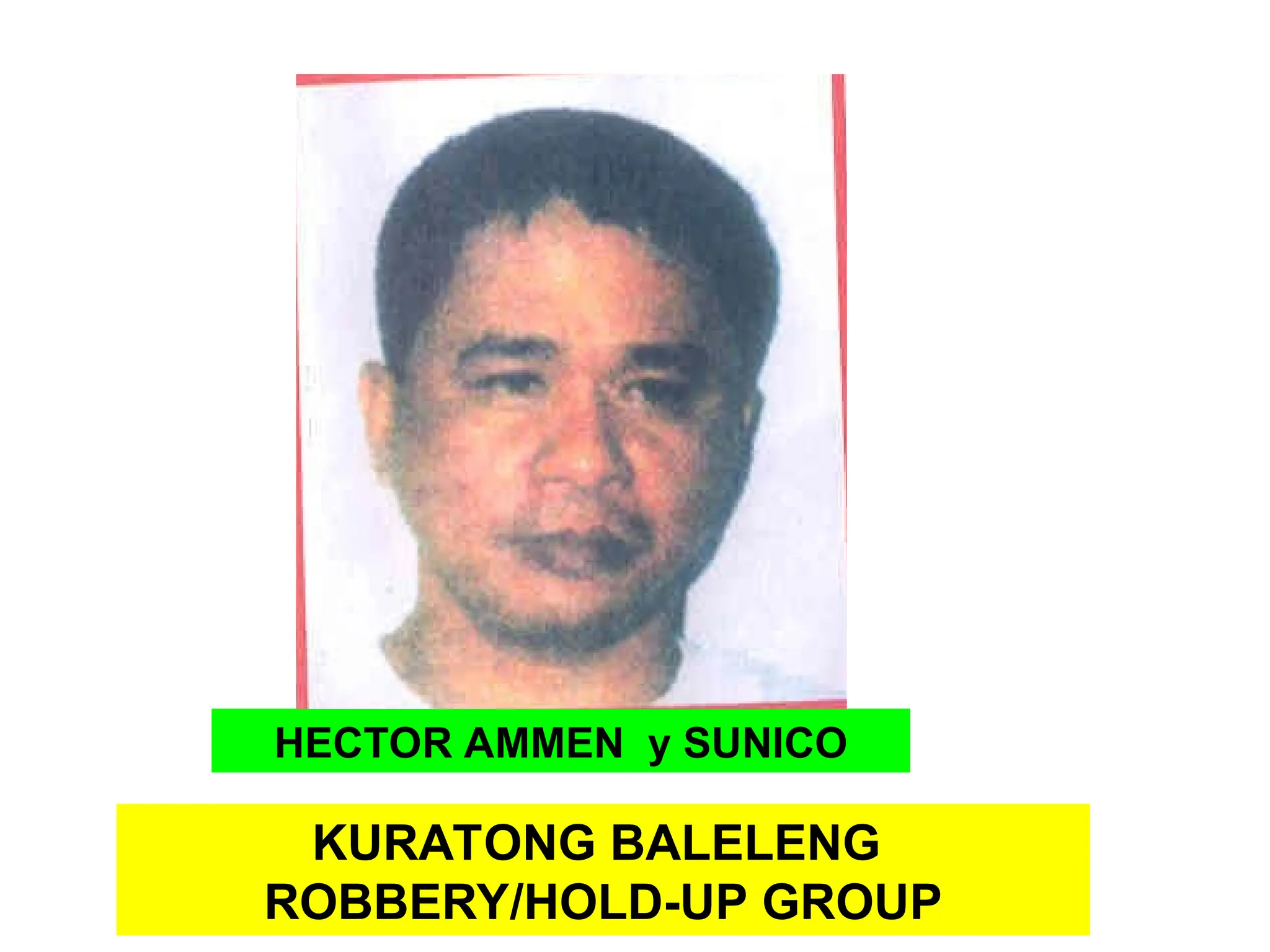
KURATONG BALELENG
ROBBERY/HOLD-UP GROUP
HECTOR AMMEN y SUNICO
END OF PRESENTATION

BARANGAY INFORMATION NETWORK DRIVE .ppt

  • 1.
    BARANGAY INFORMATION NETWORK(BIN) CONCEPT OF UTILIZATION •BRIEF OVERVIEW OF THE LOCAL COMMUNIST MOVEMENT (LCM) •Introduction to intelligence •Information Gathering •The Intelligence Cycle •Various Crimes Information • Report Writing and Practical Exercise •DOCUMENTATION OF AAs/EBs •Syndicated Crime Groups PRESENTED BY: MA. CRISTINA G. CARIÑO Training Officer
  • 2.
    REFERENCES: •PNP INTEL PLAN:BIN dated 23 June 1995 •EO No. 546 •Annex “A” to Intel Guidelines to LOI 38/Y2 (Action Plan “AGAP”) *EO 546 directs the PNP to undertake active role on ISO, there is now a need to further enhance the existing BIN. The BIN seeks to develop a responsive and effective people-based intel network in order to provide the necessary tactical intel requirements supportive of the functions of the PNP and AFP field units directly involved in ISO and anti-criminality campaign.
  • 3.
    OBJECTIVES: 1. To tapand train selected local residents in the intel collection opn. 2. To detect and neutralize enemy efforts at its early stage to infiltrate unaffected areas/brgys. 3. To identify and isolate EN infrastructure, organs of political power in affected areas and prevent the establishment of a well-entrenched network in the nearby areas. 4. To preempt or thwart the projected activities of criminal elements and other threat groups to include the establishment of a base for their opns. 5. To identify the existence/presence of network being used by the CTM, criminal elements and other threat groups in the area. * Specifically, the object of the BIN is to provide the COP MPS, GC, PMG and PD, PPO with a clandestine apparatus to collect usable data on the enemy’s political, military and united front or alliance building activities in their respective AOR.
  • 4.
    CONCEPTUAL FRAMEWORK: In supportof the AFP’s fundamental thrust of security operations, the PNP shall intensify and broaden intel covrage in: DETECTING, MONITORING and NEUTRALIZING the LCM, criminality and other threat grps with emphasis on the brgy as the breeding ground of basic party organs and mass base. The PNP intel community shall undertake the following: 1. Establish info networks in all brgys, if possible, to neutralize insurgency and criminality at all levels and denying the EN access to brgy manpower and material resources. 2. With the PN P Speakers Bureau, local leaders and key communicators in the area to take active participation and keeping the people on the side of the govt and involving them in the fight against insurgency/criminality. 3. Disseminate info in order to develop the territorial and tactical units into well-motivated and well-informed counter- insurgent and anti-criminality forces.
  • 5.
  • 9.
    SUBVERSION  Act tooverthrow  Activity carried out by individuals or group of individuals, which seek to alter the form of government thru unconstitutional means.  Action principally clandestine or covert, designed to undermine the military, economic psychological, moral or political strength of a regime. INSURGENCY  A condition of revolt against a government that is less than an organized revolution and is not recognized as belligerency. This definition is used in conjunction with the condition of insurgent war. Within the present context, subversive insurgency is communist led and inspired.  Has a more political color and social color combined with military activities. It covers guerilla warfare, which is only a part of its movement.
  • 10.
    The Local CommunistMovement is currently divided into two groups the Mainstream CPP/NPA/NDF of Reaffirmist and the breakaway anti- SISON Rejectionist faction.
  • 11.
    1. REAFFIRMIST -SISON Group Party: Communist Party of the Phil Leader: Jose Ma SISON Armed Group: New Peoples’ Army (NPA) United Front: National Democratic Front (NDF) Ideology: Marxist-Leninist-MaoTse-Tung Thought following three basic principles: Theory of Classes and Class Struggle (1) Theory of the State and Revolution and the Proletarian Dictatorship (2) Theory of the Protracted People’s War (Encircling the cities from the countryside). Our primary concern at the moment is the CPP/NPA/NDF because it is far stronger in terms of manpower and firepower than the other faction, better organized and more widely scattered in various parts of the country. The goal of the CPP/NPA/NDF is the seizure of political power and supplants our democratic from of government with a communist rule.
  • 13.
    The New People'sArmy (NPA), led by José Ma Sison (a former University of the Philippines lecturer) and Bernabe Buscayno (alias Dante), stole the limelight from the Hukbalahap guerrillas and the old Soviet-style People's Army. The NPA was joined during the year by two able young defectors from the Philippine armed forces, who brought government matériel with them. In one NPA attack government helicopters were destroyed. The headquarters of two large U.S. oil companies, the Con-Con conference hall, the University of the Philippines, and even the president's palace were among the targets of bomb or grenade attacks, and a Philippine Air Lines BAC-111 jet was hijacked by a group of young radical Filipinos to Canton in the People's Republic of China.
  • 14.
    After ten oppositionLiberal Party politicians were killed and almost 100 injured by grenades during a political rally in August, President Marcos, blaming Communists for the incident, suspended the right of habeas corpus indefinitely. A Senate committee concluded in September that 'there is no clear or present danger of Communist-inspired insurrection or rebellion' and estimated the NPA's strength at under 300. Marcos subsequently dropped the charge that Communists were responsible for the August bombing and claimed he did not know what group was responsible. He also restored the right of habeas corpus.
  • 15.
    Organization The party utilizesthree main weapons in its revolutionary struggle, namely: the Party (CPP), the Army (NPA) and the United Front (NDF) that shields the activities and carry out the propaganda of the communist movement. (1) The CPP – the Communist Party of the Philippines is the brain of the people’s revolution. It provides the political leadership to the movement and determines the general line and direction of the revolution. It controls the activities of the army and the united front. (2) The NPA – the New Peoples Army; it is the military arm of the Party tasked with the advancement of the protracted people’s war through the principal use of the armed struggle.
  • 16.
    (3) The NDF– National Democratic Front is the shield of the revolution. It provides an umbrella organization for the CPP/NPA and other militant and “progressive” organization including CPP and CPP- infiltrated groups. It is composed of various territorial and sectoral non-governmental organizations as well as functional organizations tasked with advancing the legal program of the communist movement hitherto taking care of propaganda and black propaganda activities. (4) The Party also maintains an International Department, which takes care of generating support from other countries or from other communist movement from abroad (e.g., from the communist party in Australia, the Netherlands, and from the other socialist countries in Eastern Europe). To maintain organizational unity, the CPP/NPA/NDF adopts a committee system to organization based on the principle of democratic centralism. A Central Committee directs and supervises the different functional staffs and regional committees. The basic unit of the CPP is the party branch, which is established in barangays, urban poor communities and factories.
  • 17.
    Strength and Weaknesses TheCPP/NPA/NDF has embarked on a rectification process that seeks to isolate the anti-SISON Rejectionist CPP faction, reiterate the ideological and political lines of the movement and intensify recruitment and organizational expansion work. In line with this, the Party has launched a program to win back former members and sympathizers who had deserted and lied low from the movement. Recruitment activities are now conducted not only among minors but also among the ranks of “advanced activists” among the sectoral front groups. They also extorted money from business establishments, mining firms, bus operators and multinational corporations, farmers and even small time entrepreneurs, raking in about P108-million in 1999 alone. For those who refuse to give in to their demands, they burned and destroyed company equipment vehicles and facilities. The Party’s overseas revolutionary work has enabled it to generate funds and support from among fraternal parties, other revolutionary movements and NGOs with whom it has established solidarity ties.
  • 18.
    (1) internal rift (2)health problems of guerrilla fighters (3) limited number of qualified and reliable party cadres and organizers (4) deteriorating quality of recruits (5) drying up of logistical base (6) financial opportunism of some regional and staff leaders However, despite the organiza-tional inroads of the DTs, the LCM remains beset by the following problems and weaknesses:
  • 19.
    The CPP/NPA/NDF hasthe following capabilities: (1) Intensify tactical armed offensives in the countryside complemented by occasional urban armed activities against selected targets; (2) Intensify organizational expansion work, broaden their mass base and expand operational areas; (3) Recruit more members and procure more firearms and other logistical supports; (4) Intensify agitation-propa-ganda activities harping mainly on popular but provocative issues and problems gripping the nation to rally more supporters/sympathizers and alienate the people from the government; (5) Embark on wide-scale fund-raising drive to support the increasing tempo of the insurgent activities; (6) Covertly work for the resumption of the GRP-NDF peace talks for tactical expedience; belittle and if possible derail the government’s peace initiatives with individual insurgent leaders in the field; (7) Mount counter propaganda blitz to neutralize the bad publicity against the top CPP/NPA/NDF leadership and the insurgents’ terrorist and bandit-like activities; (8) Intensify vilification drive to marginalize the anti-SISON Rejection group; and, (9) Strengthen the ideological mooring of the insurgents.
  • 20.
    2. REJECTIONIST GROUPS Thisfaction disagrees with the CPP/NPA/NDF’s strict adherence to the Maoist Concept of protracted people’s war and is instead advocating the Nicaraguan model of insurrectionary strategy and tactics aimed at creating a revolutionary situation by staging crippling strikes and urban terrorism. It has been polarized into NINE (9) sub-groups due to personal and policy differences, to wit: (1) PMP (Partido ng Manggaga-wang Pilipino) Leader: Filemon LAGMAN - Chairman Date Established: 30 Jan 1999 Front Orgns: SANLAKAS (Sandigan ng Kalayaan at Demokrasya para sa Sambayanan; BMP (Bukluran ng Manggagawang Pilipino), KAMALAYAN Armed Group: Armadong Partisano ng Paggawa (APP). The group is composed of an undetermined number of Negros-trained members and former ABB members previously neutralized by the government. It also intends to conduct sabotage operations in Metro Manila particularly the bombing of oil companies, small and undermanned police/military stations/detachments, and “agaw-armas” operations.
  • 21.
    PMP Composition andLeadership: The PMP, formerly known as the Worker’s Revolutionary Party-Manila Rizal Regional Committee (WRP-MRRC), was launched during a secret congress in Bato-Bato, Brgy Bucal, Calamba, Laguna on 30 Jan – 05 Feb 1999. During said congress, Filemon “Popoy” Lagman was elected as Chairman. The organization has more than 1,500 founding members who consider themselves as “survivors” of the revolutionary movement in the country, which is currently characterized by factionalism. At least six (6) regional committees have already been established, namely: 1) Metro-Manila-Rizal Party Committee, 2 Calaba (Cavite, Laguna, and Batangas) Party Committee, 3) Cebu Party Committee, 4) Negros Party Committee and 5) Panay Party Committee, 6) Central Mindanao Party Committee.
  • 23.
    (3) Sosyalistang Partidong Paggawa ( SPP) Leader: Sonny Melencio Julio Rafael Armed Group: Hukbong Mapagpalaya ng Bayan (4) Partido Marxista-Leninista ng Pilipinas (PMLP) Leader: Prudencio Bation @ Drigo/Carlo Armed Group: (ABB) Alex Boncayao Brigade The group is another breakaway faction of the Lagman Group. It has formed three (3) regional committees in the NCR, Central Luzon, Southern Tagalog and Mindanao.
  • 24.
    (5) Third Bloc- The group follows the teachings of Karl Marx and aims to gain political power through mass mobilizations. It has gained momentum when its political party AKBAYAN won a seat as sectoral representative in 1998 elections. The bloc was reportedly divided into: (6) Partido Proletaryo Demokratiko (PPD) Leader: Manjet LOPEZ Ideology: Advocates the popular democratic line that calls for a political renewal in the leftist movement by unifying the forces from different ideological traditions (i.e. social democrats, popular democrats, progressive democrats) as well as other forces that accept the national democratic program but not armed struggle. (7) PADAYON Leader: Ricardo REYES
  • 25.
    (8) Central MindanaoRegional Committee/ Conferential Body Leader: Ike DELOS REYES This group is one of the territorial organs that had broken away from the mainstream party in 1993. It is based in Lanao del Norte. Recent reports bore that the CMRC has established tactical linkages with Tabara’s group. (9) Independent Political Forces Party: Marxist Leninist Party of the Philippines (MLPP) Leader: Triumvirate called “Magdangal–Olive– Bill” faction Francisco Pascual @ Robert/Daniel aka Nicolas Magdangal Caridad Magpantay @ Olive Luisito Balgos dela Cruz @ Bill United Front: Kilusan para sa Pambansang Demokrasya (KPD) Armed Group: Rebolusyonaryong Hukbong Bayan
  • 26.
    FACTION IDEOLOGY STRATEGYTACTICS CPP/NPA/ NDF Marxist-Leninist-Mao Zedong though with a greater degree of "bureaucratic centralism" in running the party  Encirclement of the cities from the countryside through the protracted people's war  Unite and control the progressive mass organs nationwide to have a strong mass base and deep reserves for the NPA  The party and the army should be distinct but not separate  Integration of the armed struggle, land reform, and mass base building, and coordinating urban and rural work within the framework of the new democratic revolution  Exploits anti-feudalism, capitalism, and US imperialism.  The NPA employs the 16 character formula of Mao Zedong  Targets the local police and paramilitary units for FAs acquisition  Painstaking and long- term mass work to gain popular support  Win-over, neutralized or liquidate concept in influencing the mil and civil bureaucracy  Gives utmost emphasis on BI of prospective party members  Education of "Lipunan at Rebolusyong Pilipino" (LRP) was emphasized in sectoral infiltration
  • 27.
    MLPP/ RHB/ KPD Marxist-Leninist-Mao Zedong Thoughtbut with inclination in revisionism and opportunism  Combination of the urban insurrection and countryside armed effort  Unite and control mass organizations for parliamentary struggles in the urban areas  Advocates urban basing  The party should be above the army  Follows the basic tactics of the CPP  Infiltration of the sectors of the society is less militant RPM/RPA-ABB Marxist-Leninist with the inclination of the "left opportunists" line  Combination of the urban insurrection and countryside armed effort  Insurrectionist and advocates military adventurism PMP Marxist-Leninist  Concentrated on the labor sector as the primary force to wage the revolution SPP Marxist-Leninist with adherence to the principle of "Democratic Centralism" in running the party  Parliamentary revolution which is centered on the strength of the labor sector to work and fight for the seizure of political power PPD Marxist-Leninist with leanings on "Right Opportunism" or Parliamentarism  Wage revolution through social emancipation of the oppressed and the toiling masses
  • 28.
    The presence andactivities of the LCM are felt in 984 affected barangays or 2% of the 42,000 barangays nationwide, increasing at an annual average rate of 24% since 1995. These insurgents-affected areas are mostly located in Central Luzon, Southern Tagalog, Bicol, Samar, Bohol and Bukidnon. The LCM aggressive recovery works mainly through intimidation and deception have enabled the CPP/NPA to expand its 71 operational areas which they call “guerrilla fronts” throughout the country. These operational areas have been increasing at an annual average rate of 10% since 1995. Actually, only twelve of the so-called “guerrilla fronts” are considered active. These are located in Aurora, Quezon, Albay, Negros, Bohol, Western Samar, Agusan del Sur, Davao del Norte, Compostela Valley and North Cotabato.
  • 30.
    Aside from thefirst three groups that hated ML were: 4. Political Party opposed to Pres Marcos who also wanted to overthrow him 5. Wealthy businessmen who likewise lost their vast haciendas (domains), plantations, monopoly, business cartels. 6. Mainstream media whose their freedom of the press was violated. These media are owned by wealthy Oligarchs (small governing group: a small group of people who together govern a nation or control an organization, often for their own purposes)
  • 31.
    *These groups joinedtheir forces together until Pres Marcos was ousted on 25 Feb . It took almost 24 years before these groups succeeded in ending ML. *But the credit does not go alone to the above-named groups. With the help of the CIA, Marcos was overthrown from power. *Contrary to popular belief, the fall of Marcos was not attributed to the strength of these groups but with the charisma of POPE JOHN PAUL II who asked Marcos on 17 Jan 1981 to end ML as a secret precondition of his visit to the Philippines. Marcos voluntarily ended ML and one (1) month after (17 Feb 1981) POPE JOHN PAUL II came to Manila. Two years later, Sen Ninoy Aquino returned to the country and wanted to be President but was shot and killed at the NIA Tarmac.
  • 32.
    1. ORGN: The RIIDshall supervise the implementation of the said plan at the regional level and the Provl Intel and Investigation Branch at the provincial level. BIN shall be established and maintained at MPS and PMG levels with the recruitment of at least two (2) informants per brgy in the following places in their respective AOR: Where: To be established/maintained by: CT affected COP Vicinity of MPS/PMG COP/GC PMG Along national., provincial COP/GC PMG and municipal road
  • 33.
    2. OPNS: a. Informantsrecruited in the above-cited areas shall collect info related to the following: * Contact intel (location, movements of insurgents/criminal armed grps, camps, FAs, etc.) * Local intel – (terrain, legal front orgns, ID of the underground mbrs in the community and their activities) * Background Intel – (social, economic and political characteristics of the area, insurgents/criminal elements’ doctrine, strategies, tactics and orgn)
  • 34.
    b. Handlers inthe MPS and PMG must ensure that: * Informants are loyal and properly motivated to work for a higher entity and noble cause. *Means of info dissemination (mobile phones, radio, telephone or couriers ) *Personal and constant maintenance of informants. * Informants are properly documented. *Accessibility of assets must be given utmost importance. c. The establishment of a BIN shall be covered by quantifiable intel plan. d. Training – shall be conducted in coordination with the Intel Task Grp of the AFP to maximize the effectiveness of the members of the BIN.
  • 35.
    TARGETS: Leadership, structure, activities,goals and programs, orgns responsible for the mobilization of the population at the brgy level. Intel opn will include the ID and neut4ralization of insurgent tactical forces and individual targets. Others: eco, pol situation of the brgy to include sociological factors (attitude, [problems and characteristics of the people).
  • 36.
    BASIC INTEL REQUIREMENTS: InternalSecurity - A. EN infrastructure on Affected Areas: 1. Political – contact man in the brgy, barrio liaison grp or similar orgn, adjoining barrio where organizers came from, how did they enter/exit; where did they stay. Organizers of mass meetings, propaganda units, time and frequency of meetings, target audience. Basic Mass Orgn – peasant, women, student/youth, labor, professions, urban poor, ethnic minorities, political, special concerns, others.
  • 37.
    2. Military –Regulars, militias, volunteers from mass orgns, propaganda teams and guerilla bases. 3. Party Infrastructure in Urban Areas per Sector/Community Target Orgns – Liaison grps, organizing grps, organizing committees, Investigators, Lecturers, Organizer of mass meetings, teach-ins, cultural presentations, etc., party cell of branch and mass orgn. 4. Party Infrastructure within the Govt Infrastructure – Punong Brgy, Brgy Council, District Ldrs Municipal govt B. EN LOGISTICS: - Production bases, system of open market purchased by the EN, support from allies
  • 38.
    C. EN COMMOLINES – within the party infrastructure, with higher party organs, with legal operatives and with the people. D. INFILTRATION OF AFFECTED BRGYS: Affected Brgy – either influenced or less influenced where manifestations of CTs activities are taking place – transient EN grp visiting the area, timing and regularity of visits, Method (who and how contacts are made), purpose of the visit. Influenced Brgy – CTs have established a BMOs, PB, Barrio Rev Committee (BRC), Militia to act as an auxiliary of the CTS armed grps and above 50% of the populace can be mobilized for pol activities. Less-Influenced Brgy – CTs have established Organizing Coms (OCs), there is no militia yet, 25-50% of the populace is sympathethic , gives aid and comfort to the CTs, and can be mobilized for party pol activities and, initial Party Indoctrination has already been conducted.
  • 39.
    E. PRESENCE OFINTEREST GRPS/SECTORS – grps emerge only when there are important national issues to be resolved, objectives, Ident personalities, Affiliationss/ leanings, Orgnl or Opnl linkages with threat groups’ foreign links, issues expl;oited by the group, front or legal orgns used. F. ATTITUDE/LOYALTY OF THE POPULATIONS TOWARDS - local ldrs, military, PNP, self defense force, EN, Current issues (local, national or international)
  • 40.
  • 41.
    • Intelligence –the product resulting from the collection, evaluation, analysis, integration and interpretation of all available information which concerns one or more aspects of security operations and which is immediately or potentially significant to security planning. Intelligence as a “ Intelligence as a “process” process” – is an activity which treats – is an activity which treats processed information as basis from departmental processed information as basis from departmental policy and decision-making. policy and decision-making. Intelligence as “ Intelligence as “an an organization” organization” – is an institution – is an institution composed of those who pursue special kind of composed of those who pursue special kind of knowledge for the purpose of planning the collection of knowledge for the purpose of planning the collection of information, processing, dissemination of intelligence information, processing, dissemination of intelligence relating to physical security of an installation.. relating to physical security of an installation..
  • 42.
    PURPOSE OF INTELLIGENCE •Too often, security administrators are required to make major decisions based upon inadequate information. Intelligence must fill the void often existing in decision-making. • Fundamentally stated, the purpose of intelligence is to increase the probability of accuracy in operational staff decisions by gathering the appropriate information. In other terms, it can be said that intelligence is the investigation arm of the chief security officer.
  • 44.
    The Intelligence Cycle Four(4) Phases Planning the Collection Effort Collection Processing Continuous Process Used in the Production of Intelligence
  • 45.
    EVALUATION OF INFORMATION Stepsin the processing of information: • Collation – the organization of raw data and information into usable form; grouping similar items of information so that they will be readily accessible. • Evaluation – the examination of raw information to determine: – Intelligence value – Pertinence of the information – Reliability of the source and agency – Credibility or truth of the information
  • 46.
    Interpretation: • Analysis –shifting and isolating those elements which have significance in the light of the mission or objective. • Integration – combining the elements isolated in analysis and known information to form a logical picture or theory.
  • 47.
    EVALUATION RATING A –Completely Reliable 1 – Confirmed by other sources B – Usually Reliable 2 - Probably True C – Fairly Reliable 3 – Possibly True D – Doubtfully Reliable 4 –Probably True E – Unreliable 5 – Improbable F – Reliability cannot be Judged 6 – Truth cannot be Judged T – Direct observation by Unit Comdr U – Penetration/Resident Agent V – AFP troops involved in encounter/operation W – Interrogation of captured enemy X – Govt civilian employee Y – Documentary Ex: A-1Y – means that the report was made by a member of the populace who is completely reliable and that the info was confirmed by other sources.
  • 48.
    INFORMATION GATHERING BYSECURITY GUARDS AS ACTION AGENTS/EYES IN THE BRGY
  • 58.
    VARIOUS CRIMES: • EXTORTION •INFILTRATION OF LEGITIMATE BUSINESS FOR ILLEGITIMATE PURPOSES • STOLEN SECURITIES • BRIBERY • MAJOR CRIMES – THEFT, BUREGLARY, KIDNAPPING, DESTRUCTION OF PROPERTY, ROBBERY, FRAUD, FENCING OF STOLEN PROPERTY AND ARSON • MANUFACTURING, USE OR POSSESSION OPF EXPLOSIVE DEVICES FOR ILLEGAL PURPOSES, • THREATS OF VIOLENCE, OR USE OF VIOLENCE AGAINST OR IN CONNECTION WITH PERSONS OR PROPERTY • COMPUTER CRIMES
  • 59.
    • COUNTERFEITING • IDENTITYTHEFT • ACTS OF TERRORISM – ACTS DANGHEROUS OPF HUMAN LIFE, ACTS INTENDED TO INFLUENCE THE POLICY OF A GOVERNMENT OR BUSINESS BY INTIMIDATION OR COERCION • INFO RE INDIVIDUALS – SUSPECTED OF BEING INVOLVED IN THE PLANNING, ORGANIZING, FINANCING OR COMMISSION OF A CRIMINAL ACTIVITY • INFO RE INDIVIDUALS SUSPECTED OF BEING INVOLVED IN CRIMINAL ACTIVITIES IWHT KNOWN OR SUSPECTED CRIMINAL OR SUBVERSIVE ORGNS VARIOUS CRIMES:
  • 63.
    CRIME INFORMATION -name of the grp, name of the ldr, name of mbrs, criminal activity, areas of opn/main base, current activities, arms and equipment (FAs, vehs, typs of commo equipment CONNECTIONS – military, PNP, govt, pol connections MODUS OPERANDI - (Distinct Style or mode of opns) [- time, place/lairs, use of runners/lookouts, presence of network, plans/targets in the conduct of their activity. PENDING WARRANTS OF ARREST AND CRIMINAL CASES PHOTOGRAPHS, if available
  • 64.
    SOURCES OF INFORMATION: SidewalkVendors: Cigarette/Candy, Newspaper,Taho, Ice cream, balut, fruits, vegetables, cellphone & gadgets, shoes/slippers, apparel, Terminal Dispatcher, Barker,etc.
  • 65.
    TARGETS - ROBBERYARMED GROUPS: PAROHINOG LUGNASIN NOLI ALMA KURATONG BALELENG AMISTOSO ALPEREZ ALVIN FLORES OTHER LAWLESS GRPS MAJOR DEL ROSARIO, PMAyer(ACTIVE/AT-LARGE) Arrested mbrs of Del Rosario KFR Group: ILT MOEL ALIPIO MELAD (Active) Ex-Cpls Valentino Carlobos, Edgar Alipio Civs – Joseph Intredicho, Grexon Behare, Rafael Camasis, Jaime Bendo
  • 66.
  • 67.
    REPORT WRITING (Tobe used as PE) 5Ws & 1H Sample Equivalent Sample Info What Incident Transpired Robbery Hold-up Who Persons involved 5 unident armed men sporting M16 Rifles and riding in a red Toyota Fortuner with PN: ABC - 123 Where Place of Occurrence BPI Shaw Blvd Branch, Pasig City When Time/Date Incident 1130H 11 Nov 2014 Occurred Why Causes why Incident Unsuspicious guards Occurred who were immediately disarmed How Manner how incident Sudden/unexpected attack Occurred Other Related Info: The robbers who fled with more or less Php50M escaped to the direction of C5 Road on board a red Toyota Fortuner with PN: ABC- 123.
  • 68.
    INFORMATION REPORT IDENTITY OFTHE SOURCE:____________________ TIME/DATE INFO ACQUIRED:__________________ MANNER INFO ACQUIRED:____________________
  • 69.
    REPORT WRITING PRACTICALEXERCISE SITUATION: SI LILY B. UGAN AY ISANG TINDERA NG SIGARILYO SA MAY HARAPAN NG BDO SHAW BLVD BRANCH, PASIG CITY ANG NAGBIGAY NG IMPORMASYON NA MAY ISANG GRUPO NG LIMANG (5) DI NAKIKILALANG LALAKI NA KAHINAHINALA ANG KILOS AT NAKASAKAY SA ISANG PULANG TOYOTA FORTUNER NA MAY PN: BAC – I23. NAGPARK SILA SA TABI NG KALSADA MALAPIT SA BDO NG BANDANG 10 A.M. 11 Nov 2014 AT HINAYAANG UMAANDAR ANG KANILANG SASAKYAN. HABANG SILA AY NASA LOOB NG SASAKYAN ANG NATURANG GRUPO AY NAKITA NI LILY B. UGAN NA KINUKUNAN NG LARAWAN ANG PALIGID NG NATURANG BANGKO AT ISA SA KANILA AY BUMABA SA KANILANG SASAKYAN AT NAGLAKADLAKAD SA PALIGID NG BDO. PAGKARAAN NG ILANG SANDALI, ANG GRUPO AY UMALIS PATUNGO SA DIREKSIYON NG C-5 ROAD.
  • 70.
    DOCUMENTATION OF SGSAS ACTION AGENTS/EYES IN THE BARANGAY
  • 72.
    OSAMA BIN LADEN– SLAIN HEAD OF AL QAEDA – TERRORIST ORGANIZATION
  • 73.
    PICTURES OF ROBBERYHOLD-UP SYNDICATES
  • 74.
    JOSE PUNO YALMOUETE (Ex Security) IDENTIFIED MEMBERS OF VARIOUS ORGANIZED CRIME GROUPS
  • 75.
    TEPODULFO CANON, JRy DIZON (Ex Security)
  • 76.
    AMANDO DENTE yGUITA (Ex Security)
  • 77.
  • 78.
  • 79.
  • 80.
  • 81.
    MARVIN PURA yLAROLA (Ex Security)
  • 82.
    NOLI ALMA ROBBERY/HOLD-UP GROUP ALMA- SAS PASCUALITO CASUELA Y CANTILANG
  • 83.
  • 84.
  • 85.
  • 86.
  • 87.
  • 88.
  • 89.
  • 90.
  • 91.
  • 92.
  • 93.
  • 94.
  • 95.
  • 96.
  • 97.
    ALPEREZ ROBBERY/HOLD-UP GROUP DIOSDADONOBLEZA y ALPEREZ @ BOY ALPEREZ/PIKOT
  • 98.
  • 99.
  • 100.
  • 101.