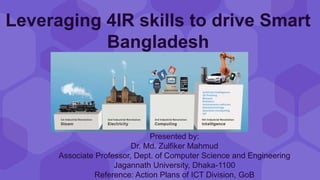
Leveraging 4IR skills to drive Smart
Bangladesh
Presented by:
Dr. Md. Zulfiker Mahmud
Associate Professor, Dept. of Computer Science and Engineering
Jagannath University, Dhaka-1100
Reference: Action Plans of ICT Division, GoB
Industrial Revolution?
Timeline of Industrial Revolution
Fourth Industrial Revolution
Characteristics of IR
Driving forces of 4IR
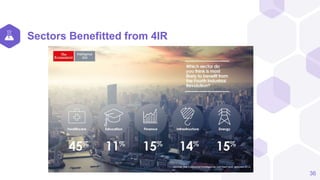
Sectors Benefitted from 4IR
Potential Impact of 4IR
Opportunities of 4IR
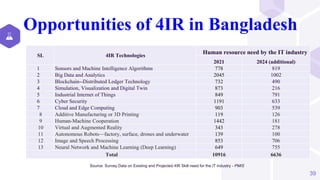
Opportunities of 4IR in Bangladesh
4IR Technologies in Different Sectors
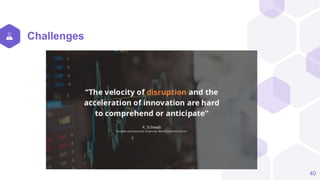
Challenges
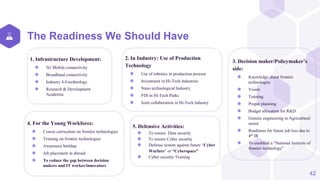
The Readiness We Should Have
Overview
2
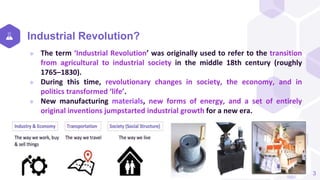
Industrial Revolution?
 The term ‘Industrial Revolution’ was originally used to refer to the transition
from agricultural to industrial society in the middle 18th century (roughly
1765–1830).
 During this time, revolutionary changes in society, the economy, and in
politics transformed ‘life’.
 New manufacturing materials, new forms of energy, and a set of entirely
original inventions jumpstarted industrial growth for a new era.
3
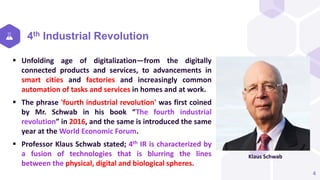
4th Industrial Revolution
 Unfolding age of digitalization—from the digitally
connected products and services, to advancements in
smart cities and factories and increasingly common
automation of tasks and services in homes and at work.
 The phrase 'fourth industrial revolution' was first coined
by Mr. Schwab in his book “The fourth industrial
revolution” in 2016, and the same is introduced the same
year at the World Economic Forum.
 Professor Klaus Schwab stated; 4th IR is characterized by
a fusion of technologies that is blurring the lines
between the physical, digital and biological spheres.
4
Klaus Schwab
1780 1870 1970 2000+
6
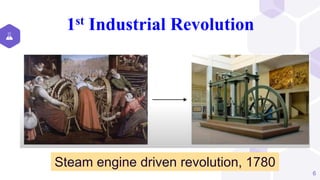
1st Industrial Revolution
Steam engine driven revolution, 1780
7
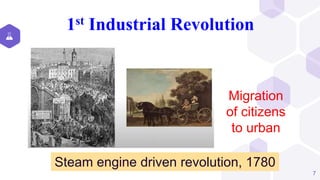
1st Industrial Revolution
Migration
of citizens
to urban
Steam engine driven revolution, 1780
8
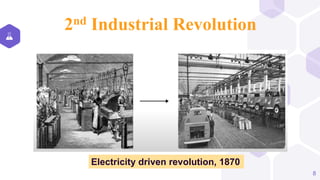
2nd Industrial Revolution
Electricity driven revolution, 1870
9
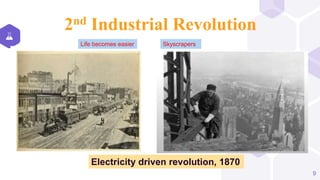
2nd Industrial Revolution
Electricity driven revolution, 1870
Life becomes easier Skyscrapers
10
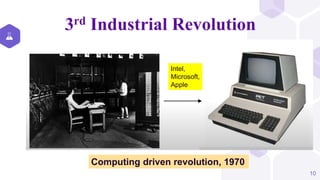
3rd Industrial Revolution
Computing driven revolution, 1970
Intel,
Microsoft,
Apple
11
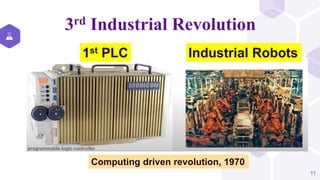
3rd Industrial Revolution
Computing driven revolution, 1970
1st PLC Industrial Robots
programmable logic controller
12
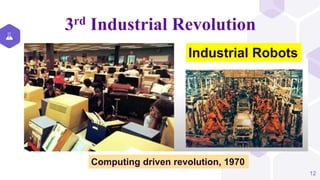
3rd Industrial Revolution
Computing driven revolution, 1970
1st PLC Industrial Robots
13
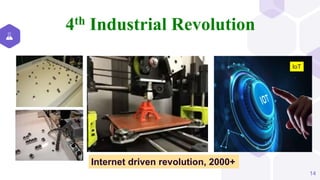
4th Industrial Revolution
Internet driven revolution, 2000+
Connected Computers,
Internet
14
4th Industrial Revolution
Internet driven revolution, 2000+
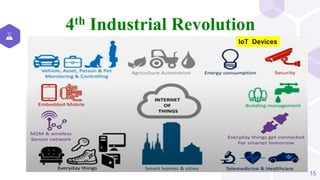
IoT
15
4th Industrial Revolution
IoT Devices
Characteristics of IRs
 4th IR is now building on 3rd IR – the ‘digital
revolution’, representing new ways in which
technology becomes embedded within
societies and even into the human body.
 World heading towards an intelligent world,
where things will be intelligent and able to
sense and connect.
 Devices will be sensing organs, Network will
connect them together, Clouds will be its
digital brain – a source of intelligence.
16
Industrial Revolution Timeline
17
Examples of
Industrial Revolution
18
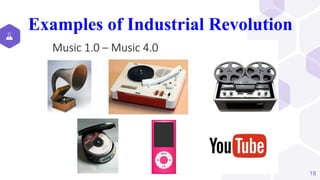
Examples of Industrial Revolution
19
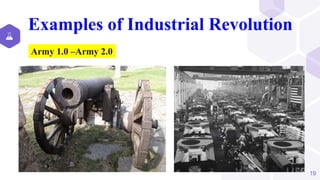
Examples of Industrial Revolution
Army 1.0 –Army 2.0
20
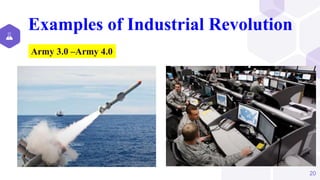
Examples of Industrial Revolution
Army 3.0 –Army 4.0
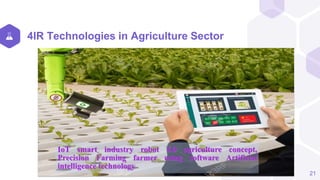
4IR Technologies in Agriculture Sector
21
IoT smart industry robot 4.0 agriculture concept,
Precision Farming farmer using software Artificial
intelligence technology
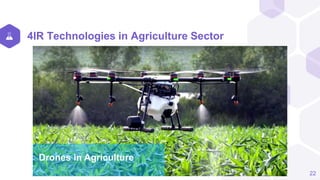
4IR Technologies in Agriculture Sector
22
Drones in Agriculture
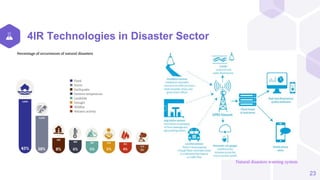
4IR Technologies in Disaster Sector
23
Precision Farming
Natural disasters warning system
4IR Technologies in Disaster Sector
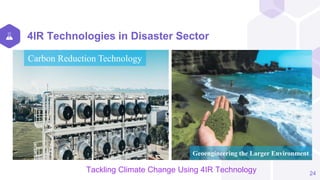
24
Precision Farming
Carbon Reduction Technology
Geoengineering the Larger Environment
Tackling Climate Change Using 4IR Technology
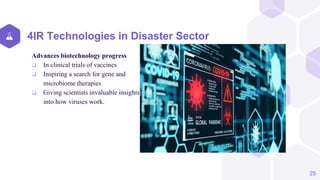
4IR Technologies in Disaster Sector
Advances biotechnology progress
 In clinical trials of vaccines
 Inspiring a search for gene and
microbiome therapies
 Giving scientists invaluable insights
into how viruses work.
25
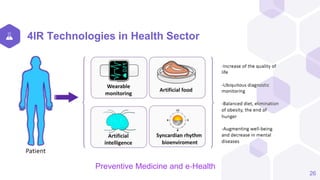
4IR Technologies in Health Sector
Preventive Medicine and e‐Health
26
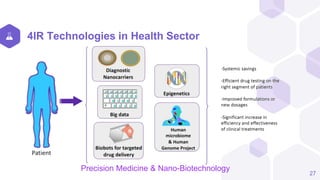
4IR Technologies in Health Sector
Precision Medicine & Nano-Biotechnology
27
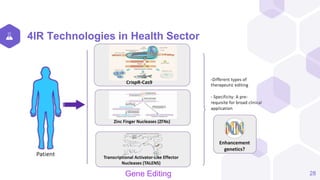
4IR Technologies in Health Sector
Gene Editing 28
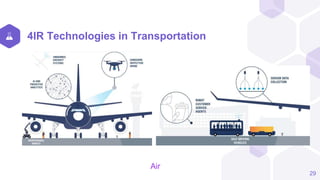
4IR Technologies in Transportation
Air
29
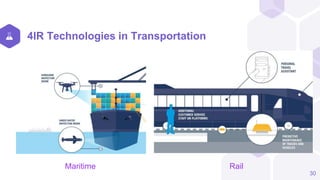
4IR Technologies in Transportation
Rail
30
Maritime
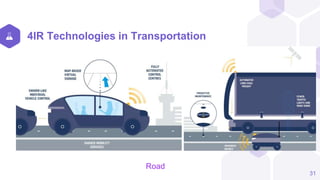
4IR Technologies in Transportation
Road
31
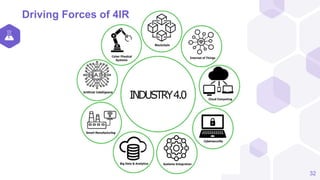
Driving Forces of 4IR
32
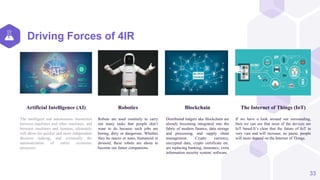
Driving Forces of 4IR
33
Artificial Intelligence (AI)
The intelligent and autonomous interaction
between machines and other machines, and
between machines and humans, ultimately
will allow for quicker and more independent
decision making, and eventually the
automatization of entire economic
processes.
Robotics
Robots are used routinely to carry
out many tasks that people don’t
want to do because such jobs are
boring, dirty or dangerous. Whether
they be macro or nano, humanoid or
dronoid, these robots are about to
become our future companions.
Blockchain
Distributed ledgers aka blockchain are
already becoming integrated into the
fabric of modern finance, data storage
and processing, and supply chain
management. Crypto currency,
encrypted data, crypto certificate etc.
are replacing banking, insurance, extra
information security system/ software.
The Internet of Things (IoT)
If we have a look around our surrounding,
then we can see that most of the devices are
IoT based.It’s clear that the future of IoT in
very vast and will increase, no pause, people
will more depend on the Internet of Things.
Driving Forces of 4IR
34
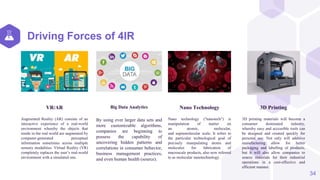
VR/AR
Augmented Reality (AR) consists of an
interactive experience of a real-world
environment whereby the objects that
reside in the real world are augmented by
computer-generated perceptual
information sometimes across multiple
sensory modalities. Virtual Reality (VR)
completely replaces the user’s real-world
environment with a simulated one.
Big Data Analytics
By using ever larger data sets and
more customizable algorithms,
companies are beginning to
possess the capability of
uncovering hidden patterns and
correlations in consumer behavior,
business management practices,
and even human health (source).
3D Printing
3D printing materials will become a
consumer dominated industry,
whereby easy and accessible tools can
be designed and created quickly for
personal use. Not only will additive
manufacturing allow for better
packaging and labelling of products,
but it will also allow companies to
source materials for their industrial
operations in a cost-effective and
efficient manner.
Nano Technology
Nano technology ("nanotech") is
manipulation of matter on
an atomic, molecular,
and supramolecular scale. It refers to
the particular technological goal of
precisely manipulating atoms and
molecules for fabrication of
macroscale products, also now referred
to as molecular nanotechnology.
Driving Forces of 4IR
35
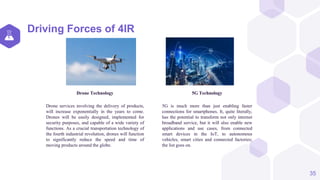
Drone Technology
Drone services involving the delivery of products,
will increase exponentially in the years to come.
Drones will be easily designed, implemented for
security purposes, and capable of a wide variety of
functions. As a crucial transportation technology of
the fourth industrial revolution, drones will function
to significantly reduce the speed and time of
moving products around the globe.
5G Technology
5G is much more than just enabling faster
connections for smartphones. It, quite literally,
has the potential to transform not only internet
broadband service, but it will also enable new
applications and use cases, from connected
smart devices in the IoT, to autonomous
vehicles, smart cities and connected factories;
the list goes on.
Sectors Benefitted from 4IR
36
Potential Impact of 4IR
 Unprecedented paradigm shifts in economy, business, society and individually
 Changes “what” and “how” of doing things, and also “who”
 Transformation of entire systems of
 production, management and governance across (and within) countries, companies and society
 institutions, industries, and individuals.
 changing the lives from entertainment to education to employment.
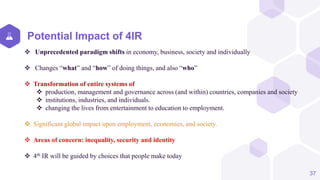
 Significant global impact upon employment, economies, and society.
 Areas of concern: inequality, security and identity
 4th IR will be guided by choices that people make today
37
Opportunities of 4IR
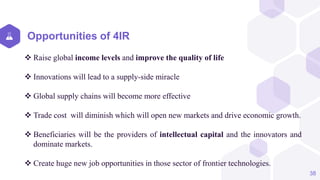
 Raise global income levels and improve the quality of life
 Innovations will lead to a supply-side miracle
 Global supply chains will become more effective
 Trade cost will diminish which will open new markets and drive economic growth.
 Beneficiaries will be the providers of intellectual capital and the innovators and
dominate markets.
 Create huge new job opportunities in those sector of frontier technologies.
38
SL 4IR Technologies
Human resource need by the IT industry
2021 2024 (additional)
1 Sensors and Machine Intelligence Algorithms 778 819
2 Big Data and Analytics 2045 1002
3 Blockchain--Distributed Ledger Technology 732 490
4 Simulation, Visualization and Digital Twin 873 216
5 Industrial Internet of Things 849 791
6 Cyber Security 1191 633
7 Cloud and Edge Computing 903 539
8 Additive Manufacturing or 3D Printing 119 126
9 Human-Machine Cooperation 1442 181
10 Virtual and Augmented Reality 343 278
11 Autonomous Robots—factory, surface, drones and underwater 139 100
12 Image and Speech Processing 853 706
13 Neural Network and Machine Learning (Deep Learning) 649 755
Total 10916 6636
Source: Survey Data on Existing and Projected 4IR Skill need for the IT industry - PMIS
39
Opportunities of 4IR in Bangladesh
Challenges
40
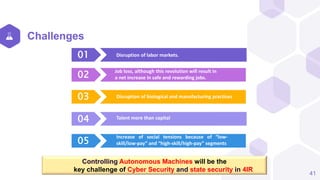
Challenges
41
Controlling Autonomous Machines will be the
key challenge of Cyber Security and state security in 4IR
01
02
03
04
05
Disruption of labor markets.
Job loss, although this revolution will result in
a net increase in safe and rewarding jobs.
Disruption of biological and manufacturing practices
Talent more than capital
Increase of social tensions because of “low-
skill/low-pay” and “high-skill/high-pay” segments
The Readiness We Should Have
1. Infrastructure Development:
⬢ 5G Mobile connectivity
⬢ Broadband connectivity
⬢ Industry 4.0 technology
⬢ Research & Development
Academia
2. In Industry: Use of Production
Technology
⬢ Use of robotics in production process
⬢ Investment in Hi-Tech industries
⬢ Nano technological Industry
⬢ FDI in Hi-Tech Parks
⬢ Joint collaboration in Hi-Tech industry
3. Decision maker/Policymaker’s
side:
⬢ Knowledge about frontier
technologies
⬢ Vision
⬢ Training
⬢ Proper planning
⬢ Budget allocation for R&D
⬢ Genetic engineering in Agricultural
sector
⬢ Readiness for future job loss due to
4th IR
⬢ To establish a “National Institute of
frontier technology”
42
4. For the Young Workforce:
⬢ Course curriculum on frontier technologies
⬢ Training on frontier technologies
⬢ Awareness buildup
⬢ Job placement in abroad
⬢ To reduce the gap between decision
makers and IT worker/innovators
5. Defensive Activities:
⬢ To ensure Data security
⬢ To ensure Cyber security
⬢ Defense system against future “Cyber
Warfare” or “Cyberspace”
⬢ Cyber security Training
4IR Will Change Our Lives In Every Possible Way
43
https://www.youtube.com/watch?v=909Nn9_hrlM
44
THANK YOU

4IR BD Presentation with mooooooooooon.pptx

  • 1.
    Leveraging 4IR skillsto drive Smart Bangladesh Presented by: Dr. Md. Zulfiker Mahmud Associate Professor, Dept. of Computer Science and Engineering Jagannath University, Dhaka-1100 Reference: Action Plans of ICT Division, GoB
  • 2.
    Industrial Revolution? Timeline ofIndustrial Revolution Fourth Industrial Revolution Characteristics of IR Driving forces of 4IR Sectors Benefitted from 4IR Potential Impact of 4IR Opportunities of 4IR Opportunities of 4IR in Bangladesh 4IR Technologies in Different Sectors Challenges The Readiness We Should Have Overview 2
  • 3.
    Industrial Revolution?  Theterm ‘Industrial Revolution’ was originally used to refer to the transition from agricultural to industrial society in the middle 18th century (roughly 1765–1830).  During this time, revolutionary changes in society, the economy, and in politics transformed ‘life’.  New manufacturing materials, new forms of energy, and a set of entirely original inventions jumpstarted industrial growth for a new era. 3
  • 4.
    4th Industrial Revolution Unfolding age of digitalization—from the digitally connected products and services, to advancements in smart cities and factories and increasingly common automation of tasks and services in homes and at work.  The phrase 'fourth industrial revolution' was first coined by Mr. Schwab in his book “The fourth industrial revolution” in 2016, and the same is introduced the same year at the World Economic Forum.  Professor Klaus Schwab stated; 4th IR is characterized by a fusion of technologies that is blurring the lines between the physical, digital and biological spheres. 4 Klaus Schwab
  • 5.
  • 6.
    6 1st Industrial Revolution Steamengine driven revolution, 1780
  • 7.
    7 1st Industrial Revolution Migration ofcitizens to urban Steam engine driven revolution, 1780
  • 8.
  • 9.
    9 2nd Industrial Revolution Electricitydriven revolution, 1870 Life becomes easier Skyscrapers
  • 10.
    10 3rd Industrial Revolution Computingdriven revolution, 1970 Intel, Microsoft, Apple
  • 11.
    11 3rd Industrial Revolution Computingdriven revolution, 1970 1st PLC Industrial Robots programmable logic controller
  • 12.
    12 3rd Industrial Revolution Computingdriven revolution, 1970 1st PLC Industrial Robots
  • 13.
    13 4th Industrial Revolution Internetdriven revolution, 2000+ Connected Computers, Internet
  • 14.
    14 4th Industrial Revolution Internetdriven revolution, 2000+ IoT
  • 15.
  • 16.
    Characteristics of IRs 4th IR is now building on 3rd IR – the ‘digital revolution’, representing new ways in which technology becomes embedded within societies and even into the human body.  World heading towards an intelligent world, where things will be intelligent and able to sense and connect.  Devices will be sensing organs, Network will connect them together, Clouds will be its digital brain – a source of intelligence. 16 Industrial Revolution Timeline
  • 17.
  • 18.
  • 19.
    19 Examples of IndustrialRevolution Army 1.0 –Army 2.0
  • 20.
    20 Examples of IndustrialRevolution Army 3.0 –Army 4.0
  • 21.
    4IR Technologies inAgriculture Sector 21 IoT smart industry robot 4.0 agriculture concept, Precision Farming farmer using software Artificial intelligence technology
  • 22.
    4IR Technologies inAgriculture Sector 22 Drones in Agriculture
  • 23.
    4IR Technologies inDisaster Sector 23 Precision Farming Natural disasters warning system
  • 24.
    4IR Technologies inDisaster Sector 24 Precision Farming Carbon Reduction Technology Geoengineering the Larger Environment Tackling Climate Change Using 4IR Technology
  • 25.
    4IR Technologies inDisaster Sector Advances biotechnology progress  In clinical trials of vaccines  Inspiring a search for gene and microbiome therapies  Giving scientists invaluable insights into how viruses work. 25
  • 26.
    4IR Technologies inHealth Sector Preventive Medicine and e‐Health 26
  • 27.
    4IR Technologies inHealth Sector Precision Medicine & Nano-Biotechnology 27
  • 28.
    4IR Technologies inHealth Sector Gene Editing 28
  • 29.
    4IR Technologies inTransportation Air 29
  • 30.
    4IR Technologies inTransportation Rail 30 Maritime
  • 31.
    4IR Technologies inTransportation Road 31
  • 32.
  • 33.
    Driving Forces of4IR 33 Artificial Intelligence (AI) The intelligent and autonomous interaction between machines and other machines, and between machines and humans, ultimately will allow for quicker and more independent decision making, and eventually the automatization of entire economic processes. Robotics Robots are used routinely to carry out many tasks that people don’t want to do because such jobs are boring, dirty or dangerous. Whether they be macro or nano, humanoid or dronoid, these robots are about to become our future companions. Blockchain Distributed ledgers aka blockchain are already becoming integrated into the fabric of modern finance, data storage and processing, and supply chain management. Crypto currency, encrypted data, crypto certificate etc. are replacing banking, insurance, extra information security system/ software. The Internet of Things (IoT) If we have a look around our surrounding, then we can see that most of the devices are IoT based.It’s clear that the future of IoT in very vast and will increase, no pause, people will more depend on the Internet of Things.
  • 34.
    Driving Forces of4IR 34 VR/AR Augmented Reality (AR) consists of an interactive experience of a real-world environment whereby the objects that reside in the real world are augmented by computer-generated perceptual information sometimes across multiple sensory modalities. Virtual Reality (VR) completely replaces the user’s real-world environment with a simulated one. Big Data Analytics By using ever larger data sets and more customizable algorithms, companies are beginning to possess the capability of uncovering hidden patterns and correlations in consumer behavior, business management practices, and even human health (source). 3D Printing 3D printing materials will become a consumer dominated industry, whereby easy and accessible tools can be designed and created quickly for personal use. Not only will additive manufacturing allow for better packaging and labelling of products, but it will also allow companies to source materials for their industrial operations in a cost-effective and efficient manner. Nano Technology Nano technology ("nanotech") is manipulation of matter on an atomic, molecular, and supramolecular scale. It refers to the particular technological goal of precisely manipulating atoms and molecules for fabrication of macroscale products, also now referred to as molecular nanotechnology.
  • 35.
    Driving Forces of4IR 35 Drone Technology Drone services involving the delivery of products, will increase exponentially in the years to come. Drones will be easily designed, implemented for security purposes, and capable of a wide variety of functions. As a crucial transportation technology of the fourth industrial revolution, drones will function to significantly reduce the speed and time of moving products around the globe. 5G Technology 5G is much more than just enabling faster connections for smartphones. It, quite literally, has the potential to transform not only internet broadband service, but it will also enable new applications and use cases, from connected smart devices in the IoT, to autonomous vehicles, smart cities and connected factories; the list goes on.
  • 36.
  • 37.
    Potential Impact of4IR  Unprecedented paradigm shifts in economy, business, society and individually  Changes “what” and “how” of doing things, and also “who”  Transformation of entire systems of  production, management and governance across (and within) countries, companies and society  institutions, industries, and individuals.  changing the lives from entertainment to education to employment.  Significant global impact upon employment, economies, and society.  Areas of concern: inequality, security and identity  4th IR will be guided by choices that people make today 37
  • 38.
    Opportunities of 4IR Raise global income levels and improve the quality of life  Innovations will lead to a supply-side miracle  Global supply chains will become more effective  Trade cost will diminish which will open new markets and drive economic growth.  Beneficiaries will be the providers of intellectual capital and the innovators and dominate markets.  Create huge new job opportunities in those sector of frontier technologies. 38
  • 39.
    SL 4IR Technologies Humanresource need by the IT industry 2021 2024 (additional) 1 Sensors and Machine Intelligence Algorithms 778 819 2 Big Data and Analytics 2045 1002 3 Blockchain--Distributed Ledger Technology 732 490 4 Simulation, Visualization and Digital Twin 873 216 5 Industrial Internet of Things 849 791 6 Cyber Security 1191 633 7 Cloud and Edge Computing 903 539 8 Additive Manufacturing or 3D Printing 119 126 9 Human-Machine Cooperation 1442 181 10 Virtual and Augmented Reality 343 278 11 Autonomous Robots—factory, surface, drones and underwater 139 100 12 Image and Speech Processing 853 706 13 Neural Network and Machine Learning (Deep Learning) 649 755 Total 10916 6636 Source: Survey Data on Existing and Projected 4IR Skill need for the IT industry - PMIS 39 Opportunities of 4IR in Bangladesh
  • 40.
  • 41.
    Challenges 41 Controlling Autonomous Machineswill be the key challenge of Cyber Security and state security in 4IR 01 02 03 04 05 Disruption of labor markets. Job loss, although this revolution will result in a net increase in safe and rewarding jobs. Disruption of biological and manufacturing practices Talent more than capital Increase of social tensions because of “low- skill/low-pay” and “high-skill/high-pay” segments
  • 42.
    The Readiness WeShould Have 1. Infrastructure Development: ⬢ 5G Mobile connectivity ⬢ Broadband connectivity ⬢ Industry 4.0 technology ⬢ Research & Development Academia 2. In Industry: Use of Production Technology ⬢ Use of robotics in production process ⬢ Investment in Hi-Tech industries ⬢ Nano technological Industry ⬢ FDI in Hi-Tech Parks ⬢ Joint collaboration in Hi-Tech industry 3. Decision maker/Policymaker’s side: ⬢ Knowledge about frontier technologies ⬢ Vision ⬢ Training ⬢ Proper planning ⬢ Budget allocation for R&D ⬢ Genetic engineering in Agricultural sector ⬢ Readiness for future job loss due to 4th IR ⬢ To establish a “National Institute of frontier technology” 42 4. For the Young Workforce: ⬢ Course curriculum on frontier technologies ⬢ Training on frontier technologies ⬢ Awareness buildup ⬢ Job placement in abroad ⬢ To reduce the gap between decision makers and IT worker/innovators 5. Defensive Activities: ⬢ To ensure Data security ⬢ To ensure Cyber security ⬢ Defense system against future “Cyber Warfare” or “Cyberspace” ⬢ Cyber security Training
  • 43.
    4IR Will ChangeOur Lives In Every Possible Way 43 https://www.youtube.com/watch?v=909Nn9_hrlM
  • 44.

Editor's Notes

  • #37 https://eiuperspectives.economist.com/technology-innovation/healthcare-benefit-most-fourth-industrial-revolution-executives-predict
  • #42 The economists Erik Brynjolfsson and Andrew McAfee have pointed out, the revolution could yield greater inequality, particularly in its potential to disrupt labor markets. displacement of workers by machines As automation substitutes for labor across the entire economy, the net displacement of workers by machines might exacerbate the gap between returns to capital and returns to labor. On the other hand, it is also possible that the displacement of workers by technology will, in aggregate, result in a net increase in safe and rewarding jobs. 4. We cannot foresee at this point which scenario is likely to emerge, and history suggests that the outcome is likely to be some combination of the two. 5. However, I am convinced of one thing—that in the future, talent more than capital, will represent the critical factor of production. 6. This will give rise to a job market increasingly segregated into “low-skill/low-pay” and “high-skill/high-pay” segments, which in turn will lead to an increase in social tensions. 7. fourth industrial revolution also possesses the ability to radically disrupt current biological and manufacturing practices.