Finance and Accounting Case Study 
September 2014 
Business Need 
An international division of a Fortune 100 company was experiencing difficulties with its bank reconciliation process. Accounting staff with valuable experience and knowledge of the workflow had left the organization, and sufficient resources were not always available to complete the monthly reconciliation process in a timely manner. 
As a consequence, unresolved debits and credits carried over into following months without resolution, increasing the risk of misstatements or inaccuracies in financial accounting and reporting records. 
The issues with the process were becoming a costly distraction to the division. High-paid, high-skill accounting staff were being taken away from their primary responsibilities to handle bank reconciliations-- tasks that could be more efficiently handled by junior staff. 
Although bank reconciliation is a straightforward concept from an accounting standpoint, this division’s process was rather complex and time consuming--it involved gathering information from dozens of bank statements across several countries, presented in different languages. 
Additionally, the division had little-to-no documented procedures or process maps outlining the steps required for the bank reconciliation process. The client’s management team recognized that the bank reconciliation process would be better off if it were handled by an outside expert rather than in-house. 
The organization reached out to DATAMARK to propose a business process solution for bank reconciliations that incorporated process improvements as well as an outsourcing arrangement. 
DATAMARK DELIVERS A SOLUTION TO IMPROVE 
A BANK RECONCILIATION PROCESS 
©2014 DATAMARK, Inc. www.datamark.net
The Solution 
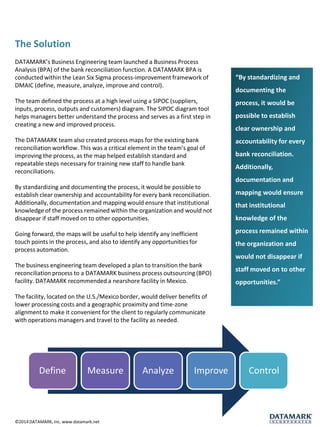
DATAMARK’s Business Engineering team launched a Business Process Analysis (BPA) of the bank reconciliation function. A DATAMARK BPA is conducted within the Lean Six Sigma process-improvement framework of DMAIC (define, measure, analyze, improve and control). 
The team defined the process at a high level using a SIPOC (suppliers, inputs,process,outputs andcustomers) diagram. The SIPOC diagram tool helps managers better understand the process and serves as a first step in creating a new and improved process. 
The DATAMARK team also created process maps for the existing bank reconciliation workflow. This was a critical element in the team’s goal of improving the process, as the map helped establish standard and repeatable steps necessary for training new staff to handle bank reconciliations. 
By standardizing and documenting the process, it would be possible to establish clear ownership and accountability for every bank reconciliation. Additionally, documentation and mapping would ensure that institutional knowledge of the process remained within the organization and would not disappear if staff moved on to other opportunities. 
Going forward, the maps will be useful to help identify any inefficient touch points in the process, and also to identify any opportunities for process automation. 
The business engineering team developed a plan to transition the bank reconciliation process to a DATAMARK business process outsourcing (BPO) facility. DATAMARK recommended a nearshore facility in Mexico. 
The facility, located on the U.S./Mexico border, would deliver benefits of lower processing costs and a geographic proximity and time-zone alignment to make it convenient for the client to regularly communicate with operations managers and travel to the facility as needed. 
“By standardizing and documenting the process, it would be possible to establish clear ownership and accountability for every bank reconciliation. Additionally, documentation and mapping would ensure that institutional knowledge of the process remained within the organization and would not disappear if staff moved on to other opportunities.” 
©2014 DATAMARK, Inc. www.datamark.netDefine 
Measure 
Analyze 
Improve 
Control
The Benefits 
Cost Savings: The client can expect significant savings by shifting ownership of the process from high-paid analysts and other employees with advanced accounting knowledge to staff trained specifically for the bank reconciliation process. By basing staff at a nearshore location, significant hourly wage savings can be achieved, when compared to other locations in the United States. 
Documented Processes: Documenting and mapping the workflow is the first step in stabilizing the process, which creates opportunities to identify areas for improvement. Documentation helps to eliminate the inefficiencies, mistakes and other problems that arise from processes that do not have a consistent methodology. 
Improved Efficiency and Reduced Turn-Around Time (TAT): By establishing a dedicated team for the process, rather than relying on overburdened accounting personnel, bank reconciliations can be processed within the required 10-business-day TAT, and the number of unreconciled items carried over into the next month will be significantly reduced. 
Continuous Improvement: With the workflow standardized and stabilized, DATAMARK’s business engineering and operations teams will focus on improving the process. This includes exploring ways to standardize reconciliation forms and worksheets, and testing commercial software tools to bring automation into the bank reconciliation process. 
The Bottom Line 
The client understood that the back-office function of bank reconciliation was becoming an expensive and time-consuming distraction from its core business. Mature business organizations understand that non-core activities are often best outsourced to a specialist provider. 
DATAMARK responded by delivering a solution to the client to deliver cost savings, documentation to preserve institutional knowledge of the bank reconciliation process, and overall improved efficiency and turn-around time. About DATAMARKFor more than 20 years, DATAMARK, Inc. has provided bilingual (English/Spanish) multichannel contact center services, mailroom management, data entry, document processing, business process improvement consulting and other outsourcing services for Fortune 500 companies across all industry sectors. If you have questions or need assistance in developing your organization’s case for outsourcing or business process improvement, DATAMARK’s business process outsourcing specialists are available for a complimentary initial consultation. Contact us at: www.datamark.netToll-free: 800.477.1944Info: info@datamark.net 
©2014 DATAMARK, Inc. www.datamark.net

DATAMARK Delivers a Solution to Improve a Bank Reconciliation Process

  • 1.
    Finance and AccountingCase Study September 2014 Business Need An international division of a Fortune 100 company was experiencing difficulties with its bank reconciliation process. Accounting staff with valuable experience and knowledge of the workflow had left the organization, and sufficient resources were not always available to complete the monthly reconciliation process in a timely manner. As a consequence, unresolved debits and credits carried over into following months without resolution, increasing the risk of misstatements or inaccuracies in financial accounting and reporting records. The issues with the process were becoming a costly distraction to the division. High-paid, high-skill accounting staff were being taken away from their primary responsibilities to handle bank reconciliations-- tasks that could be more efficiently handled by junior staff. Although bank reconciliation is a straightforward concept from an accounting standpoint, this division’s process was rather complex and time consuming--it involved gathering information from dozens of bank statements across several countries, presented in different languages. Additionally, the division had little-to-no documented procedures or process maps outlining the steps required for the bank reconciliation process. The client’s management team recognized that the bank reconciliation process would be better off if it were handled by an outside expert rather than in-house. The organization reached out to DATAMARK to propose a business process solution for bank reconciliations that incorporated process improvements as well as an outsourcing arrangement. DATAMARK DELIVERS A SOLUTION TO IMPROVE A BANK RECONCILIATION PROCESS ©2014 DATAMARK, Inc. www.datamark.net
  • 2.
    The Solution DATAMARK’sBusiness Engineering team launched a Business Process Analysis (BPA) of the bank reconciliation function. A DATAMARK BPA is conducted within the Lean Six Sigma process-improvement framework of DMAIC (define, measure, analyze, improve and control). The team defined the process at a high level using a SIPOC (suppliers, inputs,process,outputs andcustomers) diagram. The SIPOC diagram tool helps managers better understand the process and serves as a first step in creating a new and improved process. The DATAMARK team also created process maps for the existing bank reconciliation workflow. This was a critical element in the team’s goal of improving the process, as the map helped establish standard and repeatable steps necessary for training new staff to handle bank reconciliations. By standardizing and documenting the process, it would be possible to establish clear ownership and accountability for every bank reconciliation. Additionally, documentation and mapping would ensure that institutional knowledge of the process remained within the organization and would not disappear if staff moved on to other opportunities. Going forward, the maps will be useful to help identify any inefficient touch points in the process, and also to identify any opportunities for process automation. The business engineering team developed a plan to transition the bank reconciliation process to a DATAMARK business process outsourcing (BPO) facility. DATAMARK recommended a nearshore facility in Mexico. The facility, located on the U.S./Mexico border, would deliver benefits of lower processing costs and a geographic proximity and time-zone alignment to make it convenient for the client to regularly communicate with operations managers and travel to the facility as needed. “By standardizing and documenting the process, it would be possible to establish clear ownership and accountability for every bank reconciliation. Additionally, documentation and mapping would ensure that institutional knowledge of the process remained within the organization and would not disappear if staff moved on to other opportunities.” ©2014 DATAMARK, Inc. www.datamark.netDefine Measure Analyze Improve Control
  • 3.
    The Benefits CostSavings: The client can expect significant savings by shifting ownership of the process from high-paid analysts and other employees with advanced accounting knowledge to staff trained specifically for the bank reconciliation process. By basing staff at a nearshore location, significant hourly wage savings can be achieved, when compared to other locations in the United States. Documented Processes: Documenting and mapping the workflow is the first step in stabilizing the process, which creates opportunities to identify areas for improvement. Documentation helps to eliminate the inefficiencies, mistakes and other problems that arise from processes that do not have a consistent methodology. Improved Efficiency and Reduced Turn-Around Time (TAT): By establishing a dedicated team for the process, rather than relying on overburdened accounting personnel, bank reconciliations can be processed within the required 10-business-day TAT, and the number of unreconciled items carried over into the next month will be significantly reduced. Continuous Improvement: With the workflow standardized and stabilized, DATAMARK’s business engineering and operations teams will focus on improving the process. This includes exploring ways to standardize reconciliation forms and worksheets, and testing commercial software tools to bring automation into the bank reconciliation process. The Bottom Line The client understood that the back-office function of bank reconciliation was becoming an expensive and time-consuming distraction from its core business. Mature business organizations understand that non-core activities are often best outsourced to a specialist provider. DATAMARK responded by delivering a solution to the client to deliver cost savings, documentation to preserve institutional knowledge of the bank reconciliation process, and overall improved efficiency and turn-around time. About DATAMARKFor more than 20 years, DATAMARK, Inc. has provided bilingual (English/Spanish) multichannel contact center services, mailroom management, data entry, document processing, business process improvement consulting and other outsourcing services for Fortune 500 companies across all industry sectors. If you have questions or need assistance in developing your organization’s case for outsourcing or business process improvement, DATAMARK’s business process outsourcing specialists are available for a complimentary initial consultation. Contact us at: www.datamark.netToll-free: 800.477.1944Info: info@datamark.net ©2014 DATAMARK, Inc. www.datamark.net