PREFACE
The project report “Management of Bank Al-Falah” is about the all views of its
management, including the current & past over all progress & process of Planning,
Organizing, Leading, Controlling, Ethics, Culture & Organization design.

The process which is being followed & running presently, of Planning, Organizing,
Leading, Controlling, Ethics, Culture, Organization design and Position of whole
Organization in our Nation are also being discussed in detail in this report.


                                                                                    13
Introduction of Bank Al-Falah-------------------------------------------------------------------------05

Mission & Vision----------------------------------------------------------------------------------------08

Chairperson’s Message---------------------------------------------------------------------------------09

Historical Overview-------------------------------------------------------------------------------------10

Board of Directors---------------------------------------------------------------------------------------11

Management----------------------------------------------------------------------------------------------12

1. Planning----------------------------------------------------------------------------------------------14

    1.1. Definition---------------------------------------------------------------------------------------15

    1.2. Types of Planning------------------------------------------------------------------------------
         15

    1.3. Goals / Objectives-----------------------------------------------------------------------------16

    1.4. Process of Planning----------------------------------------------------------------------------17

    1.5. Types of Strategy------------------------------------------------------------------------------18

    1.6. Internal & External Factors-------------------------------------------------------------------18

        1.6.1. Internal Factors-------------------------------------------------------------------------
              18

        1.6.2. External Factors------------------------------------------------------------------------19

    1.7. SWOT Analysis--------------------------------------------------------------------------------20

    1.8. BCG-Matrix------------------------------------------------------------------------------------22

    1.9. Decision Making Authorities-----------------------------------------------------------------
         23

2. Organizing-------------------------------------------------------------------------------------------24

    2.1. Bank al-Falah’s Structure---------------------------------------------------------------------25

    2.2. Purpose of Organizing------------------------------------------------------------------------26

    2.3. Bank Al-Falah’s Management Chart--------------------------------------------------------26


                                                                                                               13
2.4. Finance Department---------------------------------------------------------------------------27

    2.5. Marketing Department------------------------------------------------------------------------28


    2.6. IT Department----------------------------------------------------------------------------------29

    2.7. Centralization vs. Decentralization----------------------------------------------------------30

    2.8. Type of Organization--------------------------------------------------------------------------30

    2.9. Human Resource Management (HRM)-----------------------------------------------------31

    2.10.          Communication---------------------------------------------------------------------------
         -----33

3. Leadership--------------------------------------------------------------------------------------------
    35

    3.1. By Early Leadership Theories---------------------------------------------------------------36

         3.1.1. Formal vs. Informal-------------------------------------------------------------------36

         3.1.2. Traits of Leader------------------------------------------------------------------------36

         3.1.3. Type of Leaders------------------------------------------------------------------------37

         3.1.4. Managerial Grid------------------------------------------------------------------------
              37

    3.2. By Contingency Theories---------------------------------------------------------------------38

         3.2.1. Fiedler’s Model------------------------------------------------------------------------38

         3.2.2. Situational Theory---------------------------------------------------------------------38

         3.2.3. Goal-Path Model-----------------------------------------------------------------------38

    3.3. Leadership Behaviors-------------------------------------------------------------------------39

    3.4. By Motivation----------------------------------------------------------------------------------40

         3.4.1. Early Theories of Motivation--------------------------------------------------------41

         3.4.2. Contemporary Theories of Motivation----------------------------------------------
              41

4. Control------------------------------------------------------------------------------------------------43

                                                                                                               13
4.1. Testing the system of internal control-------------------------------------------------------44

    4.2. Separation of Duties---------------------------------------------------------------------------45

    4.3. Security------------------------------------------------------------------------------------------
         45

5. Ethics-------------------------------------------------------------------------------------------------46

    5.1. Approaches to Ethics--------------------------------------------------------------------------
         47

        5.1.1. Utilitarianism Approach--------------------------------------------------------------47

        5.1.2. Individualism Approach--------------------------------------------------------------47

        5.1.3. Right Approach------------------------------------------------------------------------47

        5.1.4. Justice Approach-----------------------------------------------------------------------47

    5.2. Strategies for Managing Stakeholders------------------------------------------------------48

        5.2.1. Confrontation Strategy----------------------------------------------------------------48

        5.2.2. Damage Control Strategy-------------------------------------------------------------48

        5.2.3. Accommodation Strategy-------------------------------------------------------------48

        5.2.4.     Pro-active Strategy--------------------------------------------------------------------
              48

6. Culture------------------------------------------------------------------------------------------------49

    6.1. Types of typologies----------------------------------------------------------------------------50

7. Organization design---------------------------------------------------------------------------------52

    7.1. Types of Organization Design---------------------------------------------------------------
         53

8. Conclusion & Suggestions-------------------------------------------------------------------------54

    8.1. Conclusion--------------------------------------------------------------------------------------55

    8.2. Suggestions-------------------------------------------------------------------------------------55


Reference-------------------------------------------------------------------------------------------------56

                                                                                                               13
13
Bank Al-Falah was incorporated on 21st June, 1997 as a public limited company under the
Companies Ordinance 1984. Its banking operations commenced from 1st November, 1997.
The bank is engaged in commercial banking and related services as defined in the Banking
companies ordinance, 1962.
Bank Al-Falah Limited is a Pakistan-based bank, engaged in commercial banking and related
services. The services offered by the Company include Branch banking, Consumer banking,
Electronic banking, corporate banking and Treasury and Investment.
Its Branch banking services include direct and indirect Foreign Currencies Remittance
facility, Foreign Trade and Correspondent banking and safe Deposit Locker facilities.
Through Consumer banking, the Company offers Credit cards, Home Loans, Rupee Traveler
checks, Auto loans, and Money-Gram, which is a person-to-person money transfer service.
Its Electronic banking services include Phone banking, Automated Teller Machines (ATM)
and On-line banking. Its Treasury and Investment services include Financial advisory
services, and services for the money market and foreign exchange market. Its corporate
banking activities include Trade finance and structured finance.
The Company offers services through a network of 142 branches and 59 ATM machines.
These branches are in the following cities of Pakistan.

     • Abbott Abad                     • Chitral                     • Haroonabad
     • Ahmedpur East                   • D.G.Khan                    • Hasilpur
     • Arifwala                        • D.I.Khan                    • Hayatabad
     • Attock                          • Daharki                     • Heart
     • Bahawalpur                      • Daska                       • Hyderabad
     • Bannu                           • Fasialabad                  • Islamabad
     • Bhalwal                         • Ghotki                      • Jhang
     • Burewala                        • Gilgit                      • Jhelum
     • Chakwal                         • Gujranwala                  • Karachi
     • Chaman                          • Gujrat                      • Kasur
     • Chichawatni                     • Hafizabad                   • Kharian
     • Chiniot                         • Hangu                       • Kohat
                                                                                            13
• Kotla          • Mirpur Khas   • Sadiqabad
• Lahore         • Multan        • Sahiwal
• Lala Musa      • Nawabshah     • Sailkot
• Larkana        • Okara         • Sargoda
• Mandi          • Pakpattan     • Sheikhupura
  Bahauddin      • Peshawar      • Sukkar
• Mansehra       • Quetta        • Toba Tek Singh
• Mdardan        • Rawalpindi    • Wah Cantt
• Mian Chunnu    • Rhaim-Yar-
• Mingora/Swat     Khan


                                                    13
MISSION & VISION


Mission
“To develop and deliver the most innovative services, products, manage customer experience,
deliver quality service that contributes to brand strength, establishes a comprehensive
advantage and enhances profitability, in this way providing value to the stakeholders of the
bank.”

Vision
“To be the premier organizations operating locally & internationally that provides the
complete range of financial services to all segments under one roof.”


                                                                                               13
CHAIRPERSON’S MESSAGE
“Our core philosophy of honesty, transparency in customer dealings, product innovation,
excellence in customer services and our commitment to being a responsible corporate citizen
pervades this website.”

Since the inception of Bank Al-Falah, by the grace of the Almighty Allah, we have moved
rapidly in expanding our branch network and deposit base, along with making profitable
advances and increasing the range of products and services. We have made a break-through
in providing premier services at an affordable cost to our customers.

Keeping in view our valued clients and the need for constant and effective communication of
information, we have designed this website to be as user-friendly as possible.

As we pursue the path of excellence, customer satisfaction remains our priority. It is only
when we know our customers better, can we deliver a higher quality of services, thereby
adding synergy to our existing management expertise, financial strength and profitability.

This is yet another channel of communication for the delivery of quality products and
services that enhance value to our stakeholders.


                                                                                              13
HISTORICAL OVERVIEW
Bank Al-Falah Limited was incorporated on June 21st, 1997 as a public limited company
under the Companies Ordinance 1984. Its banking operations commenced from November
1st, 1997. The bank is engaged in commercial banking and related services as defined in the
Banking companies ordinance, 1962. The Bank is currently operating through 104 branches
in 36 cities, with the registered office at B.A.Building, II.Chundrigar, Karachi.

Since its inception, as the new identity of H.C.E.B after the privatization in 1997, the
management of the bank has implemented strategies and policies to carve a distinct position
for the bank in the market place.

Strengthened with the banking of the Abu Dhabi Group and driven by the strategic goals
set out by its board of management, the             Bank    has   invested    in    revolutionary
technology to have an extensive range of products and services.

This facilitates our commitment to a culture of innovation and seeks out synergies with
clients and service providers to ensure uninterrupted services to its customers. We perceive
the requirements of our customers and match them with quality products and service
solutions. During the past five years, we have emerged as one of the foremost financial
institution in the region endeavoring to meet the needs of tomorrow today.


                                                                                                    13
BOARD OF DIRECTORS


            H.E. Sheikh Hamdan Bin Mubarak Al Nahayan
                            Chairman


Mr. Abdulla Nasser Hawalileel Al-
Mansoori
Director                            Mr. Ikram Ul-Majeed Sehgal
                                    Director


Mr. Abdull Khalil Al Mutawa
Director
                                    Mr. Nadeem Iqbal Sheikh
                                    Director

Mr.Khalid Mana Saeed Al Otaiba
Director
                                    Mr. Sirajuddin Aziz
                                    Director & CEO


                                                                 13
MANAGEMENT
Mr. Sirajuddin Aziz
Chief Executive Officer
                                 Mr. A. Wahid Dada
                                 Group Head
                                 Commercial Banking
Mr. Parvez A. Shahid
Co-Chairman Central Management
Committee
                                 Mr. Hamid Ashraf
                                 General Manager
                                 Legal Affairs & Company Secretary
Mr. Shakil Sadiq
Chief Operating Officer
                                 Mr. Zahid Ali H. Jamall
                                 Chief Financial Officer

Mr. Arfa Waheed Malik
Group Head
Corporate & Investment Banking
                                 Mr. Mohammad Iqbal Saifee
                                 Group Head
                                 Audit & Inspection
Mr. Ijaz Farooq
Group Head
Islamic Banking
                                 Mr. Talib Rizvi
                                 Group Head
                                 Priority Banking & Wealth
Mr. Adil Rashid                  Management
Group Head
Consumer Finance
                                 Mr. Tariq Mir
                                 General Manager
                                 International Business
Mr. Nadeem Ul Haq
Group Head
Operations                       Mr. Ather Shehab
                                 Executive Incharge
Mr. Mohammad Yousuf              Establishment & Administration
Group Head                       Mr. Mahmood Ashraf
Credit & Collections             General Manager
Mr. Bakhtiar Khawaja             Credit Monitoring
Group Head
Training & Development

                                                                     13
Mr. Falak Sher
Chief Compliance Officer
                                     Mr. Haroon Khalid
                                     General Manager
                                     Risk Management
Mr. Imtiaz Ahmad Sheikh
General Manager
Information Technology


Mr. M. Mudassar Aqil
General Manager
Human Resource & Quality Assurance


                                                         13
23
PLANNING
 1.1.      Definition
    Planning is

    •   Defining organization’s goals and objectives.

    •   Establishing overall strategies for achieving those goals.

    •   Developing a comprehensive set of plans to integrate and coordinate
        organizational work.


 1.2.      Types of Planning
           Bank Al-Falah use both formal and informal types of planning.

    1.2.1. Informal

           In informal planning, their planning is not written down, short term focus and
           specific to an organizational unit.

    1.2.2. Formal

           In formal planning, their planning is written down, specific, long term focus
           and involves shared goals for the organization.


                                                                                            23
1.3.      Goals / Objectives
   •   Financial strength and Profitability by making profitable advances

   •   Customer satisfaction by providing higher quality of services at an affordable cost

   •   Growth by expanding branch network and deposit base

   1.3.1. Short-term Objectives

          •   Profitability

   1.3.2. Long-term Objectives

          •   Profitability

          •   To optimize the use of resources


                                                                                             23
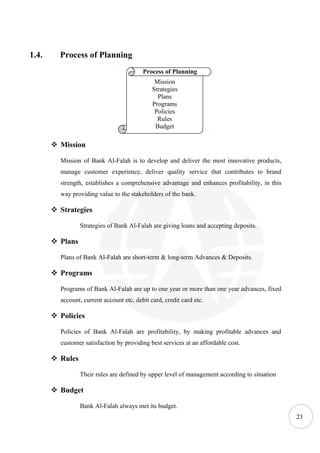
1.4.     Process of Planning
                                          Process of Planning
                                               Mission
                                              Strategies
                                                Plans
                                              Programs
                                               Policies
                                                Rules
                                               Budget

        Mission

         Mission of Bank Al-Falah is to develop and deliver the most innovative products,
         manage customer experience, deliver quality service that contributes to brand
         strength, establishes a comprehensive advantage and enhances profitability, in this
         way providing value to the stakeholders of the bank.

        Strategies

                 Strategies of Bank Al-Falah are giving loans and accepting deposits.

        Plans

         Plans of Bank Al-Falah are short-term & long-term Advances & Deposits.

        Programs

         Programs of Bank Al-Falah are up to one year or more than one year advances, fixed
         account, current account etc, debit card, credit card etc.

        Policies

         Policies of Bank Al-Falah are profitability, by making profitable advances and
         customer satisfaction by providing best services at an affordable cost.

        Rules

                 Their rules are defined by upper level of management according to situation

        Budget

                 Bank Al-Falah always met its budget.
                                                                                               23
1.5.     Types of Strategy
         There are seven kinds of strategy:

          • Cost Leadership Strategy

          • Differentiation Strategy

          • Focused Strategy

         Bank Al-Falah is following the focused strategy. They are focusing on
         customers by advancing and depositing.


1.6.     Internal & External Factors
   1.6.1. Internal Factors

         HRM

         HRM is playing both positive and negative role in the performance of
         organization. Positively, HRM is performing its functions and managing the
         human resource properly. On the negative side, sometimes HRM adopts the
         policy of favoritism due to political pressure in managing human resource.

         Structure / Infrastructure

         Bank Al-Falah has sound structure and infrastructure.

         Organizational Policies
         Policies of Bank Al-Falah are favorable for customers.

         Nature of Organization
         Financial Institution.


                                                                                      23
1.6.2. External Factors

Technological Factors

Technologically, Bank Al-Falah is weak and this element is threatening to Bank Al-
Falah. Online Banking (advances, deposits, transactions etc.) is not working properly.

Political Factors

Politically, people are influencing on the performance of Bank Al-Falah. Particularly,
agricultural people get benefits due to relation to politicians. Such people are getting
advances and jobs on favoritism.

Physical Factors

Physical structure of Bank Al-Falah is very sound.

Demographic Factors

Population of Pakistan is a big number, which is supportive for bank.

Economic Factors

Population of Pakistan is rich which is beneficial for the bank.

Legal & Ethical Factors

Bank has legal entity and is taking care of ethics which is giving it advantage in
attaining customer attention.

Social & Cultural Factors

Social and cultural factors are affecting the bank. Majority of the population is un-
educated and unaware of the benefits of banking sector. They have low saving and
want to keep money with them.


                                                                                           23
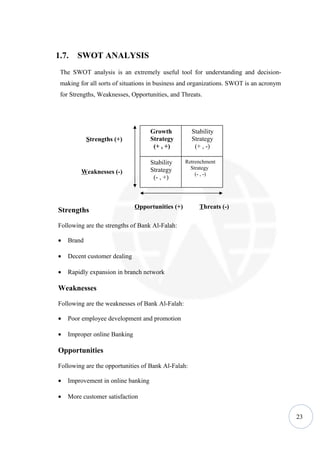
1.7.   SWOT ANALYSIS
 The SWOT analysis is an extremely useful tool for understanding and decision-
 making for all sorts of situations in business and organizations. SWOT is an acronym

 for Strengths, Weaknesses, Opportunities, and Threats.


                                    Growth          Stability
            Strengths (+)           Strategy        Strategy
                                     (+ , +)         (+ , -)

                                    Stability     Retrenchment
                                    Strategy        Strategy
         Weaknesses (-)                               (- , -)
                                     (- , +)


                              Opportunities (+)        Threats (-)
Strengths

Following are the strengths of Bank Al-Falah:

•   Brand

•   Decent customer dealing

•   Rapidly expansion in branch network

Weaknesses

Following are the weaknesses of Bank Al-Falah:

•   Poor employee development and promotion

•   Improper online Banking

Opportunities

Following are the opportunities of Bank Al-Falah:

•   Improvement in online banking

•   More customer satisfaction


                                                                                        23
Threats

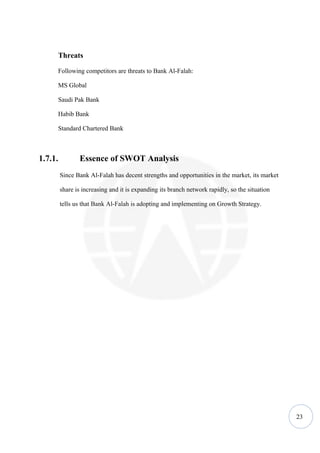
      Following competitors are threats to Bank Al-Falah:

      MS Global

      Saudi Pak Bank

      Habib Bank

      Standard Chartered Bank


1.7.1.          Essence of SWOT Analysis
         Since Bank Al-Falah has decent strengths and opportunities in the market, its market

         share is increasing and it is expanding its branch network rapidly, so the situation

         tells us that Bank Al-Falah is adopting and implementing on Growth Strategy.


                                                                                                23
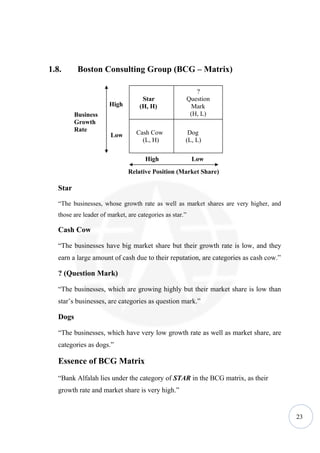
1.8.       Boston Consulting Group (BCG – Matrix)

                                                             ?
                                     Star                 Question
                       High         (H, H)                  Mark
          Business                                         (H, L)
          Growth
          Rate                    Cash Cow             Dog
                        Low
                                    (L, H)            (L, L)

                                      High                 Low
                               Relative Position (Market Share)

   Star

   “The businesses, whose growth rate as well as market shares are very higher, and
   those are leader of market, are categories as star.”

   Cash Cow

   “The businesses have big market share but their growth rate is low, and they
   earn a large amount of cash due to their reputation, are categories as cash cow.”

   ? (Question Mark)

   “The businesses, which are growing highly but their market share is low than
   star’s businesses, are categories as question mark.”

   Dogs

   “The businesses, which have very low growth rate as well as market share, are
   categories as dogs.”

   Essence of BCG Matrix
   “Bank Alfalah lies under the category of STAR in the BCG matrix, as their
   growth rate and market share is very high.”


                                                                                       23
1.9. Decision Making Authorities

   1.9.1. Top Level of Management

         Important and overall decisions of the bank are made by top level of
         management. For example: Chairman

   1.9.2. Regional Manager

         Regional manager makes decisions at regional level.

   1.9.3. Branch Manager

         Branch manager makes decisions at branch level.


                                                                                23
23
ORGANIZING
Managers work in organization. But what is an organization? An organization is a
deliberate arrangement of people to accomplish some specific purpose. Your banks,
university is an organization, colleges, govt. departments are all organizations because
they have three common characteristics.

First, each organization has a distinct purpose. This purpose is typically expressed in
terms of a goal or set of goals that the organization hopes to accomplish.

Second, each organization is composed of people. One person working alone is not an
organization and it takes people to perform the work that’s necessary for the organization
to achieve its goals

Third, all organization develop some deliberate structure so that their members can do
their work.


2.1.          Bank Al-Falah’s Structure
    Sweden’s premiere bank is one of the largest banks in the Nordic region. Lars
    Grunted(pictured),president and group chief executive, oversees a business that is
    organized around a decentralized structure with a network of some 540 branches in
    Norway, as well as in nine European countries and six countries outside Europe. He
    believes that the bank’s 30-plus years of developing its branch network has allowed it
    to consistently grow market share and achieve a return on equality above the average
    of its Nordic competitors are starting to copy Handelsbanken’s structural model.
    Handelsbanken’s branch managers can choose their customers and product mix.
    They also set staffing numbers and decide salary levels. All customers, private and
    corporate, no matter what size, are the responsibility of a local branch.
    Handelsbanken’s flat management structure and emphasis on personal responsibility
    and consensus approach is well suited to the Swedish culture.


                                                                                             34
2.2.      Purposes of Organizing
   •   Divide work to be done into specific jobs and departments in Bank Al-Falah.

   •   Assign tasks and responsibilities associated with individual jobs in Bank Al-Falah.

   •   Coordinates diverse organizational tasks in Bank Al-Falah.

   •   Establishes relationships among individuals, groups and departments in Bank Al-
       Falah.

   •   Establishes formal lines of authority in Bank Al-Falah.

   •   Allocates and deploys organizational resources in Bank Al-Falah.

2.3.      Bank Al-Falah’s Management Chart
   •   Management performs different functions in Bank Al-Falah.

   • C.E.O (Chief executive officer)

          o Controls the whole management affairs in Bank Al-Falah.

   • Executive Incharge (E.I)

          o Establishes the environment of strategic planning and aware of to hold the
                global market.

          o Manages the HRM and assigns work to individual for betterment.

          o Divides the credit in different ways and allocation to safer place.

          o Controls the administration activities and carries on the establishment
                process for the betterment of Bank Al-Falah.

          o Investigates the business development reports that our business gets profit
                or loss.

          o Analysis the audit and inspection division for efficient work.

          o His work is to divide the cards in best manner, just like debit cards, credit
                cards, ATM’s cards and Hilal cards in Bank Al-Falah.

          o He did his work for international and treasury division in Bank Al-Falah.
                                                                                             34
o Divided the I.T (information technology).

            o Supports the corporate and home finance.

            o He monitoring the credit division.

            o Investigates the legal affairs.

2.4.        Finance Department
   Finance is responsible in terms of money in all departments or monetary policies. It
   is concern with more inflow of the cash that outflow of the cash in terms of Bank Al-
   Falah.

   Structured Finance

   Established in 1998 in order to provide innovative investment banking services to our
   valued clients.

   A team of handpicked professionals, dedicated to syndicated loans and structured
   products. The team’s expertise is well known in the marketplace with its capability to
   assist public & private sector entities, major financial institutions, multinational
   corporations, domestic & international institutional investors in innovative financing
   including underwriting & private placements.

   The scope of SFU’s activities also encompasses advisory assignments, such as
   privatization, Mergers & Acquisitions (Man’s), domestic listings, IPOs and
   restructuring.
   During the past few years, SFU has been successful in sourcing and participating in a
   number of prestigious transactions involving large amounts.

   Some of the value added services offered by SFU include the following:

   •   Loan syndication

   •   Public floatation of Term Finance Certificates (TFCs) and equity

   •   Private placement of Term Finance Certificates (TFCs) and equity underwriting

   •   Guarantee syndications

   •   Financial restructuring

                                                                                            34
•   Mergers & Acquisitions (M&As)

   •   Fostering joint ventures

   •   Privatization – Sale side and buyers side advisory

   •   Structuring new financial instruments

   In the future, SFU is envisaged to supplement the enhanced profile and profitability
   of Bank Al-Falah Limited through its value added services, through both asset
   building and income generating aspects.


2.5.     Marketing Department
         Marketing department performs different functions in terms of Bank Al-Falah.

   2.5.1. Sales

         In Bank Al-Falah sales gets only in the light of the customer.

   2.5.2. Need Identification

         First of all, you identify your customer and how is your dealing with that
         person.

   2.5.3. Positioning

         In Bank Al-Falah, what is your position to deal that person?

   2.5.4. Targeting

         What is your long term goal and short term goal according to Bank Al-Falah?

   2.5.5. Promotion

         It is concerned with all types of advertisement. Its purpose is to get more
         customers in terms of promotion according to Bank Al-Falah.


                                                                                          34
2.6.    IT Department
   2.6.1. ATM’s

        Bank Al-Falah through its commitment to provide superior and improved
        services to its valued customers, has unveiled a nationwide network of ATMs.
        For your convenience, you now have access to instantaneous cash availability,
        24 hours a day, 7 days a week.

        Our ATM network is geared up to exploit the latest technology, and is
        equipped to meet the highest standards of security and efficiency.

        •   With your new Hilal-Card you can now:

        •   Withdraw Cash

        •   Use our convenient, user-friendly fast cash option

        •   Make a Balance Inquiry.

        •   Get an instant printout of your account balances

        •   Get a printout of your last transactions (Mini-statement) on the spot.

        •   Change your PIN (Personal Identification Number).

        Bank Al-Falah is pleased to introduce 55 state of the art ATMs, deployed at
        the most convenient and accessible locations. Bank Al-Falah is a founder
        member of the 1-Link Switch, thus making a country wide network of ATMs
        available.

   2.6.2. Online Banking

        Bank Al-Falah now offers the facility of on-line banking to its customers
        through its country wide network of branches. Customers can use the ATMs
        or the banking counters of any branch for day-to-day banking needs,
        irrespective of branch where they maintain their accounts.

        For Corporate customers centralized Cash Management facility is also offered
        through on-line banking.

                                                                                        34
2.6.3. Phone Banking

          "Al-Falah Phone Banking” is available to all customers on a countrywide
          basis. Customers can dial 111-225-111 (without any city code/prefix) from
          their respective cities i.e. 21 cities where Bank Al-Falah is present, and can get
          prompt    services   from    the   Centralized    Phone     Banking    Services.
          Customers enjoy 24x7 Round the Clock Phone Banking Services.
          Bank Al-Falah is the first bank in Pakistan to offer Centralized UAN
          connectivity from 21 cities to its Call Centre with Hunting & ACD facilities.

2.7.      Centralized vs. Decentralization
          Centralized describes the degree to which decision making is concentrated at a
          single point in the banking organization. If top managers make the banking
          organization’s key decision with little or no input from below, then the
          banking organization is centralized.

          In Bank Al-Falah the major portion of organization is ‘Decentralized’, because
          the Managers of all levels have the power of decision making.

2.8.      Type of Organization
   2.8.1. Tall vs. Flat

          Bank Al-Falah is a Tall organization.

   2.8.2. Multinational vs. National

          Bank Al-Falah is a multinational organization.

   2.8.3. Mechanistic vs. Organic

          Bank Al-Falah is an organic organization.

   2.8.4. Single vs. Branch

          Bank Al-Falah is a branched organization.

   2.8.5. Big vs. Small

          Bank Al-Falah is a big organization.

                                                                                               34
2.9. Human Resource Management (HRM)
     HRM means to put the right man, for the right job, at the right time and at the right
     place, so HRM deals with the fair job description as a whole in Bank Al-Falah.

     Road-Map of HRM
     The road-map through which HRM helps the managers to organize the activities of
     man-power in Bank Al-Falah.

2.9.1. How HRM is important

     A banking organization HRM practices have been found to have a significant impact
     on organizational performance.

2.9.2. HRM process

     Activities necessary for staffing the organization and sustaining high employee
     performance in Bank Al-Falah.

2.9.3. HRM training and development

     Bank Al-Falah’s HR management believes in developing the potential of the Bank’s
     employees to the fullest extent. Training & Development Centre of the Bank is
     housed in custom-built, state of the art facility on the 4th floor of the Head Office
     building at Karachi. The centre is responsible for providing multi-level high quality
     training programs to all staff members in the following areas:

            •   Consumer banking operations

            •   Credit marketing & credit proposals

            •   Credit administration/documentation

            •   Trade finance operations

            •   Marketing & selling skills

            •   Customer service skills

            •   Performance appraisal skills

            •   Time management & personal effectiveness

                                                                                             34
It is obligatory for each staff member of the bank to attend at least one training program.
   Wherever the Training Department is unable to provide focused training for certain
   groups of staff, reputable external training providers are invited to fill the gap.

HRM Trade Department
   Inspired by a challenging spirit and an unyielding desire to create a sound and reliable
   networking of correspondent relationships, the bank has placed great emphasis towards it
   growth. Accomplishing something for the first time requires a special focus. It demands
   foreseeing possibilities. In our endeavor, to do so, we successfully surmounted problems
   and difficulties arising out of issues relating to weak economic conditions of the
   economy and a continuous deteriorating status of country risk.

   The incertitude and skepticism of the international banking community towards financial
   institutions from emerging markets remained intact. Our persistence during the past four
   years allowed us to make significant inroads into the arena of correspondent banking.
   Large international banks, after critically evaluating us, agreed to enter into relationship.

   During 2002 we added 81 banks to our network of correspondents, bringing the total
   number over 170. Of these relationships, there are now several banks that rank amongst,
   the top financial institutions in the world. Our geographical coverage now extends to
   over 100 countries, which is adequately compatible with our trade flows.

   Our correspondents, during the year extended us unqualified support, which enabled us
   to undertake a healthy quantum of foreign trade business. There are many challenges
   ahead for the bank, in the coming year, our bank will not only continue to review its
   efforts on existing correspondents to make the relationship more beneficial, but will also
   add more correspondents to establish a comprehensive international networking to
   facilitate our customer’s transaction as well as the Bank’s proprietary needs.

   We have provided against the list of correspondents their world and country ranking.
   These ranking have been taken from The Bankers Almanac – July 2001 issue.

   We would like to emphasize that correspondent arrangements do not necessarily imply
   the existence of account relationship. We are in the process of rationalizing our current
   nostro account relationships. We shall continue to open new accounts in various
   currencies     based     on     our    trade     flows     and     business     requirements.


                                                                                                   34
Communication
         The flow of information in Bank Al-Falah.

2.9.4.   Direction of communication

         Bank Al-Falah communication can flow downward, upward, laterally, or
         diagonally.

         Down-ward Communication

         Any communication that flows downward from a C.E.O to employees is
         downward communication.

         Up-ward Communication

         Any communication that flows upward from employees to C.E.O.

         Lateral Communication

         Communication that takes place among employees on the same level is called
         lateral communication.

         Diagonal Communication

         Communication that cuts across both work areas and organizational levels.


                                                                                      34
2.9.5.         Communication Model
    Message

    Any type of message of Executive Incharge (E.I) to be conveyed.

    Encoding

    Converting a message into symbols.

    Channel

    The medium a message travels along.

    Decoding

    Retranslating an Executive Incharge (E.I) message.

    Receiver

    The seven elements involved in transferring meaning from Executive Incharge (E.I) to
    another.

    Feed back

    Any disturbance that interfere with the transmission, receipts or feed back of a
    message.

2.9.6.         Types of Communication
               Verbal & Non-verbal communication

               Verbal communication means audiotape-communication conferences, radio in
               Bank Al-Falah. Non-verbal communication means visual, sign board,
               newspapers in Bank Al-Falah.

               Audio - Video
               Audio - Video means multimedia presentations, video conferences and
               meetings in Bank Al-Falah.

               Formal & Informal communication

               Discussion between C.E.O and Executive Incharge is Formal communication.

               Discussion between employees in Bank Al-Falah is Informal communication.    34
34
LEADERSHIP
“The process of influencing a group of people towards the achievement of pre-selected
goals is called leadership.” & “The person who makes this process or who can influence
others / group of people and who has managerial authority is called a leader.”

The leader is needed by the every field & Organization, as well as the Bank Al-Falah has
its leader in the form of High qualified & skilled Managers, which are working hardly to
put the bank at the peak level as well as achieving the organization’s pre-selected goals.

3.1.       By Early Leadership Theories
   3.1.1. Formal vs. Informal

           The leaders, Bank Al-Falah have, are the Formal leaders.

   3.1.2. Traits of Leader

           The leaders of Bank Al-Falah have the following Traits & Skills in
           themselves.

           •   Decision making

           •   Risk taking & Risk bearing

           •   Stress taking & Stress bearing

           •   Communication Power

           •   Honesty

           •   Strong Vision

           •   Interpersonal skill

           •   Market forecasting skill

           •   Consistency

           •   Step forward

           •   Discipline

           •   Competitive skill                                                             42
•    Believe on Equality

   3.1.3.    Type of Leader
             There are three basic types of leaders;

             •    Dictator

             •    Democratic

             •    Laissez-fair

            But the Bank Al-Falah has the Democratic leaders.

            Democratic leader

            The leaders, Bank Al-Falah have, are the types of “Democratic”. Because the
            major portion of bank is ‘De-centralized’, that’s why the each leader has the
            complete power of decision making, but they are working “Collaboratively” in
            whole organization with each other. All leaders of bank are involved in decision
            making, delegating their authorities to their higher qualified employees,
            encouraged the participation of their employees in work and gives them
            opportunities of coaching in well manners.


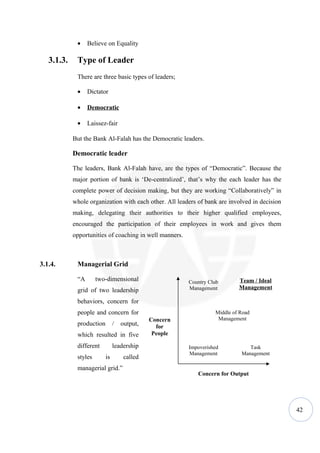
3.1.4.       Managerial Grid

             “A       two-dimensional                    Country Club       Team / Ideal
             grid of two leadership                      Management         Management

             behaviors, concern for
             people and concern for                                Middle of Road
                                             Concern                Management
             production        /   output,     for
             which resulted in five           People

             different         leadership                Impoverished           Task
                                                         Management          Management
             styles       is        called
             managerial grid.”
                                                            Concern for Output


                                                                                               42
The behaviors of leaders of bank Al-Falah are lies in the “Team / Ideal Management”,
    because all the managers are doing their work collaborative with each other and also
    with their whole team of workers, they have as well.


3.2. By Contingency Theories
3.2.1.       Fiedler’s Model

             “A leadership theory that proposes that effective group performance depends
             upon the proper match between a leader’s style of interacting with his / her
             followers and the degree to which the leader to control and influence is known
             as Fiedler’s model.”

             The leaders of Bank Al-Falah have the proper match between the leaders’
             styles and the degree.

             Least preferred co-workers

             All the leaders of Bank Al-Falah are Cooperative with their followers, and NO
             one possess uncooperative attitude.


3.2.2.       Situational Theory
             “The leadership contingency theory that focuses on the follower’s readiness.”

             In the Bank Al-Falah, this theory is also applicable because the followers /
             employees of leader(s) are ready every time for do any task / mission or any
             kind of work given by their leader(s). And all the Leaders or Managers are
             also careful for giving any task or work to their followers that they are see
             firstly that either their followers are ready for this job or not.


3.2.3.       Goal-path Model

             As above the all Leaders of Bank Al-Falah are very cooperative to each other
             as well as with their followers, that’s why they are also providing the right
                                                                                              42
‘Path / Direction’, after finding, to their followers on through they and their
followers could achieve their targets and goals.


                                                                                  42
3.3.      Leadership Behaviors
          The leaders of Bank Al-Falah, in their behaviors, are;

   Directive      They provide the proper schedules, direction and guidance etc. to
                  their followers / employees, from through the employees can do the
                  specific work or task which has been given to them, to achieving their
                  and organizational objectives as well.

   Supportive The leaders also give the proper attention on their followers /
                  employees and also help them in case of any trouble in achieving the
                  targets and tasks.

       All the work is done in friendly atmosphere in the Bank Al-Falah.


                                                                                           42
3.4. Motivation
     “The process that account for an individual’s willingness to exert high levels of effort
     to reach organizational goals, conditioned by the effort’s ability to satisfy some
     individual need is known as Motivation.”

     The motivation has a great role in the success of any field. The success ratio goes
     higher when the leader motivates his / her followers to do the work or complete the
     task, given to them in time. Sometimes the employees perform certain kind of
     difficult & hectic tasks, that’s just because they get motivated by the employer /
     concerned authorities.

     The Leaders / Executives / Managers of Bank Al-Falah motivate their employees in
     the above mentioned manner to achieve the best results.

3.4.1.       Early Theories of Motivation
                    Maslow’s Hierarchy of Needs

                    The Leaders / Executives / Managers of Bank Al-Falah are very well
                    familiar with all the basic or extra needs, like Physiological needs,
                    Safety needs, Social needs, Esteem needs and Self-actualization needs,
                    of their employees.

                    That’s why they are handling their employees in same manner that
                    they are providing the basic, physiological and safety, needs to their
                    employees but when their employees perform with greater efficiency
                    for the Bank, then the concerned authorities or concerned management
                    staff provide them the Social, Esteem needs and Self-actualization’s
                    things as reward or as any else.

                    McGregor’s Theory X &Y

                    The Bank Al-Falah has the both type of employees ‘X’ & ‘Y’ in it. The
                    mostly employees of bank are the type of ‘Y’, so that the Leaders /
                    Executives / Managers of Bank are only motivates them, due to their
                    Activeness, Effectiveness and Seek Responsibilities, but the other type
                    of employees ‘X’, are Punished (not heavily) and Motivates by the
                                                                                                42
Leaders / Executives / Managers of Bank due to their some Laziness,
                    Avoiding of Responsibilities and Non-proper Interest in work.

                    Herzberg’s Hygiene Theory

                    Some of the employees of type ‘X’, in the bank feel like hygiene from
                    their job. That’s why the Leaders / Executives / Managers of Bank
                    have to face some difficulties to motivate them. But they are fully
                    managing them as well as whole organization in the best way. And
                    they are still removing those factors which are cause of the
                    dissatisfaction for their employees.


3.4.2.       Contemporary Theories of Motivation
             These theories and approaches are representing the current explanations of
             employee’s motivation. These theories are;

             • Three – Needs Theory

             • Goal-Setting Theory

             • Reinforcement Theory

             • Equity Theory

             According to these theories, the Leaders / Executives / Managers of Bank Al-
             Falah motivate their employees in the same sense that their employees do the
             work for achievements and they behave in the best way with everyone, so to
             make a friendly atmosphere in the whole organization, for making a good
             relationship with everyone.

             The Leaders / Executives / Managers of Bank Al-Falah also provide the
             sustention support to their employees that they make their full intentions
             towards their goals for the best result.

    The Leaders / Executives / Managers of Bank Al-Falah also provide the suitable
    atmosphere to their employees, which belongs to category ‘Y’, that they ignore the
    factors like goals, expectations of management and needs etc. but they should only be
                                                                                            42
focused on “What happen to a person when he / she do / takes some action?” This step
is helps to the employees of category ‘Y’ that they should do more than before for
organizational development, and they will get more benefits like Job Enlargement, Job
Scope, Job Enrichment and Job Satisfaction etc.

The Leaders / Executives / Managers of Bank Al-Falah are very careful regarding the
issues of ‘Discrimination’ and ‘De-motivation’ due to any discrimination. They are
fully avoiding those rules and regulations and anything which causes discrimination in
their organization. That’s why all the leaders believe on the ‘Equity’ and they are also
motivating their each of the employee as well.


                                                                                           42
56
CONTROL
4.1   Testing the System of Internal Controls

The general objective of testing controls is to obtain reasonable assurance that the
controls are in use and operating as planned. Sampling techniques are used in Al-
Falah bank. Tests should meet the following criteria:

      4.1.1. Data Integrity

             • Are the controls in place to ensure the integrity of the data?

             • Are records up-to-date and accurate?

      4.1.2. Documentation

             • Are all systems, functions, processes, procedures, programs, and
                 activities clearly documented?

             • Is the documentation readily available for examination?

             • Are operating procedures adequate?

      4.1.3. Recordation

             • Are there records that show that controls are in use?

      4.1.4 Supervision

             • Are appropriate procedures in place for assigning, reviewing, and
                 approving work?

             • Do the employees adhere to procedures for assigning, reviewing, and
                 approving work?


                                                                                       56
4.1.5 Authorization

      • Are appropriate controls in place to ensure transactions and other
         significant activities are authorized and executed only by authorized
         personnel?

      • Do employees adhere to the requirements of authorization only by
         authorized personnel?

4.2   Separation of Duties

      • Are key duties and responsibilities such as authorizing, processing,
         recording, and reviewing separated among individuals?

4.3   Security

      • Are appropriate procedures in place which limits access to resources
         and records to authorized personnel?

      • Do employees adhere to security procedures?


                                                                                 56
56
ETHICS
      Ethics is a branch of philosophy which seeks to address questions about morality, such
as what the fundamental semantic, ontological, and epistemic nature of ethics or morality is
meta-ethics, how moral values should be determined, how a moral outcome can be achieved
in specific situations, how moral capacity or moral agency develops and what its nature is
moral psychology, and what moral values people actually abide by descriptive ethics.


5.1. APPROACHES TO ETHICS


       5.1.1.         Utilitarianism Approach

                      What is good for the most number of people states the utilitarianism
                      approach.


       5.1.2.         Individualism Approach

                      Any Ethical decision that can be for self interest until or unless it is not
                      harmful for anyone else.


       5.1.3.         Right Approach

                      In right approach, basic fundamental rights of human being are
                      protected until or unless yours decision are ethical


       5.1.4.         Justice Approach

                      In justice approach we treat everyone equally, fairly & consistently


                     Justice Approach is being adopted in Bank Alfalah                               56
5.2. STRATEGIES FOR MANAGING STAKEHOLDERS


           5.2.1 Confrontation Strategy
                       In such a strategy one confronts the claims upon one’s self. The
                       company doesn’t admit the claims. Rather they prefer to face
                       the challenge.


           5.2.2 Damage Control Strategy
                       In such a strategy we admit the claims and positively respond
                       to those claims by properly controlling the damage caused.


           5.2.3 Accommodation Strategy
                       In this sort of strategy, the company provides the compensation
                       on the claims to the victims.


           5.2.4 Proactive Strategy
                       The company is already prepared to face any kind of situation
                       in this type of strategy.


Bank Alfalah practices both damage control strategy as well as accommodation
                    strategy on the basis of the situation.


                                                                                          56
56
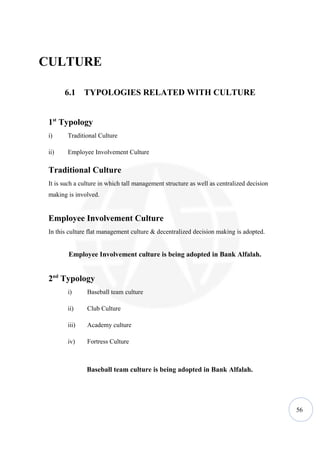
CULTURE

       6.1     TYPOLOGIES RELATED WITH CULTURE


 1st Typology
 i)     Traditional Culture

 ii)    Employee Involvement Culture

 Traditional Culture
 It is such a culture in which tall management structure as well as centralized decision
 making is involved.


 Employee Involvement Culture
 In this culture flat management culture & decentralized decision making is adopted.


        Employee Involvement culture is being adopted in Bank Alfalah.


 2nd Typology
        i)      Baseball team culture

        ii)     Club Culture

        iii)    Academy culture

        iv)     Fortress Culture


                Baseball team culture is being adopted in Bank Alfalah.


                                                                                           56
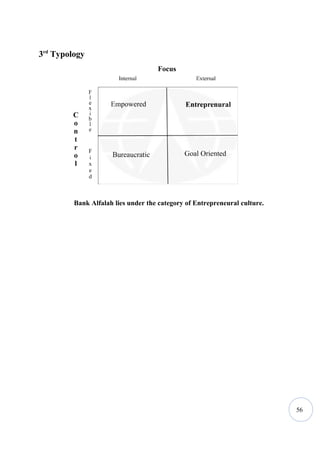
3rd Typology


         Bank Alfalah lies under the category of Entrepreneural culture.


                                                                           56
56
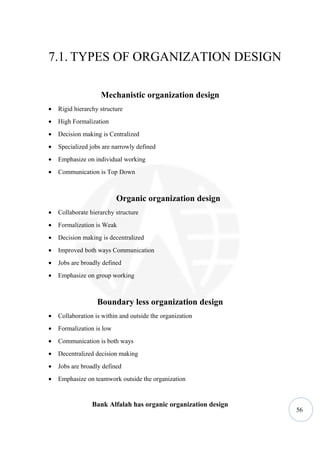
7.1. TYPES OF ORGANIZATION DESIGN

                    Mechanistic organization design
•   Rigid hierarchy structure
•   High Formalization
•   Decision making is Centralized
•   Specialized jobs are narrowly defined
•   Emphasize on individual working
•   Communication is Top Down


                           Organic organization design
•   Collaborate hierarchy structure
•   Formalization is Weak
•   Decision making is decentralized
•   Improved both ways Communication
•   Jobs are broadly defined
•   Emphasize on group working


                   Boundary less organization design
•   Collaboration is within and outside the organization
•   Formalization is low
•   Communication is both ways
•   Decentralized decision making
•   Jobs are broadly defined
•   Emphasize on teamwork outside the organization


                 Bank Alfalah has organic organization design
                                                                56
56
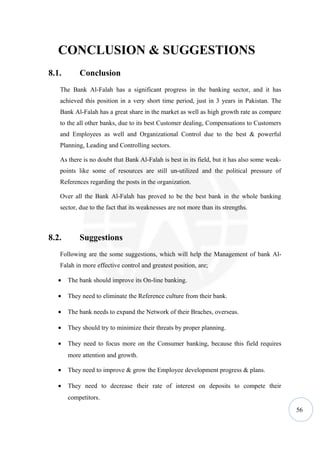
CONCLUSION & SUGGESTIONS
8.1.       Conclusion
   The Bank Al-Falah has a significant progress in the banking sector, and it has
   achieved this position in a very short time period, just in 3 years in Pakistan. The
   Bank Al-Falah has a great share in the market as well as high growth rate as compare
   to the all other banks, due to its best Customer dealing, Compensations to Customers
   and Employees as well and Organizational Control due to the best & powerful
   Planning, Leading and Controlling sectors.

   As there is no doubt that Bank Al-Falah is best in its field, but it has also some weak-
   points like some of resources are still un-utilized and the political pressure of
   References regarding the posts in the organization.

   Over all the Bank Al-Falah has proved to be the best bank in the whole banking
   sector, due to the fact that its weaknesses are not more than its strengths.


8.2.       Suggestions
   Following are the some suggestions, which will help the Management of bank Al-
   Falah in more effective control and greatest position, are;

   •   The bank should improve its On-line banking.

   •   They need to eliminate the Reference culture from their bank.

   •   The bank needs to expand the Network of their Braches, overseas.

   •   They should try to minimize their threats by proper planning.

   •   They need to focus more on the Consumer banking, because this field requires
       more attention and growth.

   •   They need to improve & grow the Employee development progress & plans.
   •   They need to decrease their rate of interest on deposits to compete their
       competitors.
                                                                                              56
REFERENCES
 1. Visit of Bank Alfalah, College Road – Branch

 2. www.bankalfalah.com

 3. www.en.wikipedia.org


                            *~*~*~*~*~*~*~*~*~*


                                                   56
REFERENCES
 1. Visit of Bank Alfalah, College Road – Branch

 2. www.bankalfalah.com

 3. www.en.wikipedia.org


                            *~*~*~*~*~*~*~*~*~*


                                                   56
REFERENCES
 1. Visit of Bank Alfalah, College Road – Branch

 2. www.bankalfalah.com

 3. www.en.wikipedia.org


                            *~*~*~*~*~*~*~*~*~*


                                                   56

Bank alfalah project

  • 1.
    PREFACE The project report“Management of Bank Al-Falah” is about the all views of its management, including the current & past over all progress & process of Planning, Organizing, Leading, Controlling, Ethics, Culture & Organization design. The process which is being followed & running presently, of Planning, Organizing, Leading, Controlling, Ethics, Culture, Organization design and Position of whole Organization in our Nation are also being discussed in detail in this report. 13
  • 2.
    Introduction of BankAl-Falah-------------------------------------------------------------------------05 Mission & Vision----------------------------------------------------------------------------------------08 Chairperson’s Message---------------------------------------------------------------------------------09 Historical Overview-------------------------------------------------------------------------------------10 Board of Directors---------------------------------------------------------------------------------------11 Management----------------------------------------------------------------------------------------------12 1. Planning----------------------------------------------------------------------------------------------14 1.1. Definition---------------------------------------------------------------------------------------15 1.2. Types of Planning------------------------------------------------------------------------------ 15 1.3. Goals / Objectives-----------------------------------------------------------------------------16 1.4. Process of Planning----------------------------------------------------------------------------17 1.5. Types of Strategy------------------------------------------------------------------------------18 1.6. Internal & External Factors-------------------------------------------------------------------18 1.6.1. Internal Factors------------------------------------------------------------------------- 18 1.6.2. External Factors------------------------------------------------------------------------19 1.7. SWOT Analysis--------------------------------------------------------------------------------20 1.8. BCG-Matrix------------------------------------------------------------------------------------22 1.9. Decision Making Authorities----------------------------------------------------------------- 23 2. Organizing-------------------------------------------------------------------------------------------24 2.1. Bank al-Falah’s Structure---------------------------------------------------------------------25 2.2. Purpose of Organizing------------------------------------------------------------------------26 2.3. Bank Al-Falah’s Management Chart--------------------------------------------------------26 13
  • 3.
    2.4. Finance Department---------------------------------------------------------------------------27 2.5. Marketing Department------------------------------------------------------------------------28 2.6. IT Department----------------------------------------------------------------------------------29 2.7. Centralization vs. Decentralization----------------------------------------------------------30 2.8. Type of Organization--------------------------------------------------------------------------30 2.9. Human Resource Management (HRM)-----------------------------------------------------31 2.10. Communication--------------------------------------------------------------------------- -----33 3. Leadership-------------------------------------------------------------------------------------------- 35 3.1. By Early Leadership Theories---------------------------------------------------------------36 3.1.1. Formal vs. Informal-------------------------------------------------------------------36 3.1.2. Traits of Leader------------------------------------------------------------------------36 3.1.3. Type of Leaders------------------------------------------------------------------------37 3.1.4. Managerial Grid------------------------------------------------------------------------ 37 3.2. By Contingency Theories---------------------------------------------------------------------38 3.2.1. Fiedler’s Model------------------------------------------------------------------------38 3.2.2. Situational Theory---------------------------------------------------------------------38 3.2.3. Goal-Path Model-----------------------------------------------------------------------38 3.3. Leadership Behaviors-------------------------------------------------------------------------39 3.4. By Motivation----------------------------------------------------------------------------------40 3.4.1. Early Theories of Motivation--------------------------------------------------------41 3.4.2. Contemporary Theories of Motivation---------------------------------------------- 41 4. Control------------------------------------------------------------------------------------------------43 13
  • 4.
    4.1. Testing thesystem of internal control-------------------------------------------------------44 4.2. Separation of Duties---------------------------------------------------------------------------45 4.3. Security------------------------------------------------------------------------------------------ 45 5. Ethics-------------------------------------------------------------------------------------------------46 5.1. Approaches to Ethics-------------------------------------------------------------------------- 47 5.1.1. Utilitarianism Approach--------------------------------------------------------------47 5.1.2. Individualism Approach--------------------------------------------------------------47 5.1.3. Right Approach------------------------------------------------------------------------47 5.1.4. Justice Approach-----------------------------------------------------------------------47 5.2. Strategies for Managing Stakeholders------------------------------------------------------48 5.2.1. Confrontation Strategy----------------------------------------------------------------48 5.2.2. Damage Control Strategy-------------------------------------------------------------48 5.2.3. Accommodation Strategy-------------------------------------------------------------48 5.2.4. Pro-active Strategy-------------------------------------------------------------------- 48 6. Culture------------------------------------------------------------------------------------------------49 6.1. Types of typologies----------------------------------------------------------------------------50 7. Organization design---------------------------------------------------------------------------------52 7.1. Types of Organization Design--------------------------------------------------------------- 53 8. Conclusion & Suggestions-------------------------------------------------------------------------54 8.1. Conclusion--------------------------------------------------------------------------------------55 8.2. Suggestions-------------------------------------------------------------------------------------55 Reference-------------------------------------------------------------------------------------------------56 13
  • 5.
  • 6.
    Bank Al-Falah wasincorporated on 21st June, 1997 as a public limited company under the Companies Ordinance 1984. Its banking operations commenced from 1st November, 1997. The bank is engaged in commercial banking and related services as defined in the Banking companies ordinance, 1962. Bank Al-Falah Limited is a Pakistan-based bank, engaged in commercial banking and related services. The services offered by the Company include Branch banking, Consumer banking, Electronic banking, corporate banking and Treasury and Investment. Its Branch banking services include direct and indirect Foreign Currencies Remittance facility, Foreign Trade and Correspondent banking and safe Deposit Locker facilities. Through Consumer banking, the Company offers Credit cards, Home Loans, Rupee Traveler checks, Auto loans, and Money-Gram, which is a person-to-person money transfer service. Its Electronic banking services include Phone banking, Automated Teller Machines (ATM) and On-line banking. Its Treasury and Investment services include Financial advisory services, and services for the money market and foreign exchange market. Its corporate banking activities include Trade finance and structured finance. The Company offers services through a network of 142 branches and 59 ATM machines. These branches are in the following cities of Pakistan. • Abbott Abad • Chitral • Haroonabad • Ahmedpur East • D.G.Khan • Hasilpur • Arifwala • D.I.Khan • Hayatabad • Attock • Daharki • Heart • Bahawalpur • Daska • Hyderabad • Bannu • Fasialabad • Islamabad • Bhalwal • Ghotki • Jhang • Burewala • Gilgit • Jhelum • Chakwal • Gujranwala • Karachi • Chaman • Gujrat • Kasur • Chichawatni • Hafizabad • Kharian • Chiniot • Hangu • Kohat 13
  • 7.
    • Kotla • Mirpur Khas • Sadiqabad • Lahore • Multan • Sahiwal • Lala Musa • Nawabshah • Sailkot • Larkana • Okara • Sargoda • Mandi • Pakpattan • Sheikhupura Bahauddin • Peshawar • Sukkar • Mansehra • Quetta • Toba Tek Singh • Mdardan • Rawalpindi • Wah Cantt • Mian Chunnu • Rhaim-Yar- • Mingora/Swat Khan 13
  • 8.
    MISSION & VISION Mission “Todevelop and deliver the most innovative services, products, manage customer experience, deliver quality service that contributes to brand strength, establishes a comprehensive advantage and enhances profitability, in this way providing value to the stakeholders of the bank.” Vision “To be the premier organizations operating locally & internationally that provides the complete range of financial services to all segments under one roof.” 13
  • 9.
    CHAIRPERSON’S MESSAGE “Our corephilosophy of honesty, transparency in customer dealings, product innovation, excellence in customer services and our commitment to being a responsible corporate citizen pervades this website.” Since the inception of Bank Al-Falah, by the grace of the Almighty Allah, we have moved rapidly in expanding our branch network and deposit base, along with making profitable advances and increasing the range of products and services. We have made a break-through in providing premier services at an affordable cost to our customers. Keeping in view our valued clients and the need for constant and effective communication of information, we have designed this website to be as user-friendly as possible. As we pursue the path of excellence, customer satisfaction remains our priority. It is only when we know our customers better, can we deliver a higher quality of services, thereby adding synergy to our existing management expertise, financial strength and profitability. This is yet another channel of communication for the delivery of quality products and services that enhance value to our stakeholders. 13
  • 10.
    HISTORICAL OVERVIEW Bank Al-FalahLimited was incorporated on June 21st, 1997 as a public limited company under the Companies Ordinance 1984. Its banking operations commenced from November 1st, 1997. The bank is engaged in commercial banking and related services as defined in the Banking companies ordinance, 1962. The Bank is currently operating through 104 branches in 36 cities, with the registered office at B.A.Building, II.Chundrigar, Karachi. Since its inception, as the new identity of H.C.E.B after the privatization in 1997, the management of the bank has implemented strategies and policies to carve a distinct position for the bank in the market place. Strengthened with the banking of the Abu Dhabi Group and driven by the strategic goals set out by its board of management, the Bank has invested in revolutionary technology to have an extensive range of products and services. This facilitates our commitment to a culture of innovation and seeks out synergies with clients and service providers to ensure uninterrupted services to its customers. We perceive the requirements of our customers and match them with quality products and service solutions. During the past five years, we have emerged as one of the foremost financial institution in the region endeavoring to meet the needs of tomorrow today. 13
  • 11.
    BOARD OF DIRECTORS H.E. Sheikh Hamdan Bin Mubarak Al Nahayan Chairman Mr. Abdulla Nasser Hawalileel Al- Mansoori Director Mr. Ikram Ul-Majeed Sehgal Director Mr. Abdull Khalil Al Mutawa Director Mr. Nadeem Iqbal Sheikh Director Mr.Khalid Mana Saeed Al Otaiba Director Mr. Sirajuddin Aziz Director & CEO 13
  • 12.
    MANAGEMENT Mr. Sirajuddin Aziz ChiefExecutive Officer Mr. A. Wahid Dada Group Head Commercial Banking Mr. Parvez A. Shahid Co-Chairman Central Management Committee Mr. Hamid Ashraf General Manager Legal Affairs & Company Secretary Mr. Shakil Sadiq Chief Operating Officer Mr. Zahid Ali H. Jamall Chief Financial Officer Mr. Arfa Waheed Malik Group Head Corporate & Investment Banking Mr. Mohammad Iqbal Saifee Group Head Audit & Inspection Mr. Ijaz Farooq Group Head Islamic Banking Mr. Talib Rizvi Group Head Priority Banking & Wealth Mr. Adil Rashid Management Group Head Consumer Finance Mr. Tariq Mir General Manager International Business Mr. Nadeem Ul Haq Group Head Operations Mr. Ather Shehab Executive Incharge Mr. Mohammad Yousuf Establishment & Administration Group Head Mr. Mahmood Ashraf Credit & Collections General Manager Mr. Bakhtiar Khawaja Credit Monitoring Group Head Training & Development 13
  • 13.
    Mr. Falak Sher ChiefCompliance Officer Mr. Haroon Khalid General Manager Risk Management Mr. Imtiaz Ahmad Sheikh General Manager Information Technology Mr. M. Mudassar Aqil General Manager Human Resource & Quality Assurance 13
  • 14.
  • 15.
    PLANNING 1.1. Definition Planning is • Defining organization’s goals and objectives. • Establishing overall strategies for achieving those goals. • Developing a comprehensive set of plans to integrate and coordinate organizational work. 1.2. Types of Planning Bank Al-Falah use both formal and informal types of planning. 1.2.1. Informal In informal planning, their planning is not written down, short term focus and specific to an organizational unit. 1.2.2. Formal In formal planning, their planning is written down, specific, long term focus and involves shared goals for the organization. 23
  • 16.
    1.3. Goals / Objectives • Financial strength and Profitability by making profitable advances • Customer satisfaction by providing higher quality of services at an affordable cost • Growth by expanding branch network and deposit base 1.3.1. Short-term Objectives • Profitability 1.3.2. Long-term Objectives • Profitability • To optimize the use of resources 23
  • 17.
    1.4. Process of Planning Process of Planning Mission Strategies Plans Programs Policies Rules Budget  Mission Mission of Bank Al-Falah is to develop and deliver the most innovative products, manage customer experience, deliver quality service that contributes to brand strength, establishes a comprehensive advantage and enhances profitability, in this way providing value to the stakeholders of the bank.  Strategies Strategies of Bank Al-Falah are giving loans and accepting deposits.  Plans Plans of Bank Al-Falah are short-term & long-term Advances & Deposits.  Programs Programs of Bank Al-Falah are up to one year or more than one year advances, fixed account, current account etc, debit card, credit card etc.  Policies Policies of Bank Al-Falah are profitability, by making profitable advances and customer satisfaction by providing best services at an affordable cost.  Rules Their rules are defined by upper level of management according to situation  Budget Bank Al-Falah always met its budget. 23
  • 18.
    1.5. Types of Strategy There are seven kinds of strategy: • Cost Leadership Strategy • Differentiation Strategy • Focused Strategy Bank Al-Falah is following the focused strategy. They are focusing on customers by advancing and depositing. 1.6. Internal & External Factors 1.6.1. Internal Factors HRM HRM is playing both positive and negative role in the performance of organization. Positively, HRM is performing its functions and managing the human resource properly. On the negative side, sometimes HRM adopts the policy of favoritism due to political pressure in managing human resource. Structure / Infrastructure Bank Al-Falah has sound structure and infrastructure. Organizational Policies Policies of Bank Al-Falah are favorable for customers. Nature of Organization Financial Institution. 23
  • 19.
    1.6.2. External Factors TechnologicalFactors Technologically, Bank Al-Falah is weak and this element is threatening to Bank Al- Falah. Online Banking (advances, deposits, transactions etc.) is not working properly. Political Factors Politically, people are influencing on the performance of Bank Al-Falah. Particularly, agricultural people get benefits due to relation to politicians. Such people are getting advances and jobs on favoritism. Physical Factors Physical structure of Bank Al-Falah is very sound. Demographic Factors Population of Pakistan is a big number, which is supportive for bank. Economic Factors Population of Pakistan is rich which is beneficial for the bank. Legal & Ethical Factors Bank has legal entity and is taking care of ethics which is giving it advantage in attaining customer attention. Social & Cultural Factors Social and cultural factors are affecting the bank. Majority of the population is un- educated and unaware of the benefits of banking sector. They have low saving and want to keep money with them. 23
  • 20.
    1.7. SWOT ANALYSIS The SWOT analysis is an extremely useful tool for understanding and decision- making for all sorts of situations in business and organizations. SWOT is an acronym for Strengths, Weaknesses, Opportunities, and Threats. Growth Stability Strengths (+) Strategy Strategy (+ , +) (+ , -) Stability Retrenchment Strategy Strategy Weaknesses (-) (- , -) (- , +) Opportunities (+) Threats (-) Strengths Following are the strengths of Bank Al-Falah: • Brand • Decent customer dealing • Rapidly expansion in branch network Weaknesses Following are the weaknesses of Bank Al-Falah: • Poor employee development and promotion • Improper online Banking Opportunities Following are the opportunities of Bank Al-Falah: • Improvement in online banking • More customer satisfaction 23
  • 21.
    Threats Following competitors are threats to Bank Al-Falah: MS Global Saudi Pak Bank Habib Bank Standard Chartered Bank 1.7.1. Essence of SWOT Analysis Since Bank Al-Falah has decent strengths and opportunities in the market, its market share is increasing and it is expanding its branch network rapidly, so the situation tells us that Bank Al-Falah is adopting and implementing on Growth Strategy. 23
  • 22.
    1.8. Boston Consulting Group (BCG – Matrix) ? Star Question High (H, H) Mark Business (H, L) Growth Rate Cash Cow Dog Low (L, H) (L, L) High Low Relative Position (Market Share) Star “The businesses, whose growth rate as well as market shares are very higher, and those are leader of market, are categories as star.” Cash Cow “The businesses have big market share but their growth rate is low, and they earn a large amount of cash due to their reputation, are categories as cash cow.” ? (Question Mark) “The businesses, which are growing highly but their market share is low than star’s businesses, are categories as question mark.” Dogs “The businesses, which have very low growth rate as well as market share, are categories as dogs.” Essence of BCG Matrix “Bank Alfalah lies under the category of STAR in the BCG matrix, as their growth rate and market share is very high.” 23
  • 23.
    1.9. Decision MakingAuthorities 1.9.1. Top Level of Management Important and overall decisions of the bank are made by top level of management. For example: Chairman 1.9.2. Regional Manager Regional manager makes decisions at regional level. 1.9.3. Branch Manager Branch manager makes decisions at branch level. 23
  • 24.
  • 25.
    ORGANIZING Managers work inorganization. But what is an organization? An organization is a deliberate arrangement of people to accomplish some specific purpose. Your banks, university is an organization, colleges, govt. departments are all organizations because they have three common characteristics. First, each organization has a distinct purpose. This purpose is typically expressed in terms of a goal or set of goals that the organization hopes to accomplish. Second, each organization is composed of people. One person working alone is not an organization and it takes people to perform the work that’s necessary for the organization to achieve its goals Third, all organization develop some deliberate structure so that their members can do their work. 2.1. Bank Al-Falah’s Structure Sweden’s premiere bank is one of the largest banks in the Nordic region. Lars Grunted(pictured),president and group chief executive, oversees a business that is organized around a decentralized structure with a network of some 540 branches in Norway, as well as in nine European countries and six countries outside Europe. He believes that the bank’s 30-plus years of developing its branch network has allowed it to consistently grow market share and achieve a return on equality above the average of its Nordic competitors are starting to copy Handelsbanken’s structural model. Handelsbanken’s branch managers can choose their customers and product mix. They also set staffing numbers and decide salary levels. All customers, private and corporate, no matter what size, are the responsibility of a local branch. Handelsbanken’s flat management structure and emphasis on personal responsibility and consensus approach is well suited to the Swedish culture. 34
  • 26.
    2.2. Purposes of Organizing • Divide work to be done into specific jobs and departments in Bank Al-Falah. • Assign tasks and responsibilities associated with individual jobs in Bank Al-Falah. • Coordinates diverse organizational tasks in Bank Al-Falah. • Establishes relationships among individuals, groups and departments in Bank Al- Falah. • Establishes formal lines of authority in Bank Al-Falah. • Allocates and deploys organizational resources in Bank Al-Falah. 2.3. Bank Al-Falah’s Management Chart • Management performs different functions in Bank Al-Falah. • C.E.O (Chief executive officer) o Controls the whole management affairs in Bank Al-Falah. • Executive Incharge (E.I) o Establishes the environment of strategic planning and aware of to hold the global market. o Manages the HRM and assigns work to individual for betterment. o Divides the credit in different ways and allocation to safer place. o Controls the administration activities and carries on the establishment process for the betterment of Bank Al-Falah. o Investigates the business development reports that our business gets profit or loss. o Analysis the audit and inspection division for efficient work. o His work is to divide the cards in best manner, just like debit cards, credit cards, ATM’s cards and Hilal cards in Bank Al-Falah. o He did his work for international and treasury division in Bank Al-Falah. 34
  • 27.
    o Divided theI.T (information technology). o Supports the corporate and home finance. o He monitoring the credit division. o Investigates the legal affairs. 2.4. Finance Department Finance is responsible in terms of money in all departments or monetary policies. It is concern with more inflow of the cash that outflow of the cash in terms of Bank Al- Falah. Structured Finance Established in 1998 in order to provide innovative investment banking services to our valued clients. A team of handpicked professionals, dedicated to syndicated loans and structured products. The team’s expertise is well known in the marketplace with its capability to assist public & private sector entities, major financial institutions, multinational corporations, domestic & international institutional investors in innovative financing including underwriting & private placements. The scope of SFU’s activities also encompasses advisory assignments, such as privatization, Mergers & Acquisitions (Man’s), domestic listings, IPOs and restructuring. During the past few years, SFU has been successful in sourcing and participating in a number of prestigious transactions involving large amounts. Some of the value added services offered by SFU include the following: • Loan syndication • Public floatation of Term Finance Certificates (TFCs) and equity • Private placement of Term Finance Certificates (TFCs) and equity underwriting • Guarantee syndications • Financial restructuring 34
  • 28.
    Mergers & Acquisitions (M&As) • Fostering joint ventures • Privatization – Sale side and buyers side advisory • Structuring new financial instruments In the future, SFU is envisaged to supplement the enhanced profile and profitability of Bank Al-Falah Limited through its value added services, through both asset building and income generating aspects. 2.5. Marketing Department Marketing department performs different functions in terms of Bank Al-Falah. 2.5.1. Sales In Bank Al-Falah sales gets only in the light of the customer. 2.5.2. Need Identification First of all, you identify your customer and how is your dealing with that person. 2.5.3. Positioning In Bank Al-Falah, what is your position to deal that person? 2.5.4. Targeting What is your long term goal and short term goal according to Bank Al-Falah? 2.5.5. Promotion It is concerned with all types of advertisement. Its purpose is to get more customers in terms of promotion according to Bank Al-Falah. 34
  • 29.
    2.6. IT Department 2.6.1. ATM’s Bank Al-Falah through its commitment to provide superior and improved services to its valued customers, has unveiled a nationwide network of ATMs. For your convenience, you now have access to instantaneous cash availability, 24 hours a day, 7 days a week. Our ATM network is geared up to exploit the latest technology, and is equipped to meet the highest standards of security and efficiency. • With your new Hilal-Card you can now: • Withdraw Cash • Use our convenient, user-friendly fast cash option • Make a Balance Inquiry. • Get an instant printout of your account balances • Get a printout of your last transactions (Mini-statement) on the spot. • Change your PIN (Personal Identification Number). Bank Al-Falah is pleased to introduce 55 state of the art ATMs, deployed at the most convenient and accessible locations. Bank Al-Falah is a founder member of the 1-Link Switch, thus making a country wide network of ATMs available. 2.6.2. Online Banking Bank Al-Falah now offers the facility of on-line banking to its customers through its country wide network of branches. Customers can use the ATMs or the banking counters of any branch for day-to-day banking needs, irrespective of branch where they maintain their accounts. For Corporate customers centralized Cash Management facility is also offered through on-line banking. 34
  • 30.
    2.6.3. Phone Banking "Al-Falah Phone Banking” is available to all customers on a countrywide basis. Customers can dial 111-225-111 (without any city code/prefix) from their respective cities i.e. 21 cities where Bank Al-Falah is present, and can get prompt services from the Centralized Phone Banking Services. Customers enjoy 24x7 Round the Clock Phone Banking Services. Bank Al-Falah is the first bank in Pakistan to offer Centralized UAN connectivity from 21 cities to its Call Centre with Hunting & ACD facilities. 2.7. Centralized vs. Decentralization Centralized describes the degree to which decision making is concentrated at a single point in the banking organization. If top managers make the banking organization’s key decision with little or no input from below, then the banking organization is centralized. In Bank Al-Falah the major portion of organization is ‘Decentralized’, because the Managers of all levels have the power of decision making. 2.8. Type of Organization 2.8.1. Tall vs. Flat Bank Al-Falah is a Tall organization. 2.8.2. Multinational vs. National Bank Al-Falah is a multinational organization. 2.8.3. Mechanistic vs. Organic Bank Al-Falah is an organic organization. 2.8.4. Single vs. Branch Bank Al-Falah is a branched organization. 2.8.5. Big vs. Small Bank Al-Falah is a big organization. 34
  • 31.
    2.9. Human ResourceManagement (HRM) HRM means to put the right man, for the right job, at the right time and at the right place, so HRM deals with the fair job description as a whole in Bank Al-Falah. Road-Map of HRM The road-map through which HRM helps the managers to organize the activities of man-power in Bank Al-Falah. 2.9.1. How HRM is important A banking organization HRM practices have been found to have a significant impact on organizational performance. 2.9.2. HRM process Activities necessary for staffing the organization and sustaining high employee performance in Bank Al-Falah. 2.9.3. HRM training and development Bank Al-Falah’s HR management believes in developing the potential of the Bank’s employees to the fullest extent. Training & Development Centre of the Bank is housed in custom-built, state of the art facility on the 4th floor of the Head Office building at Karachi. The centre is responsible for providing multi-level high quality training programs to all staff members in the following areas: • Consumer banking operations • Credit marketing & credit proposals • Credit administration/documentation • Trade finance operations • Marketing & selling skills • Customer service skills • Performance appraisal skills • Time management & personal effectiveness 34
  • 32.
    It is obligatoryfor each staff member of the bank to attend at least one training program. Wherever the Training Department is unable to provide focused training for certain groups of staff, reputable external training providers are invited to fill the gap. HRM Trade Department Inspired by a challenging spirit and an unyielding desire to create a sound and reliable networking of correspondent relationships, the bank has placed great emphasis towards it growth. Accomplishing something for the first time requires a special focus. It demands foreseeing possibilities. In our endeavor, to do so, we successfully surmounted problems and difficulties arising out of issues relating to weak economic conditions of the economy and a continuous deteriorating status of country risk. The incertitude and skepticism of the international banking community towards financial institutions from emerging markets remained intact. Our persistence during the past four years allowed us to make significant inroads into the arena of correspondent banking. Large international banks, after critically evaluating us, agreed to enter into relationship. During 2002 we added 81 banks to our network of correspondents, bringing the total number over 170. Of these relationships, there are now several banks that rank amongst, the top financial institutions in the world. Our geographical coverage now extends to over 100 countries, which is adequately compatible with our trade flows. Our correspondents, during the year extended us unqualified support, which enabled us to undertake a healthy quantum of foreign trade business. There are many challenges ahead for the bank, in the coming year, our bank will not only continue to review its efforts on existing correspondents to make the relationship more beneficial, but will also add more correspondents to establish a comprehensive international networking to facilitate our customer’s transaction as well as the Bank’s proprietary needs. We have provided against the list of correspondents their world and country ranking. These ranking have been taken from The Bankers Almanac – July 2001 issue. We would like to emphasize that correspondent arrangements do not necessarily imply the existence of account relationship. We are in the process of rationalizing our current nostro account relationships. We shall continue to open new accounts in various currencies based on our trade flows and business requirements. 34
  • 33.
    Communication The flow of information in Bank Al-Falah. 2.9.4. Direction of communication Bank Al-Falah communication can flow downward, upward, laterally, or diagonally. Down-ward Communication Any communication that flows downward from a C.E.O to employees is downward communication. Up-ward Communication Any communication that flows upward from employees to C.E.O. Lateral Communication Communication that takes place among employees on the same level is called lateral communication. Diagonal Communication Communication that cuts across both work areas and organizational levels. 34
  • 34.
    2.9.5. Communication Model Message Any type of message of Executive Incharge (E.I) to be conveyed. Encoding Converting a message into symbols. Channel The medium a message travels along. Decoding Retranslating an Executive Incharge (E.I) message. Receiver The seven elements involved in transferring meaning from Executive Incharge (E.I) to another. Feed back Any disturbance that interfere with the transmission, receipts or feed back of a message. 2.9.6. Types of Communication Verbal & Non-verbal communication Verbal communication means audiotape-communication conferences, radio in Bank Al-Falah. Non-verbal communication means visual, sign board, newspapers in Bank Al-Falah. Audio - Video Audio - Video means multimedia presentations, video conferences and meetings in Bank Al-Falah. Formal & Informal communication Discussion between C.E.O and Executive Incharge is Formal communication. Discussion between employees in Bank Al-Falah is Informal communication. 34
  • 35.
  • 36.
    LEADERSHIP “The process ofinfluencing a group of people towards the achievement of pre-selected goals is called leadership.” & “The person who makes this process or who can influence others / group of people and who has managerial authority is called a leader.” The leader is needed by the every field & Organization, as well as the Bank Al-Falah has its leader in the form of High qualified & skilled Managers, which are working hardly to put the bank at the peak level as well as achieving the organization’s pre-selected goals. 3.1. By Early Leadership Theories 3.1.1. Formal vs. Informal The leaders, Bank Al-Falah have, are the Formal leaders. 3.1.2. Traits of Leader The leaders of Bank Al-Falah have the following Traits & Skills in themselves. • Decision making • Risk taking & Risk bearing • Stress taking & Stress bearing • Communication Power • Honesty • Strong Vision • Interpersonal skill • Market forecasting skill • Consistency • Step forward • Discipline • Competitive skill 42
  • 37.
    Believe on Equality 3.1.3. Type of Leader There are three basic types of leaders; • Dictator • Democratic • Laissez-fair But the Bank Al-Falah has the Democratic leaders. Democratic leader The leaders, Bank Al-Falah have, are the types of “Democratic”. Because the major portion of bank is ‘De-centralized’, that’s why the each leader has the complete power of decision making, but they are working “Collaboratively” in whole organization with each other. All leaders of bank are involved in decision making, delegating their authorities to their higher qualified employees, encouraged the participation of their employees in work and gives them opportunities of coaching in well manners. 3.1.4. Managerial Grid “A two-dimensional Country Club Team / Ideal grid of two leadership Management Management behaviors, concern for people and concern for Middle of Road Concern Management production / output, for which resulted in five People different leadership Impoverished Task Management Management styles is called managerial grid.” Concern for Output 42
  • 38.
    The behaviors ofleaders of bank Al-Falah are lies in the “Team / Ideal Management”, because all the managers are doing their work collaborative with each other and also with their whole team of workers, they have as well. 3.2. By Contingency Theories 3.2.1. Fiedler’s Model “A leadership theory that proposes that effective group performance depends upon the proper match between a leader’s style of interacting with his / her followers and the degree to which the leader to control and influence is known as Fiedler’s model.” The leaders of Bank Al-Falah have the proper match between the leaders’ styles and the degree. Least preferred co-workers All the leaders of Bank Al-Falah are Cooperative with their followers, and NO one possess uncooperative attitude. 3.2.2. Situational Theory “The leadership contingency theory that focuses on the follower’s readiness.” In the Bank Al-Falah, this theory is also applicable because the followers / employees of leader(s) are ready every time for do any task / mission or any kind of work given by their leader(s). And all the Leaders or Managers are also careful for giving any task or work to their followers that they are see firstly that either their followers are ready for this job or not. 3.2.3. Goal-path Model As above the all Leaders of Bank Al-Falah are very cooperative to each other as well as with their followers, that’s why they are also providing the right 42
  • 39.
    ‘Path / Direction’,after finding, to their followers on through they and their followers could achieve their targets and goals. 42
  • 40.
    3.3. Leadership Behaviors The leaders of Bank Al-Falah, in their behaviors, are; Directive They provide the proper schedules, direction and guidance etc. to their followers / employees, from through the employees can do the specific work or task which has been given to them, to achieving their and organizational objectives as well. Supportive The leaders also give the proper attention on their followers / employees and also help them in case of any trouble in achieving the targets and tasks. All the work is done in friendly atmosphere in the Bank Al-Falah. 42
  • 41.
    3.4. Motivation “The process that account for an individual’s willingness to exert high levels of effort to reach organizational goals, conditioned by the effort’s ability to satisfy some individual need is known as Motivation.” The motivation has a great role in the success of any field. The success ratio goes higher when the leader motivates his / her followers to do the work or complete the task, given to them in time. Sometimes the employees perform certain kind of difficult & hectic tasks, that’s just because they get motivated by the employer / concerned authorities. The Leaders / Executives / Managers of Bank Al-Falah motivate their employees in the above mentioned manner to achieve the best results. 3.4.1. Early Theories of Motivation Maslow’s Hierarchy of Needs The Leaders / Executives / Managers of Bank Al-Falah are very well familiar with all the basic or extra needs, like Physiological needs, Safety needs, Social needs, Esteem needs and Self-actualization needs, of their employees. That’s why they are handling their employees in same manner that they are providing the basic, physiological and safety, needs to their employees but when their employees perform with greater efficiency for the Bank, then the concerned authorities or concerned management staff provide them the Social, Esteem needs and Self-actualization’s things as reward or as any else. McGregor’s Theory X &Y The Bank Al-Falah has the both type of employees ‘X’ & ‘Y’ in it. The mostly employees of bank are the type of ‘Y’, so that the Leaders / Executives / Managers of Bank are only motivates them, due to their Activeness, Effectiveness and Seek Responsibilities, but the other type of employees ‘X’, are Punished (not heavily) and Motivates by the 42
  • 42.
    Leaders / Executives/ Managers of Bank due to their some Laziness, Avoiding of Responsibilities and Non-proper Interest in work. Herzberg’s Hygiene Theory Some of the employees of type ‘X’, in the bank feel like hygiene from their job. That’s why the Leaders / Executives / Managers of Bank have to face some difficulties to motivate them. But they are fully managing them as well as whole organization in the best way. And they are still removing those factors which are cause of the dissatisfaction for their employees. 3.4.2. Contemporary Theories of Motivation These theories and approaches are representing the current explanations of employee’s motivation. These theories are; • Three – Needs Theory • Goal-Setting Theory • Reinforcement Theory • Equity Theory According to these theories, the Leaders / Executives / Managers of Bank Al- Falah motivate their employees in the same sense that their employees do the work for achievements and they behave in the best way with everyone, so to make a friendly atmosphere in the whole organization, for making a good relationship with everyone. The Leaders / Executives / Managers of Bank Al-Falah also provide the sustention support to their employees that they make their full intentions towards their goals for the best result. The Leaders / Executives / Managers of Bank Al-Falah also provide the suitable atmosphere to their employees, which belongs to category ‘Y’, that they ignore the factors like goals, expectations of management and needs etc. but they should only be 42
  • 43.
    focused on “Whathappen to a person when he / she do / takes some action?” This step is helps to the employees of category ‘Y’ that they should do more than before for organizational development, and they will get more benefits like Job Enlargement, Job Scope, Job Enrichment and Job Satisfaction etc. The Leaders / Executives / Managers of Bank Al-Falah are very careful regarding the issues of ‘Discrimination’ and ‘De-motivation’ due to any discrimination. They are fully avoiding those rules and regulations and anything which causes discrimination in their organization. That’s why all the leaders believe on the ‘Equity’ and they are also motivating their each of the employee as well. 42
  • 44.
  • 45.
    CONTROL 4.1 Testing the System of Internal Controls The general objective of testing controls is to obtain reasonable assurance that the controls are in use and operating as planned. Sampling techniques are used in Al- Falah bank. Tests should meet the following criteria: 4.1.1. Data Integrity • Are the controls in place to ensure the integrity of the data? • Are records up-to-date and accurate? 4.1.2. Documentation • Are all systems, functions, processes, procedures, programs, and activities clearly documented? • Is the documentation readily available for examination? • Are operating procedures adequate? 4.1.3. Recordation • Are there records that show that controls are in use? 4.1.4 Supervision • Are appropriate procedures in place for assigning, reviewing, and approving work? • Do the employees adhere to procedures for assigning, reviewing, and approving work? 56
  • 46.
    4.1.5 Authorization • Are appropriate controls in place to ensure transactions and other significant activities are authorized and executed only by authorized personnel? • Do employees adhere to the requirements of authorization only by authorized personnel? 4.2 Separation of Duties • Are key duties and responsibilities such as authorizing, processing, recording, and reviewing separated among individuals? 4.3 Security • Are appropriate procedures in place which limits access to resources and records to authorized personnel? • Do employees adhere to security procedures? 56
  • 47.
  • 48.
    ETHICS Ethics is a branch of philosophy which seeks to address questions about morality, such as what the fundamental semantic, ontological, and epistemic nature of ethics or morality is meta-ethics, how moral values should be determined, how a moral outcome can be achieved in specific situations, how moral capacity or moral agency develops and what its nature is moral psychology, and what moral values people actually abide by descriptive ethics. 5.1. APPROACHES TO ETHICS 5.1.1. Utilitarianism Approach What is good for the most number of people states the utilitarianism approach. 5.1.2. Individualism Approach Any Ethical decision that can be for self interest until or unless it is not harmful for anyone else. 5.1.3. Right Approach In right approach, basic fundamental rights of human being are protected until or unless yours decision are ethical 5.1.4. Justice Approach In justice approach we treat everyone equally, fairly & consistently Justice Approach is being adopted in Bank Alfalah 56
  • 49.
    5.2. STRATEGIES FORMANAGING STAKEHOLDERS 5.2.1 Confrontation Strategy In such a strategy one confronts the claims upon one’s self. The company doesn’t admit the claims. Rather they prefer to face the challenge. 5.2.2 Damage Control Strategy In such a strategy we admit the claims and positively respond to those claims by properly controlling the damage caused. 5.2.3 Accommodation Strategy In this sort of strategy, the company provides the compensation on the claims to the victims. 5.2.4 Proactive Strategy The company is already prepared to face any kind of situation in this type of strategy. Bank Alfalah practices both damage control strategy as well as accommodation strategy on the basis of the situation. 56
  • 50.
  • 51.
    CULTURE 6.1 TYPOLOGIES RELATED WITH CULTURE 1st Typology i) Traditional Culture ii) Employee Involvement Culture Traditional Culture It is such a culture in which tall management structure as well as centralized decision making is involved. Employee Involvement Culture In this culture flat management culture & decentralized decision making is adopted. Employee Involvement culture is being adopted in Bank Alfalah. 2nd Typology i) Baseball team culture ii) Club Culture iii) Academy culture iv) Fortress Culture Baseball team culture is being adopted in Bank Alfalah. 56
  • 52.
    3rd Typology Bank Alfalah lies under the category of Entrepreneural culture. 56
  • 53.
  • 54.
    7.1. TYPES OFORGANIZATION DESIGN Mechanistic organization design • Rigid hierarchy structure • High Formalization • Decision making is Centralized • Specialized jobs are narrowly defined • Emphasize on individual working • Communication is Top Down Organic organization design • Collaborate hierarchy structure • Formalization is Weak • Decision making is decentralized • Improved both ways Communication • Jobs are broadly defined • Emphasize on group working Boundary less organization design • Collaboration is within and outside the organization • Formalization is low • Communication is both ways • Decentralized decision making • Jobs are broadly defined • Emphasize on teamwork outside the organization Bank Alfalah has organic organization design 56
  • 55.
  • 56.
    CONCLUSION & SUGGESTIONS 8.1. Conclusion The Bank Al-Falah has a significant progress in the banking sector, and it has achieved this position in a very short time period, just in 3 years in Pakistan. The Bank Al-Falah has a great share in the market as well as high growth rate as compare to the all other banks, due to its best Customer dealing, Compensations to Customers and Employees as well and Organizational Control due to the best & powerful Planning, Leading and Controlling sectors. As there is no doubt that Bank Al-Falah is best in its field, but it has also some weak- points like some of resources are still un-utilized and the political pressure of References regarding the posts in the organization. Over all the Bank Al-Falah has proved to be the best bank in the whole banking sector, due to the fact that its weaknesses are not more than its strengths. 8.2. Suggestions Following are the some suggestions, which will help the Management of bank Al- Falah in more effective control and greatest position, are; • The bank should improve its On-line banking. • They need to eliminate the Reference culture from their bank. • The bank needs to expand the Network of their Braches, overseas. • They should try to minimize their threats by proper planning. • They need to focus more on the Consumer banking, because this field requires more attention and growth. • They need to improve & grow the Employee development progress & plans. • They need to decrease their rate of interest on deposits to compete their competitors. 56
  • 57.
    REFERENCES 1. Visitof Bank Alfalah, College Road – Branch 2. www.bankalfalah.com 3. www.en.wikipedia.org *~*~*~*~*~*~*~*~*~* 56
  • 58.
    REFERENCES 1. Visitof Bank Alfalah, College Road – Branch 2. www.bankalfalah.com 3. www.en.wikipedia.org *~*~*~*~*~*~*~*~*~* 56
  • 59.
    REFERENCES 1. Visitof Bank Alfalah, College Road – Branch 2. www.bankalfalah.com 3. www.en.wikipedia.org *~*~*~*~*~*~*~*~*~* 56