Bank
Meaning of Bank
• An old joke attributed to Bob Hope says “a
bank is a financial institution where you
can borrow money only if you can prove
you don’t need it.”
• Banks are the principal source of credit
(loanable funds) for millions of individuals
and families and for many units of
government and businesses
2
Meaning of Bank
• A bank can be defined in terms of (1) the
economic function it serves, (2) the
service it offers its customers, or (3) the
legal basis for its existence.
(1) Converting deposits into loans
(2) Various services offered
(3) Definition given by legal
authority
3
Meaning of Bank
• Prof. Kinley “ A bank is an establishment
which makes to individuals such advances
of money as may be required and safely
made, and to which individuals entrust
money when not required by them for
use.”
4
Types of Banks
• Commercial banks
Sell deposits and make loans to businesses and
individuals
• Money center banks
Large commercial banks based in leading financial
centers
• Community banks
Small, locally focused commercial and savings banks
• Savings banks
Attracts savings deposits and make loans to business
and individuals 5
Types of Banks
• Cooperative banks
Help farmers, ranchers and consumers acquire
goods and services
• Mortgage banks
Provide mortgage loans on new homes but do not
sell deposits
• Investment banks
Underwrite issue of new securities from customers
• Merchant banks
Supply debt and equity capital to business 6
Types of Banks
• Industrial banks
State chartered loan companies owned by financial
or non-financial corporations
• International banks
Commercial banks operations in more than one
nation
• Wholesale banks
Large banks serving corporations and Government
• Retail banks
Small banks serving primary households and small
businesses 7
Types of Banks
• Limited purpose banks
Offer narrow menu of services such as credit card
companies
• Bankers’ banks
Supply services (for eg: cheque clearing) to banks
• Minority banks
Focus on customers belonging to minority groups
• National banks
Function under a federal charter
8
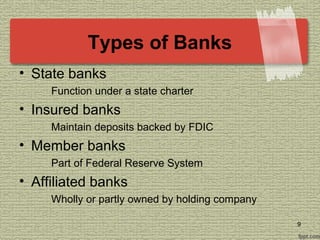
Types of Banks
• State banks
Function under a state charter
• Insured banks
Maintain deposits backed by FDIC
• Member banks
Part of Federal Reserve System
• Affiliated banks
Wholly or partly owned by holding company
9
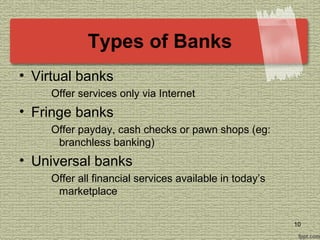
Types of Banks
• Virtual banks
Offer services only via Internet
• Fringe banks
Offer payday, cash checks or pawn shops (eg:
branchless banking)
• Universal banks
Offer all financial services available in today’s
marketplace
10
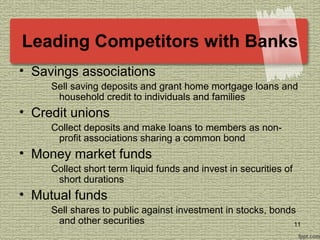
Leading Competitors with Banks
• Savings associations
Sell saving deposits and grant home mortgage loans and
household credit to individuals and families
• Credit unions
Collect deposits and make loans to members as non-
profit associations sharing a common bond
• Money market funds
Collect short term liquid funds and invest in securities of
short durations
• Mutual funds
Sell shares to public against investment in stocks, bonds
and other securities 11
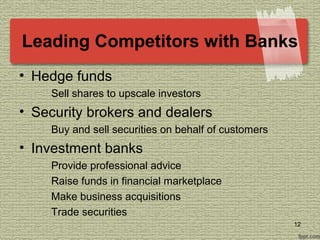
Leading Competitors with Banks
• Hedge funds
Sell shares to upscale investors
• Security brokers and dealers
Buy and sell securities on behalf of customers
• Investment banks
Provide professional advice
Raise funds in financial marketplace
Make business acquisitions
Trade securities
12
Leading Competitors with Banks
• Finance companies
Offer loans by borrowing funds in the open market
• Financial holding companies (FHCs)
Credit card companies, insurance and finance
companies, security broker/dealers operating
under one umbrella
• Life and property/casualty insurance
companies
Insurance companies
13
Services Offered by Banks
(For Centuries)
• Carrying out currency exchanges
• Discounting commercial notes (making loans
by selling account receivables) and making
business loans
• Offering savings deposits
• Safekeeping of valuables and certification
of value
• Supporting government activities with
credit 14
Services Offered by Banks
(For Centuries)
• Offering checking accounts (demand
deposits)
• Offering trust services
Managing financial affairs and property of
individuals and firms (For eg: Trustees for
wills, Managing Deceased person estate
against claims, Safekeeping of valuable
assets, Pension plans for business, etc)
15
Services Offered by Banks
(in the past century)
• Granting consumer loans
• Financial advising
• Managing cash
• Offering equipment leasing
• Making venture capital loans
• Selling insurance policies
• Selling and managing retirement plans
16
Services Offered by Banks
(in the past century)
• Dealing in securities: offering security
brokerage and investment banking
services
• Offering mutual funds, annuities and other
investment products
• Offering merchant banking services
• Offering risk management and hedging
services
17
Trends affecting all FIs
• Service proliferation
• Rising competition
• Government deregulation
• An increasingly interest sensitive mix of
funds
• Technological change and automation
• Consolidation and geographic expansion
• Convergence and globalization 18
Trends affecting Nepalese Banks
• Mergers
• Liquidity scenario
• E-banking (Branchless banking, Mobile
banking, Internet banking)
• Investment in productive sectors like
hydropower and tourism
19
• Checking the sampling process
• Preparation of questionnaire
• Pilot survey
• Fix procedures
• Use of competent manpower
• Provide information
• Provide training
• Use of experts
• Checking data processing and analysis

Bank

  • 1.
  • 2.
    Meaning of Bank •An old joke attributed to Bob Hope says “a bank is a financial institution where you can borrow money only if you can prove you don’t need it.” • Banks are the principal source of credit (loanable funds) for millions of individuals and families and for many units of government and businesses 2
  • 3.
    Meaning of Bank •A bank can be defined in terms of (1) the economic function it serves, (2) the service it offers its customers, or (3) the legal basis for its existence. (1) Converting deposits into loans (2) Various services offered (3) Definition given by legal authority 3
  • 4.
    Meaning of Bank •Prof. Kinley “ A bank is an establishment which makes to individuals such advances of money as may be required and safely made, and to which individuals entrust money when not required by them for use.” 4
  • 5.
    Types of Banks •Commercial banks Sell deposits and make loans to businesses and individuals • Money center banks Large commercial banks based in leading financial centers • Community banks Small, locally focused commercial and savings banks • Savings banks Attracts savings deposits and make loans to business and individuals 5
  • 6.
    Types of Banks •Cooperative banks Help farmers, ranchers and consumers acquire goods and services • Mortgage banks Provide mortgage loans on new homes but do not sell deposits • Investment banks Underwrite issue of new securities from customers • Merchant banks Supply debt and equity capital to business 6
  • 7.
    Types of Banks •Industrial banks State chartered loan companies owned by financial or non-financial corporations • International banks Commercial banks operations in more than one nation • Wholesale banks Large banks serving corporations and Government • Retail banks Small banks serving primary households and small businesses 7
  • 8.
    Types of Banks •Limited purpose banks Offer narrow menu of services such as credit card companies • Bankers’ banks Supply services (for eg: cheque clearing) to banks • Minority banks Focus on customers belonging to minority groups • National banks Function under a federal charter 8
  • 9.
    Types of Banks •State banks Function under a state charter • Insured banks Maintain deposits backed by FDIC • Member banks Part of Federal Reserve System • Affiliated banks Wholly or partly owned by holding company 9
  • 10.
    Types of Banks •Virtual banks Offer services only via Internet • Fringe banks Offer payday, cash checks or pawn shops (eg: branchless banking) • Universal banks Offer all financial services available in today’s marketplace 10
  • 11.
    Leading Competitors withBanks • Savings associations Sell saving deposits and grant home mortgage loans and household credit to individuals and families • Credit unions Collect deposits and make loans to members as non- profit associations sharing a common bond • Money market funds Collect short term liquid funds and invest in securities of short durations • Mutual funds Sell shares to public against investment in stocks, bonds and other securities 11
  • 12.
    Leading Competitors withBanks • Hedge funds Sell shares to upscale investors • Security brokers and dealers Buy and sell securities on behalf of customers • Investment banks Provide professional advice Raise funds in financial marketplace Make business acquisitions Trade securities 12
  • 13.
    Leading Competitors withBanks • Finance companies Offer loans by borrowing funds in the open market • Financial holding companies (FHCs) Credit card companies, insurance and finance companies, security broker/dealers operating under one umbrella • Life and property/casualty insurance companies Insurance companies 13
  • 14.
    Services Offered byBanks (For Centuries) • Carrying out currency exchanges • Discounting commercial notes (making loans by selling account receivables) and making business loans • Offering savings deposits • Safekeeping of valuables and certification of value • Supporting government activities with credit 14
  • 15.
    Services Offered byBanks (For Centuries) • Offering checking accounts (demand deposits) • Offering trust services Managing financial affairs and property of individuals and firms (For eg: Trustees for wills, Managing Deceased person estate against claims, Safekeeping of valuable assets, Pension plans for business, etc) 15
  • 16.
    Services Offered byBanks (in the past century) • Granting consumer loans • Financial advising • Managing cash • Offering equipment leasing • Making venture capital loans • Selling insurance policies • Selling and managing retirement plans 16
  • 17.
    Services Offered byBanks (in the past century) • Dealing in securities: offering security brokerage and investment banking services • Offering mutual funds, annuities and other investment products • Offering merchant banking services • Offering risk management and hedging services 17
  • 18.
    Trends affecting allFIs • Service proliferation • Rising competition • Government deregulation • An increasingly interest sensitive mix of funds • Technological change and automation • Consolidation and geographic expansion • Convergence and globalization 18
  • 19.
    Trends affecting NepaleseBanks • Mergers • Liquidity scenario • E-banking (Branchless banking, Mobile banking, Internet banking) • Investment in productive sectors like hydropower and tourism 19
  • 20.
    • Checking thesampling process • Preparation of questionnaire • Pilot survey • Fix procedures • Use of competent manpower • Provide information • Provide training • Use of experts • Checking data processing and analysis