For use at 8:30 a.m., EST
February 11, 2014

MONETARY POLICY REPORT
February 11, 2014

Board of Governors of the Federal Reserve System
Letter of Transmittal

Board of Governors of the
Federal Reserve System
Washington, D.C., February 11, 2014
The President of the Senate
The Speaker of the House of Representatives
The Board of Governors is pleased to submit its Monetary Policy Report pursuant to
section 2B of the Federal Reserve Act.
Sincerely,

Janet L. Yellen, Chair
Statement on Longer-Run Goals and Monetary Policy Strategy
As amended effective January 28, 2014
The Federal Open Market Committee (FOMC) is firmly committed to fulfilling its statutory
mandate from the Congress of promoting maximum employment, stable prices, and moderate
long-term interest rates. The Committee seeks to explain its monetary policy decisions to the public
as clearly as possible. Such clarity facilitates well-informed decisionmaking by households and
businesses, reduces economic and financial uncertainty, increases the effectiveness of monetary
policy, and enhances transparency and accountability, which are essential in a democratic society.
Inflation, employment, and long-term interest rates fluctuate over time in response to economic and
financial disturbances. Moreover, monetary policy actions tend to influence economic activity and
prices with a lag. Therefore, the Committee’s policy decisions reflect its longer-run goals, its mediumterm outlook, and its assessments of the balance of risks, including risks to the financial system that
could impede the attainment of the Committee’s goals.
The inflation rate over the longer run is primarily determined by monetary policy, and hence the
Committee has the ability to specify a longer-run goal for inflation. The Committee reaffirms its
judgment that inflation at the rate of 2 percent, as measured by the annual change in the price index
for personal consumption expenditures, is most consistent over the longer run with the Federal
Reserve’s statutory mandate. Communicating this inflation goal clearly to the public helps keep
longer-term inflation expectations firmly anchored, thereby fostering price stability and moderate
long-term interest rates and enhancing the Committee’s ability to promote maximum employment in
the face of significant economic disturbances.
The maximum level of employment is largely determined by nonmonetary factors that affect
the structure and dynamics of the labor market. These factors may change over time and may
not be directly measurable. Consequently, it would not be appropriate to specify a fixed goal
for employment; rather, the Committee’s policy decisions must be informed by assessments of
the maximum level of employment, recognizing that such assessments are necessarily uncertain
and subject to revision. The Committee considers a wide range of indicators in making these
assessments. Information about Committee participants’ estimates of the longer-run normal rates
of output growth and unemployment is published four times per year in the FOMC’s Summary of
Economic Projections. For example, in the most recent projections, FOMC participants’ estimates of
the longer-run normal rate of unemployment had a central tendency of 5.2 percent to 5.8 percent.
In setting monetary policy, the Committee seeks to mitigate deviations of inflation from its
longer-run goal and deviations of employment from the Committee’s assessments of its maximum
level. These objectives are generally complementary. However, under circumstances in which the
Committee judges that the objectives are not complementary, it follows a balanced approach in
promoting them, taking into account the magnitude of the deviations and the potentially different
time horizons over which employment and inflation are projected to return to levels judged
consistent with its mandate.
The Committee intends to reaffirm these principles and to make adjustments as appropriate at its
annual organizational meeting each January.
Contents
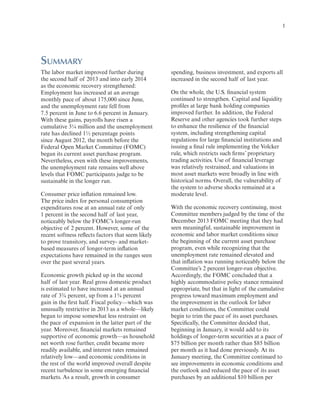
Summary . . . . . . . . . . . . . . . . . . . . . . . . . . . . . . . . . . . . . . . . . . . . . . . . . . . . . . . . . . . . . . . . . . 1
Part 1:  Recent Economic and Financial Developments. . . . . . . . . . . . . . . . . . . . . .  3
Domestic Developments. .  .  .  .  .  .  .  .  .  .  .  .  .  .  .  .  .  .  .  .  .  .  .  .  .  .  .  .  .  .  .  .  .  .  .  .  .  .  .  .  .  .  .  .  .  .  .  .  .  .  .  3
Financial Developments . .  .  .  .  .  .  .  .  .  .  .  .  .  .  .  .  .  .  .  .  .  .  .  .  .  .  .  .  .  .  .  .  .  .  .  .  .  .  .  .  .  .  .  .  .  .  .  .  .  .  17
International Developments . .  .  .  .  .  .  .  .  .  .  .  .  .  .  .  .  .  .  .  .  .  .  .  .  .  .  .  .  .  .  .  .  .  .  .  .  .  .  .  .  .  .  .  .  .  .  .  23

Part 2:  Monetary Policy. . . . . . . . . . . . . . . . . . . . . . . . . . . . . . . . . . . . . . . . . . . . . . . . . .   31
Part 3:  Summary of Economic Projections. . . . . . . . . . . . . . . . . . . . . . . . . . . . . . . .   37
The Outlook for Economic Activity . .  .  .  .  .  .  .  .  .  .  .  .  .  .  .  .  .  .  .  .  .  .  .  .  .  .  .  .  .  .  .  .  .  .  .  .  .  .  .  .  .
The Outlook for Inflation.  .  .  .  .  .  .  .  .  .  .  .  .  .  .  .  .  .  .  .  .  .  .  .  .  .  .  .  .  .  .  .  .  .  .  .  .  .  .  .  .  .  .  .  .  .  .  .  .  .
 .
Appropriate Monetary Policy . .  .  .  .  .  .  .  .  .  .  .  .  .  .  .  .  .  .  .  .  .  .  .  .  .  .  .  .  .  .  .  .  .  .  .  .  .  .  .  .  .  .  .  .  .  .
Uncertainty and Risks . .  .  .  .  .  .  .  .  .  .  .  .  .  .  .  .  .  .  .  .  .  .  .  .  .  .  .  .  .  .  .  .  .  .  .  .  .  .  .  .  .  .  .  .  .  .  .  .  .  .  .  .

 40
 43
 43
 47

Abbreviations. . . . . . . . . . . . . . . . . . . . . . . . . . . . . . . . . . . . . . . . . . . . . . . . . . . . . . . . . . . .  51
List of Boxes
Recent Changes in Household Wealth . . . . . . . . . . . . . . . . . . . . . . . . . . . . . . . . . . . . . . . . . .
Developments Related to Financial Stability. . . . . . . . . . . . . . . . . . . . . . . . . . . . . . . . . . . . . .
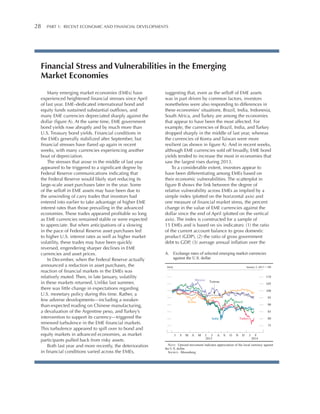
Financial Stress and Vulnerabilities in the Emerging Market Economies . . . . . . . . . . . . . . . . .
Forecast Uncertainty. . . . . . . . . . . . . . . . . . . . . . . . . . . . . . . . . . . . . . . . . . . . . . . . . . . . . . . .

   Note: Unless otherwise noted, the time series in the figures extend through, for daily data, February 6, 2014; for
monthly data, January 2014; and, for quarterly data, 2013:Q4. In bar charts, except as noted, the change for a given
period is measured to its final quarter from the final quarter of the preceding period.

12
24
28
49
 

1

Summary
The labor market improved further during
the second half of 2013 and into early 2014
as the economic recovery strengthened:
Employment has increased at an average
monthly pace of about 175,000 since June,
and the unemployment rate fell from
7.5 percent in June to 6.6 percent in January.
With these gains, payrolls have risen a
cumulative 3¼ million and the unemployment
rate has declined 1½ percentage points
since August 2012, the month before the
Federal Open Market Committee (FOMC)
began its current asset purchase program.
Nevertheless, even with these improvements,
the unemployment rate remains well above
levels that FOMC participants judge to be
sustainable in the longer run.
Consumer price inflation remained low.
The price index for personal consumption
expenditures rose at an annual rate of only
1 percent in the second half of last year,
noticeably below the FOMC’s longer-run
objective of 2 percent. However, some of the
recent softness reflects factors that seem likely
to prove transitory, and survey- and marketbased measures of longer-term inflation
expectations have remained in the ranges seen
over the past several years.
Economic growth picked up in the second
half of last year. Real gross domestic product
is estimated to have increased at an annual
rate of 3¾ percent, up from a 1¾ percent
gain in the first half. Fiscal policy—which was
unusually restrictive in 2013 as a whole—likely
began to impose somewhat less restraint on
the pace of expansion in the latter part of the
year. Moreover, financial markets remained
supportive of economic growth—as household
net worth rose further, credit became more
readily available, and interest rates remained
relatively low—and economic conditions in
the rest of the world improved overall despite
recent turbulence in some emerging financial
markets. As a result, growth in consumer

spending, business investment, and exports all
increased in the second half of last year.
On the whole, the U.S. financial system
continued to strengthen. Capital and liquidity
profiles at large bank holding companies
improved further. In addition, the Federal
Reserve and other agencies took further steps
to enhance the resilience of the financial
system, including strengthening capital
regulations for large financial institutions and
issuing a final rule implementing the Volcker
rule, which restricts such firms’ proprietary
trading activities. Use of financial leverage
was relatively restrained, and valuations in
most asset markets were broadly in line with
historical norms. Overall, the vulnerability of
the system to adverse shocks remained at a
moderate level.
With the economic recovery continuing, most
Committee members judged by the time of the
December 2013 FOMC meeting that they had
seen meaningful, sustainable improvement in
economic and labor market conditions since
the beginning of the current asset purchase
program, even while recognizing that the
unemployment rate remained elevated and
that inflation was running noticeably below the
Committee’s 2 percent longer-run objective.
Accordingly, the FOMC concluded that a
highly accommodative policy stance remained
appropriate, but that in light of the cumulative
progress toward maximum employment and
the improvement in the outlook for labor
market conditions, the Committee could
begin to trim the pace of its asset purchases.
Specifically, the Committee decided that,
beginning in January, it would add to its
holdings of longer-term securities at a pace of
$75 billion per month rather than $85 billion
per month as it had done previously. At its
January meeting, the Committee continued to
see improvements in economic conditions and
the outlook and reduced the pace of its asset
purchases by an additional $10 billion per
2 

Summary

month, to $65 billion. The FOMC indicated
that if incoming information continues to
broadly support the Committee’s expectation
of ongoing improvement in labor market
conditions and inflation moving back toward
its longer-run objective, the Committee will
likely reduce the pace of asset purchases in
further measured steps at future meetings.
Nonetheless, the Committee reiterated that
asset purchases are not on a preset course, and
that its decisions about their pace will remain
contingent on the Committee’s outlook for
the labor market and inflation as well as its
assessment of the likely efficacy and costs of
such purchases. The FOMC also noted that its
sizable and still-increasing holdings of longerterm securities should maintain downward
pressure on longer-term interest rates, support
mortgage markets, and help make broader
financial conditions more accommodative.
At the same time, to emphasize its
commitment to provide a high level of
monetary accommodation for as long
as needed to support continued progress
toward maximum employment and price
stability, the Committee enhanced its forward
guidance regarding the federal funds rate.
Over the year prior to December 2013, the
FOMC had reaffirmed its view that a highly
accommodative stance of monetary policy
would remain appropriate for a considerable
time after the asset purchase program ends
and the economic recovery strengthens.
In particular, the Committee indicated its
intention to maintain the current low target
range for the federal funds rate at least as
long as the unemployment rate remained
above 6½ percent, inflation between one
and two years ahead was projected to be no
more than a half percentage point above the
Committee’s 2 percent longer-run goal, and
longer-term inflation expectations continued

to be well anchored. At the December 2013
FOMC meeting, with the unemployment
rate moving down toward the 6½ percent
threshold, the Committee decided to provide
additional information about how it expects
its policies to evolve after the threshold is
crossed. Specifically, the Committee indicated
its anticipation that it will likely maintain
the current federal funds rate target well
past the time that the unemployment rate
declines below 6½ percent, especially if
projected inflation continues to run below its
2 percent goal.
At the time of the most recent FOMC meeting
in late January, Committee participants saw
the economic outlook as little changed from
the time of their December meeting, when
the most recent Summary of Economic
Projections (SEP) was compiled. (The
December SEP is included as Part 3 of this
report.) Participants viewed labor market
indicators as showing further improvement
on balance—notwithstanding recent mixed
readings—and overall economic activity as
consistent with growing underlying strength
in the broader economy. Even taking into
account the recent volatility in global financial
markets, participants regarded the risks to the
outlook for the economy and the labor market
as having become more nearly balanced in
recent months. FOMC participants expected
that, with appropriate policy accommodation,
economic activity would expand at a moderate
pace, and that the unemployment rate would
gradually decline toward levels the Committee
judges consistent with its dual mandate.
The Committee recognized that inflation
persistently below its 2 percent objective could
pose risks to economic performance, and it is
monitoring inflation developments carefully
for evidence that inflation will move back
toward its objective over the medium term.
3

Part 1

Recent Economic and Financial Developments
The labor market continued to improve over the second half of last year. Job gains have averaged
about 175,000 per month since June, and the unemployment rate fell from 7.5 percent in June 2013
to 6.6 percent in January of this year. Even so, the unemployment rate remains well above Federal
Open Market Committee (FOMC) participants’ estimates of the long-run sustainable rate. Inflation
remained low, as the price index for personal consumption expenditures (PCE) increased at an
annual rate of 1 percent from June to December—noticeably below the FOMC’s longer-run goal of
2 percent. However, transitory influences appear to have been partly responsible for the low readings
on inflation last year, and measures of inflation expectations remained steady and near longer-run
averages. Growth in economic activity picked up in the second half of 2013. Real gross domestic
product (GDP) is estimated to have risen at an annual rate of 3¾ percent, up from a 1¾ percent
rate of increase in the first half. Fiscal policy—which was unusually restrictive in 2013 as a whole—
likely started to exert somewhat less restraint on economic growth in the second half of the year. In
addition, household net worth rose further as key asset prices continued to increase, credit became
more available while interest rates remained low, and economic conditions in the rest of the world
improved overall in spite of recent turbulence in emerging financial markets. Consumer spending,
business investment, and exports all increased more rapidly in the latter part of last year. In contrast,
the recovery in the housing sector appeared to pause in the second half of last year following
increases in mortgage interest rates in the spring and summer.

Domestic Developments
The labor market continued to
improve, . . .
The labor market continued to improve over
the second half of 2013. Payroll employment
has increased an average of about 175,000
per month since June, roughly similar to the
average gain over the first half of last year
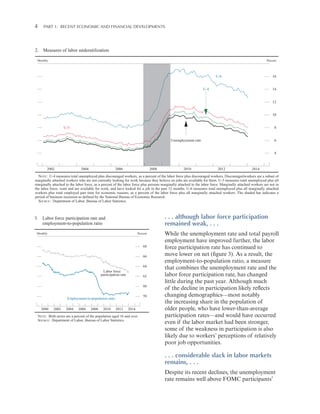
(figure 1). In addition, the unemployment
rate declined from 7.5 percent in June to
6.6 percent in January of this year (figure 2).
A variety of alternative measures of labor
force underutilization—which include, in
addition to the unemployed, those classified
as discouraged, other individuals who are
out of work and classified as marginally
attached to the labor force, and individuals
who have a job but would like to work more
hours—have also improved in the past several
months. Since August 2012—the month
before the Committee began its current asset
purchase program—total payroll employment
has increased a cumulative 3¼ million,
and the unemployment rate has declined
1½ percentage points.

1. Net change in payroll employment
3-month moving averages

Thousands of jobs

400

Private

200
+
0
_
Total nonfarm

200
400
600
800

2007

2008

2009

2010

2011

2012

2013

2014

SOURCE: Department of Labor, Bureau of Labor Statistics.
4 

Part 1:   Recent Economic and Financial Developments

2. Measures of labor underutilization
Monthly

Percent

16

U-6

14

U-4

12
10
8

U-5

6

Unemployment rate

4

2002

2004

2006

2008

2010

2012

2014

NOTE: U-4 measures total unemployed plus discouraged workers, as a percent of the labor force plus discouraged workers. Discouraged workers are a subset of
marginally attached workers who are not currently looking for work because they believe no jobs are available for them. U-5 measures total unemployed plus all
marginally attached to the labor force, as a percent of the labor force plus persons marginally attached to the labor force. Marginally attached workers are not in
the labor force, want and are available for work, and have looked for a job in the past 12 months. U-6 measures total unemployed plus all marginally attached
workers plus total employed part time for economic reasons, as a percent of the labor force plus all marginally attached workers. The shaded bar indicates a
period of business recession as defined by the National Bureau of Economic Research.
SOURCE: Department of Labor, Bureau of Labor Statistics.

. . . although labor force participation
remained weak, . . .

3. Labor force participation rate and
employment-to-population ratio
Monthly

Percent

68
66
64
Labor force
participation rate

62
60
58

Employment-to-population ratio
2000

2002

2004

2006

2008

2010

2012

2014

NOTE: Both series are a percent of the population aged 16 and over.
SOURCE: Department of Labor, Bureau of Labor Statistics.

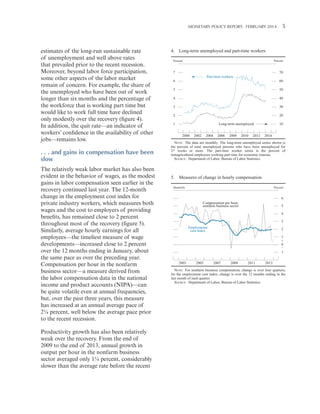
While the unemployment rate and total payroll
employment have improved further, the labor
force participation rate has continued to
move lower on net (figure 3). As a result, the
employment-to-population ratio, a measure
that combines the unemployment rate and the
labor force participation rate, has changed
little during the past year. Although much
of the decline in participation likely reflects
changing demographics—most notably
the increasing share in the population of
older people, who have lower-than-average
participation rates—and would have occurred
even if the labor market had been stronger,
some of the weakness in participation is also
likely due to workers’ perceptions of relatively
poor job opportunities.

. . . considerable slack in labor markets
remains, . . .
Despite its recent declines, the unemployment
rate remains well above FOMC participants’
MONETARY POLICY REPORT:   FEBRUARY 2014 5 

estimates of the long-run sustainable rate
of unemployment and well above rates
that prevailed prior to the recent recession.
Moreover, beyond labor force participation,
some other aspects of the labor market
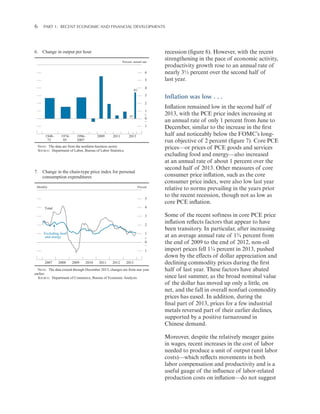
remain of concern. For example, the share of
the unemployed who have been out of work
longer than six months and the percentage of
the workforce that is working part time but
would like to work full time have declined
only modestly over the recovery (figure 4).
In addition, the quit rate—an indicator of
workers’ confidence in the availability of other
jobs—remains low.

. . . and gains in compensation have been
slow
The relatively weak labor market has also been
evident in the behavior of wages, as the modest
gains in labor compensation seen earlier in the
recovery continued last year. The 12-month
change in the employment cost index for
private industry workers, which measures both
wages and the cost to employers of providing
benefits, has remained close to 2 percent
throughout most of the recovery (figure 5).
Similarly, average hourly earnings for all
employees—the timeliest measure of wage
developments—increased close to 2 percent
over the 12 months ending in January, about
the same pace as over the preceding year.
Compensation per hour in the nonfarm
business sector—a measure derived from
the labor compensation data in the national
income and product accounts (NIPA)—can
be quite volatile even at annual frequencies,
but, over the past three years, this measure
has increased at an annual average pace of
2¼ percent, well below the average pace prior
to the recent recession.
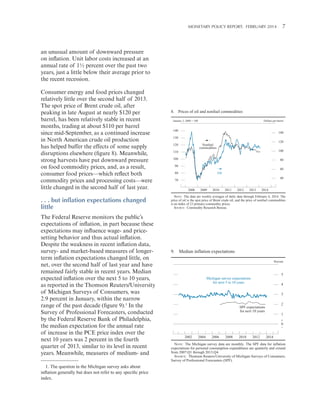
Productivity growth has also been relatively
weak over the recovery. From the end of
2009 to the end of 2013, annual growth in
output per hour in the nonfarm business
sector averaged only 1¼ percent, considerably
slower than the average rate before the recent

4. Long-term unemployed and part-time workers
Percent

Percent

7

70

Part-time workers

6

60

5

50

4

40

3

30

2

20

1

Long-term unemployed
2000

2002

2004

2006

2008

2010

2012

10
2014

NOTE: The data are monthly. The long-term unemployed series shown is
the percent of total unemployed persons who have been unemployed for
27 weeks or more. The part-time worker series is the percent of
nonagricultural employees working part time for economic reasons.
SOURCE: Department of Labor, Bureau of Labor Statistics.

5. Measures of change in hourly compensation
Quarterly

Percent

6

Compensation per hour,
nonfarm business sector

5
4
3

Employment
cost index

2
1
+
0
_
1

2003

2005

2007

2009

2011

2013

NOTE: For nonfarm business compensation, change is over four quarters;
for the employment cost index, change is over the 12 months ending in the
last month of each quarter.
SOURCE: Department of Labor, Bureau of Labor Statistics.
6 

Part 1:   Recent Economic and Financial Developments

6. Change in output per hour
Percent, annual rate

6
5
H2

4
3
2

H1

1
+
0
_
1

1948–
73

1974–
95

1996–
2007

2009

2011

2013

NOTE: The data are from the nonfarm business sector.
SOURCE: Department of Labor, Bureau of Labor Statistics.

7. Change in the chain-type price index for personal
consumption expenditures
Monthly

Percent

5
4

Total

3
2
Excluding food
and energy

1
+
0
_
1

2007

2008

2009

2010

2011

2012

recession (figure 6). However, with the recent
strengthening in the pace of economic activity,
productivity growth rose to an annual rate of
nearly 3½ percent over the second half of
last year.

2013

NOTE: The data extend through December 2013; changes are from one year
earlier.
SOURCE: Department of Commerce, Bureau of Economic Analysis.

Inflation was low . . .
Inflation remained low in the second half of
2013, with the PCE price index increasing at
an annual rate of only 1 percent from June to
December, similar to the increase in the first
half and noticeably below the FOMC’s longrun objective of 2 percent (figure 7). Core PCE
prices—or prices of PCE goods and services
excluding food and energy—also increased
at an annual rate of about 1 percent over the
second half of 2013. Other measures of core
consumer price inflation, such as the core
consumer price index, were also low last year
relative to norms prevailing in the years prior
to the recent recession, though not as low as
core PCE inflation.
Some of the recent softness in core PCE price
inflation reflects factors that appear to have
been transitory. In particular, after increasing
at an average annual rate of 1¾ percent from
the end of 2009 to the end of 2012, non-oil
import prices fell 1¼ percent in 2013, pushed
down by the effects of dollar appreciation and
declining commodity prices during the first
half of last year. These factors have abated
since last summer, as the broad nominal value
of the dollar has moved up only a little, on
net, and the fall in overall nonfuel commodity
prices has eased. In addition, during the
final part of 2013, prices for a few industrial
metals reversed part of their earlier declines,
supported by a positive turnaround in
Chinese demand.
Moreover, despite the relatively meager gains
in wages, recent increases in the cost of labor
needed to produce a unit of output (unit labor
costs)—which reflects movements in both
labor compensation and productivity and is a
useful gauge of the influence of labor-related
production costs on inflation—do not suggest
MONETARY POLICY REPORT:   FEBRUARY 2014 7 

an unusual amount of downward pressure
on inflation. Unit labor costs increased at an
annual rate of 1½ percent over the past two
years, just a little below their average prior to
the recent recession.
Consumer energy and food prices changed
relatively little over the second half of 2013.
The spot price of Brent crude oil, after
peaking in late August at nearly $120 per
barrel, has been relatively stable in recent
months, trading at about $110 per barrel
since mid-September, as a continued increase
in North American crude oil production
has helped buffer the effects of some supply
disruptions elsewhere (figure 8). Meanwhile,
strong harvests have put downward pressure
on food commodity prices, and, as a result,
consumer food prices—which reflect both
commodity prices and processing costs—were
little changed in the second half of last year.

. . . but inflation expectations changed
little
The Federal Reserve monitors the public’s
expectations of inflation, in part because these
expectations may influence wage- and pricesetting behavior and thus actual inflation.
Despite the weakness in recent inflation data,
survey- and market-based measures of longerterm inflation expectations changed little, on
net, over the second half of last year and have
remained fairly stable in recent years. Median
expected inflation over the next 5 to 10 years,
as reported in the Thomson Reuters/University
of Michigan Surveys of Consumers, was
2.9 percent in January, within the narrow
range of the past decade (figure 9).1 In the
Survey of Professional Forecasters, conducted
by the Federal Reserve Bank of Philadelphia,
the median expectation for the annual rate
of increase in the PCE price index over the
next 10 years was 2 percent in the fourth
quarter of 2013, similar to its level in recent
years. Meanwhile, measures of medium- and
1. The question in the Michigan survey asks about
inflation generally but does not refer to any specific price
index.

8. Prices of oil and nonfuel commodities
January 2, 2008 = 100

Dollars per barrel

140

140

130
120

120

Nonfuel
commodities

110

100

100

80

90

60

Oil

80

40

70
2008

2009

2010

2011

2012

2013

2014

NOTE: The data are weekly averages of daily data through February 6, 2014. The
price of oil is the spot price of Brent crude oil, and the price of nonfuel commodities
is an index of 23 primary-commodity prices.
SOURCE: Commodity Research Bureau.

9. Median inflation expectations
Percent

5

Michigan survey expectations
for next 5 to 10 years

4
3
2

SPF expectations
for next 10 years

1
+
0
_

2002

2004

2006

2008

2010

2012

2014

NOTE: The Michigan survey data are monthly. The SPF data for inflation
expectations for personal consumption expenditures are quarterly and extend
from 2007:Q1 through 2013:Q4.
SOURCE: Thomson Reuters/University of Michigan Surveys of Consumers;
Survey of Professional Forecasters (SPF).
8 

Part 1:   Recent Economic and Financial Developments

10. Inflation compensation
Daily

Percent

4

5 to 10 years ahead

3
2
1
+
0
_

5-year (carry adjusted)

1
2
2002

2004

2006

2008

2010

2012

2014

NOTE: Inflation compensation is the difference between yields on nominal
Treasury securities and Treasury inflation-protected securities (TIPS) of
comparable maturities, based on yield curves fitted to off-the-run nominal
Treasury securities and on- and off-the-run TIPS. The 5-year measure is
adjusted for the effect of indexation lags.
SOURCE: Federal Reserve Bank of New York; Barclays; Federal Reserve
Board staff estimates.

11. Change in real gross domestic product
Percent, annual rate

H2
H1

4
2
+
0
_
2
4

2007

2008

2009

2010

2011

2012

2013

SOURCE: Department of Commerce, Bureau of Economic Analysis.

12. Gross domestic product and gross domestic income
Quarterly

4-quarter percent change

Gross domestic product

4
3
2

Gross domestic income

1
+
0
_
1
2

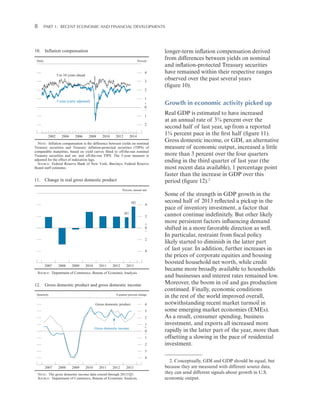
longer-term inflation compensation derived
from differences between yields on nominal
and inflation-protected Treasury securities
have remained within their respective ranges
observed over the past several years
(figure 10).

Growth in economic activity picked up
Real GDP is estimated to have increased
at an annual rate of 3¾ percent over the
second half of last year, up from a reported
1¾ percent pace in the first half (figure 11).
Gross domestic income, or GDI, an alternative
measure of economic output, increased a little
more than 3 percent over the four quarters
ending in the third quarter of last year (the
most recent data available), 1 percentage point
faster than the increase in GDP over this
period (figure 12).2
Some of the strength in GDP growth in the
second half of 2013 reflected a pickup in the
pace of inventory investment, a factor that
cannot continue indefinitely. But other likely
more persistent factors influencing demand
shifted in a more favorable direction as well.
In particular, restraint from fiscal policy
likely started to diminish in the latter part
of last year. In addition, further increases in
the prices of corporate equities and housing
boosted household net worth, while credit
became more broadly available to households
and businesses and interest rates remained low.
Moreover, the boom in oil and gas production
continued. Finally, economic conditions
in the rest of the world improved overall,
notwithstanding recent market turmoil in
some emerging market economies (EMEs).
As a result, consumer spending, business
investment, and exports all increased more
rapidly in the latter part of the year, more than
offsetting a slowing in the pace of residential
investment.

3
4
2007

2008

2009

2010

2011

2012

2013

NOTE: The gross domestic income data extend through 2013:Q3.
SOURCE: Department of Commerce, Bureau of Economic Analysis.

2. Conceptually, GDI and GDP should be equal, but
because they are measured with different source data,
they can send different signals about growth in U.S.
economic output.
MONETARY POLICY REPORT:   FEBRUARY 2014 9 

Fiscal policy was a notable headwind in
2013, . . .
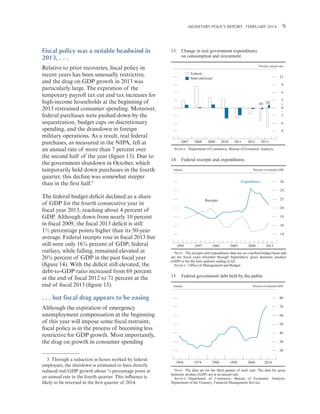
Relative to prior recoveries, fiscal policy in
recent years has been unusually restrictive,
and the drag on GDP growth in 2013 was
particularly large. The expiration of the
temporary payroll tax cut and tax increases for
high-income households at the beginning of
2013 restrained consumer spending. Moreover,
federal purchases were pushed down by the
sequestration, budget caps on discretionary
spending, and the drawdown in foreign
military operations. As a result, real federal
purchases, as measured in the NIPA, fell at
an annual rate of more than 7 percent over
the second half of the year (figure 13). Due to
the government shutdown in October, which
temporarily held down purchases in the fourth
quarter, this decline was somewhat steeper
than in the first half.3

13. Change in real government expenditures
on consumption and investment
Percent, annual rate

Federal
State and local

12
9
6
H1 H2

3
+
0
_
3
6
9

2007

2008

2009

2010

2011

2012

2013

SOURCE: Department of Commerce, Bureau of Economic Analysis.

14. Federal receipts and expenditures
Annual

Percent of nominal GDP

26

Expenditures

24

The federal budget deficit declined as a share
of GDP for the fourth consecutive year in
fiscal year 2013, reaching about 4 percent of
GDP. Although down from nearly 10 percent
in fiscal 2009, the fiscal 2013 deficit is still
1½ percentage points higher than its 50-year
average. Federal receipts rose in fiscal 2013 but
still were only 16¾ percent of GDP; federal
outlays, while falling, remained elevated at
20¾ percent of GDP in the past fiscal year
(figure 14). With the deficit still elevated, the
debt-to-GDP ratio increased from 69 percent
at the end of fiscal 2012 to 71 percent at the
end of fiscal 2013 (figure 15).

22

Receipts

20
18
16
14
1993

1997

2001

2005

2009

2013

NOTE: The receipts and expenditures data are on a unified-budget basis and
are for fiscal years (October through September); gross domestic product
(GDP) is for the four quarters ending in Q3.
SOURCE: Office of Management and Budget.

15. Federal government debt held by the public
Annual

Percent of nominal GDP

. . . but fiscal drag appears to be easing

80

Although the expiration of emergency
unemployment compensation at the beginning
of this year will impose some fiscal restraint,
fiscal policy is in the process of becoming less
restrictive for GDP growth. Most importantly,
the drag on growth in consumer spending

70
60
50
40
30
20

3. Through a reduction in hours worked by federal
employees, the shutdown is estimated to have directly
reduced real GDP growth about ¼ percentage point at
an annual rate in the fourth quarter. This influence is
likely to be reversed in the first quarter of 2014.

1964

1974

1984

1994

2004

2014

NOTE: The data are for the third quarter of each year. The data for gross
domestic product (GDP) are at an annual rate.
SOURCE: Department of Commerce, Bureau of Economic Analysis;
Department of the Treasury, Financial Management Service.
10 

Part 1:   Recent Economic and Financial Developments

16. Change in real personal consumption expenditures
Percent, annual rate

3

H2
H1

2
1
+
0
_
1
2

2007

2008

2009

2010

2011

2012

2013

Consumer spending rose faster, supported
by improvements in labor markets, . . .

SOURCE: Department of Commerce, Bureau of Economic Analysis.

17. Consumer sentiment indexes
Monthly

120
100
Michigan survey
80
60
40
Conference Board
20
2007

2008

2009

2010

2011

2012

2013

2014

NOTE: The Conference Board data are indexed to 100 in 1985. The
Michigan survey data are indexed to 100 in 1966.
SOURCE: The Conference Board; Thomson Reuters/University of Michigan
Surveys of Consumers.

18. Interest rate for new auto loans
Weekly

Percent

9
8
7
6
5
4
3
2
1
2002

2004

2006

2008

2010

NOTE: The data extend through January 26, 2014.
SOURCE: Mintel.

2012

2014

from the tax increases at the beginning of
2013 has likely begun to wane. In addition,
the Bipartisan Budget Act of 2013 will ease
the limits on spending associated with the
sequestration, and an increase in transfers
from the Affordable Care Act should provide
a boost to demand beginning this year. Also,
fiscal conditions at the state and local levels
of government have improved, and real
purchases by such governments are estimated
to have edged up in 2013 after several years of
declines.

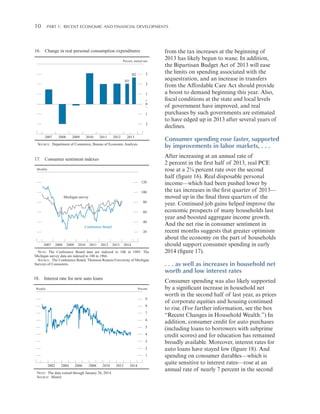
After increasing at an annual rate of
2 percent in the first half of 2013, real PCE
rose at a 2¾ percent rate over the second
half (figure 16). Real disposable personal
income—which had been pushed lower by
the tax increases in the first quarter of 2013—
moved up in the final three quarters of the
year. Continued job gains helped improve the
economic prospects of many households last
year and boosted aggregate income growth.
And the net rise in consumer sentiment in
recent months suggests that greater optimism
about the economy on the part of households
should support consumer spending in early
2014 (figure 17).

. . . as well as increases in household net
worth and low interest rates
Consumer spending was also likely supported
by a significant increase in household net
worth in the second half of last year, as prices
of corporate equities and housing continued
to rise. (For further information, see the box
“Recent Changes in Household Wealth.”) In
addition, consumer credit for auto purchases
(including loans to borrowers with subprime
credit scores) and for education has remained
broadly available. Moreover, interest rates for
auto loans have stayed low (figure 18). And
spending on consumer durables—which is
quite sensitive to interest rates—rose at an
annual rate of nearly 7 percent in the second
MONETARY POLICY REPORT:   FEBRUARY 2014 11 

half of the year. Nevertheless, standards and
terms for credit card debt have remained tight,
and, partly as a result, credit card balances
changed relatively little over the second half.

19. Change in real business fixed investment
Percent, annual rate

Structures
Equipment and intangible capital

30
20

Business investment picked up . . .
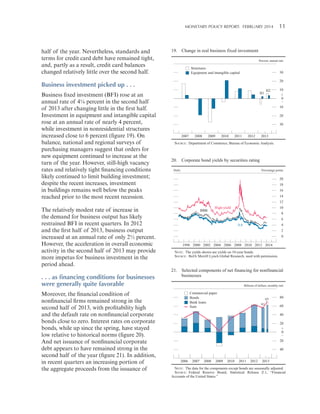
Business fixed investment (BFI) rose at an
annual rate of 4¼ percent in the second half
of 2013 after changing little in the first half.
Investment in equipment and intangible capital
rose at an annual rate of nearly 4 percent,
while investment in nonresidential structures
increased close to 6 percent (figure 19). On
balance, national and regional surveys of
purchasing managers suggest that orders for
new equipment continued to increase at the
turn of the year. However, still-high vacancy
rates and relatively tight financing conditions
likely continued to limit building investment;
despite the recent increases, investment
in buildings remains well below the peaks
reached prior to the most recent recession.
The relatively modest rate of increase in
the demand for business output has likely
restrained BFI in recent quarters. In 2012
and the first half of 2013, business output
increased at an annual rate of only 2½ percent.
However, the acceleration in overall economic
activity in the second half of 2013 may provide
more impetus for business investment in the
period ahead.

. . . as financing conditions for businesses
were generally quite favorable
Moreover, the financial condition of
nonfinancial firms remained strong in the
second half of 2013, with profitability high
and the default rate on nonfinancial corporate
bonds close to zero. Interest rates on corporate
bonds, while up since the spring, have stayed
low relative to historical norms (figure 20).
And net issuance of nonfinancial corporate
debt appears to have remained strong in the
second half of the year (figure 21). In addition,
in recent quarters an increasing portion of
the aggregate proceeds from the issuance of

H1

H2

10
+
0
_
10
20
30

2007

2008

2009

2010

2011

2012

2013

SOURCE: Department of Commerce, Bureau of Economic Analysis.

20. Corporate bond yields by securities rating
Daily

Percentage points

20
18
16
14
12
BBB

10

High-yield

8
6
4

AA

2
0
1998 2000 2002 2004 2006 2008 2010 2012 2014
NOTE: The yields shown are yields on 10-year bonds.
SOURCE: BofA Merrill Lynch Global Research, used with permission.

21. Selected components of net financing for nonfinancial
businesses
Billions of dollars, monthly rate

Commercial paper
Bonds
Bank loans
Sum

Q3
H1

80
60
40
20
+
0
_
20
40

2006

2007

2008

2009

2010

2011

2012

2013

NOTE: The data for the components except bonds are seasonally adjusted.
SOURCE: Federal Reserve Board, Statistical Release Z.1, “Financial
Accounts of the United States.”
12 

Part 1:   Recent Economic and Financial Developments

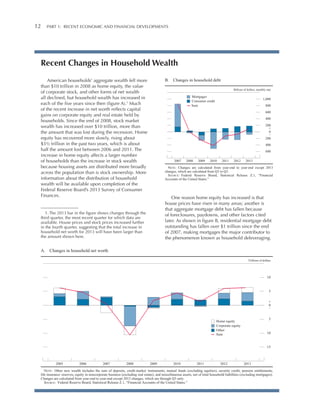
Recent Changes in Household Wealth
B. Changes in household debt

American households’ aggregate wealth fell more
than $10 trillion in 2008 as home equity, the value
of corporate stock, and other forms of net wealth
all declined, but household wealth has increased in
each of the five years since then (figure A).1 Much
of the recent increase in net worth reflects capital
gains on corporate equity and real estate held by
households. Since the end of 2008, stock market
wealth has increased over $10 trillion, more than
the amount that was lost during the recession. Home
equity has recovered more slowly, rising about
$3½ trillion in the past two years, which is about
half the amount lost between 2006 and 2011. The
increase in home equity affects a larger number
of households than the increase in stock wealth
because housing assets are distributed more broadly
across the population than is stock ownership. More
information about the distribution of household
wealth will be available upon completion of the
Federal Reserve Board’s 2013 Survey of Consumer
Finances.

Billions of dollars, monthly rate

Mortgages
Consumer credit
Sum

1,000
800
600
400
200
+
0
_
200
400
600

2007

2008

2009

2010

2011

2012

2013

NOTE: Changes are calculated from year-end to year-end except 2013
changes, which are calculated from Q3 to Q3.
SOURCE: Federal Reserve Board, Statistical Release Z.1, “Financial
Accounts of the United States.”

One reason home equity has increased is that
house prices have risen in many areas; another is
that aggregate mortgage debt has fallen because
of foreclosures, paydowns, and other factors cited
later. As shown in figure B, residential mortgage debt
outstanding has fallen over $1 trillion since the end
of 2007, making mortgages the major contributor to
the phenomenon known as household deleveraging.

1. The 2013 bar in the figure shows changes through the
third quarter, the most recent quarter for which data are
available. House prices and stock prices increased further
in the fourth quarter, suggesting that the total increase in
household net worth for 2013 will have been larger than
the amount shown here.

A. Changes in household net worth
Trillions of dollars

10

5
+
0
_
5

Home equity
Corporate equity
Other
Sum

10

15

2005

2006

2007

2008

2009

2010

2011

2012

2013

NOTE: Other new wealth includes the sum of deposits, credit market instruments, mutual funds (excluding equities), security credit, pension entitlements,
life insurance reserves, equity in noncorporate business (excluding real estate), and miscellaneous assets, net of total household liabilities (excluding mortgages).
Changes are calculated from year-end to year-end except 2013 changes, which are through Q3 only.
SOURCE: Federal Reserve Board, Statistical Release Z.1, “Financial Accounts of the United States.”
MONETARY POLICY REPORT:   FEBRUARY 2014 13 

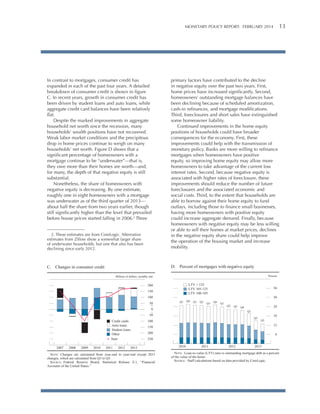
In contrast to mortgages, consumer credit has
expanded in each of the past four years. A detailed
breakdown of consumer credit is shown in figure
C. In recent years, growth in consumer credit has
been driven by student loans and auto loans, while
aggregate credit card balances have been relatively
flat.
Despite the marked improvements in aggregate
household net worth since the recession, many
households’ wealth positions have not recovered.
Weak labor market conditions and the precipitous
drop in home prices continue to weigh on many
households’ net worth. Figure D shows that a
significant percentage of homeowners with a
mortgage continue to be “underwater”—that is,
they owe more than their homes are worth—and,
for many, the depth of that negative equity is still
substantial.
Nonetheless, the share of homeowners with
negative equity is decreasing. By one estimate,
roughly one in eight homeowners with a mortgage
was underwater as of the third quarter of 2013—
about half the share from two years earlier, though
still significantly higher than the level that prevailed
before house prices started falling in 2006.2 Three
2. These estimates are from CoreLogic. Alternative
estimates from Zillow show a somewhat larger share
of underwater households, but one that also has been
declining since early 2012.

primary factors have contributed to the decline
in negative equity over the past two years. First,
home prices have increased significantly. Second,
homeowners’ outstanding mortgage balances have
been declining because of scheduled amortization,
cash-in refinances, and mortgage modifications.
Third, foreclosures and short sales have extinguished
some homeowner liability.
Continued improvements in the home equity
positions of households could have broader
consequences for the economy. First, these
improvements could help with the transmission of
monetary policy. Banks are more willing to refinance
mortgages when homeowners have positive
equity, so improving home equity may allow more
homeowners to take advantage of the current low
interest rates. Second, because negative equity is
associated with higher rates of foreclosure, these
improvements should reduce the number of future
foreclosures and the associated economic and
social costs. Third, to the extent that households are
able to borrow against their home equity to fund
outlays, including those to finance small businesses,
having more homeowners with positive equity
could increase aggregate demand. Finally, because
homeowners with negative equity may be less willing
or able to sell their homes at market prices, declines
in the negative equity share could help improve
the operation of the housing market and increase
mobility.

C. Changes in consumer credit

D. Percent of mortgages with negative equity
Percent

Billions of dollars, monthly rate

LTV > 125
LTV 105-125
LTV 100-105

200
150
100
50
+
0
_
50
Credit cards
Auto loans
Student loans
Other
Sum
2007

2008

2009

2010

2011

2012

Q3

Q4

Q1

Q2

Q3

36
30
Q4

Q1

Q2

Q3

24

Q4
Q1
Q2

100

18
Q3

12

150
200

6

250

2013

NOTE: Changes are calculated from year-end to year-end except 2013
changes, which are calculated from Q3 to Q3.
SOURCE: Federal Reserve Board, Statistical Release Z.1, “Financial
Accounts of the United States.”

2010

2011

2012

2013

NOTE: Loan-to-value (LTV) ratio is outstanding mortgage debt as a percent
of the value of the home.
SOURCE: Staff calculations based on data provided by CoreLogic.
14 

Part 1:   Recent Economic and Financial Developments

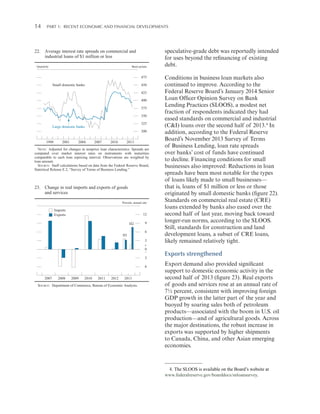
22. Average interest rate spreads on commercial and
industrial loans of $1 million or less
Quarterly

Basis points

475
450

Small domestic banks

425
400
375
350
325

Large domestic banks

1998

2001

2004

300
2007

2010

2013

NOTE: Adjusted for changes in nonprice loan characteristics. Spreads are
computed over market interest rates on instruments with maturities
comparable to each loan repricing interval. Observations are weighted by
loan amount.
SOURCE: Staff calculations based on data from the Federal Reserve Board,
Statistical Release E.2, “Survey of Terms of Business Lending.”

23. Change in real imports and exports of goods
and services
Percent, annual rate

Imports
Exports

12
H2
H1

9
6
3
+
0
_
3
6

2007

2008

2009

2010

2011

2012

2013

SOURCE: Department of Commerce, Bureau of Economic Analysis.

speculative-grade debt was reportedly intended
for uses beyond the refinancing of existing
debt.
Conditions in business loan markets also
continued to improve. According to the
Federal Reserve Board’s January 2014 Senior
Loan Officer Opinion Survey on Bank
Lending Practices (SLOOS), a modest net
fraction of respondents indicated they had
eased standards on commercial and industrial
(C&I) loans over the second half of 2013.4 In
addition, according to the Federal Reserve
Board’s November 2013 Survey of Terms
of Business Lending, loan rate spreads
over banks’ cost of funds have continued
to decline. Financing conditions for small
businesses also improved: Reductions in loan
spreads have been most notable for the types
of loans likely made to small businesses—
that is, loans of $1 million or less or those
originated by small domestic banks (figure 22).
Standards on commercial real estate (CRE)
loans extended by banks also eased over the
second half of last year, moving back toward
longer-run norms, according to the SLOOS.
Still, standards for construction and land
development loans, a subset of CRE loans,
likely remained relatively tight.

Exports strengthened
Export demand also provided significant
support to domestic economic activity in the
second half of 2013 (figure 23). Real exports
of goods and services rose at an annual rate of
7½ percent, consistent with improving foreign
GDP growth in the latter part of the year and
buoyed by soaring sales both of petroleum
products—associated with the boom in U.S. oil
production—and of agricultural goods. Across
the major destinations, the robust increase in
exports was supported by higher shipments
to Canada, China, and other Asian emerging
economies.

4. The SLOOS is available on the Board’s website at
www.federalreserve.gov/boarddocs/snloansurvey.
MONETARY POLICY REPORT:   FEBRUARY 2014 15 

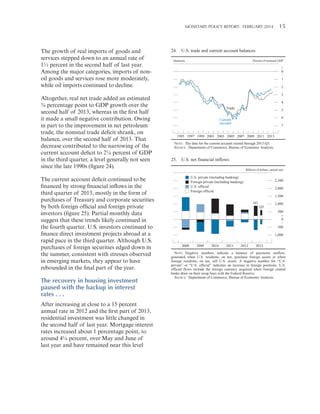
The growth of real imports of goods and
services stepped down to an annual rate of
1½ percent in the second half of last year.
Among the major categories, imports of nonoil goods and services rose more moderately,
while oil imports continued to decline.
Altogether, real net trade added an estimated
¾ percentage point to GDP growth over the
second half of 2013, whereas in the first half
it made a small negative contribution. Owing
in part to the improvement in net petroleum
trade, the nominal trade deficit shrank, on
balance, over the second half of 2013. That
decrease contributed to the narrowing of the
current account deficit to 2¼ percent of GDP
in the third quarter, a level generally not seen
since the late 1990s (figure 24).
The current account deficit continued to be
financed by strong financial inflows in the
third quarter of 2013, mostly in the form of
purchases of Treasury and corporate securities
by both foreign official and foreign private
investors (figure 25). Partial monthly data
suggest that these trends likely continued in
the fourth quarter. U.S. investors continued to
finance direct investment projects abroad at a
rapid pace in the third quarter. Although U.S.
purchases of foreign securities edged down in
the summer, consistent with stresses observed
in emerging markets, they appear to have
rebounded in the final part of the year.

The recovery in housing investment
paused with the backup in interest
rates . . .
After increasing at close to a 15 percent
annual rate in 2012 and the first part of 2013,
residential investment was little changed in
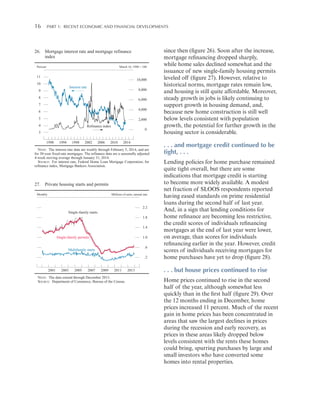
the second half of last year. Mortgage interest
rates increased about 1 percentage point, to
around 4¼ percent, over May and June of
last year and have remained near this level

24. U.S. trade and current account balances
Quarterly

Percent of nominal GDP

+
0
_
1
2
3
4
Trade

5
6

Current
account

7

1995 1997 1999 2001 2003 2005 2007 2009 2011 2013
NOTE: The data for the current account extend through 2013:Q3.
SOURCE: Department of Commerce, Bureau of Economic Analysis.

25. U.S. net financial inflows
Billions of dollars, annual rate

U.S. private (including banking)
Foreign private (including banking)
U.S. official
Foreign official

2,500
2,000
1,500
H1

Q3

1,000
500
+
0
_
500
1,000

2008

2009

2010

2011

2012

2013

NOTE: Negative numbers indicate a balance of payments outflow,
generated when U.S. residents, on net, purchase foreign assets or when
foreign residents, on net, sell U.S. assets. A negative number for “U.S.
private” or “U.S. official” indicates an increase in foreign positions. U.S.
official flows include the foreign currency acquired when foreign central
banks draw on their swap lines with the Federal Reserve.
SOURCE: Department of Commerce, Bureau of Economic Analysis.
16 

Part 1:   Recent Economic and Financial Developments

26. Mortgage interest rate and mortgage refinance
index
Percent

March 16, 1990 = 100

11

10,000

10

Interest rate

9

8,000

8

6,000

7
4,000

6
5

2,000

4

Refinance index

0

3
1990

1994

1998

2002

2006

2010

2014

NOTE: The interest rate data are weekly through February 5, 2014, and are
for 30-year fixed-rate mortgages. The refinance data are a seasonally adjusted
4-week moving average through January 31, 2014.
SOURCE: For interest rate, Federal Home Loan Mortgage Corporation; for
refinance index, Mortgage Bankers Association.

27. Private housing starts and permits
Monthly

Millions of units, annual rate

2.2
Single-family starts
1.8
1.4
1.0

Single-family permits

.6

Multifamily starts

.2
2001

2003

2005

2007

2009

2011

NOTE: The data extend through December 2013.
SOURCE: Department of Commerce, Bureau of the Census.

2013

since then (figure 26). Soon after the increase,
mortgage refinancing dropped sharply,
while home sales declined somewhat and the
issuance of new single-family housing permits
leveled off (figure 27). However, relative to
historical norms, mortgage rates remain low,
and housing is still quite affordable. Moreover,
steady growth in jobs is likely continuing to
support growth in housing demand, and,
because new home construction is still well
below levels consistent with population
growth, the potential for further growth in the
housing sector is considerable.

. . . and mortgage credit continued to be
tight, . . .
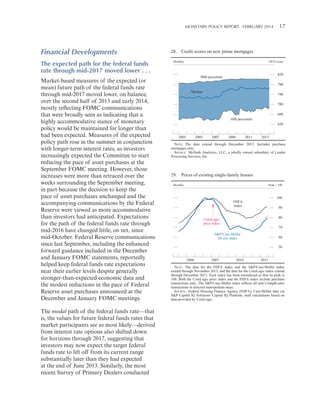
Lending policies for home purchase remained
quite tight overall, but there are some
indications that mortgage credit is starting
to become more widely available. A modest
net fraction of SLOOS respondents reported
having eased standards on prime residential
loans during the second half of last year.
And, in a sign that lending conditions for
home refinance are becoming less restrictive,
the credit scores of individuals refinancing
mortgages at the end of last year were lower,
on average, than scores for individuals
refinancing earlier in the year. However, credit
scores of individuals receiving mortgages for
home purchases have yet to drop (figure 28).

. . . but house prices continued to rise
Home prices continued to rise in the second
half of the year, although somewhat less
quickly than in the first half (figure 29). Over
the 12 months ending in December, home
prices increased 11 percent. Much of the recent
gain in home prices has been concentrated in
areas that saw the largest declines in prices
during the recession and early recovery, as
prices in these areas likely dropped below
levels consistent with the rents these homes
could bring, spurring purchases by large and
small investors who have converted some
homes into rental properties.
MONETARY POLICY REPORT:   FEBRUARY 2014 17 

Financial Developments
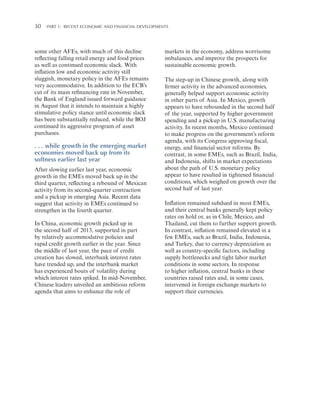
The expected path for the federal funds
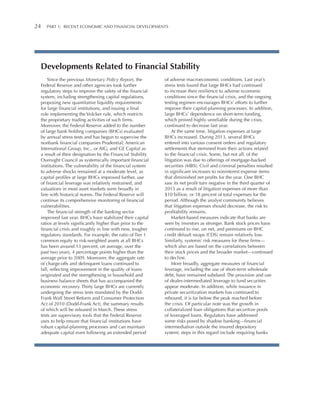
rate through mid-2017 moved lower . . .
Market-based measures of the expected (or
mean) future path of the federal funds rate
through mid-2017 moved lower, on balance,
over the second half of 2013 and early 2014,
mostly reflecting FOMC communications
that were broadly seen as indicating that a
highly accommodative stance of monetary
policy would be maintained for longer than
had been expected. Measures of the expected
policy path rose in the summer in conjunction
with longer-term interest rates, as investors
increasingly expected the Committee to start
reducing the pace of asset purchases at the
September FOMC meeting. However, those
increases were more than retraced over the
weeks surrounding the September meeting,
in part because the decision to keep the
pace of asset purchases unchanged and the
accompanying communications by the Federal
Reserve were viewed as more accommodative
than investors had anticipated. Expectations
for the path of the federal funds rate through
mid-2016 have changed little, on net, since
mid-October. Federal Reserve communications
since last September, including the enhanced
forward guidance included in the December
and January FOMC statements, reportedly
helped keep federal funds rate expectations
near their earlier levels despite generally
stronger-than-expected economic data and
the modest reductions in the pace of Federal
Reserve asset purchases announced at the
December and January FOMC meetings.
The modal path of the federal funds rate—that
is, the values for future federal funds rates that
market participants see as most likely—derived
from interest rate options also shifted down
for horizons through 2017, suggesting that
investors may now expect the target federal
funds rate to lift off from its current range
substantially later than they had expected
at the end of June 2013. Similarly, the most
recent Survey of Primary Dealers conducted

28. Credit scores on new prime mortgages
Monthly

FICO score

820

90th percentile

780
Median

740
700
660
10th percentile
620

2003

2005

2007

2009

2011

2013

NOTE: The data extend through December 2013. Includes purchase
mortgages only.
SOURCE: McDash Analytics, LLC, a wholly owned subsidiary of Lender
Processing Services, Inc.

29. Prices of existing single-family houses
Monthly

Peak = 100

100

FHFA
index

90
80

CoreLogic
price index

70

S&P/Case-Shiller
20-city index

60
50

2004

2007

2010

2013

NOTE: The data for the FHFA index and the S&P/Case-Shiller index
extend through November 2013, and the data for the CoreLogic index extend
through December 2013. Each index has been normalized so that its peak is
100. Both the CoreLogic price index and the FHFA index include purchase
transactions only. The S&P/Case-Shiller index reflects all arm’s-length sales
transactions in selected metropolitan areas.
SOURCE: Federal Housing Finance Agency (FHFA); Case-Shiller data via
S&P Capital IQ Solutions’ Capital IQ Platform; staff calculations based on
data provided by CoreLogic.
18 

Part 1:   Recent Economic and Financial Developments

30. Yields on nominal Treasury securities
Daily

Percent

7
6
10-year

30-year

5
4

5-year

3
2
1

2000

2002

2004

2006

2008

2010

2012

2014

NOTE: The Treasury ceased publication of the 30-year constant maturity
series on February 18, 2002, and resumed that series on February 9, 2006.
SOURCE: Department of the Treasury.

31. Yield and spread on agency mortgage-backed
securities
Percent

Basis points

400

9
8

350

Yield

300

7

250

6

200

5

150

4

Spread

100

3

50

2

0
2000

2002

2004

2006

2008

2010

2012

2014

NOTE: The data are daily. Yield shown is for the Fannie Mae 30-year
current coupon, the coupon rate at which new mortgage-backed securities
would be priced at par, or face, value. Spread shown is to the average of the
5- and 10-year nominal Treasury yields.
SOURCE: Department of the Treasury; Barclays.

by the Open Market Desk at the Federal
Reserve Bank of New York just prior to the
January FOMC meeting showed that dealers’
expectations of the date of liftoff have moved
out about two quarters since the middle of last
year, to the fourth quarter of 2015.5

. . . while yields on longer-term securities
increased but remained low by historical
standards
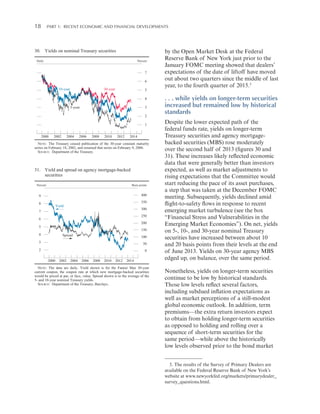
Despite the lower expected path of the
federal funds rate, yields on longer-term
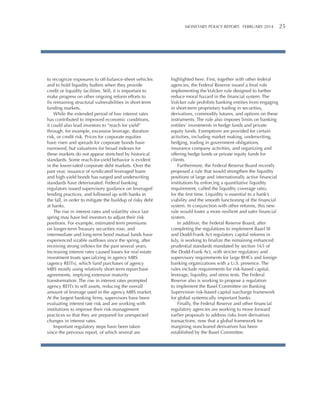
Treasury securities and agency mortgagebacked securities (MBS) rose moderately
over the second half of 2013 (figures 30 and
31). These increases likely reflected economic
data that were generally better than investors
expected, as well as market adjustments to
rising expectations that the Committee would
start reducing the pace of its asset purchases,
a step that was taken at the December FOMC
meeting. Subsequently, yields declined amid
flight-to-safety flows in response to recent
emerging market turbulence (see the box
“Financial Stress and Vulnerabilities in the
Emerging Market Economies”). On net, yields
on 5-, 10-, and 30-year nominal Treasury
securities have increased between about 10
and 20 basis points from their levels at the end
of June 2013. Yields on 30-year agency MBS
edged up, on balance, over the same period.
Nonetheless, yields on longer-term securities
continue to be low by historical standards.
Those low levels reflect several factors,
including subdued inflation expectations as
well as market perceptions of a still-modest
global economic outlook. In addition, term
premiums—the extra return investors expect
to obtain from holding longer-term securities
as opposed to holding and rolling over a
sequence of short-term securities for the
same period—while above the historically
low levels observed prior to the bond market
5. The results of the Survey of Primary Dealers are
available on the Federal Reserve Bank of New York’s
website at www.newyorkfed.org/markets/primarydealer_
survey_questions.html.
MONETARY POLICY REPORT:   FEBRUARY 2014 19 

selloff in the summer, remained within the
low range they have occupied since the onset
of the financial crisis, reflecting both the
FOMC’s large-scale asset purchases and strong
demand for longer-term securities from global
investors.
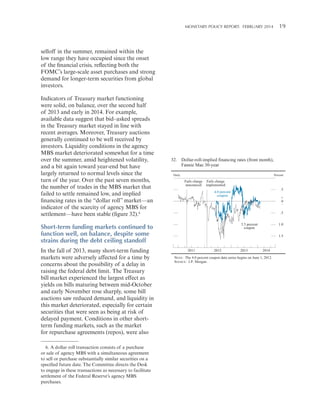
Indicators of Treasury market functioning
were solid, on balance, over the second half
of 2013 and early in 2014. For example,
available data suggest that bid–asked spreads
in the Treasury market stayed in line with
recent averages. Moreover, Treasury auctions
generally continued to be well received by
investors. Liquidity conditions in the agency
MBS market deteriorated somewhat for a time
over the summer, amid heightened volatility,
and a bit again toward year-end but have
largely returned to normal levels since the
turn of the year. Over the past seven months,
the number of trades in the MBS market that
failed to settle remained low, and implied
financing rates in the “dollar roll” market—an
indicator of the scarcity of agency MBS for
settlement—have been stable (figure 32).6

32. Dollar-roll-implied financing rates (front month),
Fannie Mae 30-year
Daily

Percent

Fails charge Fails charge
announced implemented

6. A dollar roll transaction consists of a purchase
or sale of agency MBS with a simultaneous agreement
to sell or purchase substantially similar securities on a
specified future date. The Committee directs the Desk
to engage in these transactions as necessary to facilitate
settlement of the Federal Reserve’s agency MBS
purchases.

+
0
_
.5
3.5 percent
coupon

Short-term funding markets continued to
function well, on balance, despite some
strains during the debt ceiling standoff
In the fall of 2013, many short-term funding
markets were adversely affected for a time by
concerns about the possibility of a delay in
raising the federal debt limit. The Treasury
bill market experienced the largest effect as
yields on bills maturing between mid-October
and early November rose sharply, some bill
auctions saw reduced demand, and liquidity in
this market deteriorated, especially for certain
securities that were seen as being at risk of
delayed payment. Conditions in other shortterm funding markets, such as the market
for repurchase agreements (repos), were also

.5

4.0 percent
coupon

1.0
1.5

2011

2012

2013

2014

NOTE: The 4.0 percent coupon data series begins on June 1, 2012.
SOURCE: J.P. Morgan.
20 

Part 1:   Recent Economic and Financial Developments

strained for a time. However, these effects
eased quickly after an agreement to raise
the debt limit was reached in mid-October,
and, overall, the debt ceiling standoff left no
permanent imprint on short-term funding
markets.
On balance, since the end of June 2013,
conditions in both secured and unsecured
short-term funding markets have changed
little, with many money market rates
remaining near the bottom of the ranges they
have occupied since the federal funds rate
first reached its zero lower bound. Unsecured
offshore dollar funding markets generally
did not exhibit any signs of stress. Rates on
asset-backed commercial paper and unsecured
financial commercial paper for the most part
also stayed low. In the repo market, rates for
general collateral Treasury repos also were low,
consistent with reduced financing activities
of dealers. These rates declined noticeably at
year-end, leading to increased participation
in the Federal Reserve’s overnight reverse
repurchase agreement operations (see Part 2
of this report). Overall, year-end pressures in
short-term funding markets were modest and
roughly in line with experiences during other
years since the financial crisis.

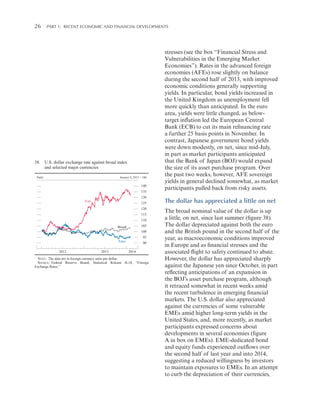
Broad equity price indexes increased
further and risk spreads on corporate
debt declined . . .
33. Equity prices
Daily

December 31, 2007 = 100

140
Dow Jones
bank index

120
100
80
60

S&P 500 index

40
20

1996 1998 2000 2002 2004 2006 2008 2010 2012 2014
SOURCE: Dow Jones bank index and Standard & Poor’s 500 index via
Bloomberg.

Boosted by improved market sentiment
regarding the economic outlook and the
FOMC’s sustained highly accommodative
monetary policy, broad measures of equity
prices continued posting substantial gains
through the end of 2013. Around the turn
of the year, however, investor sentiment
deteriorated amid resurfacing concerns about
emerging financial markets, and equity prices
retraced some of their earlier increases.
As of early February, broad measures of
equity prices were more than 10 percent
higher, on net, than their levels in the middle
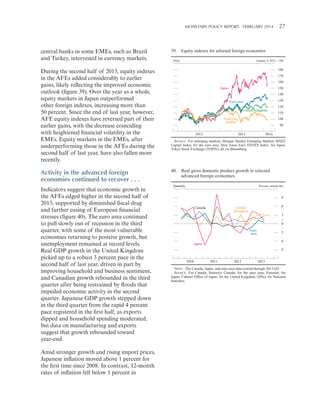
of 2013 (figure 33). Consistent with the
developments in equity markets, the spreads
of yields on corporate bonds to yields on
MONETARY POLICY REPORT:   FEBRUARY 2014 21 

Treasury securities of comparable maturities
have narrowed, on net, since the middle of
2013. Spreads on syndicated loans have also
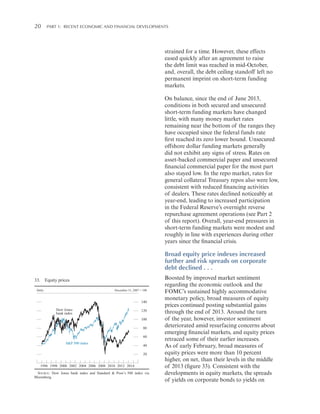
narrowed some, and issuance of leveraged
loans, boosted by strong demand from
collateralized loan obligations, was generally
strong in the second half of 2013.
While some broad equity price indexes
touched all-time highs in nominal terms since
the middle of 2013 and valuation metrics
in some sectors appear stretched, valuation
measures for the overall market are now
generally at levels not far above their historical
average levels, suggesting that, in aggregate,
investors are not excessively optimistic in their
attitudes toward equities. Implied volatility for
the S&P 500 index, as calculated from option
prices, generally remained low over the period;
it has risen since early January but remains
below the recent high reached during the debt
ceiling standoff in the fall.

. . . and market sentiment toward
financial institutions continued to
strengthen as their capital and liquidity
profiles improved
Market sentiment toward the financial sector
continued to strengthen in the second half
of 2013, reportedly driven in large part by
improvements in banks’ capital and liquidity
profiles, as well as further improvements in
asset quality. On average, equity prices of large
domestic banks and insurance companies
performed roughly in line with broader equity
indexes (figure 33). The spreads on the credit
default swap (CDS) contracts written on
the debt of these firms generally narrowed.
Among nonbank financial institutions, many
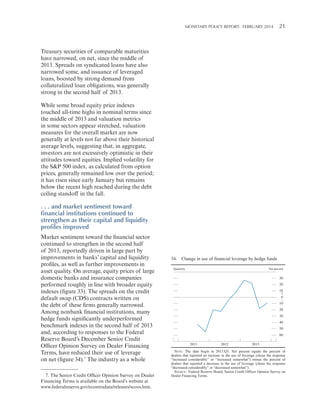
hedge funds significantly underperformed
benchmark indexes in the second half of 2013
and, according to responses to the Federal
Reserve Board’s December Senior Credit
Officer Opinion Survey on Dealer Financing
Terms, have reduced their use of leverage
on net (figure 34).7 The industry as a whole
7. The Senior Credit Officer Opinion Survey on Dealer
Financing Terms is available on the Board’s website at
www.federalreserve.gov/econresdata/releases/scoos.htm.

34. Change in use of financial leverage by hedge funds
Quarterly

Net percent

30
20
10
+
0
_
10
20
30
40
50
60
2011

2012

2013

NOTE: The data begin in 2011:Q3. Net percent equals the percent of
dealers that reported an increase in the use of leverage (chose the response
“increased considerably” or “increased somewhat”) minus the percent of
dealers that reported a decrease in the use of leverage (chose the response
“decreased considerably” or “decreased somewhat”).
SOURCE: Federal Reserve Board, Senior Credit Officer Opinion Survey on
Dealer Financing Terms.
22 

Part 1:   Recent Economic and Financial Developments

35. Delinquency and charge-off rates for commercial banks
Quarterly

Percent

continued to see strong inflows, however,
bringing its assets under management to an
all-time high by the end of 2013.

8
7
6
5
4
3

Delinquencies, all loans

2

Net charge-offs, all loans

1
0

1992

1995

1998

2001

2004

2007

2010

2013

NOTE: The data extend through 2013:Q3. The delinquency rates are the
percent of loans 30 days or more past due or not accruing interest. The net
charge-off rates are the percent of loans charged off net of recoveries. The
shaded bars indicate a period of business recession as defined by the National
Bureau of Economic Research.
SOURCE: Federal Financial Institutions Examination Council, FFIEC
031/041, “Consolidation Reports of Condition and Income for Commerical
Banks” (Call Reports).

36. Change in total bank credit
Quarterly

Percent, annual rate

15
10
5
+
0
_
5
10
1992

1995

1998

2001

2004

2007

2010

2013

NOTE: The data are seasonally adjusted.
SOURCE: Federal Reserve Board, Statistical Release H.8, “Assets and
Liabilities of Commercial Banks in the United States.”

Standard measures of profitability of bank
holding companies (BHCs) were little
changed in the third quarter of 2013, as
large reductions in income from mortgage
originations and revenue from fixed-income
trading, as well as a sharp increase in litigation
expenses, were offset primarily by decreases
in provisions for loan losses and in employee
compensation. Asset quality continued to
improve for BHCs, with delinquency rates
declining across a range of asset classes and
the industry’s net charge-off rate now close
to pre-crisis levels (figure 35). Net interest
margins remained about unchanged over
the same period. (For further discussion
of the financial condition of BHCs, see the
box “Developments Related to Financial
Stability.”) Meanwhile, aggregate credit
provided by commercial banks inched up
in the second half of 2013 following the
rise in longer-term interest rates (figure 36).
Strong growth in loan categories that are
more likely to have floating interest rates or
shorter maturities—including C&I, CRE,
and auto loans—was partly offset by runoffs
in assets that have longer duration and so are
more sensitive to increases in interest rates—
including residential mortgages and some
securities.

Financial conditions in the municipal
bond market generally remained stable
Yields on 20-year general obligation municipal
bonds rose since June 2013. However, the
spreads of municipal bond yields over those
of comparable-maturity Treasury securities
generally fell over the same period, and CDS
spreads on debt obligations of individual states
were generally little changed and remained at
moderate levels.
Nevertheless, significant financial strains have
been evident for some issuers. For example,
MONETARY POLICY REPORT:   FEBRUARY 2014 23 

the City of Detroit filed for bankruptcy in
July 2013, making it the largest municipal
bankruptcy filing in U.S. history. In addition,
the prices of bonds issued by Puerto Rico
continued to reflect the substantial financial
pressures facing the territory and the spreads
for five-year CDS contracts written on the
debt issued by the territory soared. In early
February, some of the territory’s bonds were
downgraded to below investment grade.

M2 rose briskly
M2 has increased at an annual rate of about
7½ percent since June, faster than the pace
registered in the first half of 2013. Flows into
M2 picked up amid the selloff in fixed-income
markets in the summer, which prompted
large outflows from bond funds, as well as the
uncertainty about the passage of debt limit
legislation in the fall, which appeared to have
led some institutional investors to shift from
money fund shares to bank deposits. Following
the resolution of the fiscal standoff, M2 growth
slowed significantly as investors reallocated out
of cash positions.

International Developments
Bond yields rose sharply in some emerging
market economies, but were flat to down
in most advanced foreign economies
Foreign long-term bond yields rose significantly
from May of last year through most of the
summer, as expectations of an imminent
reduction in the pace of large-scale asset
purchases by the Federal Reserve intensified
(figure 37). In many EMEs, yields stabilized
after the September FOMC meeting. However,
in a handful of vulnerable EMEs, sovereign
yields continued to exhibit outsized increases—
particularly in Brazil and Turkey—and, more
recently, EME yields generally moved up as
several EMEs experienced heightened financial

37. 10-year nominal benchmark yields
Daily

Percent

3.5
3.0
2.5

United Kingdom

Germany

2.0
1.5
1.0

Japan

.5
2012
SOURCE: Bloomberg.

2013

2014
24 

Part 1:   Recent Economic and Financial Developments

Developments Related to Financial Stability
Since the previous Monetary Policy Report, the
Federal Reserve and other agencies took further
regulatory steps to improve the safety of the financial
system, including strengthening capital regulations,
proposing new quantitative liquidity requirements
for large financial institutions, and issuing a final
rule implementing the Volcker rule, which restricts
the proprietary trading activities of such firms.
Moreover, the Federal Reserve added to the number
of large bank holding companies (BHCs) evaluated
by annual stress tests and has begun to supervise the
nonbank financial companies Prudential; American
International Group, Inc., or AIG; and GE Capital as
a result of their designation by the Financial Stability
Oversight Council as systemically important financial
institutions. The vulnerability of the financial system
to adverse shocks remained at a moderate level, as
capital profiles at large BHCs improved further, use
of financial leverage was relatively restrained, and
valuations in most asset markets were broadly in
line with historical norms. The Federal Reserve will
continue its comprehensive monitoring of financial
vulnerabilities.
The financial strength of the banking sector
improved last year. BHCs have stabilized their capital
ratios at levels significantly higher than prior to the
financial crisis and roughly in line with new, tougher
regulatory standards. For example, the ratio of Tier 1
common equity to risk-weighted assets at all BHCs
has been around 13 percent, on average, over the
past two years, 4 percentage points higher than the
average prior to 2009. Moreover, the aggregate rate
of charge-offs and delinquent loans continued to
fall, reflecting improvement in the quality of loans
originated and the strengthening in household and
business balance sheets that has accompanied the
economic recovery. Thirty large BHCs are currently
undergoing the stress tests mandated by the DoddFrank Wall Street Reform and Consumer Protection
Act of 2010 (Dodd-Frank Act), the summary results
of which will be released in March. These stress
tests are supervisory tools that the Federal Reserve
uses to help ensure that financial institutions have
robust capital-planning processes and can maintain
adequate capital even following an extended period

of adverse macroeconomic conditions. Last year’s
stress tests found that large BHCs had continued
to increase their resilience to adverse economic
conditions since the financial crisis, and the ongoing
testing regimen encourages BHCs’ efforts to further
improve their capital-planning processes. In addition,
large BHCs’ dependence on short-term funding,
which proved highly unreliable during the crisis,
continued to decrease last year.
At the same time, litigation expenses at large
BHCs increased. During 2013, several BHCs
entered into various consent orders and regulatory
settlements that stemmed from their actions related
to the financial crisis. Some, but not all, of the
litigation was due to offerings of mortgage-backed
securities (MBS). Civil and criminal penalties resulted
in significant increases to noninterest expense items
that diminished net profits for the year. One BHC
saw its net profit turn negative in the third quarter of
2013 as a result of litigation expenses of more than
$10 billion, or 18 percent of total expenses for the
period. Although the analyst community believes
that litigation expenses should decrease, the risk to
profitability remains.
Market-based measures indicate that banks are
seen by investors as stronger. Bank stock prices have
continued to rise, on net, and premiums on BHC
credit default swaps (CDS) remain relatively low.
Similarly, systemic risk measures for these firms—
which also are based on the correlations between
their stock prices and the broader market—continued
to decline.
More broadly, aggregate measures of financial
leverage, including the use of short-term wholesale
debt, have remained subdued. The provision and use
of dealer-intermediated leverage to fund securities
appear moderate. In addition, while issuance in
private securitization markets has continued to
rebound, it is far below the peak reached before
the crisis. Of particular note was the growth in
collateralized loan obligations that securitize pools
of leveraged loans. Regulators have addressed
some risks posed by shadow banking—financial
intermediation outside the insured depository
system; steps in this regard include requiring banks
MONETARY POLICY REPORT:   FEBRUARY 2014 25 

to recognize exposures to off-balance-sheet vehicles
and to hold liquidity buffers when they provide
credit or liquidity facilities. Still, it is important to
make progress on other ongoing reform efforts to
fix remaining structural vulnerabilities in short-term
funding markets.
While the extended period of low interest rates
has contributed to improved economic conditions,
it could also lead investors to “reach for yield”
through, for example, excessive leverage, duration
risk, or credit risk. Prices for corporate equities
have risen and spreads for corporate bonds have
narrowed, but valuations for broad indexes for
these markets do not appear stretched by historical
standards. Some reach-for-yield behavior is evident
in the lower-rated corporate debt markets. Over the
past year, issuance of syndicated leveraged loans
and high-yield bonds has surged and underwriting
standards have deteriorated. Federal banking
regulators issued supervisory guidance on leveraged
lending practices, and followed up with banks in
the fall, in order to mitigate the buildup of risky debt
at banks.
The rise in interest rates and volatility since last
spring may have led investors to adjust their risk
positions. For example, estimated term premiums
on longer-term Treasury securities rose, and
intermediate and long-term bond mutual funds have
experienced sizable outflows since the spring, after
receiving strong inflows for the past several years.
Increasing interest rates caused losses for real estate
investment trusts specializing in agency MBS
(agency REITs), which fund purchases of agency
MBS mostly using relatively short-term repurchase
agreements, implying extensive maturity
transformation. The rise in interest rates prompted
agency REITs to sell assets, reducing the overall
amount of leverage used in the agency MBS market.
At the largest banking firms, supervisors have been
evaluating interest rate risk and are working with
institutions to improve their risk-management
practices so that they are prepared for unexpected
changes in interest rates.
Important regulatory steps have been taken
since the previous report, of which several are

highlighted here. First, together with other federal
agencies, the Federal Reserve issued a final rule
implementing the Volcker rule designed to further
reduce moral hazard in the financial system. The
Volcker rule prohibits banking entities from engaging
in short-term proprietary trading in securities,
derivatives, commodity futures, and options on these
instruments. The rule also imposes limits on banking
entities’ investments in hedge funds and private
equity funds. Exemptions are provided for certain
activities, including market making, underwriting,
hedging, trading in government obligations,
insurance company activities, and organizing and
offering hedge funds or private equity funds for
clients.
Furthermore, the Federal Reserve Board recently
proposed a rule that would strengthen the liquidity
positions of large and internationally active financial
institutions by enforcing a quantitative liquidity
requirement, called the liquidity coverage ratio,
for the first time. Liquidity is essential to a bank’s
viability and the smooth functioning of the financial
system. In conjunction with other reforms, this new
rule would foster a more resilient and safer financial
system.
In addition, the Federal Reserve Board, after
completing the regulations to implement Basel III
and Dodd-Frank Act regulatory capital reforms in
July, is working to finalize the remaining enhanced
prudential standards mandated by section 165 of
the Dodd-Frank Act, with stricter regulatory and
supervisory requirements for large BHCs and foreign
banking organizations with a U.S. presence. The
rules include requirements for risk-based capital,
leverage, liquidity, and stress tests. The Federal
Reserve also is working to propose a regulation
to implement the Basel Committee on Banking
Supervision risk-based capital surcharge framework
for global systemically important banks.
Finally, the Federal Reserve and other financial
regulatory agencies are working to move forward
earlier proposals to address risks from derivatives
transactions, now that a global framework for
margining noncleared derivatives has been
established by the Basel Committee.
26 

Part 1:   Recent Economic and Financial Developments

38. U.S. dollar exchange rate against broad index
and selected major currencies
Daily

January 4, 2012 = 100

140
135
130

Yen

125
120
115
110
105

Broad

100
95

Euro
2012

2013

90
2014

NOTE: The data are in foreign currency units per dollar.
SOURCE: Federal Reserve Board, Statistical Release H.10, “Foreign
Exchange Rates.”

stresses (see the box “Financial Stress and
Vulnerabilities in the Emerging Market
Economies”). Rates in the advanced foreign
economies (AFEs) rose slightly on balance
during the second half of 2013, with improved
economic conditions generally supporting
yields. In particular, bond yields increased in
the United Kingdom as unemployment fell
more quickly than anticipated. In the euro
area, yields were little changed, as belowtarget inflation led the European Central
Bank (ECB) to cut its main refinancing rate
a further 25 basis points in November. In
contrast, Japanese government bond yields
were down modestly, on net, since mid-July,
in part as market participants anticipated
that the Bank of Japan (BOJ) would expand
the size of its asset purchase program. Over
the past two weeks, however, AFE sovereign
yields in general declined somewhat, as market
participants pulled back from risky assets.

The dollar has appreciated a little on net
The broad nominal value of the dollar is up
a little, on net, since last summer (figure 38).
The dollar depreciated against both the euro
and the British pound in the second half of the
year, as macroeconomic conditions improved
in Europe and as financial stresses and the
associated flight to safety continued to abate.
However, the dollar has appreciated sharply
against the Japanese yen since October, in part
reflecting anticipations of an expansion in
the BOJ’s asset purchase program, although
it retraced somewhat in recent weeks amid
the recent turbulence in emerging financial
markets. The U.S. dollar also appreciated
against the currencies of some vulnerable
EMEs amid higher long-term yields in the
United States, and, more recently, as market
participants expressed concerns about
developments in several economies (figure
A in box on EMEs). EME-dedicated bond
and equity funds experienced outflows over
the second half of last year and into 2014,
suggesting a reduced willingness by investors
to maintain exposures to EMEs. In an attempt
to curb the depreciation of their currencies,
MONETARY POLICY REPORT:   FEBRUARY 2014 27 

central banks in some EMEs, such as Brazil
and Turkey, intervened in currency markets.
During the second half of 2013, equity indexes
in the AFEs added considerably to earlier
gains, likely reflecting the improved economic
outlook (figure 39). Over the year as a whole,
equity markets in Japan outperformed
other foreign indexes, increasing more than
50 percent. Since the end of last year, however,
AFE equity indexes have reversed part of their
earlier gains, with the decrease coinciding
with heightened financial volatility in the
EMEs. Equity markets in the EMEs, after
underperforming those in the AFEs during the
second half of last year, have also fallen more
recently.

Activity in the advanced foreign
economies continued to recover . . .
Indicators suggest that economic growth in
the AFEs edged higher in the second half of
2013, supported by diminished fiscal drag
and further easing of European financial
stresses (figure 40). The euro area continued
to pull slowly out of recession in the third
quarter, with some of the most vulnerable
economies returning to positive growth, but
unemployment remained at record levels.
Real GDP growth in the United Kingdom
picked up to a robust 3 percent pace in the
second half of last year, driven in part by
improving household and business sentiment,
and Canadian growth rebounded in the third
quarter after being restrained by floods that
impeded economic activity in the second
quarter. Japanese GDP growth stepped down
in the third quarter from the rapid 4 percent
pace registered in the first half, as exports
dipped and household spending moderated,
but data on manufacturing and exports
suggest that growth rebounded toward
year-end.
Amid stronger growth and rising import prices,
Japanese inflation moved above 1 percent for
the first time since 2008. In contrast, 12-month
rates of inflation fell below 1 percent in

39. Equity indexes for selected foreign economies
Daily

January 4, 2012 = 100

180
170
160
Japan

150
140
130

Euro area
United Kingdom
Emerging
markets
2012

120
110
100
90

2013

2014

SOURCE: For emerging markets, Morgan Stanley Emerging Markets MXEF
Capital Index; for the euro area, Dow Jones Euro STOXX Index; for Japan,
Tokyo Stock Exchange (TOPIX); all via Bloomberg.

40. Real gross domestic product growth in selected
advanced foreign economies
Quarterly

Percent, annual rate

9
Canada

6

United
Kingdom

3
+
0
_
Euro
area

3
6

Japan

9
2010

2011

2012

2013

NOTE: The Canada, Japan, and euro area data extend through 2013:Q3.
SOURCE: For Canada, Statistics Canada; for the euro area, Eurostat; for
Japan, Cabinet Office of Japan; for the United Kingdom, Office for National
Statistics.
28 

Part 1:   Recent Economic and Financial Developments

Financial Stress and Vulnerabilities in the Emerging
Market Economies
Many emerging market economies (EMEs) have
experienced heightened financial stresses since April
of last year. EME–dedicated international bond and
equity funds sustained substantial outflows, and
many EME currencies depreciated sharply against the
dollar (figure A). At the same time, EME government
bond yields rose abruptly and by much more than
U.S. Treasury bond yields. Financial conditions in
the EMEs generally stabilized after September, but
financial stresses have flared up again in recent
weeks, with many currencies experiencing another
bout of depreciation.
The stresses that arose in the middle of last year
appeared to be triggered to a significant degree by
Federal Reserve communications indicating that
the Federal Reserve would likely start reducing its
large-scale asset purchases later in the year. Some
of the selloff in EME assets may have been due to
the unwinding of carry trades that investors had
entered into earlier to take advantage of higher EME
interest rates than those prevailing in the advanced
economies. These trades appeared profitable so long
as EME currencies remained stable or were expected
to appreciate. But when anticipations of a slowing
in the pace of Federal Reserve asset purchases led
to higher U.S. interest rates as well as higher market
volatility, these trades may have been quickly
reversed, engendering sharper declines in EME
currencies and asset prices.
In December, when the Federal Reserve actually
announced a reduction in asset purchases, the
reaction of financial markets in the EMEs was
relatively muted. Then, in late January, volatility
in these markets returned. Unlike last summer,
there was little change in expectations regarding
U.S. monetary policy during this time. Rather, a
few adverse developments—including a weakerthan-expected reading on Chinese manufacturing,
a devaluation of the Argentine peso, and Turkey’s
intervention to support its currency—triggered the
renewed turbulence in the EME financial markets.
This turbulence appeared to spill over to bond and
equity markets in advanced economies, as market
participants pulled back from risky assets.
Both last year and more recently, the deterioration
in financial conditions varied across the EMEs,

suggesting that, even as the selloff of EME assets
was in part driven by common factors, investors
nonetheless were also responding to differences in
these economies’ situations. Brazil, India, Indonesia,
South Africa, and Turkey are among the economies
that appear to have been the most affected. For
example, the currencies of Brazil, India, and Turkey
dropped sharply in the middle of last year, whereas
the currencies of Korea and Taiwan were more
resilient (as shown in figure A). And in recent weeks,
although EME currencies sold off broadly, EME bond
yields tended to increase the most in economies that
saw the largest rises during 2013.
To a considerable extent, investors appear to
have been differentiating among EMEs based on
their economic vulnerabilities. The scatterplot in
figure B shows the link between the degree of
relative vulnerability across EMEs as implied by a
simple index (plotted on the horizontal axis) and
one measure of financial market stress, the percent
change in the value of EME currencies against the
dollar since the end of April (plotted on the vertical
axis). The index is constructed for a sample of
15 EMEs and is based on six indicators: (1) the ratio
of the current account balance to gross domestic
product (GDP), (2) the ratio of gross government
debt to GDP, (3) average annual inflation over the
A. Exchange rates of selected emerging market currencies
against the U.S. dollar
Daily

January 2, 2013 = 100

Mexico

110
Taiwan

105
100

Korea

95

Brazil

90
85

India

Turkey

80
75

J

F

M

A

M

J J
2013

A

S

O

N

D

J

F
2014

NOTE: Upward movement indicates appreciation of the local currency against
the U.S. dollar.
SOURCE: Bloomberg.
MONETARY POLICY REPORT:   FEBRUARY 2014 29 

past three years, (4) the change over the past five
years of bank credit to the private sector as a share of
GDP, (5) the ratio of total external debt to annualized
exports, and (6) the ratio of foreign exchange
reserves to GDP.1 By construction, higher values of
the index indicate a greater degree of vulnerability.
The figure indicates that those economies that appear
relatively more vulnerable according to the index
also experienced larger currency depreciations.
Moreover, the more vulnerable EMEs have also
suffered larger increases in government bond
yields since late April (not shown). This evidence is
consistent with the view that reducing the extent of
economic vulnerabilities is important if EMEs are to
become more resilient to external shocks, including
those emanating from financial developments in the
advanced economies.
Indeed, policymakers in many EMEs made
sustained efforts, following the crises of the 1990s,
to improve their policy frameworks and reduce
their vulnerabilities to external funding shocks.
These efforts included taming rampant inflation,
allowing greater exchange rate flexibility, reducing
external indebtedness, and building holdings of
foreign exchange reserves. As a result, the degree
of vulnerability across economies appears to be
materially lower compared with past episodes of
widespread EME crisis, even for those economies
that currently appear relatively more vulnerable.
These improvements should leave many EMEs better
positioned than in the past to manage volatility in
financial markets.
That said, a number of EMEs continue to harbor
significant economic and financial vulnerabilities,
and even economies in somewhat stronger positions
face the challenge of bolstering investor confidence
in a jittery environment. To be sure, in response to
bouts of turbulence since last summer, authorities
in EMEs have taken steps to stabilize their markets
and enhance their resilience. For example, some
central banks interrupted their plans to continue
1. The sample of 15 EMEs comprises Brazil, Chile,
China, Colombia, India, Indonesia, Malaysia, Mexico, the
Philippines, Russia, South Africa, South Korea, Taiwan,
Thailand, and Turkey.

easing in the middle of last year, fearing further
outflows of capital and additional disruptive currency
depreciations that could exacerbate inflationary
pressures. Brazil, India, and Turkey, among other
EMEs, have raised their policy rates since then. In
addition, some EME central banks have intervened in
foreign exchange markets to support their currencies.
To help stabilize financial markets, Brazil and
Indonesia relaxed some of the restrictions on capital
inflows that they imposed during the recovery from
the global financial crisis, when inflows surged.
India and Indonesia also imposed measures, such
as import restrictions, to curb their current account
deficits.
Nevertheless, beyond these stopgap measures,
continued progress implementing monetary, fiscal,
and structural reforms will be needed in some EMEs
to help remedy fundamental vulnerabilities, put
the EMEs on a firmer footing, and make them more
resilient to a range of economic shocks. Such reforms
will take time, and global investors will be watching
their progress closely.
B. Exchange rate appreciation versus emerging market
economy vulnerability index
Exchange rate appreciation (percent)

5

KO

CH

+
0
_

Regression line; R-squared = 0.71

TA

MA PH

RU
TH

MX

5

CO

10
IN

CL

BZ

15
TK

SA

20

ID
3

4

5

6

7
8
9
10
Vulnerability index

11

12

13

NOTE: Exchange rate appreciation of emerging market currencies against the
U.S. dollar is measured from April 30, 2013, to February 6, 2014. BZ is Brazil;
CH is China; CL is Chile; CO is Colombia; ID is Indonesia; IN is India; KO is
Korea; MA is Malaysia; MX is Mexico; PH is the Philippines; RU is Russia; SA
is South Africa; TA is Taiwan; TH is Thailand; TK is Turkey.
SOURCE: CEIC; Haver Analytics; International Monetary Fund (IMF)
International Financial Statistics and World Economic Outlook; IMF Fiscal
Monitor; Joint BIS-IMF-OECD-WB External Debt Hub; Federal Reserve Board
staff calculations.
30 

Part 1:   Recent Economic and Financial Developments

some other AFEs, with much of this decline
reflecting falling retail energy and food prices
as well as continued economic slack. With
inflation low and economic activity still
sluggish, monetary policy in the AFEs remains
very accommodative. In addition to the ECB’s
cut of its main refinancing rate in November,
the Bank of England issued forward guidance
in August that it intends to maintain a highly
stimulative policy stance until economic slack
has been substantially reduced, while the BOJ
continued its aggressive program of asset
purchases.

. . . while growth in the emerging market
economies moved back up from its
softness earlier last year
After slowing earlier last year, economic
growth in the EMEs moved back up in the
third quarter, reflecting a rebound of Mexican
activity from its second-quarter contraction
and a pickup in emerging Asia. Recent data
suggest that activity in EMEs continued to
strengthen in the fourth quarter.
In China, economic growth picked up in
the second half of 2013, supported in part
by relatively accommodative policies and
rapid credit growth earlier in the year. Since
the middle of last year, the pace of credit
creation has slowed, interbank interest rates
have trended up, and the interbank market
has experienced bouts of volatility during
which interest rates spiked. In mid-November,
Chinese leaders unveiled an ambitious reform
agenda that aims to enhance the role of

markets in the economy, address worrisome
imbalances, and improve the prospects for
sustainable economic growth.
The step-up in Chinese growth, along with
firmer activity in the advanced economies,
generally helped support economic activity
in other parts of Asia. In Mexico, growth
appears to have rebounded in the second half
of the year, supported by higher government
spending and a pickup in U.S. manufacturing
activity. In recent months, Mexico continued
to make progress on the government’s reform
agenda, with its Congress approving fiscal,
energy, and financial sector reforms. By
contrast, in some EMEs, such as Brazil, India,
and Indonesia, shifts in market expectations
about the path of U.S. monetary policy
appear to have resulted in tightened financial
conditions, which weighed on growth over the
second half of last year.
Inflation remained subdued in most EMEs,
and their central banks generally kept policy
rates on hold or, as in Chile, Mexico, and
Thailand, cut them to further support growth.
In contrast, inflation remained elevated in a
few EMEs, such as Brazil, India, Indonesia,
and Turkey, due to currency depreciation as
well as country-specific factors, including
supply bottlenecks and tight labor market
conditions in some sectors. In response
to higher inflation, central banks in these
countries raised rates and, in some cases,
intervened in foreign exchange markets to
support their currencies.
31

Part 2

Monetary Policy
In light of the cumulative progress toward maximum employment and the improvement in the
outlook for labor market conditions, the Federal Open Market Committee (FOMC) decided to
modestly reduce the pace of its asset purchases at its December 2013 and January 2014 meetings.
Nonetheless, with unemployment still well above its longer-run normal level and inflation below the
Committee’s 2 percent objective, the stance of monetary policy remains highly accommodative, with
the Federal Reserve continuing to increase the size of its balance sheet, albeit at a reduced pace, and
having enhanced its forward guidance with regard to the future path of the federal funds rate.

Through most of last year, the FOMC
maintained the current pace of largescale asset purchases while awaiting
more evidence that progress toward
its economic objectives would be
sustained . . .
Since the onset of the financial crisis and
ensuing deep recession, the unemployment rate
has remained well above its normal levels and
the inflation rate has tended to run at or below
the FOMC’s 2 percent objective despite the
target range for the federal funds rate remaining
at its effective lower bound. Accordingly, the
strategy of the FOMC during the past several
years has been to employ alternative methods of
providing additional monetary accommodation
and promoting the more rapid achievement
of its mandated objectives of maximum
employment and price stability. In particular,
the FOMC has used large-scale asset purchases
and forward guidance regarding the future
path of the federal funds rate to put downward
pressure on longer-term interest rates.
During most of the second half of 2013,
with unemployment still elevated (though
declining), and with inflation remaining
noticeably below the Committee’s 2 percent
longer-run objective, the FOMC left in place
the key parameters of its monetary policy
stance while awaiting further evidence that
progress toward its economic objectives would
be sustained. Nonetheless, the Committee
recognized the cumulative improvement in
labor market conditions and therefore believed
it important to begin the process of outlining
the considerations that would ultimately

govern the winding-down of the program
of large-scale asset purchases. In his press
conference following the June 2013 FOMC
meeting, Chairman Bernanke indicated that,
if the economy were to evolve broadly in line
with the expectations that the Committee
held at that time, the FOMC would moderate
the pace of purchases later in 2013 and, if
economic developments remained broadly
consistent with the Committee’s expectations,
subsequently reduce them in further measured
steps. However, the Chairman emphasized
that the Committee’s purchases were in no
way predetermined, and that a decision about
reducing the pace of purchases would depend
on how economic conditions evolved.8
At each of its subsequent meetings prior to
December 2013, the Committee judged that the
outlook for the economy and the labor market
had improved, on net, since the inception of
the current asset purchase program, but that
it was appropriate to await more evidence that
the progress would be sustained before the
Committee began adjusting the pace of its
purchases. In addition, at the July meeting, the
Committee recognized that inflation persistently
below its 2 percent objective could pose risks
to economic performance.9 At the September
8. See Board of Governors of the Federal Reserve
System (2013), “Transcript of Chairman Bernanke’s
Press Conference,” June 19, www.federalreserve.gov/
mediacenter/files/FOMCpresconf20130619.pdf.
9. See Board of Governors of the Federal Reserve
System (2013), “Federal Reserve Issues FOMC
Statement,” press release, July 31, www.federalreserve.
gov/newsevents/press/monetary/20130731a.htm.
32 

Part 2:   Monetary Policy

FOMC meeting, Committee members also
expressed concern about near-term fiscal
uncertainties and the rapid tightening of
financial conditions observed over the summer,
which, if sustained, could have slowed
improvements in the economy and the labor
market.10 The Committee therefore decided to
await more evidence that progress toward its
goals would be maintained before adjusting the
pace of asset purchases and, in the meantime,
continued adding to its holdings of agency
mortgage-backed securities (MBS) and longerterm Treasury securities at a pace of $40 billion
and $45 billion per month, respectively.

. . . before modestly reducing the pace of
asset purchases in light of the cumulative
progress toward maximum employment
and the improvement in the outlook for
labor market conditions
By the time of the December 2013 meeting,
most Committee members viewed the
cumulative improvement in labor market
conditions as meaningful and likely to be
sustained. Participants also anticipated
that inflation would move back toward
2 percent over time as the economic recovery
strengthened and longer-run inflation
expectations remained steady. Therefore, most
members agreed that the Committee could
appropriately begin to slow the pace of its
asset purchases. Nonetheless, some members
expressed concern about the potential for an
unintended tightening of financial conditions if
a reduction in the pace of asset purchases was
misinterpreted as signaling that the Committee
was likely to withdraw policy accommodation
more quickly than had been anticipated. Many
members therefore judged that the Committee
should proceed cautiously in taking its first
action to reduce the pace of asset purchases and
should indicate that further reductions would
be undertaken in measured steps. Members also

10. See Board of Governors of the Federal Reserve
System (2013), “Transcript of Chairman Bernanke’s
Press Conference,” September 18, www.federalreserve.
gov/mediacenter/files/FOMCpresconf20130918.pdf.

stressed the need to underscore that the pace of
asset purchases was not on a preset course and
would remain contingent on the Committee’s
outlook for the labor market and inflation as
well as its assessment of the efficacy and costs
of purchases.
Consistent with this approach, the Committee
announced at the December meeting that it
would reduce the pace of its purchases of
agency MBS from $40 billion to $35 billion per
month and reduce the pace of its purchases of
longer-term Treasury securities from $45 billion
to $40 billion per month. The Committee
continued to see improvements in economic
conditions and the labor market outlook at the
January meeting and further reduced the pace
of its asset purchases to $30 billion per month
for agency MBS and $35 billion per month for
longer-term Treasury securities.
While deciding to modestly reduce its pace
of purchases, the Committee emphasized
that its holdings of longer-term securities
were sizable and would still be increasing,
which would promote a stronger economic
recovery by maintaining downward pressure
on longer-term interest rates, supporting
mortgage markets, and helping to make broader
financial conditions more accommodative. The
Committee reiterated that it will continue its
asset purchases and employ its other policy
tools as appropriate until the outlook for the
labor market has improved substantially in
a context of price stability. The FOMC also
maintained its practices of reinvesting principal
payments it receives on agency debt and agencyguaranteed MBS in new agency MBS and of
rolling over maturing Treasury securities at
auction.

The Committee first kept in place and
then reinforced its forward guidance on
the path of the federal funds rate
With regard to the federal funds rate, the
Committee continued to indicate through the
second half of 2013 its expectation that a highly
accommodative stance of monetary policy will
MONETARY POLICY REPORT:   FEBRUARY 2014 33 

remain appropriate for a considerable time
after the asset purchase program ends and the
economic recovery strengthens. In particular,
the Committee stated that the current
exceptionally low target range for the federal
funds rate of 0 to ¼ percent will be appropriate
at least as long as the unemployment rate
remains above 6½ percent, inflation between
one and two years ahead is projected to be no
more than a half percentage point above the
Committee’s 2 percent longer-run goal, and
longer-term inflation expectations continue to
be well anchored (figure 41). The Committee
emphasized that these criteria are thresholds,
not triggers, meaning that crossing a threshold
will not lead automatically to an increase in the
federal funds rate but will indicate only that it
is appropriate for the Committee to consider
whether the broader economic outlook justifies
such an increase.
In December, with the unemployment rate
having moved closer to the 6½ percent
threshold, the FOMC decided to provide
qualitative guidance to clarify its likely actions
during the time after the unemployment
threshold is crossed and, in particular, to
emphasize its commitment to providing a high
level of monetary accommodation for as long
as needed to foster its objectives. Specifically,

the Committee indicated that in determining
how long to maintain a highly accommodative
stance of monetary policy, it will consider not
only the unemployment rate but also other
indicators, including additional measures of
labor market conditions, indicators of inflation
pressures and inflation expectations, and
readings on financial developments. Further,
the Committee stated that, based on these
factors, it continues to anticipate that it will
likely be appropriate to maintain the current
federal funds rate target well past the time
that the unemployment rate declines to below
6½ percent, especially if projected inflation
continues to run below the Committee’s
2 percent longer-run goal. The Committee
continued to indicate that when it decides to
begin to remove policy accommodation, it will
take a balanced approach consistent with its
longer-run goals of maximum employment and
inflation of 2 percent.

The Committee’s large-scale asset
purchases led to a significant increase in
the size of the Federal Reserve’s balance
sheet
As a result of the Committee’s large-scale asset
purchase program, Federal Reserve assets have
increased significantly since the middle of last

41. Selected interest rates
Daily

Percent

5
10-year Treasury rate

4
3
2

2-year Treasury rate

1
Target federal funds rate
0
1/30 4/30
8/5 10/29 1/28 4/29
8/12 11/4 1/27 4/28
8/10 11/3 1/26 4/27
8/9 11/2 1/25 4/25
8/1 10/24 1/30
5/1 7/31 10/30 1/29
3/18
6/25 9/16 12/16 3/18 6/24 9/23 12/16 3/16
6/23 9/21 12/14 3/15
6/22 9/21 12/13 3/13
6/20 9/13 12/12 3/20 6/19 9/18 12/18

2008

2009

2010

2011

2012

2013

2014

NOTE: The 2-year and 10-year Treasury rates are the constant-maturity yields based on the most actively traded securities. The dates on the horizontal axis are
those of regularly scheduled Federal Open Market Committee meetings.
SOURCE: Department of the Treasury; Federal Reserve Board.
34 

Part 2:   Monetary Policy

year (figure 42). The par value of the holdings
of U.S. Treasury securities in the System
Open Market Account (SOMA) increased
$315 billion to $2.2 trillion, and the par value of
its holdings of agency debt and MBS increased
$308 billion, on net, to $1.5 trillion.11 As of
the end of January 2014, the SOMA’s holdings
of Treasury and agency securities constituted
55 percent and 39 percent, respectively, of the
$4 trillion in total Federal Reserve assets. As a
result of these purchases, the size of the overall
Federal Reserve balance sheet increased briskly
over the second half of the year; on the liability
side of the balance sheet, the rise resulted in a
further increase in reserve balances.
Reflecting the continued improvement in
offshore U.S. dollar funding markets, the
outstanding amount of dollars provided
through the temporary U.S. dollar liquidity
swap arrangements with foreign central
banks decreased $1 billion, bringing the level
11.  The difference between changes in the par value
of SOMA holdings and the amount of purchases of
securities since the middle of 2013 reflects, in part, lags in
settlements.

close to zero. To reduce uncertainties among
market participants as to whether and when
these arrangements would be renewed, at
the October FOMC meeting the Committee
agreed to convert the existing temporary
central bank liquidity swap arrangements
to standing arrangements with no preset
expiration dates, with the intention to review
participation in these arrangements annually.
These modifications to the liquidity swap
arrangements were introduced to help support
financial stability and confidence in global
funding markets.
Interest income on the SOMA portfolio
continued to support a substantial volume of
remittances to the U.S. Treasury Department.
Preliminary estimates suggest that in 2013 the
Federal Reserve provided more than $77 billion
of such distributions to the Treasury.12

12. See Board of Governors of the Federal Reserve
System (2014), “Reserve Bank Income and Expense Data
and Transfers to the Treasury for 2013,” press release,
January 10, www.federalreserve.gov/newsevents/press/
other/20140110a.htm.

42. Federal Reserve assets and liabilities
Weekly

Trillions of dollars

Assets

—
—
—
—
—
—
—
—
—
—
—
—
—
—
—
—
—

Other assets
Agency debt and mortgage-backed securities holdings
Credit and liquidity
facilities

Treasury securities held outright
Federal Reserve notes in circulation
Deposits of depository institutions
Capital and other liabilities

Liabilities and capital

4.0
3.5
3.0
2.5
2.0
1.5
1.0
.5
0
.5
1.0
1.5
2.0
2.5
3.0
3.5
4.0

1/30 4/30
8/5 10/29 1/28 4/29
8/12 11/4 1/27 4/28
8/10 11/3 1/26 4/27
8/9 11/2 1/25 4/25
8/1 10/24 1/30
5/1
7/31 10/30 1/29
3/18
6/25 9/16 12/16 3/18 6/24 9/23 12/16 3/16
6/23 9/21 12/14 3/15
6/22 9/21 12/13 3/13
6/20 9/13 12/12 3/20 6/19 9/18 12/18

2008

2009

2010

2011

2012

2013

2014

NOTE: The data extend through February 7, 2014. Credit and liquidity facilities consists of primary, secondary, and seasonal credit; term auction credit; central
bank liquidity swaps; support for Maiden Lane, Bear Stearns, and AIG; and other credit facilities, including the Primary Dealer Credit Facility, the Asset-Backed
Commercial Paper Money Market Mutual Fund Liquidity Facility, the Commercial Paper Funding Facility, and the Term Asset-Backed Securities Loan Facility.
Other assets includes unamortized premiums and discounts on securities held outright. Other liabilities includes reverse repurchase agreements, the U.S. Treasury
General Account, and the U.S. Treasury Supplementary Financing Account. The dates on the horizontal axis are those of regularly scheduled Federal Open Market
Committee meetings.
SOURCE: Federal Reserve Board, Statistical Release H.4.1, “Factors Affecting Reserve Balances,” www.federalreserve.gov/releases/h41/.
MONETARY POLICY REPORT:   FEBRUARY 2014 35 

The Federal Reserve continued to test
tools that could potentially be used to
manage reserves
As part of its ongoing program to ensure the
readiness of tools to manage reserves, the
Federal Reserve conducted a series of smallscale transactions with eligible counterparties.
Since the end of June 2013, the Federal Reserve
has conducted four operations for 28-day term
deposits under the Term Deposit Facility.
The offerings had a fixed-rate format, with
individual operations totaling between about
$12 billion and $13.5 billion in deposits. In
addition, in August 2013, the Federal Reserve
conducted six overnight reverse repurchase
operations with auction sizes between $1 billion
and $5 billion, using Treasury securities and
agency MBS as collateral.
Moreover, in support of the Committee’s
longer-run plan for improvements in the
implementation of monetary policy, at the
July 2013 FOMC meeting, the Committee
discussed the potential for establishing a fixedrate, full-allotment overnight reverse repurchase
agreement (ON RRP) facility as an additional
tool for managing money market interest rates.
At the September 2013 meeting, the Committee
authorized the Open Market Desk to conduct
a series of fixed-rate ON RRP operations
involving U.S. government securities and
securities that are direct obligations of, or fully
guaranteed as to principal and interest by, any
agency of the United States, for the purpose
of assessing operational readiness. A number
of meeting participants emphasized that their
interest in these operations reflected an ongoing
effort to improve the technical execution of
policy and did not signal any change in the
Committee’s views about policy going forward.

From the operations’ inception through early
February, the fixed rate on the operations has
been adjusted gradually within the authorized
limits of 0 to 5 basis points set by the FOMC,
and the daily counterparty allotment limit
has been gradually raised from $500 million
to $5 billion. All operations to date have
proceeded smoothly. Participation in and
usage of ON RRP operations has varied from
day to day, in part reflecting changes in the
spread between market rates on repurchase
agreement transactions and the rate offered
in the Federal Reserve’s ON RRP operations,
as well as quarter-end dynamics. In particular,
take-up at these operations surged at year-end
and only partly retraced over recent weeks,
as rates in markets for Treasury repurchase
agreements remained generally low against the
backdrop of reduced supply of U.S. Treasury
securities in collateral markets. The operations
were reauthorized at the January FOMC
meeting through January 30, 2015, to allow the
Committee to obtain additional information
about the potential usefulness of ON RRP
operations to affect market interest rates when
doing so becomes appropriate.
In addition, the Desk has been developing the
capability to conduct agency MBS transactions
over FedTrade, its proprietary trading platform.
To test this capability, the Desk conducted an
exercise consisting of a series of small-value
purchase and sale operations of agency MBS
via FedTrade, running from November 21,
2013, through January 14, 2014. The operations
conducted as part of this exercise did not exceed
$500 million in total and were not counted
toward the monthly agency MBS purchases
that the Desk was conducting at the direction
of the FOMC.
 

37

Part 3

Summary of Economic Projections
The following material appeared as an addendum to the minutes of the December 17–18, 2013,
meeting of the Federal Open Market Committee.
In conjunction with the December 17–18,
2013, Federal Open Market Committee
(FOMC) meeting, meeting participants—
5 members of the Board of Governors and the
12 presidents of the Federal Reserve Banks, all
of whom participated in the deliberations—
submitted their assessments of real output
growth, the unemployment rate, inflation,
and the target federal funds rate for each
year from 2013 through 2016 and over the
longer run. Each participant’s assessment was
based on information available at the time
of the meeting plus his or her judgment of
appropriate monetary policy and assumptions
about the factors likely to affect economic
outcomes. The longer-run projections
represent each participant’s judgment of the
value to which each variable would be expected
to converge, over time, under appropriate
monetary policy and in the absence of
further shocks to the economy. “Appropriate
monetary policy” is defined as the future
path of policy that each participant deems

most likely to foster outcomes for economic
activity and inflation that best satisfy his or
her individual interpretation of the Federal
Reserve’s objectives of maximum employment
and stable prices.
Overall, FOMC participants expected, under
appropriate monetary policy, that economic
growth would pick up, on average, over the
next three years, with the unemployment rate
declining gradually (table 1 and figure 1).
Almost all of the participants projected that
inflation, as measured by the annual change
in the price index for personal consumption
expenditures (PCE), would rise to a level at
or slightly below the Committee’s 2 percent
objective in 2016.
Most participants expected that highly
accommodative monetary policy would
remain warranted over the next few years to
foster progress toward the Federal Reserve’s
longer-run objectives. As shown in figure 2,

Table 1. Economic projections of Federal Reserve Board members and Federal Reserve Bank presidents, December 2013
Percent
Range2

Central tendency1
Variable

2013

2014

2015

2016

Longer
run

2013

2014

2015

2016

Longer run

Change in real GDP.........
September projection.....
 
Unemployment rate.........
September projection.....

2.2 to 2.3
2.0 to 2.3

2.8 to 3.2
2.9 to 3.1

3.0 to 3.4
3.0 to 3.5

2.5 to 3.2
2.5 to 3.3

2.2 to 2.4
2.2 to 2.5

2.2 to 2.4
1.8 to 2.4

2.2 to 3.3
2.2 to 3.3

2.2 to 3.6
2.2 to 3.7

2.1 to 3.5
2.2 to 3.5

1.8 to 2.5
2.1 to 2.5

7.0 to 7.1
7.1 to 7.3

6.3 to 6.6
6.4 to 6.8

5.8 to 6.1
5.9 to 6.2

5.3 to 5.8
5.4 to 5.9

5.2 to 5.8
5.2 to 5.8

7.0 to 7.1
6.9 to 7.3

6.2 to 6.7
6.2 to 6.9

5.5 to 6.2
5.3 to 6.3

5.0 to 6.0
5.2 to 6.0

5.2 to 6.0
5.2 to 6.0

PCE inflation...................
September projection.....

0.9 to 1.0
1.1 to 1.2

1.4 to 1.6
1.3 to 1.8

1.5 to 2.0
1.6 to 2.0

1.7 to 2.0
1.7 to 2.0

2.0
2.0

0.9 to 1.2
1.0 to 1.3

1.3 to 1.8
1.2 to 2.0

1.4 to 2.3
1.4 to 2.3

1.6 to 2.2
1.5 to 2.3

2.0
2.0

Core PCE inflation3.........
September projection.....

1.1 to 1.2
1.2 to 1.3

1.4 to 1.6
1.5 to 1.7

1.6 to 2.0
1.7 to 2.0

1.8 to 2.0
1.9 to 2.0

1.1 to 1.2
1.2 to 1.4

1.3 to 1.8
1.4 to 2.0

1.5 to 2.3
1.6 to 2.3

1.6 to 2.2
1.7 to 2.3

 Note: Projections of change in real gross domestic product (GDP) and projections for both measures of inflation are from the fourth quarter of the previous year to the fourth quarter of the year indicated. PCE inflation and core PCE inflation are the percentage rates of change in, respectively, the price index for personal consumption expenditures (PCE) and the
price index for PCE excluding food and energy. Projections for the unemployment rate are for the average civilian unemployment rate in the fourth quarter of the year indicated. Each
participant’s projections are based on his or her assessment of appropriate monetary policy. Longer-run projections represent each participant’s assessment of the rate to which each
variable would be expected to converge under appropriate monetary policy and in the absence of further shocks to the economy. The September projections were made in conjunction
with the meeting of the Federal Open Market Committee on September 17–18, 2013.
  1.  The central tendency excludes the three highest and three lowest projections for each variable in each year.
  2.  The range for a variable in a given year includes all participants’ projections, from lowest to highest, for that variable in that year.
  3.  Longer-run projections for core PCE inflation are not collected.
38 

Part 3:   Summary of Economic Projections

Figure 1. Central tendencies and ranges of economic projections, 2013–16 and over the longer run
Percent

Change in real GDP

5

Central tendency of projections
Range of projections

4
3
2
1
+
0
1

Actual

2
3

2008

2009

2010

2011

2012

2013

2014

2015

2016

Longer
run
Percent

Unemployment rate

10
9
8
7
6
5

2008

2009

2010

2011

2012

2013

2014

2015

2016

Longer
run
Percent

PCE inflation
3
2
1

2008

2009

2010

2011

2012

2013

2014

2015

2016

Longer
run
Percent

Core PCE inflation
3
2
1

2008

2009

2010

2011

2012

2013

2014

2015

2016

Longer
run

NOTE: Definitions of variables are in the general note to table 1. The data for the actual values of the variables are annual.
39

Monetary Policy Report:   FEBRUARY 2014 

Figure 2. Overview of FOMC participants’ assessments of appropriate monetary policy
Number of participants

Appropriate timing of policy firming

12

12
11
10
9
8
7
6
5
4
3

3

2

2
1

2014

2015

2016

Appropriate pace of policy firming

Percent

Target federal funds rate at year-end

6

5

4

3

2

1

0

2013

2014

2015

2016

Longer run

NOTE: In the upper panel, the height of each bar denotes the number of FOMC participants who judge that, under appropriate
monetary policy, the first increase in the target federal funds rate from its current range of 0 to ¼ percent will occur in the specified
calendar year. In September 2013, the numbers of FOMC participants who judged that the first increase in the target federal funds rate
would occur in 2014, 2015, and 2016 were, respectively, 3, 12, and 2. In the lower panel, each shaded circle indicates the value
(rounded to the nearest ¼ percentage point) of an individual participant’s judgment of the appropriate level of the target federal
funds rate at the end of the specified calendar year or over the longer run.
40 

Part 3:   Summary of Economic Projections

a large majority of participants projected not
only that it would be appropriate to wait until
2015 or later before beginning to increase the
federal funds rate, but also that it would then
be appropriate to raise the target federal funds
rate relatively gradually. Most participants
viewed their economic projections as broadly
consistent with a slowing in the pace of
the Committee’s purchases of longer-term
securities in early 2014 and the completion of
the program in the second half of the year.
Most participants saw the uncertainty
associated with their outlook for economic
growth, the unemployment rate, and inflation
as similar to that of the past 20 years. In
addition, most participants considered the
risks to the outlook for real gross domestic
product (GDP), the unemployment rate, and
inflation to be broadly balanced, although a
few saw the risks to their inflation forecasts as
tilted to the downside.

The Outlook for Economic Activity
Participants generally projected that,
conditional on their individual assumptions
about appropriate monetary policy, real
GDP growth would accelerate in 2014 from
its rate in 2013 and would pick up further
in 2015. Subsequently, in 2016, real GDP
growth would begin to converge back to a
pace that participants saw as the longer-run
rate of output growth. Participants pointed
to a number of factors contributing to the
pickup in growth in the near term, including
diminishing restraint from fiscal policy,
pent-up demand for consumer and producer
durables, rising household net worth, stronger
growth abroad, and accommodative monetary
policy. A number of participants noted that
growth in residential investment had slowed
some recently as a result of higher mortgage
rates, but they expected growth to strengthen
beginning in 2014. Several participants also
noted a slowdown in the growth of business
investment but saw growth picking up over
the forecast horizon, reflecting an expected
acceleration in sales.

The central tendencies of participants’
projections for real GDP growth were 2.2 to
2.3 percent in 2013, 2.8 to 3.2 percent in
2014, 3.0 to 3.4 percent in 2015, and 2.5 to
3.2 percent in 2016. The central tendency for
the longer-run rate of growth of real GDP was
2.2 to 2.4 percent. These projections were little
changed from September.
Participants anticipated a gradual decline in
the unemployment rate over the projection
period. The central tendencies of participants’
forecasts for the unemployment rate in the
fourth quarter of each year were 7.0 to
7.1 percent in 2013, 6.3 to 6.6 percent in
2014, 5.8 to 6.1 percent in 2015, and 5.3 to
5.8 percent in 2016. Nearly all participants
made a modest downward revision to their
projected path for the unemployment rate,
reflecting its recent larger-than-expected
decline; however, the central tendency of
participants’ estimates of the longer-run
normal rate of unemployment that would
prevail under appropriate monetary policy
and in the absence of further shocks to the
economy was unchanged at 5.2 to 5.8 percent.
A majority of participants projected that the
unemployment rate would be near or slightly
above their individual estimates of its longerrun level at the end of 2016.
Figures 3.A and 3.B show that participants’
views regarding the likely outcomes for real
GDP growth and the unemployment rate
remained dispersed. The diversity evidently
reflected their individual assessments of the
likely rate at which the restraint from fiscal
policy will diminish and demand for consumer
and producer durables will recover, the
anticipated path for foreign economic activity,
the trajectory for growth in household net
worth, and the appropriate path of monetary
policy. Relative to September, the dispersions
of participants’ projections for GDP growth
in 2014 and beyond were about unchanged,
while dispersions of the projections for
the unemployment rate narrowed some
through 2015.
Monetary Policy Report:   FEBRUARY 2014 

Figure 3.A. Distribution of participants’ projections for the change in real GDP, 2013–16 and over the longer run
Number of participants

2013

1.8 1.9

December projections
September projections

2.0 2.1

2.2 2.3

2.4 2.5

2.6 2.7

2.8 2.9

3.0 3.1

3.2 3.3

3.4 3.5

20
18
16
14
12
10
8
6
4
2

3.6 3.7

Percent range
Number of participants

20
18
16
14
12
10
8
6
4
2

2014

1.8 1.9

2.0 2.1

2.2 2.3

2.4 2.5

2.6 2.7

2.8 2.9

3.0 3.1

3.2 3.3

3.4 3.5

3.6 3.7

Percent range
Number of participants

20
18
16
14
12
10
8
6
4
2

2015

1.8 1.9

2.0 2.1

2.2 2.3

2.4 2.5

2.6 2.7

2.8 2.9

3.0 3.1

3.2 3.3

3.4 3.5

3.6 3.7

Percent range
Number of participants

20
18
16
14
12
10
8
6
4
2

2016

1.8 1.9

2.0 2.1

2.2 2.3

2.4 2.5

2.6 2.7

2.8 2.9

3.0 3.1

3.2 3.3

3.4 3.5

3.6 3.7

Percent range
Number of participants

20
18
16
14
12
10
8
6
4
2

Longer run

1.8 1.9

2.0 2.1

2.2 2.3

2.4 2.5

2.6 2.7

2.8 2.9

Percent range

NOTE: Definitions of variables are in the general note to table 1.

3.0 3.1

3.2 3.3

3.4 3.5

3.6 3.7

41
42 

Part 3:   Summary of Economic Projections

Figure 3.B. Distribution of participants’ projections for the unemployment rate, 2013–16 and over the longer run
Number of participants

2013

20
18
16
14
12
10
8
6
4
2

December projections
September projections

5.0 5.1

5.2 5.3

5.4 5.5

5.6 5.7

5.8 5.9

6.0 6.1

6.2 6.3

6.4 6.5

6.6 6.7

6.8 6.9

7.0 7.1

7.2 7.3

Percent range
Number of participants

20
18
16
14
12
10
8
6
4
2

2014

5.0 5.1

5.2 5.3

5.4 5.5

5.6 5.7

5.8 5.9

6.0 6.1

6.2 6.3

6.4 6.5

6.6 6.7

6.8 6.9

7.0 7.1

7.2 7.3

Percent range
Number of participants

20
18
16
14
12
10
8
6
4
2

2015

5.0 5.1

5.2 5.3

5.4 5.5

5.6 5.7

5.8 5.9

6.0 6.1

6.2 6.3

6.4 6.5

6.6 6.7

6.8 6.9

7.0 7.1

7.2 7.3

Percent range
Number of participants

20
18
16
14
12
10
8
6
4
2

2016

5.0 5.1

5.2 5.3

5.4 5.5

5.6 5.7

5.8 5.9

6.0 6.1

6.2 6.3

6.4 6.5

6.6 6.7

6.8 6.9

7.0 7.1

7.2 7.3

Percent range
Number of participants

20
18
16
14
12
10
8
6
4
2

Longer run

5.0 5.1

5.2 5.3

5.4 5.5

5.6 5.7

5.8 5.9

6.0 6.1

6.2 6.3

Percent range

NOTE: Definitions of variables are in the general note to table 1.

6.4 6.5

6.6 6.7

6.8 6.9

7.0 7.1

7.2 7.3
Monetary Policy Report:   FEBRUARY 2014 

The Outlook for Inflation
Participants’ views on the broad outlook for
inflation under the assumption of appropriate
monetary policy were marked down a bit in
2013 and 2014 from those in their September
projections, but the central tendencies for
2015 and beyond were similar. All participants
anticipated that, on average, both headline
and core inflation would rise gradually over
the next few years, and a large majority of
participants expected headline inflation
to be at or slightly below the Committee’s
2 percent objective in 2016. Specifically, the
central tendencies for PCE inflation were
0.9 to 1.0 percent in 2013, 1.4 to 1.6 percent
in 2014, 1.5 to 2.0 percent in 2015, and 1.7 to
2.0 percent in 2016. The central tendencies of
the forecasts for core inflation were slightly
lower over the projection period than in
September and broadly similar to those for the
headline measure. A number of participants
viewed the combination of stable inflation
expectations and diminishing resource slack
as likely to contribute to a gradual rise of
inflation back toward the Committee’s longerrun objective.
Figures 3.C and 3.D provide information
on the diversity of participants’ views
about the outlook for inflation. Relative
to September, the ranges of participants’
projections for overall inflation narrowed
some in 2013 and 2014 but remained relatively
unchanged thereafter. In 2016, the forecasts
for PCE inflation were concentrated near the
Committee’s longer-run objective, though
one participant expected inflation to be
¼ percentage point above the Committee’s
objective and another three expected it to be
almost ½ percentage point below. Similar
to the projections for headline inflation,
the projections for core inflation also were
concentrated near 2 percent in 2016.

Appropriate Monetary Policy
As indicated in figure 2, most participants
judged that exceptionally low levels of the

43

federal funds rate would remain appropriate
for the next few years. In particular,
12 participants thought that the first increase
in the target federal funds rate would not
be warranted until sometime in 2015, and
3 judged that policy firming would likely not
be appropriate until 2016. Only 2 participants
judged that an increase in the federal funds
rate in 2014 would be appropriate.
All participants projected that the
unemployment rate would be below the
Committee’s 6½ percent threshold at the
end of the year in which they viewed the
initial increase in the federal funds rate to
be appropriate, and all but one judged that
inflation would be at or below the Committee’s
longer-run objective. Almost all participants
projected that the unemployment rate would
remain above their view of its longer-run
normal level at the end of the year in which
they saw the federal funds rate increasing from
the effective lower bound.
Figure 3.E provides the distribution of
participants’ judgments regarding the
appropriate level of the target federal funds
rate at the end of each calendar year from
2013 to 2016 and over the longer run. As noted
above, most participants judged that economic
conditions would warrant maintaining the
current low level of the federal funds rate until
2015. The two participants who saw the federal
funds rate leaving the effective lower bound
earlier submitted projections for the federal
funds rate at the end of 2014 of ¾ percent
and 1¼ percent. These two participants’
views of the appropriate level of the federal
funds rate at the end of 2015 were 2¾ percent
and 3¼ percent, while the remainder of
participants saw the appropriate level of the
funds rate at that time to be 2 percent or lower.
On balance, while the dispersion of projections
for the value of the federal funds rate in
each year changed little since September, the
median value of the rate at the end of 2015
and 2016 decreased ¼ percentage point.
44 

Part 3:   Summary of Economic Projections

Figure 3.C. Distribution of participants’ projections for PCE inflation, 2013–16 and over the longer run
Number of participants

2013

December projections
September projections

0.9 1.0

1.1 1.2

1.3 1.4

1.5 1.6

1.7 1.8

1.9 2.0

2.1 2.2

20
18
16
14
12
10
8
6
4
2

2.3 2.4

Percent range
Number of participants

20
18
16
14
12
10
8
6
4
2

2014

0.9 1.0

1.1 1.2

1.3 1.4

1.5 1.6

1.7 1.8

1.9 2.0

2.1 2.2

2.3 2.4

Percent range
Number of participants

20
18
16
14
12
10
8
6
4
2

2015

0.9 1.0

1.1 1.2

1.3 1.4

1.5 1.6

1.7 1.8

1.9 2.0

2.1 2.2

2.3 2.4

Percent range
Number of participants

20
18
16
14
12
10
8
6
4
2

2016

0.9 1.0

1.1 1.2

1.3 1.4

1.5 1.6

1.7 1.8

1.9 2.0

2.1 2.2

2.3 2.4

Percent range
Number of participants

20
18
16
14
12
10
8
6
4
2

Longer run

0.9 1.0

1.1 1.2

1.3 1.4

1.5 1.6

Percent range

NOTE: Definitions of variables are in the general note to table 1.

1.7 1.8

1.9 2.0

2.1 2.2

2.3 2.4
Monetary Policy Report:   FEBRUARY 2014 

Figure 3.D. Distribution of participants’ projections for core PCE inflation, 2013–16
Number of participants

2013

December projections
September projections

1.1 1.2

1.3 1.4

1.5 1.6

1.7 1.8

1.9 2.0

2.1 2.2

20
18
16
14
12
10
8
6
4
2

2.3 2.4

Percent range
Number of participants

2014

20
18
16
14
12
10
8
6
4
2
1.1 1.2

1.3 1.4

1.5 1.6

1.7 1.8

1.9 2.0

2.1 2.2

2.3 2.4

Percent range
Number of participants

2015

20
18
16
14
12
10
8
6
4
2
1.1 1.2

1.3 1.4

1.5 1.6

1.7 1.8

1.9 2.0

2.1 2.2

2.3 2.4

Percent range
Number of participants

2016

20
18
16
14
12
10
8
6
4
2
1.1 1.2

1.3 1.4

1.5 1.6

1.7 1.8

Percent range

NOTE: Definitions of variables are in the general note to table 1.

1.9 2.0

2.1 2.2

2.3 2.4

45
46 

Part 3:   Summary of Economic Projections

Figure 3.E. Distribution of participants’ projections for the target federal funds rate, 2013–16 and over the longer run
Number of participants

2013

0.00 0.37

20
18
16
14
12
10
8
6
4
2

December projections
September projections

0.38 0.62

0.63 0.87

0.88 1.12

1.13 1.37

1.38 1.62

1.63 1.87

1.88 2.12

2.13 2.37

2.38 2.62

2.63 2.87

2.88 3.12

3.13 3.37

3.38 3.62

3.63 3.87

3.88 4.12

4.13 4.37

Percent range
Number of participants

2014

0.00 0.37

20
18
16
14
12
10
8
6
4
2

0.38 0.62

0.63 0.87

0.88 1.12

1.13 1.37

1.38 1.62

1.63 1.87

1.88 2.12

2.13 2.37

2.38 2.62

2.63 2.87

2.88 3.12

3.13 3.37

3.38 3.62

3.63 3.87

3.88 4.12

4.13 4.37

Percent range
Number of participants

2015

0.00 0.37

20
18
16
14
12
10
8
6
4
2

0.38 0.62

0.63 0.87

0.88 1.12

1.13 1.37

1.38 1.62

1.63 1.87

1.88 2.12

2.13 2.37

2.38 2.62

2.63 2.87

2.88 3.12

3.13 3.37

3.38 3.62

3.63 3.87

3.88 4.12

4.13 4.37

Percent range
Number of participants

2016

0.00 0.37

20
18
16
14
12
10
8
6
4
2

0.38 0.62

0.63 0.87

0.88 1.12

1.13 1.37

1.38 1.62

1.63 1.87

1.88 2.12

2.13 2.37

2.38 2.62

2.63 2.87

2.88 3.12

3.13 3.37

3.38 3.62

3.63 3.87

3.88 4.12

4.13 4.37

Percent range
Number of participants

Longer run

0.00 0.37

0.38 0.62

20
18
16
14
12
10
8
6
4
2

0.63 0.87

0.88 1.12

1.13 1.37

1.38 1.62

1.63 1.87

1.88 2.12

2.13 2.37

2.38 2.62

2.63 2.87

2.88 3.12

3.13 3.37

3.38 3.62

3.63 3.87

3.88 4.12

4.13 4.37

Percent range
NOTE: The target federal funds rate is measured as the level of the target rate at the end of the calendar year or in the longer run.
Monetary Policy Report:   FEBRUARY 2014 

As in September, all of the participants who
saw the first tightening in either 2015 or
2016 judged that the appropriate level of the
federal funds rate at the end of 2016 would
still be below their individual assessments of
its expected longer-run value. In contrast, the
two participants who saw the first tightening
in 2014 believed that the appropriate level of
the federal funds rate at the end of 2016 would
be at their assessment of its longer-run level,
which they judged to be either at or just above
4 percent. Among all participants, estimates of
the longer-run target federal funds rate ranged
from 3½ to about 4¼ percent, reflecting the
Committee’s inflation objective of 2 percent
and participants’ individual judgments about
the appropriate longer-run level of the real
federal funds rate in the absence of further
shocks to the economy.
Participants also described their views
regarding the appropriate path of the Federal
Reserve’s balance sheet. Conditional on
their respective economic outlooks, most
participants judged that it would likely be
appropriate to begin to reduce the pace of
the Committee’s purchases of longer-term
securities in the first quarter of 2014 and to
conclude purchases in the second half of the
year. A number of participants thought it
would be appropriate to end the asset purchase
program earlier; in contrast, one participant
thought a more accommodative path for asset
purchases would be appropriate.
Participants’ views of the appropriate path
for monetary policy were informed by their
judgments on the state of the economy,
including the values of the unemployment
rate and other labor market indicators
that would be consistent with maximum
employment, the extent to which the economy
was currently falling short of maximum
employment, the prospects for inflation to
reach the Committee’s longer-term objective of
2 percent, and the balance of risks around the
outlook. A few participants also mentioned
using various monetary policy rules to guide

47

their thinking on the appropriate path for the
federal funds rate.
Table 2. Average historical projection error ranges
Percentage points
Variable

2013

2014

2015

2016
±1.8

Change in real GDP �����������

±0.5

±1.4

±1.8

Unemployment rate1������������

±0.1

±0.7

±1.4

±1.8

Total consumer prices2���������

±0.3

±0.9

±1.0

±1.0

1

Note: Error ranges shown are measured as plus or minus the root
mean squared error of projections for 1993 through 2012 that were
released in the winter by various private and government forecasters. As
described in the box “Forecast Uncertainty,” under certain assumptions,
there is about a 70 percent probability that actual outcomes for real GDP,
unemployment, and consumer prices will be in ranges implied by the
average size of projection errors made in the past. Further information
may be found in David Reifschneider and Peter Tulip (2007), “Gauging
the Uncertainty of the Economic Outlook from Historical Forecasting
Errors,” Finance and Economics Discussion Series 2007-60 (Washington:
Board of Governors of the Federal Reserve System, November).
1. Definitions of variables are in the general note to table 1.
2. Measure is the overall consumer price index, the price measure that
has been most widely used in government and private economic forecasts.
Projection is percent change, fourth quarter of the previous year to the
fourth quarter of the year indicated.

Uncertainty and Risks
Nearly all participants judged that the levels
of uncertainty about their projections for
real GDP growth and unemployment were
broadly similar to the norm during the
previous 20 years, although three participants
continued to see them as higher (figure 4).13
More participants than in September
judged the risks to real GDP growth and the
unemployment rate to be broadly balanced.
A range of factors was cited as contributing
to this change in view, including an improved
outlook for global financial and economic
conditions, a moderation in geopolitical risks,
an upgraded assessment of the prospects for
consumption growth, and reduced odds of a
fiscal impasse.

13. Table 2 provides estimates of the forecast
uncertainty for the change in real GDP, the
unemployment rate, and total consumer price inflation
over the period from 1993 through 2012. At the end
of this summary, the box “Forecast Uncertainty”
discusses the sources and interpretation of uncertainty
in the economic forecasts and explains the approach
used to assess the uncertainty and risks attending the
participants’ projections.
48 

Part 3:   Summary of Economic Projections

Figure 4. Uncertainty and risks in economic projections
Number of participants

Uncertainty about GDP growth

20
18
16
14
12
10
8
6
4
2

December projections
September projections

Lower

Broadly
similar

Higher

Number of participants

Risks to GDP growth

Weighted to
downside

Broadly
balanced

Number of participants

Uncertainty about the unemployment rate

Lower

Broadly
similar

20
18
16
14
12
10
8
6
4
2

Higher

Risks to the unemployment rate

Weighted to
downside

Lower

Broadly
similar

20
18
16
14
12
10
8
6
4
2

Higher

Broadly
balanced

Lower

Broadly
similar

Higher

Weighted to
upside

Risks to PCE inflation

Weighted to
downside

20
18
16
14
12
10
8
6
4
2

20
18
16
14
12
10
8
6
4
2

Number of participants

20
18
16
14
12
10
8
6
4
2

Broadly
balanced

Number of participants

Uncertainty about core PCE inflation

Weighted to
upside
Number of participants

Number of participants

Uncertainty about PCE inflation

20
18
16
14
12
10
8
6
4
2

December projections
September projections

Weighted to
upside
Number of participants

Risks to core PCE inflation

Weighted to
downside

Broadly
balanced

20
18
16
14
12
10
8
6
4
2

Weighted to
upside

NOTE: For definitions of uncertainty and risks in economic projections, see the box “Forecast Uncertainty.” Definitions of variables
are in the general note to table 1.
Monetary Policy Report:   FEBRUARY 2014 

Participants reported little change in their
assessments of the level of uncertainty and
the balance of risks around their forecasts
for overall PCE inflation and core inflation.
Most participants judged the levels of
uncertainty associated with their forecasts
for the two inflation measures to be broadly
similar to historical norms and the risks to
those projections as broadly balanced. Four

participants saw the risks to their inflation
forecasts as tilted to the downside, reflecting,
for example, the possibility that the current
low levels of inflation could prove more
persistent than anticipated. Conversely, one
participant cited upside risks to inflation
stemming from uncertainty about the timing
and efficacy of the Committee’s withdrawal
of accommodation.

Forecast Uncertainty
The economic projections provided by the
members of the Board of Governors and the
presidents of the Federal Reserve Banks inform
discussions of monetary policy among policymakers
and can aid public understanding of the basis for
policy actions. Considerable uncertainty attends
these projections, however. The economic and
statistical models and relationships used to help
produce economic forecasts are necessarily
imperfect descriptions of the real world, and the
future path of the economy can be affected by
myriad unforeseen developments and events. Thus,
in setting the stance of monetary policy, participants
consider not only what appears to be the most likely
economic outcome as embodied in their projections,
but also the range of alternative possibilities, the
likelihood of their occurring, and the potential costs
to the economy should they occur.
Table 2 summarizes the average historical
accuracy of a range of forecasts, including those
reported in past Monetary Policy Reports and those
prepared by the Federal Reserve Board’s staff in
advance of meetings of the Federal Open Market
Committee. The projection error ranges shown in
the table illustrate the considerable uncertainty
associated with economic forecasts. For example,
suppose a participant projects that real gross
domestic product (GDP) and total consumer prices
will rise steadily at annual rates of, respectively,
3 percent and 2 percent. If the uncertainty attending
those projections is similar to that experienced in
the past and the risks around the projections are
broadly balanced, the numbers reported in table 2
would imply a probability of about 70 percent that
actual GDP would expand within a range of 2.5 to
3.5 percent in the current year, 1.6 to 4.4 percent

49

in the second year, and 1.2 to 4.8 percent in
the third and fourth years. The corresponding
70 percent confidence intervals for overall inflation
would be 1.7 to 2.3 percent in the current year,
1.1 to 2.9 percent in the second year, and 1.0 to
3.0 percent in the third and fourth years.
Because current conditions may differ from
those that prevailed, on average, over history,
participants provide judgments as to whether the
uncertainty attached to their projections of each
variable is greater than, smaller than, or broadly
similar to typical levels of forecast uncertainty
in the past, as shown in table 2. Participants also
provide judgments as to whether the risks to their
projections are weighted to the upside, are weighted
to the downside, or are broadly balanced. That is,
participants judge whether each variable is more
likely to be above or below their projections of the
most likely outcome. These judgments about the
uncertainty and the risks attending each participant’s
projections are distinct from the diversity of
participants’ views about the most likely outcomes.
Forecast uncertainty is concerned with the risks
associated with a particular projection rather than
with divergences across a number of different
projections.
As with real activity and inflation, the outlook
for the future path of the federal funds rate is subject
to considerable uncertainty. This uncertainty arises
primarily because each participant’s assessment of
the appropriate stance of monetary policy depends
importantly on the evolution of real activity and
inflation over time. If economic conditions evolve
in an unexpected manner, then assessments of the
appropriate setting of the federal funds rate would
change from that point forward.
51

Abbreviations
AFE			

advanced foreign economy

BHC			

bank holding company

BFI			

business fixed investment

BOJ 			

Bank of Japan

CDS			

credit default swaps

CI			

commercial and industrial

CRE			

commercial real estate

Desk 			

Open Market Desk

ECB			

European Central Bank

EME			

emerging market economy

FOMC			

Federal Open Market Committee; also, the Committee

GDI			

gross domestic income

GDP			

gross domestic product

MBS			mortgage-backed securities
NIPA			

national income and product accounts

ON RRP		

overnight reverse repurchase agreement

PCE			

personal consumption expenditures

repo			repurchase agreement
SEP			

Summary of Economic Projections

SLOOS			

Senior Loan Officer Opinion Survey on Bank Lending Practices

SOMA 		

System Open Market Account

SP			

Standard and Poor’s
For use at 8:30 a.m., EST
February 11, 2014

MONETARY POLICY REPORT
February 11, 2014

Board of Governors of the Federal Reserve System

20140211 mprfullreport

  • 1.
    For use at8:30 a.m., EST February 11, 2014 MONETARY POLICY REPORT February 11, 2014 Board of Governors of the Federal Reserve System
  • 2.
    Letter of Transmittal Boardof Governors of the Federal Reserve System Washington, D.C., February 11, 2014 The President of the Senate The Speaker of the House of Representatives The Board of Governors is pleased to submit its Monetary Policy Report pursuant to section 2B of the Federal Reserve Act. Sincerely, Janet L. Yellen, Chair
  • 3.
    Statement on Longer-RunGoals and Monetary Policy Strategy As amended effective January 28, 2014 The Federal Open Market Committee (FOMC) is firmly committed to fulfilling its statutory mandate from the Congress of promoting maximum employment, stable prices, and moderate long-term interest rates. The Committee seeks to explain its monetary policy decisions to the public as clearly as possible. Such clarity facilitates well-informed decisionmaking by households and businesses, reduces economic and financial uncertainty, increases the effectiveness of monetary policy, and enhances transparency and accountability, which are essential in a democratic society. Inflation, employment, and long-term interest rates fluctuate over time in response to economic and financial disturbances. Moreover, monetary policy actions tend to influence economic activity and prices with a lag. Therefore, the Committee’s policy decisions reflect its longer-run goals, its mediumterm outlook, and its assessments of the balance of risks, including risks to the financial system that could impede the attainment of the Committee’s goals. The inflation rate over the longer run is primarily determined by monetary policy, and hence the Committee has the ability to specify a longer-run goal for inflation. The Committee reaffirms its judgment that inflation at the rate of 2 percent, as measured by the annual change in the price index for personal consumption expenditures, is most consistent over the longer run with the Federal Reserve’s statutory mandate. Communicating this inflation goal clearly to the public helps keep longer-term inflation expectations firmly anchored, thereby fostering price stability and moderate long-term interest rates and enhancing the Committee’s ability to promote maximum employment in the face of significant economic disturbances. The maximum level of employment is largely determined by nonmonetary factors that affect the structure and dynamics of the labor market. These factors may change over time and may not be directly measurable. Consequently, it would not be appropriate to specify a fixed goal for employment; rather, the Committee’s policy decisions must be informed by assessments of the maximum level of employment, recognizing that such assessments are necessarily uncertain and subject to revision. The Committee considers a wide range of indicators in making these assessments. Information about Committee participants’ estimates of the longer-run normal rates of output growth and unemployment is published four times per year in the FOMC’s Summary of Economic Projections. For example, in the most recent projections, FOMC participants’ estimates of the longer-run normal rate of unemployment had a central tendency of 5.2 percent to 5.8 percent. In setting monetary policy, the Committee seeks to mitigate deviations of inflation from its longer-run goal and deviations of employment from the Committee’s assessments of its maximum level. These objectives are generally complementary. However, under circumstances in which the Committee judges that the objectives are not complementary, it follows a balanced approach in promoting them, taking into account the magnitude of the deviations and the potentially different time horizons over which employment and inflation are projected to return to levels judged consistent with its mandate. The Committee intends to reaffirm these principles and to make adjustments as appropriate at its annual organizational meeting each January.
  • 4.
    Contents Summary . .. . . . . . . . . . . . . . . . . . . . . . . . . . . . . . . . . . . . . . . . . . . . . . . . . . . . . . . . . . . . . . . . 1 Part 1:  Recent Economic and Financial Developments. . . . . . . . . . . . . . . . . . . . . .  3 Domestic Developments. . . . . . . . . . . . . . . . . . . . . . . . . . . . . . . . . . . . . . . . . . . . . . . . . . . .  3 Financial Developments . . . . . . . . . . . . . . . . . . . . . . . . . . . . . . . . . . . . . . . . . . . . . . . . . . .  17 International Developments . . . . . . . . . . . . . . . . . . . . . . . . . . . . . . . . . . . . . . . . . . . . . . . .  23 Part 2:  Monetary Policy. . . . . . . . . . . . . . . . . . . . . . . . . . . . . . . . . . . . . . . . . . . . . . . . . .  31 Part 3:  Summary of Economic Projections. . . . . . . . . . . . . . . . . . . . . . . . . . . . . . . .  37 The Outlook for Economic Activity . . . . . . . . . . . . . . . . . . . . . . . . . . . . . . . . . . . . . . . . . . The Outlook for Inflation. . . . . . . . . . . . . . . . . . . . . . . . . . . . . . . . . . . . . . . . . . . . . . . . . . . Appropriate Monetary Policy . . . . . . . . . . . . . . . . . . . . . . . . . . . . . . . . . . . . . . . . . . . . . . . Uncertainty and Risks . . . . . . . . . . . . . . . . . . . . . . . . . . . . . . . . . . . . . . . . . . . . . . . . . . . . .  40  43  43  47 Abbreviations. . . . . . . . . . . . . . . . . . . . . . . . . . . . . . . . . . . . . . . . . . . . . . . . . . . . . . . . . . . . 51 List of Boxes Recent Changes in Household Wealth . . . . . . . . . . . . . . . . . . . . . . . . . . . . . . . . . . . . . . . . . . Developments Related to Financial Stability. . . . . . . . . . . . . . . . . . . . . . . . . . . . . . . . . . . . . . Financial Stress and Vulnerabilities in the Emerging Market Economies . . . . . . . . . . . . . . . . . Forecast Uncertainty. . . . . . . . . . . . . . . . . . . . . . . . . . . . . . . . . . . . . . . . . . . . . . . . . . . . . . . .    Note: Unless otherwise noted, the time series in the figures extend through, for daily data, February 6, 2014; for monthly data, January 2014; and, for quarterly data, 2013:Q4. In bar charts, except as noted, the change for a given period is measured to its final quarter from the final quarter of the preceding period. 12 24 28 49
  • 6.
      1 Summary The labor marketimproved further during the second half of 2013 and into early 2014 as the economic recovery strengthened: Employment has increased at an average monthly pace of about 175,000 since June, and the unemployment rate fell from 7.5 percent in June to 6.6 percent in January. With these gains, payrolls have risen a cumulative 3¼ million and the unemployment rate has declined 1½ percentage points since August 2012, the month before the Federal Open Market Committee (FOMC) began its current asset purchase program. Nevertheless, even with these improvements, the unemployment rate remains well above levels that FOMC participants judge to be sustainable in the longer run. Consumer price inflation remained low. The price index for personal consumption expenditures rose at an annual rate of only 1 percent in the second half of last year, noticeably below the FOMC’s longer-run objective of 2 percent. However, some of the recent softness reflects factors that seem likely to prove transitory, and survey- and marketbased measures of longer-term inflation expectations have remained in the ranges seen over the past several years. Economic growth picked up in the second half of last year. Real gross domestic product is estimated to have increased at an annual rate of 3¾ percent, up from a 1¾ percent gain in the first half. Fiscal policy—which was unusually restrictive in 2013 as a whole—likely began to impose somewhat less restraint on the pace of expansion in the latter part of the year. Moreover, financial markets remained supportive of economic growth—as household net worth rose further, credit became more readily available, and interest rates remained relatively low—and economic conditions in the rest of the world improved overall despite recent turbulence in some emerging financial markets. As a result, growth in consumer spending, business investment, and exports all increased in the second half of last year. On the whole, the U.S. financial system continued to strengthen. Capital and liquidity profiles at large bank holding companies improved further. In addition, the Federal Reserve and other agencies took further steps to enhance the resilience of the financial system, including strengthening capital regulations for large financial institutions and issuing a final rule implementing the Volcker rule, which restricts such firms’ proprietary trading activities. Use of financial leverage was relatively restrained, and valuations in most asset markets were broadly in line with historical norms. Overall, the vulnerability of the system to adverse shocks remained at a moderate level. With the economic recovery continuing, most Committee members judged by the time of the December 2013 FOMC meeting that they had seen meaningful, sustainable improvement in economic and labor market conditions since the beginning of the current asset purchase program, even while recognizing that the unemployment rate remained elevated and that inflation was running noticeably below the Committee’s 2 percent longer-run objective. Accordingly, the FOMC concluded that a highly accommodative policy stance remained appropriate, but that in light of the cumulative progress toward maximum employment and the improvement in the outlook for labor market conditions, the Committee could begin to trim the pace of its asset purchases. Specifically, the Committee decided that, beginning in January, it would add to its holdings of longer-term securities at a pace of $75 billion per month rather than $85 billion per month as it had done previously. At its January meeting, the Committee continued to see improvements in economic conditions and the outlook and reduced the pace of its asset purchases by an additional $10 billion per
  • 7.
    2  Summary month, to $65 billion.The FOMC indicated that if incoming information continues to broadly support the Committee’s expectation of ongoing improvement in labor market conditions and inflation moving back toward its longer-run objective, the Committee will likely reduce the pace of asset purchases in further measured steps at future meetings. Nonetheless, the Committee reiterated that asset purchases are not on a preset course, and that its decisions about their pace will remain contingent on the Committee’s outlook for the labor market and inflation as well as its assessment of the likely efficacy and costs of such purchases. The FOMC also noted that its sizable and still-increasing holdings of longerterm securities should maintain downward pressure on longer-term interest rates, support mortgage markets, and help make broader financial conditions more accommodative. At the same time, to emphasize its commitment to provide a high level of monetary accommodation for as long as needed to support continued progress toward maximum employment and price stability, the Committee enhanced its forward guidance regarding the federal funds rate. Over the year prior to December 2013, the FOMC had reaffirmed its view that a highly accommodative stance of monetary policy would remain appropriate for a considerable time after the asset purchase program ends and the economic recovery strengthens. In particular, the Committee indicated its intention to maintain the current low target range for the federal funds rate at least as long as the unemployment rate remained above 6½ percent, inflation between one and two years ahead was projected to be no more than a half percentage point above the Committee’s 2 percent longer-run goal, and longer-term inflation expectations continued to be well anchored. At the December 2013 FOMC meeting, with the unemployment rate moving down toward the 6½ percent threshold, the Committee decided to provide additional information about how it expects its policies to evolve after the threshold is crossed. Specifically, the Committee indicated its anticipation that it will likely maintain the current federal funds rate target well past the time that the unemployment rate declines below 6½ percent, especially if projected inflation continues to run below its 2 percent goal. At the time of the most recent FOMC meeting in late January, Committee participants saw the economic outlook as little changed from the time of their December meeting, when the most recent Summary of Economic Projections (SEP) was compiled. (The December SEP is included as Part 3 of this report.) Participants viewed labor market indicators as showing further improvement on balance—notwithstanding recent mixed readings—and overall economic activity as consistent with growing underlying strength in the broader economy. Even taking into account the recent volatility in global financial markets, participants regarded the risks to the outlook for the economy and the labor market as having become more nearly balanced in recent months. FOMC participants expected that, with appropriate policy accommodation, economic activity would expand at a moderate pace, and that the unemployment rate would gradually decline toward levels the Committee judges consistent with its dual mandate. The Committee recognized that inflation persistently below its 2 percent objective could pose risks to economic performance, and it is monitoring inflation developments carefully for evidence that inflation will move back toward its objective over the medium term.
  • 8.
    3 Part 1 Recent Economicand Financial Developments The labor market continued to improve over the second half of last year. Job gains have averaged about 175,000 per month since June, and the unemployment rate fell from 7.5 percent in June 2013 to 6.6 percent in January of this year. Even so, the unemployment rate remains well above Federal Open Market Committee (FOMC) participants’ estimates of the long-run sustainable rate. Inflation remained low, as the price index for personal consumption expenditures (PCE) increased at an annual rate of 1 percent from June to December—noticeably below the FOMC’s longer-run goal of 2 percent. However, transitory influences appear to have been partly responsible for the low readings on inflation last year, and measures of inflation expectations remained steady and near longer-run averages. Growth in economic activity picked up in the second half of 2013. Real gross domestic product (GDP) is estimated to have risen at an annual rate of 3¾ percent, up from a 1¾ percent rate of increase in the first half. Fiscal policy—which was unusually restrictive in 2013 as a whole— likely started to exert somewhat less restraint on economic growth in the second half of the year. In addition, household net worth rose further as key asset prices continued to increase, credit became more available while interest rates remained low, and economic conditions in the rest of the world improved overall in spite of recent turbulence in emerging financial markets. Consumer spending, business investment, and exports all increased more rapidly in the latter part of last year. In contrast, the recovery in the housing sector appeared to pause in the second half of last year following increases in mortgage interest rates in the spring and summer. Domestic Developments The labor market continued to improve, . . . The labor market continued to improve over the second half of 2013. Payroll employment has increased an average of about 175,000 per month since June, roughly similar to the average gain over the first half of last year (figure 1). In addition, the unemployment rate declined from 7.5 percent in June to 6.6 percent in January of this year (figure 2). A variety of alternative measures of labor force underutilization—which include, in addition to the unemployed, those classified as discouraged, other individuals who are out of work and classified as marginally attached to the labor force, and individuals who have a job but would like to work more hours—have also improved in the past several months. Since August 2012—the month before the Committee began its current asset purchase program—total payroll employment has increased a cumulative 3¼ million, and the unemployment rate has declined 1½ percentage points. 1. Net change in payroll employment 3-month moving averages Thousands of jobs 400 Private 200 + 0 _ Total nonfarm 200 400 600 800 2007 2008 2009 2010 2011 2012 2013 2014 SOURCE: Department of Labor, Bureau of Labor Statistics.
  • 9.
    4  Part 1:   RecentEconomic and Financial Developments 2. Measures of labor underutilization Monthly Percent 16 U-6 14 U-4 12 10 8 U-5 6 Unemployment rate 4 2002 2004 2006 2008 2010 2012 2014 NOTE: U-4 measures total unemployed plus discouraged workers, as a percent of the labor force plus discouraged workers. Discouraged workers are a subset of marginally attached workers who are not currently looking for work because they believe no jobs are available for them. U-5 measures total unemployed plus all marginally attached to the labor force, as a percent of the labor force plus persons marginally attached to the labor force. Marginally attached workers are not in the labor force, want and are available for work, and have looked for a job in the past 12 months. U-6 measures total unemployed plus all marginally attached workers plus total employed part time for economic reasons, as a percent of the labor force plus all marginally attached workers. The shaded bar indicates a period of business recession as defined by the National Bureau of Economic Research. SOURCE: Department of Labor, Bureau of Labor Statistics. . . . although labor force participation remained weak, . . . 3. Labor force participation rate and employment-to-population ratio Monthly Percent 68 66 64 Labor force participation rate 62 60 58 Employment-to-population ratio 2000 2002 2004 2006 2008 2010 2012 2014 NOTE: Both series are a percent of the population aged 16 and over. SOURCE: Department of Labor, Bureau of Labor Statistics. While the unemployment rate and total payroll employment have improved further, the labor force participation rate has continued to move lower on net (figure 3). As a result, the employment-to-population ratio, a measure that combines the unemployment rate and the labor force participation rate, has changed little during the past year. Although much of the decline in participation likely reflects changing demographics—most notably the increasing share in the population of older people, who have lower-than-average participation rates—and would have occurred even if the labor market had been stronger, some of the weakness in participation is also likely due to workers’ perceptions of relatively poor job opportunities. . . . considerable slack in labor markets remains, . . . Despite its recent declines, the unemployment rate remains well above FOMC participants’
  • 10.
    MONETARY POLICY REPORT:  FEBRUARY 2014 5  estimates of the long-run sustainable rate of unemployment and well above rates that prevailed prior to the recent recession. Moreover, beyond labor force participation, some other aspects of the labor market remain of concern. For example, the share of the unemployed who have been out of work longer than six months and the percentage of the workforce that is working part time but would like to work full time have declined only modestly over the recovery (figure 4). In addition, the quit rate—an indicator of workers’ confidence in the availability of other jobs—remains low. . . . and gains in compensation have been slow The relatively weak labor market has also been evident in the behavior of wages, as the modest gains in labor compensation seen earlier in the recovery continued last year. The 12-month change in the employment cost index for private industry workers, which measures both wages and the cost to employers of providing benefits, has remained close to 2 percent throughout most of the recovery (figure 5). Similarly, average hourly earnings for all employees—the timeliest measure of wage developments—increased close to 2 percent over the 12 months ending in January, about the same pace as over the preceding year. Compensation per hour in the nonfarm business sector—a measure derived from the labor compensation data in the national income and product accounts (NIPA)—can be quite volatile even at annual frequencies, but, over the past three years, this measure has increased at an annual average pace of 2¼ percent, well below the average pace prior to the recent recession. Productivity growth has also been relatively weak over the recovery. From the end of 2009 to the end of 2013, annual growth in output per hour in the nonfarm business sector averaged only 1¼ percent, considerably slower than the average rate before the recent 4. Long-term unemployed and part-time workers Percent Percent 7 70 Part-time workers 6 60 5 50 4 40 3 30 2 20 1 Long-term unemployed 2000 2002 2004 2006 2008 2010 2012 10 2014 NOTE: The data are monthly. The long-term unemployed series shown is the percent of total unemployed persons who have been unemployed for 27 weeks or more. The part-time worker series is the percent of nonagricultural employees working part time for economic reasons. SOURCE: Department of Labor, Bureau of Labor Statistics. 5. Measures of change in hourly compensation Quarterly Percent 6 Compensation per hour, nonfarm business sector 5 4 3 Employment cost index 2 1 + 0 _ 1 2003 2005 2007 2009 2011 2013 NOTE: For nonfarm business compensation, change is over four quarters; for the employment cost index, change is over the 12 months ending in the last month of each quarter. SOURCE: Department of Labor, Bureau of Labor Statistics.
  • 11.
    6  Part 1:   RecentEconomic and Financial Developments 6. Change in output per hour Percent, annual rate 6 5 H2 4 3 2 H1 1 + 0 _ 1 1948– 73 1974– 95 1996– 2007 2009 2011 2013 NOTE: The data are from the nonfarm business sector. SOURCE: Department of Labor, Bureau of Labor Statistics. 7. Change in the chain-type price index for personal consumption expenditures Monthly Percent 5 4 Total 3 2 Excluding food and energy 1 + 0 _ 1 2007 2008 2009 2010 2011 2012 recession (figure 6). However, with the recent strengthening in the pace of economic activity, productivity growth rose to an annual rate of nearly 3½ percent over the second half of last year. 2013 NOTE: The data extend through December 2013; changes are from one year earlier. SOURCE: Department of Commerce, Bureau of Economic Analysis. Inflation was low . . . Inflation remained low in the second half of 2013, with the PCE price index increasing at an annual rate of only 1 percent from June to December, similar to the increase in the first half and noticeably below the FOMC’s longrun objective of 2 percent (figure 7). Core PCE prices—or prices of PCE goods and services excluding food and energy—also increased at an annual rate of about 1 percent over the second half of 2013. Other measures of core consumer price inflation, such as the core consumer price index, were also low last year relative to norms prevailing in the years prior to the recent recession, though not as low as core PCE inflation. Some of the recent softness in core PCE price inflation reflects factors that appear to have been transitory. In particular, after increasing at an average annual rate of 1¾ percent from the end of 2009 to the end of 2012, non-oil import prices fell 1¼ percent in 2013, pushed down by the effects of dollar appreciation and declining commodity prices during the first half of last year. These factors have abated since last summer, as the broad nominal value of the dollar has moved up only a little, on net, and the fall in overall nonfuel commodity prices has eased. In addition, during the final part of 2013, prices for a few industrial metals reversed part of their earlier declines, supported by a positive turnaround in Chinese demand. Moreover, despite the relatively meager gains in wages, recent increases in the cost of labor needed to produce a unit of output (unit labor costs)—which reflects movements in both labor compensation and productivity and is a useful gauge of the influence of labor-related production costs on inflation—do not suggest
  • 12.
    MONETARY POLICY REPORT:  FEBRUARY 2014 7  an unusual amount of downward pressure on inflation. Unit labor costs increased at an annual rate of 1½ percent over the past two years, just a little below their average prior to the recent recession. Consumer energy and food prices changed relatively little over the second half of 2013. The spot price of Brent crude oil, after peaking in late August at nearly $120 per barrel, has been relatively stable in recent months, trading at about $110 per barrel since mid-September, as a continued increase in North American crude oil production has helped buffer the effects of some supply disruptions elsewhere (figure 8). Meanwhile, strong harvests have put downward pressure on food commodity prices, and, as a result, consumer food prices—which reflect both commodity prices and processing costs—were little changed in the second half of last year. . . . but inflation expectations changed little The Federal Reserve monitors the public’s expectations of inflation, in part because these expectations may influence wage- and pricesetting behavior and thus actual inflation. Despite the weakness in recent inflation data, survey- and market-based measures of longerterm inflation expectations changed little, on net, over the second half of last year and have remained fairly stable in recent years. Median expected inflation over the next 5 to 10 years, as reported in the Thomson Reuters/University of Michigan Surveys of Consumers, was 2.9 percent in January, within the narrow range of the past decade (figure 9).1 In the Survey of Professional Forecasters, conducted by the Federal Reserve Bank of Philadelphia, the median expectation for the annual rate of increase in the PCE price index over the next 10 years was 2 percent in the fourth quarter of 2013, similar to its level in recent years. Meanwhile, measures of medium- and 1. The question in the Michigan survey asks about inflation generally but does not refer to any specific price index. 8. Prices of oil and nonfuel commodities January 2, 2008 = 100 Dollars per barrel 140 140 130 120 120 Nonfuel commodities 110 100 100 80 90 60 Oil 80 40 70 2008 2009 2010 2011 2012 2013 2014 NOTE: The data are weekly averages of daily data through February 6, 2014. The price of oil is the spot price of Brent crude oil, and the price of nonfuel commodities is an index of 23 primary-commodity prices. SOURCE: Commodity Research Bureau. 9. Median inflation expectations Percent 5 Michigan survey expectations for next 5 to 10 years 4 3 2 SPF expectations for next 10 years 1 + 0 _ 2002 2004 2006 2008 2010 2012 2014 NOTE: The Michigan survey data are monthly. The SPF data for inflation expectations for personal consumption expenditures are quarterly and extend from 2007:Q1 through 2013:Q4. SOURCE: Thomson Reuters/University of Michigan Surveys of Consumers; Survey of Professional Forecasters (SPF).
  • 13.
    8  Part 1:   RecentEconomic and Financial Developments 10. Inflation compensation Daily Percent 4 5 to 10 years ahead 3 2 1 + 0 _ 5-year (carry adjusted) 1 2 2002 2004 2006 2008 2010 2012 2014 NOTE: Inflation compensation is the difference between yields on nominal Treasury securities and Treasury inflation-protected securities (TIPS) of comparable maturities, based on yield curves fitted to off-the-run nominal Treasury securities and on- and off-the-run TIPS. The 5-year measure is adjusted for the effect of indexation lags. SOURCE: Federal Reserve Bank of New York; Barclays; Federal Reserve Board staff estimates. 11. Change in real gross domestic product Percent, annual rate H2 H1 4 2 + 0 _ 2 4 2007 2008 2009 2010 2011 2012 2013 SOURCE: Department of Commerce, Bureau of Economic Analysis. 12. Gross domestic product and gross domestic income Quarterly 4-quarter percent change Gross domestic product 4 3 2 Gross domestic income 1 + 0 _ 1 2 longer-term inflation compensation derived from differences between yields on nominal and inflation-protected Treasury securities have remained within their respective ranges observed over the past several years (figure 10). Growth in economic activity picked up Real GDP is estimated to have increased at an annual rate of 3¾ percent over the second half of last year, up from a reported 1¾ percent pace in the first half (figure 11). Gross domestic income, or GDI, an alternative measure of economic output, increased a little more than 3 percent over the four quarters ending in the third quarter of last year (the most recent data available), 1 percentage point faster than the increase in GDP over this period (figure 12).2 Some of the strength in GDP growth in the second half of 2013 reflected a pickup in the pace of inventory investment, a factor that cannot continue indefinitely. But other likely more persistent factors influencing demand shifted in a more favorable direction as well. In particular, restraint from fiscal policy likely started to diminish in the latter part of last year. In addition, further increases in the prices of corporate equities and housing boosted household net worth, while credit became more broadly available to households and businesses and interest rates remained low. Moreover, the boom in oil and gas production continued. Finally, economic conditions in the rest of the world improved overall, notwithstanding recent market turmoil in some emerging market economies (EMEs). As a result, consumer spending, business investment, and exports all increased more rapidly in the latter part of the year, more than offsetting a slowing in the pace of residential investment. 3 4 2007 2008 2009 2010 2011 2012 2013 NOTE: The gross domestic income data extend through 2013:Q3. SOURCE: Department of Commerce, Bureau of Economic Analysis. 2. Conceptually, GDI and GDP should be equal, but because they are measured with different source data, they can send different signals about growth in U.S. economic output.
  • 14.
    MONETARY POLICY REPORT:  FEBRUARY 2014 9  Fiscal policy was a notable headwind in 2013, . . . Relative to prior recoveries, fiscal policy in recent years has been unusually restrictive, and the drag on GDP growth in 2013 was particularly large. The expiration of the temporary payroll tax cut and tax increases for high-income households at the beginning of 2013 restrained consumer spending. Moreover, federal purchases were pushed down by the sequestration, budget caps on discretionary spending, and the drawdown in foreign military operations. As a result, real federal purchases, as measured in the NIPA, fell at an annual rate of more than 7 percent over the second half of the year (figure 13). Due to the government shutdown in October, which temporarily held down purchases in the fourth quarter, this decline was somewhat steeper than in the first half.3 13. Change in real government expenditures on consumption and investment Percent, annual rate Federal State and local 12 9 6 H1 H2 3 + 0 _ 3 6 9 2007 2008 2009 2010 2011 2012 2013 SOURCE: Department of Commerce, Bureau of Economic Analysis. 14. Federal receipts and expenditures Annual Percent of nominal GDP 26 Expenditures 24 The federal budget deficit declined as a share of GDP for the fourth consecutive year in fiscal year 2013, reaching about 4 percent of GDP. Although down from nearly 10 percent in fiscal 2009, the fiscal 2013 deficit is still 1½ percentage points higher than its 50-year average. Federal receipts rose in fiscal 2013 but still were only 16¾ percent of GDP; federal outlays, while falling, remained elevated at 20¾ percent of GDP in the past fiscal year (figure 14). With the deficit still elevated, the debt-to-GDP ratio increased from 69 percent at the end of fiscal 2012 to 71 percent at the end of fiscal 2013 (figure 15). 22 Receipts 20 18 16 14 1993 1997 2001 2005 2009 2013 NOTE: The receipts and expenditures data are on a unified-budget basis and are for fiscal years (October through September); gross domestic product (GDP) is for the four quarters ending in Q3. SOURCE: Office of Management and Budget. 15. Federal government debt held by the public Annual Percent of nominal GDP . . . but fiscal drag appears to be easing 80 Although the expiration of emergency unemployment compensation at the beginning of this year will impose some fiscal restraint, fiscal policy is in the process of becoming less restrictive for GDP growth. Most importantly, the drag on growth in consumer spending 70 60 50 40 30 20 3. Through a reduction in hours worked by federal employees, the shutdown is estimated to have directly reduced real GDP growth about ¼ percentage point at an annual rate in the fourth quarter. This influence is likely to be reversed in the first quarter of 2014. 1964 1974 1984 1994 2004 2014 NOTE: The data are for the third quarter of each year. The data for gross domestic product (GDP) are at an annual rate. SOURCE: Department of Commerce, Bureau of Economic Analysis; Department of the Treasury, Financial Management Service.
  • 15.
    10  Part 1:   RecentEconomic and Financial Developments 16. Change in real personal consumption expenditures Percent, annual rate 3 H2 H1 2 1 + 0 _ 1 2 2007 2008 2009 2010 2011 2012 2013 Consumer spending rose faster, supported by improvements in labor markets, . . . SOURCE: Department of Commerce, Bureau of Economic Analysis. 17. Consumer sentiment indexes Monthly 120 100 Michigan survey 80 60 40 Conference Board 20 2007 2008 2009 2010 2011 2012 2013 2014 NOTE: The Conference Board data are indexed to 100 in 1985. The Michigan survey data are indexed to 100 in 1966. SOURCE: The Conference Board; Thomson Reuters/University of Michigan Surveys of Consumers. 18. Interest rate for new auto loans Weekly Percent 9 8 7 6 5 4 3 2 1 2002 2004 2006 2008 2010 NOTE: The data extend through January 26, 2014. SOURCE: Mintel. 2012 2014 from the tax increases at the beginning of 2013 has likely begun to wane. In addition, the Bipartisan Budget Act of 2013 will ease the limits on spending associated with the sequestration, and an increase in transfers from the Affordable Care Act should provide a boost to demand beginning this year. Also, fiscal conditions at the state and local levels of government have improved, and real purchases by such governments are estimated to have edged up in 2013 after several years of declines. After increasing at an annual rate of 2 percent in the first half of 2013, real PCE rose at a 2¾ percent rate over the second half (figure 16). Real disposable personal income—which had been pushed lower by the tax increases in the first quarter of 2013— moved up in the final three quarters of the year. Continued job gains helped improve the economic prospects of many households last year and boosted aggregate income growth. And the net rise in consumer sentiment in recent months suggests that greater optimism about the economy on the part of households should support consumer spending in early 2014 (figure 17). . . . as well as increases in household net worth and low interest rates Consumer spending was also likely supported by a significant increase in household net worth in the second half of last year, as prices of corporate equities and housing continued to rise. (For further information, see the box “Recent Changes in Household Wealth.”) In addition, consumer credit for auto purchases (including loans to borrowers with subprime credit scores) and for education has remained broadly available. Moreover, interest rates for auto loans have stayed low (figure 18). And spending on consumer durables—which is quite sensitive to interest rates—rose at an annual rate of nearly 7 percent in the second
  • 16.
    MONETARY POLICY REPORT:  FEBRUARY 2014 11  half of the year. Nevertheless, standards and terms for credit card debt have remained tight, and, partly as a result, credit card balances changed relatively little over the second half. 19. Change in real business fixed investment Percent, annual rate Structures Equipment and intangible capital 30 20 Business investment picked up . . . Business fixed investment (BFI) rose at an annual rate of 4¼ percent in the second half of 2013 after changing little in the first half. Investment in equipment and intangible capital rose at an annual rate of nearly 4 percent, while investment in nonresidential structures increased close to 6 percent (figure 19). On balance, national and regional surveys of purchasing managers suggest that orders for new equipment continued to increase at the turn of the year. However, still-high vacancy rates and relatively tight financing conditions likely continued to limit building investment; despite the recent increases, investment in buildings remains well below the peaks reached prior to the most recent recession. The relatively modest rate of increase in the demand for business output has likely restrained BFI in recent quarters. In 2012 and the first half of 2013, business output increased at an annual rate of only 2½ percent. However, the acceleration in overall economic activity in the second half of 2013 may provide more impetus for business investment in the period ahead. . . . as financing conditions for businesses were generally quite favorable Moreover, the financial condition of nonfinancial firms remained strong in the second half of 2013, with profitability high and the default rate on nonfinancial corporate bonds close to zero. Interest rates on corporate bonds, while up since the spring, have stayed low relative to historical norms (figure 20). And net issuance of nonfinancial corporate debt appears to have remained strong in the second half of the year (figure 21). In addition, in recent quarters an increasing portion of the aggregate proceeds from the issuance of H1 H2 10 + 0 _ 10 20 30 2007 2008 2009 2010 2011 2012 2013 SOURCE: Department of Commerce, Bureau of Economic Analysis. 20. Corporate bond yields by securities rating Daily Percentage points 20 18 16 14 12 BBB 10 High-yield 8 6 4 AA 2 0 1998 2000 2002 2004 2006 2008 2010 2012 2014 NOTE: The yields shown are yields on 10-year bonds. SOURCE: BofA Merrill Lynch Global Research, used with permission. 21. Selected components of net financing for nonfinancial businesses Billions of dollars, monthly rate Commercial paper Bonds Bank loans Sum Q3 H1 80 60 40 20 + 0 _ 20 40 2006 2007 2008 2009 2010 2011 2012 2013 NOTE: The data for the components except bonds are seasonally adjusted. SOURCE: Federal Reserve Board, Statistical Release Z.1, “Financial Accounts of the United States.”
  • 17.
    12  Part 1:   RecentEconomic and Financial Developments Recent Changes in Household Wealth B. Changes in household debt American households’ aggregate wealth fell more than $10 trillion in 2008 as home equity, the value of corporate stock, and other forms of net wealth all declined, but household wealth has increased in each of the five years since then (figure A).1 Much of the recent increase in net worth reflects capital gains on corporate equity and real estate held by households. Since the end of 2008, stock market wealth has increased over $10 trillion, more than the amount that was lost during the recession. Home equity has recovered more slowly, rising about $3½ trillion in the past two years, which is about half the amount lost between 2006 and 2011. The increase in home equity affects a larger number of households than the increase in stock wealth because housing assets are distributed more broadly across the population than is stock ownership. More information about the distribution of household wealth will be available upon completion of the Federal Reserve Board’s 2013 Survey of Consumer Finances. Billions of dollars, monthly rate Mortgages Consumer credit Sum 1,000 800 600 400 200 + 0 _ 200 400 600 2007 2008 2009 2010 2011 2012 2013 NOTE: Changes are calculated from year-end to year-end except 2013 changes, which are calculated from Q3 to Q3. SOURCE: Federal Reserve Board, Statistical Release Z.1, “Financial Accounts of the United States.” One reason home equity has increased is that house prices have risen in many areas; another is that aggregate mortgage debt has fallen because of foreclosures, paydowns, and other factors cited later. As shown in figure B, residential mortgage debt outstanding has fallen over $1 trillion since the end of 2007, making mortgages the major contributor to the phenomenon known as household deleveraging. 1. The 2013 bar in the figure shows changes through the third quarter, the most recent quarter for which data are available. House prices and stock prices increased further in the fourth quarter, suggesting that the total increase in household net worth for 2013 will have been larger than the amount shown here. A. Changes in household net worth Trillions of dollars 10 5 + 0 _ 5 Home equity Corporate equity Other Sum 10 15 2005 2006 2007 2008 2009 2010 2011 2012 2013 NOTE: Other new wealth includes the sum of deposits, credit market instruments, mutual funds (excluding equities), security credit, pension entitlements, life insurance reserves, equity in noncorporate business (excluding real estate), and miscellaneous assets, net of total household liabilities (excluding mortgages). Changes are calculated from year-end to year-end except 2013 changes, which are through Q3 only. SOURCE: Federal Reserve Board, Statistical Release Z.1, “Financial Accounts of the United States.”
  • 18.
    MONETARY POLICY REPORT:  FEBRUARY 2014 13  In contrast to mortgages, consumer credit has expanded in each of the past four years. A detailed breakdown of consumer credit is shown in figure C. In recent years, growth in consumer credit has been driven by student loans and auto loans, while aggregate credit card balances have been relatively flat. Despite the marked improvements in aggregate household net worth since the recession, many households’ wealth positions have not recovered. Weak labor market conditions and the precipitous drop in home prices continue to weigh on many households’ net worth. Figure D shows that a significant percentage of homeowners with a mortgage continue to be “underwater”—that is, they owe more than their homes are worth—and, for many, the depth of that negative equity is still substantial. Nonetheless, the share of homeowners with negative equity is decreasing. By one estimate, roughly one in eight homeowners with a mortgage was underwater as of the third quarter of 2013— about half the share from two years earlier, though still significantly higher than the level that prevailed before house prices started falling in 2006.2 Three 2. These estimates are from CoreLogic. Alternative estimates from Zillow show a somewhat larger share of underwater households, but one that also has been declining since early 2012. primary factors have contributed to the decline in negative equity over the past two years. First, home prices have increased significantly. Second, homeowners’ outstanding mortgage balances have been declining because of scheduled amortization, cash-in refinances, and mortgage modifications. Third, foreclosures and short sales have extinguished some homeowner liability. Continued improvements in the home equity positions of households could have broader consequences for the economy. First, these improvements could help with the transmission of monetary policy. Banks are more willing to refinance mortgages when homeowners have positive equity, so improving home equity may allow more homeowners to take advantage of the current low interest rates. Second, because negative equity is associated with higher rates of foreclosure, these improvements should reduce the number of future foreclosures and the associated economic and social costs. Third, to the extent that households are able to borrow against their home equity to fund outlays, including those to finance small businesses, having more homeowners with positive equity could increase aggregate demand. Finally, because homeowners with negative equity may be less willing or able to sell their homes at market prices, declines in the negative equity share could help improve the operation of the housing market and increase mobility. C. Changes in consumer credit D. Percent of mortgages with negative equity Percent Billions of dollars, monthly rate LTV > 125 LTV 105-125 LTV 100-105 200 150 100 50 + 0 _ 50 Credit cards Auto loans Student loans Other Sum 2007 2008 2009 2010 2011 2012 Q3 Q4 Q1 Q2 Q3 36 30 Q4 Q1 Q2 Q3 24 Q4 Q1 Q2 100 18 Q3 12 150 200 6 250 2013 NOTE: Changes are calculated from year-end to year-end except 2013 changes, which are calculated from Q3 to Q3. SOURCE: Federal Reserve Board, Statistical Release Z.1, “Financial Accounts of the United States.” 2010 2011 2012 2013 NOTE: Loan-to-value (LTV) ratio is outstanding mortgage debt as a percent of the value of the home. SOURCE: Staff calculations based on data provided by CoreLogic.
  • 19.
    14  Part 1:   RecentEconomic and Financial Developments 22. Average interest rate spreads on commercial and industrial loans of $1 million or less Quarterly Basis points 475 450 Small domestic banks 425 400 375 350 325 Large domestic banks 1998 2001 2004 300 2007 2010 2013 NOTE: Adjusted for changes in nonprice loan characteristics. Spreads are computed over market interest rates on instruments with maturities comparable to each loan repricing interval. Observations are weighted by loan amount. SOURCE: Staff calculations based on data from the Federal Reserve Board, Statistical Release E.2, “Survey of Terms of Business Lending.” 23. Change in real imports and exports of goods and services Percent, annual rate Imports Exports 12 H2 H1 9 6 3 + 0 _ 3 6 2007 2008 2009 2010 2011 2012 2013 SOURCE: Department of Commerce, Bureau of Economic Analysis. speculative-grade debt was reportedly intended for uses beyond the refinancing of existing debt. Conditions in business loan markets also continued to improve. According to the Federal Reserve Board’s January 2014 Senior Loan Officer Opinion Survey on Bank Lending Practices (SLOOS), a modest net fraction of respondents indicated they had eased standards on commercial and industrial (C&I) loans over the second half of 2013.4 In addition, according to the Federal Reserve Board’s November 2013 Survey of Terms of Business Lending, loan rate spreads over banks’ cost of funds have continued to decline. Financing conditions for small businesses also improved: Reductions in loan spreads have been most notable for the types of loans likely made to small businesses— that is, loans of $1 million or less or those originated by small domestic banks (figure 22). Standards on commercial real estate (CRE) loans extended by banks also eased over the second half of last year, moving back toward longer-run norms, according to the SLOOS. Still, standards for construction and land development loans, a subset of CRE loans, likely remained relatively tight. Exports strengthened Export demand also provided significant support to domestic economic activity in the second half of 2013 (figure 23). Real exports of goods and services rose at an annual rate of 7½ percent, consistent with improving foreign GDP growth in the latter part of the year and buoyed by soaring sales both of petroleum products—associated with the boom in U.S. oil production—and of agricultural goods. Across the major destinations, the robust increase in exports was supported by higher shipments to Canada, China, and other Asian emerging economies. 4. The SLOOS is available on the Board’s website at www.federalreserve.gov/boarddocs/snloansurvey.
  • 20.
    MONETARY POLICY REPORT:  FEBRUARY 2014 15  The growth of real imports of goods and services stepped down to an annual rate of 1½ percent in the second half of last year. Among the major categories, imports of nonoil goods and services rose more moderately, while oil imports continued to decline. Altogether, real net trade added an estimated ¾ percentage point to GDP growth over the second half of 2013, whereas in the first half it made a small negative contribution. Owing in part to the improvement in net petroleum trade, the nominal trade deficit shrank, on balance, over the second half of 2013. That decrease contributed to the narrowing of the current account deficit to 2¼ percent of GDP in the third quarter, a level generally not seen since the late 1990s (figure 24). The current account deficit continued to be financed by strong financial inflows in the third quarter of 2013, mostly in the form of purchases of Treasury and corporate securities by both foreign official and foreign private investors (figure 25). Partial monthly data suggest that these trends likely continued in the fourth quarter. U.S. investors continued to finance direct investment projects abroad at a rapid pace in the third quarter. Although U.S. purchases of foreign securities edged down in the summer, consistent with stresses observed in emerging markets, they appear to have rebounded in the final part of the year. The recovery in housing investment paused with the backup in interest rates . . . After increasing at close to a 15 percent annual rate in 2012 and the first part of 2013, residential investment was little changed in the second half of last year. Mortgage interest rates increased about 1 percentage point, to around 4¼ percent, over May and June of last year and have remained near this level 24. U.S. trade and current account balances Quarterly Percent of nominal GDP + 0 _ 1 2 3 4 Trade 5 6 Current account 7 1995 1997 1999 2001 2003 2005 2007 2009 2011 2013 NOTE: The data for the current account extend through 2013:Q3. SOURCE: Department of Commerce, Bureau of Economic Analysis. 25. U.S. net financial inflows Billions of dollars, annual rate U.S. private (including banking) Foreign private (including banking) U.S. official Foreign official 2,500 2,000 1,500 H1 Q3 1,000 500 + 0 _ 500 1,000 2008 2009 2010 2011 2012 2013 NOTE: Negative numbers indicate a balance of payments outflow, generated when U.S. residents, on net, purchase foreign assets or when foreign residents, on net, sell U.S. assets. A negative number for “U.S. private” or “U.S. official” indicates an increase in foreign positions. U.S. official flows include the foreign currency acquired when foreign central banks draw on their swap lines with the Federal Reserve. SOURCE: Department of Commerce, Bureau of Economic Analysis.
  • 21.
    16  Part 1:   RecentEconomic and Financial Developments 26. Mortgage interest rate and mortgage refinance index Percent March 16, 1990 = 100 11 10,000 10 Interest rate 9 8,000 8 6,000 7 4,000 6 5 2,000 4 Refinance index 0 3 1990 1994 1998 2002 2006 2010 2014 NOTE: The interest rate data are weekly through February 5, 2014, and are for 30-year fixed-rate mortgages. The refinance data are a seasonally adjusted 4-week moving average through January 31, 2014. SOURCE: For interest rate, Federal Home Loan Mortgage Corporation; for refinance index, Mortgage Bankers Association. 27. Private housing starts and permits Monthly Millions of units, annual rate 2.2 Single-family starts 1.8 1.4 1.0 Single-family permits .6 Multifamily starts .2 2001 2003 2005 2007 2009 2011 NOTE: The data extend through December 2013. SOURCE: Department of Commerce, Bureau of the Census. 2013 since then (figure 26). Soon after the increase, mortgage refinancing dropped sharply, while home sales declined somewhat and the issuance of new single-family housing permits leveled off (figure 27). However, relative to historical norms, mortgage rates remain low, and housing is still quite affordable. Moreover, steady growth in jobs is likely continuing to support growth in housing demand, and, because new home construction is still well below levels consistent with population growth, the potential for further growth in the housing sector is considerable. . . . and mortgage credit continued to be tight, . . . Lending policies for home purchase remained quite tight overall, but there are some indications that mortgage credit is starting to become more widely available. A modest net fraction of SLOOS respondents reported having eased standards on prime residential loans during the second half of last year. And, in a sign that lending conditions for home refinance are becoming less restrictive, the credit scores of individuals refinancing mortgages at the end of last year were lower, on average, than scores for individuals refinancing earlier in the year. However, credit scores of individuals receiving mortgages for home purchases have yet to drop (figure 28). . . . but house prices continued to rise Home prices continued to rise in the second half of the year, although somewhat less quickly than in the first half (figure 29). Over the 12 months ending in December, home prices increased 11 percent. Much of the recent gain in home prices has been concentrated in areas that saw the largest declines in prices during the recession and early recovery, as prices in these areas likely dropped below levels consistent with the rents these homes could bring, spurring purchases by large and small investors who have converted some homes into rental properties.
  • 22.
    MONETARY POLICY REPORT:  FEBRUARY 2014 17  Financial Developments The expected path for the federal funds rate through mid-2017 moved lower . . . Market-based measures of the expected (or mean) future path of the federal funds rate through mid-2017 moved lower, on balance, over the second half of 2013 and early 2014, mostly reflecting FOMC communications that were broadly seen as indicating that a highly accommodative stance of monetary policy would be maintained for longer than had been expected. Measures of the expected policy path rose in the summer in conjunction with longer-term interest rates, as investors increasingly expected the Committee to start reducing the pace of asset purchases at the September FOMC meeting. However, those increases were more than retraced over the weeks surrounding the September meeting, in part because the decision to keep the pace of asset purchases unchanged and the accompanying communications by the Federal Reserve were viewed as more accommodative than investors had anticipated. Expectations for the path of the federal funds rate through mid-2016 have changed little, on net, since mid-October. Federal Reserve communications since last September, including the enhanced forward guidance included in the December and January FOMC statements, reportedly helped keep federal funds rate expectations near their earlier levels despite generally stronger-than-expected economic data and the modest reductions in the pace of Federal Reserve asset purchases announced at the December and January FOMC meetings. The modal path of the federal funds rate—that is, the values for future federal funds rates that market participants see as most likely—derived from interest rate options also shifted down for horizons through 2017, suggesting that investors may now expect the target federal funds rate to lift off from its current range substantially later than they had expected at the end of June 2013. Similarly, the most recent Survey of Primary Dealers conducted 28. Credit scores on new prime mortgages Monthly FICO score 820 90th percentile 780 Median 740 700 660 10th percentile 620 2003 2005 2007 2009 2011 2013 NOTE: The data extend through December 2013. Includes purchase mortgages only. SOURCE: McDash Analytics, LLC, a wholly owned subsidiary of Lender Processing Services, Inc. 29. Prices of existing single-family houses Monthly Peak = 100 100 FHFA index 90 80 CoreLogic price index 70 S&P/Case-Shiller 20-city index 60 50 2004 2007 2010 2013 NOTE: The data for the FHFA index and the S&P/Case-Shiller index extend through November 2013, and the data for the CoreLogic index extend through December 2013. Each index has been normalized so that its peak is 100. Both the CoreLogic price index and the FHFA index include purchase transactions only. The S&P/Case-Shiller index reflects all arm’s-length sales transactions in selected metropolitan areas. SOURCE: Federal Housing Finance Agency (FHFA); Case-Shiller data via S&P Capital IQ Solutions’ Capital IQ Platform; staff calculations based on data provided by CoreLogic.
  • 23.
    18  Part 1:   RecentEconomic and Financial Developments 30. Yields on nominal Treasury securities Daily Percent 7 6 10-year 30-year 5 4 5-year 3 2 1 2000 2002 2004 2006 2008 2010 2012 2014 NOTE: The Treasury ceased publication of the 30-year constant maturity series on February 18, 2002, and resumed that series on February 9, 2006. SOURCE: Department of the Treasury. 31. Yield and spread on agency mortgage-backed securities Percent Basis points 400 9 8 350 Yield 300 7 250 6 200 5 150 4 Spread 100 3 50 2 0 2000 2002 2004 2006 2008 2010 2012 2014 NOTE: The data are daily. Yield shown is for the Fannie Mae 30-year current coupon, the coupon rate at which new mortgage-backed securities would be priced at par, or face, value. Spread shown is to the average of the 5- and 10-year nominal Treasury yields. SOURCE: Department of the Treasury; Barclays. by the Open Market Desk at the Federal Reserve Bank of New York just prior to the January FOMC meeting showed that dealers’ expectations of the date of liftoff have moved out about two quarters since the middle of last year, to the fourth quarter of 2015.5 . . . while yields on longer-term securities increased but remained low by historical standards Despite the lower expected path of the federal funds rate, yields on longer-term Treasury securities and agency mortgagebacked securities (MBS) rose moderately over the second half of 2013 (figures 30 and 31). These increases likely reflected economic data that were generally better than investors expected, as well as market adjustments to rising expectations that the Committee would start reducing the pace of its asset purchases, a step that was taken at the December FOMC meeting. Subsequently, yields declined amid flight-to-safety flows in response to recent emerging market turbulence (see the box “Financial Stress and Vulnerabilities in the Emerging Market Economies”). On net, yields on 5-, 10-, and 30-year nominal Treasury securities have increased between about 10 and 20 basis points from their levels at the end of June 2013. Yields on 30-year agency MBS edged up, on balance, over the same period. Nonetheless, yields on longer-term securities continue to be low by historical standards. Those low levels reflect several factors, including subdued inflation expectations as well as market perceptions of a still-modest global economic outlook. In addition, term premiums—the extra return investors expect to obtain from holding longer-term securities as opposed to holding and rolling over a sequence of short-term securities for the same period—while above the historically low levels observed prior to the bond market 5. The results of the Survey of Primary Dealers are available on the Federal Reserve Bank of New York’s website at www.newyorkfed.org/markets/primarydealer_ survey_questions.html.
  • 24.
    MONETARY POLICY REPORT:  FEBRUARY 2014 19  selloff in the summer, remained within the low range they have occupied since the onset of the financial crisis, reflecting both the FOMC’s large-scale asset purchases and strong demand for longer-term securities from global investors. Indicators of Treasury market functioning were solid, on balance, over the second half of 2013 and early in 2014. For example, available data suggest that bid–asked spreads in the Treasury market stayed in line with recent averages. Moreover, Treasury auctions generally continued to be well received by investors. Liquidity conditions in the agency MBS market deteriorated somewhat for a time over the summer, amid heightened volatility, and a bit again toward year-end but have largely returned to normal levels since the turn of the year. Over the past seven months, the number of trades in the MBS market that failed to settle remained low, and implied financing rates in the “dollar roll” market—an indicator of the scarcity of agency MBS for settlement—have been stable (figure 32).6 32. Dollar-roll-implied financing rates (front month), Fannie Mae 30-year Daily Percent Fails charge Fails charge announced implemented 6. A dollar roll transaction consists of a purchase or sale of agency MBS with a simultaneous agreement to sell or purchase substantially similar securities on a specified future date. The Committee directs the Desk to engage in these transactions as necessary to facilitate settlement of the Federal Reserve’s agency MBS purchases. + 0 _ .5 3.5 percent coupon Short-term funding markets continued to function well, on balance, despite some strains during the debt ceiling standoff In the fall of 2013, many short-term funding markets were adversely affected for a time by concerns about the possibility of a delay in raising the federal debt limit. The Treasury bill market experienced the largest effect as yields on bills maturing between mid-October and early November rose sharply, some bill auctions saw reduced demand, and liquidity in this market deteriorated, especially for certain securities that were seen as being at risk of delayed payment. Conditions in other shortterm funding markets, such as the market for repurchase agreements (repos), were also .5 4.0 percent coupon 1.0 1.5 2011 2012 2013 2014 NOTE: The 4.0 percent coupon data series begins on June 1, 2012. SOURCE: J.P. Morgan.
  • 25.
    20  Part 1:   RecentEconomic and Financial Developments strained for a time. However, these effects eased quickly after an agreement to raise the debt limit was reached in mid-October, and, overall, the debt ceiling standoff left no permanent imprint on short-term funding markets. On balance, since the end of June 2013, conditions in both secured and unsecured short-term funding markets have changed little, with many money market rates remaining near the bottom of the ranges they have occupied since the federal funds rate first reached its zero lower bound. Unsecured offshore dollar funding markets generally did not exhibit any signs of stress. Rates on asset-backed commercial paper and unsecured financial commercial paper for the most part also stayed low. In the repo market, rates for general collateral Treasury repos also were low, consistent with reduced financing activities of dealers. These rates declined noticeably at year-end, leading to increased participation in the Federal Reserve’s overnight reverse repurchase agreement operations (see Part 2 of this report). Overall, year-end pressures in short-term funding markets were modest and roughly in line with experiences during other years since the financial crisis. Broad equity price indexes increased further and risk spreads on corporate debt declined . . . 33. Equity prices Daily December 31, 2007 = 100 140 Dow Jones bank index 120 100 80 60 S&P 500 index 40 20 1996 1998 2000 2002 2004 2006 2008 2010 2012 2014 SOURCE: Dow Jones bank index and Standard & Poor’s 500 index via Bloomberg. Boosted by improved market sentiment regarding the economic outlook and the FOMC’s sustained highly accommodative monetary policy, broad measures of equity prices continued posting substantial gains through the end of 2013. Around the turn of the year, however, investor sentiment deteriorated amid resurfacing concerns about emerging financial markets, and equity prices retraced some of their earlier increases. As of early February, broad measures of equity prices were more than 10 percent higher, on net, than their levels in the middle of 2013 (figure 33). Consistent with the developments in equity markets, the spreads of yields on corporate bonds to yields on
  • 26.
    MONETARY POLICY REPORT:  FEBRUARY 2014 21  Treasury securities of comparable maturities have narrowed, on net, since the middle of 2013. Spreads on syndicated loans have also narrowed some, and issuance of leveraged loans, boosted by strong demand from collateralized loan obligations, was generally strong in the second half of 2013. While some broad equity price indexes touched all-time highs in nominal terms since the middle of 2013 and valuation metrics in some sectors appear stretched, valuation measures for the overall market are now generally at levels not far above their historical average levels, suggesting that, in aggregate, investors are not excessively optimistic in their attitudes toward equities. Implied volatility for the S&P 500 index, as calculated from option prices, generally remained low over the period; it has risen since early January but remains below the recent high reached during the debt ceiling standoff in the fall. . . . and market sentiment toward financial institutions continued to strengthen as their capital and liquidity profiles improved Market sentiment toward the financial sector continued to strengthen in the second half of 2013, reportedly driven in large part by improvements in banks’ capital and liquidity profiles, as well as further improvements in asset quality. On average, equity prices of large domestic banks and insurance companies performed roughly in line with broader equity indexes (figure 33). The spreads on the credit default swap (CDS) contracts written on the debt of these firms generally narrowed. Among nonbank financial institutions, many hedge funds significantly underperformed benchmark indexes in the second half of 2013 and, according to responses to the Federal Reserve Board’s December Senior Credit Officer Opinion Survey on Dealer Financing Terms, have reduced their use of leverage on net (figure 34).7 The industry as a whole 7. The Senior Credit Officer Opinion Survey on Dealer Financing Terms is available on the Board’s website at www.federalreserve.gov/econresdata/releases/scoos.htm. 34. Change in use of financial leverage by hedge funds Quarterly Net percent 30 20 10 + 0 _ 10 20 30 40 50 60 2011 2012 2013 NOTE: The data begin in 2011:Q3. Net percent equals the percent of dealers that reported an increase in the use of leverage (chose the response “increased considerably” or “increased somewhat”) minus the percent of dealers that reported a decrease in the use of leverage (chose the response “decreased considerably” or “decreased somewhat”). SOURCE: Federal Reserve Board, Senior Credit Officer Opinion Survey on Dealer Financing Terms.
  • 27.
    22  Part 1:   RecentEconomic and Financial Developments 35. Delinquency and charge-off rates for commercial banks Quarterly Percent continued to see strong inflows, however, bringing its assets under management to an all-time high by the end of 2013. 8 7 6 5 4 3 Delinquencies, all loans 2 Net charge-offs, all loans 1 0 1992 1995 1998 2001 2004 2007 2010 2013 NOTE: The data extend through 2013:Q3. The delinquency rates are the percent of loans 30 days or more past due or not accruing interest. The net charge-off rates are the percent of loans charged off net of recoveries. The shaded bars indicate a period of business recession as defined by the National Bureau of Economic Research. SOURCE: Federal Financial Institutions Examination Council, FFIEC 031/041, “Consolidation Reports of Condition and Income for Commerical Banks” (Call Reports). 36. Change in total bank credit Quarterly Percent, annual rate 15 10 5 + 0 _ 5 10 1992 1995 1998 2001 2004 2007 2010 2013 NOTE: The data are seasonally adjusted. SOURCE: Federal Reserve Board, Statistical Release H.8, “Assets and Liabilities of Commercial Banks in the United States.” Standard measures of profitability of bank holding companies (BHCs) were little changed in the third quarter of 2013, as large reductions in income from mortgage originations and revenue from fixed-income trading, as well as a sharp increase in litigation expenses, were offset primarily by decreases in provisions for loan losses and in employee compensation. Asset quality continued to improve for BHCs, with delinquency rates declining across a range of asset classes and the industry’s net charge-off rate now close to pre-crisis levels (figure 35). Net interest margins remained about unchanged over the same period. (For further discussion of the financial condition of BHCs, see the box “Developments Related to Financial Stability.”) Meanwhile, aggregate credit provided by commercial banks inched up in the second half of 2013 following the rise in longer-term interest rates (figure 36). Strong growth in loan categories that are more likely to have floating interest rates or shorter maturities—including C&I, CRE, and auto loans—was partly offset by runoffs in assets that have longer duration and so are more sensitive to increases in interest rates— including residential mortgages and some securities. Financial conditions in the municipal bond market generally remained stable Yields on 20-year general obligation municipal bonds rose since June 2013. However, the spreads of municipal bond yields over those of comparable-maturity Treasury securities generally fell over the same period, and CDS spreads on debt obligations of individual states were generally little changed and remained at moderate levels. Nevertheless, significant financial strains have been evident for some issuers. For example,
  • 28.
    MONETARY POLICY REPORT:  FEBRUARY 2014 23  the City of Detroit filed for bankruptcy in July 2013, making it the largest municipal bankruptcy filing in U.S. history. In addition, the prices of bonds issued by Puerto Rico continued to reflect the substantial financial pressures facing the territory and the spreads for five-year CDS contracts written on the debt issued by the territory soared. In early February, some of the territory’s bonds were downgraded to below investment grade. M2 rose briskly M2 has increased at an annual rate of about 7½ percent since June, faster than the pace registered in the first half of 2013. Flows into M2 picked up amid the selloff in fixed-income markets in the summer, which prompted large outflows from bond funds, as well as the uncertainty about the passage of debt limit legislation in the fall, which appeared to have led some institutional investors to shift from money fund shares to bank deposits. Following the resolution of the fiscal standoff, M2 growth slowed significantly as investors reallocated out of cash positions. International Developments Bond yields rose sharply in some emerging market economies, but were flat to down in most advanced foreign economies Foreign long-term bond yields rose significantly from May of last year through most of the summer, as expectations of an imminent reduction in the pace of large-scale asset purchases by the Federal Reserve intensified (figure 37). In many EMEs, yields stabilized after the September FOMC meeting. However, in a handful of vulnerable EMEs, sovereign yields continued to exhibit outsized increases— particularly in Brazil and Turkey—and, more recently, EME yields generally moved up as several EMEs experienced heightened financial 37. 10-year nominal benchmark yields Daily Percent 3.5 3.0 2.5 United Kingdom Germany 2.0 1.5 1.0 Japan .5 2012 SOURCE: Bloomberg. 2013 2014
  • 29.
    24  Part 1:   RecentEconomic and Financial Developments Developments Related to Financial Stability Since the previous Monetary Policy Report, the Federal Reserve and other agencies took further regulatory steps to improve the safety of the financial system, including strengthening capital regulations, proposing new quantitative liquidity requirements for large financial institutions, and issuing a final rule implementing the Volcker rule, which restricts the proprietary trading activities of such firms. Moreover, the Federal Reserve added to the number of large bank holding companies (BHCs) evaluated by annual stress tests and has begun to supervise the nonbank financial companies Prudential; American International Group, Inc., or AIG; and GE Capital as a result of their designation by the Financial Stability Oversight Council as systemically important financial institutions. The vulnerability of the financial system to adverse shocks remained at a moderate level, as capital profiles at large BHCs improved further, use of financial leverage was relatively restrained, and valuations in most asset markets were broadly in line with historical norms. The Federal Reserve will continue its comprehensive monitoring of financial vulnerabilities. The financial strength of the banking sector improved last year. BHCs have stabilized their capital ratios at levels significantly higher than prior to the financial crisis and roughly in line with new, tougher regulatory standards. For example, the ratio of Tier 1 common equity to risk-weighted assets at all BHCs has been around 13 percent, on average, over the past two years, 4 percentage points higher than the average prior to 2009. Moreover, the aggregate rate of charge-offs and delinquent loans continued to fall, reflecting improvement in the quality of loans originated and the strengthening in household and business balance sheets that has accompanied the economic recovery. Thirty large BHCs are currently undergoing the stress tests mandated by the DoddFrank Wall Street Reform and Consumer Protection Act of 2010 (Dodd-Frank Act), the summary results of which will be released in March. These stress tests are supervisory tools that the Federal Reserve uses to help ensure that financial institutions have robust capital-planning processes and can maintain adequate capital even following an extended period of adverse macroeconomic conditions. Last year’s stress tests found that large BHCs had continued to increase their resilience to adverse economic conditions since the financial crisis, and the ongoing testing regimen encourages BHCs’ efforts to further improve their capital-planning processes. In addition, large BHCs’ dependence on short-term funding, which proved highly unreliable during the crisis, continued to decrease last year. At the same time, litigation expenses at large BHCs increased. During 2013, several BHCs entered into various consent orders and regulatory settlements that stemmed from their actions related to the financial crisis. Some, but not all, of the litigation was due to offerings of mortgage-backed securities (MBS). Civil and criminal penalties resulted in significant increases to noninterest expense items that diminished net profits for the year. One BHC saw its net profit turn negative in the third quarter of 2013 as a result of litigation expenses of more than $10 billion, or 18 percent of total expenses for the period. Although the analyst community believes that litigation expenses should decrease, the risk to profitability remains. Market-based measures indicate that banks are seen by investors as stronger. Bank stock prices have continued to rise, on net, and premiums on BHC credit default swaps (CDS) remain relatively low. Similarly, systemic risk measures for these firms— which also are based on the correlations between their stock prices and the broader market—continued to decline. More broadly, aggregate measures of financial leverage, including the use of short-term wholesale debt, have remained subdued. The provision and use of dealer-intermediated leverage to fund securities appear moderate. In addition, while issuance in private securitization markets has continued to rebound, it is far below the peak reached before the crisis. Of particular note was the growth in collateralized loan obligations that securitize pools of leveraged loans. Regulators have addressed some risks posed by shadow banking—financial intermediation outside the insured depository system; steps in this regard include requiring banks
  • 30.
    MONETARY POLICY REPORT:  FEBRUARY 2014 25  to recognize exposures to off-balance-sheet vehicles and to hold liquidity buffers when they provide credit or liquidity facilities. Still, it is important to make progress on other ongoing reform efforts to fix remaining structural vulnerabilities in short-term funding markets. While the extended period of low interest rates has contributed to improved economic conditions, it could also lead investors to “reach for yield” through, for example, excessive leverage, duration risk, or credit risk. Prices for corporate equities have risen and spreads for corporate bonds have narrowed, but valuations for broad indexes for these markets do not appear stretched by historical standards. Some reach-for-yield behavior is evident in the lower-rated corporate debt markets. Over the past year, issuance of syndicated leveraged loans and high-yield bonds has surged and underwriting standards have deteriorated. Federal banking regulators issued supervisory guidance on leveraged lending practices, and followed up with banks in the fall, in order to mitigate the buildup of risky debt at banks. The rise in interest rates and volatility since last spring may have led investors to adjust their risk positions. For example, estimated term premiums on longer-term Treasury securities rose, and intermediate and long-term bond mutual funds have experienced sizable outflows since the spring, after receiving strong inflows for the past several years. Increasing interest rates caused losses for real estate investment trusts specializing in agency MBS (agency REITs), which fund purchases of agency MBS mostly using relatively short-term repurchase agreements, implying extensive maturity transformation. The rise in interest rates prompted agency REITs to sell assets, reducing the overall amount of leverage used in the agency MBS market. At the largest banking firms, supervisors have been evaluating interest rate risk and are working with institutions to improve their risk-management practices so that they are prepared for unexpected changes in interest rates. Important regulatory steps have been taken since the previous report, of which several are highlighted here. First, together with other federal agencies, the Federal Reserve issued a final rule implementing the Volcker rule designed to further reduce moral hazard in the financial system. The Volcker rule prohibits banking entities from engaging in short-term proprietary trading in securities, derivatives, commodity futures, and options on these instruments. The rule also imposes limits on banking entities’ investments in hedge funds and private equity funds. Exemptions are provided for certain activities, including market making, underwriting, hedging, trading in government obligations, insurance company activities, and organizing and offering hedge funds or private equity funds for clients. Furthermore, the Federal Reserve Board recently proposed a rule that would strengthen the liquidity positions of large and internationally active financial institutions by enforcing a quantitative liquidity requirement, called the liquidity coverage ratio, for the first time. Liquidity is essential to a bank’s viability and the smooth functioning of the financial system. In conjunction with other reforms, this new rule would foster a more resilient and safer financial system. In addition, the Federal Reserve Board, after completing the regulations to implement Basel III and Dodd-Frank Act regulatory capital reforms in July, is working to finalize the remaining enhanced prudential standards mandated by section 165 of the Dodd-Frank Act, with stricter regulatory and supervisory requirements for large BHCs and foreign banking organizations with a U.S. presence. The rules include requirements for risk-based capital, leverage, liquidity, and stress tests. The Federal Reserve also is working to propose a regulation to implement the Basel Committee on Banking Supervision risk-based capital surcharge framework for global systemically important banks. Finally, the Federal Reserve and other financial regulatory agencies are working to move forward earlier proposals to address risks from derivatives transactions, now that a global framework for margining noncleared derivatives has been established by the Basel Committee.
  • 31.
    26  Part 1:   RecentEconomic and Financial Developments 38. U.S. dollar exchange rate against broad index and selected major currencies Daily January 4, 2012 = 100 140 135 130 Yen 125 120 115 110 105 Broad 100 95 Euro 2012 2013 90 2014 NOTE: The data are in foreign currency units per dollar. SOURCE: Federal Reserve Board, Statistical Release H.10, “Foreign Exchange Rates.” stresses (see the box “Financial Stress and Vulnerabilities in the Emerging Market Economies”). Rates in the advanced foreign economies (AFEs) rose slightly on balance during the second half of 2013, with improved economic conditions generally supporting yields. In particular, bond yields increased in the United Kingdom as unemployment fell more quickly than anticipated. In the euro area, yields were little changed, as belowtarget inflation led the European Central Bank (ECB) to cut its main refinancing rate a further 25 basis points in November. In contrast, Japanese government bond yields were down modestly, on net, since mid-July, in part as market participants anticipated that the Bank of Japan (BOJ) would expand the size of its asset purchase program. Over the past two weeks, however, AFE sovereign yields in general declined somewhat, as market participants pulled back from risky assets. The dollar has appreciated a little on net The broad nominal value of the dollar is up a little, on net, since last summer (figure 38). The dollar depreciated against both the euro and the British pound in the second half of the year, as macroeconomic conditions improved in Europe and as financial stresses and the associated flight to safety continued to abate. However, the dollar has appreciated sharply against the Japanese yen since October, in part reflecting anticipations of an expansion in the BOJ’s asset purchase program, although it retraced somewhat in recent weeks amid the recent turbulence in emerging financial markets. The U.S. dollar also appreciated against the currencies of some vulnerable EMEs amid higher long-term yields in the United States, and, more recently, as market participants expressed concerns about developments in several economies (figure A in box on EMEs). EME-dedicated bond and equity funds experienced outflows over the second half of last year and into 2014, suggesting a reduced willingness by investors to maintain exposures to EMEs. In an attempt to curb the depreciation of their currencies,
  • 32.
    MONETARY POLICY REPORT:  FEBRUARY 2014 27  central banks in some EMEs, such as Brazil and Turkey, intervened in currency markets. During the second half of 2013, equity indexes in the AFEs added considerably to earlier gains, likely reflecting the improved economic outlook (figure 39). Over the year as a whole, equity markets in Japan outperformed other foreign indexes, increasing more than 50 percent. Since the end of last year, however, AFE equity indexes have reversed part of their earlier gains, with the decrease coinciding with heightened financial volatility in the EMEs. Equity markets in the EMEs, after underperforming those in the AFEs during the second half of last year, have also fallen more recently. Activity in the advanced foreign economies continued to recover . . . Indicators suggest that economic growth in the AFEs edged higher in the second half of 2013, supported by diminished fiscal drag and further easing of European financial stresses (figure 40). The euro area continued to pull slowly out of recession in the third quarter, with some of the most vulnerable economies returning to positive growth, but unemployment remained at record levels. Real GDP growth in the United Kingdom picked up to a robust 3 percent pace in the second half of last year, driven in part by improving household and business sentiment, and Canadian growth rebounded in the third quarter after being restrained by floods that impeded economic activity in the second quarter. Japanese GDP growth stepped down in the third quarter from the rapid 4 percent pace registered in the first half, as exports dipped and household spending moderated, but data on manufacturing and exports suggest that growth rebounded toward year-end. Amid stronger growth and rising import prices, Japanese inflation moved above 1 percent for the first time since 2008. In contrast, 12-month rates of inflation fell below 1 percent in 39. Equity indexes for selected foreign economies Daily January 4, 2012 = 100 180 170 160 Japan 150 140 130 Euro area United Kingdom Emerging markets 2012 120 110 100 90 2013 2014 SOURCE: For emerging markets, Morgan Stanley Emerging Markets MXEF Capital Index; for the euro area, Dow Jones Euro STOXX Index; for Japan, Tokyo Stock Exchange (TOPIX); all via Bloomberg. 40. Real gross domestic product growth in selected advanced foreign economies Quarterly Percent, annual rate 9 Canada 6 United Kingdom 3 + 0 _ Euro area 3 6 Japan 9 2010 2011 2012 2013 NOTE: The Canada, Japan, and euro area data extend through 2013:Q3. SOURCE: For Canada, Statistics Canada; for the euro area, Eurostat; for Japan, Cabinet Office of Japan; for the United Kingdom, Office for National Statistics.
  • 33.
    28  Part 1:   RecentEconomic and Financial Developments Financial Stress and Vulnerabilities in the Emerging Market Economies Many emerging market economies (EMEs) have experienced heightened financial stresses since April of last year. EME–dedicated international bond and equity funds sustained substantial outflows, and many EME currencies depreciated sharply against the dollar (figure A). At the same time, EME government bond yields rose abruptly and by much more than U.S. Treasury bond yields. Financial conditions in the EMEs generally stabilized after September, but financial stresses have flared up again in recent weeks, with many currencies experiencing another bout of depreciation. The stresses that arose in the middle of last year appeared to be triggered to a significant degree by Federal Reserve communications indicating that the Federal Reserve would likely start reducing its large-scale asset purchases later in the year. Some of the selloff in EME assets may have been due to the unwinding of carry trades that investors had entered into earlier to take advantage of higher EME interest rates than those prevailing in the advanced economies. These trades appeared profitable so long as EME currencies remained stable or were expected to appreciate. But when anticipations of a slowing in the pace of Federal Reserve asset purchases led to higher U.S. interest rates as well as higher market volatility, these trades may have been quickly reversed, engendering sharper declines in EME currencies and asset prices. In December, when the Federal Reserve actually announced a reduction in asset purchases, the reaction of financial markets in the EMEs was relatively muted. Then, in late January, volatility in these markets returned. Unlike last summer, there was little change in expectations regarding U.S. monetary policy during this time. Rather, a few adverse developments—including a weakerthan-expected reading on Chinese manufacturing, a devaluation of the Argentine peso, and Turkey’s intervention to support its currency—triggered the renewed turbulence in the EME financial markets. This turbulence appeared to spill over to bond and equity markets in advanced economies, as market participants pulled back from risky assets. Both last year and more recently, the deterioration in financial conditions varied across the EMEs, suggesting that, even as the selloff of EME assets was in part driven by common factors, investors nonetheless were also responding to differences in these economies’ situations. Brazil, India, Indonesia, South Africa, and Turkey are among the economies that appear to have been the most affected. For example, the currencies of Brazil, India, and Turkey dropped sharply in the middle of last year, whereas the currencies of Korea and Taiwan were more resilient (as shown in figure A). And in recent weeks, although EME currencies sold off broadly, EME bond yields tended to increase the most in economies that saw the largest rises during 2013. To a considerable extent, investors appear to have been differentiating among EMEs based on their economic vulnerabilities. The scatterplot in figure B shows the link between the degree of relative vulnerability across EMEs as implied by a simple index (plotted on the horizontal axis) and one measure of financial market stress, the percent change in the value of EME currencies against the dollar since the end of April (plotted on the vertical axis). The index is constructed for a sample of 15 EMEs and is based on six indicators: (1) the ratio of the current account balance to gross domestic product (GDP), (2) the ratio of gross government debt to GDP, (3) average annual inflation over the A. Exchange rates of selected emerging market currencies against the U.S. dollar Daily January 2, 2013 = 100 Mexico 110 Taiwan 105 100 Korea 95 Brazil 90 85 India Turkey 80 75 J F M A M J J 2013 A S O N D J F 2014 NOTE: Upward movement indicates appreciation of the local currency against the U.S. dollar. SOURCE: Bloomberg.
  • 34.
    MONETARY POLICY REPORT:  FEBRUARY 2014 29  past three years, (4) the change over the past five years of bank credit to the private sector as a share of GDP, (5) the ratio of total external debt to annualized exports, and (6) the ratio of foreign exchange reserves to GDP.1 By construction, higher values of the index indicate a greater degree of vulnerability. The figure indicates that those economies that appear relatively more vulnerable according to the index also experienced larger currency depreciations. Moreover, the more vulnerable EMEs have also suffered larger increases in government bond yields since late April (not shown). This evidence is consistent with the view that reducing the extent of economic vulnerabilities is important if EMEs are to become more resilient to external shocks, including those emanating from financial developments in the advanced economies. Indeed, policymakers in many EMEs made sustained efforts, following the crises of the 1990s, to improve their policy frameworks and reduce their vulnerabilities to external funding shocks. These efforts included taming rampant inflation, allowing greater exchange rate flexibility, reducing external indebtedness, and building holdings of foreign exchange reserves. As a result, the degree of vulnerability across economies appears to be materially lower compared with past episodes of widespread EME crisis, even for those economies that currently appear relatively more vulnerable. These improvements should leave many EMEs better positioned than in the past to manage volatility in financial markets. That said, a number of EMEs continue to harbor significant economic and financial vulnerabilities, and even economies in somewhat stronger positions face the challenge of bolstering investor confidence in a jittery environment. To be sure, in response to bouts of turbulence since last summer, authorities in EMEs have taken steps to stabilize their markets and enhance their resilience. For example, some central banks interrupted their plans to continue 1. The sample of 15 EMEs comprises Brazil, Chile, China, Colombia, India, Indonesia, Malaysia, Mexico, the Philippines, Russia, South Africa, South Korea, Taiwan, Thailand, and Turkey. easing in the middle of last year, fearing further outflows of capital and additional disruptive currency depreciations that could exacerbate inflationary pressures. Brazil, India, and Turkey, among other EMEs, have raised their policy rates since then. In addition, some EME central banks have intervened in foreign exchange markets to support their currencies. To help stabilize financial markets, Brazil and Indonesia relaxed some of the restrictions on capital inflows that they imposed during the recovery from the global financial crisis, when inflows surged. India and Indonesia also imposed measures, such as import restrictions, to curb their current account deficits. Nevertheless, beyond these stopgap measures, continued progress implementing monetary, fiscal, and structural reforms will be needed in some EMEs to help remedy fundamental vulnerabilities, put the EMEs on a firmer footing, and make them more resilient to a range of economic shocks. Such reforms will take time, and global investors will be watching their progress closely. B. Exchange rate appreciation versus emerging market economy vulnerability index Exchange rate appreciation (percent) 5 KO CH + 0 _ Regression line; R-squared = 0.71 TA MA PH RU TH MX 5 CO 10 IN CL BZ 15 TK SA 20 ID 3 4 5 6 7 8 9 10 Vulnerability index 11 12 13 NOTE: Exchange rate appreciation of emerging market currencies against the U.S. dollar is measured from April 30, 2013, to February 6, 2014. BZ is Brazil; CH is China; CL is Chile; CO is Colombia; ID is Indonesia; IN is India; KO is Korea; MA is Malaysia; MX is Mexico; PH is the Philippines; RU is Russia; SA is South Africa; TA is Taiwan; TH is Thailand; TK is Turkey. SOURCE: CEIC; Haver Analytics; International Monetary Fund (IMF) International Financial Statistics and World Economic Outlook; IMF Fiscal Monitor; Joint BIS-IMF-OECD-WB External Debt Hub; Federal Reserve Board staff calculations.
  • 35.
    30  Part 1:   RecentEconomic and Financial Developments some other AFEs, with much of this decline reflecting falling retail energy and food prices as well as continued economic slack. With inflation low and economic activity still sluggish, monetary policy in the AFEs remains very accommodative. In addition to the ECB’s cut of its main refinancing rate in November, the Bank of England issued forward guidance in August that it intends to maintain a highly stimulative policy stance until economic slack has been substantially reduced, while the BOJ continued its aggressive program of asset purchases. . . . while growth in the emerging market economies moved back up from its softness earlier last year After slowing earlier last year, economic growth in the EMEs moved back up in the third quarter, reflecting a rebound of Mexican activity from its second-quarter contraction and a pickup in emerging Asia. Recent data suggest that activity in EMEs continued to strengthen in the fourth quarter. In China, economic growth picked up in the second half of 2013, supported in part by relatively accommodative policies and rapid credit growth earlier in the year. Since the middle of last year, the pace of credit creation has slowed, interbank interest rates have trended up, and the interbank market has experienced bouts of volatility during which interest rates spiked. In mid-November, Chinese leaders unveiled an ambitious reform agenda that aims to enhance the role of markets in the economy, address worrisome imbalances, and improve the prospects for sustainable economic growth. The step-up in Chinese growth, along with firmer activity in the advanced economies, generally helped support economic activity in other parts of Asia. In Mexico, growth appears to have rebounded in the second half of the year, supported by higher government spending and a pickup in U.S. manufacturing activity. In recent months, Mexico continued to make progress on the government’s reform agenda, with its Congress approving fiscal, energy, and financial sector reforms. By contrast, in some EMEs, such as Brazil, India, and Indonesia, shifts in market expectations about the path of U.S. monetary policy appear to have resulted in tightened financial conditions, which weighed on growth over the second half of last year. Inflation remained subdued in most EMEs, and their central banks generally kept policy rates on hold or, as in Chile, Mexico, and Thailand, cut them to further support growth. In contrast, inflation remained elevated in a few EMEs, such as Brazil, India, Indonesia, and Turkey, due to currency depreciation as well as country-specific factors, including supply bottlenecks and tight labor market conditions in some sectors. In response to higher inflation, central banks in these countries raised rates and, in some cases, intervened in foreign exchange markets to support their currencies.
  • 36.
    31 Part 2 Monetary Policy Inlight of the cumulative progress toward maximum employment and the improvement in the outlook for labor market conditions, the Federal Open Market Committee (FOMC) decided to modestly reduce the pace of its asset purchases at its December 2013 and January 2014 meetings. Nonetheless, with unemployment still well above its longer-run normal level and inflation below the Committee’s 2 percent objective, the stance of monetary policy remains highly accommodative, with the Federal Reserve continuing to increase the size of its balance sheet, albeit at a reduced pace, and having enhanced its forward guidance with regard to the future path of the federal funds rate. Through most of last year, the FOMC maintained the current pace of largescale asset purchases while awaiting more evidence that progress toward its economic objectives would be sustained . . . Since the onset of the financial crisis and ensuing deep recession, the unemployment rate has remained well above its normal levels and the inflation rate has tended to run at or below the FOMC’s 2 percent objective despite the target range for the federal funds rate remaining at its effective lower bound. Accordingly, the strategy of the FOMC during the past several years has been to employ alternative methods of providing additional monetary accommodation and promoting the more rapid achievement of its mandated objectives of maximum employment and price stability. In particular, the FOMC has used large-scale asset purchases and forward guidance regarding the future path of the federal funds rate to put downward pressure on longer-term interest rates. During most of the second half of 2013, with unemployment still elevated (though declining), and with inflation remaining noticeably below the Committee’s 2 percent longer-run objective, the FOMC left in place the key parameters of its monetary policy stance while awaiting further evidence that progress toward its economic objectives would be sustained. Nonetheless, the Committee recognized the cumulative improvement in labor market conditions and therefore believed it important to begin the process of outlining the considerations that would ultimately govern the winding-down of the program of large-scale asset purchases. In his press conference following the June 2013 FOMC meeting, Chairman Bernanke indicated that, if the economy were to evolve broadly in line with the expectations that the Committee held at that time, the FOMC would moderate the pace of purchases later in 2013 and, if economic developments remained broadly consistent with the Committee’s expectations, subsequently reduce them in further measured steps. However, the Chairman emphasized that the Committee’s purchases were in no way predetermined, and that a decision about reducing the pace of purchases would depend on how economic conditions evolved.8 At each of its subsequent meetings prior to December 2013, the Committee judged that the outlook for the economy and the labor market had improved, on net, since the inception of the current asset purchase program, but that it was appropriate to await more evidence that the progress would be sustained before the Committee began adjusting the pace of its purchases. In addition, at the July meeting, the Committee recognized that inflation persistently below its 2 percent objective could pose risks to economic performance.9 At the September 8. See Board of Governors of the Federal Reserve System (2013), “Transcript of Chairman Bernanke’s Press Conference,” June 19, www.federalreserve.gov/ mediacenter/files/FOMCpresconf20130619.pdf. 9. See Board of Governors of the Federal Reserve System (2013), “Federal Reserve Issues FOMC Statement,” press release, July 31, www.federalreserve. gov/newsevents/press/monetary/20130731a.htm.
  • 37.
    32  Part 2:   MonetaryPolicy FOMC meeting, Committee members also expressed concern about near-term fiscal uncertainties and the rapid tightening of financial conditions observed over the summer, which, if sustained, could have slowed improvements in the economy and the labor market.10 The Committee therefore decided to await more evidence that progress toward its goals would be maintained before adjusting the pace of asset purchases and, in the meantime, continued adding to its holdings of agency mortgage-backed securities (MBS) and longerterm Treasury securities at a pace of $40 billion and $45 billion per month, respectively. . . . before modestly reducing the pace of asset purchases in light of the cumulative progress toward maximum employment and the improvement in the outlook for labor market conditions By the time of the December 2013 meeting, most Committee members viewed the cumulative improvement in labor market conditions as meaningful and likely to be sustained. Participants also anticipated that inflation would move back toward 2 percent over time as the economic recovery strengthened and longer-run inflation expectations remained steady. Therefore, most members agreed that the Committee could appropriately begin to slow the pace of its asset purchases. Nonetheless, some members expressed concern about the potential for an unintended tightening of financial conditions if a reduction in the pace of asset purchases was misinterpreted as signaling that the Committee was likely to withdraw policy accommodation more quickly than had been anticipated. Many members therefore judged that the Committee should proceed cautiously in taking its first action to reduce the pace of asset purchases and should indicate that further reductions would be undertaken in measured steps. Members also 10. See Board of Governors of the Federal Reserve System (2013), “Transcript of Chairman Bernanke’s Press Conference,” September 18, www.federalreserve. gov/mediacenter/files/FOMCpresconf20130918.pdf. stressed the need to underscore that the pace of asset purchases was not on a preset course and would remain contingent on the Committee’s outlook for the labor market and inflation as well as its assessment of the efficacy and costs of purchases. Consistent with this approach, the Committee announced at the December meeting that it would reduce the pace of its purchases of agency MBS from $40 billion to $35 billion per month and reduce the pace of its purchases of longer-term Treasury securities from $45 billion to $40 billion per month. The Committee continued to see improvements in economic conditions and the labor market outlook at the January meeting and further reduced the pace of its asset purchases to $30 billion per month for agency MBS and $35 billion per month for longer-term Treasury securities. While deciding to modestly reduce its pace of purchases, the Committee emphasized that its holdings of longer-term securities were sizable and would still be increasing, which would promote a stronger economic recovery by maintaining downward pressure on longer-term interest rates, supporting mortgage markets, and helping to make broader financial conditions more accommodative. The Committee reiterated that it will continue its asset purchases and employ its other policy tools as appropriate until the outlook for the labor market has improved substantially in a context of price stability. The FOMC also maintained its practices of reinvesting principal payments it receives on agency debt and agencyguaranteed MBS in new agency MBS and of rolling over maturing Treasury securities at auction. The Committee first kept in place and then reinforced its forward guidance on the path of the federal funds rate With regard to the federal funds rate, the Committee continued to indicate through the second half of 2013 its expectation that a highly accommodative stance of monetary policy will
  • 38.
    MONETARY POLICY REPORT:  FEBRUARY 2014 33  remain appropriate for a considerable time after the asset purchase program ends and the economic recovery strengthens. In particular, the Committee stated that the current exceptionally low target range for the federal funds rate of 0 to ¼ percent will be appropriate at least as long as the unemployment rate remains above 6½ percent, inflation between one and two years ahead is projected to be no more than a half percentage point above the Committee’s 2 percent longer-run goal, and longer-term inflation expectations continue to be well anchored (figure 41). The Committee emphasized that these criteria are thresholds, not triggers, meaning that crossing a threshold will not lead automatically to an increase in the federal funds rate but will indicate only that it is appropriate for the Committee to consider whether the broader economic outlook justifies such an increase. In December, with the unemployment rate having moved closer to the 6½ percent threshold, the FOMC decided to provide qualitative guidance to clarify its likely actions during the time after the unemployment threshold is crossed and, in particular, to emphasize its commitment to providing a high level of monetary accommodation for as long as needed to foster its objectives. Specifically, the Committee indicated that in determining how long to maintain a highly accommodative stance of monetary policy, it will consider not only the unemployment rate but also other indicators, including additional measures of labor market conditions, indicators of inflation pressures and inflation expectations, and readings on financial developments. Further, the Committee stated that, based on these factors, it continues to anticipate that it will likely be appropriate to maintain the current federal funds rate target well past the time that the unemployment rate declines to below 6½ percent, especially if projected inflation continues to run below the Committee’s 2 percent longer-run goal. The Committee continued to indicate that when it decides to begin to remove policy accommodation, it will take a balanced approach consistent with its longer-run goals of maximum employment and inflation of 2 percent. The Committee’s large-scale asset purchases led to a significant increase in the size of the Federal Reserve’s balance sheet As a result of the Committee’s large-scale asset purchase program, Federal Reserve assets have increased significantly since the middle of last 41. Selected interest rates Daily Percent 5 10-year Treasury rate 4 3 2 2-year Treasury rate 1 Target federal funds rate 0 1/30 4/30 8/5 10/29 1/28 4/29 8/12 11/4 1/27 4/28 8/10 11/3 1/26 4/27 8/9 11/2 1/25 4/25 8/1 10/24 1/30 5/1 7/31 10/30 1/29 3/18 6/25 9/16 12/16 3/18 6/24 9/23 12/16 3/16 6/23 9/21 12/14 3/15 6/22 9/21 12/13 3/13 6/20 9/13 12/12 3/20 6/19 9/18 12/18 2008 2009 2010 2011 2012 2013 2014 NOTE: The 2-year and 10-year Treasury rates are the constant-maturity yields based on the most actively traded securities. The dates on the horizontal axis are those of regularly scheduled Federal Open Market Committee meetings. SOURCE: Department of the Treasury; Federal Reserve Board.
  • 39.
    34  Part 2:   MonetaryPolicy year (figure 42). The par value of the holdings of U.S. Treasury securities in the System Open Market Account (SOMA) increased $315 billion to $2.2 trillion, and the par value of its holdings of agency debt and MBS increased $308 billion, on net, to $1.5 trillion.11 As of the end of January 2014, the SOMA’s holdings of Treasury and agency securities constituted 55 percent and 39 percent, respectively, of the $4 trillion in total Federal Reserve assets. As a result of these purchases, the size of the overall Federal Reserve balance sheet increased briskly over the second half of the year; on the liability side of the balance sheet, the rise resulted in a further increase in reserve balances. Reflecting the continued improvement in offshore U.S. dollar funding markets, the outstanding amount of dollars provided through the temporary U.S. dollar liquidity swap arrangements with foreign central banks decreased $1 billion, bringing the level 11.  The difference between changes in the par value of SOMA holdings and the amount of purchases of securities since the middle of 2013 reflects, in part, lags in settlements. close to zero. To reduce uncertainties among market participants as to whether and when these arrangements would be renewed, at the October FOMC meeting the Committee agreed to convert the existing temporary central bank liquidity swap arrangements to standing arrangements with no preset expiration dates, with the intention to review participation in these arrangements annually. These modifications to the liquidity swap arrangements were introduced to help support financial stability and confidence in global funding markets. Interest income on the SOMA portfolio continued to support a substantial volume of remittances to the U.S. Treasury Department. Preliminary estimates suggest that in 2013 the Federal Reserve provided more than $77 billion of such distributions to the Treasury.12 12. See Board of Governors of the Federal Reserve System (2014), “Reserve Bank Income and Expense Data and Transfers to the Treasury for 2013,” press release, January 10, www.federalreserve.gov/newsevents/press/ other/20140110a.htm. 42. Federal Reserve assets and liabilities Weekly Trillions of dollars Assets — — — — — — — — — — — — — — — — — Other assets Agency debt and mortgage-backed securities holdings Credit and liquidity facilities Treasury securities held outright Federal Reserve notes in circulation Deposits of depository institutions Capital and other liabilities Liabilities and capital 4.0 3.5 3.0 2.5 2.0 1.5 1.0 .5 0 .5 1.0 1.5 2.0 2.5 3.0 3.5 4.0 1/30 4/30 8/5 10/29 1/28 4/29 8/12 11/4 1/27 4/28 8/10 11/3 1/26 4/27 8/9 11/2 1/25 4/25 8/1 10/24 1/30 5/1 7/31 10/30 1/29 3/18 6/25 9/16 12/16 3/18 6/24 9/23 12/16 3/16 6/23 9/21 12/14 3/15 6/22 9/21 12/13 3/13 6/20 9/13 12/12 3/20 6/19 9/18 12/18 2008 2009 2010 2011 2012 2013 2014 NOTE: The data extend through February 7, 2014. Credit and liquidity facilities consists of primary, secondary, and seasonal credit; term auction credit; central bank liquidity swaps; support for Maiden Lane, Bear Stearns, and AIG; and other credit facilities, including the Primary Dealer Credit Facility, the Asset-Backed Commercial Paper Money Market Mutual Fund Liquidity Facility, the Commercial Paper Funding Facility, and the Term Asset-Backed Securities Loan Facility. Other assets includes unamortized premiums and discounts on securities held outright. Other liabilities includes reverse repurchase agreements, the U.S. Treasury General Account, and the U.S. Treasury Supplementary Financing Account. The dates on the horizontal axis are those of regularly scheduled Federal Open Market Committee meetings. SOURCE: Federal Reserve Board, Statistical Release H.4.1, “Factors Affecting Reserve Balances,” www.federalreserve.gov/releases/h41/.
  • 40.
    MONETARY POLICY REPORT:  FEBRUARY 2014 35  The Federal Reserve continued to test tools that could potentially be used to manage reserves As part of its ongoing program to ensure the readiness of tools to manage reserves, the Federal Reserve conducted a series of smallscale transactions with eligible counterparties. Since the end of June 2013, the Federal Reserve has conducted four operations for 28-day term deposits under the Term Deposit Facility. The offerings had a fixed-rate format, with individual operations totaling between about $12 billion and $13.5 billion in deposits. In addition, in August 2013, the Federal Reserve conducted six overnight reverse repurchase operations with auction sizes between $1 billion and $5 billion, using Treasury securities and agency MBS as collateral. Moreover, in support of the Committee’s longer-run plan for improvements in the implementation of monetary policy, at the July 2013 FOMC meeting, the Committee discussed the potential for establishing a fixedrate, full-allotment overnight reverse repurchase agreement (ON RRP) facility as an additional tool for managing money market interest rates. At the September 2013 meeting, the Committee authorized the Open Market Desk to conduct a series of fixed-rate ON RRP operations involving U.S. government securities and securities that are direct obligations of, or fully guaranteed as to principal and interest by, any agency of the United States, for the purpose of assessing operational readiness. A number of meeting participants emphasized that their interest in these operations reflected an ongoing effort to improve the technical execution of policy and did not signal any change in the Committee’s views about policy going forward. From the operations’ inception through early February, the fixed rate on the operations has been adjusted gradually within the authorized limits of 0 to 5 basis points set by the FOMC, and the daily counterparty allotment limit has been gradually raised from $500 million to $5 billion. All operations to date have proceeded smoothly. Participation in and usage of ON RRP operations has varied from day to day, in part reflecting changes in the spread between market rates on repurchase agreement transactions and the rate offered in the Federal Reserve’s ON RRP operations, as well as quarter-end dynamics. In particular, take-up at these operations surged at year-end and only partly retraced over recent weeks, as rates in markets for Treasury repurchase agreements remained generally low against the backdrop of reduced supply of U.S. Treasury securities in collateral markets. The operations were reauthorized at the January FOMC meeting through January 30, 2015, to allow the Committee to obtain additional information about the potential usefulness of ON RRP operations to affect market interest rates when doing so becomes appropriate. In addition, the Desk has been developing the capability to conduct agency MBS transactions over FedTrade, its proprietary trading platform. To test this capability, the Desk conducted an exercise consisting of a series of small-value purchase and sale operations of agency MBS via FedTrade, running from November 21, 2013, through January 14, 2014. The operations conducted as part of this exercise did not exceed $500 million in total and were not counted toward the monthly agency MBS purchases that the Desk was conducting at the direction of the FOMC.
  • 42.
      37 Part 3 Summary ofEconomic Projections The following material appeared as an addendum to the minutes of the December 17–18, 2013, meeting of the Federal Open Market Committee. In conjunction with the December 17–18, 2013, Federal Open Market Committee (FOMC) meeting, meeting participants— 5 members of the Board of Governors and the 12 presidents of the Federal Reserve Banks, all of whom participated in the deliberations— submitted their assessments of real output growth, the unemployment rate, inflation, and the target federal funds rate for each year from 2013 through 2016 and over the longer run. Each participant’s assessment was based on information available at the time of the meeting plus his or her judgment of appropriate monetary policy and assumptions about the factors likely to affect economic outcomes. The longer-run projections represent each participant’s judgment of the value to which each variable would be expected to converge, over time, under appropriate monetary policy and in the absence of further shocks to the economy. “Appropriate monetary policy” is defined as the future path of policy that each participant deems most likely to foster outcomes for economic activity and inflation that best satisfy his or her individual interpretation of the Federal Reserve’s objectives of maximum employment and stable prices. Overall, FOMC participants expected, under appropriate monetary policy, that economic growth would pick up, on average, over the next three years, with the unemployment rate declining gradually (table 1 and figure 1). Almost all of the participants projected that inflation, as measured by the annual change in the price index for personal consumption expenditures (PCE), would rise to a level at or slightly below the Committee’s 2 percent objective in 2016. Most participants expected that highly accommodative monetary policy would remain warranted over the next few years to foster progress toward the Federal Reserve’s longer-run objectives. As shown in figure 2, Table 1. Economic projections of Federal Reserve Board members and Federal Reserve Bank presidents, December 2013 Percent Range2 Central tendency1 Variable 2013 2014 2015 2016 Longer run 2013 2014 2015 2016 Longer run Change in real GDP......... September projection.....   Unemployment rate......... September projection..... 2.2 to 2.3 2.0 to 2.3 2.8 to 3.2 2.9 to 3.1 3.0 to 3.4 3.0 to 3.5 2.5 to 3.2 2.5 to 3.3 2.2 to 2.4 2.2 to 2.5 2.2 to 2.4 1.8 to 2.4 2.2 to 3.3 2.2 to 3.3 2.2 to 3.6 2.2 to 3.7 2.1 to 3.5 2.2 to 3.5 1.8 to 2.5 2.1 to 2.5 7.0 to 7.1 7.1 to 7.3 6.3 to 6.6 6.4 to 6.8 5.8 to 6.1 5.9 to 6.2 5.3 to 5.8 5.4 to 5.9 5.2 to 5.8 5.2 to 5.8 7.0 to 7.1 6.9 to 7.3 6.2 to 6.7 6.2 to 6.9 5.5 to 6.2 5.3 to 6.3 5.0 to 6.0 5.2 to 6.0 5.2 to 6.0 5.2 to 6.0 PCE inflation................... September projection..... 0.9 to 1.0 1.1 to 1.2 1.4 to 1.6 1.3 to 1.8 1.5 to 2.0 1.6 to 2.0 1.7 to 2.0 1.7 to 2.0 2.0 2.0 0.9 to 1.2 1.0 to 1.3 1.3 to 1.8 1.2 to 2.0 1.4 to 2.3 1.4 to 2.3 1.6 to 2.2 1.5 to 2.3 2.0 2.0 Core PCE inflation3......... September projection..... 1.1 to 1.2 1.2 to 1.3 1.4 to 1.6 1.5 to 1.7 1.6 to 2.0 1.7 to 2.0 1.8 to 2.0 1.9 to 2.0 1.1 to 1.2 1.2 to 1.4 1.3 to 1.8 1.4 to 2.0 1.5 to 2.3 1.6 to 2.3 1.6 to 2.2 1.7 to 2.3  Note: Projections of change in real gross domestic product (GDP) and projections for both measures of inflation are from the fourth quarter of the previous year to the fourth quarter of the year indicated. PCE inflation and core PCE inflation are the percentage rates of change in, respectively, the price index for personal consumption expenditures (PCE) and the price index for PCE excluding food and energy. Projections for the unemployment rate are for the average civilian unemployment rate in the fourth quarter of the year indicated. Each participant’s projections are based on his or her assessment of appropriate monetary policy. Longer-run projections represent each participant’s assessment of the rate to which each variable would be expected to converge under appropriate monetary policy and in the absence of further shocks to the economy. The September projections were made in conjunction with the meeting of the Federal Open Market Committee on September 17–18, 2013.   1.  The central tendency excludes the three highest and three lowest projections for each variable in each year.   2.  The range for a variable in a given year includes all participants’ projections, from lowest to highest, for that variable in that year.   3.  Longer-run projections for core PCE inflation are not collected.
  • 43.
    38  Part 3:   Summaryof Economic Projections Figure 1. Central tendencies and ranges of economic projections, 2013–16 and over the longer run Percent Change in real GDP 5 Central tendency of projections Range of projections 4 3 2 1 + 0 1 Actual 2 3 2008 2009 2010 2011 2012 2013 2014 2015 2016 Longer run Percent Unemployment rate 10 9 8 7 6 5 2008 2009 2010 2011 2012 2013 2014 2015 2016 Longer run Percent PCE inflation 3 2 1 2008 2009 2010 2011 2012 2013 2014 2015 2016 Longer run Percent Core PCE inflation 3 2 1 2008 2009 2010 2011 2012 2013 2014 2015 2016 Longer run NOTE: Definitions of variables are in the general note to table 1. The data for the actual values of the variables are annual.
  • 44.
    39 Monetary Policy Report:  FEBRUARY 2014  Figure 2. Overview of FOMC participants’ assessments of appropriate monetary policy Number of participants Appropriate timing of policy firming 12 12 11 10 9 8 7 6 5 4 3 3 2 2 1 2014 2015 2016 Appropriate pace of policy firming Percent Target federal funds rate at year-end 6 5 4 3 2 1 0 2013 2014 2015 2016 Longer run NOTE: In the upper panel, the height of each bar denotes the number of FOMC participants who judge that, under appropriate monetary policy, the first increase in the target federal funds rate from its current range of 0 to ¼ percent will occur in the specified calendar year. In September 2013, the numbers of FOMC participants who judged that the first increase in the target federal funds rate would occur in 2014, 2015, and 2016 were, respectively, 3, 12, and 2. In the lower panel, each shaded circle indicates the value (rounded to the nearest ¼ percentage point) of an individual participant’s judgment of the appropriate level of the target federal funds rate at the end of the specified calendar year or over the longer run.
  • 45.
    40  Part 3:   Summaryof Economic Projections a large majority of participants projected not only that it would be appropriate to wait until 2015 or later before beginning to increase the federal funds rate, but also that it would then be appropriate to raise the target federal funds rate relatively gradually. Most participants viewed their economic projections as broadly consistent with a slowing in the pace of the Committee’s purchases of longer-term securities in early 2014 and the completion of the program in the second half of the year. Most participants saw the uncertainty associated with their outlook for economic growth, the unemployment rate, and inflation as similar to that of the past 20 years. In addition, most participants considered the risks to the outlook for real gross domestic product (GDP), the unemployment rate, and inflation to be broadly balanced, although a few saw the risks to their inflation forecasts as tilted to the downside. The Outlook for Economic Activity Participants generally projected that, conditional on their individual assumptions about appropriate monetary policy, real GDP growth would accelerate in 2014 from its rate in 2013 and would pick up further in 2015. Subsequently, in 2016, real GDP growth would begin to converge back to a pace that participants saw as the longer-run rate of output growth. Participants pointed to a number of factors contributing to the pickup in growth in the near term, including diminishing restraint from fiscal policy, pent-up demand for consumer and producer durables, rising household net worth, stronger growth abroad, and accommodative monetary policy. A number of participants noted that growth in residential investment had slowed some recently as a result of higher mortgage rates, but they expected growth to strengthen beginning in 2014. Several participants also noted a slowdown in the growth of business investment but saw growth picking up over the forecast horizon, reflecting an expected acceleration in sales. The central tendencies of participants’ projections for real GDP growth were 2.2 to 2.3 percent in 2013, 2.8 to 3.2 percent in 2014, 3.0 to 3.4 percent in 2015, and 2.5 to 3.2 percent in 2016. The central tendency for the longer-run rate of growth of real GDP was 2.2 to 2.4 percent. These projections were little changed from September. Participants anticipated a gradual decline in the unemployment rate over the projection period. The central tendencies of participants’ forecasts for the unemployment rate in the fourth quarter of each year were 7.0 to 7.1 percent in 2013, 6.3 to 6.6 percent in 2014, 5.8 to 6.1 percent in 2015, and 5.3 to 5.8 percent in 2016. Nearly all participants made a modest downward revision to their projected path for the unemployment rate, reflecting its recent larger-than-expected decline; however, the central tendency of participants’ estimates of the longer-run normal rate of unemployment that would prevail under appropriate monetary policy and in the absence of further shocks to the economy was unchanged at 5.2 to 5.8 percent. A majority of participants projected that the unemployment rate would be near or slightly above their individual estimates of its longerrun level at the end of 2016. Figures 3.A and 3.B show that participants’ views regarding the likely outcomes for real GDP growth and the unemployment rate remained dispersed. The diversity evidently reflected their individual assessments of the likely rate at which the restraint from fiscal policy will diminish and demand for consumer and producer durables will recover, the anticipated path for foreign economic activity, the trajectory for growth in household net worth, and the appropriate path of monetary policy. Relative to September, the dispersions of participants’ projections for GDP growth in 2014 and beyond were about unchanged, while dispersions of the projections for the unemployment rate narrowed some through 2015.
  • 46.
    Monetary Policy Report:  FEBRUARY 2014  Figure 3.A. Distribution of participants’ projections for the change in real GDP, 2013–16 and over the longer run Number of participants 2013 1.8 1.9 December projections September projections 2.0 2.1 2.2 2.3 2.4 2.5 2.6 2.7 2.8 2.9 3.0 3.1 3.2 3.3 3.4 3.5 20 18 16 14 12 10 8 6 4 2 3.6 3.7 Percent range Number of participants 20 18 16 14 12 10 8 6 4 2 2014 1.8 1.9 2.0 2.1 2.2 2.3 2.4 2.5 2.6 2.7 2.8 2.9 3.0 3.1 3.2 3.3 3.4 3.5 3.6 3.7 Percent range Number of participants 20 18 16 14 12 10 8 6 4 2 2015 1.8 1.9 2.0 2.1 2.2 2.3 2.4 2.5 2.6 2.7 2.8 2.9 3.0 3.1 3.2 3.3 3.4 3.5 3.6 3.7 Percent range Number of participants 20 18 16 14 12 10 8 6 4 2 2016 1.8 1.9 2.0 2.1 2.2 2.3 2.4 2.5 2.6 2.7 2.8 2.9 3.0 3.1 3.2 3.3 3.4 3.5 3.6 3.7 Percent range Number of participants 20 18 16 14 12 10 8 6 4 2 Longer run 1.8 1.9 2.0 2.1 2.2 2.3 2.4 2.5 2.6 2.7 2.8 2.9 Percent range NOTE: Definitions of variables are in the general note to table 1. 3.0 3.1 3.2 3.3 3.4 3.5 3.6 3.7 41
  • 47.
    42  Part 3:   Summaryof Economic Projections Figure 3.B. Distribution of participants’ projections for the unemployment rate, 2013–16 and over the longer run Number of participants 2013 20 18 16 14 12 10 8 6 4 2 December projections September projections 5.0 5.1 5.2 5.3 5.4 5.5 5.6 5.7 5.8 5.9 6.0 6.1 6.2 6.3 6.4 6.5 6.6 6.7 6.8 6.9 7.0 7.1 7.2 7.3 Percent range Number of participants 20 18 16 14 12 10 8 6 4 2 2014 5.0 5.1 5.2 5.3 5.4 5.5 5.6 5.7 5.8 5.9 6.0 6.1 6.2 6.3 6.4 6.5 6.6 6.7 6.8 6.9 7.0 7.1 7.2 7.3 Percent range Number of participants 20 18 16 14 12 10 8 6 4 2 2015 5.0 5.1 5.2 5.3 5.4 5.5 5.6 5.7 5.8 5.9 6.0 6.1 6.2 6.3 6.4 6.5 6.6 6.7 6.8 6.9 7.0 7.1 7.2 7.3 Percent range Number of participants 20 18 16 14 12 10 8 6 4 2 2016 5.0 5.1 5.2 5.3 5.4 5.5 5.6 5.7 5.8 5.9 6.0 6.1 6.2 6.3 6.4 6.5 6.6 6.7 6.8 6.9 7.0 7.1 7.2 7.3 Percent range Number of participants 20 18 16 14 12 10 8 6 4 2 Longer run 5.0 5.1 5.2 5.3 5.4 5.5 5.6 5.7 5.8 5.9 6.0 6.1 6.2 6.3 Percent range NOTE: Definitions of variables are in the general note to table 1. 6.4 6.5 6.6 6.7 6.8 6.9 7.0 7.1 7.2 7.3
  • 48.
    Monetary Policy Report:  FEBRUARY 2014  The Outlook for Inflation Participants’ views on the broad outlook for inflation under the assumption of appropriate monetary policy were marked down a bit in 2013 and 2014 from those in their September projections, but the central tendencies for 2015 and beyond were similar. All participants anticipated that, on average, both headline and core inflation would rise gradually over the next few years, and a large majority of participants expected headline inflation to be at or slightly below the Committee’s 2 percent objective in 2016. Specifically, the central tendencies for PCE inflation were 0.9 to 1.0 percent in 2013, 1.4 to 1.6 percent in 2014, 1.5 to 2.0 percent in 2015, and 1.7 to 2.0 percent in 2016. The central tendencies of the forecasts for core inflation were slightly lower over the projection period than in September and broadly similar to those for the headline measure. A number of participants viewed the combination of stable inflation expectations and diminishing resource slack as likely to contribute to a gradual rise of inflation back toward the Committee’s longerrun objective. Figures 3.C and 3.D provide information on the diversity of participants’ views about the outlook for inflation. Relative to September, the ranges of participants’ projections for overall inflation narrowed some in 2013 and 2014 but remained relatively unchanged thereafter. In 2016, the forecasts for PCE inflation were concentrated near the Committee’s longer-run objective, though one participant expected inflation to be ¼ percentage point above the Committee’s objective and another three expected it to be almost ½ percentage point below. Similar to the projections for headline inflation, the projections for core inflation also were concentrated near 2 percent in 2016. Appropriate Monetary Policy As indicated in figure 2, most participants judged that exceptionally low levels of the 43 federal funds rate would remain appropriate for the next few years. In particular, 12 participants thought that the first increase in the target federal funds rate would not be warranted until sometime in 2015, and 3 judged that policy firming would likely not be appropriate until 2016. Only 2 participants judged that an increase in the federal funds rate in 2014 would be appropriate. All participants projected that the unemployment rate would be below the Committee’s 6½ percent threshold at the end of the year in which they viewed the initial increase in the federal funds rate to be appropriate, and all but one judged that inflation would be at or below the Committee’s longer-run objective. Almost all participants projected that the unemployment rate would remain above their view of its longer-run normal level at the end of the year in which they saw the federal funds rate increasing from the effective lower bound. Figure 3.E provides the distribution of participants’ judgments regarding the appropriate level of the target federal funds rate at the end of each calendar year from 2013 to 2016 and over the longer run. As noted above, most participants judged that economic conditions would warrant maintaining the current low level of the federal funds rate until 2015. The two participants who saw the federal funds rate leaving the effective lower bound earlier submitted projections for the federal funds rate at the end of 2014 of ¾ percent and 1¼ percent. These two participants’ views of the appropriate level of the federal funds rate at the end of 2015 were 2¾ percent and 3¼ percent, while the remainder of participants saw the appropriate level of the funds rate at that time to be 2 percent or lower. On balance, while the dispersion of projections for the value of the federal funds rate in each year changed little since September, the median value of the rate at the end of 2015 and 2016 decreased ¼ percentage point.
  • 49.
    44  Part 3:   Summaryof Economic Projections Figure 3.C. Distribution of participants’ projections for PCE inflation, 2013–16 and over the longer run Number of participants 2013 December projections September projections 0.9 1.0 1.1 1.2 1.3 1.4 1.5 1.6 1.7 1.8 1.9 2.0 2.1 2.2 20 18 16 14 12 10 8 6 4 2 2.3 2.4 Percent range Number of participants 20 18 16 14 12 10 8 6 4 2 2014 0.9 1.0 1.1 1.2 1.3 1.4 1.5 1.6 1.7 1.8 1.9 2.0 2.1 2.2 2.3 2.4 Percent range Number of participants 20 18 16 14 12 10 8 6 4 2 2015 0.9 1.0 1.1 1.2 1.3 1.4 1.5 1.6 1.7 1.8 1.9 2.0 2.1 2.2 2.3 2.4 Percent range Number of participants 20 18 16 14 12 10 8 6 4 2 2016 0.9 1.0 1.1 1.2 1.3 1.4 1.5 1.6 1.7 1.8 1.9 2.0 2.1 2.2 2.3 2.4 Percent range Number of participants 20 18 16 14 12 10 8 6 4 2 Longer run 0.9 1.0 1.1 1.2 1.3 1.4 1.5 1.6 Percent range NOTE: Definitions of variables are in the general note to table 1. 1.7 1.8 1.9 2.0 2.1 2.2 2.3 2.4
  • 50.
    Monetary Policy Report:  FEBRUARY 2014  Figure 3.D. Distribution of participants’ projections for core PCE inflation, 2013–16 Number of participants 2013 December projections September projections 1.1 1.2 1.3 1.4 1.5 1.6 1.7 1.8 1.9 2.0 2.1 2.2 20 18 16 14 12 10 8 6 4 2 2.3 2.4 Percent range Number of participants 2014 20 18 16 14 12 10 8 6 4 2 1.1 1.2 1.3 1.4 1.5 1.6 1.7 1.8 1.9 2.0 2.1 2.2 2.3 2.4 Percent range Number of participants 2015 20 18 16 14 12 10 8 6 4 2 1.1 1.2 1.3 1.4 1.5 1.6 1.7 1.8 1.9 2.0 2.1 2.2 2.3 2.4 Percent range Number of participants 2016 20 18 16 14 12 10 8 6 4 2 1.1 1.2 1.3 1.4 1.5 1.6 1.7 1.8 Percent range NOTE: Definitions of variables are in the general note to table 1. 1.9 2.0 2.1 2.2 2.3 2.4 45
  • 51.
    46  Part 3:   Summaryof Economic Projections Figure 3.E. Distribution of participants’ projections for the target federal funds rate, 2013–16 and over the longer run Number of participants 2013 0.00 0.37 20 18 16 14 12 10 8 6 4 2 December projections September projections 0.38 0.62 0.63 0.87 0.88 1.12 1.13 1.37 1.38 1.62 1.63 1.87 1.88 2.12 2.13 2.37 2.38 2.62 2.63 2.87 2.88 3.12 3.13 3.37 3.38 3.62 3.63 3.87 3.88 4.12 4.13 4.37 Percent range Number of participants 2014 0.00 0.37 20 18 16 14 12 10 8 6 4 2 0.38 0.62 0.63 0.87 0.88 1.12 1.13 1.37 1.38 1.62 1.63 1.87 1.88 2.12 2.13 2.37 2.38 2.62 2.63 2.87 2.88 3.12 3.13 3.37 3.38 3.62 3.63 3.87 3.88 4.12 4.13 4.37 Percent range Number of participants 2015 0.00 0.37 20 18 16 14 12 10 8 6 4 2 0.38 0.62 0.63 0.87 0.88 1.12 1.13 1.37 1.38 1.62 1.63 1.87 1.88 2.12 2.13 2.37 2.38 2.62 2.63 2.87 2.88 3.12 3.13 3.37 3.38 3.62 3.63 3.87 3.88 4.12 4.13 4.37 Percent range Number of participants 2016 0.00 0.37 20 18 16 14 12 10 8 6 4 2 0.38 0.62 0.63 0.87 0.88 1.12 1.13 1.37 1.38 1.62 1.63 1.87 1.88 2.12 2.13 2.37 2.38 2.62 2.63 2.87 2.88 3.12 3.13 3.37 3.38 3.62 3.63 3.87 3.88 4.12 4.13 4.37 Percent range Number of participants Longer run 0.00 0.37 0.38 0.62 20 18 16 14 12 10 8 6 4 2 0.63 0.87 0.88 1.12 1.13 1.37 1.38 1.62 1.63 1.87 1.88 2.12 2.13 2.37 2.38 2.62 2.63 2.87 2.88 3.12 3.13 3.37 3.38 3.62 3.63 3.87 3.88 4.12 4.13 4.37 Percent range NOTE: The target federal funds rate is measured as the level of the target rate at the end of the calendar year or in the longer run.
  • 52.
    Monetary Policy Report:  FEBRUARY 2014  As in September, all of the participants who saw the first tightening in either 2015 or 2016 judged that the appropriate level of the federal funds rate at the end of 2016 would still be below their individual assessments of its expected longer-run value. In contrast, the two participants who saw the first tightening in 2014 believed that the appropriate level of the federal funds rate at the end of 2016 would be at their assessment of its longer-run level, which they judged to be either at or just above 4 percent. Among all participants, estimates of the longer-run target federal funds rate ranged from 3½ to about 4¼ percent, reflecting the Committee’s inflation objective of 2 percent and participants’ individual judgments about the appropriate longer-run level of the real federal funds rate in the absence of further shocks to the economy. Participants also described their views regarding the appropriate path of the Federal Reserve’s balance sheet. Conditional on their respective economic outlooks, most participants judged that it would likely be appropriate to begin to reduce the pace of the Committee’s purchases of longer-term securities in the first quarter of 2014 and to conclude purchases in the second half of the year. A number of participants thought it would be appropriate to end the asset purchase program earlier; in contrast, one participant thought a more accommodative path for asset purchases would be appropriate. Participants’ views of the appropriate path for monetary policy were informed by their judgments on the state of the economy, including the values of the unemployment rate and other labor market indicators that would be consistent with maximum employment, the extent to which the economy was currently falling short of maximum employment, the prospects for inflation to reach the Committee’s longer-term objective of 2 percent, and the balance of risks around the outlook. A few participants also mentioned using various monetary policy rules to guide 47 their thinking on the appropriate path for the federal funds rate. Table 2. Average historical projection error ranges Percentage points Variable 2013 2014 2015 2016 ±1.8 Change in real GDP ����������� ±0.5 ±1.4 ±1.8 Unemployment rate1������������ ±0.1 ±0.7 ±1.4 ±1.8 Total consumer prices2��������� ±0.3 ±0.9 ±1.0 ±1.0 1 Note: Error ranges shown are measured as plus or minus the root mean squared error of projections for 1993 through 2012 that were released in the winter by various private and government forecasters. As described in the box “Forecast Uncertainty,” under certain assumptions, there is about a 70 percent probability that actual outcomes for real GDP, unemployment, and consumer prices will be in ranges implied by the average size of projection errors made in the past. Further information may be found in David Reifschneider and Peter Tulip (2007), “Gauging the Uncertainty of the Economic Outlook from Historical Forecasting Errors,” Finance and Economics Discussion Series 2007-60 (Washington: Board of Governors of the Federal Reserve System, November). 1. Definitions of variables are in the general note to table 1. 2. Measure is the overall consumer price index, the price measure that has been most widely used in government and private economic forecasts. Projection is percent change, fourth quarter of the previous year to the fourth quarter of the year indicated. Uncertainty and Risks Nearly all participants judged that the levels of uncertainty about their projections for real GDP growth and unemployment were broadly similar to the norm during the previous 20 years, although three participants continued to see them as higher (figure 4).13 More participants than in September judged the risks to real GDP growth and the unemployment rate to be broadly balanced. A range of factors was cited as contributing to this change in view, including an improved outlook for global financial and economic conditions, a moderation in geopolitical risks, an upgraded assessment of the prospects for consumption growth, and reduced odds of a fiscal impasse. 13. Table 2 provides estimates of the forecast uncertainty for the change in real GDP, the unemployment rate, and total consumer price inflation over the period from 1993 through 2012. At the end of this summary, the box “Forecast Uncertainty” discusses the sources and interpretation of uncertainty in the economic forecasts and explains the approach used to assess the uncertainty and risks attending the participants’ projections.
  • 53.
    48  Part 3:   Summaryof Economic Projections Figure 4. Uncertainty and risks in economic projections Number of participants Uncertainty about GDP growth 20 18 16 14 12 10 8 6 4 2 December projections September projections Lower Broadly similar Higher Number of participants Risks to GDP growth Weighted to downside Broadly balanced Number of participants Uncertainty about the unemployment rate Lower Broadly similar 20 18 16 14 12 10 8 6 4 2 Higher Risks to the unemployment rate Weighted to downside Lower Broadly similar 20 18 16 14 12 10 8 6 4 2 Higher Broadly balanced Lower Broadly similar Higher Weighted to upside Risks to PCE inflation Weighted to downside 20 18 16 14 12 10 8 6 4 2 20 18 16 14 12 10 8 6 4 2 Number of participants 20 18 16 14 12 10 8 6 4 2 Broadly balanced Number of participants Uncertainty about core PCE inflation Weighted to upside Number of participants Number of participants Uncertainty about PCE inflation 20 18 16 14 12 10 8 6 4 2 December projections September projections Weighted to upside Number of participants Risks to core PCE inflation Weighted to downside Broadly balanced 20 18 16 14 12 10 8 6 4 2 Weighted to upside NOTE: For definitions of uncertainty and risks in economic projections, see the box “Forecast Uncertainty.” Definitions of variables are in the general note to table 1.
  • 54.
    Monetary Policy Report:  FEBRUARY 2014  Participants reported little change in their assessments of the level of uncertainty and the balance of risks around their forecasts for overall PCE inflation and core inflation. Most participants judged the levels of uncertainty associated with their forecasts for the two inflation measures to be broadly similar to historical norms and the risks to those projections as broadly balanced. Four participants saw the risks to their inflation forecasts as tilted to the downside, reflecting, for example, the possibility that the current low levels of inflation could prove more persistent than anticipated. Conversely, one participant cited upside risks to inflation stemming from uncertainty about the timing and efficacy of the Committee’s withdrawal of accommodation. Forecast Uncertainty The economic projections provided by the members of the Board of Governors and the presidents of the Federal Reserve Banks inform discussions of monetary policy among policymakers and can aid public understanding of the basis for policy actions. Considerable uncertainty attends these projections, however. The economic and statistical models and relationships used to help produce economic forecasts are necessarily imperfect descriptions of the real world, and the future path of the economy can be affected by myriad unforeseen developments and events. Thus, in setting the stance of monetary policy, participants consider not only what appears to be the most likely economic outcome as embodied in their projections, but also the range of alternative possibilities, the likelihood of their occurring, and the potential costs to the economy should they occur. Table 2 summarizes the average historical accuracy of a range of forecasts, including those reported in past Monetary Policy Reports and those prepared by the Federal Reserve Board’s staff in advance of meetings of the Federal Open Market Committee. The projection error ranges shown in the table illustrate the considerable uncertainty associated with economic forecasts. For example, suppose a participant projects that real gross domestic product (GDP) and total consumer prices will rise steadily at annual rates of, respectively, 3 percent and 2 percent. If the uncertainty attending those projections is similar to that experienced in the past and the risks around the projections are broadly balanced, the numbers reported in table 2 would imply a probability of about 70 percent that actual GDP would expand within a range of 2.5 to 3.5 percent in the current year, 1.6 to 4.4 percent 49 in the second year, and 1.2 to 4.8 percent in the third and fourth years. The corresponding 70 percent confidence intervals for overall inflation would be 1.7 to 2.3 percent in the current year, 1.1 to 2.9 percent in the second year, and 1.0 to 3.0 percent in the third and fourth years. Because current conditions may differ from those that prevailed, on average, over history, participants provide judgments as to whether the uncertainty attached to their projections of each variable is greater than, smaller than, or broadly similar to typical levels of forecast uncertainty in the past, as shown in table 2. Participants also provide judgments as to whether the risks to their projections are weighted to the upside, are weighted to the downside, or are broadly balanced. That is, participants judge whether each variable is more likely to be above or below their projections of the most likely outcome. These judgments about the uncertainty and the risks attending each participant’s projections are distinct from the diversity of participants’ views about the most likely outcomes. Forecast uncertainty is concerned with the risks associated with a particular projection rather than with divergences across a number of different projections. As with real activity and inflation, the outlook for the future path of the federal funds rate is subject to considerable uncertainty. This uncertainty arises primarily because each participant’s assessment of the appropriate stance of monetary policy depends importantly on the evolution of real activity and inflation over time. If economic conditions evolve in an unexpected manner, then assessments of the appropriate setting of the federal funds rate would change from that point forward.
  • 56.
    51 Abbreviations AFE advanced foreign economy BHC bankholding company BFI business fixed investment BOJ Bank of Japan CDS credit default swaps CI commercial and industrial CRE commercial real estate Desk Open Market Desk ECB European Central Bank EME emerging market economy FOMC Federal Open Market Committee; also, the Committee GDI gross domestic income GDP gross domestic product MBS mortgage-backed securities NIPA national income and product accounts ON RRP overnight reverse repurchase agreement PCE personal consumption expenditures repo repurchase agreement SEP Summary of Economic Projections SLOOS Senior Loan Officer Opinion Survey on Bank Lending Practices SOMA System Open Market Account SP Standard and Poor’s
  • 58.
    For use at8:30 a.m., EST February 11, 2014 MONETARY POLICY REPORT February 11, 2014 Board of Governors of the Federal Reserve System