IW:LEARN
TDA/SAP
Training Course
Module 2: Development of the
TDA
Section 4: Transboundary Problem
Identification and Prioritisation
+
Where are we?
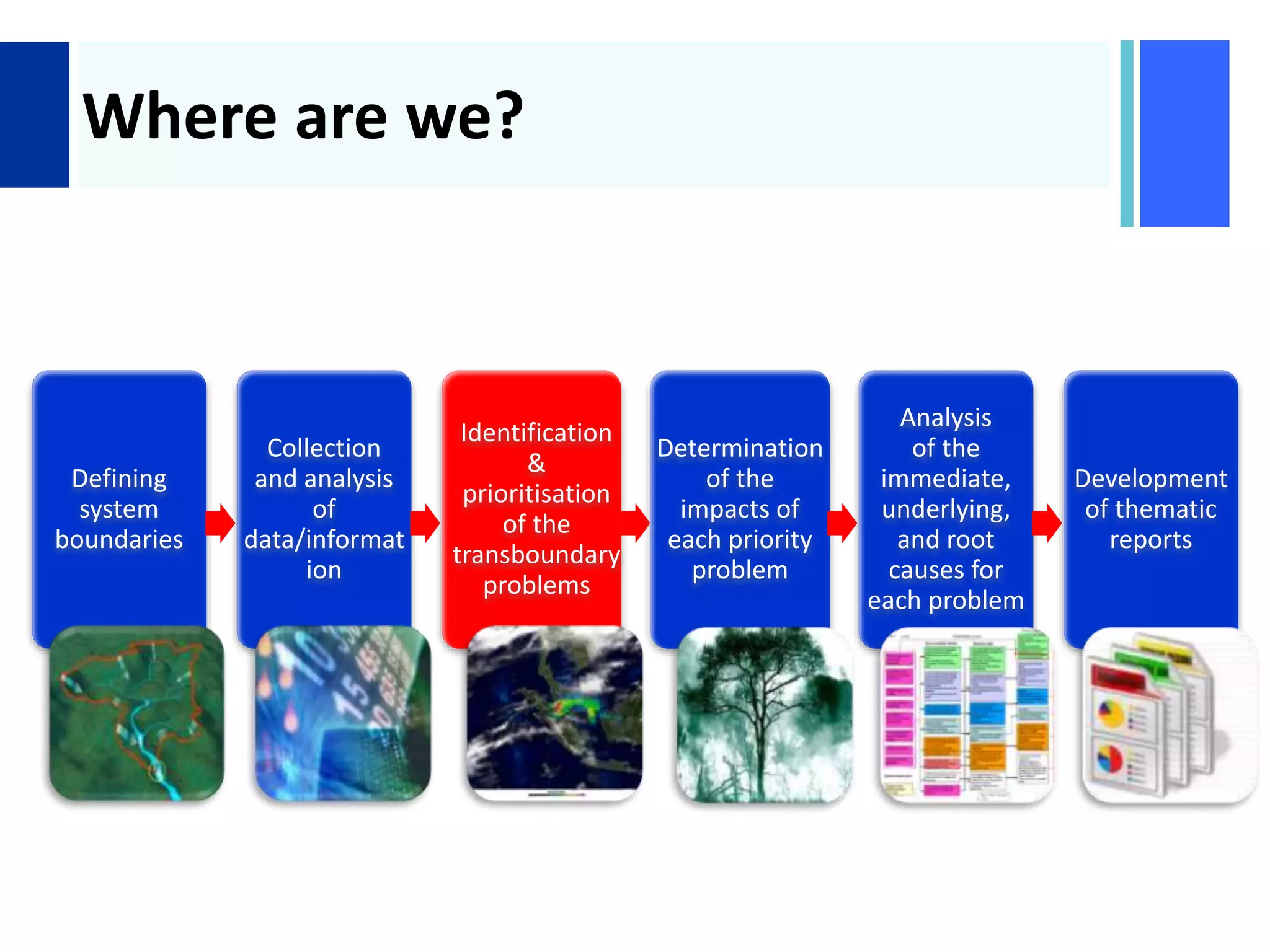
Defining
system
boundaries
Collection
and analysis
of
data/informat
ion
Identification
&
prioritisation
of the
transboundary
problems
Determination
of the
impacts of
each priority
problem
Analysis
of the
immediate,
underlying,
and root
causes for
each problem
Development
of thematic
reports
+
In this Section you will learn about….
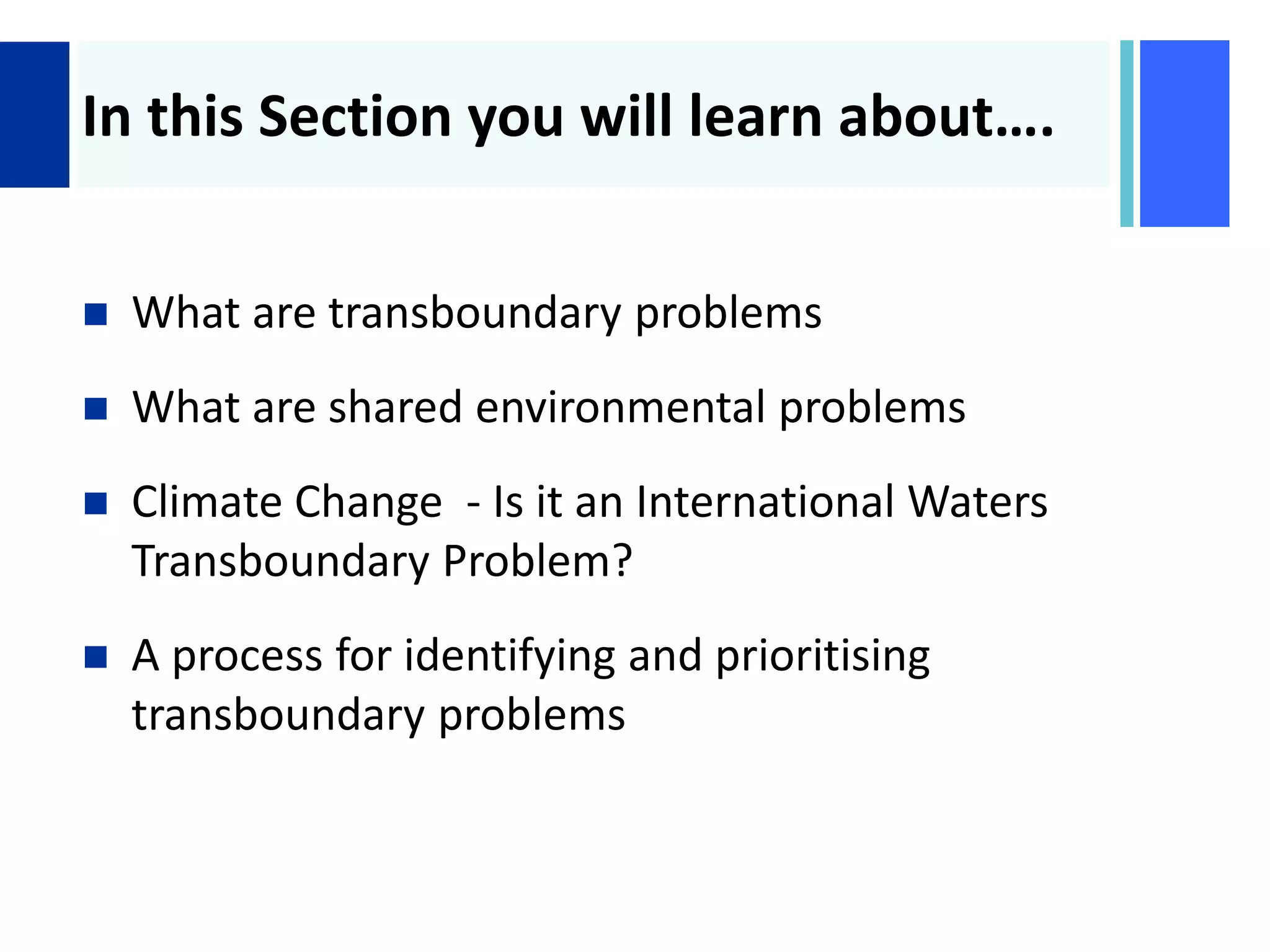
 What are transboundary problems
 What are shared environmental problems
 Climate Change - Is it an International Waters
Transboundary Problem?
 A process for identifying and prioritising
transboundary problems
+
What is a Transboundary Problem?
A transboundary problem is an environmental
problem that is transboundary in scale.
In other words, it is an environmental problem
originating in, or contributed by, one country and
affecting (or impacting) another.
+
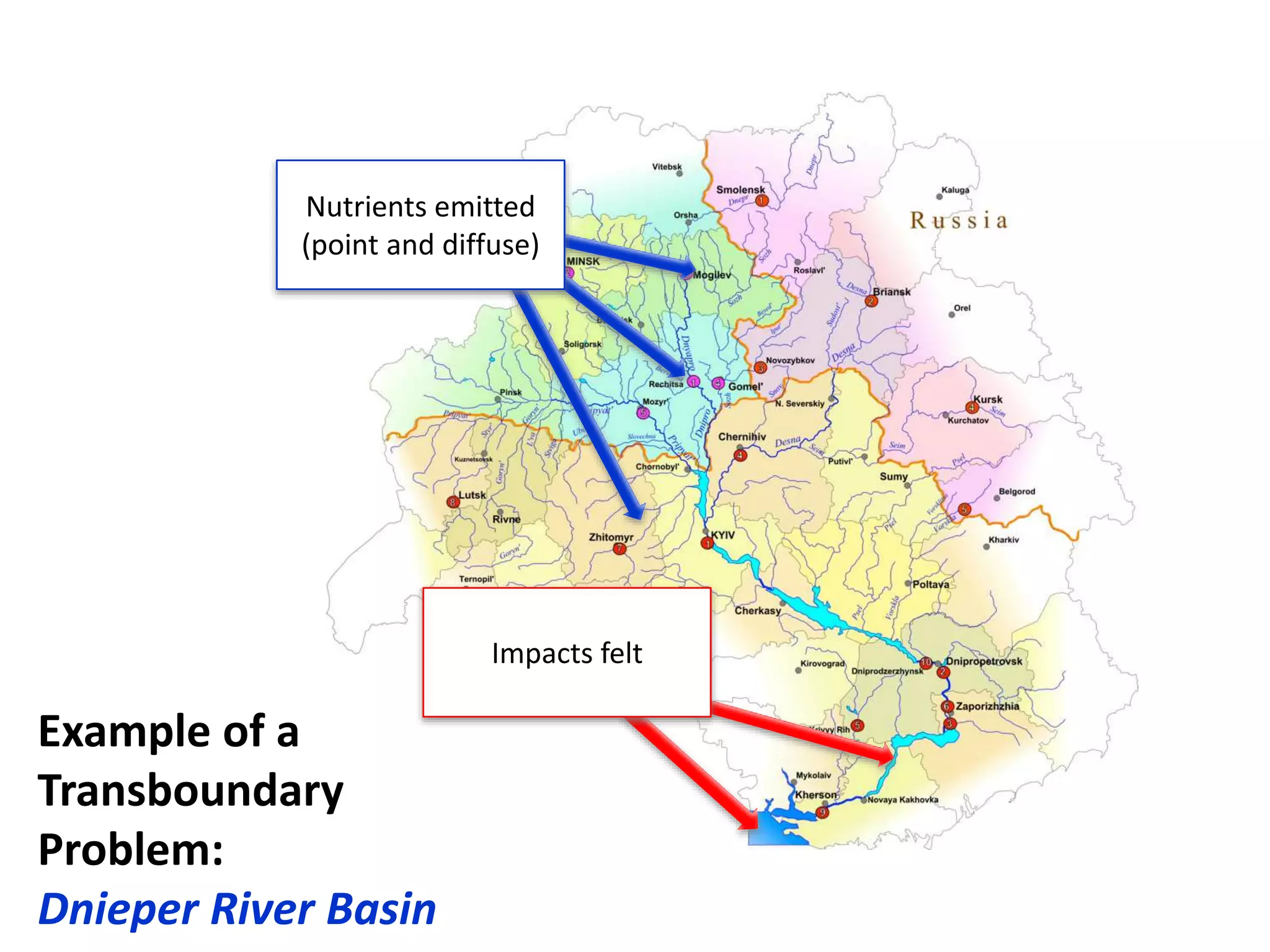
Nutrients emitted
(point and diffuse)
Impacts felt
Example of a
Transboundary
Problem:
Dnieper River Basin
+
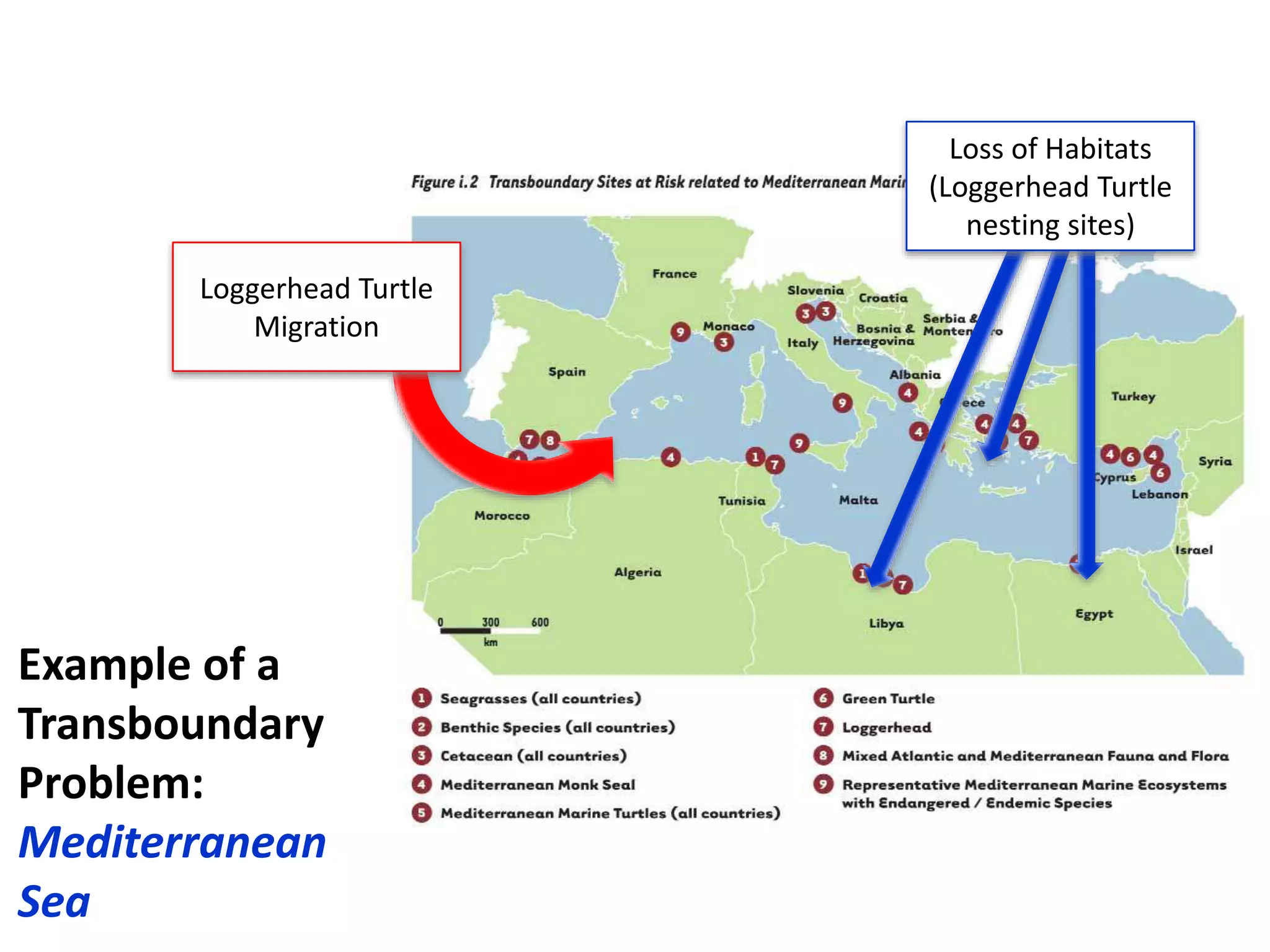
Example of a
Transboundary
Problem:
Mediterranean
Sea
Loss of Habitats
(Loggerhead Turtle
nesting sites)
Loggerhead Turtle
Migration
+ What is a Shared Environmental
Problem?
A shared environmental problem is an
environmental problem that is shared between 2
or more countries in a given water system
The problem is not transboundary as given in the
definition above but is a common problem in the
region
+
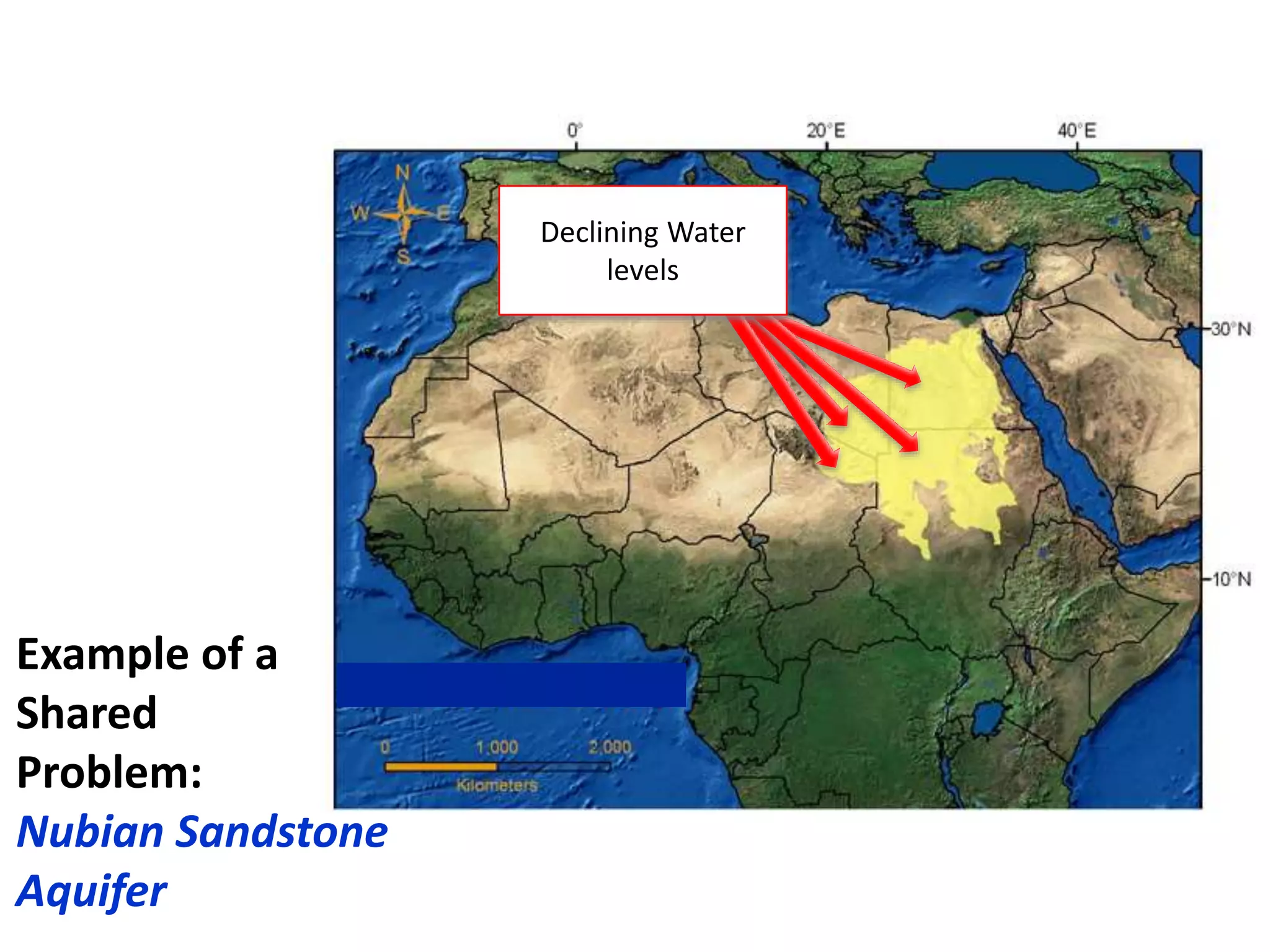
Example of a
Shared
Problem:
Nubian Sandstone
Aquifer
+
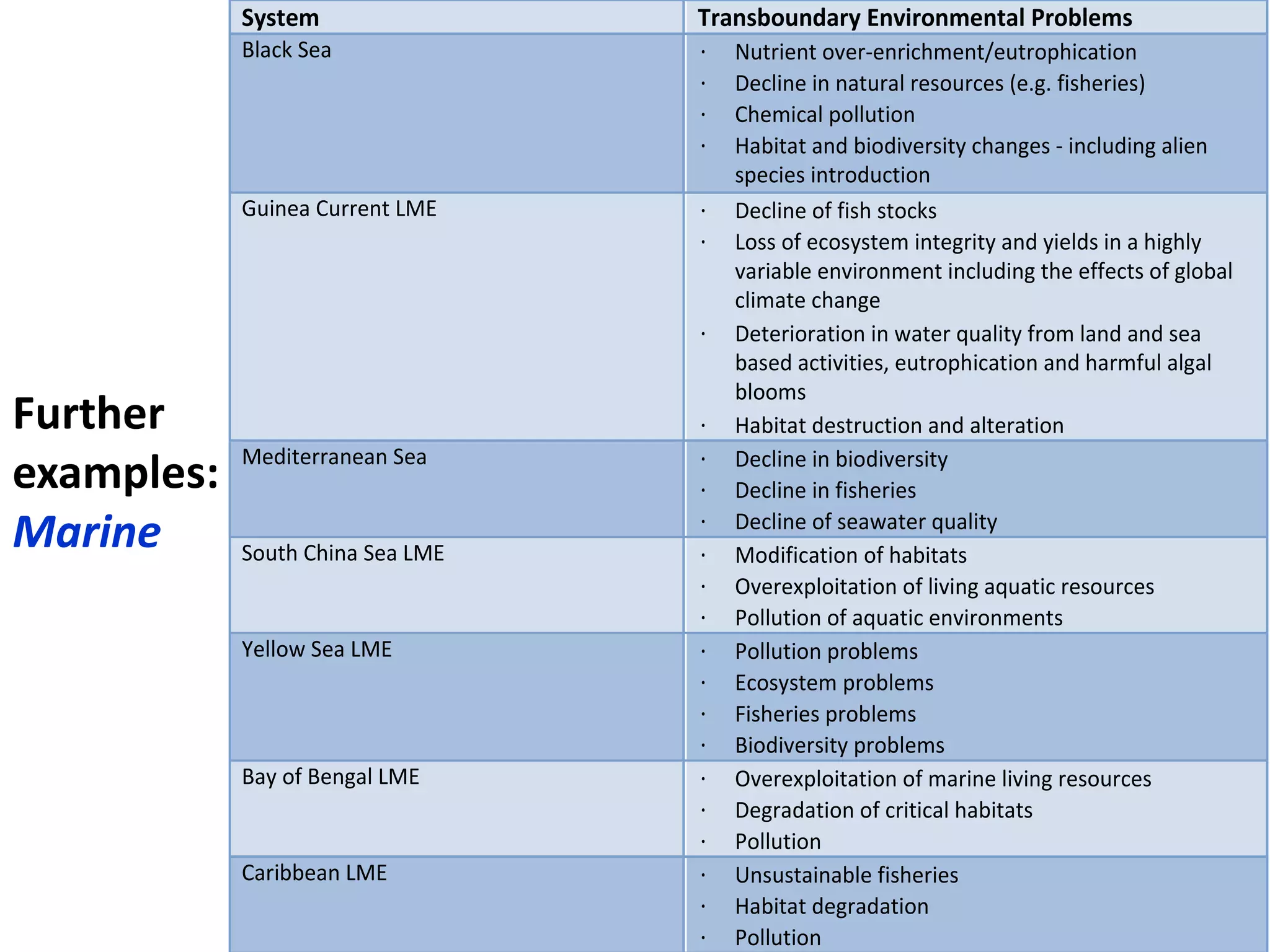
System Transboundary Environmental Problems
Black Sea · Nutrient over-enrichment/eutrophication
· Decline in natural resources (e.g. fisheries)
· Chemical pollution
· Habitat and biodiversity changes - including alien
species introduction
Guinea Current LME · Decline of fish stocks
· Loss of ecosystem integrity and yields in a highly
variable environment including the effects of global
climate change
· Deterioration in water quality from land and sea
based activities, eutrophication and harmful algal
blooms
· Habitat destruction and alteration
Mediterranean Sea · Decline in biodiversity
· Decline in fisheries
· Decline of seawater quality
South China Sea LME · Modification of habitats
· Overexploitation of living aquatic resources
· Pollution of aquatic environments
Yellow Sea LME · Pollution problems
· Ecosystem problems
· Fisheries problems
· Biodiversity problems
Bay of Bengal LME · Overexploitation of marine living resources
· Degradation of critical habitats
· Pollution
Caribbean LME · Unsustainable fisheries
· Habitat degradation
· Pollution
Further
examples:
Marine
+
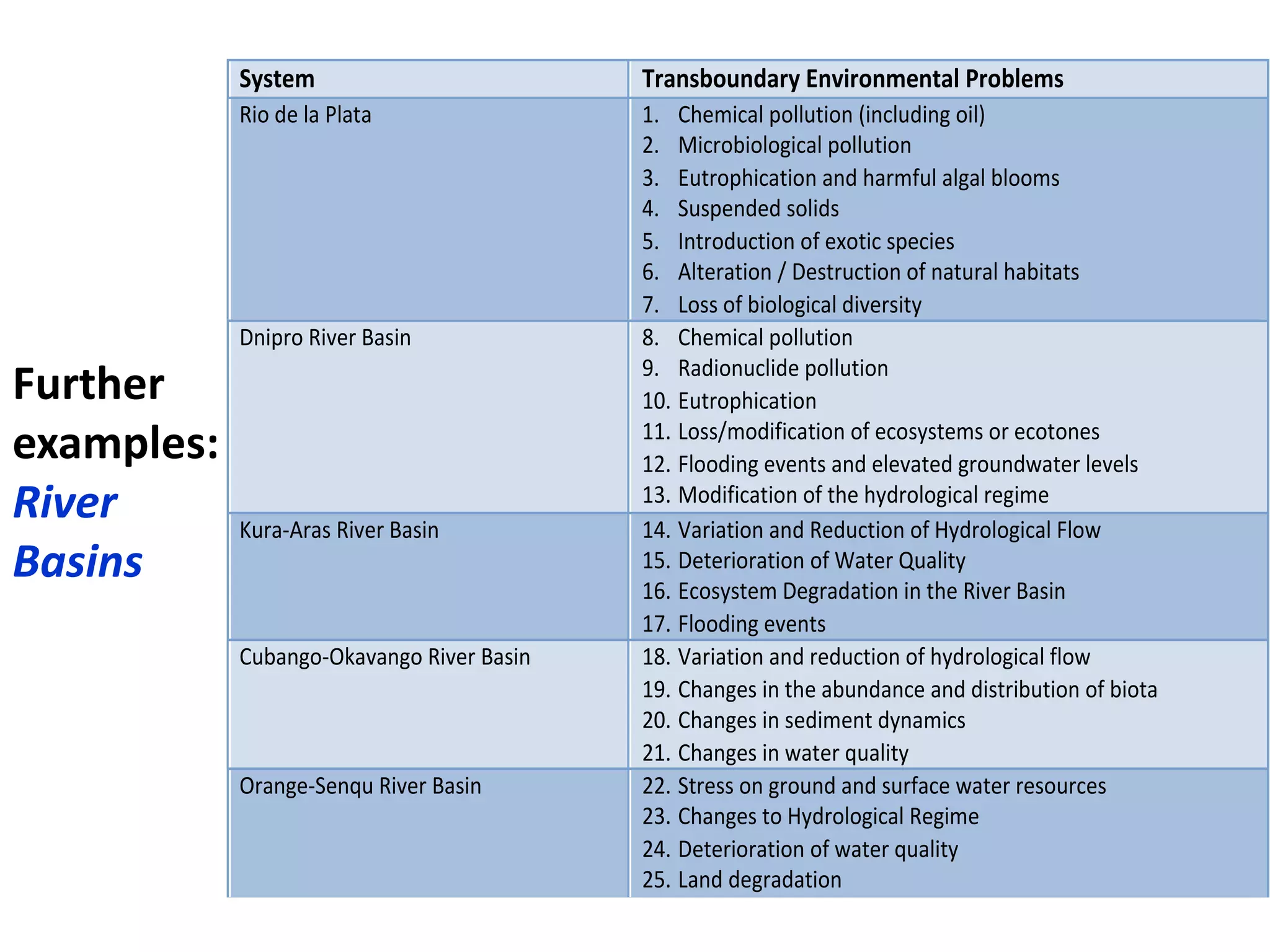
Further
examples:
River
Basins
System Transboundary Environmental Problems
Rio de la Plata 1. Chemical pollution (including oil)
2. Microbiological pollution
3. Eutrophication and harmful algal blooms
4. Suspended solids
5. Introduction of exotic species
6. Alteration / Destruction of natural habitats
7. Loss of biological diversity
Dnipro River Basin 8. Chemical pollution
9. Radionuclide pollution
10. Eutrophication
11. Loss/modification of ecosystems or ecotones
12. Flooding events and elevated groundwater levels
13. Modification of the hydrological regime
Kura-Aras River Basin 14. Variation and Reduction of Hydrological Flow
15. Deterioration of Water Quality
16. Ecosystem Degradation in the River Basin
17. Flooding events
Cubango-Okavango River Basin 18. Variation and reduction of hydrological flow
19. Changes in the abundance and distribution of biota
20. Changes in sediment dynamics
21. Changes in water quality
Orange-Senqu River Basin 22. Stress on ground and surface water resources
23. Changes to Hydrological Regime
24. Deterioration of water quality
25. Land degradation
+
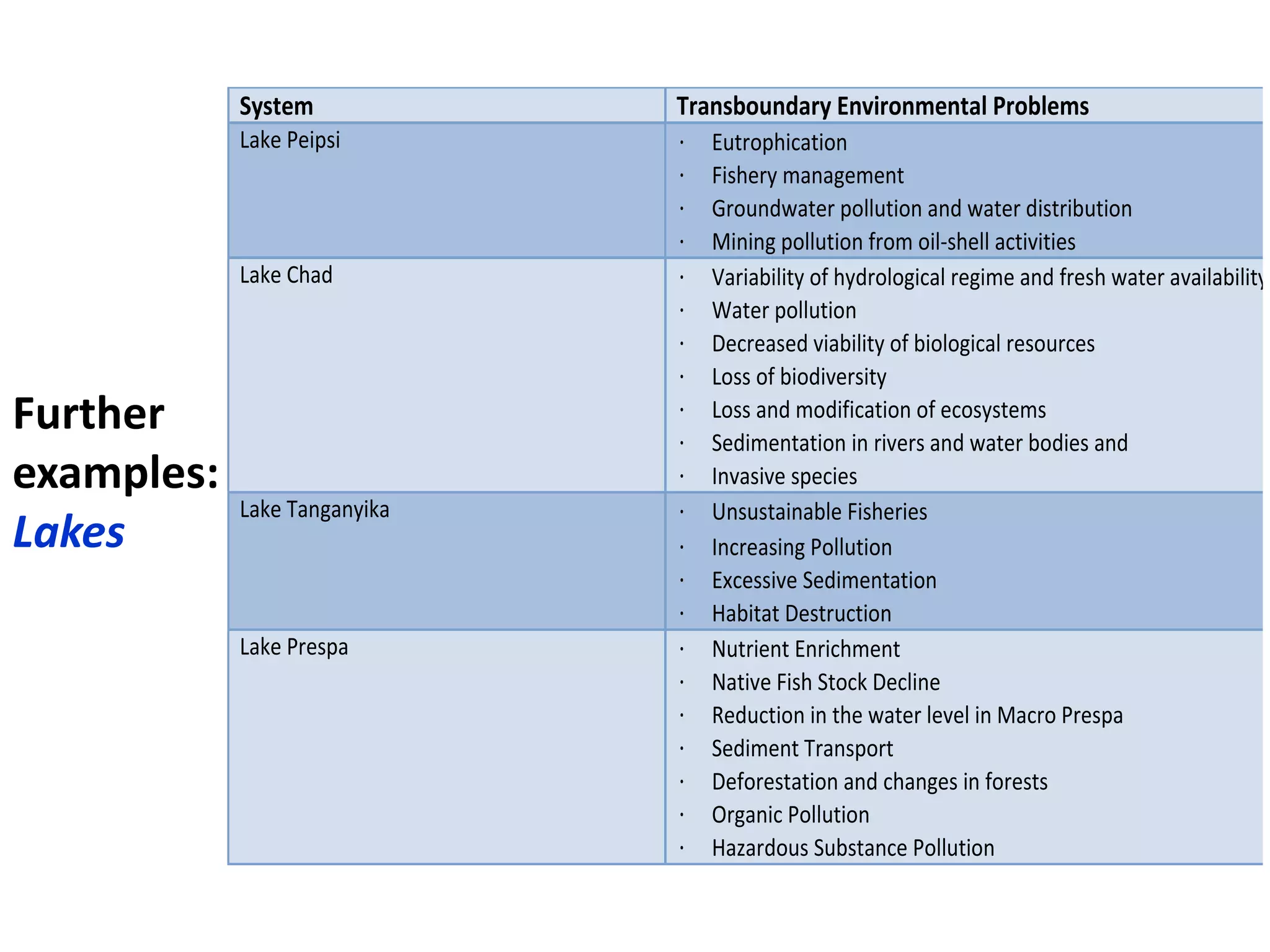
Further
examples:
Lakes
System Transboundary Environmental Problems
Lake Peipsi · Eutrophication
· Fishery management
· Groundwater pollution and water distribution
· Mining pollution from oil-shell activities
Lake Chad · Variability of hydrological regime and fresh water availability
· Water pollution
· Decreased viability of biological resources
· Loss of biodiversity
· Loss and modification of ecosystems
· Sedimentation in rivers and water bodies and
· Invasive species
Lake Tanganyika · Unsustainable Fisheries
· Increasing Pollution
· Excessive Sedimentation
· Habitat Destruction
Lake Prespa · Nutrient Enrichment
· Native Fish Stock Decline
· Reduction in the water level in Macro Prespa
· Sediment Transport
· Deforestation and changes in forests
· Organic Pollution
· Hazardous Substance Pollution
+
Further
examples:
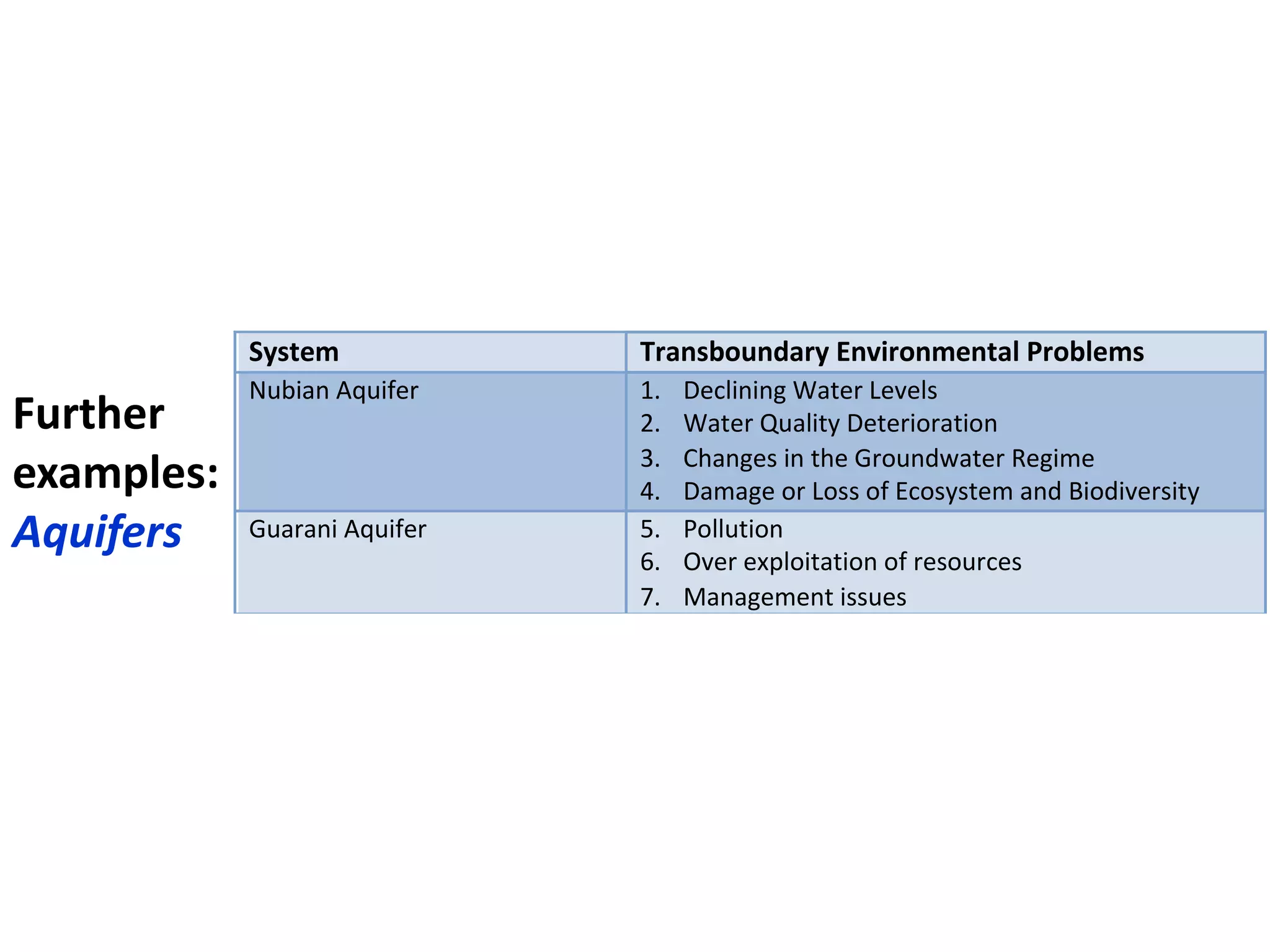
Aquifers
System Transboundary Environmental Problems
Nubian Aquifer 1. Declining Water Levels
2. Water Quality Deterioration
3. Changes in the Groundwater Regime
4. Damage or Loss of Ecosystem and Biodiversity
Guarani Aquifer 5. Pollution
6. Over exploitation of resources
7. Management issues
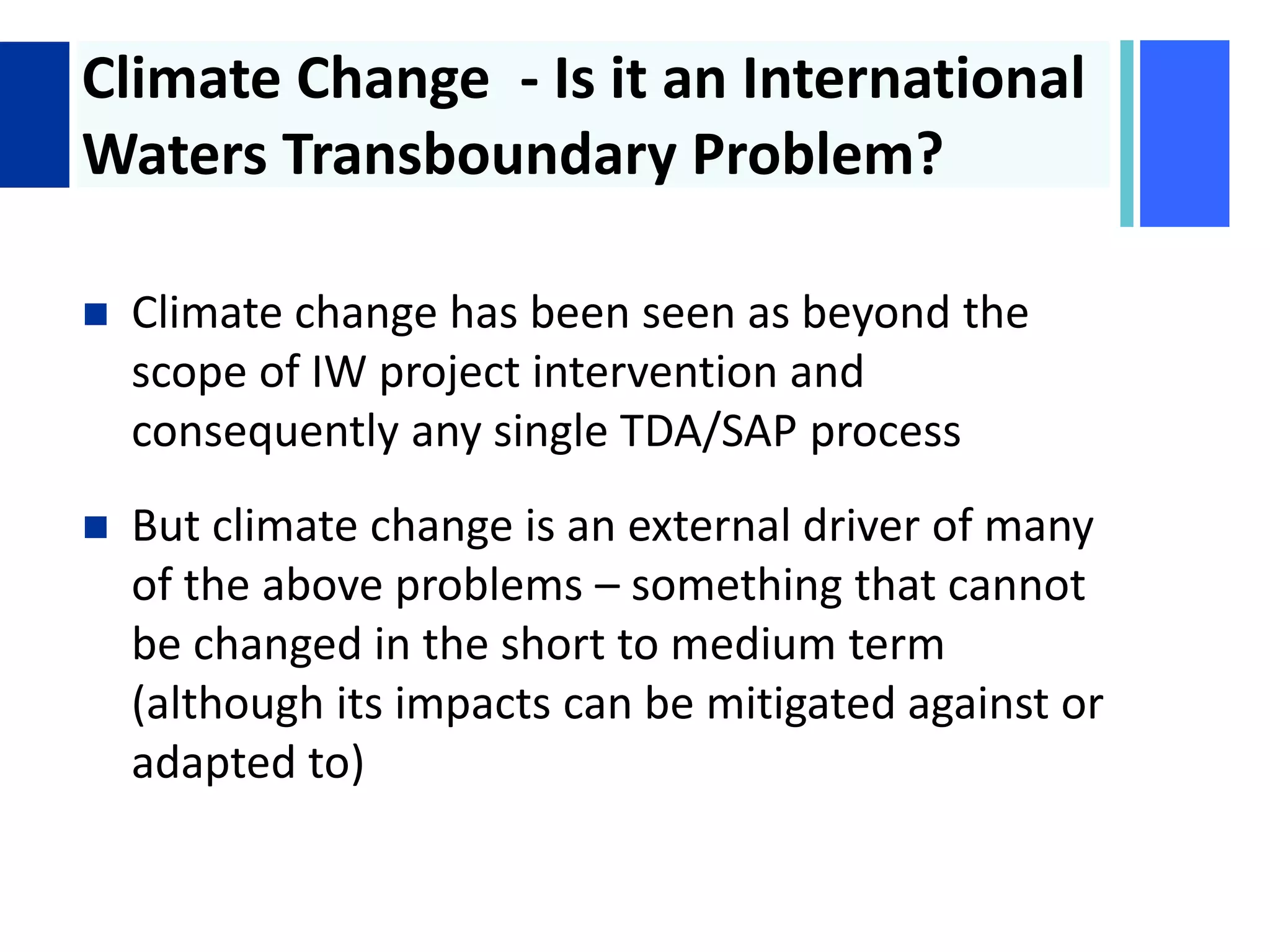
+ Climate Change - Is it an International
Waters Transboundary Problem?
 Climate change has been seen as beyond the
scope of IW project intervention and
consequently any single TDA/SAP process
 But climate change is an external driver of many
of the above problems – something that cannot
be changed in the short to medium term
(although its impacts can be mitigated against or
adapted to)
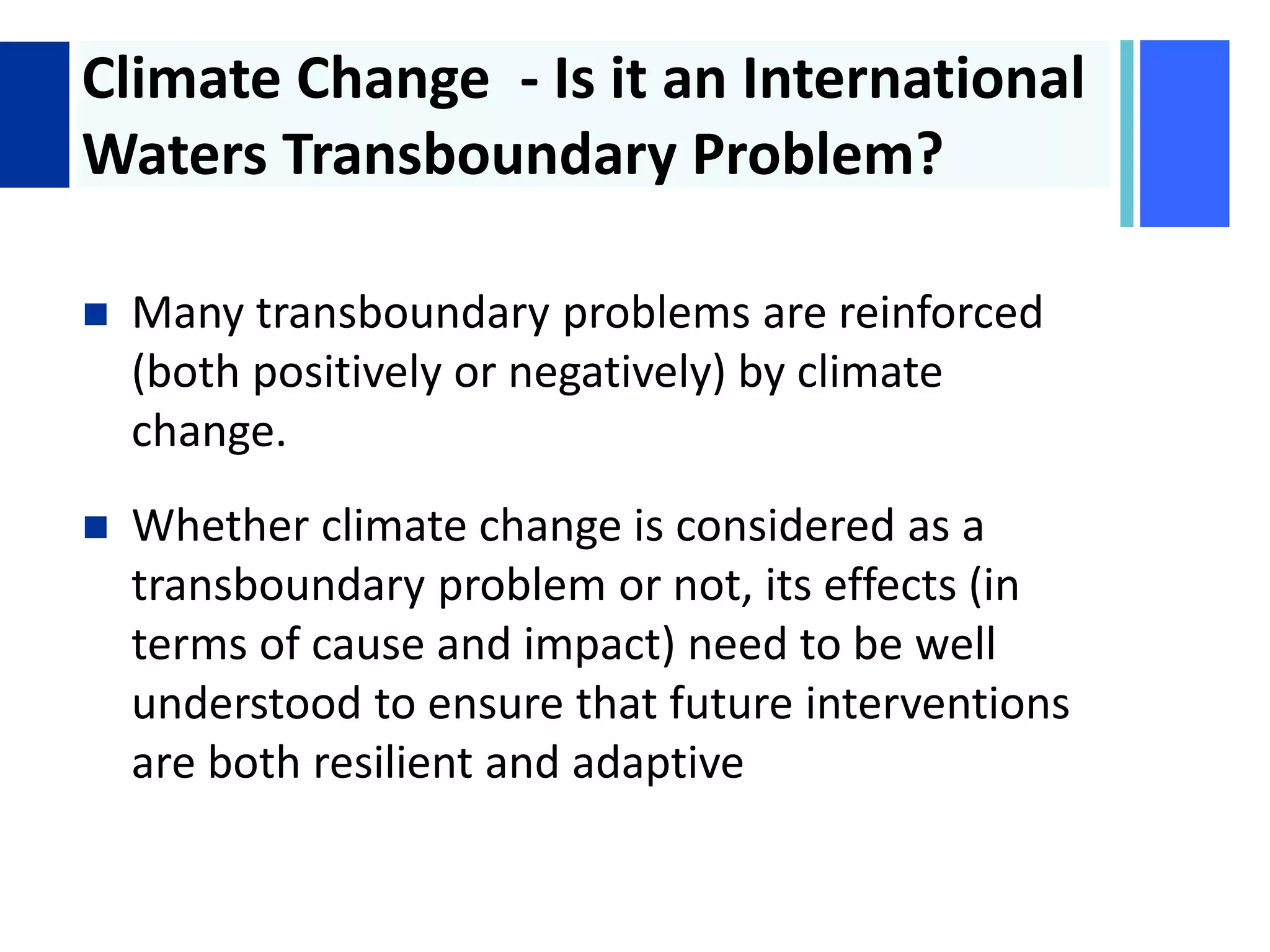
+ Climate Change - Is it an International
Waters Transboundary Problem?
 Many transboundary problems are reinforced
(both positively or negatively) by climate
change.
 Whether climate change is considered as a
transboundary problem or not, its effects (in
terms of cause and impact) need to be well
understood to ensure that future interventions
are both resilient and adaptive
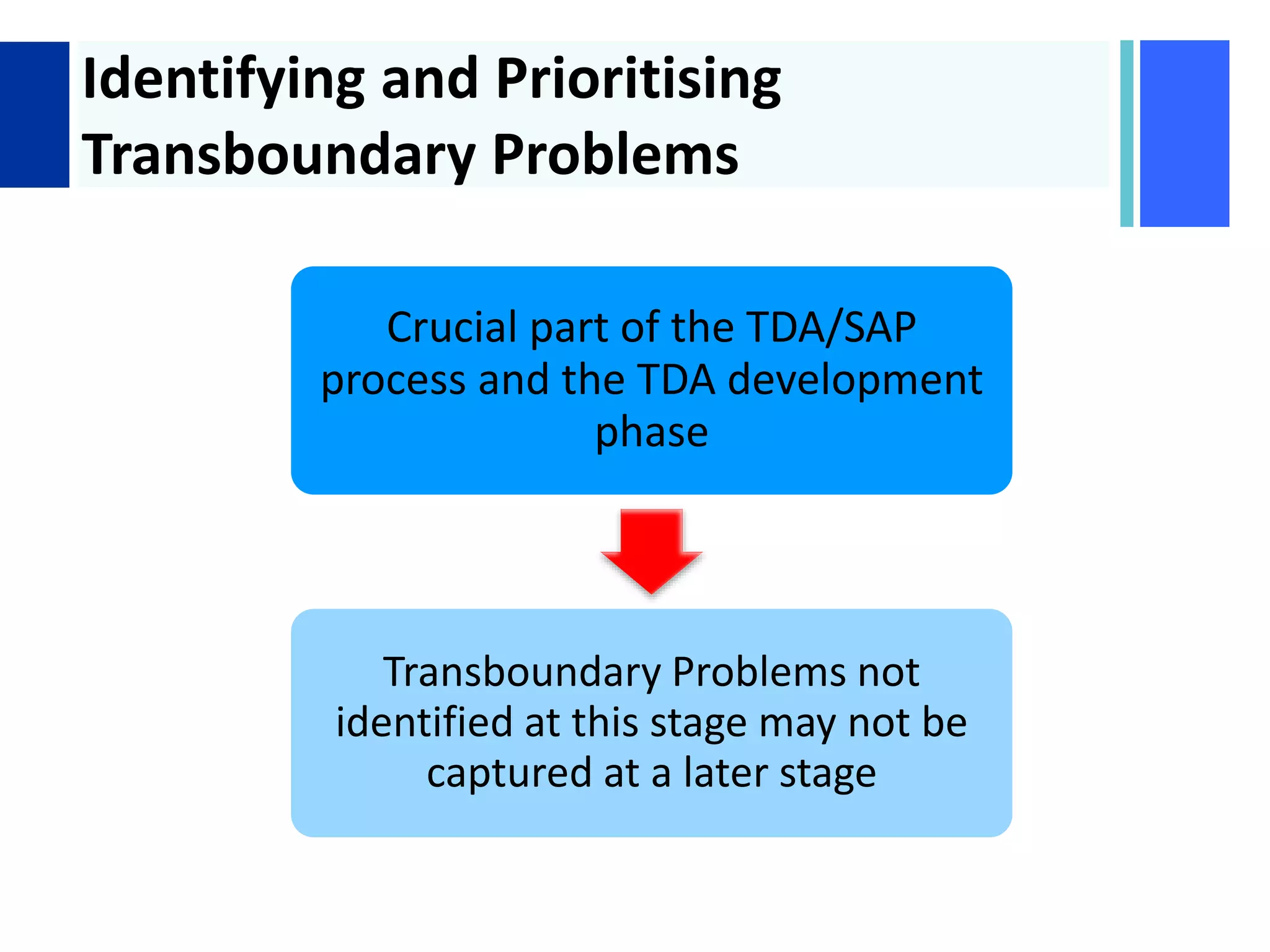
+ Identifying and Prioritising
Transboundary Problems
Crucial part of the TDA/SAP
process and the TDA development
phase
Transboundary Problems not
identified at this stage may not be
captured at a later stage
+ Prioritisation- an Integral part of
Strategic Planning
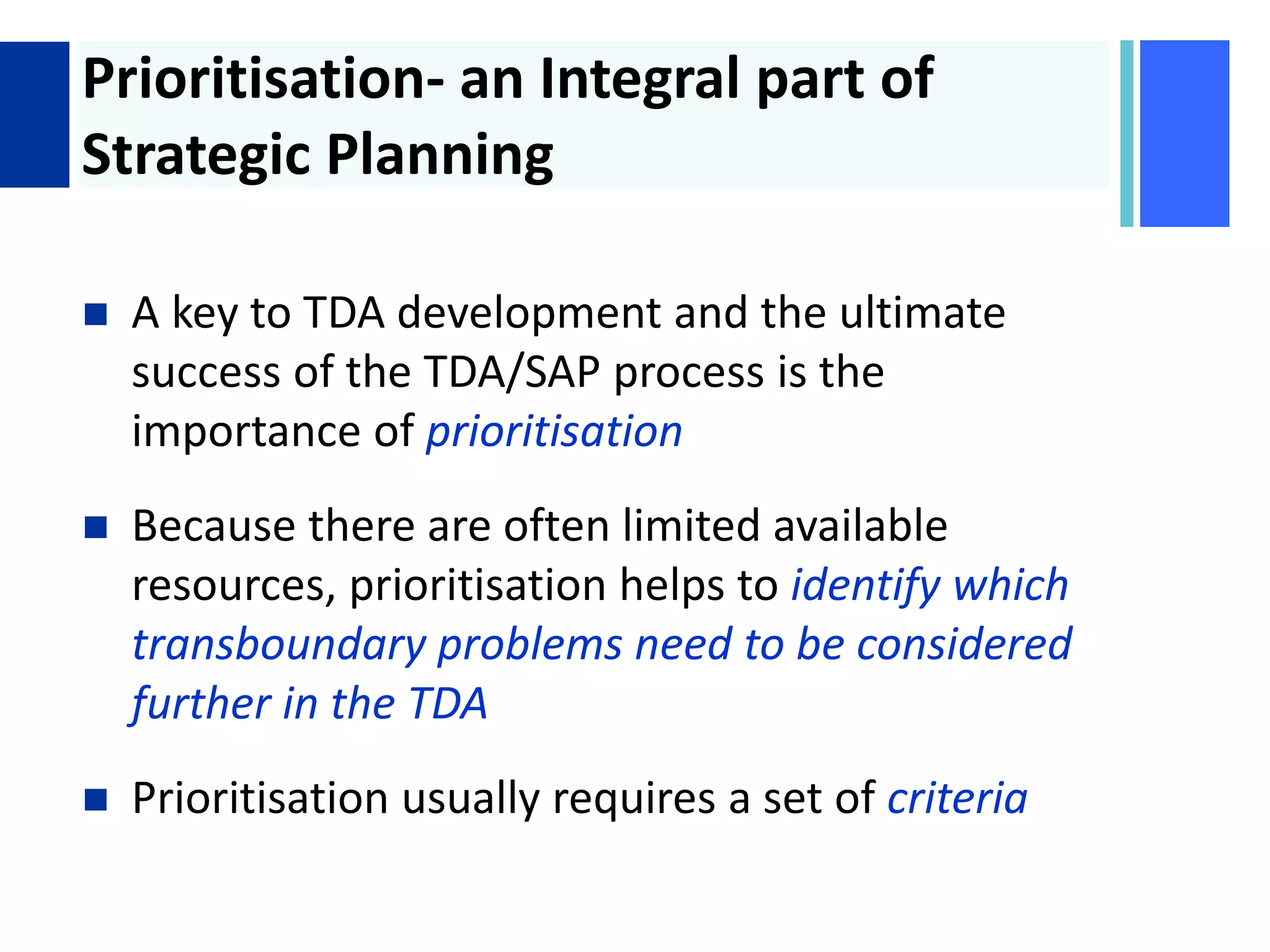
 A key to TDA development and the ultimate
success of the TDA/SAP process is the
importance of prioritisation
 Because there are often limited available
resources, prioritisation helps to identify which
transboundary problems need to be considered
further in the TDA
 Prioritisation usually requires a set of criteria
+
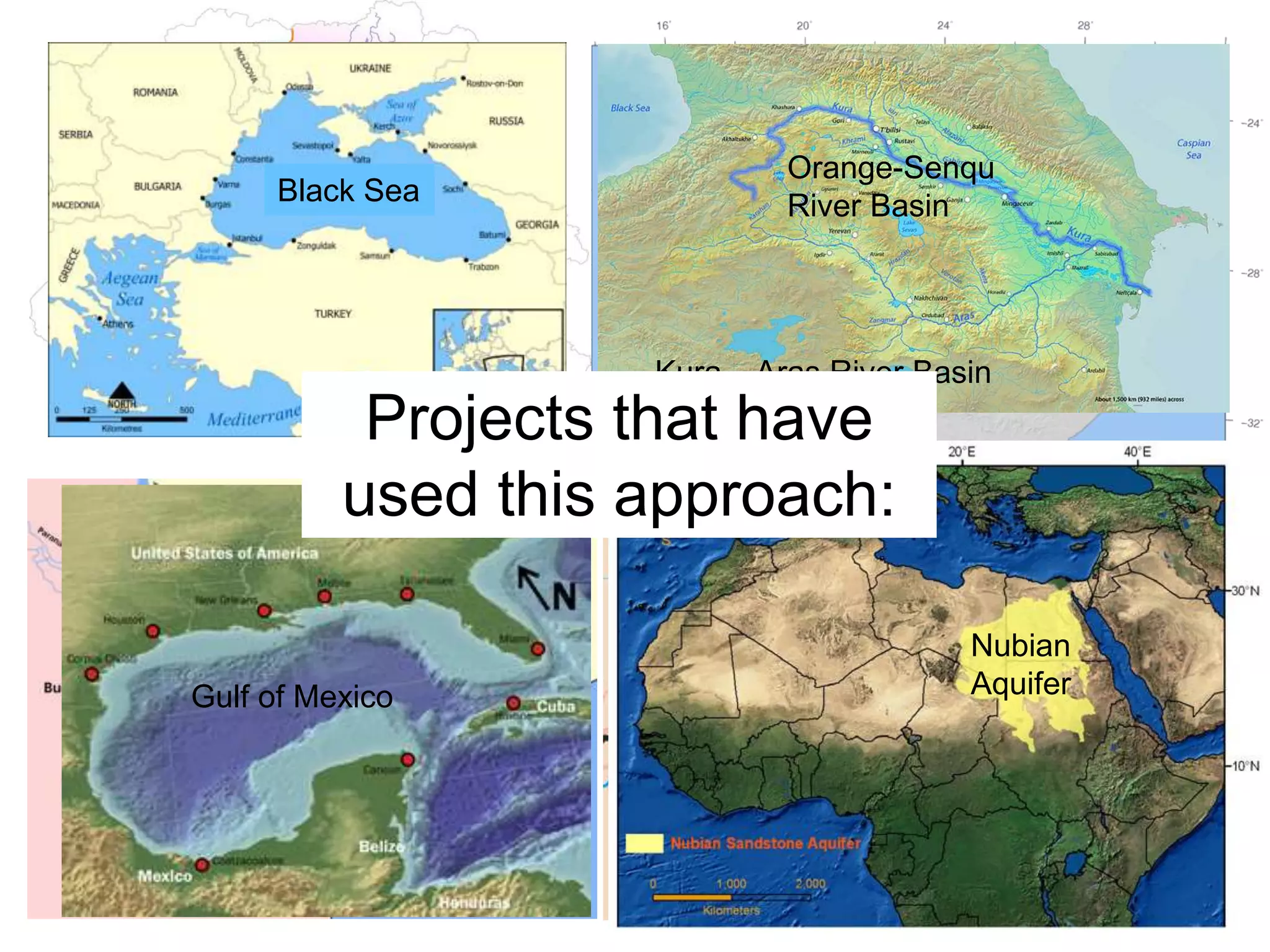
Kura – Aras River Basin
Dnieper River Basin
Rio de la Plata
Black Sea
Gulf of Mexico Lake Chad
Nubian
Aquifer
Projects that have
used this approach:
Orange-Senqu
River Basin
+
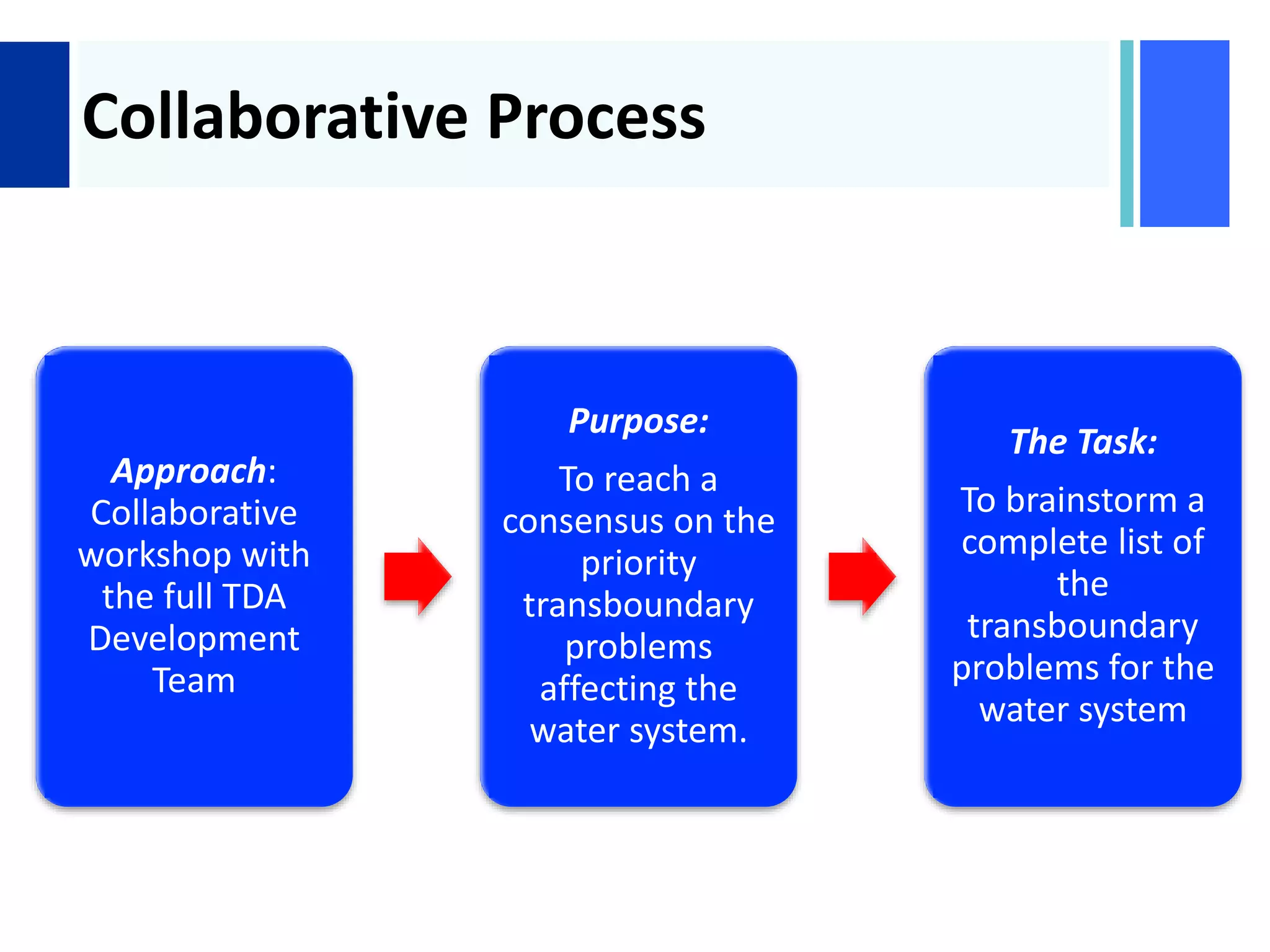
Collaborative Process
Approach:
Collaborative
workshop with
the full TDA
Development
Team
Purpose:
To reach a
consensus on the
priority
transboundary
problems
affecting the
water system.
The Task:
To brainstorm a
complete list of
the
transboundary
problems for the
water system
+
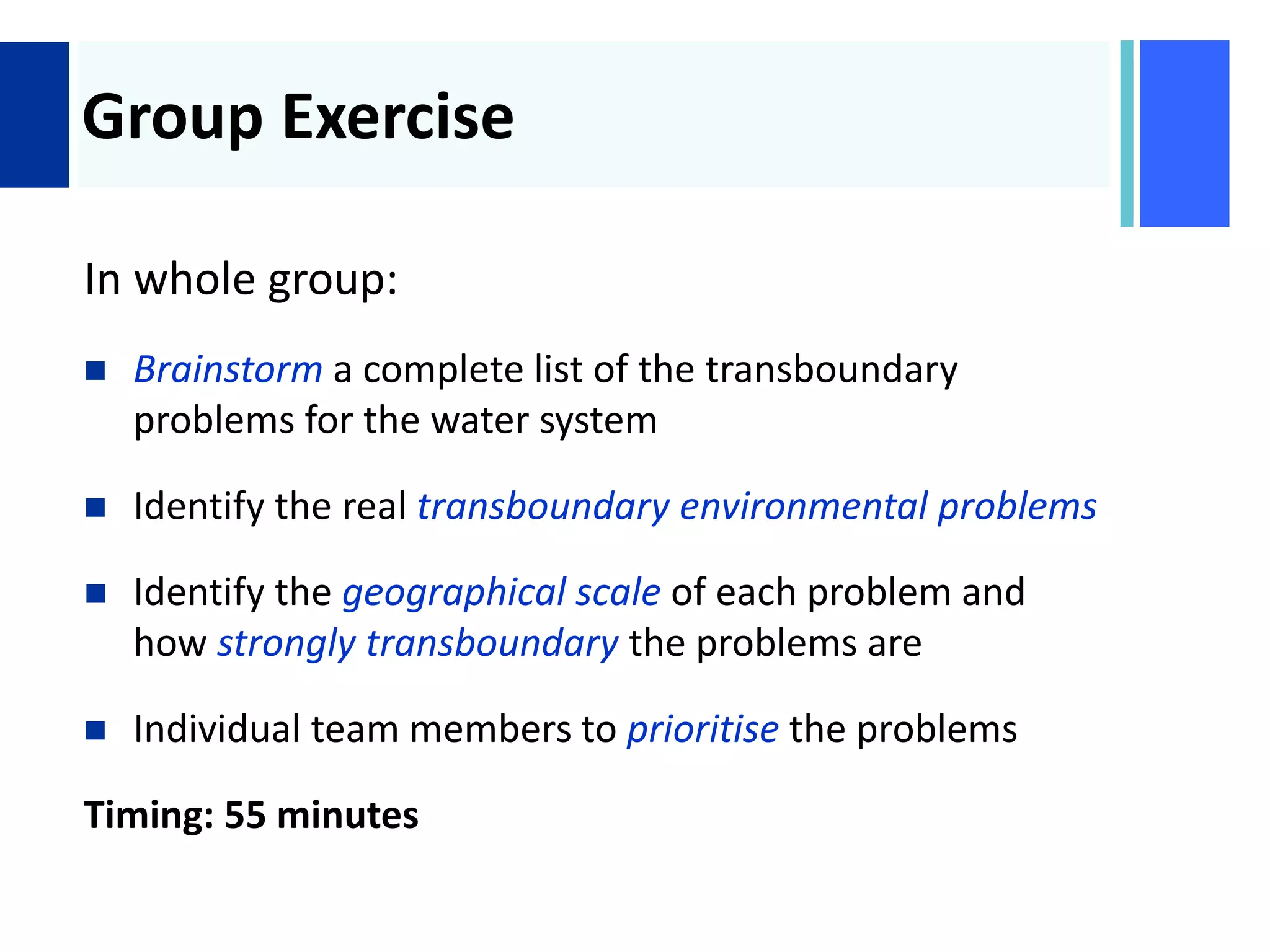
Group Exercise
In whole group:
 Brainstorm a complete list of the transboundary
problems for the water system
 Identify the real transboundary environmental problems
 Identify the geographical scale of each problem and
how strongly transboundary the problems are
 Individual team members to prioritise the problems
Timing: 55 minutes
+
Golden Rules of Brainstorming
+
Group Exercise
In whole group:
 Brainstorm a complete list of the transboundary
problems for the water system
 Identify the real transboundary environmental problems
 Identify the geographical scale of each problem and
how strongly transboundary the problems are
 Individual team members to prioritise the problems
Timing: 55 minutes

TDA/SAP Methodology Training Course Module 2 Section 4

  • 1.
  • 2.
    Section 4: TransboundaryProblem Identification and Prioritisation
  • 3.
    + Where are we? Defining system boundaries Collection andanalysis of data/informat ion Identification & prioritisation of the transboundary problems Determination of the impacts of each priority problem Analysis of the immediate, underlying, and root causes for each problem Development of thematic reports
  • 4.
    + In this Sectionyou will learn about….  What are transboundary problems  What are shared environmental problems  Climate Change - Is it an International Waters Transboundary Problem?  A process for identifying and prioritising transboundary problems
  • 5.
    + What is aTransboundary Problem? A transboundary problem is an environmental problem that is transboundary in scale. In other words, it is an environmental problem originating in, or contributed by, one country and affecting (or impacting) another.
  • 6.
    + Nutrients emitted (point anddiffuse) Impacts felt Example of a Transboundary Problem: Dnieper River Basin
  • 7.
    + Example of a Transboundary Problem: Mediterranean Sea Lossof Habitats (Loggerhead Turtle nesting sites) Loggerhead Turtle Migration
  • 8.
    + What isa Shared Environmental Problem? A shared environmental problem is an environmental problem that is shared between 2 or more countries in a given water system The problem is not transboundary as given in the definition above but is a common problem in the region
  • 9.
  • 10.
    + System Transboundary EnvironmentalProblems Black Sea · Nutrient over-enrichment/eutrophication · Decline in natural resources (e.g. fisheries) · Chemical pollution · Habitat and biodiversity changes - including alien species introduction Guinea Current LME · Decline of fish stocks · Loss of ecosystem integrity and yields in a highly variable environment including the effects of global climate change · Deterioration in water quality from land and sea based activities, eutrophication and harmful algal blooms · Habitat destruction and alteration Mediterranean Sea · Decline in biodiversity · Decline in fisheries · Decline of seawater quality South China Sea LME · Modification of habitats · Overexploitation of living aquatic resources · Pollution of aquatic environments Yellow Sea LME · Pollution problems · Ecosystem problems · Fisheries problems · Biodiversity problems Bay of Bengal LME · Overexploitation of marine living resources · Degradation of critical habitats · Pollution Caribbean LME · Unsustainable fisheries · Habitat degradation · Pollution Further examples: Marine
  • 11.
    + Further examples: River Basins System Transboundary EnvironmentalProblems Rio de la Plata 1. Chemical pollution (including oil) 2. Microbiological pollution 3. Eutrophication and harmful algal blooms 4. Suspended solids 5. Introduction of exotic species 6. Alteration / Destruction of natural habitats 7. Loss of biological diversity Dnipro River Basin 8. Chemical pollution 9. Radionuclide pollution 10. Eutrophication 11. Loss/modification of ecosystems or ecotones 12. Flooding events and elevated groundwater levels 13. Modification of the hydrological regime Kura-Aras River Basin 14. Variation and Reduction of Hydrological Flow 15. Deterioration of Water Quality 16. Ecosystem Degradation in the River Basin 17. Flooding events Cubango-Okavango River Basin 18. Variation and reduction of hydrological flow 19. Changes in the abundance and distribution of biota 20. Changes in sediment dynamics 21. Changes in water quality Orange-Senqu River Basin 22. Stress on ground and surface water resources 23. Changes to Hydrological Regime 24. Deterioration of water quality 25. Land degradation
  • 12.
    + Further examples: Lakes System Transboundary EnvironmentalProblems Lake Peipsi · Eutrophication · Fishery management · Groundwater pollution and water distribution · Mining pollution from oil-shell activities Lake Chad · Variability of hydrological regime and fresh water availability · Water pollution · Decreased viability of biological resources · Loss of biodiversity · Loss and modification of ecosystems · Sedimentation in rivers and water bodies and · Invasive species Lake Tanganyika · Unsustainable Fisheries · Increasing Pollution · Excessive Sedimentation · Habitat Destruction Lake Prespa · Nutrient Enrichment · Native Fish Stock Decline · Reduction in the water level in Macro Prespa · Sediment Transport · Deforestation and changes in forests · Organic Pollution · Hazardous Substance Pollution
  • 13.
    + Further examples: Aquifers System Transboundary EnvironmentalProblems Nubian Aquifer 1. Declining Water Levels 2. Water Quality Deterioration 3. Changes in the Groundwater Regime 4. Damage or Loss of Ecosystem and Biodiversity Guarani Aquifer 5. Pollution 6. Over exploitation of resources 7. Management issues
  • 14.
    + Climate Change- Is it an International Waters Transboundary Problem?  Climate change has been seen as beyond the scope of IW project intervention and consequently any single TDA/SAP process  But climate change is an external driver of many of the above problems – something that cannot be changed in the short to medium term (although its impacts can be mitigated against or adapted to)
  • 15.
    + Climate Change- Is it an International Waters Transboundary Problem?  Many transboundary problems are reinforced (both positively or negatively) by climate change.  Whether climate change is considered as a transboundary problem or not, its effects (in terms of cause and impact) need to be well understood to ensure that future interventions are both resilient and adaptive
  • 16.
    + Identifying andPrioritising Transboundary Problems Crucial part of the TDA/SAP process and the TDA development phase Transboundary Problems not identified at this stage may not be captured at a later stage
  • 17.
    + Prioritisation- anIntegral part of Strategic Planning  A key to TDA development and the ultimate success of the TDA/SAP process is the importance of prioritisation  Because there are often limited available resources, prioritisation helps to identify which transboundary problems need to be considered further in the TDA  Prioritisation usually requires a set of criteria
  • 18.
    + Kura – ArasRiver Basin Dnieper River Basin Rio de la Plata Black Sea Gulf of Mexico Lake Chad Nubian Aquifer Projects that have used this approach: Orange-Senqu River Basin
  • 19.
    + Collaborative Process Approach: Collaborative workshop with thefull TDA Development Team Purpose: To reach a consensus on the priority transboundary problems affecting the water system. The Task: To brainstorm a complete list of the transboundary problems for the water system
  • 20.
    + Group Exercise In wholegroup:  Brainstorm a complete list of the transboundary problems for the water system  Identify the real transboundary environmental problems  Identify the geographical scale of each problem and how strongly transboundary the problems are  Individual team members to prioritise the problems Timing: 55 minutes
  • 21.
    + Golden Rules ofBrainstorming
  • 22.
    + Group Exercise In wholegroup:  Brainstorm a complete list of the transboundary problems for the water system  Identify the real transboundary environmental problems  Identify the geographical scale of each problem and how strongly transboundary the problems are  Individual team members to prioritise the problems Timing: 55 minutes