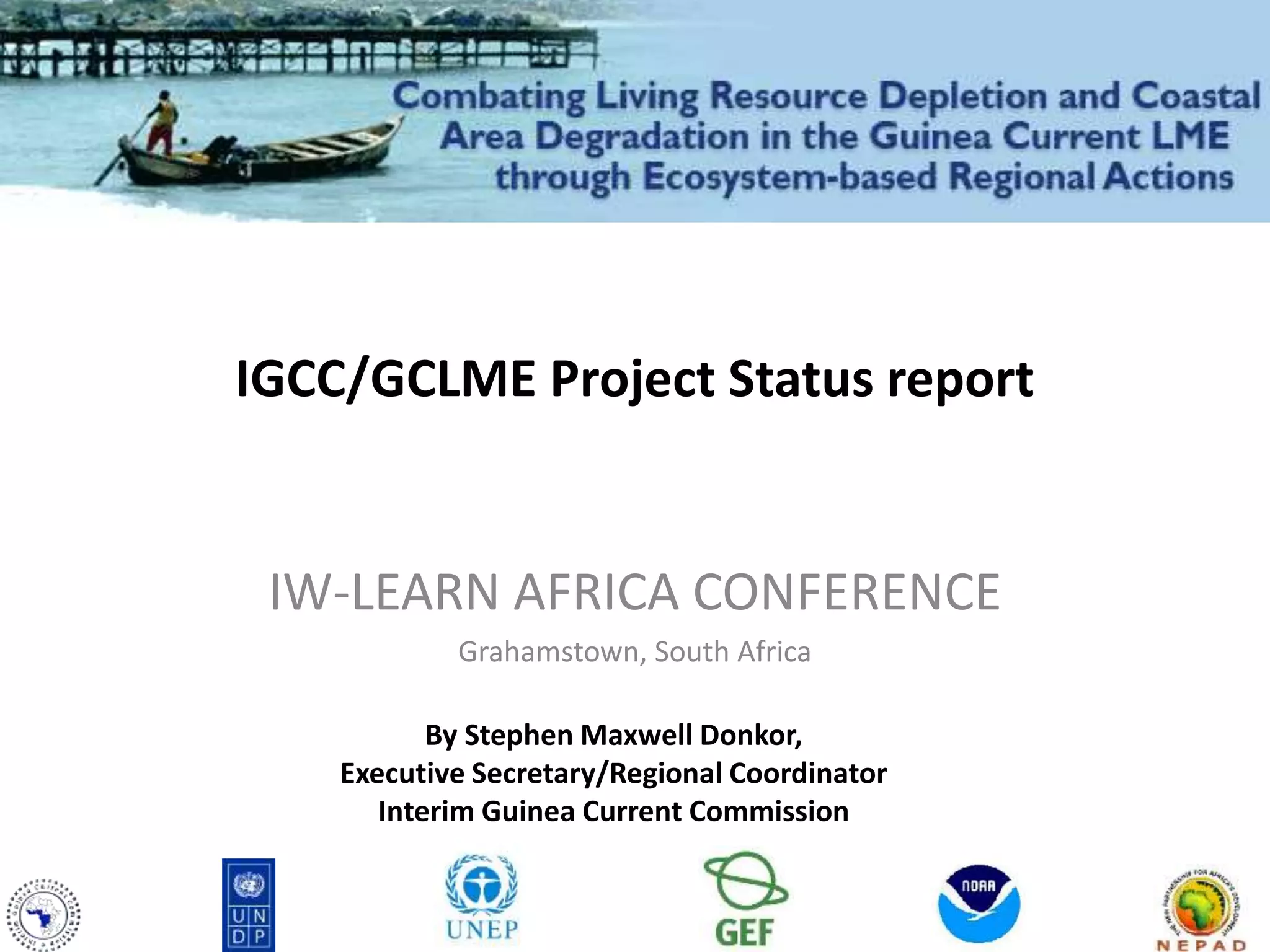
IGCC/GCLME Project Status report 
IW-LEARN AFRICA CONFERENCE 
Grahamstown, South Africa 
By Stephen Maxwell Donkor, 
Executive Secretary/Regional Coordinator 
Interim Guinea Current Commission
A. Main Project Objectives 
GCLME Project 
The overall development goals of this project are 
to: 
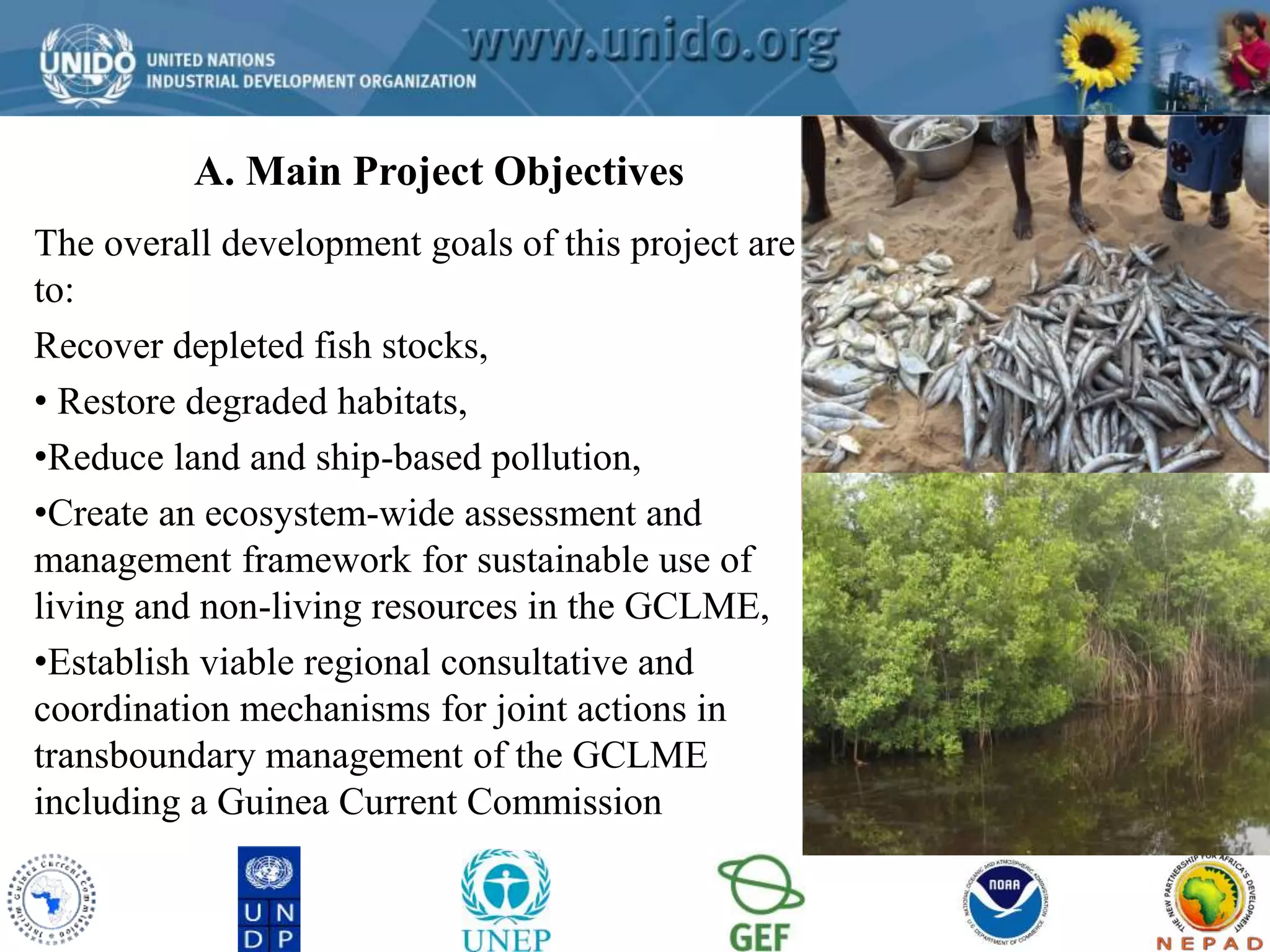
Recover depleted fish stocks, 
• Restore degraded habitats, 
•Reduce land and ship-based pollution, 
•Create an ecosystem-wide assessment and 
management framework for sustainable use of 
living and non-living resources in the GCLME, 
•Establish viable regional consultative and 
coordination mechanisms for joint actions in 
transboundary management of the GCLME 
including a Guinea Current Commission
GCLME Project 
COMPONENTS 
1. Recovery of depleted fisheries 
2. Restore degraded habitats 
3. Reduce land and ship-based pollution 
4. Create an ecosystem wide assessment and 
management framework for environmental 
and living resource management 
5. Establish viable regional consultative and 
coordination mechanisms for transboundary 
management of the GCLME including a 
Guinea Current Commission
GCLME Project 
Key Milestones 
The IGCC/GCLME Project has made real progress and 
successfully completed many of the activities set out at 
inception in 2005 : 
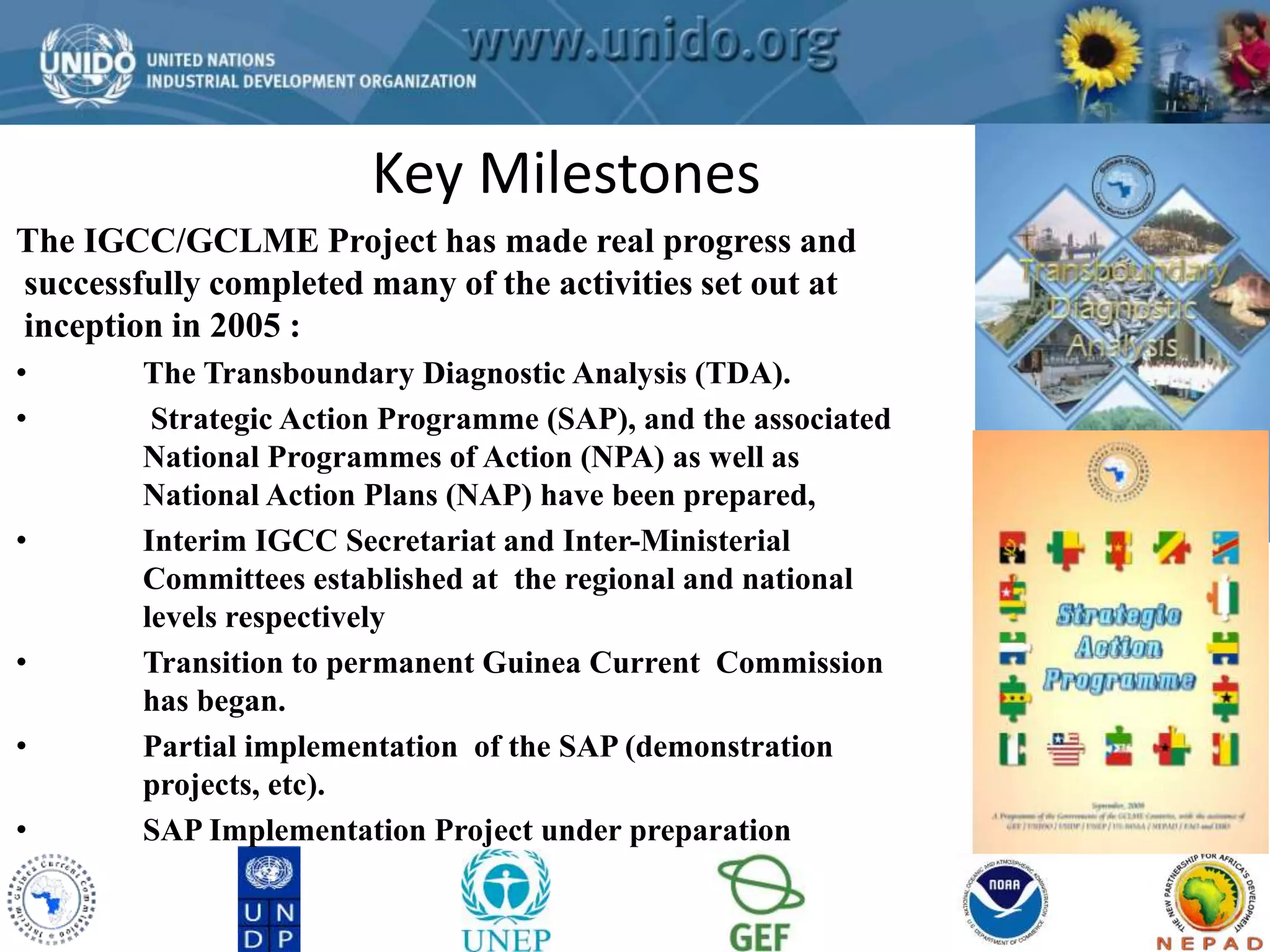
• The Transboundary Diagnostic Analysis (TDA). 
• Strategic Action Programme (SAP), and the associated 
National Programmes of Action (NPA) as well as 
National Action Plans (NAP) have been prepared, 
• Interim IGCC Secretariat and Inter-Ministerial 
Committees established at the regional and national 
levels respectively 
• Transition to permanent Guinea Current Commission 
has began. 
• Partial implementation of the SAP (demonstration 
projects, etc). 
• SAP Implementation Project under preparation
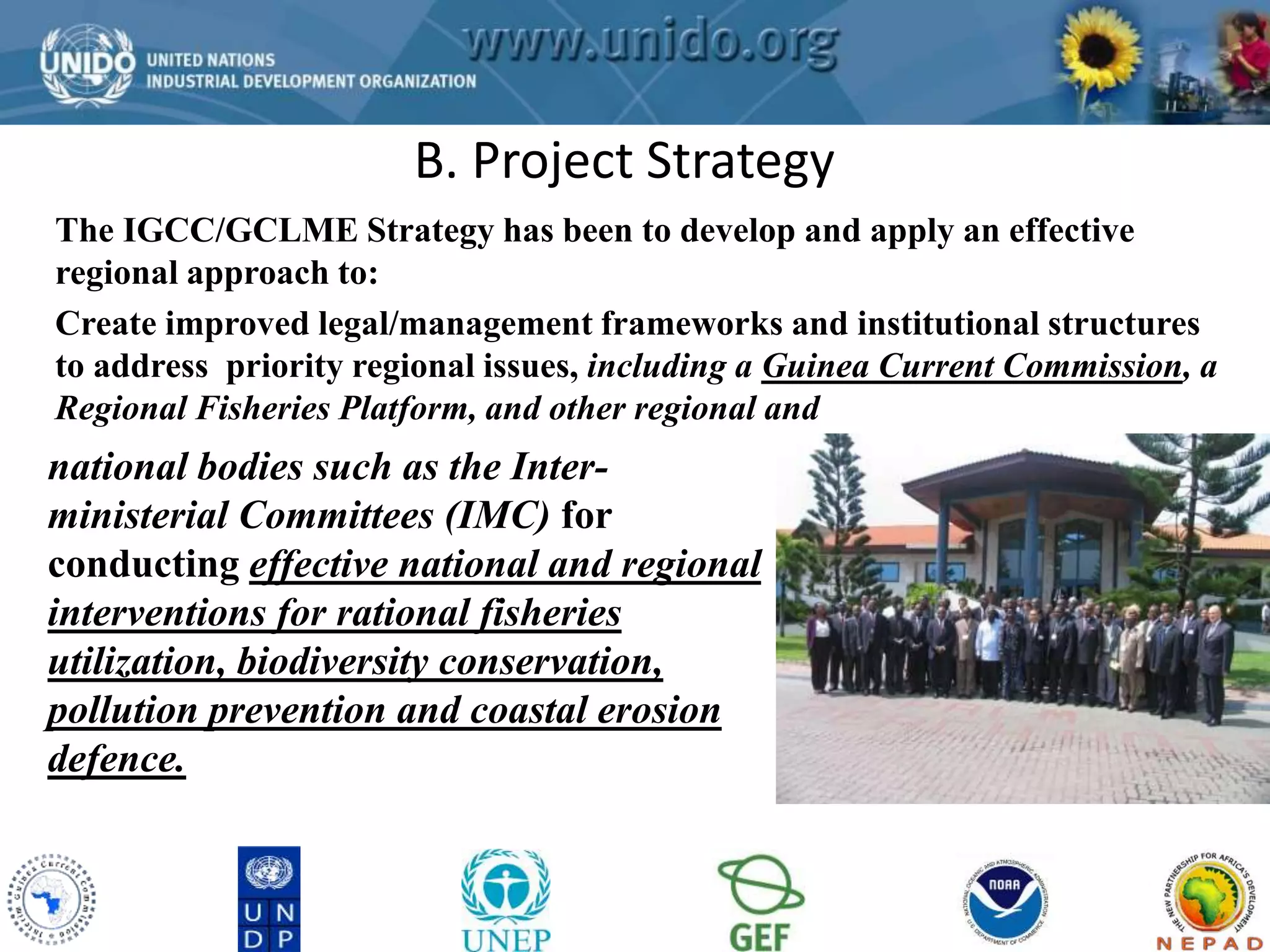
GCLME Project B. Project Strategy 
The IGCC/GCLME Strategy has been to develop and apply an effective 
regional approach to: 
Create improved legal/management frameworks and institutional structures 
to address priority regional issues, including a Guinea Current Commission, a 
Regional Fisheries Platform, and other regional and 
national bodies such as the Inter-ministerial 
Committees (IMC) for 
conducting effective national and regional 
interventions for rational fisheries 
utilization, biodiversity conservation, 
pollution prevention and coastal erosion 
defence.
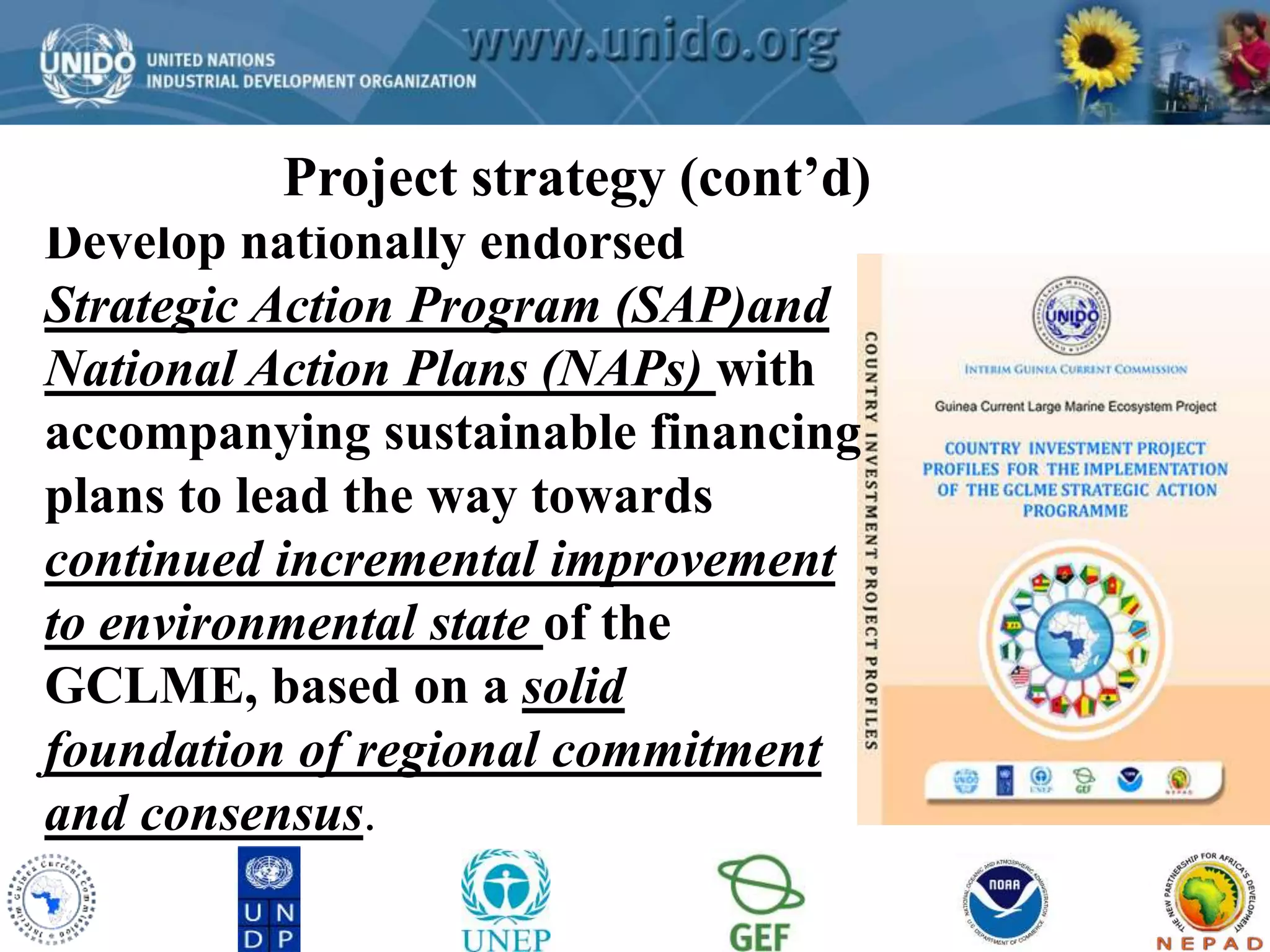
Project strategy (cont’d) 
GCLME Project 
Develop nationally endorsed 
Strategic Action Program (SAP)and 
National Action Plans (NAPs) with 
accompanying sustainable financing 
plans to lead the way towards 
continued incremental improvement 
to environmental state of the 
GCLME, based on a solid 
foundation of regional commitment 
and consensus.
GCLME Project 
Key Outcome 
Establish viable regional consultative and 
coordination mechanisms for transboundary 
management of the GCLME including a Guinea 
Current Commission 
The IGCC Ministers in their 2nd statutory meeting 
on 2nd July 2010 decided to establish a 
permanent Guinea Current Commission in line 
with their decision under the Abuja Declaration 
in 2006.
Steps towards permanent Guinea Current 
GCLME Project 
Commission 
1. Draft documents required for the establishment 
Guinea Current Commission were prepared at the 
request of the 6th SCM. 
2. A related Inter-Agency process to propose options 
for the establishment of the permanent Guinea 
Current Commission completed. 
3. Development of MOUs with FAO (signed), FCWC and 
COREP completed.
Steps towards permanent Guinea Current 
GCLME Project 
Commission 
4. National Action Plans: the 16 countries in the GCLME project 
have prepared their Action 
Plans, which include proposed policy and legal reforms, 
investment needed and economic instruments 
5. A portfolio of selected National Priority projects was established 
by the IMCs for future country-level negotiations between sovereign 
states and development partners. 
6. Partnership Conference was organized in Douala, Cameroon.
LESSONS LEARNT 
GCLME Project 
1. The LME Concept is accepted as an integrative 
Frame work by all 16 IGCC countries. 
2. The NAPs and IMCs are best means of cohesive 
national level management of Coast and 
Marine resources. 
3. Member states will provide funding resources 
when can get direct benefits from projects ( 
500 million US$ Co-financing for SAP 
implementation.)
Priorities for IW-LEARN 
GCLME Project 
1. Support for IGCC in setting up Guinea Current 
Information Clearing House including sustenance of 
GCLME Website. 
2. Training modules for strengthening IMC at Country 
level. 
3. Twinning with Knowledge Centres of specific technical 
issues such as Remote Sensing and GIS. 
4. Twinning with RBOs (Niger, Congo, Volta, Mano, etc) 
5. Need to establish linkages with Africa Policy processes 
such as AMCOW and UN Water/Africa.
GCLME Project 
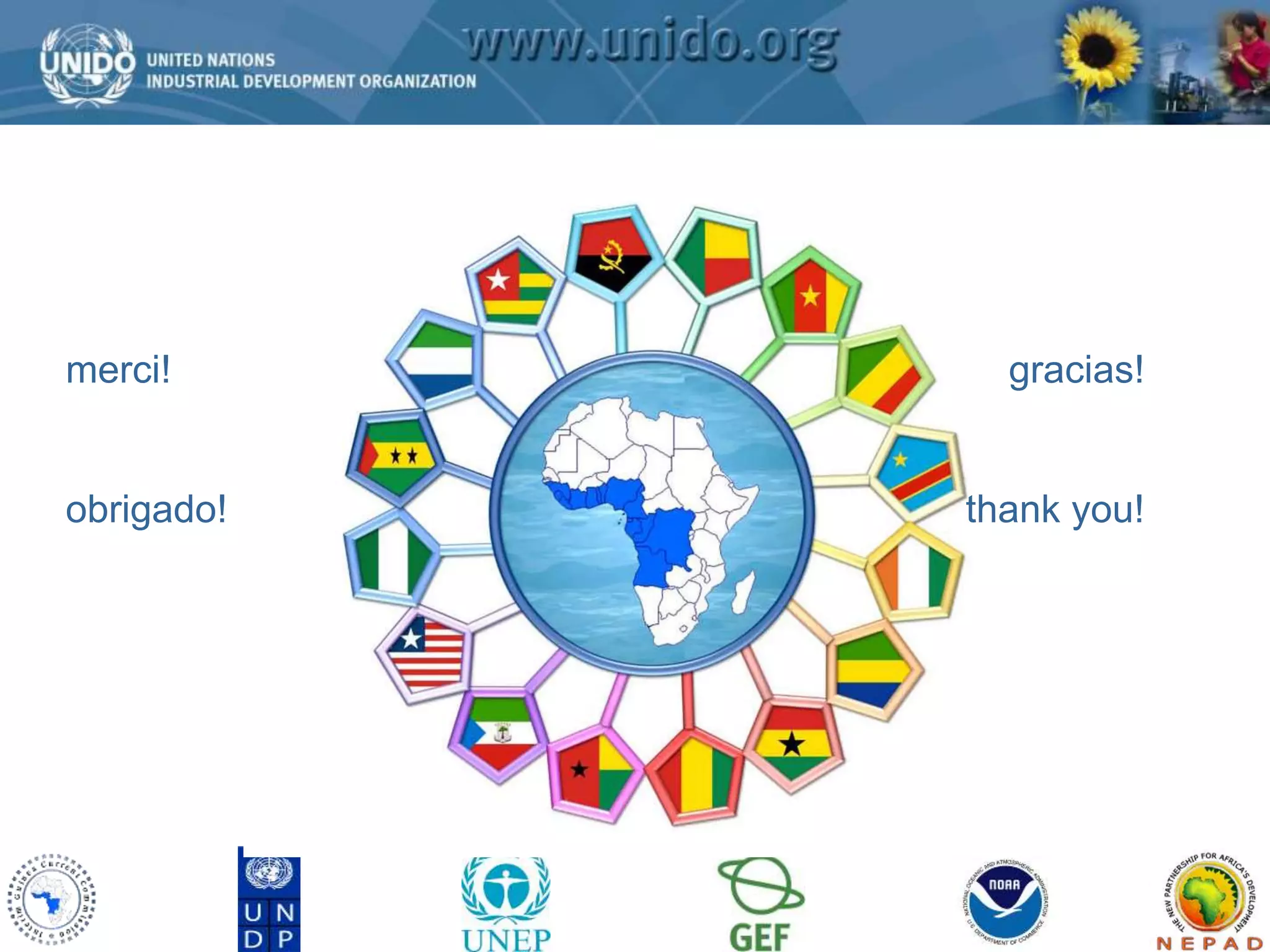
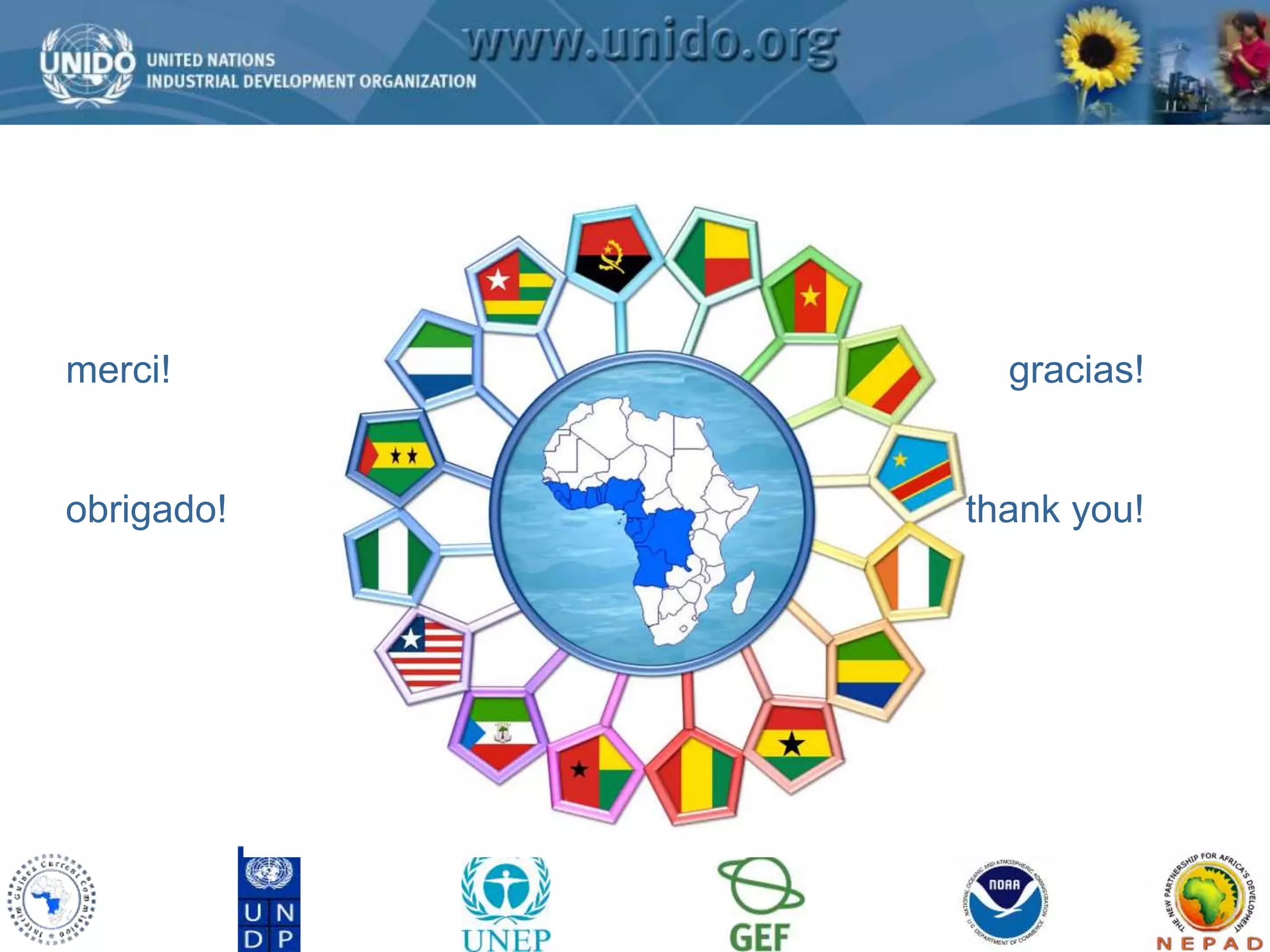
merci! gracias! 
obrigado! thank you!
GCLME Project 
C. Assessment of Project Performance 
and Achievement of Targets for the 
period June 
2010 to May 2011
1- Recover Depleted Fish Stocks 
GCLME Project 
For the period June 2010 to May 2011, the following activities were 
successfully undertaken under this component: 
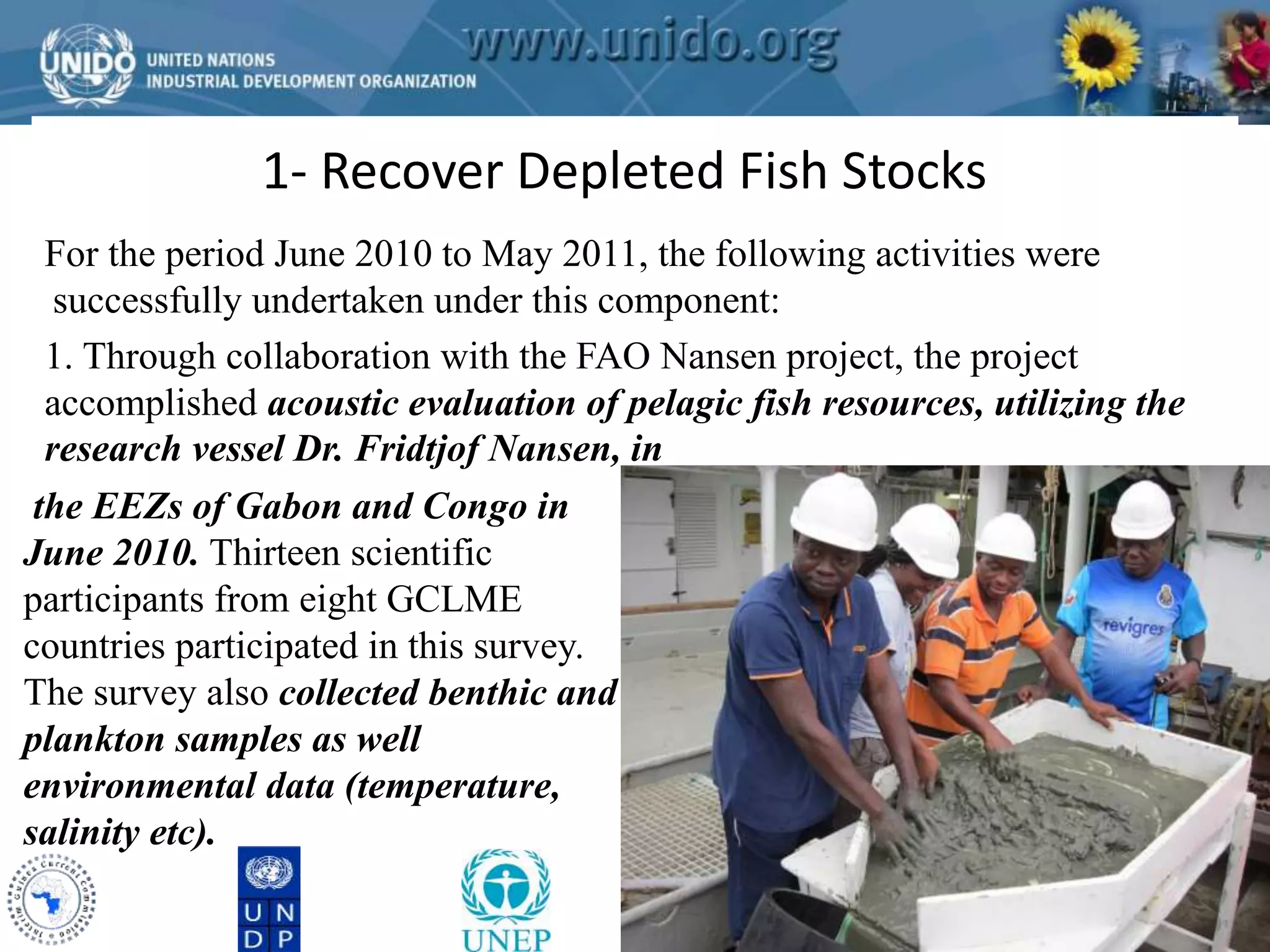
1. Through collaboration with the FAO Nansen project, the project 
accomplished acoustic evaluation of pelagic fish resources, utilizing the 
research vessel Dr. Fridtjof Nansen, in 
the EEZs of Gabon and Congo in 
June 2010. Thirteen scientific 
participants from eight GCLME 
countries participated in this survey. 
The survey also collected benthic and 
plankton samples as well 
environmental data (temperature, 
salinity etc).
GCLME Project 
Stomach Content Analysis 
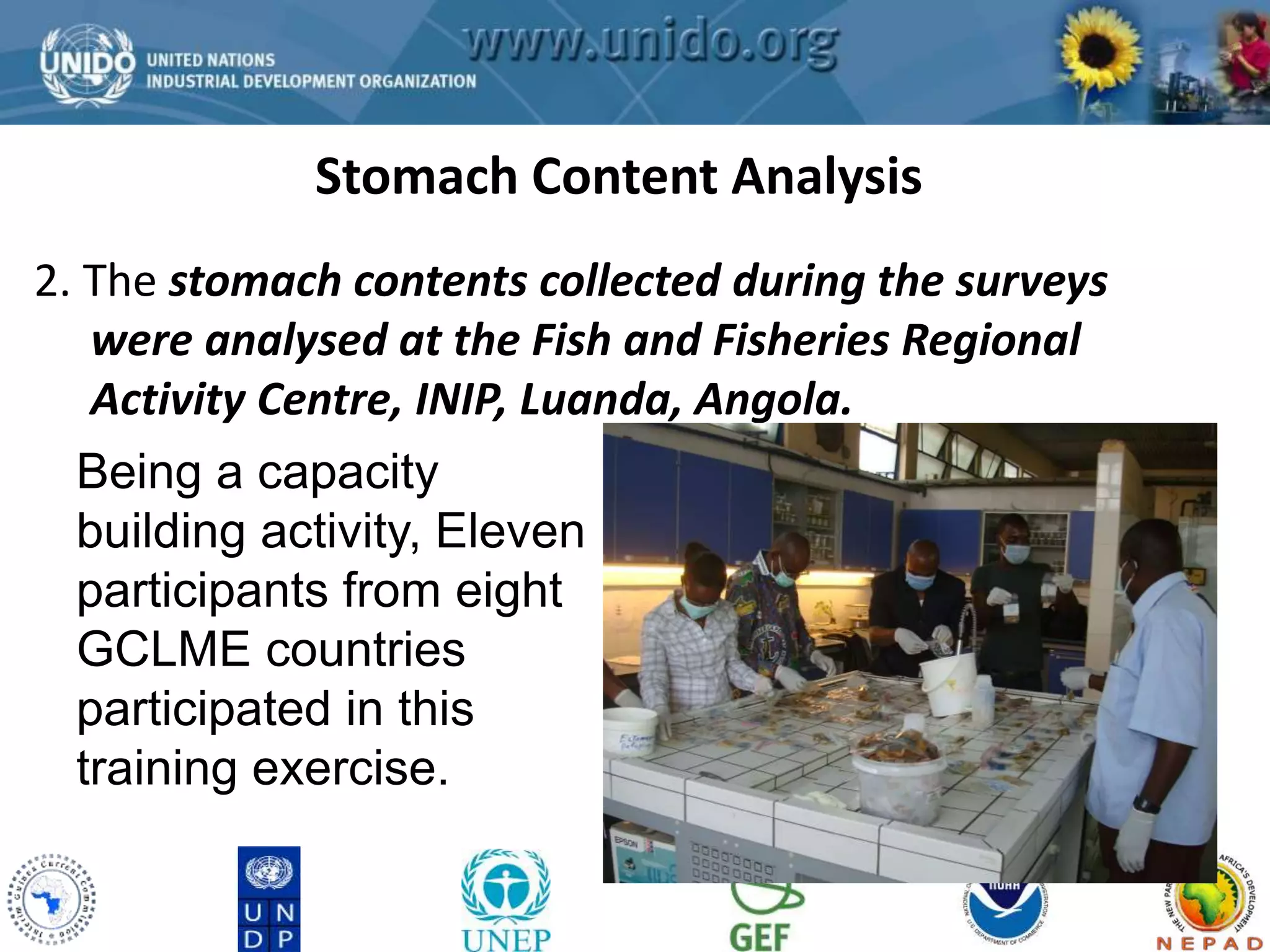
2. The stomach contents collected during the surveys 
were analysed at the Fish and Fisheries Regional 
Activity Centre, INIP, Luanda, Angola. 
Being a capacity 
building activity, Eleven 
participants from eight 
GCLME countries 
participated in this 
training exercise.
Productivity Assessment 
GCLME Project 
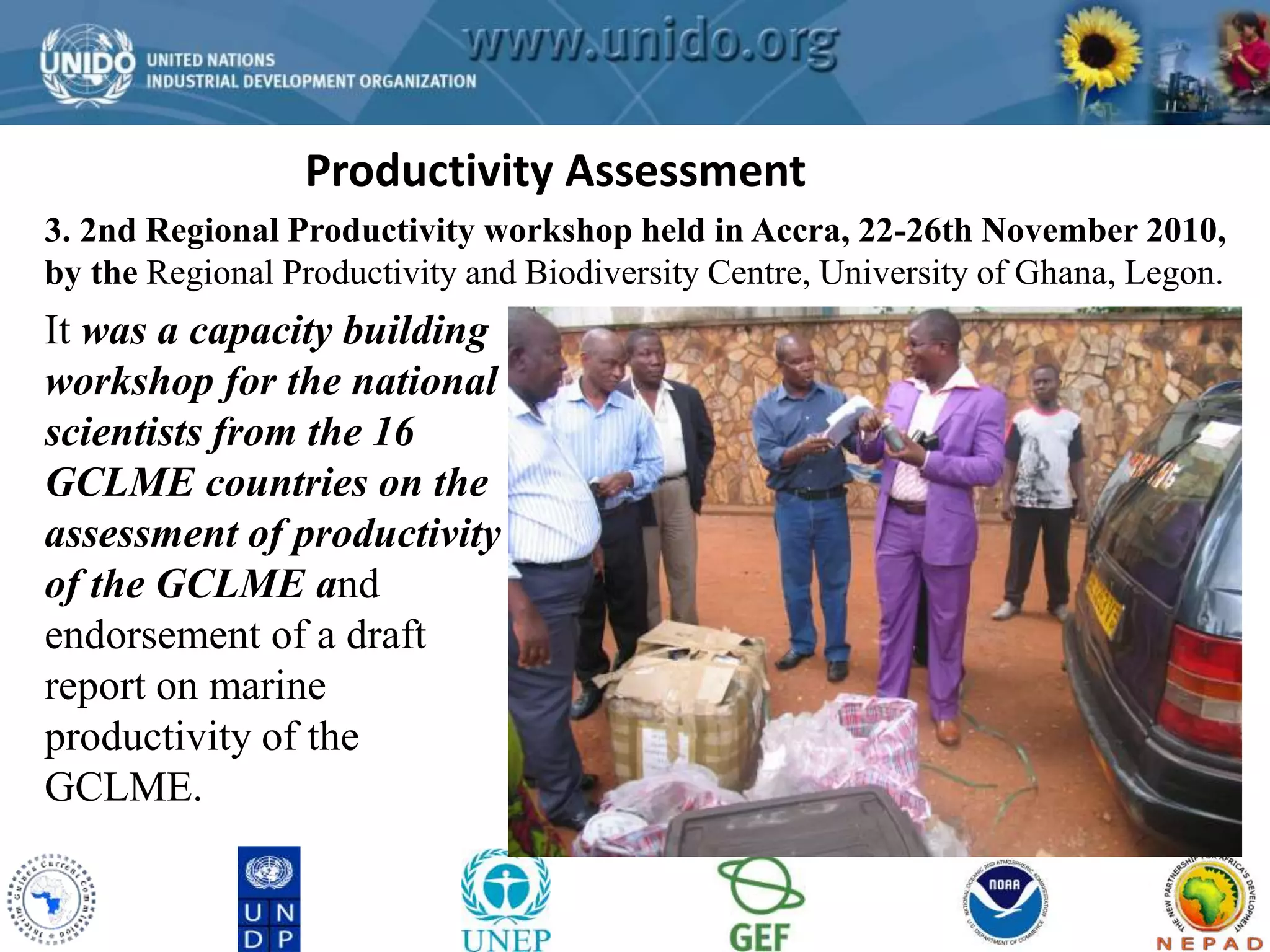
3. 2nd Regional Productivity workshop held in Accra, 22-26th November 2010, 
by the Regional Productivity and Biodiversity Centre, University of Ghana, Legon. 
It was a capacity building 
workshop for the national 
scientists from the 16 
GCLME countries on the 
assessment of productivity 
of the GCLME and 
endorsement of a draft 
report on marine 
productivity of the 
GCLME.
GCLME Project 
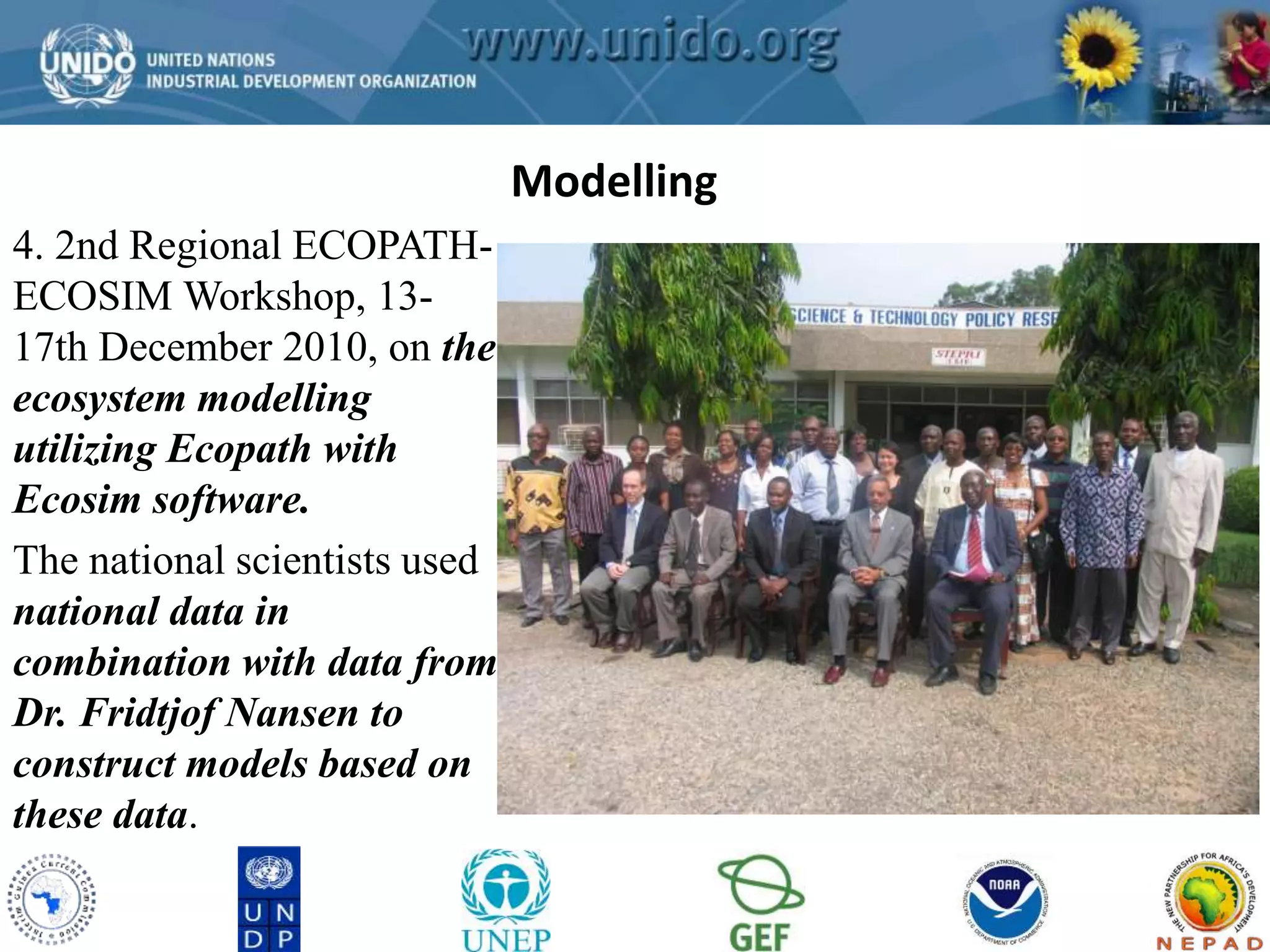
4. 2nd Regional ECOPATH-ECOSIM 
Workshop, 13- 
17th December 2010, on the 
ecosystem modelling 
utilizing Ecopath with 
Ecosim software. 
The national scientists used 
national data in 
combination with data from 
Dr. Fridtjof Nansen to 
construct models based on 
these data. 
Modelling
GCLME Project 
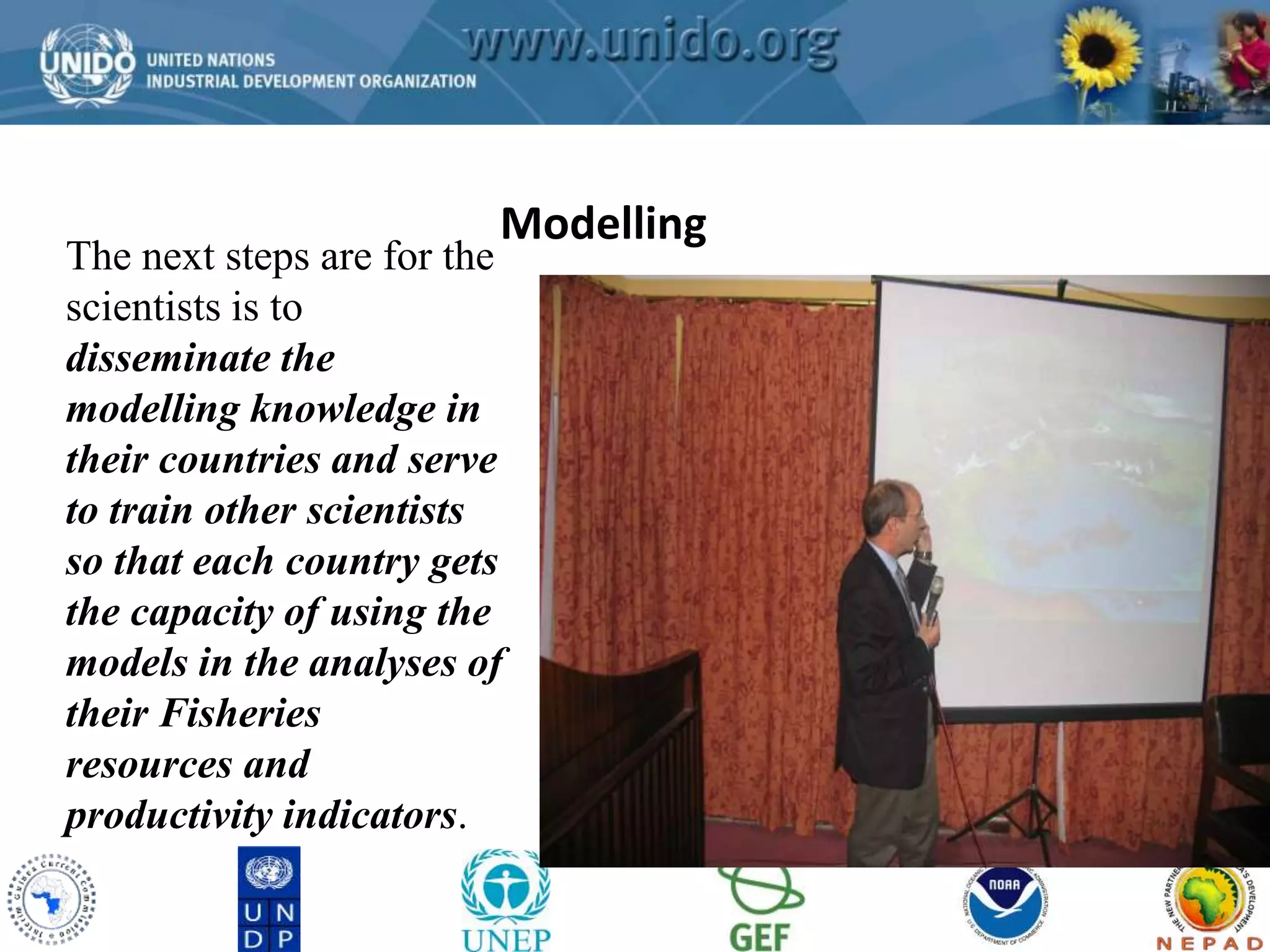
Modelling 
The next steps are for the 
scientists is to 
disseminate the 
modelling knowledge in 
their countries and serve 
to train other scientists 
so that each country gets 
the capacity of using the 
models in the analyses of 
their Fisheries 
resources and 
productivity indicators.
Mariculture 
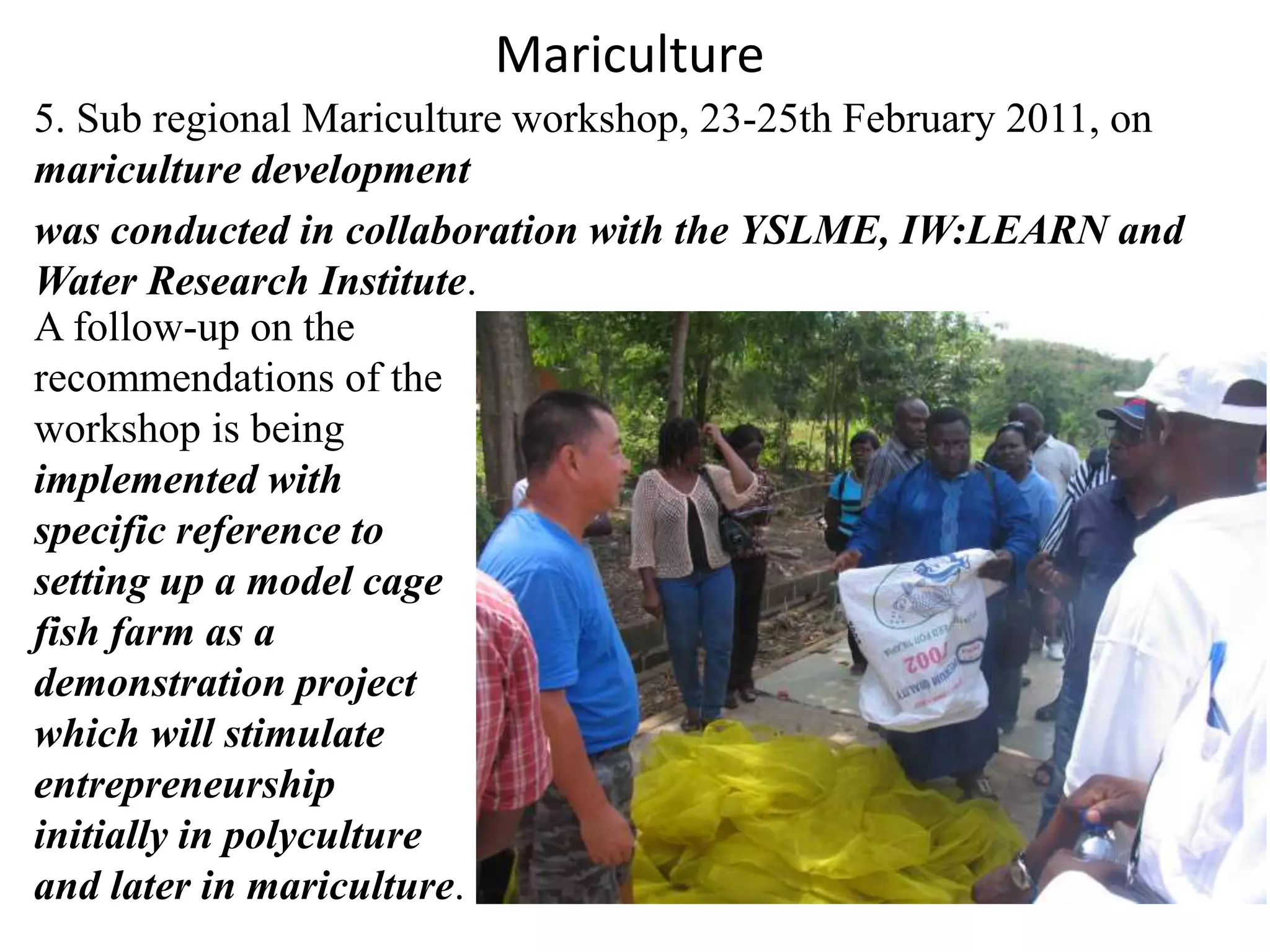
5. Sub regional Mariculture workshop, 23-25th February 2011, on 
mariculture development 
was conducted in collaboration with the YSLME, IW:LEARN and 
Water Research Institute. 
A follow-up on the 
recommendations of the 
workshop is being 
implemented with 
specific reference to 
setting up a model cage 
fish farm as a 
demonstration project 
which will stimulate 
entrepreneurship 
initially in polyculture 
and later in mariculture.
GCLME Project 
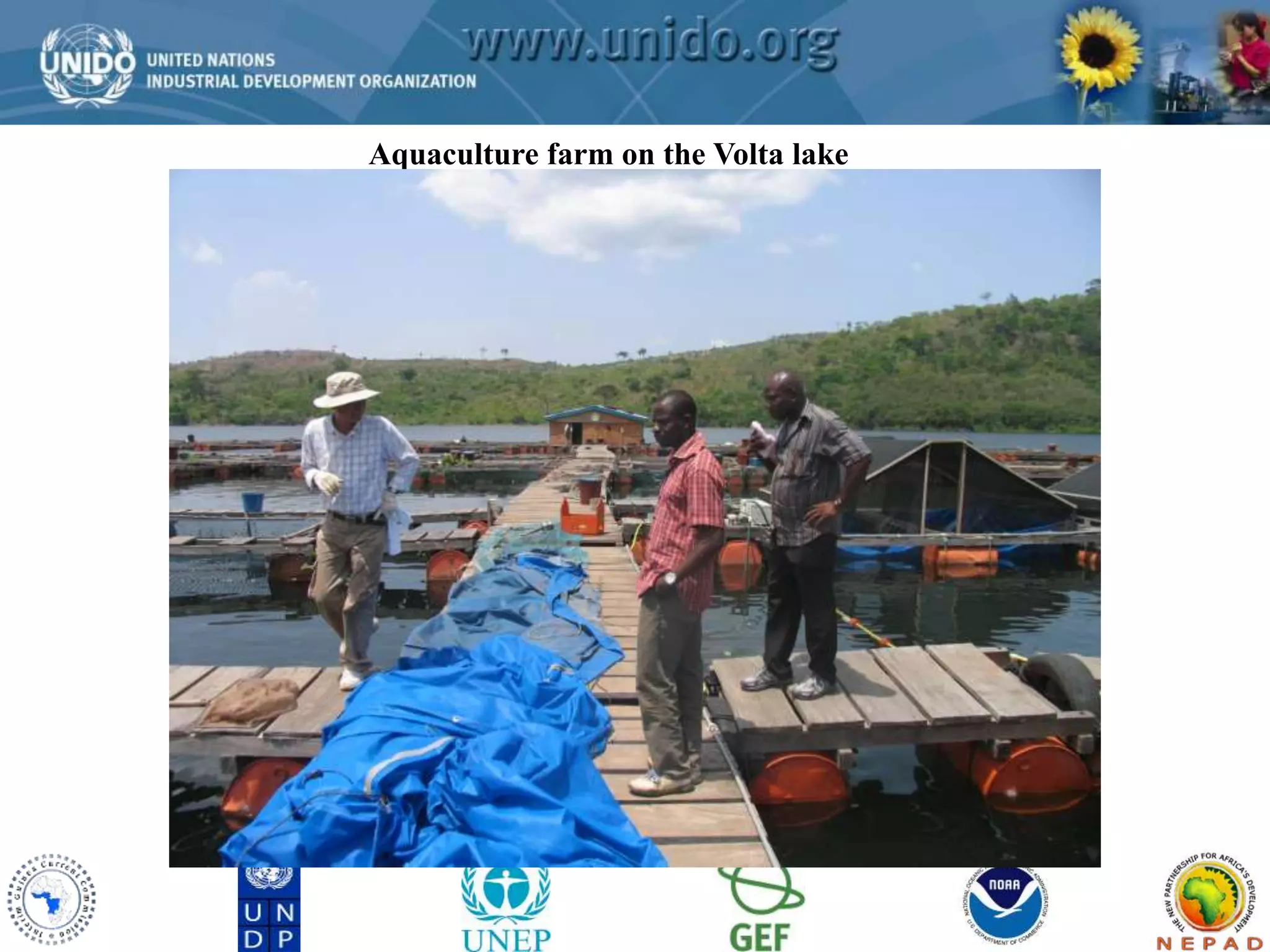
Aquaculture farm on the Volta lake
GCLME Project 2- Restore degraded habitats 
For the period June 2010 to May 2011, the following activities were 
successfully undertaken under this component: 
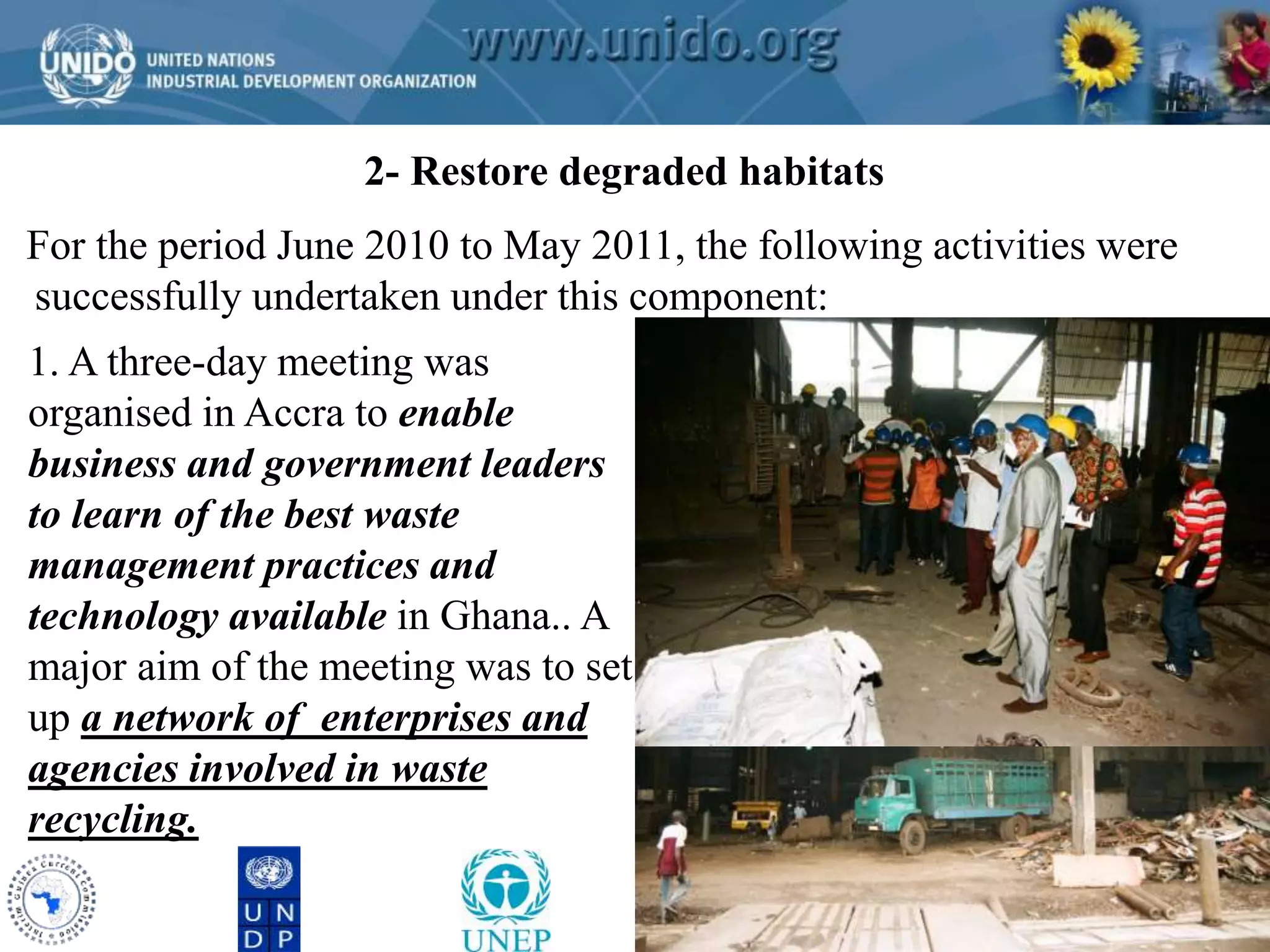
1. A three-day meeting was 
organised in Accra to enable 
business and government leaders 
to learn of the best waste 
management practices and 
technology available in Ghana.. A 
major aim of the meeting was to set 
up a network of enterprises and 
agencies involved in waste 
recycling.
Demonstration Projects 
GCLME Project 
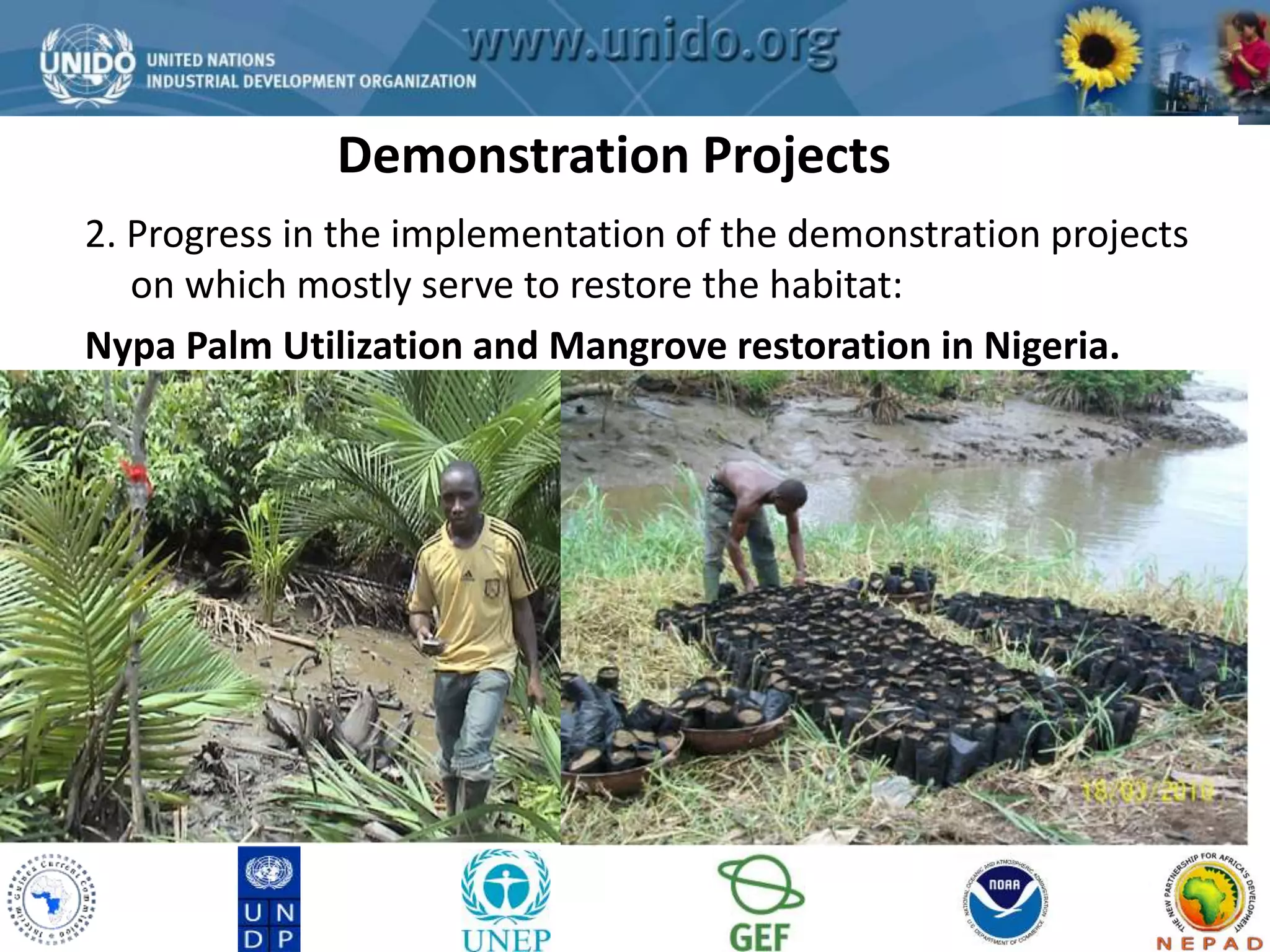
2. Progress in the implementation of the demonstration projects 
on which mostly serve to restore the habitat: 
Nypa Palm Utilization and Mangrove restoration in Nigeria.
Demonstration Projects 
GCLME Project 
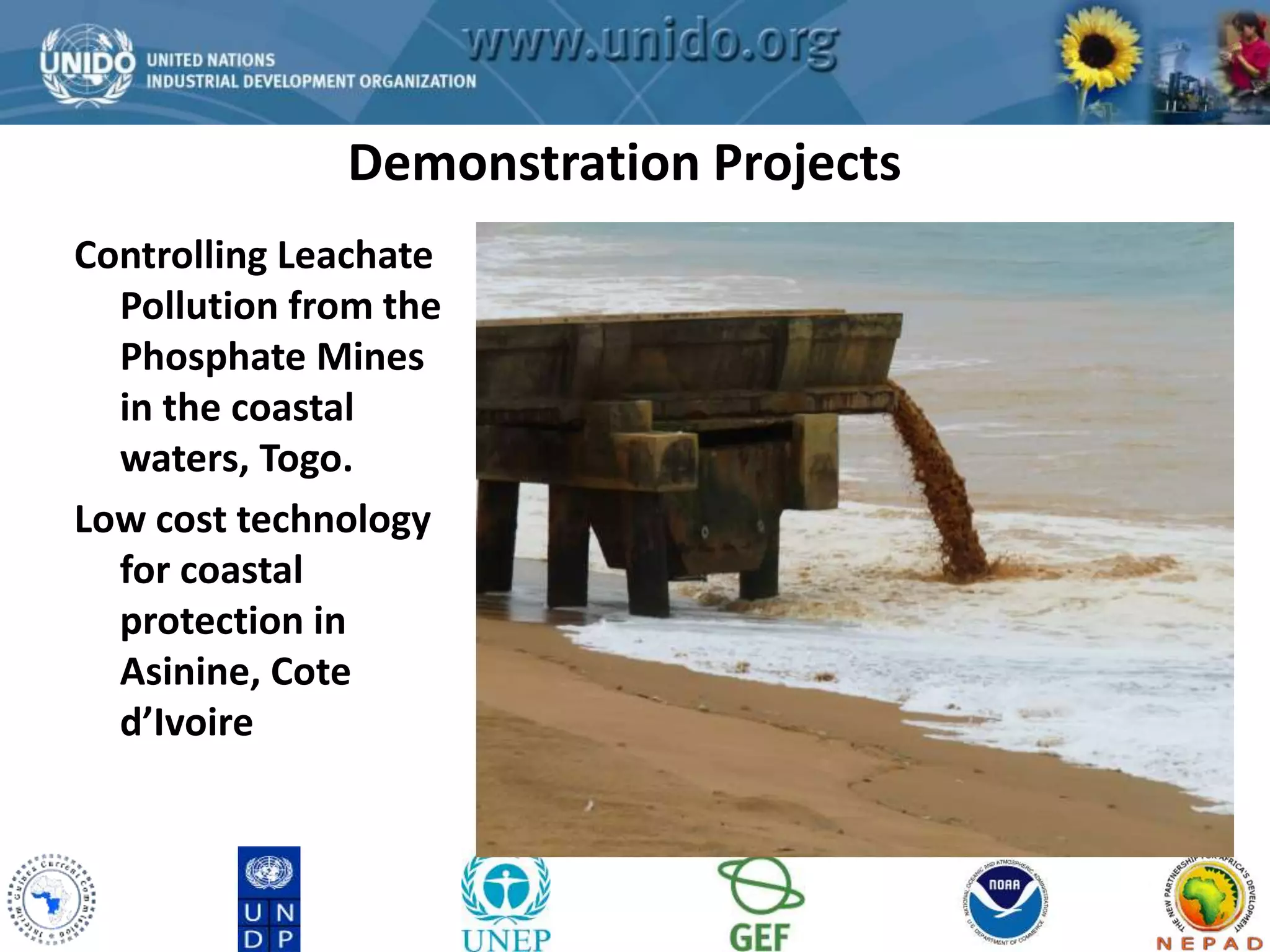
Controlling Leachate 
Pollution from the 
Phosphate Mines 
in the coastal 
waters, Togo. 
Low cost technology 
for coastal 
protection in 
Asinine, Cote 
d’Ivoire
Demonstration Projects 
GCLME Project 
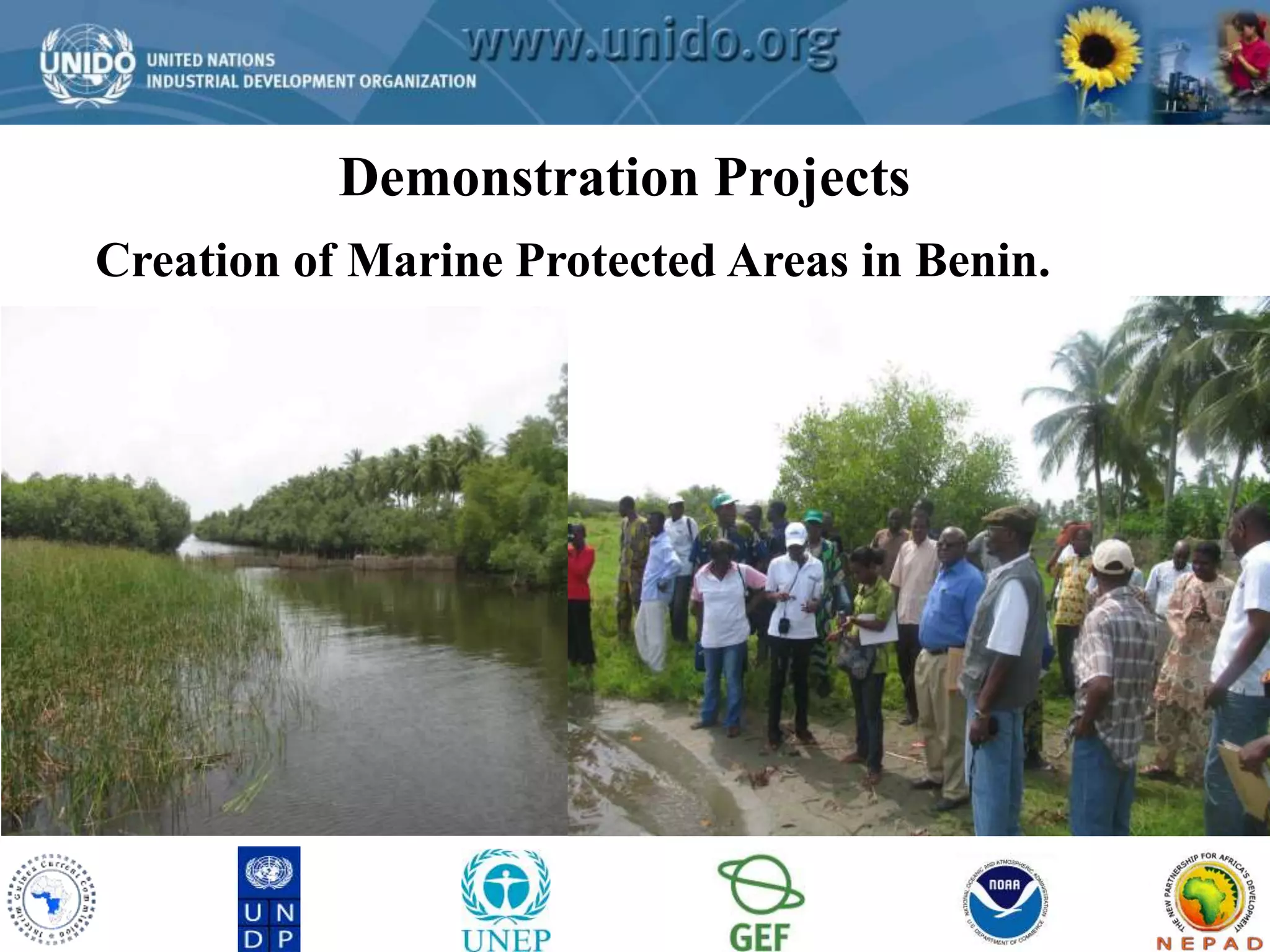
Creation of Marine Protected Areas in Benin.
GCLME Project 
Demonstration Projects 
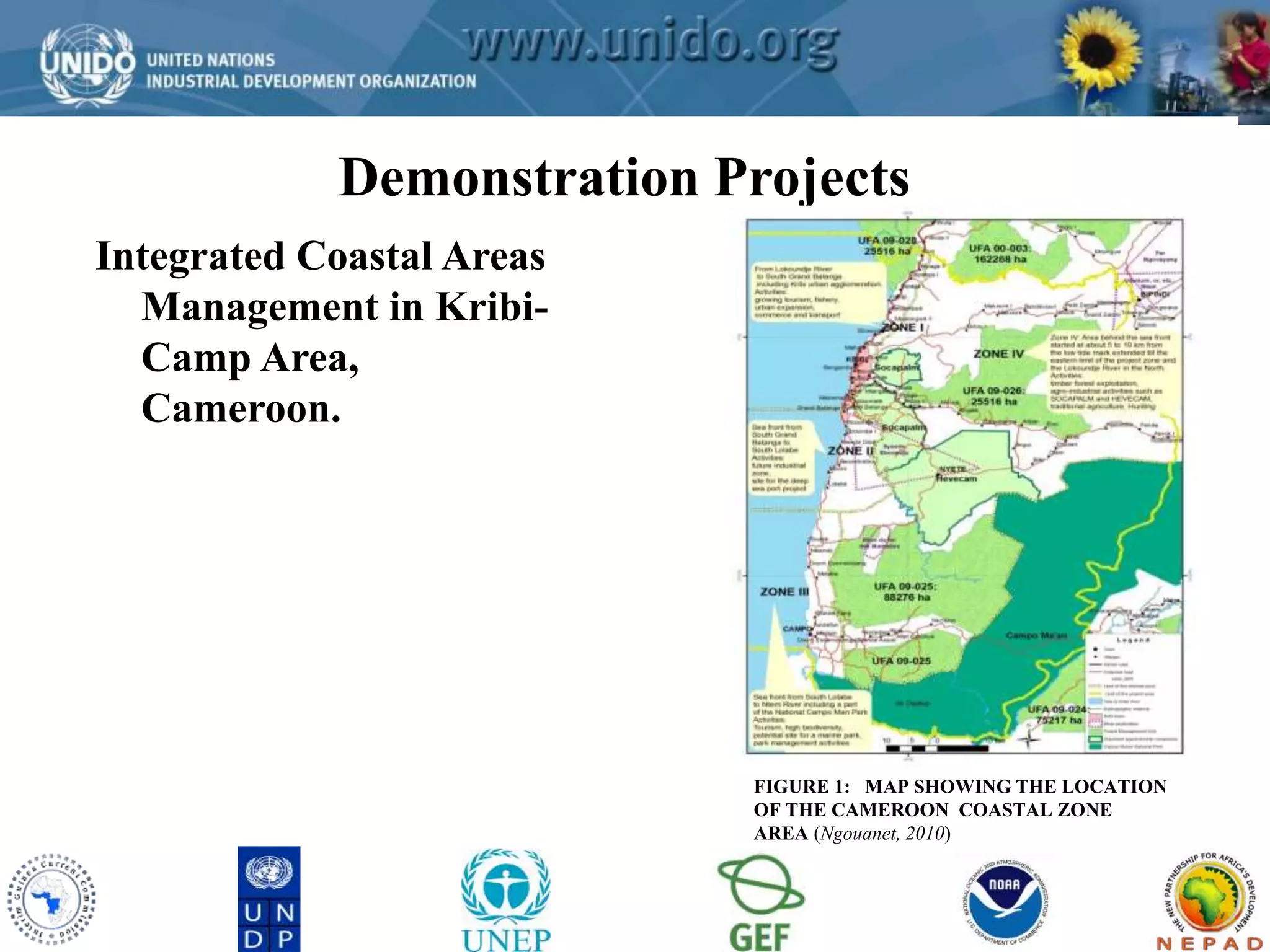
Integrated Coastal Areas 
Management in Kribi- 
Camp Area, 
Cameroon. 
FIGURE 1: MAP SHOWING THE LOCATION 
OF THE CAMEROON COASTAL ZONE 
AREA (Ngouanet, 2010)
3 - Reduce land and ship-based pollution 
GCLME Project 
For the period June 2010 to May 2011, the following activities were 
successfully undertaken 
under this component: 
1. The Emergency Protocol of the Abidjan Convention which was 
developed with part funding by the IGCC/GCLME Project in a Letter 
of Agreement with IMO. UNEP also contributed financially to the 
legal review by National Legal Experts from IGCC/GCLME, BCC and 
CCLME countries at in 2008 in Yaounde and also a Pre-COP Workshop 
of the Abidjan COP 9. The Emergency Protocol was subsequently 
adopted by COP 9.
GCLME Project 
Oil Spill Contingency 
2. The deterioration of the coastal and marine 
environment is caused and/or exacerbated 
by pollutants from shipping related, as well as land 
based activities. Under the IGCC/GCLME project, 
collaboration with IMO and IPIECA has resulted in a 
regional oil/chemical spill contingency plan that 
was updated/ refined through consultations and 
discussed by all countries during the Abidjan 
Convention COP9.
Ship Ballast Water Management 
GCLME Project 
3. The IGCC in collaboration with the GloBallast 
Partnerships Project Coordination Unit of IMO conducted 
a three day (15-17 June 2010) workshop with 2 days on a 
training on the legal implementation of the Ballast Water 
Management Convention and a half-day with particular 
focus on the legal aspects of the BWM Convention, to 
provide an input to the Regional Strategic Action Plan on 
BWM adopted by the Regional Task Force in Abidjan, July 
2009.
Oil Spill Response 
GCLME Project 
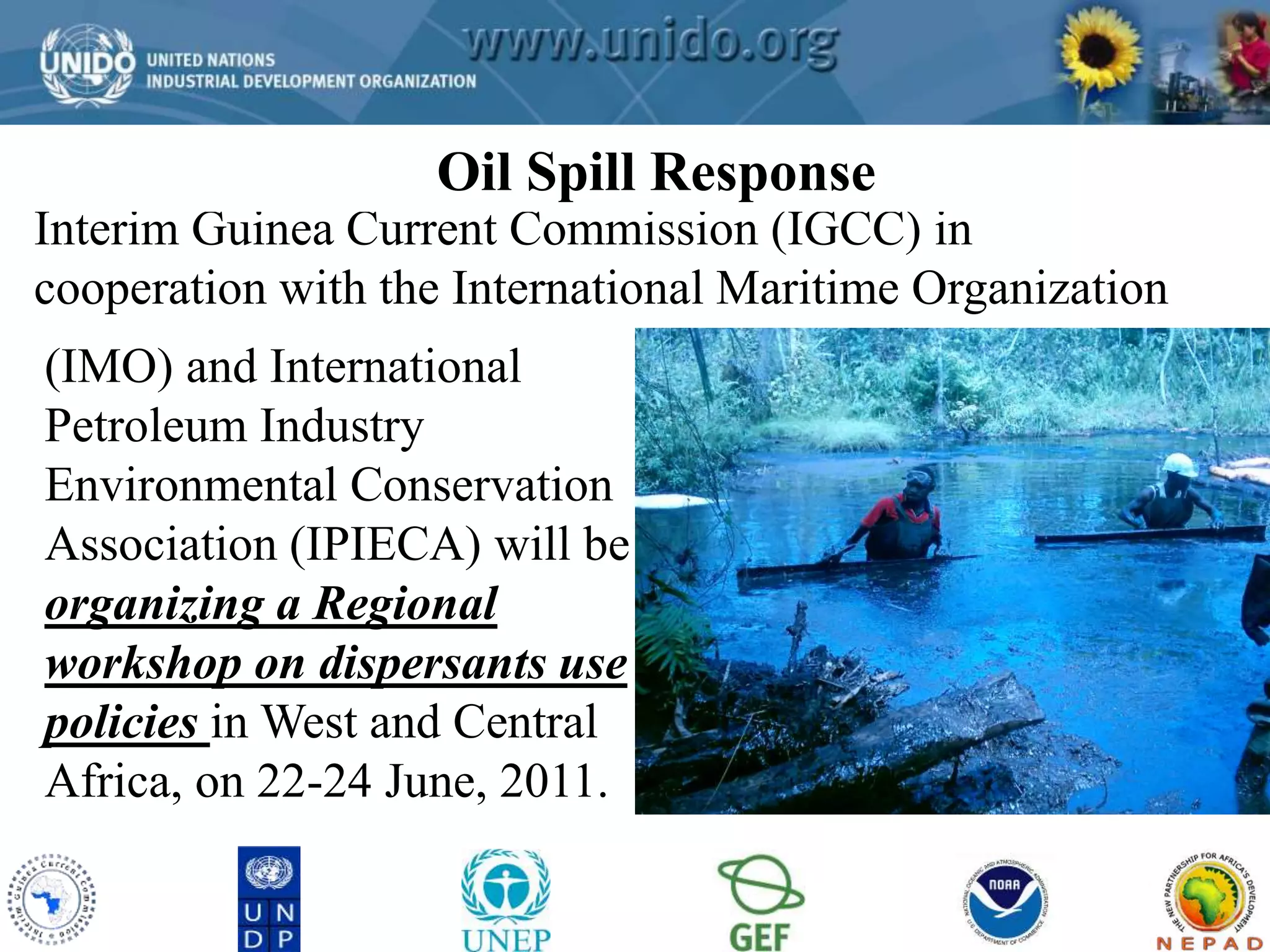
Interim Guinea Current Commission (IGCC) in 
cooperation with the International Maritime Organization 
(IMO) and International 
Petroleum Industry 
Environmental Conservation 
Association (IPIECA) will be 
organizing a Regional 
workshop on dispersants use 
policies in West and Central 
Africa, on 22-24 June, 2011.
4 - Create an ecosystem wide assessment and 
management framework for environmental 
GCLME Project 
and living resource management 
For the period June 2010 to May 2011, the following 
activities were successfully undertaken 
under this component: 
1. Monitoring the implementation of fisheries plans for 
shrimps and demersal resources are ongoing following the 
framework developed at the IGCC Workshop on Fisheries 
Management Planning in Douala, Cameroon in 2009.
GCLME Project 
Mapping 
2. GIS mapping on breeding and nursery grounds 
of important fish species in the Gulf of Guinea 
was initiated under a sub contract with the 
IGCC/GCLME Environmental Information 
Management RAC at the University of Lagos in 
Nigeria.
Surveys 
GCLME Project 
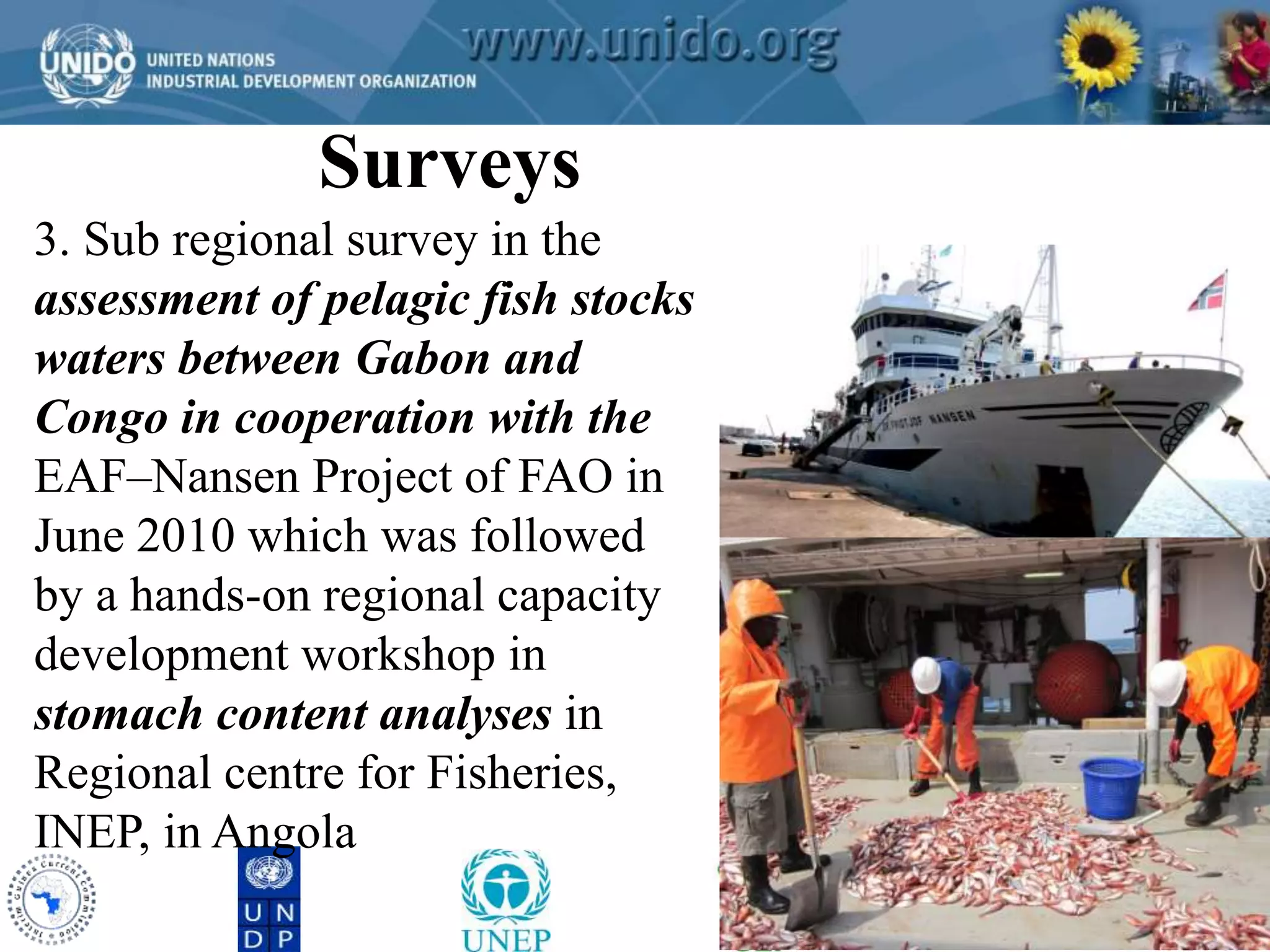
3. Sub regional survey in the 
assessment of pelagic fish stocks 
waters between Gabon and 
Congo in cooperation with the 
EAF–Nansen Project of FAO in 
June 2010 which was followed 
by a hands-on regional capacity 
development workshop in 
stomach content analyses in 
Regional centre for Fisheries, 
INEP, in Angola
GCLME Project 
Surveys 
4. Workshops and surveys on estimating/ 
quantifying economic benefits of environmental 
and social services provided by healthy 
ecosystems in the GCLME were conducted in 
2010. Initial estimates of value of ecosystems 
goods and services is between 13-17 billion US 
dollars.
Workshops and Meetings 
GCLME Project 
5. Overall the Project organized 48 
Workshops/Meetings (30 at National level and 18 
at regional Level) since the 7th Steering 
Committee meeting in June 2010. Main focus on 
National Workshops was on the development and 
validation of National Action Plans (NAPs) and 
dissemination of results of the Demo projects 
which were complete.
Conclusions 
GCLME Project 
Overall the IGCC/GCLME Project has made great 
strides in implementing the project activities planned 
and has made up for the one year suspension of 
activities in 2008. 
A “No cost extension” has been approved by 8th SCM 
for the SAP Development Phase to enable, among 
others, consultations to be completed on the 
establishment of An independent, permanent Guinea 
Current Commission
GCLME Project 
merci! gracias! 
obrigado! thank you!

IGCC/GCLME Achievements, Best Practices and Challenges

  • 1.
    IGCC/GCLME Project Statusreport IW-LEARN AFRICA CONFERENCE Grahamstown, South Africa By Stephen Maxwell Donkor, Executive Secretary/Regional Coordinator Interim Guinea Current Commission
  • 2.
    A. Main ProjectObjectives GCLME Project The overall development goals of this project are to: Recover depleted fish stocks, • Restore degraded habitats, •Reduce land and ship-based pollution, •Create an ecosystem-wide assessment and management framework for sustainable use of living and non-living resources in the GCLME, •Establish viable regional consultative and coordination mechanisms for joint actions in transboundary management of the GCLME including a Guinea Current Commission
  • 3.
    GCLME Project COMPONENTS 1. Recovery of depleted fisheries 2. Restore degraded habitats 3. Reduce land and ship-based pollution 4. Create an ecosystem wide assessment and management framework for environmental and living resource management 5. Establish viable regional consultative and coordination mechanisms for transboundary management of the GCLME including a Guinea Current Commission
  • 4.
    GCLME Project KeyMilestones The IGCC/GCLME Project has made real progress and successfully completed many of the activities set out at inception in 2005 : • The Transboundary Diagnostic Analysis (TDA). • Strategic Action Programme (SAP), and the associated National Programmes of Action (NPA) as well as National Action Plans (NAP) have been prepared, • Interim IGCC Secretariat and Inter-Ministerial Committees established at the regional and national levels respectively • Transition to permanent Guinea Current Commission has began. • Partial implementation of the SAP (demonstration projects, etc). • SAP Implementation Project under preparation
  • 5.
    GCLME Project B.Project Strategy The IGCC/GCLME Strategy has been to develop and apply an effective regional approach to: Create improved legal/management frameworks and institutional structures to address priority regional issues, including a Guinea Current Commission, a Regional Fisheries Platform, and other regional and national bodies such as the Inter-ministerial Committees (IMC) for conducting effective national and regional interventions for rational fisheries utilization, biodiversity conservation, pollution prevention and coastal erosion defence.
  • 6.
    Project strategy (cont’d) GCLME Project Develop nationally endorsed Strategic Action Program (SAP)and National Action Plans (NAPs) with accompanying sustainable financing plans to lead the way towards continued incremental improvement to environmental state of the GCLME, based on a solid foundation of regional commitment and consensus.
  • 7.
    GCLME Project KeyOutcome Establish viable regional consultative and coordination mechanisms for transboundary management of the GCLME including a Guinea Current Commission The IGCC Ministers in their 2nd statutory meeting on 2nd July 2010 decided to establish a permanent Guinea Current Commission in line with their decision under the Abuja Declaration in 2006.
  • 8.
    Steps towards permanentGuinea Current GCLME Project Commission 1. Draft documents required for the establishment Guinea Current Commission were prepared at the request of the 6th SCM. 2. A related Inter-Agency process to propose options for the establishment of the permanent Guinea Current Commission completed. 3. Development of MOUs with FAO (signed), FCWC and COREP completed.
  • 9.
    Steps towards permanentGuinea Current GCLME Project Commission 4. National Action Plans: the 16 countries in the GCLME project have prepared their Action Plans, which include proposed policy and legal reforms, investment needed and economic instruments 5. A portfolio of selected National Priority projects was established by the IMCs for future country-level negotiations between sovereign states and development partners. 6. Partnership Conference was organized in Douala, Cameroon.
  • 10.
    LESSONS LEARNT GCLMEProject 1. The LME Concept is accepted as an integrative Frame work by all 16 IGCC countries. 2. The NAPs and IMCs are best means of cohesive national level management of Coast and Marine resources. 3. Member states will provide funding resources when can get direct benefits from projects ( 500 million US$ Co-financing for SAP implementation.)
  • 11.
    Priorities for IW-LEARN GCLME Project 1. Support for IGCC in setting up Guinea Current Information Clearing House including sustenance of GCLME Website. 2. Training modules for strengthening IMC at Country level. 3. Twinning with Knowledge Centres of specific technical issues such as Remote Sensing and GIS. 4. Twinning with RBOs (Niger, Congo, Volta, Mano, etc) 5. Need to establish linkages with Africa Policy processes such as AMCOW and UN Water/Africa.
  • 12.
    GCLME Project merci!gracias! obrigado! thank you!
  • 13.
    GCLME Project C.Assessment of Project Performance and Achievement of Targets for the period June 2010 to May 2011
  • 14.
    1- Recover DepletedFish Stocks GCLME Project For the period June 2010 to May 2011, the following activities were successfully undertaken under this component: 1. Through collaboration with the FAO Nansen project, the project accomplished acoustic evaluation of pelagic fish resources, utilizing the research vessel Dr. Fridtjof Nansen, in the EEZs of Gabon and Congo in June 2010. Thirteen scientific participants from eight GCLME countries participated in this survey. The survey also collected benthic and plankton samples as well environmental data (temperature, salinity etc).
  • 15.
    GCLME Project StomachContent Analysis 2. The stomach contents collected during the surveys were analysed at the Fish and Fisheries Regional Activity Centre, INIP, Luanda, Angola. Being a capacity building activity, Eleven participants from eight GCLME countries participated in this training exercise.
  • 16.
    Productivity Assessment GCLMEProject 3. 2nd Regional Productivity workshop held in Accra, 22-26th November 2010, by the Regional Productivity and Biodiversity Centre, University of Ghana, Legon. It was a capacity building workshop for the national scientists from the 16 GCLME countries on the assessment of productivity of the GCLME and endorsement of a draft report on marine productivity of the GCLME.
  • 17.
    GCLME Project 4.2nd Regional ECOPATH-ECOSIM Workshop, 13- 17th December 2010, on the ecosystem modelling utilizing Ecopath with Ecosim software. The national scientists used national data in combination with data from Dr. Fridtjof Nansen to construct models based on these data. Modelling
  • 18.
    GCLME Project Modelling The next steps are for the scientists is to disseminate the modelling knowledge in their countries and serve to train other scientists so that each country gets the capacity of using the models in the analyses of their Fisheries resources and productivity indicators.
  • 19.
    Mariculture 5. Subregional Mariculture workshop, 23-25th February 2011, on mariculture development was conducted in collaboration with the YSLME, IW:LEARN and Water Research Institute. A follow-up on the recommendations of the workshop is being implemented with specific reference to setting up a model cage fish farm as a demonstration project which will stimulate entrepreneurship initially in polyculture and later in mariculture.
  • 20.
    GCLME Project Aquaculturefarm on the Volta lake
  • 21.
    GCLME Project 2-Restore degraded habitats For the period June 2010 to May 2011, the following activities were successfully undertaken under this component: 1. A three-day meeting was organised in Accra to enable business and government leaders to learn of the best waste management practices and technology available in Ghana.. A major aim of the meeting was to set up a network of enterprises and agencies involved in waste recycling.
  • 22.
    Demonstration Projects GCLMEProject 2. Progress in the implementation of the demonstration projects on which mostly serve to restore the habitat: Nypa Palm Utilization and Mangrove restoration in Nigeria.
  • 23.
    Demonstration Projects GCLMEProject Controlling Leachate Pollution from the Phosphate Mines in the coastal waters, Togo. Low cost technology for coastal protection in Asinine, Cote d’Ivoire
  • 24.
    Demonstration Projects GCLMEProject Creation of Marine Protected Areas in Benin.
  • 25.
    GCLME Project DemonstrationProjects Integrated Coastal Areas Management in Kribi- Camp Area, Cameroon. FIGURE 1: MAP SHOWING THE LOCATION OF THE CAMEROON COASTAL ZONE AREA (Ngouanet, 2010)
  • 26.
    3 - Reduceland and ship-based pollution GCLME Project For the period June 2010 to May 2011, the following activities were successfully undertaken under this component: 1. The Emergency Protocol of the Abidjan Convention which was developed with part funding by the IGCC/GCLME Project in a Letter of Agreement with IMO. UNEP also contributed financially to the legal review by National Legal Experts from IGCC/GCLME, BCC and CCLME countries at in 2008 in Yaounde and also a Pre-COP Workshop of the Abidjan COP 9. The Emergency Protocol was subsequently adopted by COP 9.
  • 27.
    GCLME Project OilSpill Contingency 2. The deterioration of the coastal and marine environment is caused and/or exacerbated by pollutants from shipping related, as well as land based activities. Under the IGCC/GCLME project, collaboration with IMO and IPIECA has resulted in a regional oil/chemical spill contingency plan that was updated/ refined through consultations and discussed by all countries during the Abidjan Convention COP9.
  • 28.
    Ship Ballast WaterManagement GCLME Project 3. The IGCC in collaboration with the GloBallast Partnerships Project Coordination Unit of IMO conducted a three day (15-17 June 2010) workshop with 2 days on a training on the legal implementation of the Ballast Water Management Convention and a half-day with particular focus on the legal aspects of the BWM Convention, to provide an input to the Regional Strategic Action Plan on BWM adopted by the Regional Task Force in Abidjan, July 2009.
  • 29.
    Oil Spill Response GCLME Project Interim Guinea Current Commission (IGCC) in cooperation with the International Maritime Organization (IMO) and International Petroleum Industry Environmental Conservation Association (IPIECA) will be organizing a Regional workshop on dispersants use policies in West and Central Africa, on 22-24 June, 2011.
  • 30.
    4 - Createan ecosystem wide assessment and management framework for environmental GCLME Project and living resource management For the period June 2010 to May 2011, the following activities were successfully undertaken under this component: 1. Monitoring the implementation of fisheries plans for shrimps and demersal resources are ongoing following the framework developed at the IGCC Workshop on Fisheries Management Planning in Douala, Cameroon in 2009.
  • 31.
    GCLME Project Mapping 2. GIS mapping on breeding and nursery grounds of important fish species in the Gulf of Guinea was initiated under a sub contract with the IGCC/GCLME Environmental Information Management RAC at the University of Lagos in Nigeria.
  • 32.
    Surveys GCLME Project 3. Sub regional survey in the assessment of pelagic fish stocks waters between Gabon and Congo in cooperation with the EAF–Nansen Project of FAO in June 2010 which was followed by a hands-on regional capacity development workshop in stomach content analyses in Regional centre for Fisheries, INEP, in Angola
  • 33.
    GCLME Project Surveys 4. Workshops and surveys on estimating/ quantifying economic benefits of environmental and social services provided by healthy ecosystems in the GCLME were conducted in 2010. Initial estimates of value of ecosystems goods and services is between 13-17 billion US dollars.
  • 34.
    Workshops and Meetings GCLME Project 5. Overall the Project organized 48 Workshops/Meetings (30 at National level and 18 at regional Level) since the 7th Steering Committee meeting in June 2010. Main focus on National Workshops was on the development and validation of National Action Plans (NAPs) and dissemination of results of the Demo projects which were complete.
  • 35.
    Conclusions GCLME Project Overall the IGCC/GCLME Project has made great strides in implementing the project activities planned and has made up for the one year suspension of activities in 2008. A “No cost extension” has been approved by 8th SCM for the SAP Development Phase to enable, among others, consultations to be completed on the establishment of An independent, permanent Guinea Current Commission
  • 36.
    GCLME Project merci!gracias! obrigado! thank you!