Chemical Equations
Putting chemical changes into
words
A chemical equation is a
symbolic representation of a
chemical reaction.
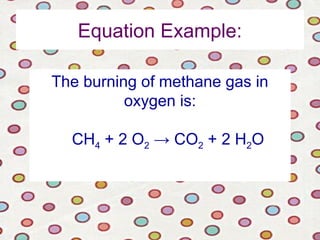
Equation Example:
The burning of methane gas in
oxygen is:
CH4 + 2 O2 → CO2 + 2 H2O
Review:
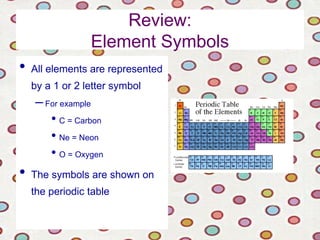
Element Symbols
• All elements are represented
by a 1 or 2 letter symbol
–For example
• C = Carbon
• Ne = Neon
• O = Oxygen
• The symbols are shown on
the periodic table
Review:
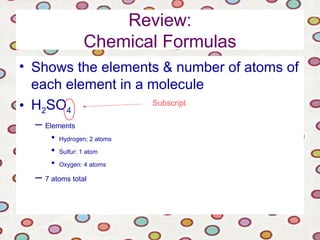
Chemical Formulas
• Shows the elements & number of atoms of
each element in a molecule
• H2SO4
– Elements
• Hydrogen; 2 atoms
• Sulfur: 1 atom
• Oxygen: 4 atoms
– 7 atoms total
Subscript
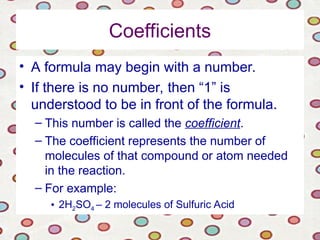
Coefficients
• A formula may begin with a number.
• If there is no number, then “1” is
understood to be in front of the formula.
– This number is called the coefficient.
– The coefficient represents the number of
molecules of that compound or atom needed
in the reaction.
– For example:
• 2H2SO4 – 2 molecules of Sulfuric Acid
Coefficients
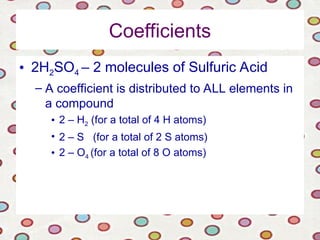
• 2H2SO4 – 2 molecules of Sulfuric Acid
– A coefficient is distributed to ALL elements in
a compound
• 2 – H2 (for a total of 4 H atoms)
• 2 – S (for a total of 2 S atoms)
• 2 – O4 (for a total of 8 O atoms)
Reading Chemical Equations
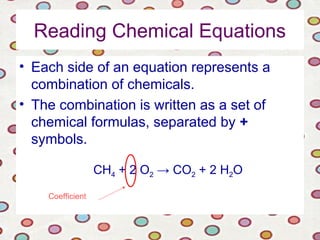
• Each side of an equation represents a
combination of chemicals.
• The combination is written as a set of
chemical formulas, separated by +
symbols.
CH4 + 2 O2 → CO2 + 2 H2O
Coefficient
Reading Chemical Equations
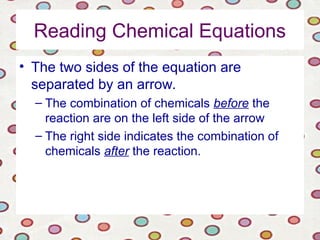
• The two sides of the equation are
separated by an arrow.
– The combination of chemicals before the
reaction are on the left side of the arrow
– The right side indicates the combination of
chemicals after the reaction.
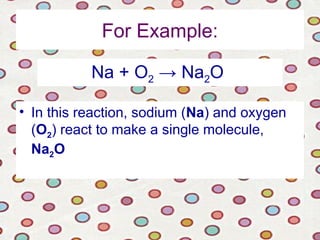
For Example:
• In this reaction, sodium (Na) and oxygen
(O2) react to make a single molecule,
Na2O
Na + O2 → Na2O
Balancing Equations
• The Law of Conservation of Mass states
that in a chemical reaction, the quantity or
amount of each element does not change.
• This means that each side of the equation
must represent the same quantity of each
element; in other words have the same
number of each kind of atom.
Balancing Equations
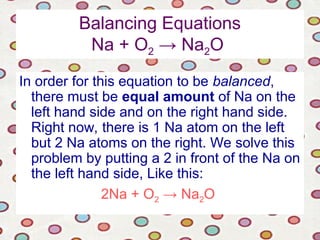
Na + O2 → Na2O
In order for this equation to be balanced,
there must be equal amount of Na on the
left hand side and on the right hand side.
Right now, there is 1 Na atom on the left
but 2 Na atoms on the right. We solve this
problem by putting a 2 in front of the Na on
the left hand side, Like this:
2Na + O2 → Na2O
Balancing Equations
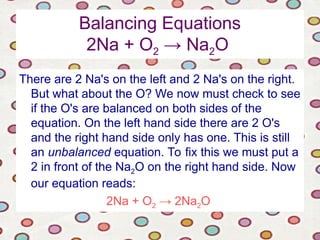
2Na + O2 → Na2O
There are 2 Na's on the left and 2 Na's on the right.
But what about the O? We now must check to see
if the O's are balanced on both sides of the
equation. On the left hand side there are 2 O's
and the right hand side only has one. This is still
an unbalanced equation. To fix this we must put a
2 in front of the Na2O on the right hand side. Now
our equation reads:
2Na + O2 → 2Na2O
Balancing Equations
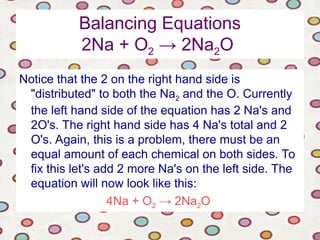
2Na + O2 → 2Na2O
Notice that the 2 on the right hand side is
"distributed" to both the Na2 and the O. Currently
the left hand side of the equation has 2 Na's and
2O's. The right hand side has 4 Na's total and 2
O's. Again, this is a problem, there must be an
equal amount of each chemical on both sides. To
fix this let's add 2 more Na's on the left side. The
equation will now look like this:
4Na + O2 → 2Na2O
Sources
http://en.wikipedia.org/wiki/Chemi
cal_equations

Chemical Equations.ppt SDDSDSVSDSDCSDDCSDCDSC

  • 1.
  • 2.
    A chemical equationis a symbolic representation of a chemical reaction.
  • 3.
    Equation Example: The burningof methane gas in oxygen is: CH4 + 2 O2 → CO2 + 2 H2O
  • 4.
    Review: Element Symbols • Allelements are represented by a 1 or 2 letter symbol –For example • C = Carbon • Ne = Neon • O = Oxygen • The symbols are shown on the periodic table
  • 5.
    Review: Chemical Formulas • Showsthe elements & number of atoms of each element in a molecule • H2SO4 – Elements • Hydrogen; 2 atoms • Sulfur: 1 atom • Oxygen: 4 atoms – 7 atoms total Subscript
  • 6.
    Coefficients • A formulamay begin with a number. • If there is no number, then “1” is understood to be in front of the formula. – This number is called the coefficient. – The coefficient represents the number of molecules of that compound or atom needed in the reaction. – For example: • 2H2SO4 – 2 molecules of Sulfuric Acid
  • 7.
    Coefficients • 2H2SO4 –2 molecules of Sulfuric Acid – A coefficient is distributed to ALL elements in a compound • 2 – H2 (for a total of 4 H atoms) • 2 – S (for a total of 2 S atoms) • 2 – O4 (for a total of 8 O atoms)
  • 8.
    Reading Chemical Equations •Each side of an equation represents a combination of chemicals. • The combination is written as a set of chemical formulas, separated by + symbols. CH4 + 2 O2 → CO2 + 2 H2O Coefficient
  • 9.
    Reading Chemical Equations •The two sides of the equation are separated by an arrow. – The combination of chemicals before the reaction are on the left side of the arrow – The right side indicates the combination of chemicals after the reaction.
  • 10.
    For Example: • Inthis reaction, sodium (Na) and oxygen (O2) react to make a single molecule, Na2O Na + O2 → Na2O
  • 11.
    Balancing Equations • TheLaw of Conservation of Mass states that in a chemical reaction, the quantity or amount of each element does not change. • This means that each side of the equation must represent the same quantity of each element; in other words have the same number of each kind of atom.
  • 12.
    Balancing Equations Na +O2 → Na2O In order for this equation to be balanced, there must be equal amount of Na on the left hand side and on the right hand side. Right now, there is 1 Na atom on the left but 2 Na atoms on the right. We solve this problem by putting a 2 in front of the Na on the left hand side, Like this: 2Na + O2 → Na2O
  • 13.
    Balancing Equations 2Na +O2 → Na2O There are 2 Na's on the left and 2 Na's on the right. But what about the O? We now must check to see if the O's are balanced on both sides of the equation. On the left hand side there are 2 O's and the right hand side only has one. This is still an unbalanced equation. To fix this we must put a 2 in front of the Na2O on the right hand side. Now our equation reads: 2Na + O2 → 2Na2O
  • 14.
    Balancing Equations 2Na +O2 → 2Na2O Notice that the 2 on the right hand side is "distributed" to both the Na2 and the O. Currently the left hand side of the equation has 2 Na's and 2O's. The right hand side has 4 Na's total and 2 O's. Again, this is a problem, there must be an equal amount of each chemical on both sides. To fix this let's add 2 more Na's on the left side. The equation will now look like this: 4Na + O2 → 2Na2O
  • 15.