Function-Oriented Metrics

● Each of these questions is answered using a scale
that ranges from 0 (not important or applicable) to 5
(absolutely essential).
● Once function points have been calculated, they
are used in a manner analogous to LOC as a way
to normalize measures for software productivity,
quality, and other attributes:

● Errors per FP
● Defects per FP
● $ per FP
● Pages of documentation per FP
● FP per person-month

1
Metrics for Software Quality

● The

quality of a system is only as good as the
requirements
that
describe
the
problem
(requirement specification), the design that models
the solution (design models), the code that leads to
an executable program (source code), and the tests
that exercise the software to uncover errors (test
case), and also the project progresses

2
Measuring Quality Indicators
● Useful indicators:
● Correctness.

A program must operate correctly or it
provides little value to its users. Correctness is the
degree to which the software performs its required
function; defects per KLOC counted over a standard
period of time, typically one year.
● Maintainability. Maintainability is the ease with which a
program can be corrected if an error is encountered,
adapted if its environment changes, or enhanced if the
customer desires a change in requirements; a simple
time-oriented metric is mean-time-to change (MTTC), the
time it takes to analyze the change request, design an
appropriate modification, implement the change, test it,
and distribute the change to all users.
3
Measuring Quality Indicators
● Useful indicators:
● Integrity.

This attribute measures a system's ability to
withstand attacks (both accidental and intentional) to its
security. Attacks can be made on all three components
of software: programs, data, and documents.
● To measure integrity, two additional attributes must be
defined: threat and security.

4
Measuring Quality Indicators
● Useful indicators:
● Integrity. The integrity of a system can then be
defined as
integrity = summation [(1 – threat) (1 – security)]
where threat and security are summed over each type
of attack.
Threat is the probability (which can be estimated or
derived from empirical evidence) that an attack of a
specific type will occur within a given time.
Security is the probability (which can be estimated or
derived from empirical evidence) that the attack of a
specific type will be repelled.
5
Measuring Quality Indicators
● Useful indicators:
● Usability.

If a program is not user-friendly, it is often
doomed to failure, even if the functions that it performs
are valuable. Usability is an attempt to quantify userfriendliness;

6
Measuring Quality Indicators
● Useful indicators:
● Usability

can be measured in terms of four
characteristics:
(1) the physical and or intellectual skill required to learn
the system,
(2) the time required to become moderately efficient in
the use of the system,
(3) the net increase in productivity (over the approach
that the system replaces) measured when the system is used
by someone who is moderately efficient,
(4) a subjective assessment (sometimes obtained
through a questionnaire) of users attitudes toward the system.
7
Defect Removal Efficiency
● A quality metric that provides benefit at both the project and
process level is defect removal efficiency (DRE).
● DRE is a measure of the filtering ability of quality assurance
and control activities as they are applied throughout all
process framework activities.
● DRE is defined in the following manner:
DRE = E/(E + D)
where E is the number of errors found before delivery of the
software to the end-user and D is the number of defects
found after delivery.
The ideal value for DRE is 1

8
Content

Part III
Software Project
Planning
9
Software Project Planning
● Software project management begins with a set of activities
that are collectively called project planning.
● Before the project can begin, the manager and the software
team must estimate
● the work to be done,
● the resources that will be required,
● and the time that will elapse from start to finish,

10
Project Planning Objectives
● Software

Scope. Software scope describes the data and
control to be processed, function, performance, constraints,
interfaces, and reliability.
● Obtaining Information of Software Scope
● Who is behind the request for this work?
● Who will use the solution?
● What will be the economic benefit of a successful
solution?
● Is there another source for the solution?, etc.

● Feasibility

● Once scope is understood, the software team and others
must work to determine if it can be done within the
dimensions just noted
11
Project Planning Objectives
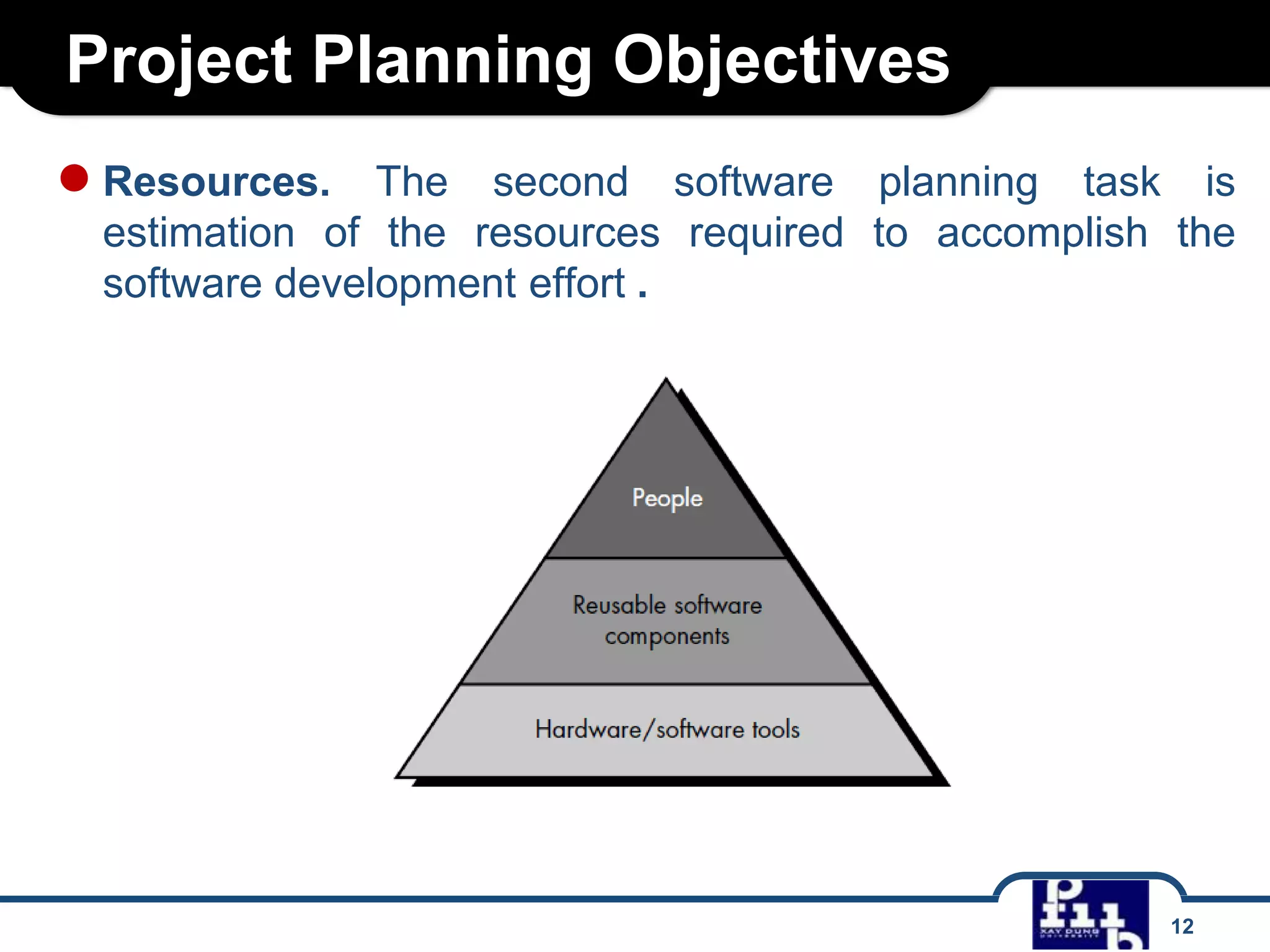
● Resources.

The second software planning task is
estimation of the resources required to accomplish the
software development effort .

12
Project Planning Objectives
● Resources.

Each resource is specified
characteristics:
● description of the resource,
● a statement of availability,
● time when the resource will be required;
● duration of time that resource will be applied

with

four

13
Project Planning Objectives
● Resources.

● Human Resources.
● The planner begins by evaluating scope and selecting
the skills required to complete development. Both
organizational position (e.g., manager, senior software
engineer) and specialty (e.g., telecommunications,
database, client/server) are specified.
● For relatively small projects (one person-year or less),
a single individual may perform all software
engineering tasks, consulting with specialists as
required.
● The number of people required for a software project
is determined only after an estimate of development
effort (person-months) is made.
14
Project Planning Objectives
● Resources.

● Reusable Software Resources. Four software resource
categories:
● Off-the-shelf components. Existing software that can
be acquired from a third party or that has been
developed internally for a past project
● Full-experience
components.
Existing
specifications, designs, code, or test data developed
for past projects that are similar to the software to be
built for the current project. Members of the current
software team have had full experience in the
application area represented by these components.

15
Project Planning Objectives
● Resources.

● Reusable Software Resources. Four software resource
categories (cont.):
● Partial-experience
components.
Existing
specifications, designs, code, or test data developed
for past projects that are related to the software to be
built for the current project but will require substantial
modification. Members of the current software team
have only limited experience in the application area
represented by these components
● New components. Software components that must
be built by the software team specifically for the needs
of the current project.
16
Project Planning Objectives
● Resources.

● Environmental

Resources. Software engineering
environment (SEE) incorporates hardware and software.
A project planner must prescribe the time window
required for hardware and software and verify that these
resources will be available.

17
Software Project Estimation
● Software cost and effort estimation.
● Many variables - human, technical, environmental, political can affect the ultimate cost of software and effort .
● To achieve reliable cost and effort estimates:
1. Delay estimation until late in the project (obviously, we
can achieve 100% accurate estimates after the project
is complete!).
2. Base estimates on similar projects that have already
been completed.
3. Use relatively simple decomposition techniques to
generate project cost and effort estimates.
4. Use one or more empirical models for software cost and
effort estimation.
18

Bai giang-spm-20feb14

  • 1.
    Function-Oriented Metrics ● Eachof these questions is answered using a scale that ranges from 0 (not important or applicable) to 5 (absolutely essential). ● Once function points have been calculated, they are used in a manner analogous to LOC as a way to normalize measures for software productivity, quality, and other attributes: ● Errors per FP ● Defects per FP ● $ per FP ● Pages of documentation per FP ● FP per person-month 1
  • 2.
    Metrics for SoftwareQuality ● The quality of a system is only as good as the requirements that describe the problem (requirement specification), the design that models the solution (design models), the code that leads to an executable program (source code), and the tests that exercise the software to uncover errors (test case), and also the project progresses 2
  • 3.
    Measuring Quality Indicators ●Useful indicators: ● Correctness. A program must operate correctly or it provides little value to its users. Correctness is the degree to which the software performs its required function; defects per KLOC counted over a standard period of time, typically one year. ● Maintainability. Maintainability is the ease with which a program can be corrected if an error is encountered, adapted if its environment changes, or enhanced if the customer desires a change in requirements; a simple time-oriented metric is mean-time-to change (MTTC), the time it takes to analyze the change request, design an appropriate modification, implement the change, test it, and distribute the change to all users. 3
  • 4.
    Measuring Quality Indicators ●Useful indicators: ● Integrity. This attribute measures a system's ability to withstand attacks (both accidental and intentional) to its security. Attacks can be made on all three components of software: programs, data, and documents. ● To measure integrity, two additional attributes must be defined: threat and security. 4
  • 5.
    Measuring Quality Indicators ●Useful indicators: ● Integrity. The integrity of a system can then be defined as integrity = summation [(1 – threat) (1 – security)] where threat and security are summed over each type of attack. Threat is the probability (which can be estimated or derived from empirical evidence) that an attack of a specific type will occur within a given time. Security is the probability (which can be estimated or derived from empirical evidence) that the attack of a specific type will be repelled. 5
  • 6.
    Measuring Quality Indicators ●Useful indicators: ● Usability. If a program is not user-friendly, it is often doomed to failure, even if the functions that it performs are valuable. Usability is an attempt to quantify userfriendliness; 6
  • 7.
    Measuring Quality Indicators ●Useful indicators: ● Usability can be measured in terms of four characteristics: (1) the physical and or intellectual skill required to learn the system, (2) the time required to become moderately efficient in the use of the system, (3) the net increase in productivity (over the approach that the system replaces) measured when the system is used by someone who is moderately efficient, (4) a subjective assessment (sometimes obtained through a questionnaire) of users attitudes toward the system. 7
  • 8.
    Defect Removal Efficiency ●A quality metric that provides benefit at both the project and process level is defect removal efficiency (DRE). ● DRE is a measure of the filtering ability of quality assurance and control activities as they are applied throughout all process framework activities. ● DRE is defined in the following manner: DRE = E/(E + D) where E is the number of errors found before delivery of the software to the end-user and D is the number of defects found after delivery. The ideal value for DRE is 1 8
  • 9.
  • 10.
    Software Project Planning ●Software project management begins with a set of activities that are collectively called project planning. ● Before the project can begin, the manager and the software team must estimate ● the work to be done, ● the resources that will be required, ● and the time that will elapse from start to finish, 10
  • 11.
    Project Planning Objectives ●Software Scope. Software scope describes the data and control to be processed, function, performance, constraints, interfaces, and reliability. ● Obtaining Information of Software Scope ● Who is behind the request for this work? ● Who will use the solution? ● What will be the economic benefit of a successful solution? ● Is there another source for the solution?, etc. ● Feasibility ● Once scope is understood, the software team and others must work to determine if it can be done within the dimensions just noted 11
  • 12.
    Project Planning Objectives ●Resources. The second software planning task is estimation of the resources required to accomplish the software development effort . 12
  • 13.
    Project Planning Objectives ●Resources. Each resource is specified characteristics: ● description of the resource, ● a statement of availability, ● time when the resource will be required; ● duration of time that resource will be applied with four 13
  • 14.
    Project Planning Objectives ●Resources. ● Human Resources. ● The planner begins by evaluating scope and selecting the skills required to complete development. Both organizational position (e.g., manager, senior software engineer) and specialty (e.g., telecommunications, database, client/server) are specified. ● For relatively small projects (one person-year or less), a single individual may perform all software engineering tasks, consulting with specialists as required. ● The number of people required for a software project is determined only after an estimate of development effort (person-months) is made. 14
  • 15.
    Project Planning Objectives ●Resources. ● Reusable Software Resources. Four software resource categories: ● Off-the-shelf components. Existing software that can be acquired from a third party or that has been developed internally for a past project ● Full-experience components. Existing specifications, designs, code, or test data developed for past projects that are similar to the software to be built for the current project. Members of the current software team have had full experience in the application area represented by these components. 15
  • 16.
    Project Planning Objectives ●Resources. ● Reusable Software Resources. Four software resource categories (cont.): ● Partial-experience components. Existing specifications, designs, code, or test data developed for past projects that are related to the software to be built for the current project but will require substantial modification. Members of the current software team have only limited experience in the application area represented by these components ● New components. Software components that must be built by the software team specifically for the needs of the current project. 16
  • 17.
    Project Planning Objectives ●Resources. ● Environmental Resources. Software engineering environment (SEE) incorporates hardware and software. A project planner must prescribe the time window required for hardware and software and verify that these resources will be available. 17
  • 18.
    Software Project Estimation ●Software cost and effort estimation. ● Many variables - human, technical, environmental, political can affect the ultimate cost of software and effort . ● To achieve reliable cost and effort estimates: 1. Delay estimation until late in the project (obviously, we can achieve 100% accurate estimates after the project is complete!). 2. Base estimates on similar projects that have already been completed. 3. Use relatively simple decomposition techniques to generate project cost and effort estimates. 4. Use one or more empirical models for software cost and effort estimation. 18

Editor's Notes

  • #10 Cach do, do do, va so do