BACTERIAL GENETICS
Structure and Function of the Genetic
Material
Chromosomes are cellular structures made up
of genes that carry hereditary information.
Genetics is the study of genes carry
information, how they are replicated and passed
to other generations, and how they affect the
characteristics of an organism.
A gene is a segment of DNA that codes for a
functional product.
The genetic information in a cell is the genome.
Nucleotides
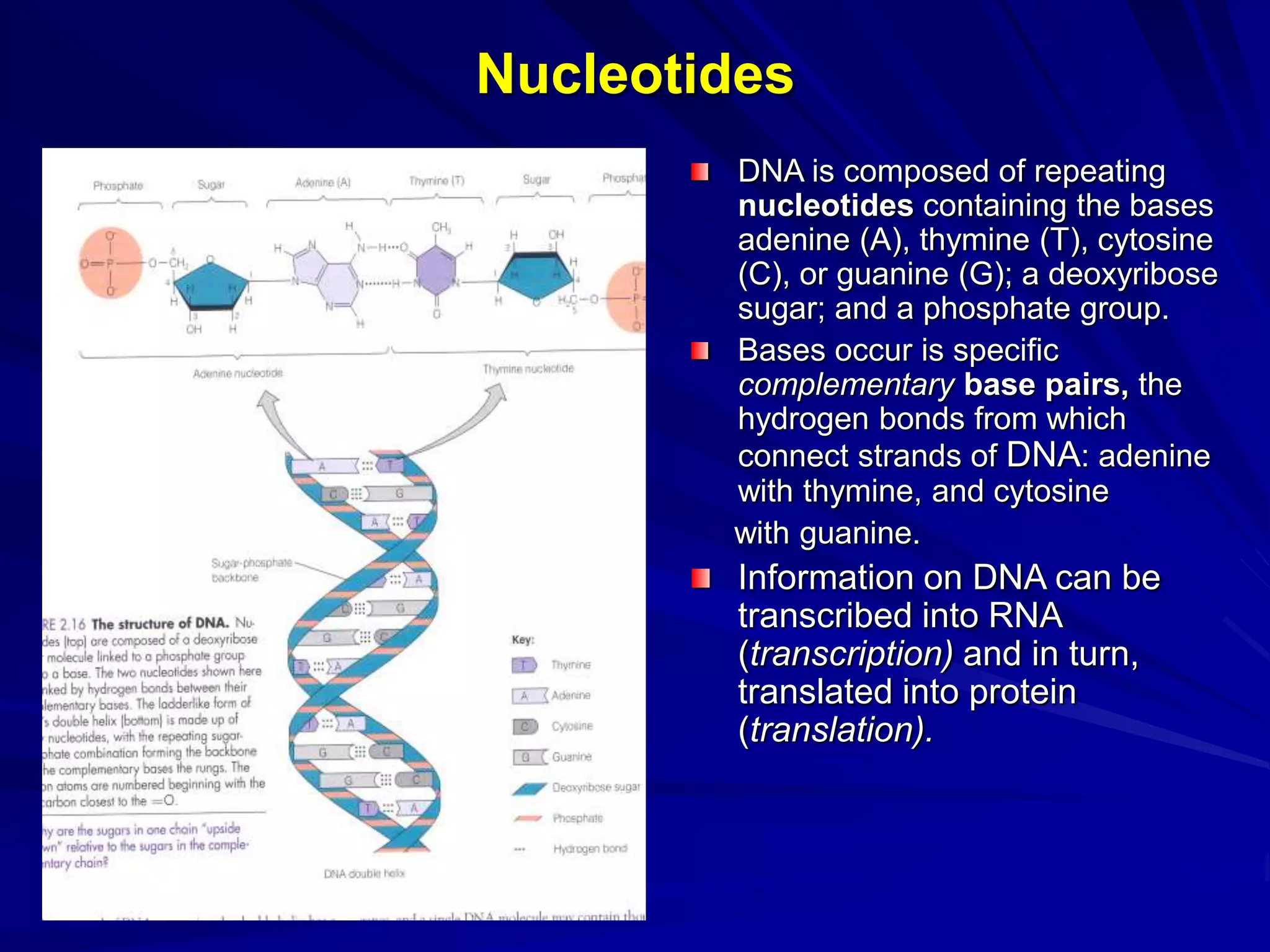
DNA is composed of repeating
nucleotides containing the bases
adenine (A), thymine (T), cytosine
(C), or guanine (G); a deoxyribose
sugar; and a phosphate group.
Bases occur is specific
complementary base pairs, the
hydrogen bonds from which
connect strands of DNA: adenine
with thymine, and cytosine
with guanine.
Information on DNA can be
transcribed into RNA
(transcription) and in turn,
translated into protein
(translation).
Genotype and Phenotype
The genotype is an organism’s genetic makeup, the
information that codes for all the characteristics and
potential properties of the organism.
The genotype is its gene collection- its DNA.
The phenotype refers to an organism’s actual
expressed properties, such as its ability to perform a
chemical reaction.
The phenotype is the collection of enzymatic or structural
proteins.
DNA and Chromosomes
DNA in chromosomes is in the form of long
double helix.
In prokaryotes, DNA is not found within a
nuclear membrane.
The chromosome takes up only about
10% of the cell’s volume because the DNA
is supercoiled by an enzyme called DNA
gyrase.
DNA replication
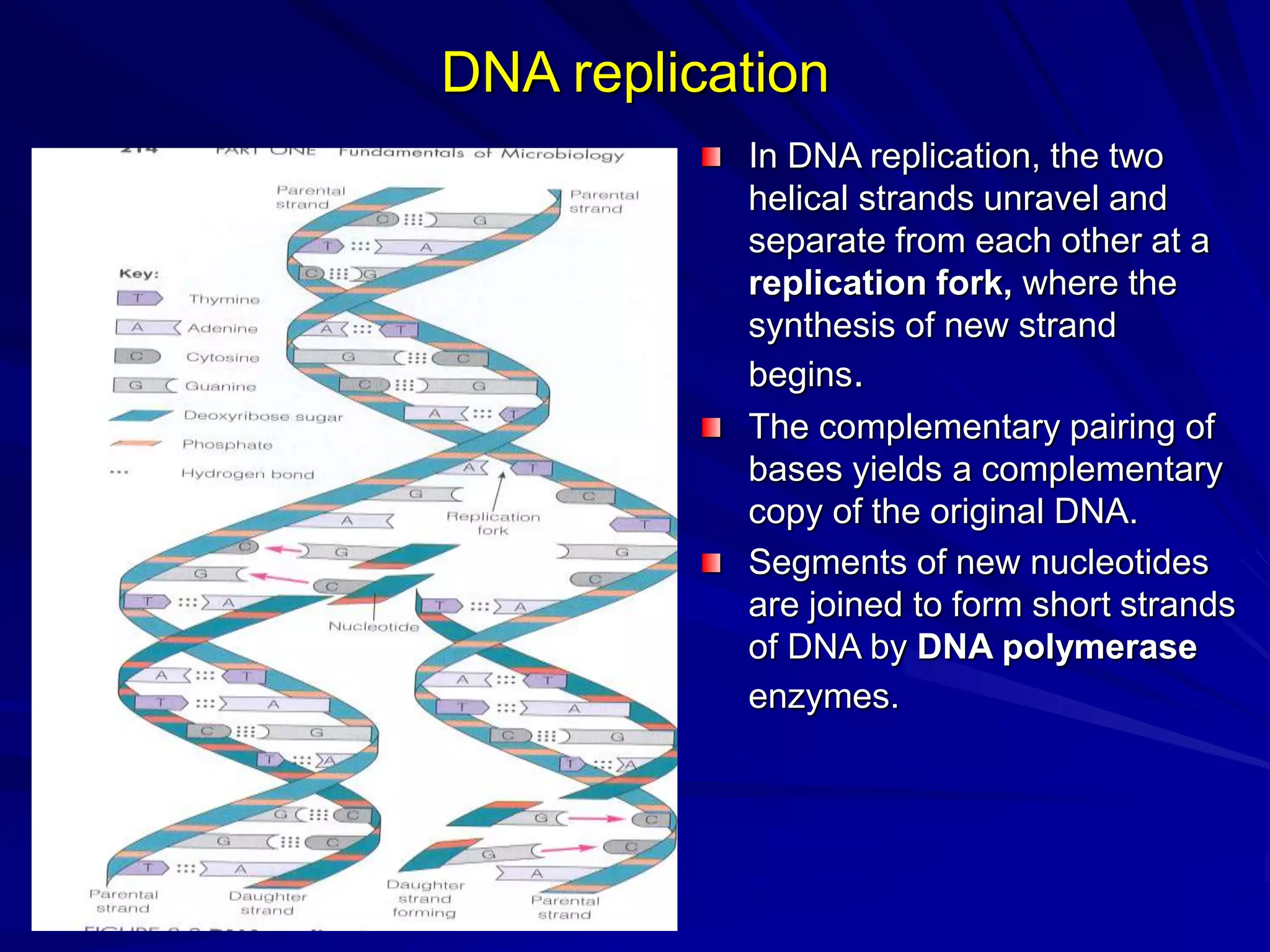
In DNA replication, the two
helical strands unravel and
separate from each other at a
replication fork, where the
synthesis of new strand
begins.
The complementary pairing of
bases yields a complementary
copy of the original DNA.
Segments of new nucleotides
are joined to form short strands
of DNA by DNA polymerase
enzymes.
DNA Replication
Short strands of DNA are then joined into continuous DNA by DNA
ligase enzymes.
Because each new double-stranded DNA molecule has one original
strand and one new strand, the process is called semi-
conservative replication.
In bacteria, replication begins at an origin of replication and in some
cases two replication forks move in opposite directions.
DNA replication makes few mistakes, largely due to the proofreading
capability of DNA polymerase.
RNA and Protein Synthesis
Transcription
In transcription, a strand of
messenger RNA (mRNA) is
synthesized from the genetic
information in DNA.
Adenine in the DNA dictates the
location of uracil, which replaces
thymine in mRNA.
If DNA has the bases sequence
ATGCAT, the mRNA will have
UACGUA.
The region where RNA
polymerase (needed for synthesis)
binds to DNA and transcription
begins is known as promoter
site.
The terminator site is where the
RNA polymerase and newly
formed mRNA are released from
the DNA.-Endpoint.
Translation
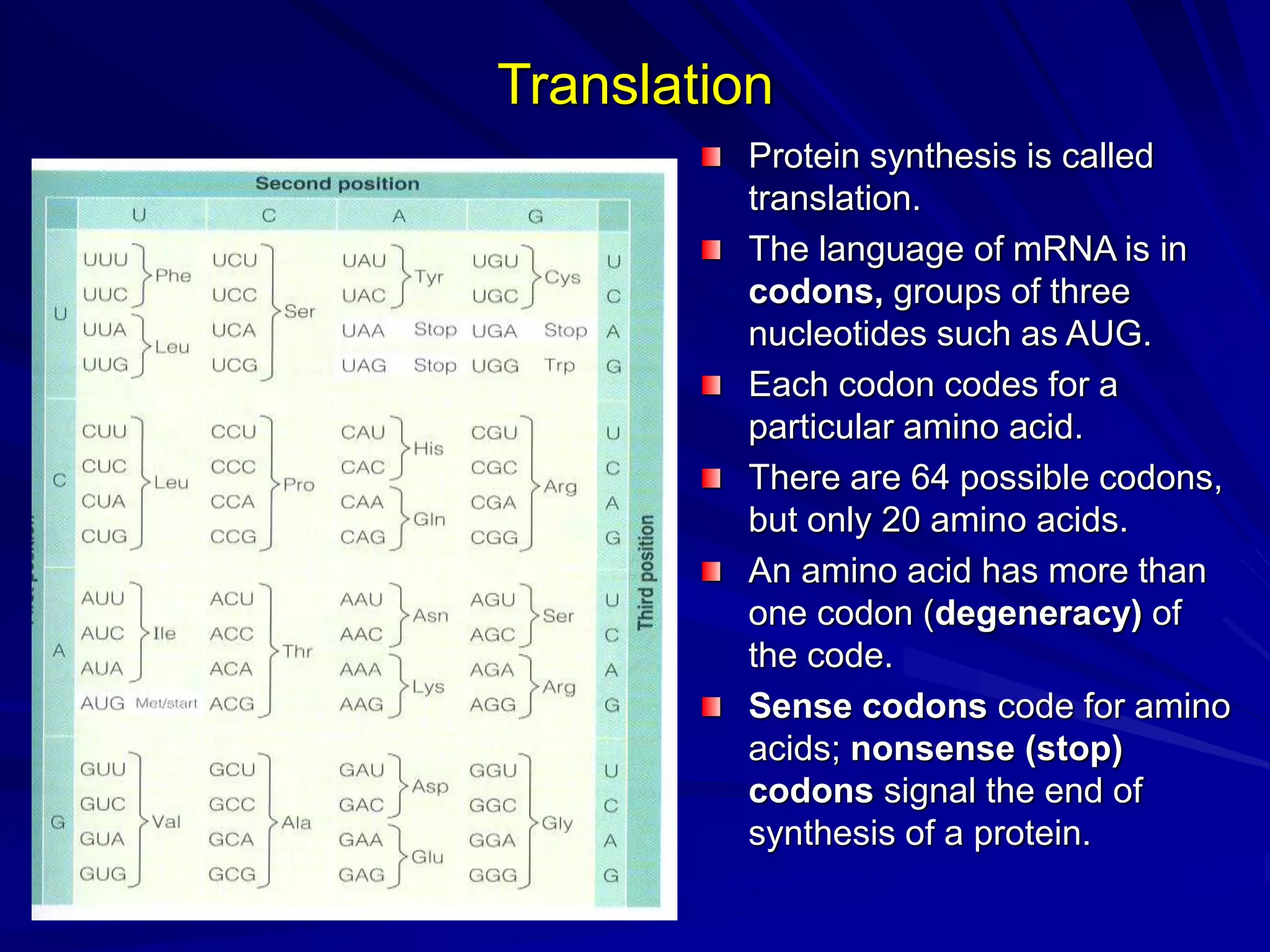
Protein synthesis is called
translation.
The language of mRNA is in
codons, groups of three
nucleotides such as AUG.
Each codon codes for a
particular amino acid.
There are 64 possible codons,
but only 20 amino acids.
An amino acid has more than
one codon (degeneracy) of
the code.
Sense codons code for amino
acids; nonsense (stop)
codons signal the end of
synthesis of a protein.
Translation
The site of translation are
ribosomes that move
along mRNA.
The amino acids are
transported to the
ribosome by transfer
RNA (tRNA).
Each tRNA molecule is
made specific for an
amino acid by an
anticodon that is
complementary to a
codon.
The codon AUG would
attach to anticodon UAC.
Repression and Induction
An inducer is a substance
(substrate) whose presence
results in the formation, or
increase in the amount of an
enzyme.
Such enzymes are called
inducible enzymes; this
genetically controlled response
is termed enzyme induction.
Lactase production in
response to lactose – example.
Genetic regulation that
decreases enzymes synthesis
is enzyme repression.
Mutation: Change in Genetic Material
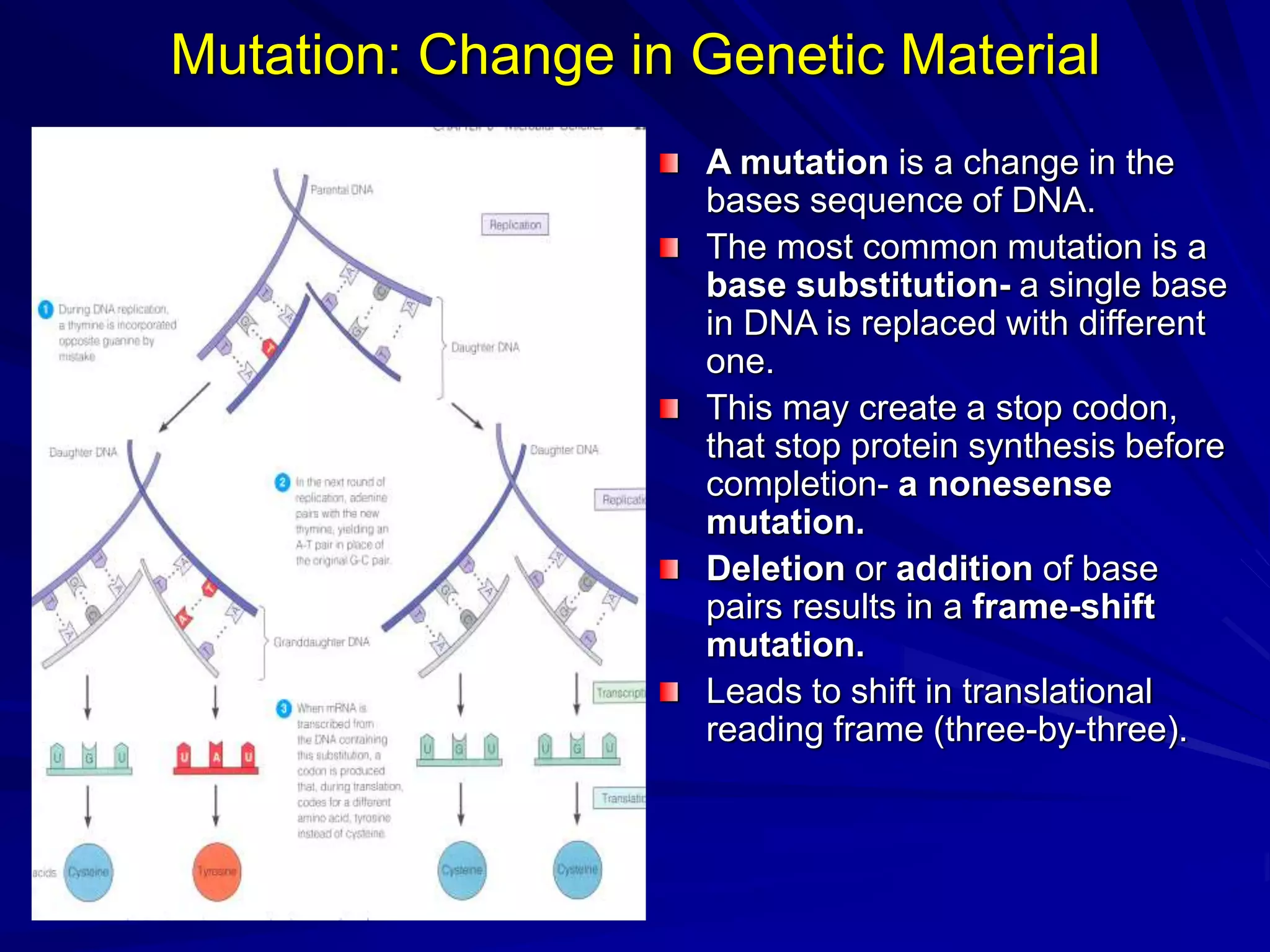
A mutation is a change in the
bases sequence of DNA.
The most common mutation is a
base substitution- a single base
in DNA is replaced with different
one.
This may create a stop codon,
that stop protein synthesis before
completion- a nonesense
mutation.
Deletion or addition of base
pairs results in a frame-shift
mutation.
Leads to shift in translational
reading frame (three-by-three).
Mutagens
Many chemicals and
radiation bring about
mutations; these are called
mutagens.
Nitrous acid (HNO2) is a
base pair mutagen.
It cases Adenine to pair with
Cytosine not Thymine.
Other mutagens are
nucleoside analogs-
structurally similar to bases
and incorporated into DNA
by error.
Example- 2-Aminopurine
analog to Adenine, 5-
Bromouracil to Thymine.
Mutagenic drugs
Some antiviral and anti-tumor drugs are nucleoside
analogs.
AZT (azidothymindine), one of the primary drugs used to
treat HIV infection.
Other chemical mutagens cause small deletions or
insertions, which can result in frame-shifts.
Example- benzpyrene, which present in smoke and soot.
Aflatoxin – produced by Aspergillus flavus is a frame
mutagen.
Acridine dyes used against herpesvirus infections.
Radiation
Ionizing radiation- such
as X rays and gamma
rays are mutagens and
damage DNA.
They cause electrons to
pop out of their usual
shells- producing ions
and free radicals.
Ultraviolet light (non-
ionizing radiation) is
also mutagen.
Light-repair enzymes
repair UV damage to
DNA.
Enzymes cut out
distorted DNA and
synthesize replacement.
Genetic Transfer and Recombination
Genetic recombination is the
rearrangement of genes to
form new combinations.
Crossing over happens when
two chromosomes break and
rejoined in such a way- genes
are reshuffled between the two
chromosomes.
The donor cell gives a portion
of its total DNA to a different
recipient cell (recombinant).
Vertical gene transfer occurs
from an organism to its
offspring.
Horizontal gene transfer from
bacteria to other microbe.
Transformation in Bacteria
Transformation –naked
DNA in solution is
transferred from one
bacteria to another.
It occurs naturally among
very few genera of
bacteria, when donor and
recipient are closely
related- occurs in the log-
phase of growth.
Recipient cell must be
competent- cell wall
permeable to large DNA
molecules.
Conjugation in Bacteria
Conjugation requires contact
between living cells of opposite
mating types.
The donor cell F+ has plasmid
called F (fertility factor).
When F+ cell mixed with F-,
cells attach by sex pili.
F factor is duplicated by donor
and the new copy is
transferred to F- cell.
Transduction in Bacteria
In generalized
transduction, the phage
(bacteriophage)
attaches to the bacterial
cell wall and injects DNA
into bacteria.
Normally this synthesis
new viruses.
Occasionally part of
bacterial chromosome is
taken by the viral DNA.
When new bacteria are
infected by these viruses
old bacterial DNA is
incorporated in the new
bacterial genome.

BACTERIAL GENETICS.ppt

  • 1.
  • 2.
    Structure and Functionof the Genetic Material Chromosomes are cellular structures made up of genes that carry hereditary information. Genetics is the study of genes carry information, how they are replicated and passed to other generations, and how they affect the characteristics of an organism. A gene is a segment of DNA that codes for a functional product. The genetic information in a cell is the genome.
  • 3.
    Nucleotides DNA is composedof repeating nucleotides containing the bases adenine (A), thymine (T), cytosine (C), or guanine (G); a deoxyribose sugar; and a phosphate group. Bases occur is specific complementary base pairs, the hydrogen bonds from which connect strands of DNA: adenine with thymine, and cytosine with guanine. Information on DNA can be transcribed into RNA (transcription) and in turn, translated into protein (translation).
  • 4.
    Genotype and Phenotype Thegenotype is an organism’s genetic makeup, the information that codes for all the characteristics and potential properties of the organism. The genotype is its gene collection- its DNA. The phenotype refers to an organism’s actual expressed properties, such as its ability to perform a chemical reaction. The phenotype is the collection of enzymatic or structural proteins.
  • 5.
    DNA and Chromosomes DNAin chromosomes is in the form of long double helix. In prokaryotes, DNA is not found within a nuclear membrane. The chromosome takes up only about 10% of the cell’s volume because the DNA is supercoiled by an enzyme called DNA gyrase.
  • 6.
    DNA replication In DNAreplication, the two helical strands unravel and separate from each other at a replication fork, where the synthesis of new strand begins. The complementary pairing of bases yields a complementary copy of the original DNA. Segments of new nucleotides are joined to form short strands of DNA by DNA polymerase enzymes.
  • 7.
    DNA Replication Short strandsof DNA are then joined into continuous DNA by DNA ligase enzymes. Because each new double-stranded DNA molecule has one original strand and one new strand, the process is called semi- conservative replication. In bacteria, replication begins at an origin of replication and in some cases two replication forks move in opposite directions. DNA replication makes few mistakes, largely due to the proofreading capability of DNA polymerase.
  • 8.
    RNA and ProteinSynthesis Transcription In transcription, a strand of messenger RNA (mRNA) is synthesized from the genetic information in DNA. Adenine in the DNA dictates the location of uracil, which replaces thymine in mRNA. If DNA has the bases sequence ATGCAT, the mRNA will have UACGUA. The region where RNA polymerase (needed for synthesis) binds to DNA and transcription begins is known as promoter site. The terminator site is where the RNA polymerase and newly formed mRNA are released from the DNA.-Endpoint.
  • 9.
    Translation Protein synthesis iscalled translation. The language of mRNA is in codons, groups of three nucleotides such as AUG. Each codon codes for a particular amino acid. There are 64 possible codons, but only 20 amino acids. An amino acid has more than one codon (degeneracy) of the code. Sense codons code for amino acids; nonsense (stop) codons signal the end of synthesis of a protein.
  • 10.
    Translation The site oftranslation are ribosomes that move along mRNA. The amino acids are transported to the ribosome by transfer RNA (tRNA). Each tRNA molecule is made specific for an amino acid by an anticodon that is complementary to a codon. The codon AUG would attach to anticodon UAC.
  • 11.
    Repression and Induction Aninducer is a substance (substrate) whose presence results in the formation, or increase in the amount of an enzyme. Such enzymes are called inducible enzymes; this genetically controlled response is termed enzyme induction. Lactase production in response to lactose – example. Genetic regulation that decreases enzymes synthesis is enzyme repression.
  • 12.
    Mutation: Change inGenetic Material A mutation is a change in the bases sequence of DNA. The most common mutation is a base substitution- a single base in DNA is replaced with different one. This may create a stop codon, that stop protein synthesis before completion- a nonesense mutation. Deletion or addition of base pairs results in a frame-shift mutation. Leads to shift in translational reading frame (three-by-three).
  • 13.
    Mutagens Many chemicals and radiationbring about mutations; these are called mutagens. Nitrous acid (HNO2) is a base pair mutagen. It cases Adenine to pair with Cytosine not Thymine. Other mutagens are nucleoside analogs- structurally similar to bases and incorporated into DNA by error. Example- 2-Aminopurine analog to Adenine, 5- Bromouracil to Thymine.
  • 14.
    Mutagenic drugs Some antiviraland anti-tumor drugs are nucleoside analogs. AZT (azidothymindine), one of the primary drugs used to treat HIV infection. Other chemical mutagens cause small deletions or insertions, which can result in frame-shifts. Example- benzpyrene, which present in smoke and soot. Aflatoxin – produced by Aspergillus flavus is a frame mutagen. Acridine dyes used against herpesvirus infections.
  • 15.
    Radiation Ionizing radiation- such asX rays and gamma rays are mutagens and damage DNA. They cause electrons to pop out of their usual shells- producing ions and free radicals. Ultraviolet light (non- ionizing radiation) is also mutagen. Light-repair enzymes repair UV damage to DNA. Enzymes cut out distorted DNA and synthesize replacement.
  • 16.
    Genetic Transfer andRecombination Genetic recombination is the rearrangement of genes to form new combinations. Crossing over happens when two chromosomes break and rejoined in such a way- genes are reshuffled between the two chromosomes. The donor cell gives a portion of its total DNA to a different recipient cell (recombinant). Vertical gene transfer occurs from an organism to its offspring. Horizontal gene transfer from bacteria to other microbe.
  • 17.
    Transformation in Bacteria Transformation–naked DNA in solution is transferred from one bacteria to another. It occurs naturally among very few genera of bacteria, when donor and recipient are closely related- occurs in the log- phase of growth. Recipient cell must be competent- cell wall permeable to large DNA molecules.
  • 18.
    Conjugation in Bacteria Conjugationrequires contact between living cells of opposite mating types. The donor cell F+ has plasmid called F (fertility factor). When F+ cell mixed with F-, cells attach by sex pili. F factor is duplicated by donor and the new copy is transferred to F- cell.
  • 19.
    Transduction in Bacteria Ingeneralized transduction, the phage (bacteriophage) attaches to the bacterial cell wall and injects DNA into bacteria. Normally this synthesis new viruses. Occasionally part of bacterial chromosome is taken by the viral DNA. When new bacteria are infected by these viruses old bacterial DNA is incorporated in the new bacterial genome.