TRU seminar, Kamloops, Canada, 9 September 2010 1
UK approaches to
quality in e-learning
views from the UK benchmarking programmes,
Re.ViCa project on critical success factors
and the Distance Learning Benchmarking Club
Professor Paul Bacsich
Matic Media Ltd
TRU seminar, Kamloops, Canada, 9 September 2010 2
Topics
1. Introduction
2. The four phases of the UK HE
Benchmarking Programme
3. More recent developments in UK HE
benchmarking e-learning
4. Implications for schemes on
Quality of e-Learning
TRU seminar, Kamloops, Canada, 9 September 2010 3
1. Introduction
TRU seminar, Kamloops, Canada, 9 September 2010 4
The requirement
from ICDE/Athabasca/
Alberta Quality Council
To produce an up to date set of guidelines for
quality in e-learning, focussed on the needs
of providers of distance e-learning, and taking
into account developments in other provinces,
(nearby) nations of the world, and
international projects
TRU seminar, Kamloops, Canada, 9 September 2010 5
2. The four phases of the UK HE
Benchmarking Programme
an overview
TRU seminar, Kamloops, Canada, 9 September 2010 6
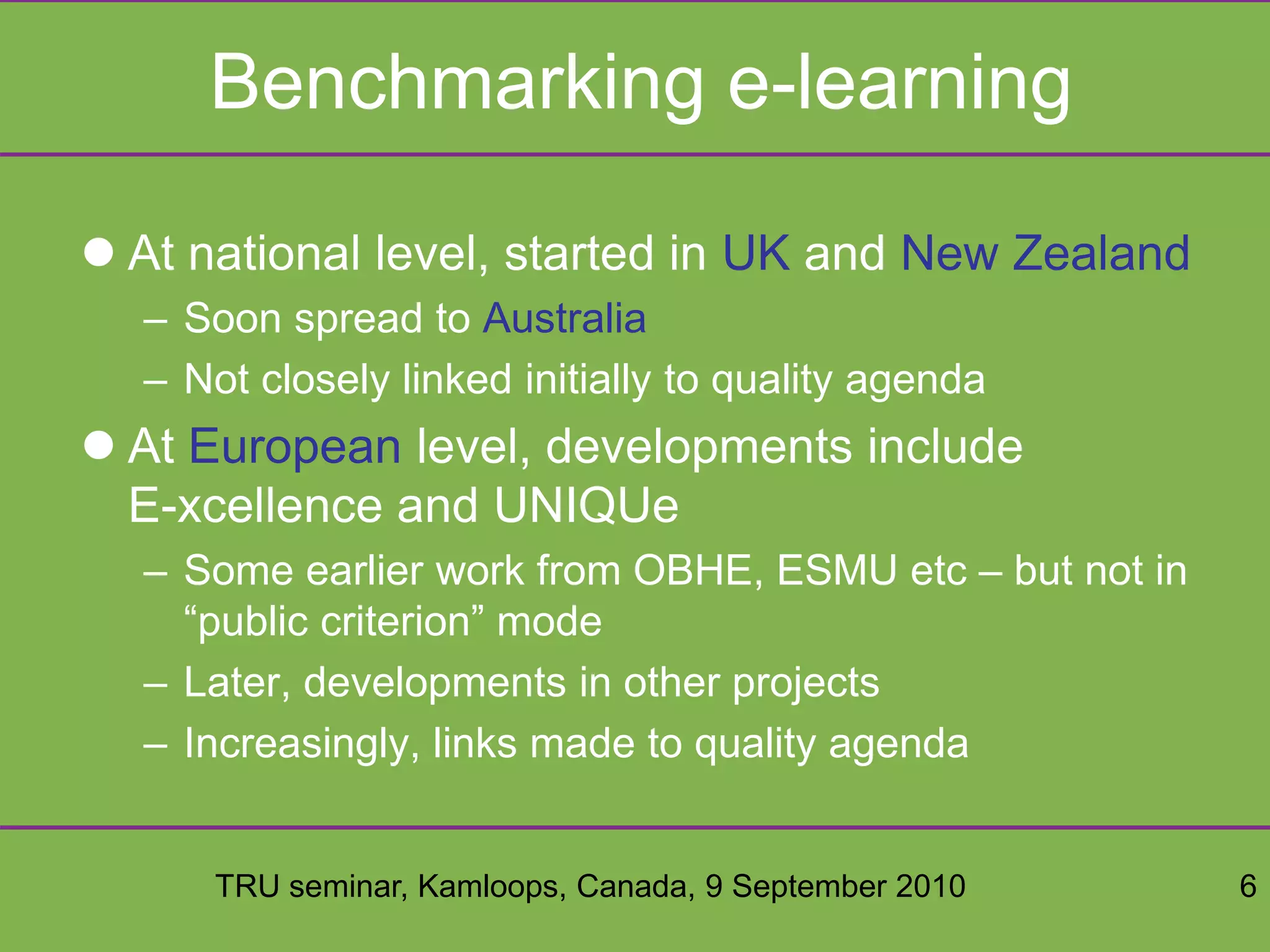
Benchmarking e-learning
 At national level, started in UK and New Zealand
– Soon spread to Australia
– Not closely linked initially to quality agenda
 At European level, developments include
E-xcellence and UNIQUe
– Some earlier work from OBHE, ESMU etc – but not in
“public criterion” mode
– Later, developments in other projects
– Increasingly, links made to quality agenda
TRU seminar, Kamloops, Canada, 9 September 2010 7
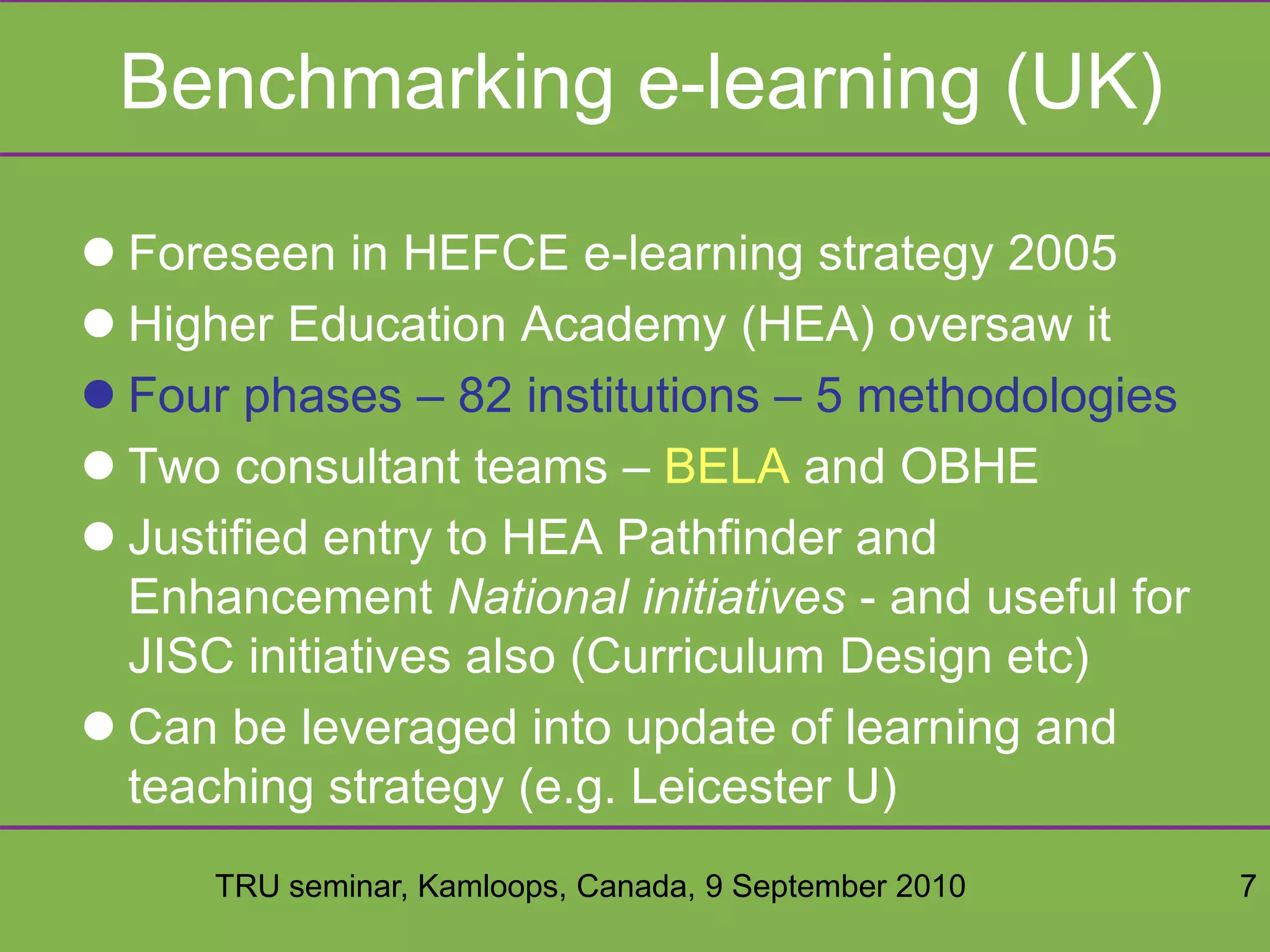
Benchmarking e-learning (UK)
 Foreseen in HEFCE e-learning strategy 2005
 Higher Education Academy (HEA) oversaw it
 Four phases – 82 institutions – 5 methodologies
 Two consultant teams – BELA and OBHE
 Justified entry to HEA Pathfinder and
Enhancement National initiatives - and useful for
JISC initiatives also (Curriculum Design etc)
 Can be leveraged into update of learning and
teaching strategy (e.g. Leicester U)
TRU seminar, Kamloops, Canada, 9 September 2010 8
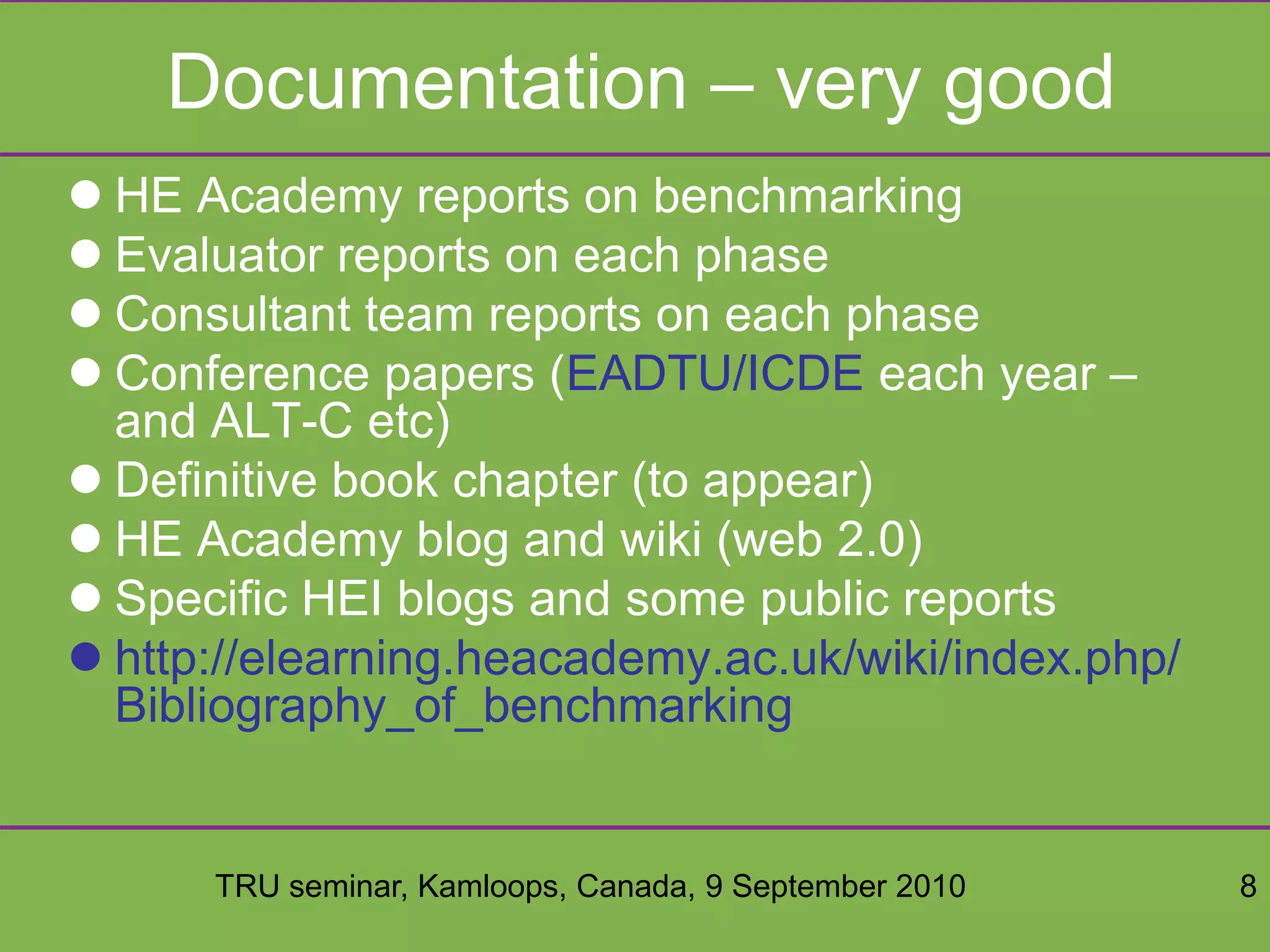
Documentation – very good
 HE Academy reports on benchmarking
 Evaluator reports on each phase
 Consultant team reports on each phase
 Conference papers (EADTU/ICDE each year –
and ALT-C etc)
 Definitive book chapter (to appear)
 HE Academy blog and wiki (web 2.0)
 Specific HEI blogs and some public reports
 http://elearning.heacademy.ac.uk/wiki/index.php/
Bibliography_of_benchmarking
TRU seminar, Kamloops, Canada, 9 September 2010 9
UK: benchmarking e-learning
“Possibly more important is for us [HEFCE] to
help individual institutions
understand their own positions on e-learning,
to set their aspirations and goals for
embedding e-learning – and then to
benchmark themselves and their progress
against institutions with similar goals,
and across the sector”
TRU seminar, Kamloops, Canada, 9 September 2010 10
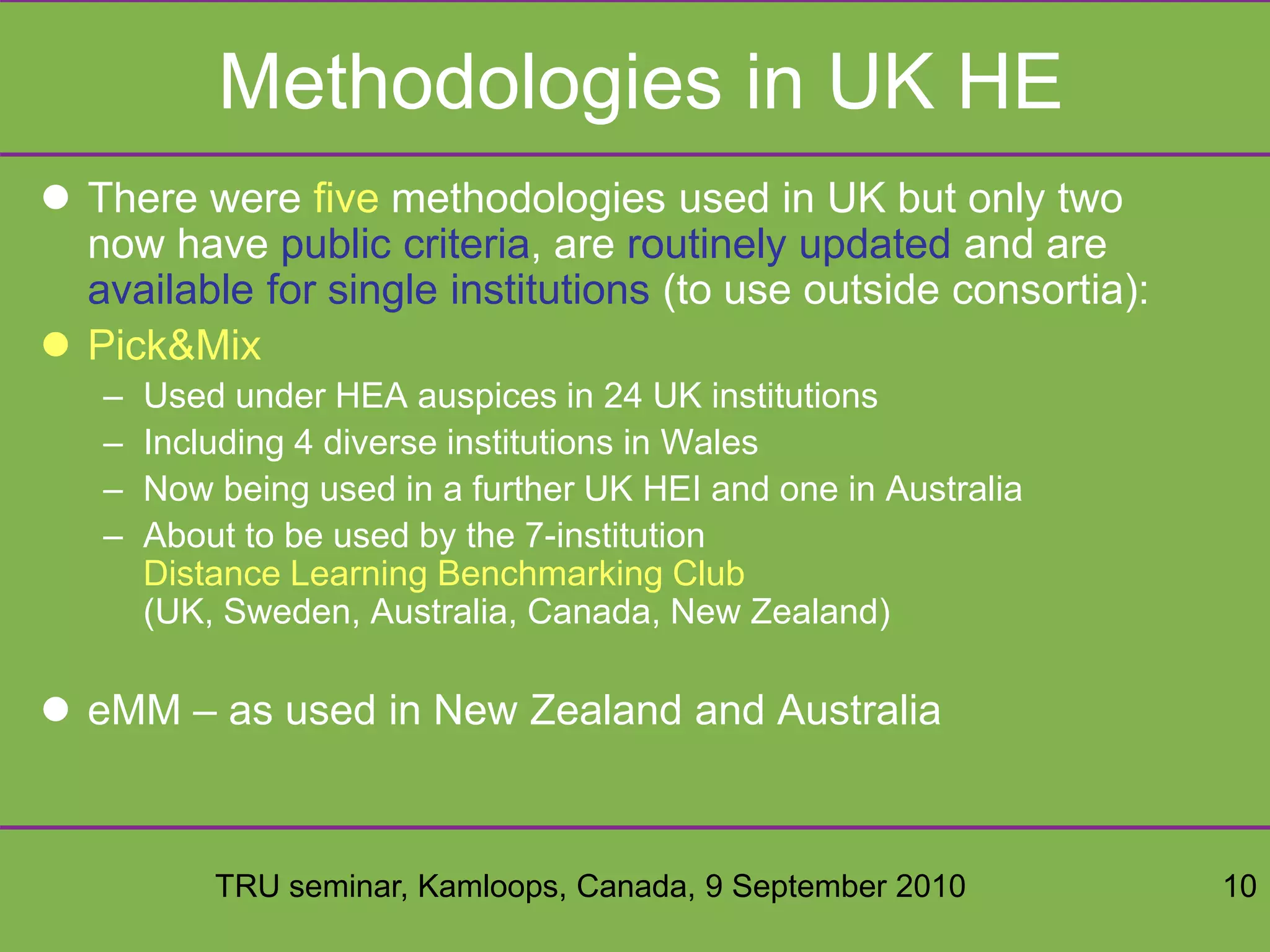
Methodologies in UK HE
 There were five methodologies used in UK but only two
now have public criteria, are routinely updated and are
available for single institutions (to use outside consortia):
 Pick&Mix
– Used under HEA auspices in 24 UK institutions
– Including 4 diverse institutions in Wales
– Now being used in a further UK HEI and one in Australia
– About to be used by the 7-institution
Distance Learning Benchmarking Club
(UK, Sweden, Australia, Canada, New Zealand)
 eMM – as used in New Zealand and Australia
TRU seminar, Kamloops, Canada, 9 September 2010 11
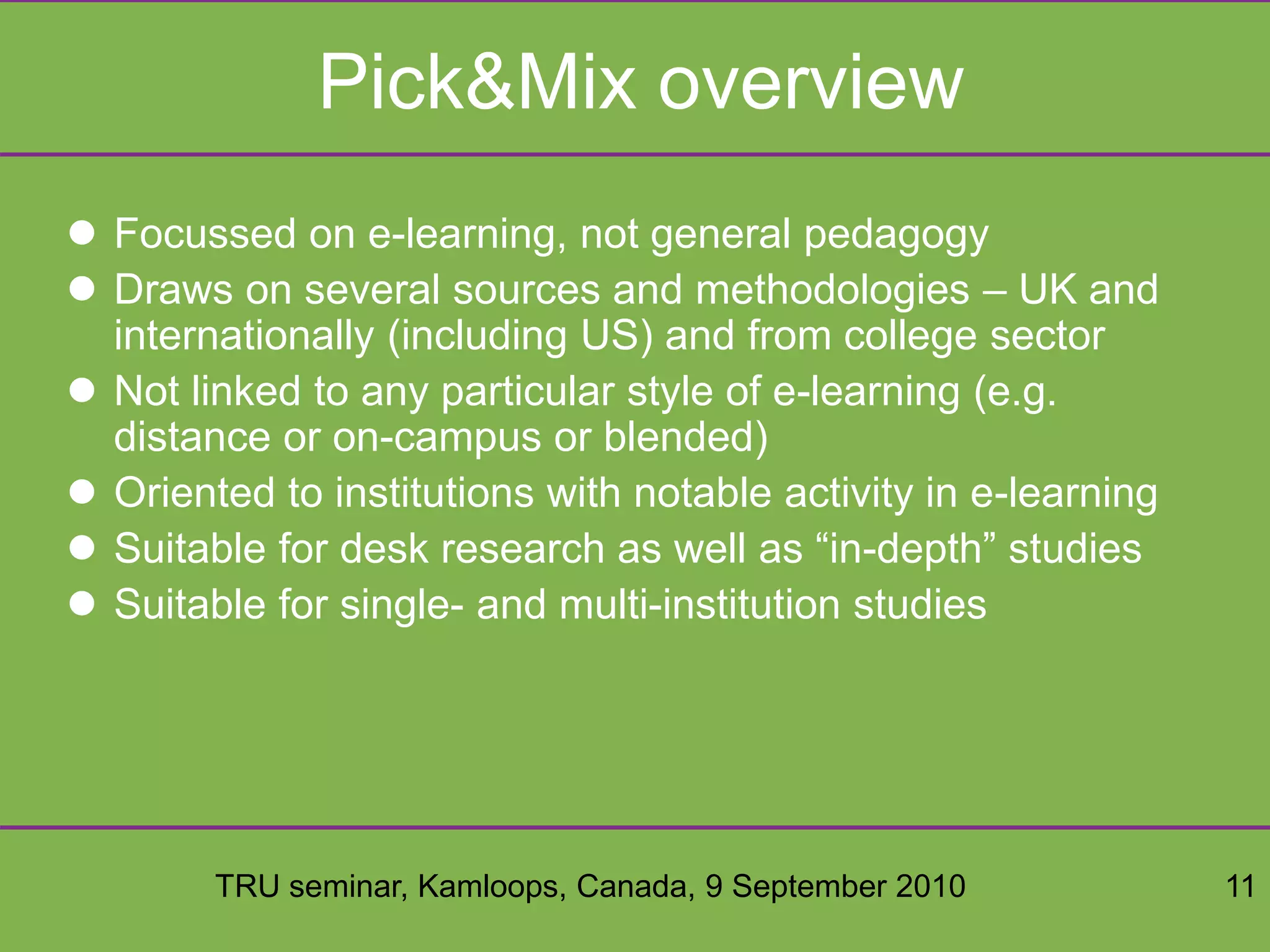
Pick&Mix overview
 Focussed on e-learning, not general pedagogy
 Draws on several sources and methodologies – UK and
internationally (including US) and from college sector
 Not linked to any particular style of e-learning (e.g.
distance or on-campus or blended)
 Oriented to institutions with notable activity in e-learning
 Suitable for desk research as well as “in-depth” studies
 Suitable for single- and multi-institution studies
TRU seminar, Kamloops, Canada, 9 September 2010 12
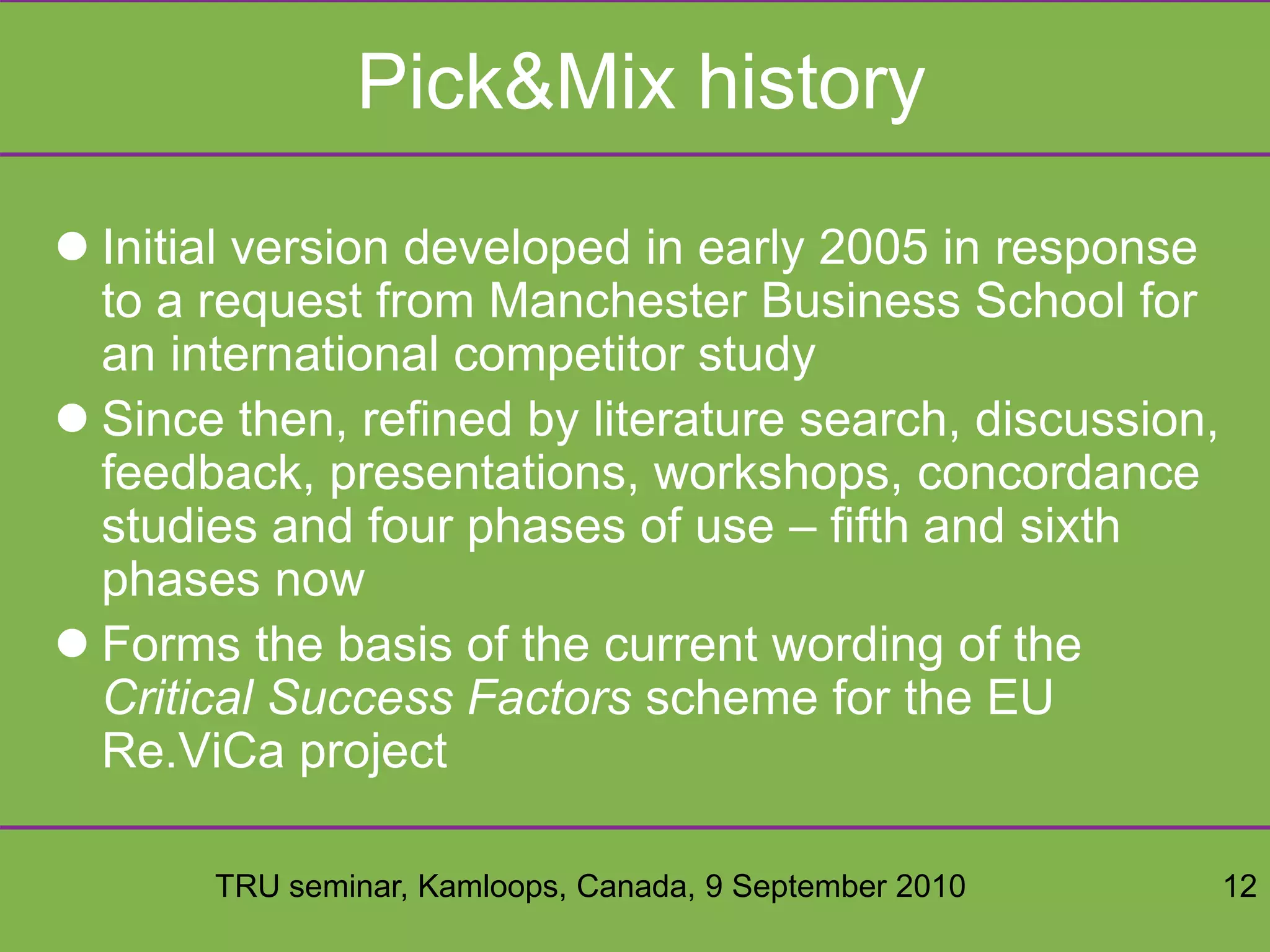
Pick&Mix history
 Initial version developed in early 2005 in response
to a request from Manchester Business School for
an international competitor study
 Since then, refined by literature search, discussion,
feedback, presentations, workshops, concordance
studies and four phases of use – fifth and sixth
phases now
 Forms the basis of the current wording of the
Critical Success Factors scheme for the EU
Re.ViCa project
TRU seminar, Kamloops, Canada, 9 September 2010 13
Pick&Mix
Criteria and metrics
TRU seminar, Kamloops, Canada, 9 September 2010 14
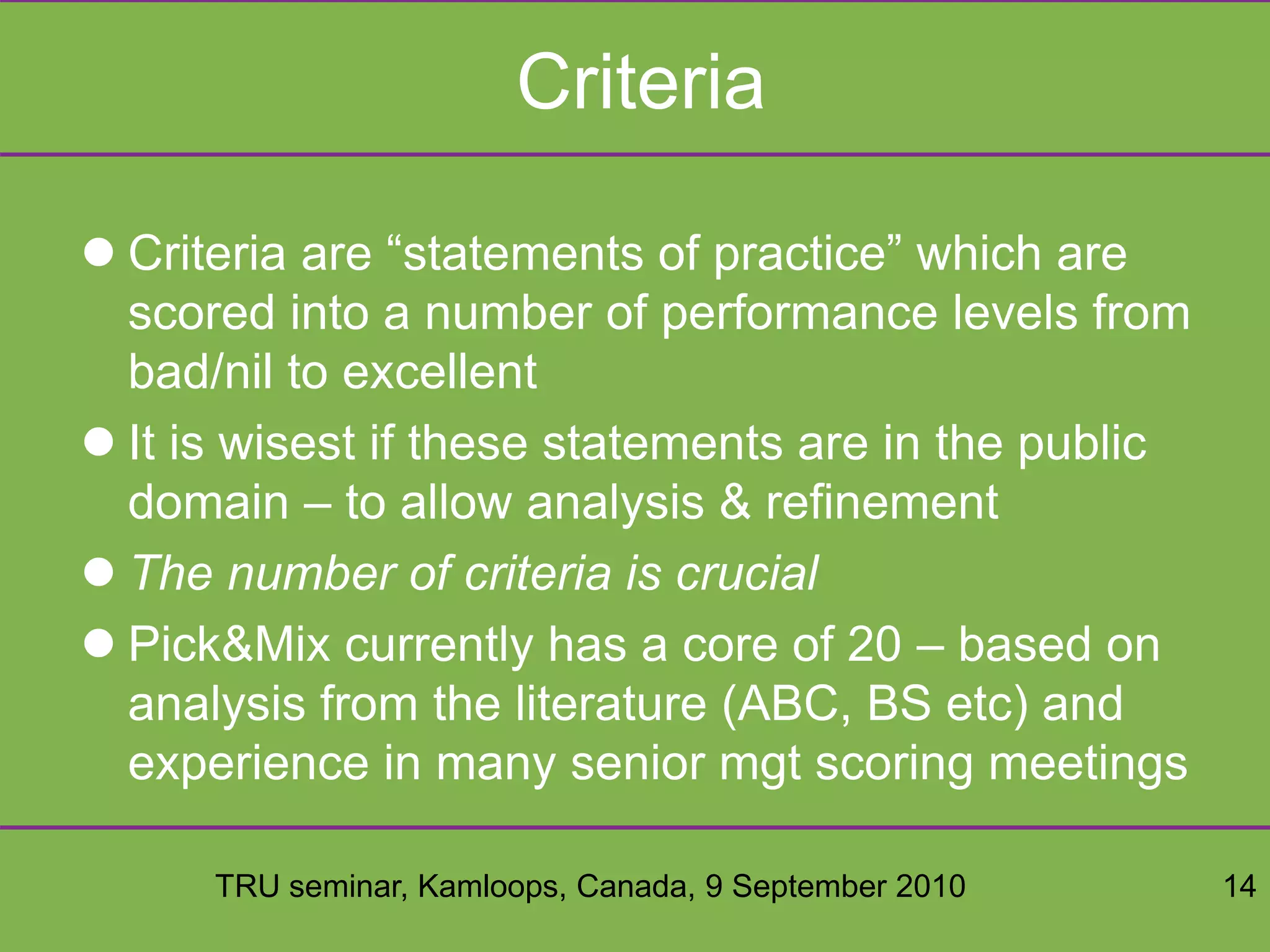
Criteria
 Criteria are “statements of practice” which are
scored into a number of performance levels from
bad/nil to excellent
 It is wisest if these statements are in the public
domain – to allow analysis & refinement
 The number of criteria is crucial
 Pick&Mix currently has a core of 20 – based on
analysis from the literature (ABC, BS etc) and
experience in many senior mgt scoring meetings
TRU seminar, Kamloops, Canada, 9 September 2010 15
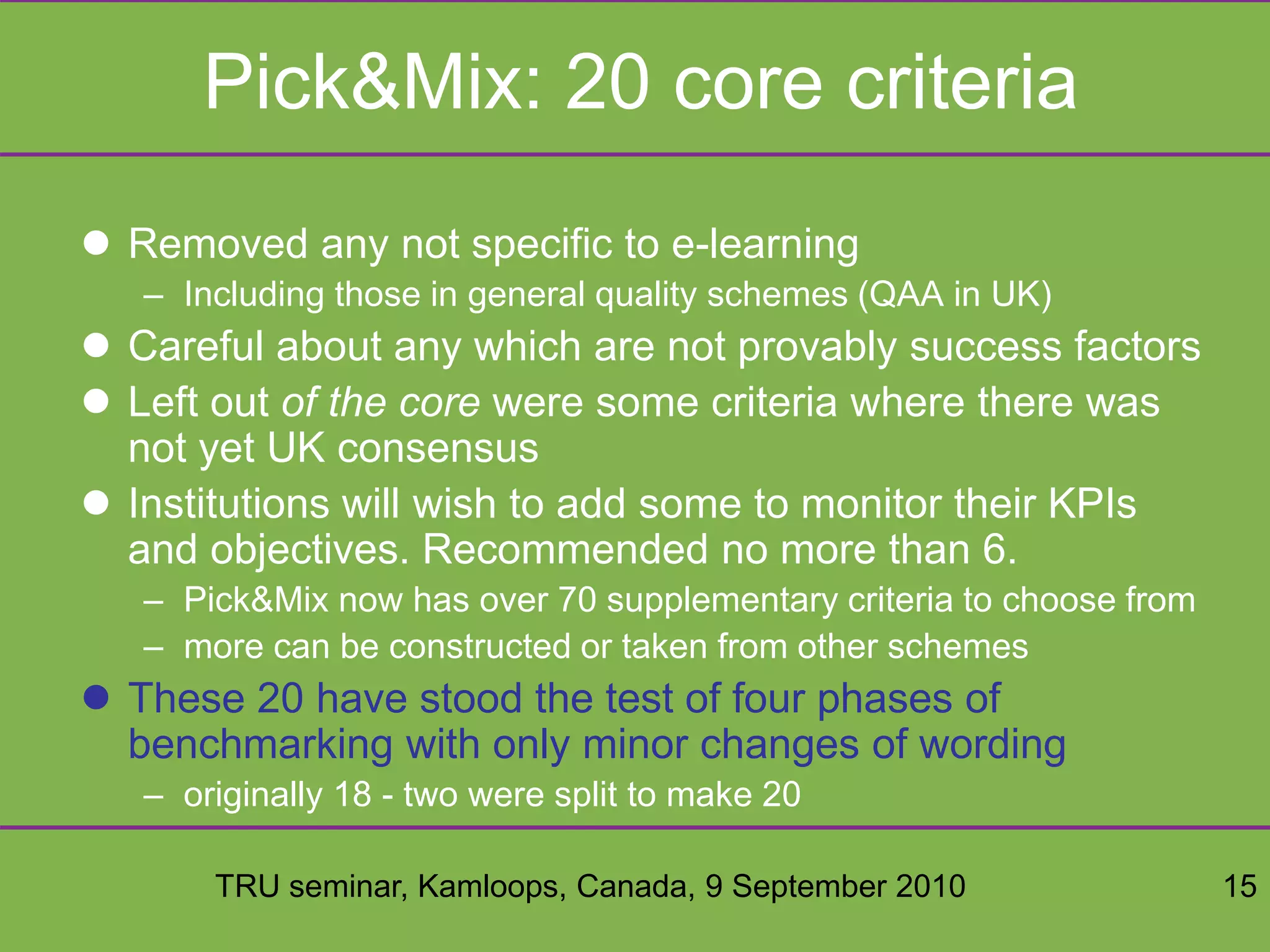
Pick&Mix: 20 core criteria
 Removed any not specific to e-learning
– Including those in general quality schemes (QAA in UK)
 Careful about any which are not provably success factors
 Left out of the core were some criteria where there was
not yet UK consensus
 Institutions will wish to add some to monitor their KPIs
and objectives. Recommended no more than 6.
– Pick&Mix now has over 70 supplementary criteria to choose from
– more can be constructed or taken from other schemes
 These 20 have stood the test of four phases of
benchmarking with only minor changes of wording
– originally 18 - two were split to make 20
TRU seminar, Kamloops, Canada, 9 September 2010 16
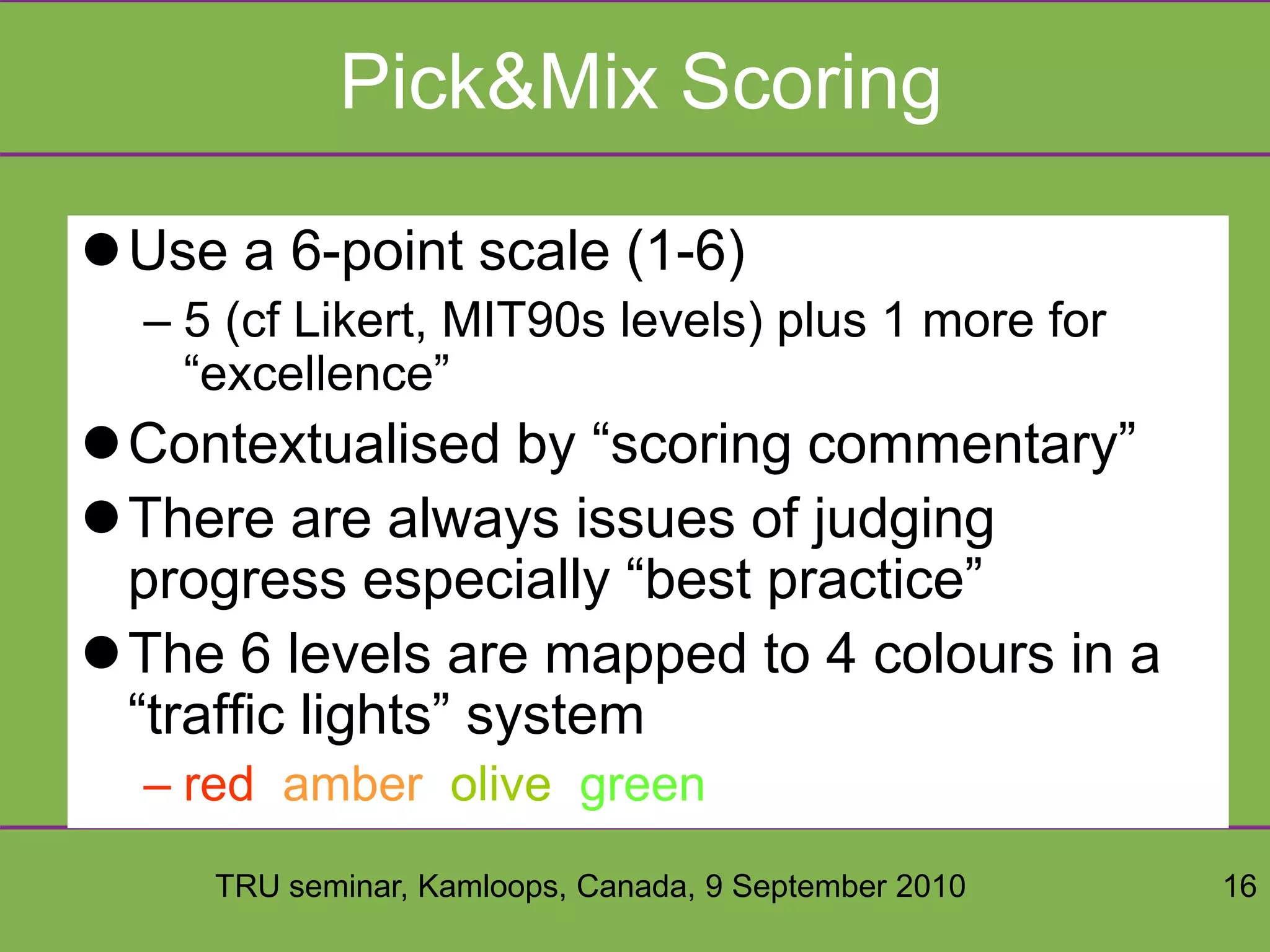
Pick&Mix Scoring
Use a 6-point scale (1-6)
– 5 (cf Likert, MIT90s levels) plus 1 more for
“excellence”
Contextualised by “scoring commentary”
There are always issues of judging
progress especially “best practice”
The 6 levels are mapped to 4 colours in a
“traffic lights” system
– red, amber, olive, green
TRU seminar, Kamloops, Canada, 9 September 2010 17
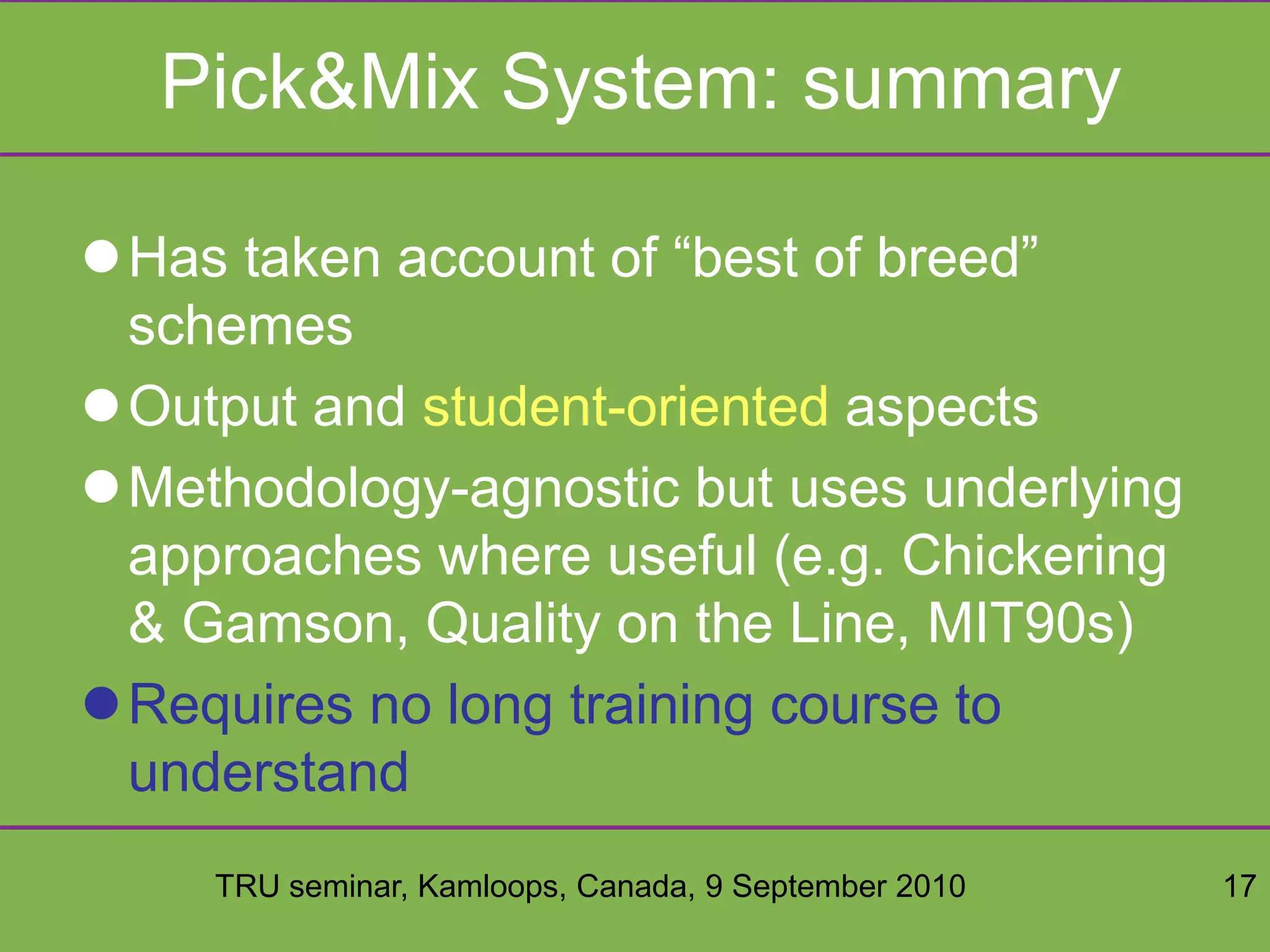
Pick&Mix System: summary
Has taken account of “best of breed”
schemes
Output and student-oriented aspects
Methodology-agnostic but uses underlying
approaches where useful (e.g. Chickering
& Gamson, Quality on the Line, MIT90s)
Requires no long training course to
understand
TRU seminar, Kamloops, Canada, 9 September 2010 18
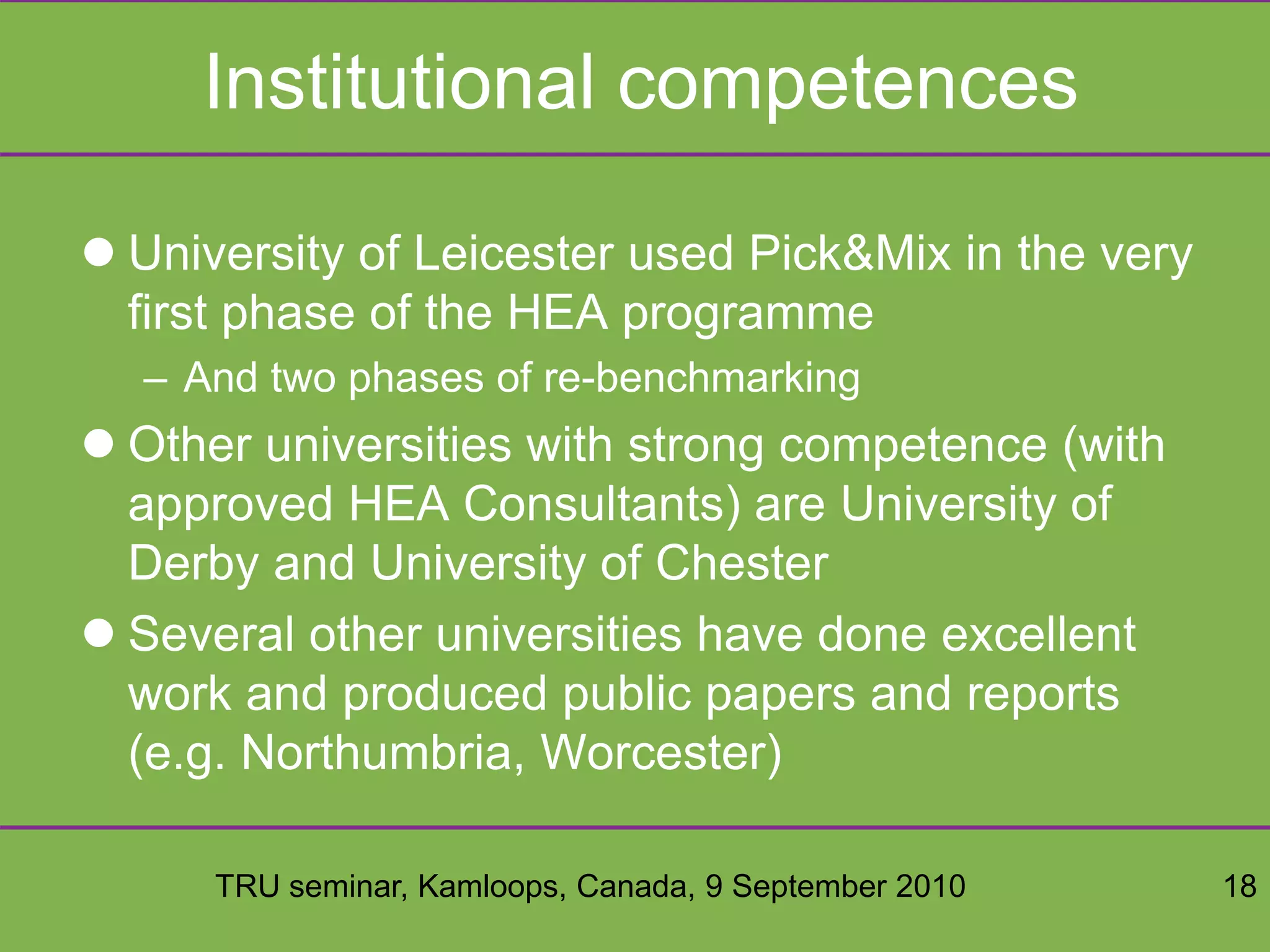
Institutional competences
 University of Leicester used Pick&Mix in the very
first phase of the HEA programme
– And two phases of re-benchmarking
 Other universities with strong competence (with
approved HEA Consultants) are University of
Derby and University of Chester
 Several other universities have done excellent
work and produced public papers and reports
(e.g. Northumbria, Worcester)
TRU seminar, Kamloops, Canada, 9 September 2010 19
Pick&Mix
Three sample criteria
TRU seminar, Kamloops, Canada, 9 September 2010 20
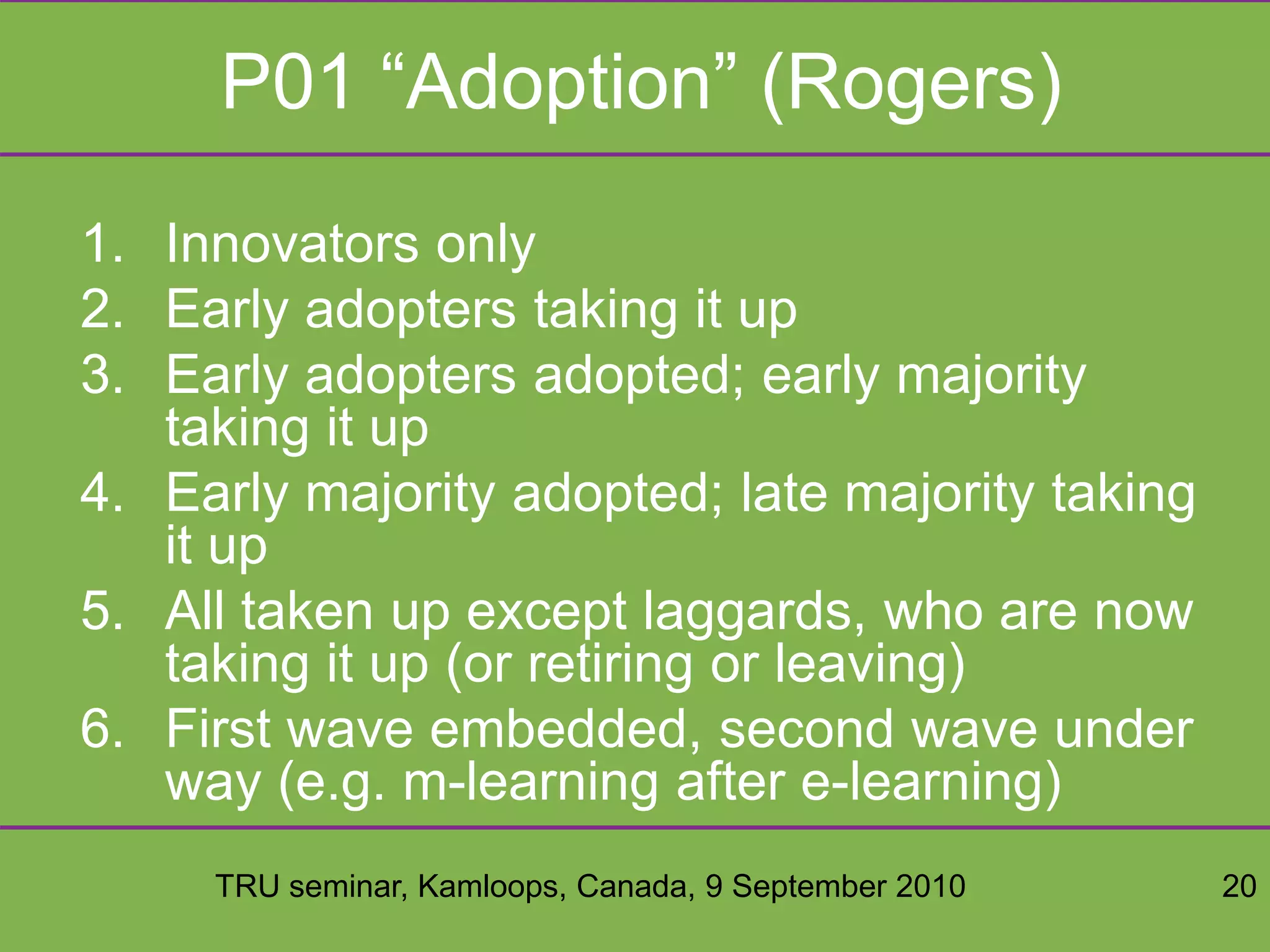
P01 “Adoption” (Rogers)
1. Innovators only
2. Early adopters taking it up
3. Early adopters adopted; early majority
taking it up
4. Early majority adopted; late majority taking
it up
5. All taken up except laggards, who are now
taking it up (or retiring or leaving)
6. First wave embedded, second wave under
way (e.g. m-learning after e-learning)
TRU seminar, Kamloops, Canada, 9 September 2010 21
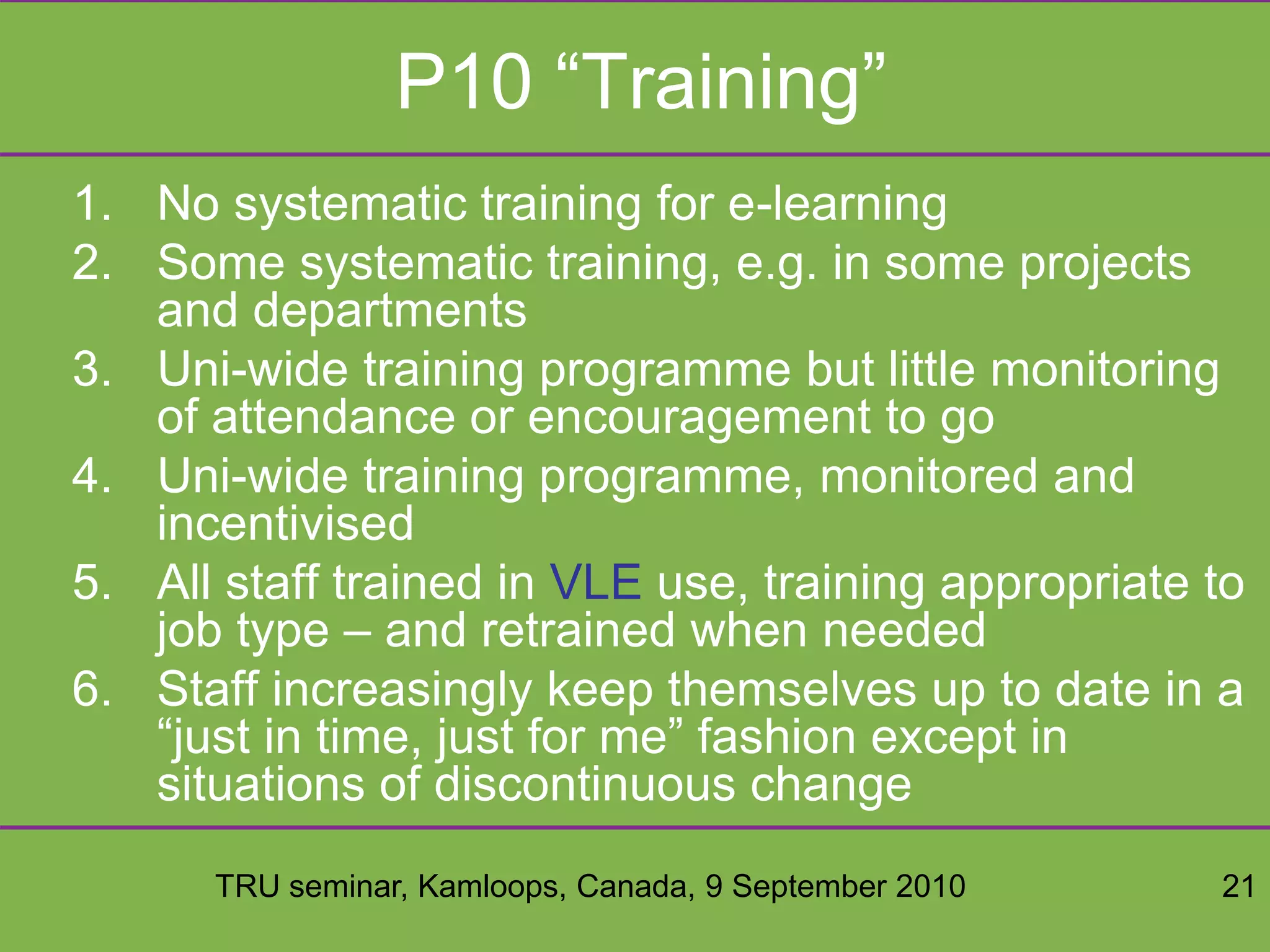
P10 “Training”
1. No systematic training for e-learning
2. Some systematic training, e.g. in some projects
and departments
3. Uni-wide training programme but little monitoring
of attendance or encouragement to go
4. Uni-wide training programme, monitored and
incentivised
5. All staff trained in VLE use, training appropriate to
job type – and retrained when needed
6. Staff increasingly keep themselves up to date in a
“just in time, just for me” fashion except in
situations of discontinuous change
TRU seminar, Kamloops, Canada, 9 September 2010 22
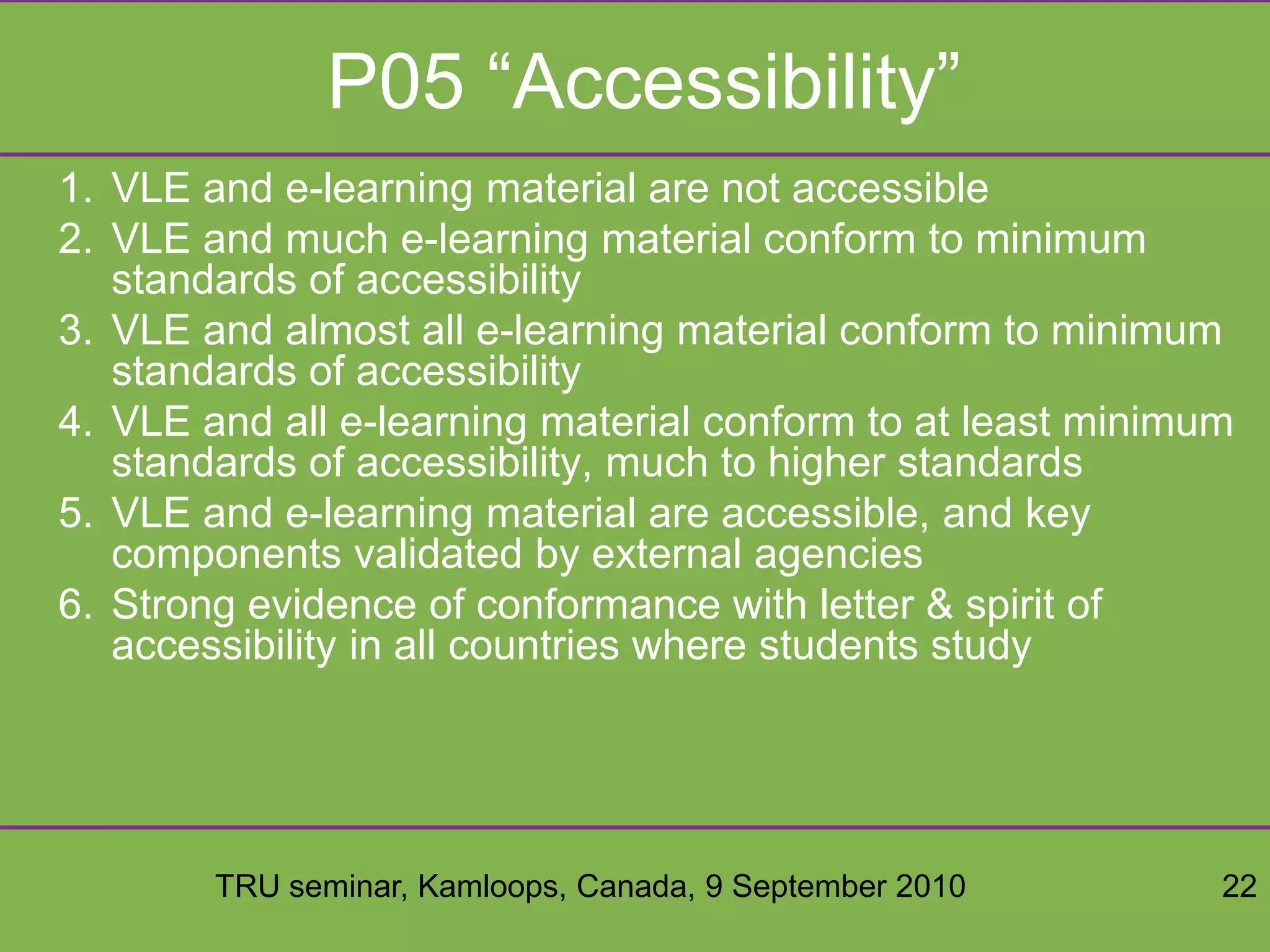
P05 “Accessibility”
1. VLE and e-learning material are not accessible
2. VLE and much e-learning material conform to minimum
standards of accessibility
3. VLE and almost all e-learning material conform to minimum
standards of accessibility
4. VLE and all e-learning material conform to at least minimum
standards of accessibility, much to higher standards
5. VLE and e-learning material are accessible, and key
components validated by external agencies
6. Strong evidence of conformance with letter & spirit of
accessibility in all countries where students study
TRU seminar, Kamloops, Canada, 9 September 2010 23
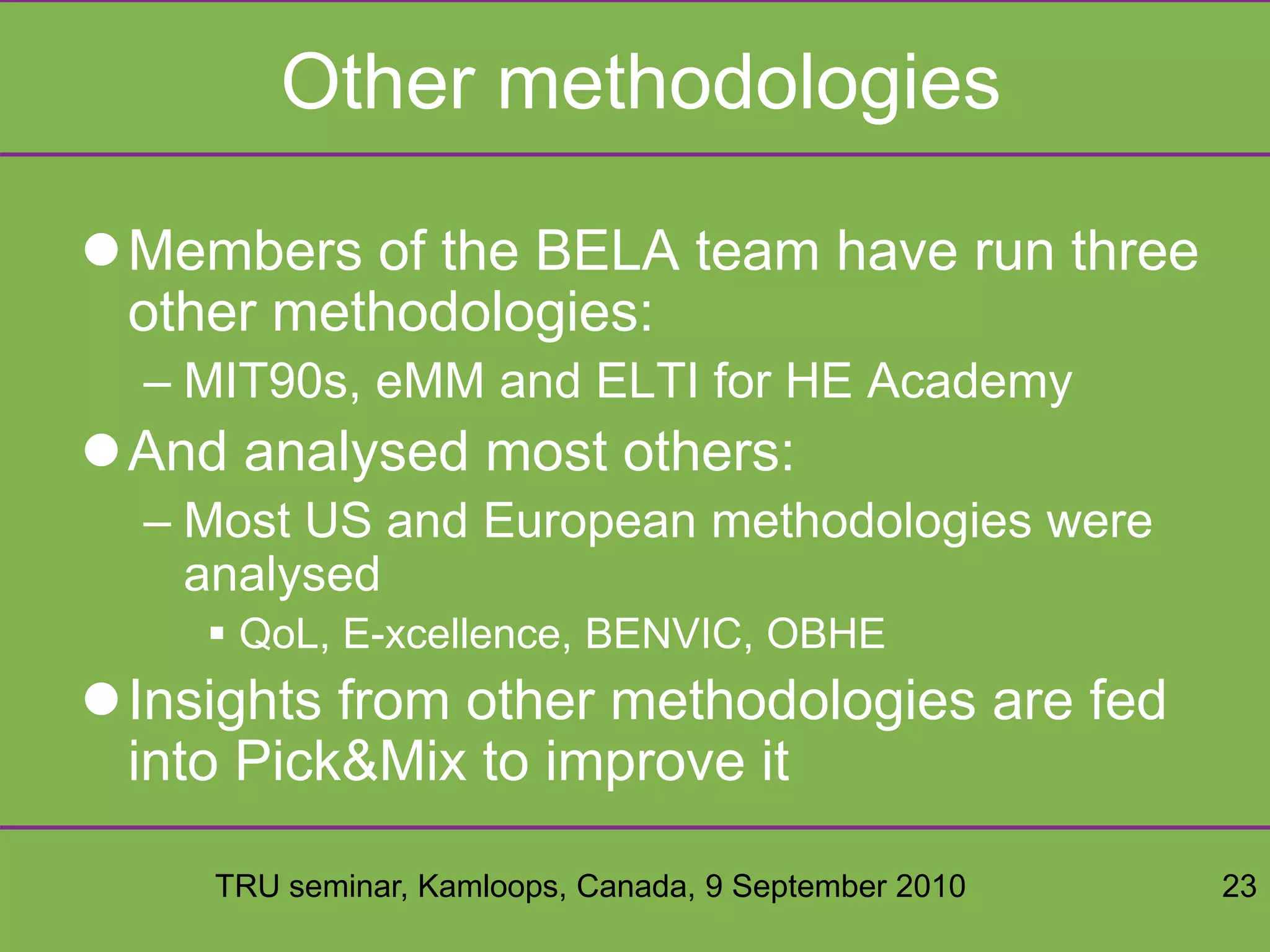
Other methodologies
Members of the BELA team have run three
other methodologies:
– MIT90s, eMM and ELTI for HE Academy
And analysed most others:
– Most US and European methodologies were
analysed
 QoL, E-xcellence, BENVIC, OBHE
Insights from other methodologies are fed
into Pick&Mix to improve it
TRU seminar, Kamloops, Canada, 9 September 2010 24
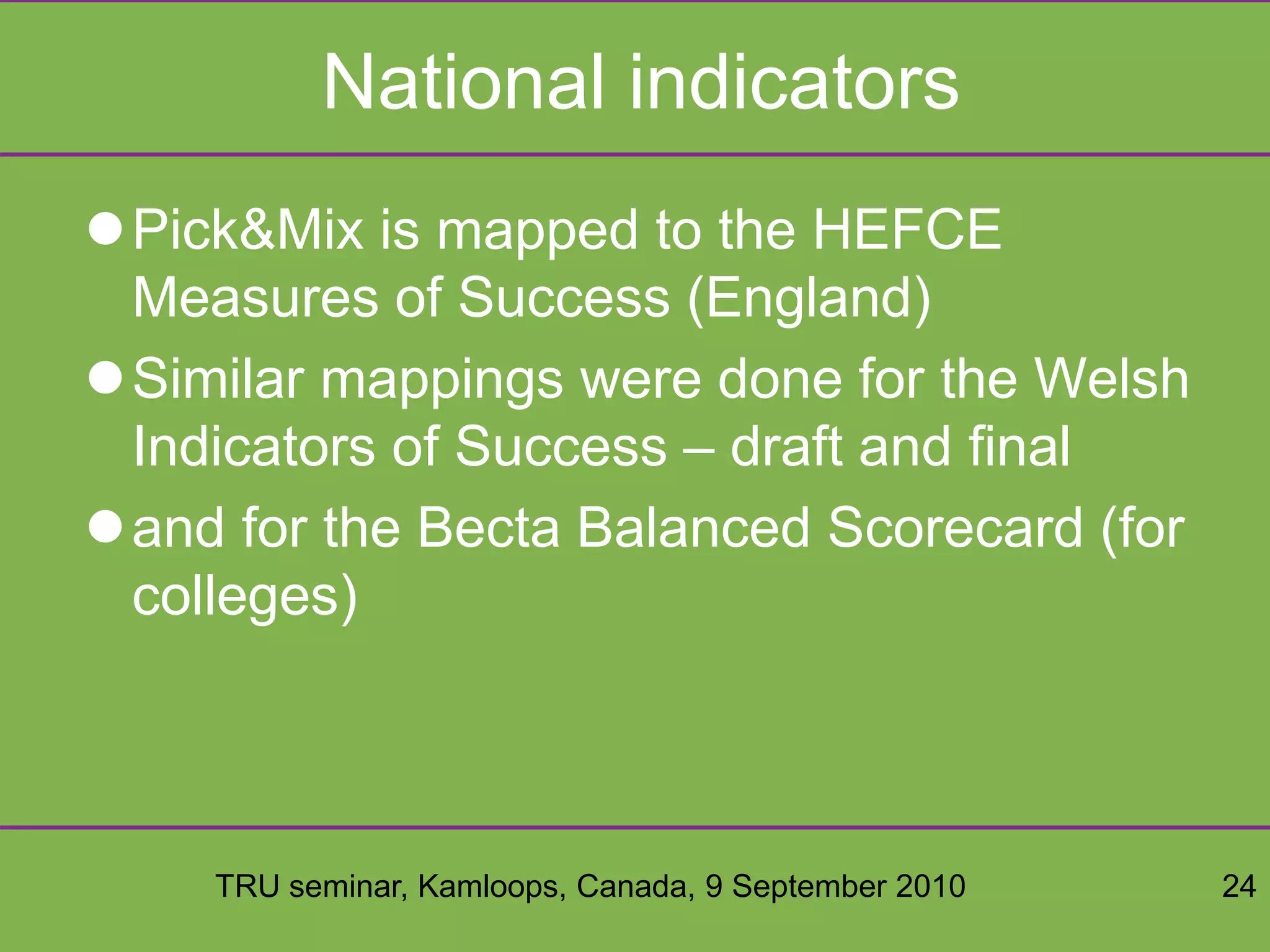
National indicators
Pick&Mix is mapped to the HEFCE
Measures of Success (England)
Similar mappings were done for the Welsh
Indicators of Success – draft and final
and for the Becta Balanced Scorecard (for
colleges)
TRU seminar, Kamloops, Canada, 9 September 2010 25
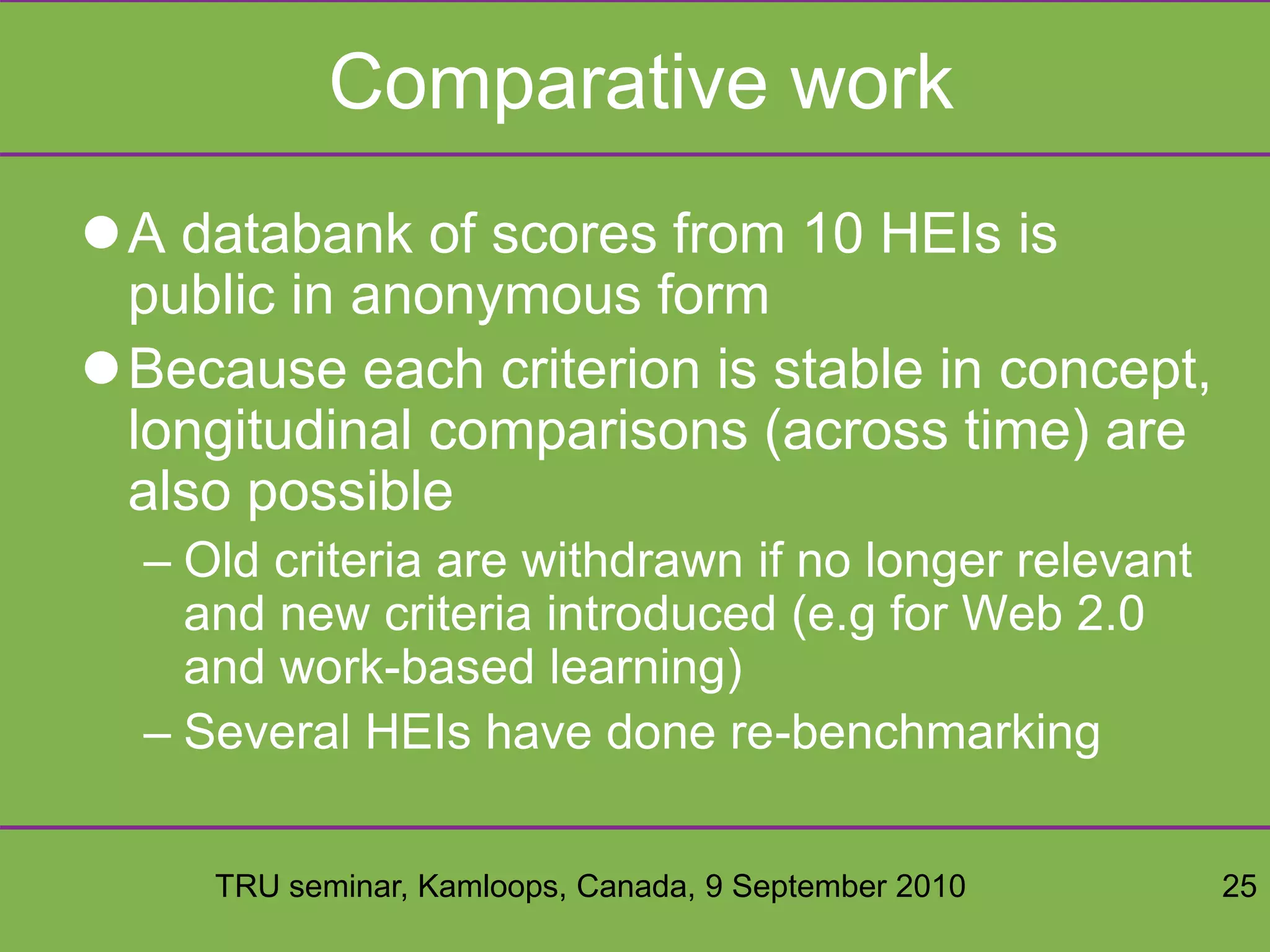
Comparative work
A databank of scores from 10 HEIs is
public in anonymous form
Because each criterion is stable in concept,
longitudinal comparisons (across time) are
also possible
– Old criteria are withdrawn if no longer relevant
and new criteria introduced (e.g for Web 2.0
and work-based learning)
– Several HEIs have done re-benchmarking
TRU seminar, Kamloops, Canada, 9 September 2010 26
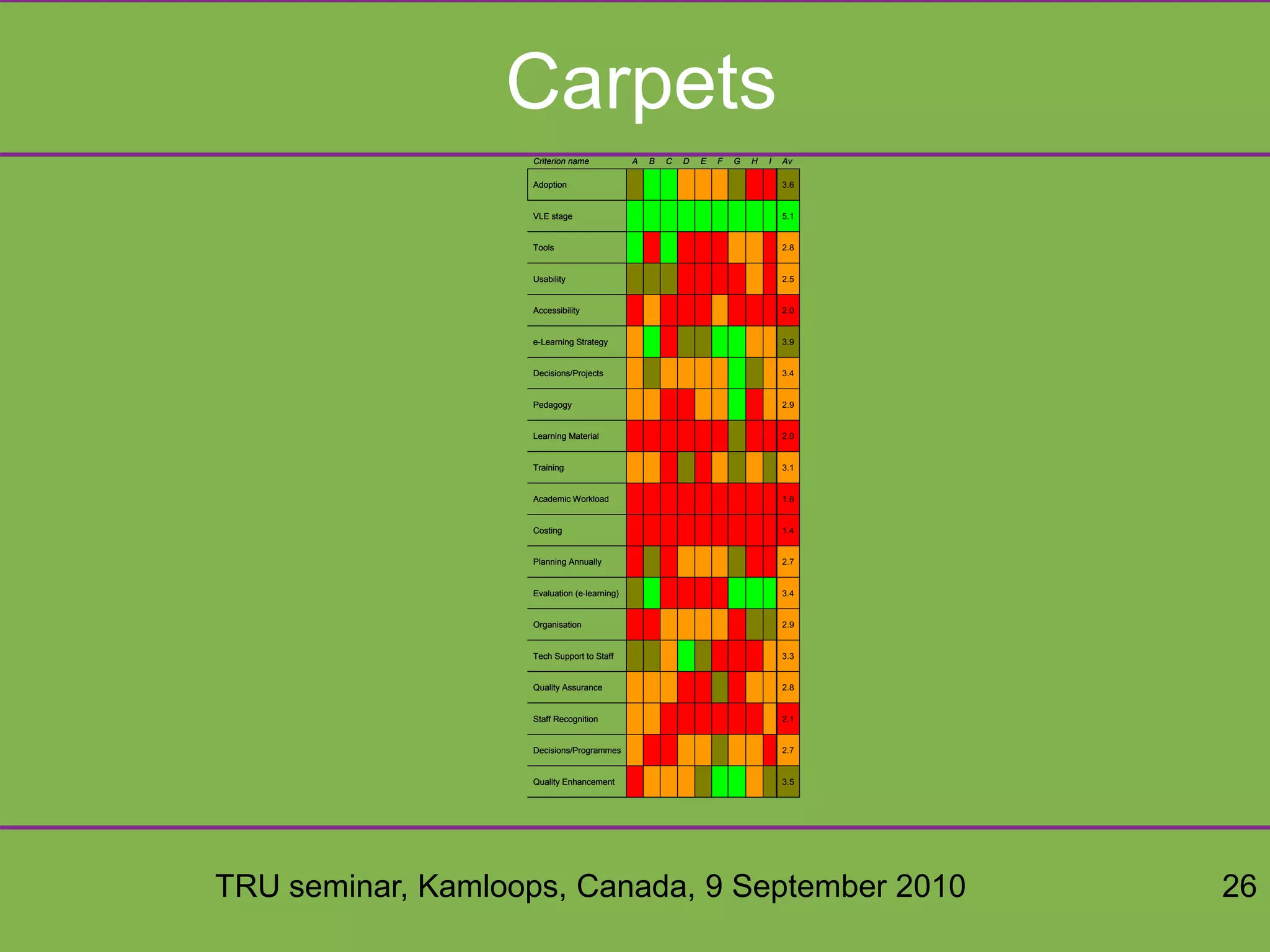
Carpets
3.5Quality Enhancement
2.7Decisions/Programmes
2.1Staff Recognition
2.8Quality Assurance
3.3Tech Support to Staff
2.9Organisation
3.4Evaluation (e-learning)
2.7Planning Annually
1.4Costing
1.6Academic Workload
3.1Training
2.0Learning Material
2.9Pedagogy
3.4Decisions/Projects
3.9e-Learning Strategy
2.0Accessibility
2.5Usability
2.8Tools
5.1VLE stage
3.6Adoption
AvIHGFEDCBACriterion name
3.5Quality Enhancement
2.7Decisions/Programmes
2.1Staff Recognition
2.8Quality Assurance
3.3Tech Support to Staff
2.9Organisation
3.4Evaluation (e-learning)
2.7Planning Annually
1.4Costing
1.6Academic Workload
3.1Training
2.0Learning Material
2.9Pedagogy
3.4Decisions/Projects
3.9e-Learning Strategy
2.0Accessibility
2.5Usability
2.8Tools
5.1VLE stage
3.6Adoption
AvIHGFEDCBACriterion name
TRU seminar, Kamloops, Canada, 9 September 2010 27
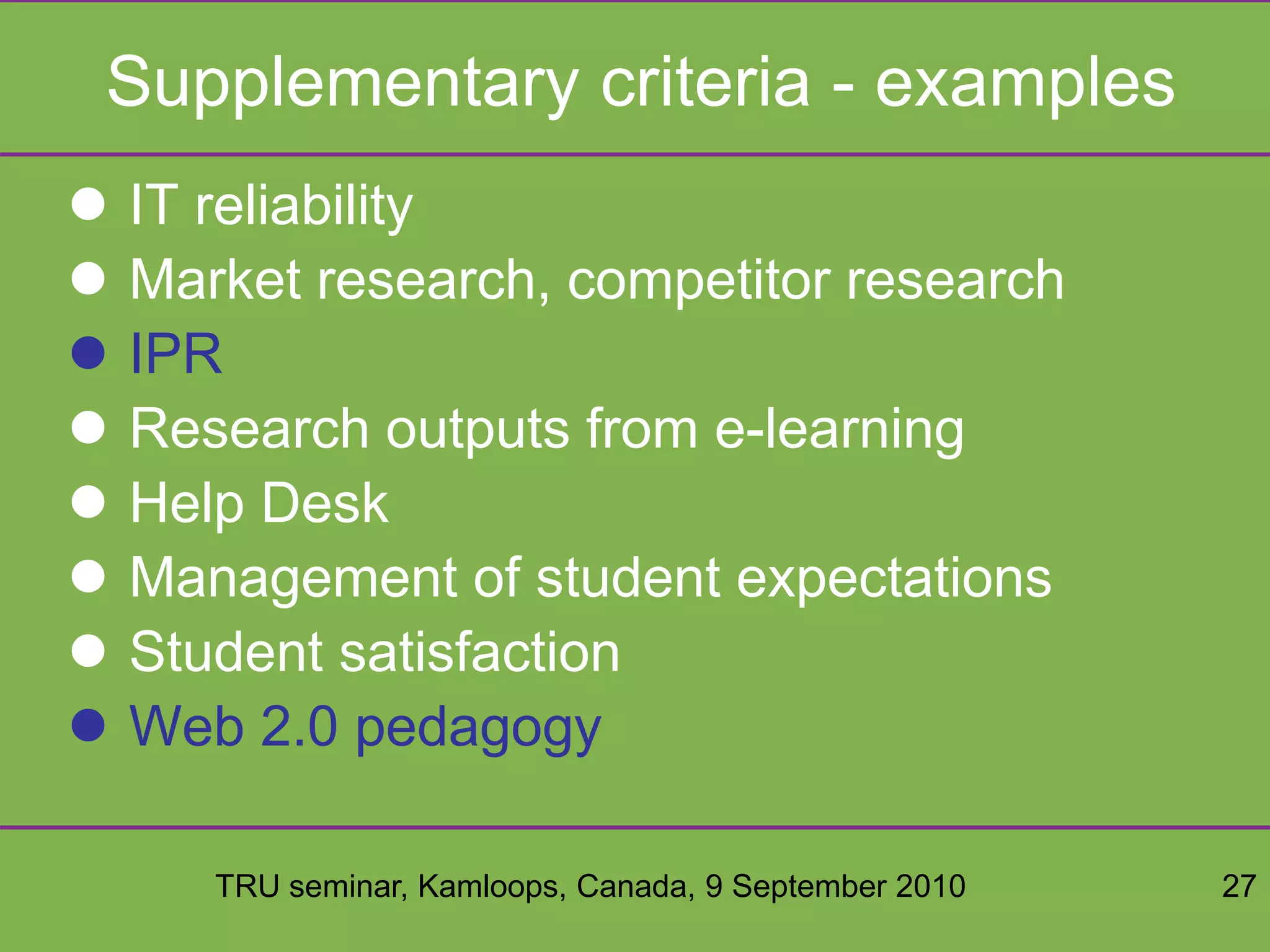
Supplementary criteria - examples
 IT reliability
 Market research, competitor research
 IPR
 Research outputs from e-learning
 Help Desk
 Management of student expectations
 Student satisfaction
 Web 2.0 pedagogy
TRU seminar, Kamloops, Canada, 9 September 2010 28
Local criteria
Institutions can track their own “local
criteria”
But this is rarely done
– It is actually very hard to craft good criterion
statements
TRU seminar, Kamloops, Canada, 9 September 2010 29
Slices (departments etc)
 As well as benchmarking the whole institution, it
is wise to look at a few “slices”:
 Schools, Faculties,, Programmes…
 Useful to give a context to scores
 Do not do too many
 Slices need not be organisational
– Distance learning…
– Thematic or dimensional slices like HR, costs…
 Most other systems also now use this approach
TRU seminar, Kamloops, Canada, 9 September 2010 30
Evidence and Process
Iterative Self-Review
for public criterion systems
TRU seminar, Kamloops, Canada, 9 September 2010 31
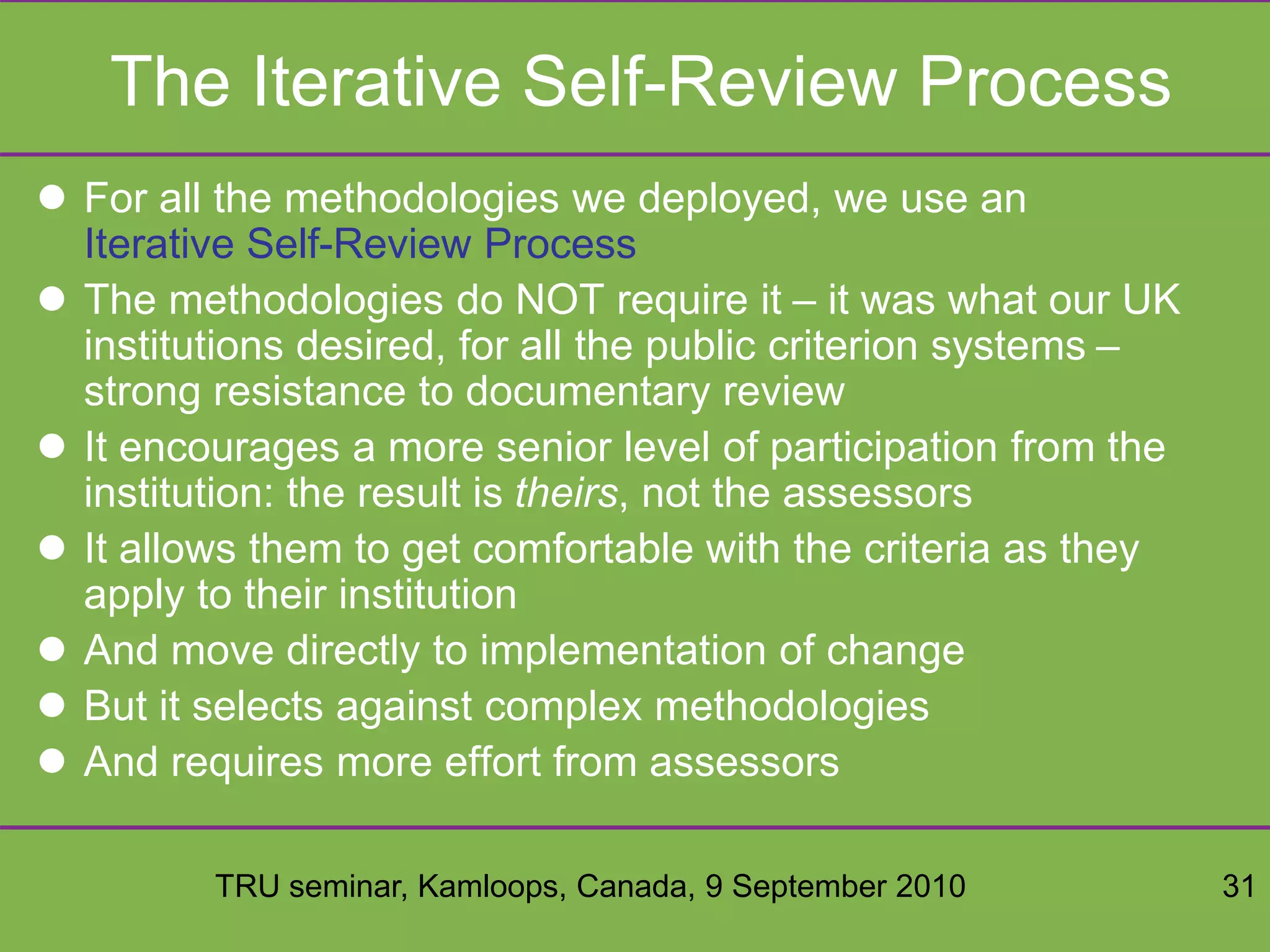
The Iterative Self-Review Process
 For all the methodologies we deployed, we use an
Iterative Self-Review Process
 The methodologies do NOT require it – it was what our UK
institutions desired, for all the public criterion systems –
strong resistance to documentary review
 It encourages a more senior level of participation from the
institution: the result is theirs, not the assessors
 It allows them to get comfortable with the criteria as they
apply to their institution
 And move directly to implementation of change
 But it selects against complex methodologies
 And requires more effort from assessors
TRU seminar, Kamloops, Canada, 9 September 2010 32
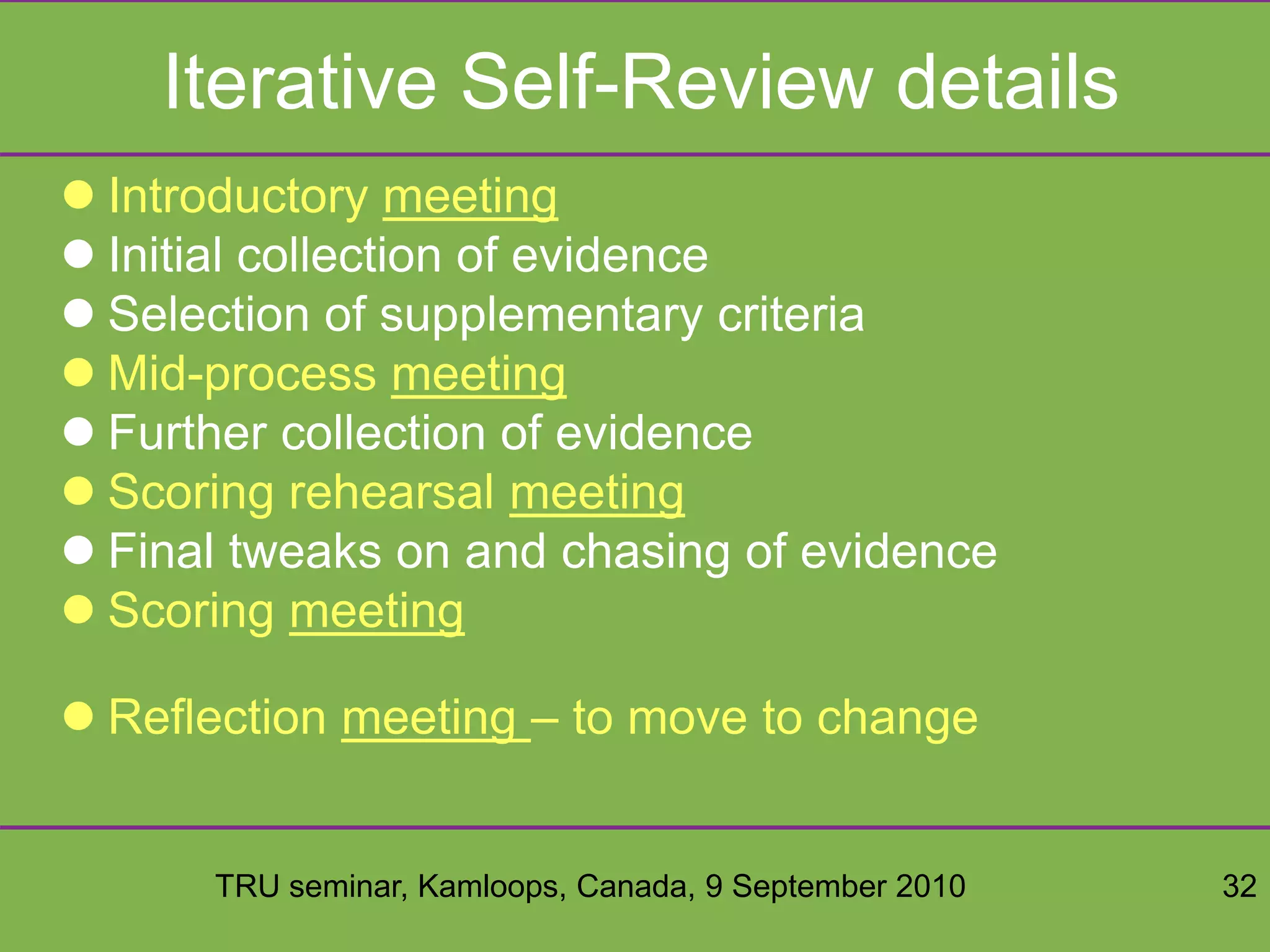
Iterative Self-Review details
 Introductory meeting
 Initial collection of evidence
 Selection of supplementary criteria
 Mid-process meeting
 Further collection of evidence
 Scoring rehearsal meeting
 Final tweaks on and chasing of evidence
 Scoring meeting
 Reflection meeting – to move to change
TRU seminar, Kamloops, Canada, 9 September 2010 33
How to handle evidence
Have a “file” for each criterion
Institutions normally group criteria
according to their own L&T strategy or in
terms of “owning” departments
– We also supply some standard groupings, e.g.
based on MIT90s, but few use these
TRU seminar, Kamloops, Canada, 9 September 2010 34
Peer review
Peer review exists in the Iterated Self
Review model:
– Specialist assessors (normally two nowadays)
have experience in the sector
– Often, the benchmarking is done in a
benchmarking cohort and the leaders of each
HEI in the cohort form a peer group
TRU seminar, Kamloops, Canada, 9 September 2010 35
Distance Learning
Benchmarking Club
A work package in the JISC Curriculum
Delivery project DUCKLING at the
University of Leicester
A number (7) of institutions in UK and
beyond will be benchmarked this year
– And again next year (Sept-Oct 2010)
– The aim is to baseline and then measure
incremental progress in e-learning
TRU seminar, Kamloops, Canada, 9 September 2010 36
Re.ViCa
(Review of Virtual Campuses)
 Project supported by the European Union under the Lifelong
Learning Programme - Erasmus/Virtual Campus
– With International Advisory Committee
 Database of countries, agencies and Programmes (500)
 Nine case studies
 Set of 17 Critical Success Factors developed after wide
international consultation – now embedded in Pick&Mix scheme
 Organised post-secondary e-learning initiatives are found
across the “G-100” (all except the Least Developed Countries)
TRU seminar, Kamloops, Canada, 9 September 2010 37
Members
University of Leicester (UK)
University of Liverpool (UK)
University of Southern Queensland
(Australia)
Massey University (NZ)
Thompson Rivers University (Canada)
Lund University (Sweden)
KTH (Sweden)
TRU seminar, Kamloops, Canada, 9 September 2010 38
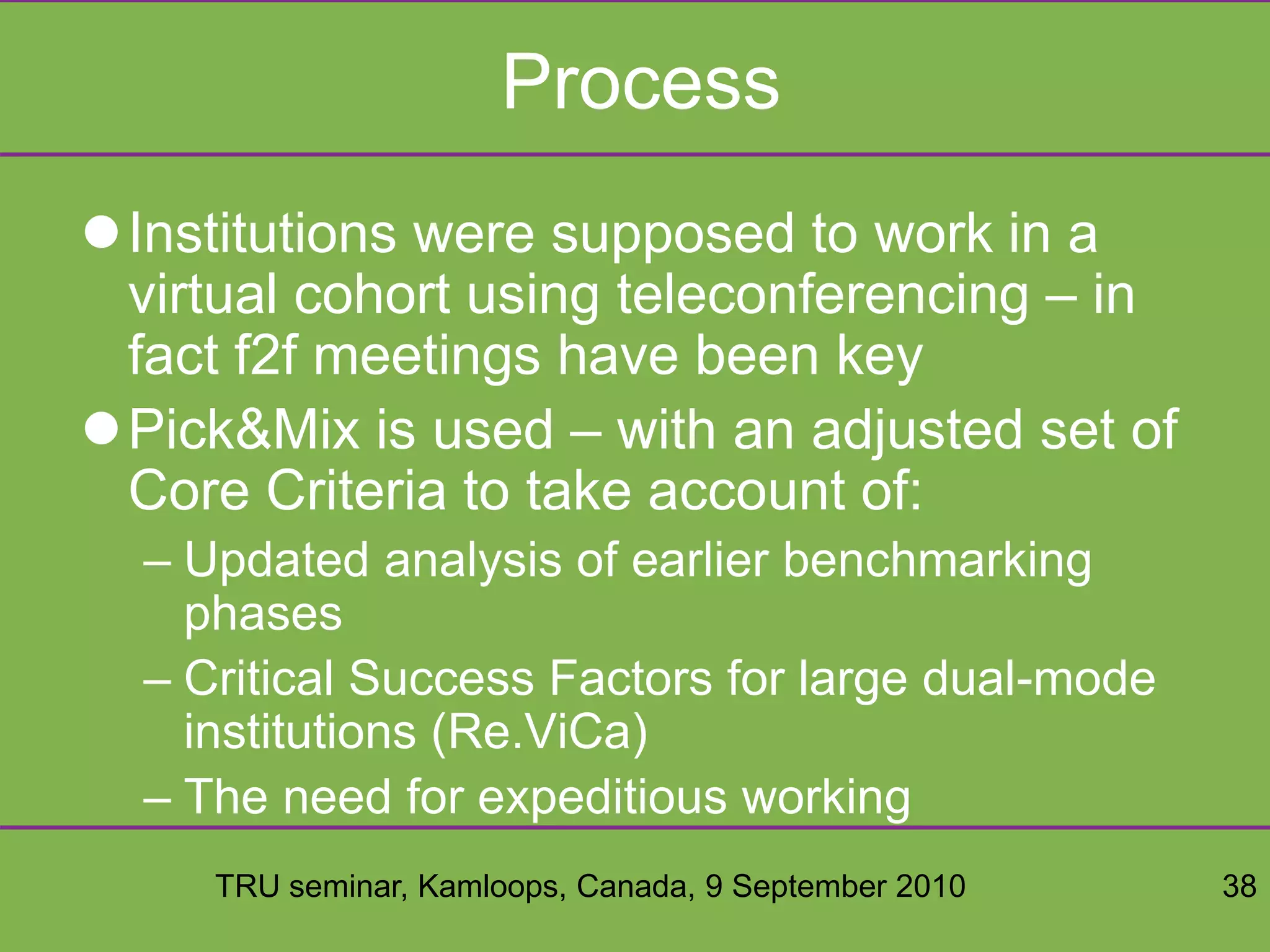
Process
Institutions were supposed to work in a
virtual cohort using teleconferencing – in
fact f2f meetings have been key
Pick&Mix is used – with an adjusted set of
Core Criteria to take account of:
– Updated analysis of earlier benchmarking
phases
– Critical Success Factors for large dual-mode
institutions (Re.ViCa)
– The need for expeditious working
TRU seminar, Kamloops, Canada, 9 September 2010 39
4. Implications for
QA in e-learning
My thoughts
(as proposed to ENQA in 2009)
TRU seminar, Kamloops, Canada, 9 September 2010 40
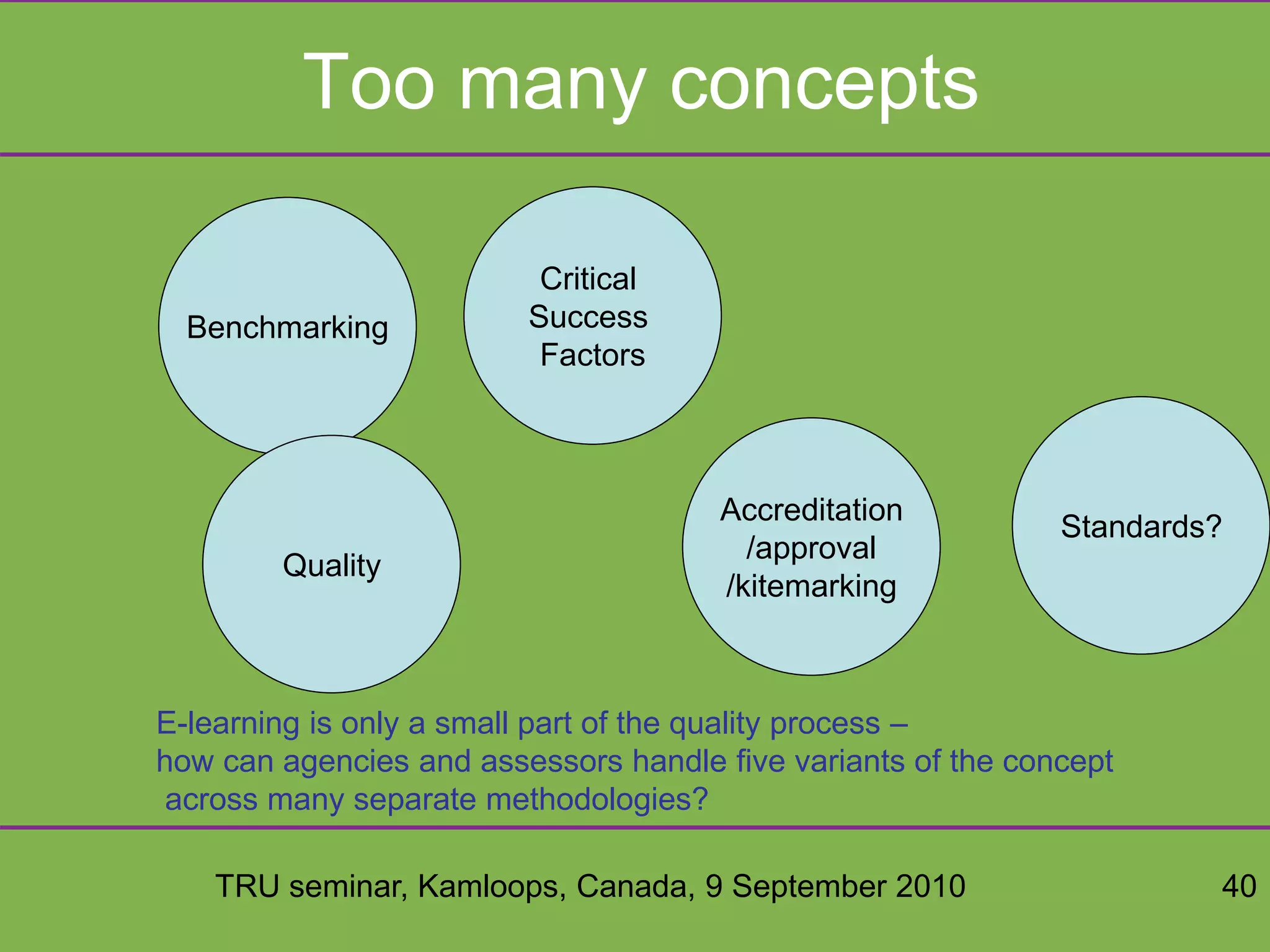
Too many concepts
Benchmarking
Standards?
Quality
Accreditation
/approval
/kitemarking
Critical
Success
Factors
E-learning is only a small part of the quality process –
how can agencies and assessors handle five variants of the concept
across many separate methodologies?
TRU seminar, Kamloops, Canada, 9 September 2010 41
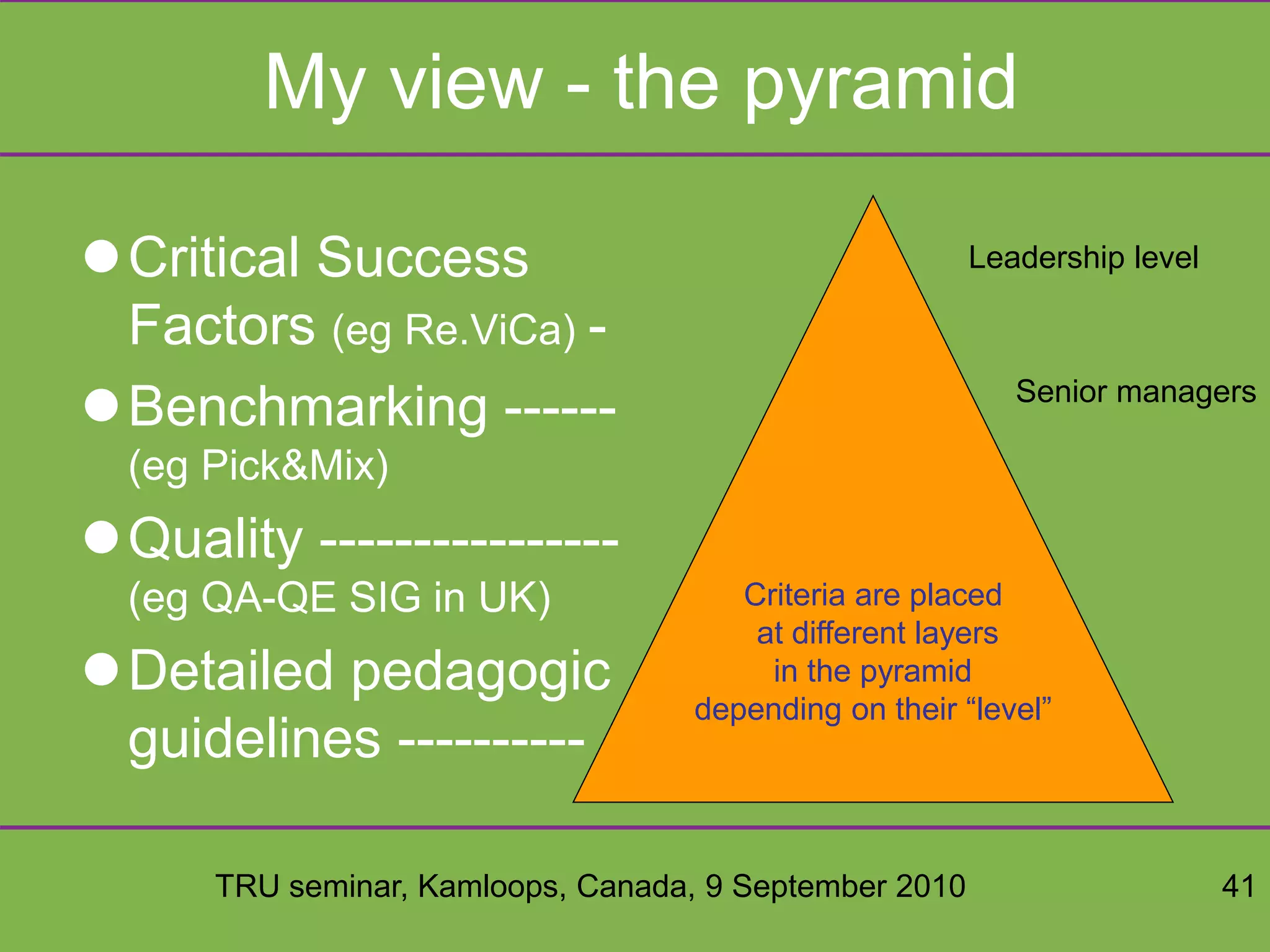
My view - the pyramid
Critical Success
Factors (eg Re.ViCa) -
Benchmarking ------
(eg Pick&Mix)
Quality ----------------
(eg QA-QE SIG in UK)
Detailed pedagogic
guidelines ----------
Criteria are placed
at different layers
in the pyramid
depending on their “level”
Leadership level
Senior managers
TRU seminar, Kamloops, Canada, 9 September 2010 42
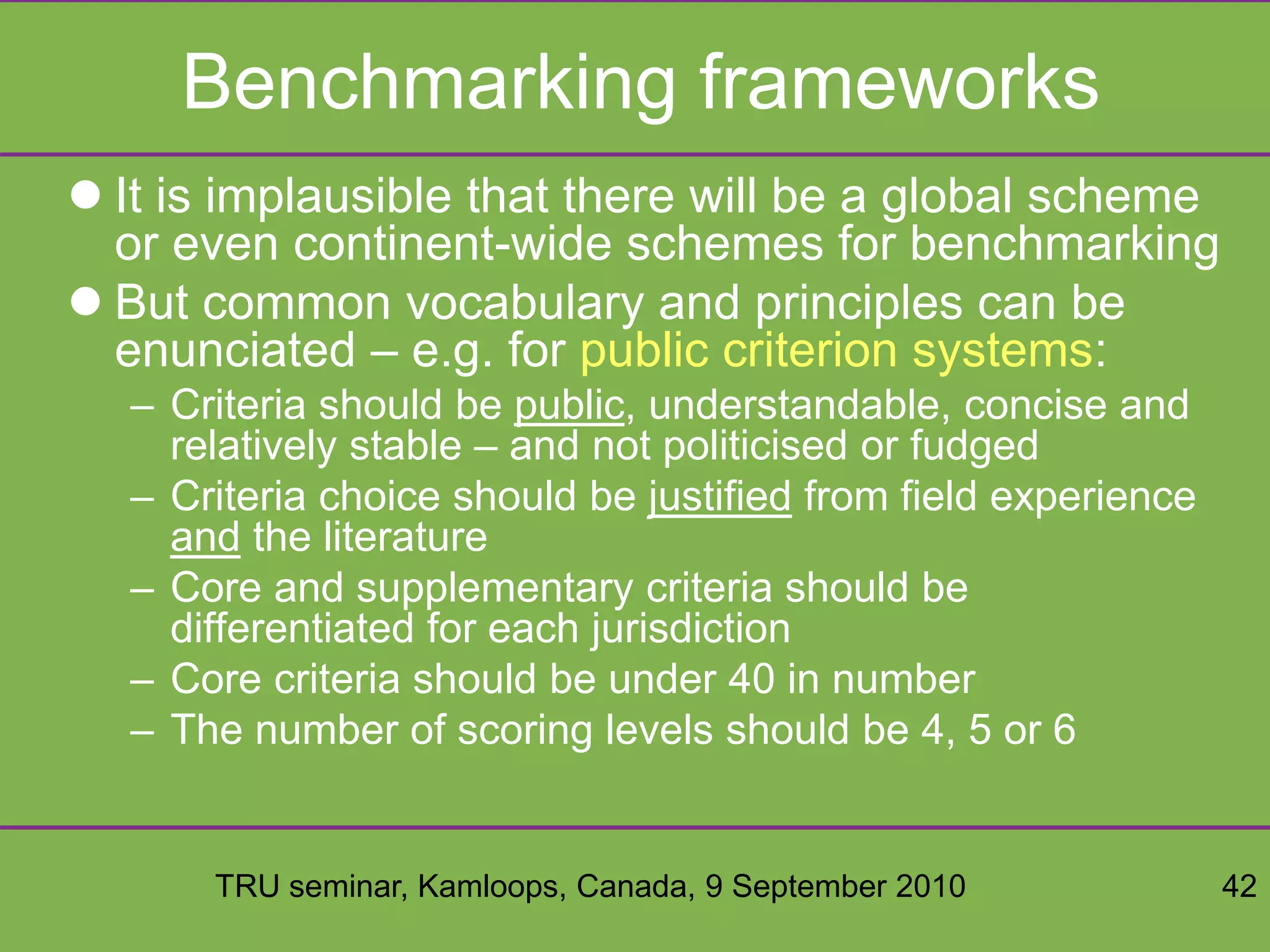
Benchmarking frameworks
 It is implausible that there will be a global scheme
or even continent-wide schemes for benchmarking
 But common vocabulary and principles can be
enunciated – e.g. for public criterion systems:
– Criteria should be public, understandable, concise and
relatively stable – and not politicised or fudged
– Criteria choice should be justified from field experience
and the literature
– Core and supplementary criteria should be
differentiated for each jurisdiction
– Core criteria should be under 40 in number
– The number of scoring levels should be 4, 5 or 6
TRU seminar, Kamloops, Canada, 9 September 2010 43
Concordances
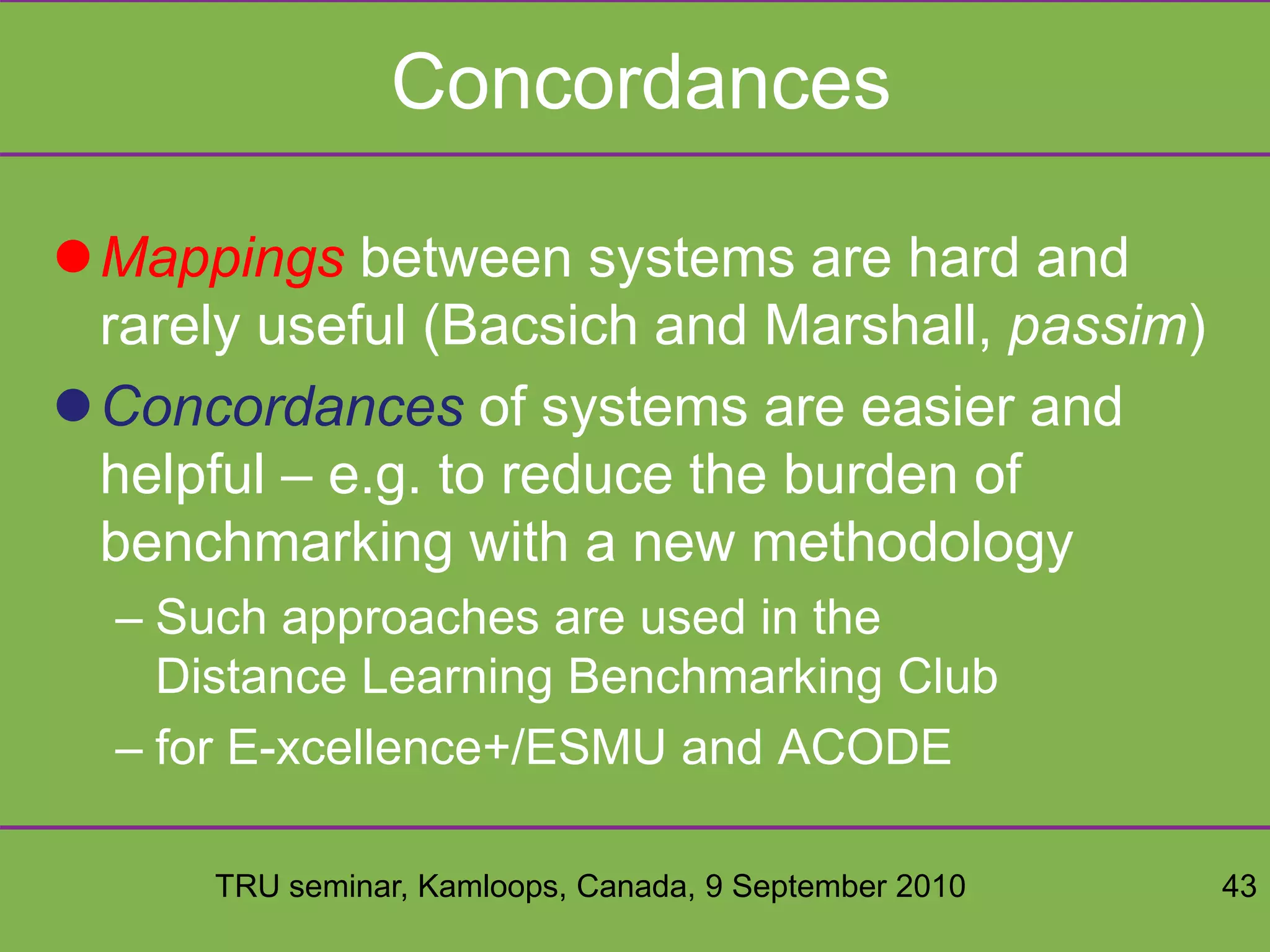
Mappings between systems are hard and
rarely useful (Bacsich and Marshall, passim)
Concordances of systems are easier and
helpful – e.g. to reduce the burden of
benchmarking with a new methodology
– Such approaches are used in the
Distance Learning Benchmarking Club
– for E-xcellence+/ESMU and ACODE
TRU seminar, Kamloops, Canada, 9 September 2010 44
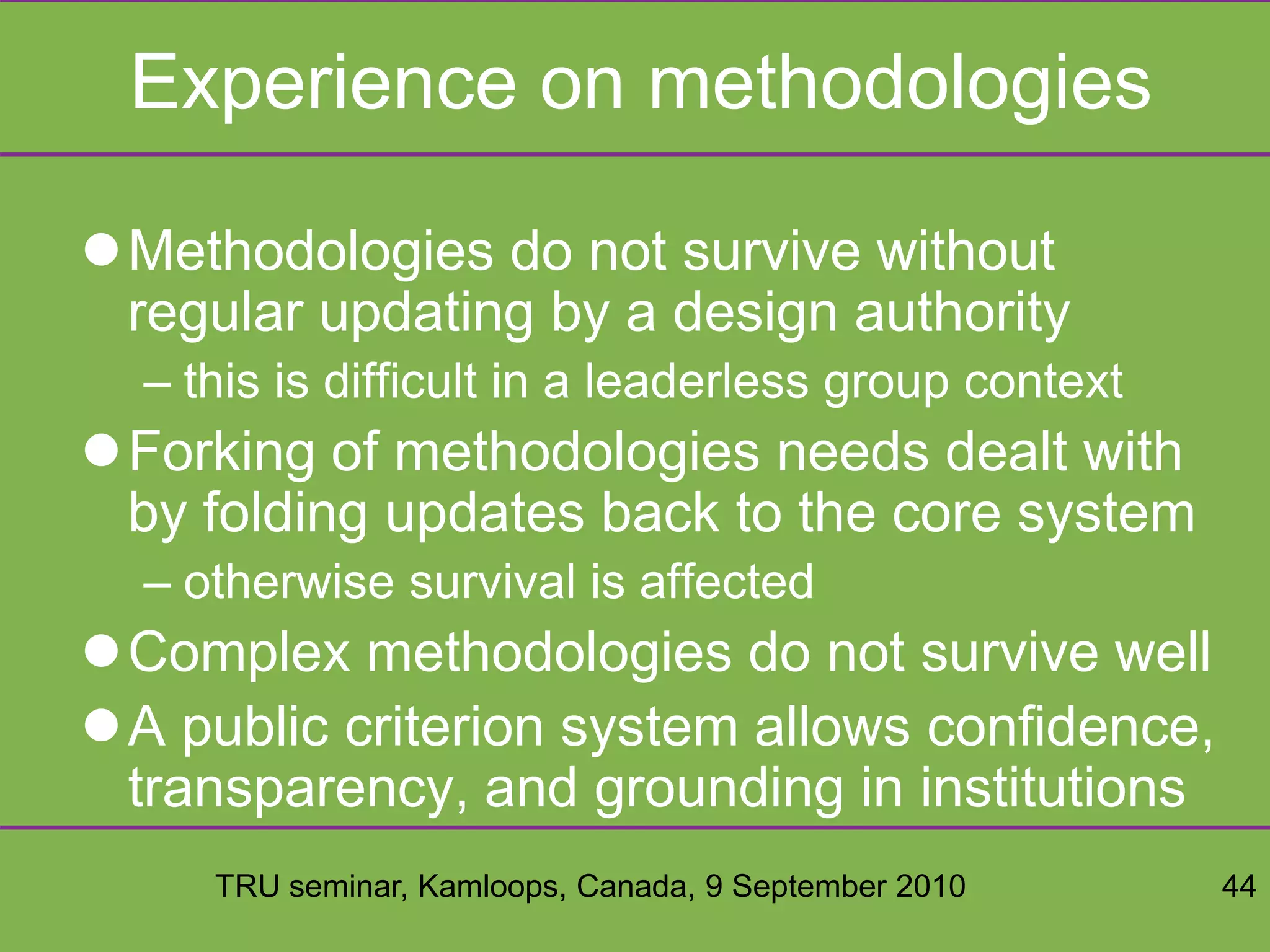
Experience on methodologies
Methodologies do not survive without
regular updating by a design authority
– this is difficult in a leaderless group context
Forking of methodologies needs dealt with
by folding updates back to the core system
– otherwise survival is affected
Complex methodologies do not survive well
A public criterion system allows confidence,
transparency, and grounding in institutions
TRU seminar, Kamloops, Canada, 9 September 2010 45
References
A key paper on the international aspects is
“BENCHMARKING E-LEARNING IN UK UNIVERSITIES:
LESSONS FROM AND FOR THE INTERNATIONAL CONTEXT”, in
Proceedings of the ICDE conference M-2009 at
http://www.ou.nl/Docs/Campagnes/ICDE2009/Papers/Final_Paper_338Bacsich.pdf.
A specific chapter on the UK HE benchmarking programme methodologies is:
“Benchmarking e-learning in UK universities – the methodologies”, in
Mayes, J.T., Morrison, D., Bullen, P., Mellar, H., and Oliver, M.(Eds.)
Transformation in Higher Education through Technology-Enhanced Learning,
York: Higher Education Academy, 2009
http://elearning.heacademy.ac.uk/wiki/index.php/Bibliography_of_benchmarking

Benchmarking-derived approaches to quality in e-learning

  • 1.
    TRU seminar, Kamloops,Canada, 9 September 2010 1 UK approaches to quality in e-learning views from the UK benchmarking programmes, Re.ViCa project on critical success factors and the Distance Learning Benchmarking Club Professor Paul Bacsich Matic Media Ltd
  • 2.
    TRU seminar, Kamloops,Canada, 9 September 2010 2 Topics 1. Introduction 2. The four phases of the UK HE Benchmarking Programme 3. More recent developments in UK HE benchmarking e-learning 4. Implications for schemes on Quality of e-Learning
  • 3.
    TRU seminar, Kamloops,Canada, 9 September 2010 3 1. Introduction
  • 4.
    TRU seminar, Kamloops,Canada, 9 September 2010 4 The requirement from ICDE/Athabasca/ Alberta Quality Council To produce an up to date set of guidelines for quality in e-learning, focussed on the needs of providers of distance e-learning, and taking into account developments in other provinces, (nearby) nations of the world, and international projects
  • 5.
    TRU seminar, Kamloops,Canada, 9 September 2010 5 2. The four phases of the UK HE Benchmarking Programme an overview
  • 6.
    TRU seminar, Kamloops,Canada, 9 September 2010 6 Benchmarking e-learning  At national level, started in UK and New Zealand – Soon spread to Australia – Not closely linked initially to quality agenda  At European level, developments include E-xcellence and UNIQUe – Some earlier work from OBHE, ESMU etc – but not in “public criterion” mode – Later, developments in other projects – Increasingly, links made to quality agenda
  • 7.
    TRU seminar, Kamloops,Canada, 9 September 2010 7 Benchmarking e-learning (UK)  Foreseen in HEFCE e-learning strategy 2005  Higher Education Academy (HEA) oversaw it  Four phases – 82 institutions – 5 methodologies  Two consultant teams – BELA and OBHE  Justified entry to HEA Pathfinder and Enhancement National initiatives - and useful for JISC initiatives also (Curriculum Design etc)  Can be leveraged into update of learning and teaching strategy (e.g. Leicester U)
  • 8.
    TRU seminar, Kamloops,Canada, 9 September 2010 8 Documentation – very good  HE Academy reports on benchmarking  Evaluator reports on each phase  Consultant team reports on each phase  Conference papers (EADTU/ICDE each year – and ALT-C etc)  Definitive book chapter (to appear)  HE Academy blog and wiki (web 2.0)  Specific HEI blogs and some public reports  http://elearning.heacademy.ac.uk/wiki/index.php/ Bibliography_of_benchmarking
  • 9.
    TRU seminar, Kamloops,Canada, 9 September 2010 9 UK: benchmarking e-learning “Possibly more important is for us [HEFCE] to help individual institutions understand their own positions on e-learning, to set their aspirations and goals for embedding e-learning – and then to benchmark themselves and their progress against institutions with similar goals, and across the sector”
  • 10.
    TRU seminar, Kamloops,Canada, 9 September 2010 10 Methodologies in UK HE  There were five methodologies used in UK but only two now have public criteria, are routinely updated and are available for single institutions (to use outside consortia):  Pick&Mix – Used under HEA auspices in 24 UK institutions – Including 4 diverse institutions in Wales – Now being used in a further UK HEI and one in Australia – About to be used by the 7-institution Distance Learning Benchmarking Club (UK, Sweden, Australia, Canada, New Zealand)  eMM – as used in New Zealand and Australia
  • 11.
    TRU seminar, Kamloops,Canada, 9 September 2010 11 Pick&Mix overview  Focussed on e-learning, not general pedagogy  Draws on several sources and methodologies – UK and internationally (including US) and from college sector  Not linked to any particular style of e-learning (e.g. distance or on-campus or blended)  Oriented to institutions with notable activity in e-learning  Suitable for desk research as well as “in-depth” studies  Suitable for single- and multi-institution studies
  • 12.
    TRU seminar, Kamloops,Canada, 9 September 2010 12 Pick&Mix history  Initial version developed in early 2005 in response to a request from Manchester Business School for an international competitor study  Since then, refined by literature search, discussion, feedback, presentations, workshops, concordance studies and four phases of use – fifth and sixth phases now  Forms the basis of the current wording of the Critical Success Factors scheme for the EU Re.ViCa project
  • 13.
    TRU seminar, Kamloops,Canada, 9 September 2010 13 Pick&Mix Criteria and metrics
  • 14.
    TRU seminar, Kamloops,Canada, 9 September 2010 14 Criteria  Criteria are “statements of practice” which are scored into a number of performance levels from bad/nil to excellent  It is wisest if these statements are in the public domain – to allow analysis & refinement  The number of criteria is crucial  Pick&Mix currently has a core of 20 – based on analysis from the literature (ABC, BS etc) and experience in many senior mgt scoring meetings
  • 15.
    TRU seminar, Kamloops,Canada, 9 September 2010 15 Pick&Mix: 20 core criteria  Removed any not specific to e-learning – Including those in general quality schemes (QAA in UK)  Careful about any which are not provably success factors  Left out of the core were some criteria where there was not yet UK consensus  Institutions will wish to add some to monitor their KPIs and objectives. Recommended no more than 6. – Pick&Mix now has over 70 supplementary criteria to choose from – more can be constructed or taken from other schemes  These 20 have stood the test of four phases of benchmarking with only minor changes of wording – originally 18 - two were split to make 20
  • 16.
    TRU seminar, Kamloops,Canada, 9 September 2010 16 Pick&Mix Scoring Use a 6-point scale (1-6) – 5 (cf Likert, MIT90s levels) plus 1 more for “excellence” Contextualised by “scoring commentary” There are always issues of judging progress especially “best practice” The 6 levels are mapped to 4 colours in a “traffic lights” system – red, amber, olive, green
  • 17.
    TRU seminar, Kamloops,Canada, 9 September 2010 17 Pick&Mix System: summary Has taken account of “best of breed” schemes Output and student-oriented aspects Methodology-agnostic but uses underlying approaches where useful (e.g. Chickering & Gamson, Quality on the Line, MIT90s) Requires no long training course to understand
  • 18.
    TRU seminar, Kamloops,Canada, 9 September 2010 18 Institutional competences  University of Leicester used Pick&Mix in the very first phase of the HEA programme – And two phases of re-benchmarking  Other universities with strong competence (with approved HEA Consultants) are University of Derby and University of Chester  Several other universities have done excellent work and produced public papers and reports (e.g. Northumbria, Worcester)
  • 19.
    TRU seminar, Kamloops,Canada, 9 September 2010 19 Pick&Mix Three sample criteria
  • 20.
    TRU seminar, Kamloops,Canada, 9 September 2010 20 P01 “Adoption” (Rogers) 1. Innovators only 2. Early adopters taking it up 3. Early adopters adopted; early majority taking it up 4. Early majority adopted; late majority taking it up 5. All taken up except laggards, who are now taking it up (or retiring or leaving) 6. First wave embedded, second wave under way (e.g. m-learning after e-learning)
  • 21.
    TRU seminar, Kamloops,Canada, 9 September 2010 21 P10 “Training” 1. No systematic training for e-learning 2. Some systematic training, e.g. in some projects and departments 3. Uni-wide training programme but little monitoring of attendance or encouragement to go 4. Uni-wide training programme, monitored and incentivised 5. All staff trained in VLE use, training appropriate to job type – and retrained when needed 6. Staff increasingly keep themselves up to date in a “just in time, just for me” fashion except in situations of discontinuous change
  • 22.
    TRU seminar, Kamloops,Canada, 9 September 2010 22 P05 “Accessibility” 1. VLE and e-learning material are not accessible 2. VLE and much e-learning material conform to minimum standards of accessibility 3. VLE and almost all e-learning material conform to minimum standards of accessibility 4. VLE and all e-learning material conform to at least minimum standards of accessibility, much to higher standards 5. VLE and e-learning material are accessible, and key components validated by external agencies 6. Strong evidence of conformance with letter & spirit of accessibility in all countries where students study
  • 23.
    TRU seminar, Kamloops,Canada, 9 September 2010 23 Other methodologies Members of the BELA team have run three other methodologies: – MIT90s, eMM and ELTI for HE Academy And analysed most others: – Most US and European methodologies were analysed  QoL, E-xcellence, BENVIC, OBHE Insights from other methodologies are fed into Pick&Mix to improve it
  • 24.
    TRU seminar, Kamloops,Canada, 9 September 2010 24 National indicators Pick&Mix is mapped to the HEFCE Measures of Success (England) Similar mappings were done for the Welsh Indicators of Success – draft and final and for the Becta Balanced Scorecard (for colleges)
  • 25.
    TRU seminar, Kamloops,Canada, 9 September 2010 25 Comparative work A databank of scores from 10 HEIs is public in anonymous form Because each criterion is stable in concept, longitudinal comparisons (across time) are also possible – Old criteria are withdrawn if no longer relevant and new criteria introduced (e.g for Web 2.0 and work-based learning) – Several HEIs have done re-benchmarking
  • 26.
    TRU seminar, Kamloops,Canada, 9 September 2010 26 Carpets 3.5Quality Enhancement 2.7Decisions/Programmes 2.1Staff Recognition 2.8Quality Assurance 3.3Tech Support to Staff 2.9Organisation 3.4Evaluation (e-learning) 2.7Planning Annually 1.4Costing 1.6Academic Workload 3.1Training 2.0Learning Material 2.9Pedagogy 3.4Decisions/Projects 3.9e-Learning Strategy 2.0Accessibility 2.5Usability 2.8Tools 5.1VLE stage 3.6Adoption AvIHGFEDCBACriterion name 3.5Quality Enhancement 2.7Decisions/Programmes 2.1Staff Recognition 2.8Quality Assurance 3.3Tech Support to Staff 2.9Organisation 3.4Evaluation (e-learning) 2.7Planning Annually 1.4Costing 1.6Academic Workload 3.1Training 2.0Learning Material 2.9Pedagogy 3.4Decisions/Projects 3.9e-Learning Strategy 2.0Accessibility 2.5Usability 2.8Tools 5.1VLE stage 3.6Adoption AvIHGFEDCBACriterion name
  • 27.
    TRU seminar, Kamloops,Canada, 9 September 2010 27 Supplementary criteria - examples  IT reliability  Market research, competitor research  IPR  Research outputs from e-learning  Help Desk  Management of student expectations  Student satisfaction  Web 2.0 pedagogy
  • 28.
    TRU seminar, Kamloops,Canada, 9 September 2010 28 Local criteria Institutions can track their own “local criteria” But this is rarely done – It is actually very hard to craft good criterion statements
  • 29.
    TRU seminar, Kamloops,Canada, 9 September 2010 29 Slices (departments etc)  As well as benchmarking the whole institution, it is wise to look at a few “slices”:  Schools, Faculties,, Programmes…  Useful to give a context to scores  Do not do too many  Slices need not be organisational – Distance learning… – Thematic or dimensional slices like HR, costs…  Most other systems also now use this approach
  • 30.
    TRU seminar, Kamloops,Canada, 9 September 2010 30 Evidence and Process Iterative Self-Review for public criterion systems
  • 31.
    TRU seminar, Kamloops,Canada, 9 September 2010 31 The Iterative Self-Review Process  For all the methodologies we deployed, we use an Iterative Self-Review Process  The methodologies do NOT require it – it was what our UK institutions desired, for all the public criterion systems – strong resistance to documentary review  It encourages a more senior level of participation from the institution: the result is theirs, not the assessors  It allows them to get comfortable with the criteria as they apply to their institution  And move directly to implementation of change  But it selects against complex methodologies  And requires more effort from assessors
  • 32.
    TRU seminar, Kamloops,Canada, 9 September 2010 32 Iterative Self-Review details  Introductory meeting  Initial collection of evidence  Selection of supplementary criteria  Mid-process meeting  Further collection of evidence  Scoring rehearsal meeting  Final tweaks on and chasing of evidence  Scoring meeting  Reflection meeting – to move to change
  • 33.
    TRU seminar, Kamloops,Canada, 9 September 2010 33 How to handle evidence Have a “file” for each criterion Institutions normally group criteria according to their own L&T strategy or in terms of “owning” departments – We also supply some standard groupings, e.g. based on MIT90s, but few use these
  • 34.
    TRU seminar, Kamloops,Canada, 9 September 2010 34 Peer review Peer review exists in the Iterated Self Review model: – Specialist assessors (normally two nowadays) have experience in the sector – Often, the benchmarking is done in a benchmarking cohort and the leaders of each HEI in the cohort form a peer group
  • 35.
    TRU seminar, Kamloops,Canada, 9 September 2010 35 Distance Learning Benchmarking Club A work package in the JISC Curriculum Delivery project DUCKLING at the University of Leicester A number (7) of institutions in UK and beyond will be benchmarked this year – And again next year (Sept-Oct 2010) – The aim is to baseline and then measure incremental progress in e-learning
  • 36.
    TRU seminar, Kamloops,Canada, 9 September 2010 36 Re.ViCa (Review of Virtual Campuses)  Project supported by the European Union under the Lifelong Learning Programme - Erasmus/Virtual Campus – With International Advisory Committee  Database of countries, agencies and Programmes (500)  Nine case studies  Set of 17 Critical Success Factors developed after wide international consultation – now embedded in Pick&Mix scheme  Organised post-secondary e-learning initiatives are found across the “G-100” (all except the Least Developed Countries)
  • 37.
    TRU seminar, Kamloops,Canada, 9 September 2010 37 Members University of Leicester (UK) University of Liverpool (UK) University of Southern Queensland (Australia) Massey University (NZ) Thompson Rivers University (Canada) Lund University (Sweden) KTH (Sweden)
  • 38.
    TRU seminar, Kamloops,Canada, 9 September 2010 38 Process Institutions were supposed to work in a virtual cohort using teleconferencing – in fact f2f meetings have been key Pick&Mix is used – with an adjusted set of Core Criteria to take account of: – Updated analysis of earlier benchmarking phases – Critical Success Factors for large dual-mode institutions (Re.ViCa) – The need for expeditious working
  • 39.
    TRU seminar, Kamloops,Canada, 9 September 2010 39 4. Implications for QA in e-learning My thoughts (as proposed to ENQA in 2009)
  • 40.
    TRU seminar, Kamloops,Canada, 9 September 2010 40 Too many concepts Benchmarking Standards? Quality Accreditation /approval /kitemarking Critical Success Factors E-learning is only a small part of the quality process – how can agencies and assessors handle five variants of the concept across many separate methodologies?
  • 41.
    TRU seminar, Kamloops,Canada, 9 September 2010 41 My view - the pyramid Critical Success Factors (eg Re.ViCa) - Benchmarking ------ (eg Pick&Mix) Quality ---------------- (eg QA-QE SIG in UK) Detailed pedagogic guidelines ---------- Criteria are placed at different layers in the pyramid depending on their “level” Leadership level Senior managers
  • 42.
    TRU seminar, Kamloops,Canada, 9 September 2010 42 Benchmarking frameworks  It is implausible that there will be a global scheme or even continent-wide schemes for benchmarking  But common vocabulary and principles can be enunciated – e.g. for public criterion systems: – Criteria should be public, understandable, concise and relatively stable – and not politicised or fudged – Criteria choice should be justified from field experience and the literature – Core and supplementary criteria should be differentiated for each jurisdiction – Core criteria should be under 40 in number – The number of scoring levels should be 4, 5 or 6
  • 43.
    TRU seminar, Kamloops,Canada, 9 September 2010 43 Concordances Mappings between systems are hard and rarely useful (Bacsich and Marshall, passim) Concordances of systems are easier and helpful – e.g. to reduce the burden of benchmarking with a new methodology – Such approaches are used in the Distance Learning Benchmarking Club – for E-xcellence+/ESMU and ACODE
  • 44.
    TRU seminar, Kamloops,Canada, 9 September 2010 44 Experience on methodologies Methodologies do not survive without regular updating by a design authority – this is difficult in a leaderless group context Forking of methodologies needs dealt with by folding updates back to the core system – otherwise survival is affected Complex methodologies do not survive well A public criterion system allows confidence, transparency, and grounding in institutions
  • 45.
    TRU seminar, Kamloops,Canada, 9 September 2010 45 References A key paper on the international aspects is “BENCHMARKING E-LEARNING IN UK UNIVERSITIES: LESSONS FROM AND FOR THE INTERNATIONAL CONTEXT”, in Proceedings of the ICDE conference M-2009 at http://www.ou.nl/Docs/Campagnes/ICDE2009/Papers/Final_Paper_338Bacsich.pdf. A specific chapter on the UK HE benchmarking programme methodologies is: “Benchmarking e-learning in UK universities – the methodologies”, in Mayes, J.T., Morrison, D., Bullen, P., Mellar, H., and Oliver, M.(Eds.) Transformation in Higher Education through Technology-Enhanced Learning, York: Higher Education Academy, 2009 http://elearning.heacademy.ac.uk/wiki/index.php/Bibliography_of_benchmarking

Editor's Notes