BACK-OFFICE, FRONT-OFFICE, EFFICIENCY
CIPS WORKSHOP ON eOFFICE
Morten Meyerhoff Nielsen
TUT-RNS / democratise
HYDRABAD via skype (IN), 25 February 2016
AND EFFECTIVENESS
THE GORDIAN KNOT –
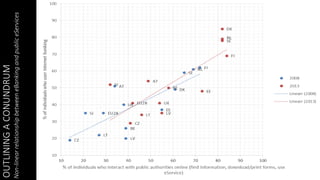
OUTLINING THE CONUNDRUM
ICT investments to date has not:
• Achieve the efficiency and effectiveness envisaged
• Public-sector governance model and multi-stakeholder
cooperation lacking
CONUNDRUM
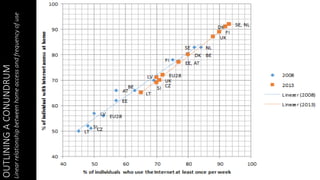
OUTLININGACONUNDRUM
Linearrelationshipbetweenhomeaccessandfrequencyofuse
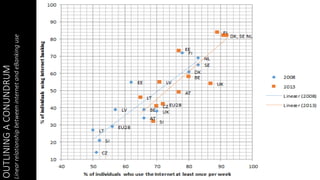
OUTLININGACONUNDRUM
LinearrelationshipbetweeninternetandeBankinguse
OUTLININGACONUNDRUM
Non-linearrelationshipbetweeneBankingandpubliceServices
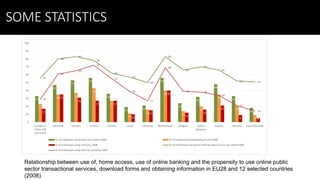
Relationship between use of, home access, use of online banking and the propensity to use online public
sector transactional services, download forms and obtaining information in EU28 and 12 selected countries
(2008)
SOME STATISTICS
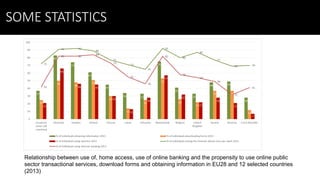
Relationship between use of, home access, use of online banking and the propensity to use online public
sector transactional services, download forms and obtaining information in EU28 and 12 selected countries
(2013)
SOME STATISTICS
THE GORDIAN KNOT –
CHALLENGES AND GOALS
EXEMPLES:
- More for less – but how?
- Growth and productivity – what is posible?
- Access, trust, quality – also remotely?
- No access, cannot, will not – is it a barrier?
THE STATE
BUT WHERE ARE WE HEADING?
GLOBALLY:
Letters, forms and e-mail -
papir is expensive!
Authorities are
”eliminating” paper.
Call centres and eServices
are better and 2 – 3.5 times
cheaper.
DENMARK:
Minimum requirement bans legal and burocratic language
use, ensure logical and recognisable design and security.
Results:
- 78% of bike thefts reported online.
- 88% of all adresse changes are digital.
- 98% of students registered for school online.
- 100% of tax returens er digitale.
Savings of € 110+ million annually when fully
implemented (DIGST & borger.dk, 2015).
ESTONIA:
Citizens can safely and securely access their
personlal data online – and what authorities have
seen and used their data (eesti.ee, 2015).
RULES STILL APPLY
DENMARK:
Reuse of data expected to save € 3 million in
government plus € 6.7 million in the private
sector annually when fully implented (DIGST &
Grunddata, 2015).
EUROPE:
Potential of BIG and OPEN data estimated to 1.9%
of GDP in 2020 - for 21 different sectors in the 28
EU countries (demosEUROPE & WISE Institute,
http://bit.ly/1oVe8Hj).
DATA CAN INCREASE EFFICIENCY AND LEAD
TO GROWTH
DIGITAL IDENTITY AND SIGNATURE IS KEY
FOR EASY, SECURY AND PERSONAL
SERVICE – AND CHEAPER
DIGITAL IDENTITY AND SIGNATURE IS KEY
FOR EASY, SECURY AND PERSONAL
SERVICE – AND CHEAPER
ESTONIA:
2% of GDP in annual socio-
economic benefits by eSignature
use (Gov. Office of Estonia, 2015).
DENMARK:
Over 90% of Danes have NemID and can
signe digitally.
Only 10.8% of Danes have requested an
excemption from Digital Post!
6 to 8.5 million digital messages to citizens
and businesses per month. Annual savings up
to € 300 million (DIGST, 2015).
THE REVOLUTION…
... is also me!
Yours sincerely,
The State…
CHANGE AND
CONDITIONALITEIS
USER-FRIENDLINESS IS
GOOD BUSINESS
AMSTERDAM:
A hotel, cafe or resturant now save € 1,200 in time
annually, through single entry and adapted process for
licences (European eGov Awards, 2007).
FROM CURITIBA TO HAMBURG:
To increase participation and transparency ctizens and
businesses can participate in budget decisions and
planning (www.hamburg.de).
STOCKHOLM:
Citizens can compare and apply for daycare, school and
retirement homes – just like booking.com
(www.stockholm.se/jamfor).
ADMINISTRATIVE BURDEN REDUCTION SAVE
MONEY AND IS GOOD FOR BUSINESSES
HOLLAND:
Less burocracy has saved 0.9% of
GDP – from 3.7 to 2.8%.
(World Bank Group, 2007)
USEABILITY IS RISK MINIMISING!
DESIGN MUST BE HOLISTIC, LOGIC AND
INTUITIVE
USEABILITY GUIDE
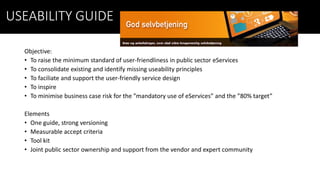
Objective:
• To raise the minimum standard of user-friendliness in public sector eServices
• To consolidate existing and identify missing useability principles
• To faciliate and support the user-friendly service design
• To inspire
• To minimise business case risk for the ”mandatory use of eServices” and the ”80% target”
Elements
• One guide, strong versioning
• Measurable accept criteria
• Tool kit
• Joint public sector ownership and support from the vendor and expert community
LANGUAGE USE
Objective: Simple, clear and understandable language use
Criteria:
• 1.1 Follow language guidelines
• 1.2 Use simple are clear language
• 1.3 Guide the user
• 1.4 Give meaningfull feedback on errors
• 1.5 Error messages must be in Danish
DESIGN, FLOW AND FUNCTIONALITY
Objective: A logic, consistent and simple user-experience
Criteria:
• 2.1 Comply with design manuals
• 2.2 Prepare and manage user expectations
• 2.3 Create a logical and consistent flow
• 2.4 Summarise entered data
• 2.5 Check and validate data prior to submission
• 2.6 Provide receipt
• 2.7 Responsible authority must be visible
• 2.8 Optimise to relevant platforms and devices
• 2.9 Optimise to browsers
• 2.10 Prelaunch user-tests
DATA, COMPONENTS AND STANDARDS
Objective: Reuse data, components and standards.
Criteria:
• 3.1 Use secure login and single sign-on (NemLog-in)
• 3.2 Reuse existing data
• 3.3 Reuse components
• 3.4 Use joint public, international and open standards
• 3.5 Adapt flow and data requests based on entered information
• 3.6 Store data securely
• 3.7 User teller-script
WEB-ACCESSIBILITY
Objective: Access for all
Criteria:
• 4.1 – 4.4 WCAG 2.0 AA – THE WHOLE SPECTRUM
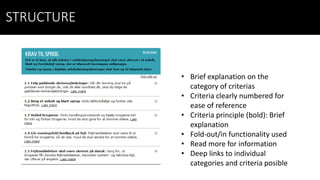
STRUCTURE
• Brief explanation on the
category of criterias
• Criteria clearly numbered for
ease of reference
• Criteria principle (bold): Brief
explanation
• Fold-out/in functionality used
• Read more for information
• Deep links to individual
categories and criteria posible
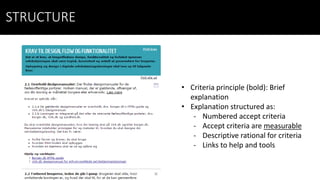
STRUCTURE
• Criteria principle (bold): Brief
explanation
• Explanation structured as:
- Numbered accept criteria
- Accept criteria are measurable
- Descriptive rational for criteria
- Links to help and tools
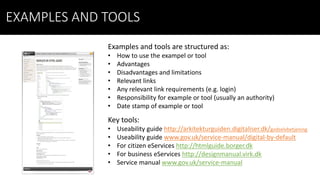
EXAMPLES AND TOOLS
Examples and tools are structured as:
• How to use the exampel or tool
• Advantages
• Disadvantages and limitations
• Relevant links
• Any relevant link requirements (e.g. login)
• Responsibility for example or tool (usually an authority)
• Date stamp of example or tool
Key tools:
• Useability guide http://arkitekturguiden.digitaliser.dk/godselvbetjening
• Useability guide www.gov.uk/service-manual/digital-by-default
• For citizen eServices http://htmlguide.borger.dk
• For business eServices http://designmanual.virk.dk
• Service manual www.gov.uk/service-manual
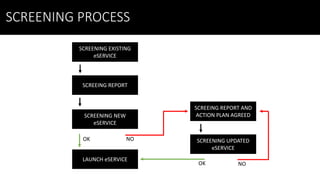
SCREENING PROCESS
SCREENING EXISTING
eSERVICE
SCREEING REPORT
SCREENING NEW
eSERVICE
OK
LAUNCH eSERVICE
NO
SCREEING REPORT AND
ACTION PLAN AGREED
SCREENING UPDATED
eSERVICE
OK NO
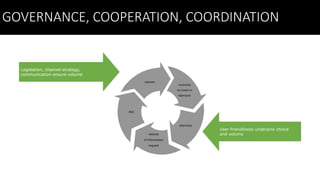
Legislation, channel-strategy,
communication ensure volume
User-friendliness underpins choice
and volume
incentive
to invest in
eServices
eServices
volume
of information
request
ROI
volume
GOVERNANCE, COOPERATION, COORDINATION
BENEFIT REALISATION ESSENTIAL
FOLLOW-UP:
Without objectives and goals, you don’t
know where you are or where you are
going. Without follow-up you don’t
know if you achieved your goals!
COOPERATION:
Vertical and horizontal cooperation is
essential, citizens and businesses do not
care: They want easy and fast service!
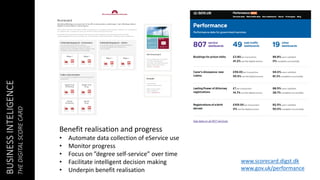
Benefit realisation and progress
• Automate data collection of eService use
• Monitor progress
• Focus on ”degree self-service” over time
• Facilitate intelligent decision making
• Underpin benefit realisation
BUSINESSINTELIGENCE
THEDIGITALSCORECARD
www.scorecard.digst.dk
www.gov.uk/performance
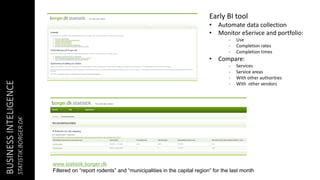
www.statistik.borger.dk
Filtered on “report rodents” and “municipalities in the capital region” for the last month
Early BI tool
• Automate data collection
• Monitor eSerivce and portfolio:
- Use
- Completion rates
- Completion times
• Compare:
- Services
- Service areas
- With other authorities
- With other vendors
BUSINESSINTELIGENCE
STATISTIK.BORGER.DK
VISION, WILL, GOALS AND FOLLOW-UP
CONTACT
MORTEN MEYERHOFF NIELSEN
Tallinn University of Technology, Ragnar Nurkse School of Innovation and Governance
Ehitajate tee 5
19086 Tallinn, Estonia
Tel (EE): +372 59 06 07 09
Tel (DK): +45 23 92 22 91
Mail: morten.nielsen@ttu.ee / mortenmeyerhoff@gmail.com
Twitter: @mortenmeyerhoff
LinkedIN: mortenmeyerhoff

Backoffice, frontoffice, efficiency and effectiveness

  • 1.
    BACK-OFFICE, FRONT-OFFICE, EFFICIENCY CIPSWORKSHOP ON eOFFICE Morten Meyerhoff Nielsen TUT-RNS / democratise HYDRABAD via skype (IN), 25 February 2016 AND EFFECTIVENESS
  • 2.
    THE GORDIAN KNOT– OUTLINING THE CONUNDRUM
  • 3.
    ICT investments todate has not: • Achieve the efficiency and effectiveness envisaged • Public-sector governance model and multi-stakeholder cooperation lacking CONUNDRUM
  • 4.
  • 5.
  • 6.
  • 7.
    Relationship between useof, home access, use of online banking and the propensity to use online public sector transactional services, download forms and obtaining information in EU28 and 12 selected countries (2008) SOME STATISTICS
  • 8.
    Relationship between useof, home access, use of online banking and the propensity to use online public sector transactional services, download forms and obtaining information in EU28 and 12 selected countries (2013) SOME STATISTICS
  • 9.
    THE GORDIAN KNOT– CHALLENGES AND GOALS EXEMPLES: - More for less – but how? - Growth and productivity – what is posible? - Access, trust, quality – also remotely? - No access, cannot, will not – is it a barrier?
  • 10.
    THE STATE BUT WHEREARE WE HEADING? GLOBALLY: Letters, forms and e-mail - papir is expensive! Authorities are ”eliminating” paper. Call centres and eServices are better and 2 – 3.5 times cheaper.
  • 11.
    DENMARK: Minimum requirement banslegal and burocratic language use, ensure logical and recognisable design and security. Results: - 78% of bike thefts reported online. - 88% of all adresse changes are digital. - 98% of students registered for school online. - 100% of tax returens er digitale. Savings of € 110+ million annually when fully implemented (DIGST & borger.dk, 2015). ESTONIA: Citizens can safely and securely access their personlal data online – and what authorities have seen and used their data (eesti.ee, 2015). RULES STILL APPLY
  • 12.
    DENMARK: Reuse of dataexpected to save € 3 million in government plus € 6.7 million in the private sector annually when fully implented (DIGST & Grunddata, 2015). EUROPE: Potential of BIG and OPEN data estimated to 1.9% of GDP in 2020 - for 21 different sectors in the 28 EU countries (demosEUROPE & WISE Institute, http://bit.ly/1oVe8Hj). DATA CAN INCREASE EFFICIENCY AND LEAD TO GROWTH
  • 13.
    DIGITAL IDENTITY ANDSIGNATURE IS KEY FOR EASY, SECURY AND PERSONAL SERVICE – AND CHEAPER DIGITAL IDENTITY AND SIGNATURE IS KEY FOR EASY, SECURY AND PERSONAL SERVICE – AND CHEAPER ESTONIA: 2% of GDP in annual socio- economic benefits by eSignature use (Gov. Office of Estonia, 2015). DENMARK: Over 90% of Danes have NemID and can signe digitally. Only 10.8% of Danes have requested an excemption from Digital Post! 6 to 8.5 million digital messages to citizens and businesses per month. Annual savings up to € 300 million (DIGST, 2015).
  • 14.
    THE REVOLUTION… ... isalso me! Yours sincerely, The State… CHANGE AND CONDITIONALITEIS USER-FRIENDLINESS IS GOOD BUSINESS AMSTERDAM: A hotel, cafe or resturant now save € 1,200 in time annually, through single entry and adapted process for licences (European eGov Awards, 2007). FROM CURITIBA TO HAMBURG: To increase participation and transparency ctizens and businesses can participate in budget decisions and planning (www.hamburg.de). STOCKHOLM: Citizens can compare and apply for daycare, school and retirement homes – just like booking.com (www.stockholm.se/jamfor).
  • 15.
    ADMINISTRATIVE BURDEN REDUCTIONSAVE MONEY AND IS GOOD FOR BUSINESSES HOLLAND: Less burocracy has saved 0.9% of GDP – from 3.7 to 2.8%. (World Bank Group, 2007)
  • 16.
    USEABILITY IS RISKMINIMISING! DESIGN MUST BE HOLISTIC, LOGIC AND INTUITIVE
  • 17.
    USEABILITY GUIDE Objective: • Toraise the minimum standard of user-friendliness in public sector eServices • To consolidate existing and identify missing useability principles • To faciliate and support the user-friendly service design • To inspire • To minimise business case risk for the ”mandatory use of eServices” and the ”80% target” Elements • One guide, strong versioning • Measurable accept criteria • Tool kit • Joint public sector ownership and support from the vendor and expert community
  • 18.
    LANGUAGE USE Objective: Simple,clear and understandable language use Criteria: • 1.1 Follow language guidelines • 1.2 Use simple are clear language • 1.3 Guide the user • 1.4 Give meaningfull feedback on errors • 1.5 Error messages must be in Danish
  • 19.
    DESIGN, FLOW ANDFUNCTIONALITY Objective: A logic, consistent and simple user-experience Criteria: • 2.1 Comply with design manuals • 2.2 Prepare and manage user expectations • 2.3 Create a logical and consistent flow • 2.4 Summarise entered data • 2.5 Check and validate data prior to submission • 2.6 Provide receipt • 2.7 Responsible authority must be visible • 2.8 Optimise to relevant platforms and devices • 2.9 Optimise to browsers • 2.10 Prelaunch user-tests
  • 20.
    DATA, COMPONENTS ANDSTANDARDS Objective: Reuse data, components and standards. Criteria: • 3.1 Use secure login and single sign-on (NemLog-in) • 3.2 Reuse existing data • 3.3 Reuse components • 3.4 Use joint public, international and open standards • 3.5 Adapt flow and data requests based on entered information • 3.6 Store data securely • 3.7 User teller-script
  • 21.
    WEB-ACCESSIBILITY Objective: Access forall Criteria: • 4.1 – 4.4 WCAG 2.0 AA – THE WHOLE SPECTRUM
  • 22.
    STRUCTURE • Brief explanationon the category of criterias • Criteria clearly numbered for ease of reference • Criteria principle (bold): Brief explanation • Fold-out/in functionality used • Read more for information • Deep links to individual categories and criteria posible
  • 23.
    STRUCTURE • Criteria principle(bold): Brief explanation • Explanation structured as: - Numbered accept criteria - Accept criteria are measurable - Descriptive rational for criteria - Links to help and tools
  • 24.
    EXAMPLES AND TOOLS Examplesand tools are structured as: • How to use the exampel or tool • Advantages • Disadvantages and limitations • Relevant links • Any relevant link requirements (e.g. login) • Responsibility for example or tool (usually an authority) • Date stamp of example or tool Key tools: • Useability guide http://arkitekturguiden.digitaliser.dk/godselvbetjening • Useability guide www.gov.uk/service-manual/digital-by-default • For citizen eServices http://htmlguide.borger.dk • For business eServices http://designmanual.virk.dk • Service manual www.gov.uk/service-manual
  • 25.
    SCREENING PROCESS SCREENING EXISTING eSERVICE SCREEINGREPORT SCREENING NEW eSERVICE OK LAUNCH eSERVICE NO SCREEING REPORT AND ACTION PLAN AGREED SCREENING UPDATED eSERVICE OK NO
  • 26.
    Legislation, channel-strategy, communication ensurevolume User-friendliness underpins choice and volume incentive to invest in eServices eServices volume of information request ROI volume GOVERNANCE, COOPERATION, COORDINATION
  • 27.
    BENEFIT REALISATION ESSENTIAL FOLLOW-UP: Withoutobjectives and goals, you don’t know where you are or where you are going. Without follow-up you don’t know if you achieved your goals! COOPERATION: Vertical and horizontal cooperation is essential, citizens and businesses do not care: They want easy and fast service!
  • 28.
    Benefit realisation andprogress • Automate data collection of eService use • Monitor progress • Focus on ”degree self-service” over time • Facilitate intelligent decision making • Underpin benefit realisation BUSINESSINTELIGENCE THEDIGITALSCORECARD www.scorecard.digst.dk www.gov.uk/performance
  • 29.
    www.statistik.borger.dk Filtered on “reportrodents” and “municipalities in the capital region” for the last month Early BI tool • Automate data collection • Monitor eSerivce and portfolio: - Use - Completion rates - Completion times • Compare: - Services - Service areas - With other authorities - With other vendors BUSINESSINTELIGENCE STATISTIK.BORGER.DK
  • 30.
    VISION, WILL, GOALSAND FOLLOW-UP
  • 31.
    CONTACT MORTEN MEYERHOFF NIELSEN TallinnUniversity of Technology, Ragnar Nurkse School of Innovation and Governance Ehitajate tee 5 19086 Tallinn, Estonia Tel (EE): +372 59 06 07 09 Tel (DK): +45 23 92 22 91 Mail: morten.nielsen@ttu.ee / mortenmeyerhoff@gmail.com Twitter: @mortenmeyerhoff LinkedIN: mortenmeyerhoff