Introduction                      1 
Figure 01: Regional Context                    2 
Figure 02: Community Growth Area and Study Area              3 
Figure 03: Study Area                    4 
 
Development History                   7 
Figure 04: Regional Historic Development – Single Center              7 
Figure 05: Regional Historic Development ‐ Multiple Centers            8 
Figure 06: Commercial Centers                  10 
Figure 07: Local Historic Development                  12‐13 
Figure 08: Locust Level Estate and Evergreen Point              14 
 
Existing Conditions                    17 
Figure 09: Topography                    17 
Figure 10: Existing Land Use                    18 
Figure 11: Percent of Total Acres by Land Use                19 
Figure 12: Value by Land Use in Millions                19 
Table 13: Land Area and Value                  19 
Figure 14: Existing Building Use                  20 
Figure 15: Building Area                    21 
Figure 16: Building Area by Subdivision                 21 
Figure 17: Square Feet by Building Use                  21 
Figure 18: Existing Comprehensive Plan Land Use Designations            22 
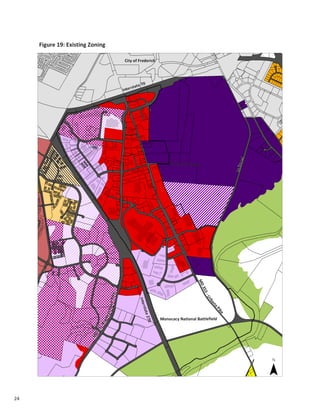
Figure 19: Existing Zoning                    24 
Figure 20: Traffic Volume                    26 
Figure 20a: Comprehensive Plan Road Classifications              27 
Figure 20b: Existing Transit                    27 
 
Issues and Opportunities                  29 
Figure 21: MD355 ‐ Historic Corridor                  30 
Figure 22: MD85 ‐ Business Corridor                  30 
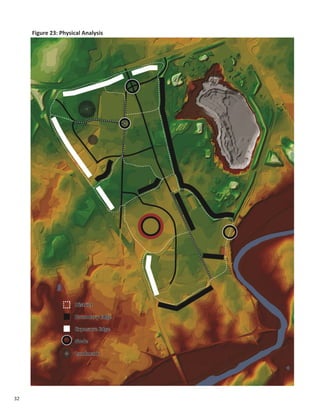
Figure 23: Physical Analysis                    32 
Figure 24: Analysis of Potential Residential Enclaves              33 
TABLE OF CONTENTS 
1 
The Corridor Planning Process 
The  Community  and  Corridor  planning  process 
described  in  “Frederick  County’s  Future”,  the 
Countywide  Comprehensive  Plan  (April  2010),  is  a 
strategy that facilitates a more locally focused level 
of planning throughout the County.  While planning 
at  the  countywide  level  occurs  through  cyclical 
updates  of  the  Countywide  Comprehensive  Plan, 
planning at the local level related to the wide variety 
of  communities  and  jurisdictions  throughout  the 
County  can  be  addressed  in  detail  through  the 
development of the Community and Corridor plans.   
Plans produced under the Community and Corridor 
process have primary emphasis on exploring design 
concepts,  redevelopment  opportunities,  and 
development staging in greater detail than described 
in  the  Countywide  Plan.  The  result  of  this  will 
produce  a  stand  alone  community  plan  document 
that would amend the Countywide Plan. 
One of the first plans to be produced under this new 
planning process is for the corridor of land along MD 
85 and MD 355 just to the south of Frederick City.   
The Southeast Corridor 
The MD85/355 corridor, hereafter referred to as the 
Southeast Corridor, is located just south of Frederick 
City,  bounded  by  I‐270  on  the  west,  I‐70  on  the 
north,  LaFarge  Quarry  on  the  east  and  Monocacy 
National Battlefield on the south.  Two major state 
roads traverse the area, MD85 ‐ Buckeystown Pike, 
and  MD355  ‐  Urbana  Pike.    It  is  a  major  retail, 
commercial, and industrial area of Frederick County. 
Regionally, the Southeast Corridor is located at the 
junction  of  primary  connections  to  major 
metropolitan  areas,  namely  Washington  D.C.  and 
Baltimore.  The growth of these cites has historically 
driven  the  growth  of  Frederick  County,  and  this  is 
expected to continue  in the future.  The location at 
this  junction  potentially  makes  the  Southeast 
Corridor a focal point for this growth, which gives it 
the potential to play a role not just locally, but within 
the region as well. 
Redevelopment 
The  Southeast  Corridor  has  been  prioritized  as  a 
corridor  plan  because  of  its  potential  to 
accommodate  growth  through  redevelopment.  
While  much  of  the  land  is  already  developed  and 
built  out  under  current  development  intensity, 
redevelopment  in  a  more  intense  fashion  can 
maximize  land  use  potential  and  provide 
opportunities  to  introduce  residential  uses  while 
leveraging existing infrastructure.   
In  general,  redevelopment  has  been  employed  to 
counteract  economic  disinvestment  in  land  that 
results  in  the  deterioration  of  buildings  and 
infrastructure,  commonly  referred  to  as  blight.  
However, economic disinvestment in the Southeast 
Corridor is not a pressing concern.  Rather, the focus 
on the redevelopment of this area relates more to a 
priority on leveraging existing infrastructure relative 
to  the  management  of  growth  in  the  County.  The 
County  Comprehensive  Plan  emphasizes 
redevelopment in the following goals: 
MG‐G‐07:  Establish  as  a  targeted  goal  for  the 
development  and  redevelopment  of  lands 
within  Community  Growth  Areas,  an  average 
density of 7.5 residential dwellings/acre by the 
year 2025. 
MG‐G‐08: Increase the number of properties ‐ both 
vacant and underdeveloped land ‐ available for 
employment  uses  in  order  to  support  policies 
that  emphasize  the  reuse  and  revitalization  of 
previously developed sites. 
MG‐G‐10:  Emphasize  reinvestment  in  our  growth 
areas  by  encouraging  infill  and  redevelopment 
projects  which  are  compatible  with  existing 
neighborhoods and districts. 
Additionally,  the  County  Comprehensive  Plan 
expresses the specific policy of using redevelopment 
as a growth management strategy: 
INTRODUCTION 
2 
Figure 01: Regional Context 
3 
MG‐P‐03   Pursue  redevelopment  strategies 
as  a  way  to  minimize  the  need  to  expand 
existing  Community  Growth  Areas  or  establish 
new Community Growth Areas. 
This  policy  supports  planning  that  moderates  the 
practice  of  expanding  growth  areas  outward  to 
accommodate  growth  by  supporting  planning  that 
calls  for  more  intense  development  within  existing 
growth  areas.    Rather  than  solely  emphasize  the 
development of rural land around the periphery of 
the Community Growth Areas, the demand for new 
residential  and  employment  development  can  also 
be  accommodated  through  infill  of  vacant  parcels 
and redevelopment in the Southeast Corridor. 
The development pattern in the Southeast Corridor 
presents an prime opportunity for redevelopment in 
this  regard  for  several  reasons.    First,  there  is  a 
wealth of  infrastructure in the area in the form of 
two  Interstates,  two  State  highways,  and  a 
commuter  rail  station.    Therefore  additional 
investment  in  infrastructure  can  be  minimized 
because,  for  the  same  level  of  development,    the 
cost  of  any  required  upgrades  in  an  area  like  the 
Southeast Corridor with relatively new infrastructure 
systems may be much less than the cost of providing 
new infrastructure. 
Second,  there  is  an  abundance  of  “open  air” 
shopping facilities in the Southeast Corridor, where a 
high  percentage  of  land  is  paved  parking  fields.  
Therefore  a  version  of  an  infill  development 
approach  can  be  employed  to  maximize  the 
development potential of property while minimizing 
the  burden  to  existing  owners  and  tenants.      This 
means  that  there  is  a  lot  of  area,  in  the  form  of 
parking fields, that can either be built upon with new 
construction,  that  can  be  reserved  for  needed 
infrastructure, or that can provide public amenities 
such as parks and playgrounds.  And all of this can 
occur in a phased manner that would not necessarily 
require the replacement of existing facilities. 
Third, with an area like the Southeast Corridor, with 
an abundance of geographic endowments such as a 
high degree of access, a high degree of attraction of 
consumers,  and  an  relatively  new  and  healthy 
infrastructure  system,  redevelopment  can  leverage 
job growth in the County.  This is because increasing 
the intensity of development in areas with numerous 
locational  advantages  has  the  potential  of 
minimizing  the  amount  of  public  investment 
required to service development while still providing 
the  potential  for  new  and  desirable  facilities  for 
corporate tenants.  The potential of combining the 
advantages  of  access,  attraction,  and  infrastructure 
with  the  possibility  for  new  and  modern  facilities, 
perhaps in an environment that provides amenities 
such  as  walkable  streets,  can  create  a  competitive 
advantage when firms make decisions about where 
to locate. 
Finally, the Southeast Corridor shares the advantage 
with  Frederick  County  of  proximity  to  Washington 
D.C. and Baltimore.  The economic engines of these 
two  metropolitan  areas  has  driven  growth  in  the 
County for decades, and there is ample opportunity 
to channel that growth into the Southeast Corridor 
in the future. 
Figure 02: Community Growth Area and Study Area 
4 
Figure 03: Study Area 
5 
Study Area Delineation 
The Southeast Corridor is a portion of the Frederick 
Southeast  Community  Growth  Area  defined  in  the 
2010 County Comprehensive Plan.  The development 
in the far eastern portion of the growth area on the 
northeast  side  of  Reich's  Ford  Road  along  Quinn 
Orchard  Road  is  not  included  in  the  Southeast 
Corridor  study  area.    This  is  because,  while  both 
areas  are  within  the  same  growth  area,  they  are 
geographically  divided  by  the  LaFarge  quarry,  and 
are very different in terms of land use.   
The definition of the Southeast Corridor study area 
takes  several  issues  into  account.    First,  is  the 
difficulty  in  determining  with  certainty  what  the 
required  extent  of  a  study  area  should  be  without 
“studying  the  area”.    In  other  words,  once  plan 
development  has  commenced,  more  information 
will be obtained, and therefore better decisions can 
be made regarding the extent of the study area. 
Second, most aspects of this corridor are connected 
with other factors outside the realm of the corridor 
itself.  For example, the addition of housing to the 
Westview development could significantly alter what 
would be proposed in the Southeast Corridor.  Every 
part of the Corridor is a part of a hierarchy of other 
issues and factors several scales beyond a proposed 
immediate  study  area,  so  one  aspect  cannot  be 
considered unless the next higher scale is also taken 
into account.  Some of these factors include: 
• Transit connections and highway connections to 
Washington  D.C.  and  the  I270  technology 
corridor  to  the  south  and  to  Baltimore  to  the 
east 
• Operations of the LaFarge quarry 
• Competing  and  compatible  adjacent  uses  such 
as  the  downtown  and  the  East  Street 
redevelopment  in  Frederick  City  and  the 
Westview mixed use development and industrial 
development to the south 
• Market demand and demographic trends for the 
Frederick County region 
• The  growth  of  residential  development  in 
counties to surrounding Frederick County 
Delineating  a  study  area,  therefore,  does  not  limit 
the  factors  that  will  be  considered  in  the  plan.  
Rather, the study area is proposed to be the limit of 
any potential interventions outlined in the plan. 
The delineation of the Study Area for the Southeast 
Corridor  is  largely  based  on  aligning  with  existing 
physical  barriers.    Specifically,  the  barriers  typically 
used as boundaries are those that present significant 
physical obstacles in terms of access from one side 
to the other. 
To  the  west  and  north,  the  study  area  extends  to 
I270  and  I70  respectively.    To  the  east,  the  study 
area  extends  to  the  quarry  boundary,  typically 
aligning with the west side of the quarry berms built 
along MD355.   
The  exception  along  the  eastern  boundary  of  the 
study area is where the quarry property ends around 
the  Riverside  Shopping  Center.    At  this  point,  the 
study  area  boundary  includes  all  of  the  MARC 
Station parking area and junction up to the railroad.  
It  continues  to  follow  the  railroad  south  until  it 
enters the Monocacy Battlefield where it aligns with 
the edge of the Monocacy River. 
To  the  south,  the  study  area  extends  to  the 
Monocacy  River,  and  includes  a  portion  of  the 
Monocacy  Battlefield.    While  specific  interventions 
will not be proposed with the Battlefield itself, it was 
included  in  the  study  area  to  indicate  that  it  is  an 
area of special concern to the planning effort. 
 
7 
The  geographic  organization  of  land  use  in  central 
Frederick County has changed from a single discrete 
commercial  center  to  a  pattern  of  multiple 
commercial  centers  distributed  in  the  region 
surrounding Frederick City.  The newer commercial 
areas  in  and  around  Frederick  City  have  either 
rapidly  developed  in  the  last  fifty  years,  or  are 
currently  in  the  process  of  development.    The  
changes  wrought  by  this  growth  and  development 
are unprecedented in the history of the County. 
Regional Context—Single Center 
Throughout most of the history of Frederick County, 
the Southeast Corridor area has played a minor role 
in  the  commercial  and  industrial  activity  of  the 
County, with at most being the location of scattered 
roadside  businesses  and  estate  farms.    Rather 
Downtown  Frederick  City  has  served  as  the  major 
regional  commercial  center,  with  manufacturing 
industries  significantly  shaping  its  development.  
Throughout the early 19th century, timber, mining of 
limestone  and  iron  ore,  and  tanning  were  the 
predominant industries.  In the later 19th century, a 
shift in emphasis in the County to dairy farming led 
to  the  growth  of  dairy  processing  industries.  
Additionally, canning industries to process fruits and 
vegetables also experienced growth during this time 
period. 
Even  as  infrastructure  improvements  were 
constructed  over  time,  Frederick  City’s  downtown 
maintained  it’s  standing  as  the  dominant  center  of 
commerce  and  industry  in  the  County.    It  was  not 
until the post World War II growth of the 1950’s and 
beyond  that  the  geographic  distribution  of  major 
commercial  and  industrial  activity  in  the  County 
became  dispersed  into  multiple  centers,  with  the 
Southeast  Corridor  playing  a  major  role  in  this 
dispersion. 
 
DEVELOPMENT 
HISTORY 
Figure  04:  Regional  Historic  Development  ‐ 
Single Center 
Pre 1920 
National  Road  begun  in  1811,  planned  connection  between 
Cumberland, MD and St. Louis, MO.  Middletown Turnpike and 
Baltimore Turnpike part of chain of turnpikes chartered by MD 
connecting Baltimore to the National Road.  Completed in 1824 
and referred to as the eastern extension of the National Road.  
Georgetown  Turnpike  chartered  by  MD  in  1805.    Georgetown 
Turnpike realigned at Araby.  Creates Araby Church Road. 
1926+ 
U.S.  Highway  System  adopted  in  1926.    Baltimore  and 
Middletown  Turnpikes  designated  US  40  as  part  of  the  US 
Highway  System.    Georgetown  Turnpike  designated  US240.  
Jefferson Pike designated US 340.  Buckeystown Pike designated 
US 15. 
1948 
New  alignment  of  US40  opens  between  Frederick  and 
Hagerstown.  Pre‐existing alignment of US40 becomes US40A. 
1953 
New  alignment  of  US240  constructed,  alongside  previous 
alignment.  Previous alignment eventually designated MD355. 
1959 
I‐70 construction begins as part of US Highway Act of 1956.  First 
Interstate Highway.  Parallels US40 east of Frederick City, and 
splits  off  from  US40  west  of  Frederick  City.    Old  alignment  of 
US40  designated  MD144.    Frederick  Bypass  completed  up  to 
US40.    US240  decommissioned  and  re‐designated  I‐70S  along 
the same right of way. 
1960’s 
Frederick  Bypass  completed  and  US15  north  of  Frederick  City 
improved.  Old alignment of US15 designated MD806. 
 
8 
Revitalization planning begins for Golden Mile in Frederick City.  
Frederick Towne Mall in decline. 
Downtown Frederick City revitalization successful.  Serves 
specialized role in the region.   
Southeast Corridor essentially built out at current planned 
intensity.  Prime area for redevelopment as high density mixed 
use sector. 
Continued growth of Monocacy Boulevard area as retail and 
industrial center. 
Continued prosperity of Golden Mile in Frederick City, building 
stock begins to approach end of economic lifespan.   
Frederick Towne Mall in competition with FSK Mall.  Beginning 
of decline for Frederick Towne Mall as major anchor tenant 
relocates to FSK Mall. 
Downtown Frederick City revitalization continues as center for 
government, professional, and leisure activities.   
Growth of Southeast Corridor. 
New regional retail and industrial center around Monocacy 
Boulevard begins to develop. 
Continued growth of Golden Mile in 
Frederick City. 
Decline of Downtown Frederick City continues, accelerated by 
Flood of 1976. 
Growth of Southeast Corridor continues, accelerated by 
construction of FSK Mall in 1979. 
Carroll Creek flood control project begun in late 1970’s, 
beginning revitalization of Downtown Frederick. 
US340 constructed and US 15 realigned south of Frederick City. 
US15 south of Frederick City re‐designated MD85 and MD28. 
US340 re‐designated MD180 and I‐70S re‐designated I‐270. 
Golden Mile in Frederick City development begins.  Frederick 
Towne Mall Opens in 1972. 
Decline of Downtown Frederick City begins as modern 
commercial space develops along Golden Mile. 
Development along Southeast Corridor begins. 
Figure 05: Regional Historic Development ‐ Multiple Centers 
9 
Regional Context—Multiple Centers 
After the 1950’s and well into the latter half of the 
twentieth century, economic growth and expansion 
took a new form in Frederick County as commercial 
activity  began  to  redistribute  into  multiple 
geographic  centers.    For  the  first  time  in  it’s  long 
history,  Frederick  City’s  downtown  began  to  share 
the load of commercial and industrial demand with 
other  surrounding  areas,  inside  and  outside  of  the 
City.    This  began  with  the  development  of  the 
Golden  Mile  along  US  40  west  of  Downtown 
Frederick,  and  continued  with  the  growth  and 
development  of  the  Southeast  Corridor.    Finally,  a 
more recent employment and commercial center is 
emerging along the Monocacy Boulevard area in the 
northern portion of the City. 
The Golden Mile: 
The  first  major  dispersion  of  commercial  activity 
occurred with the development of the Golden Mile, 
on  the  stretch  of  US  40  to  the  west  of  Downtown 
Frederick.  From the beginnings of its growth in the 
early  1970’s,  it  has  been  a  center  for  large  format 
regional  chains  and  local  retail  businesses.  Over 
time,  ethnically  oriented  shopping  and  dining 
establishments have been introduced into the area. 
From an occupancy standpoint, the Golden Mile as a 
whole  is  currently  in  good  condition,  with  the 
exception of the Fredericktowne Mall.  Among other 
factors, competition with the FSK Mall to the south 
of  Frederick  City  has  led  to  the  decline  of  the 
Fredericktowne Mall.  Beyond the Mall, much of the 
building stock along the Golden Mile is nearing the 
end of it’s economic lifespan, which has resulted in a 
deterioration in the physical appearance of the area.  
Additionally,  the  growth  and  proximity  of 
surrounding  residential  uses  has  led  to  increase 
pedestrian  activity  in  an  area  designed  almost 
entirely  for  automobile  circulation.    These  factors 
have led to strong public interest in revitalization of 
the Golden Mile. 
Downtown Frederick: 
Downtown  Frederick  experienced  an  economic 
downturn in the mid 1970’s.  With the development 
of  the  Golden  Mile,  many  of  the  major  anchor 
tenants  departed  Downtown  Frederick  for  those 
newer  and  updated  facilities.    Also,  many  business 
owners and residents were impacted by the Flood of 
1976 where Carroll Creek inundated the Downtown 
with water. 
In  time  Downtown  Frederick  experienced  an 
economic recovery, redefining itself as a center for 
professional  business  and  services,  unique  and 
specialty  retail,  and  dining.    This  was  due  in  large 
part  to  community  support  and  visionary  planning, 
an  aspect  of  which  was  a  flood  control  project 
known  as  the  Carroll  Creek  Promenade  that 
combined  a  major  urban  civic  space  with  flood 
management facilities. 
While  the  historic  core  of  Downtown  Frederick  is 
enjoying  a  healthy  balance  of  economic  activity, 
another area of the Downtown along East Street is 
poised  for  major  growth.    This  historic  focus  on 
industrial activity in this area has been redirected to 
the  Monocacy  Boulevard  Area.    With  a  recently 
constructed  connection  between  East  Street,  I‐70, 
and MD85, this area is being envisioned as a center 
for mixed use development focusing on commercial 
office, retail, and residential. 
North Frederick Area 
This retail center, located around the confluence of 
US26, US15, and Monocacy Boulevard, is a growing 
concentration of office, large format chain retailers 
with  locally  oriented  retail  and  service  businesses.  
South  of  this  along  Monocacy  Boulevard  is  a 
concentration of industrial uses, some of which have 
relocated  from  the  East  Street  area  in  Downtown 
Frederick. 
 
Commercial Centers 
As described above, the Southeast Corridor is one of 
many  commercial  areas  in  the  County.    The 
commercial  areas  identified  on  the  following  map 
include strip shopping centers such as the Frederick 
Shopping Center or College Park Plaza, office parks 
such  as  the  Thomas  Johnson  Professional  Center, 
industrial  areas  such  as  the  development  in  the 
southern  portion  of  Frederick  Southeast  and  the 
Airport  Industrial  Park,  mixed  use  centers  such  as 
Downtown Frederick, and major retail districts such 
as  the  Golden  Mile.    The  clusters  identified  on  the 
following  map  are  defined  based  on  their 
geographical proximity, and the historical timeframe 
of  their development. 
10 
Figure 06: Commercial Centers 
11 
Short of conducting a full fledged market analysis, a 
general  impression  of  the  market  forces  that  may 
impact the redevelopment of the Southeast Corridor 
can  be  gained  from  several  sources  based  on 
proposed  projects,  projected  demand,  and 
anticipated demographic trends. 
A  picture  of  existing  and  proposed  business  and 
retail development in the County can be gained from 
a  database  maintained  by  the  Office  of  Economic 
Development  that  tracks  business  parks  and  retail 
centers,  updated  quarterly.    According  to  this,  the 
business park properties in the vicinity of Frederick 
City  that  are  included  in  this  database  constitute 
roughly 9.6 million square feet of built area, with 6.4 
million  existing  and  3.2  million  proposed.  
Additionally,  retail  properties  constitute    roughly  7 
million  square  feet,  with  1.2  million  proposed  and 
5.8 million existing. 
In  September  2007  and  May  2008,  the  City  of 
Frederick  commissioned  a  market  analysis  of  the 
Frederick  City  market  area  for  retail,  office,  flex/
R&D,  and  industrial  uses.    While  economic 
conditions  have  changed  dramatically  since  the 
release  of  these  reports,  the  projected  demand 
proposed  in  these  reports  can  shed  some  light  on 
potential opportunity gaps in the Frederick business 
and  retail  markets.    These  reports  accounted  for 
existing and proposed projects, and concluded that 
there  was  an  opportunity  gap  in  the  form  of  an 
additional demand outside the expected pipeline for 
100,00  square  feet  of  office  space,  700,000  square 
feet of industrial space, and 1.4 million square feet 
of  flex  space.    For  the  retail  market,  these  reports 
concluded that the market was generally saturated, 
and that additional demand for retail would be tied 
to  demand  expansion  in  the  form  of  population 
growth. 
Finally, an understanding of future housing demand 
can  be  gained  from  the  analysis  of  broad 
demographic  trends.    While  the  Frederick  County 
Comprehensive  Plan  projects  a  demand  of  36,000 
housing units over the next twenty years, it does not 
evaluate  the  breakdown  of  demand  by  unit  type, 
such as single family, townhomes, or multi‐family.   
However,  demographic  shifts  and  changing  values 
relative  to  future  housing  demand  have  been 
evaluated  by  John  McIlwain  of  the  Urban  Land 
Institute.    Some  key  demographic  trends  that 
R  1  Ballenger Creek Plaza   
R  2  College Park Plaza   
R  3  Discovery Shopping Center   
R  4  Eastgate Shopping Center   
R  5  Festival at Frederick   
R  6  Frederick Shopping Center   
R  7  Kingsbrook Crossing   
R  8  Monocacy Village Center   
R  9  Northgate Plaza  Proposed 
R  10  Prospect Plaza Shopping Center   
R  11  River Run Center  Proposed 
R  12  Rose Hill Plaza   
R  13  Spring Ridge Shopping Center   
R  14  The Shops at Monocacy   
R  15  Thomas Johnson Center   
R  16  The Turning Point Center   
R  17  Villages at Urbana Town Center   
R  18  Walnut Ridge Shopping Center   
R  19  Whittier Lakefront Center   
R  20  Worman's Mill Village Square  Proposed 
R  21  Crestwood Plaza   
R  22  Westview Village   
R  23  Westview Corner   
R  24  Clemson Corner  Proposed 
R  25  Market Square at Frederick  Proposed 
R  26  Urbana Village Center   
R  27  Westview Promenade   
R  28  Golden Mile   
R  29  Linganore Town Center  Proposed 
R  30  Landmark  Proposed 
R  31  Downtown Frederick   
B  1  Ballenger Creek Center   
B  2  Center Park   
B  3  Frederick Research Park   
B  4  Governor's Choice   
B  5  North Amber Business Park   
B  6  Riverside Corporate Park   
B  7  Riverside Corporate Center   
B  8  Worman's Mill Industrial Park   
B  9  Center at Monocacy   
B  10  Airport Industrial Park   
B  11  Frederick Industrial Park   
B  12  Bowman Plains Industrial Park   
B  13  Dudrow Business Park   
B  14  Knowledge Farms   
B  15  McKinney Industrial Park   
B  16  Omega Center   
B  17  Riverside Technology Park   
B  18  Riverside Research Park   
B  19  Wedgewood Industrial Park   
B  20  Century Center  Proposed 
B  21  Industrial Center East   
B  22  Urbana Office & Research Center   
B  23  Frederick Airport Park   
B  24  Frederick Brick Works Site  Proposed 
B  25  Westview South Office Research Center   
B  26  Westview Corporate Campus   
B  27  Jefferson Technology Park  Proposed 
B  28  Russell Property  Proposed 
B  29  Urbana R & D Park  Proposed 
B  30  Crum Farm  Proposed 
B  31  Thatcher  Proposed 
B  32  Jefferson Tech Park West  Proposed 
12 
1953  1973 
1979  1988 
Figure 07: Local Historic Development 
13 
McIlwain  identifies  point  toward  an  increased 
demand for smaller lots and more “urbanized” forms 
of housing development.   
As  the  housing  market  has  declined,  so  has  the 
demand  for  single  family  homes.    Older  baby 
boomers who are not stuck in their suburban homes 
in situations of negative equity are typically choosing 
to  live  in  smaller  dwellings  closer  to  family  and 
grandchildren rather  than  relocate to  the Sun  Belt.  
Younger  baby  boomers  who  have  purchased  single 
family  homes  and  wish  to  sell,  now  have  a  much 
smaller  population  of  buyers  in  the  form  of  the 
Generation  X  demographic.    Additionally,  the 
housing  bust  has  depleted  the  equity  of  many 
Younger  Boomers,  and  the  traditional  demand  for 
second  homes  in  this  demographic  has  similarly 
been eroded.  Finally, the Generation Y demographic 
(late teens to early 30’s) has lost the confidence of 
previous generations in the wealth building potential 
of  homeownership.    This,  in  combination  with  the 
general desire among this demographic group to live 
in urban settings has spurred the trend for smaller 
dwellings and rental housing. 
The general impression that the above information 
gives is that there is a potential opportunity gap for 
new development in the business sector (specifically 
flex/R&D  and  industrial  space)  and  in  non‐single 
family  housing,  with  the  demand  for  retail  being 
restrained  by  a  saturated  market  and  generally 
keeping pace with population growth.  This suggests 
that  any  redevelopment  in  the  Southeast  Corridor 
would  best  be  directed  toward  employment  and 
housing,  while  generally  maintaining  current  levels 
of  retail  service.    Given  the  presence  of  the  MARC 
station,  and  the  general  affinity  and  compatibility 
between office and residential types of uses in urban 
settings,  the  Southeast  Corridor  presents  ample 
potential  for  redevelopment  as  a  mixed  use  urban 
center in Frederick County. 
 
Local Context 
As the diagrams to the left illustrate, the Southeast 
Corridor has undergone a vast amount of change in 
the last sixty years.  In the early 1950’s, the area was 
largely  agricultural,  with  some  residential  and 
transitional  roadside  businesses.    Since  then,  the 
area has transformed into one of the most valuable 
and intensively used portions of land in the County. 
2000 
2007 
14 
Evergreen Point was likely named for the row 
of evergreen trees that fronted the Locust Level 
Estate at the intersection of Buckeystown Pike 
(MD85)  and  Urbana  Pike  (MD355).    For 
decades, the manner house of the Jacob Lewis 
property, named Locust Level for the level line 
of  locust  trees  that  were  arranged  along  the 
front  porch  of  the  house,  was  located  at  this 
intersection.  Presumably for privacy purposes, 
a  row  of  evergreens  was  planted  along  the 
road  frontage  of  this  estate,  right  at  the 
intersection  of  MD85  and  MD  355.    As  the 
evergreens grew and became a prominent and 
distinct  visual feature  of  this  heavily  travelled 
intersection,  the  name  “Evergreen  Point” 
emerged. 
Figure 08: Locust Level Estate and Evergreen Point 
15 
Several factors have contributed to the growth of 
the  area.    The  most  basic  is  the  high  degree  of 
accessibility the area enjoys due to the adjacency 
of  two  Interstates,  and  the  convergence  of  two 
State  Roads.    This,  alongside  the  proximity  to 
Downtown  Frederick,  a  regional  magnet  for 
business  and  consumer  activity,  had  primed  the 
area for growth.   
However,  access  and  attraction  alone  were  not 
adequate  to  spark  the  growth  of  the  area.  
Infrastructure  for  intensive  development  was 
needed but was not available until the late 1970’s.  
The  functional  ability  to  accommodate  higher 
capacity  development  was  provided  when  the 
Ballenger  Creek  Water  and  Sewage  System  was 
completed  in  1978.    This  was  the  catalyst  that 
allowed all of the geographic benefits of the area 
to be capitalized, and played the most direct role in 
the development of the Southeast Corridor. 
Finally,  the  inevitable  growth  of  the  Southeast 
Corridor  was  firmly  established  with  the 
construction of the Francis Scott Key Mall in 1978.  
Businesses,  both  local  and  national,  had  already 
begun  to  establish  themselves  in  the  area, 
providing confidence to investors and land owners 
that  development  was  low  risk  and  high  reward.  
But  the  economic  boost  provided    by  the 
construction of the mall cemented the notion.   
 
Change and Physical Structure 
In  just  under  60  years,  the  entire  Southeast 
Corridor  has  changed  dramatically.    It  has  gone 
from  being  identified  as  “Evergreen  Point”,  a 
crossroads where MD85 and MD355 intersected at 
an  oblique  angle  and  scattered  houses  and 
businesses  were  surrounded  by  fields  and 
farmland,  to  an  intensive  suburban  corridor, 
covered by parking lots and buildings.     
The change in the Southeast Corridor has not only 
been  economic,  despite  this  typically  being  the 
most emphasized aspect when discussed in relation 
the  growth  of  the  area.    The  change  in  the 
Southeast Corridor is also largely physical, and this 
is the aspect that citizens and users are perhaps the 
most exposed to on a daily basis.     
In this respect, it can be argued that the Corridor 
has lost many of the physical features that gave the 
area  a  distinct  and  identifiable  quality  and  that 
allowed the name “Evergreen Point” to emerge.   
Today,  the  Southeast  Corridor  can  no  longer  be 
tied  to  the  presence  of  a  dominant  landmark 
feature  at  a  major  crossroads  to  organize  how 
people  perceive  and  identify  the  physical 
environment.  It is now a different animal, a sizable 
developed area, rivaling Frederick City to the north 
in terms of development intensity. 
However,  Frederick  City  has  a  vivid  clarity  in  its 
physical  form  and  organization  that  is  missing  in 
the  Southeast  Corridor.    It  is  a  kind  of  clarity  of 
organization  that  is  in  the  same  category  as  the 
landmark  evergreens  of  the  Evergreen  Point  of 
yesterday. 
Development  in  the  Southeast  Corridor  today 
conforms  to  the  haphazard  and  unharmonious 
visual  qualities  of  most  strip  commercial.    While 
beyond the apparent discord the area is somewhat 
defined  into  districts  based  on  zoning  and 
subdivision activity, the clear and vivid perceptual 
organization  of  the  area,  as  demonstrated  by  the 
genesis of the name “Evergreen Point”, is gone. 
However,  the  kinds  of  features  that  made 
Evergreen Point so identifiable in the past, and that 
give Frederick City it’s character, do not need to be 
abandoned.  Nor do they need to be copied.   
As the last sixty years have shown, development in 
the  Southeast  Corridor  is  ongoing.    And  as  time 
goes on, change can make the Southeast Corridor 
into  a  distinct  place  of  its  own,  on  par  with 
Frederick  City  in  terms  of  physical  clarity  and 
organization.    Change  is  sometimes  an  uncertain 
process and often anxiety provoking.  However, the 
Southeast Corridor developed because change was 
embraced, not resisted.  Beyond all, the ability of 
investors, business and land owners, officials, and 
citizens  to  imagine  what  was  possible  drove  the 
growth the Southeast Corridor.  When considering 
the possible future of this area, this fact should be 
kept in mind.   
 
17 
EXISTING 
CONDITIONS 
Population: There  is  currently  very  little  residential 
development  in  the  community.    The  2000  Census 
population  for  the  corridor  is  69,  and  is  entirely 
clustered  around  the  existing  trailer  park  between 
MD  85  and  MD355,  behind  Lowes  Home 
Improvement and to the north of the FSK Mall. 
Schools: Currently,  the  corridor  lies  within  the 
attendance  areas  of  Lincoln  Elementary  School, 
Crestwood  Middle  School,  and  Tuscarora  High 
School.   
Fire Service: The corridor is served by the Westview/
United  Fire  Company,  located  on  the  west  side  of 
I270 at New Design Road north of Corporate Drive. 
Parks: There are currently no existing parks with the 
Corridor  Study  Area.    However,  many  park  and 
recreation  resources  are  available  in  the  vicinity.  
These  include  the  Monocacy  National  Battlefield 
bordering the southern edge of the study area, Loats 
Park with Harry Grove Stadium to the north of the 
study  area,  as  well  as  other  park  resources  of 
Frederick City including Baker Park.   
Two  County  regional  parks  are  also  in  the  vicinity.  
These are Ballenger Creek Park on the west side of I‐
270 at Ballenger Creek Pike, and Pinecliff Park to the 
east of LaFarge Quarry along Reich's Ford Road.   
Water  and  Sewer:    The  New  Design  System 
operated  by  the  County  serves  the  Frederick 
Southeast community. 
The County’s Central Frederick Sewer Service Area is 
served  by  the  Ballenger/McKinney  wastewater 
treatment plant.  This system serves a portion of the 
City of Frederick, Ballenger Creek, and the Frederick 
Southeast growth areas. 
There is additional capacity for water and sewer in 
this area that could generally serve redevelopment 
at higher intensities. 
Topography:  Much  of  the  topography  of  the 
Corridor has been modified by the development of 
infrastructure  and  individual  sites.    However,  the 
underlying shape of the corridor as a whole retains 
it’s basic natural form of gradually sloping peaks and 
stream valleys.   
Two areas of the Corridor are natural low‐lying areas 
that feed into existing stream systems.  The first of 
located  in  the  middle  of  the  Frederick  Industrial 
Center subdivision, and drains to the west across I‐
270, to Ballenger Creek.  The second valley is directly 
under  the  FSK  Mall,  and  also  drains  to  the  west 
across I‐270 into Ballenger Creek. 
Some  of  the  highest  ground  in  the  corridor  occurs 
between the two valleys described above in south of 
Grove Road.  Another high point occurs at the site of 
the  Riverview  retail  subdivision  along  MD355  and 
continues west to I‐270. 
Figure 09: Topography 
18 
Figure 10: Existing Land Use 
19 
Table 13: Land Area and Value 
Figure 11: Percent of Total Acres by Land Use  Figure 12: Value by Land Use in Millions 
20 
Figure 14: Existing Building Use 
21 
Figure 15: Building Area 
Figure 17: Square Feet by Building Use 
Figure 16: Building Area by Subdivision 
22 
Figure 18: Existing Comprehensive Plan Land Use Designations 
23 
Mineral  Mining:  This designation is primarily applied to 
areas  under  active  mining  operations  and  areas  where 
future mining and associated activities may occur. 
Mixed  Used  Development:    The  intent  of  this  new 
designation is to accommodate a mix of medium to high 
intensity commercial, civic, employment, and residential 
uses within new and existing Community Growth Areas. 
The  Mixed  Use  (MU)  land  use  designation  has  been 
applied to an area that at its furthest extent currently is 
approximately  one  mile  from  the  Monocacy  MARC 
station.    It  is  bounded  by  the  Frederick  Southeast 
Community Growth Area to the south, Grove Road to the 
north and MD 85 to the west.   
General  Commercial:  The  General  Commercial 
designation provides for general retail, small scale office 
and business/personal service uses. 
Office/Research/Industrial:    The  intent  of  this 
designation  is  to  support  business,  professional,  and 
corporate  office  uses  as  well  as  research  and 
development  uses  typically  as  part  of  a  campus  style 
development.    This  designation  is  primarily  applied  on 
properties  that  have  visibility  from  interstate  highways 
and  are  in  close  proximity  to  interstate  highway 
interchanges. 
Limited  Industrial:  This  designation  provides 
opportunities for warehousing, wholesaling, and limited 
manufacturing  uses  in  addition  to  corporate  office  and 
research/development  uses.    These  areas  should  have 
close access to the arterial highway network. 
 Natural  Resource:  This designation is generally applied 
to environmental features including 100‐year floodplain, 
large contiguous tracts of woodlands, and steep slopes (> 
25%).    The  Natural  Resource  land  use  designation 
matches  the  existing  100‐year  floodplain  along  the 
Monocacy River.   
Public Parkland/Open Space: This designation is applied 
to    lands  primarily  under  public  ownership  for  local, 
state, or federal parklands.  It is also applied to publicly 
owned open space lands devoted to watersheds as well 
as  to  large  property  holdings  under  private  ownership, 
which  have  some  degree  of  protection  from 
development.    The  northern  portion  of  the  Monocacy 
National  Battlefield  is  designated  Public  Parkland/Open 
Space. 
 
Comprehensive Plan 
24 
Figure 19: Existing Zoning 
25 
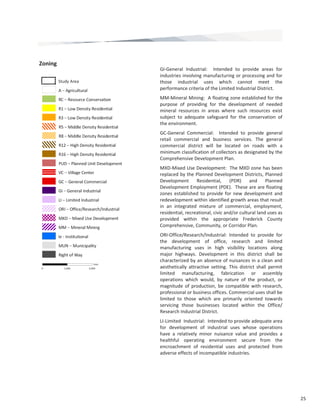
GI‐General  Industrial:    Intended  to  provide  areas  for 
industries involving manufacturing or processing and for 
those  industrial  uses  which  cannot  meet  the 
performance criteria of the Limited Industrial District.  
MM‐Mineral Mining:  A floating zone established for the 
purpose  of  providing  for  the  development  of  needed 
mineral  resources  in  areas  where  such  resources  exist 
subject  to  adequate  safeguard  for  the  conservation  of 
the environment.  
GC‐General  Commercial:    Intended  to  provide  general 
retail  commercial  and  business  services.  The  general 
commercial  district  will  be  located  on  roads  with  a 
minimum classification of collectors as designated by the 
Comprehensive Development Plan.  
MXD‐Mixed Use Development:  The MXD zone has been 
replaced by the Planned Development Districts, Planned 
Development  Residential,  (PDR)  and  Planned 
Development Employment (PDE).  These are are floating 
zones established to provide for new development and 
redevelopment within identified growth areas that result 
in  an  integrated  mixture  of  commercial,  employment, 
residential, recreational, civic and/or cultural land uses as 
provided  within  the  appropriate  Frederick  County 
Comprehensive, Community, or Corridor Plan.  
ORI‐Office/Research/Industrial:  Intended  to  provide  for 
the  development  of  office,  research  and  limited 
manufacturing  uses  in  high  visibility  locations  along 
major  highways.  Development  in  this  district  shall  be 
characterized by an absence of nuisances in a clean and 
aesthetically  attractive  setting.  This  district  shall  permit 
limited  manufacturing,  fabrication  or  assembly 
operations  which  would,  by  nature  of  the  product,  or 
magnitude  of  production,  be  compatible  with  research, 
professional or business offices. Commercial uses shall be 
limited  to  those  which  are  primarily  oriented  towards 
servicing  those  businesses  located  within  the  Office/
Research Industrial District.  
LI‐Limited  Industrial:  Intended to provide adequate area 
for  development  of  industrial  uses  whose  operations 
have  a  relatively  minor  nuisance  value  and  provides  a 
healthful  operating  environment  secure  from  the 
encroachment  of  residential  uses  and  protected  from 
adverse effects of incompatible industries.  
Zoning 
26 
Figure 20: Traffic Volume 
27 
Transportation 
Highway Functional Classifications 
Freeway/Expressway:  Divided  highways  that  carry  a 
high  volume  of  traffic  at  high  design  speeds  for 
interstate and inter‐county travel. They connect the 
major centers of activity and provide uninterrupted 
flow  (no  signalized  intersections)  from  origin  to 
destination.    Access  is  fully  controlled  by  grade 
separated  interchanges.  Freeways  in  the  Southeast 
Corridor are include I‐70 and I‐270.   
Major Arterial:  Carries  a  high  volume  of  traffic  for 
travel  within  the  county,  or  for  travel  to  and  from 
adjacent  counties.  Access  is  typically  allowed  from 
intersecting  public  streets  and  not  directly  with 
adjoining  parcels.    MD85  and  MD355  are  major 
arterials. 
Minor Arterial:  Carries  moderate  to  high  volume  of 
traffic  usually  for  travel  within  the  County.  These 
roads  typically  provide  access  to  the  interstate 
system.    There  are  no  minor  arterials  within  the 
Southeast Corridor study area.  
Collector:    Collects  and  distributes  traffic  from 
neighborhoods  to  the  arterial  system.  They  may 
allow some direct access to adjacent properties such 
as  community  shopping  areas,  schools,  parks,  and 
residential  developments.    Spectrum  Drive  around 
FSK  Mall,  Guilford  Drive,  and  Genstar  Drive  are 
designated collectors. 
Local:  Local  roads  provide  direct  access  to  abutting 
properties.  They  are  designed  to  handle  relatively 
low  traffic  volume.  Locals  roads  in  the  Southeast 
Corridor  study  area  include  Grove  Road,  Industry 
Lane,    New  Technology  Way,  Frederick  Crossing 
Lane, New Horizon Way,  Holiday Drive, Francis Scott 
Key Drive, and Lowes Lane. 
Public Transportation 
Transit is provided throughout the study area.   The 
Monocacy  Junction  MARC  Station  is  located  in  the 
south  of  the  study  area.    The  MTA  Commuter  Bus 
passes  through  the  study  area  and  stops  at  the 
MARC Station. 
Figure 20a: Comprehensive Plan Road 
Classifications 
Figure 20b: Existing Transit 
29 
Issue: The corridor is underdeveloped 
The  Southeast  Corridor    provides  a  high  level  of 
accessibility  to  services,  employment,  and 
infrastructure,  and  in  places  such  as  this  there  is 
natural momentum for higher density development.  
This, in combination with the less intensive suburban 
style  of  most  development  in  the  Southeast 
Corridor, underlies the potential for redevelopment 
in a more dense and urban fashion.   
Opportunity: Efficient provision of infrastructure 
The simple logic behind higher density development 
relates  to  the  efficient  provision  of  infrastructure 
and  services,  the  idea  being  that  shorter 
infrastructure runs need to be constructed, and less 
distance needs to be travelled in order to serve more 
people.  In an area with existing infrastructure and 
possible  excess  capacity,  as  in  the  Southeast 
Corridor,  this  efficiency  advantage  can  be  even 
greater in that the use of existing infrastructure and 
services can be maximized.   
Opportunity: Increased returns to property owners 
The potential advantages of increasing development 
density  can  also  translate  to  the  property  owner.  
The potential revenue a piece of land can generate 
can  increase  as  its  development  yield  increases.  
Thereby, profits for private property owners can be 
maximized. 
Opportunity:  Enhancement  of  local  transportation 
infrastructure 
Perhaps  the  biggest  pitfall  of  increasing 
development  intensity  in  the  Southeast  Corridor  is 
traffic  congestion.    MD  85  and  MD355  are  already 
busy  roads  in  the  County,  and  more  development 
means more trips.  However, by providing more local 
roads  to  maximize  the  connectivity  within    the 
corridor  and  to  points  outside  of  the  corridor, 
excessive congestion can be mitigated. 
From a layout and spatial organization perspective, 
there is ample opportunity to provide new road and 
ISSUES AND 
OPPORTUNITES 
pedestrian  connections  to  offset  the  potential 
increase  in  development  intensity  in  the  Southeast 
Corridor.  Given the large amount of surface parking 
area  in  the  corridor,  and  the  wide  berth  between 
most  existing  buildings,  an  augmented  street 
network  could  be planned  in  a  way  that minimizes 
the  impact  to  existing  buildings.    This  could  be  a 
benefit  when  considering  how  the  implementation 
of  proposed  plans  could  be  phased  over  time, 
assuming that it is generally much easier to propose 
a road that doesn’t require the demolition of existing 
buildings. 
Issue:  The  physical  character  of  the 
corridor  is  generic,  uncoordinated,  and 
unattractive 
If someone makes a comparison in their mind’s eye 
between  the  historic  downtown  of  Frederick  City 
and  the  suburban  strip  of  the  Southeast  Corridor, 
perhaps  what  would  be  most  evident  is  the  stark 
contrast  in  physical  character  between  each  place.   
Frederick City is endowed with beautiful architecture 
that defines public space, a clear and legible layout, 
a  discrete  organization  of  neighborhoods,  and 
landmark  buildings  that  make  the  downtown 
identifiable  and  promote  meaningful  and  symbolic 
associations between places and peoples lives.   
Not many would argue that the Southeast Corridor 
lacks many of these qualities, if not completely, then 
certainly  in  degree.    And  yet,  it  is  the  qualities  of 
historic Frederick City that time and again are upheld 
as the desired models to emulate.   
Opportunity:  Development  of  a  memorable  and 
unique environment 
It  then  follows  that  the  redevelopment  of  the 
Southeast  Corridor  is  an  opportunity  to  realize  the 
design  qualities  of  the  Frederick  Downtown  in  a 
place  that  is  modern,  updated,  and  efficient,  yet 
every bit as memorable and unique as Frederick City. 
30 
Figure 21: MD355 ‐ Historic Corridor 
Figure 22: MD85 ‐ Business Corridor 
31 
The  following  is  a  cursory  analysis  of  some  of  the 
unique features of the Southeast Corridor and how 
those  features  can  play  a  role  in  the  design  of  its 
future growth and redevelopment. 
Opportunity: Historic Corridor 
MD  355,  Urbana  Pike,  is  not  only  a  historic  road 
whose general alignment has been roughly the same 
since  the  pre‐colonial  era,  but  it  also  connects 
several  significant  historic  places  throughout  the 
County and Frederick City.  To the south of the site, 
MD355  crosses  the  Monocacy  National  Battlefield.  
As  it  continues  north,  it  passes  several  other 
historically  significant  places,  such  as  Mt.  Olivet 
Cemetery  where  Francis  Scott  Key  is  buried,  the 
Historic  District  of  Downtown  Frederick  and  Baker 
Park,  and  finally  Rose  Hill  Manor,  the  retirement 
home  of  Thomas  Johnson,  the  first  Governor  of 
Maryland.  These landmarks are illustrated below. 
The interpretation of MD355 as a “historic corridor” 
can frame and give context to decisions about how it 
should develop in the future. 
Opportunity: Business Corridor 
In  the  same  way  that  MD355    connects  significant 
historic features, MD85 connects significant centers 
of  business  in  the  County  and through  the  City.   A 
large industrial center is located to the south of the 
Corridor Study Area along MD85.  This area includes 
the  Westwood  Business  Park,  the  McKinney  and 
Dudrow  Industrial  Parks,  and  the  Omega  and 
Monocacy Centers.  North of this along MD85 is the 
Westview  Commercial  Center  with  mixed  use 
development  containing  retail  and  office  uses.  
Within the study area itself is the Frederick Industrial 
Center  subdivision  with  a  concentration  of 
commercial and business services.  To the north of 
the study area is the future East Street development 
area  in  the  City  of Frederick,  slated  to  be  a  mix  of 
housing,  retail,  and  office  uses,  and  the  Frederick 
Airport  Industrial  Area.    Further  north,  MD85 
terminates into other adjacent roads that lead to the 
North  Frederick  commercial  area  and  the Riverside 
Technology Park. 
In addition, MD85 is the most accessible road in the 
Southeast  Corridor  in  that  it  has  two  interchanges 
with two different Interstates, I‐270 to the east, and 
I‐70 to the north.   
 
Opportunity:  Capitalization  of  existing  physical 
features  to  provide  design  structure  and 
organization 
The map on the facing page illustrates some of the 
significant  physical  features  of  the  Southeast 
Corridor.  These are discussed below in terms of how 
these features influence the existing physical layout 
of the Corridor, as well as it’s redevelopment.   
It has been established, by Kevin Lynch and others, 
that we cognitively process the physical environment 
through  the  formation  of  mental  images.    The 
aspects  of  the  physical  environment  that  compose 
those images have been described as the following: 
districts, paths, edges, nodes, and landmarks.  It has 
been shown that places are more legible when these 
elements are clearly organized and that the design of 
places  can  more  likely  be  successful  when  these 
elements are considered and accounted for. 
Legible places can have practical benefits in terms of 
way‐finding.  But they are also places that can more 
easily  provide  that  fuzzy  yet  much  sought  after 
aspect  of  place  called  identity.    The  Southeast 
Corridor, beleaguered by the uniformity of the strip 
center and an ad hoc overall character, is lacking in 
this respect.  If planning is done using the principles 
of  how  we  use  mental  images  to  structure  our 
perception  and  understanding  of  places,  a  place  is 
more likely to embody the fuzzy aspects that allow 
us to endow a place with identity. 
Districts:    Districts  are  discrete  and  identifiable 
divisions  of  a  larger  whole.    In  the  Southeast 
Corridor,  there  is  little  existing  criteria by  which  to 
define  districts.    Upon  initial  inspection,  everything 
seems  to  flow  into  the  next,  without  obvious 
physical  division.    However,  closer  examination 
reveals that features of the topography, the location 
of  infrastructure,  and  the  clustering  of  similar  uses 
establishes  a  rudimentary  pattern  of  districts, 
however  inchoate.    As  planning  for  the  corridor 
precedes, the districts identified on the facing map 
can serve a starting point. 
Boundary Edges:  Boundary edges are linear features 
that  act  as  breaks  in  the  continuity  of  a  defined 
space.    The  berms  along  the  LaFarge  Quarry  are  a 
notable edge, as is the tree line along the northern 
edge  of  the  Monocacy  Battlefield.    Other  less 
obvious edges are identified in the facing map, and 
are  typically  places  of  significant  and  steep  shift  in 
elevation. 
32 
Figure 23: Physical Analysis 
33 


Figure 24: Analysis of Potential Residential Enclaves 
Exposure  Edges:    Exposure  edges  are  boundaries 
within the Corridor that are in plain view to a large 
number  of  people.    The  type  of  development  that 
might  occur  along  an  exposure  edge  would  be  the 
kind that would benefit from high visibility, such as 
corporate  office  space.    These  areas  can  produce 
development that capitalizes on the high degree of 
exposure,  but  also  acts  as  significant  identifying 
features of the Corridor to the outside world 
Nodes:    Two  types  of  nodes  exist  in  the  Southeast 
Corridor,  junctions  and  activity  centers.    Junctions 
are typically road intersections, and activity centers 
are  typically    areas  that  attract  significant 
commercial activity. 
The  significant  junctions  identified  at  this  time,  at 
least from a perceptual perspective, are the MD85/
MD355  intersection  and  the  Guilford  Drive/MD85 
intersection.    The  MARC  Train  Station  was  also 
identified  as  a  significant  junction,  although  this  is 
likely  not  a  dominant  aspect  of  the  perception  of 
junctions in the corridor. 
While  the  entire  Southeast  Corridor  is  essential  a 
commercial center, only the FSK Mall was identified 
as  an  activity  center.    This  is  because  most  other 
commercial development  has a uniform quality. 
Landmarks 
Landmarks  are  external  point  references  and 
typically can be seen from a large area or are notable 
by  the  degree  of  difference  in  character  from  the 
surroundings.  Two  areas  were  identified  a 
landmarks.  The Guilford Manor complex was noted 
because  it  is  on  a  promontory  that  dominates  it’s 
surrounding  in  terms  of  physical  presence.    The 
storm  water  management  basin  in  the  Frederick 
Industrial  Center  on  Industry  Lane  is  identified 
because it is external in that it is not a park or center 
for activity, and it is also in contrast to it’s context in 
terms of physical presence. 
Issue:  Residential  development  in  the 
Southeast Corridor 
In  it’s  current  state,  it  is  difficult  to  imagine  how 
residential uses would be compatible or appropriate 
in  the  Southeast  Corridor.    Since  the  1970’s  it  has 
largely  developed  in  a  strip  commercial  manner, 
which  emphasizes  the  exposure  of  buildings  to 
public  streets.    The  emphasis  of  retail  centers  for 
high  visibility  seems  at  odds  with  the  needs  for 
privacy  and  quiet  that  residential  development 
demands.   
Opportunity: Residential Buffers and Enclaves 
Cities  have  historically  solved  this  problem  in  two 
ways.  The first is to provide a buffer from active and 
noisy  streets  by  elevating  residential  uses  above 
street level, locating it in the upper levels of multi‐
story buildings.   
The other approach taken by many cities it to locate 
housing  in  buffered  enclaves.    This  occurs  when 
housing  is  located  in  residential  pockets  that  are 
surrounded  on  the  perimeter  by  more  intensive 
commercial  uses.    Within  the  pocketed  areas  is 
primarily residential land use, while commercial land 
use  occurs  on  the  edges.    This  approach  affords  a 
wider range of options in terms of housing types. 
The diagram below is a cursory analysis in order to 
identify  and  locate  potential  areas  for  residential 
enclaves  within  the  study  area,  and  also  illustrate 
the concept.  In the diagram, as the intensity of the 
red color increases, so does the potential to provide 
quiet, less active areas of the Corridor that would be 
appropriate for housing. 
 

Background report

  • 3.
    Introduction                     1  Figure 01: Regional Context                    2  Figure 02: Community Growth Area and Study Area              3  Figure 03: Study Area                    4    Development History                   7  Figure 04: Regional Historic Development – Single Center              7  Figure 05: Regional Historic Development ‐ Multiple Centers            8  Figure 06: Commercial Centers                  10  Figure 07: Local Historic Development                  12‐13  Figure 08: Locust Level Estate and Evergreen Point              14    Existing Conditions                    17  Figure 09: Topography                    17  Figure 10: Existing Land Use                    18  Figure 11: Percent of Total Acres by Land Use                19  Figure 12: Value by Land Use in Millions                19  Table 13: Land Area and Value                  19  Figure 14: Existing Building Use                  20  Figure 15: Building Area                    21  Figure 16: Building Area by Subdivision                 21  Figure 17: Square Feet by Building Use                  21  Figure 18: Existing Comprehensive Plan Land Use Designations            22  Figure 19: Existing Zoning                    24  Figure 20: Traffic Volume                    26  Figure 20a: Comprehensive Plan Road Classifications              27  Figure 20b: Existing Transit                    27    Issues and Opportunities                  29  Figure 21: MD355 ‐ Historic Corridor                  30  Figure 22: MD85 ‐ Business Corridor                  30  Figure 23: Physical Analysis                    32  Figure 24: Analysis of Potential Residential Enclaves              33  TABLE OF CONTENTS 
  • 5.
    1  The Corridor Planning Process  The  Community  and Corridor  planning  process  described  in  “Frederick  County’s  Future”,  the  Countywide  Comprehensive  Plan  (April  2010),  is  a  strategy that facilitates a more locally focused level  of planning throughout the County.  While planning  at  the  countywide  level  occurs  through  cyclical  updates  of  the  Countywide  Comprehensive  Plan,  planning at the local level related to the wide variety  of  communities  and  jurisdictions  throughout  the  County  can  be  addressed  in  detail  through  the  development of the Community and Corridor plans.    Plans produced under the Community and Corridor  process have primary emphasis on exploring design  concepts,  redevelopment  opportunities,  and  development staging in greater detail than described  in  the  Countywide  Plan.  The  result  of  this  will  produce  a  stand  alone  community  plan  document  that would amend the Countywide Plan.  One of the first plans to be produced under this new  planning process is for the corridor of land along MD  85 and MD 355 just to the south of Frederick City.    The Southeast Corridor  The MD85/355 corridor, hereafter referred to as the  Southeast Corridor, is located just south of Frederick  City,  bounded  by  I‐270  on  the  west,  I‐70  on  the  north,  LaFarge  Quarry  on  the  east  and  Monocacy  National Battlefield on the south.  Two major state  roads traverse the area, MD85 ‐ Buckeystown Pike,  and  MD355  ‐  Urbana  Pike.    It  is  a  major  retail,  commercial, and industrial area of Frederick County.  Regionally, the Southeast Corridor is located at the  junction  of  primary  connections  to  major  metropolitan  areas,  namely  Washington  D.C.  and  Baltimore.  The growth of these cites has historically  driven  the  growth  of  Frederick  County,  and  this  is  expected to continue  in the future.  The location at  this  junction  potentially  makes  the  Southeast  Corridor a focal point for this growth, which gives it  the potential to play a role not just locally, but within  the region as well.  Redevelopment  The  Southeast  Corridor  has  been  prioritized  as  a  corridor  plan  because  of  its  potential  to  accommodate  growth  through  redevelopment.   While  much  of  the  land  is  already  developed  and  built  out  under  current  development  intensity,  redevelopment  in  a  more  intense  fashion  can  maximize  land  use  potential  and  provide  opportunities  to  introduce  residential  uses  while  leveraging existing infrastructure.    In  general,  redevelopment  has  been  employed  to  counteract  economic  disinvestment  in  land  that  results  in  the  deterioration  of  buildings  and  infrastructure,  commonly  referred  to  as  blight.   However, economic disinvestment in the Southeast  Corridor is not a pressing concern.  Rather, the focus  on the redevelopment of this area relates more to a  priority on leveraging existing infrastructure relative  to  the  management  of  growth  in  the  County.  The  County  Comprehensive  Plan  emphasizes  redevelopment in the following goals:  MG‐G‐07:  Establish  as  a  targeted  goal  for  the  development  and  redevelopment  of  lands  within  Community  Growth  Areas,  an  average  density of 7.5 residential dwellings/acre by the  year 2025.  MG‐G‐08: Increase the number of properties ‐ both  vacant and underdeveloped land ‐ available for  employment  uses  in  order  to  support  policies  that  emphasize  the  reuse  and  revitalization  of  previously developed sites.  MG‐G‐10:  Emphasize  reinvestment  in  our  growth  areas  by  encouraging  infill  and  redevelopment  projects  which  are  compatible  with  existing  neighborhoods and districts.  Additionally,  the  County  Comprehensive  Plan  expresses the specific policy of using redevelopment  as a growth management strategy:  INTRODUCTION 
  • 6.
  • 7.
    3  MG‐P‐03   Pursue  redevelopment strategies  as  a  way  to  minimize  the  need  to  expand  existing  Community  Growth  Areas  or  establish  new Community Growth Areas.  This  policy  supports  planning  that  moderates  the  practice  of  expanding  growth  areas  outward  to  accommodate  growth  by  supporting  planning  that  calls  for  more  intense  development  within  existing  growth  areas.    Rather  than  solely  emphasize  the  development of rural land around the periphery of  the Community Growth Areas, the demand for new  residential  and  employment  development  can  also  be  accommodated  through  infill  of  vacant  parcels  and redevelopment in the Southeast Corridor.  The development pattern in the Southeast Corridor  presents an prime opportunity for redevelopment in  this  regard  for  several  reasons.    First,  there  is  a  wealth of  infrastructure in the area in the form of  two  Interstates,  two  State  highways,  and  a  commuter  rail  station.    Therefore  additional  investment  in  infrastructure  can  be  minimized  because,  for  the  same  level  of  development,    the  cost  of  any  required  upgrades  in  an  area  like  the  Southeast Corridor with relatively new infrastructure  systems may be much less than the cost of providing  new infrastructure.  Second,  there  is  an  abundance  of  “open  air”  shopping facilities in the Southeast Corridor, where a  high  percentage  of  land  is  paved  parking  fields.   Therefore  a  version  of  an  infill  development  approach  can  be  employed  to  maximize  the  development potential of property while minimizing  the  burden  to  existing  owners  and  tenants.      This  means  that  there  is  a  lot  of  area,  in  the  form  of  parking fields, that can either be built upon with new  construction,  that  can  be  reserved  for  needed  infrastructure, or that can provide public amenities  such as parks and playgrounds.  And all of this can  occur in a phased manner that would not necessarily  require the replacement of existing facilities.  Third, with an area like the Southeast Corridor, with  an abundance of geographic endowments such as a  high degree of access, a high degree of attraction of  consumers,  and  an  relatively  new  and  healthy  infrastructure  system,  redevelopment  can  leverage  job growth in the County.  This is because increasing  the intensity of development in areas with numerous  locational  advantages  has  the  potential  of  minimizing  the  amount  of  public  investment  required to service development while still providing  the  potential  for  new  and  desirable  facilities  for  corporate tenants.  The potential of combining the  advantages  of  access,  attraction,  and  infrastructure  with  the  possibility  for  new  and  modern  facilities,  perhaps in an environment that provides amenities  such  as  walkable  streets,  can  create  a  competitive  advantage when firms make decisions about where  to locate.  Finally, the Southeast Corridor shares the advantage  with  Frederick  County  of  proximity  to  Washington  D.C. and Baltimore.  The economic engines of these  two  metropolitan  areas  has  driven  growth  in  the  County for decades, and there is ample opportunity  to channel that growth into the Southeast Corridor  in the future.  Figure 02: Community Growth Area and Study Area 
  • 8.
  • 9.
    5  Study Area Delineation  The Southeast Corridor is a portion of the Frederick  Southeast  Community  Growth Area  defined  in  the  2010 County Comprehensive Plan.  The development  in the far eastern portion of the growth area on the  northeast  side  of  Reich's  Ford  Road  along  Quinn  Orchard  Road  is  not  included  in  the  Southeast  Corridor  study  area.    This  is  because,  while  both  areas  are  within  the  same  growth  area,  they  are  geographically  divided  by  the  LaFarge  quarry,  and  are very different in terms of land use.    The definition of the Southeast Corridor study area  takes  several  issues  into  account.    First,  is  the  difficulty  in  determining  with  certainty  what  the  required  extent  of  a  study  area  should  be  without  “studying  the  area”.    In  other  words,  once  plan  development  has  commenced,  more  information  will be obtained, and therefore better decisions can  be made regarding the extent of the study area.  Second, most aspects of this corridor are connected  with other factors outside the realm of the corridor  itself.  For example, the addition of housing to the  Westview development could significantly alter what  would be proposed in the Southeast Corridor.  Every  part of the Corridor is a part of a hierarchy of other  issues and factors several scales beyond a proposed  immediate  study  area,  so  one  aspect  cannot  be  considered unless the next higher scale is also taken  into account.  Some of these factors include:  • Transit connections and highway connections to  Washington  D.C.  and  the  I270  technology  corridor  to  the  south  and  to  Baltimore  to  the  east  • Operations of the LaFarge quarry  • Competing  and  compatible  adjacent  uses  such  as  the  downtown  and  the  East  Street  redevelopment  in  Frederick  City  and  the  Westview mixed use development and industrial  development to the south  • Market demand and demographic trends for the  Frederick County region  • The  growth  of  residential  development  in  counties to surrounding Frederick County  Delineating  a  study  area,  therefore,  does  not  limit  the  factors  that  will  be  considered  in  the  plan.   Rather, the study area is proposed to be the limit of  any potential interventions outlined in the plan.  The delineation of the Study Area for the Southeast  Corridor  is  largely  based  on  aligning  with  existing  physical  barriers.    Specifically,  the  barriers  typically  used as boundaries are those that present significant  physical obstacles in terms of access from one side  to the other.  To  the  west  and  north,  the  study  area  extends  to  I270  and  I70  respectively.    To  the  east,  the  study  area  extends  to  the  quarry  boundary,  typically  aligning with the west side of the quarry berms built  along MD355.    The  exception  along  the  eastern  boundary  of  the  study area is where the quarry property ends around  the  Riverside  Shopping  Center.    At  this  point,  the  study  area  boundary  includes  all  of  the  MARC  Station parking area and junction up to the railroad.   It  continues  to  follow  the  railroad  south  until  it  enters the Monocacy Battlefield where it aligns with  the edge of the Monocacy River.  To  the  south,  the  study  area  extends  to  the  Monocacy  River,  and  includes  a  portion  of  the  Monocacy  Battlefield.    While  specific  interventions  will not be proposed with the Battlefield itself, it was  included  in  the  study  area  to  indicate  that  it  is  an  area of special concern to the planning effort.   
  • 11.
    7  The  geographic  organization of  land  use  in  central  Frederick County has changed from a single discrete  commercial  center  to  a  pattern  of  multiple  commercial  centers  distributed  in  the  region  surrounding Frederick City.  The newer commercial  areas  in  and  around  Frederick  City  have  either  rapidly  developed  in  the  last  fifty  years,  or  are  currently  in  the  process  of  development.    The   changes  wrought  by  this  growth  and  development  are unprecedented in the history of the County.  Regional Context—Single Center  Throughout most of the history of Frederick County,  the Southeast Corridor area has played a minor role  in  the  commercial  and  industrial  activity  of  the  County, with at most being the location of scattered  roadside  businesses  and  estate  farms.    Rather  Downtown  Frederick  City  has  served  as  the  major  regional  commercial  center,  with  manufacturing  industries  significantly  shaping  its  development.   Throughout the early 19th century, timber, mining of  limestone  and  iron  ore,  and  tanning  were  the  predominant industries.  In the later 19th century, a  shift in emphasis in the County to dairy farming led  to  the  growth  of  dairy  processing  industries.   Additionally, canning industries to process fruits and  vegetables also experienced growth during this time  period.  Even  as  infrastructure  improvements  were  constructed  over  time,  Frederick  City’s  downtown  maintained  it’s  standing  as  the  dominant  center  of  commerce  and  industry  in  the  County.    It  was  not  until the post World War II growth of the 1950’s and  beyond  that  the  geographic  distribution  of  major  commercial  and  industrial  activity  in  the  County  became  dispersed  into  multiple  centers,  with  the  Southeast  Corridor  playing  a  major  role  in  this  dispersion.    DEVELOPMENT  HISTORY  Figure  04:  Regional  Historic  Development  ‐  Single Center  Pre 1920  National  Road  begun  in  1811,  planned  connection  between  Cumberland, MD and St. Louis, MO.  Middletown Turnpike and  Baltimore Turnpike part of chain of turnpikes chartered by MD  connecting Baltimore to the National Road.  Completed in 1824  and referred to as the eastern extension of the National Road.   Georgetown  Turnpike  chartered  by  MD  in  1805.    Georgetown  Turnpike realigned at Araby.  Creates Araby Church Road.  1926+  U.S.  Highway  System  adopted  in  1926.    Baltimore  and  Middletown  Turnpikes  designated  US  40  as  part  of  the  US  Highway  System.    Georgetown  Turnpike  designated  US240.   Jefferson Pike designated US 340.  Buckeystown Pike designated  US 15.  1948  New  alignment  of  US40  opens  between  Frederick  and  Hagerstown.  Pre‐existing alignment of US40 becomes US40A.  1953  New  alignment  of  US240  constructed,  alongside  previous  alignment.  Previous alignment eventually designated MD355.  1959  I‐70 construction begins as part of US Highway Act of 1956.  First  Interstate Highway.  Parallels US40 east of Frederick City, and  splits  off  from  US40  west  of  Frederick  City.    Old  alignment  of  US40  designated  MD144.    Frederick  Bypass  completed  up  to  US40.    US240  decommissioned  and  re‐designated  I‐70S  along  the same right of way.  1960’s  Frederick  Bypass  completed  and  US15  north  of  Frederick  City  improved.  Old alignment of US15 designated MD806.   
  • 12.
    8  Revitalization planning begins for Golden Mile in Frederick City.   Frederick Towne Mall in decline.  Downtown Frederick City revitalization successful.  Serves  specialized role in the region.    Southeast Corridor essentially built out at current planned  intensity.  Prime area for redevelopment as high density mixed  use sector.  Continued growth of Monocacy Boulevard area as retail and  industrial center.  Continued prosperity of Golden Mile in Frederick City, building  stock begins to approach end of economic lifespan.    Frederick Towne Mall in competition with FSK Mall.  Beginning  of decline for Frederick Towne Mall as major anchor tenant  relocates to FSK Mall.  Downtown Frederick City revitalization continues as center for  government, professional, and leisure activities.    Growth of Southeast Corridor.  New regional retail and industrial center around Monocacy  Boulevard begins to develop.  Continued growth of Golden Mile in  Frederick City.  Decline of Downtown Frederick City continues, accelerated by  Flood of 1976.  Growth of Southeast Corridor continues, accelerated by  construction of FSK Mall in 1979.  Carroll Creek flood control project begun in late 1970’s,  beginning revitalization of Downtown Frederick.  US340 constructed and US 15 realigned south of Frederick City.  US15 south of Frederick City re‐designated MD85 and MD28.  US340 re‐designated MD180 and I‐70S re‐designated I‐270.  Golden Mile in Frederick City development begins.  Frederick  Towne Mall Opens in 1972.  Decline of Downtown Frederick City begins as modern  commercial space develops along Golden Mile.  Development along Southeast Corridor begins.  Figure 05: Regional Historic Development ‐ Multiple Centers 
  • 13.
    9  Regional Context—Multiple Centers  After the 1950’s and well into the latter half of the  twentieth century, economic growth and expansion  took a new form in Frederick County as commercial  activity  began  to redistribute  into  multiple  geographic  centers.    For  the  first  time  in  it’s  long  history,  Frederick  City’s  downtown  began  to  share  the load of commercial and industrial demand with  other  surrounding  areas,  inside  and  outside  of  the  City.    This  began  with  the  development  of  the  Golden  Mile  along  US  40  west  of  Downtown  Frederick,  and  continued  with  the  growth  and  development  of  the  Southeast  Corridor.    Finally,  a  more recent employment and commercial center is  emerging along the Monocacy Boulevard area in the  northern portion of the City.  The Golden Mile:  The  first  major  dispersion  of  commercial  activity  occurred with the development of the Golden Mile,  on  the  stretch  of  US  40  to  the  west  of  Downtown  Frederick.  From the beginnings of its growth in the  early  1970’s,  it  has  been  a  center  for  large  format  regional  chains  and  local  retail  businesses.  Over  time,  ethnically  oriented  shopping  and  dining  establishments have been introduced into the area.  From an occupancy standpoint, the Golden Mile as a  whole  is  currently  in  good  condition,  with  the  exception of the Fredericktowne Mall.  Among other  factors, competition with the FSK Mall to the south  of  Frederick  City  has  led  to  the  decline  of  the  Fredericktowne Mall.  Beyond the Mall, much of the  building stock along the Golden Mile is nearing the  end of it’s economic lifespan, which has resulted in a  deterioration in the physical appearance of the area.   Additionally,  the  growth  and  proximity  of  surrounding  residential  uses  has  led  to  increase  pedestrian  activity  in  an  area  designed  almost  entirely  for  automobile  circulation.    These  factors  have led to strong public interest in revitalization of  the Golden Mile.  Downtown Frederick:  Downtown  Frederick  experienced  an  economic  downturn in the mid 1970’s.  With the development  of  the  Golden  Mile,  many  of  the  major  anchor  tenants  departed  Downtown  Frederick  for  those  newer  and  updated  facilities.    Also,  many  business  owners and residents were impacted by the Flood of  1976 where Carroll Creek inundated the Downtown  with water.  In  time  Downtown  Frederick  experienced  an  economic recovery, redefining itself as a center for  professional  business  and  services,  unique  and  specialty  retail,  and  dining.    This  was  due  in  large  part  to  community  support  and  visionary  planning,  an  aspect  of  which  was  a  flood  control  project  known  as  the  Carroll  Creek  Promenade  that  combined  a  major  urban  civic  space  with  flood  management facilities.  While  the  historic  core  of  Downtown  Frederick  is  enjoying  a  healthy  balance  of  economic  activity,  another area of the Downtown along East Street is  poised  for  major  growth.    This  historic  focus  on  industrial activity in this area has been redirected to  the  Monocacy  Boulevard  Area.    With  a  recently  constructed  connection  between  East  Street,  I‐70,  and MD85, this area is being envisioned as a center  for mixed use development focusing on commercial  office, retail, and residential.  North Frederick Area  This retail center, located around the confluence of  US26, US15, and Monocacy Boulevard, is a growing  concentration of office, large format chain retailers  with  locally  oriented  retail  and  service  businesses.   South  of  this  along  Monocacy  Boulevard  is  a  concentration of industrial uses, some of which have  relocated  from  the  East  Street  area  in  Downtown  Frederick.    Commercial Centers  As described above, the Southeast Corridor is one of  many  commercial  areas  in  the  County.    The  commercial  areas  identified  on  the  following  map  include strip shopping centers such as the Frederick  Shopping Center or College Park Plaza, office parks  such  as  the  Thomas  Johnson  Professional  Center,  industrial  areas  such  as  the  development  in  the  southern  portion  of  Frederick  Southeast  and  the  Airport  Industrial  Park,  mixed  use  centers  such  as  Downtown Frederick, and major retail districts such  as  the  Golden  Mile.    The  clusters  identified  on  the  following  map  are  defined  based  on  their  geographical proximity, and the historical timeframe  of  their development. 
  • 14.
  • 15.
    11  Short of conducting a full fledged market analysis, a  general  impression  of the  market  forces  that  may  impact the redevelopment of the Southeast Corridor  can  be  gained  from  several  sources  based  on  proposed  projects,  projected  demand,  and  anticipated demographic trends.  A  picture  of  existing  and  proposed  business  and  retail development in the County can be gained from  a  database  maintained  by  the  Office  of  Economic  Development  that  tracks  business  parks  and  retail  centers,  updated  quarterly.    According  to  this,  the  business park properties in the vicinity of Frederick  City  that  are  included  in  this  database  constitute  roughly 9.6 million square feet of built area, with 6.4  million  existing  and  3.2  million  proposed.   Additionally,  retail  properties  constitute    roughly  7  million  square  feet,  with  1.2  million  proposed  and  5.8 million existing.  In  September  2007  and  May  2008,  the  City  of  Frederick  commissioned  a  market  analysis  of  the  Frederick  City  market  area  for  retail,  office,  flex/ R&D,  and  industrial  uses.    While  economic  conditions  have  changed  dramatically  since  the  release  of  these  reports,  the  projected  demand  proposed  in  these  reports  can  shed  some  light  on  potential opportunity gaps in the Frederick business  and  retail  markets.    These  reports  accounted  for  existing and proposed projects, and concluded that  there  was  an  opportunity  gap  in  the  form  of  an  additional demand outside the expected pipeline for  100,00  square  feet  of  office  space,  700,000  square  feet of industrial space, and 1.4 million square feet  of  flex  space.    For  the  retail  market,  these  reports  concluded that the market was generally saturated,  and that additional demand for retail would be tied  to  demand  expansion  in  the  form  of  population  growth.  Finally, an understanding of future housing demand  can  be  gained  from  the  analysis  of  broad  demographic  trends.    While  the  Frederick  County  Comprehensive  Plan  projects  a  demand  of  36,000  housing units over the next twenty years, it does not  evaluate  the  breakdown  of  demand  by  unit  type,  such as single family, townhomes, or multi‐family.    However,  demographic  shifts  and  changing  values  relative  to  future  housing  demand  have  been  evaluated  by  John  McIlwain  of  the  Urban  Land  Institute.    Some  key  demographic  trends  that  R  1  Ballenger Creek Plaza    R  2  College Park Plaza    R  3  Discovery Shopping Center    R  4  Eastgate Shopping Center    R  5  Festival at Frederick    R  6  Frederick Shopping Center    R  7  Kingsbrook Crossing    R  8  Monocacy Village Center    R  9  Northgate Plaza  Proposed  R  10  Prospect Plaza Shopping Center    R  11  River Run Center  Proposed  R  12  Rose Hill Plaza    R  13  Spring Ridge Shopping Center    R  14  The Shops at Monocacy    R  15  Thomas Johnson Center    R  16  The Turning Point Center    R  17  Villages at Urbana Town Center    R  18  Walnut Ridge Shopping Center    R  19  Whittier Lakefront Center    R  20  Worman's Mill Village Square  Proposed  R  21  Crestwood Plaza    R  22  Westview Village    R  23  Westview Corner    R  24  Clemson Corner  Proposed  R  25  Market Square at Frederick  Proposed  R  26  Urbana Village Center    R  27  Westview Promenade    R  28  Golden Mile    R  29  Linganore Town Center  Proposed  R  30  Landmark  Proposed  R  31  Downtown Frederick    B  1  Ballenger Creek Center    B  2  Center Park    B  3  Frederick Research Park    B  4  Governor's Choice    B  5  North Amber Business Park    B  6  Riverside Corporate Park    B  7  Riverside Corporate Center    B  8  Worman's Mill Industrial Park    B  9  Center at Monocacy    B  10  Airport Industrial Park    B  11  Frederick Industrial Park    B  12  Bowman Plains Industrial Park    B  13  Dudrow Business Park    B  14  Knowledge Farms    B  15  McKinney Industrial Park    B  16  Omega Center    B  17  Riverside Technology Park    B  18  Riverside Research Park    B  19  Wedgewood Industrial Park    B  20  Century Center  Proposed  B  21  Industrial Center East    B  22  Urbana Office & Research Center    B  23  Frederick Airport Park    B  24  Frederick Brick Works Site  Proposed  B  25  Westview South Office Research Center    B  26  Westview Corporate Campus    B  27  Jefferson Technology Park  Proposed  B  28  Russell Property  Proposed  B  29  Urbana R & D Park  Proposed  B  30  Crum Farm  Proposed  B  31  Thatcher  Proposed  B  32  Jefferson Tech Park West  Proposed 
  • 16.
  • 17.
    13  McIlwain  identifies  point toward  an  increased  demand for smaller lots and more “urbanized” forms  of housing development.    As  the  housing  market  has  declined,  so  has  the  demand  for  single  family  homes.    Older  baby  boomers who are not stuck in their suburban homes  in situations of negative equity are typically choosing  to  live  in  smaller  dwellings  closer  to  family  and  grandchildren rather  than  relocate to  the Sun  Belt.   Younger  baby  boomers  who  have  purchased  single  family  homes  and  wish  to  sell,  now  have  a  much  smaller  population  of  buyers  in  the  form  of  the  Generation  X  demographic.    Additionally,  the  housing  bust  has  depleted  the  equity  of  many  Younger  Boomers,  and  the  traditional  demand  for  second  homes  in  this  demographic  has  similarly  been eroded.  Finally, the Generation Y demographic  (late teens to early 30’s) has lost the confidence of  previous generations in the wealth building potential  of  homeownership.    This,  in  combination  with  the  general desire among this demographic group to live  in urban settings has spurred the trend for smaller  dwellings and rental housing.  The general impression that the above information  gives is that there is a potential opportunity gap for  new development in the business sector (specifically  flex/R&D  and  industrial  space)  and  in  non‐single  family  housing,  with  the  demand  for  retail  being  restrained  by  a  saturated  market  and  generally  keeping pace with population growth.  This suggests  that  any  redevelopment  in  the  Southeast  Corridor  would  best  be  directed  toward  employment  and  housing,  while  generally  maintaining  current  levels  of  retail  service.    Given  the  presence  of  the  MARC  station,  and  the  general  affinity  and  compatibility  between office and residential types of uses in urban  settings,  the  Southeast  Corridor  presents  ample  potential  for  redevelopment  as  a  mixed  use  urban  center in Frederick County.    Local Context  As the diagrams to the left illustrate, the Southeast  Corridor has undergone a vast amount of change in  the last sixty years.  In the early 1950’s, the area was  largely  agricultural,  with  some  residential  and  transitional  roadside  businesses.    Since  then,  the  area has transformed into one of the most valuable  and intensively used portions of land in the County.  2000  2007 
  • 18.
    14  Evergreen Point was likely named for the row  of evergreen trees that fronted the Locust Level  Estate at the intersection of Buckeystown Pike  (MD85)  and  Urbana Pike  (MD355).    For  decades, the manner house of the Jacob Lewis  property, named Locust Level for the level line  of  locust  trees  that  were  arranged  along  the  front  porch  of  the  house,  was  located  at  this  intersection.  Presumably for privacy purposes,  a  row  of  evergreens  was  planted  along  the  road  frontage  of  this  estate,  right  at  the  intersection  of  MD85  and  MD  355.    As  the  evergreens grew and became a prominent and  distinct  visual feature  of  this  heavily  travelled  intersection,  the  name  “Evergreen  Point”  emerged.  Figure 08: Locust Level Estate and Evergreen Point 
  • 19.
    15  Several factors have contributed to the growth of  the  area.   The  most  basic  is  the  high  degree  of  accessibility the area enjoys due to the adjacency  of  two  Interstates,  and  the  convergence  of  two  State  Roads.    This,  alongside  the  proximity  to  Downtown  Frederick,  a  regional  magnet  for  business  and  consumer  activity,  had  primed  the  area for growth.    However,  access  and  attraction  alone  were  not  adequate  to  spark  the  growth  of  the  area.   Infrastructure  for  intensive  development  was  needed but was not available until the late 1970’s.   The  functional  ability  to  accommodate  higher  capacity  development  was  provided  when  the  Ballenger  Creek  Water  and  Sewage  System  was  completed  in  1978.    This  was  the  catalyst  that  allowed all of the geographic benefits of the area  to be capitalized, and played the most direct role in  the development of the Southeast Corridor.  Finally,  the  inevitable  growth  of  the  Southeast  Corridor  was  firmly  established  with  the  construction of the Francis Scott Key Mall in 1978.   Businesses,  both  local  and  national,  had  already  begun  to  establish  themselves  in  the  area,  providing confidence to investors and land owners  that  development  was  low  risk  and  high  reward.   But  the  economic  boost  provided    by  the  construction of the mall cemented the notion.      Change and Physical Structure  In  just  under  60  years,  the  entire  Southeast  Corridor  has  changed  dramatically.    It  has  gone  from  being  identified  as  “Evergreen  Point”,  a  crossroads where MD85 and MD355 intersected at  an  oblique  angle  and  scattered  houses  and  businesses  were  surrounded  by  fields  and  farmland,  to  an  intensive  suburban  corridor,  covered by parking lots and buildings.      The change in the Southeast Corridor has not only  been  economic,  despite  this  typically  being  the  most emphasized aspect when discussed in relation  the  growth  of  the  area.    The  change  in  the  Southeast Corridor is also largely physical, and this  is the aspect that citizens and users are perhaps the  most exposed to on a daily basis.      In this respect, it can be argued that the Corridor  has lost many of the physical features that gave the  area  a  distinct  and  identifiable  quality  and  that  allowed the name “Evergreen Point” to emerge.    Today,  the  Southeast  Corridor  can  no  longer  be  tied  to  the  presence  of  a  dominant  landmark  feature  at  a  major  crossroads  to  organize  how  people  perceive  and  identify  the  physical  environment.  It is now a different animal, a sizable  developed area, rivaling Frederick City to the north  in terms of development intensity.  However,  Frederick  City  has  a  vivid  clarity  in  its  physical  form  and  organization  that  is  missing  in  the  Southeast  Corridor.    It  is  a  kind  of  clarity  of  organization  that  is  in  the  same  category  as  the  landmark  evergreens  of  the  Evergreen  Point  of  yesterday.  Development  in  the  Southeast  Corridor  today  conforms  to  the  haphazard  and  unharmonious  visual  qualities  of  most  strip  commercial.    While  beyond the apparent discord the area is somewhat  defined  into  districts  based  on  zoning  and  subdivision activity, the clear and vivid perceptual  organization  of  the  area,  as  demonstrated  by  the  genesis of the name “Evergreen Point”, is gone.  However,  the  kinds  of  features  that  made  Evergreen Point so identifiable in the past, and that  give Frederick City it’s character, do not need to be  abandoned.  Nor do they need to be copied.    As the last sixty years have shown, development in  the  Southeast  Corridor  is  ongoing.    And  as  time  goes on, change can make the Southeast Corridor  into  a  distinct  place  of  its  own,  on  par  with  Frederick  City  in  terms  of  physical  clarity  and  organization.    Change  is  sometimes  an  uncertain  process and often anxiety provoking.  However, the  Southeast Corridor developed because change was  embraced, not resisted.  Beyond all, the ability of  investors, business and land owners, officials, and  citizens  to  imagine  what  was  possible  drove  the  growth the Southeast Corridor.  When considering  the possible future of this area, this fact should be  kept in mind.     
  • 21.
    17  EXISTING  CONDITIONS  Population: There  is  currently very  little  residential  development  in  the  community.    The  2000  Census  population  for  the  corridor  is  69,  and  is  entirely  clustered  around  the  existing  trailer  park  between  MD  85  and  MD355,  behind  Lowes  Home  Improvement and to the north of the FSK Mall.  Schools: Currently,  the  corridor  lies  within  the  attendance  areas  of  Lincoln  Elementary  School,  Crestwood  Middle  School,  and  Tuscarora  High  School.    Fire Service: The corridor is served by the Westview/ United  Fire  Company,  located  on  the  west  side  of  I270 at New Design Road north of Corporate Drive.  Parks: There are currently no existing parks with the  Corridor  Study  Area.    However,  many  park  and  recreation  resources  are  available  in  the  vicinity.   These  include  the  Monocacy  National  Battlefield  bordering the southern edge of the study area, Loats  Park with Harry Grove Stadium to the north of the  study  area,  as  well  as  other  park  resources  of  Frederick City including Baker Park.    Two  County  regional  parks  are  also  in  the  vicinity.   These are Ballenger Creek Park on the west side of I‐ 270 at Ballenger Creek Pike, and Pinecliff Park to the  east of LaFarge Quarry along Reich's Ford Road.    Water  and  Sewer:    The  New  Design  System  operated  by  the  County  serves  the  Frederick  Southeast community.  The County’s Central Frederick Sewer Service Area is  served  by  the  Ballenger/McKinney  wastewater  treatment plant.  This system serves a portion of the  City of Frederick, Ballenger Creek, and the Frederick  Southeast growth areas.  There is additional capacity for water and sewer in  this area that could generally serve redevelopment  at higher intensities.  Topography:  Much  of  the  topography  of  the  Corridor has been modified by the development of  infrastructure  and  individual  sites.    However,  the  underlying shape of the corridor as a whole retains  it’s basic natural form of gradually sloping peaks and  stream valleys.    Two areas of the Corridor are natural low‐lying areas  that feed into existing stream systems.  The first of  located  in  the  middle  of  the  Frederick  Industrial  Center subdivision, and drains to the west across I‐ 270, to Ballenger Creek.  The second valley is directly  under  the  FSK  Mall,  and  also  drains  to  the  west  across I‐270 into Ballenger Creek.  Some  of  the  highest  ground  in  the  corridor  occurs  between the two valleys described above in south of  Grove Road.  Another high point occurs at the site of  the  Riverview  retail  subdivision  along  MD355  and  continues west to I‐270.  Figure 09: Topography 
  • 22.
  • 23.
  • 24.
  • 25.
  • 26.
  • 27.
    23  Mineral  Mining:  This designation is primarily applied to  areas under  active  mining  operations  and  areas  where  future mining and associated activities may occur.  Mixed  Used  Development:    The  intent  of  this  new  designation is to accommodate a mix of medium to high  intensity commercial, civic, employment, and residential  uses within new and existing Community Growth Areas.  The  Mixed  Use  (MU)  land  use  designation  has  been  applied to an area that at its furthest extent currently is  approximately  one  mile  from  the  Monocacy  MARC  station.    It  is  bounded  by  the  Frederick  Southeast  Community Growth Area to the south, Grove Road to the  north and MD 85 to the west.    General  Commercial:  The  General  Commercial  designation provides for general retail, small scale office  and business/personal service uses.  Office/Research/Industrial:    The  intent  of  this  designation  is  to  support  business,  professional,  and  corporate  office  uses  as  well  as  research  and  development  uses  typically  as  part  of  a  campus  style  development.    This  designation  is  primarily  applied  on  properties  that  have  visibility  from  interstate  highways  and  are  in  close  proximity  to  interstate  highway  interchanges.  Limited  Industrial:  This  designation  provides  opportunities for warehousing, wholesaling, and limited  manufacturing  uses  in  addition  to  corporate  office  and  research/development  uses.    These  areas  should  have  close access to the arterial highway network.   Natural  Resource:  This designation is generally applied  to environmental features including 100‐year floodplain,  large contiguous tracts of woodlands, and steep slopes (>  25%).    The  Natural  Resource  land  use  designation  matches  the  existing  100‐year  floodplain  along  the  Monocacy River.    Public Parkland/Open Space: This designation is applied  to    lands  primarily  under  public  ownership  for  local,  state, or federal parklands.  It is also applied to publicly  owned open space lands devoted to watersheds as well  as  to  large  property  holdings  under  private  ownership,  which  have  some  degree  of  protection  from  development.    The  northern  portion  of  the  Monocacy  National  Battlefield  is  designated  Public  Parkland/Open  Space.    Comprehensive Plan 
  • 28.
  • 29.
    25  GI‐General  Industrial:   Intended  to  provide  areas  for  industries involving manufacturing or processing and for  those  industrial  uses  which  cannot  meet  the  performance criteria of the Limited Industrial District.   MM‐Mineral Mining:  A floating zone established for the  purpose  of  providing  for  the  development  of  needed  mineral  resources  in  areas  where  such  resources  exist  subject  to  adequate  safeguard  for  the  conservation  of  the environment.   GC‐General  Commercial:    Intended  to  provide  general  retail  commercial  and  business  services.  The  general  commercial  district  will  be  located  on  roads  with  a  minimum classification of collectors as designated by the  Comprehensive Development Plan.   MXD‐Mixed Use Development:  The MXD zone has been  replaced by the Planned Development Districts, Planned  Development  Residential,  (PDR)  and  Planned  Development Employment (PDE).  These are are floating  zones established to provide for new development and  redevelopment within identified growth areas that result  in  an  integrated  mixture  of  commercial,  employment,  residential, recreational, civic and/or cultural land uses as  provided  within  the  appropriate  Frederick  County  Comprehensive, Community, or Corridor Plan.   ORI‐Office/Research/Industrial:  Intended  to  provide  for  the  development  of  office,  research  and  limited  manufacturing  uses  in  high  visibility  locations  along  major  highways.  Development  in  this  district  shall  be  characterized by an absence of nuisances in a clean and  aesthetically  attractive  setting.  This  district  shall  permit  limited  manufacturing,  fabrication  or  assembly  operations  which  would,  by  nature  of  the  product,  or  magnitude  of  production,  be  compatible  with  research,  professional or business offices. Commercial uses shall be  limited  to  those  which  are  primarily  oriented  towards  servicing  those  businesses  located  within  the  Office/ Research Industrial District.   LI‐Limited  Industrial:  Intended to provide adequate area  for  development  of  industrial  uses  whose  operations  have  a  relatively  minor  nuisance  value  and  provides  a  healthful  operating  environment  secure  from  the  encroachment  of  residential  uses  and  protected  from  adverse effects of incompatible industries.   Zoning 
  • 30.
  • 31.
    27  Transportation  Highway Functional Classifications  Freeway/Expressway:  Divided  highways  that carry  a  high  volume  of  traffic  at  high  design  speeds  for  interstate and inter‐county travel. They connect the  major centers of activity and provide uninterrupted  flow  (no  signalized  intersections)  from  origin  to  destination.    Access  is  fully  controlled  by  grade  separated  interchanges.  Freeways  in  the  Southeast  Corridor are include I‐70 and I‐270.    Major Arterial:  Carries  a  high  volume  of  traffic  for  travel  within  the  county,  or  for  travel  to  and  from  adjacent  counties.  Access  is  typically  allowed  from  intersecting  public  streets  and  not  directly  with  adjoining  parcels.    MD85  and  MD355  are  major  arterials.  Minor Arterial:  Carries  moderate  to  high  volume  of  traffic  usually  for  travel  within  the  County.  These  roads  typically  provide  access  to  the  interstate  system.    There  are  no  minor  arterials  within  the  Southeast Corridor study area.   Collector:    Collects  and  distributes  traffic  from  neighborhoods  to  the  arterial  system.  They  may  allow some direct access to adjacent properties such  as  community  shopping  areas,  schools,  parks,  and  residential  developments.    Spectrum  Drive  around  FSK  Mall,  Guilford  Drive,  and  Genstar  Drive  are  designated collectors.  Local:  Local  roads  provide  direct  access  to  abutting  properties.  They  are  designed  to  handle  relatively  low  traffic  volume.  Locals  roads  in  the  Southeast  Corridor  study  area  include  Grove  Road,  Industry  Lane,    New  Technology  Way,  Frederick  Crossing  Lane, New Horizon Way,  Holiday Drive, Francis Scott  Key Drive, and Lowes Lane.  Public Transportation  Transit is provided throughout the study area.   The  Monocacy  Junction  MARC  Station  is  located  in  the  south  of  the  study  area.    The  MTA  Commuter  Bus  passes  through  the  study  area  and  stops  at  the  MARC Station.  Figure 20a: Comprehensive Plan Road  Classifications  Figure 20b: Existing Transit 
  • 33.
    29  Issue: The corridor is underdeveloped  The  Southeast  Corridor   provides  a  high  level  of  accessibility  to  services,  employment,  and  infrastructure,  and  in  places  such  as  this  there  is  natural momentum for higher density development.   This, in combination with the less intensive suburban  style  of  most  development  in  the  Southeast  Corridor, underlies the potential for redevelopment  in a more dense and urban fashion.    Opportunity: Efficient provision of infrastructure  The simple logic behind higher density development  relates  to  the  efficient  provision  of  infrastructure  and  services,  the  idea  being  that  shorter  infrastructure runs need to be constructed, and less  distance needs to be travelled in order to serve more  people.  In an area with existing infrastructure and  possible  excess  capacity,  as  in  the  Southeast  Corridor,  this  efficiency  advantage  can  be  even  greater in that the use of existing infrastructure and  services can be maximized.    Opportunity: Increased returns to property owners  The potential advantages of increasing development  density  can  also  translate  to  the  property  owner.   The potential revenue a piece of land can generate  can  increase  as  its  development  yield  increases.   Thereby, profits for private property owners can be  maximized.  Opportunity:  Enhancement  of  local  transportation  infrastructure  Perhaps  the  biggest  pitfall  of  increasing  development  intensity  in  the  Southeast  Corridor  is  traffic  congestion.    MD  85  and  MD355  are  already  busy  roads  in  the  County,  and  more  development  means more trips.  However, by providing more local  roads  to  maximize  the  connectivity  within    the  corridor  and  to  points  outside  of  the  corridor,  excessive congestion can be mitigated.  From a layout and spatial organization perspective,  there is ample opportunity to provide new road and  ISSUES AND  OPPORTUNITES  pedestrian  connections  to  offset  the  potential  increase  in  development  intensity  in  the  Southeast  Corridor.  Given the large amount of surface parking  area  in  the  corridor,  and  the  wide  berth  between  most  existing  buildings,  an  augmented  street  network  could  be planned  in  a  way  that minimizes  the  impact  to  existing  buildings.    This  could  be  a  benefit  when  considering  how  the  implementation  of  proposed  plans  could  be  phased  over  time,  assuming that it is generally much easier to propose  a road that doesn’t require the demolition of existing  buildings.  Issue:  The  physical  character  of  the  corridor  is  generic,  uncoordinated,  and  unattractive  If someone makes a comparison in their mind’s eye  between  the  historic  downtown  of  Frederick  City  and  the  suburban  strip  of  the  Southeast  Corridor,  perhaps  what  would  be  most  evident  is  the  stark  contrast  in  physical  character  between  each  place.    Frederick City is endowed with beautiful architecture  that defines public space, a clear and legible layout,  a  discrete  organization  of  neighborhoods,  and  landmark  buildings  that  make  the  downtown  identifiable  and  promote  meaningful  and  symbolic  associations between places and peoples lives.    Not many would argue that the Southeast Corridor  lacks many of these qualities, if not completely, then  certainly  in  degree.    And  yet,  it  is  the  qualities  of  historic Frederick City that time and again are upheld  as the desired models to emulate.    Opportunity:  Development  of  a  memorable  and  unique environment  It  then  follows  that  the  redevelopment  of  the  Southeast  Corridor  is  an  opportunity  to  realize  the  design  qualities  of  the  Frederick  Downtown  in  a  place  that  is  modern,  updated,  and  efficient,  yet  every bit as memorable and unique as Frederick City. 
  • 34.
  • 35.
    31  The  following  is a  cursory  analysis  of  some  of  the  unique features of the Southeast Corridor and how  those  features  can  play  a  role  in  the  design  of  its  future growth and redevelopment.  Opportunity: Historic Corridor  MD  355,  Urbana  Pike,  is  not  only  a  historic  road  whose general alignment has been roughly the same  since  the  pre‐colonial  era,  but  it  also  connects  several  significant  historic  places  throughout  the  County and Frederick City.  To the south of the site,  MD355  crosses  the  Monocacy  National  Battlefield.   As  it  continues  north,  it  passes  several  other  historically  significant  places,  such  as  Mt.  Olivet  Cemetery  where  Francis  Scott  Key  is  buried,  the  Historic  District  of  Downtown  Frederick  and  Baker  Park,  and  finally  Rose  Hill  Manor,  the  retirement  home  of  Thomas  Johnson,  the  first  Governor  of  Maryland.  These landmarks are illustrated below.  The interpretation of MD355 as a “historic corridor”  can frame and give context to decisions about how it  should develop in the future.  Opportunity: Business Corridor  In  the  same  way  that  MD355    connects  significant  historic features, MD85 connects significant centers  of  business  in  the  County  and through  the  City.   A  large industrial center is located to the south of the  Corridor Study Area along MD85.  This area includes  the  Westwood  Business  Park,  the  McKinney  and  Dudrow  Industrial  Parks,  and  the  Omega  and  Monocacy Centers.  North of this along MD85 is the  Westview  Commercial  Center  with  mixed  use  development  containing  retail  and  office  uses.   Within the study area itself is the Frederick Industrial  Center  subdivision  with  a  concentration  of  commercial and business services.  To the north of  the study area is the future East Street development  area  in  the  City  of Frederick,  slated  to  be  a  mix  of  housing,  retail,  and  office  uses,  and  the  Frederick  Airport  Industrial  Area.    Further  north,  MD85  terminates into other adjacent roads that lead to the  North  Frederick  commercial  area  and  the Riverside  Technology Park.  In addition, MD85 is the most accessible road in the  Southeast  Corridor  in  that  it  has  two  interchanges  with two different Interstates, I‐270 to the east, and  I‐70 to the north.      Opportunity:  Capitalization  of  existing  physical  features  to  provide  design  structure  and  organization  The map on the facing page illustrates some of the  significant  physical  features  of  the  Southeast  Corridor.  These are discussed below in terms of how  these features influence the existing physical layout  of the Corridor, as well as it’s redevelopment.    It has been established, by Kevin Lynch and others,  that we cognitively process the physical environment  through  the  formation  of  mental  images.    The  aspects  of  the  physical  environment  that  compose  those images have been described as the following:  districts, paths, edges, nodes, and landmarks.  It has  been shown that places are more legible when these  elements are clearly organized and that the design of  places  can  more  likely  be  successful  when  these  elements are considered and accounted for.  Legible places can have practical benefits in terms of  way‐finding.  But they are also places that can more  easily  provide  that  fuzzy  yet  much  sought  after  aspect  of  place  called  identity.    The  Southeast  Corridor, beleaguered by the uniformity of the strip  center and an ad hoc overall character, is lacking in  this respect.  If planning is done using the principles  of  how  we  use  mental  images  to  structure  our  perception  and  understanding  of  places,  a  place  is  more likely to embody the fuzzy aspects that allow  us to endow a place with identity.  Districts:    Districts  are  discrete  and  identifiable  divisions  of  a  larger  whole.    In  the  Southeast  Corridor,  there  is  little  existing  criteria by  which  to  define  districts.    Upon  initial  inspection,  everything  seems  to  flow  into  the  next,  without  obvious  physical  division.    However,  closer  examination  reveals that features of the topography, the location  of  infrastructure,  and  the  clustering  of  similar  uses  establishes  a  rudimentary  pattern  of  districts,  however  inchoate.    As  planning  for  the  corridor  precedes, the districts identified on the facing map  can serve a starting point.  Boundary Edges:  Boundary edges are linear features  that  act  as  breaks  in  the  continuity  of  a  defined  space.    The  berms  along  the  LaFarge  Quarry  are  a  notable edge, as is the tree line along the northern  edge  of  the  Monocacy  Battlefield.    Other  less  obvious edges are identified in the facing map, and  are  typically  places  of  significant  and  steep  shift  in  elevation. 
  • 36.
  • 37.
    33        Figure 24: Analysis of Potential Residential Enclaves  Exposure  Edges:   Exposure  edges  are  boundaries  within the Corridor that are in plain view to a large  number  of  people.    The  type  of  development  that  might  occur  along  an  exposure  edge  would  be  the  kind that would benefit from high visibility, such as  corporate  office  space.    These  areas  can  produce  development that capitalizes on the high degree of  exposure,  but  also  acts  as  significant  identifying  features of the Corridor to the outside world  Nodes:    Two  types  of  nodes  exist  in  the  Southeast  Corridor,  junctions  and  activity  centers.    Junctions  are typically road intersections, and activity centers  are  typically    areas  that  attract  significant  commercial activity.  The  significant  junctions  identified  at  this  time,  at  least from a perceptual perspective, are the MD85/ MD355  intersection  and  the  Guilford  Drive/MD85  intersection.    The  MARC  Train  Station  was  also  identified  as  a  significant  junction,  although  this  is  likely  not  a  dominant  aspect  of  the  perception  of  junctions in the corridor.  While  the  entire  Southeast  Corridor  is  essential  a  commercial center, only the FSK Mall was identified  as  an  activity  center.    This  is  because  most  other  commercial development  has a uniform quality.  Landmarks  Landmarks  are  external  point  references  and  typically can be seen from a large area or are notable  by  the  degree  of  difference  in  character  from  the  surroundings.  Two  areas  were  identified  a  landmarks.  The Guilford Manor complex was noted  because  it  is  on  a  promontory  that  dominates  it’s  surrounding  in  terms  of  physical  presence.    The  storm  water  management  basin  in  the  Frederick  Industrial  Center  on  Industry  Lane  is  identified  because it is external in that it is not a park or center  for activity, and it is also in contrast to it’s context in  terms of physical presence.  Issue:  Residential  development  in  the  Southeast Corridor  In  it’s  current  state,  it  is  difficult  to  imagine  how  residential uses would be compatible or appropriate  in  the  Southeast  Corridor.    Since  the  1970’s  it  has  largely  developed  in  a  strip  commercial  manner,  which  emphasizes  the  exposure  of  buildings  to  public  streets.    The  emphasis  of  retail  centers  for  high  visibility  seems  at  odds  with  the  needs  for  privacy  and  quiet  that  residential  development  demands.    Opportunity: Residential Buffers and Enclaves  Cities  have  historically  solved  this  problem  in  two  ways.  The first is to provide a buffer from active and  noisy  streets  by  elevating  residential  uses  above  street level, locating it in the upper levels of multi‐ story buildings.    The other approach taken by many cities it to locate  housing  in  buffered  enclaves.    This  occurs  when  housing  is  located  in  residential  pockets  that  are  surrounded  on  the  perimeter  by  more  intensive  commercial  uses.    Within  the  pocketed  areas  is  primarily residential land use, while commercial land  use  occurs  on  the  edges.    This  approach  affords  a  wider range of options in terms of housing types.  The diagram below is a cursory analysis in order to  identify  and  locate  potential  areas  for  residential  enclaves  within  the  study  area,  and  also  illustrate  the concept.  In the diagram, as the intensity of the  red color increases, so does the potential to provide  quiet, less active areas of the Corridor that would be  appropriate for housing.